

Extrinsic and intrinsic motivation; Factors influencing intrinsic motivation.
Official Syllabus: Paper I · Unit 9 Motivation and Emotion
“Intrinsic motivation is defined as the doing of an activity for its inherent satisfactions rather than for some separable consequence.”
— Ryan and Deci (2000)
The finding that organised this field is counter-intuitive and well replicated: paying people to do something they already enjoy can make them do less of it afterwards. That single result forced a revision of the assumption, shared by drive theory and by reinforcement theory alike, that motivations add up.
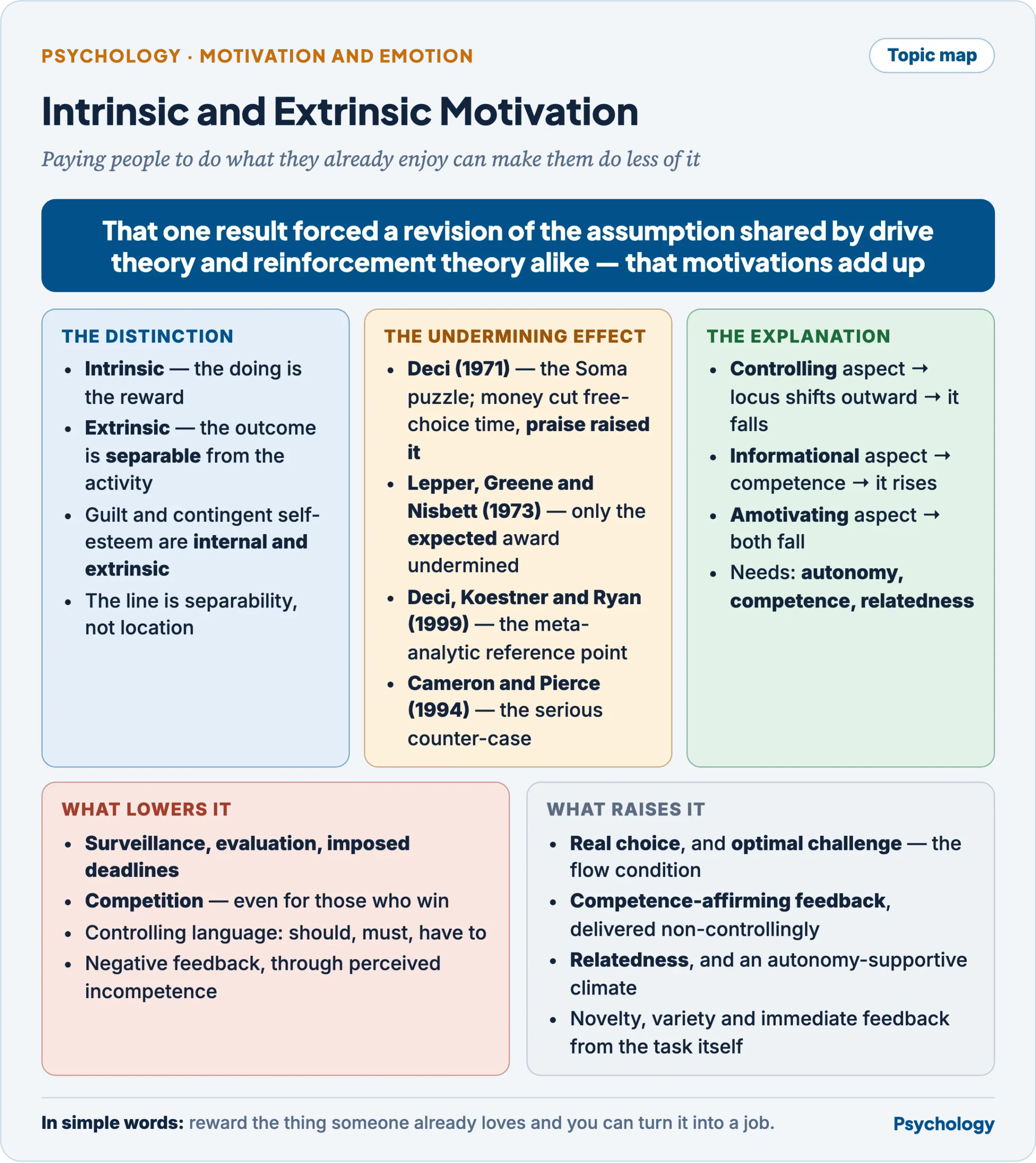
The distinction, stated precisely
- Intrinsic motivation — the activity is performed because it is inherently interesting or enjoyable, so the reward is the doing. Its markers are spontaneous engagement when no consequence is at stake, absorption, and persistence without supervision.
- Extrinsic motivation — the activity is performed for a separable outcome: pay, grades, approval, avoidance of punishment.
- Not internal against external. This is the point most often got wrong. Motivation driven by guilt, by contingent self-esteem or by the wish to avoid shame is internal to the person and is nonetheless extrinsic, because the activity is still a means to something else. The dividing line is whether the outcome is separable from the activity, not where it is located.
- Not reward against no-reward. An activity can be intrinsically motivated and also paid; the question is whether the payment has changed why the person is doing it.
- Three cases that fix the distinction. A student who reads history outside the syllabus because the period interests them is intrinsically motivated; the same student revising it for an examination is extrinsically motivated, on an identical activity. A musician who practises because playing well absorbs them differs from one practising to avoid a teacher’s displeasure — the second is extrinsic although nobody is watching, because the activity is a means to avoiding shame. A salaried engineer may still be intrinsically motivated by the problems; the pay undermines only when it becomes the reason for solving them.
- Not additive. The expectation of a drive-theoretic account is that adding an extrinsic incentive to an intrinsically motivated activity raises total motivation. It frequently does the opposite.
The undermining effect
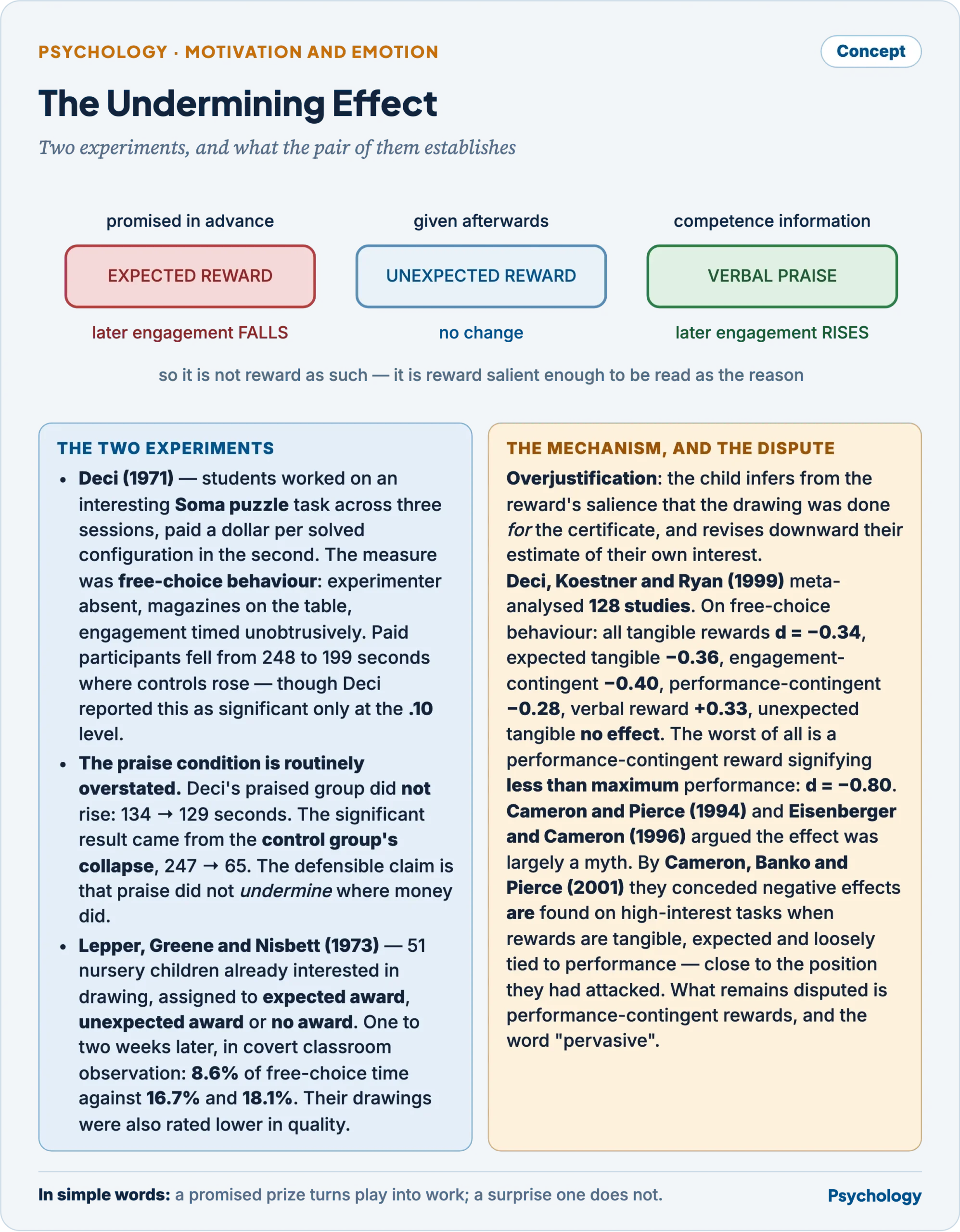
- Deci (1971) ran three studies, not the one usually described. In the first, students worked on an interesting Soma puzzle task across three sessions, paid a dollar per configuration solved in the second only. The measure was free-choice behaviour: the experimenter left on a pretext, magazines lay on the table, and engagement was timed unobtrusively for eight minutes. Paid participants fell from 248 to 199 seconds between the first and third sessions while controls rose — but Deci reported this as significant only at the .10 level and said so plainly, adding that further evidence was needed. His field experiment is the strongest result in the paper and is almost always omitted: headline writers on a college newspaper, paid per headline, worked significantly more slowly once payment stopped, an effect still present the following semester.
- The praise condition is routinely overstated. In Deci’s third study the reward was verbal praise rather than money, and the praised group’s free-choice time did not rise — it fell slightly, from 134 to 129 seconds. The significant result was produced by the control group’s collapse, from 247 seconds to 65. Deci noticed this himself and re-analysed controlling for initial score, which reduced the effect to the .10 level. The defensible statement is that praise did not undermine where money did, not that praise raised intrinsic motivation.
- Lepper, Greene and Nisbett (1973) tested the claim on 51 nursery school children already interested in drawing with marker pens, in three conditions: an expected award (promised a “Good Player” certificate and given it), an unexpected award (no promise, certificate afterwards) and no award. Observed covertly in the classroom one to two weeks later, the expected-award children spent 8.6 per cent of free-choice time drawing, against 16.7 for no-award and 18.1 for unexpected award; only the expected-award group fell from its own baseline. Blind judges also rated their drawings lower in quality.
- The term and the idea are not the same thing. That paper named the overjustification hypothesis — the child infers from the reward’s salience that the drawing was done for the certificate, and revises their estimate of their own interest downward — but explicitly credited the idea to deCharms (1968) and Deci (1971) among others, giving Deci priority for the first intentional test.
- What the pair establish. The effect is not about reward as such. It is about reward that is expected, and salient enough to be read as the reason for the behaviour, on a task that was already interesting.
- The scale of the evidence. Deci, Koestner and Ryan (1999) meta-analysed 128 studies. On free-choice behaviour, all tangible rewards undermined at d = −0.34; expected tangible rewards at −0.36; rewards contingent on engaging in the task at −0.40 and on completing it at −0.36; performance-contingent rewards at −0.28; while verbal reward and positive feedback enhanced at +0.33. Unexpected tangible rewards had no effect at all.
- Two details worth more than the headline. The single most damaging contingency is a performance-contingent reward signifying less than maximum performance — one that tells the person they did not do well enough — at d = −0.80, which the authors call by far the most detrimental type and note is common in applied settings. And praise enhanced free-choice motivation for college students but not for children, which is a caution against the standard classroom advice.
- A limit the meta-analysis itself reports: on self-report measures of interest rather than free-choice behaviour, the effects are much weaker and for several categories absent — all rewards together produce no effect on reported interest. The undermining effect is substantially a behavioural finding.
- The counter-case, which was serious. Cameron and Pierce (1994), meta-analysing 96 experiments, concluded that reward does not generally reduce intrinsic motivation, that negative effects occur only under easily avoided conditions, and that cognitive evaluation theory should be abandoned; Eisenberger and Cameron (1996) restated this for a general readership as the claim that the undermining effect is largely a myth. Deci and colleagues replied that the analysis had aggregated dull tasks with interesting ones, where there is no intrinsic motivation to undermine, used inappropriate control groups — including a study in which every group was paid, so there was no unrewarded control — and misclassified contingencies.
- Where it settled. Cameron, Banko and Pierce (2001) conceded that negative effects are found on high-interest tasks when rewards are tangible, expected and loosely tied to performance, that verbal rewards produce positive effects, and that rewards for low-interest tasks enhance motivation — while maintaining that the effects are not pervasive. That is close to the position they had been arguing against, and what remains in dispute is performance-contingent rewards and the word “pervasive”.
- Neural evidence. Murayama and colleagues (2010) induced the effect inside a scanner: participants paid per successful trial on a stopwatch task later played it significantly less in an unpaid free-choice period. The anterior striatum, which responded to success feedback in both groups at first, dropped to non-significance in the rewarded group in the second session while the control group’s response was sustained; the right lateral prefrontal cortex showed the same pattern at the task cue, and the neural index predicted the behavioural decline.
Cognitive evaluation theory: why rewards backfire, and when they do not
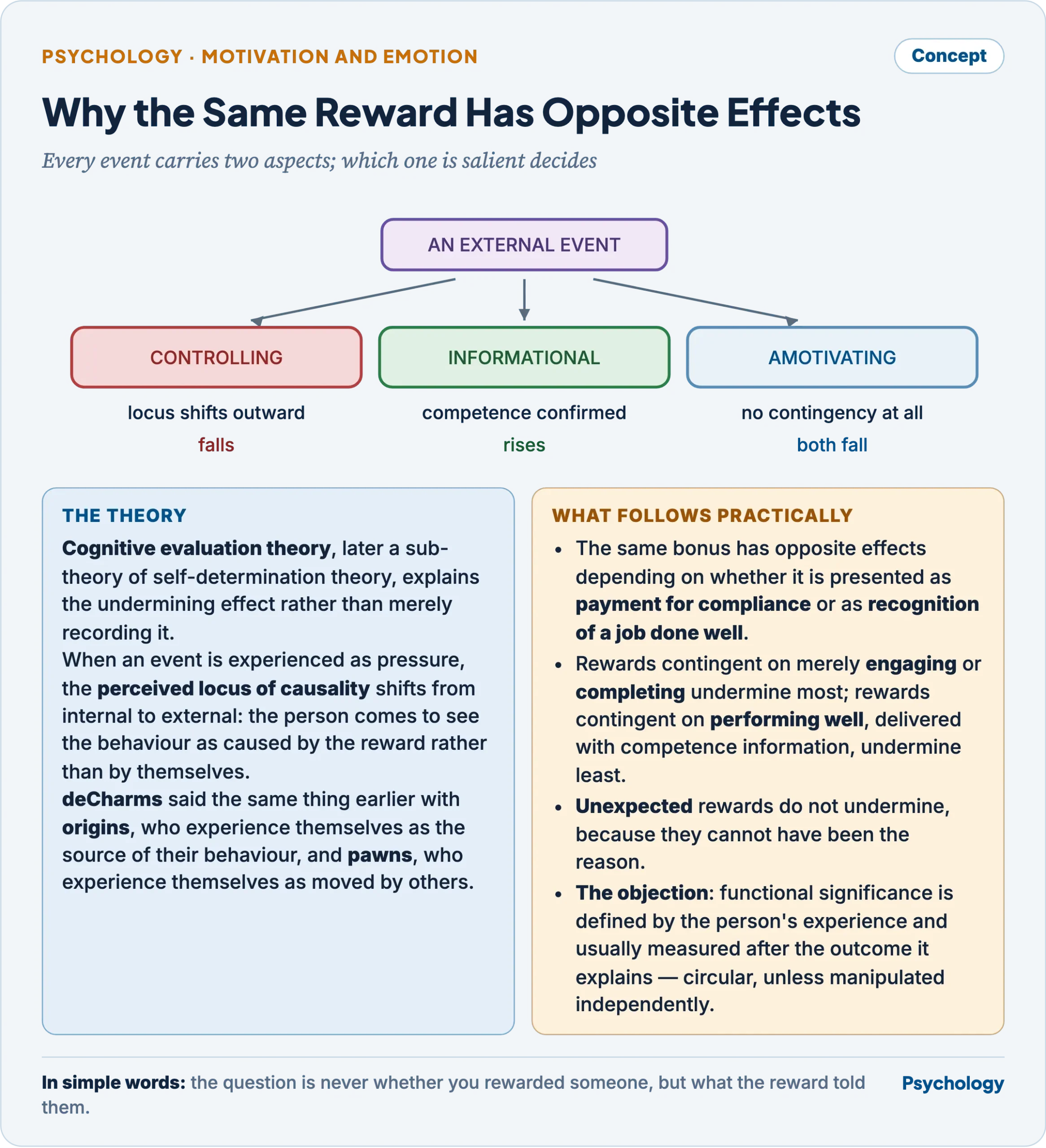
Cognitive evaluation theory (Deci, 1975), later the first of self-determination theory’s mini-theories, explains the effect rather than merely recording it. It is stated as a set of formal propositions — three concerning external events, extended by further propositions on interpersonal climates and intrapersonal events. The first two make intrinsic motivation a function of the perceived locus of causality and of perceived competence. The third is the operative one: every external event carries three potential aspects, and whichever is most salient to the person determines its effect.
- The controlling aspect. When an event is experienced as pressure to behave in a particular way, the perceived locus of causality shifts from internal to external — the person comes to see the behaviour as caused by the reward rather than by themselves — and intrinsic motivation falls. deCharms‘s distinction between origins, who experience themselves as the source of their behaviour, and pawns, who experience themselves as moved by others, is the same idea stated earlier.
- The informational aspect. When an event conveys competence — that one has done well — and does so in a context that supports autonomy, intrinsic motivation rises. This is why verbal praise usually enhances it.
- The amotivating aspect. When an event conveys incompetence or that outcomes are not contingent on one’s actions at all, it undermines both kinds of motivation.
- The practical prediction. A reward undermines to the extent that it is experienced as controlling, and supports to the extent that it is experienced as informational. So the same bonus can have opposite effects depending on whether it is presented as payment for compliance or as recognition of a job done well.
- The contingency matters. Rewards contingent merely on engaging in a task, or on completing it, are experienced as controlling and undermine most. Rewards contingent on performing well, delivered with competence information, undermine less and can enhance. Unexpected rewards do not undermine, because they cannot have been the reason for the behaviour.
- The objection. The theory’s central variable — the perceived functional significance of an event — is defined by the person’s experience and is usually measured after the outcome it is meant to explain, so it is open to the charge of circularity unless functional significance is manipulated independently. Much of the evidence comes from short laboratory tasks with university students and nursery children, and the external validity to long-term paid work, where the alternative to the reward is not doing the job at all, is assumed rather than shown.
Self-determination theory and the continuum of regulation
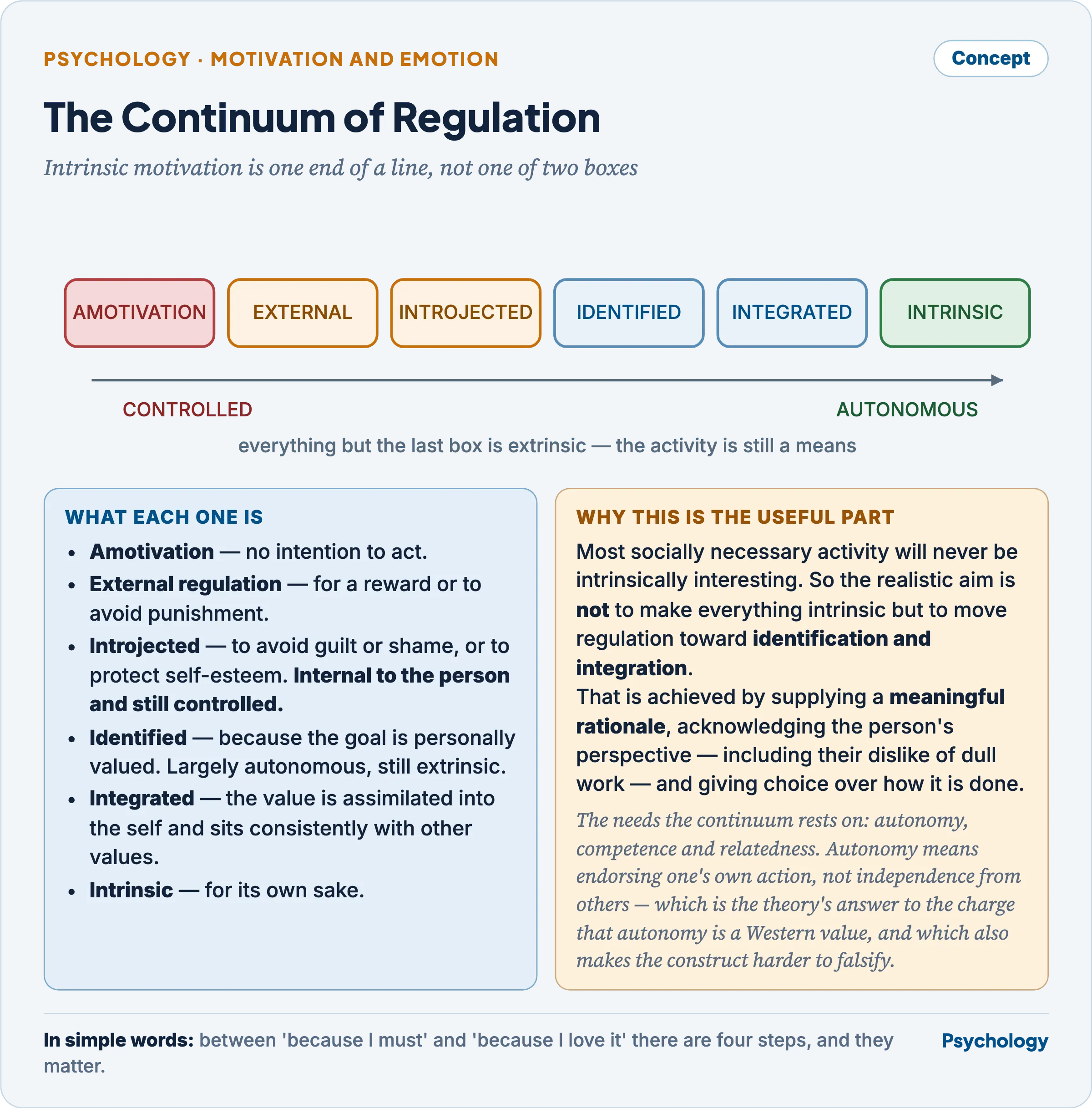
Deci and Ryan‘s broader framework makes intrinsic motivation one end of a continuum rather than one of two categories.
- Three basic psychological needs whose satisfaction is required for intrinsic motivation and for well-being: autonomy, the experience of being the author of one’s actions; competence, the experience of effectance and mastery; and relatedness, the experience of connection with others. Autonomy is the one that does the explanatory work in the undermining literature.
- The regulatory continuum, from least to most self-determined, which is the theory’s most useful contribution:
- Amotivation — no intention to act.
- External regulation — behaviour performed to obtain a reward or avoid a punishment. Fully extrinsic.
- Introjected regulation — performed to avoid guilt or shame or to protect self-esteem. Internal to the person, still controlled.
- Identified regulation — performed because its goal is personally valued. Largely autonomous, still extrinsic, since the activity remains a means.
- Integrated regulation — the value is assimilated into the self and is consistent with other values. The most autonomous form of extrinsic motivation.
- Intrinsic motivation — performed for its own sake.
- The nuance most often got wrong. Fully internalised extrinsic motivation does not become intrinsic motivation. Integrated regulation remains the most autonomous form of extrinsic motivation, because the activity is still done for its personal importance rather than for its own sake — intrinsic motivation rests on being interested in the activity, integrated regulation on believing it matters.
- Cognitive evaluation theory and organismic integration theory are two of six mini-theories making up self-determination theory, alongside those covering causality orientations, basic needs, goal contents and relationships.
- Why the continuum matters — Most socially necessary activity is never going to be intrinsically interesting, so the realistic goal is not to make everything intrinsic but to move regulation along the continuum toward identification and integration — which is achieved by supplying a meaningful rationale, acknowledging the person’s perspective, and offering choice about how the work is done.
- The objection. The three needs are proposed as universal, and the autonomy need in particular is contested cross-culturally: critics argue that what the theory calls autonomy is a culturally specific value, and that in collectivist settings choices made by trusted others can be experienced as supportive rather than controlling. The theory’s reply is that autonomy means endorsement of one’s action rather than independence from others, and that a choice made out of loyalty can be fully autonomous in that sense — a reply which is coherent and which makes the construct harder to falsify.
Factors influencing intrinsic motivation
- Choice. Zuckerman and colleagues (1978) used yoked pairs: one member chose which puzzles to work on and how long to spend, the other was assigned the same puzzles and times. The choosers were more intrinsically motivated, with nothing else differing. Patall, Cooper and Robinson (2008), meta-analysing 41 studies, put the effect of choice on intrinsic motivation at about d = 0.30, with its largest effect on perceived competence (d = 0.59) — though correction for publication bias shrinks the main effect by roughly a third.
- Optimal challenge. Danner and Lonky (1981) gave children free choice among learning activities pitched at different levels of difficulty: all three ability groups spent the most time on the activities just beyond their own current level, and rated those as the most interesting. Csikszentmihalyi‘s flow — the absorbed state in which action and awareness merge, self-consciousness drops and time perception distorts — rests on the same balance. The mature statement of the condition is stricter than the familiar one: flow requires not merely that challenge and skill match, but that both are high relative to the person’s own average, which is what distinguishes flow from apathy.
- Positive, competence-affirming feedback raises intrinsic motivation, provided it is not delivered controllingly — “you did very well, as you should” reinstates the controlling aspect and cancels the benefit. Vallerand and Reid (1984) gave participants positive, negative or no feedback on a balancing task and found positive feedback raising and negative feedback lowering both intrinsic motivation and perceived competence, with perceived competence mediating the effect.
- Negative feedback lowers it by undermining perceived competence.
- Surveillance lowers it. Lepper and Greene (1975) crossed expected against unexpected reward with being told one’s performance would be monitored by camera, and found two independent main effects: expected reward reduced later interest, and so did surveillance on its own.
- Evaluation and deadlines lower it. Amabile (1979) found that women who expected their collages to be externally evaluated produced work judged less creative by expert raters, and later work confirmed evaluation expectation as the strong and consistent effect. Imposed deadlines are classified with the controlling events on the same basis.
- Internally controlling events do the same work from inside. Plant and Ryan (1985) found self-awareness manipulations — a mirror, a video camera — and induced ego-involvement all lowering intrinsic motivation, which extends the theory from what others do to a person to what the person does to themselves.
- Competition, with an important qualifier. Deci and colleagues (1981) found that instructing participants to beat another person lowered intrinsic motivation relative to simply working quickly. But Reeve and Deci (1996) separated the elements: winning raised intrinsic motivation by raising perceived competence, while a pressured interpersonal context lowered it by reducing perceived self-determination. Competition is therefore not uniformly undermining — the pressure in it is.
- Threats, directives and controlling language lower it; “should”, “must” and “have to” shift the perceived locus of causality outward.
- Autonomy-supportive climates. Teachers, managers and parents who take the other’s perspective, acknowledge negative feelings about dull work and give a rationale produce more autonomous motivation, better conceptual learning and better persistence than those who direct and pressure.
- Relatedness matters more than it is given credit for: children engage more with activities modelled by adults to whom they feel securely connected.
- Task characteristics. Novelty, variety, complexity, and the presence of clear immediate feedback from the activity itself all raise intrinsic motivation.
Which is more powerful?
The question invites a single answer and the evidence supports a conditional one.
- Extrinsic motivation is more powerful for getting a specific behaviour performed now, especially a dull, well-defined, algorithmic one. Reward contingencies reliably raise output on such tasks, which is why incentive systems work in routine production.
- Intrinsic motivation is more powerful for everything depending on persistence, quality, flexibility and creativity. Cerasoli, Nicklin and Ford (2014), meta-analysing 183 samples and over 212,000 people, found intrinsic motivation predicting performance at ρ = .26, and established the division of labour precisely: incentives better predict the quantity of work and intrinsic motivation better predicts its quality. Their conclusion is that the two are “not necessarily antagonistic and are best considered simultaneously”.
- The cost of the external kind is measurable. Howard and colleagues (2021), across 344 samples and more than 223,000 students, found external regulation unrelated to performance or persistence and associated with reduced well-being — which is the strongest modern evidence for the practical claim.
- Extrinsic motivation has a built-in fragility: the behaviour is contingent on the reward, so it stops when the reward stops, and the reward must usually escalate to retain its effect.
- Intrinsic motivation has a built-in limitation: it cannot be commanded, it is restricted to activities a person already finds interesting, and most necessary work is not of that kind.
- The defensible position is that intrinsic motivation is the more powerful where it is available, extrinsic motivation is indispensable where it is not, and the practical task is to use extrinsic contingencies in ways that are informational rather than controlling, and to move regulation of necessary work toward identification rather than attempting to make it intrinsic.
The Indian context
- The clearest Indian policy statement of the undermining argument is older than most of the research supporting it. The National Curriculum Framework, 2005 states that “competition is motivating, but it is an extrinsic rather than intrinsic form of motivation”, notes that it is “much easier to establish and to manipulate, and therefore frequently resorted to by teachers and school systems”, observes that schools begin ranking children as early as the pre-primary years, and concludes that “such a competitive drive has several negative side effects on learning”, since “superficial learning is sufficient to create and maintain impressions” and “over time students lose their ability to take initiative”. The same document asserts that “all children are naturally motivated to learn”.
- The later policy documents dropped the vocabulary. The National Education Policy, 2020 never uses the word “intrinsic”, and its uses of “motivation” refer to teachers rather than students. The learner-side commitment is carried by adjacent language instead — the shift “away from the culture of rote learning”, the reduction of the “high stakes” aspect of board examinations, and flexibility for learners to “choose their learning trajectories”.
- A cross-cultural qualification on choice. Iyengar and Lepper (1999) found Anglo-American children most intrinsically motivated when they chose for themselves, while Asian-American children were most motivated when a trusted in-group member — their mother — chose for them. The result is often reported as showing that choice demotivates in collectivist settings, which it does not: personal choice still beat a stranger’s choice for both groups. What differs is that a trusted other’s choice could beat personal choice. The study’s effect sizes were extreme outliers in the choice literature, and the replication record is partial, so it is best cited as a live question rather than a settled difference.
- The gap. There is no body of Indian experimental work on the undermining effect, and the Indian evidence is policy statement and survey research rather than controlled study — which matters, because the autonomy premise is exactly the part of the theory a collectivist setting would test.
Criticisms and limitations
- Generalisation from the laboratory is the standing weakness. The classic demonstrations use short tasks, small rewards and free-choice measures taken minutes or weeks later; real employment involves large rewards, long horizons and no option of walking away.
- The measure drives the result: undermining appears clearly on free-choice persistence and much less on self-reported interest, and the 1990s dispute was substantially about which outcome counts.
- Inclusion rules in the competing meta-analyses were set by investigators with declared theoretical commitments on both sides.
- The distinction is not always clean. Grades, pay and recognition carry competence information as well as control, so real rewards are mixtures whose net effect the theory does not predict well.
- Cultural scope. Almost all of the evidence comes from Western educational and laboratory settings, and the universality of the autonomy need remains contested.
- Amotivation gets little treatment, and it is the practical problem in much of education: the student who is neither interested nor responsive to incentives is the hardest case, and the least developed part of the theory.
Previous Year Questions
- 2024Citing relevant examples, explain how intrinsic and extrinsic motivation differ. Referring to relevant studies, describe the factors influencing intrinsic motivation.
- 2020Discuss the reasons why rewards may backfire and not produce their intended results for behaviour.
- 2015Distinguish between extrinsic and intrinsic motivation. Which one is more powerful and why?
- 2013What is intrinsic motivation? Why it gets reduced if the person gets external reward for undertaking a task that he or she loves?
- 2012Evaluate various factors which influence intrinsic motivation.
- 2011What is the difference between intrinsic and extrinsic motivation? Explain with the help of examples.
- 2006Present a critical appraisal of the cognitive evaluation theory of intrinsic motivation and describe those studies that bring out that achievement responsibility, interest and competence are independent of extrinsic motivators.