

Effects of motivation and emotion on behaviour.
Official Syllabus: Paper I · Unit 9 Motivation and Emotion
“Emotions are transient, bio-psycho-social reactions to events that have consequences for our welfare and potentially require immediate action.”
— Matsumoto and Hwang (2011)
Motivation and emotion are inferred from behaviour, so the claim that they affect behaviour risks being empty. It is not, because the effects are specific and separable: motivation and emotion change what is attended to, what is remembered, what is chosen, how hard and how long a person works, and how well they perform — and each of those has been measured independently of the state that produced it.
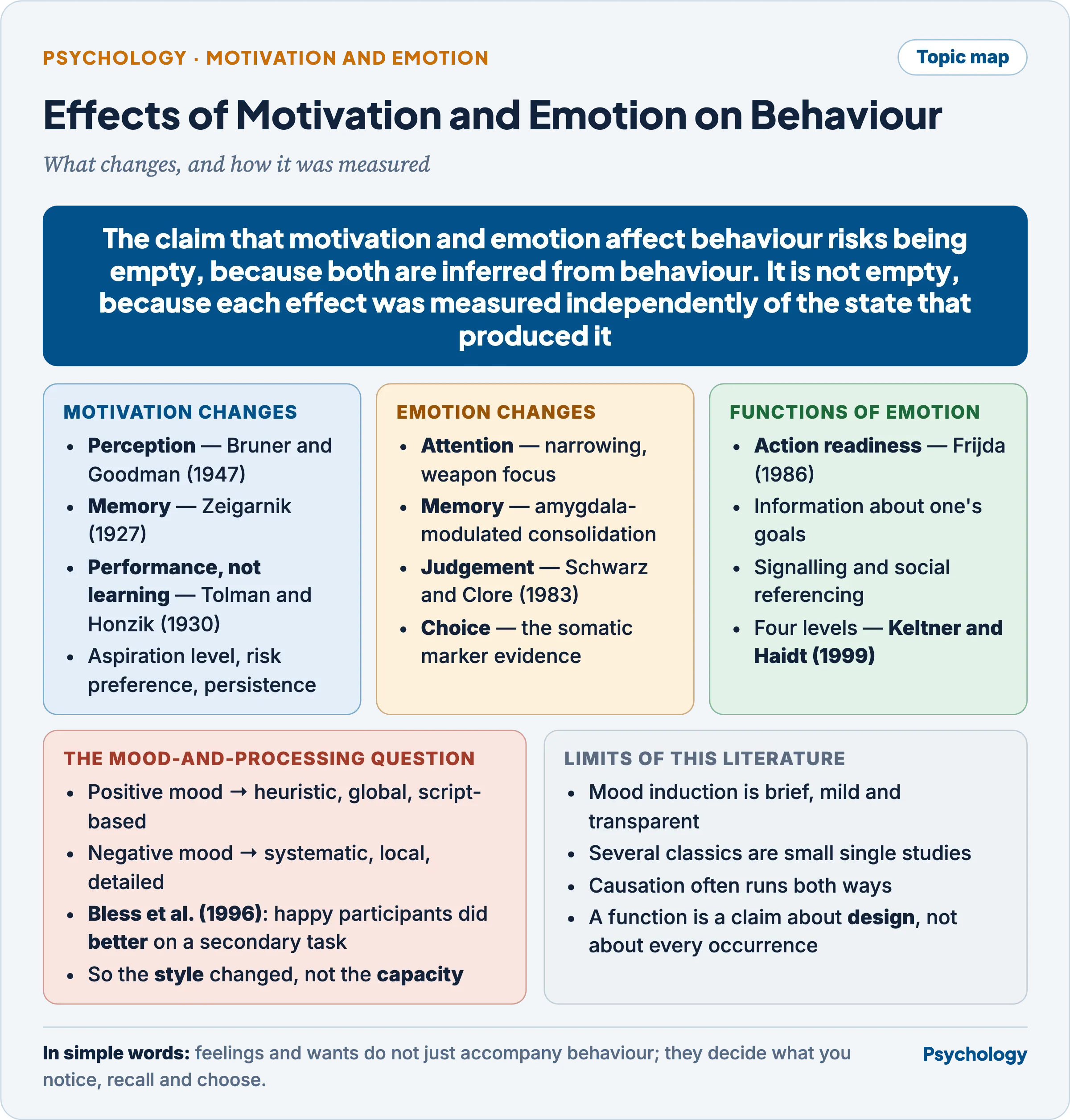
The functions of emotions
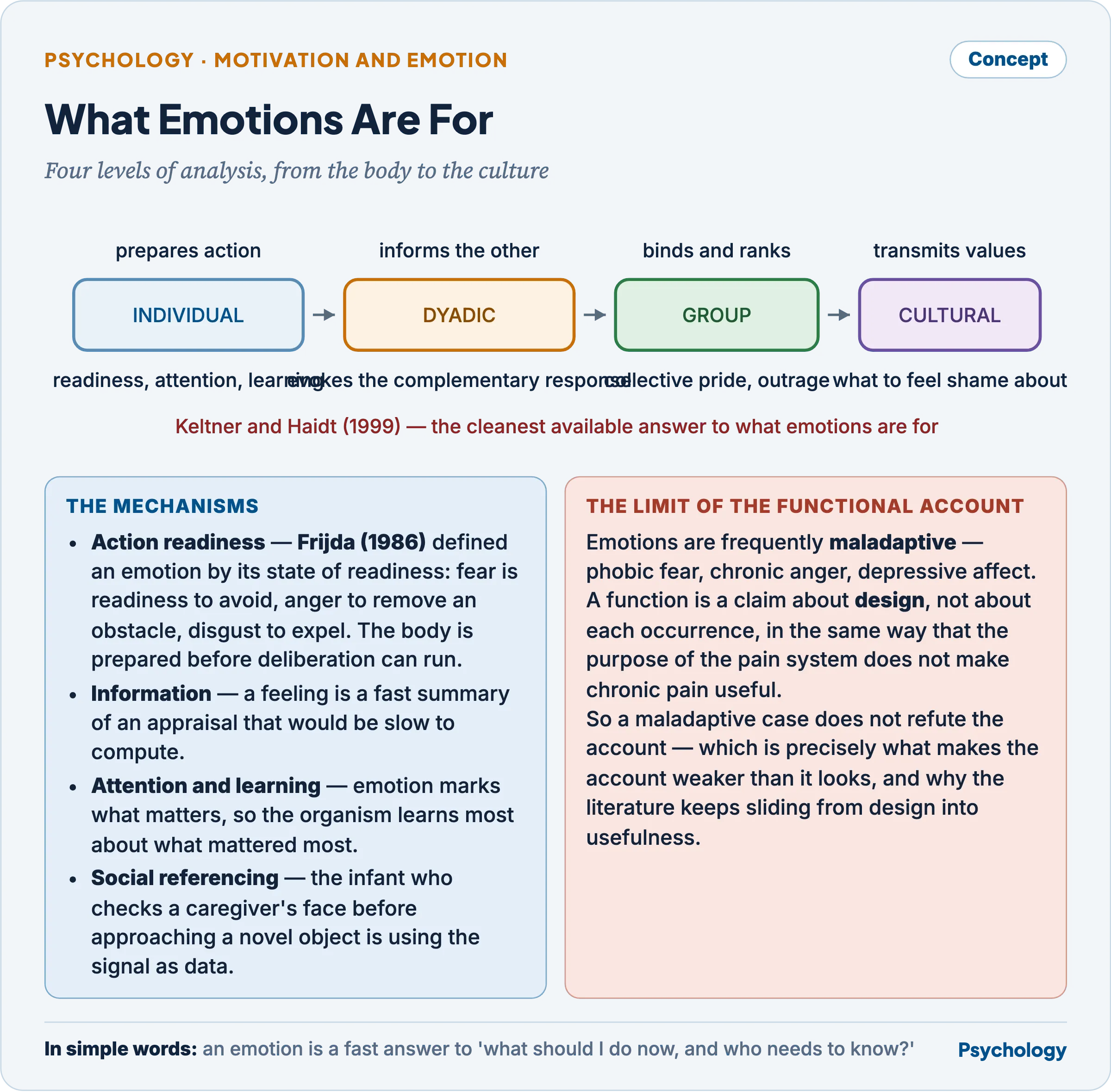
Emotions are not by-products. Keltner and Haidt (1999) organised their functions at four levels of analysis, and the scheme is the cleanest available answer to what emotions are for.
- Intrapersonal — action readiness. Frijda (1986) defined an emotion by its state of action readiness: fear is readiness to avoid, anger readiness to remove an obstacle, disgust readiness to expel. The emotion prepares the body and biases the behavioural repertoire before deliberation can.
- Intrapersonal — information. Emotions tell the organism how things stand with its goals. A feeling is a fast summary of an appraisal that would be slow to compute.
- Intrapersonal — attention and learning. Emotion marks what matters, directing attention to it and strengthening its memory trace, so the organism learns most about what mattered most.
- Interpersonal — signalling. Expressions inform others of one’s state and probable action, which is what allows cooperation and deterrence without speech. Social referencing — the infant who checks a caregiver’s face before approaching a novel object — shows the signal being used as data.
- Interpersonal — evoking complementary responses. Distress evokes care, anger evokes submission or counter-anger, embarrassment evokes forgiveness. Emotions are moves in an interaction rather than private states.
- Group level. Emotions define group boundaries and sustain hierarchy and cooperation: collective grief, shared pride, moral outrage at a norm violation.
- Cultural level. Emotions transmit and enforce cultural values, since what a culture teaches people to feel shame or pride about is how it reproduces itself.
- The functional claim has limits. Emotions are also frequently maladaptive — phobic fear, chronic anger, depressive affect — and the functionalist account explains their design rather than their every occurrence, in the same way that the pain system’s purpose does not make chronic pain useful.
Effects of motivation on behaviour
- Energising and directing. Motivation raises general activity level and selects among available actions. These separate empirically: deprivation increases activity in animals that have no goal object available, which is energising with no direction.
- Attention and perception. Motivated states bias what is perceived. Bruner and Goodman (1947) found children from poorer families overestimated the size of coins more than better-off children did, with the effect largest for the most valuable coins — value and need acting as organising factors in perception. Perceptual sensitivity to need-relevant stimuli rises generally, which is why the hungry notice food words faster.
- Memory. Zeigarnik (1927) found that tasks interrupted before completion were recalled better than completed ones, the standard interpretation being that an unsatisfied intention remains active. Motivation also distorts: material inconsistent with a wanted conclusion is scrutinised harder and recalled worse.
- Learning against performance — the distinction that matters. Tolman and Honzik (1930) showed rats that had explored a maze without reward ran it efficiently as soon as reward was introduced, so the learning had occurred while the motivation was absent. Motivation therefore affects performance, not necessarily acquisition, and a failure to perform is not evidence of a failure to learn. This is the single most useful distinction in the applied literature on motivation, because it relocates many apparent learning problems as motivational ones.
- Level of aspiration. Lewin and colleagues showed that the goal a person sets after a trial shifts with success and failure, typically upward after success and downward after failure, and that the pattern is itself a stable individual difference.
- Choice of difficulty. Atkinson‘s model predicts that those high in the achievement motive and low in fear of failure prefer tasks of intermediate difficulty, where the information gained about one’s own competence is greatest, while those high in fear of failure prefer very easy or very hard tasks. The prediction is confirmed in risk-taking tasks.
- Persistence. The clearest behavioural signature of motivation is resumption after interruption and continuation after failure. Persistence depends more on attributions and self-efficacy beliefs than on the strength of the original need.
- Performance level. Motivational intensity and performance are related by the inverted-U of arousal, with the optimum lower for complex tasks. Excess motivation narrows attention and consumes working memory.
- Frustration. A blocked motive produces aggression, regression, fixation or withdrawal; the frustration–aggression link is real but conditional on cues and on attributions of intent rather than automatic.
Effects of emotion on behaviour
- Attention. Emotion narrows attention onto the emotion-eliciting object. Weapon focus is the practical case: witnesses to an armed crime remember the weapon well and the face poorly, which is attentional narrowing with a forensic cost.
- Memory. Emotional arousal enhances memory for the gist of the arousing event while impairing memory for peripheral detail. The mechanism is modulation of consolidation by the amygdala through adrenergic activity, which Cahill and McGaugh established by showing that beta-blockade abolishes the emotional memory advantage without affecting memory for neutral material.
- Judgement. Schwarz and Clore (1983) telephoned participants on sunny and rainy days and found reported life satisfaction tracked the weather — but the effect disappeared when the call began with a remark about the weather, because participants then attributed the feeling to its real cause. Feelings are used as information about the judged object, and only when their source is misattributed.
- Decision making. The somatic marker hypothesis holds that bodily emotional signals mark options as good or bad and so narrow the choice set before reasoning begins. Bechara, Damasio and colleagues (1994, 1997) showed on the Iowa gambling task that healthy participants generated anticipatory skin-conductance responses to risky decks before they could state which decks were bad, while patients with ventromedial prefrontal damage failed to generate the signals and continued choosing badly despite describing the task correctly.
- Prosocial behaviour. Positive affect increases helping. Isen and Levin (1972) found that participants who had just found a dime in a phone booth were far more likely to help a passer-by who dropped papers.
- Emotion regulation changes the behavioural outcome. Gross (1998) distinguished antecedent-focused regulation, chiefly cognitive reappraisal, from response-focused regulation, chiefly expressive suppression. Reappraisal reduces the experience as well as the expression and carries no cognitive cost; suppression reduces expression only, leaves physiological arousal intact or raised, impairs memory for the event, and makes interaction partners uncomfortable. The two produce different consequences from the same emotion, which is why “controlling emotion” is not one skill.
- Performance under pressure. Anxiety consumes working memory and shifts attention to the self and to the mechanics of a skilled action. Beilock and Carr (2001) showed that choking under pressure is worst for those with the most working memory capacity on tasks that depend on it, because the resource their performance relies on is the one anxiety occupies.
- Health and long-term behaviour. Chronic negative affect alters health behaviour, adherence and immune and cardiovascular function; the behavioural pathway — sleep, substance use, diet, help-seeking — accounts for a substantial share of the effect.
Emotion and cognition: how feelings shape thoughts
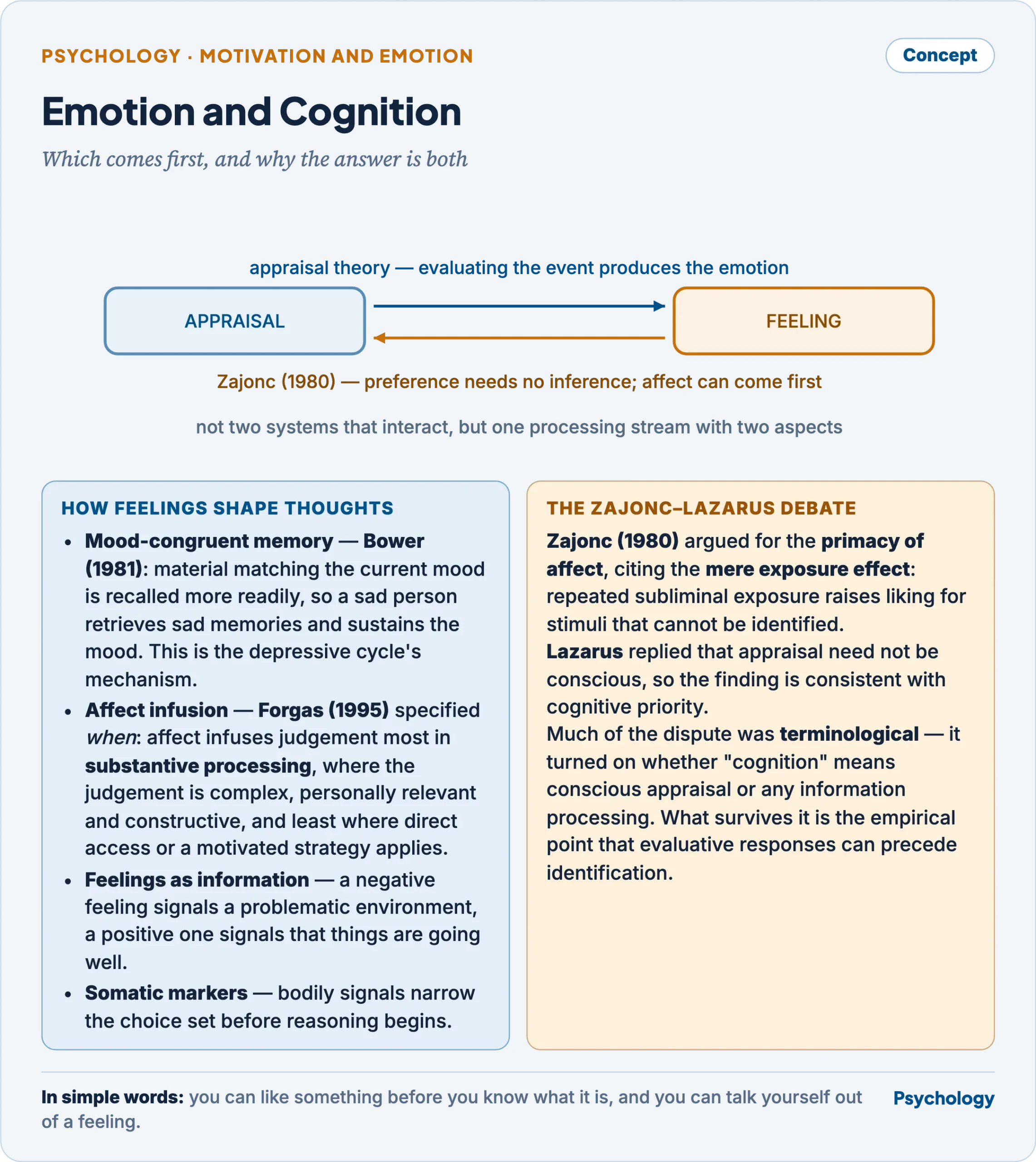
- Cognition can be prior. Appraisal theory makes emotion the output of an evaluation of the event’s significance for one’s goals, so a cognitive step precedes the feeling. Reappraising the event changes the emotion, which is the clinical basis of cognitive therapy.
- Affect can be prior. Zajonc (1980) argued for the primacy of affect: preferences form without recognition, as in the mere exposure effect, where repeated subliminal exposure raises liking for stimuli that cannot be identified. The resulting Zajonc–Lazarus debate turned on whether “cognition” means conscious appraisal or any information processing, and the dispute was partly terminological — but the empirical point stands that evaluative responses can precede identification.
- Mood-congruent memory. Bower (1981) showed that material matching the current mood is recalled more readily, so a sad person retrieves sad memories and thereby sustains the mood. This is the mechanism of the depressive cycle and one reason emotional states are self-perpetuating.
- Affect infusion. Forgas (1995) specified when feelings colour thought: affect infuses judgement most in substantive processing, where the judgement is complex, personally relevant and requires constructive thinking, and least where a direct access or motivated strategy applies. The model resolved a literature of inconsistent findings by making the degree of influence conditional on the processing strategy.
- Feelings as information. Emotions enter thought not only as content but as a cue about the situation: a negative feeling signals a problematic environment, a positive one signals that things are going well.
- The current position is that emotion and cognition are not two systems that interact but aspects of a single processing stream, since appraisal is cognitive, feeling is informational, and attention, memory and judgement are all modulated by affect at every stage.
Mood and the capacity to process information
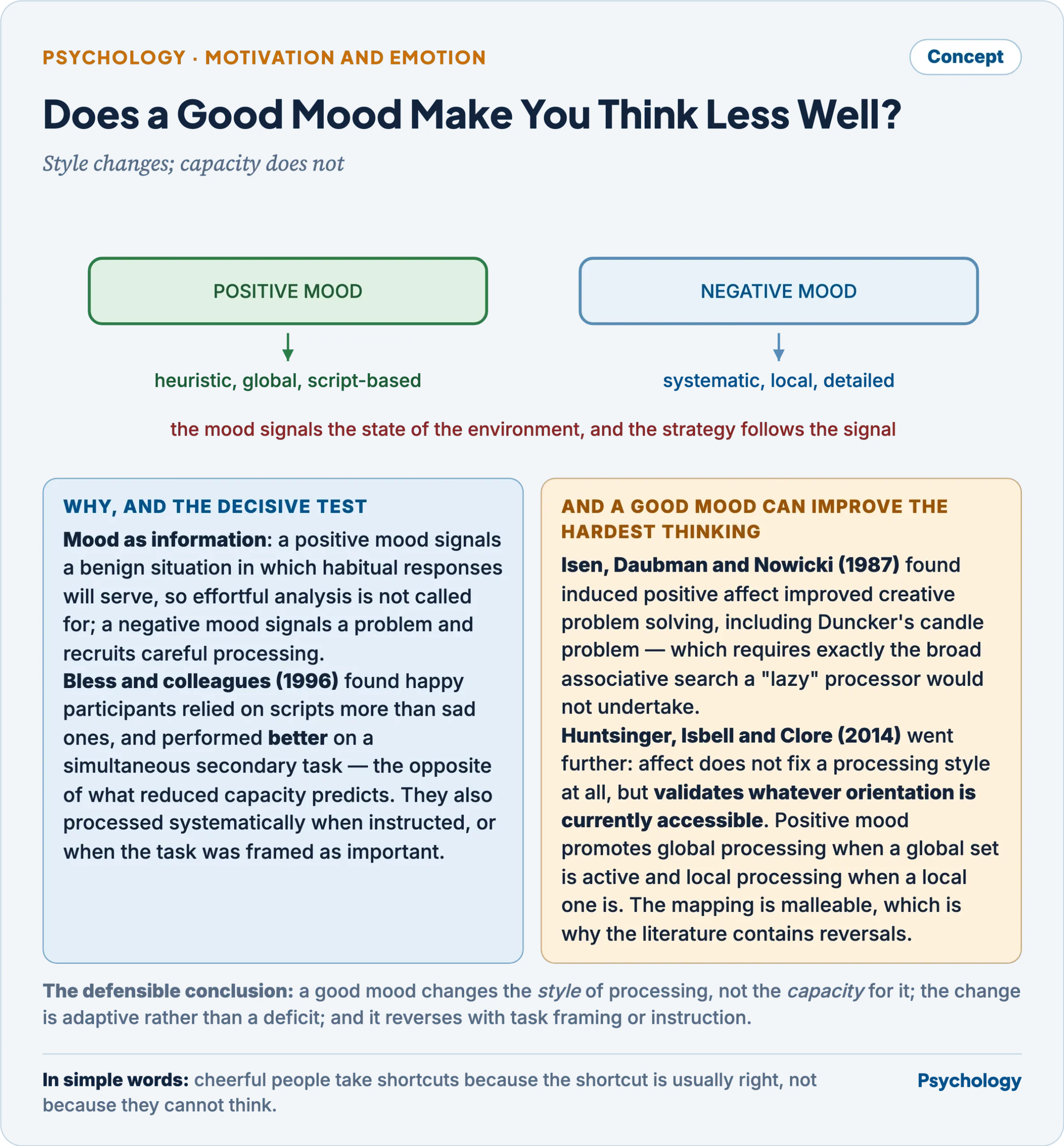
The familiar claim is that a good mood makes people lazy thinkers. The evidence supports something more specific and more interesting.
- What is found. People in a positive mood rely more on heuristics, stereotypes, schemas and general knowledge structures, and attend to the global rather than the local; those in a negative mood process more systematically and attend to detail. Positive mood increases susceptibility to persuasion by weak arguments and to script-based errors.
- Why. The mood-as-information account holds that affect signals the state of the environment. A positive mood signals that the situation is benign and that habitual responses will serve, so effortful analysis is not called for; a negative mood signals a problem and recruits careful processing. On this account the processing difference is a strategy selected by the mood, not a limit imposed by it.
- The decisive test. Bless and colleagues (1996) found that happy participants relied on scripts more than sad ones, yet performed better on a simultaneous secondary task — which is the opposite of what reduced capacity predicts. Happy participants also processed systematically when instructed to, or when the task was framed as important. Capacity was not reduced; the default strategy was different.
- Positive mood can improve the hardest thinking. Isen, Daubman and Nowicki (1987) found that induced positive affect improved performance on creative problem-solving tasks, including Duncker’s candle problem, which requires exactly the broad associative search that a “lazy” processor would not undertake.
- The qualification. Huntsinger, Isbell and Clore (2014) argued that affect does not fix a processing style at all: it validates whatever orientation is currently accessible, so positive mood promotes global processing when a global set is active and local processing when a local set is active. The mood-to-style mapping is therefore malleable rather than fixed, which explains why the literature contains reversals.
- The defensible conclusion is that a good mood changes the style of processing and not the capacity for it, that the change is adaptive rather than a deficit, and that it is reversible by task framing or instruction.
Criticisms and limitations
- Circularity remains the structural risk. If the motive is inferred from the behaviour and then used to explain it, nothing is added; the effects listed above count as evidence only because the state was induced or measured independently of the behaviour.
- Mood induction is weak and artificial. Film clips, music and gift bags produce brief, mild states in volunteers who often guess the purpose, and generalising from them to grief, terror or rage is an inference the designs do not support.
- Effect sizes and replication. Several classic demonstrations in this literature are small single studies, and the field’s replication record is uneven; the mood-and-processing findings have held up better than the mood-and-helping ones.
- Direction of causation is often ambiguous in the health and performance literatures, since behaviour changes affect as readily as affect changes behaviour.
- The functional account cannot be falsified by a maladaptive case, which makes it weaker than it appears: a function is a claim about design, and the literature frequently slides from that into claiming each occurrence is useful.
- Culture is under-represented. Most of the evidence on affect and judgement comes from Western undergraduate samples, and the few cross-cultural tests find that the direction of mood effects on processing is not constant.
Previous Year Questions
- 2026Explain the relationship between emotion and cognition. Examine how feelings shape our thoughts.
- 2018Do you think being in a good mood reduces your capacity to process incoming information? Examine in the light of research studies.
- 2011What are the functions of emotions?