

Creative thinking and fostering creativity.
Official Syllabus: Paper I · Unit 8 Thinking and Problem Solving
“Creativity and intelligence overlap at the lower end of the ability range and come apart at the upper.”
— the threshold hypothesis, which is the standing summary of a seventy-year literature
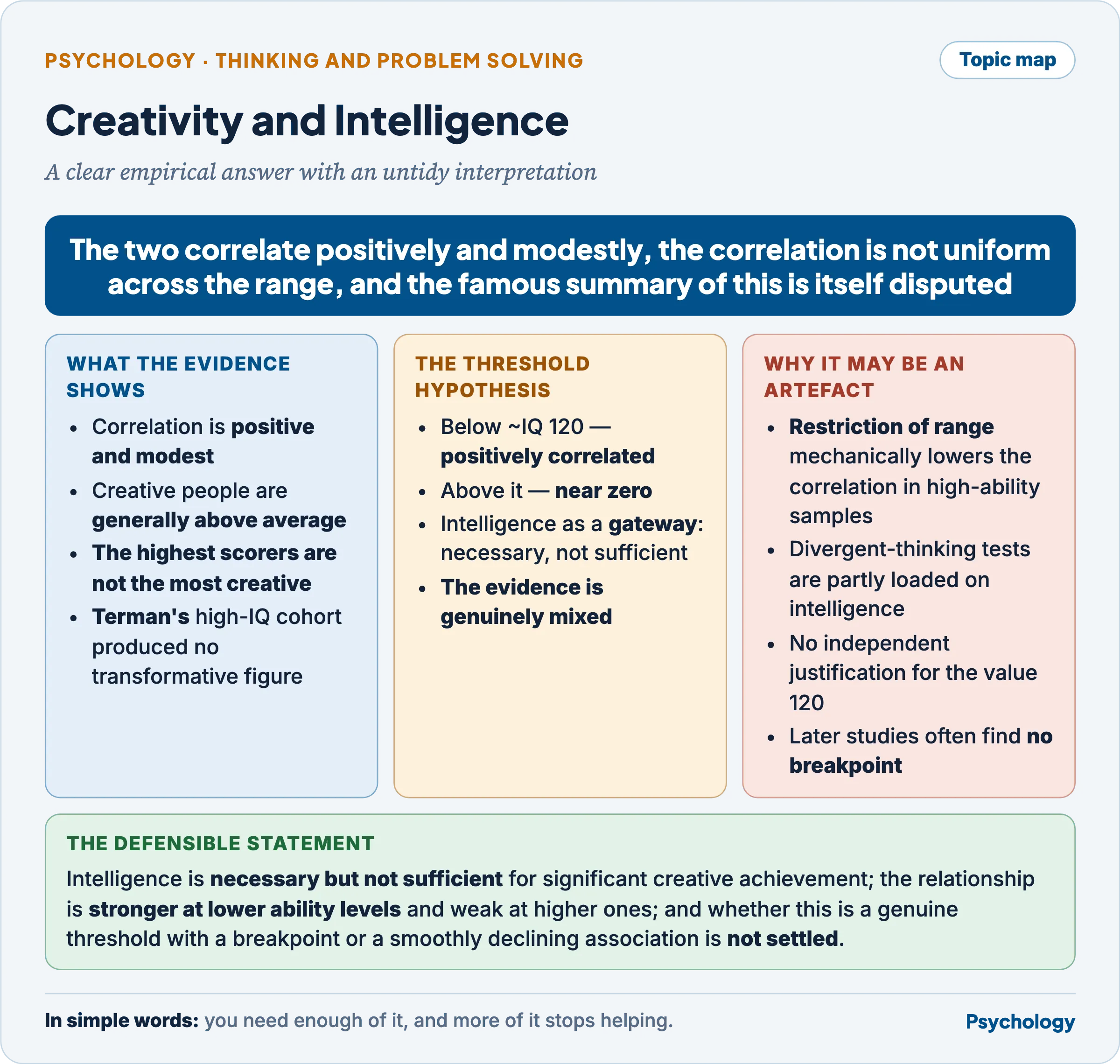
The question was opened by Guilford (1950), who pointed out that the intelligence tests then dominating psychology measured convergent thinking and therefore could not be measuring creativity, and it was given its classic empirical form by Getzels and Jackson (1962), who separated high-IQ from high-creativity schoolchildren and found the two groups were largely different people. The relationship between the two constructs is one of the oldest questions in differential psychology, and it has a clear empirical answer with an untidy theoretical interpretation. The two constructs correlate positively and modestly, the correlation is not uniform across the range, and the most quoted summary of this — the threshold hypothesis — is itself contested.
Why they were expected to be related, and why to differ
Grounds for expecting a relationship. Both involve knowledge, working memory and the manipulation of representations. Generating remote associations requires a large and well-organised store; evaluating which ideas are worth pursuing is analytic work; and no creative contribution to a demanding domain is made by someone who cannot master the domain.
Grounds for expecting a difference. Conventional intelligence tests measure convergent thinking — a single correct answer, reached by rule, under time pressure, scored for accuracy. Creativity requires divergent production — many answers, scored for variety and rarity — followed by evaluation. A test that rewards finding the one right answer quickly is a poor instrument for measuring the disposition to look for a different one.
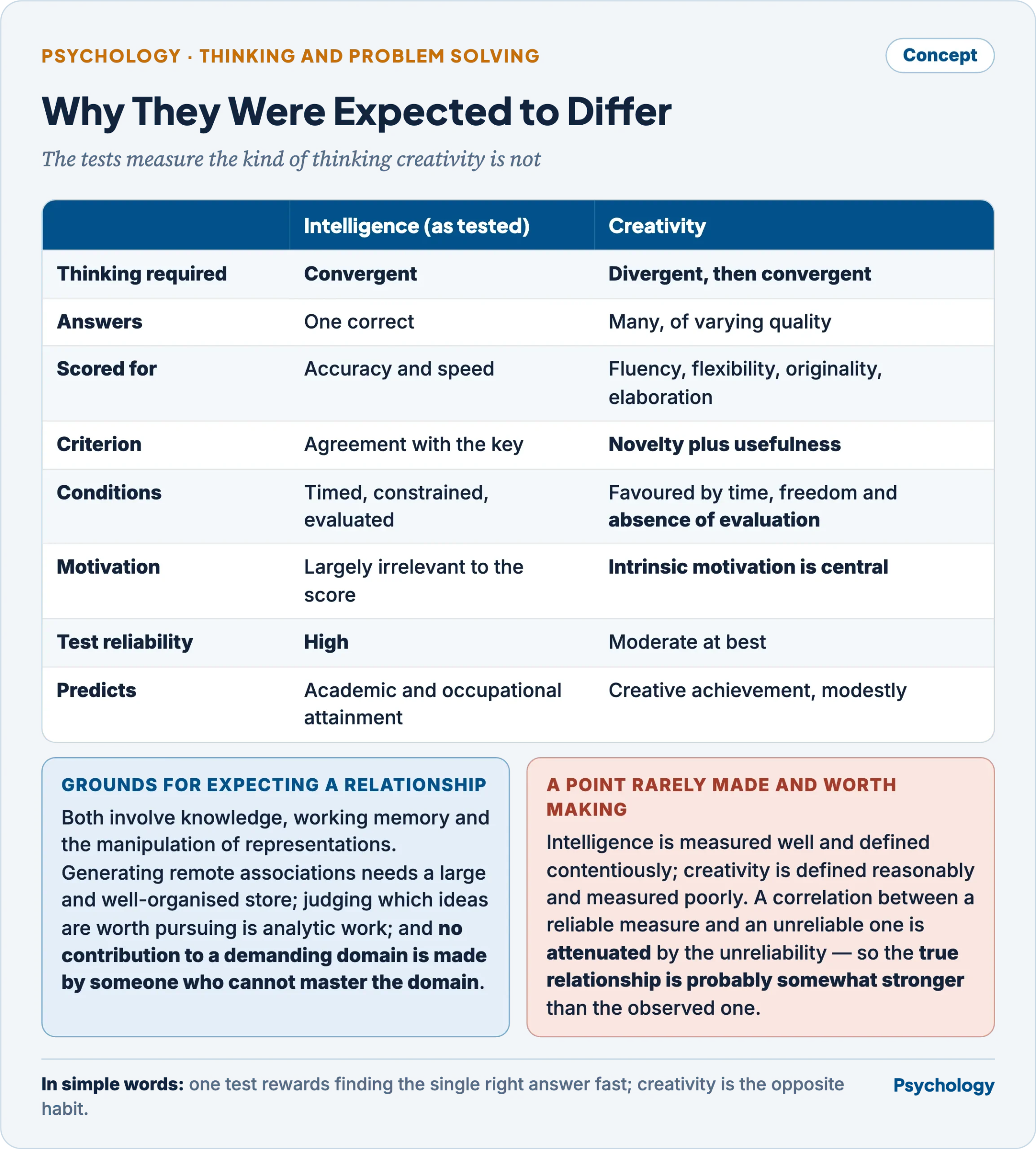
| Intelligence (as tested) | Creativity | |
|---|---|---|
| Thinking required | Convergent | Divergent, then convergent |
| Answers | One correct | Many, of varying quality |
| Scored for | Accuracy and speed | Fluency, flexibility, originality, elaboration |
| Criterion | Agreement with the key | Novelty plus usefulness |
| Conditions | Timed, constrained, evaluated | Favoured by time, freedom and absence of evaluation |
| Motivation | Largely irrelevant to the score | Intrinsic motivation is central |
| Test reliability | High | Moderate at best |
| Predicts | Academic and occupational attainment | Creative achievement, modestly |
What the evidence shows
- The correlation is positive and modest. Across many studies the association between psychometric intelligence and divergent-thinking scores falls in the low-to-moderate range — enough to establish that they are related, far too small for them to be the same thing.
- Creative people are generally of above-average intelligence. Studies of eminent and professionally creative individuals find few with below-average ability. A reasonable level of intelligence appears to be a necessary condition for significant creative achievement in a demanding domain.
- The highest scorers are not the most creative. Within high-ability groups, further increases in measured intelligence do not predict further increases in creative achievement. Terman’s longitudinal study of very high-IQ children is the standard case: the sample achieved conventional success at high rates and produced no figure of transformative creative eminence, which is the finding the question “creative people usually have high IQ scores but those with the highest IQ scores are not necessarily the most creative” is pointing at.
- Getzels and Jackson separated high-IQ and high-creativity groups of schoolchildren and found the high-creativity group achieved comparably in school while being rated less favourably by teachers — evidence both that the constructs separate and that institutions reward one of them.
- Divergent-thinking scores predict creative achievement only modestly, and considerably less well than past creative behaviour does.
The threshold hypothesis
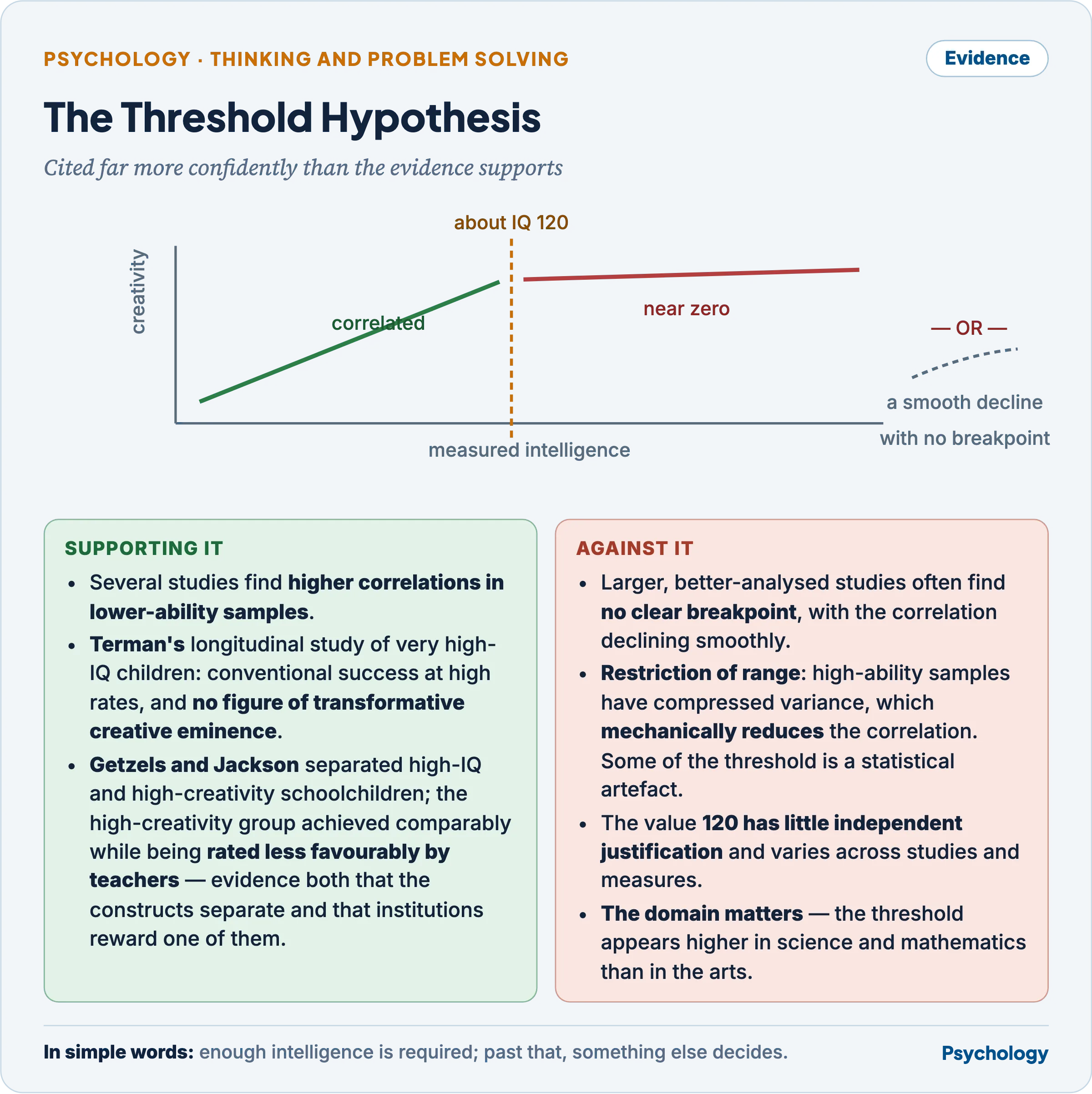
The hypothesis proposes that the relationship is non-linear.
- Below about IQ 120, intelligence and creativity are positively correlated: ability constrains creative production, and more of it helps.
- Above that threshold, the correlation falls to near zero: further intelligence is not the limiting factor, and what determines creative achievement is personality, motivation, opportunity and persistence.
The reasoning behind it is that intelligence functions as a necessary but not sufficient condition — a gateway. Once enough is present to master the domain, differences in the other confluence components dominate.
The evidence is genuinely mixed, and overstating the hypothesis is the standard error.
- Supporting it: several studies find higher correlations in lower-ability samples, and the Terman and Getzels–Jackson findings fit it.
- Against it: later studies with larger samples and better analysis often find no clear breakpoint, with the correlation declining smoothly rather than switching off. The specific value of 120 has little independent justification and varies across studies and measures.
- A methodological objection: restriction of range. High-ability samples have compressed variance in intelligence, which mechanically reduces the correlation. Some of the apparent threshold is a statistical artefact rather than a psychological fact.
- A measurement objection: divergent-thinking tests have moderate reliability and are themselves partly loaded on intelligence, so both sides of the correlation are measured imperfectly.
- The domain matters. The threshold appears higher in science and mathematics, where domain mastery is more demanding, and lower in the arts.
The defensible statement: intelligence is necessary but not sufficient for significant creative achievement; the relationship is stronger at lower ability levels and weak at higher ones; and whether this constitutes a genuine threshold with a breakpoint, or a smoothly declining association, is not settled.
Creativity, intelligence and artistic aptitude
Artistic aptitude is a third construct, and keeping all three apart matters.
- Aptitude is domain-specific potential — for music, drawing, dance — typically involving perceptual sensitivity, motor skill and the capacity to acquire a technique rapidly. It is narrower than either general intelligence or general creativity.
- Aptitude is neither necessary nor sufficient for creativity. A technically superb performer who reproduces a tradition faithfully is skilled rather than creative; a person of modest technical facility may make a genuinely original contribution. The two are separable in principle and correlated in practice, because aptitude determines who stays in a domain long enough to contribute to it.
- Intelligence relates to aptitude weakly, since aptitude is domain-specific and intelligence is general.
- The three function sequentially in a career: aptitude determines which domain is entered, intelligence and domain knowledge determine whether mastery is achieved, and creativity determines whether what follows mastery is reproduction or contribution.
- The honest caution: aptitude testing has a poor record of predicting eventual artistic achievement, which is consistent with the confluence view that no single component determines the outcome.
Why the question keeps recurring, and what it is really about
The association is persistently over- and under-stated, and both errors have consequences.
- Overstating it — treating intelligence tests as proxies for creative potential — produces selection systems that identify convergent, compliant, fast test-takers and miss the rest. This is the practical criticism of examination-driven selection, and it applies directly to Indian education, where selection is almost entirely by convergent, timed, single-answer testing and where creative dispositions are neither measured nor rewarded.
- Understating it — treating creativity as unrelated to ability — produces the romantic view that creative achievement requires no mastery, which no study of eminent creators supports. A decade of domain knowledge precedes nearly every significant contribution, and that knowledge has to be acquired.
- The construct problem underneath. Intelligence is measured well and defined contentiously; creativity is defined reasonably and measured poorly. A correlation between a reliable measure and an unreliable one is attenuated by the unreliability, so the true relationship is probably somewhat stronger than the observed one — a point rarely made and worth making.
What explains the gap
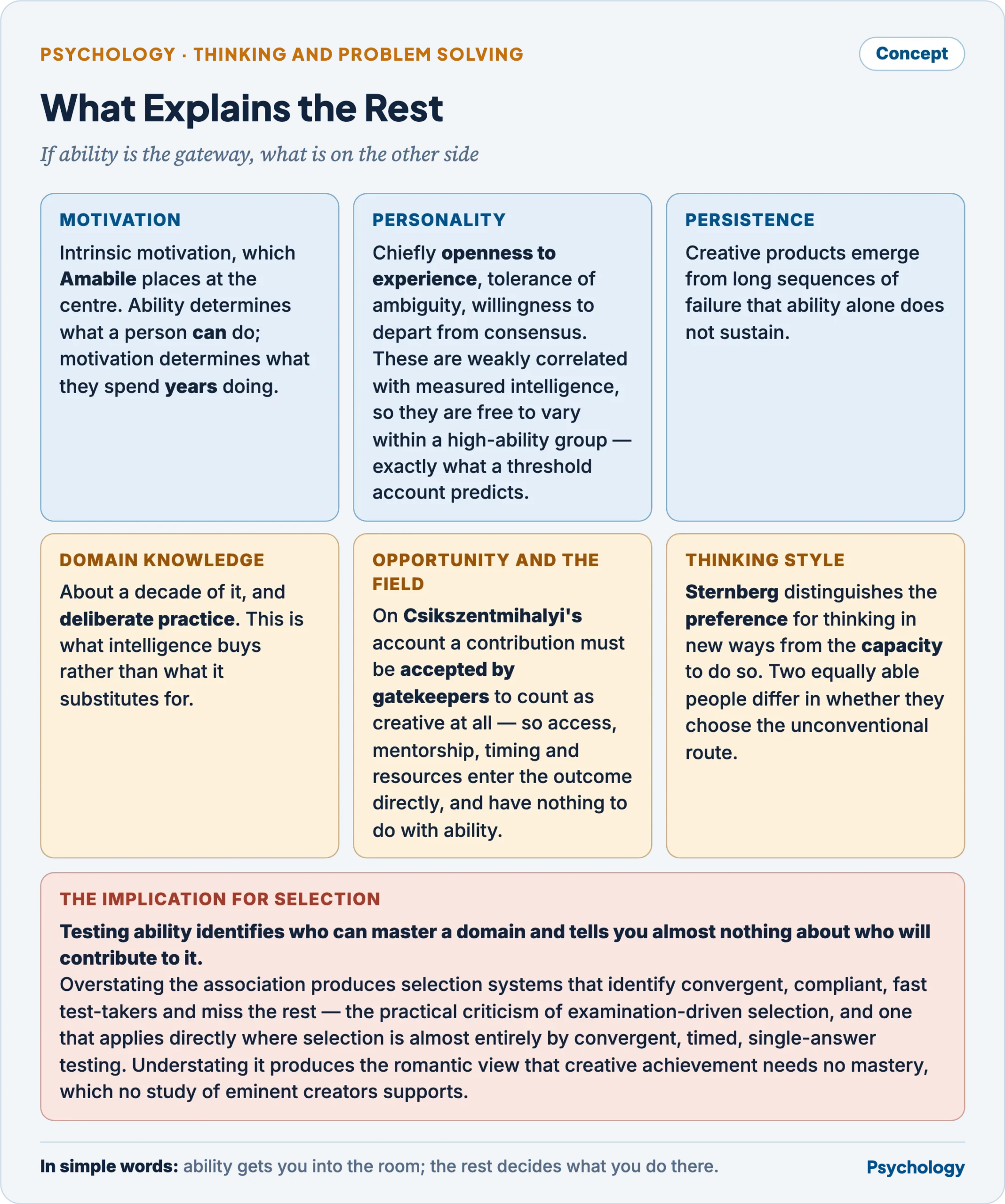
If intelligence is necessary and not sufficient, the interesting question is what supplies the remainder.
- Motivation, and specifically intrinsic motivation, which Amabile’s work places at the centre. Ability determines what a person can do; motivation determines what they spend years doing.
- Personality, chiefly openness to experience, tolerance of ambiguity and willingness to depart from consensus. These are uncorrelated or weakly correlated with measured intelligence, so they are free to vary within a high-ability group — which is exactly what a threshold account predicts.
- Persistence, since creative products emerge from long sequences of failure that ability alone does not sustain.
- Domain knowledge and deliberate practice, which take about a decade and are what intelligence buys rather than what it substitutes for.
- Opportunity and the field. On Csikszentmihalyi’s systems account, a contribution must be accepted by gatekeepers to count as creative at all, so access, mentorship, timing and resources enter the outcome directly and have nothing to do with the individual’s ability.
- Thinking style — the preference for thinking in new ways, which Sternberg distinguishes from the capacity to do so. Two equally able people differ in whether they choose the unconventional route.
The practical implication for selection is direct: testing ability identifies who can master a domain and tells you almost nothing about who will contribute to it.
Criticisms and limitations
- The constructs are not commensurable. Intelligence is operationalised by high-reliability standardised tests; creativity by instruments whose scoring depends on the comparison sample. Correlating them compares unlike things.
- Divergent thinking is not creativity, and nearly all of this literature uses the former as a stand-in for the latter.
- Restriction of range affects every study of high-ability samples, and is insufficiently corrected for.
- Most evidence is cross-sectional and from schoolchildren and students, with the eminent-creator literature relying on retrospective biography.
- Both constructs are culturally loaded. Intelligence tests carry known cultural content; creativity tests reward a conception of originality that is itself culturally particular.
- The threshold hypothesis is cited far more confidently than the evidence supports, and is best presented as a useful approximation under active dispute rather than as an established finding.
Previous Year Questions
- 2012Critically evaluate the relationship between intelligence and creativity. Cite experimental evidences in support of your answer.
- 2017Creative people usually have high IQ scores but those with highest IQ scores are not necessarily the most creative people. Explain.
- 1997What is the relation of creativity, artistic aptitude and intelligence?
- 1996How are intelligence and creativity interrelated?