

Concept and theories of learning (Behaviourists, Gestaltalist and Information processing models).
Official Syllabus: Paper I · Unit 6 Learning
“The mentality of apes is to be studied by watching what they do when a detour is the only way to the goal.”
— Wolfgang Köhler (1925), on why problems, not reflexes, reveal how learning works
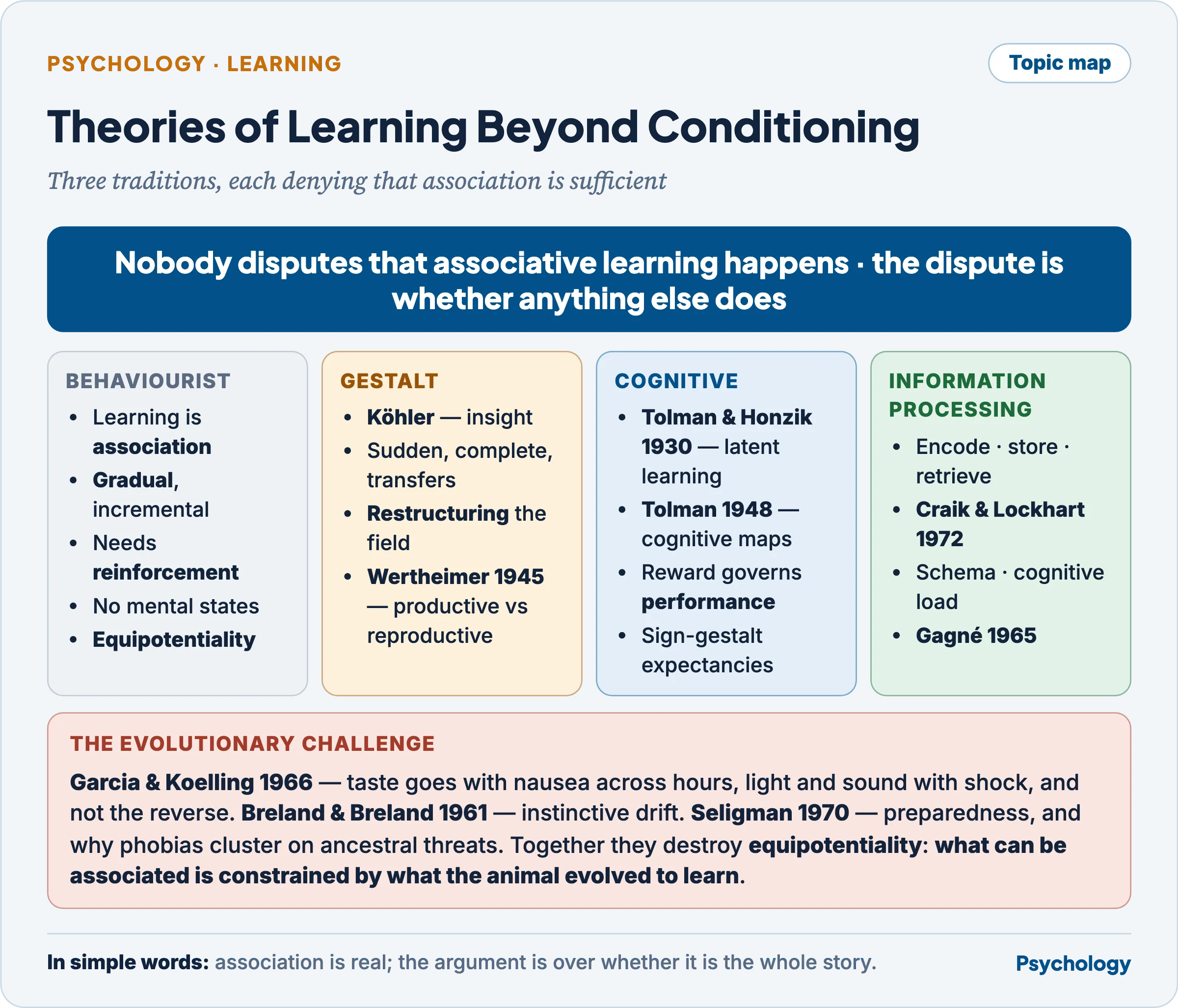
The behaviourist account treats learning as the strengthening of connections by association and reinforcement. Three other traditions dispute not the evidence for that account but its sufficiency — the Gestalt school because it finds learning that is sudden and structural rather than gradual, the cognitive tradition because it finds learning that occurs without any reinforcement at all, and the information-processing tradition because it asks what happens between stimulus and response rather than treating that interval as closed.
The behaviourist position, in one page
Stated so the disagreements that follow are intelligible, and developed in the notes on classical conditioning and on reinforcement.
- Learning is association. What is acquired is a connection — between two stimuli, or between a response and its consequence.
- It is gradual. Learning curves are smooth; each reinforced trial adds a quantum of strength. Thorndike’s (1898) cats took progressively less time to escape the puzzle box, with no sudden drop.
- It requires reinforcement. Hull (1943) made this explicit: reinforcement is drive reduction, and without it no learning occurs.
- It needs no mental states. The organism is treated as a system whose inputs and outputs can be described without any account of what lies between.
- Its laws are general. The same principles hold across species and across responses — the assumption of equipotentiality.
Each of these five claims is challenged below, and the last two are challenged most successfully.
The Gestalt account: learning as insight
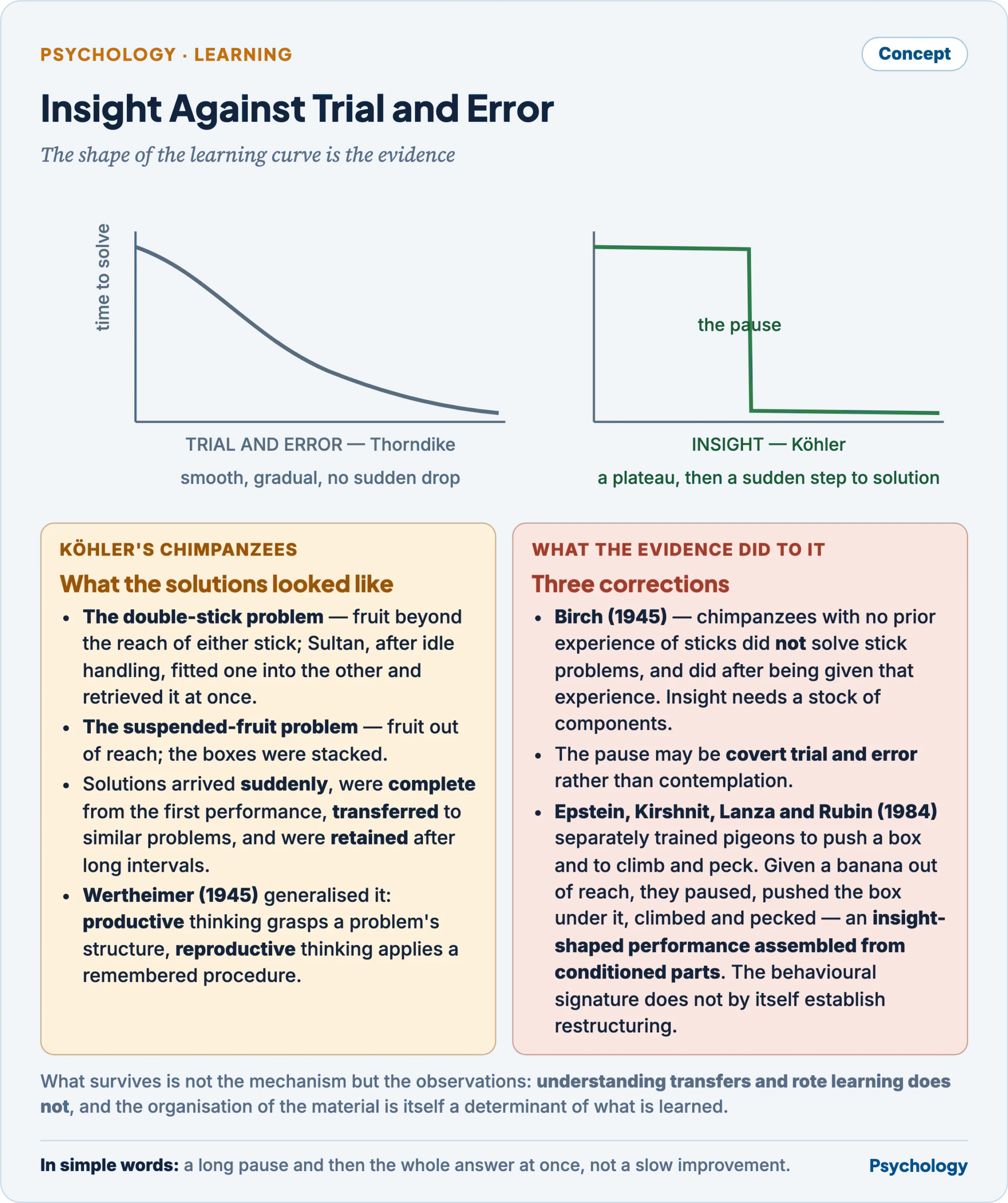
Wolfgang Köhler, working with chimpanzees at Tenerife during the First World War and publishing The Mentality of Apes in German in 1917 and English in 1925, set problems that could not be solved by trial and error because the apparatus allowed no gradual approach.
- The suspended-fruit problem. Fruit hung out of reach, with boxes in the enclosure. Sultan, the ablest of the chimpanzees, eventually stacked boxes and climbed.
- The double-stick problem. Fruit outside the cage, beyond the reach of either of two short sticks. Sultan, after a period of apparently idle handling, fitted one stick into the other to make a longer tool and retrieved the fruit immediately.
What mattered was the shape of the solution rather than its occurrence.
- It arrived suddenly, after a pause rather than through gradual improvement.
- It was complete — once found, the solution was performed smoothly from the start, with none of the hesitation a partially learned response shows.
- It transferred to structurally similar problems with different objects.
- It was retained well after long intervals.
- It was preceded by restructuring — the animal appeared to stop acting and to reorganise the perceptual field, after which the stick ceased to be an object and became a means.
The theoretical claim follows: learning is the reorganisation of a perceptual field so that the relations between its elements are seen, and not the accumulation of connections. Wertheimer (1945) generalised it to human thinking as the distinction between productive thinking, which grasps the structure of a problem, and reproductive thinking, which applies a remembered procedure. A child who has understood why the area of a parallelogram is base times height can handle a parallelogram in an unfamiliar orientation; a child who has memorised the formula cannot.
What the evidence did to the claim
- Prior experience is necessary. Birch (1945) found that chimpanzees without previous experience of handling sticks did not solve stick problems, and solved them after being given that experience. Insight requires a stock of relevant components; it is not independent of learning history, which is what Köhler had implied.
- The pause may not be contemplation. Critics argued that covert, rapid trial and error could produce the same pattern, with the apparent suddenness reflecting the point at which an already-assembled sequence is first run.
- Insight was reproduced by shaping. Epstein, Kirshnit, Lanza and Rubin (1984) separately trained pigeons to push a box toward a target and to climb and peck a suspended banana. Presented with the banana out of reach and a box in the chamber, the pigeons paused, then pushed the box under the banana, climbed and pecked — an insight-shaped performance assembled entirely from separately conditioned components. This does not show that chimpanzee insight is nothing but conditioning; it shows that the behavioural signature of insight does not by itself establish restructuring.
The durable contributions are not the mechanism but the observations: that understanding transfers and rote learning does not, and that the organisation of the material is itself a determinant of what is learned.
The cognitive account: learning without reinforcement
Edward Tolman called his position purposive behaviourism — behaviourist in method, cognitive in what it posited. His central move was the distinction between learning and performance.
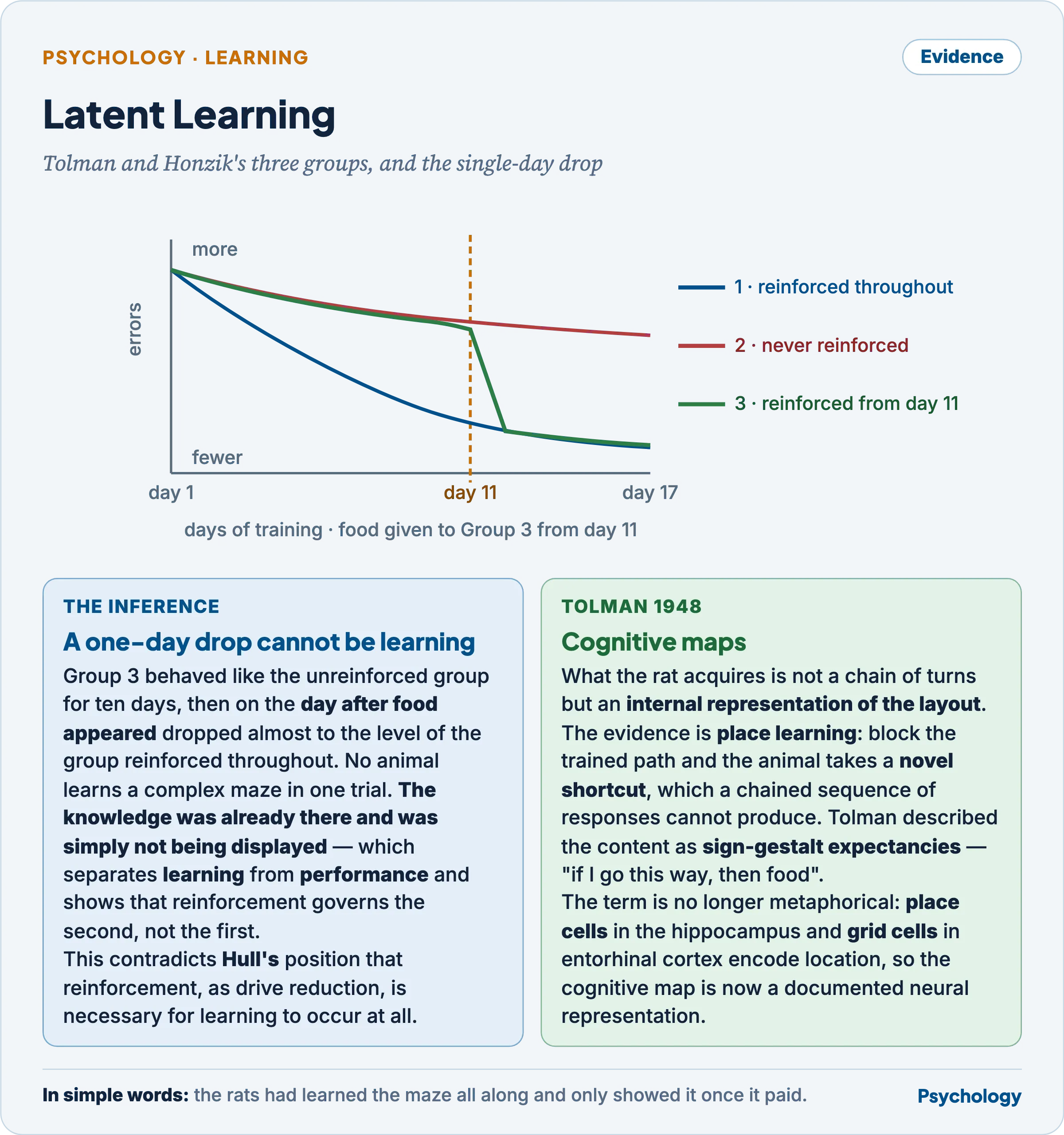
Tolman and Honzik (1930) ran three groups of rats in a complex maze.
- Group 1 was reinforced with food on reaching the goal box every day, and improved steadily.
- Group 2 was never reinforced, and wandered, improving very little.
- Group 3 was unreinforced for the first ten days, then reinforced from day eleven onward. Its performance over the first ten days resembled Group 2’s. On the day after reinforcement began, error rates dropped almost to Group 1’s level.
A group that improves in a single trial must already have possessed the knowledge. The learning had occurred during the unreinforced days and was simply not displayed — latent learning. Reinforcement therefore governs performance, not acquisition, which contradicts Hull’s position directly and weakens the behaviourist claim that reinforcement is necessary for learning.
Tolman (1948), in Cognitive maps in rats and men, drew the further conclusion. What the rat acquires is not a chain of responses but a cognitive map — an internal representation of the spatial layout. The supporting evidence is place learning: a rat trained to find food at a particular location will take a novel shortcut when the trained path is blocked, which a chained sequence of turns cannot produce. Tolman described the content of learning as sign-gestalt expectancies: the organism learns that one event leads to another, in the form “if I go this way, then food”.
The modern descendant is not metaphorical. Place cells in the hippocampus, and grid cells in entorhinal cortex, encode spatial location, and the term cognitive map is now used for a documented neural representation rather than a hypothetical one.
The information-processing account
Where the Gestalt and cognitive traditions attacked particular behaviourist claims, the information-processing tradition replaced the framework. The organism is modelled as a system that encodes, stores, transforms and retrieves information, and learning is a change in what that system holds and how readily it can be retrieved.
- The stages. Information is encoded into a representation, stored, and retrieved when required. Failure at any stage looks like failure to learn, and distinguishing them is what makes the account useful — a student who cannot answer may have encoded poorly, or encoded well and cannot retrieve.
- Structural limits matter. Atkinson and Shiffrin’s (1968) multi-store model gives a sensory register, a sharply capacity-limited short-term store, and a long-term store. Because the limited store is where new material is processed, the rate of presentation is bounded by architecture, not by motivation.
- Depth of processing decides retention. Craik and Lockhart (1972) showed that material processed for meaning is retained far better than the same material processed for its appearance or sound, with no difference in exposure or intent to learn. Learning depends on what is done with the input, which has no counterpart in a theory where repetition and reinforcement are the active ingredients.
- Prior knowledge is a determinant. New material is assimilated to a schema, so what is already known governs what can be encoded — the information-processing version of the Gestalt insistence on organisation.
- Instruction follows from it. Gagné (1965) set out a hierarchy of learning outcomes, each with its own internal and external conditions, and derived the events of instruction — gaining attention, recalling prior learning, presenting the material, eliciting performance, giving feedback, assessing, promoting transfer — directly from what the processing system needs at each stage. Sweller’s cognitive load theory draws the sharper practical conclusion: instruction fails when it imposes load extraneous to the material, so a well-designed worked example teaches more than an unguided problem for a novice.
The evolutionary challenge
The most damaging evidence against the behaviourist claim of equipotentiality came from inside the laboratory.
- Garcia and Koelling (1966) gave rats flavoured water paired with either a shock or with nausea induced hours later. Rats readily associated taste with nausea across a delay of hours, and light and sound with shock, but not the reverse pairings. If association were general, all four pairings should have been equally learnable. They are not: the animal is prepared to make the associations its ecology requires and contraprepared to make others.
- Breland and Breland (1961), in The misbehavior of organisms, reported that conditioned animals in commercial work drifted back to species-typical behaviour — a raccoon trained to deposit coins began rubbing them together instead, losing reinforcement to do so. Instinctive drift shows that conditioning operates on, and is constrained by, an inherited behavioural repertoire.
- Seligman (1970) formalised this as a continuum of preparedness and applied it to phobias, which cluster on snakes, spiders, heights and enclosed spaces rather than on the objectively more dangerous modern hazards, because the former posed ancestral threats and the latter have no evolutionary history.
How far the three schools accept association and reinforcement
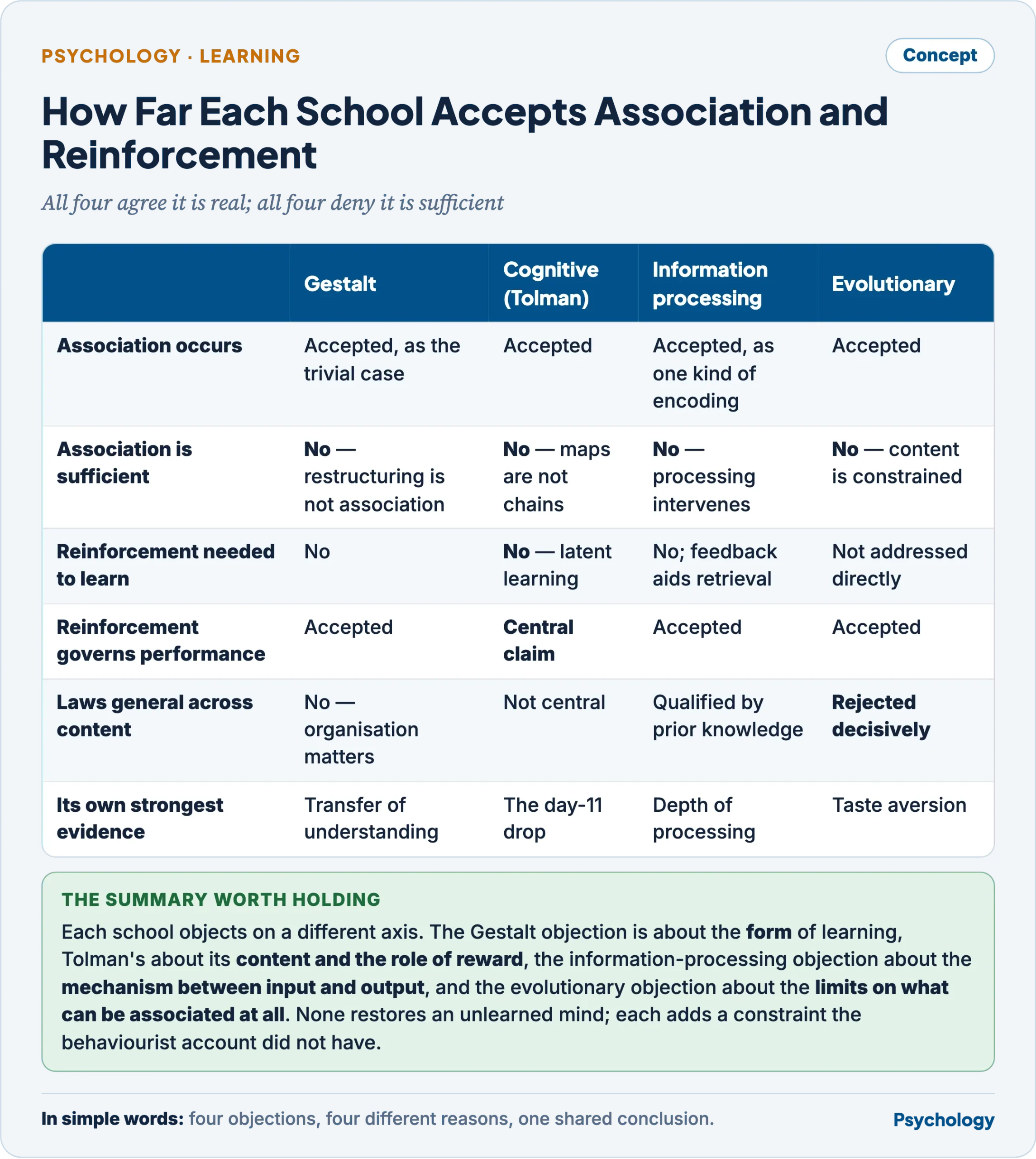
| Gestalt | Cognitive (Tolman) | Information processing | Evolutionary | |
|---|---|---|---|---|
| Association occurs | Accepted, as the trivial case | Accepted | Accepted, as one encoding | Accepted |
| Association is sufficient | Rejected — restructuring is not association | Rejected — maps are not chains | Rejected — processing intervenes | Rejected — content is constrained |
| Reinforcement is necessary for learning | Rejected | Rejected outright (latent learning) | Rejected; feedback aids retrieval | Not addressed directly |
| Reinforcement governs performance | Accepted | Central claim | Accepted | Accepted |
| Laws are general across content | Rejected — organisation matters | Not central | Qualified by prior knowledge | Rejected decisively |
The defensible summary is that all four accept associative learning as real and demonstrable, and deny that it is the whole story, each for a different reason. The Gestalt objection is about the form of learning, Tolman’s about its content and the role of reward, the information-processing objection about the mechanism between input and output, and the evolutionary objection about the limits on what can be associated at all. None of them restores an unlearned mind; each adds a constraint the behaviourist account did not have.
Applications
- Teaching for understanding rather than recall follows from Wertheimer: present the structure of a problem, and test transfer to a changed form rather than repetition of the trained form.
- Discovery and guided-discovery methods descend from the insight tradition, with the qualification Birch supplies: discovery works only where the learner already holds the components, so unguided discovery fails novices.
- Spacing, retrieval practice and elaboration come from the information-processing account, and are among the best-supported interventions in education.
- Worked examples before problems for novices, from cognitive load theory, and the reverse once expertise develops.
- Therapy for phobias takes preparedness seriously: the fears that cluster are the prepared ones, and treatment addresses the response rather than attempting to argue the fear out of existence.
Criticisms and limitations
- Insight remains underspecified. Describing a solution as restructuring names the phenomenon without supplying a mechanism, and the Epstein demonstration shows the behavioural signature can be produced without one.
- Köhler’s observations were few and unblinded, with Sultan supplying a disproportionate share of the famous results.
- Tolman left the rat “buried in thought” — it specified what the animal knew without specifying how knowledge issues in action, a gap that performance theory had to fill later.
- The computer metaphor is borrowed, and the mismatch matters: human memory is reconstructive, capacity-limited in ways a machine is not, and shaped by emotion and motivation that the model does not represent.
- Gagné’s hierarchy is prescriptive rather than empirically derived, and work best for well-structured content, less well for open-ended or creative learning.
- The traditions are complementary, not competing, and treating them as rivals to be scored against one another misses that each is strongest where the others are silent.
Previous Year Questions
- 2020“Any sort of learning takes place with the help of suitable associations and reinforcement.” Critically examine that how much cognitivists, Gestaltists and evolutionary psychologists agree with the statement.
The questions on classical and operant conditioning listed under this syllabus clause are answered in the notes on classical conditioning and on reinforcement, its types and schedules.