

Types and the schedules of reinforcement, escape, avoidance and punishment.
Official Syllabus: Paper I · Unit 6 Learning
“Passivity in response to shock is not learned. It is the default, unlearned response to prolonged aversive events.”
— Steven Maier and Martin Seligman (2016), revising a theory the two of them had built fifty years earlier
Conditioning is usually described in terms of how an organism acquires what it wants. This topic concerns the other half of life: what an organism does about what it does not want. Three outcomes are possible — it can terminate the aversive event, prevent it, or fail at both. Each has its own learning, and the third produces the most consequential finding in the area.
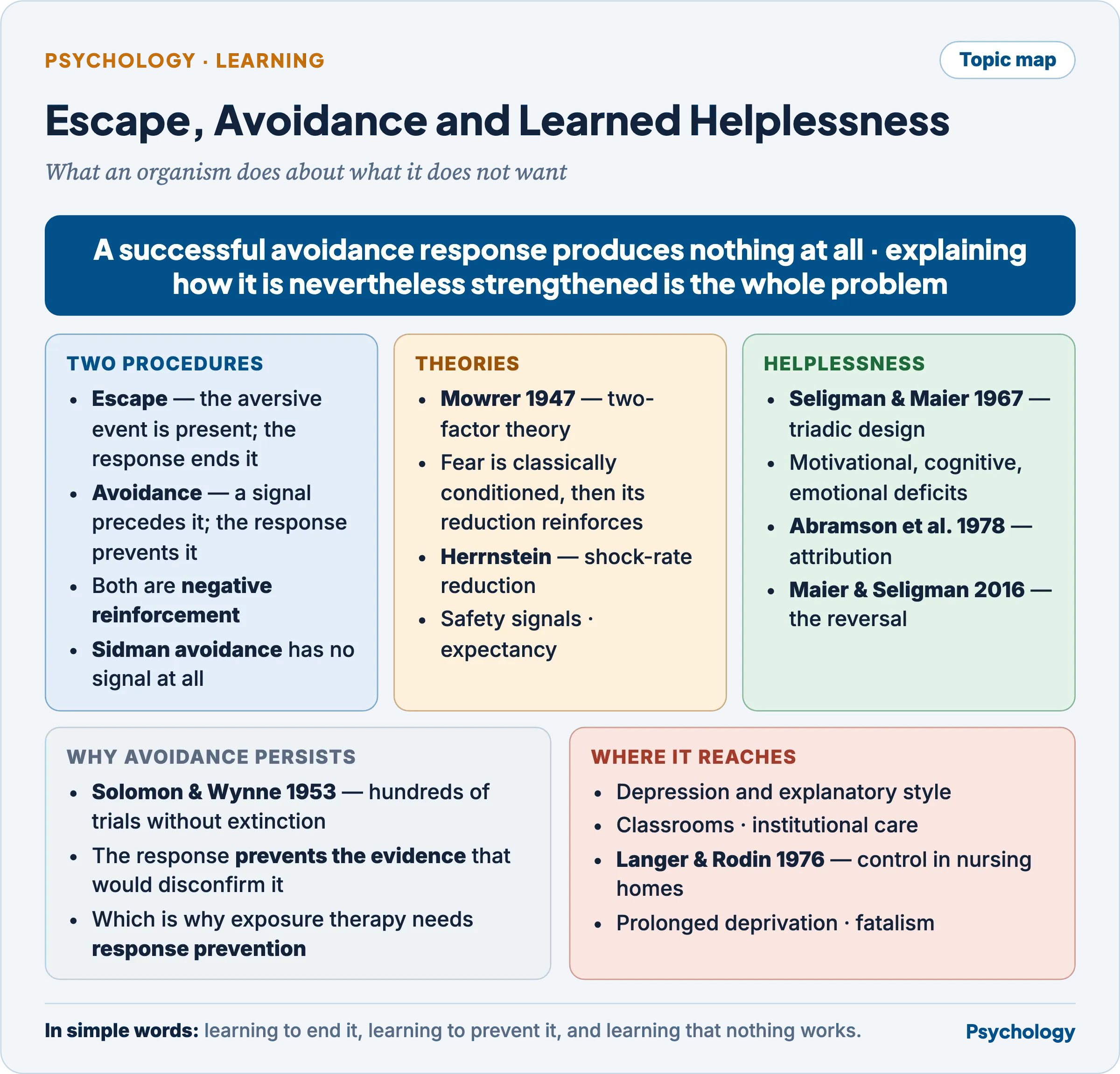
Escape and avoidance defined
Both are forms of negative reinforcement: a behaviour is strengthened because it removes or prevents something aversive. The distinction between them is one of timing.
- Escape learning — the aversive stimulus is already present, and the response terminates it. Taking an analgesic for a headache already in progress, leaving a room that is too loud, a rat pressing a lever that switches off a shock already running.
- Acquisition is rapid, because the contingency is obvious: the aversive event stops immediately and the connection needs no inference.
- It is the first stage in learning to avoid. An organism generally learns to escape before it learns to prevent.
- Avoidance learning — a warning signal precedes the aversive stimulus, and responding during the signal prevents it altogether. Leaving home early to avoid traffic, a rat jumping a barrier when a tone sounds, taking an umbrella on seeing clouds.
- Acquisition is slower, because the organism must learn the signal’s meaning before the response can pay.
- Once acquired it is highly persistent — far more so than any other learned response — and that persistence is the central theoretical puzzle.
Two procedural variants matter.
- Discriminated (signalled) avoidance uses an explicit warning stimulus, usually in a shuttle box where the animal crosses to the other compartment during a tone.
- Sidman (free-operant) avoidance has no warning signal at all. Shocks arrive at fixed intervals, and each response postpones the next one by a set period. Animals learn it readily, which is awkward for any theory that requires a signal.
The avoidance paradox
A successful avoidance response produces nothing. No shock arrives, no reward is delivered, nothing observable changes. Ordinary reinforcement theory has no account of how a behaviour followed by nothing could be strengthened — still less of how it could persist for hundreds of trials without weakening. This is the problem every theory in the area was built to solve.
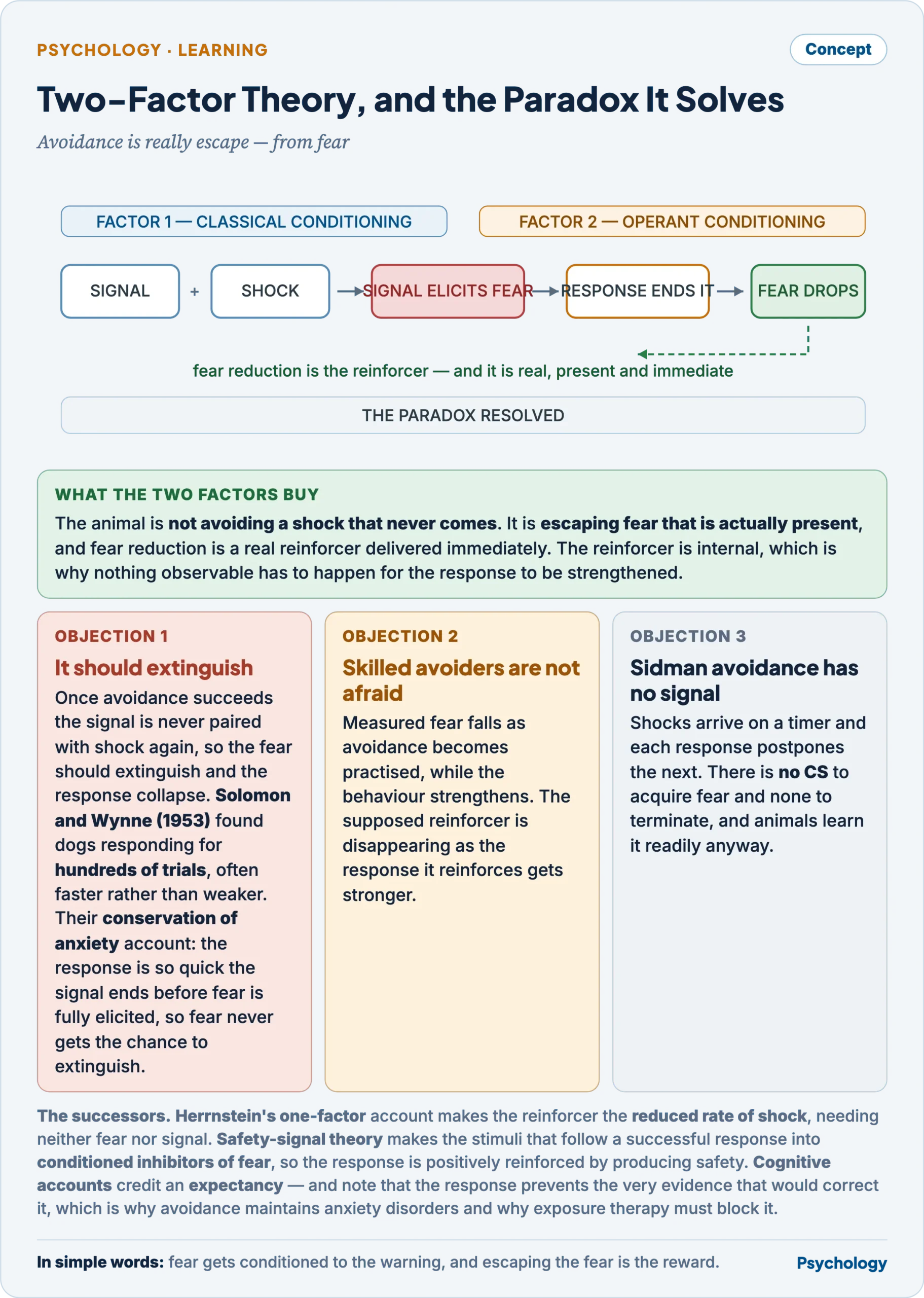
Two-factor theory, proposed by O. H. Mowrer (1947) and developed through the 1950s, resolves it by arguing that two different learning processes are at work in sequence.
- Factor one is classical conditioning. The warning signal is repeatedly paired with shock and becomes a conditioned stimulus eliciting fear. Fear is now a real, present, aversive internal state.
- Factor two is operant conditioning. The avoidance response terminates the warning signal, and so reduces fear. Fear reduction is a genuine negative reinforcer, delivered immediately.
The elegance of the solution is that it converts avoidance into escape: the animal is not avoiding a shock that never comes, it is escaping from fear that is actually present. The reinforcer is internal, which is why nothing observable needs to happen.
Where two-factor theory fails
The theory is a standard illustration of a model that explains its target phenomenon well and is contradicted by the evidence around it.
- Avoidance does not extinguish as it should. Once the animal is avoiding successfully, the CS is no longer paired with shock, so conditioned fear ought to extinguish and the response collapse. Solomon and Wynne (1953) found the opposite in dogs: responding continued for hundreds of trials with no shock at all, often becoming faster rather than weaker. Their explanation, conservation of anxiety, is that the animal responds so quickly the CS is terminated before fear is fully elicited, so there is never an occasion on which fear can extinguish.
- Well-trained avoiders do not look frightened. Measured fear declines as avoidance becomes skilled, yet the response continues. If fear reduction is the reinforcer, the reinforcer is disappearing while the behaviour strengthens.
- Sidman avoidance has no CS, so there is no signal to become a fear-eliciting stimulus and none to terminate. The procedure works anyway.
Later accounts address these. Herrnstein’s one-factor view argues that the reinforcer is simply the reduced rate of shock, requiring no fear and no signal. Safety-signal theory holds that stimuli following a successful response — the other side of the shuttle box, the passage of time — become conditioned inhibitors of fear, and the response is positively reinforced by producing them. Cognitive accounts credit the organism with an expectancy: the response is made because the animal expects shock if it does not respond, and expectancies founded on avoided outcomes are notoriously resistant to correction, since the behaviour prevents the very evidence that would disconfirm it.
That last point is the clinically important one. A person who avoids a feared situation never discovers that the feared outcome would not have occurred, so avoidance maintains anxiety disorders indefinitely. It is precisely why exposure therapy requires response prevention — the avoidance must be blocked for the disconfirming evidence to be collected.
Learned helplessness: the original demonstration
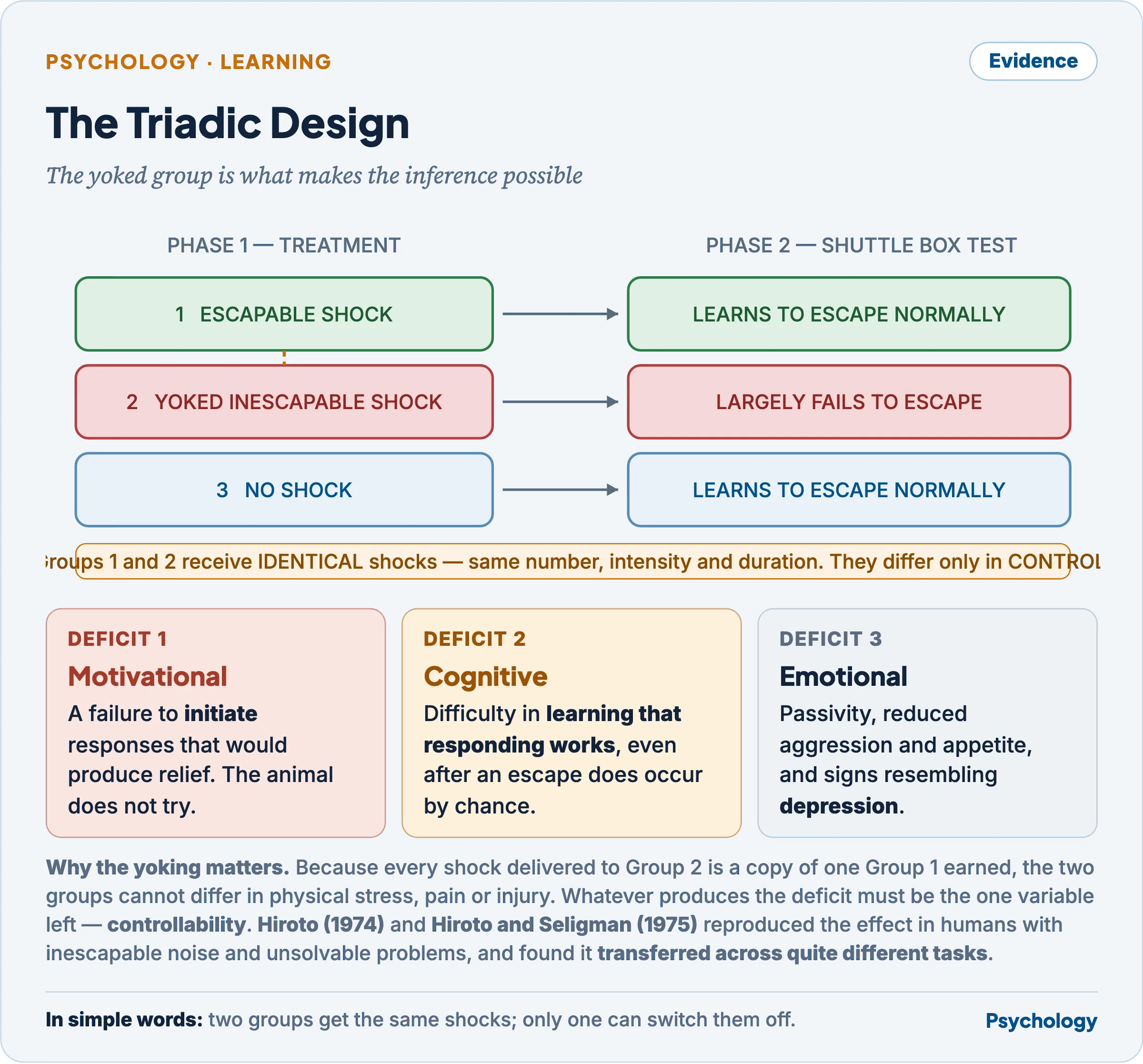
Seligman and Maier (1967) reported that dogs given inescapable shock later failed to escape shock that was fully escapable. The design that establishes this is a triadic one, and its logic is worth setting out because the yoked group is what makes the inference possible.
- Group 1, escapable shock. The animal can terminate the shock by a response.
- Group 2, yoked inescapable shock. Each animal is paired with one animal from Group 1 and receives exactly the same shocks, of the same intensity and duration, but nothing it does has any effect. The yoking is the whole point: the two groups are identical in the physical stress received and differ only in controllability.
- Group 3, no shock. The untreated control.
All three are then tested in a shuttle box where escape is simple. Groups 1 and 3 learn normally. Group 2 largely fails — many animals do not cross the barrier at all, and simply endure the shock. Since the amount of shock was identical for Groups 1 and 2, the deficit cannot be due to stress or injury. It follows from uncontrollability alone.
Three deficits were described.
- Motivational — a failure to initiate responses that would produce relief.
- Cognitive — difficulty in learning that responding works, even when a successful escape does occur.
- Emotional — passivity, reduced aggression and appetite, and signs resembling depression.
Hiroto (1974) and Hiroto and Seligman (1975) extended the finding to humans using inescapable noise and unsolvable problems, and found the deficit transferred across tasks — participants exposed to unsolvable anagrams later performed poorly on a quite different escape task. Transfer across domains is what made the phenomenon interesting beyond the laboratory.
The reformulation, and then the reversal
The animal work does not explain why people differ so much in their response to the same uncontrollable events, nor why some become helpless in one area of life while functioning normally in others.
Abramson, Seligman and Teasdale (1978) answered this by adding causal attribution. What matters is not uncontrollability itself but the explanation the person gives for it, along three dimensions.
- Internal or external — “I am incapable” against “the task was impossible”. Internal attributions damage self-esteem.
- Stable or unstable — “it will always be so” against “this was a bad week”. Stable attributions make the deficit persist over time.
- Global or specific — “I fail at everything” against “I am poor at this one thing”. Global attributions make the deficit spread across situations.
A person who habitually explains bad events as internal, stable and global has a pessimistic explanatory style and is at elevated risk of depression following uncontrollable events. The later hopelessness theory of Abramson, Metalsky and Alloy (1989) refined this into a subtype of depression caused specifically by the expectation that desired outcomes will not occur and nothing can be done about it.
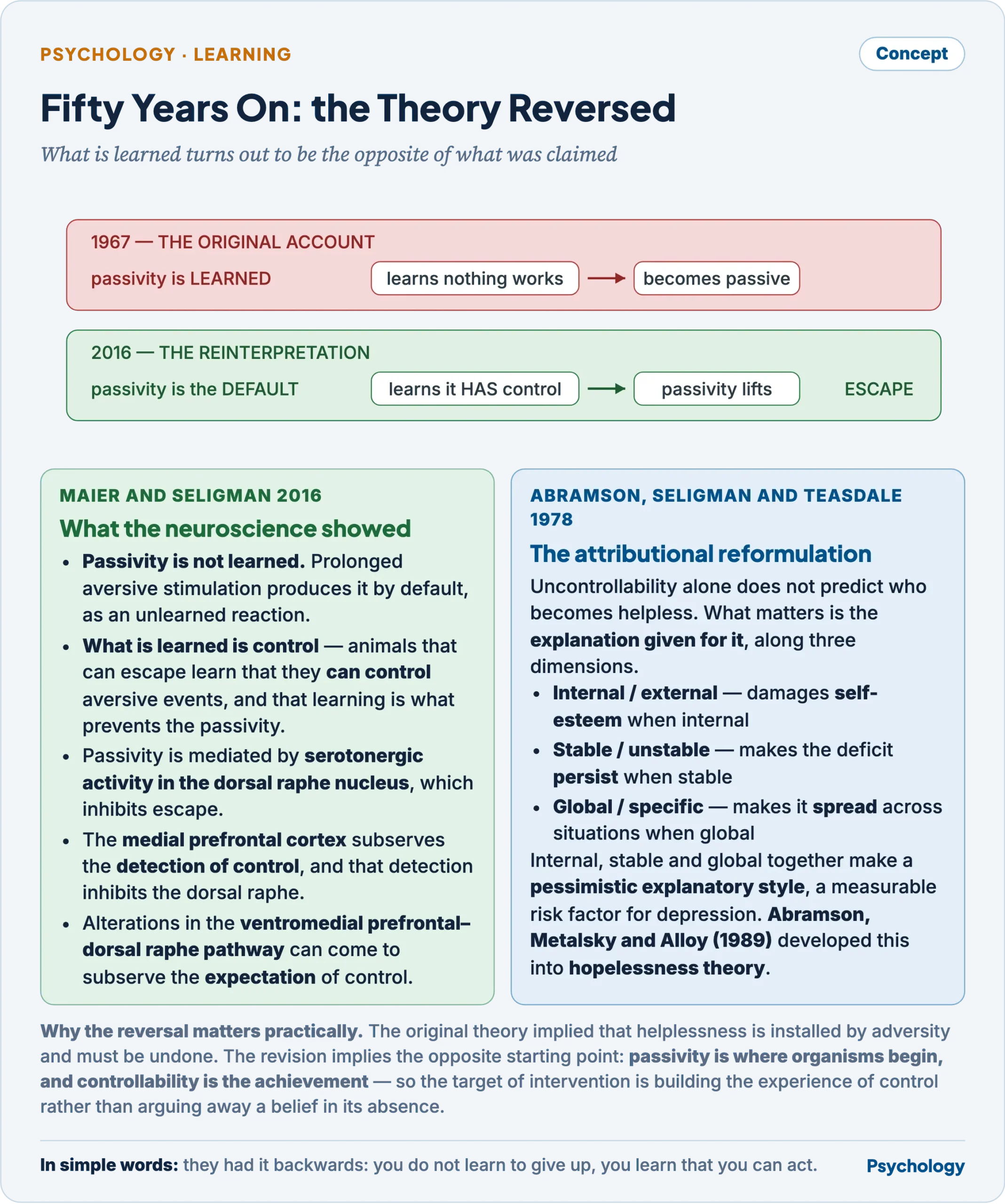
Maier and Seligman (2016) then reversed the original interpretation on the strength of fifty years of neuroscience, and the correction is more interesting than the original claim.
- Passivity is not learned. Prolonged aversive stimulation produces passivity by default, as an unlearned reaction. Nothing has to be acquired for an animal to stop responding.
- What is learned is control. Animals that can escape learn that they can control aversive events, and it is that learning which prevents the passivity.
- The mechanism they describe runs through serotonergic activity in the dorsal raphe nucleus, which mediates the passivity and inhibits escape. Activity in the medial prefrontal cortex subserves the detection of control, and that detection inhibits the dorsal raphe.
- They further propose that alterations in the ventromedial prefrontal–dorsal raphe pathway can come to subserve the expectation of control, and speculate that default passivity together with the detection and expectation of control has implications for how depression is treated.
The practical reading is a genuine inversion. The original theory implied that helplessness is installed by adversity and must be undone. The revision implies that passivity is the starting state and controllability is the achievement — so the target of intervention is not removing a learned belief in helplessness but building the experience of control.
Where it applies
- Depression. Learned helplessness remains one of the principal laboratory models of depression, and explanatory style is a measurable risk factor. The therapeutic descendant is attributional retraining, which teaches the systematic reinterpretation of failure as specific and unstable rather than global and permanent, and which sits inside cognitive therapy rather than beside it.
- Education. A student who has met repeated failure attributes it to fixed inability, stops attempting work that is within reach, and produces the failure that confirms the attribution. The counter is experience of success on attainable tasks and feedback that attributes outcomes to effort and strategy rather than to ability — the same logic that underlies work on mastery orientation.
- Institutional care. Langer and Rodin (1976) gave nursing-home residents on one floor responsibility for small decisions and for a plant of their own, while residents on another floor were given the same amenities with staff taking responsibility. The responsibility group showed greater alertness, activity and self-reported wellbeing, and follow-up found differences in health outcomes. The variable manipulated was control, not care.
- Chronic poverty and discrimination. Where effort is genuinely and repeatedly disconnected from outcome, withdrawal of effort is an accurate reading of the environment before it is a cognitive distortion. This is the limit of the concept’s clinical use: an intervention that treats the attribution while leaving the uncontrollability intact is treating the wrong term.
- Indian context. Indian research on prolonged deprivation has examined precisely this territory — how sustained disadvantage across generations affects aspiration, effort and achievement motivation — and the construct of fatalism, where outcomes are attributed to destiny, overlaps substantially with an external-stable-global style while carrying a different cultural meaning. Fatalism in an Indian setting is often a culturally sanctioned coping resource rather than a symptom, which should caution against reading the attributional dimensions as universally pathological.
Criticisms and limitations
- The original theory’s central claim was later withdrawn by its own authors, and it took five decades and a different method to establish that. The lesson is about the limits of inference from behaviour alone: the triadic design is excellent for showing that controllability matters, and it cannot show what was learned.
- Two-factor theory survives its own failed prediction. It predicts extinction of avoidance and avoidance does not extinguish, yet it is still taught as the account rather than as the first of several.
- Not all animals become helpless, and the proportion that does varies with species, strain and prior history. The individual differences the 1978 reformulation introduced for humans were visible in the animal data and were set aside.
- The depression analogy is partial. Helplessness models the passivity and the pessimism; it does not model the full syndrome, and depression occurs without any history of uncontrollable events.
- Ethical cost. The dog experiments would not be approved today, and the knowledge gained cannot be separated from how it was obtained — a point worth stating plainly rather than leaving implicit.
- Uncontrollability is an empirical claim, not a clinical one. Where it is true, the finding indicts the environment; where it is false, it indicts the attribution. Collapsing the two turns a research result into victim-blaming.
Previous Year Questions
- 2011Discuss the consequences of learned helplessness as demonstrated in classic experiment on dogs. Find out its parallels in real life.
The punishment questions listed under this syllabus clause — on the difference between negative reinforcement and punishment, on whether punishment works, and on reward and punishment failing to change behaviour — are answered in the note on reinforcement, its types and schedules, where the four contingencies are set out together.