

Subliminal perception.
Official Syllabus: Paper I · Unit 5 Sensation, Attention and Perception
“The conscious and the unconscious are separated by a limen, below which ideas may still be active.”
— the notion of a threshold of consciousness that Johann Friedrich Herbart (1824) introduced, and from which the word subliminal descends
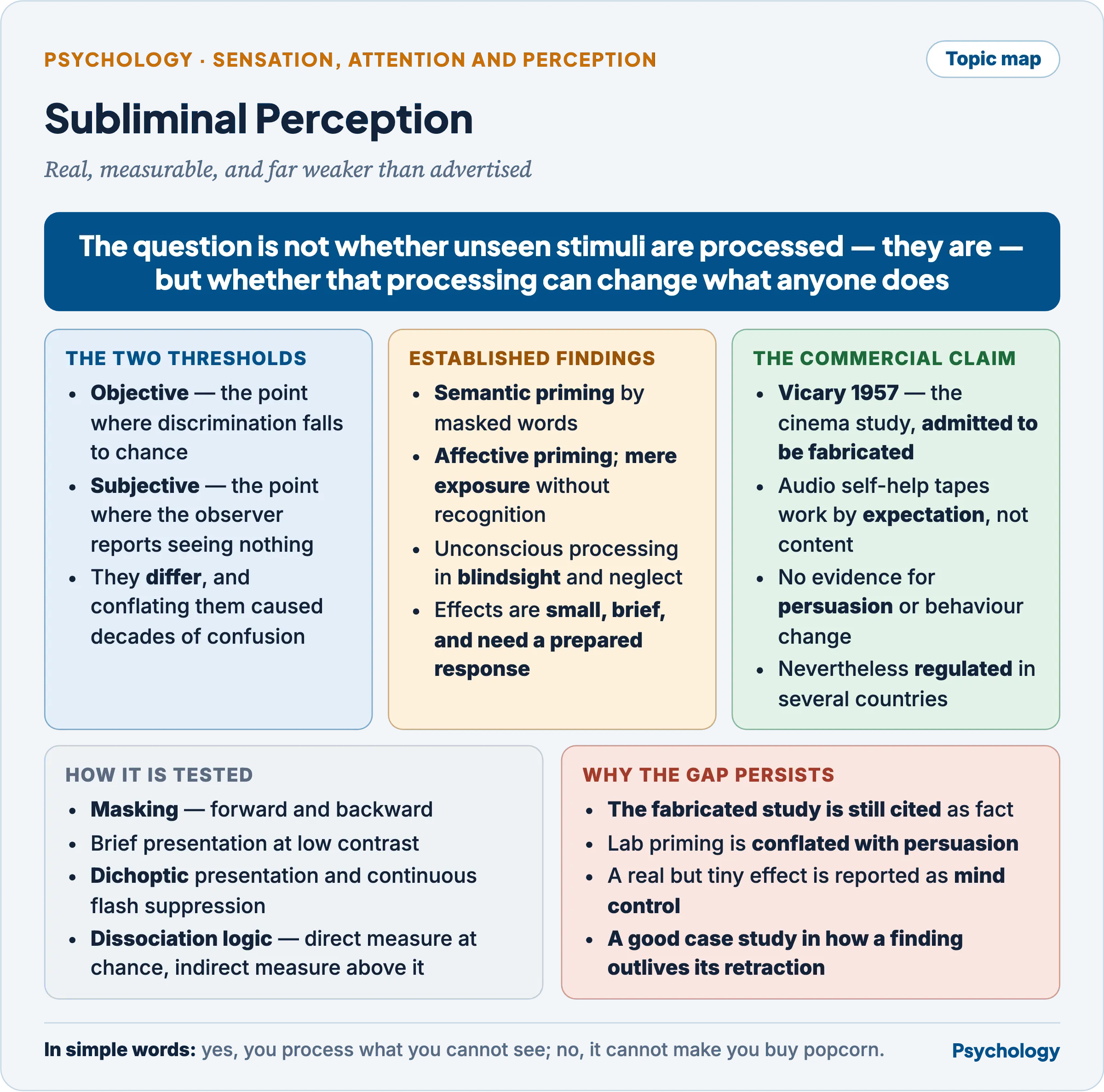
Subliminal means below the limen — below the threshold of conscious awareness. The question is whether a stimulus too weak or too brief to be consciously perceived can nevertheless be processed and influence behaviour. The scientific answer is a carefully qualified yes; the popular answer is a wildly overstated yes; and the distance between them is almost entirely the fault of a single fraudulent claim made in 1957.
What subliminal perception is, and the threshold problem
A stimulus is subliminal when the person cannot consciously report it, and supraliminal when they can. The difficulty is that the limen is not a fixed boundary: it fluctuates with attention, fatigue and motivation, so a stimulus is subliminal for a given person at a given moment, not absolutely.
Two further distinctions are required and are routinely conflated.
- The objective threshold is the level at which the stimulus cannot be discriminated at all, as shown by forced-choice performance at chance. The subjective threshold is the level at which the person reports seeing nothing but can still discriminate above chance when forced to guess. Most “subliminal” findings use the subjective threshold, and a critic can always argue that some conscious perception remained. Demonstrating processing below the objective threshold is far harder and is the methodologically decisive case.
- Subliminal is not the same as unattended. Inattentional blindness involves a fully supraliminal stimulus — clearly visible, well above threshold — that fails to reach awareness because attention was elsewhere. The gorilla walking through the basketball game is not subliminal; it is unattended. Both are failures of awareness arising at different points, and the contrast is the clearest way to define each.
How it is studied
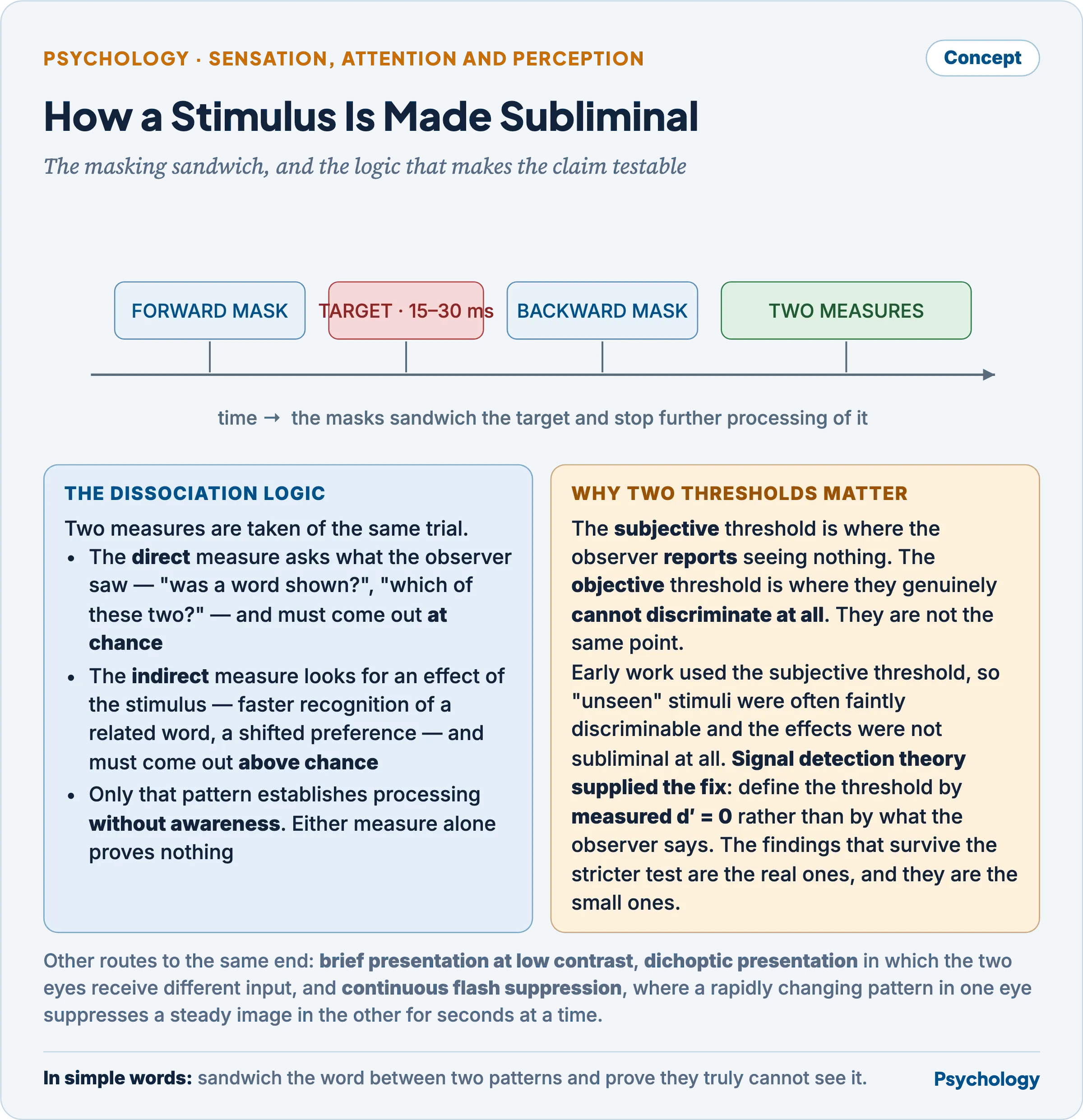
- Backward masking is the principal technique. A target is presented very briefly and immediately followed by a mask — a pattern, or a string of consonants — which interrupts the processing of the target and prevents it reaching awareness, while the target has already entered the system. Greenwald’s “subliminal sandwich” is the standard arrangement: a string of consonants, then the prime word, then a second string, so the word is masked both forward and backward.
- Visual priming is the principal measure. If a masked prime has been processed, it should facilitate a subsequent related target and interfere with an unrelated one. Faster or more accurate responses to related targets are the evidence that the prime was registered. Priming measures are indirect, which is their strength: they do not ask the participant what they saw.
- The response window technique, which Greenwald, Draine and Abrams (1996) introduced, obliges participants to respond within a narrow time window. Under this time pressure, error rates rise sharply when prime and target disagree in meaning, which demonstrates that the prime was semantically processed. Its importance is that it made the effect reliably replicable in any laboratory, which earlier subliminal work conspicuously was not.
- Dichotic listening, where unattended-channel material shows effects without report.
- Clinical dissociations provide the strongest evidence of all, because they are not manipulations of threshold but naturally occurring separations of processing from awareness. In blindsight, patients with damage to primary visual cortex report seeing nothing in the blind field yet locate and discriminate stimuli well above chance. In prosopagnosia, patients who cannot consciously recognise familiar faces nevertheless show differential autonomic responses to familiar against unfamiliar ones. Processing is demonstrably occurring without awareness.
The Vicary affair
The public understanding of this topic rests almost entirely on a hoax, and the facts should be stated plainly.
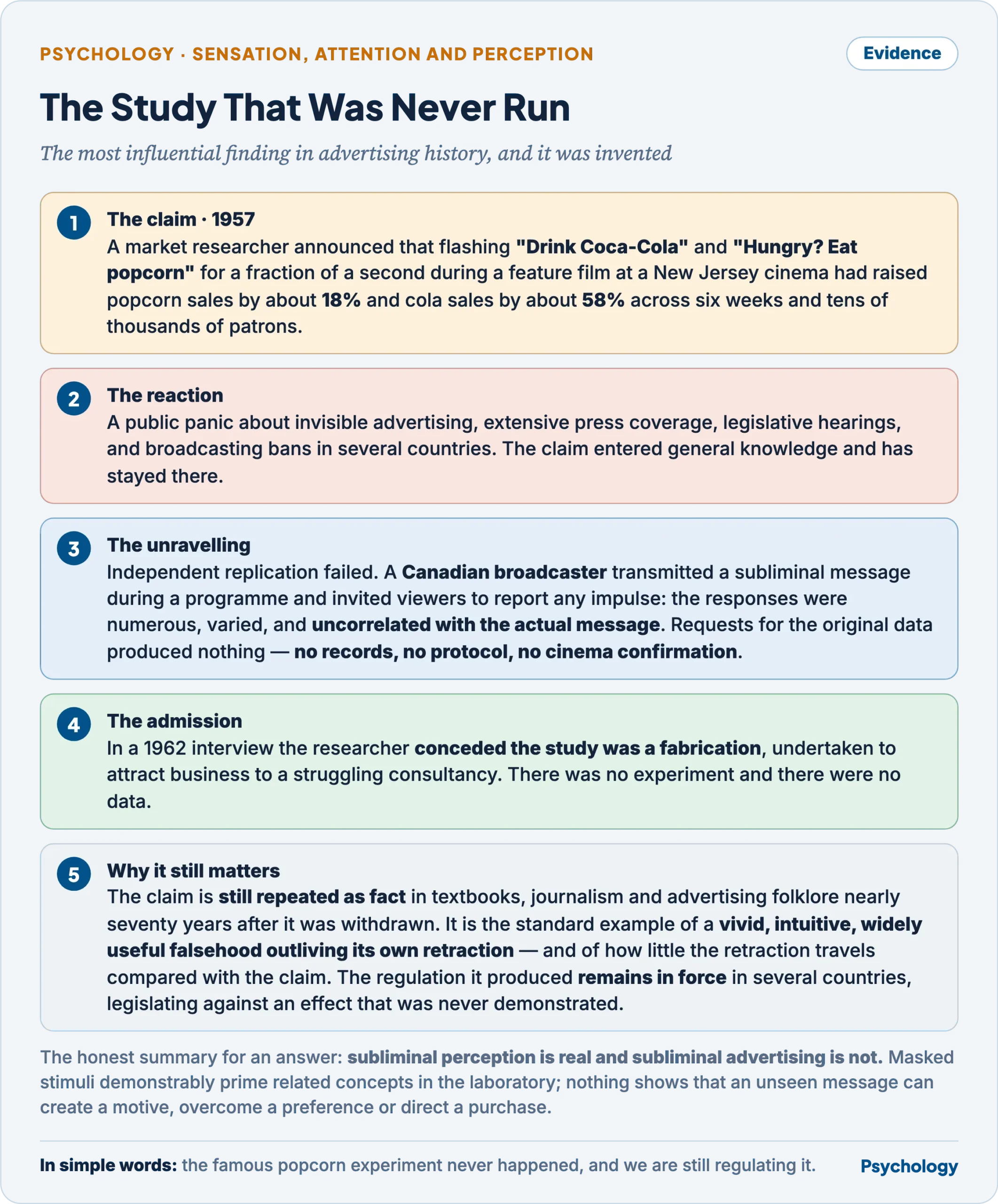
In September 1957, market researcher James Vicary announced that over six weeks he had flashed the messages “Eat popcorn” and “Drink Coca-Cola” for a fraction of a second at five-second intervals during a film at a cinema in New Jersey, and that this had raised cola sales by about 18 per cent and popcorn sales by about 58 per cent.
The effect on public opinion was immediate and enormous, producing alarm about mind control, calls for legislation, and a durable popular belief in subliminal advertising.
No one ever replicated it, and after roughly five years Vicary admitted the study was a gimmick — a publicity stunt for his failing marketing business. The admission received a small fraction of the attention the original claim had. Subsequent analysis added two further reasons to reject it independently of the confession: a two-word instruction is too complex to be processed from a subliminal exposure, and the influence of a single subliminal word decays within roughly a tenth of a second, which cannot produce a purchase minutes later in a different room.
Two related popular claims failed on examination in the same way. Backmasking — alleged satanic or instructional messages recorded backwards into music — was the subject of litigation and public panic in the 1980s; the courts dismissed the cases and research found that reversed speech leaves no measurable trace in memory and exerts no influence. And subliminal self-help tapes were tested by Greenwald and colleagues (1991), who gave 237 participants tapes claiming to improve either self-confidence or memory, with half the labels deliberately switched. The tapes produced no effect on either self-confidence or memory. Participants did, however, report improvement in whatever the label promised — a clean demonstration that the whole industry ran on expectancy.
Is it a myth or a reality? What the evidence supports
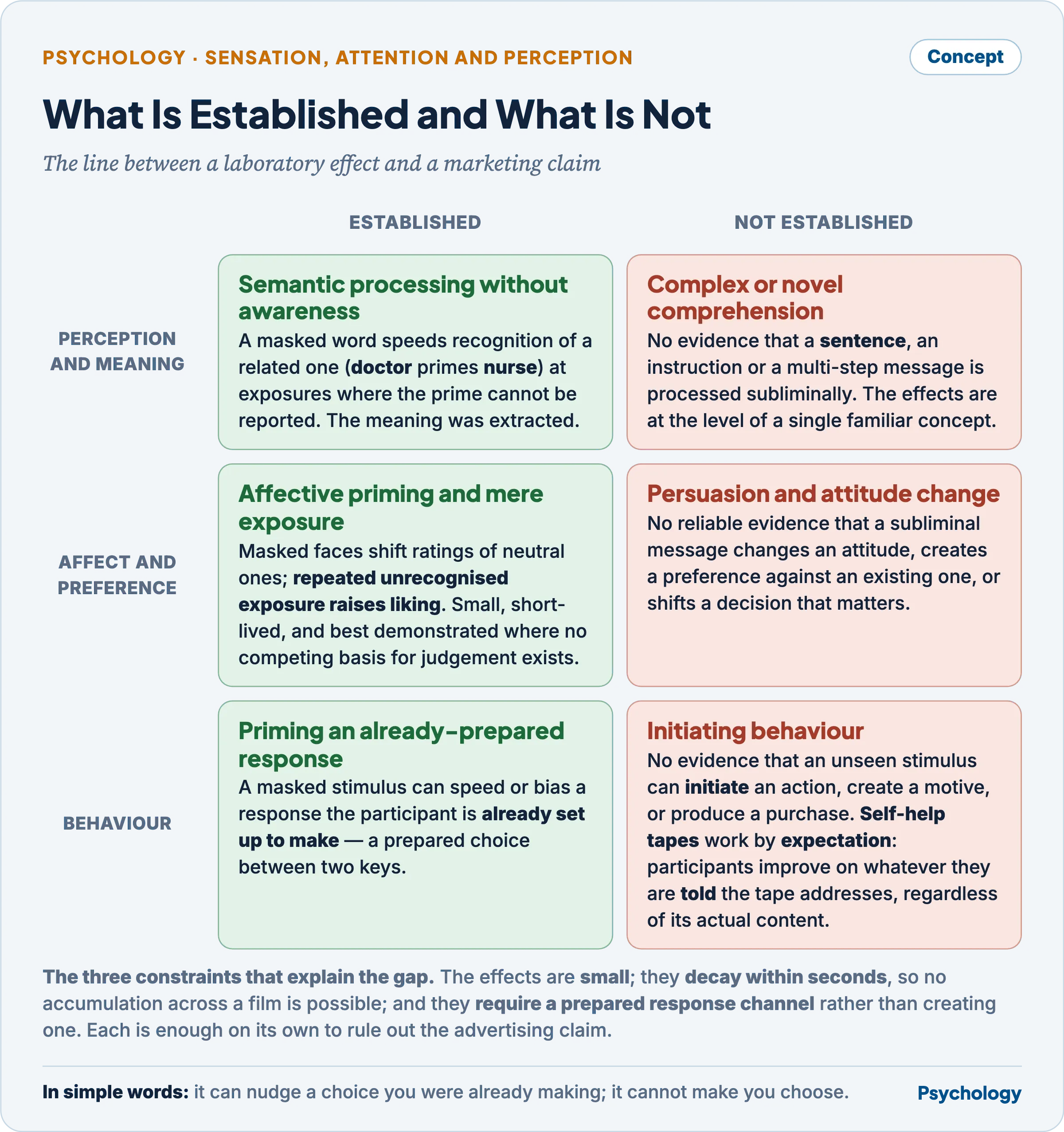
The defensible position distinguishes sharply between two claims that popular discussion merges.
Established.
- Subliminal perception exists. Stimuli presented below the threshold of report are processed, including to the level of meaning, and the effect is reliably replicable with the response-window and priming methods.
- Affective and semantic priming occur. Masked primes shift evaluations, speed related judgements and produce measurable error patterns.
- The clinical dissociations are unambiguous. Blindsight and covert face recognition establish processing without awareness beyond reasonable doubt.
- Mere exposure operates subliminally: repeatedly presented stimuli that were never consciously seen are later preferred, without the person knowing why.
Not established.
- Complex instructions cannot be conveyed. A subliminal stimulus does not transmit a sentence, a command or a reasoned proposition.
- The effects are very brief. A single subliminal prime’s influence decays in a fraction of a second, which rules out delayed behavioural control.
- The effects are small. They are detectable in aggregate across many trials with sensitive measures, not in the behaviour of an individual on one occasion.
- There is no evidence of the capacity to override intention. Nothing in the literature supports the popular fear of subliminal control of behaviour against the person’s will.
The one important qualification: goal relevance
The most interesting modern finding is that subliminal priming can affect a real behavioural choice under a specific condition.
Karremans, Stroebe and Claus (2006), in two experiments pointedly titled “Beyond Vicary’s fantasies”, subliminally primed participants with the brand name of a drink and then measured choice and intention. The priming increased choice of the primed brand and the intention to drink it — but only for participants who were thirsty. Priming had no significant effect on participants who were not thirsty, and this held whether thirst was self-rated or induced by giving participants salty sweets.
The principle the finding establishes is that a subliminal prime can direct an existing motivation but cannot create one. It makes an already-active goal more likely to be satisfied in a particular way; it does not install a goal. That is a far weaker claim than Vicary’s and it is supported, and it is the right answer to whether subliminal messages can produce significant changes in attitudes or behaviour: they can nudge a choice among options when the motivation is already present, and they cannot manufacture motivation or convey a message.
Advertising
The honest account of subliminal advertising has three parts.
- It is prohibited or restricted in many jurisdictions — including under broadcasting codes in the United Kingdom, Australia and elsewhere — on the strength of the Vicary panic rather than of evidence, which is a notable case of regulation built on a hoax.
- It is not what advertising actually does. Real advertising works supraliminally and by well-understood means: mere exposure and familiarity, classical conditioning of the brand to attractive imagery, source credibility, repetition, availability at the point of decision, and brand priming that is perfectly visible but not consciously analysed. The effective techniques are in plain sight, which is why the preoccupation with subliminal messages is a distraction from the mechanisms that matter.
- What the evidence permits is the Karremans case: a brand prime can tilt a choice among available options for someone who already wants a drink. Placement at the point of sale and brand familiarity do this far more effectively and legally.
A further strand of the popular literature concerned embedded imagery — claims that suggestive shapes are concealed in advertisements. These claims have not been substantiated, and the perception of such figures is better explained by patternicity in ambiguous visual material than by deliberate embedding.
Can the effects be generalised?
The limits on generalisation are severe and specifiable, and stating them is the appropriate caution.
- From the laboratory to the world. Laboratory effects require precise control of exposure duration, masking, viewing distance and fixation. A cinema or a television cannot deliver these to an audience with varying positions, screens and attention.
- Across individuals. The threshold varies between people and within a person over time, so a single presentation level is subliminal for some and supraliminal for others.
- In duration. Effects decay within fractions of a second, so they cannot be accumulated.
- In complexity. Single words and simple images can be processed; propositions cannot.
- In magnitude. Effects detectable statistically across many trials do not translate into reliable control of an individual’s behaviour.
- In direction. Where participants become aware that they may have been influenced, they frequently correct for it, sometimes overcorrecting in the opposite direction.
The summary is that subliminal perception is a real and well-established phenomenon of limited power, and that the popular conception of it is a myth with a known author.
Criticisms and limitations
- The threshold problem has never been fully solved. A critic can always argue that some residual conscious perception remained, and demonstrating processing below the objective threshold is far harder than most studies attempt.
- Null results are hard to interpret. Failure to find an effect may mean no subliminal processing occurred or that the stimulus was too weak, so the hypothesis is difficult to disconfirm cleanly.
- Early studies were poorly controlled, and the field’s reputation still suffers from an association with commercial claims and from the Vicary affair.
- Replication has been uneven, which is why Greenwald’s response-window technique mattered so much — it was the first method that worked reliably in other hands.
- Publication bias is likely, since positive subliminal findings are far more publishable than negatives.
- The dissociation logic is contested. Blindsight and similar findings are sometimes explained as degraded conscious vision with a conservative criterion for reporting awareness, rather than as unconscious perception — a signal-detection objection that applies to the whole literature on perception without awareness.
- The regulatory position is evidentially odd. Subliminal advertising is restricted while far more effective supraliminal techniques are not, which suggests the law is responding to the vividness of a fear rather than to demonstrated harm.
Previous Year Questions
- 2026What do you understand by ‘inattentional blindness’? How can subliminal stimulus affect our behaviour?
- 2023What do you mean by subliminal perception? Discuss its role in advertising with the help of suitable example.
- 2017Do you think subliminal messages can actually lead to significant changes in attitudes or behaviour? Cite research evidence.
- 2016Describe the phenomenon of subliminal perception and explain it with reference to the concepts of backward marking and visual priming. Do you think that the effect of the phenomenon of subliminal perception can be generalized?
- 2002Is subliminal perception a myth or a reality? Answer citing relevant experimental evidence.