

Perceptual organization; culture and perception.
Official Syllabus: Paper I · Unit 5 Sensation, Attention and Perception
“Illusions are not failures of perception. They are the price paid for a system that is right almost all the time.”
— the conclusion Richard Gregory (1968) drew from his work on illusion as misapplied constancy
An illusion is embarrassing to a theory that treats perception as a readout of the world, and illuminating to one that treats it as inference. That is why illusions matter out of proportion to their frequency: they are the cases where the perceptual system’s assumptions become visible, because the assumptions are wrong. And since different environments install different assumptions, the illusions are not the same everywhere — which is where culture enters.
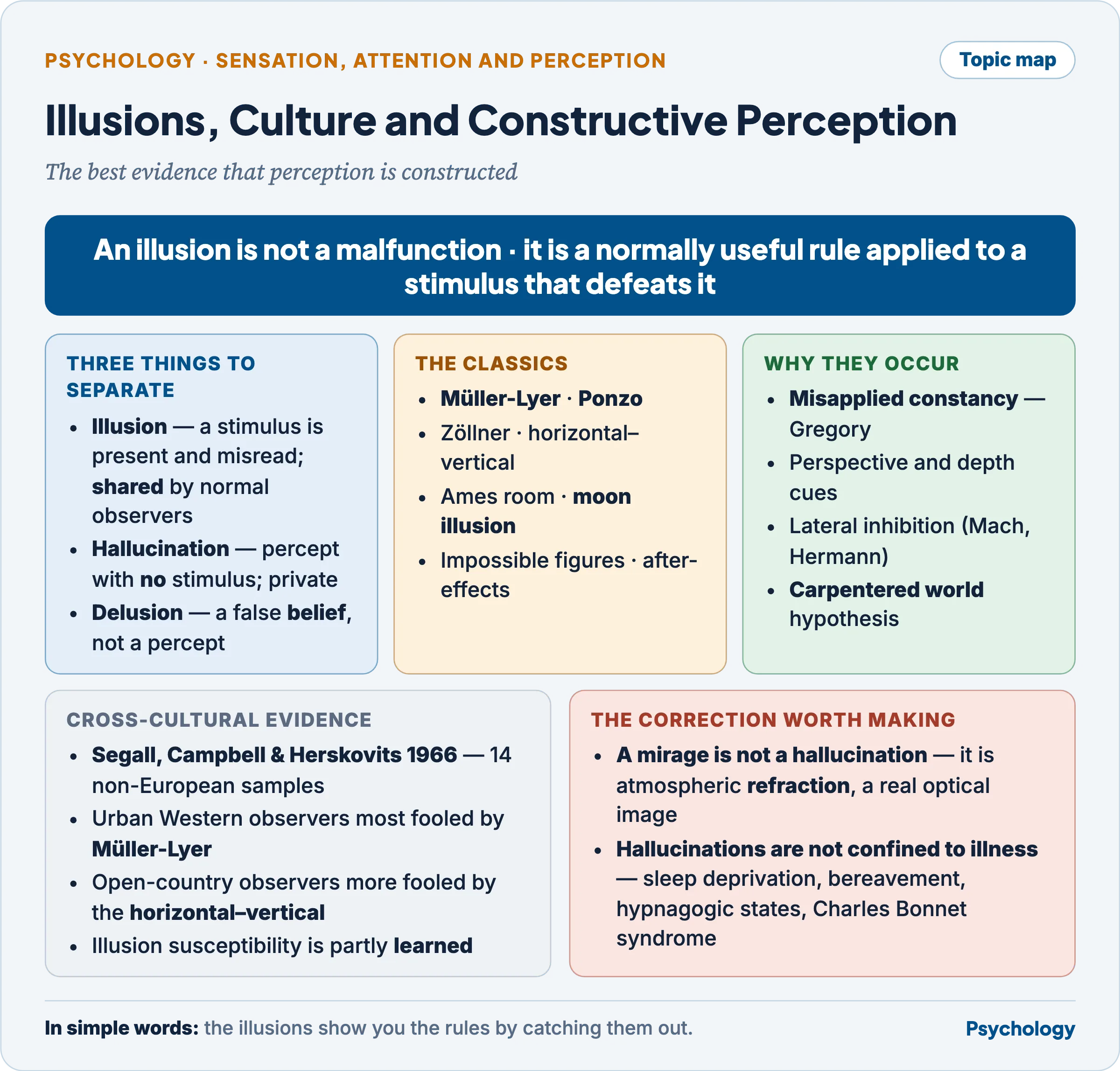
What an illusion is, and what it is not
An illusion is a consistent misperception of a real external stimulus. The stimulus is present and is being registered correctly by the receptors; the error is in the interpretation.
Three distinctions must be kept clear, and two of them are commonly got wrong.
- Illusion against hallucination. A hallucination is a perceptual experience with no external stimulus at all. The important corrective is that hallucinations are not confined to the mentally ill: they occur reliably in sensory deprivation, fever, drug states, bereavement, extreme fatigue and the hypnagogic state at the edge of sleep, and in Charles Bonnet syndrome in people losing their sight. Treating hallucination as a marker of mental illness is both wrong and clinically harmful.
- The desert mirage is not a hallucination. It is frequently given as one and it is not. A mirage is a physical phenomenon — light refracted through layers of air at different temperatures — so the observer is veridically perceiving real light that has genuinely arrived. If anything it is an illusion, and it would be photographed by a camera, which no hallucination would.
- Illusion against delusion. An illusion is a perceptual error; a delusion is a false belief held against evidence. One is in the perceptual system, the other in judgement.
Illusions are universal, consistent and compelling: the same stimulus produces the same error in almost everyone, the error is predictable in direction and magnitude, and it persists after explanation. That last property is the theoretically important one — knowing that two lines are equal does not make them look equal — because it shows that perception is not under the control of belief. The modules are cognitively impenetrable.
The geometrical illusions
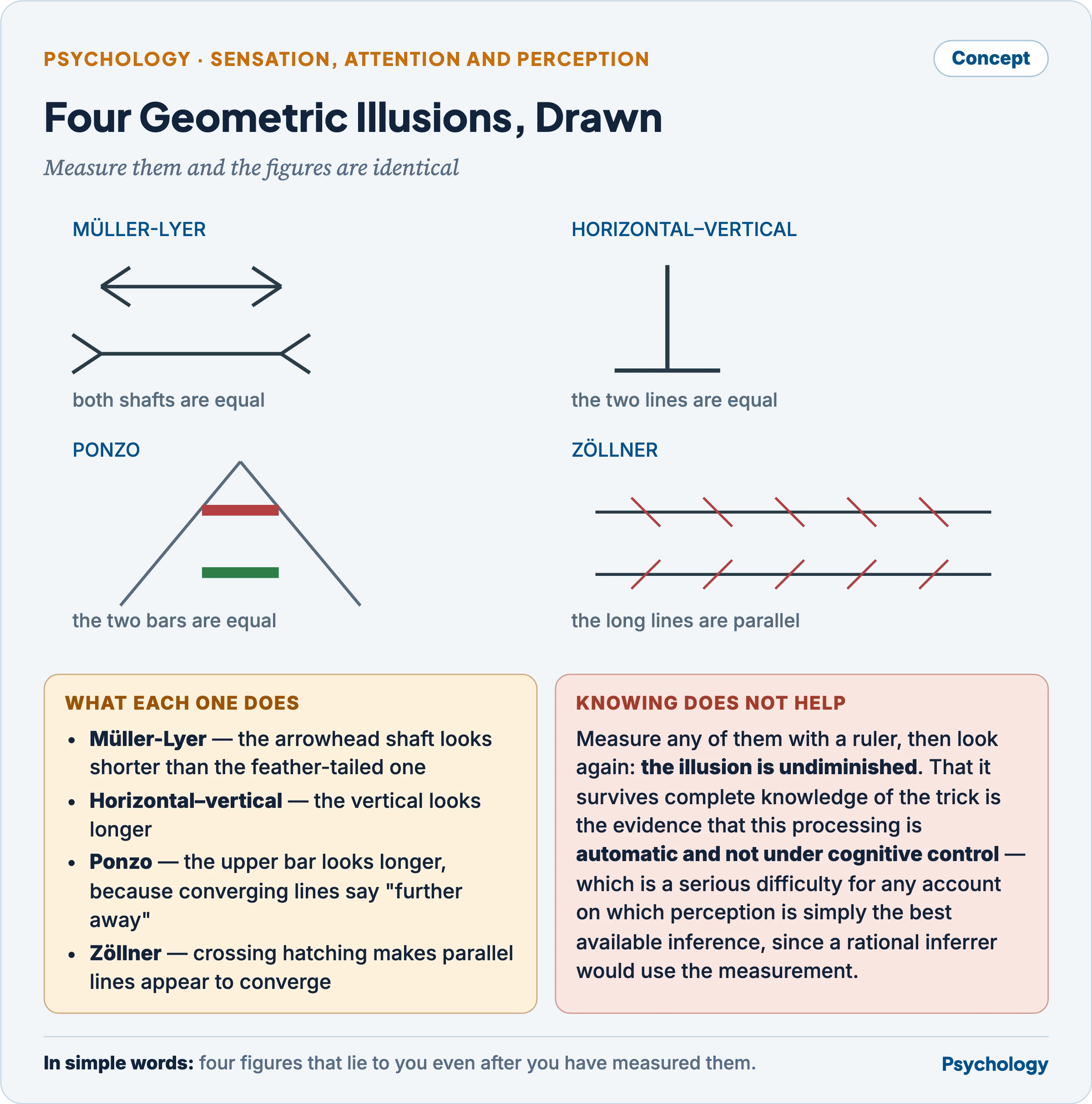
- Müller-Lyer (1889). Two lines of equal length, one with outward-pointing fins and one with inward-pointing fins; the outward-fin line is seen as longer. The most studied illusion in psychology.
- Ponzo. Two identical horizontal lines placed across a pair of converging lines; the line nearer the convergence appears longer. Note that the illusion is the difference between the two horizontals, not the convergence of the rails — a point frequently muddled.
- Zöllner. Long parallel lines crossed by short oblique strokes appear to diverge or converge, the parallels being distorted by the orientation of the crossing strokes.
- Horizontal–vertical illusion. A vertical line is judged longer than a horizontal line of the same length, most strongly in an inverted-T arrangement.
- Ebbinghaus (Titchener circles). A circle surrounded by large circles appears smaller than an identical circle surrounded by small ones — a contrast effect rather than a perspective one.
- Sander parallelogram. The two diagonals of a divided parallelogram appear unequal and are equal.
- Poggendorff. A straight line interrupted by a rectangle appears misaligned on the far side.
- Café wall. Rows of offset light and dark tiles with a contrasting mortar line appear to slope, though every row is horizontal — a low-level effect arising in the retina.
- Moon illusion. The moon appears markedly larger near the horizon than overhead, while its visual angle is unchanged.
- Ames room. A distorted room built so that one corner is much further from the viewing point, yet projects as rectangular from that one point; two people of equal height standing in the corners appear grossly unequal.
Why they occur
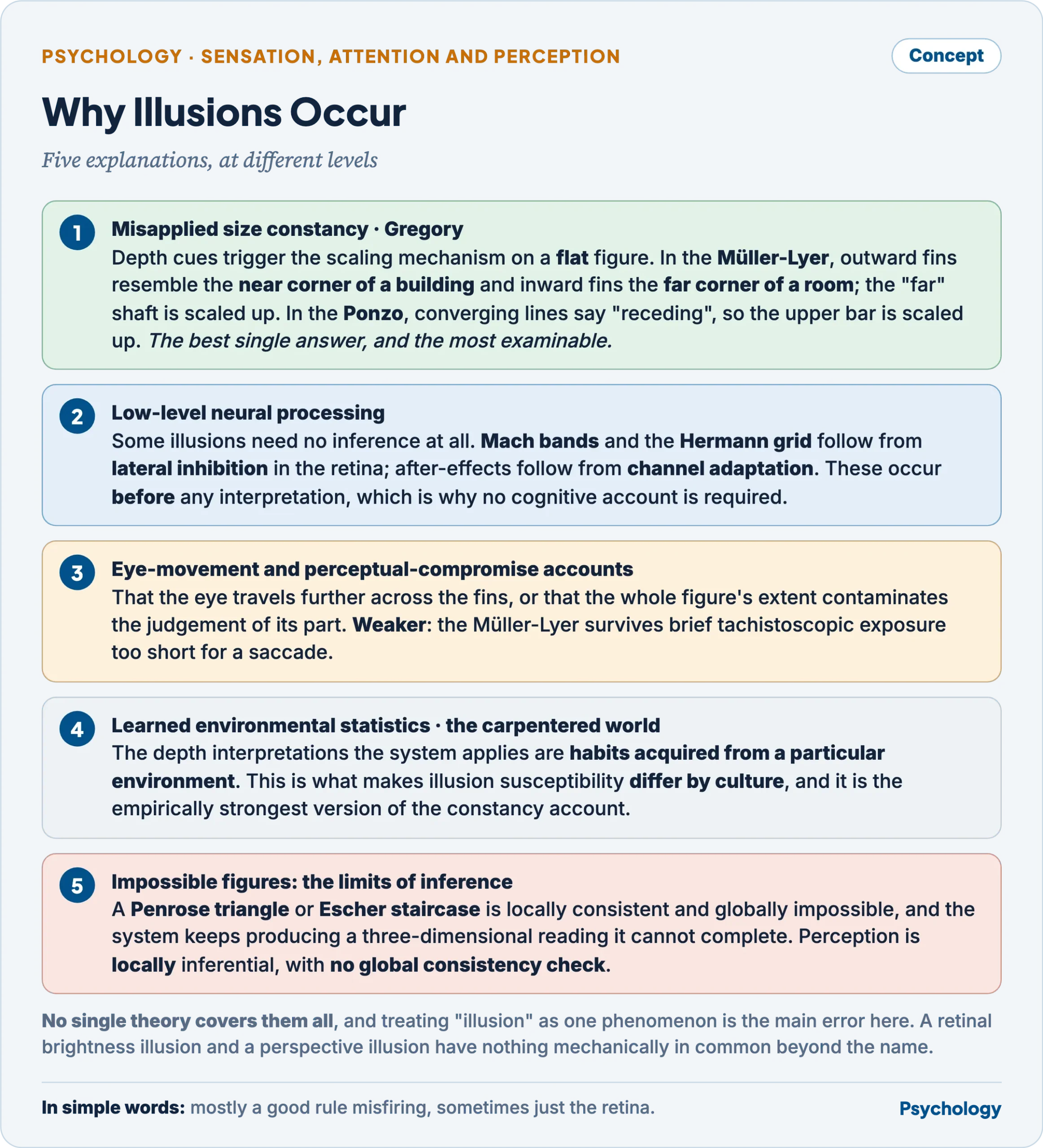
No single theory covers them all, and the best answer names several mechanisms operating at different levels — which is itself the point, since illusions arise wherever any stage of processing applies a rule outside its proper domain.
Misapplied constancy scaling
Gregory’s theory is the most important and should lead any answer. Perception applies size constancy: an object judged to be further away is scaled up, so that its perceived size matches its physical size rather than its retinal size. In a flat figure containing perspective cues, the scaling mechanism is triggered by the cues and applies — but there is no actual distance difference to compensate for, so the correction becomes an error.
Applied to Müller-Lyer: the outward fins resemble the inside corner of a room, which is a receding, more distant edge; the inward fins resemble the outside corner of a building, a nearer edge. The system scales the “more distant” line up, and it is seen as longer. Applied to Ponzo: the converging lines are linear perspective, so the upper horizontal is registered as more distant and scaled up.
The strongest evidence for Gregory’s account is cross-cultural, and it is set out in the next section — the theory predicts that people not raised among rectangular carpentry should be less susceptible, and they are.
Other mechanisms
- Perspective and depth-cue theory more broadly: illusions arise wherever two-dimensional figures contain cues the system treats as three-dimensional.
- Day’s conflict theory. Where two sources of information about extent disagree — the length of the line against the length of the whole figure — perceived length is a compromise. This handles Müller-Lyer without invoking depth at all, which matters because the illusion survives in forms with no plausible perspective reading.
- Lateral inhibition and low-level neural interaction. The café wall and some brightness illusions arise in the retina and early cortex from the interaction of adjacent receptive fields, with no cognitive component.
- Eye-movement theory. The eye travels further across one figure than the other. Largely discredited, since the illusions survive in brief exposures too short for eye movements and in afterimages.
- Contrast and assimilation. Ebbinghaus is a size-contrast effect — judgement against a reference frame — rather than a depth effect.
- Apparent-distance and angular-size contrast accounts of the moon illusion. On the first, the horizon moon is seen across intervening terrain rich in depth cues and is therefore registered as further and scaled up, while the zenith moon has no cues. On the second, the horizon moon is surrounded by small objects and the zenith moon by a vast empty sky, so relative size contrast differs. Neither alone accounts for the full effect, and the illusion remains genuinely unresolved after two millennia of discussion.
Illusions and constancies are the same mechanism
This is the single most useful idea in the topic and converts a list into an argument.
Constancies are the achievements: size constancy (a person does not shrink as they walk away), shape constancy (a door is seen as rectangular through every trapezoidal projection as it opens), brightness constancy (coal looks black in sunlight and paper white in shadow, though the coal may reflect more light), colour constancy (a shirt keeps its colour under tungsten and daylight), and location constancy (the world does not jump when the eyes move).
Each constancy is produced by taking context into account — scaling the raw sensory value by an estimate of distance, slant or illumination. That scaling is almost always right, and the result is a stable world.
An illusion is that same scaling applied where it does not belong. The Ames room produces a size illusion precisely because shape constancy is working: the system assumes the room is rectangular, registers the two corners as equidistant, and therefore must conclude the people differ in size. The error is not a malfunction but the correct operation of a rule outside its domain.
The conclusion that follows is the answer to what illusions tell us about perception: they show that perception is inference from assumptions, and they reveal what the assumptions are. A perfect camera would have no illusions and also no constancies, and would therefore be far less useful.
Is perception a constructive process?
The evidence from illusions and constancies, taken together, supports a constructive account, and the argument has four steps.
- The input underdetermines the output. The same retinal image is consistent with infinitely many world arrangements, so the percept contains information not present in the stimulus. That surplus must be contributed by the perceiver.
- Constancies prove that contribution is systematic. Perceiving a receding door as rectangular requires the system to use information about slant that is nowhere in the shape of the retinal image.
- Illusions prove the contribution is rule-governed and involuntary. The errors are consistent in direction, predictable in magnitude, and survive the knowledge that they are errors.
- Context effects complete it. The same grey patch, the same line, the same ambiguous character is perceived differently according to surroundings, so the percept is a function of the whole configuration rather than of the local stimulus.
Why our representations are not entirely accurate then has a precise answer with five parts: the input is incomplete and must be filled in; the system selects only a fraction through attention; it applies assumptions that hold usually and not always; it is shaped by expectation, motive and emotion; and it is built for action rather than accuracy — a fast, usually-right representation that supports behaviour beats a slow, always-right one, so the system trades accuracy for speed and gets it mostly right.
The necessary qualification is Gibson’s: in a rich, textured, three-dimensional environment with a moving observer, the available information is far greater than constructivist laboratory studies suggest, and perception is correspondingly more direct and less inferential. Illusions are produced by impoverished, static, two-dimensional displays — the Ames room works from one fixed viewing point with one eye and collapses the moment the observer moves. So the constructive account is right, and the degree of construction required depends on how impoverished the input is.
Culture and perception
If perception depends on assumptions, and assumptions are installed by the environment, then people raised in different environments should perceive differently. They do, and the illusion evidence is the best-documented case.
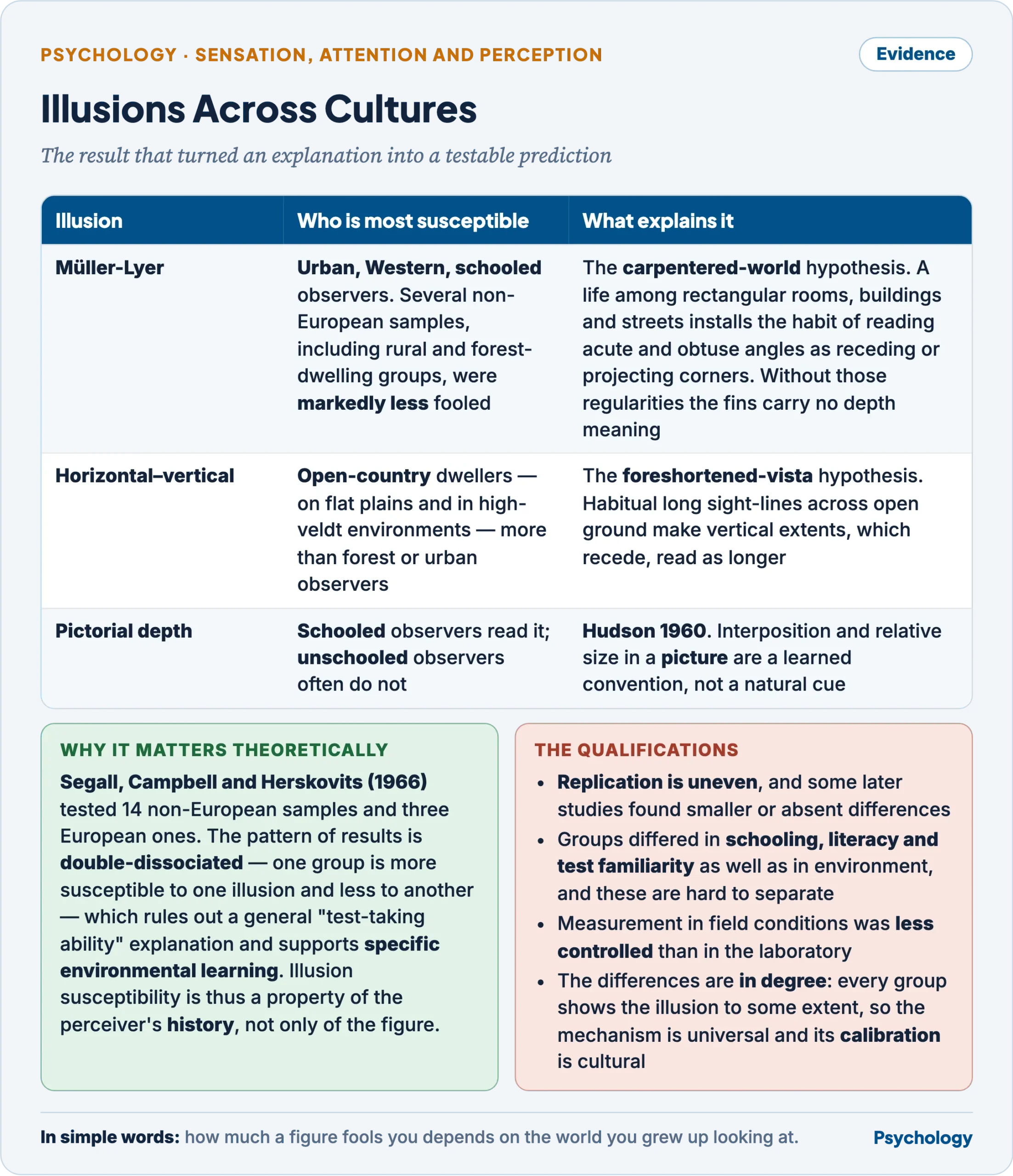
The cross-cultural illusion evidence
- Rivers (1905), working on the Cambridge Anthropological Expedition to the Torres Straits and in India, compared English, rural Indian and New Guinean participants on the Müller-Lyer and horizontal–vertical illusions. English participants showed the stronger Müller-Lyer illusion; the Indian and New Guinean participants showed the stronger horizontal–vertical illusion. This is the first demonstration that susceptibility to illusion varies systematically by culture, and the Indian sample makes it directly usable.
- Segall, Campbell and Herskovits (1966) conducted the large systematic study, comparing Western and non-Western samples on five illusions. Western samples showed higher susceptibility to the Müller-Lyer, the Sander parallelogram and the Ponzo and its adaptations; non-Western samples showed higher susceptibility to the horizontal–vertical illusion.
The three hypotheses
- The carpentered world hypothesis. People raised in rectangular, manufactured environments — buildings with square corners, rooms, streets meeting at right angles — learn to interpret acute and obtuse angles on a flat surface as right angles receding in depth. That habit is exactly what Gregory’s misapplied-constancy account requires, so they are more susceptible to Müller-Lyer and Sander. People raised in rounded dwellings and irregular landscapes have not installed the habit and are less susceptible.
- The foreshortening hypothesis. People living in open, broad landscapes are accustomed to interpreting vertical extents in the picture plane as long distances receding along the ground, and so are more susceptible to the horizontal–vertical illusion. Those in enclosed, forested or urban environments where long sightlines are rare are less so.
- The sophistication hypothesis. Exposure to pictorial material — photographs, drawings, printed illustration — trains the interpretation of two-dimensional representations and so increases susceptibility to illusions that depend on reading flat figures as depictions.
Several studies have supported these, and the carpentered-world account in particular is the strongest single piece of evidence for Gregory’s theory: it was a prediction that people from non-carpentered environments should show the weaker Müller-Lyer illusion, and the prediction held.
Culture beyond illusions
- Pictorial depth perception. Hudson (1960, 1970) presented drawings containing pictorial depth cues and asked what was happening. Schooled participants read the third dimension as intended; unschooled participants frequently did not, judging the hunter to be aiming at the distant elephant rather than the nearer antelope. Reading depth from a flat picture is a learned convention, not a perceptual universal, which is a caution for anyone designing visual material for a mixed-literacy population.
- Colour perception. Colour vision is physiologically universal, and colour naming varies: languages differ in how many basic colour terms they have and where the boundaries fall. The consistent finding is that discrimination is universal while categorisation is linguistic, so speakers of a language with one term covering blue and green still see the difference but categorise and remember it differently.
- Pattern and figure perception. Familiarity and schooling speed recognition, which again points to experience rather than to any difference in the sensory apparatus.
- Auditory perception. Differences in auditory acuity between populations have been reported, with non-industrialised groups showing better sensitivity and less age-related loss — plausibly an effect of lifetime noise exposure rather than of culture as such.
- Analytic against holistic attention. East Asian observers attend relatively more to context and relationships and Western observers relatively more to focal objects, a difference visible in eye-movement records and in memory for backgrounds. This is the clearest modern evidence that culture shapes what is attended and not only what is believed.
- Social perception. Judgements of emotion, intention and character are strongly culture-bound, since the categories applied are supplied by the culture.
The psychological factors alongside the cultural
- Perceptual set and expectation, which determine which interpretation of an ambiguous stimulus is adopted.
- Motivation and need, which lower thresholds for need-relevant material.
- Emotion, which biases toward threat and narrows the attended field.
- Past experience and expertise, which determine the categories available.
- Values, which were the New Look movement’s central claim: participants judged coins as larger than discs of the same size, and poorer children more so than richer ones.
The integrating statement is that culture acts on perception through exactly these psychological mechanisms, not alongside them. Culture supplies the experience that installs the assumptions, the categories that set is readiness for, and the values that weight the motives — which is why the cultural and psychological halves of this question are one answer and not two.
Criticisms and limitations
- No unified theory of illusion exists. Different illusions require different mechanisms at different levels, and the field has a collection of partial explanations rather than a theory.
- Gregory’s account does not cover all cases. Müller-Lyer persists in versions with circles or squares replacing the fins, where no perspective reading is available, which is what Day’s conflict theory was proposed to handle.
- The moon illusion remains unexplained after two thousand years of attention, which is a standing embarrassment to the field.
- Illusion research uses atypical stimuli. Brief, flat, impoverished, two-dimensional displays are where inference is forced to work hardest, so building a general theory of perception on them risks overstating how constructive ordinary perception is.
- The cross-cultural studies have real methodological problems. Samples were small and opportunistic, “culture” was confounded with schooling, literacy, urbanisation and familiarity with testing, instructions had to be translated, and the demand characteristics of an unfamiliar testing situation were not controlled. The findings have held up in direction, and the size of the effects should be treated cautiously.
- The early cross-cultural literature carries a colonial framing. Studies conducted on colonised populations by metropolitan researchers took the Western pattern as the standard and the other as the deviation, and some of the sophistication-hypothesis language reflects this. The findings survive the framing, but the framing should be named rather than reproduced.
- Culture is treated as a nation or a group when the operative variables are usually schooling, literacy, urbanisation and the built environment — variables that vary enormously within any society, including within India.
Previous Year Questions
- 2025Explain how psychological and cultural factors affect perception.
- 2015Do you think that cultural settings influence the understanding and evaluation of meanings of external stimuli? Provide suitable justification for your answer.
- 2019Why do most people experience geometrical illusions? Explain from the psychological perspective.
- 2014Is perception a constructive process? Explain in the light of studies on illusions and constancies.
- 2013Why our representations of the external world are not entirely accurate?
- 2011What do illusions tell about the nature of perception?