

Values in public service; Regulatory Commissions; National Human Rights Commission; Problems of administration in coalition regimes; Citizen administration interface; Corruption and administration; Disaster management.
This article: Values in public service (meaning, sources, families of values, the Nolan principles, constitutional values, the 2nd ARC’s Ethics in Governance, the draft Public Services Bill, the 2014 values clause, codes for ministers, Appleby, Waldo, the New Public Service, public service motivation, values under market reforms, the committed bureaucracy debate, citizens’ ethics); Regulatory Commissions (the regulatory state in India, the main regulators, their quasi-legislative, quasi-judicial and executive powers, SEBI and TRAI at work, independence, capture, overlap, accountability, tribunals, the 2nd ARC’s 13th Report, FSLRC, the draft Regulatory Reform Bill, regulatory impact assessment, leading judgments, the Central Social Welfare Board); the National Human Rights Commission (Protection of Human Rights Act 1993 and its 2006 and 2019 amendments, composition, powers, procedure, limitations, State Commissions and Human Rights Courts, Paris Principles and GANHRI accreditation, custodial deaths, encounters, bonded labour, leading judgments).
Official Syllabus: Paper II · Unit 2-14 Significant Issues in Indian Administration
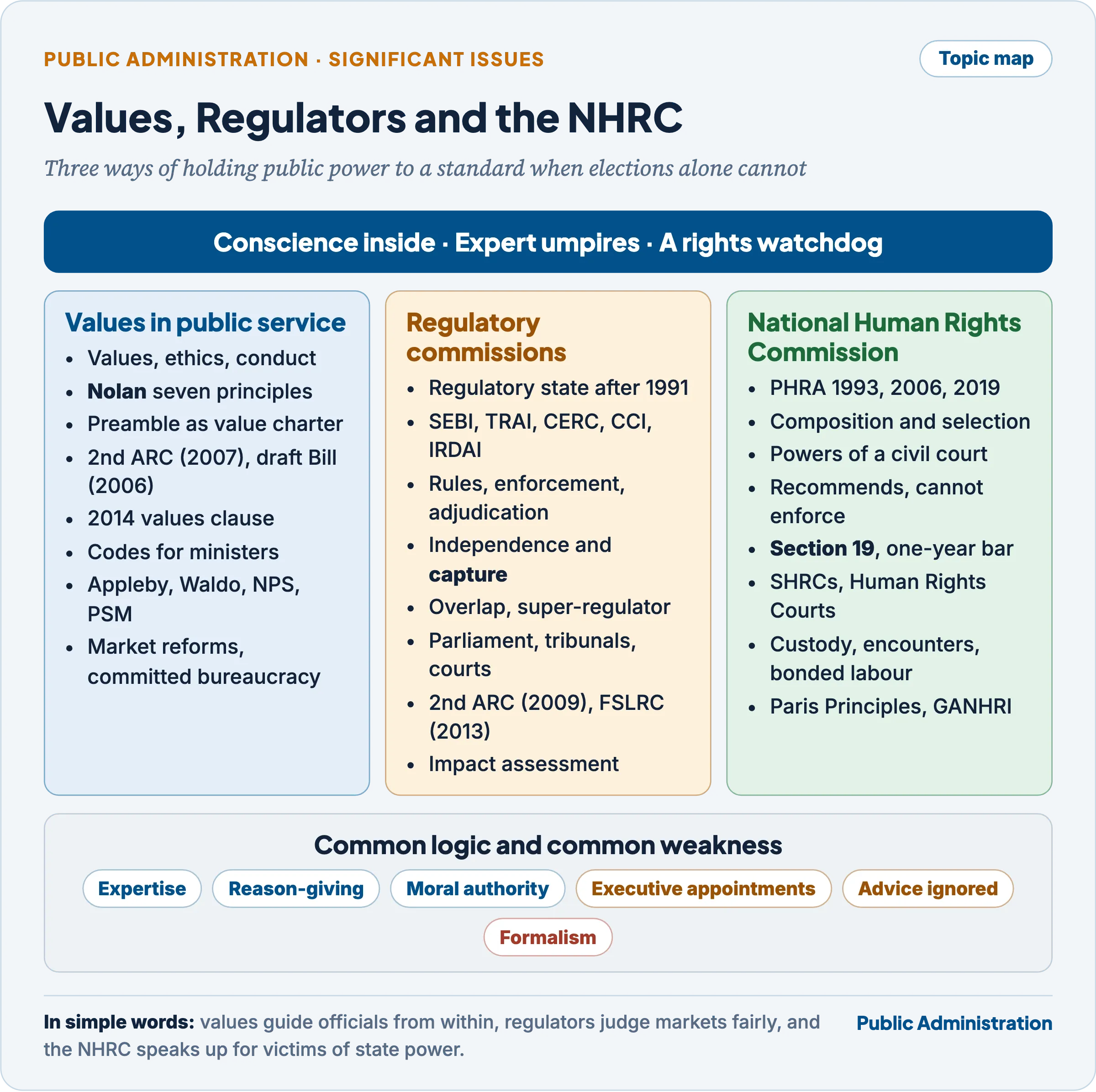
These three syllabus items look unrelated, but they answer one question: how does a democracy keep public power honest when elections alone cannot? Values work from inside the official, as a sense of what is right. Regulatory commissions take technical decisions away from day-to-day politics and hand them to expert, rule-bound bodies. The National Human Rights Commission (NHRC) watches the state’s coercive arm (police, jails, armed forces) on behalf of the citizen. All three rely less on command than on expertise, reason-giving and moral authority, and all three are only as strong as the political system lets them be.
In simple words
Think of a cricket match. Values are the players’ own sense of fair play; the regulator is the umpire who applies the rules without favouring either team; the NHRC is the match referee who steps in when a player is hurt by foul play. A match needs all three, and none of them works if the team owners can sack the umpire or ignore the referee.
1. Values in Public Service: Meaning, Sources and Families
In simple words
A value is a belief about what matters: honesty, fairness, service. Rules tell an official what not to do; values guide the many choices that no rule covers, such as whom to help first or how to treat a poor applicant. A public service with good rules but weak values follows the letter of the law and misses its purpose.
1.1 Values, ethics and conduct
- Values are enduring beliefs that influence attitudes, actions and choices. This is the working definition of Canada’s Task Force on Public Service Values and Ethics chaired by John Tait, whose report A Strong Foundation (1996) remains the classic study of the subject.
- Ethics is a sub-set of values: the beliefs about what is right or wrong. Not every value choice is ethical (a career or non-career service is a design choice), but an ethical choice always involves a possible wrong. The American scholar Montgomery Van Wart similarly treats ethics as values in action.
- Conduct is behaviour, and codes of conduct turn values into enforceable rules of behaviour.
- The OECD defines public service values as the principles or standards that guide judgement about what is good or proper. Values themselves “do nothing”: they act only when officials apply them in decisions.
| Level | What it is | Indian example |
|---|---|---|
| Values | Broad beliefs about what is good (integrity, impartiality, service) | Preamble; values in the draft Public Services Bill |
| Code of ethics | Principles that guide judgement in grey areas | AIS (Conduct) Rules 3(1A) and 3(2B), inserted 2014 |
| Code of conduct | Specific dos and don’ts, enforced by discipline | CCS (Conduct) Rules 1964; AIS (Conduct) Rules 1968 |
The table shows a ladder from the abstract to the enforceable. Values give direction, ethics gives a method of judgement, and conduct rules give a floor below which no official may fall. The 2nd ARC built its proposals on exactly this three-step ladder (section 2.3).
1.2 Why values matter more in public service
- Public office is a trust. Officials exercise powers that belong to citizens; the 2nd ARC called authority a trusteeship to be used only in the public interest.
- Discretion is unavoidable. Laws cannot foresee every case; the field official deciding a ration card, a land record or a police complaint fills the gap with judgement. Values decide whether discretion serves the citizen or the official.
- Monopoly and coercion. A citizen can leave a bad shop but not a bad tehsil office or police station. Where exit is impossible, values and accountability must do the work that competition does in markets.
- The “soft state”. The Swedish economist Gunnar Myrdal, in Asian Drama (1968), described South Asian countries as soft states: they pass progressive laws but lack the social discipline to enforce them, and officials collude with the powerful. A soft state is above all a values deficit.
- Values need institutions, and institutions need values. The 2nd ARC’s fourth report opened with this point: values are the guiding stars, but without institutional support they weaken; institutions without values become empty shells.
- History’s warning. Historians from Edward Gibbon onward have linked the decline of states to nepotism, corruption and moral decay among their rulers and officials.
1.3 Sources of public service values
- Religious and civilisational traditions. Most traditions converge on a short list of virtues: truth, non-violence, honesty, self-restraint and service to others (the dharma of Manu, the Buddha’s precepts, the Ten Commandments, Confucius’s jen, yi and li). Kautilya‘s Arthashastra is the Indian classic on official integrity: it famously compares detecting an official’s embezzlement to knowing when a fish drinks water (see the article on Kautilya’s Arthashastra).
- Secular and democratic ideals. Locke, Montesquieu and Rousseau grounded government in consent, rights and the separation of powers; the American Declaration of Independence (1776) and the French Declaration of the Rights of Man (1789) turned these into public values: equality, liberty, equal access to public office.
- The Constitution. The Preamble (justice, liberty, equality, fraternity, dignity), Fundamental Rights, Directive Principles (Articles 38, 39, 46), Fundamental Duties (Article 51A) and the oath of office in the Third Schedule are India’s authoritative statement of public values.
- Gandhian ethics. Gandhi’s talisman (recall the face of the poorest person and ask whether your step will help him) is the simplest Indian test of a public decision; his seven social sins (Young India, 1925), which include “politics without principles” and “commerce without morality”, name the values a public servant must resist.
- Professional norms: the ethics of doctors, engineers, auditors, police and judges add role-specific values.
- International codes: the UN International Code of Conduct for Public Officials (General Assembly resolution 51/59, 1996), the OECD Recommendation on Improving Ethical Conduct in the Public Service (1998) and its Recommendation on Public Integrity (2017), and national codes such as the UK Civil Service Code (1996), Canada’s Values and Ethics Code and New Zealand’s public service code.
1.4 Families of public service values
The Canadian scholar Kenneth Kernaghan, building on the Tait Report, grouped public service values into four overlapping families (“Integrating Values into Public Service: The Values Statement as Centerpiece”, Public Administration Review, 2003).
| Family | Core values | What it asks of the official | Indian illustration |
|---|---|---|---|
| Democratic | Rule of law, loyalty to the elected government, accountability, neutrality | Give honest advice; implement lawful decisions loyally; support ministerial accountability | Article 75(3) collective responsibility; Rule 3(1A) political neutrality |
| Professional | Competence, excellence, efficiency, objectivity, innovation | Serve with skill; use public money well; care how ends are achieved | Mission Karmayogi’s competency framework |
| Ethical | Integrity, honesty, probity, fairness | Act so that conduct bears the closest public scrutiny; resolve conflicts of interest in favour of the public | Declaration of assets; conflict-of-interest rules |
| People | Respect, courtesy, compassion, dignity | Treat citizens and colleagues with fairness and civility | “Responsiveness to the public, particularly to the weaker section” (AIS Rule 3(1A)) |
- The families overlap and sometimes clash. Efficiency (professional) may collide with due process (democratic); loyalty to the minister may collide with honesty to Parliament.
- Universal values. Reviews of public sector codes repeatedly find the same core: honesty and integrity, impartiality, respect for the law, respect for persons, diligence, economy and effectiveness, responsiveness and accountability. Many writers call these eternal values, because they change little across time and culture.
- How many public values are there? The Danish and American scholars Torben Beck Jørgensen and Barry Bozeman, in “Public Values: An Inventory” (Administration & Society, 2007), catalogued dozens of public values from the literature and showed that they form constellations (some values promote others; some compete), which is why no single value can be maximised.
- Christopher Hood‘s “A Public Management for All Seasons?” (Public Administration, 1991) offers a sharper typology of administrative values:
- Sigma values (keep it lean and purposeful): economy, efficiency, matching resources to tasks.
- Theta values (keep it honest and fair): equity, fairness, integrity, prevention of abuse.
- Lambda values (keep it robust and resilient): reliability, security, adaptability in crises.
- Hood’s point: a design that maximises one family weakens another. NPM pursued sigma values and was criticised for neglecting theta and lambda values (section 4.1).
Common confusion
Are values and the code of conduct the same thing? No. The CCS (Conduct) Rules, 1964 are mostly prohibitions (do not accept gifts above a limit, do not join politics) enforced by disciplinary action. Values are positive aspirations (be impartial, be compassionate) that guide judgement where no rule exists. An official can obey every conduct rule and still be indifferent, discourteous or unfair; the 2nd ARC therefore asked for a separate statement of values and a code of ethics on top of the conduct rules.
2. Nolan, the Constitution and India’s Value Statements
In simple words
Countries write down the values they expect of officials so that everyone knows the standard. Britain’s Nolan Committee wrote seven short principles in 1995. India has its Constitution, a 2007 report of the Administrative Reforms Commission, a draft law that was never passed, and a 2014 change to the service rules that finally made values part of the rulebook.
2.1 The Nolan Committee’s Seven Principles of Public Life
The UK Committee on Standards in Public Life was set up in October 1994 under the Law Lord Lord Nolan, after the “cash for questions” scandal. Its first report (May 1995) stated seven principles for every holder of public office: ministers, MPs, civil servants, councillors and staff of public bodies.
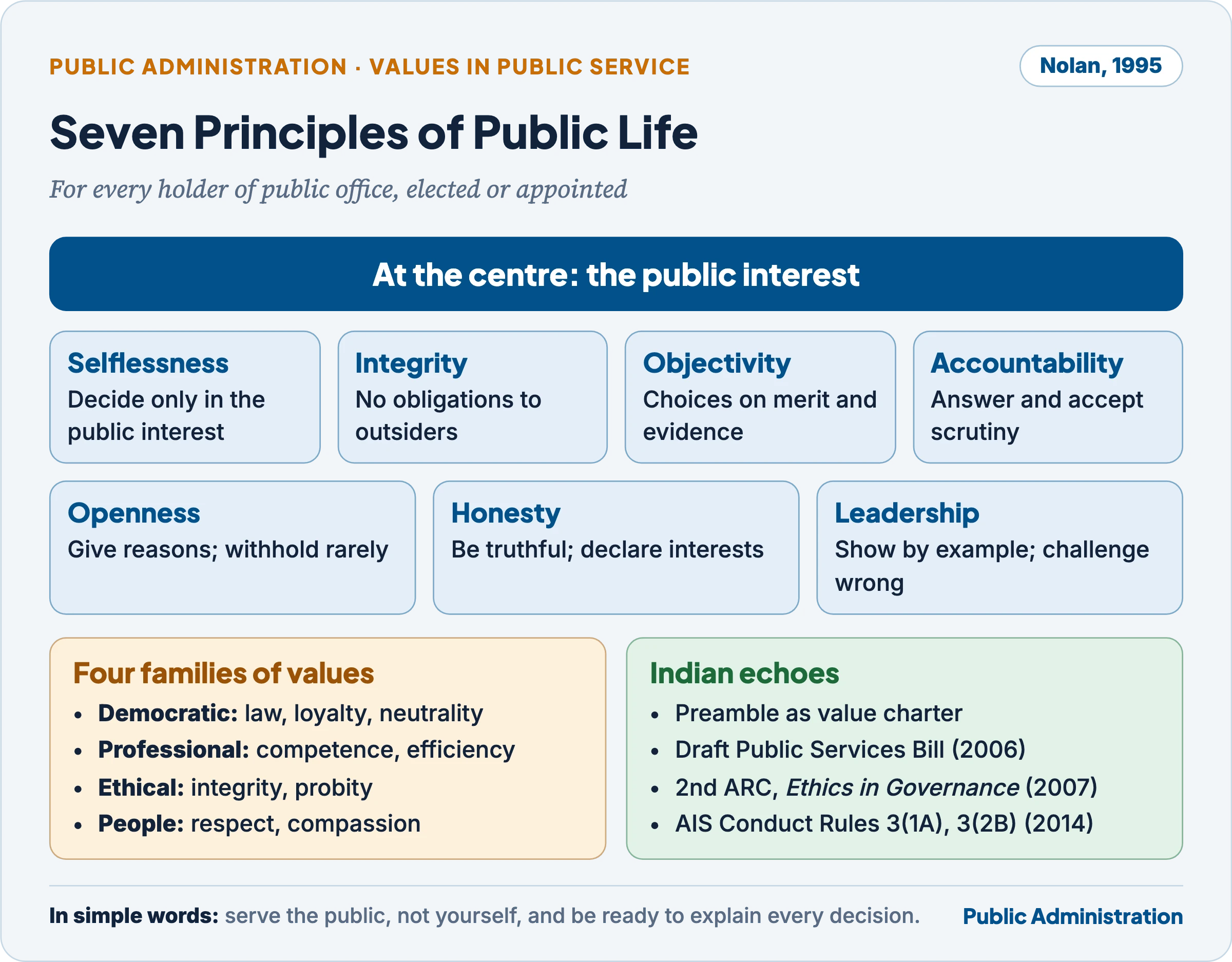
| Principle | Meaning in brief |
|---|---|
| Selflessness | Decide solely in the public interest, not for gain to self, family or friends |
| Integrity | Do not place yourself under obligations to outsiders who might influence official work |
| Objectivity | Make choices (appointments, contracts, rewards) on merit |
| Accountability | Answer to the public for decisions and submit to scrutiny |
| Openness | Be as open as possible; give reasons; restrict information only when the wider public interest demands |
| Honesty | Declare private interests and resolve conflicts in a way that protects the public interest |
| Leadership | Promote and support these principles by example |
- The descriptors above follow the 1995 wording, which the 2nd ARC reproduced; the Committee refreshed them in 2013 (honesty became simply “be truthful”, and leadership now includes challenging poor behaviour).
- Influence on India: the 2nd ARC’s fourth report quoted the seven principles as the most comprehensive statement of standards; the 2014 amendment of the AIS (Conduct) Rules uses Nolan’s language almost word for word (“decisions solely in public interest”, “not place himself under any financial or other obligations”).
- Why Nolan worked in Britain: an independent standing committee keeps the standards under review, and a political culture of resignation enforces them. India has borrowed the words more readily than the enforcement machinery. A fuller treatment is in the article on Administrative Ethics.
2.2 Constitutional values as the value charter of Indian administration
The American scholar John Rohr argued in Ethics for Bureaucrats (1978) that unelected officials should draw their values from the regime values of the Constitution, not from private morality. In India the Constitution is the obvious source.
| Constitutional value | Where found | What it requires of administration |
|---|---|---|
| Justice (social, economic, political) | Preamble; Arts. 38, 39, 46 | Priority to the weaker sections; fair distribution of benefits |
| Liberty | Preamble; Arts. 19, 21 | Restraint in the use of coercive power; due process |
| Equality | Arts. 14–16 | Non-arbitrary action; equal access to public office |
| Fraternity and dignity | Preamble; Art. 51A(e) | Courtesy and respect towards every citizen |
| Rule of law | Arts. 13, 32, 226, 311 | Action only under authority of law; reasons for decisions |
| Secularism and integrity of the nation | Preamble; Art. 51A(c) | Impartiality between communities and regions |
| Accountability | Arts. 75(3), 148–151 | Answerability through ministers, Parliament and the CAG |
- The Preamble supplies ends (justice, equality), the rights chapter supplies limits (what the state may not do), and the Directive Principles supply duties (what the state must try to do). Together they give the official a standard against which to test orders.
- Sardar Patel, defending the all-India services in the Constituent Assembly (10 October 1949), asked for officers who would give their independent opinion without fear, secure in their tenure: constitutional values need a protected service to carry them.
- Limits: constitutional values are general and contested (does equality mean identical treatment or reservation?), and courts, not officials, have the final say on their meaning.
2.3 The 2nd ARC’s fourth report: Ethics in Governance (2007)
The Second Administrative Reforms Commission (Chair: M. Veerappa Moily) submitted Ethics in Governance in January 2007. Its chapter on the civil service observed that the conduct rules mainly catalogue undesirable activities and that India has no code of ethics for civil servants.
- Three-tier ethics framework for civil servants:
- Public service values at the apex: a short statement of the values all civil servants should imbibe.
- A code of ethics: the broad principles of behaviour.
- A code of conduct: unambiguous rules on acceptable and unacceptable behaviour.
- Public Service Values to be defined by law and made applicable to all tiers of government and parastatal bodies; any transgression to be treated as misconduct inviting punishment.
- Conflict of interest to be covered comprehensively in both the code of ethics and the code of conduct; serving officials should not sit on the boards of public undertakings (non-profit and advisory bodies excepted).
- Values cannot simply be taught after recruitment: the Commission noted that values which subordinate the self to the larger good and create empathy for those in need are not easily imbibed after joining service, so recruitment, training and leadership must all carry them.
- Ministers: a code of ethics in addition to the existing code of conduct, with a dedicated unit in the offices of the Prime Minister and Chief Ministers to monitor it (section 2.6).
- Legislators: an ethics commission in each House and a code of conduct for members.
- Wider society: ethics in governance has a much wider import than government alone; it must extend to business, professions, voluntary organisations and citizens (section 4.4).
2.4 The draft Public Services Bill (2006, revised 2007)
- The Department of Personnel and Training circulated a draft Public Services Bill in August 2006 to give the civil services a statutory basis under Article 309, which allows Parliament to regulate recruitment and service conditions by law. A revised draft followed in 2007.
- Its stated objective was a professional, politically neutral, merit-based and accountable public service as an instrument of good governance.
- Values it listed (as summarised by the 2nd ARC):
- Allegiance to the ideals of the Preamble, the Constitution and the law.
- Apolitical functioning.
- Good governance for the betterment of the people as the primary goal.
- Duty to act objectively and impartially.
- Accountability and transparency in decision-making.
- Highest ethical standards.
- Merit in selection, consistent with the nation’s cultural, ethnic and other diversities.
- Economy and avoidance of wasteful expenditure.
- A healthy and congenial work environment.
- Communication, consultation and cooperation at all levels of management.
- Machinery: a Public Service Code of Ethics to be notified, a Public Service Management Code, protection of whistle-blowers and a Central Public Services Authority to review the services and report annually.
- Status: the Bill was never introduced in Parliament. Its value statement survived in diluted form in the 2014 conduct-rule amendment.
2.5 The values clause of 2014
The All India Services (Conduct) Amendment Rules, 2014 (notified in August 2014) inserted two value statements, the first time positive values entered Indian service rules.
- Rule 3(1A): maintain high ethical standards, integrity and honesty; political neutrality; promote the principles of merit, fairness and impartiality; accountability and transparency; responsiveness to the public, particularly the weaker section; courtesy and good behaviour with the public.
- Rule 3(2B): uphold the supremacy of the Constitution and democratic values; defend the sovereignty and integrity of India; take decisions solely in public interest; declare private interests and resolve conflicts; do not place oneself under obligations to outsiders; make choices on merit; act with fairness and impartiality, not discriminating against the poor and under-privileged; maintain discipline, professionalism and dedication.
- Significance and limits: values became enforceable (a breach can be misconduct), but they sit in executive rules that the government can amend, with no independent ethics authority to interpret them. The conduct rules themselves are covered in the article on Code of Conduct, Discipline and Grievance Redressal.
2.6 Codes for ministers
Values in public service apply to the political executive as much as to civil servants: a minister who uses office for private gain makes integrity impossible below.
- Code of Conduct for Ministers (Union and State), issued by the Ministry of Home Affairs (first adopted in 1964, later revised):
- Disclose assets, liabilities and business interests of self and family to the Prime Minister or Chief Minister within two months of taking office, and annually by 31 August.
- Sever all connection with the management of any business; divest interests in firms that supply the government or depend on its licences.
- Refrain from starting or joining any business, and from buying or selling immovable property to the government.
- Uphold the political impartiality of the civil services and not ask civil servants to act against their duties.
- Enforcement lies with the Prime Minister (for Union ministers), the Prime Minister and Home Minister (for Chief Ministers) and the Chief Minister (for State ministers).
- 2nd ARC’s proposal: a separate Code of Ethics for ministers to guide how they should uphold the highest standards of constitutional and ethical conduct, with monitoring units in the PMO and the Chief Ministers’ offices. The government first rejected it, holding that a code of ethics would duplicate the code of conduct; a Group of Ministers reconsidered the idea in 2013 while examining the tenth report, but no code was adopted.
- The 2023 debate: would codes help?
- For: a code of ethics gives positive standards for grey areas (use of discretionary quotas, conflicts of interest, treatment of civil servants); public codes create benchmarks for the media, Parliament and voters; the UK’s Ministerial Code shows how a published code supports accountability.
- Against: the existing code is rarely enforced and its asset declarations come in no standard format; enforcement by the Prime Minister or Chief Minister is enforcement by a party leader; codes without an independent adviser or ethics body become paper; real change depends on electoral reform, party funding and inner-party democracy.
- Balanced view: codes are necessary but not sufficient. They work when backed by disclosure in standard form, an independent body to investigate breaches, and a political culture in which breaches lead to resignation.
2.7 Core values explained
| Value | Meaning | Indian illustration |
|---|---|---|
| Integrity | Consistency between values and action; honesty in money and in word | Declaration of assets; refusal of gifts |
| Impartiality | Equal treatment of all, without fear or favour | Same rules for every applicant regardless of caste or connection |
| Neutrality | Serving any lawful government with equal loyalty; no party bias | Officers carrying out the policies of successive governments |
| Objectivity | Decisions on evidence and merit | Selection boards using written criteria |
| Empathy and compassion | Feeling for the citizen’s situation, especially the weak | A Collector reaching flood victims before the paperwork |
| Accountability | Readiness to explain and answer for decisions | Answering RTI requests, audit paras and court notices |
| Transparency | Openness about reasons and processes | Suo motu disclosure under Section 4 of the RTI Act |
| Dedication to public service | Commitment beyond the minimum; the public interest above career interest | Officers working through disasters and elections |
| Courage | Willingness to give unwelcome advice and resist illegal orders | Recording dissent on file; whistle-blowing |
| Tolerance | Respect for diversity and dissent | Neutral handling of protests and minority concerns |
- Neutrality and impartiality differ: neutrality concerns the official’s relation to political parties; impartiality concerns the relation to citizens. Both are explored in the article on Civil Service Neutrality and Activism.
- Empathy is a newer value: classical Weberian administration prized impersonality; development administration, the 2nd ARC and the 2014 rules add compassion for the weaker sections, reflecting the Directive Principles.
3. Thinkers on Public Service Values
In simple words
Scholars have asked where an official’s values should come from: from democracy itself, from the law, from the profession, from the citizen, or from the person’s own wish to serve. Each answer gives a different picture of the good public servant.
3.1 Paul Appleby: morality in democratic government
- Paul H. Appleby, the American administrator who wrote two reports on Indian administration (1953 and 1956), argued in Morality and Administration in Democratic Government (1952) that the democratic political process itself supplies the moral framework of administration.
- The morality of the official lies less in private virtue than in responsiveness to the public through political institutions, in sharing power, and in accepting political direction within the law. Hence his dictum: responsible government is ethical government.
- Stephen K. Bailey, in an essay in Appleby’s honour (“Ethics and the Public Service”, 1964), drew from his work the moral qualities a public servant needs: optimism, courage and fairness tempered by charity, together with an awareness of the moral ambiguity of all policies.
- Indian relevance: Appleby’s view supports a civil service that is committed to the Constitution and democratic process but not to a party; it also explains why ethics cannot be separated from accountability to Parliament.
3.2 Dwight Waldo: competing obligations
- Dwight Waldo, in The Enterprise of Public Administration (1980), drew a map of twelve ethical obligations of the public administrator: to the Constitution, law, nation, democracy, organisational norms, profession, family and friends, self, middle-range collectivities (caste, party, union, religion), public interest, humanity, and religion or God.
- His key insight is that these obligations have no fixed order of priority: the official must weigh them afresh in each case. Values are therefore a matter of judgement, not a checklist.
- Indian example: a District Magistrate during communal tension balances the Constitution’s equal protection, the government’s political signals, pressure from caste and religious groups, career safety and the duty to protect life (see the article on Administrative Ethics for the full map).
3.3 The Finer–Friedrich debate in brief
- Herman Finer (1941) held that only external controls (legislature, law, sanctions) keep officials responsible; Carl Friedrich (1940) held that internal responsibility (professional standards, conscience) matters more because outside checks cannot reach discretion.
- Modern value regimes combine both: codes and controls (Finer) with training, leadership and culture (Friedrich). India has relied mainly on controls; the 2nd ARC and Mission Karmayogi try to add the internal side.
3.4 The New Public Service: serving, not steering
Janet and Robert Denhardt, in “The New Public Service: Serving Rather than Steering” (Public Administration Review, 2000) and their book The New Public Service (2003), proposed a citizen-centred alternative to NPM. Its seven principles:
- Serve citizens, not customers: citizens have rights and duties; customers only have preferences.
- Seek the public interest: the public interest is a shared value arrived at through dialogue, not the sum of individual interests.
- Value citizenship over entrepreneurship: officials are stewards of public resources, not owners of a business.
- Think strategically, act democratically: policies work best when citizens help shape and implement them.
- Recognise that accountability is not simple: officials answer to law, community values, political norms, professional standards and citizens’ interests at once.
- Serve rather than steer: help citizens articulate and meet shared interests instead of controlling society.
- Value people, not just productivity: organisations succeed through collaboration and shared leadership.
- Kathryn Denhardt earlier named honour, benevolence and justice as the moral foundations of public administration (The Ethics of Public Service, 1988).
- Indian echoes: participatory planning in Panchayats, social audit under the rural employment programme, citizens’ charters and RTI.
3.5 Public service motivation
- James Perry and Lois Wise, in “The Motivational Bases of Public Service” (Public Administration Review, 1990), defined public service motivation (PSM) as an individual’s predisposition to respond to motives grounded primarily or uniquely in public institutions.
- Perry (1996) measured it through four dimensions: attraction to policy-making, commitment to the public interest and civic duty, compassion, and self-sacrifice.
- Claims: people with high PSM are more likely to choose public employment, perform better in it, and depend less on money incentives; organisations can attract, select and socialise for PSM.
- Implications for India:
- Recruitment and training should test and build motivation and values, not only knowledge (the 2nd ARC’s point that values are hard to teach after joining).
- Heavy reliance on performance pay and targets can crowd out intrinsic motivation, as studies of PSM warn.
- Recognition (PM’s Awards for Excellence in Public Administration), meaningful work and protection from arbitrary transfers sustain motivation better than money alone.
- Critique: PSM is hard to measure, may reflect self-reporting bias, and high motivation can coexist with poor capacity; motivation needs capacity and supportive structures to produce efficiency.
3.6 Public value and public values
- Mark Moore, Creating Public Value (1995), asked managers to create public value (outcomes citizens value, produced legitimately), using the strategic triangle of public value, legitimacy and support, and operational capacity.
- Barry Bozeman distinguishes public values (normative consensus on rights, benefits and obligations of citizens and governments) from market values, and warns of public value failure when neither markets nor governments deliver them.
4. Values under Strain in Indian Administration
In simple words
Good values are tested by real pressures: governments that want loyal rather than fair officers, reforms that judge officials only by targets, and citizens who offer bribes for quicker service. This section looks at where values break down and what keeps them alive.
4.1 Market approaches and traditional public service values
Since the 1990s, New Public Management (NPM) and market reforms have brought business values into government: efficiency, competition, customer focus, performance pay, contracting out and agencies with managerial freedom.
| Traditional public service values | Market (NPM) values | Where they clash in India |
|---|---|---|
| Equity and universal access | Efficiency and cost recovery | User charges in hospitals; viability-driven closure of rural services |
| Accountability through ministers and Parliament | Accountability through contracts and targets | Outsourced services where no one answers in Parliament |
| Due process and rule-following | Flexibility and results | Fast-track approvals that skip consultation |
| Citizen with rights | Customer with preferences | Services designed for those who can pay or complain online |
| Career service and neutrality | Contract and lateral hiring | Concerns over neutrality and reservation in lateral entry |
| Public interest | Organisational performance | Agencies optimising their own indicators |
- Challenges identified in the literature: new modes of governance (networks, partnerships), market-based reforms, politicisation, agencification, decentralisation and relocation, changes in HRM and recruitment, and ICT. Each creates value conflicts: PPP contracts blur responsibility; agencies may pursue sigma values at the cost of theta values (Hood); digital services can exclude the poor.
- The case against overstating the threat: market tools have improved some values too: transparency (online tracking), responsiveness (time-bound services under right-to-services laws) and reduced discretion (direct benefit transfer cut leakages). The 2nd ARC itself observed that competition and transparency reduce corruption (telephones, railway reservations).
- Balanced position: India needs “NPM with public values”: market tools inside a frame of equity, accountability and constitutional rights, which is the New Public Service’s argument (see the article on New Public Management and After).
4.2 Politicisation and the committed bureaucracy debate
- Weber’s two partners: Max Weber saw the modern state run by two uneasy partners, the elected politician and the career official: one brings interests and values, the other facts and expertise. Their relationship is the central puzzle of democratic administration.
- Early harmony: under Nehru and Patel, emphasis on cooperation built trust between ministers and the services.
- The 1967 turning point: the end of single-party dominance in several States, defections and unstable governments made politicians more aggressive towards administrators; ministers busy with survival either rubber-stamped official advice or bullied pliable officers (the coalition dimension is covered in the companion article on coalition regimes).
- “Committed bureaucracy” (around 1969–70): the call that civil servants be committed to the ruling party’s programme and ideology, not merely to the Constitution, blurred the line between commitment to constitutional values (desirable) and commitment to a party (destructive of neutrality).
- Symptoms of value erosion:
- Transfers with every change of government, including under President’s Rule.
- Caste and patronage in postings; officers seeking post-retirement sinecures.
- Officers becoming “willing tools” of those in power, and the politician–business–official nexus.
- Field studies such as that of Shanti Kothari and Ramashray Roy found politicians and administrators holding conflicting views of each other’s roles, with grievances, loans and site allotments as recurrent flashpoints.
- Do civil servants mirror their political masters’ values? Partly. Where postings and careers depend on political favour, officials adapt to the values of those above them (a principal–agent and career-incentive effect). But constitutional and service protections (Article 311, fixed tenure under T.S.R. Subramanian v. Union of India, 2013, Civil Services Boards, written instructions) give room for independent values. The debate is treated fully in the article on Civil Service Neutrality and Activism.
- Remedies often proposed: electoral reform to reduce money and muscle power; probity at the top; strong UPSC, CVC and judiciary; inner-party democracy; protection for honest officers; transparent transfer policies; and a working Lokpal.
4.3 Why implementation depends on ethical values
- Government remains central to the lives of most Indians (food, schooling, health, land, jobs). Yet the gap between policy and outcome usually opens at the point of delivery.
- Michael Lipsky‘s Street-Level Bureaucracy (1980) showed that front-line workers (teachers, constables, patwaris, health workers) make policy in practice through discretion over whom to serve and how. Their values determine whether a scheme reaches the eligible.
- Where values change outcomes:
- Targeting: honest identification of beneficiaries versus inclusion of the connected.
- Leakage: diversion of rations, wages and materials.
- Dignity: courtesy towards poor and illiterate applicants decides whether they return.
- Initiative: officers who go beyond the minimum (disaster response, campaign-mode drives) deliver results that rules alone cannot.
- But values are not enough: good values without capacity, resources and simple procedures produce frustration; poor design creates temptations that values must constantly resist. The 2nd ARC therefore paired values with simplification, reduced discretion, transparency and e-governance.
4.4 Ethics beyond the state: citizens and public life
- In a democracy citizens are co-producers of integrity. Much corruption is collusive: the citizen who pays to jump a queue, evade tax or get an illegal construction approved is a partner, not a victim (the 2nd ARC’s distinction between coercive and collusive corruption).
- The 2nd ARC stressed that ethics must extend to corporate ethics, the professions, voluntary organisations and civil society, because these now share in governance.
- Constitutional anchor: Article 51A lays Fundamental Duties on citizens: to abide by the Constitution, promote harmony, safeguard public property and strive towards excellence.
- Citizen roles in an ethics regime: demanding receipts and reasons; using RTI, social audit and grievance portals; refusing to pay bribes; voting against criminal and corrupt candidates; and whistle-blowing.
- Administrative values have value only when shared. A code the political class ignores, or a reform citizens do not demand, will not change behaviour; values must be valued by all stakeholders: politicians, officials, business, media and citizens.
4.5 Building a values regime
Indian Connect — Institutionalising values in Indian administration
- Statement of values: the 2014 values clause; a statutory Civil Services Law remains pending since the 2006 draft.
- Recruitment and training: Ethics, Integrity and Aptitude paper in the Civil Services Examination since 2013; Mission Karmayogi (launched September 2020) and the iGOT platform add behavioural and functional competencies, including citizen-centricity.
- Leadership by example: Kernaghan’s lesson that leaders must be models and managers of values.
- Protection of dissent: Whistle Blowers Protection Act, 2014 (its operative provisions have not been notified); recording of oral instructions; fixed tenure.
- Transparency and accountability: RTI, social audit, CVC’s preventive vigilance, Lokpal.
- Reward and recognition: PM’s Awards for Excellence in Public Administration; integrity in appraisals.
- Prevention of misconduct needs values at both levels. Rules catch only what they foresee; misconduct is prevented when political and administrative leaders model integrity, when systems reduce temptation, and when breaches are punished swiftly. Equating public ethics with anti-corruption enforcement alone is insufficient: an ethics code that only prohibits bribery says nothing about fairness, courtesy, courage or care for the weak.
5. Regulatory Commissions: The Regulatory State in India
In simple words
Before 1991 the government ran telephones, airlines and power plants itself. When private firms entered these fields, someone neutral had to set prices, settle disputes and protect customers. Parliament created expert bodies such as SEBI, TRAI and the electricity commissions to do this at arm’s length from ministers.
5.1 The regulatory function of the state
- Government functions can be grouped as regulatory, service-providing and developmental. Regulation (laws on traffic, building, food, weapons, immigration, taxes) has always been a core function of the state, because unlimited freedom for one person infringes the rights of others.
- Constitutional basis: Article 19 allows reasonable restrictions on fundamental freedoms; Article 53(3)(b) allows Parliament to confer functions by law on authorities other than the President, the basis of statutory regulators; Article 39(b) and (c) direct the state against concentration of wealth.
- The over-regulation problem: India has been rated a relatively over-regulated state that burdens business and citizens yet enforces poorly. The 2nd ARC’s twelfth report, Citizen Centric Administration (2009), set five principles:
- Regulation only where necessary: periodic scrutiny of all laws, repeal of unnecessary ones and simplification.
- Regulation must be effective: build enforcement capacity, with supervision and independent assessment.
- Self-regulation is the best form of regulation: shift to self-assessment (income tax, GST) and self-certification (building plans certified by registered architects).
- Simple, transparent and citizen-friendly procedures using IT.
- Involve citizens’ groups and professional bodies in enforcement.
5.2 From licence raj to independent regulators
- Before 1991: regulation was departmental: industrial licensing under the Industries (Development and Regulation) Act, 1951, price controls, the MRTP Commission (1969), and public monopolies in telecom, power and insurance. The same ministry owned the producer and made the rules.
- Why independent regulators after 1991:
- Private entry into telecom, power, insurance, airports and capital markets needed a neutral umpire, since PSUs competed with private firms and a ministry owning BSNL or a State electricity board could not be fair.
- Investor confidence: long-term investment needs credible commitment that tariffs will not be cut before every election (the time-inconsistency problem).
- Technical complexity of tariffs, spectrum, interconnection and prudential norms required experts.
- Insulation of technical decisions from day-to-day political interference.
- International templates: the American commission model and British utility regulators spread worldwide.
- Majone’s regulatory state: Giandomenico Majone (The Rise of the Regulatory State in Europe, 1994) described the shift from the positive state (owning and spending) to the regulatory state (rule-making by non-majoritarian institutions whose legitimacy rests on expertise and procedure, not votes). India’s post-1991 trajectory follows this pattern, though with far more ministerial control.
- Diffusion by emulation: Fabrizio Gilardi (Delegation in the Regulatory State, 2008) showed that independent regulators spread across countries partly by emulation: once a model looks legitimate, others copy it, sometimes under donor pressure. TRAI and the electricity commissions were shaped partly by such templates, which explains why form sometimes runs ahead of function.
- Does regulation end the “arbitrator state”? Not quite. Discretionary, case-by-case arbitration by ministers is replaced by standing, rule-based arbitration through regulators and tribunals; the state remains the final arbiter in crises. The theory is covered in the article on Regulatory Authorities and Public-Private Partnerships.
5.3 India’s regulators
| Sector | Regulator | Law (year of body) | Appellate forum |
|---|---|---|---|
| Money, banks, payments | RBI; Monetary Policy Committee | RBI Act, 1934; MPC under the 2016 amendment | Courts |
| Securities | SEBI | Set up 1988; SEBI Act, 1992 | SAT |
| Insurance | IRDAI | IRDA Act, 1999 | SAT |
| Pensions | PFRDA | Set up 2003; PFRDA Act, 2013 | SAT |
| Telecom and broadcasting | TRAI | TRAI Act, 1997 (amended 2000) | TDSAT |
| Electricity | CERC and SERCs | ERC Act, 1998; Electricity Act, 2003 | APTEL |
| Petroleum and gas | PNGRB | PNGRB Act, 2006 | APTEL |
| Airports tariffs | AERA | AERA Act, 2008 | TDSAT |
| Competition | CCI | Competition Act, 2002 (set up 2003; MRTP wound up) | NCLAT |
| Insolvency | IBBI | Insolvency and Bankruptcy Code, 2016 | NCLAT |
| Food safety | FSSAI | Food Safety and Standards Act, 2006 (set up 2008) | Tribunals and courts |
| Real estate | State RERAs | RERA, 2016 | Real Estate Appellate Tribunals |
| Personal data | Data Protection Board of India | DPDP Act, 2023 (established 13 November 2025) | TDSAT |
- General and sectoral regulators: the CCI is a general (economy-wide) regulator of competition; TRAI, CERC, IRDAI are sector-specific.
- Older arm’s-length regulators predate 1991: the RBI, the Central and State Pollution Control Boards (1974) and the MRTP Commission.
- Self-regulatory bodies: professional councils (Bar Council, Institute of Chartered Accountants, Medical and Nursing Councils) regulate professional education and ethical conduct; some are statutory, some voluntary (the Institution of Engineers). The 2nd ARC’s ninth report, Social Capital (2008), recommended strengthening their autonomy and accountability.
- Federal layering: electricity and real estate have State regulators, so regulatory quality varies across States, and tariff-setting remains politically sensitive.
5.4 Features and powers: three powers in one body
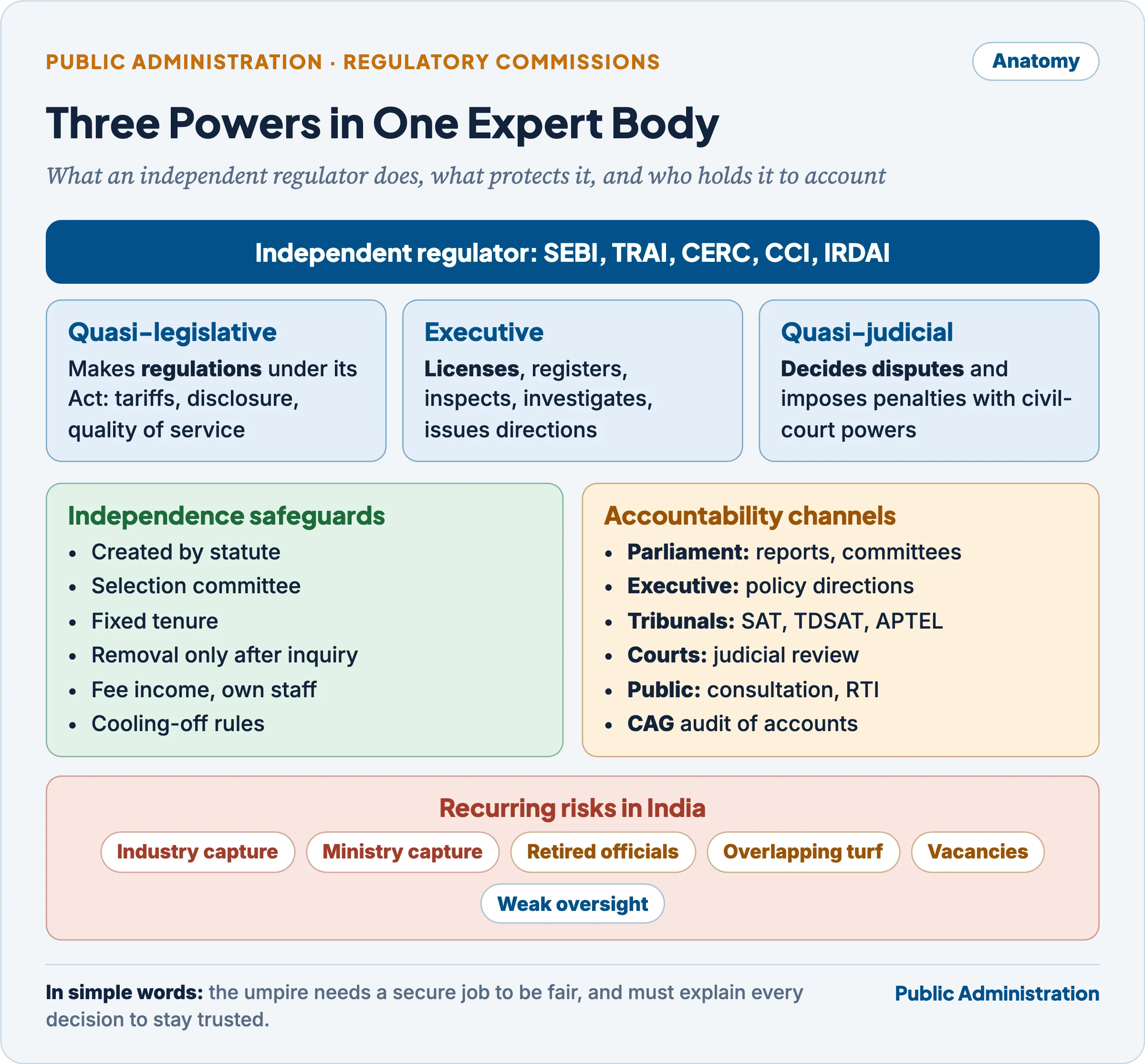
- Quasi-legislative powers: making regulations under the parent Act (SEBI’s insider-trading and disclosure regulations; TRAI’s tariff and quality-of-service regulations; CERC’s tariff regulations under Section 178 of the Electricity Act). These are delegated legislation, laid before Parliament and open to judicial review.
- Executive powers: licensing and registration (SEBI registers intermediaries; CERC grants transmission and trading licences), inspection, investigation and monitoring, issuing directions.
- Quasi-judicial powers: adjudicating disputes and imposing penalties (SEBI’s adjudicating officers; CERC and SERCs deciding disputes between generators and distributors; CCI penalising cartels), usually with the powers of a civil court.
- Advisory power: TRAI’s statutory recommendations on spectrum and licensing; CERC’s advice to government.
- Other features:
- Statutory creation and a defined mandate.
- Collegial (multi-member) structure with fixed terms.
- Expert membership; some financial autonomy through fees (SEBI, IRDAI) or government grants (TRAI, CERC).
- Members are public servants for purposes of the criminal law, and accounts are audited by the CAG.
- Annual reports are laid before Parliament.
- Decisions are appealable to specialised tribunals and then to the Supreme Court.
- Why combine three powers? Speed, expertise and continuity. The risk is bias and concentration of power, which is why good practice separates investigation from adjudication inside the body (CCI’s Director General investigates; the Commission decides) and insists on natural justice and reasoned orders.
5.5 Boards that promote: the Central Social Welfare Board
Not every “board” regulates markets; some exist to promote welfare through voluntary agencies. The Central Social Welfare Board (CSWB) shows the strengths and pitfalls of this form.
- Origin: set up by a Government of India resolution of 12 August 1953, with the social reformer Durgabai Deshmukh as its first chairperson, to channel public funds through voluntary organisations for women, children and the disabled. State Social Welfare Advisory Boards followed in 1954.
- Status: a limb of government until 1969, when it was registered as a charitable (non-profit) company under the Companies Act to give it legal personality; it now works under the Ministry of Women and Child Development.
- Functions: grants-in-aid to voluntary agencies; schemes such as condensed courses for women’s education, family counselling centres, short-stay homes and crèches; acting as a bridge between government resources and voluntary energy.
- The critique of “rigidity and centralisation”: grant decisions concentrated at the centre, uniform schemes that ignored local needs, long delays in sanctions, dependence on ministry funds, weak monitoring that let fly-by-night NGOs draw grants, and State boards with little autonomy. As the welfare ministry built its own schemes and delivery systems (ICDS, later Mission Shakti), the Board’s role shrank.
- Lesson: semi-autonomous boards succeed only with genuine decentralisation, flexible schemes and strong monitoring; otherwise they reproduce departmental rigidity without departmental accountability.
6. Regulators at Work: SEBI, TRAI and the Power Sector
In simple words
A regulator is judged by what it does for ordinary people: whether small investors get their money back, whether mobile users are protected from spam and unfair tariffs, whether electricity prices are fair. SEBI and TRAI are the best-studied Indian examples.
6.1 SEBI and the protection of investors
- Evolution: set up in April 1988 as a non-statutory body; given statutory powers under the SEBI Act, 1992 after the securities scam of that year. Its preamble sets three aims: protect investors, develop and regulate the securities market.
- Powers: registration and regulation of intermediaries (brokers, mutual funds, portfolio managers, credit rating agencies); prohibition of fraudulent and unfair trade practices and insider trading; regulation of takeovers; inspection, search and seizure; directions under Section 11B; monetary penalties; disgorgement of illegal gains. Appeals go to the Securities Appellate Tribunal (SAT).
- Investor-protection tools:
- Disclosure regime for public issues and listed companies (ICDR and LODR regulations).
- SCORES, the online complaints system, upgraded to SCORES 2.0 (April 2024) with auto-routing and time-bound review.
- SMART ODR (2023): online conciliation and arbitration for investor disputes.
- Investor Protection and Education Fund and investor charters for intermediaries.
- ASBA (application money stays in the investor’s account) and T+1 settlement (completed in January 2023).
- Curbs on retail speculation in equity derivatives (2024) after SEBI’s own studies showed most individual traders lost money.
- Landmark: Sahara India Real Estate Corp. v. SEBI (31 August 2012): the Supreme Court upheld SEBI’s jurisdiction over Sahara’s “optionally fully convertible debentures” sold to millions of small investors as private placements, held them to be public issues, and ordered refunds of over Rs. 24,000 crore with interest through SEBI.
- Landmark: Vishal Tiwari v. Union of India (3 January 2024), the Adani–Hindenburg case: the Court held that its power to enter SEBI’s regulatory domain is limited, that judicial review of an expert regulator’s policy tests only legality, not wisdom, and declined to transfer SEBI’s investigation, while asking SEBI to complete it.
- Problems: delays in investigation and adjudication; conflict-of-interest allegations against SEBI’s own leadership in 2024, which led to a High-Level Committee chaired by Pratyush Sinha (report, November 2025) on disclosure and recusal norms for SEBI members and staff; dependence on government for appointments; weak recovery of penalties.
- Securities Markets Code, 2025: introduced on 18 December 2025 to merge the SEBI Act, the Securities Contracts (Regulation) Act and the Depositories Act; it would enlarge the SEBI board, widen conflict-of-interest bars and limit reopening of old cases. The Standing Committee on Finance reported on 23 July 2026, recommending a two-year cooling-off period for SEBI’s chairperson and whole-time members.
6.2 TRAI and the protection of telecom consumers
- Origin and the 2000 amendment: TRAI was set up on 20 February 1997 under the TRAI Act, 1997. Early clashes with the Department of Telecommunications over its powers, and an adverse Delhi High Court ruling, led to the TRAI (Amendment) Act, 2000, which removed adjudication from TRAI and created the Telecom Disputes Settlement and Appellate Tribunal (TDSAT). TRAI kept recommendatory powers on licensing and spectrum and regulatory powers on tariffs, interconnection and quality of service (Section 11).
- Consumer protection by TRAI:
- Tariff regulation and transparency of tariffs; ban on misleading tariff advertisements.
- Quality of service standards, call-drop benchmarks and publication of network performance.
- Mobile number portability (2011), which gave consumers the power of exit.
- Unsolicited commercial communication: the Telecom Commercial Communications Customer Preference Regulations (2018) created do-not-disturb preferences and consent registers on distributed-ledger technology; later amendments tightened penalties on senders and operators.
- Consultation: consultation papers and open house discussions before major regulations, required by the transparency mandate of Section 11(4).
- Net neutrality: in February 2016 TRAI’s Prohibition of Discriminatory Tariffs for Data Services Regulations barred zero-rating schemes that priced data differently by content. Its November 2017 recommendations on net neutrality (no blocking, throttling or preferential treatment of content, with exceptions for specialised services and critical IoT) were accepted by the government in July 2018 and written into licence conditions. In the network era, challenges continue from network slicing in 5G, OTT communication apps, zero-rated bundles and content-delivery deals, where the line between reasonable traffic management and discrimination is hard to draw.
- Limits on TRAI:
- Cellular Operators Association of India v. TRAI (11 May 2016): the Supreme Court struck down TRAI’s call-drop compensation regulation as arbitrary and unreasonable, because it penalised operators even for drops not caused by them and was not backed by transparent reasons. Consumer protection must still be evidence-based.
- CCI v. Bharti Airtel (5 December 2018): sector-specific questions (interconnection) must first be decided by TRAI before the CCI examines anti-competitive conduct.
- Government retains the final word on spectrum and licensing; the Telecommunications Act, 2023 reorganised licensing as authorisation and allowed administrative allocation of satellite spectrum.
- The chairperson since 2024, a retired Railway Board chairman, is only the third non-IAS head since 1997, showing the regulator’s continued reliance on retired officials.
6.3 Electricity regulators and political pricing
- The Electricity Regulatory Commissions Act, 1998 created the CERC and enabled SERCs; the Electricity Act, 2003 made SERCs mandatory and gave them tariff-setting, licensing and dispute powers, with appeals to APTEL.
- PTC India Ltd. v. CERC (15 March 2010): a Constitution Bench held that regulations under Section 178 are subordinate legislation; APTEL cannot sit in judgment on their validity, which can be tested only through judicial review by courts.
- The persistent problem: State governments use policy directions (Section 108) and subsidy politics to keep farm and domestic tariffs low, SERCs delay tariff orders, and distribution companies pile up losses. The electricity regulator thus shows the limits of independence in a politically sensitive sector.
6.4 Newer forms: the MPC and the Data Protection Board
- Monetary Policy Committee (2016): an amendment to the RBI Act created a six-member MPC (three from the RBI, three external members appointed by government) with a statutory inflation target. It is India’s clearest case of delegating a technical decision to a non-majoritarian body to gain credibility (Majone’s argument).
- Data Protection Board of India: created under Section 18 of the DPDP Act, 2023 and established on 13 November 2025 with the DPDP Rules, 2025. It is an adjudicatory body (a chairperson and four members, chosen through a search-cum-selection committee) for personal data breaches. Critics note that its members are appointed and removable by the Union government, which is also the largest data processor; as of October 2026 its members had not been appointed, and the Kerala High Court directed in October 2026 that it be made functional within eight weeks.
7. Issues in Regulatory Governance
In simple words
An umpire must be free from the team owners but must also answer for bad decisions. India’s regulators struggle on both counts: governments choose and can remove them, often from among their own retired officers, while Parliament rarely examines what they do.
7.1 What “independent” means
- Independence from what? From the executive (ministerial pressure), from the regulated industry (capture) and from short-term electoral pressure. It is not independence from law, Parliament or courts.
- Dimensions: legal (statute), appointment, tenure and removal, financial, operational (staff), and policy (government’s power to issue directions).
7.2 Appointment, tenure and removal
The 2nd ARC compared the four main regulators of its time and found wide variations.
| Feature | SEBI | TRAI | IRDA(I) | CERC |
|---|---|---|---|---|
| Board size (then) | Nine, including ex officio members | Chairperson, up to two whole-time and two part-time members | Chairperson, up to five whole-time and four part-time members | Chairperson and three members, plus an ex officio member |
| Appointed by | Union government | Union government | Union government | Union government on a selection committee’s recommendation |
| Tenure (then) | Up to 3 years or 65 years | Up to 3 years or 65 years | 5 years or 65 years (chair) | 5 years or 65 years |
| Removal | Union government, on specified conditions | Only for financial interest or abuse of power, after a Supreme Court inquiry | Union government, on conditions in Section 6 | As for TRAI: Supreme Court inquiry |
- The table shows that bodies created for similar purposes enjoyed different degrees of autonomy, reflecting ad hoc creation by different ministries. The 2nd ARC sought uniformity (section 8.1).
- Retired bureaucrats: chairpersons and members are often retired secretaries of the parent ministry. Defenders cite administrative experience; critics point to executive capture, a post-retirement reward culture, a narrow skill base (few economists, engineers or lawyers) and loyalty to the ministry’s view.
- Vacancies and delays: posts remain vacant for months (TRAI’s chair was vacant for about four months in 2023–24; the NHRC chair for six months in 2024), leaving regulators headless.
7.3 Regulatory capture
- George Stigler, the Chicago economist, argued in “The Theory of Economic Regulation” (1971) that regulation is acquired by the industry and designed and operated primarily for its benefit: small, organised industries lobby hard, while consumers are many and dispersed.
- Marver Bernstein (Regulating Business by Independent Commission, 1955) described a life cycle in which commissions move from crusading youth to cosy maturity and protective old age.
- Forms of capture in India:
- Industry capture: information dependence on regulated firms, lobbying, the revolving door between regulators and industry.
- Executive (political) capture: ministries appoint loyal retired officers and steer decisions through directions and informal pressure.
- Cognitive capture: regulators come to see the world through the industry’s data and experts.
- Indian illustrations: concerns about regulators going soft on dominant firms in telecom and finance; SERCs approving tariffs that suit State governments; FSSAI’s slow action on adulteration by large firms. Not all of these are proven; the theory is hard to falsify.
- Safeguards: cooling-off periods, conflict-of-interest disclosure and recusal, public consultation and reasoned orders, consumer representation, collegial boards and rotation of staff.
7.4 Proliferation, overlap and the super-regulator debate
- Proliferation: ministries set up regulators ad hoc, sometimes with overlapping jurisdictions and turf wars: CCI and sector regulators; RBI and SEBI over hybrid products; RBI, SEBI, IRDAI and PFRDA over financial conglomerates; MeitY, the Data Protection Board, CCI and TRAI over digital platforms.
- Arguments for a unified or super-regulator: ends jurisdictional conflict and regulatory arbitrage; uniform standards; better oversight of conglomerates and converging technologies; economies of scale.
- Arguments against: loss of sectoral expertise; a single point of capture; concentration of power; sectors differ (network industries versus finance).
- India’s middle path:
- Coordination councils: the Financial Stability and Development Council (FSDC, 2010) for financial regulators.
- Selective mergers: the Forward Markets Commission was merged into SEBI in 2015.
- Sequencing by courts: CCI v. Bharti Airtel (2018).
- Rejection of a Department of Regulatory Affairs: the 2nd ARC held that a generic department could not build sectoral expertise.
7.5 Accountability: the Cushman dilemma
- In 1937 the Brownlow Committee in the USA called the independent commissions a “headless fourth branch” of government. Robert Cushman, who prepared its study and wrote The Independent Regulatory Commissions (1941), stated the dilemma: wholly independent commissions do important policy work while responsible to no one; robbed of independence, their judicial work loses impartiality. His answer was to place policy work under the responsible executive and keep adjudication independent.
- Indian accountability channels:
- Parliament: annual reports laid before both Houses; questions; appearance before Departmentally Related Standing Committees; CAG audit of accounts.
- Executive: policy directions (TRAI Act Section 25, Electricity Act Section 107, SEBI Act Section 16), with the government’s view of what is “policy” being final; power to supersede the regulator for persistent default (e.g., SEBI Act Section 17).
- Courts: statutory appeals to tribunals; judicial review under Articles 32, 136 and 226.
- Public: consultation papers, open hearings, reasoned orders, RTI.
- The 2nd ARC’s principle: independence and accountability are mutually reinforcing, not a trade-off: the greater the autonomy, the more credible the accountability must be. Regulators should be backed by statute, have a clear mandate, a defined relationship with the three organs, a legal procedure for appointment, removal and supersession, and transparent decision-making.
- Weak parliamentary oversight: annual reports are laid but rarely debated; standing committees are overloaded; MPs lack technical staff; no regular hearings of regulators’ heads on the British select-committee pattern.
- Accountability as a cure for over-regulation: regulators that must publish impact assessments, justify rules against costs, and report against agreed objectives are less likely to pile up rules and more likely to act as facilitators.
7.6 Appellate tribunals and courts
- Appeals lie to SAT, TDSAT, APTEL and NCLAT, and then to the Supreme Court. Tribunals give speed and expertise but suffer vacancies and executive control over appointments.
- The Supreme Court in Madras Bar Association v. Union of India (19 November 2025) struck down key provisions of the Tribunals Reforms Act, 2021 and directed a National Tribunals Commission; Parliament responded with the Tribunals Reforms Act, 2026.
- Courts as regulators of regulators: COAI (2016) on reasoned rule-making, PTC India (2010) on the status of regulations, Sahara (2012) strengthening SEBI, Vishal Tiwari (2024) on judicial deference to expert regulators.
8. Reforming Regulators: Commissions and Proposals
In simple words
Several official reports have asked for the same reforms: create a regulator only when it is truly needed, appoint its members fairly, give them fixed terms, test every new rule for its costs and benefits, and make regulators report regularly to Parliament.
8.1 The 2nd ARC’s thirteenth report (2009)
The thirteenth report, Organisational Structure of Government of India (finalised in April 2009), devoted a chapter to creating an effective regulatory framework.
- Review before creation: a regulator should be set up only after a detailed review shows that it would deliver the policy objectives better than the department; the UK Better Regulation Task Force model of landscape and end-to-end reviews should be mandatory for ministries.
- Management statement: each ministry should set out the regulator’s objectives, roles and the rules of its interaction with government.
- Uniform appointment: chairpersons and members appointed by the Union or State government from a panel recommended by a selection committee defined in each Act, broadly on the pattern of the Electricity Regulatory Commissions Act, 1998.
- Uniform tenure: preferably three years or age 65, whichever is earlier.
- Uniform removal: only on specified conditions (as in Section 6 of the IRDA Act), with inquiry and UPSC consultation before removal for abuse of power.
- Parliamentary oversight through the Departmentally Related Standing Committees, focusing on major decisions rather than day-to-day functioning (an exclusive committee for all regulators was judged impractical).
- Periodic evaluation: endorsing the High Level Committee on Financial Sector Reforms (Planning Commission, 2008): every five years outside experts set evaluation parameters; the regulator’s annual report reports against them and is discussed by the parliamentary committee, with transcripts made public.
- Regulatory impact assessment by an external agency built into every statute, with intervention reduced, and regulators abolished or converged, once a level playing field is achieved.
- No separate Department of Regulatory Affairs.
8.2 Financial Sector Legislative Reforms Commission (2013)
- Chair: Justice B.N. Srikrishna; constituted in 2011; report in March 2013, with a draft Indian Financial Code.
- Architecture: RBI for banking and payments; a Unified Financial Agency absorbing SEBI, FMC, IRDA and PFRDA; an expanded Financial Sector Appellate Tribunal; a Resolution Corporation; a Financial Redress Agency; a Public Debt Management Agency; a statutory FSDC.
- Regulatory governance principles: clear objectives, independent board members, cost–benefit analysis of regulations, public consultation, reasoned orders, separation of rule-making and adjudication, and reporting to Parliament.
- Outcome: partial: the FMC–SEBI merger (2015), the MPC (2016) and the insolvency framework (2016) reflect its thinking; the unified agency and full Code were not adopted.
8.3 Draft Regulatory Reform Bill (2013)
- Released by the Planning Commission in 2013 as a common law for infrastructure regulators; never enacted.
- Key ideas: a common selection committee (with a UPSC member) to recommend panels; a fixed non-renewable term; members with finance, technical and legal expertise; a one-year cooling-off bar for officials who dealt with the sector; asset disclosure; and answerability to Parliament through annual reports and a committee.
8.4 Regulatory impact assessment and better regulation
- Regulatory impact assessment (RIA) is a structured cost–benefit test of proposed rules: if costs exceed benefits, alternatives (information, self-regulation, market incentives) should be tried. It is standard in OECD countries.
- India has no general RIA law, but consultation papers with economic analysis (TRAI, SEBI), decriminalisation of minor offences (the Jan Vishwas (Amendment of Provisions) Act, 2023) and the High-Level Committee for Regulatory Reforms chaired by Rajiv Gauba (constituted August 2025) to review non-financial regulations move in that direction.
Indian Connect — What a reformed Indian regulator would look like
- Mandate: a statute with clear objectives and a management statement.
- People: members chosen by a selection committee with independent members, from a wide pool of experts, for a fixed non-renewable term, with cooling-off on both entry and exit.
- Money: fee-based or Parliament-voted budget, audited by the CAG.
- Process: consultation, impact assessment, reasoned orders, separation of investigation and adjudication.
- Answerability: annual performance report against agreed parameters, hearings before standing committees, appeal to independent tribunals.
9. The National Human Rights Commission: Origin and Legal Framework
In simple words
The NHRC is a body of retired judges and experts that listens to complaints when the police, jail staff or other officials violate people’s rights. It can investigate, recommend compensation and prosecution, and approach the courts. But it cannot punish anyone itself, and the government can decline its advice.
9.1 Why India set up the NHRC
- International context: the Paris Principles on national human rights institutions (NHRIs) were adopted at a Paris workshop in October 1991 and endorsed by the UN General Assembly (resolution 48/134, 20 December 1993). They require NHRIs to have a broad mandate, independence from government set out in law, pluralism in composition, adequate powers and resources, and cooperation with civil society.
- Domestic pressures: criticism of human rights violations in Punjab, Jammu and Kashmir and the North-East; custodial deaths and torture; the need for a quicker, cheaper and more focused forum than the courts, without replacing them.
- Legal birth: an ordinance deemed in force from 28 September 1993; the NHRC was constituted on 12 October 1993; the Protection of Human Rights Act, 1993 received assent on 8 January 1994.
- Definition: human rights means the rights relating to life, liberty, equality and dignity of the individual guaranteed by the Constitution or embodied in the International Covenants (ICCPR and ICESCR, 1966) and enforceable by courts in India (Section 2(1)(d)).
9.2 Articles and Acts
| Provision | What it says |
|---|---|
| Arts. 14, 19, 20, 21, 22 | Equality, freedoms, protection in criminal matters, life and liberty, safeguards on arrest: the core rights the NHRC protects |
| Arts. 23, 24 | Bar on forced labour and hazardous child labour: basis of NHRC’s work on bonded and child labour |
| Arts. 32, 226 | Writ jurisdiction; the NHRC can approach these courts (Section 18(b)) |
| Art. 253 | Parliament may legislate to implement international treaties; supports the PHRA |
| PHRA Section 2(1)(d) | Definition of human rights |
| Section 3 | Composition of the NHRC |
| Section 4 | Appointment by the President on the recommendation of a six-member committee |
| Section 5 | Removal only by the President after a Supreme Court inquiry (misbehaviour or incapacity) or on listed disqualifications |
| Section 6 | Term of three years or up to age 70; eligible for reappointment (since 2019) |
| Section 12 | Functions |
| Sections 13, 14 | Powers of a civil court; investigation through its own or borrowed staff; transfer of complaints to SHRCs (13(6)) |
| Section 17 | Inquiry into complaints |
| Section 18 | Steps during and after inquiry; government’s report on action within one month |
| Section 19 | Procedure for complaints against the armed forces |
| Section 20 | Annual and special reports laid before Parliament with an action-taken memorandum |
| Sections 21–29 | State Human Rights Commissions |
| Sections 30, 31 | Human Rights Courts and Special Public Prosecutors |
| Section 36 | No inquiry into matters pending before another commission (36(1)) or after one year of the alleged act (36(2)) |
The table shows how much of the NHRC’s character lies in its procedure: it has a court’s powers to collect evidence (Section 13) but only a recommender’s power at the end (Section 18), and its reach stops at the armed forces (Section 19) and at old cases (Section 36).
9.3 Composition and appointment
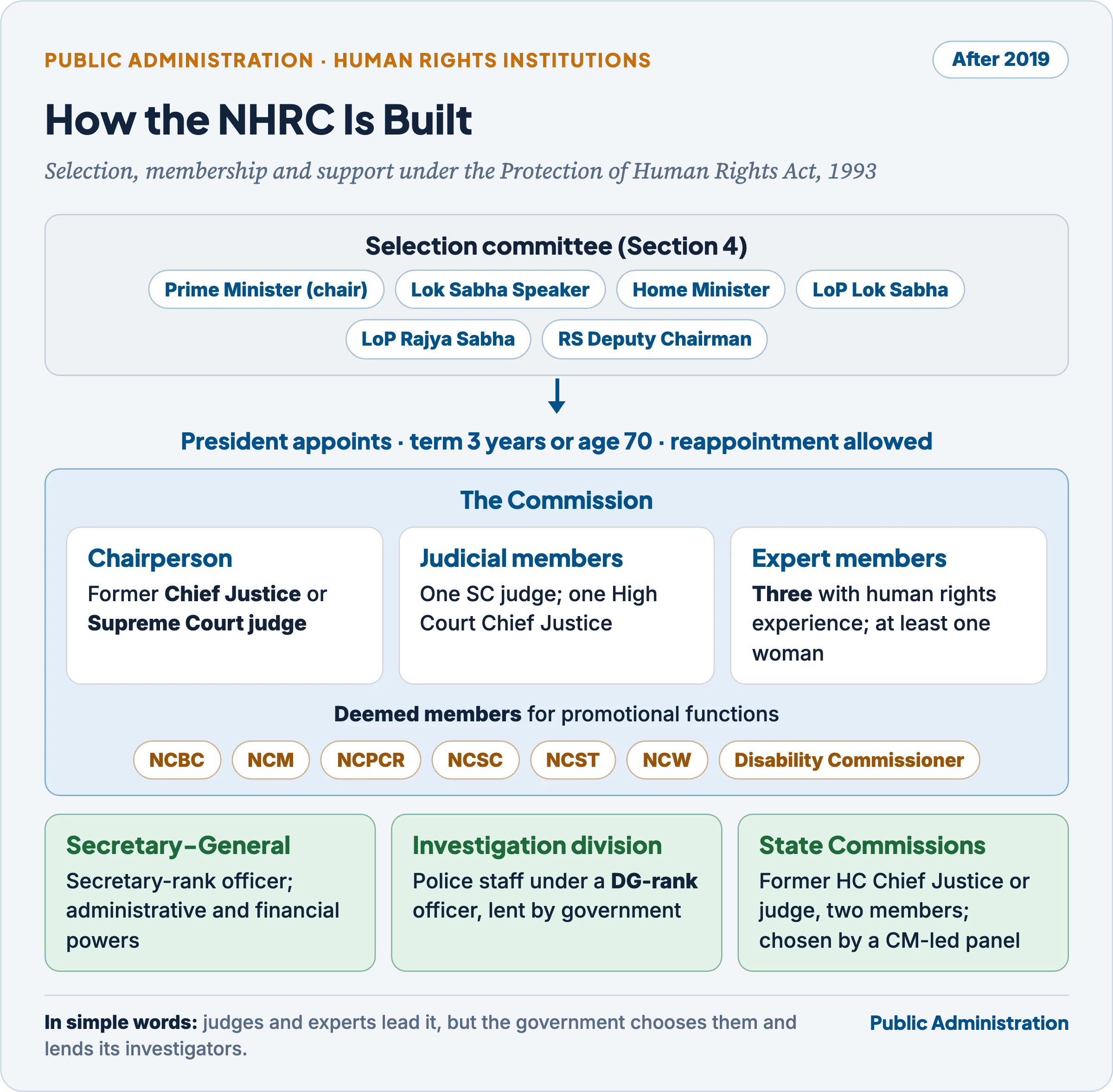
- Chairperson: a person who has been Chief Justice of India or a Judge of the Supreme Court (the second option added in 2019).
- Members: one member who is or has been a Supreme Court judge; one who is or has been a High Court Chief Justice; and three members with knowledge of or practical experience in human rights, at least one a woman (raised from two in 2019).
- Deemed members (for functions under Section 12(b) to (j)): the chairpersons of the National Commissions for Backward Classes, Minorities, Protection of Child Rights, Scheduled Castes, Scheduled Tribes and Women, and the Chief Commissioner for Persons with Disabilities.
- Selection committee (Section 4): the Prime Minister (chair), the Speaker of the Lok Sabha, the Union Home Minister, the Leaders of the Opposition in both Houses and the Deputy Chairman of the Rajya Sabha. A sitting judge can be appointed only after consulting the Chief Justice of India.
- Secretary-General: an officer of the rank of Secretary to the Government of India; since 2019 exercises all administrative and financial powers under the chairperson’s control.
- Investigation division: police and investigative staff under an officer not below the rank of Director General of Police, made available by the Union government.
- Funding: grants from the Union government (Section 32); the Commission spends them as it thinks fit, and its accounts are audited by the CAG.
- Current position: Justice V. Ramasubramanian, a former Supreme Court judge, became chairperson on 30 December 2024 after the post had been vacant from June 2024; the appointment drew a written dissent from the opposition members of the selection committee.
9.4 Functions and powers
- Functions (Section 12):
- Inquire, suo motu, on a petition by a victim or any person on his behalf, or on a court’s direction (added in 2006), into violation of human rights or abetment or negligence in preventing a violation by a public servant.
- Intervene in court proceedings involving human rights, with the court’s approval.
- Visit jails and other institutions under the State government where people are detained for treatment, reformation or protection (since 2006, without prior intimation to the State) and recommend improvements.
- Review constitutional and legal safeguards, and factors including terrorism that inhibit human rights.
- Study treaties and international instruments and recommend implementation.
- Research, human rights literacy and support to NGOs.
- Powers (Sections 13 and 14): powers of a civil court to summon and examine witnesses on oath, require documents, receive affidavit evidence, requisition public records and issue commissions; to require information from any person; to enter and search premises and seize documents; proceedings are judicial proceedings for certain purposes of the criminal law. For investigation it may use its own staff or, with concurrence, any officer or agency of the Union or State.
- Steps after inquiry (Section 18): recommend compensation or damages; recommend prosecution or other action against the public servant; approach the Supreme Court or High Court; recommend interim relief at any stage (since 2006); give the inquiry report to the petitioner; and publish the report with the government’s comments. The government must report action taken within one month.
9.5 Procedure: from complaint to report
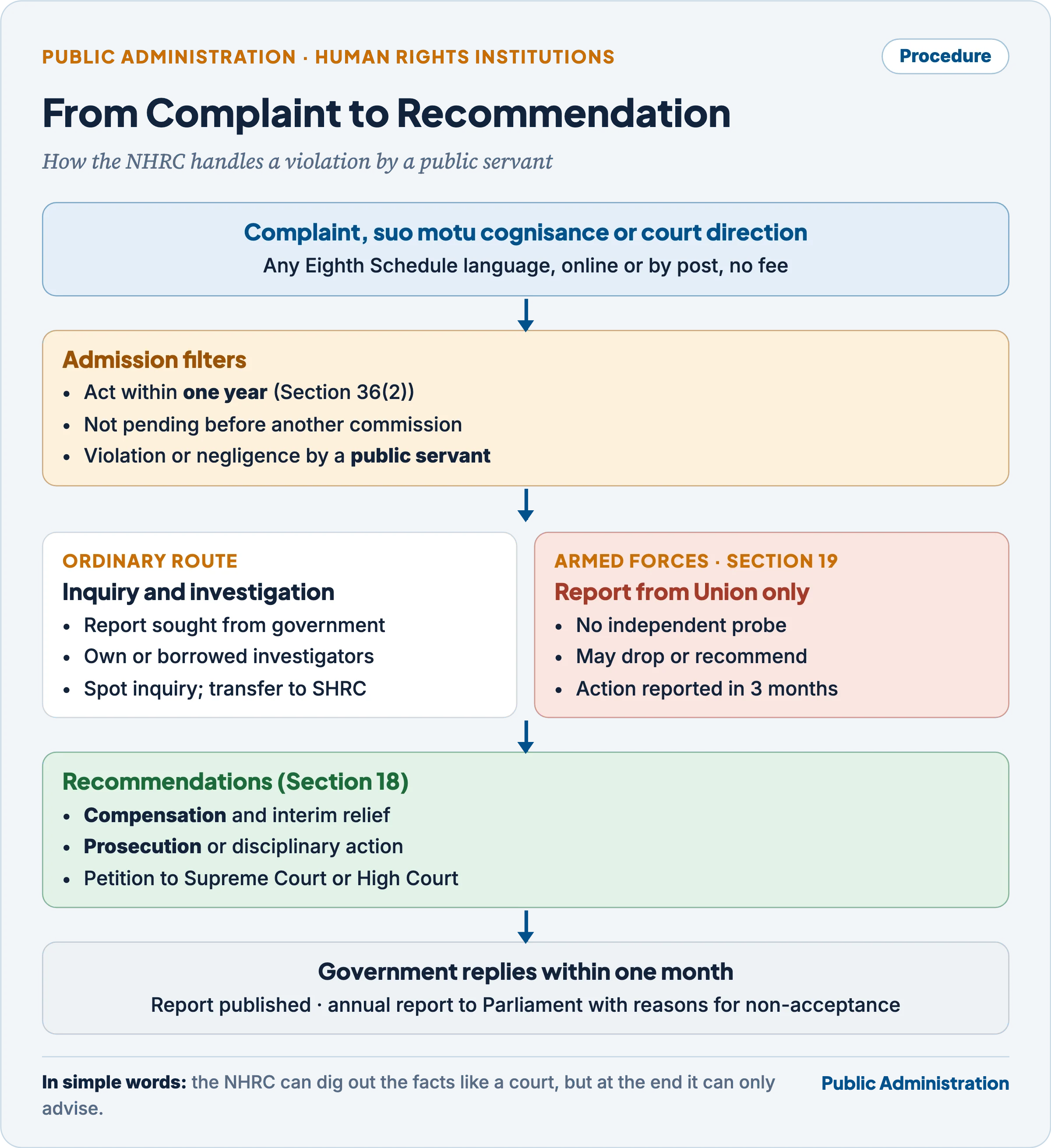
- Admission: complaints in any Eighth Schedule language, online or by post, free of fee. Complaints are dismissed in limine if beyond one year (Section 36(2)), already before another commission or court, anonymous or frivolous, or about private parties or service matters.
- Inquiry: the Commission calls for a report from the government or authority; if none comes in time, it may proceed on its own. It may order spot inquiries and investigations (Section 14), or transfer the complaint to the State Commission (Section 13(6), added in 2006).
- Armed forces (Section 19): the NHRC may only seek a report from the Union government; on receiving it, it may drop the matter or make recommendations; the government must inform it of action within three months, and the report is published. It cannot independently investigate.
- Reporting: the annual report and special reports are laid before Parliament (or the State legislature) with a memorandum of action taken and reasons for non-acceptance of recommendations (Section 20).
9.6 The 2006 and 2019 amendments
| Amendment | Main changes |
|---|---|
| 2006 (Act 43 of 2006) | Inquiry on a court’s direction; jail visits without intimation to the State; recommendation of interim relief at any stage; transfer of complaints to SHRCs; SHRC strength cut from five to three; separate NCSC and NCST chairpersons as deemed members |
| 2019 (Act 19 of 2019) | Chair may be a former CJI or Supreme Court judge; SHRC chair may be a former High Court judge; three expert members including one woman; chairpersons of NCBC, NCPCR and the Chief Commissioner for Persons with Disabilities added as deemed members; term cut from five to three years with reappointment allowed; Secretary-General given administrative and financial powers; SHRCs may handle human rights matters of Union territories (except Delhi, which stays with the NHRC) |
- The 2019 amendment was presented as bringing India closer to the Paris Principles on pluralism. Critics argued that shorter, renewable terms make members more dependent on government for reappointment, the opposite of independence.
9.7 State Human Rights Commissions and Human Rights Courts
- SHRCs (Sections 21–29): chairperson a former Chief Justice or Judge of a High Court; two members; appointed by the Governor on the recommendation of a committee headed by the Chief Minister. They inquire into violations on State List and Concurrent List subjects. Two or more States may share a commission.
- Problems: vacancies and non-functional commissions (the Manipur SHRC was defunct for years, as the Supreme Court noted in 2016); thin staff and budgets; heavy reliance on State police for investigation.
- Human Rights Courts (Section 30): the State government, with the concurrence of the High Court Chief Justice, may designate a Sessions Court in each district as a Human Rights Court for speedy trial, with a Special Public Prosecutor (Section 31). They have remained largely nominal, because the Act never defines “offences arising out of violation of human rights” or the procedure for cognisance; the NHRC itself has repeatedly asked for amendment of Section 30.
10. The NHRC in Action
In simple words
The NHRC’s best work has come from setting rules that police and jails must follow everywhere: report every custodial death within a day, film post-mortems, inquire into every encounter. It has also helped the Supreme Court supervise the release of bonded labourers and the running of mental hospitals.
10.1 Custodial deaths and torture
- 24-hour reporting: by a circular of 14 December 1993, the NHRC required every death or rape in police or judicial custody to be reported within 24 hours, failing which it would presume an attempt at suppression.
- Post-mortem safeguards: video-filming of post-mortems, a model autopsy form, and a magisterial or judicial inquiry into every custodial death.
- Scale: the NHRC registered 157 (2023–24), 140 (2024–25) and 170 (2025–26, to 15 March 2026) cases of death in police custody; deaths in judicial custody run far higher, with intimations averaging over 1,500 a year for a decade. In 2023–24 the Commission registered 76,891 cases and took suo motu cognisance in 106.
- BNSS: after the new criminal laws came into force on 1 July 2024, the NHRC (May 2024) revised its guidelines to align with Section 196 of the BNSS, which requires a judicial magistrate’s inquiry into custodial deaths and rapes.
- Judgments it builds on:
- D.K. Basu v. State of West Bengal (decided December 1996, reported 1997): eleven requirements on arrest and detention (identification of arresting officers, arrest memo attested by a witness, informing a relative, medical examination every 48 hours, access to a lawyer, police control room information), with compensation and contempt for breach. The BNSS now writes several of these into law.
- Nilabati Behera v. State of Orissa (1993): monetary compensation under Article 32 for custodial death as a public-law remedy.
- Paramvir Singh Saini v. Baljit Singh (2020): CCTV cameras in every police station and in the offices of central agencies with powers of arrest.
- The missing law: India signed the UN Convention against Torture in 1997 but has not ratified it; the Law Commission’s 273rd Report (2017) recommended a law against torture, which has not been enacted.
10.2 Encounter killings
- NHRC guidelines: first issued in March 1997 (register information about an encounter death, investigate it independently, prosecute if the killing was not justified), revised in 2003 and 2010 (magisterial inquiry in every case; reporting to the NHRC within 48 hours; six-monthly returns).
- PUCL v. State of Maharashtra (23 September 2014): the Supreme Court turned these into 16 binding requirements under Article 141: record tip-offs in writing; register an FIR; independent investigation by the CID or another police station; magisterial inquiry; information to the NHRC or SHRC without delay (NHRC to intervene only if independence is in serious doubt); post-mortem by two doctors, videographed; surrender of weapons for ballistic analysis; no out-of-turn promotion or gallantry award until gallantry is established; and a complaint to the Sessions Judge if the procedure is not followed.
- EEVFAM v. Union of India (2016): in the Manipur extra-judicial killings case, the Supreme Court held that there is no absolute immunity for the armed forces or police and that every death must be inquired into; it recorded the petitioners’ charge, and the NHRC’s own grievance, that the Commission had become a “toothless tiger”, and kept open whether its guidelines are binding.
10.3 Bonded labour, child labour and vulnerable groups
- Bonded labour: by an order of 11 May 1997, the Supreme Court entrusted the NHRC with monitoring the Bonded Labour System (Abolition) Act, 1976 in all States; the Commission obtains six-monthly reports on identification, release and rehabilitation and runs a dedicated cell.
- Supreme Court remits: supervision of the mental hospitals at Ranchi, Agra and Gwalior and the Government Protective Home (Women), Agra (from 1997).
- Other programmes: abolition of child labour (carpets, glass bangles, brick kilns, stone quarries); manual scavenging; implementation of the Vishaka guidelines on sexual harassment at work; Dalit atrocities; denotified tribes; rights of the disabled (it pressed for their enumeration in the 2001 Census); right to health and HIV/AIDS; right to food; destitute women in Vrindavan; relief after the Odisha cyclone (1999) and Gujarat earthquake (2001).
- Landmark interventions:
- Punjab mass cremations: in Paramjit Kaur v. State of Punjab the Supreme Court remitted the secret cremation of over 2,000 bodies to the NHRC (1996) and later held (1998) that when acting on the Court’s remit the Commission works as a sui generis body not bound by the one-year limit; the NHRC eventually recommended compensation.
- Gujarat violence (2002): suo motu inquiry and a petition to the Supreme Court that led to the retrial of the Best Bakery case outside the State.
- District Complaints Authority: a proposal for district-level police complaint bodies chaired by the District Judge, adopted by a few States, which anticipated the police complaints authorities of Prakash Singh (2006).
11. Limitations of the NHRC and the Way Forward
In simple words
The NHRC has a court’s power to gather facts but only an adviser’s power to act on them. It cannot look at cases more than a year old, cannot investigate the army, and depends on the government for its staff and money. Reformers want its advice to carry more weight and its selection to be more open.
11.1 The main limitations
- Recommendatory power: governments may ignore recommendations, delay compliance or pay compensation without prosecuting anyone. Section 20 requires only that reasons for non-acceptance be laid before Parliament.
- One-year bar (Section 36(2)): in N.C. Dhoundial v. Union of India (decided December 2003) the Supreme Court held this to be a jurisdictional bar that the Commission cannot avoid by calling a wrong “continuing”. Victims of old abuses, often the most powerless, are shut out.
- Armed forces exclusion (Section 19): in areas under AFSPA, where serious allegations arise, the NHRC can only seek a report from the Ministry of Defence or Home Affairs. Section 2(1)(a) defines armed forces as the naval, military and air forces “and includes any other armed forces of the Union”, wording wide enough to cause doubt about central armed police forces. The army investigating itself undermines credibility.
- Dependence on government investigators: its investigation division is staffed by police officers on deputation, so the police often investigate the police.
- Composition: dominance of retired judges; weak pluralism (civil society, women, minorities); and members drawn from government networks. GANHRI has repeatedly questioned the selection process and the appointment of a serving civil servant as Secretary-General.
- Backlog and capacity: tens of thousands of complaints a year, a large share dismissed in limine; thin staff for spot inquiries.
- No power over private actors except through negligence of public servants; limited reach on economic and social rights.
- Weak State commissions and nominal human rights courts.
- Perception of reticence: critics say it is slow to act on politically sensitive violations (treatment of human rights defenders, use of anti-terror laws).
11.2 GANHRI accreditation
- The Global Alliance of National Human Rights Institutions (GANHRI) accredits NHRIs: A (fully compliant with the Paris Principles) or B (partially compliant).
- India’s record: A status in 1999, 2006 and 2011; deferred in 2016, re-accredited A in 2017; deferred in March 2023 and again in 2024; in March 2025 the Sub-Committee on Accreditation recommended downgrading to B.
- Concerns cited: police officers seconded as investigators; a senior civil servant made available as Secretary-General; lack of pluralism and gender balance; an opaque selection process; inadequate response to violations and to human rights defenders; limited cooperation with civil society; and attempts by Indian authorities to lobby members of the accreditation sub-committee.
- Status in October 2026: the GANHRI Bureau rejected the NHRC’s appeal in December 2025; India keeps A status until a formal “alteration of accreditation” review, postponed from March 2026 to the Sub-Committee’s session of November 2026. A downgrade would cost it voting rights within GANHRI and its independent speaking rights at the UN Human Rights Council.
Criticism — Is the NHRC a “toothless tiger”?
- Its recommendations are advisory; governments comply selectively and late.
- The one-year bar and the armed forces exclusion close its door on the gravest and oldest abuses.
- It investigates through borrowed police officers and is funded and staffed by the government it watches.
- Selection by a committee dominated by the ruling side, and renewable three-year terms, invite deference.
- Repeated GANHRI deferrals and a recommended downgrade signal doubts abroad about its independence.
Defence — The case for the NHRC’s record
- Its guidelines on custodial deaths, post-mortems and encounters changed police practice across India and were adopted by the Supreme Court in PUCL (2014).
- It has secured compensation for thousands of victims and works as a low-cost, accessible forum in 22 languages.
- The Supreme Court has trusted it with bonded labour monitoring, the Punjab cremations and supervision of institutions.
- Moral authority, publicity and the power to approach courts are real powers; most NHRIs worldwide are recommendatory by design, as the Paris Principles envisage.
- Its weaknesses lie largely in the statute and political will, which Parliament can cure.
Common confusion
If an advisory body cannot enforce its advice, is it useless? Compare the President’s “grandparent” role. Not necessarily. Like a grandparent whose advice the family may ignore, the President under Article 74(1) can only ask the Council of Ministers to reconsider advice once (proviso added by the 44th Amendment, 1978), and under Article 78 has the right to be informed; Bagehot called these the rights to be consulted, to encourage and to warn. The NHRC is similar: its power lies in reason, publicity and the cost of ignoring it. Such authority works when governments value legitimacy and when Parliament, courts and media follow up; it fails when they do not. The remedy is to raise the cost of non-compliance (mandatory reasons, follow-up, court enforcement), not to turn every advisory body into a court.
11.3 Reform proposals
- Binding or semi-binding recommendations: compliance within a fixed time unless the government obtains a court’s stay; compensation awards enforceable like decrees.
- Own investigation cadre recruited independently, ending reliance on seconded police.
- Jurisdiction over the armed forces at least for allegations of killing, torture and sexual violence; repeal or dilution of the one-year bar for grave violations.
- Pluralist, transparent selection: public advertisement of vacancies, consultation with civil society, members beyond retired judges, gender balance, and single longer terms without reappointment.
- Financial autonomy: a budget voted directly by Parliament.
- A law against torture and ratification of the UN Convention against Torture.
- Functional State commissions and real Human Rights Courts through amendment of Section 30.
- Follow-up mechanisms: parliamentary discussion of NHRC reports; publication of compliance data department-wise.
12. Theory Lens and Overall Assessment
In simple words
Ideas from administrative theory explain why these institutions behave as they do: why governments hand power to independent experts, why those experts can be captured, why values matter where rules run out, and why advisory watchdogs work only when someone listens.
Theory lens: delegation, capture and values
- Regulatory state and non-majoritarian institutions (Majone). Giandomenico Majone explained why democracies hand decisions to unelected experts: to gain credibility and expertise that elected bodies lack. India’s MPC and SEBI fit this logic; the frequent use of policy directions and retired officials shows that Indian governments delegate form more readily than power. See the article on Regulatory Authorities and Public-Private Partnerships.
- Capture theory (Stigler, Bernstein). George Stigler (1971) predicted that concentrated interests capture regulators; Marver Bernstein (1955) charted their ageing. Indian regulators face a double capture, by industry and by the parent ministry, which explains reforms such as cooling-off periods and independent selection.
- Principal–agent theory and delegation. Parliament (principal) delegates to regulators and the NHRC (agents) but lacks information to monitor them; McCubbins and Schwartz (1984) showed that legislators rely on “fire alarms” (complaints, appeals) rather than “police patrols”. In India the fire alarms are the courts, RTI and tribunals, while parliamentary patrols are weak. The same lens explains why civil servants mirror their political masters when careers depend on them. See the article on Accountability and Control.
- Public choice. Public choice theorists (Buchanan, Tullock, Niskanen) treat officials and regulators as self-interested; this predicts post-retirement appointments, regulatory empire-building and rent-seeking in licensing, and supports rules that limit discretion. See the article on New Public Administration and Public Choice.
- NPM agencification. NPM recommended separating policy (ministry) from delivery and regulation (agencies) with managerial freedom and performance contracts; the 2nd ARC’s thirteenth report endorsed executive agencies and regulators on this logic. Hood’s critique that NPM favours sigma over theta values explains the worry that market reforms erode public service values. See the article on New Public Management and After.
- New Public Service values (Denhardt). The New Public Service restores citizenship, public interest and service as core values; it supports the NHRC’s mandate of dignity and the shift from enforcement-only ethics to values-based public service.
- Accountability theory. Barbara Romzek and Melvin Dubnick (1987) identified hierarchical, legal, professional and political accountability; regulators combine legal accountability (courts) and professional accountability (expertise) but have weak political accountability, while the NHRC relies on political and moral accountability through publicity and Parliament.
- Riggs’ formalism. Fred Riggs described formalism, the gap between law and practice in prismatic societies. Value statements unenforced, regulators independent on paper, NHRC recommendations ignored and human rights courts that never sit are textbook formalism. See the article on Riggsian Models.
Overall assessment
- Common thread: values, regulators and the NHRC all depend on legitimacy rather than coercion. Their strength comes from independence in appointment, transparency in reasoning and follow-up by Parliament and courts.
- Common weakness: all three are vulnerable to executive dominance: governments that choose regulators and NHRC members, amend rules at will, and ignore advice.
- Direction of reform: a statutory Civil Services Law with values and an independent ethics body; uniform, transparent appointment and accountability rules for regulators; and an NHRC with its own investigators, wider jurisdiction and recommendations that are costly to ignore.
Key Terms
| Term | Meaning in simple words |
|---|---|
| Public service values | Enduring beliefs that guide officials’ choices: integrity, impartiality, service |
| Code of ethics | Statement of principles guiding judgement in grey areas |
| Code of conduct | Specific enforceable rules of behaviour for officials |
| Nolan principles | Seven UK principles of public life (1995): selflessness to leadership |
| Regime values | Values drawn from a country’s Constitution and its interpretation (Rohr) |
| Soft state | Myrdal’s term for a state that cannot enforce its own laws and social discipline |
| Public service motivation | Desire to serve the public that draws people to public work (Perry and Wise) |
| Sigma, theta, lambda values | Hood’s lean, honest-and-fair, and robust families of administrative values |
| Committed bureaucracy | Officials committed to a ruling party’s programme rather than to neutral service |
| Collusive corruption | Corruption in which giver and taker both gain at society’s cost |
| Regulatory state | A state that governs by rules and independent agencies rather than ownership |
| Non-majoritarian institution | A body deliberately not run by elected politicians, such as a regulator or central bank |
| Quasi-legislative power | A regulator’s power to make binding regulations under its parent Act |
| Quasi-judicial power | A regulator’s power to decide disputes and impose penalties |
| Regulatory capture | A regulator serving the industry or ministry it should control |
| Cooling-off period | A gap required before an official joins a regulator or a regulated firm |
| Regulatory impact assessment | Cost–benefit test of a proposed regulation before it is made |
| Super-regulator | A single regulator covering several sectors |
| Net neutrality | Equal treatment of all internet traffic, without blocking, throttling or paid priority |
| Paris Principles | UN standards (1993) for independent national human rights institutions |
| GANHRI | Global body that accredits national human rights institutions as A or B |
| Deemed members | Heads of other national commissions who sit on the NHRC for some functions |
| Custodial death | Death of a person in police or judicial custody |
| Human Rights Court | A Sessions Court designated under Section 30 to try human rights offences |
Commissions, Committees and Judgments
The table lists, in order, the bodies, laws and cases that shaped values, regulation and human rights institutions covered in this article.
| Body / case | Year | Key point |
|---|---|---|
| Brownlow Committee (USA) | 1937 | Independent commissions a “headless fourth branch” |
| Paul Appleby Reports | 1953, 1956 | Reviews of Indian administration; Appleby’s ethics of democratic responsibility |
| Central Social Welfare Board (Chair: Durgabai Deshmukh) | 1953 | Board to fund voluntary welfare agencies; company form from 1969 |
| Santhanam Committee (Chair: K. Santhanam) | 1964 | Integrity at the top; CVC and conduct rules |
| Nilabati Behera v. State of Orissa | 1993 | Compensation for custodial death under Article 32 |
| Protection of Human Rights Act | 1993 | NHRC, SHRCs, Human Rights Courts |
| Nolan Committee (Chair: Lord Nolan, UK) | 1995 | Seven principles of public life |
| Tait Task Force (Chair: John Tait, Canada) | 1996 | Four families of public service values |
| D.K. Basu v. State of West Bengal | 1996–97 | Eleven safeguards on arrest and detention |
| Paramjit Kaur v. State of Punjab | 1996, 1998 | Punjab cremations remitted to NHRC; sui generis role beyond the one-year bar |
| Supreme Court order on bonded labour (PUCL v. State of Tamil Nadu) | 1997 | NHRC to monitor the Bonded Labour System (Abolition) Act |
| N.C. Dhoundial v. Union of India | 2003 | One-year limit in Section 36(2) is a jurisdictional bar |
| PHRA Amendment | 2006 | Jail visits without notice, interim relief, transfer to SHRCs |
| Draft Public Services Bill (DoPT) | 2006–07 | Statutory values, code of ethics, Central Public Services Authority |
| 2nd ARC, 4th Report: Ethics in Governance (Chair: M. Veerappa Moily) | 2007 | Three-tier values framework; code of ethics for ministers |
| 2nd ARC, 13th Report: Organisational Structure | 2009 | Uniform appointment, tenure, removal of regulators; RIA; parliamentary oversight |
| PTC India v. CERC | 2010 | Regulations under Section 178 are subordinate legislation, tested only by judicial review |
| Sahara India Real Estate Corp. v. SEBI | 2012 | SEBI’s jurisdiction upheld; refunds to small investors |
| FSLRC (Chair: B.N. Srikrishna) | 2013 | Indian Financial Code; unified agency; regulatory governance principles |
| Draft Regulatory Reform Bill (Planning Commission) | 2013 | Common selection, fixed terms, cooling-off for regulators |
| T.S.R. Subramanian v. Union of India | 2013 | Fixed tenure, Civil Services Boards, written instructions |
| AIS (Conduct) Amendment Rules | 2014 | Values clause: Rules 3(1A) and 3(2B) |
| PUCL v. State of Maharashtra | 2014 | Sixteen binding requirements for encounter deaths |
| COAI v. TRAI | 2016 | Call-drop compensation rule struck down as arbitrary |
| EEVFAM v. Union of India | 2016 | No absolute immunity under AFSPA; NHRC “toothless tiger” grievance noted |
| Law Commission, 273rd Report | 2017 | Law against torture; ratify UN Convention against Torture |
| CCI v. Bharti Airtel | 2018 | Sector regulator decides sector questions before CCI |
| PHRA Amendment | 2019 | Wider eligibility, woman member, three-year terms, more deemed members |
| Paramvir Singh Saini v. Baljit Singh | 2020 | CCTV in police stations and central agencies |
| Vishal Tiwari v. Union of India | 2024 | Limited judicial review of an expert regulator’s policy |
| Pratyush Sinha Committee (SEBI) | 2025 | Conflict-of-interest and recusal norms for SEBI’s own leadership |
| Madras Bar Association v. Union of India | 2025 | Tribunals Reforms Act provisions struck down; National Tribunals Commission |
Contemporary Developments
- NHRC accreditation (2025–26): GANHRI’s Sub-Committee recommended in March 2025 that India’s NHRC be downgraded to B; the GANHRI Bureau rejected the NHRC’s appeal on 4 December 2025, and the alteration-of-accreditation review was moved to the Sub-Committee’s session of 9–20 November 2026.
- New NHRC leadership (December 2024): Justice V. Ramasubramanian took charge as chairperson on 30 December 2024, with a former High Court Chief Justice and the former NCPCR chairperson as members.
- Custodial deaths data (March 2026): the Home Ministry told the Lok Sabha that NHRC registered 170 cases of death in police custody in 2025–26 (to 15 March), up from 140 in 2024–25.
- Data Protection Board (2025–26): established on 13 November 2025 under the DPDP Act; the government invited applications for the posts of chairperson and four members only in mid-2026, and in October 2026 the Kerala High Court directed that the Board be made functional within eight weeks, as consent-manager registration was due from 13 November 2026.
- Securities Markets Code (2025–26): introduced on 18 December 2025; the Standing Committee on Finance’s report of 23 July 2026 backed SEBI’s enlarged role but asked for a two-year cooling-off period for its chairperson and whole-time members and tighter limits on reopening old cases.
- SEBI conflict-of-interest norms (November 2025): the Pratyush Sinha committee proposed stronger disclosure and recusal rules for SEBI’s board and officials.
- Regulatory reform (2025): a High-Level Committee for Regulatory Reforms under Rajiv Gauba (August 2025) began reviewing non-financial regulations, licences and inspections, alongside further decriminalisation of minor offences.
- Tribunals (2025–26): after Madras Bar Association (19 November 2025), Parliament passed the Tribunals Reforms Act, 2026 creating a National Tribunals Commission for tribunals that hear regulatory appeals.
Revision Grid
| Thinker / body | Work or report (year) | Key idea |
|---|---|---|
| Gunnar Myrdal | Asian Drama (1968) | Soft state lacks social discipline |
| Paul Appleby | Morality and Administration in Democratic Government (1952) | Responsible government is ethical government |
| John Rohr | Ethics for Bureaucrats (1978) | Regime values |
| Dwight Waldo | The Enterprise of Public Administration (1980) | Twelve competing obligations |
| Michael Lipsky | Street-Level Bureaucracy (1980) | Front-line discretion makes policy |
| Perry and Wise | “The Motivational Bases of Public Service” (1990) | Public service motivation |
| Christopher Hood | “A Public Management for All Seasons?” (1991) | Sigma, theta, lambda values |
| Nolan Committee | First report (1995) | Seven principles of public life |
| John Tait / Kenneth Kernaghan | A Strong Foundation (1996); PAR article (2003) | Four families of values; values statement |
| Denhardt and Denhardt | “The New Public Service” (2000) | Serve citizens, not customers |
| 2nd ARC | Ethics in Governance (2007) | Values, code of ethics, code of conduct |
| Robert Cushman | The Independent Regulatory Commissions (1941) | Independence versus responsibility dilemma |
| Marver Bernstein | Regulating Business by Independent Commission (1955) | Life cycle of commissions |
| George Stigler | “The Theory of Economic Regulation” (1971) | Regulation acquired by industry |
| Giandomenico Majone | The Rise of the Regulatory State in Europe (1994) | Non-majoritarian regulatory state |
| Fabrizio Gilardi | Delegation in the Regulatory State (2008) | Diffusion by emulation |
| 2nd ARC | Organisational Structure of GoI (2009) | Uniform rules and oversight for regulators |
| FSLRC | Report (2013) | Principles-based financial code |
| Paris Principles | UNGA resolution 48/134 (1993) | Independence, pluralism, broad mandate for NHRIs |
| Protection of Human Rights Act | 1993; amended 2006, 2019 | NHRC, SHRCs, Human Rights Courts |
Previous Year Questions
- 2024Examine the role of Telecom Regulatory Authority of India (TRAI) in protecting the interests of the consumers.
- 2023Do you agree that code of ethics and code of conduct for ministers would help in upholding higher standards of their constitutional and ethical conduct? Explain.
- 2022In India, for the upliftment of majority of people, governmental intervention remains a central fact of life. Nevertheless, the effective implementation of policies depends on the ethical values of Public Servants. Discuss.
- 2022Examine the role of Securities and Exchange Board of India (SEBI) in protecting the interests of the investors in securities.
- 2021Recent market approaches to public services present serious challenges to traditional and state-sponsored public service values. Evaluate the statement in the context of Indian administration.
- 2021National Human Rights Commission is handicapped by its jurisdictional limitations of not being able to investigate the cases of violation of human rights by the armed forces. Discuss.
- 2021The Preamble to the Constitution of India provides a foundational framework of ideals and values for the Indian administration. Discuss.
- 2019Accountability of regulatory bodies would address the problem of over-regulation and help make them truly facilitators. Analyze the present status of regulators and suggest measures to induce accountability in the mechanism.
- 2018“In the Network Era the TRAI has the challenging task of protecting the Net Neutrality from digital aggression.” Comment.
- 2018“The AFSPA debate reveals that the Indian paramilitary forces are caught between the imperatives of national security and protection of human rights.” Discuss.
- 2017Discuss, with suitable examples, the emerging challenges faced by the Regulatory Commissions as the arbitrating agents between the State and the market forces.
- 2016“In a democratic polity, any conception of ethics and integrity in public life must encompass not only politicians and civil servants but also citizens.” Discuss.
- 2010With the creation of new regulatory agencies in the wake of a liberalisation, overlapping jurisdictions and conflicts became the new trend. Is there need for the creation of a super-regulator or unified regulator?
- 2009“The National Human Rights Commission has done a commendable job in developing a sense of responsibility among organizations towards the protection of human rights.” Comment on this assessment.
- 2009“Values of Indian administration must be rooted in the Preamble of the Indian Constitution.” Discuss.
- 2007“The President of India acts like grand-parent in a family. If younger generation does not follow his/her advice, he/she is just unable to do anything.” Comment.
- 2006“The role played by the National Human Rights Commission in maintaining and preserving dignity of India’s citizens has been satisfactory and up to the expectations.” Elucidate.
- 2004“The National Human Rights Commission is unable to play its role effectively due to various hindrances.” Comment.
- 2004“Values, more than techniques are the eventual determinants of the actions of the administrators.” Comment.
- 1996“Rigidity in administration and centralization has greatly incapacitated the Central Social Welfare Board,” Examine, in the light of this statement, the organization and working of the Central Social Welfare Board.
- 2025Values and ethics in civil services are shaped by global practices and trends. Explain.
- 2024Regulatory authorities are independent and effective for controlling service delivery activities but are subjected to extraneous factors. Do you agree? Give reasons.
- 2022Regulatory governance frameworks have become essential building blocks of world society. Discuss their potential and impact in fulfilling the hopes and demands.
- 2022Most civil service regimes still equate ‘Public Sector Ethics’ with anti-corruption efforts. Discuss the insufficiency of Ethics-code in this background.
- 2021Regulation is an old but increasingly necessary mode of social coordination and political intervention into societal processes. Examine it in the context of globalization.
- 2021Civil servants generally tend to exhibit the values and ethical framework of the political executives under whom they function. Explain.
- 2021Examine the approach of public service motivation as an inducement to bring the desired level of efficiency in public service delivery.
- 2020“Prevention of misconduct requires institutionalization of ethical values at the political and administrative levels.” Justify.
- 2019“The advent of the regulatory regimes indicates the demise of the arbitrator state.” Comment.
- 2018“Administrative values have no value unless they are valued by all stakeholders of the governance system.” Comment.
- 2016“If the Regulatory Commissions … are wholly independent, they are completely irresponsible for the doing of very important policy determining and administrative work …. on the other hand, to rob the commissions of their independence is seriously to menace the impartial performance of their judicial work.” (Cushman) Examine.
- 2014“Delegation to independent agencies has taken place in an interdependent progress driven by emulation.” Discuss in the context of independent regulatory agencies in the modern regulatory State.
- 2011Civil Servants must be social moralists in action, living up to Paul Appleby’s dictum that ‘responsible government is ethical government.’ Examine this statement in the light of good governance.
- 2010Briefly discuss the principles of ensuring ethics in public service as recommended in the Nolan Committee Report.