

Constitutional position; Structure, recruitment, training and capacity building; Good governance initiatives; Code of conduct and discipline; Staff associations; Political rights; Grievance redressal mechanism; Civil service neutrality; Civil service activism.
This article: Code of conduct (CCS (Conduct) Rules, 1964 and AIS (Conduct) Rules, 1968: integrity, political neutrality, gifts, assets, media, criticism of government and social media; the 2014 values clauses; the 2nd ARC’s code of ethics and the draft Public Services Bills of 2006–07; Nolan principles in brief; code for ministers); discipline (CCS (CCA) Rules, 1965 and AIS (D&A) Rules, 1969: penalties, procedure, suspension, Article 311 and Tulsiram Patel, Ajay Kumar Choudhary; vigilance under the CVC Act, 2003, departmental vigilance and Section 17A; premature retirement under FR 56(j) and AIS Rule 16(3); reform proposals); staff associations (Article 19(1)(c) and its limits, O.K. Ghosh, CCS (Recognition of Service Associations) Rules, 1993, the right to strike and T.K. Rangarajan, Whitleyism, the Joint Consultative Machinery of 1966, pay commissions up to the 8th CPC); political rights (Rule 5, the 2024 RSS memorandum, voting, contesting after resignation, cooling-off and post-retirement debates, Masterman Committee and Hatch Act); grievance redressal for employees (internal machinery, CAT under Article 323A and the 1985 Act, L. Chandra Kumar, Tribunals Reforms Acts of 2021 and 2026) and for citizens (DARPG, CPGRAMS and its 2024 guidelines, NextGen CPGRAMS, PRAGATI, Citizen’s Charters, Sevottam, right to services laws, the lapsed 2011 Bill, Lokpal and Lokayuktas, ombudsman models); theory lens. Structure and recruitment, training, good governance initiatives, and neutrality and activism are summarised briefly with links to their own articles.
Official Syllabus: Paper II · Unit 2-08 Civil Services
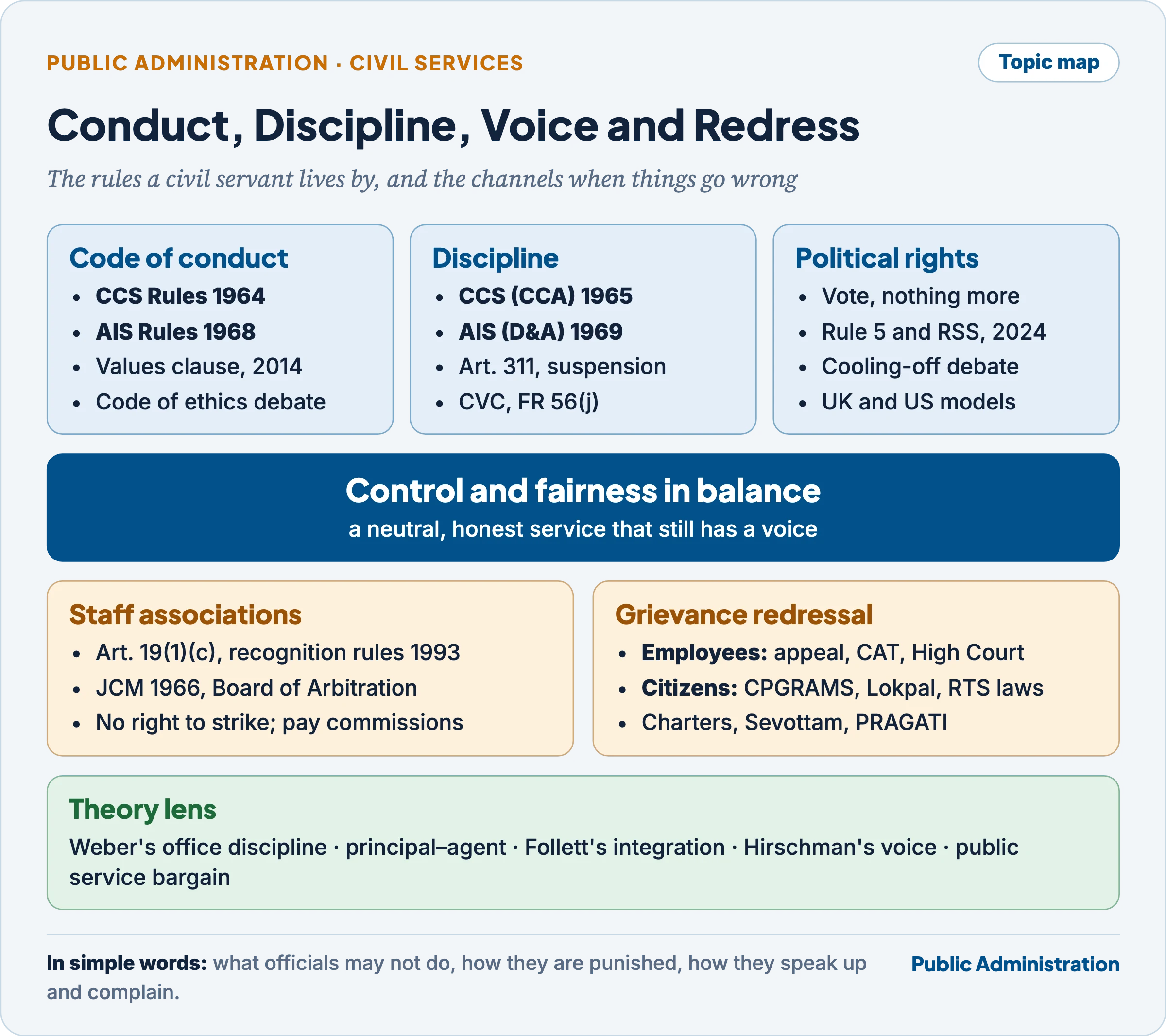
A civil servant is two things at once: an agent of the State, who exercises public power and must be controlled, and a citizen and employee, who has rights and needs to be heard. This article covers the machinery that manages both sides. The code of conduct says in advance what an official may not do; discipline punishes breaches, within constitutional limits; staff associations and joint councils give employees a collective voice; the rules on political rights keep the service out of party politics; and grievance redressal hears complaints, both from employees against their employer and from citizens against the administration.
Each of these is a balance between control and fairness. Too much control makes the service fearful, silent and pliable; too much protection makes it unaccountable. Indian practice has swung between these poles since the colonial period, and most current debates (repealing Article 311, a cooling-off period, social media rules, the right to strike, CPGRAMS) are arguments about where the balance should lie.
In simple words
Think of a hospital. Doctors follow a professional code (no gifts from drug companies), a medical council can suspend a doctor after a hearing, the doctors’ association negotiates duty hours with the management, doctors may vote but should not campaign in the wards, and patients have a complaints desk and, beyond it, a consumer court. Remove any one of these and the hospital becomes either lawless or miserable.
1. Why Civil Servants Live by Special Rules
In simple words
An ordinary employee who misbehaves hurts his company. A civil servant who misbehaves hurts citizens, because he holds the State’s power. That is why the State writes special rules for its servants, and why the Constitution also protects them from unfair punishment.
1.1 The rationale
- Public power and discretion. Officials issue licences, award contracts, collect taxes and arrest people. A conflict of interest harms the public, not just the employer, so the State regulates even private conduct (gifts, investments, debts).
- Political neutrality. A permanent service must serve every elected government with equal loyalty. This requires limits on party activity and on public criticism of policy.
- Public trust. The appearance of integrity matters as much as integrity itself; a rule against accepting costly gifts protects confidence even where no favour is shown.
- Continuity of essential services. Railways, posts, power and policing cannot stop, which is why strikes are treated differently in government.
- Fairness to the employee. Because the State is both employer and sovereign, the Constitution adds safeguards (Article 311) and Parliament provides a specialised tribunal (the CAT), so that control does not become oppression.
1.2 The legal framework at a glance
The table gathers the Articles, Acts and rules that this article draws on.
| Provision | What it does |
|---|---|
| Article 19(1)(a), (b), (c) and 19(2)–(4) | Speech, assembly and association, subject to reasonable restrictions (public order, sovereignty, morality) |
| Article 33 | Parliament may restrict fundamental rights of the armed forces, police and intelligence personnel |
| Article 309 | Legislature (and, until it acts, the President or Governor) regulates recruitment and conditions of service; source of most conduct and discipline rules |
| Articles 310 and 311 | Doctrine of pleasure; two safeguards before dismissal, removal or reduction in rank, with three exceptions |
| Article 312 and All India Services Act, 1951 | Basis of AIS rules: AIS (Conduct) Rules, 1968, AIS (Discipline and Appeal) Rules, 1969, AIS (DCRB) Rules, 1958 |
| Article 320(3)(c) | UPSC to be consulted on disciplinary matters affecting civil servants |
| Article 323A (42nd Amendment, 1976) | Administrative tribunals for service disputes; Administrative Tribunals Act, 1985 |
| CCS (Conduct) Rules, 1964 | Code of conduct for Central Government employees |
| CCS (Classification, Control and Appeal) Rules, 1965 | Penalties, disciplinary procedure, suspension, appeal |
| CCS (Recognition of Service Associations) Rules, 1993 | Conditions for recognising staff associations |
| Fundamental Rule 56(j); AIS (DCRB) Rule 16(3) | Premature retirement in the public interest |
| Central Vigilance Commission Act, 2003 | Statutory CVC supervising vigilance and the CBI’s anti-corruption work |
| Lokpal and Lokayuktas Act, 2013 | Ombudsman for corruption complaints against public servants |
| Police Forces (Restriction of Rights) Act, 1966; Intelligence Organisations (Restriction of Rights) Act, 1985 | Limits on association and expression for police and intelligence staff under Article 33 |
- One constitutional thread runs through all of it. Government servants do not lose their fundamental rights on entering service (O.K. Ghosh v. E.X. Joseph, 1962); the State may restrict them only by rules that pass the test of reasonable restriction. The conduct rules, the bans on politics and strikes, and the recognition rules all live within that test.
1.3 Where the neighbouring topics are covered
- Constitutional position, structure and recruitment. Part XIV (Articles 308–323), the doctrine of pleasure, the two safeguards of Article 311 and its exceptions, the All India Services and the UPSC are treated in depth in the article on Civil Services: Constitutional Position, Structure and Recruitment. This article uses Article 311 only as it bears on disciplinary procedure.
- Training and capacity building. LBSNAA, the National Training Policy and Mission Karmayogi: see the article on Civil Service Training and Capacity Building.
- Good governance initiatives. Performance appraisal (APAR), Civil Services Boards after T.S.R. Subramanian (2013), e-governance and Sevottam as a service-delivery reform: see the article on Good Governance Initiatives in the Civil Services.
- Neutrality and activism. The Weberian ideal of neutrality, anonymity, the committed bureaucracy debate and whistle-blowing as activism: see the article on Civil Service Neutrality and Activism. Political rights, covered here, are the legal side of neutrality.
2. Code of Conduct
In simple words
A code of conduct is the rulebook of behaviour for a job, written in advance. It tells an officer that he may not take an expensive gift, join a party, run a side business or attack government policy in a newspaper. Because the rule is known beforehand, punishing its breach is fair.
2.1 Meaning: rules, ethics and values
- A code of conduct lists specific acts that are required or forbidden, and attaches a penalty through the disciplinary rules. It is prescriptive and mostly negative (“do not accept gifts above a limit”).
- A code of ethics states principles that guide judgement where no rule exists (“act impartially”, “put the public interest first”). It is aspirational and enforced mainly through culture, leadership and peer pressure.
- Values are the deepest layer: the commitments (integrity, impartiality, service) from which both codes flow.
- Conduct and discipline are two halves of one system. The conduct rules define misconduct; the CCA or D&A rules define what happens when it occurs. India separated the two deliberately after Independence on the advice of the Santhanam Committee on Prevention of Corruption (1962–64), which wanted conduct rules, especially on integrity, to be uniform across services while discipline rules could vary.
2.2 Evolution of the conduct rules
- Colonial period. Penalties such as dismissal, fines and stoppage of increments existed in police and forest manuals, but there was no general code. Section 96B of the Government of India Act, 1919 made Crown service “subject to” rules, leading to the Civil Services (Classification, Control and Appeal) Rules, 1930, which combined conduct and discipline. Courts of the time (for example the Privy Council in R. Venkata Rao v. Secretary of State, 1937) held that the pleasure doctrine overrode procedural rules, which is why the framers later wrote safeguards into the Constitution itself.
- After Independence. The CCS (Conduct) Rules, 1955 and AIS (Conduct) Rules, 1954 were the first separate codes. On the Santhanam Committee’s advice they were replaced by the CCS (Conduct) Rules, 1964 (notified on 30 November 1964) and the AIS (Conduct) Rules, 1968. The Railway Services (Conduct) Rules, 1966 follow the same pattern for railway staff, and every State has parallel rules for its own employees.
- Amendments since 1964. The CCS rules have been amended dozens of times. The main waves:
- 1970s: a rule against giving or taking dowry (Rule 13A), among other additions.
- 1998: Rule 3C on sexual harassment of women at the workplace, following Vishaka v. State of Rajasthan (1997).
- 2014: revised gift limits (March 2014) and a values clause added to Rule 3 (November 2014), mirroring the AIS (Conduct) Amendment Rules, 2014 (August 2014).
2.3 Main heads of the CCS (Conduct) Rules
The rules are long; the table groups their main provisions. The AIS rules contain parallel clauses with different numbers.
| Rule | Head | Gist |
|---|---|---|
| 3 | General | Absolute integrity, devotion to duty, nothing unbecoming of a government servant; since 2014 a list of values |
| 3A, 3B | Promptness, policies | Courtesy and promptness; observance of government policies (for example on marriage age, environment) |
| 3C | Sexual harassment | No sexual harassment of any woman at the workplace |
| 4 | Relatives | No use of position to secure jobs for family in firms with official dealings |
| 5 | Politics and elections | No membership of or help to a party or political organisation; no canvassing; voting allowed |
| 6 | Associations | No membership of associations prejudicial to sovereignty, integrity, public order or morality |
| 7 | Demonstrations and strikes | No demonstration against security, public order or morality; no strike on service matters |
| 8, 9 | Press and criticism | No unsanctioned media connection; no public statement adversely criticising government policy |
| 11 | Secrecy | No unauthorised communication of official documents or information |
| 13, 13A | Gifts, dowry | Gifts only within limits and with reporting; no giving or taking of dowry |
| 15, 16, 17 | Private interests | No private trade or employment without sanction; no speculation; avoid habitual debt |
| 18 | Property | Return of assets at first appointment and annual immovable property returns; prior intimation of large transactions |
| 20 | Influence | No bringing of political or outside influence to bear on service matters |
| 21, 22, 22A | Private life | No bigamy; no intoxication in public; no employment of children below 14 |
- The “unbecoming” clause in Rule 3 is an omnibus provision that catches misconduct not listed anywhere else, including private and domestic behaviour. Courts read it narrowly, insisting that the act must reasonably reflect on the officer’s fitness for office, so that it does not become a tool for arbitrary action.
- Written orders. The AIS rules require that a direction from an official superior should ordinarily be in writing, and that an oral direction be confirmed in writing. The Supreme Court in T.S.R. Subramanian v. Union of India (31 October 2013) pressed the same point for political directions: officers should record oral instructions, so that responsibility is fixed and officers are protected.
2.4 Integrity, gifts and assets
- Gifts (Rule 13). On occasions such as weddings or religious functions, gifts from near relatives or personal friends with no official dealings may be accepted, but must be reported if their value exceeds ₹25,000 (Group A), ₹15,000 (Group B) or ₹7,500 (Group C) (limits revised in 2014). Other gifts above small limits need prior sanction; gifts from foreign firms contracting with the government are barred. Free transport, boarding and lodging count as gifts; a casual meal or lift does not, but lavish or frequent hospitality from parties with official dealings must be avoided.
- Assets (Rule 18; AIS Rule 16). Officers file a return of assets at first appointment and an annual immovable property return, and must report transactions above prescribed values. The Lokpal and Lokayuktas Act, 2013 (Section 44) added a statutory duty for public servants to declare assets and liabilities. Failure to file property returns on time is treated as a ground to deny vigilance clearance for empanelment and promotion.
- Private trade and investment (Rules 15–17). Literary, artistic, scientific and charitable work is allowed if occasional and not at the cost of duty; speculative investment and borrowing from persons with official dealings are barred; habitual indebtedness is itself misconduct, because a debt-ridden official is vulnerable to pressure.
- Post-retirement commercial employment. Under the pension rules, retired Group A officers and AIS officers need government permission to take commercial employment within one year of retirement, to prevent a “revolving door” between regulator and regulated.
2.5 Media, criticism of government and social media
- Rule 8 bars a government servant from owning, editing or managing a newspaper or other media publication without sanction; Rule 9 forbids any public statement of fact or opinion that adversely criticises a current or recent policy or action of the Union or a State government, or that could embarrass Centre–State or foreign relations.
- Exceptions. Statements made in an official capacity, and bona fide views expressed by office-bearers of a recognised association to protect or improve conditions of service, are permitted. Purely literary, artistic or scientific writing is free.
- Social media. There is no separate central code for officials’ personal social media use. The Union government has told Parliament (2019) that Rules 8 and 9 continue to govern officials’ public statements, and in practice a post, tweet or forwarded message is judged like a newspaper statement. Several States have issued detailed instructions:
- Jammu and Kashmir (guidelines of 2017, reiterated in 2023): no criticism of policy, no political or communal content, and no airing of workplace grievances on social media; administrators of group chats can be held liable.
- Maharashtra (government resolution of 28 July 2025): no adverse comment on current or past policies of the State or Centre, separate personal and official accounts, no use of uniforms, logos or official vehicles in personal posts, and no self-glorification.
- Retired officers of security agencies. The CCS (Pension) Amendment Rules notified on 31 May 2021 require retired officers of intelligence and security organisations listed in the RTI Act’s Second Schedule to obtain prior clearance before publishing anything about the organisation’s domain; pension can be withheld for breach.
- The tension. Rules written for a print era now regulate a world of RTI, social media and whistle-blowing. Critics argue that a blanket ban on criticism chills dissent, professional debate and disclosure of wrongdoing; defenders reply that a neutral service cannot have its members publicly campaigning against the government they serve. The balance struck in practice is to protect official channels (internal notes, the right to record dissent on file) while restricting public criticism.
2.6 The values clause of 2014
- The AIS (Conduct) Amendment Rules, 2014 (August 2014) inserted Rule 3(1A), requiring members to maintain high ethical standards, integrity and honesty; political neutrality; merit, fairness and impartiality; accountability and transparency; responsiveness to the public, particularly the weaker sections; and courtesy and good behaviour, and Rule 3(2B), requiring them to uphold the supremacy of the Constitution, take decisions solely in the public interest, declare private interests, avoid obligations to outsiders and not misuse their position.
- Parallel amendments to Rule 3 of the CCS (Conduct) Rules followed in November 2014.
- Significance: for the first time, values became part of enforceable service rules. The language of Rule 3(2B) draws heavily on the UK’s Nolan principles (selflessness, integrity, objectivity, accountability, openness, honesty, leadership). Limitation: values in rules are enforced by the same disciplinary machinery as gift limits; there is no independent ethics body to interpret or promote them.
2.7 The 2nd ARC and the code of ethics
- The Second Administrative Reforms Commission (chair M. Veerappa Moily), in its 4th Report, Ethics in Governance (January 2007), argued that India’s conduct rules are a list of prohibitions without a statement of what the service stands for. It recommended a three-tier framework:
- an apex statement of public service values (integrity, impartiality, commitment to public service, accountability);
- a code of ethics setting out broad principles;
- a code of conduct listing specific acceptable and unacceptable behaviour.
- It recommended that values and the code of ethics be given statutory backing, that any breach of the values be treated as misconduct, and that an independent body promote and monitor ethical standards.
- Draft Public Services Bills. The Department of Personnel and Training circulated a draft Public Services Bill, 2006 (sent to ministries and statutory commissions for comments in August 2006) and a revised draft of 2007. Their main features:
- Public Service Values: allegiance to the Constitution, patriotism and national interest, apolitical functioning, objectivity, impartiality, honesty, diligence, courtesy, transparency and absolute integrity;
- a Public Service Code of Ethics to be notified, and a Public Service Management Code;
- a performance management system linked to outcomes;
- fair and objective transfers and postings with appropriate tenure;
- the right of a public servant to refuse an order that violates the Code and to raise it before an independent forum without fear of victimisation, and a scheme to protect whistle-blowers;
- a Central Public Services Authority, appointed on the advice of a committee of the Prime Minister, a Supreme Court judge and the Leader of the Opposition, free of political control.
- A broader Civil Services Bill was drafted in 2009, but the government told Parliament in December 2009 that no decision had been taken to introduce it. None of these Bills was introduced; the 2014 values clauses are the residue.
- Code for ministers. A Code of Conduct for Ministers has existed since 1964 (issued by the Ministry of Home Affairs and revised since), covering declaration of assets, business interests and gifts. The 2nd ARC recommended a separate code of ethics for ministers stating that ministers must uphold the political impartiality of the civil service and must not ask officials to act in ways that conflict with their duties, with the Prime Minister or Chief Minister as enforcer. A code for ministers matters to civil servants because many breaches by officials begin with an improper instruction from above.
| Feature | Nolan principles (UK, 1995) | Indian framework |
|---|---|---|
| Source | Committee on Standards in Public Life (Lord Nolan), set up 1994 | Conduct rules (1964, 1968); values clauses (2014) |
| Coverage | All holders of public office, elected and appointed | Civil servants only; ministers have a separate executive code |
| Form | Seven short principles, reviewed by a standing committee | Detailed prohibitions plus a values list |
| Enforcement | Independent standards bodies; Civil Service Code (1996) | Departmental disciplinary authorities |
- The comparison shows India’s gap: the content of good values has largely been adopted, but the institutions that sustain them in the UK (a standing standards committee, an independent civil service commissioner who hears complaints under the Civil Service Code) have no Indian counterpart. The theory of codes of ethics is covered in the article on Administrative Ethics.
2.8 Critique of the conduct rules
- Vague and wide. Terms such as “unbecoming” and “embarrass the government” invite selective enforcement against inconvenient officers.
- Colonial in spirit. Many rules descend from rules made to keep Indian officials loyal to an alien government; critics see the restrictions on speech and association as a Theory X assumption that officials must be watched.
- Rules without values. A list of prohibitions encourages legalistic minimalism (“what is not forbidden is allowed”) and does little to build positive integrity, which is why the 2nd ARC wanted a code of ethics.
- Weak enforcement where it matters. Property returns are filed but rarely scrutinised; gift rules are hard to police; meanwhile minor technical breaches (unauthorised leave, a social media post) are punished readily.
- Uniform rules for unequal posts. The same ban on political activity applies to a Secretary and to a postal clerk, though the risk of partisan influence is very different (see Section 5).
3. Discipline
In simple words
Discipline keeps a group working by common rules. Most officials follow the rules because they accept them; punishment is the fallback for the few who do not. In government, punishment must also follow a fair procedure, because the employer is the all-powerful State.
3.1 Meaning, types and purposes
- Discipline has a positive and a negative side.
- Positive (self-) discipline comes from leadership, clear rules, fair treatment and motivation; people conform because they accept the norms.
- Negative (enforced) discipline relies on penalties and is the last resort, used to protect the willing discipline of the majority.
- O. Glenn Stahl, the American personnel scholar (Public Personnel Administration), observed that no personnel system is so good that correction and punishment can be avoided altogether.
- Informal and formal action.
- Informal action: oral warning, counselling, an advisory letter; used for minor lapses or where guilt is hard to prove; not a penalty and needs no inquiry, but must not be placed on record as a hidden penalty.
- Formal action: a written charge, a recorded finding and a penalty listed in the rules; must follow the prescribed procedure and rest on evidence.
- Purposes of punishment.
- Reformative: teaches the employee not to repeat the mistake.
- Deterrent: warns others; in government this is usually the main purpose, especially in removal and dismissal.
- Retributive or restitutive: recovers loss caused to the exchequer through negligence or breach of orders.
3.2 The constitutional frame: Article 311 in brief
- Article 310 states the doctrine of pleasure; Article 311 qualifies it:
- 311(1): no dismissal or removal by an authority subordinate to the appointing authority;
- 311(2): no dismissal, removal or reduction in rank except after an inquiry in which the servant is informed of the charges and given a reasonable opportunity of being heard.
- The 42nd Amendment (1976) removed the second show-cause notice on the proposed penalty; the penalty may now be imposed on the evidence of the inquiry.
- The second proviso allows the inquiry to be dropped (a) where the conduct has led to conviction on a criminal charge, (b) where the authority records that an inquiry is not reasonably practicable, and (c) where the President or Governor is satisfied that an inquiry is not expedient in the interest of the security of the State.
- Union of India v. Tulsiram Patel (11 July 1985), a Constitution Bench judgment written by Justice D.P. Madon, held the second proviso valid: when it applies, the inquiry is excluded altogether, and Article 14 cannot bring back what the Constitution expressly excludes; but reasons must be recorded, departmental appeal remains, and courts can strike down action that is mala fide or based on irrelevant grounds.
- Scope. Article 311 protects only against the three gravest penalties; other penalties rest on the service rules and natural justice. It does not cover the defence services, or employees of public sector companies, who are not holders of civil posts. The full treatment of Part XIV and the debate on retaining Article 311 is in the article on Civil Services: Constitutional Position, Structure and Recruitment.
3.3 The disciplinary rules and authorities
- Central services: the CCS (Classification, Control and Appeal) Rules, 1965 classify services, name appointing, disciplinary and appellate authorities, list penalties (Rule 11), and lay down the procedure (Rules 14–16), suspension (Rule 10), appeal, revision and review. They continue the pattern of the 1930 rules with changes made on the Santhanam Committee’s advice; State rules share the same lineage.
- All India Services: the AIS (Discipline and Appeal) Rules, 1969 reflect dual control. A State government may start proceedings against an AIS officer serving under it and impose minor penalties; major penalties can be imposed only by the Central Government (the President), after consulting the UPSC.
- Who decides. For Group A officers appointed by the President, the President (in practice the minister on the advice of the department) is the disciplinary authority; for lower groups, the authorities named in the schedule (heads of department or offices). Officers appointed by the President have no departmental appeal but may seek review; others appeal to a specified higher authority.
- The UPSC must be consulted under Article 320(3)(c) before major penalties on gazetted officers and in appeals; its advice is supplied to the officer, though it is not binding.
3.4 Penalties
Rule 11 of the CCS (CCA) Rules lists penalties in rising severity; the AIS rules have a similar list.
| Minor penalties | Major penalties |
|---|---|
| Censure | Reduction to a lower stage in the time-scale for a specified period |
| Withholding of promotion | Reduction to a lower time-scale, grade, post or service |
| Recovery from pay of loss caused by negligence or breach of orders | Compulsory retirement |
| Reduction by one stage in pay for up to three years, without cumulative effect | Removal from service (not a bar to future government employment) |
| Withholding of increments | Dismissal from service (ordinarily a bar to future government employment) |
- Removal and dismissal both end service; only dismissal ordinarily disqualifies for future government jobs.
- Not penalties: non-promotion after due consideration, reversion of an officiating employee, termination of a probationer under the terms of appointment, retirement on superannuation, suspension, and premature retirement under FR 56(j). The distinction matters because penalties attract procedure; non-penal actions do not, unless they are punishments in disguise, which courts will look through.
3.5 Procedure
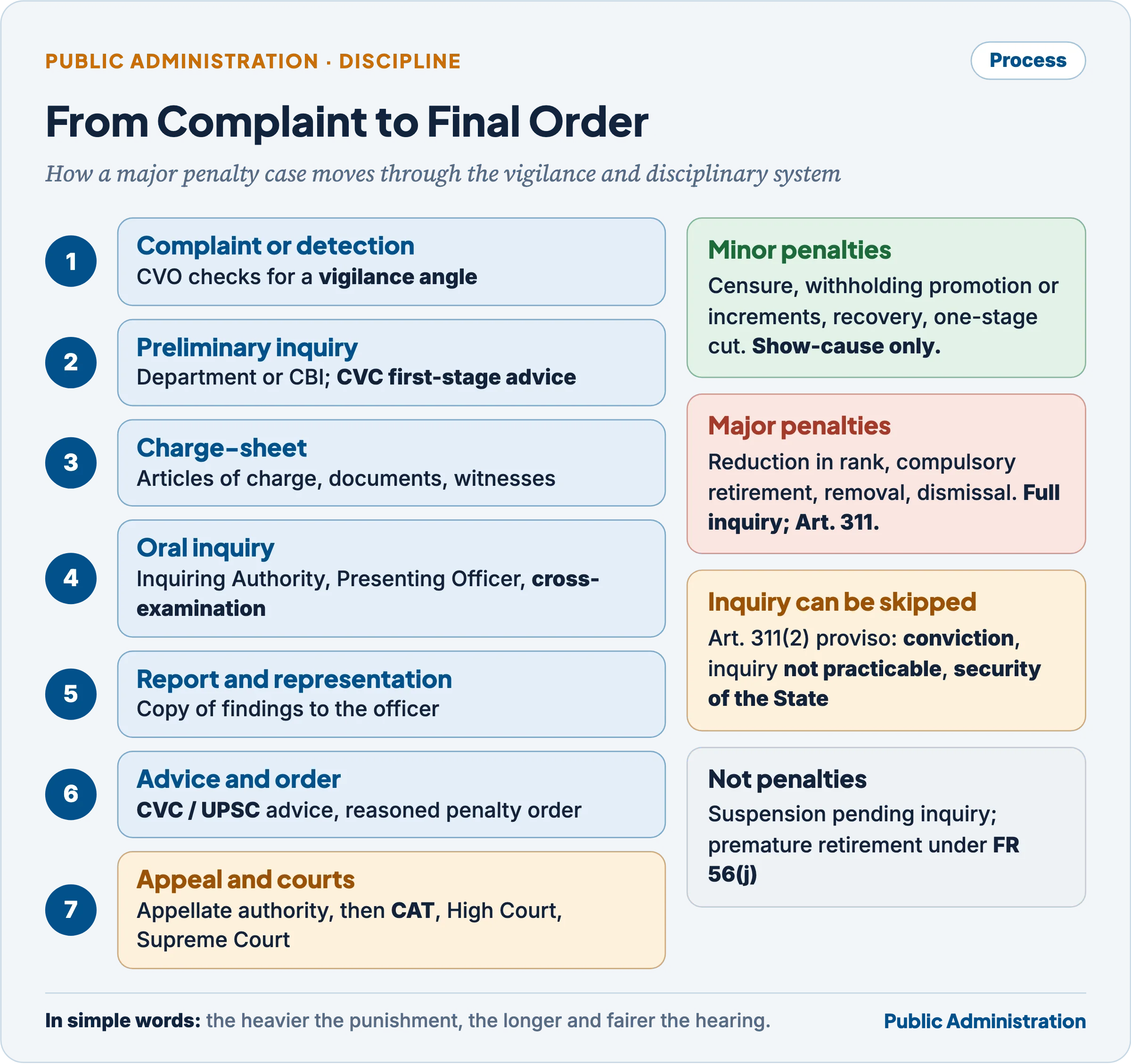
- Minor penalty (Rule 16; AIS Rule 10). A written memorandum states the imputations; the officer makes a representation; the authority decides by a reasoned order. An oral inquiry is held only if the authority thinks fit, or where the penalty would affect pension or run beyond three years.
- Major penalty (Rule 14; AIS Rule 8). A full inquiry, in stages:
- charge-sheet: articles of charge, statement of imputations, lists of documents and witnesses;
- written statement of defence;
- appointment of an Inquiring Authority and a Presenting Officer; the officer may take a defence assistant;
- oral inquiry: inspection of documents, prosecution evidence, cross-examination, defence evidence;
- inquiry report with a finding on each charge; since a 2017 amendment the inquiry should normally be completed within six months;
- copy of the report to the officer for representation before the decision (required by ECIL v. B. Karunakar, 1993);
- advice of the CVC (in vigilance cases) and the UPSC where required;
- final reasoned order, then appeal, revision or review, and the Central Administrative Tribunal.
- The standard of proof is preponderance of probabilities, not proof beyond reasonable doubt. That is why departmental proceedings often follow cases the CBI investigated but could not take to conviction: the same facts may not convict in a criminal court yet justify a major penalty.
- Natural justice in this procedure has two pillars: nemo judex in causa sua (no one judges his own cause) and audi alteram partem (hear the other side). The CCA procedure is in effect a codification of both. Courts set aside orders for procedural lapses only where the officer suffered real prejudice.
3.6 Suspension
- Suspension removes the officer from duty while an inquiry or criminal case is pending, so that evidence is not tampered with and the public is protected. It is not a penalty; the officer receives a subsistence allowance.
- Deemed suspension follows detention in custody for more than 48 hours, or conviction with imprisonment beyond 48 hours.
- Review. Under the CCS (CCA) Rules, a suspension order must be reviewed before 90 days by a review committee; if not extended after review, it lapses, and extensions run up to 180 days at a time.
- AIS officers. A State’s suspension order must be reported to the Centre within 48 hours; it is valid for 30 days and needs the Central Government’s confirmation to continue. Review committees (chaired by the Chief Secretary in the State, by the DoPT Secretary at the Centre) decide extensions; suspension beyond one year (non-corruption cases) or two years (corruption cases) needs the Central Review Committee’s recommendation.
- Ajay Kumar Choudhary v. Union of India (16 February 2015). The Supreme Court held that a suspension should not continue beyond three months if the charge-sheet has not been served within that period; if served, a reasoned order must extend it. The Court noted that prolonged suspension without charges is itself a form of punishment, damaging reputation and career.
Indian Connect — Suspension and dual control in practice
- When an IAS officer is suspended by a State government, the Union must confirm the order within 30 days. Suspensions of officers who displeased a new State government have been revoked by the Centre for want of grounds, and the Central Review Committee has become an arbiter in Centre–State disputes over individual officers.
- The same machinery protects the State’s interest too: the Centre cannot impose a major penalty without a proper inquiry, and a State cannot remove an AIS officer on its own.
3.7 Vigilance: the CVC and departmental vigilance
- Origins. The Central Vigilance Commission was created by a Government resolution of 11 February 1964 on the Santhanam Committee’s advice. After Vineet Narain v. Union of India (1997), in which the Supreme Court directed that the CVC supervise the CBI’s anti-corruption work, it was given statutory status by ordinance in 1998 and by the Central Vigilance Commission Act, 2003.
- Composition. A Central Vigilance Commissioner and up to two Vigilance Commissioners, appointed by the President on the recommendation of a committee of the Prime Minister, the Home Minister and the Leader of the Opposition in the Lok Sabha; tenure four years or until 65. The Commission returned to full three-member strength in January 2026.
- Functions.
- Superintendence over the CBI in cases under the Prevention of Corruption Act, and review of the progress of its investigations.
- Advice to ministries in vigilance cases: first-stage advice (whether to start major or minor penalty proceedings) and second-stage advice (on the inquiry report).
- Supervision of Chief Vigilance Officers (CVOs) in every ministry, public sector undertaking and public sector bank; CVOs conduct preliminary inquiries, frame charges and watch inquiries.
- Preventive vigilance: integrity pacts in procurement, e-tendering, simplification, rotation of sensitive posts, and the annual Vigilance Awareness Week around 31 October.
- Designated agency for whistle-blower complaints under the Public Interest Disclosure and Protection of Informers (PIDPI) Resolution, 2004.
- Limits.
- Its advice is not binding; ministries can and do differ.
- Its supervision covers mainly Group A and gazetted Group B officers, while most government employees are in Group C, whose cases are handled entirely within departments.
- It has no investigating wing for most matters and relies on the CBI.
- Delay. The CVC prescribes time limits for each stage (one month to check for a vigilance angle, three months for investigation, six months for the inquiry and so on), but practice diverges widely. A study of completed cases cited in the 2nd ARC’s fourth report found that inquiries in major penalty cases took on average well over a year, and that the gap between the misconduct and the first reference to the CVC ran to more than three years. Delay punishes the honest, who wait under a cloud, and protects the guilty, who often retire with benefits before the order.
- Prior approval for investigation. Section 17A of the Prevention of Corruption Act (inserted by the 2018 amendment) bars the police from even inquiring into an offence relatable to a public servant’s recommendation or decision in official functions without prior approval of the government or the removing authority, to be given within three months (extendable by one). It aims to protect bona fide decisions from harassment and “policy paralysis”. On 13 January 2026, in Centre for Public Interest Litigation v. Union of India, a two-judge bench gave a split verdict: Justice B.V. Nagarathna held the section unconstitutional as a shield for the corrupt, while Justice K.V. Viswanathan upheld it, subject to the approval being decided on the recommendation of the Lokpal or Lokayukta as an independent screen. The matter was referred to the Chief Justice for a larger bench.
3.8 Premature retirement: FR 56(j) and AIS Rule 16(3)
- Fundamental Rule 56(j) allows the government to retire a Group A or B officer who entered service before 35 after he reaches 50, and other employees after 55, by giving three months’ notice or pay in lieu, if it is in the public interest. Parallel provisions exist in the CCS (Pension) Rules (after 30 years’ service).
- AIS (DCRB) Rule 16(3), as amended in 2012, provides for review of AIS officers’ records after 15 years of qualifying service and again after 25 years or at age 50; the Centre, in consultation with the State, may retire an officer judged unfit.
- Nature. Premature retirement is not a penalty: it carries no stigma and the officer receives pension. The Supreme Court described its object in Union of India v. M.E. Reddy (1980) as weeding out “deadwood” to maintain efficiency, and in Baikuntha Nath Das v. Chief District Medical Officer (1992) held that the decision rests on the government’s subjective satisfaction on the whole record, open to judicial review only for mala fides, absence of evidence or arbitrariness.
- Use. Government data given to Parliament in 2019 showed that from July 2014 to May 2019, about 36,756 Group A and 82,654 Group B officers were reviewed and FR 56(j) or similar provisions were invoked or recommended against 125 Group A and 187 Group B officers.
- Debate.
- For: removes corrupt or incompetent officers without the delay of a full inquiry; signals that tenure is not unconditional.
- Against: can be used to remove inconvenient officers without a hearing; reviews rely on APARs that are themselves subjective; and the 2nd ARC argued that “taking deadwood out” works only if a proper performance management system first defines and measures performance. Its 10th Report proposed formal reviews at 14 and 20 years of service as a fairer replacement for ad hoc screening.
3.9 Problems in the disciplinary system and reform proposals
- Delay, discussed above, is the central complaint.
- Lack of independence. The department that frames the charge also appoints the inquiry officer, decides and hears the first appeal; employees see the process as weighted against them. The alternative, an outside disciplinary body, inspires confidence but weakens the head of department’s control, distances the decision from the organisation’s needs and may encourage litigation.
- Legalism. A large body of case law on Article 311 has turned inquiries into mini-trials in which small procedural slips void penalties.
- Employee interest versus public interest. Procedures borrowed from criminal law (“innocent until proved guilty”) protect the individual but can let the guilty escape on technicalities; the sound principle is that only lapses that could have misled the defence should vitiate proceedings.
- Social pressure. Disciplinary action against an officer from a particular community can be portrayed as discrimination, deterring legitimate action; the remedy lies in transparent, reasoned orders rather than in avoiding action.
- Uneven coverage. The CVC watches senior officers; the bulk of Group C cases receive no outside scrutiny at all.
- 2nd ARC proposals.
- 4th Report (2007): found that Article 311’s safeguards had “shielded the guilty”; recommended that Articles 310 and 311 be repealed and replaced by a law under Article 309 protecting bona fide action and setting out fair procedure; and laid down principles for new disciplinary regulations: simple procedures with short time frames, emphasis on documentary evidence, an appellate mechanism within the department, and imposition of major penalties on the recommendation of a committee for objectivity.
- 10th Report, Refurbishing of Personnel Administration (2008): replace court-style inquiries with a summary procedure with a hearing; dismissal only by an authority at least three levels above the post; consult the CVC once and the UPSC only for likely dismissal; repeal the CCS (CCA) Rules in favour of a Civil Services Law.
- Status. None of the structural proposals has been enacted; Article 311 and the 1965 rules remain. Incremental changes include time limits for inquiries (2017), online case tracking, and greater use of FR 56(j).
4. Staff Associations and Employer–Employee Relations
In simple words
The government is the country’s biggest employer, but an unusual one: it makes the laws, fixes the budget and cannot be shut down. Its employees cannot bargain and strike like factory workers, yet they need a way to be heard. India’s answer is recognised associations, joint councils and pay commissions, in return for giving up strikes.
4.1 Why government employment relations are different
- The employer is the State, represented by officers who cannot settle pay without ministers, the Finance Ministry and Parliament; there is no profit yardstick to link wages to performance; and a strike in an essential service hurts the public rather than the employer.
- The relationship has constitutional (Articles 19, 33, 309–311), political (party-linked unions, pay as an electoral issue) and operational (supervision, welfare, grievance handling) dimensions. The general theory is in the article on Discipline, Performance Appraisal, Employer–Employee Relations and Grievance Redressal.
4.2 The right to form associations and its limits
- Article 19(1)(c) guarantees the right to form associations or unions (and, since 2011, co-operative societies); Article 19(4) permits reasonable restrictions in the interests of sovereignty, integrity, public order or morality.
- O.K. Ghosh v. E.X. Joseph (30 October 1962). A rule of the 1955 conduct rules (Rule 4-B) required a government servant to leave any association that did not obtain or lost government recognition. The Supreme Court struck it down: Article 33, by allowing restrictions only for the armed forces, shows that other government servants keep their Article 19 rights; and there is no proximate connection between recognition (which can be withdrawn on grounds such as disrespectful language in letters) and public order. Making the right to form an association depend on recognition made the right “illusory”.
- Kameshwar Prasad v. State of Bihar (1962). A Bihar rule banning any form of demonstration was struck down as violating Articles 19(1)(a) and (b), but the same rule’s ban on strikes was upheld, because there is no fundamental right to strike.
- The resulting position:
- Joining an association is a fundamental right; recognition is not. A recognised association gets the right to represent members, meet officials and sit on joint councils; an unrecognised one may exist but has no such standing.
- Restrictions apply to associations whose objects are prejudicial to sovereignty, public order or morality (CCS Rule 6), and to armed forces, police and intelligence staff under Article 33 and laws such as the Police Forces (Restriction of Rights) Act, 1966 and the Intelligence Organisations (Restriction of Rights) Act, 1985.
Common confusion
Is it misconduct for a government servant to join an association that the government has not recognised? Not as such. Many notes repeat that membership of an unrecognised association is a disciplinary offence. That was the effect of the old Rule 4-B, which the Supreme Court struck down in O.K. Ghosh v. E.X. Joseph (1962); the Second Pay Commission had also recommended that such membership should not be treated as an offence. Today the conduct rules bar only associations whose objects threaten sovereignty, public order or morality. What an unrecognised association loses is standing: it cannot claim to negotiate, cannot sit on JCM councils and cannot use the check-off system for dues.
4.3 Recognition: the CCS (RSA) Rules, 1993
The Central Civil Services (Recognition of Service Associations) Rules, 1993 replaced earlier rules of 1959. They apply to all Central Government servants, including civilians in defence, except industrial employees of the railways and defence installations, who have separate recognition rules.
| Conditions for recognition (Rule 5) | Conditions for continued recognition (Rule 6) |
|---|---|
| Formed primarily to promote common service interests of members | No representation except on matters of common interest |
| Membership confined to a distinct category of employees | No espousal of individual cases |
| Represents at least 35% of the category; a second association with at least 15% may be recognised if one already exceeds 35% | No political fund; no propagation of a party’s views |
| Members and office-bearers are serving employees; executive from members only | Representations through proper channel; annual accounts and member lists |
| Not formed on the basis of caste, tribe or religion | No periodical without approval; no correspondence with foreign authorities except through government |
| Funds only from members’ subscriptions and government grants | No act that would breach the conduct rules if done by an employee (hence no strike) |
- Verification of membership is by the check-off system (deduction of subscriptions through the payroll); recognition can be withdrawn after a hearing if conditions are breached.
- The Second Pay Commission (chaired by Justice Jagannath Das, 1957–59) recommended that recognition rules be framed so as to grant recognition liberally, and that membership of unrecognised associations not be an offence; it also held that civil servants should not have a right to strike.
- Assessment. The rules buy order (associations that are apolitical, category-based and non-agitational) at the cost of autonomy: government decides who speaks for employees, and can derecognise associations that strike, as it did after the 1968 token strike.
4.4 Functions of staff associations
- Represent members on pay, allowances, hours, leave and service conditions; prepare memoranda for pay commissions.
- Provide welfare and mutual help (co-operative societies, legal aid, benevolent funds).
- Give employees a sense of belonging and collective identity, and supply members for joint councils.
- Contribute to efficiency by raising work problems that supervisors do not see.
- Types: category associations combine into federations (of railwaymen, postal staff, defence civilians, and confederations of Central Government employees); senior services such as the IAS and IPS have service associations that act mainly as professional bodies.
- Criticisms: multiplicity and rivalry of unions, links with political parties, resistance to reforms such as downsizing, outsourcing, lateral entry and performance pay, and neglect of efficiency in favour of pay demands. Public choice theorists read this as producer capture; defenders reply that associations also expose mismanagement and protect honest staff.
4.5 The right to strike
- The legal position. No general law prohibits strikes by civil servants, but CCS Rule 7 forbids participation in any strike or incitement to strike on service matters, so striking is misconduct. The Essential Services Maintenance Act (1968, re-enacted in 1981) and State ESMAs allow governments to ban strikes in notified services; the Essential Defence Services Act, 2021 did so for defence production units.
- Commission views. The Second Pay Commission said civil servants should not enjoy a right to strike; the First Administrative Reforms Commission went further and recommended a complete ban.
- Judgments.
- Kameshwar Prasad (1962): no fundamental right to strike.
- Radhey Shyam Sharma v. Post Master General (1964): penalties on postal employees who joined the July 1960 strike in defiance of the Essential Services Maintenance Ordinance were upheld.
- T.K. Rangarajan v. Government of Tamil Nadu (6 August 2003): after Tamil Nadu dismissed a very large number of striking employees under its Essential Services Maintenance Act, the Supreme Court held that government employees have no fundamental, legal, moral or equitable right to strike, that a strike in public services holds society to ransom, and that employees must use the grievance machinery available; the Court nevertheless left room for reinstatement of most of those dismissed.
- The debate.
- For a limited right: a total ban weakens employees’ bargaining power, drives protest into informal forms (work-to-rule, mass leave) and is out of line with ILO standards, which accept restrictions in essential services but not a blanket ban for all public employees.
- Against: government employees already have security of tenure, pay commissions, joint councils and compulsory arbitration as a quid pro quo for giving up the strike; the public, not the employer, bears the cost of a strike.
- The practical result is the Indian bargain: no strikes, in return for consultation, arbitration and periodic pay commissions.
4.6 Whitleyism: the British model
- Origin. A sub-committee under J.H. Whitley, a Liberal MP and later Speaker, recommended in 1917–18 joint councils with equal representation of employers and workers. The Civil Service National Whitley Council first met in 1919, with an official side and a staff side covering all conditions of service except individual cases; departmental councils mirrored it, and a Civil Service Arbitration Tribunal was added in 1936.
- Principles: joint consultation instead of confrontation, equality of sides, decisions by agreement, arbitration for pay disputes, and recognition of staff associations.
- Meaning. Whitleyism has been called a typical British response to trade unionism among public servants: it absorbed rising unionism into a consensual channel instead of suppressing it or adopting adversarial bargaining. Thatcherite delegation of pay to departments and agencies from the 1980s weakened it. The full account is in the article on Discipline, Performance Appraisal, Employer–Employee Relations and Grievance Redressal.
4.7 The Joint Consultative Machinery in India
- Early attempts. The First Pay Commission (1947) recommended Whitley-type councils; staff committees (1954), renamed staff councils (1957), were advisory and dealt with trivial matters, and unions dismissed them. The Second Pay Commission (1959) called for machinery that followed the Whitley model fully in spirit and largely in form. After the 1960 strike, the government introduced the Scheme for Joint Consultative Machinery and Compulsory Arbitration in 1966, after consulting employee leaders.
- Structure.
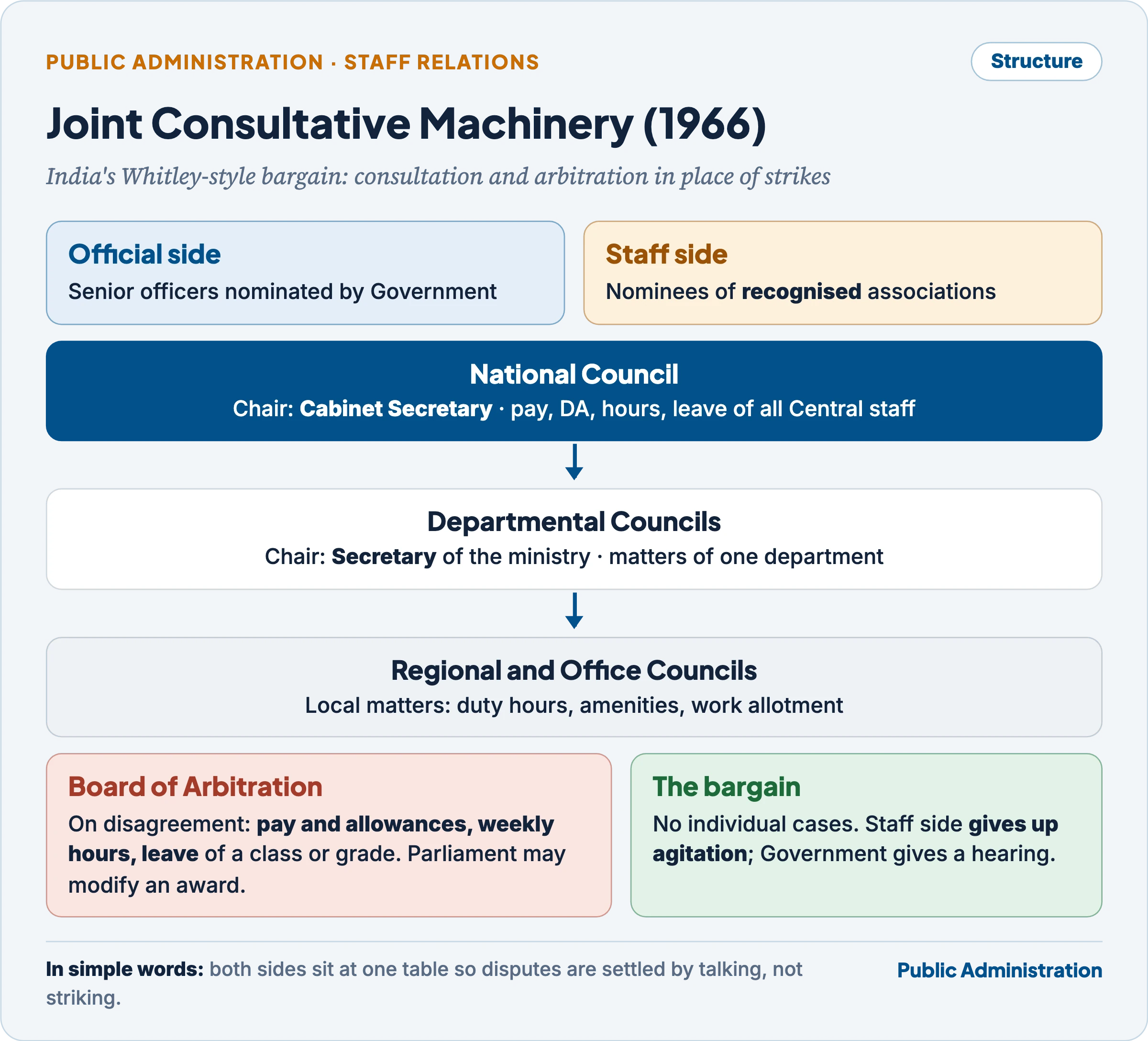
- National Council: chaired by the Cabinet Secretary; official side nominated by government; staff side nominated by recognised federations; deals with matters common to all Central employees such as minimum pay, dearness allowance, hours and leave.
- Departmental Councils: in each ministry, chaired by its Secretary, for that department’s matters.
- Regional and Office Councils: for local matters such as duty hours, amenities and allocation of work.
- Scope. Conditions of service and work, welfare, efficiency and standards of work; on recruitment, promotion and discipline, only general principles; never individual cases.
- Compulsory arbitration. On final disagreement over pay and allowances, weekly hours of work and leave of a class or grade, the matter goes to a Board of Arbitration. Government accepts awards subject to Parliament’s power to modify or reject them on grounds of national economy or social justice.
- The bargain. Participation is voluntary, but staff associations abjure agitation and strikes in return for consultation and arbitration.
- Assessment.
- Achievements: a standing forum at three levels; a channel for dearness allowance and pay commission follow-up; fewer strikes than before 1966; arbitration as a safety valve.
- Weaknesses: the National Council has often gone years without meeting; the official side controls the agenda and the Finance Ministry has an effective veto, so councils are consultative rather than negotiating bodies; arbitration awards are delayed or modified; unions are fragmented and politicised; Group A officers and the growing body of contractual and outsourced workers are outside the machinery.
4.8 Pay commissions: the periodic settlement
Collective grievances over pay are settled less through the JCM than through Central Pay Commissions, before which the JCM staff side and federations present memoranda.
| Commission | Years | Chair |
|---|---|---|
| 1st CPC | 1946–47 | Justice Srinivasa Varadachariar |
| 2nd CPC | 1957–59 | Justice Jagannath Das |
| 3rd CPC | 1970–73 | Justice Raghubir Dayal |
| 4th CPC | 1983–86 | Justice P.N. Singhal |
| 5th CPC | 1994–97 | Justice S. Ratnavel Pandian |
| 6th CPC | 2006–08 | Justice B.N. Srikrishna |
| 7th CPC | 2014–15 | Justice A.K. Mathur |
| 8th CPC | constituted 2025 | Justice Ranjana Prakash Desai |
- 7th CPC. Constituted in February 2014 under Justice A.K. Mathur; reported in November 2015; its recommendations took effect from 1 January 2016, replacing pay bands and grade pay with a single Pay Matrix and raising the minimum pay to ₹18,000 a month.
- 8th CPC. The Cabinet approved its terms of reference on 28 October 2025, and it was constituted by resolution of 3 November 2025: chair Justice Ranjana Prakash Desai, part-time member Prof. Pulak Ghosh, member-secretary Pankaj Jain, with 18 months to report. Through 2026 it has been holding consultations in State capitals (for example Jaipur, Chandigarh, Bengaluru and Mumbai).
- Pensions. Employee federations’ long campaign against the market-linked National Pension System for staff appointed after 2004 led to the Unified Pension Scheme, available as an option within NPS from 1 April 2025, with an assured payout linked to last pay. Several States returned to the old pension scheme, showing how employee demands interact with electoral politics.
- Mutual reliance. The employer relies on employees for delivery and morale; employees rely on the employer for security, fair pay and a voice. Pay commissions, the JCM and recognition rules institutionalise this mutual dependence; where they work, disputes become problems solved jointly rather than battles.
5. Political Rights of Civil Servants
In simple words
A civil servant in India may vote, but may not join a party, campaign or stand for election while in service. The reason is simple: an officer who campaigns for one party today cannot be trusted by the other party when it forms the government tomorrow.
5.1 The rules
- Constitutional base. Government servants are citizens with Article 19 rights and the vote under Article 326; restrictions on their political activity are reasonable restrictions made through service rules under Article 309 (and the AIS Act for the AIS).
- CCS Rule 5 and AIS Rule 5 provide that a government servant shall not:
- be a member of, or otherwise associated with, any political party or any organisation that takes part in politics;
- take part in, subscribe to or assist any political movement or activity;
- canvass, interfere or use influence in an election to any legislature or local authority;
- allow family members to take part in subversive activity (he must report it).
- Permitted: to vote, secretly, without indicating how he intends to vote; to perform election duty, where he must act impartially.
- Government decides what is “political”. If a question arises whether a movement or organisation is political, the government’s decision is final. Office memoranda of 30 November 1966, 25 July 1970 and 28 October 1980 named the Rashtriya Swayamsevak Sangh and the Jamaat-e-Islami as organisations whose activities attract Rule 5, so participation could lead to disciplinary action.
- The 2024 change. A DoPT office memorandum of 9 July 2024 removed the mention of the RSS from those memoranda; Central employees may now take part in its activities without attracting Rule 5. The change came while the Madhya Pradesh High Court was hearing a petition by a retired Central employee challenging the ban. The Jamaat-e-Islami remains on the list.
Common confusion
Did the 2024 memorandum free all government employees to join the RSS, and did it change Rule 5? No on both counts. The memorandum applies only to Central Government employees; State employees are governed by their own conduct rules and instructions, which several States have changed back and forth with changes of government. Rule 5 itself is unchanged: membership of any political party, or of an organisation the government declares political, is still forbidden. What changed is only the government’s classification of one organisation. The episode shows that the reach of Rule 5 depends on executive instructions, which is why critics want such classifications made through the rules themselves, on evidence, rather than by memoranda.
5.2 Elections: duty, disqualification and contesting
- Election duty. The Representation of the People Act, 1951 punishes officers on election duty who act for a candidate or try to influence votes (Section 129), and government servants who act as election, polling or counting agents (Section 134A). During elections officers come under the Election Commission’s superintendence, which can transfer or suspend them.
- Disqualification. A person holding an office of profit under government cannot be a member of a legislature (Articles 102(1)(a) and 191(1)(a)); a person dismissed for corruption or disloyalty to the State is disqualified for five years (RPA Section 9).
- Contesting. A serving officer must therefore resign (or retire) before filing a nomination. Because acceptance of resignation is at the employer’s discretion, especially when proceedings are pending, timing can become political. In 2023 a Madhya Pradesh Deputy Collector who resigned in June to contest the Assembly election had her resignation accepted only on 23–24 October, after High Court directions and the end of departmental proceedings, by which time the party she hoped to represent had named another candidate.
- Local bodies. The CCS rule bars taking part in elections to local authorities as well; claims in some notes that a Central servant may contest local elections with permission are not supported by the current rule.
5.3 After service: cooling-off and post-retirement appointments
- Commercial employment. A one-year bar on commercial employment without permission applies after retirement (Section 2.4); the Attorney General described it as resting on an intelligible differentia, since the officer may have dealt with the firm.
- Joining politics. The Election Commission wrote to the government in 2012 seeking a cooling-off period (it suggested two years) before senior AIS and Group A officers could join a party or contest after leaving service, because officials with political ambitions may favour a party in their last years. In 2013 the government rejected it on the Attorney General’s opinion that the right to contest flows from citizenship and that such a bar might not survive Article 14.
- The courts. In May 2022 the Supreme Court dismissed a petition seeking a cooling-off law, holding that it is for the legislature to decide; in April 2024 a similar petition (relying on the 2012 EC letter and the 2004 report of the Committee on Civil Service Reforms) was withdrawn with liberty to approach the authorities.
- Post-retirement appointments. Governorships, commission memberships, tribunal posts and advisory jobs given to senior officers soon after retirement raise the same concern of quid pro quo.
- Pros: experience and institutional memory are used; specialised bodies need administrators; some posts (tribunal administrative members, information commissioners) require them.
- Cons: anticipation of a post-retirement reward can bend decisions in the last years of service; it weakens the appearance of neutrality and fills independent bodies with former insiders.
- Remedies proposed: a cooling-off period, transparent selection through committees with opposition members, and disclosure of post-retirement offers.
5.4 Comparative models: graded rights
India applies one blanket rule to every grade. Britain and the United States grade political freedom by the level and sensitivity of the post.
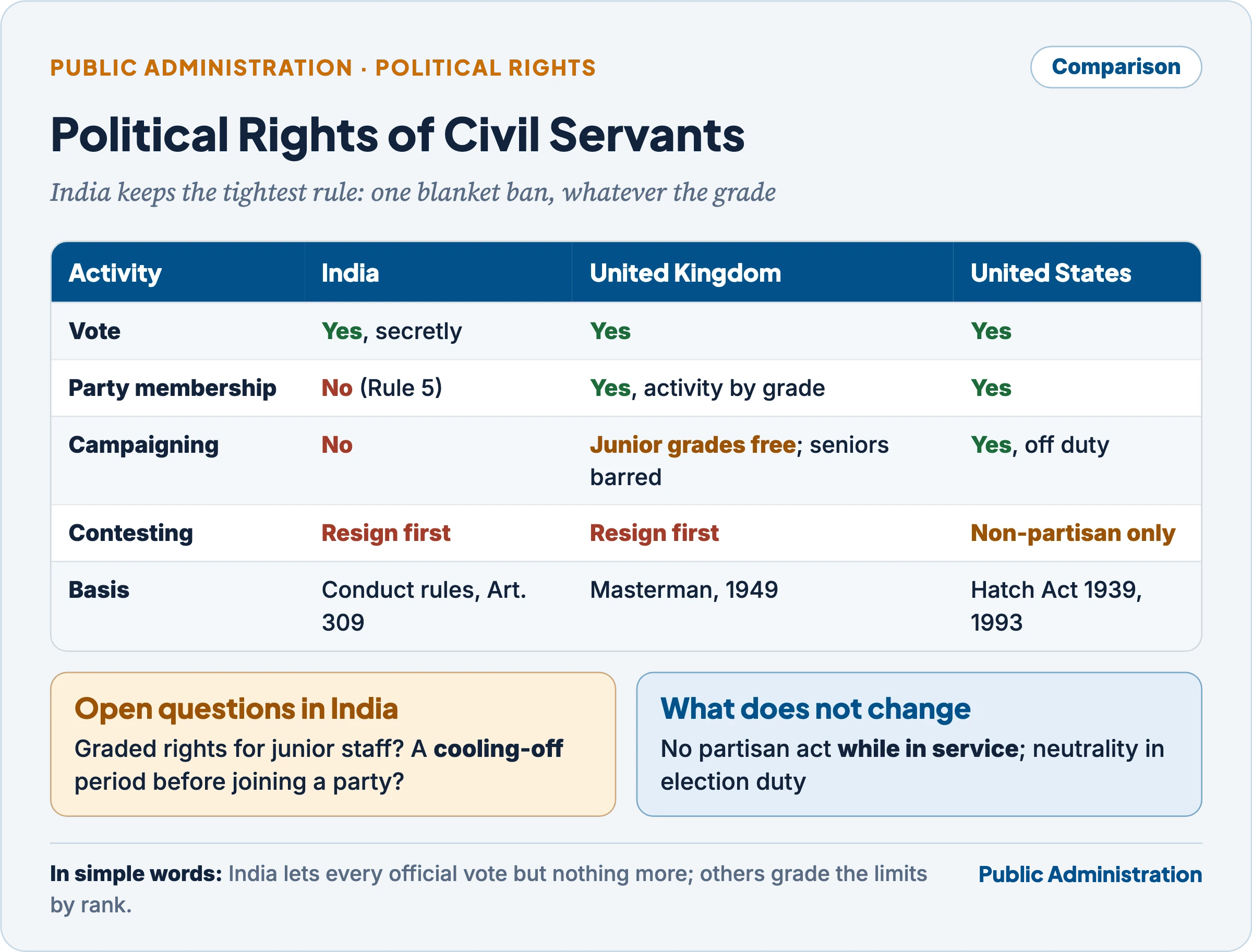
- United Kingdom: the Masterman Committee (1949). Set up in 1948 under J.C. Masterman after representations by the staff side of the National Whitley Council, it reported on 28 June 1949. It divided the civil service into three groups:
- a politically free group (industrial and minor manipulative grades, about 450,000 staff, who gained full political freedom for the first time);
- an intermediate group (clerical grades), who could take part in political activity with departmental permission, except for parliamentary candidature;
- a politically restricted group (higher grades), barred from national political activity.
The staff side protested that it had not been consulted, and the government at first implemented only the freeing of the lowest grades, refining the rest after review in the early 1950s. The graded approach survives: all civil servants must resign before standing for Parliament, but junior staff are otherwise largely free.
- United States: the Hatch Act. The Hatch Act of 1939 barred federal employees from active part in political management or campaigns, after concern over the use of relief workers for party ends. The Hatch Act Reform Amendments of 1993 reversed the presumption: most (“less restricted”) federal employees may now join and hold office in parties, campaign, speak at rallies and distribute literature, but not on duty, not in uniform or in federal buildings, not by soliciting contributions, and not as candidates in partisan elections. “Further restricted” employees (for example in security and intelligence agencies and the senior executive service) remain barred from active campaigning.
5.5 The debate: should Indian civil servants have wider political rights?
- For wider rights (graded):
- A postal clerk or railway gangman has no policy role; denying him party membership is a restriction with no proximate link to neutrality, and Britain and the US do not do it.
- Democratic participation is a value in itself; a large share of the adult workforce is excluded from civic life.
- The ban is often breached informally; open, regulated participation may be healthier than covert partisanship.
- For the present rule:
- India’s politicised administrative culture, with transfers used as reward and punishment, means even junior staff could be pressed into party work; a clear blanket rule is easier to enforce than a graded one.
- The neutrality of the cutting-edge official (the patwari, the police constable, the polling officer) matters as much to the citizen as that of a Secretary.
- Officials still have the vote and the right to association through service associations.
- A middle path would follow the Masterman logic: grade restrictions by post, keep a strict bar for officers with discretionary or electoral functions, and add a cooling-off period for senior officers. The neutrality debate itself is developed in the article on Civil Service Neutrality and Activism.
6. Grievance Redressal for Civil Servants
In simple words
A grievance is a feeling of unfairness about the job: a delayed promotion, a wrong pay fixation, an unfair transfer. If it is not heard inside the office, the employee stops caring, or goes to court or to the media. A good system hears it early and settles it quickly.
6.1 Meaning and sources
- An employee grievance is a complaint about conditions of service or treatment at work: pay fixation, seniority, promotion, transfer, leave, APAR remarks, disciplinary action, pension, harassment or working conditions.
- Collective grievances (pay scales, allowances) go to associations, the JCM and pay commissions; individual grievances need separate machinery, because the JCM and recognised associations are barred from taking up individual cases.
- Consequences of neglect: low morale, absenteeism, litigation, leaks to the media, agitation, and loss of productivity.
6.2 Internal machinery
- Representation to the controlling and higher authorities, with time limits.
- Staff grievance officers designated in ministries and departments, with periodic meetings where staff can raise problems.
- Statutory remedies under the CCS (CCA) and AIS rules: appeal, revision, review and memorials to the President; representations against APAR entries, which must be communicated to the officer (the Supreme Court required this in Dev Dutt v. Union of India, 2008).
- Internal Complaints Committees under the Sexual Harassment of Women at Workplace (Prevention, Prohibition and Redressal) Act, 2013.
- Pension grievances: the Department of Pension and Pensioners’ Welfare runs a separate pension grievance portal (CPENGRAMS) and pension adalats.
- Collective voice: recognised associations and the JCM.
Common confusion
Can a serving civil servant use CPGRAMS to complain about his promotion or a disciplinary order? Generally no. CPGRAMS is a public grievance system for citizens’ complaints about service delivery. DARPG lists service matters of government employees, including disciplinary proceedings, among the subjects it does not take up, along with RTI matters and sub judice cases. A serving employee must use the departmental channels (representation, appeal, review), then the Central Administrative Tribunal. Pensioners’ grievances are handled through the separate pension portal. Notes that present CPGRAMS as a general remedy for employees confuse the two systems.
6.3 The Central Administrative Tribunal
- Constitutional and legal basis. The 42nd Amendment (1976) inserted Article 323A, allowing Parliament to set up administrative tribunals for disputes on recruitment and conditions of service, and to exclude the jurisdiction of courts other than the Supreme Court. Parliament passed the Administrative Tribunals Act, 1985; the CAT began work on 1 November 1985. The Act also provides for State Administrative Tribunals on a State’s request and joint tribunals for two or more States.
- Composition. A Chairman (qualified to be a High Court judge, usually a retired Chief Justice) and judicial and administrative members; benches normally have one of each, combining knowledge of law and of government. It works through a Principal Bench in New Delhi and 18 other benches.
- Jurisdiction (Section 14). Service matters of members of the All India Services, Central civil services and civil posts, civilians in defence, and employees of over 230 notified public sector bodies; excluded: the armed forces (who go to the Armed Forces Tribunal), staff of the Supreme Court and High Courts, and secretarial staff of Parliament.
- Procedure. Original Application with a nominal fee; normally only after departmental remedies are exhausted or six months have passed without decision (Section 20); limitation of one year (Section 21); not bound by the Civil Procedure Code but guided by natural justice (Section 22); power to punish for contempt.
- The tribunals and the courts.
- S.P. Sampath Kumar v. Union of India (1986–87) upheld the CAT as a substitute for the High Court if it was equally effective.
- L. Chandra Kumar v. Union of India (18 March 1997), a seven-judge bench, held that the power of judicial review of High Courts (Articles 226 and 227) and of the Supreme Court (Article 32) is part of the basic structure; tribunals can be courts of first instance, but their decisions are subject to review by a Division Bench of the High Court within whose jurisdiction the bench sits.
- Has judicial review defeated the tribunal’s purpose?
- Yes, partly: the extra tier makes litigation longer and costlier; governments routinely challenge CAT orders in High Courts; the promise of speedy, final, cheap justice is diluted.
- No: tribunals staffed partly by retired civil servants and administered by the executive need a constitutional court above them to secure independence; the CAT remains the forum where most cases end, with cheap access and specialised benches; and the alternative of direct appeals to the Supreme Court would overload it.
- Performance. From 1985 to July 2025 the CAT received about 9.73 lakh cases and disposed of about 9.04 lakh; in December 2025 about 69,000 were pending before it. Some States (Madhya Pradesh, Tamil Nadu, Odisha in 2019) had their State tribunals abolished; the Supreme Court upheld the Odisha abolition in 2023, holding Article 323A to be enabling, not mandatory.
- Independence. In Madras Bar Association v. Union of India (19 November 2025) the Supreme Court struck down key service provisions of the Tribunals Reforms Act, 2021 and directed a National Tribunals Commission. The Tribunals Reforms Act, 2026 (assent 13 August 2026, in force 25 August 2026) created one to select members, review performance and handle complaints for 16 tribunals, including the CAT and SATs. See the article on Administrative Tribunals.
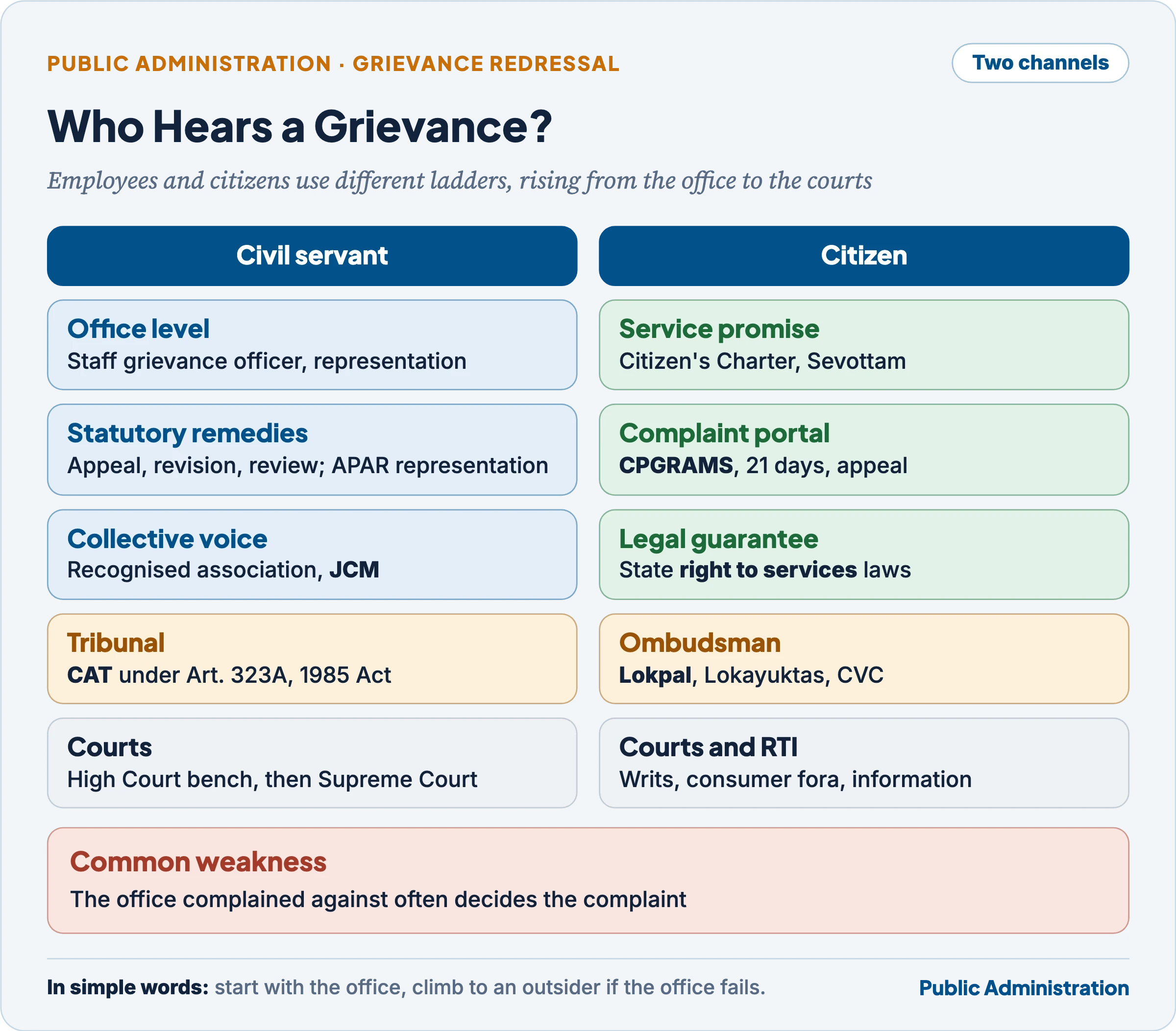
6.4 Grievances, the media and whistle-blowing
- Why the rules say “no media”. Rule 9 bars public criticism, and some States explicitly forbid airing workplace grievances on social media. The logic is that the service must speak with one voice in public and settle internal disputes internally.
- The condition for fairness. The ban is legitimate only if internal channels actually work. Where an employee’s representation is ignored for months, the department judges its own case and the CAT takes years, the media becomes the only lever.
- Whistle-blowing is different from airing a personal grievance: it discloses wrongdoing in the public interest. The PIDPI Resolution (2004) made the CVC the designated agency; the Whistle Blowers Protection Act, 2014 received assent but has not been brought into force, and an amending Bill to dilute it lapsed. Protection therefore remains largely administrative.
6.5 Why it is called the weakest link
- Grievance officers lack authority over the decisions complained of and are usually busy line officers.
- The department that caused the grievance decides it, so employees go to the CAT, where service cases form a large backlog.
- Delay in pay fixation, promotions and pension is systemic, and many grievances are really failures of process (late DPCs, unclear seniority lists).
- Remedies. Prevent grievances through timely promotions, clear rules and transparent transfers and APARs; give grievance officers authority, timelines and a duty to give reasons; use in-house mediation before litigation; track grievance data in supervisors’ performance reviews.
7. Grievance Redressal for Citizens
In simple words
A citizen who waits months for a ration card or a pension needs somewhere to complain. India’s system has three layers: a promise of service (the Citizen’s Charter), a place to complain (CPGRAMS and State portals) and an outside watchdog for serious wrongs (the Lokpal and Lokayuktas). Good systems also study the complaints, so that the same problem does not recur.
7.1 Why citizens’ grievances matter
- Grievances signal failure in delivery: delay, discourtesy, corruption, arbitrary decisions or simple error. A well-used grievance system is a free source of information on where the administration is breaking down.
- Voice, not exit. Albert Hirschman, in Exit, Voice, and Loyalty (1970), argued that dissatisfied members of an organisation can exit (switch to a competitor) or use voice (complain). Citizens usually cannot exit a government monopoly such as a passport office or a land record, so voice mechanisms are the main corrective.
- Participation or complaint? Critics argue that people’s participation in administration often shrinks into the mere filing of grievances: citizens are treated as complainants, not as partners in designing services. The richer forms (social audit, ward committees, participatory planning) are covered in the articles on Citizen and Administration and on Decentralised Planning.
7.2 Evolution of the machinery
- 1966: the First Administrative Reforms Commission (chaired first by Morarji Desai and then K. Hanumanthaiya), in its interim report on Problems of Redress of Citizens’ Grievances, recommended a Lokpal at the Centre and Lokayuktas in the States.
- 1985–88: the Department of Administrative Reforms and Public Grievances (DARPG) was formed (1985), and a Directorate of Public Grievances was set up in the Cabinet Secretariat (1988) to take up complaints that departments failed to resolve.
- 1997: the Conference of Chief Ministers adopted an Action Plan for Effective and Responsive Government (accountable administration, transparency and right to information, cleansing and motivating the civil services); Citizen’s Charters followed.
- 2005–07: the RTI Act, 2005; Sevottam (2006), whose second module is grievance redress; CPGRAMS (2007).
- 2009: the 2nd ARC’s 12th Report (Citizen Centric Administration) recommended Sevottam-compliant charters, analysis of grievance patterns, compensation for delay and independent evaluation.
- 2010 onward: State right to services laws; the central Grievance Redressal Bill, 2011 (lapsed); the Lokpal and Lokayuktas Act, 2013; PRAGATI (2015); CPGRAMS reforms (2022, 2024) and NextGen CPGRAMS.
7.3 CPGRAMS
- What it is. The Centralised Public Grievance Redress and Monitoring System, run by DARPG, is an online platform, available round the clock, through which a citizen can lodge a grievance against any Central ministry or department, and through integrated portals against State governments, and track it to disposal. Grievances can be lodged on the web portal, the mobile app (also on UMANG) or at Common Service Centres.
- The 10-step reforms (2022). After a review by the Prime Minister: universal auto-routing of grievances to the last-mile grievance officer (CPGRAMS 7.0), AI-based categorisation, regional languages, a Grievance Redressal Assessment and Index (GRAI) ranking ministries, a feedback call centre, CSC outreach, Sevottam training, monthly reports and a data strategy unit.
- Comprehensive Guidelines (August 2024). The redressal timeline was cut from 30 to 21 days; ministries must set up dedicated grievance cells with experienced nodal officers, undertake root-cause analysis, act on citizen feedback and provide an appeal to a nodal appellate authority (to be decided within 30 days). A Review Meeting Module for senior-level review was added in 2025.
- Scale and speed.
- Grievances handled rose from about 3 lakh in 2014 to about 27 lakh in 2024; grievance officers mapped rose from about 10,000 to over 1.1 lakh.
- For Central ministries, receipts were about 18.34 lakh in 2025–26, with average disposal time falling from 157 days in 2014 to 14 days.
- Citizen satisfaction measured by the feedback centre was about 76% in January–June 2026.
- NextGen CPGRAMS. DARPG is building a new platform with AI-based categorisation, multilingual and voice filing through Bhashini in 22 languages, messaging-app and chatbot channels, and integration with State portals; an AI voice chatbot, Samadhan Didi, has been launched for registration. As of August 2026 the full platform was still under development, after a go-live target of December 2025.
- Critique.
- Local issues: most citizens’ problems (a road, a ration card, a land record) lie with State, district and local bodies, which CPGRAMS reaches only where State portals are integrated; complaints are routed back to the office complained against.
- Speed over substance: pressure to close cases within 21 days encourages “disposal” without redress, such as forwarding, replying with a rule, or marking as “not actionable”.
- Digital divide: CSCs and voice filing help, but the poorest and least literate still depend on intermediaries.
- No sanction: unlike right to services laws, CPGRAMS imposes no penalty on the defaulting official.
- Defence. CPGRAMS has turned grievance handling from manual correspondence into a trackable, measurable system; its data supports root-cause analysis and process re-engineering, which removes the cause rather than the complaint.
7.4 PRAGATI
- Pro-Active Governance and Timely Implementation (PRAGATI) was launched on 25 March 2015 as an ICT platform through which the Prime Minister reviews, by video conference, public grievances, government programmes and stalled projects, together with Union Secretaries and State Chief Secretaries.
- Design. A three-tier system (PMO, Union Secretaries, Chief Secretaries); issues drawn from CPGRAMS, the Project Monitoring Group and the Ministry of Statistics’ databases; issues uploaded a week before the monthly meeting; departments and States must post their responses within days; the PM’s directions remain in the system until resolved. It combines digital data management, video-conferencing and geo-spatial information.
- Origin and record. It extends the SWAGAT grievance platform used in Gujarat. At its 50th meeting (31 December 2025), the government reported that 377 projects had been reviewed, with about 94% of identified issues resolved, and projects worth more than ₹85 lakh crore accelerated.
- Assessment. PRAGATI shows that top-level attention clears grievances and bottlenecks fast, and that review of sample grievances can force system changes (for example in EPF and income tax refunds). Critics note that it centralises attention in the PMO, can bypass ministers, and works for the issues it selects rather than for the mass of ordinary complaints. Its role as a governance initiative is discussed in the article on Good Governance Initiatives in the Civil Services.
7.5 Charters, Sevottam and right to services laws
- Citizen’s Charters (from 1997) declare services, standards, time limits and grievance procedures, but are not legally enforceable; evaluations found them drafted without consulting users or staff, poorly publicised and unrealistic. Sevottam (2006) tied charters, grievance redress and service delivery capability to an assessment framework and to IS 15700:2005, but lost momentum once the performance management system it was linked to lapsed.
- Grievance Redressal Bill, 2011. The Right of Citizens for Time Bound Delivery of Goods and Services and Redressal of their Grievances Bill, introduced on 20 December 2011, would have made charters mandatory, required Grievance Redress Officers with a 30 working-day limit, created Central and State Public Grievance Redressal Commissions and allowed a penalty of up to ₹50,000 on defaulting officials. It lapsed with the 15th Lok Sabha in 2014.
- Right to services laws. Starting with Madhya Pradesh (2010) and followed by Bihar, Karnataka (Sakala) and others in 2011, about two dozen States make notified services a time-bound entitlement: a designated officer must deliver, appellate authorities can fine him and compensate the citizen, and some States have independent Right to Service Commissions. The charter is the promise, the law the guarantee; but few services are notified, penalties are rare and appeals stay within the administration. The full treatment is in the article on Citizens’ Charters, RTI and Social Audit.
7.6 The ombudsman: Lokpal and Lokayuktas
- The idea. An ombudsman is an independent officer, usually appointed by the legislature, who investigates citizens’ complaints of maladministration and reports publicly; his strength lies in independence, accessibility and publicity, not in power to punish.
The table compares the main institutional models of redress.
| Model | Country and year | Feature |
|---|---|---|
| Ombudsman | Sweden, 1809 | Parliamentary officer supervising officials and courts; direct complaints |
| Parliamentary Commissioner for Administration | UK, 1967 | Complaints filtered through MPs; investigates maladministration, not merits |
| Procurator General (Prokuratura) | Soviet Union, 1922 | Hierarchical legality supervision over all organs, under the party-state |
| Conseil d’État and Médiateur | France, 1799 and 1973 | Administrative court for citizens versus the State; mediator for maladministration |
| Lokpal and Lokayuktas | India, 2013 Act (Lokayuktas from 1971) | Anti-corruption ombudsman with inquiry and prosecution wings |
- The comparison shows two families: ombudsmen that investigate maladministration broadly and rely on persuasion (Sweden, UK), and legal-judicial controls (the Soviet procuracy, the French administrative courts). India’s Lokpal is unusual: it is focused on corruption, not general maladministration, and is designed more as an investigative and prosecuting body than as a complaints mediator.
- Lokayuktas. Following the first ARC, Odisha passed the first Lokayukta law (1970, effective much later), and Maharashtra set up the first working Lokayukta (1971–72). Their powers vary widely: some cover Chief Ministers and others do not; most are recommendatory and lack independent investigators. Karnataka‘s Lokayukta gained prominence through its 2011 report on illegal mining, while several States left the post vacant for years.
- The Lokpal and Lokayuktas Act, 2013. After repeated Bills from 1968 onward lapsed, the India Against Corruption movement of 2011 for a “Jan Lokpal” pushed Parliament to pass the Act (assent 1 January 2014). Key features:
- a Chairperson and up to eight members, half judicial, and at least half from SC, ST, OBC, minorities and women;
- selection by a committee of the Prime Minister, Speaker, Leader of the Opposition, Chief Justice of India (or a nominated judge) and an eminent jurist;
- jurisdiction over the Prime Minister (with exclusions on international relations, security, public order, atomic energy and space), ministers, MPs and Group A to D officers;
- an Inquiry Wing and a Prosecution Wing, superintendence over the CBI in cases it refers, and asset declarations (Section 44);
- States to set up Lokayuktas within one year.
- Working. The first Lokpal, Justice Pinaki Chandra Ghose, took office in March 2019; the post lay without a regular chair after 2022 until Justice A.M. Khanwilkar took over in March 2024.
- Complaints received peaked at about 2,469 in 2022–23 and then fell sharply, partly because many were rejected for not being in the prescribed format. Complaints registered were 166 (2023–24), 292 (2024–25) and 389 (2025–26, to February 2026).
- By late 2025 the Lokpal had ordered preliminary inquiries in fewer than 300 of nearly 7,000 complaints received since 2019, and granted prosecution sanction in only a handful of cases.
- Its Prosecution Wing was constituted only on 6 June 2025, twelve years after the Act; annual reports for several years were not laid before Parliament; and a tender for luxury cars for members in October 2025 drew public criticism.
- Assessment.
- Strengths: a statutory, multi-member, independently selected body with jurisdiction up to the Prime Minister; it gives citizens a channel outside the executive hierarchy.
- Weaknesses: slow operationalisation; dependence on the CBI and departmental agencies; restrictive complaint formats; low public awareness; and the fact that one institution cannot change incentives in a political system where accountability is weak. Lokayuktas in many States remain recommendatory, under-staffed or vacant.
- The deeper point: an ombudsman works where it is backed by a culture of compliance, as in Scandinavia. In India, the Lokpal’s effectiveness depends on parallel reforms in political finance, police investigation and the speed of courts.
Indian Connect — From complaint to system change
- Root-cause analysis under the 2024 CPGRAMS guidelines asks ministries to group grievances by type, find the rule or process that generates them, and fix it. A grievance about delayed EPF transfers, for instance, led to automated transfers; recurring passport complaints led to online appointments and police verification apps.
- The 2nd ARC’s 12th Report made the same argument: process re-engineering prevents some grievances, but redressal still needs administrative commitment, because no redesign removes every error, and a system that does not punish neglect invites it.
- Integration is the frontier: linking CPGRAMS with State portals, right to services commissions and RTI systems so that a citizen’s complaint is answered by whoever actually holds the file.
8. Assessment and Theory Lens
In simple words
All these rules try to answer one question: how do we keep officials honest and neutral without making them fearful and voiceless? India leans towards control, and its protections often help the guilty more than the honest. Theory helps explain why.
8.1 The central debate
Criticism — Criticism: an over-controlled yet under-accountable service
- Restrictive in the wrong places. Bans on criticism, political participation for junior staff, social media posts and strikes treat officials as suspects, a colonial legacy that chills dissent and honest advice.
- Protective in the wrong places. Article 311 jurisprudence, slow inquiries and non-binding CVC advice let the corrupt delay penalties until retirement, while FR 56(j) and transfers can be used against the inconvenient.
- Voice without power. The JCM rarely meets, recognition depends on government favour, and individual grievances go to departments that caused them.
- Citizens’ remedies are weak. Charters are unenforceable, CPGRAMS closes cases rather than solving them, and the Lokpal has prosecuted almost no one of note.
Defence — Defence: a balance suited to Indian conditions
- Neutrality needs firm rules in a politicised environment; a clear blanket ban is easier to enforce than graded rights.
- Safeguards protect honest officers from vindictive political action; repealing Article 311 would expose them further.
- The no-strike bargain works: pay commissions, the JCM and arbitration have kept essential services running since 1966.
- Redress has improved measurably: CPGRAMS disposal time fell from 157 to 14 days; CAT disposes of over 90% of cases filed; right to services laws and the Lokpal add legal force.
- The two sides agree more than they appear to: both want fewer but enforced rules, faster and more independent discipline, and redress that changes systems, not only cases. The disagreement is over sequencing: whether to reduce protections first or to build a credible performance and accountability system first.
8.2 Theory lens: control, voice and the public service bargain
- Weber’s office discipline. Max Weber, in Economy and Society (published 1922), saw the official’s position as a vocation with a duty of impersonal, disciplined service in return for tenure, salary and pension; the official was subject to “strict and systematic discipline and control in the conduct of the office”. India’s conduct and CCA rules are the legal form of this discipline, and Article 311 is the tenure side of the Weberian exchange. Weber also distinguished the official’s duty to carry out policy sine ira et studio (without anger or partiality) from the politician’s role, which grounds the ban on political activity. See the article on Weber and Bureaucracy.
- Principal–agent theory. In agency theory, the political principal cannot fully observe the bureaucratic agent, so it uses monitoring (property returns, vigilance, APARs), bonding (codes, oaths, values clauses) and sanctions (penalties, premature retirement) to reduce agency costs. The Indian problem is that the monitoring is costly and slow, while the most powerful sanction (transfer) is used by principals for their own ends. The dual principal of the AIS (Union and State) explains the Centre’s role in confirming suspensions and imposing major penalties. See the article on Accountability and Control.
- The Finer–Friedrich debate. Herman Finer (1941) argued for external, legal control of officials; Carl Friedrich (1940) for inner responsibility grounded in professional standards. The conduct rules and CVC embody Finer; the 2nd ARC’s values and code of ethics are a turn towards Friedrich. The repeated failure of rule-based control explains why reformers now emphasise values and leadership. See the article on Administrative Ethics.
- Follett’s integration and constructive conflict. Mary Parker Follett, in Creative Experience (1924) and her lectures on constructive conflict, argued that conflict can be settled by domination, compromise or integration, and that integration, finding a solution in which both sides’ real interests are met, is the only lasting one. Whitleyism and the JCM are institutional attempts at integration between official and staff sides; their decline into formal consultation with a Finance Ministry veto shows the slide back to domination. Follett’s idea of “power with” rather than “power over” is the theoretical basis of the “mutual reliance” view of employer–employee relations. See the article on Mary Parker Follett.
- Hirschman’s exit, voice and loyalty. Albert Hirschman (1970) explains why grievance machinery matters most where exit is impossible: citizens cannot exit a monopoly public service, and civil servants with long careers rarely exit their service. Both therefore need voice (CPGRAMS, Lokpal, associations, the CAT); where voice fails, the result is either apathy (loss of loyalty) or extra-institutional voice (strikes, media campaigns).
- The public service bargain. Bernard Schaffer (1973) and later Christopher Hood and Martin Lodge, in The Politics of Public Service Bargains (2006), describe the implicit deal between politicians and civil servants: officials give loyalty, competence and political abstinence; politicians give tenure, anonymity and a share in policy. India’s political-rights rules, conduct rules and Article 311 are the written terms of a trustee-type bargain. The cooling-off debate, post-retirement appointments and selective use of transfers show the bargain being cheated on from both sides: officials seek political rewards, politicians reward pliability.
- Public choice and producer capture. William Niskanen (1971) and the public choice school predict that organised public employees push for higher pay and staffing and resist reforms that threaten them. This explains union resistance to lateral entry, outsourcing and performance pay, and the political salience of pay commissions and pension schemes. See the article on New Public Administration and Public Choice.
- Accountability types. Barbara Romzek and Melvin Dubnick (1987) distinguish bureaucratic, legal, professional and political accountability. Indian civil servants face heavy bureaucratic (hierarchy, vigilance) and legal (courts, CAT) accountability, weak professional accountability (no independent ethics body) and blurred political accountability. Citizens’ grievance machinery is an attempt to add a fifth, responsive accountability to the public. See the article on Accountability and Control.
Commissions, Committees and Judgments
The bodies and cases cited in this article are gathered here.
| Body / case | Year | Key point |
|---|---|---|
| Whitley Committee (J.H. Whitley) | 1916–18 | Joint councils of employers and employed; UK civil service Whitley Council from 1919 |
| First Central Pay Commission (Srinivasa Varadachariar) | 1947 | Recommended Whitley-type joint councils |
| Masterman Committee (J.C. Masterman), UK | 1949 | Politically free, intermediate and restricted groups of civil servants |
| Second Central Pay Commission (Jagannath Das) | 1959 | Liberal recognition of associations; no right to strike; joint consultation and arbitration |
| Kameshwar Prasad v. State of Bihar | 1962 | Ban on all demonstrations invalid; no fundamental right to strike |
| O.K. Ghosh v. E.X. Joseph | 1962 | Rule forcing employees to leave unrecognised associations struck down under Article 19(1)(c) |
| Santhanam Committee (K. Santhanam) | 1964 | Uniform conduct rules (CCS Conduct Rules, 1964); CVC; premature retirement power |
| Radhey Shyam Sharma v. Post Master General | 1964 | Penalties for joining the 1960 strike in defiance of the essential services ordinance upheld |
| First ARC (Morarji Desai, then K. Hanumanthaiya) | 1966 | Interim report recommending Lokpal and Lokayuktas |
| JCM Scheme | 1966 | National, Departmental and Office Councils; compulsory arbitration |
| 42nd Amendment | 1976 | Second show-cause notice removed; Article 323A inserted |
| Union of India v. M.E. Reddy | 1980 | Premature retirement is not a penalty; weeds out deadwood |
| Union of India v. Tulsiram Patel | 1985 | Second proviso to Article 311(2) valid; inquiry can be dispensed with entirely |
| S.P. Sampath Kumar v. Union of India | 1987 | CAT valid as an effective substitute for the High Court |
| Baikuntha Nath Das v. CDMO, Baripada | 1992 | Compulsory retirement on subjective satisfaction; limited judicial review |
| ECIL v. B. Karunakar | 1993 | Inquiry report must be given to the employee before the decision |
| L. Chandra Kumar v. Union of India | 1997 | High Court review of tribunal decisions is part of the basic structure |
| Vineet Narain v. Union of India | 1997 | CVC to supervise the CBI; led to statutory CVC |
| T.K. Rangarajan v. Government of Tamil Nadu | 2003 | No fundamental, legal, moral or equitable right to strike for government employees |
| 2nd ARC, 4th Report (M. Veerappa Moily), Ethics in Governance | 2007 | Values, code of ethics, code of conduct; repeal Articles 310–311 with a law under Article 309 |
| 2nd ARC, 10th Report, Refurbishing of Personnel Administration | 2008 | Summary disciplinary procedure; 14- and 20-year reviews |
| 2nd ARC, 12th Report, Citizen Centric Administration | 2009 | Sevottam charters, grievance analysis, compensation for delay |
| T.S.R. Subramanian v. Union of India | 2013 | Civil Services Boards; oral instructions of political superiors to be recorded |
| Ajay Kumar Choudhary v. Union of India | 2015 | Suspension beyond three months needs a served charge-sheet and a reasoned extension |
| 7th Central Pay Commission (A.K. Mathur) | 2014–15 | Pay Matrix; minimum pay ₹18,000; effective 1 January 2016 |
| Madras Bar Association v. Union of India | 2025 | Key provisions of the Tribunals Reforms Act, 2021 struck down; National Tribunals Commission directed |
| 8th Central Pay Commission (Ranjana Prakash Desai) | 2025 | Constituted 3 November 2025 with 18 months to report |
| Centre for Public Interest Litigation v. Union of India | 2026 | Split verdict on Section 17A of the PC Act; referred to a larger bench |
Key Terms
The terms below recur across the article.
| Term | Meaning in simple words |
|---|---|
| Code of conduct | Written list of acts an official must do or avoid, enforced by penalties |
| Code of ethics | Statement of principles that guide judgement where rules are silent |
| Unbecoming conduct | Omnibus ground covering misbehaviour not listed in the rules |
| Immovable property return | Annual declaration of land and buildings owned by an officer |
| Disciplinary authority | Officer or body empowered to impose penalties |
| Minor penalty | Censure, withholding promotion or increments, recovery, one-stage pay cut |
| Major penalty | Larger pay reduction, compulsory retirement, removal, dismissal |
| Charge-sheet | Written statement of charges with documents and witnesses relied on |
| Suspension | Keeping an officer off duty during an inquiry; not a penalty |
| Vigilance angle | Element of corruption or integrity in a case, bringing in the CVC |
| First- and second-stage advice | CVC advice before starting proceedings and on the inquiry report |
| Chief Vigilance Officer | Officer heading the vigilance unit of a ministry or PSU |
| FR 56(j) | Premature retirement in the public interest; not a penalty |
| Recognition | Government’s acceptance of an association as representative of a category |
| Whitleyism | British system of joint councils of official and staff sides |
| JCM | Joint Consultative Machinery, India’s Whitley-type councils (1966) |
| Compulsory arbitration | Reference of unresolved pay, hours and leave disputes to a Board of Arbitration |
| Cooling-off period | Waiting period before a retired official joins politics or a related firm |
| Politically restricted post | In the UK, a senior post whose holder may not take part in national politics |
| CPGRAMS | DARPG’s online public grievance portal |
| Root-cause analysis | Studying grievances to remove the process that generates them |
| Ombudsman | Independent officer who investigates complaints against the administration |
| Lokpal / Lokayukta | India’s anti-corruption ombudsman at the Union / State level |
| Right to services law | State law making notified services a time-bound legal entitlement |
Contemporary Developments
- 9 July 2024: DoPT removed the mention of the RSS from the 1966, 1970 and 1980 memoranda listing organisations whose activities attract Rule 5 of the CCS (Conduct) Rules; the Jamaat-e-Islami remains listed.
- August 2024: DARPG’s Comprehensive Guidelines cut the CPGRAMS redressal timeline from 30 to 21 days and mandated grievance cells, root-cause analysis and appeals; in 2025–26 Central ministries received about 18.34 lakh grievances, with average disposal in 14 days (Lok Sabha reply, 12 August 2026).
- 1 April 2025: the Unified Pension Scheme took effect as an option for Central Government employees within NPS, after a prolonged campaign by employee federations.
- 6 June 2025: the Lokpal’s Prosecution Wing was constituted; Lokpal complaints registered rose to 389 in 2025–26 (to February 2026), amid criticism of its record and a controversial car tender in October 2025.
- 3 November 2025: the 8th Central Pay Commission was constituted under Justice Ranjana Prakash Desai with 18 months to report; it held State-level consultations through 2026.
- 31 December 2025: the 50th PRAGATI meeting reported 377 projects reviewed and about 94% of identified issues resolved since 2015.
- 13 January 2026: a two-judge bench of the Supreme Court gave a split verdict on Section 17A of the Prevention of Corruption Act, referring the question of prior approval for investigating public servants to a larger bench.
- 13 and 25 August 2026: the Tribunals Reforms Act, 2026 received assent and came into force, repealing the 2021 Act and creating a National Tribunals Commission for 16 tribunals, including the CAT and State Administrative Tribunals.
Revision Grid
| Thinker / body | Work or report (year) | Key idea |
|---|---|---|
| Max Weber | Economy and Society (1922) | Office as vocation; strict discipline in return for tenure |
| O. Glenn Stahl | Public Personnel Administration | Correction and punishment can never be wholly avoided |
| Mary Parker Follett | Creative Experience (1924) | Integration and constructive conflict; power with, not over |
| J.H. Whitley | Whitley reports (1917–18) | Joint councils of official and staff sides |
| J.C. Masterman | Committee report (1949) | Graded political rights by grade of post |
| Carl Hatch | Hatch Act (1939; reformed 1993) | Limits on partisan activity of US federal employees |
| Herman Finer / Carl Friedrich | Debate (1940–41) | External control versus inner responsibility |
| Albert Hirschman | Exit, Voice, and Loyalty (1970) | Voice matters where exit is impossible |
| Hood and Lodge | The Politics of Public Service Bargains (2006) | Loyalty and abstinence traded for tenure and anonymity |
| Romzek and Dubnick | Accountability types (1987) | Bureaucratic, legal, professional, political accountability |
| Santhanam Committee | Report (1964) | Uniform conduct rules; CVC |
| Lord Nolan | Committee on Standards in Public Life (1995) | Seven principles of public life |
| 2nd ARC | 4th Report (2007) | Values, code of ethics; repeal Articles 310–311 |
| 2nd ARC | 12th Report (2009) | Citizen-centric administration; Sevottam; grievance analysis |
| Supreme Court | Tulsiram Patel (1985); Rangarajan (2003); L. Chandra Kumar (1997) | Limits of Article 311; no right to strike; tribunals under High Court review |
Previous Year Questions
- 2025Centralized Public Grievance Redress and Monitoring System (CPGRAMS) does not effectively address local level issues. Give your opinion.
- 2023Do you agree that code of ethics and code of conduct for ministers would help in upholding higher standards of their constitutional and ethical conduct? Explain.
- 2022Citizens charters in India have not succeeded in their objectives in making administrative system citizen centric. Do you agree? Give reasons.
- 2022Examine the role of Lokpal in ensuring transparency and accountability in Indian administration.
- 2020Immediate post-retirement appointments of high officers of government have become a new trend. Discuss its pros and cons.
- 2020“There are adequate legal mechanisms to address corruption and malpractices in administration, but they have failed to curb the menace to any noticeable degree.” In the light of this statement, discuss the efficacy of the institution of Lokayukta in Indian States.
- 2019Emerging developmental aspirations of the society necessitate the constitutional amendment to change the present safeguards available to the civil servants. Evaluate the pros and cons of such amendment.
- 2019Effective ‘Performance Management System’ needs to precede ‘taking deadwood out’ from bureaucracy. Comment.
- 2019Minimal accountability being the dominant norm in the political system, the Lokpal can only be an ideal institution with limited effectiveness. Explain.
- 2018“Effective public grievance redressal requires administrative commitment. But process reengineering can help prevent some grievances.” Discuss.
- 2017“Pro-Active Governance and Timely implementation (PRAGATI) is an innovative project of the Union Government.” Discuss its features and modalities.
- 2017“Civil servants should avoid airing grievances in the media.” In this context, discuss the grievance redressal mechanism available to the Civil Servants in India.
- 2015Discuss the major highlights of the reforms introduced from time-to-time in Central Civil Services Conduct Rules and add your own Comments.
- 2014Elaborate the features of the grievance redressal mechanism of the civil services in India. Does this mechanism satisfy the objectives of its creation?
- 2013“Judicial review of administrative tribunal’s decisions defeats the very objective of establishing tribunals.” Comment with reference to Central Administrative Tribunal.
- 2011“Grievance redressal system is perhaps the weakest link in India’s civil service management.” Comment.
- 2011“One Lok pal, howsoever strong it may be, cannot eliminate corruption in the politico-administrative system in India.” Comment.
- 2009“The weakest aspect of Indian administration is the grievance redressal machinery.” Discuss.
- 2005“The Lokayuktas in States have not succeeded in tackling mal-administration, while the Bill on Lokpal still faces stiff opposition on the floor of the Parliament.” Comment.
- 2004“Values, more than techniques are the eventual determinants of the actions of the administrators.” Comment.
- 2003“A distinctive feature of the Indian administration, since Independence, has been the noticeable efforts undertaken to make the administrative system effectively reach and respond to citizens’ grievances.” Comment.
- 2000Do you think that our administration is sensitive to public grievances? Discuss the existing grievances redressal mechanism and give suggestions for enhancing its capabilities.
- 1997“The machinery of administrative tribunals has been provided for the purpose of speedy and cheap justice against official excesses.” Comment.
- 1997Trace the origin of the Lokayukta plan and comment on its working.
- 1992Peoples participation in administration is a democratic rhetoric, which when translated into action, tends to become mere redressal of citizen’s grievances.’ Discuss.
- 1991‘The institution of Lokpal is still-born while that of Lokayuktas in states are ineffective. But strengthening of these institutions is a sure way of the development of democracy with integrity.’ Comment.
- 1991‘The Lokayuktas are not social reformers, nor are they persons who do little and accomplish nothing. Experience also seems to indicate that there is no comprehensive knowledge of the duties and functions of the Lokayuktas and the scope of their activities, on the part of the ordinary members of the public. Discuss.
- 1989The Ombudsman, The Parliamentary Commissioner, The People’s Procurator General, the Consell d’etat and the Lokpal represent some of the major experiments in designing a “Machinery for Redress of Citizen’s Grievances.” Comment.
- 1988“The institution of ‘Lokpal’ in India is likely to confront a different set of problems as compered to the set of problems experienced by the ‘Lokayuktas’ in the past.” Comment.
- 1987What do you understand by ‘Peoples’ participation in administration’? Suggest measures to sensitise administrators to citizen’s grievances and enlist co-operation from voluntary agencies.
- 2024Civil Servants should be allowed only to cast vote or to participate in the electoral process of the country. Examine.
- 2023“Instead of conflicting, the employer-employee relationship should be one of mutual reliance.” Explain.
- 2022Most civil service regimes still equate ‘Public Sector Ethics’ with anti-corruption efforts. Discuss the insufficiency of Ethics-code in this background.
- 2017“Administrative ethics includes the code of conduct of civil servants, but goes beyond it as well.” Discuss.
- 2016“Disciplinary action may be informal and formal.” Explain and point out the provisions made in the Constitution or Statute to check the misuse of power to take disciplinary action.
- 2015Analyse the relevance of Whitleyism in contemporary employer – employee relationship.
- 2012Comment on the role of Civil Society in facilitating administrative accountability with special reference to the ‘Janlokpal’ issue in India.
- 2003What are the various institutional devices available for the redressal of citizen’s grievances against the excesses and malfunctioning of administration? How successful have they been?
- 2002Analyse the constitutional, political and operational dimensions of employer – employee relations. What are your suggestions to bring about a satisfactory relationship between them?
- 2000Write short note on Effectiveness and utility of Central and State Administrative Tribunals.
- 1990‘Public interest demands the maintenance of political impartiality in the civil services.’ Comment.
- 1987‘Whitleyism represents a typical British response to Trade Unionism by public servants.’ Comment.