

Constitutional position; Structure, recruitment, training and capacity building; Good governance initiatives; Code of conduct and discipline; Staff associations; Political rights; Grievance redressal mechanism; Civil service neutrality; Civil service activism.
This article: Constitutional position of the civil services (Part XIV, Articles 308–323: Article 309 rules, the doctrine of pleasure under Article 310, safeguards under Article 311 and their exceptions, Tulsiram Patel and related judgments, the debate on Article 311); All India Services (Article 312, All India Services Act, 1951, dual control, cadre management, cadre allocation policies of 2017 and 2026, central deputation and the 2022 Rule 6 proposal, criticism and commission views); structure of the civil services (All India, Central Group A–C, State services; generalist vs specialist); Public Service Commissions (Articles 315–323, composition, independence, functions under Article 320, advisory nature, annual reports, State Commissions and the UPSC–SPSC relationship, Staff Selection Commission and National Recruitment Agency); methods of recruitment (direct, promotion, deputation, lateral entry); the Civil Services Examination (its evolution and the Kothari, Satish Chandra, Alagh, Hota, Nigavekar and Baswan committees, CSAT, age and attempts, service and cadre allocation, diversity and reservation including EWS, integrity reforms after 2024 and the Public Examinations Act, 2024); lateral entry from 2018 to its 2024 withdrawal; 2nd ARC recommendations on recruitment; theory lens. Training, good governance initiatives, conduct and discipline, and neutrality and activism are summarised briefly with links to their own articles.
Official Syllabus: Paper II · Unit 2-08 Civil Services
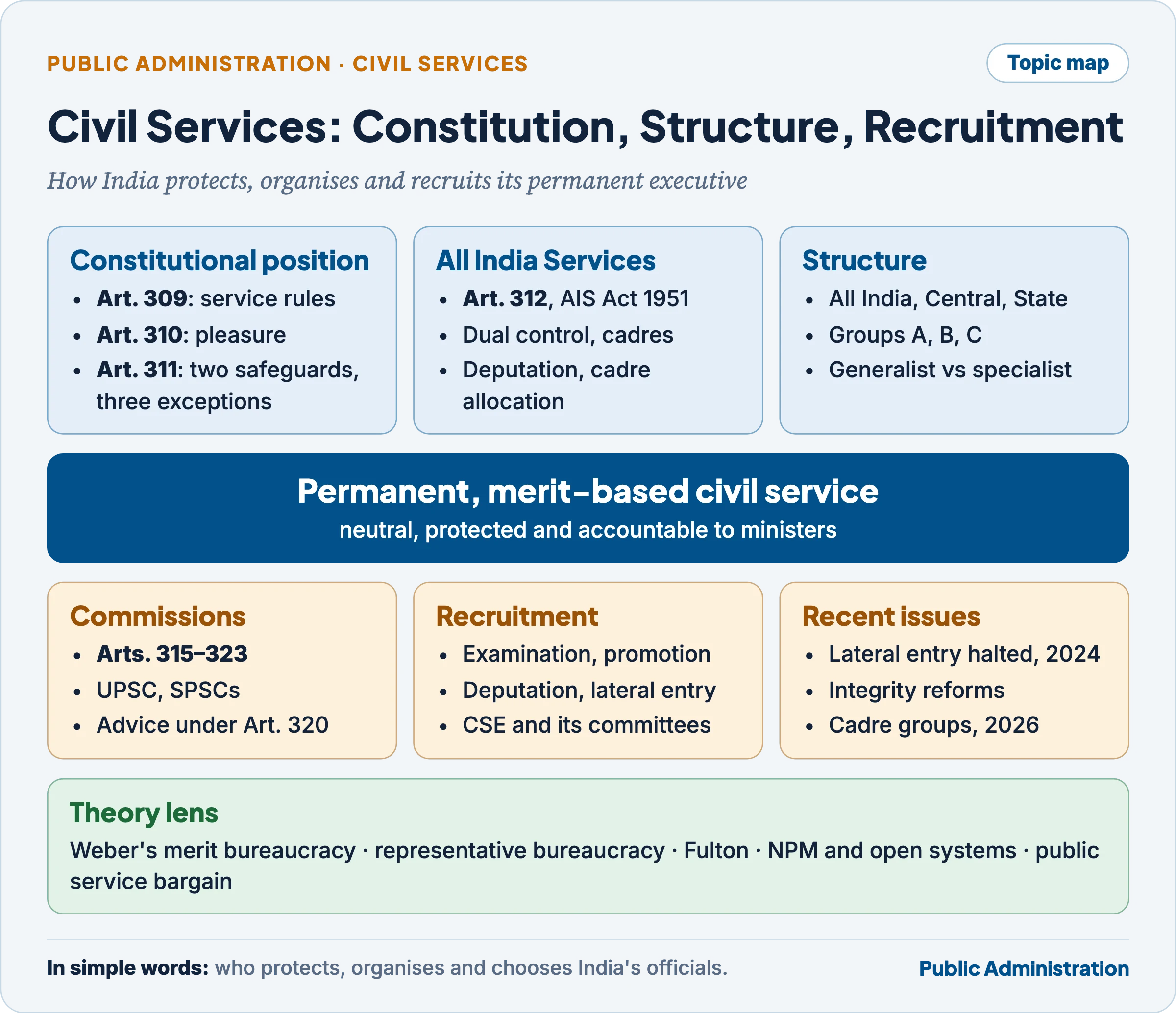
India’s civil services are the permanent executive: the officials who run districts, draft laws, collect taxes, keep order and deliver schemes while ministers come and go. The Constitution gives them an unusual place. It does not merely allow Parliament to create a civil service; it writes into Part XIV who may dismiss a civil servant, what procedure must be followed, how All India Services common to the Union and the States are created, and how independent Public Service Commissions must recruit them. Few constitutions in the world go this far.
Three questions run through this topic. How secure should a civil servant be against the government that employs him? How should the services be organised in a federation with a strong Union and powerful States? And how should India recruit officers who are able, honest and socially representative, and when should it look outside the career services for expertise?
In simple words
Think of a large school run by a trust. The trustees (ministers) change every few years, but the teachers (civil servants) stay. The trust deed says teachers can be removed only after a fair hearing, and that a neutral selection board, not the trustees’ friends, chooses new teachers through an open test. Part XIV is that trust deed for Indian government.
1. The Civil Services: Meaning, Legacy and Significance
In simple words
A civil servant is a government employee who is neither an elected politician, nor a judge, nor a soldier. India inherited a powerful civil service from British rule, kept it after independence, and placed it inside the Constitution so that it would serve every elected government fairly.
1.1 Meaning
- Civil service means the body of permanent, professionally recruited officials of the state who work in a civil (non-military, non-judicial, non-political) capacity.
- Herman Finer, the British political scientist, in The Theory and Practice of Modern Government (1932), described it as a professional body of officials, permanent and paid, who carry out government policy and serve whichever ministry is in power.
- The core features are permanence, merit-based recruitment, professional skill, political neutrality and hierarchy under the political executive.
- “Civil post” in the Constitution covers any post under the Union or a State in a civil capacity; defence services are under the doctrine of pleasure but outside the Article 311 safeguards.
- Public servant is wider: employees of public sector undertakings and statutory corporations are public servants for many laws, but they do not hold civil posts and so do not get the Part XIV safeguards.
1.2 The colonial legacy in brief
- Covenanted service. After the scandals of the East India Company’s servants, Clive and Cornwallis made the Company’s senior officers sign covenants against private trade and gifts and paid them high salaries; this covenanted civil service became the Indian Civil Service (ICS).
- Merit replaces patronage. The Charter Act of 1853 ended nomination; the Macaulay Committee Report (1854) laid down open competition and a scholastic examination for young graduates with a broad liberal education, and the first ICS examination was held in London in 1855.
- Indianisation. Satyendranath Tagore became the first Indian in the ICS (selected 1863). The Aitchison Commission (1886–87) divided services into Imperial, Provincial and Subordinate; the Islington Commission (1912–15) and the Lee Commission (1924) pushed Indianisation, the Lee Commission fixing a 40:40:20 ratio (British : directly recruited Indians : Indians promoted from provincial services) and recommending a statutory Public Service Commission.
- Public Service Commission. Set up on 1 October 1926 under the Government of India Act, 1919, with Sir Ross Barker as Chairman; the Government of India Act, 1935 provided for a Federal Public Service Commission (so named from 1937) and Provincial Commissions.
- Independence. The ICS gave way to the IAS, and the Indian Police to the IPS. On 21 April 1947, at Metcalfe House, Sardar Vallabhbhai Patel addressed the first probationers and called the services the “steel frame” of the country; the date is now Civil Services Day.
- For the full history of the ICS and Indianisation, see the article on Legacy of British Rule.
1.3 Why the framers protected the services
- National unity after Partition. In the Constituent Assembly on 10 October 1949, Patel defended the All India Services against members who saw them as a colonial relic: “You will not have a united India if you have not a good all-India Service which has the independence to speak out its mind”. He argued that an officer must have security to give frank advice.
- Continuity in a parliamentary democracy. Ministers change with elections; a permanent service carries institutional memory and implements the law impartially.
- Development state. Planning made the state the chief agent of development, so the civil service became the main instrument of change rather than just a regulator.
- Rule of law. Recruitment by an independent commission and tenure protection were meant to keep patronage and spoils out of the state.
Indian Connect — Indian Connect: what the services do today
- About 5,577 IAS, 4,594 IPS and 2,164 Indian Forest Service officers were in position on 1 January 2025, against authorised strengths of 6,877, 5,099 and 3,193 (written replies in Parliament, February–March 2026).
- 180 candidates have been recruited to the IAS each year since 2012.
- These few thousand officers head district administration, State secretariats and most senior posts in Union ministries; the much larger body of Group B and C staff does the day-to-day work.
2. Constitutional Position: Part XIV, Articles 308–323
In simple words
Part XIV is the Constitution’s chapter on government employees. One half (Articles 308–314) says who makes service rules, that employees serve at the government’s “pleasure”, and that they cannot be thrown out without a fair inquiry. The other half (Articles 315–323) sets up the independent commissions that recruit them.
2.1 The scheme of Part XIV
The Constitution divides Part XIV into two chapters. The table lists each provision and what it does.
| Article | Provision | What it does |
|---|---|---|
| 308 | Interpretation | Defines the scope of Chapter I |
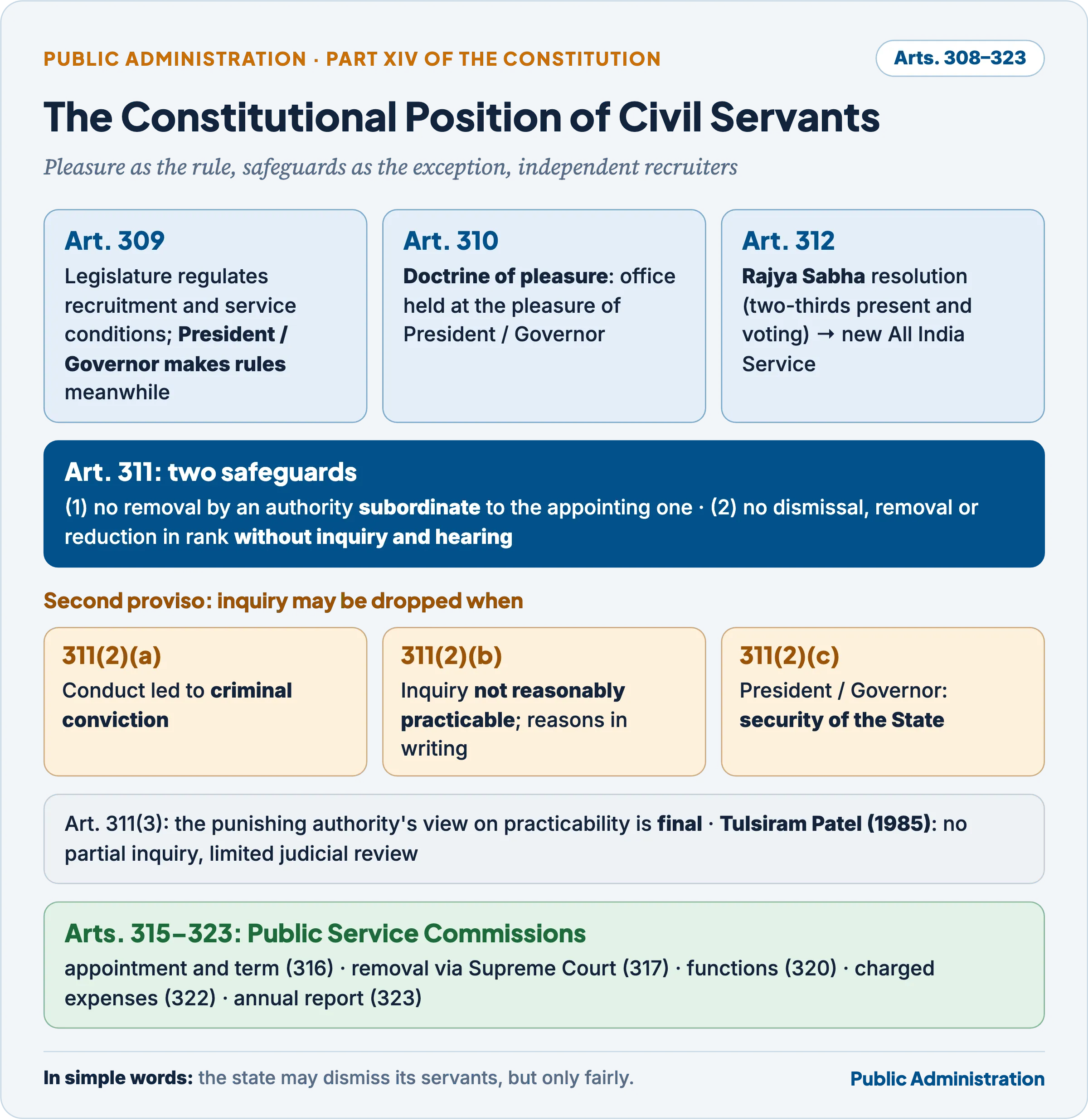
| 309 | Recruitment and conditions of service | Parliament / State legislature may regulate them by law; until then the President / Governor may make rules |
| 310 | Tenure of office | Doctrine of pleasure: civil servants hold office during the pleasure of the President or Governor |
| 311 | Dismissal, removal, reduction in rank | Two safeguards: no removal by a subordinate authority; no removal without an inquiry and reasonable opportunity of being heard |
| 312 | All India Services | Rajya Sabha resolution (two-thirds of members present and voting) → Parliament may create new AIS; IAS and IPS deemed created |
| 312A | Former Secretary of State’s services | Lets Parliament vary the conditions of former ICS officers (added by the 28th Amendment, 1972) |
| 313 | Transitional provisions | Pre-1950 rules continue until replaced |
| 314 | Protection of old ICS officers | Repealed by the 28th Amendment, 1972 |
| 315 | Public Service Commissions | One for the Union, one for each State; a Joint Commission for two or more States by parliamentary law |
| 316 | Appointment and term | Chairman and members appointed by the President (Governor for a State Commission); six years or age 65 (UPSC) / 62 (SPSC) |
| 317 | Removal and suspension | Only by the President for misbehaviour after a Supreme Court inquiry, or for insolvency, outside paid employment or infirmity |
| 318 | Regulations | Conditions of service of members and staff; cannot be varied to a member’s disadvantage after appointment |
| 319 | Bar on later office | Limits on further government employment of chairpersons and members |
| 320 | Functions | Conduct examinations; advise on recruitment, promotions, transfers, discipline and related claims |
| 321 | Extension of functions | Parliament or a State legislature may give additional functions |
| 322 | Expenses | Charged on the Consolidated Fund of India or of the State |
| 323 | Reports | Annual report; reasons for non-acceptance of advice laid before the legislature |
- Chapter I (Articles 308–314) deals with the services: rules, tenure and safeguards.
- Chapter II (Articles 315–323) deals with the Public Service Commissions.
- The detail is unusual. The US Constitution says nothing about a civil service; the British civil service rests on prerogative orders and, since 2010, a short statute. India constitutionalised both the protection of the servant and the independence of the recruiter.
2.2 Article 309: who makes the service law
- Article 309 lets the appropriate legislature regulate recruitment and conditions of service of persons appointed to public services and posts.
- Proviso: until a law is made, the President (for Union services) or the Governor (for State services) may make rules. These rules have the force of law and can even be made retrospective.
- In practice India runs its services on rules, not statutes. Parliament has never passed a general civil services law. Key rules made under the proviso include:
- Central Civil Services (Classification, Control and Appeal) Rules, 1965: penalties and disciplinary procedure;
- Central Civil Services (Conduct) Rules, 1964: conduct of Union employees;
- Fundamental Rules, including FR 56(j) on premature retirement in public interest.
- The All India Services are the exception. They are governed by a statute, the All India Services Act, 1951, made under Article 312, and rules under it such as the IAS (Cadre) Rules, 1954, IAS (Recruitment) Rules, 1954, AIS (Conduct) Rules, 1968 and AIS (Discipline and Appeal) Rules, 1969.
- Why it matters. Because rules are executive acts, the government can change service conditions without a debate in Parliament. The Hota Committee (2004) and the 2nd ARC both called for a Civil Services Law setting out values, a code of ethics, tenure and performance management; draft Public Services Bills (from 2006 onwards) were prepared but never enacted.
2.3 Article 310: the doctrine of pleasure
- Text in substance. Except as expressly provided by the Constitution, every member of a defence service, a civil service of the Union, an All India Service, or holder of a civil post under the Union holds office during the pleasure of the President; State employees hold office during the pleasure of the Governor.
- Origin. The English common law rule that Crown servants hold office at the pleasure of the Crown: the Crown could dismiss them at will, without reasons, and a servant could not sue for wrongful dismissal. It rested on public policy: the state must be able to get rid of a servant whose continuance harms the public.
- The Indian version is qualified.
- It operates “except as expressly provided by this Constitution“, so it is subject to Article 311 and to the fundamental rights (Articles 14 and 16).
- It is exercised by the President or Governor on ministerial advice, through the rules made under Article 309, not as a personal prerogative.
- Article 310(2) allows a contract with a specially qualified person (not a member of a regular service) to provide compensation if the post is abolished or he is asked to vacate it early. This is the constitutional basis for contract appointments such as lateral entry.
- Who is outside the pleasure doctrine. Offices whose holders the Constitution itself protects with a special removal procedure: Supreme Court and High Court judges, the Comptroller and Auditor General, the Chief Election Commissioner, and members of Public Service Commissions.
- Effect. The doctrine of pleasure is the rule; Article 311 creates exceptions that protect the servant’s tenure. A temporary or probationary servant may be discharged under the terms of appointment, but if the termination is in substance a punishment, Article 311 applies.
2.4 Article 311: the two safeguards
- Article 311(1): no member of a civil service of the Union, an All India Service or a civil service of a State, or holder of a civil post, shall be dismissed or removed by an authority subordinate to that by which he was appointed.
- The punishing authority may be the appointing authority or one higher than it, never lower.
- It protects against action by a junior officer with a grudge.
- Article 311(2): no such person shall be dismissed, removed or reduced in rank except after an inquiry in which he has been informed of the charges and given a reasonable opportunity of being heard in respect of those charges.
- It writes natural justice (audi alteram partem, hear the other side) into the Constitution.
- The 42nd Amendment (1976) removed the second opportunity to show cause against the proposed penalty; the penalty may now be imposed on the evidence of the inquiry.
- Only three penalties attract Article 311: dismissal (which normally disqualifies for future government employment), removal (which does not) and reduction in rank. Minor penalties such as censure or withholding increments are governed by the service rules, not by Article 311.
- When is termination a “punishment”? In Parshotam Lal Dhingra v. Union of India (1958), the Supreme Court laid down two tests:
- did the servant have a right to the post (substantive, permanent appointment)? If so, termination is removal;
- does the termination carry evil consequences (forfeiture of pay or pension, a stigma)? If so, it is punishment even for a temporary servant.
- The inquiry report. In Union of India v. Mohd. Ramzan Khan (1991) and Managing Director, ECIL v. B. Karunakar (1993), the Court held that the servant must get a copy of the inquiry officer’s report before the disciplinary authority decides, even after the 42nd Amendment.
2.5 The exceptions: second proviso to Article 311(2)
The inquiry may be dispensed with in three situations.
| Clause | Situation | Who decides |
|---|---|---|
| 311(2)(a) | The servant is dismissed, removed or reduced in rank on the ground of conduct that has led to his conviction on a criminal charge | Disciplinary authority, considering the conduct |
| 311(2)(b) | The authority is satisfied, for reasons recorded in writing, that it is not reasonably practicable to hold an inquiry | The authority empowered to dismiss |
| 311(2)(c) | The President or Governor is satisfied that in the interest of the security of the State it is not expedient to hold an inquiry | President / Governor (on ministerial advice) |
- Article 311(3): if a question arises whether it is reasonably practicable to hold an inquiry, the decision of the authority empowered to punish is final.
- Clause (a) rests on the logic that a criminal court has already given a full trial; the authority still considers whether the conduct deserves the penalty.
- Clause (b) covers situations where witnesses are terrorised, the servant and his associates threaten the inquiry, or there is a general atmosphere of violence or indiscipline.
- Clause (c) has been used against employees suspected of espionage or links with militant groups; in recent years Jammu and Kashmir has dismissed a number of employees under Article 311(2)(c) for alleged terror links, which critics see as punishment without any hearing.
2.6 Union of India v. Tulsiram Patel (1985)
- Facts. Several government servants (including CISF personnel after a violent agitation) had been dismissed without any inquiry under the second proviso. High Courts had set aside some dismissals relying on Challappan (1976), which had required a hearing on penalty even under clause (a).
- Bench. A five-judge Constitution Bench decided on 11 July 1985 by 4:1; Justice D.P. Madon wrote for the majority and Justice M.P. Thakkar dissented.
- Holdings.
- The doctrine of pleasure in India is not a royal prerogative but a constitutional power exercised in public interest, subject only to what the Constitution expressly provides.
- Article 311(2) embodies natural justice; when the second proviso applies, the Constitution itself excludes the inquiry, and Article 14 cannot be used to bring it back. No partial inquiry or show cause notice is required.
- Challappan was overruled on this point.
- The satisfaction under clauses (b) and (c) is not immune from judicial review: courts can strike it down if it is mala fide or based on wholly irrelevant or extraneous grounds; under clause (b) the reasons must be recorded, though they need not be communicated before the order.
- The servant can still have the order reviewed in a departmental appeal, where he must be heard.
- Significance. The judgment strengthened the state’s hand against indiscipline and threats to security while keeping a minimum of judicial control. It also explains why clause (c) orders are rarely overturned: courts defer to the executive on national security.
Common confusion
Does Article 311 protect every government employee, including those in public sector companies?
No. Article 311 protects only persons who are members of a civil service or hold a civil post under the Union or a State. Employees of public sector undertakings, statutory corporations and companies are not holders of civil posts, so they rely on their service regulations, Articles 14 and 16 and labour law instead. Members of the defence services hold office at pleasure under Article 310 but are outside Article 311.
2.7 Constitutional position within the executive
- Executive power of the Union vests in the President (Article 53) and is exercised on the advice of the Council of Ministers (Article 74); the State equivalent is Articles 154 and 163.
- Ministers are responsible, collectively to the Lok Sabha (Article 75(3)) and individually for their departments; civil servants are not responsible to Parliament and act in the name of the President (Article 77(1)) under the Rules of Business (Article 77(3)).
- Hence the old saying that ministers “rule” and civil servants “administer”: the elected executive decides policy and answers for it; the civil service advises, implements and keeps the machine running. In practice, as Paul Appleby observed in his reports on Indian administration (1953, 1956), senior civil servants shape policy heavily through advice, drafting and implementation, so the line is blurred.
- Anonymity follows from ministerial responsibility. Because the minister answers in Parliament, the civil servant stays in the background. The neutrality, anonymity and commitment debate is treated in full in the article on Civil Service Neutrality and Activism.
2.8 Should Article 311 be retained? The central debate
- The 2nd ARC’s case for change. Its fourth report, Ethics in Governance (2007), observed that the safeguards meant to prevent arbitrary and vindictive action had, through a mass of case law, come to shield the guilty and delay punishment. It argued that a public servant, as an agent of the State, cannot rank above the State, and recommended that Article 311 be deleted and replaced by a comprehensive law under Article 309 covering dismissal, removal and reduction in rank with fair procedure.
- The 10th Report (2008) proposed that the oral inquiry be replaced by a summary disciplinary meeting, that dismissal and removal be imposed only by an authority three levels above the servant, and that UPSC consultation be required only for proposed dismissal. The government accepted only part of this (it dropped the second-stage advice of the Central Vigilance Commission in cases where the UPSC is consulted, from 26 September 2011).
- Developmental pressure. Supporters of change argue that a development state needs performance-based tenure, that FR 56(j) premature retirement and the proposal of intensive reviews at 14 and 20 years (2nd ARC) are hampered by litigation, and that India is almost alone in giving civil servants constitutional tenure protection.
Criticism — Criticism: Article 311 protects the inefficient and the corrupt
- Disciplinary cases take years; procedural lapses lead courts to quash penalties on technicalities.
- Security of tenure breeds complacency and risk aversion; the honest and the dishonest are protected alike.
- Developmental aspirations need a service that can be reshaped and held to results; constitutional rigidity blocks performance management.
- Most democracies, including the UK, protect civil servants by law and convention, not by the constitution.
- A carefully drafted Civil Services Law under Article 309 could keep natural justice while removing excess procedure.
Defence — Defence: the safeguards protect the honest and the frank
- The substance of Article 311 is simply natural justice and a hearing; repealing it would not remove the need for a fair inquiry under Articles 14 and 21.
- Delays come from poor inquiries, overloaded authorities and weak vigilance machinery, not from the Article; the 2nd ARC’s own procedural reforms could cut delay without amending the Constitution.
- The second proviso already allows dismissal without inquiry for convicted, threatening or security-risk employees (Tulsiram Patel).
- In a political culture of transfers as punishment and pressure on officers, constitutional protection is what lets an officer say no to an illegal order; Patel’s argument of 1949 still holds.
- Weakening Article 311 could politicise the service, a risk greater than inefficiency.
- Current position. Article 311 stands unchanged. Governments have instead used FR 56(j) reviews, compulsory retirement of officers with doubtful integrity, faster departmental inquiries and online vigilance tracking. Conduct rules, penalties and the disciplinary process are covered in the article on Code of Conduct, Discipline, Staff Associations and Grievance Redressal.
3. The All India Services
In simple words
The All India Services are officers recruited and trained by the Union but posted to the States for most of their careers. An IAS officer selected in Delhi may spend thirty years in Odisha, with spells in the Union ministries. This makes them a bridge between the two levels of government, and also a source of friction between them.
3.1 Article 312 and the All India Services Act, 1951
- Article 312(1): if the Rajya Sabha declares by a resolution supported by not less than two-thirds of the members present and voting that it is necessary or expedient in the national interest, Parliament may by law create one or more All India Services (including an All India Judicial Service) common to the Union and the States, and regulate recruitment and conditions of service.
- Article 312(2): the IAS and IPS are deemed to be services created by Parliament under this Article.
- Article 312(3)–(4): an All India Judicial Service cannot include any post inferior to a district judge; the law creating it may amend Chapter VI of Part VI without counting as a constitutional amendment under Article 368. (The words on the judicial service were added by the 42nd Amendment, 1976.)
- Why the Rajya Sabha? It represents the States. Creating a service that will work inside State governments requires the consent of the federal chamber, a federal safeguard.
- All India Services Act, 1951 empowers the Union, after consultation with State governments, to make rules on recruitment and conditions of service; rules must be laid before Parliament.
- Indian Forest Service. After a Rajya Sabha resolution of 1961 proposing new services, the Indian Forest Service was constituted in 1966 (first selection 1967), the third AIS. The proposed Indian Service of Engineers and Indian Medical and Health Service were never created, and the All India Judicial Service remains on paper.
3.2 Features: dual control and the cadre system
- Recruitment by the Union: the IAS and IPS through the Civil Services Examination, the IFoS through the Indian Forest Service Examination, both conducted by the UPSC.
- Cadre-controlling authorities: Department of Personnel and Training (DoPT) for the IAS, Ministry of Home Affairs for the IPS, Ministry of Environment, Forest and Climate Change for the IFoS.
- State cadres and joint cadres: each officer belongs to a State cadre or a joint cadre (such as Assam–Meghalaya or AGMUT, which covers Arunachal Pradesh, Goa, Mizoram and the Union Territories; the Jammu and Kashmir cadre was merged into AGMUT in 2021).
- Dual control:
- the State government posts, transfers, assesses (writes performance appraisals) and can suspend an officer and start disciplinary action;
- the Union government recruits, trains, fixes cadre strength, approves promotions to higher grades and alone can impose major penalties such as dismissal, removal or compulsory retirement.
- Cadre management:
- Cadre strength of each State is reviewed by the Union in consultation with the State, normally every five years;
- each cadre includes senior duty posts plus reserves: a Central Deputation Reserve (CDR) of up to 40% of senior duty posts, and reserves for State deputation, training and leave;
- direct recruits fill about two-thirds of the cadre and officers promoted from the State Civil Service about one-third (the promotion quota is up to 33⅓% of senior duty posts under the IAS (Recruitment) Rules, 1954).
- Insider and outsider. To keep the national character, only a share of each State’s vacancies goes to “insiders” (candidates from that State who opt for it); the rest are filled by “outsiders” from other States, through a roster.
3.3 Cadre allocation: from zones to groups
- Why it matters. The cadre decides where an officer will spend most of a working life, so its allocation is both a personal stake for candidates and a federal balancing device.
- 2008 policy: a roster-based allocation with insider–outsider ratios; the 2nd ARC (2008) asked that at least one vacancy a year in small north-eastern cadres go to a willing home-State candidate.
- 2017 policy (zones). The 25 cadres were grouped into five zones; candidates gave cadre preferences zone by zone, so that officers from every region would be spread across the country.
- Zone I: AGMUT, Jammu and Kashmir, Himachal Pradesh, Uttarakhand, Punjab, Rajasthan, Haryana;
- Zone II: Uttar Pradesh, Bihar, Jharkhand, Odisha;
- Zone III: Gujarat, Maharashtra, Madhya Pradesh, Chhattisgarh;
- Zone IV: West Bengal, Sikkim, Assam–Meghalaya, Manipur, Tripura, Nagaland;
- Zone V: Telangana, Andhra Pradesh, Karnataka, Tamil Nadu, Kerala.
- 2026 policy (groups). On 23 January 2026 DoPT notified a new policy, effective from CSE-2026, that abolished the zones.
- All cadres are arranged alphabetically in four groups (Group I: AGMUT, Andhra Pradesh, Assam–Meghalaya, Bihar, Chhattisgarh; Group II: Gujarat to Madhya Pradesh; Group III: Maharashtra to Tamil Nadu; Group IV: Telangana, Tripura, Uttarakhand, Uttar Pradesh, West Bengal).
- Allocation runs through a rotational cycle of 25 candidates in merit order, matching the 25 cadres, so that top rankers are spread across cadres over time.
- Vacancies are fixed on the cadre gap as on 1 January of the year after the examination; States must send requisitions by 31 January; EWS vacancies are counted within the unreserved category.
- A candidate must expressly opt for the home State to be considered against an insider vacancy; outsider allocation is by roster, first for persons with benchmark disabilities, then for others.
3.4 Central deputation and the 2022 Rule 6 proposal
- Rule 6(1) of the IAS (Cadre) Rules, 1954: an officer may be deputed to the Union with the concurrence of the State; in case of disagreement, the matter is decided by the Union and the State gives effect to its decision.
- The problem. States have been sending fewer officers than the CDR; the Union reported shortages at Deputy Secretary, Director and Joint Secretary levels, while States argued that their own cadres were short.
- The trigger. In May 2021 the Union sought to call West Bengal’s Chief Secretary, Alapan Bandyopadhyay, to Delhi at short notice after a dispute with the State; he retired instead. The episode exposed how deputation can become a weapon in Union–State conflict.
- The proposal (December 2021–January 2022). DoPT proposed four changes to Rule 6(1):
- States would make available a list of officers for the CDR, and the Union would decide the actual number to be deputed in consultation with the State;
- in case of disagreement, the State would give effect to the Union’s decision within a specified time;
- if the State delayed, the officer would stand relieved from the cadre from a date fixed by the Union;
- in specific situations where the Union needed an officer in public interest, the State would comply within a specified time.
- Reaction. Several States, including Kerala, Tamil Nadu, West Bengal, Telangana, Odisha, Rajasthan, Jharkhand and Meghalaya, opposed it as an attack on cooperative federalism and on the officer’s ability to serve the State government without fear. DoPT told an RTI applicant in 2022 that a final view was yet to be taken, and no amended rule has been notified.
3.5 Significance of the All India Services
- National integration: officers recruited on an all-India basis carry a national outlook into State administration and a State’s ground reality into Union ministries.
- Uniform standards of administration, law and order and forest management across States.
- Link between the two governments: officers who have served in both understand each other’s concerns; this aids cooperative federalism and the implementation of centrally sponsored schemes.
- Neutrality buffer: because the Union alone can impose major penalties, an officer has some protection against a vindictive State government (and vice versa).
- High-quality leadership for districts and secretariats, selected by an independent commission.
- Continuity in crises: elections, President’s Rule, natural disasters and law-and-order emergencies.
3.6 Criticism of the All India Services
- A hangover of colonial rule: created for a unitary, authoritarian state; critics ask why a federal democracy should keep them.
- Against federalism: they restrict State autonomy, since key officers are recruited, trained and ultimately disciplined by the Union. The Rajamannar Committee (appointed by Tamil Nadu in 1969, report 1971) recommended abolishing the IAS and IPS and leaving States to recruit their own services.
- Divided loyalty: an officer serving the State but answerable to Union rules may be caught between two governments, especially when different parties rule them.
- Demoralisation of State services: AIS officers occupy the best posts, earn more and are promoted faster; State service officers reach the IAS late.
- Lack of local familiarity for outsiders (language, culture), though officers learn the State’s language in training.
- Generalism: the IAS rotates across unrelated departments; the 1st ARC (1969) recommended carving out functional fields and opening senior posts to specialists.
- Uneven representation of States among recruits, with some States sending far more candidates than others.
- Financial burden on States, which pay AIS officers at Union scales.
3.7 Commission views
- 1st ARC (1966–70): retained the AIS but recommended functional specialisation and a Senior Management Pool open to all services.
- Rajamannar Committee (1971): abolition of IAS and IPS.
- Sarkaria Commission (1983–88): called the AIS indispensable for unity and said disbanding them or letting States opt out would be retrograde; recommended new AIS for engineering, medicine and health, and education, a minimum spell of central deputation for every officer, Union restraint in using transfers and suspensions against AIS officers, and consultation with States through a council.
- Punchhi Commission (2007–10): supported strengthening and extending the AIS.
- For the place of the AIS in Union–State administrative relations, see the article on Union–State Relations.
Indian Connect — Indian Connect: “Central Services are more all-India than the All India Services”
- An IAS or IPS officer is tied to one State cadre for life, with only spells in Delhi; most of his career is spent inside one State’s politics and language.
- An officer of the Indian Revenue Service, Indian Railway services, Indian Audit and Accounts Service or the Indian Foreign Service can be posted anywhere in India (or abroad) throughout his career, and owes loyalty to one Union department.
- The paradox: the Central Services are national in practice, while the AIS are national in recruitment but State-bound in service. The AIS’s all-India character rests on outsider allocation, central deputation and Union disciplinary control, all of which States contest.
4. Structure of the Civil Services
In simple words
India has three layers of civil servants: All India Services shared by the Union and the States, Central Services that work only for the Union, and State Services that work only for one State. Within each layer, employees are graded into groups by the level of responsibility, from policy-making officers to clerks and support staff.
4.1 The three-tier structure
The structure below shows who recruits each kind of service and where it serves.
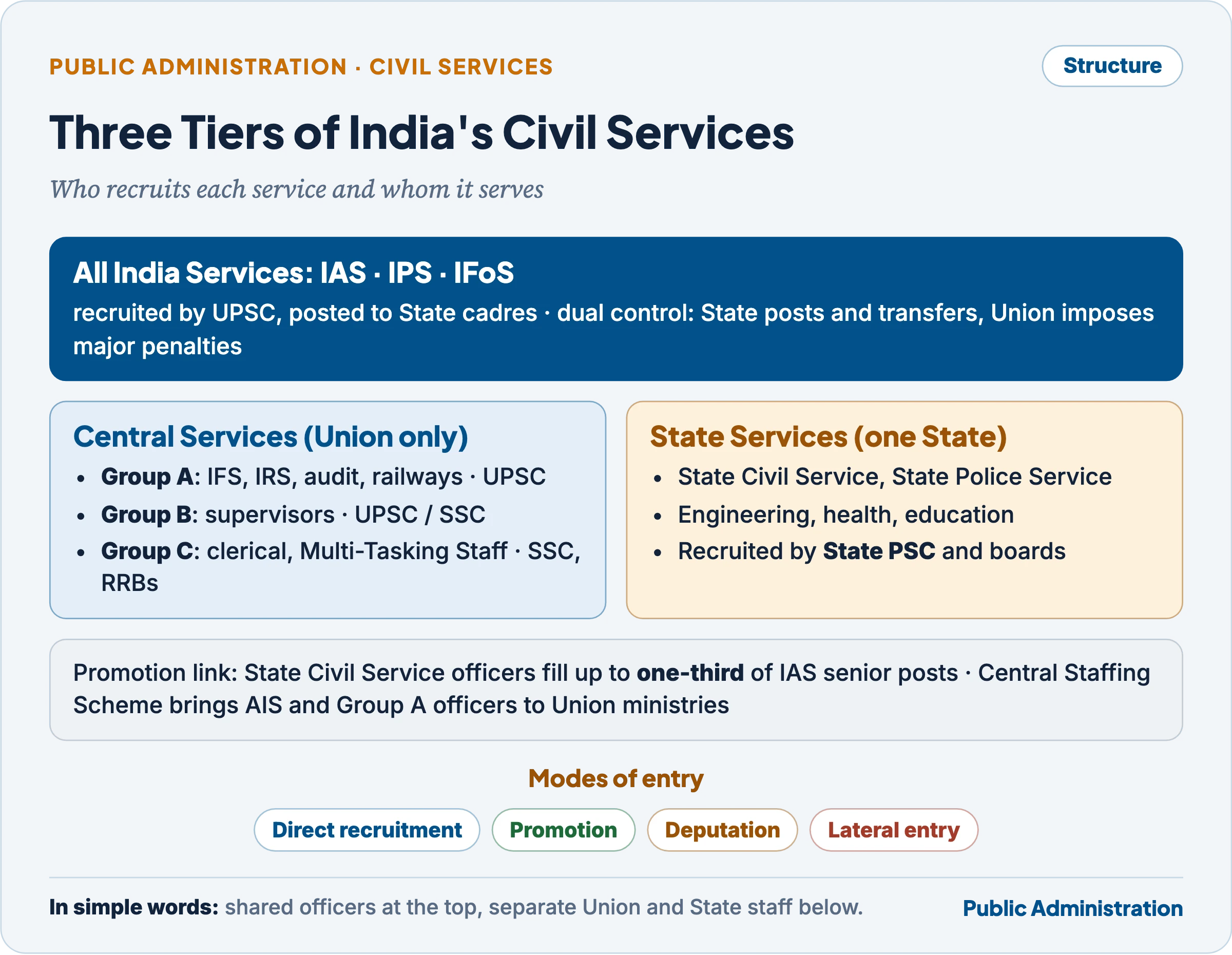
| Tier | Examples | Recruited by | Serves |
|---|---|---|---|
| All India Services | IAS, IPS, IFoS | UPSC (direct) + promotion from State services | States and Union |
| Central Services Group A | Indian Foreign Service, Indian Revenue Service, Indian Audit and Accounts Service, Indian Railway Management Service, Central Engineering Service | UPSC (examinations, selection, promotion) | Union only, across India |
| Central Services Group B | Section Officers, Central Secretariat Service, Group B posts in departments | UPSC / Staff Selection Commission / promotion | Union |
| Central Services Group C | Assistants, clerks, Multi-Tasking Staff | Staff Selection Commission, Railway Recruitment Boards, departments | Union |
| State Services | State Civil Service (executive), State Police Service, State engineering, education and health services | State Public Service Commission / State boards | One State |
- Classification history. Before 1947 the services were Imperial (later All India), Provincial and Subordinate. After independence, the Central Services were classified as Class I, II, III and IV, renamed Group A, B, C and D after the Third Central Pay Commission (1973). The Sixth Central Pay Commission (2008) recommended upgrading Group D posts into Group C as Multi-Tasking Staff, so new Group D recruitment has ended.
- Group A: senior management and policy roles; the organised Group A Central Services number several dozen, each with its own cadre and cadre-controlling ministry.
- Group B: first-line supervisors (gazetted and non-gazetted).
- Group C: clerical and operational staff, by far the largest group.
- A thin top. Group A officers are a very small share of Union employees; the overwhelming majority are in Group C. Policy-making is concentrated in a few thousand officers.
- Central Secretariat Service (CSS): the permanent backbone of Union ministries at Section Officer to Under Secretary and above; senior posts (Deputy Secretary and above) are filled largely through the Central Staffing Scheme, which draws officers of the AIS and Group A services on tenure deputation after empanelment.
- Rationalisation: in 2019 the government decided to merge eight railway Group A services into a single Indian Railway Management Service (IRMS), recruited through the CSE from 2022. NITI Aayog’s Strategy for New India @75 (December 2018) proposed reducing the 60-plus separate central and State services through rationalisation, a central talent pool allocating recruits by competence, and a lower upper age limit.
4.2 State services and their problems
- Each State has its own administrative, police, revenue, engineering, health and education services, recruited by its State Public Service Commission or subordinate service boards.
- The State Civil Service (executive) is the State’s generalist service; its officers run sub-divisions and many district-level posts and are promoted into the IAS against the promotion quota.
- Why State services suffer in comparison:
- lower pay and slower promotion than AIS and Central services;
- the best posts (Collector, Secretary) go to AIS officers, so State officers feel subordinate in their own State;
- induction into the IAS often comes late, sometimes near the end of a career;
- State Commissions are often weaker, slower and more exposed to political pressure and paper leaks, which delay recruitment for years;
- frequent transfers and political pressure are felt more by State officers, who lack Union disciplinary protection;
- weaker training and mid-career learning.
- Measures suggested:
- induction into the IAS by a UPSC-conducted examination for State officers with 8–10 years of Group A service (2nd ARC, 10th Report);
- stronger State Commissions with transparent appointments (see Section 5.6);
- State Civil Services Authorities or Civil Services Boards for postings and tenure;
- better State training institutes and inclusion in Mission Karmayogi-style capacity building;
- clear career progression and domain assignment for State officers too.
4.3 Generalist vs specialist
- Who is a generalist? An officer recruited young on a broad, non-technical test, given general training, and posted across unrelated departments, rising to top policy posts on the strength of administrative experience (the IAS in India, the administrative class in Britain).
- Who is a specialist? An officer recruited for professional knowledge (engineer, doctor, scientist, economist, accountant) who works within that field and gives technical advice.
- Indian pattern. Policy and coordination posts in secretariats and districts are held largely by generalists; specialists head technical departments and directorates, and complain that a generalist secretariat stands between them and the minister. The Secretariat–Directorate friction is treated in the article on Chief Secretary, State Secretariat and Directorates.
| Case for the generalist | Case for the specialist | |
|---|---|---|
| Coordination | Area administration (the district) needs someone who can coordinate many departments | Modern policy is technical (finance, health, digital, climate); coordination without knowledge is shallow |
| Political sense | Ministers need advisers who understand public opinion and Parliament | Specialists can explain technical choices to ministers directly, without an intermediary |
| Breadth | Broad experience avoids departmental tunnel vision | Frequent rotation of generalists prevents depth and produces dependence on consultants |
| Decision-making | Technical inputs are only one part; legal, financial and political factors dominate | The generalist depends on specialist advice anyway, but takes the credit and the decision |
| Morale | A single administrative service provides a clear leadership cadre | Excluding specialists from top posts lowers their morale and drives brain drain |
- Origins of the generalist rationale. The Northcote–Trevelyan Report (1854) in Britain and the Macaulay Report (1854) in India held that a broadly educated, intelligent young graduate, trained on the job, makes a better administrator than a narrow expert. The administrator, on this view, should have something of the qualities of a layman, able to weigh expert advice against public needs.
- The Fulton critique. The Fulton Committee in the UK (1966–68, chaired by Lord Fulton) attacked the service as still based on “the philosophy of the amateur (or ‘generalist’ or ‘all-rounder’)“, recommended a bigger role for specialists, abolition of the class system, a Civil Service Department and a Civil Service College. Its critique is the classic reference in the Indian debate.
- Indian commissions.
- The 1st ARC (1969) recommended that senior posts in functional areas go to those with functional expertise, and that non-functional senior posts be open to all services through a Senior Management Pool; it was not implemented.
- The 2nd ARC (2008) recommended domain assignment to every AIS and Group A officer after 13 years of service, with the domains assigned by a Central Civil Services Authority; the government agreed in principle but preferred assignment after 18 years in consultation with officers.
- The 2nd ARC also proposed opening Senior Administrative Grade posts to competition from all services, and earmarking some higher posts for outside talent.
- The middle way (current trend):
- domain specialisation of generalists after their field years, through mid-career training and longer tenures;
- competency mapping under Mission Karmayogi, matching officers to posts through role frameworks;
- opening the Central Staffing Scheme to more Group A services, so that IRS, audit, railway and other officers become Joint Secretaries and Secretaries;
- lateral entry of a few specialists at senior levels (Section 7);
- multidisciplinary teams in which policymakers, programme managers and technical experts work together.
Common confusion
Is the IAS purely a generalist service?
Not quite. IAS officers are generalists at entry, but many build deep expertise over long stints in finance, power, health or land administration, and the 2nd ARC and later reforms aim to formalise this through domain assignment. Conversely, many “specialist” Group A services (revenue, audit, railways) supply senior generalist managers through the Central Staffing Scheme. The real issue is how postings and tenures are managed, not the label at recruitment.
5. Public Service Commissions
In simple words
Public Service Commissions are independent recruiting bodies set up by the Constitution. Their job is to choose government employees on merit, so that a minister cannot simply hire relatives or party workers. They also advise the government on promotions and on punishing employees.
5.1 Evolution
- 1926: first Public Service Commission (Chairman Sir Ross Barker and four members), advisory, under rules framed under the 1919 Act.
- 1935–37: the Government of India Act, 1935 created a Federal PSC and Provincial PSCs, made consultation on recruitment, promotions and discipline mandatory, and the Federal Commission took that name on 1 April 1937.
- 1947: H.K. Kripalani became the first Indian Chairman.
- 26 January 1950: the Federal PSC became the Union Public Service Commission (UPSC) with constitutional status; R.N. Banerjee was its first Chairman under the Constitution.
- 1985: sanctioned strength fixed at a Chairman and ten members.
- 1992: Rose Millian Bathew Kharbuli became the first woman Chairperson.
- 1 October 2026: the UPSC completed 100 years, marked by a year-long centenary (from 1 October 2025) and a two-day conference, Manthan, in New Delhi on 30 September–1 October 2026.
5.2 Composition, appointment and independence
- Number of members is not fixed by the Constitution; it is set by the President (or Governor) through regulations; the UPSC (Members) Regulations, 1969 govern members’ conditions of service. The UPSC’s sanctioned strength has been a Chairman and ten members since 1985; in 2026 it had a Chairman and eight members.
- Appointment (Article 316): by the President for the UPSC and a Joint Commission, by the Governor for a State Commission.
- As nearly as may be one-half of the members must have held office for at least ten years under the Government of India or a State government.
- The Constitution prescribes no other qualification and no selection committee.
- Term: six years or until age 65 (UPSC) or 62 (SPSC; raised from 60 by the 41st Amendment, 1976), whichever is earlier. A member is not eligible for reappointment to the same office.
- Removal (Article 317):
- only by the President (even for a State Commission member), on the ground of misbehaviour, after an inquiry by the Supreme Court on a reference by the President, and the Court reporting that the member ought to be removed;
- the President (or Governor, for a State Commission) may suspend a member while the reference is pending;
- the President may remove a member who is adjudged insolvent, takes up paid employment outside the office, or is unfit due to infirmity of mind or body;
- being interested in a government contract or sharing its profits counts as misbehaviour.
- Conditions of service (Article 318) cannot be varied to a member’s disadvantage after appointment.
- Expenses charged (Article 322) on the Consolidated Fund, so they are not voted annually by the legislature.
- Bar on later office (Article 319):
- the UPSC Chairman is ineligible for any further employment under the Government of India or a State;
- a UPSC member can become UPSC Chairman or Chairman of a State Commission, but no other government post;
- an SPSC Chairman can become Chairman or member of the UPSC or Chairman of another SPSC;
- an SPSC member can become Chairman or member of the UPSC, or Chairman of that or another SPSC.
These provisions together make the Commissions among the most insulated bodies in the Constitution. The insulation is about tenure and money; it does not extend to selection of members, which is entirely in executive hands.
Common confusion
Can a Governor remove a member of a State Public Service Commission?
No. A Governor appoints and may suspend a State Commission member pending a reference, but removal is only by the President, and for misbehaviour only after an inquiry by the Supreme Court (Article 317). This keeps State Commissions out of the reach of the State government that appointed them.
5.3 Functions under Article 320
- Article 320(1): the UPSC and State Commissions conduct examinations for appointments to the services of the Union and the States respectively.
- Article 320(2): if two or more States request, the UPSC assists them in framing and operating joint recruitment for services needing special qualifications.
- Article 320(3): the Commission shall be consulted on:
- (a) methods of recruitment to civil services and posts;
- (b) principles to be followed in making appointments, promotions and transfers, and the suitability of candidates;
- (c) disciplinary matters affecting a civil servant, including memorials and petitions;
- (d) claims for legal costs incurred by a civil servant in defending action taken in the course of duty;
- (e) claims for injury pensions and related awards;
- and any other matter referred to it by the President or Governor.
- Exclusions:
- the proviso to 320(3) lets the President (or Governor) make regulations specifying matters on which consultation is not necessary, for example the UPSC (Exemption from Consultation) Regulations, 1958, which exclude many posts and matters;
- Article 320(4): no consultation is needed on reservation of posts for backward classes under Article 16(4) or on giving effect to Article 335 (claims of SCs and STs);
- Article 320(5): exemption regulations must be laid before Parliament or the State legislature for at least 14 days and may be modified by it.
- Article 321: Parliament or a State legislature may give additional functions, such as recruitment for local authorities or public institutions; in 1960–61 the UPSC agreed to recruit for bodies such as the Delhi Municipal Corporation and the Employees’ State Insurance Corporation.
- Article 323: the UPSC presents an annual report to the President, who lays it before Parliament with a memorandum explaining cases where the Commission’s advice was not accepted and the reasons. State Commissions report to the Governor, who lays the report before the State legislature.
- Article 315(4): the UPSC may, at a Governor’s request and with the President’s approval, serve the needs of a State.
5.4 What the UPSC actually does
- Recruitment by examination: Civil Services, Indian Forest Service, Engineering Services, Combined Medical Services, National Defence Academy and Naval Academy, Combined Defence Services, Central Armed Police Forces (Assistant Commandants) and others, about 15 examinations a year.
- Recruitment by selection: interviews (with or without a recruitment test) for specialist posts requisitioned by ministries.
- Advice on promotions: a member presides over Departmental Promotion Committees for Group A promotions; it processed records of 24,581 officers for promotion in 2023-24.
- Induction into the AIS: the Selection Committee chaired by the UPSC Chairman or a member prepares the list of State Civil Service and non-State Civil Service officers for promotion to the IAS, IPS and IFoS (532 officers inducted in 2023-24).
- Disciplinary advice before major penalties on Group A officers.
- Police leadership: since 2012–13, under the Supreme Court’s order in Prakash Singh v. Union of India (2006), it empanels senior IPS officers from which States appoint their Director General of Police.
- Advice on Recruitment Rules framed by ministries for each post.
5.5 Advisory nature and independence
- Consultation is not concurrence. In State of U.P. v. Manbodhan Lal Srivastava (1957), the Supreme Court held that Article 320(3)(c) is directory, not mandatory: failure to consult the Commission does not invalidate a disciplinary order, and Article 320 confers no enforceable right on the civil servant.
- Advice can be rejected. The government must only explain its reasons to Parliament under Article 323. In practice the advice is accepted in the vast majority of cases, and the report to Parliament creates public accountability for rejections.
- Strengths of independence:
- security of tenure, removal only through the Supreme Court, protection of service conditions;
- charged expenditure;
- the bar on post-retirement government employment of the UPSC Chairman;
- a long record of conducting examinations with integrity; the UPSC is among the most trusted institutions in India.
- Limits of independence:
- appointments are made by the executive alone, with no qualifications beyond the ten-year rule and no selection committee;
- exemption regulations can shrink the Commission’s role;
- requisitions for recruitment come from the government, which can delay or cancel them (as with the lateral entry advertisement of August 2024);
- many posts are filled through contract, deputation, outsourcing and ad hoc appointments outside the Commission’s purview;
- several promotion and disciplinary matters have been shifted away from the Commission over time;
- members who are retired civil servants may share the outlook of the bureaucracy they are meant to judge.
5.6 State Public Service Commissions and the “recruitment of recruiters”
- The weak link. Many State Commissions have faced paper leaks, cancelled examinations, delayed results, litigation over answer keys and allegations of corruption and nepotism in appointments. Since the Constitution sets no qualifications, State governments have at times appointed politicians and loyalists as Chairmen and members.
- Punjab’s warning. The Punjab Commission Chairman Ravi Pal Singh Sidhu (1996–2002) was prosecuted in a cash-for-jobs scandal, and the Supreme Court later referred to it when examining appointments.
- State of Punjab v. Salil Sabhlok (2013). The Supreme Court upheld the quashing of the appointment of a sitting MLA and lawyer as Chairman of the Punjab Public Service Commission. It held that, although Article 316 lays down no qualifications, integrity, competence and knowledge of administration and recruitment are implied relevant factors; a High Court may interfere under Article 226 in exceptional cases where these are ignored. The Court urged a transparent selection procedure and guidelines.
- Reforms suggested for appointing the recruiters:
- statutory eligibility criteria (integrity, experience in administration, academics or recruitment) and a selection committee including the Chief Minister, Leader of Opposition and a judge, on the model proposed for other constitutional bodies;
- public disclosure of the panel and reasons;
- fixed calendars, technology-based examinations and question banks to reduce discretion;
- application of the Public Examinations Act, 2024 model in State laws against unfair means (several States have their own anti-leak laws).
5.7 Relationship between the UPSC and State Commissions
- Constitutional position: the UPSC and the State Commissions are separate and coordinate bodies. There is no hierarchy: the UPSC has no power to direct, supervise or hear appeals against a State Commission. The only links are Article 315(4) (UPSC serving a State on request), Article 319 (SPSC members may move to the UPSC) and Article 320(2) (assisting joint recruitment).
- The 1989 proposal of a Supreme Court–High Court style relationship:
- For a linkage: common standards of fairness, a national policy on recruitment, shared technology, question banks and evaluation methods, training of State Commission staff, and a peer check on weak State Commissions; the UPSC already hosts conferences of State Commission chairpersons and shares practices.
- Against a hierarchy: recruitment to State services is a State subject under Article 309; a supervisory UPSC would be a centralising step contrary to federalism; the Supreme Court’s relationship with High Courts rests on appellate jurisdiction, which has no parallel in recruitment; and the UPSC’s own capacity is limited.
- Balanced position: a voluntary, cooperative linkage (common guidelines, technology sharing, a standing conference, benchmarking) rather than a constitutional hierarchy, with stronger appointment norms for State Commissions themselves.
5.8 Other recruiting bodies
- Staff Selection Commission (SSC): set up in 1975 as the Subordinate Services Commission and renamed in 1977; an attached office of DoPT that recruits for Group B (non-gazetted) and Group C posts in Union ministries through examinations such as the Combined Graduate Level and Combined Higher Secondary Level.
- Railway Recruitment Boards and the Institute of Banking Personnel Selection recruit for railways and public sector banks.
- National Recruitment Agency (NRA): approved by the Union Cabinet on 19 August 2020 to hold a computer-based Common Eligibility Test (CET) for non-gazetted posts, replacing the first-stage tests of the SSC, RRBs and IBPS. Despite repeated deadlines, it had not held a single CET by the latest official statements; the government cited the need for reliable IT and physical infrastructure. Rules under the Public Examinations Act, 2024 gave the NRA the task of preparing norms and standards for computer-based tests.
- State Commissions and subordinate service boards recruit for State Group A, B and C posts.
6. Methods of Recruitment
In simple words
Governments fill posts in four main ways: by hiring fresh candidates through a test, by promoting their own staff, by borrowing officers from other departments, and by bringing in outside experts for a fixed term. A good system mixes these so that it gets both loyalty and new skills.
6.1 The four methods
| Method | How it works | Indian examples |
|---|---|---|
| Direct recruitment | Open competition through an examination, or selection by interview with or without a recruitment test | CSE for IAS/IPS and Group A; Engineering Services; specialist posts by UPSC selection |
| Promotion | Advancement of serving employees on seniority-cum-merit through a Departmental Promotion Committee | One-third of IAS/IPS posts from State services; Group B to Group A |
| Deputation / transfer | An officer of one service or government serves temporarily in another organisation, often on tenure | Central Staffing Scheme; officers of State governments, PSUs or universities appointed by transfer on deputation |
| Lateral entry / contract | Experienced persons from outside the career services recruited for a term to a specific senior post | Joint Secretary, Director and Deputy Secretary posts since 2018 |
- Direct recruitment by examination suits large, uniform intakes of young graduates; selection by interview suits small numbers of specialist posts (doctors, scientists, legal officers).
- Promotion rewards experience and keeps morale, but heavy reliance on seniority can protect mediocrity; DPCs assess five years of appraisal reports and grade officers (outstanding, very good, good), with benchmarks for higher posts.
- Induction of State officers into the AIS happens through a Selection Committee presided over by the UPSC Chairman or a member, including senior State and Union representatives. The IAS (Appointment by Promotion) Regulations, 1955 govern this; a small part of the promotion quota may be filled from non-State Civil Service officers of outstanding merit.
- Deputation spreads experience and staffs Union ministries, but excessive dependence on it leaves some organisations without their own cadre and gives the Union leverage over officers.
6.2 Essentials of a good recruitment system
- Merit principle: open competition, equal opportunity (Article 16), an independent recruiting agency insulated from patronage.
- Positive search: wide publicity of vacancies and their requirements, so that able candidates apply, not only those already connected.
- Clear job analysis: defined qualifications and competencies for each post, so that the test measures what the job needs (validity).
- Valid and reliable tests: written examinations, aptitude tests, interviews and, where useful, psychological and situational tests; A.D. Gorwala’s Report on Public Administration (1951) argued that psychological tests should gradually supplement the short interview.
- Social representativeness: reservation and outreach so that the service mirrors the society it serves.
- Speed and predictability: a fixed calendar and short cycle; long gaps between notification and joining waste talent.
- Integrity of the process: secure question papers, identity checks, transparent evaluation and grievance redressal.
- Flexibility: some lateral entry and controlled mobility, so the service can acquire skills it lacks.
- Link to career and training: recruitment should feed into planned careers, training and appraisal; the recruited person must find a satisfying career.
- For the general theory of recruitment (spoils vs merit, positive and negative recruitment, open and closed systems), see the article on Personnel Administration: HRD, Recruitment, Training, Career, Classification, Promotion and Pay.
7. The Civil Services Examination
In simple words
The Civil Services Examination is a single, very large open competition held every year by the UPSC. About five lakh people sit the first stage; around a thousand are finally selected for the IAS, IPS, Foreign Service and other Group A and B services. Its design has been changed again and again by expert committees.
7.1 The present scheme
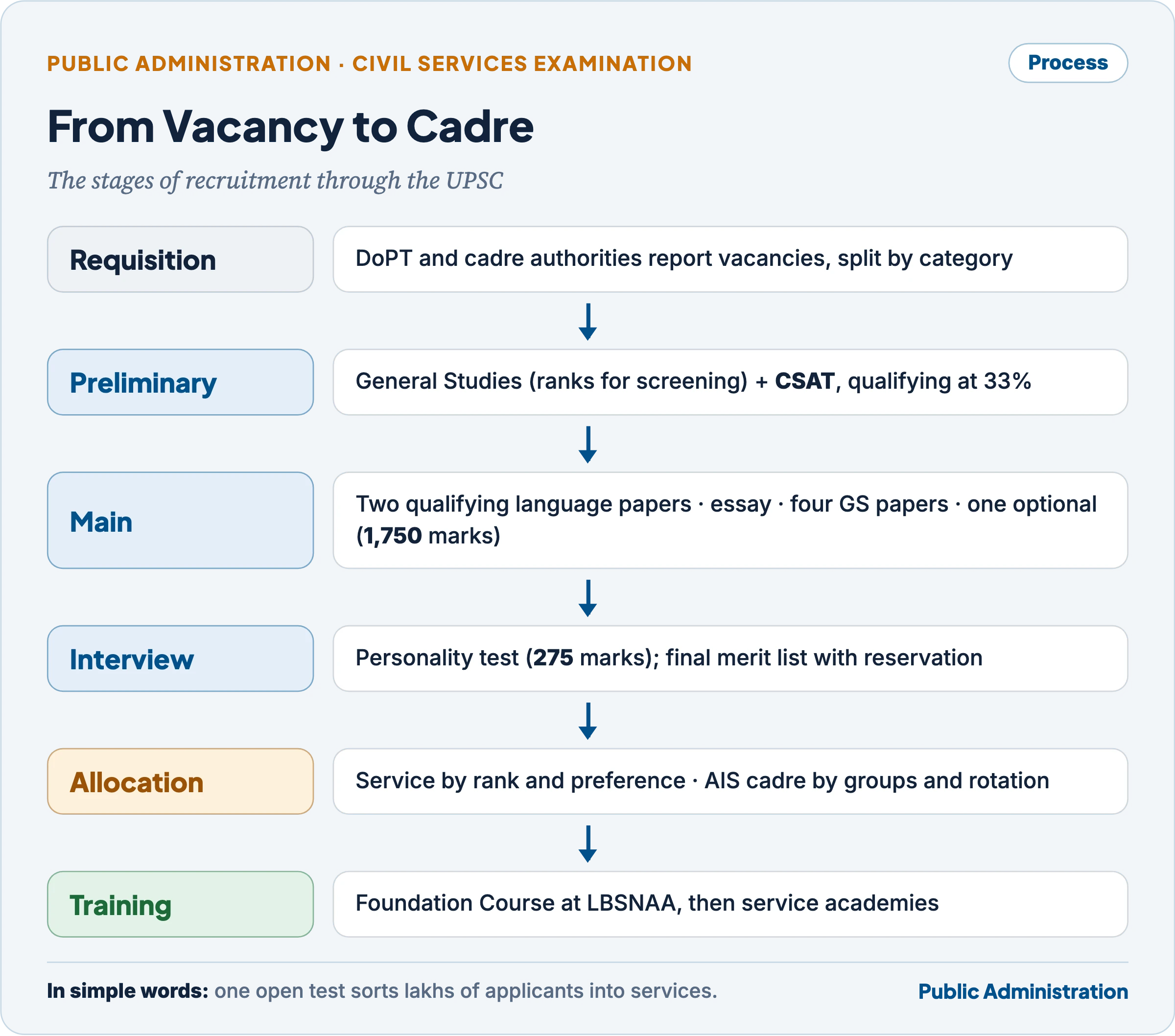
- One examination, many services. A single combined examination (since 1979) recruits for the IAS, IFS (Foreign), IPS and Central Group A and Group B services.
- Stage 1, Preliminary (screening):
- General Studies Paper I (200 marks, objective);
- General Studies Paper II, the Civil Services Aptitude Test (CSAT) (200 marks), qualifying at 33% since 2015;
- marks do not count for the final ranking.
- Stage 2, Main (written):
- two qualifying language papers (an Indian language and English, 300 marks each);
- Essay (250), four General Studies papers (250 each, including Ethics, Integrity and Aptitude) and one optional subject in two papers (250 each): a total of 1,750 marks;
- papers may be answered in English or any Eighth Schedule language.
- Stage 3, Personality Test: 275 marks; total 2,025.
- Eligibility:
- a degree from a recognised university;
- age 21–32 for general and EWS candidates, 35 for OBC, 37 for SC and ST, with up to ten more years for persons with benchmark disabilities (limits fixed in 2014);
- attempts: 6 for general and EWS, 9 for OBC and persons with benchmark disabilities, unlimited within the age limit for SC and ST.
- Reservation: 15% SC, 7.5% ST, 27% OBC (non-creamy layer), 10% EWS (from CSE 2019, after the 103rd Amendment, 2019, upheld in Janhit Abhiyan v. Union of India, 2022) and 4% for persons with benchmark disabilities (horizontal).
- Service allocation follows rank and the candidate’s service preferences; cadre allocation for the AIS then follows the cadre allocation policy (Section 3.3).
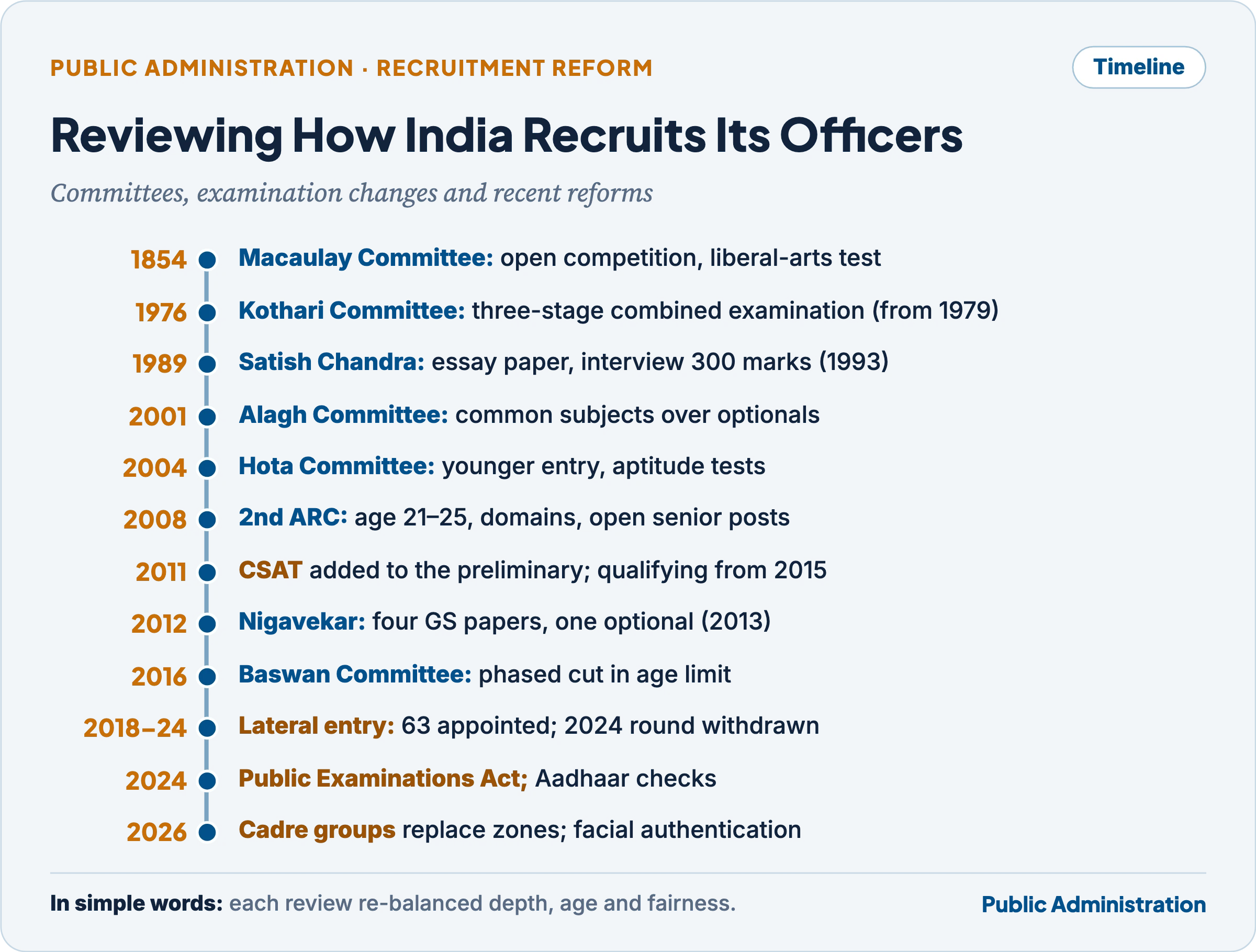
7.2 Evolution: the committees
The design of the CSE has been reviewed repeatedly. Each committee balanced breadth against depth, youth against maturity, and fairness to rural and Indian-language candidates against tests of aptitude.
| Committee | Year | Chair | Key recommendations | Fate |
|---|---|---|---|---|
| Macaulay Committee | 1854 | T.B. Macaulay | Open competition; scholastic test of liberal education; young entrants | Basis of ICS recruitment from 1855 |
| Kothari Committee | Appointed 1974, report 1976 | D.S. Kothari | Three-stage examination (preliminary, main, interview); one combined examination for all services; upper age 26; allocation after a post-training test | Three stages and combined examination adopted in 1979; post-training test rejected |
| Satish Chandra Committee | Appointed 1988, report 1989 | Satish Chandra | Essay paper (200 marks); interview raised from 250 to 300; negative marking in the preliminary; more centres | Implemented in 1993 |
| Alagh Committee | 2000–2001 | Yoginder K. Alagh | Test candidates on common subjects rather than optionals; test aptitude and values | Not implemented directly; fed into later CSAT and GS changes |
| Hota Committee | 2004 | P.C. Hota | Entry age 21–24 (5 years more for SC/ST, 3 for OBC); aptitude and leadership tests; a month after joining to choose service; a Civil Services Law, performance appraisal and tenure | Mostly not implemented |
| Nigavekar Committee | 2012 | Arun S. Nigavekar | Restructure the main examination around general studies; one optional linked to the graduation subject; age limit 25 with relaxations; three attempts | Main examination restructured in 2013 (four GS papers including Ethics, one optional); age and attempts not changed |
| Baswan Committee | Appointed August 2015, report 9 August 2016 | B.S. Baswan | Plan of examination, papers and evaluation; phased reduction of the upper age limit | Under consideration; not implemented |
- CSAT (2011). The aptitude paper replaced the optional in the preliminary in 2011. After protests in 2014 that it favoured English-medium, science and engineering graduates, it was made qualifying (33%) from 2015, and candidates of CSE-2011 got an extra attempt.
- Main examination (2013). On the Nigavekar recommendations, the main examination moved to four GS papers (including Ethics, Integrity and Aptitude) and one optional, cutting the weight of optionals.
- Upper age. Successive governments raised the age (26 in the 1960s, 28 in the 1980s, 30, and 32 since 2014) despite committees recommending lower limits; legislators from rural and backward regions argue that late starters and first-generation graduates need time.
7.3 The 2nd ARC on recruitment (10th Report, Refurbishing of Personnel Administration, 2008)
The Second Administrative Reforms Commission (constituted 2005, chaired by M. Veerappa Moily) gave its fullest treatment of recruitment in its tenth report. Its main proposals and the government’s response are summarised below.
| Recommendation | Government’s response (action taken report) |
|---|---|
| National Institutes of Public Administration and university degree courses in public administration and governance; graduates of other subjects to take a bridge course | Rejected: would deny equal opportunity; instead all Central Universities asked to offer Public Administration, and recruits to take a compact paper in it during induction |
| Age 21–25 (general), 21–28 (OBC), 21–29 (SC/ST and disabled); attempts 3, 5, 6, 6 | Agreed to lower limits (26 for general) from CSE-2015; never applied, and the limit was instead raised to 32 in 2014 |
| Compress the cycle: hold preliminary and main together, or a main within two months of the preliminary | Not taken up, as the examination had just been changed |
| Preliminary and main on compulsory subjects only, no optionals, plus an essay | Partly reflected in the 2011 CSAT and 2013 main examination changes |
| UPSC examination for State Civil Service officers with 8–10 years of Group A service for induction into the IAS, maximum two attempts, upper age 40 | Scheme drafted; not implemented |
| Promotions up to selection grade delegated to departments, with UPSC audit of DPCs | Accepted |
| UPSC consultation in discipline only for proposed dismissal | Not accepted; second-stage CVC advice dropped instead |
| Domain assignment after 13 years by a Central Civil Services Authority; senior posts open to all services and some to outside talent | Domains after 18 years in principle; Authority and open competition deferred |
| 25% of Section Officer posts by direct recruitment; a common examination for graduate-level Group B and C posts | Accepted in principle for further examination; the common-test idea resurfaced in the NRA’s CET (2020) |
- Assessment. The 2nd ARC’s recruitment vision was to make entry younger, more specialised and more professional, and to make the top competitive and open. The government accepted its procedural proposals but not its structural ones, largely because of political sensitivity over age limits, equal opportunity and reservation.
7.4 Diversity and representation
- Social profile has widened. Early IAS batches came largely from urban, upper-caste, English-educated and civil-servant families and a few universities. Reservation, the spread of higher education, the option to write in Indian languages and the higher age limits have widened entry.
- Evidence of change:
- women were 3.6% of those recommended in 1952 and 31.2% in CSE 2025 (299 of 958), with 11 of the top 25 ranks;
- SC recommended rose from 9 (1955) to 158 (2025), and ST from 2 (1956-57) to 73 (2025);
- persons with benchmark disabilities: 3 (2002) to 42 (2025);
- a separate transgender category was added to the online application in 2020.
- Concerns that remain:
- a growing share of successful candidates are engineering and technical graduates writing in English, and the success of candidates writing in Hindi and other Indian languages fell after the 2013 changes;
- the cost of years of preparation in metropolitan centres favours better-off families; the private tuition industry has grown around the examination;
- critics argue that the long age band keeps lakhs of young people in prolonged preparation, a social cost noted by the Baswan Committee and NITI Aayog.
- The theory question of whether a socially representative service also behaves differently (passive vs active representation) is taken up in the theory lens (Section 9).
7.5 Integrity of recruitment: the 2024 crisis and the response
- The Puja Khedkar case. In July 2024 a probationary IAS officer of the 2023 batch was found to have taken the CSE more times than permitted by changing her own and her parents’ names, with questions also raised about her OBC (non-creamy layer) and disability certificates.
- The UPSC issued a show cause notice on 18 July 2024, cancelled her candidature for CSE-2022 and debarred her permanently on 31 July 2024, and filed a criminal complaint; the Union then discharged her from the IAS (September 2024).
- The UPSC reviewed data of over 15,000 candidates recommended from 2009 to 2023 and found no other case of excess attempts. It stated that it does only a preliminary check of caste and disability certificates; their genuineness is the responsibility of the issuing authorities.
- Reforms that followed:
- On 28 August 2024 DoPT allowed the UPSC to use Aadhaar authentication (voluntary) at registration and at each stage of recruitment.
- A new portal (May 2025) with a Universal Registration Number replaced one-time registration; over 92% of early registrants opted for Aadhaar authentication.
- AI-based facial authentication was piloted in September 2025 and used for all of about 5.5 lakh candidates at the CS (Preliminary) Examination on 24 May 2026.
- A scan of fifteen years of data before CS (Preliminary) 2026 rejected 569 applicants who had given false information to claim extra attempts.
- Provisional answer keys for the preliminary examination are now published soon after the examination (2026), and randomised interview boards have been introduced (from 2025).
- The Public Examinations (Prevention of Unfair Means) Act, 2024 (Act 1 of 2024, assented 12 February 2024, in force from 21 June 2024) covers examinations of the UPSC, SSC, Railway Recruitment Boards, IBPS, the National Testing Agency and central ministries:
- offences are cognizable, non-bailable and non-compoundable;
- unfair means: imprisonment of 3 to 5 years and fine up to ₹10 lakh;
- a service provider at fault: fine up to ₹1 crore, recovery of examination costs and a four-year bar;
- organised crime (paper-leak gangs, colluding institutions): 5 to 10 years and a fine of at least ₹1 crore, with attachment of property;
- candidates themselves are dealt with under the examination authority’s rules rather than as criminals.
- Pratibha Setu (9 June 2025) renamed and revamped the 2018 Public Disclosure Scheme, which shares details of willing candidates who cleared every stage but missed the final list with verified employers.
Indian Connect — Indian Connect: the “Then and Now” of UPSC recruitment
- Applications to all UPSC examinations grew from 42,727 in 1950-51 to a peak of 45.1 lakh in 2022-23.
- Examination centres grew from 8 in 1950 to 86 in 2026.
- The interview may be answered in an Indian language with an interpreter since 1980-81; the main examination may be written in any Eighth Schedule language.
- The basic principle has not changed since 1854: open competition, anonymity of evaluation and an independent examining body.
8. Lateral Entry
In simple words
Lateral entry means bringing an experienced expert from outside the regular services, such as an economist from a bank or a technology manager from a company, straight into a senior government post for a few years. It is meant to add skills that career officers may lack, but it raises questions about fairness, reservation and accountability.
8.1 From ad hoc to institutional
- Old practice. India has long appointed outside experts to senior posts: Manmohan Singh (Chief Economic Adviser, 1972), Montek Singh Ahluwalia, Vijay Kelkar, Nandan Nilekani (UIDAI) and many Chief Economic Advisers and scientists. These were individual, ad hoc appointments.
- Recommendations. The 2nd ARC (2008) proposed earmarking higher posts for outside talent through a Central Civil Services Authority, and NITI Aayog’s Strategy for New India @75 (2018) recommended lateral entry of specialists at higher levels.
- The scheme from 2018. DoPT advertised Joint Secretary posts in June 2018; the selection was later entrusted to the UPSC, which recommended nine Joint Secretaries in 2019. Later rounds (2021, 2023) added Director and Deputy Secretary posts.
- Contracts of three years, extendable to five; candidates from the private sector, academia, PSUs, State governments and international bodies.
- In all, 63 appointments were made in three cycles (2018, 2021, 2023): 35 on contract (mostly from the private sector) and 28 on deputation. In August 2025, 43 were in position.
- The 2024 withdrawal. On 17 August 2024 the UPSC advertised 45 posts (10 Joint Secretaries, 35 Directors and Deputy Secretaries) in 24 ministries, the largest round. Because each post was treated as a single-post cadre, no reservation applied. Opposition parties and NDA allies objected; on 20 August 2024 DoPT Minister Jitendra Singh wrote to the UPSC Chairperson Preeti Sudan asking that the advertisement be cancelled so that the process could be aligned with social justice, and the UPSC cancelled it the same day.
- Status in 2026. No new round has been held. In June 2026 the Minister said there was no order suspending lateral entry, but no feasible model for reservation in standalone posts had emerged; DoPT said about two-thirds of the 63 entrants were still serving.
8.2 Lateral entry and Part XIV
- Article 309: recruitment methods are set by rules; lateral entry posts are filled under ministries’ recruitment rules and executive orders, without a statute.
- Article 310(2): expressly contemplates contract appointments of persons with special qualifications who are not members of a regular service, with compensation clauses. Lateral entrants on contract hold office at pleasure and under their contract.
- Article 311: applies to them as holders of civil posts, but their contractual tenure means non-renewal is not a punishment.
- Article 320: selection through the UPSC (from 2019) satisfies the principle of consultation on methods of recruitment and suitability; early critics had objected to the 2018 plan of selection by a committee of officials.
- Article 16 and reservation: Article 16(4) permits reservation; under the 13-point roster and the PGIMER, Chandigarh v. Faculty Association (1998) principle, single-post cadres cannot be reserved. Grouping lateral posts into a pool would allow reservation but conflicts with the idea of hiring for a specific specialised post.
- Article 312 and the AIS: lateral entry at Joint Secretary level takes posts that AIS officers fill under the Central Staffing Scheme, so it touches the balance between the AIS and outsiders that Part XIV was designed to protect.
8.3 Arguments
- For lateral entry:
- domain expertise in areas such as fintech, semiconductors, climate, insolvency, cyber security and logistics, where rotating generalists struggle;
- competition and fresh ideas: an antidote to complacency in a closed career service;
- meets the shortage of officers at Deputy Secretary to Joint Secretary level in Union ministries;
- global practice: the US position system, the UK’s open senior civil service competitions, Australia and New Zealand’s contract chief executives;
- New Public Management: hire for the role, on contract, for results.
- Against lateral entry:
- politicisation: without strict safeguards, it may become a back door for ideologically aligned appointees, creating a committed bureaucracy;
- accountability and conflict of interest: contract officers may return to the industry they regulated (revolving door);
- reservation: single-post appointments bypass Article 16(4);
- morale of career officers who wait 17–20 years for Joint Secretary rank;
- lack of grounding in government procedure, Parliament and federal coordination; many entrants find the bureaucracy unwelcoming.
8.4 Why it has not moved in the intended direction
- Scale too small to matter: 63 entrants over five years in a Union government with thousands of senior posts cannot change its culture.
- Middle-level focus: most posts were Director and Deputy Secretary, where specialised impact is limited; few top policy posts were opened.
- Unattractive terms: pay at government scales, short contracts and uncertain renewal deter senior private professionals; many entrants came from PSUs and other governments on deputation rather than from the market.
- Weak induction and integration: entrants received little orientation and faced resistance from career services, limiting their influence.
- No institutional design: the 2nd ARC’s Central Civil Services Authority to identify posts, set criteria and manage tenures was never created; each round was ad hoc.
- The reservation impasse since August 2024 has frozen the scheme.
- Unclear objectives and evaluation: there has been no published assessment of what lateral entrants achieved.
- The way forward suggested by reformers: a statutory or regulatory framework; posts identified through competency mapping; a pooled design allowing reservation where possible; selection by the UPSC; longer tenures for top roles; cooling-off and conflict-of-interest rules; and openness of senior posts to all career services as well, so that lateral entry supplements rather than replaces internal competition.
9. Theory Lens and Links to Other Civil Service Themes
In simple words
Paper I theories help explain why India organises and recruits its civil servants as it does. They show what the merit system gains, what a closed career service misses, and why every reform of recruitment becomes a fight over fairness and representation.
9.1 Theory lens: merit, representation and open systems
- Weber’s legal-rational bureaucracy. Max Weber, the German sociologist, in Economy and Society (published 1922), described the modern bureaucrat as appointed on technical qualifications tested by examination, holding office as a career with salary, pension and tenure, separated from ownership of the means of administration. Part XIV is a constitutional version of this ideal: open competition by an independent commission, tenure under Article 311 and a hierarchy under ministers. See the article on Weber’s Bureaucratic Model.
- Riggs and formalism. Fred Riggs, the American comparativist, in Administration in Developing Countries (1964), described formalism, the gap between rules and practice in prismatic societies. India’s merit-based entry coexists with politically driven transfers, postings and deputation: the formal rules of recruitment are Weberian, but the career that follows is often governed by personal and political ties. See the article on Riggsian Models.
- Representative bureaucracy. J. Donald Kingsley, in Representative Bureaucracy (1944), argued that the British civil service reflected its ruling middle class and that a democratic bureaucracy should mirror the society it serves. Samuel Krislov, in Representative Bureaucracy (1974), added that representation gives the bureaucracy legitimacy and brings diverse perspectives to policy. Frederick Mosher, in Democracy and the Public Service (1968), distinguished passive representation (the service resembles the population) from active representation (officers advance the interests of the groups they come from). Indian reservation, including EWS and the separate transgender category, pursues passive representation; the evidence that it changes behaviour (active representation) is weaker, since new entrants are socialised into the service’s values.
- Generalist vs specialist (Fulton). The Fulton Committee (1968) made the classic attack on the amateur generalist; India’s IAS remains the clearest surviving example of the generalist model, and the 2nd ARC’s domain assignment is a Fulton-style correction.
- Career and position systems; open and closed systems. Paper I distinguishes the career (closed) system, where officers enter young at the bottom and rise within the service (India, UK, France), from the position (open) system, where a person is hired for a particular job at any level (United States). The AIS and Group A services are a closed career system; lateral entry and deputation open windows in it. See the article on Personnel Administration: HRD, Recruitment, Training, Career, Classification, Promotion and Pay.
- New Public Management. Christopher Hood, in “A Public Management for All Seasons?” (1991), identified NPM’s doctrines: hands-on professional management, explicit standards and measures of performance, output controls and private-sector styles of management, including flexible hiring and rewards. Lateral entry, contract appointments, performance-linked careers and the NRA’s single test reflect NPM; critics answer that the public service is not a firm and that equity and neutrality are its core values. See the article on New Public Management and After.
- The public service bargain. Hood and Martin Lodge, in The Politics of Public Service Bargains (2006), describe the implicit deal between politicians and civil servants: civil servants give loyalty, competence and political neutrality; politicians give tenure, anonymity and a share in policy-making. Part XIV writes a trustee-type bargain into the Constitution. Lateral entry, weakening Article 311, and the deputation dispute are attempts to rewrite this bargain towards an agency-type bargain, in which officials serve at closer political direction and are judged on results.
- Principal–agent and federalism. The AIS has two principals, the Union and the State. Principal–agent theory predicts conflicting instructions and strategic behaviour by the agent when principals disagree, as the Rule 6 controversy and disciplinary disputes show. See the article on Union–State Relations.
9.2 Other themes of the civil services syllabus in brief
- Training and capacity building. Recruits attend a common Foundation Course at the Lal Bahadur Shastri National Academy of Administration (LBSNAA), Mussoorie, then service-specific training (for the IAS, a sandwich pattern of institutional and district training since 1969), followed by mid-career training phases linked to promotion. The National Training Policy (1996, revised 2012), Mission Karmayogi (National Programme for Civil Services Capacity Building, 2020), the iGOT Karmayogi platform and the Capacity Building Commission (2021) aim to move from rule-based to role-based management. See the article on Civil Service Training and Capacity Building.
- Good governance initiatives. Citizen’s charters and Sevottam, RTI, e-governance, performance appraisal (APAR, 360-degree feedback), fixed tenures and Civil Services Boards after T.S.R. Subramanian v. Union of India (2013). See the article on Good Governance Initiatives in the Civil Services.
- Code of conduct, discipline, staff associations, political rights and grievance redressal. The CCS and AIS conduct rules, penalties and disciplinary procedure, recognition of associations, the ban on strikes, limits on political activity, and redressal through the Central Administrative Tribunal (Article 323A) and the Joint Consultative Machinery. See the article on Code of Conduct, Discipline, Staff Associations and Grievance Redressal.
- Neutrality and activism. The Weberian ideal of neutrality, the committed bureaucracy debate of the 1970s, anonymity, whistle-blowing and civil service activism. See the article on Civil Service Neutrality and Activism.
Key Terms
| Term | Meaning in simple words |
|---|---|
| Civil post | A post under the Union or a State in a civil (non-military) capacity; its holder gets Article 311 protection |
| Doctrine of pleasure | Article 310 rule that civil servants hold office at the pleasure of the President or Governor, subject to the Constitution |
| Dismissal / removal | Ending service as a penalty; dismissal normally bars future government employment, removal does not |
| Reduction in rank | Demotion as a penalty; one of the three penalties protected by Article 311(2) |
| Reasonable opportunity | The right to know the charges and be heard in an inquiry before a major penalty |
| Second proviso to Article 311(2) | The three situations (conviction, impracticability, security of the State) in which the inquiry can be dropped |
| All India Service | A service common to the Union and the States, created under Article 312 (IAS, IPS, IFoS) |
| Dual control | Union recruits and imposes major penalties; State posts, transfers and supervises AIS officers |
| Cadre | The sanctioned body of posts of a service in a State or joint group of States |
| Insider / outsider | Candidate allotted to the home State / to another State |
| Central Deputation Reserve | Share (up to 40%) of a State cadre’s senior posts earmarked for service with the Union |
| Central Staffing Scheme | System by which AIS and Group A officers serve in Union ministries at Deputy Secretary and above on tenure |
| Group A–D | Classification of Central employees by responsibility; Group D has been merged into Group C |
| Generalist | Administrator with broad education and rotating postings, not tied to one technical field |
| Specialist | Officer recruited and working for professional or technical knowledge |
| Domain assignment | Linking a generalist officer to a field of specialisation after mid-career (2nd ARC) |
| Public Service Commission | Independent constitutional body that recruits civil servants and advises on service matters |
| Exemption regulations | Rules made under the proviso to Article 320(3) listing matters on which the Commission need not be consulted |
| Charged expenditure | Spending fixed on the Consolidated Fund that the legislature does not vote annually |
| CSAT | Civil Services Aptitude Test, the second preliminary paper, qualifying since 2015 |
| Lateral entry | Direct recruitment of outside experts to senior posts, usually on contract |
| Single-post cadre | A post that is the only one of its kind; reservation cannot apply to it |
| Representative bureaucracy | The idea that a public service should reflect the social make-up of the people it serves |
| Career system | Entry young at the base and lifetime advancement within a service |
| Position system | Recruitment to a particular job at any level, open to outsiders |
| Public service bargain | Implicit exchange of loyalty and competence for tenure and voice between civil servants and politicians |
Commissions, Committees and Judgments
| Body / case | Year | Key point |
|---|---|---|
| Macaulay Committee (T.B. Macaulay) | 1854 | Open competition and a scholastic examination for the ICS |
| Aitchison Commission (Charles Aitchison) | 1886–87 | Imperial, Provincial and Subordinate services |
| Lee Commission (Arthur Hamilton Lee) | 1924 | Faster Indianisation; statutory Public Service Commission |
| Public Service Commission (Ross Barker) | 1926 | First recruiting commission in India, from 1 October 1926 |
| A.D. Gorwala, Report on Public Administration | 1951 | Patronage-free recruitment; training; psychological tests |
| Parshotam Lal Dhingra v. Union of India | 1958 | Right-to-post and evil-consequences tests for when termination is punishment |
| State of U.P. v. Manbodhan Lal Srivastava | 1957 | Article 320(3)(c) consultation is directory; no right to the servant |
| 1st ARC, Report on Personnel Administration (K. Hanumanthaiya) | 1969 | Functional specialisation; Senior Management Pool; sandwich training |
| Rajamannar Committee (P.V. Rajamannar) | 1971 | Abolition of IAS and IPS sought by Tamil Nadu |
| Kothari Committee (D.S. Kothari) | 1976 | Three-stage combined CSE, adopted 1979 |
| Union of India v. Tulsiram Patel | 1985 | Second proviso excludes inquiry; Article 14 cannot revive it; limited judicial review; Challappan overruled |
| Sarkaria Commission (R.S. Sarkaria) | 1983–88 | AIS indispensable; new AIS for engineering, health, education |
| Satish Chandra Committee (Satish Chandra) | 1989 | Essay paper; interview to 300 marks; implemented 1993 |
| Managing Director, ECIL v. B. Karunakar | 1993 | Inquiry report must be supplied to the charged officer |
| PGIMER, Chandigarh v. Faculty Association | 1998 | No reservation in a single-post cadre |
| Alagh Committee (Yoginder K. Alagh) | 2001 | Common subjects rather than optionals; aptitude |
| Hota Committee (P.C. Hota) | 2004 | Entry age 21–24; aptitude and leadership tests; Civil Services Law |
| 2nd ARC, Ethics in Governance (M. Veerappa Moily) | 2007 | Delete Article 311; comprehensive law under Article 309 |
| 2nd ARC, Refurbishing of Personnel Administration (M. Veerappa Moily) | 2008 | Age 21–25; NIPAs; domain assignment; Central Civil Services Authority; lateral entry to senior posts |
| Nigavekar Committee (Arun S. Nigavekar) | 2012 | New main examination (four GS papers, one optional) from 2013 |
| State of Punjab v. Salil Sabhlok | 2013 | PSC Chairman must be chosen considering integrity and competence; appointment quashed |
| T.S.R. Subramanian v. Union of India | 2013 | Civil Services Boards; fixed tenure; written orders |
| Baswan Committee (B.S. Baswan) | 2016 | Review of CSE; phased reduction of age limit |
| Janhit Abhiyan v. Union of India | 2022 | Upheld 10% EWS reservation (103rd Amendment) |
| Public Examinations (Prevention of Unfair Means) Act | 2024 | 3–10 years’ jail and heavy fines for unfair means and organised leaks in central recruitment examinations |
Contemporary Developments
- UPSC at 100 (1 October 2026). The Commission completed a century; its centenary year (from 1 October 2025) ended with the Manthan conference (30 September–1 October 2026). Dr Ajay Kumar, former Defence Secretary, has been Chairman since 15 May 2025.
- New cadre allocation policy (23 January 2026). The five-zone system of 2017 was replaced by four alphabetical groups and a 25-candidate rotational cycle, effective from CSE-2026; willingness for the home cadre must be stated expressly.
- Technology against impersonation (2024–26). Aadhaar authentication allowed from 28 August 2024; a new portal with a Universal Registration Number (May 2025); AI facial authentication for all candidates at the CS (Preliminary) Examination of 24 May 2026; 569 applicants rejected for false claims of attempts; provisional answer keys published after the preliminary.
- Puja Khedkar case (July–September 2024). Candidature cancelled and permanent debarment for exceeding attempts by changing identity; discharged from the IAS; prompted the reforms above and a debate on verification of OBC and disability certificates.
- Public Examinations (Prevention of Unfair Means) Act, 2024 in force from 21 June 2024, with rules assigning the NRA to set standards for computer-based tests.
- Lateral entry in limbo (August 2024–2026). The 45-post advertisement was cancelled on 20 August 2024; the government told Parliament in August 2025 that reservation does not apply to single-post appointments and that 43 of the 63 entrants were in position; in June 2026 it said no feasible reservation model had emerged.
- Vacancies in the AIS (2025 data). Against sanctioned strengths, about 1,300 IAS, 505 IPS and 1,029 IFoS posts were vacant on 1 January 2025, sustaining the Union–State tussle over central deputation.
- Women in the CSE. Women were 31.2% of candidates recommended in CSE 2025 and held 11 of the top 25 ranks.
Revision Grid
| Thinker / body | Work or report (year) | Key idea |
|---|---|---|
| Herman Finer | The Theory and Practice of Modern Government (1932) | Civil service as permanent, paid, professional and neutral |
| Max Weber | Economy and Society (1922) | Appointment by examination; career tenure; hierarchy |
| Sardar Patel | Constituent Assembly speech (10 October 1949) | AIS needed for unity and frank advice |
| Paul Appleby | Reports on Indian administration (1953, 1956) | Civil servants shape policy despite ministerial responsibility |
| J. Donald Kingsley | Representative Bureaucracy (1944) | Service should mirror society |
| Frederick Mosher | Democracy and the Public Service (1968) | Passive vs active representation |
| Samuel Krislov | Representative Bureaucracy (1974) | Representation gives legitimacy |
| Fulton Committee | Report (1968) | Attack on the cult of the amateur generalist |
| Fred Riggs | Administration in Developing Countries (1964) | Formalism: rules vs practice |
| Christopher Hood | “A Public Management for All Seasons?” (1991) | NPM doctrines, flexible hiring |
| Hood and Lodge | The Politics of Public Service Bargains (2006) | Loyalty and competence exchanged for tenure and voice |
| Kothari Committee | Report (1976) | Three-stage combined CSE |
| 2nd ARC | Refurbishing of Personnel Administration (2008) | Younger entry, domains, open senior posts |
| Supreme Court | Tulsiram Patel (1985) | Limits of Article 311 safeguards |
| NITI Aayog | Strategy for New India @75 (2018) | Fewer services, talent pool, lateral entry |
Previous Year Questions
- 2026Lateral Entry in Government of India has not moved in the intended direction. Explain the reasons.
- 2024The constitutional stature provided to the Public Service Commissions accord them the autonomy to work towards fair recruitments. Comment.
- 2022Examine the lateral entry recruitment in government in the context of Part XIV of the Indian Constitution.
- 2021Recruitment is the cornerstone of the whole public personnel structure and it revolves around the problem of attracting the best. Discuss the essential elements of a good recruitment system.
- 2019Emerging developmental aspirations of the society necessitate the constitutional amendment to change the present safeguards available to the civil servants. Evaluate the pros and cons of such amendment.
- 2018It is apprehended that lateral entry will lead to politicisation of bureaucracy. Do you agree? Justify
- 2018“Competency mapping is important for effective allocation of responsibilities to administrators.” Do you think that a generalist administrator can handle all issues as effectively as a specialist Discuss.
- 2017“The idea of lateral entry into the Civil Services would energise Indian administration.” What are its possible advantages and limitations?
- 2009Do State Services suffer in comparison with the All-India and Central Services? Suggest measures for enhancing the role, competence and impact of State Services.
- 2006“The generalist character of I.A.S. is its chief characteristic as well as its chief criticism.” Comment.
- 2002“All India Services as an institution – is the result of history.” Comment.
- 2001“The need and significance of all-India services has been well recognized in political as well as administrative circles.” Comment.
- 2000“All India Services play a crucial unifying role in the whole administrative system of the country.” Explain.
- 2000“A middle way should be worked out to utilize the services of both generalists and specialists for the national development.” Comment.
- 1999Article 320 states that the Government shall consult the U.P.S.C. on certain specific matters.” Comment.
- 1999“The All-India Services have, naturally to be remunerated on a higher level than services recruited purely on a local basis.” Comment.
- 1998It is argued that the recruitment and training of All India and Central Services have not kept pace with the changing needs and time. Give suggestions for improving these processes in order to make administrators more effective, committed and honest.
- 1998“Central Services are more ‘All-India’ in character than are the All-India Services.” Comment.
- 1996“Independence of the Public Service Commissions has been ensured under specific provisions of the Constitution.” Examine.
- 1996“The public services in India have been conferred a Constitutional status.” Comment.
- 1995“The Satish Chandra Committee made a valiant attempt to correct the imbalances unnecessarily introduced in the selection process for civil servants during the late 1970s.” Comment.
- 1993“The generalist-neutralist model of Civil Service, more than any other model of Civil Service, fits in framework of parliamentary democracy in India, a legacy of the British pattern with which Indians have been familiar.” Comment.
- 1992‘The recruitment of recruiters in the Public Service Commissions of India needs streamlining.’ Examine the statement.
- 1989‘The Union Public Service Commission should have an integrative and coordinating role vis-à-vis State Public Service Commissions in more or less the same way as in the Case of Supreme Court of India vis-à-vis the High Courts in the States. A sound case exists for an institutional linkage between UPSC and SPSCs for evolving a National Policy, a uniform approach and common work procedures.’ Discuss.
- 1988Discuss the various facets of the All India Services and examine the emerging patterns of Conflict and Co-operation between the Union and the State in Indian Federalism.
- 1987‘Though the legislature and the executive rule as well as administer, the Civil Servants only administer and do not role.’ Comment.
- 1987‘Generalism in Civil Service is a powerful bulwark against committed bureaucracy.’ Comment.
- 2018“Lateral entry is an antidote to the complacency in civil service.” Discuss.
- 2017Lateral entry of competent experts into the government will promote freshness and innovation, but it can create problems of accountability.”
- 2000What opportunities are available to All India Services and state services in career development? Do you agree that days of generalists in modern administrative state are numbered?
- 1999“The Generalist will always have an edge over the specialist.” Substantiate the view.
- 1996“It is said that the generalist rationale was part of a revealed truth. All of us should have known better, for in a world of increasing scientific and technical complexity, it has compelling inadequacies.” Discuss.
- 1994“The administrator is a layman rather than a specialist; or at least he has about him something of the qualities of a layman.” Comment.
- 1992Differentiate between the open and closed career systems. Do you favour the coexistence of both the systems for a balanced career development?