

Union-State administrative, legislative and financial relations; Role of the Finance Commission; Governor; Chief Minister; Council of Ministers; Chief Secretary; State Secretariat; Directorates.
This article: The official machinery of a State government: the legal basis (Articles 154, 166, 309, 312 and the Rules of Business); the Chief Secretary (colonial origin, the 1973 upgradation, appointment and tenure, ARC 1969 and Second ARC proposals, T.S.R. Subramanian and the 2014 cadre rules, roles as Secretary to the Cabinet, head of the civil service, head of key departments, chief coordinator, crisis manager and link with the Union, role-set and relationship with the Chief Minister, comparison with the Cabinet Secretary, issues and reforms); the State Secretariat (meaning, departments, hierarchy, functions, relationship with ministers and the Chief Secretary, Rajasthan, Maharashtra and Odisha experience, problems, e-Office and reforms); Directorates and Heads of Departments (meaning, types, organisation, functions, field administration, the Secretariat–Directorate relationship, generalist versus specialist, ex-officio status, amalgamation and de-amalgamation, ARC and Second ARC views, executive agencies); theory lens.
Official Syllabus: Paper II · Unit 2-06 State Government and Administration
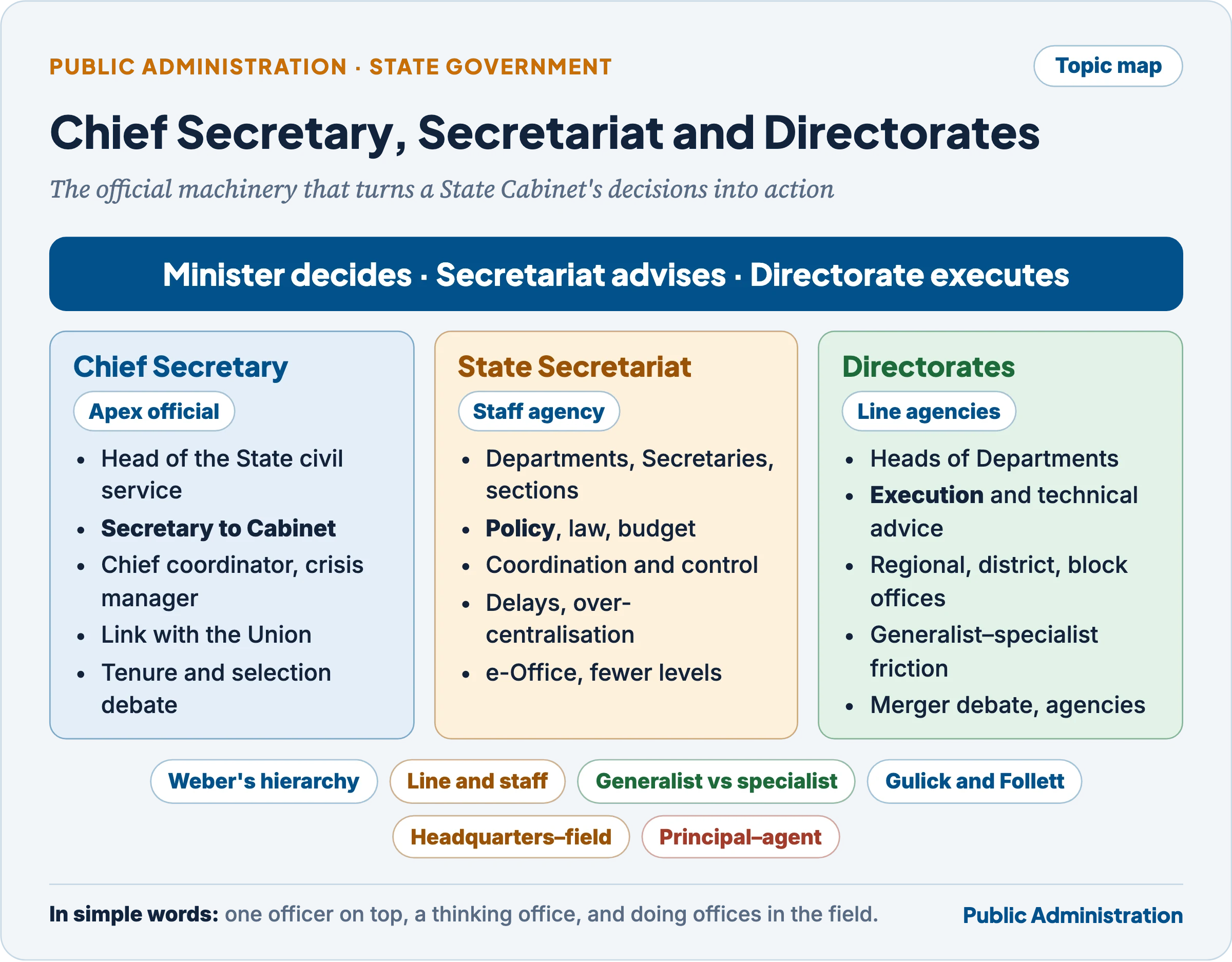
A State Cabinet can decide to build 500 rural roads, raise school enrolment or fight a flood, but ministers do not draft the order, release the money or send the engineers. Three layers of officials do that.
The State Secretariat turns a political wish into a policy, a law, a budget line and a government order. The Directorates (executive departments under Heads of Departments) carry the order to the region, the district and the block. Above both stands the Chief Secretary, the senior-most civil servant of the State, who advises the Chief Minister, services the Cabinet, heads the civil service and holds the whole machine together. How these three relate to one another, and to ministers, decides how quickly and how well a State government delivers.
In simple words
Think of a large hospital. The board (ministers) decides to open a cancer wing. The hospital’s head office (the Secretariat) plans the budget, the rules and the staff. The departments of surgery and radiology (the Directorates) actually treat patients. The medical superintendent (the Chief Secretary) keeps everyone working together and reports to the board. If the head office starts checking every bandage, or the departments ignore the plan, the patient suffers.
1. The Setting: Three Layers of State Administration
In simple words
Every State department has three parts: a minister who decides, a Secretary who advises and plans, and a head of department who executes. The first two sit in the Secretariat in the State capital; the third runs a Directorate with offices spread across the State.
1.1 Minister, Secretary and executive head
- Three components. At the State level, the government has three components: the minister (political head), the Secretary (administrative head of the Secretariat department) and the executive head (usually called the Director, the head of the Directorate). The minister and the Secretary together make up the Secretariat; the office of the executive head is the Directorate.
- The classic image. The Tottenham Committee on the reorganisation of the central government (1945–46) described the minister as the will, the Secretary as the brain and the executive head as the hands of government. The same imagery is used for States: Secretaries are the “eyes and ears” of ministers, Heads of Departments their “hands”.
- Policy and execution kept apart. The administrative philosophy behind this layout is that policy-making should be separated from policy execution, so that the Secretariat can think about long-term goals while the Directorates concentrate on delivery. Section 7 shows how this separation works, and fails, in practice.
- Same pattern as the Union. The State Secretariat mirrors the Central Secretariat, and Directorates mirror the Union’s attached and subordinate offices. For the Union structure (ministry, department, wing, division, branch, section) and the split system at the Centre, see the article on PMO, Cabinet Secretariat and Central Secretariat.
1.2 Constitutional and legal basis
The Constitution does not mention the Chief Secretary, the Secretariat or the Directorates by name. They rest on a few general provisions and on rules made under them.
| Provision | What it says | Relevance |
|---|---|---|
| Article 154(1) | Executive power of the State vests in the Governor, exercised directly or through officers subordinate to him | Legal basis of the whole official hierarchy |
| Article 163 | Council of Ministers with the Chief Minister at the head aids and advises the Governor | Real executive is the ministry the officials serve |
| Article 166(1)–(2) | All executive action is taken and authenticated in the name of the Governor | Orders issued by Secretariat officers “by order of the Governor” |
| Article 166(3) | Governor makes rules for the convenient transaction of business and its allocation among ministers | Rules of Business: they create departments and define the Chief Secretary’s functions |
| Article 309 | Legislature or Governor regulates recruitment and service conditions of State services | State civil services, Secretariat service |
| Articles 310–311 | Doctrine of pleasure; safeguards in dismissal and removal | Discipline of State employees |
| Article 312 and All India Services Act, 1951 | Creation of IAS, IPS, IFoS | Chief Secretary and most Secretaries are IAS officers |
| IAS (Cadre) Rules, 1954, Rule 7 (amended 2014) | Postings on recommendation of a Civil Services Board chaired by the Chief Secretary; minimum two-year tenure on cadre posts | Tenure and transfer of senior officers |
| AIS (Death-cum-Retirement Benefits) Rules, 1958, Rule 16 | A Chief Secretary may get an extension of up to six months on the State’s recommendation with the Union’s approval | Tenure of the Chief Secretary |
| AIS (Conduct) Rules, 1968, Rule 3(3)(iii) | Orders from superiors ordinarily in writing; oral orders to be confirmed in writing | Protects officers from verbal pressure |
| Disaster Management Act, 2005, Section 20 | State Executive Committee chaired by the Chief Secretary | Crisis-management role |
| States Reorganisation Act, 1956, Sections 15–16 | Five Zonal Councils; Chief Secretaries attend as advisers | Inter-State coordination |
The table shows that the Chief Secretary’s office is conventional and rule-based, not constitutional. Its powers come from the Rules of Business of each State, executive instructions, statutes such as the Disaster Management Act, and long practice. This is why its position varies from State to State and depends so heavily on the Chief Minister’s confidence.
1.3 Line, staff and auxiliary agencies
- Line agencies carry out the primary work of government and deal directly with citizens (police, agriculture, health). Staff agencies advise and assist the chief executive without commanding the field (planning, policy cells). Auxiliary agencies provide common services to all departments (finance, personnel, purchase, printing).
- Indian application. The Secretariat is a staff agency, and the Directorate is a line agency. Departments such as Finance, Personnel, Planning, Law and General Administration act as auxiliary or housekeeping units and usually have no Directorate attached.
- Why the distinction blurs. The Secretariat also issues binding orders, sanctions money and transfers staff, so it acts as a line authority over the Directorates. This is the root of the friction discussed in section 7. For the theory, see the article on Structure and Forms of Organisation.
2. The Chief Secretary: Evolution, Position and Tenure
In simple words
The Chief Secretary is the top civil servant of a State, usually an IAS officer with over thirty years of service. The Chief Minister picks the person. There is no fixed term, so how long the officer lasts depends on retirement age and on the Chief Minister’s trust.
2.1 Colonial origins
- Created at Fort William, 1799. Under Lord Wellesley, the single “Secretary” to the government at Fort William was redesignated Chief Secretary on 29 October 1799, with general control over the departmental Secretaries; G.H. Barlow was the first holder. The post later disappeared from the central secretariat, but it became the standard head of every provincial secretariat.
- Provincial Chief Secretary under the Raj. In each province, the Chief Secretary headed the Secretariat, advised the Governor or Lieutenant-Governor, and supervised the district officers. The post was an ICS preserve. Until provincial autonomy, India was in effect governed by secretaries rather than ministers, and the Secretariat was literally the “secretary’s office”.
- Provincial autonomy (1937). Under the Government of India Act, 1935, elected ministers took charge of provincial departments. The Chief Secretary now served popular ministers, a dual loyalty (to the elected government and to the service) that continues today.
- After 1947. The office was carried over into every State. Its rank was not uniform: in Punjab the Financial Commissioner, and in Uttar Pradesh members of the Board of Revenue, ranked above the Chief Secretary. In Maharashtra the post was held by ICS officers until 1976; the first IAS officer took over in 1977.
- Upgradation of 1973. From 1973 the office was standardised: its holder ranks with a Secretary to the Government of India and draws the same pay. Today the Chief Secretary is in the apex scale, the highest pay level open to IAS officers in a State, and is the senior-most civil servant of the State.
2.2 Position today
- Not a statutory office. The Constitution and no Act list the Chief Secretary’s powers. They come from the Rules of Business, standing orders and convention.
- Chief of the Secretaries. The Chief Secretary is not merely first among equals but the chief of all Secretaries, including Additional Chief Secretaries and Principal Secretaries. His control extends to all Secretariat departments.
- Outside the tenure system. Unlike other Secretariat posts, which rotate between field and headquarters, the post is excluded from the tenure system. An officer usually retires as Chief Secretary or moves to a senior Union post.
- “A post of great confidence.” In E.P. Royappa v. State of Tamil Nadu (1974), which arose from the transfer of a Tamil Nadu Chief Secretary, the Supreme Court described the post as one of great confidence, a lynchpin of the administration; the case also laid down that arbitrariness violates Article 14. The Court repeated this description in 2023 (section 3.7).
- During President’s Rule. If the Union appoints no advisers, the Chief Secretary becomes the main administrative support of the Governor and exercises wide powers. Where advisers (often senior retired officers) are appointed, they tend to overshadow him.
Common confusion
Is the Chief Secretary a constitutional post with powers fixed by law? No. No Article creates the office. Its functions come from each State’s Rules of Business under Article 166(3), executive orders and convention, plus a few statutes such as the Disaster Management Act, 2005. That is why the post’s weight differs across States and Chief Ministers.
2.3 Appointment
- By the Chief Minister. The State government, in practice the Chief Minister, chooses the Chief Secretary from among the senior IAS officers of the State cadre. The CM may sound out a few ministerial colleagues or the Union government, but such consultation is not obligatory.
- Three factors weigh in the choice:
- seniority: the choice is usually limited to the four or five senior-most IAS officers; a study of Rajasthan by Meena Sogani found that officers with 20–25 years of experience were appointed in the early decades (today it is typically 30 years or more);
- service record and merit: integrity, competence, reputation in the service;
- confidence of the Chief Minister: the most decisive factor, because the two must work in close daily association.
- State conventions differ. Andhra Pradesh at one time appointed the senior-most officer, the First Member of the Board of Revenue. In Rajasthan, senior officers were sometimes superseded; to avoid embarrassment they were given the Chief Secretary’s pay and posted outside the Secretariat, for example as Chairman of the Board of Revenue or of a public enterprise. The same device, an “Additional Chief Secretary” or chairman post in the apex scale, is used widely today.
- Union Territories and Delhi. For Delhi and other AGMUT-cadre territories, the Chief Secretary is appointed by the Union (Ministry of Home Affairs), which produced the 2023 dispute described in section 3.7.
2.4 Tenure: the unresolved question
- No fixed tenure. A Chief Secretary holds office at the pleasure of the State government until superannuation (60 years). An officer appointed a few months before retirement may serve only briefly; one appointed young may serve for years. Rule 16 of the AIS (DCRB) Rules, 1958 allows an extension of up to six months on the State’s recommendation, with the Union’s prior approval.
- First ARC (1969). The Administrative Reforms Commission, in its Report on State Administration (1969), recommended a minimum tenure of three to four years. States did not accept it, partly because a new Chief Minister would then be saddled with a predecessor’s choice.
- Second ARC (2007, 2009). In interim suggestions of December 2007 and its Fifteenth Report, State and District Administration (2009), the Second ARC proposed that until a State Civil Services Authority is created by law:
- a collegium recommend a panel of names to the Chief Minister/Cabinet, consisting of a Minister nominated by the CM, the Leader of the Opposition in the Assembly and the incumbent Chief Secretary;
- the field of choice be widened to all officers above a specified seniority (e.g. 30 years);
- the Chief Secretary have a fixed tenure of at least two years.
The Union and States have not implemented the collegium or fixed tenure.
- Prakash Singh as a model. In Prakash Singh v. Union of India (2006), the Supreme Court required the Director General of Police to be chosen from among the three senior-most officers empanelled by the UPSC, with a minimum tenure of two years. Reformers ask for the same insulation for the Chief Secretary, the other apex official of a State.
- T.S.R. Subramanian v. Union of India (31 October 2013). On a petition by a former Cabinet Secretary and other retired officers, the Supreme Court directed the Union and States to:
- set up Civil Services Boards (CSBs) of senior serving officers to advise on transfers and postings, with the Chief Secretary heading the State CSB;
- provide a minimum tenure for civil servants;
- ensure that officers act on written, not oral, instructions, recording oral orders on file.
- IAS (Cadre) Amendment Rules, 2014 (28 January 2014). The amended Rule 7 provides that an officer on a cadre post holds it for at least two years, and that postings and premature transfers go through the Civil Services Board (Chief Secretary as chairman, the senior-most Additional Chief Secretary or equivalent as member, and the Principal Secretary/Secretary, Personnel as member-secretary). The competent authority can overrule the Board by recording reasons. The rule protects other officers more than the Chief Secretary, whose own tenure is still set by retirement and the CM’s confidence.
- Two views on fixed tenure:
- For: stability, continuity of policy, courage to give frank advice, protection from “musical chairs” after every election, and a check on political patronage.
- Against: the CM is accountable for results and needs an officer he trusts; a fixed-tenure Chief Secretary who has lost the CM’s confidence becomes a figurehead while real power shifts to the CM’s Office.
- Experience shows a middle path. Officers who keep dignity, neutrality and a degree of anonymity can work with any party. A Rajasthan Chief Secretary served five and a half years under four Chief Ministers of two national parties. Dharma Vira, a senior civil servant, advised officers to say little in public, since the less they talked, the less trouble they invited. What Chief Ministers value is not pliability but objectivity, acumen and balance.
- Rotation of the office (1989 question). One proposal is to rotate the post among the top officers for short fixed spells. It would spread experience and reduce lobbying, but it would also make the office weaker and less continuous, exactly the problem the ARC wanted to cure. Rotation is in effect what happens when Chief Secretaries are appointed close to retirement, and it has eroded the office.
3. Roles and Functions of the Chief Secretary
In simple words
The Chief Secretary wears several hats at once: secretary to the State Cabinet, chief adviser to the Chief Minister, boss of the civil service, head of a few key departments, the person who makes all departments work together, the State’s emergency commander, and its main contact with Delhi.
3.1 Secretary to the Cabinet
- Head of the Cabinet Secretariat department. The Chief Secretary is ex officio Secretary to the Council of Ministers. He controls the State’s Cabinet Secretariat department, with the Chief Minister as its political head; a Special or Principal Secretary (Cabinet) does the routine work.
- Cabinet work, step by step:
- Memorandum scrutiny: he checks whether a department’s Cabinet note gives the facts, history, issues, arguments for and against, and the views of other departments;
- Agenda and notice: after the CM’s approval, he circulates the agenda and the date and venue of the meeting;
- In the meeting: he attends all Cabinet meetings and those of Cabinet sub-committees and often reads the summary of each item;
- Minutes: he records the decisions (not the deliberations) and sends them to the Governor, the CM and ministers;
- Follow-up: a register tracks implementation; he can call for any file of any department.
- Decision by circulation. When a meeting is not possible, the CM may have an urgent item circulated to ministers; silence by the due date counts as consent, and the next Cabinet ratifies the decision.
- Matters routed to him. States list matters that must go through the Chief Secretary. Rajasthan’s standing orders, for example, include all Cabinet papers, Centre–State and inter-State matters and Zonal Council business, establishment matters of the Governor, CM and ministers, senior officers’ conferences, Assembly and Parliament questions concerning the CM, census work, incentives to civil servants and medical aid outside the State.
3.2 Principal adviser to the Chief Minister
- Source of information and advice. In Cabinet and outside it, the Chief Secretary is the main official adviser to the CM and ministers. He works out the administrative implications of ministers’ proposals and turns them into a coherent plan.
- Balancing politics and feasibility. Ministers, elected and sensitive to public opinion, may press for decisions that please a constituency but harm long-run interests. The Chief Secretary’s long experience lets him strike a balance between political preferences and their implementational ramifications.
- Approval of new schemes. Important cases, especially new schemes, pass through him before reaching the CM or the minister.
3.3 Head of the State civil service
- Personnel role. The First ARC recommended that each State’s Department of Personnel be placed under the Chief Secretary, and in many States he is also the Personnel Secretary. Where a separate Personnel Secretary exists (Rajasthan created one in 1992), important personnel cases still go through the Chief Secretary to the CM, who usually holds the Personnel portfolio.
- Personnel functions:
- postings, transfers, promotions, seniority and retirement of IAS and senior State service officers, and the promotion of State service officers to the IAS;
- chairman of the Civil Services Board under the 2014 cadre rules;
- approval of amendments to service rules;
- consultation by the CM on appointments to the State Public Service Commission and the Lokayukta; the Lokayukta’s reports go to the legislature through him;
- enforcement of conduct rules and disciplinary action against AIS officers, Heads of Departments and senior State officers;
- writing or reviewing the Annual Performance Appraisal Reports of AIS officers in the State;
- staff welfare, training and career management (in Rajasthan he chaired the State Advisory Committee on Training).
- Leader and guardian. As head of the service he sets the tone of integrity and neutrality, represents the service before the government and protects officers from improper pressure.
3.4 Administrative head of key departments
- Unlike the Cabinet Secretary, who has no department beyond the Cabinet Secretariat, the Chief Secretary usually directly heads a few coordinating departments:
- General Administration Department (GAD): in most States the Chief Secretary is Secretary (GAD), with the CM as minister. GAD handles the Rules of Business, protocol and visits of dignitaries, honours and awards, inter-State disputes, government accommodation and buildings, vehicles, matters of former rulers and freedom fighters, and grants to cultural bodies;
- Personnel (above);
- Administrative Reforms and O&M: reorganising machinery and procedures;
- Planning: traditionally the Chief Secretary was Planning Secretary (in Rajasthan for about four decades, until a separate post was created in 1992); he chairs Planning and Development Coordination Committees and leads the State in national development consultations.
- Why these departments. Only departments with a coordinating and supervisory role are placed under him. A department gains status when brought under the Chief Secretary, so governments sometimes do this to signal priority.
- Residual legatee. Any business not allotted to another Secretary falls to him, so he is the State’s residual legatee.
3.5 Chief coordinator of the administration
The last and most important function is coordination. E.N. Mangat Rai, who served as Chief Secretary of Punjab, called the Chief Secretary “a coordinator of other men’s work”, ground between the political millstone above and the larger civil service millstone below. Coordination works at three levels.
- Centre–State. The Chief Secretary is the main channel of communication with the Union. He deals with the Cabinet Secretary, Union Home Secretary, Personnel Secretary, Finance and NITI Aayog officials, formally and informally, to secure funds, food grains, power, clearances and central forces. Forums:
- the Chief Secretaries’ Conference, long chaired annually by the Cabinet Secretary in New Delhi, and since June 2022 the National Conference of Chief Secretaries chaired by the Prime Minister (first at Dharamshala, June 2022; fifth in December 2025);
- PRAGATI video reviews by the Prime Minister with Union Secretaries and State Chief Secretaries (since 2015);
- weekly and crisis video conferences of the Cabinet Secretary with Chief Secretaries (used heavily during COVID-19).
- Inter-State. The five Zonal Councils set up under the States Reorganisation Act, 1956, chaired by the Union Home Minister, have Chief Secretaries as advisers, and the Chief Secretaries of member States serve by rotation as secretary of the Council. Disputes over boundaries, power and river waters are first thrashed out at Chief Secretary level before going to Chief Ministers.
- Intra-State. Within the State he:
- presides over meetings of Secretaries and settles inter-departmental disputes;
- routes inter-departmental cases to the Cabinet (as in Madhya Pradesh, where all cases needing inter-departmental coordination go through him); the Rajasthan Administrative Reforms Committee wanted new projects, new schemes, senior appointments and deviations from rules to pass through him so that policies stay uniform;
- chairs Senior Officers’ Conferences with Divisional Commissioners, Collectors, Heads of Departments, police chiefs and Secretaries;
- chairs many State-level committees on flagship schemes (for example, the High Powered Steering Committee of the Smart Cities Mission).
3.6 Crisis manager
- Statutory role. Under Section 20 of the Disaster Management Act, 2005, the Chief Secretary chairs the State Executive Committee, which implements the national and State disaster plans and coordinates the response.
- The nerve centre in a crisis. In floods, cyclones, droughts, communal violence, epidemics and large accidents, the Chief Secretary represents the government for all agencies: he deploys district machinery, requests central forces and the NDRF, arranges relief and briefs the Union. During COVID-19, Chief Secretaries ran State war rooms, lockdown orders under the DM Act and vaccination drives.
3.7 Link with the Union government
The 2022 question calls the Chief Secretary the chief communication link between the State and the Centre. The role has a structural tension: he is an All India Services officer whose cadre is controlled jointly by the Union and the State, but he serves the State’s elected government.
- Formal links: correspondence on Union directions under Articles 256–257, Centrally Sponsored Schemes, Finance Commission and GST matters, AIS cadre management, internal security and disasters.
- Informal links: his relationships with Union Secretaries, which help in clearing projects and funds.
- Dual loyalty problems arise when Union and State governments are run by rival parties.
Indian Connect — Two recent tests of the Chief Secretary’s dual position
- West Bengal, May 2021. After the State’s Chief Secretary did not attend a Prime Minister’s review meeting on Cyclone Yaas, the Union ordered his deputation to Delhi; the State did not relieve him, he retired on the due date and became Chief Adviser to the Chief Minister, and the Union issued a show-cause notice under the Disaster Management Act. The episode exposed the AIS officer’s conflict of loyalty in a polarised federation. The Union’s 2022 proposal to amend the IAS (Cadre) Rules so that it could call officers on deputation without the State’s consent drew opposition from several States.
- Delhi, 29 November 2023. In Government of NCT of Delhi v. Union of India, the Supreme Court upheld the Union’s six-month extension of the Delhi Chief Secretary despite the elected government’s objection, because the Delhi post also handles subjects (police, public order, land) outside the Delhi government’s competence. It added that a Chief Secretary must follow the elected government’s directions in its own sphere and must not bring the elected government to a standstill.
For the wider frame of administrative relations (Articles 256–263, AIS, central agencies), see the article on Union–State Relations.
3.8 The role-set and the Chief Minister
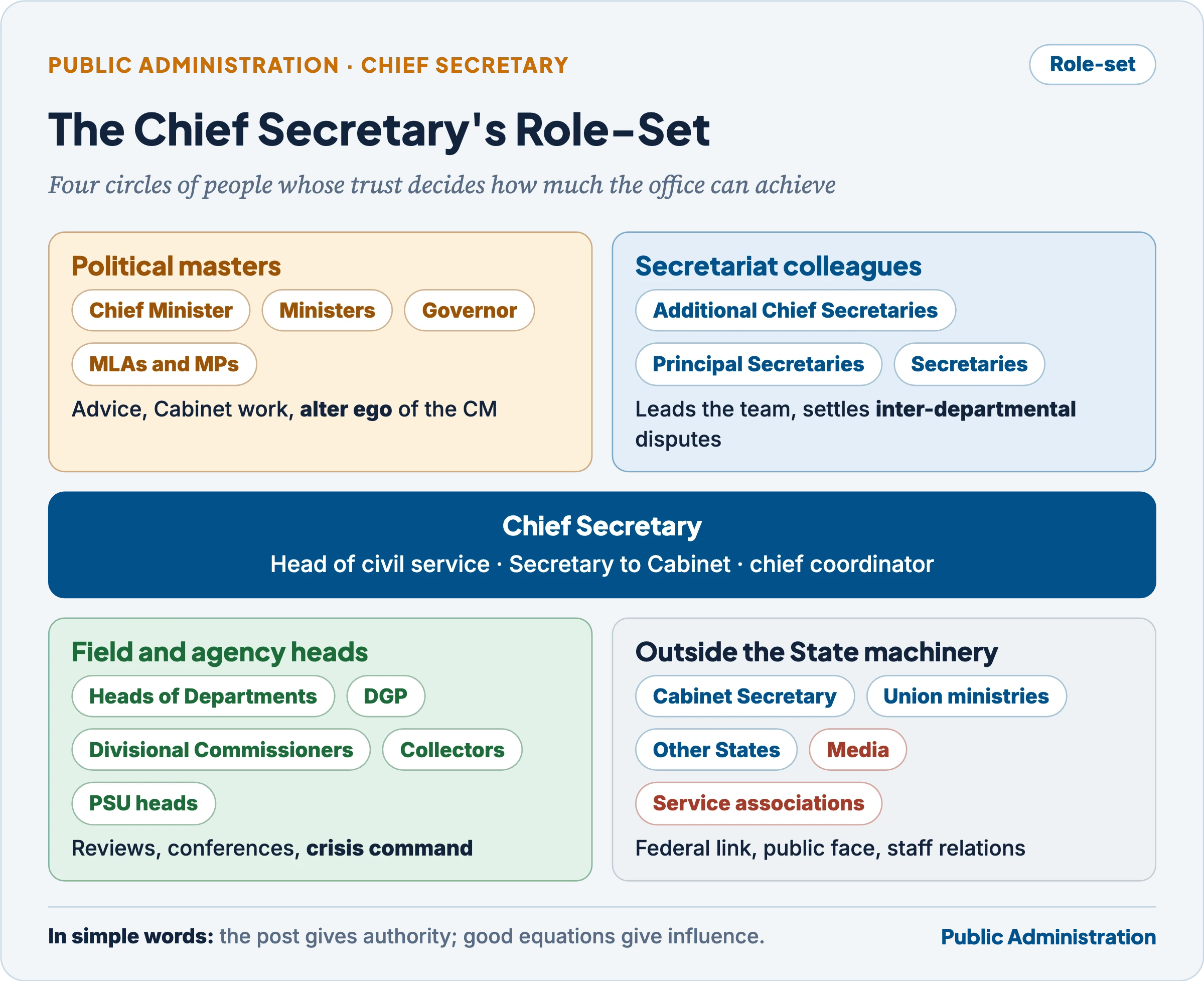
- Role-set. The sociologist Robert K. Merton used role-set for the cluster of relationships attached to one position. The Chief Secretary’s success and prestige depend on his equations with four circles:
- political masters: Chief Minister, ministers, Governor, MLAs and MPs;
- Secretariat colleagues: Additional Chief Secretaries, Principal Secretaries and Secretaries;
- field and agency heads: Heads of Departments, the DGP, Divisional Commissioners, Collectors, heads of public enterprises;
- outside actors: the Cabinet Secretary and Union ministries, other States, the media and service associations.
- Authority and influence. The post gives formal authority; the officer’s personal standing, experience, vision and style turn it into influence. Mangat Rai put it that the job is not a technician’s or a professional’s: the Chief Secretary is part of the human process of democratic government.
- The Chief Minister is the key relationship. The Chief Secretary renders objective advice and executes the Cabinet’s policies, but in practice he acts as the alter ego of the Chief Minister in administration. It is the CM’s trust that gives him strength.
- Dynamics of the CM–Chief Secretary relationship (2017 question):
- Partnership: where the CM trusts the Chief Secretary, he is the CM’s instrument for coordinating ministers and departments and for driving flagship programmes, and the office is at its strongest;
- Choice reflects confidence: CMs often pick an officer junior to others, or change the Chief Secretary soon after taking office, which makes the post look like a political appointment;
- Rival centres: strong Chief Minister’s Offices staffed by trusted officers or political advisers can bypass him. In Odisha, the 5T initiative (Teamwork, Technology, Transparency, Time, leading to Transformation), launched in 2019 under the CM’s private secretary as 5T Secretary, was widely seen as concentrating control over Secretaries in the CM’s office; the new government removed 5T and Mo Sarkar from employees’ performance appraisals in August 2024;
- Friction: where the CM and the Chief Secretary owe loyalty to different authorities (Delhi 2023), administration can stall;
- Neutral competence: the best equation is one where the CM gets frank advice in private and loyal execution in public, the classic Westminster bargain.
3.9 Comparison with the Cabinet Secretary
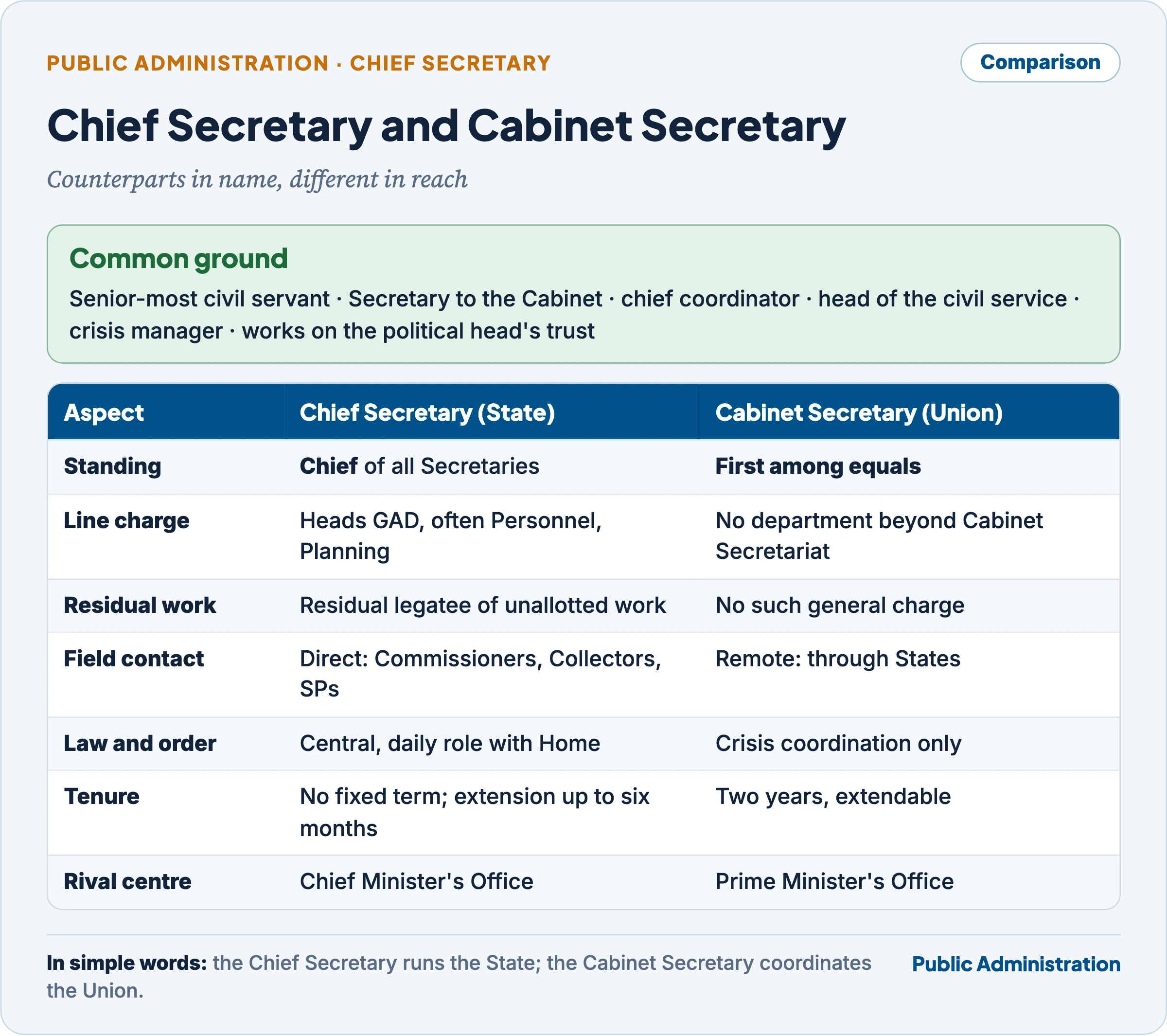
Both are their government’s senior-most civil servants, Secretaries to the Cabinet, chief coordinators, heads of their civil services and crisis managers, and both depend on the head of government’s confidence. The differences are larger than the similarities.
| Aspect | Chief Secretary (State) | Cabinet Secretary (Union) |
|---|---|---|
| Standing among Secretaries | Chief of all Secretaries, including Additional Chief and Principal Secretaries | First among equals |
| Departmental charge | Heads GAD, often Personnel, Administrative Reforms and Planning | No department beyond the Cabinet Secretariat |
| Residual business | Residual legatee of unallotted work | No such general charge |
| Personnel | Direct control of postings and discipline in the State | Chairs the Civil Services Board for Union posts; appointments decided by the ACC |
| Field contact | Direct: Divisional Commissioners, Collectors, SPs report through his system | Remote: works through State Chief Secretaries |
| Law and order | Daily role with the Home Department | Crisis coordination (chairs the National Crisis Management Committee) |
| Tenure | No fixed term; extension up to six months | Two years by convention, extendable (total capped by rule) |
| Rival centre | Chief Minister’s Office | Prime Minister’s Office |
- Scope of the office. The work a Chief Secretary does for a State is divided, at the Union level, among three officers of near-equal status: the Cabinet Secretary, the Home Secretary and the Finance Secretary. This is the sense of the 2000 question: the Chief Secretary has no exact counterpart in the Union government.
- Line versus staff. The Chief Secretary is a line administrator as well as a coordinator; the Cabinet Secretary is mainly a staff coordinator who persuades rather than commands. For the Cabinet Secretary’s own role and tenure, see the article on PMO, Cabinet Secretariat and Central Secretariat.
3.10 Issues: is the office being undermined?
The 2004 question argues that the elevated position of the Chief Secretary is undermined in practice. The evidence:
- Politicisation of selection. Choice by the CM’s confidence, frequent supersession of senior officers and changes of Chief Secretary with every change of government.
- Short and uncertain tenures. Officers appointed months before retirement cannot plan; extensions become rewards; the ARC and Second ARC proposals remain unimplemented.
- Overload with trivia. The Maharashtra administrative reorganisation committee of the 1960s found it unfortunate that the State’s highest official had to sign gazette notifications of routine appointments, promotions and transfers. Personnel cases, meetings and committee chairmanships still eat much of his time; the ARC asked that he be relieved of routine work and given staff support.
- Proliferation of parallel power centres. Chief Minister’s Offices, political advisers, special-purpose missions and senior officers with direct access to the CM dilute his coordinating role.
- Many officers in the same scale. States now have several officers in the Chief Secretary’s pay scale designated Additional Chief Secretaries, which blurs the hierarchy and creates resentment over supersession.
- Post-retirement appointments. Chairmanship of commissions, regulatory bodies or advisory posts after retirement can create incentives to please the government while in office.
- Federal cross-pressure. As 3.7 shows, a Chief Secretary can be caught between Union and State.
The office remains powerful when the CM wishes it to be, which is both its strength and its weakness: its authority is derived, not independent.
4. The State Secretariat: Meaning, Organisation and Functions
In simple words
The State Secretariat is the head office of the State government in the capital, where ministers and their Secretaries sit. It writes policies, laws, rules and the budget, and tells the field offices what to do. It is divided into departments, and each department into wings, branches and sections.
4.1 Meaning
- Definition. The State Secretariat is the complex of departments whose political heads are ministers and whose administrative heads are Secretaries to Government. It is the highest echelon of State administration and the locus of the government’s authority.
- Secretariat department defined. A Secretariat department is an organisational unit consisting of a Secretary to Government together with the part of the Secretariat under his control, to which specified functions are assigned by the Rules of Business.
- From “secretary’s office” to “minister’s office”. The term originally meant the Secretary’s office, when Secretaries in effect ran the government. After responsible government, the ministry became the seat of authority, and the Secretariat now refers to the offices of ministers and Secretaries working together, often in one building complex (the Mantralaya in Mumbai, Writers’ Building and now Nabanna in Kolkata, Fort St. George in Chennai, Lok Seva Bhavan in Bhubaneswar).
- Secretariat versus executive department. The Secretariat department (say, Agriculture Department, headed by the Secretary, Agriculture) is distinct from the executive department (the Directorate of Agriculture, headed by the Director of Agriculture). The Director is subordinate to the Secretary.
4.2 Departments and departmentalisation
- Number. The number of departments varies widely and has little to do with a State’s size: sources record Sikkim with 15 departments (1989), Mizoram with 36 (1987) and undivided Andhra Pradesh with 19 (1982); most States today have 30 to 50. Mizoram’s Secretariat had 41 departments in 2025.
- Common core. General Administration, Personnel, Home, Finance, Planning, Law, Revenue, Agriculture, Public Works, Irrigation/Water Resources, Industries, Health, Education, Rural Development and Panchayati Raj, Urban Development, Transport, Social Welfare, Forests and Environment.
- More departments than Secretaries. One Secretary often holds charge of two or more departments; heavy departments such as Finance and Home have Secretaries with single charge.
- Nerve centres. Besides functional departments, the Chief Minister’s Secretariat or Office, the Cabinet Secretariat department and the office of the Chief Secretary together form the core of policy-making, control and coordination.
- Flexible departmentalisation. In India, unlike the USA where reorganisation needs legislative approval, the political executive can create, split and merge departments by amending the Rules of Business. Examples:
- Rajasthan split Education into School and Higher/Technical Education (1993) and separated Personnel from Administrative Reforms; Art and Culture grew out of Education;
- Sikkim still has an Ecclesiastical Department dealing with monasteries, a legacy of the Chogyal’s rule before 1975;
- Odisha once had a separate Department of State Public Undertakings to supervise all State corporations, but abolished it because the corporations remained tied to their parent departments, producing dual control.
- Coalitions and department inflation. The Second ARC (2009) found that large Councils of Ministers had led to new departments created for ministers rather than functions (it cited a separate Civil Aviation department in Uttar Pradesh and a Jails department in Madhya Pradesh), causing diffused accountability and poor coordination.
4.3 Hierarchy of officers and the office
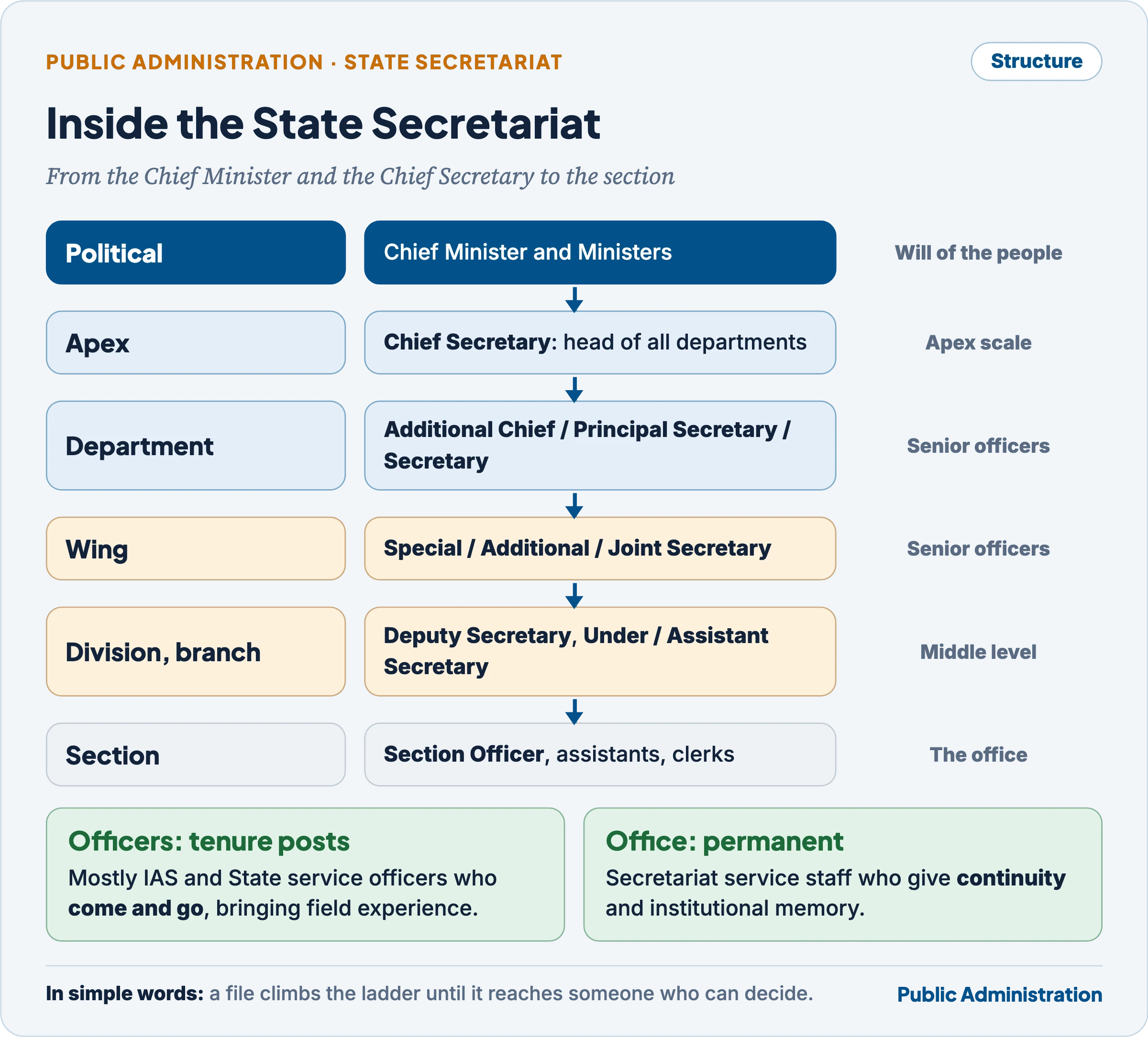
- Officers’ levels (top to bottom):
- Chief Secretary: head of all departments;
- Additional Chief Secretary (ACS): officers in the Chief Secretary’s scale holding major portfolios (Home, Finance, Development); a designation, not a separate rung, and not available in all States;
- Principal Secretary: senior Secretaries in the higher administrative grades;
- Secretary: administrative head of one or more departments, usually IAS;
- Special Secretary / Additional Secretary / Joint Secretary: in charge of wings of large departments;
- Deputy Secretary: in charge of a division;
- Under Secretary / Assistant Secretary: in charge of a branch, often from the State Secretariat Service or the State civil service;
- Section Officer: in charge of a section, assisted by assistants, clerks and typists.
- Nomenclature differs across States. In Rajasthan the hierarchy runs Secretary, Special Secretary, Deputy Secretary, Assistant Secretary; Uttar Pradesh adds Joint Secretaries above Deputy Secretaries; “Special Secretary” means a selection-grade IAS officer in Rajasthan but a very senior officer in Maharashtra.
- Specialists as Secretaries. Most Secretaries are IAS officers, but a few departments are headed by specialists: in Rajasthan the PWD and for some years Irrigation had engineer-Secretaries.
- Officers and office. The Secretariat has two components: a transitory cadre of officers on tenure, who come from and return to the field, and a permanent office of Section Officers, assistants and clerks who provide continuity and memory and do the spadework (noting, precedents) on which officers decide.
4.4 Functions of the Secretariat
The First ARC (1969) described the Secretariat as the top layer of State administration whose job is to help the government make policy and discharge its legislative functions, acting as “a memory and a clearing house” and a general supervisor of executive action. The Second ARC (2009) listed its primary functions in similar terms.
- Policy-making. Helping ministers individually and collectively to formulate and revise policies; supplying data, analysis and options. The Secretariat is the government’s think-tank and data bank.
- Legislative work. Drafting Bills, rules and regulations (delegated legislation); preparing answers to Assembly questions and material for legislative committees, including the Public Accounts and Estimates Committees.
- Budgeting and financial control. Scrutinising departmental budget estimates, re-appropriations and supplementary grants; sanctioning new expenditure beyond the powers of Heads of Departments; sanctions from the Contingency Fund; write-offs and audit objections.
- Coordination. Planning, Finance, Personnel and GAD departments coordinate the rest; the Secretariat resolves inter-departmental issues.
- Direction and control. Giving directions to Directorates and field organisations, laying down rules and standards, reviewing progress and evaluating results through inspection reports and touring reports of Heads of Departments.
- Personnel and organisation. Approving service rules, senior appointments, creation of posts, major penalties, delegation of powers and changes in administrative units and headquarters.
- External relations. Acting as the spokesman of the State government: the Union, other States and bodies such as the Finance Commission deal with the Secretariat, not directly with field offices.
- Institutional memory. Records and precedents ensure consistency and continuity across changing ministries.
Madhya Pradesh’s Secretariat illustrates the usual allocation: general matters (policy, coordination, legislation, plan schemes, conferences, Assembly and PAC work, delegation of powers, territorial changes, appeals), financial matters (budget scrutiny, new expenditure, sanctions beyond Heads of Departments, Contingency Fund, write-offs) and service matters (service rules, senior appointments and discipline, creation of posts).
4.5 Relationship with ministers and the Chief Secretary
- Minister and Secretary. The minister lays down policy and answers to the legislature; the Secretary advises, implements and manages the department. Work is allocated within a department by standing orders issued by the minister.
- Secretary to the government, not to the minister. A Secretary is formally Secretary to the Government as a whole, which lets him give an objective examination of proposals coming from the Directorates and to keep the department in line with Cabinet policy and finance rules.
- The Chief Secretary as team leader. Secretaries are the Chief Secretary’s team; he resolves conflicts among them, but each Secretary deals directly with his own minister on departmental matters. Tension arises when a minister and the Chief Secretary pull a Secretary in different directions.
- Line of command in practice. A minister’s instructions are carried out by the Secretary; disagreement is recorded on file, and the Business Rules may require certain cases to go to the Chief Secretary, Finance or the Cabinet.
4.6 Working methods
- Section system. A case starts in a section, where an assistant puts up a note with precedents; it rises through the Section Officer, Under, Deputy and Joint Secretaries to the Secretary and, if needed, the minister. Many levels mean delay.
- Desk officer system. Two officers of Under Secretary/Section Officer rank form a desk that examines and disposes of cases themselves, cutting out a level.
- Level-jumping and fewer levels. The Second ARC (13th and 15th Reports, 2009) asked that a file pass through no more than three levels before the minister, that each department publish a scheme of delegation, audited periodically, and that decisions likely to be used as precedents be kept in an electronic database. It asked States to replicate this.
5. Secretariat Reforms: State Case Studies
In simple words
Several States have experimented with ways to make their Secretariats faster: giving junior officers more power to decide, cutting the number of levels a file travels, and now moving files online. The experiments show both what works and why reforms often fade.
5.1 Rajasthan
Rajasthan’s Secretariat, formed in 1949, has the longest documented record of reforms.
| Year | Reform | Outcome |
|---|---|---|
| 1951 | Review by G. Swaminathan of the Union Ministry of States | Norms, methods and staffing; most suggestions implemented |
| 1954 | Committee under S.D. Ujwal (Home Secretary) on mechanics of Secretariat work | Departments reconstituted; more powers delegated to field departments |
| 1955 | Organisation and Methods section set up | Nucleus for continuous review; now under Administrative Reforms Department |
| 1960 | Cell system on the advice of Chief Secretary B. Mehta | Cell officers with delegated powers; faded except in Finance (Expenditure), Personnel and Law |
| 1962–63 | State Administrative Reforms Committee | Secretariat to handle only important matters; Secretaries’ tenure four to five years; posts filled by seniority-cum-merit; ex-officio status for some Heads of Departments |
| 1969–70 | Secretariat Reorganisation Committee under Mohan Mukerji | Group system: group in-charges act as desk officers below Deputy Secretaries |
| 1981 | Seminar of the IIPA Rajasthan branch | Time schedules for disposal; at most three levels; continuous training |
| 1992–93 | Separate Planning and Personnel Secretaries; Education department split | Chief Secretary relieved of some charges |
| 1999–2003 | Administrative Reforms Commission chaired by former Chief Minister Shiv Charan Mathur | Simpler procedures, stronger coordination, fewer levels, economy and integrity |
- Why the cell system faded. Cells lacked the “memory” of the permanent office; officers transferred despite the tenure rule; and eliminating office notes hurt consistency and continuity. Still, the cell and group systems reduced the levels a file travels.
- Bridging measures. Chief Engineers of PWD and Irrigation were given ex-officio Additional Secretary status, an early bridge between Secretariat and Directorate.
- The lesson. There is no shortage of reform ideas; implementation is slow, partial and easily reversed, because bureaucratic change is usually incremental, not radical.
5.2 Maharashtra
- Desk officer pattern. On the recommendation of the State’s Administrative Reforms Committee (1968), Maharashtra adopted an officer-oriented pattern: a unit of a desk officer, an assistant, a clerk and a stenographer; the desk officer writes the only note, disposes of simple cases and sends important ones up.
- Heads of Departments inside the Secretariat. A generalist IAS officer is Principal Secretary or Secretary, while the specialist Head of Department is ex-officio Joint Secretary in the department; for example, the Chief Engineer in the Irrigation and Power Department. This partial merger brings technical expertise into policy work and shortens the route between Secretariat and Directorate.
5.3 Odisha
- Three groups of departments. Odisha’s departments are often grouped into regulatory (Finance, Law, Home), developmental (Industries, Rural Development, Public Works) and infrastructural (Education, Health, Transport), all under the Chief Minister and ministers, with Principal Secretaries or Secretaries under the Chief Secretary’s overall supervision.
- Branch system. The branch is the basic unit of disposal; two or three branches form the charge of an Under Secretary, and Under and Deputy Secretaries dispose of most cases themselves. Inter-departmental cases are referred unofficially to other departments before reaching the minister.
- Experiments. The short-lived Department of State Public Undertakings (4.2) showed the risk of dual control. The 5T charter (2019–2024) used technology, deadlines and citizen feedback (Mo Sarkar, under which the government phoned citizens who had visited offices) to push departments, and tied 20 per cent of employees’ appraisal to it; it was criticised for concentrating power in the CM’s office and was removed from appraisals in August 2024.
5.4 The digital Secretariat: e-Office
- What e-Office is. e-Office, developed by the National Informatics Centre, replaces paper files with electronic files: digital receipt and diary of letters, e-signed notes, online file movement, tracking and archiving.
- Recent State moves:
- Chhattisgarh opened its first digital file in August 2024 and made the Mantralaya and Heads of Departments paperless in 2025;
- Madhya Pradesh: the Chief Secretary stopped accepting physical files from 6 January 2025 and asked all departments to move to e-Office by March 2025;
- Mizoram extended e-Office to all 41 Secretariat departments in 2025, with a Rs 1.99 crore grant from DARPG under its State Collaborative Initiative, and planned to extend it to Directorates and districts.
- Gains and limits. e-Office brings transparency, tracking of delays and speed, and lets ministers approve files from anywhere; but it digitises the same hierarchy. Unless levels are cut and powers delegated, an e-file can wait at each desk as a paper file did.
5.5 Problems of Secretariat administration
- Shock of political change. Each new government regroups departments and reshuffles officers; the Secretariat must win the confidence of new masters again and again.
- Tenure system out of rhythm. The tenure principle (rotation between field and Secretariat) does not work regularly; some officers stay in Secretariats in Delhi and the capital and lose touch with the field.
- Concentration of power. The severest criticism is that the Secretariat has concentrated too much authority. A State committee reporting in 1985 found Heads of Departments complaining that the Secretariat created hurdles instead of conditions for work; senior Secretaries admitted that at least 40 per cent of Secretariat time went on routine matters such as small sanctions and individual service cases, and that the Secretariat did not know what was happening in the field.
- Lure of Secretariat postings. Secretariat posts are prestigious, keep officers in the capital, spare them field pressures and bring them close to ministers, so officers crowd towards them.
- Slow decision-making. Too many levels and functionaries; reform committees are set up but their remedies are not pursued with vigour.
- Over-administration. The number of departments and posts keeps growing, partly because those who create posts sit in the Secretariat itself; human and political factors rather than Weberian rationality drive the growth.
5.6 Is the Secretariat an anachronism?
The 1990 question quotes the view that the State Secretariat is a colonial anachronism that should disappear in the interest of efficiency and equity between Secretariat and executive officials.
- The case against. The Secretariat was built for a regulatory colonial state run by generalists; in a development state it duplicates the Directorates’ work, delays decisions, and keeps specialists in an inferior position.
- The case for. It formulates and moderates policy in tune with the wider environment, coordinates departments, handles Centre–State relations, maintains financial discipline, guides planning, regulates personnel policy and links the government with district administration. Its records give continuity. Even as specialists’ roles grow, the needs of control and coordination remain.
- Verdict. The Secretariat is not an anachronism as an institution, since every parliamentary government needs a policy and coordination office near its ministers. What is outdated is its size, its hold over execution and its hierarchy of levels. The remedy is a small, policy-focused Secretariat with executive work delegated to agencies, which is the Second ARC’s prescription.
6. Directorates and Heads of Departments
In simple words
A Directorate is the “doing” office of a department. The Director of Agriculture, the Director General of Police or the Chief Engineer runs it and its offices in every region, district and block. The Directorate gives technical advice to the Secretariat and makes sure the work is actually done on the ground.
6.1 Meaning and nomenclature
- Definition. Directorates, also called executive departments or Heads of Departments (HoDs), are the executive arms of the State government. They translate into action the policies framed by the Secretariat and serve as the repository of technical knowledge for it. They are located outside the Secretariat and are separate organisational entities.
- Head of Department. An officer in charge of the actual administration of a service or the execution of projects. His administrative and financial powers are defined in the financial rules, civil service rules, budget manual and departmental codes, which specify what he can decide and what must go to the government.
- Names vary. Not every head is called “Director”:
| Secretariat department | Directorate / executive head |
|---|---|
| Agriculture | Director of Agriculture |
| Animal Husbandry | Director of Animal Husbandry |
| Cooperation | Registrar of Cooperative Societies |
| Excise | Commissioner of Excise |
| Commercial Taxes / State Tax | Commissioner of Commercial Taxes or State Tax (formerly Sales Tax) |
| Home (Police) | Director General of Police |
| Home (Prisons) | Director General / Inspector General of Prisons |
| Forest | Principal Chief Conservator of Forests |
| Irrigation / Water Resources | Engineer-in-Chief / Chief Engineer |
| Labour | Commissioner of Labour |
| Education | Director of School / Higher Education |
| Printing and Stationery | Controller of Printing and Stationery |
- Not every department has a Directorate. Finance, Law, Personnel, Planning, General Administration and Administrative Reforms are advisory and controlling departments without executive departments. On average a Secretariat department supervises six or seven executive departments.
6.2 Types of executive agencies
- Attached and subordinate offices. The Manual of Office Procedure distinguishes:
- Attached offices provide executive direction for implementing the policies laid down by the department and act as a repository of technical information and advice;
- Subordinate offices are field establishments that carry out the detailed execution of decisions, usually under an attached office.
The common analogy: the Secretariat is the brain, the attached office the trunk, and the subordinate offices the limbs. State Directorates usually combine both roles: a headquarters that directs and advises, and field offices that execute.
- Other executive agencies. With the growth of State activity, execution is also done by statutory boards and authorities (State Electricity Board successors, Pollution Control Board, housing boards), corporations and companies (transport corporations, industrial development corporations), registered societies (State Health Societies, Rural Livelihood Missions) and special purpose vehicles. They differ in purpose, autonomy and statutory basis, which is the point of the 1993 question:
| Form | Basis | Purpose | Autonomy |
|---|---|---|---|
| Secretariat department | Rules of Business | Policy, finance, control | None: part of government |
| Directorate | Executive order, codes | Execution, technical advice | Limited, delegated powers |
| Board / statutory authority | State Act | Regulation, quasi-judicial or specialised services | Moderate, defined by statute |
| Corporation | State Act | Commercial or developmental service | Considerable, own finances |
| Government company | Companies Act, 2013 | Commercial activity | Highest operational autonomy |
- Board of Revenue. A distinctive State-level agency: created first in Bengal in 1786 to relieve government of detailed revenue work, it is the highest revenue court and supervises Collectors’ revenue work. States show five patterns: a Board without Divisional Commissioners (historically Tamil Nadu, Kerala, Rajasthan), a Board with Divisional Commissioners (Uttar Pradesh, Madhya Pradesh, Bihar, Odisha), a Financial Commissioner in place of the Board (Punjab), a Revenue Tribunal with Divisional Commissioners (Maharashtra, Gujarat), and functional Commissioners after abolition of the Board (Andhra Pradesh, 1977). Several States have since abolished or reorganised their Boards.
6.3 Organisation
- Headquarters. A Director (or equivalent) heads the Directorate, assisted by Additional, Joint, Deputy and Assistant Directors, technical staff, statisticians and administrative officers, plus ministerial staff. The staff are mostly specialists or technicians of the department’s own service (agricultural, engineering, medical).
- Who heads Directorates. Usually a senior specialist promoted from the department, but IAS officers are often appointed to head technical departments too (agriculture, education, health, commercial taxes, industries), which itself fuels the generalist–specialist dispute.
- Field formations. A Directorate reaches the citizen through a chain:
- regional or divisional level: a Joint Director, Deputy Inspector General (police range), Superintending Engineer (irrigation circle) or Conservator (forest circle);
- district level: a Deputy or Joint Director, Superintendent of Police, Executive Engineer, District Education Officer;
- block level: extension officers for agriculture, cooperation or panchayats in the Block Development Officer’s team;
- village level: multipurpose or departmental field workers (village-level workers, agricultural assistants, health workers).
6.4 Functions of a Head of Department
- Budget: preparing the department’s budget estimates.
- Technical adviser: advising the minister and Secretary on the technical side of policy.
- Inspection: inspecting the work of district and field staff.
- Financial powers: allocating grants and making re-appropriations within limits.
- Personnel powers: appointments, confirmations, postings, transfers and promotions of subordinate staff within rules; leave and acting arrangements.
- Discipline: exercising disciplinary powers over subordinate officers.
- Public Service Commission: advising the PSC on promotions and disciplinary cases.
- Training: organising in-service training.
- Research and improvement: departmental research and experiments to raise efficiency.
- Conferences: sanctioning officers’ attendance at conferences other than inter-State or Union ones.
6.5 Field administration under the Directorates
- Why regional administration. Policy is made at one centre, but execution happens across the State. Directorates therefore build intermediate (regional) offices between headquarters and districts to supervise district officers, set standards, inspect, and feed back field problems. The ARC Study Team on District Administration (1967) argued that large States need such a level.
- Non-coterminous jurisdictions. Each department draws its own regions (police ranges, forest circles, irrigation circles, education divisions), which often do not match the revenue division under a Divisional Commissioner. This hampers coordination at the regional level.
- Divisional Commissioner. The senior IAS officer who supervises Collectors of a division, hears revenue appeals and coordinates development and law and order. The office has had a chequered career: Madhya Pradesh and Bombay abolished and later revived it; Rajasthan abolished it in 1961 (later restored).
- Should the regional tier exist? The First ARC laid down criteria (volume of supervision, cost, geographical spread, nature of work) for keeping regional offices. The Second ARC (2009) went further: with the district as the key unit and fast connectivity, there is no need for an intermediate level between the State headquarters and districts; senior officers now heading regional offices should be posted in major districts or at headquarters instead.
- Headquarters–field relations. Typical problems are excessive centralisation at headquarters, slow sanctions, reports and returns that are never used, transfers of field staff by headquarters without local consultation, and weak horizontal coordination in the district. The district Collector coordinates the district offices of many Directorates; the Collector’s changing role is taught in the article on the District Collector and district administration (unit on District Administration since Independence).
Indian Connect — Field machinery after decentralisation
The 73rd and 74th Amendments (1992) transferred many functions of line departments (primary schooling, minor irrigation, rural water supply) to panchayats and municipalities in law, though States have devolved them unevenly. The Second ARC (2009) therefore said that Directorates whose functions have passed to local governments should shift from direct execution and personnel management to monitoring standards, technical guidance and training of local bodies, and become smaller over time. For Panchayati Raj, see the article on decentralisation and the 73rd Amendment.
7. The Secretariat–Directorate Relationship
In simple words
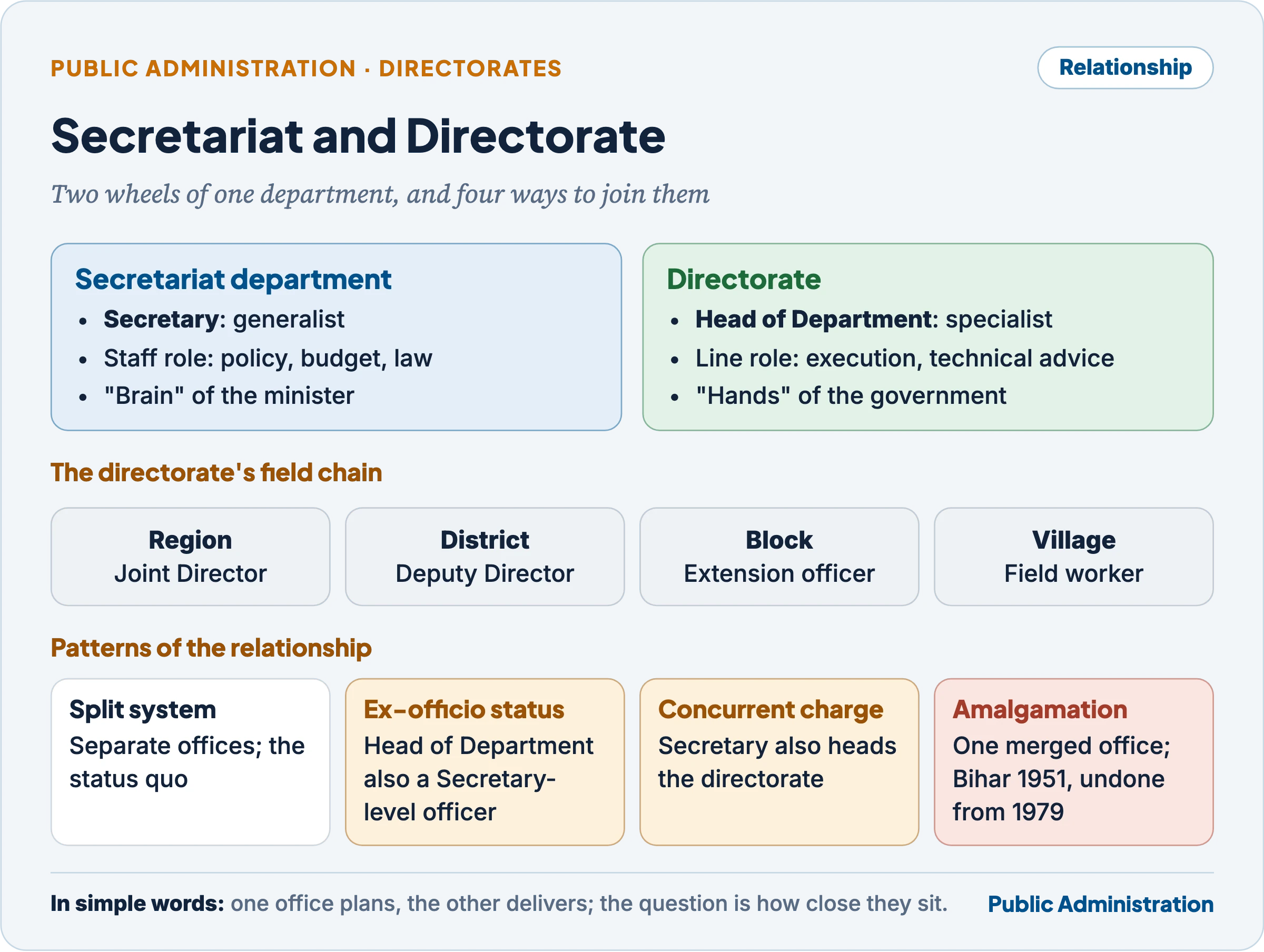
The Secretariat and the Directorate are like the two wheels of a cart. They are meant to share the load: one plans, the other delivers. In practice the Secretariat often second-guesses the Directorate’s every proposal, and the Directorate feels treated as a junior office. States have tried several ways to bring the two closer.
7.1 Principles of the split system
- Policy with the Secretariat, execution with the Directorate. Policy-making is the primary responsibility of the Secretariat; implementation belongs to the Head of Department.
- Head of Department controls his personnel, subject to service rules.
- Secretariat provides common services (accommodation, housekeeping) to its Directorates.
- Generalist over specialist. The Secretary is a generalist, usually IAS; the HoD is a specialist. Secretaries are the administrative advisers of ministers; HoDs are their executive instruments.
7.2 Why the relationship has soured
The 2025 question asks whether the lack of clear demarcation between Secretariat and Directorate harms both policy-making and implementation. The sources of friction:
- Expansionist Secretariat. The Secretariat does not confine itself to policy; it arrogates executive work (sanctions, transfers, tenders), weakening the Directorates’ authority.
- Inadequate delegation. It hesitates to delegate, so execution is delayed and the HoD’s initiative is cramped by repeated references.
- Double scrutiny from the bottom. Proposals already examined by district, regional and headquarters offices of the Directorate are examined again in the Secretariat, starting at the assistant’s level, which is dilatory and undermines the HoD.
- Generalist judging specialist. Specialists object that lay generalists have little to contribute in scrutinising technical schemes in an age of science and technology.
- Status and access. The Secretary has easy access to the minister and higher status; the HoD is treated as subordinate. Postings in the Secretariat are more prestigious, so the gulf is also one of career rivalry between services.
- Causes of the Secretariat’s expansion:
- parliamentary accountability: ministers must answer every Assembly question, so they pull detail into the Secretariat;
- constituency pressures on ministers over appointments and transfers, which are executive matters;
- planning and the welfare state, which multiplied work and decisions with wide impact;
- the belief that generalist Secretaries have broader vision and that Secretariat staff are of higher calibre;
- the tendency of bureaucracies to grow.
- Policy and administration are a continuum. The split assumes that policy and administration can be separated, the dichotomy of Woodrow Wilson (“The Study of Administration”, 1887) and of Max Weber‘s politician–official distinction. In practice they are interlinked: administrators supply data, draft Bills, make delegated legislation and exercise discretion that shapes policy content, while ministers dabble in execution. Paul Appleby (Policy and Administration, 1949) argued that administration is itself policy-making. So the demarcation cannot be clean, and each side encroaches on the other.
- Consequences. Policies are framed without field knowledge; implementation waits for sanctions; responsibility for failure is blurred; morale in the Directorates falls; and accountability to the legislature becomes formal.
7.3 The generalist–specialist dimension
The 2007 question treats the Secretariat–Directorate dispute as a generalist versus specialist controversy. It is largely that, but not only that.
| Argument | Generalist Secretary | Specialist Head of Department |
|---|---|---|
| Vision | Broad view of government as a whole; balances departments | Deep knowledge of the subject and field conditions |
| Advice to minister | Objective, checks the specialist’s “exalted fervour” | Technical soundness; experience of what works |
| Evaluation | Neutral judge of programmes the Directorate runs | Cannot judge its own work, but knows its real problems |
| Coordination | Can relate finance, law and politics | Tends to departmental tunnel vision |
| Modern governance | Needed for integration and political interface | Technology and complexity demand professional leadership |
- Beyond generalist–specialist. The dispute is also about status and pay, access to ministers, promotion prospects of departmental services, and the centralising logic of parliamentary accountability. Even where IAS officers head Directorates, friction with the Secretariat persists, which shows that the structure, not only the type of officer, causes conflict.
- Comparative anchor. In Britain the Fulton Committee (1968) attacked the “cult of the generalist” in the civil service and asked for professionalism; India’s First ARC (1969) similarly urged functional specialisation in personnel policy. For the wider debate, see the article on Recruitment Training and Career.
- Middle way. Mixed teams, specialists in Secretariat posts (engineer-Secretaries in PWD), domain competencies for generalists, and lateral movement between Secretariat and Directorates.
7.4 Three approaches to the relationship
- Status-quo approach (split system). Keep separate Secretariat (staff) and Directorate (line), following the staff–line and policy–administration dichotomies.
- For: those who execute should not assess their own performance; executors are absorbed in detail and lack the broad outlook policy needs; generalist scrutiny adds objectivity; separation encourages delegation and division of work; the system is tried and tested.
- Against: schemes are processed twice; scrutiny starts at the assistant level and distorts schemes; generalists lack technical know-how; the system is inegalitarian and makes Directorates feel inferior.
- Bridging-the-gulf approach. Bring the two closer without abolishing either:
- ex-officio Secretariat status to Heads of Departments, so they can sign on behalf of government. The Rajasthan ARC (1962–63) proposed it experimentally (Chief Engineer, PWD and Director of Industries as ex-officio Additional Secretaries); the Andhra Pradesh ARC (1964–65) recommended it for 23 heads to create psychological closeness; the Punjab ARC (1964–66) to give HoDs adequate powers; the Kerala Administrative Reorganisation and Economy Committee (1965–67) for 55 officials, for esprit de corps. Critics warn that it blurs policy and execution, overloads field officers with Secretariat work, removes balanced scrutiny and debases HoDs left without the status;
- concurrent charge: a Secretary (or Joint Secretary) is also appointed head of the Directorate, with one common office (Union examples: the Director-General of Employment and Training);
- amalgamation (merger): the Directorate’s office is merged into the Secretariat department; the Andhra Pradesh ARC (1960) favoured it for faster plan execution, and the Madhya Pradesh ARC (1970–72) for an integrated composite office avoiding duplication;
- reverse merger: the Secretariat office merged into the Directorate’s headquarters, with common files and noting only by officers (the old Posts and Telegraphs Directorate model).
- De-amalgamation approach. Bihar merged its Secretariat departments and Directorates in 1951. Supporters said it avoided double examination, cut delays and saved money. Critics found that proposal quality fell, the distinction of functions vanished, Secretaries wrote guarded notes to avoid offending HoDs, and HoDs stayed stuck in the capital instead of touring. Bihar decided in 1979 to return to the split system and completed de-amalgamation by 1982, after separating the common cadre and duplicating files.
7.5 The ARC and later recommendations
The First ARC’s Report on State Administration (1969) recommended:
- Keep the distinction between policy-making (Secretariat) and executive organisations; Directorates remain separate entities.
- Integrate with the Secretariat only those Directorates concerned with development programmes, so that planning and execution move together; regulatory, training, survey and research organisations stay separate.
- Uniform delegation of powers to all Directorates, with the Secretariat ensuring that delegated powers are actually used at all levels.
- Reorganise Directorates to remove needless multiplicity and diffusion of responsibility.
- A manual of procedures and instructions for every major Directorate, and a programme planning and review cell in every major development Directorate.
- No new Directorate without studying whether existing ones can take on the work.
- Chief Secretary: minimum tenure of three to four years, charge of the Personnel department, relief from routine work and adequate staff support.
Common confusion
Did the First ARC recommend abolishing the distinction between the Secretariat and the Directorates? Not in general. Its Study Team on the Machinery of the Government of India favoured abolishing the distinction between the Secretariat and non-Secretariat organisations through a wide merger. The Commission itself rejected general abolition and recommended integration only of development-oriented Directorates, keeping the policy–execution separation for regulatory, training, survey and research agencies. Many notes attribute the study team’s view to the ARC.
- Second ARC (2009). Its Fifteenth Report took the Union-level ideas of its Thirteenth Report to the States:
- rationalise departments by merging related subjects (for example, combining Panchayati Raj with Rural Development, or Agriculture with Animal Resources and Dairy);
- redefine Secretaries’ role, divest them of executive work and delegate more to executive departments and agencies;
- Secretariat departments to concentrate on policy, strategic decisions, budgeting, monitoring, key appointments, coordination and evaluation;
- convert implementation units into semi-autonomous, professionally managed executive agencies (departments, boards, companies or societies) bound by performance agreements or MoUs, the Indian version of Britain’s Next Steps agencies;
- no file to pass more than three levels; published and audited schemes of delegation.
- State-level synthesis. Many States have moved in this direction in parts: missions and societies for flagship schemes, State-level agencies with their own boards, and e-Office. But departments have also multiplied, and Secretariats still clear transfers and small sanctions.
7.6 Do Directorates serve “very little functional purpose”?
The 1989 question puts the extreme view. It is overstated.
- What Directorates contribute: technical expertise and data for policy; command of a statewide field network; continuity of professional standards; supervision and inspection; and a buffer between ministers and field staff.
- Where the criticism holds: when the Secretariat does their work, Directorates become post offices forwarding files; where functions have gone to local bodies, they may duplicate them; and multiple Directorates in one sector fragment action.
- The answer is not to abolish Directorates but to give them real autonomy with accountability, redefine them as executive agencies, and keep the Secretariat to policy and oversight, as both ARCs advised. The 2001 question’s description of Directorates as administrative and implementation units assisting Secretariat departments is correct for the formal design; the practical issue is whether that assistance is a partnership or a subordination.
Criticism — The case against the Secretariat–Directorate split
- Duplication and delay: the same scheme is examined twice, first by experts and then by generalists starting at the clerical level.
- Over-centralisation: the Secretariat hoards executive powers and spends much of its time on routine sanctions and transfers.
- Specialists sidelined: technical heads are kept away from policy and treated as subordinates, which hurts morale and policy quality.
- Blurred accountability: when a programme fails, Secretariat and Directorate blame each other.
- Colonial legacy: a structure built for a generalist, regulatory Raj does not fit a technical, developmental state.
Defence — The case for keeping the two separate
- Objective oversight: an office that does not execute can judge execution and resist departmental lobbies.
- Policy needs distance: freedom from daily operations lets the Secretariat think long-term and across departments.
- Political interface: a generalist Secretary handles the legislature, finance and coordination, freeing HoDs for field work.
- Experience with merger: Bihar’s amalgamation lowered the quality of proposals and was reversed.
- Modern reform builds on separation: executive agencies under performance contracts are the split system made explicit, not abolished.
On balance, the split is sound in principle and faulty in practice. The fault lies less in having two offices than in who holds which powers: a Secretariat that keeps executive powers and a Directorate without autonomy produce the worst of both. Clear delegation, fewer levels, specialists in policy roles and agencies accountable through performance contracts are the remedies.
8. Theory Lens and Overall Appraisal
In simple words
Ideas from administrative theory explain why State administration works as it does: why there is one officer at the top, why head office and field offices quarrel, why generalists and specialists clash, and why politicians and civil servants do not always want the same things.
8.1 The reform agenda in one place
- Chief Secretary: transparent selection through a collegium or Civil Services Authority; a minimum two-year tenure; relief from routine and a strong staff office; a clear definition of the role in the Rules of Business; a check on parallel power centres.
- Secretariat: fewer, rationally grouped departments; policy focus; at most three levels; audited delegation schemes; e-Office with time limits; a predictable tenure policy that rotates officers between field and headquarters.
- Directorates: real financial and administrative autonomy; ex-officio Secretariat status or joint teams for major technical heads; conversion into executive agencies with performance agreements; reorientation towards standards and support where functions have gone to local bodies; a review of the regional tier.
Theory lens: State administration through Paper I ideas
- Weber’s hierarchy and legal-rational authority. Max Weber (Economy and Society, published 1922) describes a pyramid of offices under rules, staffed by trained officials, with files as the memory of the organisation. The State Secretariat, from Chief Secretary to Section Officer, with its Rules of Business and permanent office, is a Weberian bureaucracy; its generalist IAS apex reflects Weber’s trained official who administers by rules rather than technical craft. Weber also warned that bureaucrats can dominate amateur politicians through expertise and secrecy, which explains the Secretariat’s hold over ministers. See the article on Weber and Bureaucracy.
- Line, staff and auxiliary agencies. L.D. White (Introduction to the Study of Public Administration, 1926) and later theorists separated line agencies (doing the work) from staff (advising) and auxiliary (common services). The Secretariat is staff, Finance and Personnel are auxiliary, and Directorates are line; the friction arises because the staff agency exercises line authority through sanctions and transfers, the confusion the classical theorists warned against. See the article on Structure and Forms of Organisation.
- Gulick and coordination by structure. Luther Gulick (“Notes on the Theory of Organization”, 1937) saw coordination as achieved either by organisation (a hierarchy with a single head) or by the dominance of an idea. The Chief Secretary is coordination by organisation: one apex official, with POSDCORB functions (planning, organising, staffing, directing, coordinating, reporting, budgeting) concentrated in his office. Gulick’s unity of command is violated when a Directorate takes orders from its Secretary, Finance, the Chief Secretary and the Collector at once. See the article on Classical Theory.
- Follett’s coordination as a continuous process. Mary Parker Follett (papers collected in Dynamic Administration, 1941) held that coordination works best by direct contact among the responsible people, at the early stages, as reciprocal relating of all factors and as a continuous process. Senior Officers’ Conferences, Secretaries’ meetings and ex-officio status for HoDs follow her logic; files moving up and down the hierarchy do not. See the article on Mary Parker Follett.
- Generalist versus specialist. The debate runs from the British tradition of the “intelligent amateur” to the Fulton Committee (1968), which condemned the cult of the generalist. Robert Merton‘s idea of trained incapacity (1940) cuts both ways: generalists may not grasp technology, specialists may not see the whole. India’s Secretariat–Directorate conflict is the institutional form of this debate. See the article on Recruitment Training and Career.
- Headquarters–field relations. James Fesler (Area and Administration, 1949) contrasted functional field systems (each department with its own field chain) with areal or prefectoral systems (one general agent coordinating all departments in an area). Directorates follow the functional model, the Collector and Divisional Commissioner the prefectoral one; their coexistence explains coordination problems in India’s districts, and the Second ARC’s wish to abolish the regional tier. See the article on Structure and Forms of Organisation.
- Principal–agent and politicisation. In principal–agent theory (Michael Jensen and William Meckling, 1976; applied to bureaucracy by Terry Moe, 1984), a principal who cannot fully observe an agent uses selection, rewards and monitoring to align interests. Chief Ministers (principals) choose Chief Secretaries by confidence, reward with extensions and post-retirement posts, and monitor through CM’s Offices: rational control, but at the cost of neutral competence. Fixed tenure and collegium selection (Second ARC, T.S.R. Subramanian) try to limit the principal’s power to punish frank advice. The Union and States form a double principal for AIS officers, which produced the West Bengal and Delhi disputes.
- Riggs’ formalism and public choice. Fred Riggs‘ formalism (gap between rules and practice) fits a system where the Rules of Business assign functions on paper while real decisions go to a CM’s confidant, and where delegated powers exist but are not used. William Niskanen‘s budget-maximising bureaucrat (1971) and Anthony Downs‘ bureaucratic territoriality (Inside Bureaucracy, 1967) explain the growth of departments and posts and the Secretariat’s reluctance to delegate. See the articles on Riggsian Models and New Public Administration and Public Choice.
Key Terms
| Term | Meaning in simple words |
|---|---|
| Chief Secretary | Senior-most civil servant of a State; Secretary to the Cabinet and head of the civil service |
| Rules of Business | Rules under Article 166(3) that create departments and allocate work among ministers and officials |
| Secretary to the Cabinet | The official who prepares Cabinet agendas, records decisions and follows them up |
| Residual legatee | The officer who handles all business not allotted to anyone else |
| Additional Chief Secretary | Designation for senior officers in the Chief Secretary’s pay scale holding major departments |
| Principal Secretary | Senior Secretary heading one or more departments |
| State Secretariat | Complex of departments under ministers and Secretaries in the State capital |
| Secretariat department | A Secretary with the part of the Secretariat under him, doing functions assigned by the Rules of Business |
| Office (Secretariat) | Permanent staff of Section Officers and assistants who give continuity |
| Tenure system | Rotation of officers between field and Secretariat posts for fixed terms |
| Desk officer system | Two-officer desks that examine and dispose of cases, replacing the section |
| Directorate | Executive department outside the Secretariat that implements policy |
| Head of Department (HoD) | Officer heading a Directorate, such as the Director of Agriculture or DGP |
| Attached office | Office giving executive direction and technical advice to a department |
| Subordinate office | Field establishment carrying out detailed execution |
| Line agency | Agency doing the primary work and dealing with citizens |
| Staff agency | Agency advising and assisting the chief executive |
| Auxiliary agency | Agency providing common services such as finance and personnel |
| Split system | Separation of policy-making Secretariat from executing Directorates |
| Ex-officio Secretariat status | Giving a Head of Department a Secretariat rank so he can act for government |
| Amalgamation | Merger of a Directorate’s office with its Secretariat department |
| De-amalgamation | Return from a merged set-up to the split system, as in Bihar |
| Executive agency | Semi-autonomous body that implements policy under a performance agreement |
| Civil Services Board | Committee of senior officers, chaired by the Chief Secretary, that recommends postings and transfers |
| Role-set | The full set of relationships attached to one position |
| Regional administration | Offices between the State headquarters and the districts |
| e-Office | Electronic file system replacing paper files |
Commissions, Committees and Judgments
The bodies, rules and cases below shaped the Chief Secretary’s office, the State Secretariat and the Directorates, in order of year.
| Body / case | Year | Key point |
|---|---|---|
| Board of Revenue, Bengal | 1786 | First Board to relieve government of detailed revenue work |
| Wellesley’s reorganisation of the Fort William secretariat | 1799 | Post of Chief Secretary created (G.H. Barlow first holder) |
| Tottenham Committee (Richard Tottenham) | 1945–46 | Minister is the will, Secretary the brain, executive head the hands |
| Bihar amalgamation of Secretariat and Directorates | 1951 | Merged offices; de-amalgamation decided 1979, completed 1982 |
| Rajasthan Secretariat review (G. Swaminathan) | 1951 | Norms and staffing of the new Secretariat |
| Rajasthan Secretariat Committee (S.D. Ujwal) | 1954 | Reconstituted departments; more delegation to field departments |
| States Reorganisation Act | 1956 | Five Zonal Councils; Chief Secretaries as advisers and rotating secretaries |
| Rajasthan cell system (Chief Secretary B. Mehta) | 1960 | Cell officers with delegated powers |
| Andhra Pradesh Administrative Reforms Committee | 1960 | Merger of Directorates with the Secretariat for faster plan work |
| Rajasthan Administrative Reforms Committee | 1962–63 | Ex-officio Additional Secretary status for Chief Engineer PWD and Director of Industries |
| Andhra Pradesh Administrative Reforms Committee | 1964–65 | Ex-officio Secretariat status for 23 Heads of Departments |
| Punjab Administrative Reforms Commission | 1964–66 | Ex-officio status to give HoDs adequate powers |
| Kerala Administrative Reorganisation and Economy Committee | 1965–67 | Ex-officio status for 55 officials |
| ARC Study Team on District Administration | 1967 | Need for a regional tier in large States |
| Maharashtra Administrative Reforms Committee | 1968 | Desk officer system; HoDs as ex-officio Joint Secretaries |
| First ARC, Report on State Administration (K. Hanumanthaiya) | 1969 | Chief Secretary tenure 3–4 years, Personnel under him; uniform delegation; integrate only development Directorates |
| Rajasthan Secretariat Reorganisation Committee (Mohan Mukerji) | 1969–70 | Group system with desk-officer-like group in-charges |
| Madhya Pradesh Administrative Reforms Commission | 1970–72 | Integrated composite office of Secretariat and Directorate |
| Upgradation of the Chief Secretary’s post | 1973 | Rank and pay of a Secretary to the Government of India |
| E.P. Royappa v. State of Tamil Nadu | 1974 | Chief Secretary’s post one of great confidence; arbitrariness violates Article 14 |
| Rajasthan Administrative Reforms Commission (Shiv Charan Mathur) | 1999–2003 | Simplification, fewer levels, stronger coordination |
| Prakash Singh v. Union of India | 2006 | DGP from UPSC panel of three, minimum two-year tenure; model for apex posts |
| Second ARC, 13th Report, Organisational Structure of GoI (M. Veerappa Moily) | 2009 | Three levels; ministries for policy, executive agencies for delivery |
| Second ARC, 15th Report, State and District Administration (V. Ramachandran, acting) | 2009 | Collegium for Chief Secretary; two-year tenure; 30-year field; fewer departments; executive agencies; no regional tier |
| T.S.R. Subramanian v. Union of India | 2013 | Civil Services Boards, minimum tenure, written orders |
| IAS (Cadre) Amendment Rules | 2014 | Two-year minimum on cadre posts; CSB chaired by the Chief Secretary |
| Government of NCT of Delhi v. Union of India (extension case) | 2023 | Union’s six-month extension of Delhi Chief Secretary upheld; CS must not stall the elected government |
Contemporary Developments
- Chief Secretary and federal friction (29 November 2023). The Supreme Court upheld the Union’s six-month extension of the Delhi Chief Secretary under Rule 16 of the AIS (DCRB) Rules, while stressing that a Chief Secretary must carry out the elected government’s directions in its own field.
- Odisha rolls back 5T (June–August 2024). After the change of government, Odisha removed the 5T charter and Mo Sarkar components (20 per cent weightage) from employees’ appraisal reports from 2024–25, ending a CM’s-office-driven model of Secretariat control.
- Fourth National Conference of Chief Secretaries (13–15 December 2024). Chaired by the Prime Minister, on entrepreneurship, employment and skilling, with special sessions on economic reforms in States and capacity building through Mission Karmayogi.
- Paperless Secretariats (2024–25). Chhattisgarh opened its first e-file in August 2024; Madhya Pradesh’s Chief Secretary stopped physical files from 6 January 2025; Mizoram took e-Office to all 41 Secretariat departments in 2025 with DARPG support; Chandigarh moved all departments to e-Office from 1 November 2025.
- Fifth National Conference of Chief Secretaries (26–28 December 2025). Theme “Human Capital for Viksit Bharat”, with a special session on deregulation in States and technology in governance; States were asked to prepare ten-year action plans with monitoring milestones.
- Chief Secretary-level reviews (May 2026). At the 51st PRAGATI meeting (27 May 2026), States were asked to hold monthly Chief Secretary-level reviews of social sector schemes, extending the Chief Secretary’s role as the State’s monitoring hub.
- Unfinished agenda. The Second ARC’s collegium and fixed tenure for the Chief Secretary remain unimplemented; selection still rests on the Chief Minister’s confidence.
Revision Grid
| Thinker / body | Work or report (year) | Key idea |
|---|---|---|
| Max Weber | Economy and Society (1922) | Hierarchy, rules, files; trained officials can dominate politicians |
| L.D. White | Introduction to the Study of Public Administration (1926) | Line, staff and auxiliary agencies |
| Luther Gulick | “Notes on the Theory of Organization” (1937) | Coordination by organisation; POSDCORB; unity of command |
| Mary Parker Follett | Dynamic Administration (1941) | Coordination by direct contact, early, reciprocal, continuous |
| James Fesler | Area and Administration (1949) | Functional versus prefectoral field systems |
| Paul Appleby | Policy and Administration (1949) | Administration is policy-making; no clean dichotomy |
| Robert K. Merton | Role-set; trained incapacity (1940s–50s) | Position as a set of relationships; experts’ blind spots |
| E.N. Mangat Rai | Former Chief Secretary, Punjab | Chief Secretary as coordinator of other men’s work |
| Tottenham Committee | Report (1945–46) | Will, brain, hands |
| Fulton Committee | Report on the Civil Service (1968) | Against the cult of the generalist |
| First ARC | Report on State Administration (1969) | CS tenure 3–4 years; delegation; integrate development Directorates only |
| Second ARC | 15th Report (2009) | Collegium, two-year tenure; fewer departments; executive agencies; no regional tier |
| Supreme Court | T.S.R. Subramanian (2013) | Civil Services Boards; minimum tenure; written orders |
| Jensen and Meckling; Moe | 1976; 1984 | Principal–agent control of bureaucracy |
Previous Year Questions
- 2025Lack of clear demarcation of roles between the State Secretariat and the Directorate has serious implications for policy making and policy implementation. Do you agree?
- 2022“The Chief Secretary is the chief communication link between the state and central government”. Explain.
- 2017“The chief secretary is often termed as the alter ego of the Chief Minister.” Discuss, with examples, the dynamics of their relationships in State administration.
- 2012“The success and prestige enjoyed by a Chief Secretary depend, to a large extent, upon his equations with the varied sets of people and institutions that form the work environment.” Critically evaluate the statement and its relevance to the role of the Chief Secretary in the discharge of his functions.
- 2009“The respective roles of the Cabinet Secretary of the Government of India and of the Chief Secretary of a State are similar in certain respects, and dissimilar in other.” Explain.
- 2007“The dispute between Secretariat and Directorate is the result of Generalist vs Specialist controversy.” Analyse.
- 2004“The highly significant and elevated position of Chief Secretary is significantly undermined in practice today.” Comment.
- 2001“State Directorates are administrative and implementation units assisting the Departments functioning from the Secretariat.” Explain.
- 2000“In the Chief Secretary, the State Government has an officer whose counterpart does not obtain in the Union Government.” Elucidate.
- 1994“By virtue of his unique position as head of the official machinery and adviser to the State Council of Ministers, the Chief Secretary has an extremely important role to play in the state administration.” Comment.
- 1993“The Departments, the directorates, the corporations, the companies and the Boards have different organisational purposes and statutory functions in State administration.” Discuss.
- 1990‘The Secretariat in State Government is an anachronism held over from the British regime. The sooner the secretariat disappears from the State administrative scene, the better it would be in the interests of improvement of administrative efficiency and promotion of equity between the officials at the levels of the secretariat and the Executive Departments.’ Comment.
- 1989‘The Office of the Chief Secretary should be rotated among the top Civil Servants in the State Administration.’ Comment.
- 1989‘The Directorates in the departments of State Administration serve very little functional purpose.’ Comment.
- 1987‘The role of the Chief Secretary as Principal Co-ordinator in State administration is comparable with that of the Cabinet Secretary in Union Government.’ Do you agree or not? Give reasons.
- 2024Healthy Headquarters and Field Agencies relationship thrives on effective communication. Comment.
- 2007“The distinction between line and staff is relative rather than absolute.” Discuss.
- 1999“The Generalist will always have an edge over the specialist.” Substantiate the view.
- 1998“Headquarter and Field relationships determine the tendor of implementation of programmes.” Comment.