

Executive, Parliament, Judiciary – structure, functions, work processes; Recent trends; Intra-governmental relations; Cabinet Secretariat; Prime Minister’s Office; Central Secretariat; Ministries and Departments; Boards; Commissions; Attached offices; Field organizations.
This article: The Union executive: the parliamentary design and the nominal–real executive (Bagehot, Westminster model, Articles 52–78); the President (election, removal, executive, legislative, veto, ordinance, financial, pardon, advisory, military and emergency powers; constitutional position under Articles 53 and 74, the 42nd and 44th Amendments, Shamsher Singh, situational discretion, pocket veto, assent controversies and the 2025 Presidential Reference); the Vice-President; the Prime Minister (position, powers, sources and limits of power, accountability, comparison with the British Prime Minister, models of leadership from Nehru to the coalition era and after); the Council of Ministers (composition, categories, the 91st Amendment, collective and individual responsibility, office of profit, codes for ministers); the Cabinet (cabinet system, Council versus Cabinet, kitchen cabinet, Cabinet Committees and their current list, GoMs and EGoMs); work processes (Article 77, the Allocation and Transaction of Business Rules, the Cabinet note, Rule 12); recent trends; intra-governmental relations at the apex; First and Second ARC recommendations.
Official Syllabus: Paper II · Unit 2-04 Union Government and Administration
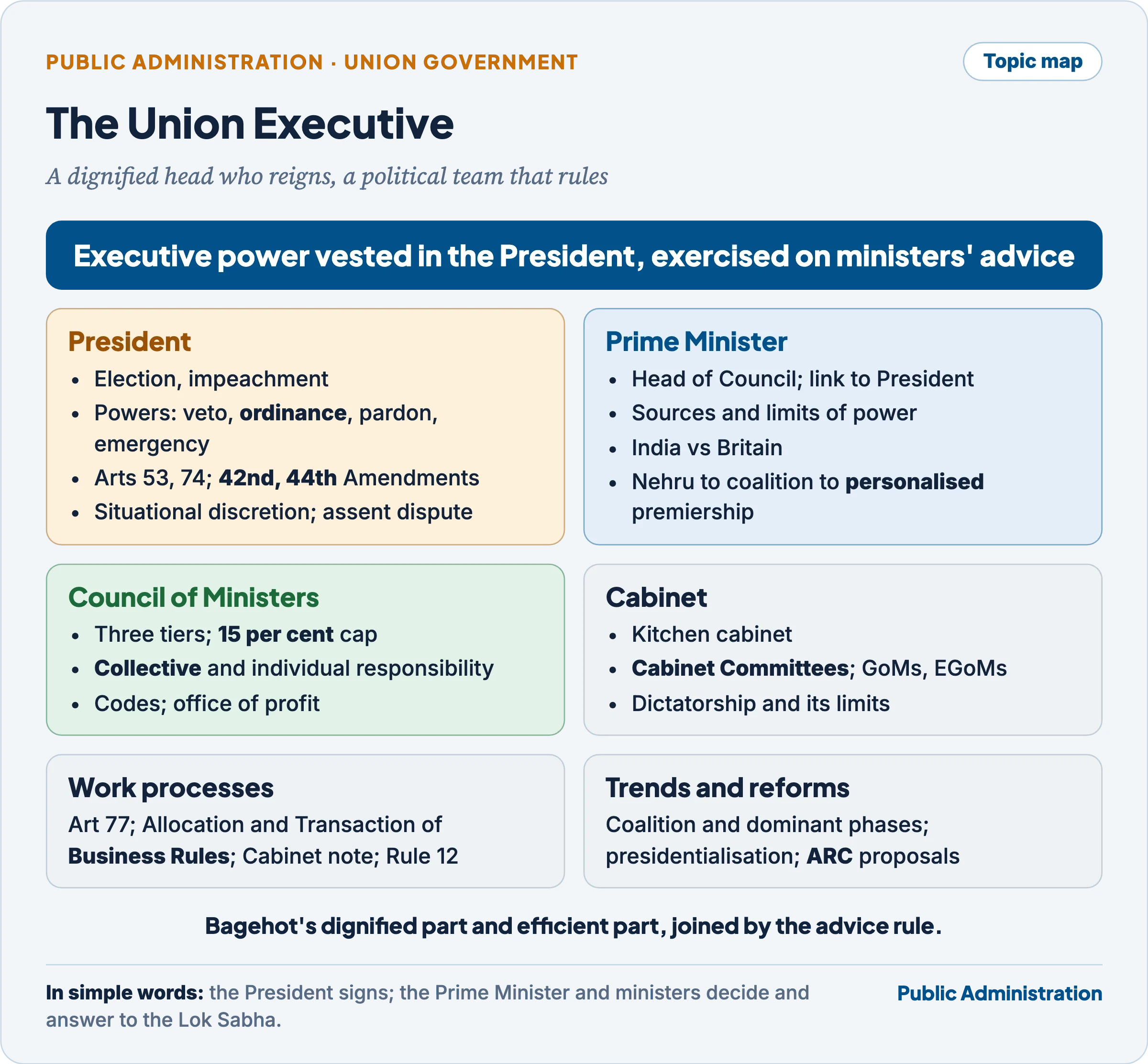
The Union executive is the part of the Government of India that carries laws and policies into action. The Constitution vests the executive power of the Union in the President (Article 53), but it creates a Council of Ministers headed by the Prime Minister to aid and advise the President (Article 74) and makes that Council collectively responsible to the Lok Sabha (Article 75(3)).
The result is a parliamentary executive: a dignified head of State who reigns, and a political team drawn from Parliament that rules. For public administration this is the apex of the machine: every ministry, department and field office ultimately takes its orders, its money and its accountability from this small group of people and the rules by which they decide.
In simple words
Think of a large school. The Chairperson of the governing board signs every certificate and presides at every function, but the Principal and the senior teachers actually run the school day to day and answer to the parents’ association. If the parents lose trust, the Principal goes; the Chairperson stays. In India, the President is the Chairperson, the Prime Minister and the ministers are the Principal and senior staff, and the Lok Sabha is the parents’ association.
1. The Parliamentary Executive: Design and Logic
In simple words
India could have copied the American system, where an elected President rules for a fixed term, or the British one, where ministers rule only as long as Parliament trusts them. India chose the British way, but with an elected President instead of a king and with a written Constitution that limits everyone.
1.1 Why the Constituent Assembly chose the Westminster model
- Three options. The framers weighed the British parliamentary model, the American presidential model and the Swiss plural (collegial) executive elected for a fixed term. K.T. Shah argued for a presidential system; some members wanted a Swiss-style executive. B.N. Rau, the constitutional adviser, called the choice of the form of responsible government the most important question in framing the Constitution.
- Ambedkar’s argument: responsibility over stability. B.R. Ambedkar, chairman of the Drafting Committee, argued that the parliamentary system allows a daily assessment of responsibility (through questions, motions and debates) as well as a periodic assessment at elections, whereas the presidential system allows only the periodic one. India, a new democracy, needed responsibility more than stability.
- Familiarity. Indians had worked a cabinet-type system in the provinces under the Government of India Act, 1935 and in the Interim Government (1946), so the Westminster model was the system they already knew.
- Adaptations. India combined the British pattern with federalism, Fundamental Rights, judicial review and a written Constitution, and replaced the hereditary monarch with an indirectly elected republican President.
1.2 The Westminster model and its Indian version
The Westminster model is the British system of government named after the Palace of Westminster. Its core features and their Indian form are compared below.
| Westminster feature | Britain | India |
|---|---|---|
| Nominal and real executive | Monarch and Cabinet | President and Council of Ministers (Arts 53, 74) |
| Fusion of powers | Ministers sit in Parliament | Ministers must be MPs within six months (Art 75(5)) |
| Collective responsibility | Convention | Written into Art 75(3) |
| Prime-ministerial leadership | Convention | Art 74(1): Council “with the Prime Minister at the head” |
| Sovereignty | Parliament supreme | Constitution supreme; judicial review; basic structure |
| Head of State | Hereditary | Elected for five years, impeachable |
- The two systems share the logic of responsible government, but India’s version is written, federal and judicially reviewable. India’s Prime Minister therefore works inside limits that a British Prime Minister does not face (a federal Constitution, a Supreme Court), while enjoying some powers a British one lacks (ordinances, an anti-defection law that disciplines MPs).
- For whether the Westminster philosophy fits India’s political culture, see the article on Constitutionalism and Political Culture.
1.3 Bagehot’s dignified and efficient parts
- Walter Bagehot, the Victorian journalist and constitutional writer, in The English Constitution (1867) divided the British constitution into “dignified parts”, which win the reverence and loyalty of the people (the monarch, ceremony), and “efficient parts”, which actually govern (the Cabinet). He called the Cabinet a “hyphen which joins, a buckle which fastens” the legislative and executive parts of the State.
- Indian application. The President is the dignified part: the symbol of the nation, in whose name all executive action is taken, who stands above party. The Prime Minister and Cabinet are the efficient part. Ambedkar put it in the same terms: the President “represents the nation but does not rule the nation”; his place is that of “a ceremonial device on a seal by which the nation’s decisions are made known”.
- Why the dignified part still matters. A dignified head provides continuity when governments fall, legitimacy to official acts, a neutral umpire when no party has a majority, and a constitutional conscience that can warn and delay. The Indian President is a dignified part with reserve functions, not a mere ornament.
1.4 Articles and Acts governing the Union executive
The table lists the constitutional and legal provisions that structure the Union executive.
| Provision | Subject |
|---|---|
| Art 52–53 | There shall be a President; executive power vested in him, exercised directly or through subordinate officers |
| Art 54–55 | Electoral college; manner of election (uniformity and parity of votes) |
| Art 56–62 | Term, re-election, qualifications, oath, impeachment, vacancy |
| Art 63–71 | Vice-President; election disputes decided by the Supreme Court (Art 71) |
| Art 72 | Pardon, reprieve, respite, remission, suspension, commutation |
| Art 74 | Council of Ministers to aid and advise; 42nd and 44th Amendment changes; 74(2) bars courts from inquiring into advice |
| Art 75 | Appointment of PM and ministers; pleasure; collective responsibility; six-month rule; 75(1A) and (1B) added by 91st Amendment |
| Art 77 | Conduct of business: action in President’s name, authentication, Business Rules |
| Art 78 | Duties of the PM to inform the President |
| Art 85, 86, 87 | Summoning, prorogation, dissolution; messages; special address |
| Art 111 | Assent to Bills; return for reconsideration |
| Art 123 | Ordinance-making power |
| Art 143 | Advisory jurisdiction of the Supreme Court |
| Art 352, 356, 360 | National, State (President’s Rule) and financial emergency |
| Art 361 | Personal immunity of the President and Governors |
| 91st Amendment Act, 2003 | Size of ministries capped at 15 per cent; defectors barred from office |
| Allocation of Business Rules, 1961 | Distribution of subjects among departments (Art 77(3)) |
| Transaction of Business Rules, 1961 | How decisions are taken; Cabinet Committees; Rule 12 |
| President’s Emoluments and Pension Act, 1951 | Salary (₹5 lakh a month since the 2018 revision) |
2. The President: Office, Election and Removal
In simple words
The President is chosen not by the people directly but by the elected members of Parliament and of the State assemblies. This makes the office represent both the Union and the States, and keeps it from claiming a popular mandate that could rival the Prime Minister’s.
2.1 Qualifications, term and conditions
- Qualifications (Art 58). A citizen of India, at least 35 years old, qualified for election to the Lok Sabha, and holding no office of profit under the Union, a State or a local authority (the offices of President, Vice-President, Governor and minister are excluded from this bar).
- Term (Art 56). Five years; the President may resign by writing to the Vice-President, and continues until a successor enters office. Re-election is allowed (Art 57); Rajendra Prasad is the only President to have served two terms (1950–62).
- Conditions (Art 59). Not a member of either House or any State legislature; emoluments fixed by Parliament and not diminished during the term. The monthly salary was raised from ₹1.5 lakh to ₹5 lakh with effect from 2018.
- Oath (Art 60). Administered by the Chief Justice of India: to “preserve, protect and defend the Constitution and the law” and to devote himself to the service of the people. The oath is the root of the argument that the President is the guardian of the Constitution, not merely a seal.
- Immunity (Art 361). The President is not answerable to any court for the exercise of official powers; no criminal proceedings may be started against him during his term.
2.2 Election (Arts 54–55)
- Electoral college. The elected members of both Houses of Parliament and the elected members of the Legislative Assemblies of the States, including Delhi and Puducherry (added by the 70th Amendment, 1992). Nominated members and members of Legislative Councils do not vote.
- Uniformity among States. Each MLA’s vote carries a value equal to the State’s population divided by its elected MLAs, divided by 1,000. Population is frozen at the 1971 Census until the first Census after 2026 (84th Amendment, 2001).
- Parity between Union and States. The total value of all MLAs’ votes is divided by the number of elected MPs to give the value of each MP’s vote (700 in 2022). This ensures that the Union and the States as a whole carry equal weight.
- Method. Proportional representation by single transferable vote, by secret ballot. A candidate must reach a quota (half of valid votes plus one); second preferences are counted if no one reaches it on first preferences.
- Disputes (Art 71). Decided by the Supreme Court; acts done before an election is declared void remain valid. The 39th Amendment (1975) removed the court’s jurisdiction; the 44th Amendment (1978) restored it. A vacancy in the electoral college (for example, a dissolved State assembly) does not invalidate the election (11th Amendment, 1961; the Supreme Court confirmed this in 1974 when Gujarat’s assembly stood dissolved).
- Landmark elections. 1969: V.V. Giri defeated the official Congress candidate Neelam Sanjiva Reddy after Indira Gandhi called for a “conscience vote”, winning only on second-preference votes; the election split the Congress. 1977: Reddy was elected unopposed, the only such case. 2022: Droupadi Murmu became the first President from a Scheduled Tribe.
2.3 Impeachment (Art 61) and vacancy (Art 62)
- Ground. Only “violation of the Constitution”, a phrase the Constitution does not define.
- Procedure. Charges may start in either House, signed by one-fourth of its members, after 14 days’ notice. The resolution must be passed by two-thirds of the total membership of that House; the other House investigates, the President may appear or be represented, and if it too passes the resolution by two-thirds of its total membership, the President stands removed.
- Who takes part. Nominated members of Parliament take part in impeachment (though not in the election); State legislators do not. No President has ever been impeached.
- Vacancy. An election must be held within six months of a vacancy. Meanwhile the Vice-President acts as President; if that office is also vacant, the Chief Justice of India acts (as M. Hidayatullah did in 1969).
Common confusion
How many members must sign the impeachment charge against the President? Many notes say two-thirds of the House must sign the notice. In fact, the notice needs the signatures of one-fourth of the members of the House; the two-thirds of total membership requirement applies to passing the resolution, in each House separately.
2.4 Why indirect election: the “German device”
- The framers rejected direct election: a directly elected President would claim a popular mandate to rival the Prime Minister and would invite a costly national campaign for a largely formal office. They also rejected election by Parliament alone, which would make the President a creature of the ruling party and leave out the States.
- The solution resembles the German Federal President, chosen by a Federal Convention of members of the federal parliament and an equal number of delegates from the state legislatures. India’s college similarly gives equal weight to the Union and the States, which suits a federal parliamentary republic.
- The British monarch could not be copied (India is a republic), and the French presidency of the Fifth Republic (an elected executive President sharing power with a Prime Minister) was ruled out because it would create two centres of real power. The Indian compromise is a republican head with monarch-like functions.
3. Powers of the President
In simple words
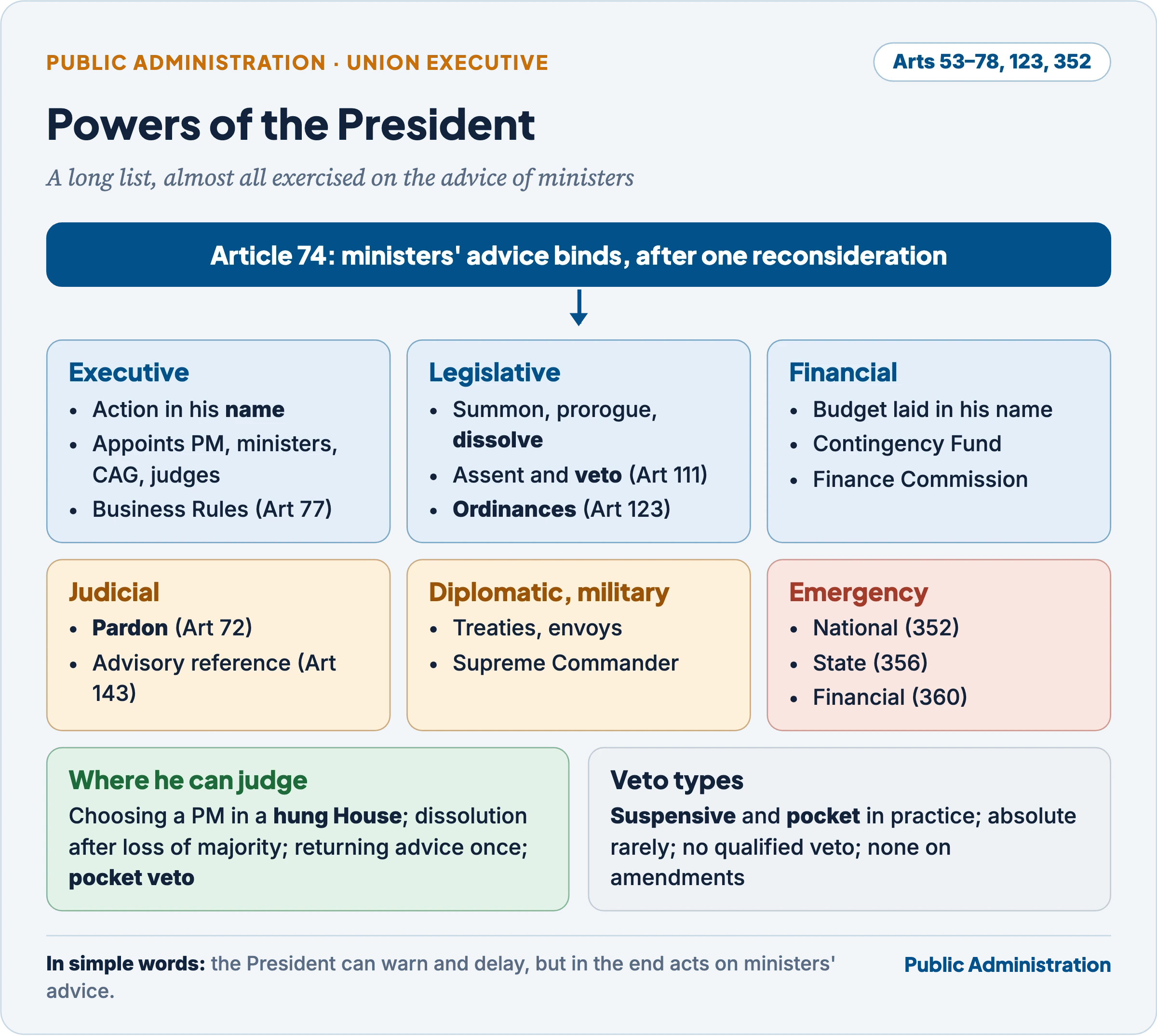
On paper the President’s list of powers is long: appointing ministers and judges, summoning Parliament, signing laws, making temporary laws, pardoning criminals and declaring emergencies. In practice almost every one of these is used on the advice of the Prime Minister and ministers, with a few important exceptions.
3.1 Executive powers
- Formal head of administration (Arts 53, 77). All executive action of the Government of India is expressed in the President’s name; orders are authenticated as the President’s rules prescribe; the President makes the Allocation and Transaction of Business Rules.
- Appointments. The Prime Minister and, on the PM’s advice, other ministers (Art 75); the Attorney-General (Art 76); the CAG (Art 148); the Chief Election Commissioner and Election Commissioners (Art 324, now under the 2023 Act); chairman and members of the UPSC (Art 316); Finance Commission (Art 280); Governors (Art 155); judges of the Supreme Court and High Courts (Arts 124, 217); Lieutenant Governors and Administrators of Union Territories.
- Right to information (Art 78). The President may seek information on administration and legislative proposals, and may require that a decision taken by a single minister be placed before the Council of Ministers.
- Commissions. May appoint commissions on Scheduled Castes, Scheduled Tribes and backward classes (Art 340), an Inter-State Council (Art 263), and the Finance Commission every five years.
- Special areas. Administers Union Territories through administrators (Art 239); powers over Scheduled and Tribal Areas (Fifth and Sixth Schedules).
3.2 Legislative powers
- Part of Parliament (Art 79). Parliament consists of the President and the two Houses. The President summons and prorogues the Houses, dissolves the Lok Sabha (Art 85), and summons a joint sitting to resolve deadlocks on ordinary Bills (Art 108).
- Addresses and messages. Addresses Parliament at the first session after each general election and at the start of the first session of each year (Art 87), a speech written by the government; may send messages to either House (Art 86).
- Nominations. Nominates 12 members to the Rajya Sabha for literature, science, art and social service (Art 80). The power to nominate two Anglo-Indians to the Lok Sabha ended in January 2020 (104th Amendment, 2019).
- Prior recommendation. Needed for Bills on new States or boundaries (Art 3), Money Bills (Art 117), and Bills affecting taxes in which States are interested (Art 274).
- Decides disqualification of MPs (other than for defection) on the opinion of the Election Commission (Art 103).
- Regulations for Union Territories without legislatures, such as the Andaman and Nicobar Islands and Lakshadweep (Art 240).
3.3 Assent and the veto
When a Bill passed by both Houses reaches the President under Article 111, the President may assent, withhold assent, or (if it is not a Money Bill) return it for reconsideration. If Parliament passes it again, with or without amendment, the President must assent.
| Type of veto | Meaning | Does the Indian President have it? |
|---|---|---|
| Absolute | Withholding assent; the Bill dies | Yes, in practice only for private members’ Bills or when a government falls before assent and the new one advises against it (PEPSU Appropriation Bill, 1954; Salary, Allowances and Pension of MPs Amendment Bill, 1991) |
| Qualified | Overridden only by a special majority | No (the US President has it) |
| Suspensive | Overridden by a simple majority on re-passage | Yes, for ordinary Bills (return under Art 111) |
| Taking no action; no time limit | Yes, because Art 111 sets no deadline |
- Pocket veto in practice. Giani Zail Singh received the Indian Post Office (Amendment) Bill, 1986, which would have allowed interception of mail, and sat on it until his term ended in 1987; the bill was later withdrawn. Zail Singh admitted in his memoirs that the Constitution gave him only two options and he took neither.
- Suspensive veto in practice. A.P.J. Abdul Kalam returned the Parliament (Prevention of Disqualification) Amendment Bill, 2006 (the “office of profit” Bill) asking Parliament to frame “just, fair and reasonable” criteria and to reconsider retrospective exemptions; Parliament re-passed it unchanged and he signed it.
- No veto on Constitutional Amendment Bills: the 24th Amendment (1971) made assent obligatory (Art 368(2)). Money Bills cannot be returned; they come with the President’s prior recommendation, so assent is normal.
- State Bills reserved by a Governor (Art 201). The President may assent, withhold assent, or direct the Governor to return a non-Money Bill to the State legislature; even if re-passed, the President is not bound to assent. This gives the Union an absolute veto over reserved State Bills, now at the centre of Centre–State conflict (see 4.6).
3.4 Ordinance-making power (Art 123)
- Conditions. The President may promulgate an ordinance only when both Houses are not in session (or one is not) and he is satisfied that circumstances exist which render it necessary to take immediate action. An ordinance has the force of an Act of Parliament and is subject to the same limits (it cannot do what Parliament cannot).
- Life span. It must be laid before both Houses when they reassemble and ceases to operate six weeks after reassembly (maximum about six months and six weeks, since sessions cannot be more than six months apart), unless disapproved earlier or withdrawn. It is not available for amending the Constitution.
- Justiciability. The 38th Amendment (1975) made the President’s satisfaction final and non-justiciable; the 44th Amendment (1978) deleted that clause. In R.C. Cooper v. Union of India (1970) the court held that satisfaction could be questioned on grounds of mala fides.
- D.C. Wadhwa v. State of Bihar (1987). Bihar had re-promulgated some 256 ordinances, some kept alive for up to 14 years, without placing them before the legislature. The court called this a “fraud on the Constitution”.
- Krishna Kumar Singh v. State of Bihar (2017). A seven-judge bench held that laying an ordinance before the legislature is mandatory, that re-promulgation without placing it before the House is a fraud on the Constitution, that the President’s or Governor’s satisfaction is open to judicial review, and that an ordinance does not automatically create enduring rights once it lapses.
- Use over time. A total of 725 central ordinances were issued from 1952 to 2024. Peaks came in the unstable early 1990s (34 in 1993) and in emergency years (29 in 1975). The first Modi government issued many ordinances (the land acquisition ordinance was re-promulgated three times in 2014–15; the enemy property ordinance five times in 2016–17). The trend then reversed: no ordinance in 2022, one in 2023 (on Delhi’s services), and none in 2024 or 2025.
Should the ordinance power be restrained?
- Case for the power. Parliament sits for only part of the year; a sudden emergency, a court verdict that leaves a legal vacuum, or a fast-moving economic crisis (the Insolvency and Bankruptcy Code (Amendment) Ordinance of 2020 during the pandemic) may need immediate law. Ambedkar defended it as a power to meet situations that brook no delay; it is an interim measure subject to Parliament’s later approval.
- Case for restraint. Ordinances bypass deliberation, committee scrutiny and the Rajya Sabha (where a government may lack a majority), and turn an emergency tool into a parallel legislative route. Re-promulgation and ordinances issued days before a session or right after a session ends show that “immediate necessity” is often political convenience.
- Possible checks. Promulgation only for genuine emergencies recorded in the explanatory statement; no re-promulgation without the House’s approval; mandatory laying and early debate; Parliament’s disapproval resolutions; and judicial review on the Krishna Kumar standard. The recent decline in numbers shows that political conditions (a majority in both Houses) matter as much as legal limits.
3.5 Financial powers
- The Union Budget (annual financial statement) is laid before Parliament in the President’s name (Art 112); no demand for grants without his recommendation (Art 113(3)).
- Contingency Fund of India is at his disposal to meet unforeseen expenditure, pending Parliament’s authorisation (Art 267).
- Constitutes the Finance Commission every five years (Art 280); its report and the action taken are laid before Parliament. The CAG’s reports on Union accounts are laid through him (Art 151).
3.6 Judicial powers: pardon and advisory jurisdiction
- Pardon (Art 72). The President may pardon, reprieve, respite or remit punishment, or suspend, remit or commute a sentence, in three classes of cases: punishment by a court-martial; offences against a Union law; and all death sentences. The Governor’s power (Art 161) covers offences against State laws and does not extend to court-martial sentences.
| Form | Meaning |
|---|---|
| Pardon | Removes both the sentence and the conviction |
| Commutation | Substitutes a lighter form of punishment (death to life imprisonment) |
| Remission | Reduces the period of sentence without changing its character |
| Respite | A lesser sentence for a special reason (pregnancy, disability) |
| Reprieve | Temporary stay of execution (of a death sentence) |
- Judicial view. Maru Ram v. Union of India (1980): the power is exercised on the advice of the Council of Ministers. Kehar Singh v. Union of India (1989): the President may examine the record afresh, but the petitioner has no right to an oral hearing. Epuru Sudhakar v. Government of Andhra Pradesh (2006): pardon decisions are open to limited judicial review (mala fides, irrelevant or political considerations, arbitrariness). Shatrughan Chauhan v. Union of India (2014): inordinate delay in deciding mercy petitions is a ground for commuting a death sentence.
- Advisory jurisdiction (Art 143). The President may refer any question of law or fact of public importance to the Supreme Court. The opinion is not binding on the President, though it carries great authority; the court may decline to answer (it returned the Ayodhya reference in 1994). The Special Courts Bill reference (1978) and the 2025 reference on assent to Bills (see 4.6) are prominent examples.
3.7 Diplomatic and military powers
- Treaties and international agreements are negotiated and concluded in the President’s name, subject to Parliament’s legislation where needed; he receives and sends envoys.
- The President is the Supreme Commander of the Defence Forces (Art 53(2)); declaring war and concluding peace are regulated by Parliament’s law. In practice these decisions are taken by the Cabinet Committee on Security.
3.8 Emergency powers
- National emergency (Art 352). On grounds of war, external aggression or armed rebellion (“armed rebellion” replaced “internal disturbance” by the 44th Amendment, 1978). Proclaimed three times: 1962 (China), 1971 (Pakistan), and 1975 (internal disturbance, alongside the 1971 one). Effects: Union executive directions to States, Parliament’s power to legislate on State subjects, alteration of revenue distribution, and suspension of the enforcement of rights (Art 19 automatically only in war or external aggression; Arts 20 and 21 can never be suspended after the 44th Amendment).
- 44th Amendment safeguards. The President may proclaim it only on the written advice of the Cabinet (defined in Art 352(3) as the PM and Cabinet-rank ministers); approval by each House within one month by a special majority; renewal every six months; the Lok Sabha may disapprove by simple majority, and one-tenth of its members can demand a special sitting for this.
- President’s Rule (Art 356, 365). When the government of a State cannot be carried on in accordance with the Constitution, on the Governor’s report or otherwise. Approval within two months; maximum three years, beyond one year only if a national emergency is in force and the Election Commission certifies that elections cannot be held. S.R. Bommai v. Union of India (1994) made the proclamation judicially reviewable and the floor test decisive. It has been used well over 100 times; the most recent long spell was Manipur (13 February 2025 to 4 February 2026). For details, see the article on Union–State Relations.
- Financial emergency (Art 360). When the financial stability or credit of India is threatened; allows cuts in salaries (including of judges) and reservation of State Money Bills. Never proclaimed.
- Misuse and restraint. The 1975 emergency (suspension of liberties, mass detention, postponed elections, the 42nd Amendment) and the frequent dismissal of opposition State governments before 1994 show that the fears of misuse proved right. The 1962 and 1971 emergencies, used against real external threats, and the sharp fall in Art 356 cases after Bommai, show that constitutional and judicial safeguards can work. The lesson is that emergency powers are as safe as the political culture, judicial review and federal balance that surround them.
4. The Constitutional Position of the President
In simple words
The real question about the President is not what powers are listed, but whose will they carry out. The Constitution’s answer, sharpened by two amendments and the courts, is: the will of the ministers who answer to the Lok Sabha, except in a few situations where no such ministers exist or the rules of the game have broken down.
4.1 The founders’ view and the early debate
- Ambedkar described the President as occupying the same position as the King under the English constitution: “head of the State but not of the Executive”. He also said the President would have the British monarch’s rights to be consulted, to encourage and to warn.
- Nehru wanted the office to carry “great authority and dignity”, not to be a figurehead like the French President of the Fourth Republic, but without real power.
- Rajendra Prasad, the first President, disagreed. In a note of September 1951, during the dispute over the Hindu Code Bill, he wanted to act on his own judgement in assenting to Bills, sending messages and returning Bills. He argued that, unlike the British King, the Indian President is elected and impeachable, and asked for a study of his powers. Nehru firmly opposed this; Prasad never acted on it, and the convention of ministerial advice prevailed.
4.2 Article 74: from “aid and advise” to “shall act”
| Stage | Text of Article 74(1) | Effect |
|---|---|---|
| Original (1950) | Council of Ministers “to aid and advise the President in the exercise of his functions” | Advice binding by convention, not by explicit text |
| 42nd Amendment (1976) | President “shall, in the exercise of his functions, act in accordance with such advice” | Advice made expressly binding |
| 44th Amendment (1978) | Proviso: President may require the Council to reconsider the advice, generally or otherwise, but shall act in accordance with the advice tendered after reconsideration | One suspensive opportunity to return advice |
- Article 74(2): the question whether any, and if so what, advice was tendered shall not be inquired into in any court. This protects Cabinet confidentiality but, since Bommai, does not shield the material on which the advice was based.
- Before 1976, could Presidents be more assertive? Formally yes: the text left a gap that Prasad tried to use, and Presidents could delay or press their views. In practice the convention of binding advice already held (see Shamsher Singh, 1974). The 42nd Amendment closed the gap in text; the 44th re-opened a narrow window (one return of advice). The President’s real room has since depended more on the state of the party system than on the text: assertive in hung Parliaments, restrained under strong majorities.
4.3 What the courts said
- Ram Jawaya Kapur v. State of Punjab (1955). The President is a formal or constitutional head; real executive power lies with the Council of Ministers. Executive power is what remains after legislative and judicial functions are taken away, and the government may act in any field where Parliament can legislate, even without a law, so long as it does not infringe rights.
- U.N.R. Rao v. Indira Gandhi (1971). Even after the dissolution of the Lok Sabha, the President must have a Council of Ministers; Art 74 is mandatory, so the President can never act without ministers. This settles that India cannot have “President’s Rule at the Centre”.
- Shamsher Singh v. State of Punjab (1974). A seven-judge bench held that the President and Governors exercise all their powers on the aid and advice of their ministers, “save in a few well-known exceptional situations”, such as choosing a Prime Minister when no one has a majority, or dismissing a government that has lost its majority but refuses to quit. The court said the President is not a “glorified cipher” but a constitutional head who works through his ministers.
4.4 Situational discretion
The President has no constitutional discretion (unlike the Governor under Art 163), but has situational discretion where the advice rule cannot work.
- Appointing a Prime Minister in a hung Lok Sabha. In 1979, after Morarji Desai’s resignation, N. Sanjiva Reddy invited Charan Singh (who never faced Parliament and resigned within weeks) and later dissolved the House on his advice, ignoring Jagjivan Ram’s claim. In 1989, R. Venkataraman invited the largest party (Congress), and when it declined, V.P. Singh of the National Front; in 1990 he gave V.P. Singh a floor test and then invited Chandra Shekhar. In 1996, S.D. Sharma invited A.B. Vajpayee as leader of the largest party (he resigned after 13 days). In 1998, K.R. Narayanan asked for letters of support before inviting Vajpayee, setting the precedent that the claimant must demonstrate majority support.
- Dismissing a government that has lost its majority. Not yet used at the Union level; the President would ordinarily ask for a floor test.
- Dissolving the Lok Sabha on the advice of a Prime Minister who has lost the confidence of the House (1979, 1991, 1998 and 1999 were dissolutions on such advice).
- Returning advice once under the Art 74 proviso. K.R. Narayanan returned the Gujral Cabinet’s recommendation for President’s Rule in Uttar Pradesh (1997) and the Vajpayee Cabinet’s recommendation for Bihar (1998); both governments let the matter drop.
- Caretaker governments. After a dissolution, the President may ask the outgoing ministry to continue and to avoid major policy decisions binding its successor.
- Pocket veto (Zail Singh, 1986) and seeking information under Art 78 (Zail Singh’s 1987 letter complaining that he was not being informed, during the Bofors controversy).
4.5 Rubber stamp, guardian or emergency lamp?
- “Rubber stamp” view. Under strong majorities the President signs what the Cabinet sends; Fakhruddin Ali Ahmed signed the 1975 emergency proclamation at night, on the Prime Minister’s letter, before the Cabinet met next morning.
- “Guardian” view. The oath, Art 78, the right to return advice and the reserve powers allow a President to counsel, warn and delay: Narayanan’s returns (1997, 1998), Kalam’s return of the office of profit Bill (2006).
- “Emergency lamp” view. R. Venkataraman compared the President to an emergency lamp that comes on when the power fails (a hung Parliament, a constitutional deadlock) and goes dormant when normal power is restored. He also said the Constitution did not envisage the President as an appellate authority over the government.
- “Convenient working hypothesis” and “grandparent” images. These describe the same reality: the President can advise and persuade but cannot compel; like a grandparent whose counsel the family may ignore, the office’s influence depends on moral authority and on whether the government needs the President.
- The hung-Parliament thesis. Between 1989 and 2014, no party had a Lok Sabha majority. Presidents had to choose Prime Ministers, demand proof of support and fix floor-test deadlines. The office’s power expands when the party system fragments and the incumbent is willing to be assertive (Venkataraman, Narayanan), and contracts when a single party has a clear majority.
Common confusion
Does Article 78 confer executive power on the President? No. Article 78 lays down the duties of the Prime Minister: to communicate Cabinet decisions to the President, furnish information he calls for, and place before the Council any matter decided by a single minister if the President so requires. It gives the President a right to be informed and to ask for reconsideration, the Bagehot-style rights “to be consulted, to encourage and to warn”. The executive power itself comes from Article 53 and is exercised on advice under Article 74.
4.6 Assent controversies and the 2025 Presidential Reference
- Background. Several State governments complained that Governors were sitting indefinitely on Bills or reserving them for the President. In State of Tamil Nadu v. Governor of Tamil Nadu (8 April 2025) a two-judge bench fixed a three-month outer limit for Governors and the President to act on Bills and treated ten pending Bills as having received deemed assent.
- Reference. On 13 May 2025 President Droupadi Murmu made a reference under Article 143 with 14 questions on the powers of Governors and the President under Articles 200 and 201, the justiciability of their decisions, and the reach of Article 142.
- Opinion (20 November 2025). A five-judge bench led by CJI B.R. Gavai gave the 16th Presidential Reference opinion: courts cannot impose uniform timelines on the President or Governors, and “deemed assent” is alien to the Constitution and violates the separation of powers; but “prolonged, unexplained and indefinite” inaction can be met with a limited mandamus to decide within a reasonable time, without reviewing the merits.
- Significance for the executive. The episode shows that the President’s assent function, normally exercised on Union ministers’ advice, has become a federal battleground. For the Governor’s side, see the article on the Governor, Chief Minister and Council of Ministers.
4.7 The President compared
The table places the Indian President between the two classic models (“not the Potomac but the Thames”).
| Point | British monarch | US President | Indian President |
|---|---|---|---|
| Basis | Hereditary | Directly elected (electoral college) | Indirectly elected by MPs and MLAs |
| Role | Dignified head | Head of State and government | Head of State, nominal executive |
| Acts on | Ministerial advice (convention) | Own authority | Ministerial advice (Art 74, written) |
| Veto | Not used since 1708 | Qualified veto, overridden by two-thirds | Suspensive and pocket; absolute in rare cases |
| Removal | None | Impeachment | Impeachment for violating the Constitution |
| Emergency powers | None formally | War powers shared with Congress | Extensive, but on Cabinet advice |
- The Indian presidency is fertilised by the Thames (British parliamentary practice) rather than the Potomac (American presidentialism). It borrows the American method of impeachment and the German method of indirect federal election, but its substance is British.
5. The Vice-President
In simple words
The Vice-President is India’s standby head of State and the presiding officer of the Rajya Sabha. The office matters mainly when the President’s office falls vacant and in the running of the Upper House.
- Election (Art 66). By an electoral college of all members of both Houses, including nominated members, by single transferable vote and secret ballot (the 11th Amendment, 1961 replaced the original joint sitting). State legislators do not vote.
- Qualifications. Citizen, at least 35, qualified for election to the Rajya Sabha, no office of profit.
- Term and removal (Art 67). Five years. Removable by a resolution of the Rajya Sabha passed by a majority of all its then members and agreed to by the Lok Sabha, after 14 days’ notice. No formal impeachment and no stated ground. The first-ever notice, against Jagdeep Dhankhar, was rejected by the Deputy Chairman on 19 December 2024 as defective and short of the 14-day requirement.
- Functions. Ex officio Chairman of the Rajya Sabha (Art 64), with a casting vote; acts as President during a vacancy (up to six months) or discharges the President’s functions during absence or illness (Art 65), drawing the President’s emoluments while doing so.
- Recent change. Jagdeep Dhankhar resigned on 21 July 2025 citing health, the first mid-term vacancy since 1987. C.P. Radhakrishnan was elected on 9 September 2025 (452 votes to 300) and serves a full five-year term from that date.
- Assessment. The office is an American borrowing in form (a standby head and Senate president) but carries no succession right: India holds a fresh presidential election within six months.
6. The Prime Minister
In simple words
The Constitution says very little about the Prime Minister: he heads the Council of Ministers and keeps the President informed. Yet he has become the centre of the whole government, because he leads the majority party, picks and drops ministers, chairs the Cabinet and its key committees, and controls the top civil service.
6.1 Appointment and constitutional position
- Appointment (Art 75(1)). The President appoints the Prime Minister; other ministers are appointed on the PM’s advice. By convention the President invites the leader of the majority party or coalition in the Lok Sabha.
- Membership. The PM may come from either House (Indira Gandhi in 1966 and Manmohan Singh throughout were Rajya Sabha members) or from outside Parliament for six months (S.P. Anand v. H.D. Deve Gowda, 1996).
- Head of the Council (Art 74(1)). The Council exists only with the PM at its head: the PM’s resignation or death dissolves the whole Council.
- Link to the President (Art 78). The PM is the sole channel between the Council and the President.
- No fixed term. The PM holds office during the pleasure of the President, which in practice means as long as the Lok Sabha’s confidence lasts.
6.2 Role descriptions
- Lord Morley: “primus inter pares” (first among equals) and “keystone of the cabinet arch”. Sir William Harcourt: “inter stellas luna minores” (a moon among lesser stars). Ivor Jennings, in Cabinet Government (1936): a sun around which planets revolve. Harold Laski: central to the Cabinet’s formation, life and death. Ramsay Muir: the steersman of the ship of State.
- R.H.S. Crossman, in his introduction to Bagehot (1963), argued that post-war Britain had moved from cabinet government to prime-ministerial government.
- Ambedkar: “If any functionary under our Constitution is to be compared with the U.S. President, he is the Prime Minister and not the President of the Union.”
- Nehru called the PM the “linchpin of government”.
- These phrases capture a range, from first among equals to sun among planets. The office’s real weight has varied with time and person, which is why its evolution (6.7) explains more than any single phrase.
6.3 Powers and functions
- In relation to the Council of Ministers. Recommends who becomes a minister, allocates and reshuffles portfolios, can ask a minister to resign or advise dismissal; presides over the Cabinet and settles its agenda; coordinates all ministers; and can bring down the whole ministry by resigning.
- In relation to Parliament. Leader of the Lok Sabha (where a member); advises summoning and prorogation; can advise dissolution; announces major policies on the floor of the House.
- In relation to the President. Communicates all Cabinet decisions; advises on key appointments (CAG, Election Commissioners, Finance Commission, Governors, service chiefs).
- Institutional chairs. Chairs the NITI Aayog and its Governing Council (which replaced the Planning Commission and NDC from 1 January 2015), the Inter-State Council, the National Disaster Management Authority, the Political Council of the Nuclear Command Authority, the Appointments Committee of the Cabinet and most other Cabinet Committees.
- Administrative head. Holds the Ministry of Personnel, the Departments of Atomic Energy and Space, “all important policy issues” and all portfolios not allotted to others; the Cabinet Secretariat is allotted to him under the Allocation of Business Rules (Rule 4(1)).
- Other roles. Chief spokesperson of the government, leader of the party, crisis manager-in-chief, and India’s face in foreign affairs.
6.4 Sources of the Prime Minister’s power
- Party leadership and electoral mandate. In an age of leader-centred campaigns, the PM’s personal appeal wins the election; ministers owe their seats and posts to him.
- The anti-defection law (Tenth Schedule, 1985) binds MPs to the whip, so the PM’s majority is far more disciplined than a British PM’s.
- Control over appointments. The ACC, chaired by the PM (with only the Home Minister as the other member since 2014), decides all senior postings; the Prime Minister’s Office and Cabinet Secretariat give him information and reach into every ministry.
- Ordinances, Rule 12 of the Business Rules, and the power to frame the Cabinet’s agenda.
- Media and digital outreach, and monitoring platforms such as PRAGATI (2015) that let the PM review projects directly with Secretaries and Chief Secretaries.
6.5 Why the Prime Minister cannot become a dictator
- Lok Sabha confidence. The PM survives only while the House supports him; governments fell on confidence votes in 1990 (V.P. Singh), 1997 (Deve Gowda) and 1999 (Vajpayee, by one vote).
- Party and coalition. Partners and party colleagues can withdraw support (Congress from Chandra Shekhar in 1991, the AIADMK from Vajpayee in 1999); even dominant PMs depend on the party.
- Federalism. States, often ruled by other parties, control police, land and most service delivery; the Rajya Sabha represents them and can block legislation.
- Judiciary. Judicial review, the basic structure doctrine (Kesavananda Bharati, 1973) and decisions such as Bommai limit executive action.
- Independent institutions. The Election Commission, CAG, UPSC, the President’s reserve role, a free press and civil society.
- Elections. The 1977 defeat after the Emergency is the decisive proof that Indian voters can remove an over-mighty PM.
- Assessment. The Emergency showed that a PM can concentrate power dangerously when Parliament, party and courts bend. But the system’s countervailing institutions and the electorate have so far prevented permanent dictatorship.
6.6 Accountability of the Prime Minister
- Formal accountability. The PM answers to the Lok Sabha through confidence and no-confidence motions, debates on the President’s Address, and questions on the ministries he holds. Unlike Britain’s weekly Prime Minister’s Questions, India has no regular question time for the PM, so his personal answerability on the floor is weaker.
- Extra-constitutional power. Accountability blurs when real influence lies with people who are not answerable to Parliament: Sanjay Gandhi during the Emergency, Indira Gandhi’s kitchen cabinet, and the National Advisory Council (2004–06, 2010–14), chaired by Sonia Gandhi as party president, which shaped major rights-based laws while the PM answered for them. Advisers in the PMO who are not ministers raise the same issue.
- “Should appear to be accountable.” Public confidence needs visible accountability: the PM’s presence in debates, reasoned answers on major decisions, and respect for parliamentary committees. Manoj Narula v. Union of India (2014) added that the PM, as a constitutional trustee, is expected not to appoint persons with serious criminal charges as ministers, though the court left this to his wisdom.
6.7 The Indian and British Prime Ministers compared
| Point | British Prime Minister | Indian Prime Minister |
|---|---|---|
| Removal by party | Party can replace a sitting PM without an election (Thatcher 1990, Johnson and Truss 2022) | No sitting PM removed by own party in office without a split |
| Party discipline | Backbench rebellions common | Anti-defection law binds MPs |
| Federal checks | Unitary; devolved bodies limited | States, Rajya Sabha, Inter-State bodies |
| Judicial review | No review of Acts of Parliament | Full review, basic structure |
| Ordinances | None | Art 123 |
| Dissolution | Restored to the PM by the Dissolution and Calling of Parliament Act, 2022 | On PM’s advice, but President may decline if the PM has lost majority |
| Question time | Weekly PMQs | None specific |
| Senior appointments | Civil Service Commission, conventions | ACC chaired by the PM |
- Where the Indian PM is stronger: anti-defection discipline, ordinances, a single leader often personally embodying the party’s vote, the ACC and the PMO’s reach, and the absence of a party mechanism to remove a sitting PM.
- Where the British PM is stronger: no judicial review of legislation, a unitary State and no federal veto player.
- On balance, a dominant Indian PM with a single-party majority is more empowered within government than his British counterpart, while a coalition PM in India (1989–2014) was weaker than almost any British PM.
6.8 How the office has evolved: models of leadership
| Phase | Model | Features |
|---|---|---|
| Nehru (1947–64) | Pluralist premiership | Dominant party; strong colleagues (Patel, Azad, Pant); Cabinet debate; Nehru pre-eminent after 1950 |
| Shastri (1964–66) | Collegial | Consensus among near-equals; Prime Minister’s Secretariat set up |
| Indira Gandhi (1969–77, 1980–84) | Neo-patrimonial or “imperial” premiership | Congress split; party bodies nominated; kitchen cabinet; expanded Secretariat; Emergency eclipsed the Cabinet |
| Janata (1977–79) | Collegial but fractious | Cabinet of stalwarts from merged parties; collective responsibility strained |
| Rajiv Gandhi (1984–89) | Dominant with coterie | Record majority; frequent reshuffles; decisions by informal advisers |
| Coalition era (1989–2014) | Federal or coalitional | Minority and coalition governments; Common Minimum Programmes; allies’ ministers semi-autonomous; GoMs and EGoMs |
| 2014–2024 | Dominant, personalised | Single-party majority; PMO-centred; GoMs abolished; PRAGATI; leader-centred campaigns |
| Since 2024 | Dominant leader in a coalition | BJP short of majority; allies (TDP, JD(U), JD(S), LJP(RV), Shiv Sena) in Cabinet and committees; same leader and structures |
- The table shows that the PM’s power is contingent: it depends on the party system (dominant or fragmented), the PM’s personality, and institutional supports (Secretariat, PMO, ACC). India has moved from cabinet government under a dominant party to coalition government, then to a personalised premiership, and since 2024 to a dominant leader working with coalition partners.
7. The Council of Ministers
In simple words
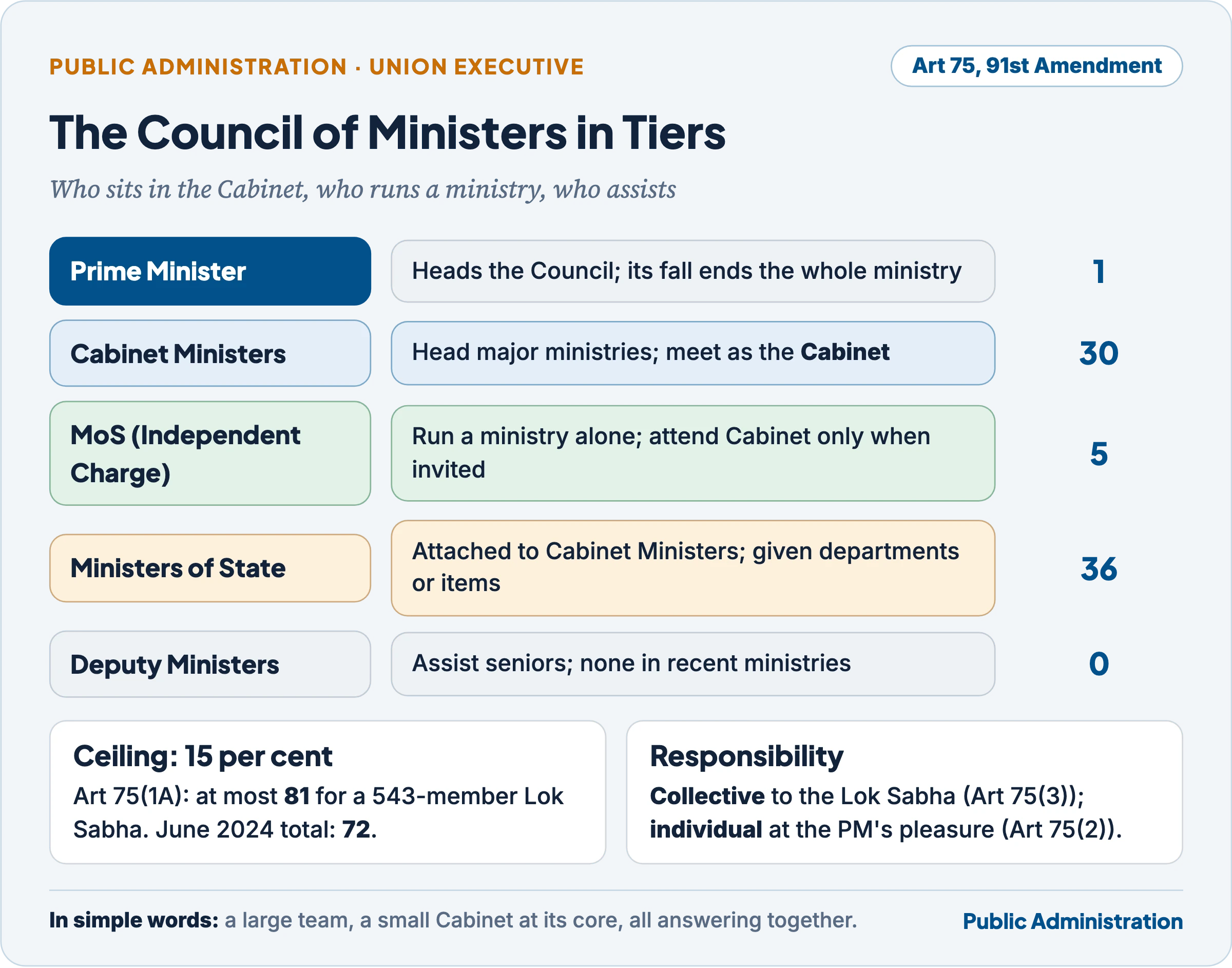
The Council of Ministers is the whole team of ministers, about seventy people today. Only the top thirty or so sit in the Cabinet, where the real decisions are taken; the rest help run particular ministries. The whole team rises and falls together in the Lok Sabha.
7.1 Composition and categories
- Cabinet Ministers. Head the major ministries (Home, Defence, Finance, External Affairs) and attend Cabinet meetings; responsible for the whole range of government policy.
- Ministers of State (Independent Charge). Head a ministry or department on their own, with the same powers as a Cabinet Minister for it, but are not Cabinet members; they attend when their subjects are discussed.
- Ministers of State. Attached to Cabinet Ministers and given departments or specific items of work under their overall charge. (In 1952 they were called “Ministers of Cabinet rank”; the old title returned in 1957.)
- Deputy Ministers. Assist Cabinet Ministers or Ministers of State in administrative, political and parliamentary work. None has been appointed in recent governments.
- Parliamentary Secretaries. The lowest rung, without departments; none appointed since 1967 apart from Rajiv Gandhi’s early years.
- Deputy Prime Minister. Not in the Constitution; appointed for political reasons: Vallabhbhai Patel (Nehru), Morarji Desai (Indira Gandhi), Charan Singh and Jagjivan Ram (Janata), Devi Lal (V.P. Singh and Chandra Shekhar), L.K. Advani (Vajpayee). Legally the post-holder is only a Cabinet Minister.
- Current strength. The ministry sworn in on 9 June 2024 had 72 members: the PM, 30 Cabinet Ministers, 5 Ministers of State (Independent Charge) and 36 Ministers of State, well under the ceiling of 81 (15 per cent of 543).
7.2 Qualifications and the six-month rule
- A minister must be an MP or become one within six months (Art 75(5)). S.R. Chaudhuri v. State of Punjab (2001) held that a non-member cannot be re-appointed for successive six-month spells without getting elected; that would subvert representative democracy.
- A minister may speak in both Houses but votes only in the House of which he is a member (Art 88).
- Salaries and allowances are fixed by Parliament under the Salaries and Allowances of Ministers Act, 1952, which defines a minister as a member of the Council of Ministers “by whatever name called”, including a Deputy Minister.
- Oaths of office and secrecy are administered by the President (Third Schedule).
7.3 The size question and the 91st Amendment (2003)
- Problem. Coalition and defection politics produced jumbo ministries: in Uttar Pradesh in 1997–98 nearly every MLA of the ruling coalition was a minister. Ministerial posts became rewards for defection.
- Recommendations. The First ARC (1968) wanted a Council of about 40 and a Cabinet of not more than 16. The National Commission to Review the Working of the Constitution (NCRWC, 2002, chaired by M.N. Venkatachaliah) recommended a ceiling of 10 per cent of the popular House.
- The 91st Amendment Act, 2003. Inserted Art 75(1A): the total number of ministers including the PM shall not exceed 15 per cent of the Lok Sabha’s total membership; and Art 75(1B): an MP disqualified for defection cannot be appointed a minister until his term ends or he is re-elected. Art 164(1A) set the same 15 per cent ceiling for States, with a minimum of 12. It also deleted the “split” exception in the Tenth Schedule.
Did the 91st Amendment right-size the Council?
- Successes. It ended the extreme jumbo ministries of the 1990s; it removed the reward for defection; it gave a clear legal ceiling that States followed; Union ministries have stayed well below the cap.
- Limits. Fifteen per cent is generous: it allows up to 81 Union ministers, far above the ARC’s 40. The minimum of 12 inflates the ratio in small States. Governments circumvent the cap through parliamentary secretaries, chairmanships of corporations with ministerial rank, and “cabinet-rank” advisers. The Supreme Court in Bimolangshu Roy v. State of Assam (2017) struck down an Assam law creating parliamentary secretaries, holding that the State legislature lacked competence, but office-of-profit exemptions remain a back door. The Amendment caps numbers, not the structure of ministries (overlapping departments), which the 2nd ARC addressed separately.
- Conclusion. It capped, but did not fully right-size, the political executive; real right-sizing needs fewer, functionally grouped ministries and limits on quasi-ministerial posts.
7.4 Collective responsibility (Art 75(3))
- Meaning. The Council of Ministers is collectively responsible to the Lok Sabha. Three conventions follow:
- Unanimity: once the Cabinet decides, every minister must support the decision in public and in Parliament, whatever his private view.
- Confidentiality: Cabinet deliberations are secret (oath of secrecy; Art 74(2)), so ministers can argue freely.
- Common fate: if the Lok Sabha passes a no-confidence motion, defeats a confidence motion or rejects a major government measure, the whole Council resigns.
- Dissent means resignation. Syama Prasad Mookerjee resigned in 1950 over the Nehru–Liaquat Pact; B.R. Ambedkar in 1951 over the shelving of the Hindu Code Bill; C.D. Deshmukh in 1956 over the States Reorganisation decision on Bombay.
- Instruments of enforcement. Questions, adjournment motions, debates, defeat of Bills and budgets, and finally no-confidence motions. Governments fell in 1979 (Morarji Desai resigned before the vote), 1990, 1997 and 1999.
- Strains. In coalition governments, ministers from allied parties sometimes criticised Cabinet decisions publicly (Janata 1977–79; the United Front 1996–98); collective responsibility was preserved by coordination committees and Common Minimum Programmes rather than by the PM’s authority. Under dominant PMs, the problem is the reverse: decisions are taken outside the Cabinet (PMO, kitchen cabinet) and the Cabinet is collectively “responsible” for choices it did not make.
7.5 Individual responsibility (Art 75(2))
- Meaning. Ministers hold office during the pleasure of the President, that is, of the Prime Minister. Each minister is personally answerable for his department, and the PM can drop him at any time.
- Resignations owning responsibility. Lal Bahadur Shastri (Railways, 1956) after the Ariyalur rail accident; T.T. Krishnamachari (Finance, 1958) after the Mundhra affair; V.K. Krishna Menon (Defence, 1962) after the China war; Dharmendra Pradhan (Education, 25 July 2026) after the NEET-UG 2026 paper leak and weeks of youth protests, accepted by the President on the PM’s advice under Art 75(2). Such resignations are rare; ministers more often survive by blaming officials or awaiting inquiries.
- Ministerial responsibility and civil-service anonymity. Because the minister answers in Parliament, the civil servant stays anonymous and neutral. Critics argue that bureaucracy thrives under this cloak: officials take real decisions while ministers, lacking time and expertise, answer for them, and neither is truly held to account. Modern devices (RTI, parliamentary committees that call Secretaries, performance dashboards) have pierced the cloak partly. See the article on Accountability and Control.
7.6 The minister as administrator
- Roles. A minister is at once a party politician, a member of Parliament, a member of a collective Cabinet and the political head of a department. The British scholar Bruce Headey, in British Cabinet Ministers (1974), found that ministers play different roles: policy initiators, policy selectors choosing among officials’ options, executive ministers focused on running the department, and ambassadors representing it outside.
- Does administrative talent decide success? It matters: C. Subramaniam (Agriculture, 1964–67) pushed the new-seed (Green Revolution) strategy against resistance; Manmohan Singh (Finance, 1991) steered liberalisation. But success also depends on political weight in the Cabinet, the PM’s backing, good relations with the Secretary, and coalition constraints. A talented minister without political support fails; a weak minister with a strong Secretary may still succeed. Administrative talent is necessary but not sufficient.
- Minister–Secretary relation. Under the Transaction of Business Rules, business is disposed of “by, or under the general or special directions of, the Minister-in-charge” (Rule 3), while the Secretary is the administrative head responsible for observing the rules (Rule 11). For the political–permanent executive relationship, see the article on Bureaucracy, Democracy and Development.
7.7 Codes for ministers
- Code of Conduct for Ministers (1964, revised later), issued by the Ministry of Home Affairs for Union and State ministers: disclosure of assets and liabilities to the PM (or CM) before appointment and annually; severing connection with any business; no acceptance of valuable gifts beyond nominal value; family members not to start businesses dealing with the government. The PM is the enforcing authority for Union ministers.
- 2nd ARC, Ethics in Governance (4th Report, 2007, chaired by M. Veerappa Moily) recommended a separate Code of Ethics for Ministers setting out the values of public office (integrity, impartiality, accountability), with the PM or CM monitoring compliance and an annual report on it placed in the public domain.
- Would codes help? They clarify expectations and make violations visible; but without independent enforcement (the PM judges his own colleagues) and political will, they remain hortatory. The Manoj Narula observations and Lokpal scrutiny add some external pressure. See the article on Values in Public Service.
7.8 Office of profit
- Rule. An MP is disqualified if he holds an office of profit under the Union or a State, other than an office exempted by Parliament by law (Art 102(1)(a)); the Parliament (Prevention of Disqualification) Act, 1959 lists exempted offices. The aim is to keep legislators independent of executive favours.
- 2006 episode. After Jaya Bachchan v. Union of India (2006) held that an office is “of profit” if it is capable of yielding pecuniary gain, whether or not taken, Sonia Gandhi resigned her Lok Sabha seat (and the National Advisory Council chair) and was re-elected. Parliament then passed an amendment exempting dozens of offices with retrospective effect. President Kalam returned it asking for general, fair criteria; Parliament re-passed it unchanged.
- The duplicity charge. Critics argued that exempting offices retrospectively and selectively, while disqualification petitions were pending, served the ruling party rather than principle. Defenders argued Parliament has the constitutional power to exempt offices. The lasting lesson is the need for generic criteria, as Kalam asked, and for limiting ministerial-rank sinecures that also evade the 91st Amendment.
8. The Cabinet
In simple words
The Cabinet is the inner circle of senior ministers that meets regularly, usually once a week, and takes the big decisions. Much of its work is done in smaller committees, and sometimes the real decisions are taken by an even smaller informal group around the Prime Minister.
8.1 Council of Ministers and Cabinet distinguished
| Point | Council of Ministers | Cabinet |
|---|---|---|
| Size | Large (72 in 2024) | Small (30 in 2024) |
| Membership | All categories of ministers | Cabinet Ministers only |
| Meetings | Rarely meets as a body | Meets regularly as a body |
| Powers | Vested with powers in theory | Exercises them in practice; directs the Council |
| Constitutional basis | Arts 74, 75 | Mentioned only in Art 352(3) (44th Amendment); otherwise convention and Business Rules |
| Responsibility | Collectively responsible to the Lok Sabha | Enforces collective responsibility on the Council |
- Is the Cabinet a constitutional body? The original Constitution did not mention the Cabinet at all. The 44th Amendment (1978) inserted it into Art 352(3) only to require the Cabinet’s written advice for a national emergency, defining it as “the council consisting of the Prime Minister and other Ministers of Cabinet rank appointed under article 75”. Its powers, size and procedures rest on British conventions and on the Transaction of Business Rules made under Art 77(3). It is thus recognised by the Constitution and governed by statutory rules, but it is not created by it; the constitutional body is the Council of Ministers.
8.2 Functions of the Cabinet
- Policy: the final determination of policy to be placed before Parliament.
- Execution: supreme direction of the executive in carrying out the laws.
- Coordination: continuous coordination of ministries; resolving inter-ministerial disputes (Rule 4 of the Business Rules sends unresolved disputes to the Cabinet).
- Legislation and finance: decides the government’s legislative programme, ordinances (a Second Schedule item) and the Budget’s broad contours.
- Appointments and crises: major appointments through the ACC; crisis management; foreign and defence policy through the CCS.
- Advice to the President, binding under Art 74.
8.3 The “dictatorship of the Cabinet” and its limits
- Ramsay Muir, in How Britain is Governed (1930), described a Cabinet with a disciplined majority as a “dictatorship”, omnipotent in theory and checked only by publicity; Lord Hailsham later called the British system an “elective dictatorship” (1976). The image fits India when one party commands the Lok Sabha: the Cabinet controls the legislative agenda, the budget and, through whips and the anti-defection law, the votes.
- Why it is not omnipotent. The Cabinet is limited by the Constitution and judicial review, the Rajya Sabha, federal States, coalition partners, public opinion and media, independent bodies (CAG, Election Commission), civil service advice and, in the end, elections. Inside the executive, its own authority is limited by the Prime Minister, the PMO and Cabinet Committees that decide much before it meets.
8.4 The kitchen cabinet
- Meaning. An informal “inner cabinet” of the PM and two to four trusted colleagues, sometimes including non-ministers (party leaders, family, personal advisers), where decisions are effectively made before they reach the formal Cabinet.
- Examples. Nehru: Maulana Azad, Rafi Ahmed Kidwai, N. Gopalaswami Ayyangar. Shastri: Y.B. Chavan, Swaran Singh, G.L. Nanda. Indira Gandhi: the term “kitchen cabinet” became current for her circle (Y.B. Chavan, Uma Shankar Dikshit, Fakhruddin Ali Ahmed and others, and later Sanjay Gandhi). Vajpayee: L.K. Advani, George Fernandes, Jaswant Singh, Pramod Mahajan.
- Merits. Small, fast, can keep secrets, meets often, gives the PM frank advice.
- Demerits. It diminishes the Cabinet, lets outsiders without accountability shape policy, and breaks the logic of collective responsibility. The phenomenon is not unique to India; British and American leaders also rely on such circles.
8.5 Cabinet Committees
Origin and legal basis
- Origin. A Defence Committee and an Economic Committee of the Cabinet existed in the late 1940s. N. Gopalaswami Ayyangar’s report on the Reorganisation of the Machinery of Government (1949) recommended standing Cabinet committees with permanent secretariat support. In 1950 four standing committees were set up (defence, economic, parliamentary and legal affairs, administrative organisation), and an Appointments Committee followed.
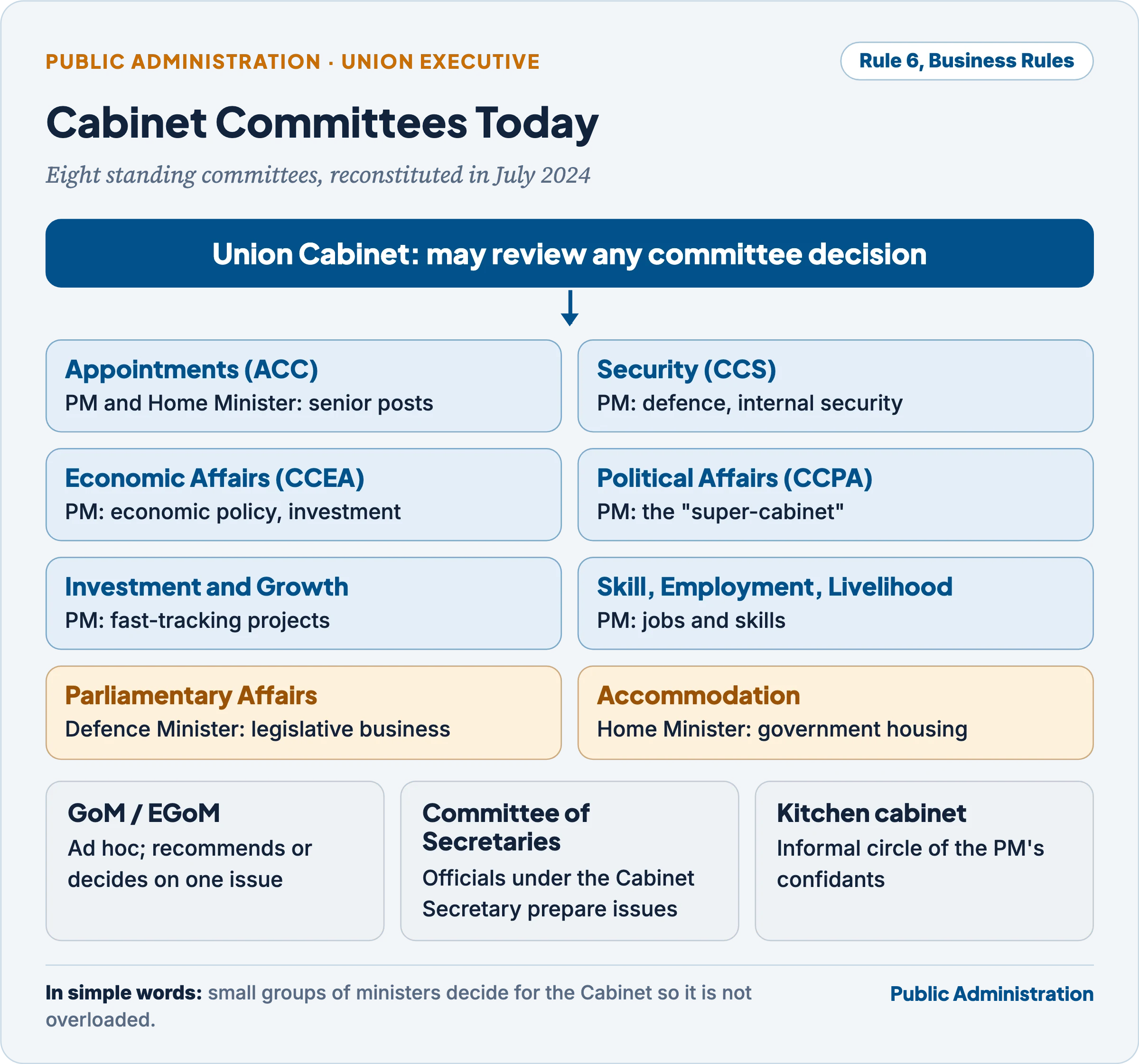
- Legal basis. Cabinet Committees are extra-constitutional but statutory in practice: Rule 6 of the Transaction of Business Rules, 1961 says there shall be standing committees set out in the First Schedule, with the functions there specified; the PM may add, abolish or modify them and decides their membership. Each committee can decide matters referred to it; the Cabinet may review any committee decision.
The present list
The Cabinet Committees reconstituted on 3 July 2024 (composition unchanged in structure as of October 2026) are listed below.
| Committee | Chair | Main business |
|---|---|---|
| Appointments Committee (ACC) | PM (with Home Minister) | Senior appointments, empanelment, extensions, inter-cadre transfers, CPSE board posts |
| Cabinet Committee on Security (CCS) | PM | Defence, internal security, nuclear and strategic matters, major defence purchases |
| Cabinet Committee on Economic Affairs (CCEA) | PM | Economic policy, investment proposals above set limits, prices of farm products |
| Cabinet Committee on Political Affairs (CCPA) | PM | Centre–State issues, political problems of national importance; often called the “super-cabinet” |
| Cabinet Committee on Investment and Growth | PM | Fast-tracking investment and infrastructure (created 2019) |
| Cabinet Committee on Skill, Employment and Livelihood | PM | Policies for jobs and skills (created 2019 as Employment and Skill Development) |
| Cabinet Committee on Parliamentary Affairs | Defence Minister | Legislative programme, session dates |
| Cabinet Committee on Accommodation | Home Minister | Government accommodation and office location |
- Pattern. The PM chairs six of eight; the Home Minister sits on all eight. After 2024, allies’ ministers (TDP, JD(U), JD(S), LJP(RV)) were placed on the CCEA, CCPA and others, a mark of the coalition’s return.
Features and functions
- Number, names and membership vary with the PM and the times; members range from two (ACC) to over a dozen; non-Cabinet ministers may be special invitees.
- Functions. They reduce the Cabinet’s workload (division of labour), allow in-depth examination of complex issues, coordinate ministries in a field, and take decisions (not merely recommend) on matters within their charter. The Cabinet Secretariat services them; many are shadowed by Committees of Secretaries that prepare issues.
- Staff agencies or decision-makers? In theory a committee of ministers is part of the line (decision-making) structure. In practice, committees that sift, examine and recommend work like staff agencies for the Cabinet, while powerful ones (ACC, CCS, CCEA) decide with the force of the government. They are best seen as delegated decision units of the Cabinet, which keep the Cabinet’s authority while sharing its load.
- Interface between officials and non-officials. Committee meetings bring ministers (non-officials) and Secretaries (officials) around one table, often with experts; they are a forum where policy and administration meet, an illustration of the politics–administration continuum.
What makes committees effective or weak
- The PM’s style. Under dominant PMs (Nehru, Indira, Rajiv) committees often lost significance because decisions were taken by the PM or his circle; under collegial and coalition PMs (Janata, United Front, UPA) committees and GoMs carried more real work.
- Coverage and reference. Committees can act only on matters referred to them, and they have not covered all important areas.
- Composition. Inclusion of coalition partners and the relevant ministers affects legitimacy; the ARC (1968) wanted membership normally capped at six and including all ministers in charge of the subjects.
- Secretariat support and time limits decide whether committees speed decisions or delay them.
8.6 Groups of Ministers and Empowered Groups of Ministers
- Basis. Rule 6(4) of the Business Rules: ad hoc committees of ministers, including Groups of Ministers, may be set up by the Cabinet, a standing committee or the PM to investigate and report, and, if authorised, to take decisions.
- GoM and EGoM. A GoM examines and recommends to the Cabinet. An Empowered GoM (EGoM) is authorised to decide, and its decision has the force of a government decision.
- The UPA years. GoMs and EGoMs multiplied: UPA-II alone set up 27 GoMs and 24 EGoMs, on telecom spectrum, gas pricing, the Bhopal gas tragedy, drought and corruption. They helped coalition consensus but were criticised for delay (“policy paralysis”) and for diluting Cabinet authority.
- Abolition. On 31 May 2014 the new government abolished all 9 EGoMs and 21 GoMs, sending pending issues back to the ministries, with the Cabinet Secretariat and PMO facilitating where ministries faced difficulties. Ad hoc GoMs have since been used sparingly.
Does an EGoM impair Cabinet responsibility?
- Yes, partly. An EGoM takes binding decisions that the full Cabinet may never discuss, yet all ministers must collectively defend them in Parliament. Ministers outside the group share responsibility for decisions they did not shape; and EGoMs could be used to shift blame or avoid difficult Cabinet debates.
- No, formally. EGoMs are created by the Cabinet or the PM, act under delegated authority, and the Cabinet may review their decisions (Rule 6(6)). Delegation is a normal feature of collective government, just as standing committees decide on its behalf.
- Balance. The doctrine survives if EGoMs have clear mandates, time limits and reporting to the Cabinet, which is what the 2nd ARC’s 13th Report (2009) recommended: selective but effective use of GoMs with clear mandates and prescribed time limits.
Common confusion
Is a Group of Ministers the same as a Cabinet Committee? No. Cabinet Committees are standing bodies listed in the First Schedule of the Business Rules with fixed charters. GoMs and EGoMs are ad hoc bodies created for one issue under Rule 6(4) and dissolved when it is settled. A GoM only recommends; an EGoM decides within its mandate. (GoMs of the GST Council are a different thing: they serve a federal body of Union and State finance ministers.)
9. Work Processes of the Union Executive
In simple words
A government of seventy ministers and dozens of ministries needs a rulebook: who decides what, whom a ministry must consult, which matters go to the Cabinet and which the Prime Minister alone can settle. India’s rulebook is two sets of rules made by the President, and the step-by-step process of the Cabinet note.
9.1 Article 77 and the two Business Rules
- Art 77(1): all executive action of the Government of India shall be expressed to be taken in the name of the President. Art 77(2): orders and instruments are authenticated as specified by rules (the Authentication Rules). Art 77(3): the President shall make rules for the more convenient transaction of business and its allocation among ministers.
- Government of India (Allocation of Business) Rules, 1961. The First Schedule lists the ministries, departments, secretariats and offices; the Second Schedule distributes subjects among them (including their attached and subordinate offices and PSUs). The President, on the PM’s advice, allocates departments among ministers; the business allotted to the Cabinet Secretariat is deemed allotted to the PM. Creating or merging a ministry (the Ministry of Cooperation in 2021, the split of Housing and Urban Affairs into two departments in July 2026) is done by amending these Rules.
- Government of India (Transaction of Business) Rules, 1961. These say how business is done. Their key rules are summarised below.
| Rule | Content |
|---|---|
| Rule 3 | Business disposed of by or under directions of the Minister-in-charge |
| Rule 4 | Inter-departmental consultation: no decision until concerned departments concur, failing which the Cabinet decides; prior concurrence of Finance (expenditure, posts, revenue), Law (legislation, rules, contracts), DoPT (recruitment, service conditions), External Affairs (external relations) |
| Rule 5 | PM may call for papers from any department; Finance Minister where finance is involved |
| Rule 6 | Standing Cabinet Committees (First Schedule); ad hoc committees and GoMs; Cabinet may review |
| Rule 7 | Cases in the Second Schedule go to the Cabinet (legislation, ordinances, President’s Address, Art 356 proclamations, inter-ministerial disputes, reversing Cabinet decisions, major appointments not with the ACC) |
| Rule 8 | Cases in the Third Schedule go to the PM and/or the President before orders issue |
| Rule 9 | Each department sends the Cabinet a monthly summary of its main activities |
| Rule 11 | The Secretary is the administrative head, responsible for observing the rules |
| Rule 12 | The PM may permit or condone a departure from these rules to the extent he deems necessary |
- Supplementary instructions under these Rules (the “Supplementary Instructions” and the Handbook on Writing Cabinet Notes) govern procedure in detail. The Cabinet Secretariat administers both sets of Rules (see the article on the PMO, Cabinet Secretariat and Central Secretariat).
9.2 The Cabinet note process
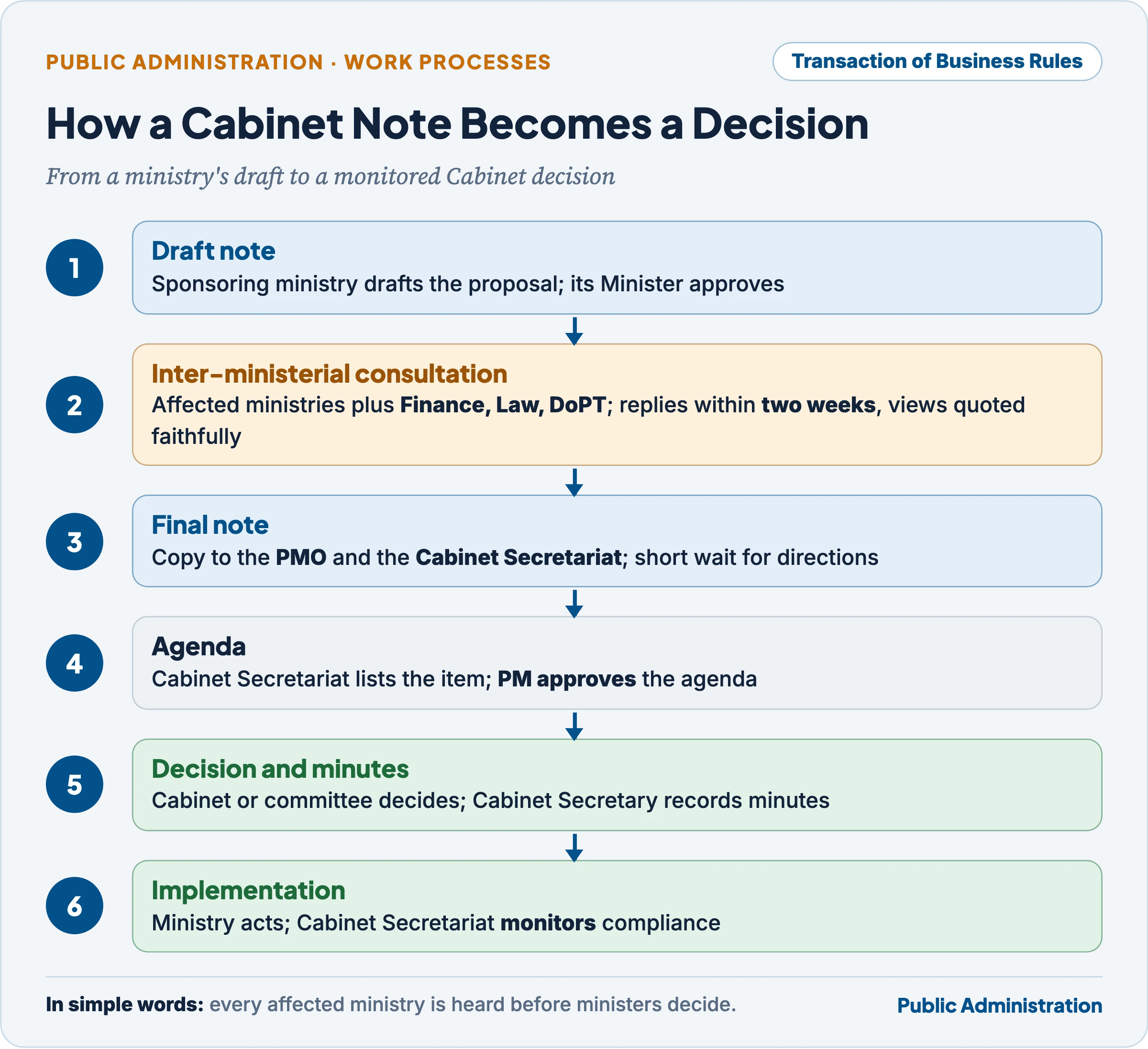
- Draft note. The sponsoring ministry prepares a draft note for the Cabinet or a Cabinet Committee in the prescribed format: the proposal, background, financial implications, legal position, implementation schedule and the decision sought, approved by its Minister-in-charge.
- Inter-ministerial consultation. The draft goes to every ministry whose business is affected and to the nodal ministries (Finance, Law, DoPT, External Affairs as Rule 4 requires), and to the PMO and Cabinet Secretariat. Consulted ministries must reply within two weeks, with their minister’s approval; their views must be reproduced faithfully in the final note, with the sponsoring ministry’s response.
- Final note. A single copy goes to the PMO and copies to the Cabinet Secretariat; after a short waiting period for any directions, the final note is submitted.
- Agenda. The Cabinet Secretariat prepares the agenda, approved by the PM, and circulates the notes to ministers in advance; urgent items may be taken as table items or approved by circulation.
- Decision. The Cabinet or the committee decides; the Cabinet Secretary records the minutes, which the PM approves and which are communicated to the ministries.
- Implementation and monitoring. The sponsoring ministry acts; the Cabinet Secretariat monitors compliance with Cabinet decisions (through periodic reports and digital dashboards). Decisions are announced to the public through press briefings.
- Why the process matters. It forces a proposal to meet every affected interest before ministers decide, so that the Cabinet chooses with the full range of views (Simon’s “decision premises”) on the table. Its weakness is delay: consultations can stretch for months, and ministries sometimes paraphrase or brush aside dissent, which the Handbook expressly forbids.
9.3 Decision-making in practice
- Levels of decision. Most business is settled inside a ministry under delegated powers; disputes go to Committees of Secretaries chaired by the Cabinet Secretary; politically important or contested issues go to Cabinet Committees, GoMs or the Cabinet; a small set needs the PM’s or President’s approval.
- Rule 12 and its use. The PM’s power to condone departures is meant for urgent or unforeseen cases, with the Cabinet giving post facto approval. It was used for the proclamations reorganising Jammu and Kashmir into two Union Territories (31 October 2019) and to revoke President’s Rule in Maharashtra in the early hours of 23 November 2019 without a Cabinet meeting. Critics see such use as centralising decisions in the PM; defenders point to its legality and the need for speed.
- Cabinet secrecy and transparency. Cabinet papers are confidential, but under the RTI Act, 2005 (s. 8(1)(i)) Cabinet decisions, the reasons for them and the material on which they were based must be made public after the decision is taken and the matter is complete.
- Theory. The Cabinet system is a structured form of bounded rationality (Herbert Simon): no single minister can see everything, so committees, consultation and secretariat screening divide the problem into manageable parts. Coalition bargaining in GoMs resembles Charles Lindblom’s “partisan mutual adjustment” and incrementalism. See the article on Decision-Making.
10. Intra-governmental Relations at the Apex
In simple words
At the top of the government, several people and bodies must work together: the President and the Prime Minister, the Prime Minister and his ministers, the ministers and their Secretaries, and the government and Parliament. Friction at any of these joints slows the whole machine.
- President and Prime Minister. Governed by Arts 74 and 78 and by personal equations. Smooth relations are the norm; friction has arisen over information (Zail Singh and Rajiv Gandhi, 1987), assent (Prasad and Nehru, 1951; Kalam, 2006), and Art 356 advice (Narayanan, 1997–98). The President’s weekly or periodic briefings by the PM and monthly ministry summaries (Rule 9) are the channels.
- Prime Minister and Cabinet. The balance swings between collegial and prime-ministerial government (6.8). The PM controls the agenda, portfolios, committees and the PMO; ministers retain influence through political weight, coalition backing and departmental expertise.
- Cabinet and ministries. Coordination through Cabinet Committees, Committees of Secretaries, GoMs, inter-ministerial consultation (Rule 4) and the Cabinet Secretariat; dispute resolution, if consultation fails, at the Cabinet level.
- Ministers and Secretaries. The political–permanent executive relationship: ministers decide policy and answer to Parliament; Secretaries advise, implement and keep the rules. Problems include transfers as reward or punishment, oral instructions, and over-dependence of ministers on officials (see the article on Bureaucracy, Democracy and Development).
- Executive and Parliament. The Cabinet leads the House through the legislative agenda, whips and the budget; Parliament controls through questions, committees and confidence. For details, see the article on Parliament and Judiciary.
- Executive and judiciary. Judicial review of executive action, the collegium and appointment disputes, and Art 143 references. See the article on Parliament and Judiciary.
- Union and States at the apex. The Inter-State Council (Art 263), the NITI Aayog Governing Council and zonal councils are chaired by the PM or Home Minister; the assent dispute (4.6) is the sharpest current friction.
- PMO and Cabinet Secretariat. The PMO (a staff office of the PM, headed by the Principal Secretary) and the Cabinet Secretariat (secretariat of the Cabinet, headed by the Cabinet Secretary) are the two coordinating hubs of the apex; their relative weight tracks the PM’s style. See the article on the PMO, Cabinet Secretariat and Central Secretariat.
Indian Connect — Indian Connect: coordination tools at the apex
- Committee of Secretaries under the Cabinet Secretary settles inter-ministerial disputes before they reach ministers.
- PRAGATI (since March 2015): monthly reviews by the PM of stalled projects with Union Secretaries and Chief Secretaries.
- PM Gati Shakti National Master Plan (2021): a shared GIS platform for infrastructure ministries.
- Monthly summaries under Rule 9 keep the President and Cabinet informed of every department’s work.
11. Recent Trends in the Union Executive
In simple words
The way India’s top executive works has changed with politics. Strong single-party governments concentrate power in the Prime Minister; coalitions spread it among partners. Since 2014 the system has become more leader-centred, more digital and more driven from the top, and since 2024 it has had to accommodate coalition allies again.
11.1 From dominant party to coalition and back
- 1952–1989: dominant-party cabinets (the “Congress system”, in Rajni Kothari’s phrase, 1964). Cabinets were homogeneous; the PM’s authority came from party dominance.
- 1989–2014: coalition cabinets. No single-party majority for 25 years. Features: Common Minimum Programmes, coordination committees of alliance partners, allies’ ministers enjoying autonomy in their ministries, more GoMs and EGoMs, a stronger President in government formation, and a weaker PM (“coalition dharma“). Collective responsibility was strained, but federal interests gained a voice at the centre.
- 2014–2024: single-party majority with a personalised premiership. GoMs abolished; decision-making moved to the PMO and ministries; ordinances first rose, then fell.
- Since June 2024: dominant leader in a coalition. The BJP won 240 seats; allies are in the Cabinet and the Cabinet Committees, but the leader, the PMO and the core ministries (Home, Defence, Finance, External Affairs) remain with the largest party.
11.2 Personalisation and “presidentialisation”
- Meaning. Thomas Poguntke and Paul Webb (The Presidentialization of Politics, 2005) describe how parliamentary systems come to work like presidential ones: leader-centred elections, more resources and autonomy for the head of government, and less dependence on party and Cabinet.
- Indian signs. Campaigns built around the PM; centralised communication; PMO-driven flagship schemes; the ACC reduced to two members; direct monitoring through PRAGATI; frequent use of the PM’s Rule 12 powers in urgent cases.
- Weber’s charismatic authority. Max Weber described authority resting on the extraordinary personal qualities of a leader, as distinct from traditional and legal-rational authority. Indira Gandhi in the early 1970s and the post-2014 premiership show charismatic legitimation layered on the legal-rational office. Weber also warned of the “routinisation of charisma”: the need to embed personal authority in institutions if it is to outlast the leader.
- Risks and benefits. Benefits: speed, coherence, accountability located in one person. Risks: weakened Cabinet deliberation, over-load at the top, sycophancy, and vulnerability of institutions to one person’s judgement.
11.3 Other trends
- Ordinances: from a high-use route (2014–2021) to almost none (2022–2025), reflecting majorities in both Houses and criticism.
- Cabinet Committees: new committees on Investment and Growth and Skill, Employment and Livelihood (2019); a two-member ACC; inclusion of allies (2024).
- “Minimum government, maximum governance”: the 2014 slogan for fewer layers and faster decisions: abolition of GoMs, merger of ministries (Overseas Indian Affairs into External Affairs, 2016; the Railway Budget merged with the General Budget, 2017), single-window clearances, and digital governance. Critics note that the Council of Ministers did not shrink much and that new ministries were also created (Jal Shakti 2019, Cooperation 2021).
- Collegial versus presidential style: a long swing from Nehru’s pluralism to Indira’s centralisation, the coalition era’s collegiality, and the post-2014 premiership. The executive’s style now depends less on formal rules than on electoral arithmetic.
- Digital and performance tools: e-office in the Secretariat, dashboards to track Cabinet decisions, PRAGATI and Gati Shakti, outcome monitoring by NITI Aayog.
- Ministerial accountability under public pressure: the July 2026 resignation of the Education Minister after the NEET paper leak shows that individual responsibility can still be enforced when public and political pressure is strong.
- Federal friction over assent: the 2025 judgment and Presidential Reference made the President’s assent function a live constitutional issue.
Criticism — Criticism: the rise of prime-ministerial government
- Cabinet reduced to a ratifying body: key decisions are taken in the PMO or a small circle and brought to the Cabinet for formal approval.
- Collective responsibility hollowed out: ministers defend decisions they did not shape.
- Over-centralisation overloads the PM and slows decisions that ministries could take.
- Extra-constitutional actors (advisers, party leaders, kitchen cabinets) influence policy without answering to Parliament.
- Institutional erosion: committees, GoMs and the Cabinet Secretariat lose weight; Rule 12 and ordinances can bypass normal deliberation.
Defence — Defence: why a strong Prime Minister is needed
- Coordination of a large, fragmented government needs a single centre of direction; coalition-era paralysis showed the cost of its absence.
- Electoral mandate today is given to a leader; strong leadership is the democratic will, not a distortion.
- Accountability is clearer: voters know whom to reward or punish.
- Formal checks remain: Lok Sabha confidence, Rajya Sabha, courts, States, coalition partners since 2024, and elections.
- Speed and coherence in security, economic crises and infrastructure delivery require decisive executive leadership.
Theory lens: the Union executive through Paper I ideas
- Bagehot’s dignified and efficient parts. Walter Bagehot (The English Constitution, 1867) explains the division between the President (dignified, symbolic, continuity) and the Cabinet (efficient, governing), and why the dignified part keeps reserve functions in a crisis. See the article on Comparative Public Administration.
- Westminster model and comparative administration. The Indian executive is a transplanted Westminster model adapted to a federal, written-constitution polity; Fred Riggs’ idea of formalism helps explain gaps between form and practice, such as collective responsibility on paper and PM-centred decisions in practice. See the article on Riggsian Models.
- Weber’s charismatic and legal-rational authority. Max Weber (Economy and Society, 1922) explains personalised premierships as charisma working through a legal-rational office, and the Cabinet Secretariat and Business Rules as the legal-rational machine that routinises it. See the article on Weber and Bureaucracy.
- Simon’s decision-making. Herbert Simon (Administrative Behavior, 1947) explains Cabinet Committees, the Cabinet note and inter-ministerial consultation as devices to cope with bounded rationality: factoring complex decisions, setting decision premises, and satisficing under time pressure. See the article on Herbert Simon.
- Gulick’s coordination. Luther Gulick (“Notes on the Theory of Organization”, 1937) named coordination as a core executive function and identified coordination by organisation (hierarchy, committees) and by the dominance of an idea. The Cabinet, its committees and the Cabinet Secretariat are coordination by organisation; a strong PM’s agenda is coordination by idea. See the article on Classical Theory.
- Politics–administration dichotomy. Woodrow Wilson (1887) separated politics from administration; the Indian minister–Secretary relation, the Cabinet note and committee meetings with officials show instead Paul Appleby’s continuum, with ministers deciding and officials shaping options. See the article on Wilson and Evolution of the Discipline.
- Principal–agent and accountability. Voters are principals of the Lok Sabha, the Lok Sabha of the Council of Ministers, and ministers of civil servants; collective and individual responsibility are the devices that reduce agency loss, and their weakening is the core of the prime-ministerial government debate. See the article on Accountability and Control.
- Lindblom’s incrementalism. Charles Lindblom (“The Science of ‘Muddling Through'”, 1959) explains coalition-era GoMs as partisan mutual adjustment: policies emerged from bargaining among allies rather than comprehensive planning. See the article on Models of Policy-Making.
12. First and Second ARC Recommendations on the Executive
In simple words
Two Administrative Reforms Commissions, in the 1960s and the 2000s, studied how the top of the government works and suggested how to make it smaller, better coordinated and more accountable. Some ideas were adopted; many were not.
12.1 First ARC: Machinery of the Government of India and its Procedures of Work (1968)
- On the Prime Minister. The PM should be supported, in an institutional way, by a Deputy Prime Minister; should not ordinarily hold a ministry, to keep time for guidance, coordination and supervision; should keep the Department of Personnel under his direct charge; should be associated with important appointments; should discuss implementation progress with ministers individually or in groups every month; and should choose ministers for political stature, integrity, intellectual ability and decision-making capacity.
- On the Council and Cabinet. Keep the three-tier structure (Cabinet Ministers, Ministers of State, Deputy Ministers); the Council should normally number about 40; the Cabinet should be a compact body of not more than 16 including the PM; each departmental subject should be represented in the Cabinet; no more than two ministers in any ministry; the Deputy PM’s office should be recognised in the Business Rules; Ministers of State should not hold independent charge; Deputy Ministers should be used to train future ministers and given real work; the post of Parliamentary Secretary need not be revived.
- On Cabinet Committees. There should be eleven standing committees covering all important areas, each with membership normally not exceeding six and including all ministers in charge of the subjects; each should be supported by a Committee of Secretaries; ad hoc committees should only investigate, not decide. The government did not accept these committee proposals in full.
12.2 Second ARC (2005–09, chaired by M. Veerappa Moily)
- 4th Report, Ethics in Governance (2007). A Code of Ethics for Ministers in addition to the Code of Conduct, with monitoring by the PM or CM and an annual report on compliance; measures against conflicts of interest.
- 13th Report, Organisational Structure of Government of India (2009).
- Subsidiarity as the guiding principle; the Union to concentrate on core functions.
- Regroup ministries: a ministry should be a group of closely related departments under a First or Coordinating Minister, reducing the number of ministries to 20–25.
- Recast the Allocation of Business Rules to reflect functional grouping.
- Ministries to focus on policy analysis, planning, budgeting and evaluation, with execution passed to executive agencies with balanced autonomy and accountability.
- Fewer levels: a file should pass through no more than three levels before decision.
- Coordination mechanisms: make GoMs and Committees of Secretaries work effectively; selective but effective use of GoMs with a clear mandate and prescribed time limits; unresolved Centre–State issues to go to the Committee of Secretaries and then the Cabinet.
- Other bodies. The NCRWC (2002) recommended a 10 per cent ceiling on ministries and a bar on defectors holding office (partly enacted by the 91st Amendment), and limiting ministerial-rank political posts to 2 per cent of the lower House.
- Status. The size cap, the defector bar, the abolition of GoMs (2014) and delayering in the Secretariat move in the ARC’s direction; the 20–25 ministry structure and executive agencies remain largely unimplemented.
Key Terms
| Term | Meaning in simple words |
|---|---|
| Nominal executive | The head in whose name government acts but who does not rule (the President) |
| Real executive | Those who actually govern (PM and Council of Ministers) |
| Dignified and efficient parts | Bagehot’s terms for the ceremonial head and the governing Cabinet |
| Westminster model | British system of a cabinet drawn from and responsible to Parliament |
| Aid and advice | Article 74 rule that the President acts on ministers’ advice |
| Situational discretion | President’s room for judgement when advice is unavailable or the party system fails |
| Suspensive veto | Return of a Bill that Parliament can override by passing it again |
| Pocket veto | Killing a Bill by taking no action on it |
| Ordinance | Temporary law made by the executive when Parliament is not in session |
| Re-promulgation | Issuing an ordinance again after it lapses without Parliament’s approval |
| Commutation | Replacing a punishment by a lighter one |
| Presidential Reference | President’s request to the Supreme Court for an advisory opinion (Art 143) |
| Collective responsibility | Ministers stand or fall together before the Lok Sabha |
| Individual responsibility | Each minister answers for his department and serves at the PM’s pleasure |
| Minister of State (Independent Charge) | Junior minister heading a ministry alone, outside the Cabinet |
| Kitchen cabinet | Informal inner circle of the PM’s trusted confidants |
| Cabinet Committee | Standing committee of ministers under the Business Rules that decides on the Cabinet’s behalf |
| GoM / EGoM | Ad hoc group of ministers that recommends (GoM) or decides (EGoM) on one issue |
| Allocation of Business Rules | Rules that distribute subjects among ministries |
| Transaction of Business Rules | Rules on how decisions are taken and which go to Cabinet or PM |
| Cabinet note | Formal proposal by a ministry for a Cabinet decision after consultation |
| Rule 12 | PM’s power to allow departure from the Business Rules |
| Prime-ministerial government | System where the PM dominates the Cabinet (Crossman’s term) |
| Presidentialisation | Parliamentary systems working in leader-centred, presidential ways |
| Office of profit | Government post with gain that can disqualify a legislator |
| Caretaker government | Outgoing ministry continuing until a new one is formed |
Commissions, Committees and Judgments
The bodies and cases below shaped the structure and working of the Union executive, listed by year.
| Body / case | Year | Key point |
|---|---|---|
| Gopalaswami Ayyangar report on Reorganisation of the Machinery of Government (N. Gopalaswami Ayyangar) | 1949 | Standing Cabinet Committees with secretariat support |
| Ram Jawaya Kapur v. State of Punjab | 1955 | President a formal head; executive power is the residue after legislative and judicial functions |
| Code of Conduct for Ministers (Ministry of Home Affairs) | 1964 | Asset disclosure, severing business links, gifts |
| First ARC, Report on Machinery of GoI (Morarji Desai, then K. Hanumanthaiya) | 1968 | Council about 40, Cabinet up to 16; 11 standing committees; Deputy PM |
| R.C. Cooper v. Union of India | 1970 | Ordinance satisfaction open to challenge for mala fides |
| U.N.R. Rao v. Indira Gandhi | 1971 | Council of Ministers continues after dissolution; President cannot act without ministers |
| Shamsher Singh v. State of Punjab | 1974 | President and Governor act on ministers’ advice save in exceptional situations |
| 42nd Amendment Act | 1976 | President “shall act in accordance with” advice |
| 44th Amendment Act | 1978 | Advice may be returned once; “armed rebellion”; Cabinet’s written advice for emergency |
| Maru Ram v. Union of India | 1980 | Pardon power exercised on Council’s advice |
| D.C. Wadhwa v. State of Bihar | 1987 | Re-promulgation of ordinances a fraud on the Constitution |
| Kehar Singh v. Union of India | 1989 | President may review the case; no right to oral hearing |
| S.R. Bommai v. Union of India | 1994 | Art 356 subject to judicial review; floor test decisive |
| S.P. Anand v. H.D. Deve Gowda | 1996 | Non-member may be PM for six months |
| S.R. Chaudhuri v. State of Punjab | 2001 | No repeated six-month appointments of non-members as ministers |
| NCRWC (M.N. Venkatachaliah) | 2002 | Ministries capped at 10 per cent; defectors barred from office |
| 91st Amendment Act | 2003 | 15 per cent cap; Art 75(1A), (1B); split exception deleted |
| Epuru Sudhakar v. Government of A.P. | 2006 | Limited judicial review of pardons |
| Jaya Bachchan v. Union of India | 2006 | Office of profit means capable of yielding gain |
| 2nd ARC, 4th Report, Ethics in Governance (M. Veerappa Moily) | 2007 | Code of Ethics for Ministers |
| 2nd ARC, 13th Report, Organisational Structure of GoI (M. Veerappa Moily) | 2009 | 20–25 ministries; coordinating ministers; selective GoMs with time limits |
| Shatrughan Chauhan v. Union of India | 2014 | Undue delay in mercy petitions ground for commutation |
| Manoj Narula v. Union of India | 2014 | PM expected not to appoint ministers facing serious charges |
| Krishna Kumar Singh v. State of Bihar | 2017 | Laying of ordinances mandatory; re-promulgation a fraud; satisfaction reviewable |
| Bimolangshu Roy v. State of Assam | 2017 | State cannot create parliamentary secretaries with ministerial status |
| State of Tamil Nadu v. Governor of Tamil Nadu | 2025 | Three-month limit for Governors and President; deemed assent |
| In re Presidential Reference No. 1 of 2025 | 2025 | No judicial timelines or deemed assent; limited mandamus for indefinite inaction |
Contemporary Developments
- Coalition cabinet (9 June 2024). The third Modi ministry of 72 (30 Cabinet, 5 Independent Charge, 36 Ministers of State) included ministers from the TDP, JD(U), JD(S), LJP(RV), Shiv Sena and RLD, the first coalition-dependent Union government since 2014.
- Cabinet Committees reconstituted (3 July 2024). Eight committees, with allies on the CCEA, CCPA and others; the ACC (PM and Home Minister) and CCS unchanged. The composition list of 15 October 2026 retains all eight.
- No ordinances (2024–2025). The Ministry of Parliamentary Affairs recorded no ordinance in 2024, continuing the decline after 2021; 725 ordinances had been issued since 1952.
- Presidential Reference opinion (20 November 2025). The Constitution Bench ruled out judicial timelines and deemed assent for the President and Governors while allowing a limited mandamus against indefinite inaction, settling the April 2025 controversy.
- Vice-President change (2025). Jagdeep Dhankhar resigned on 21 July 2025; C.P. Radhakrishnan was elected on 9 September 2025 by 452 votes to 300. A removal notice against Dhankhar had been rejected on 19 December 2024.
- President’s Rule in Manipur ended (4 February 2026) after nearly a year (from 13 February 2025), with a new government sworn in the same day.
- Ministerial resignation (25 July 2026). Education Minister Dharmendra Pradhan resigned over the NEET-UG 2026 paper leak; the President accepted it on the PM’s advice under Art 75(2) and gave Pralhad Joshi additional charge.
- Business Rules amended (2024–2026). The Transaction of Business Rules stood amended up to Series No. 73 (March 2024); Allocation of Business Rules changes in July 2026 split the Ministry of Housing and Urban Affairs into two departments, showing Art 77(3) as the main tool for reorganising the executive.
Revision Grid
| Thinker / body | Work or report (year) | Key idea |
|---|---|---|
| Walter Bagehot | The English Constitution (1867) | Dignified and efficient parts; Cabinet as hyphen and buckle |
| Lord Morley | Writings on Walpole (1889) | PM as primus inter pares, keystone of the cabinet arch |
| Ramsay Muir | How Britain is Governed (1930) | Dictatorship of the Cabinet |
| Ivor Jennings | Cabinet Government (1936) | PM as the sun around which planets revolve |
| Luther Gulick | “Notes on the Theory of Organization” (1937) | Coordination by organisation and by idea |
| Herbert Simon | Administrative Behavior (1947) | Bounded rationality; decision premises |
| Max Weber | Economy and Society (1922) | Charismatic and legal-rational authority |
| R.H.S. Crossman | Introduction to Bagehot (1963) | Cabinet government became prime-ministerial government |
| Rajni Kothari | “The Congress System” (1964) | Dominant-party system |
| Bruce Headey | British Cabinet Ministers (1974) | Ministerial roles: initiator, selector, executive, ambassador |
| Lord Hailsham | Dimbleby Lecture (1976) | Elective dictatorship |
| Poguntke and Webb | The Presidentialization of Politics (2005) | Leader-centred parliamentary systems |
| B.R. Ambedkar | Constituent Assembly (1948–49) | Responsibility over stability; President as head of State, not executive |
| N. Gopalaswami Ayyangar | Machinery of Government report (1949) | Standing Cabinet Committees |
| First ARC | Machinery of GoI (1968) | Compact Cabinet, 11 committees, Deputy PM |
| NCRWC | Report (2002) | 10 per cent cap; defectors barred |
| 2nd ARC | 4th (2007), 13th (2009) Reports | Code of Ethics for Ministers; 20–25 ministries; time-bound GoMs |
| Supreme Court | Shamsher Singh (1974); Krishna Kumar Singh (2017); Reference (2025) | Advice rule; ordinance limits; no judicial timelines for assent |
Previous Year Questions
- 2023The Ninety-First Constitutional Amendment Act successfully right-sized the Council of Ministers both at Union and State levels. Comment.
- 2023“Indian Prime Minister is more empowered than his British counterpart in the Westminster model of democracy.” Elucidate.
- 2023Do you agree that code of ethics and code of conduct for ministers would help in upholding higher standards of their constitutional and ethical conduct? Explain.
- 2015“Ordinance-making power of the Executive needs to be suitably restrained.” Examine it critically.
- 2012In the exercise of his/her functions, the President of India is a mere ‘Convenient working hypothesis’. Do you agree with this view? Justify your reasoning with illustrations.
- 2012Critically examine the variables in the composition and functioning of Cabinet Committees.
- 2010“In an era of hung parliaments the power of the President expands, more so when the incumbent decides to be assertive.” Comment on the statement with reference to the situation in during the last two decades.
- 2010Does the emergence of an Empowered Group of Ministers at the Central level impair the doctrine of Cabinet responsibility?
- 2009“Administrative talent of a Minister determined his success.” Comment.
- 2007“The President of India acts like grand-parent in a family. If younger generation does not follow his/her advice, he/she is just unable to do anything.” Comment.
- 2006“By taking some offices out of the jurisdiction of the Office of Profit Act, the Government of India has doubly assured the public mind of its duplicity.” Comment.
- 2006Indian prime Minister should not only be accountable to the Indian Parliament but should appear to be so.” Comment on the accountability of the Prime Minister to the Indian Parliament in the context of extra-constitutional power.
- 2006“Not the Potomac, but the Thames, fertilizes the flow of Yamuna”. In the light of the statement comment on the symbolic institution of the President of India.
- 2005“The veto-power of the Indian President is a combination of the absolute, suspensive and pocket veto.” Comment.
- 2004“Presidents of India prior to the passage of 42 nd and 44 th amendment could afford to be more assertive.” Comment.
- 2003“Looking back to our past experience, the fear that the emergency provisions can be misused have at times proved right and wrong at other times.” Discuss with examples.
- 2003“Despite all the powers that he has, the Indian Prime Minister cannot become a dictator.” Comment.
- 2001“The Prime Minister stands out as the most powerful authority even today.” Comment.
- 2000“Indian Constitution confers vast legislative powers on the President.” Comment.
- 2000“Though the dictatorship of the Cabinet is a stark reality in modern times, it does not mean that the Cabinet is omnipotent.” Comment.
- 1998“Art. 78 of the Constitution confers Executive Power on the President.” Comment.
- 1996“The essential purpose of Cabinet Committee is relieve the Cabinet of some burden of work.” Discuss.
- 1996“Rather than describing the Prime Minister’s position through phrases, it is better to examine how the office of the Prime Minister has actually evolved over time.” Explain.
- 1995“While discussing the President’s position in the Constitution, the model of the British monarch being impracticable and the model of the French Presidency having been ruled out, the compromise model had to fall back upon some such device as the German one.” Comment.
- 1994“The Cabinet is not a constitutional body.” Comment.
- 1991‘The Cabinet Committees in the Union Government are a proven to it as staff agencies.’ Elucidate.
- 1989‘The Cabinet Committees provide a useful forum for interface between officials and non-officials in participatory situation in “Policy Administration” in a Parliamentary Democracy’. Comment.
- 1992‘Bureaucracy thrives under the cloak of ministerial responsibility in a parliamentary democracy; Comment.