

Salient features and value premises; Constitutionalism; Political culture; Bureaucracy and democracy; Bureaucracy and development.
This article: Bureaucracy and democracy (the value tension; Weber, Michels, Lowi and Etzioni-Halevy; democratic controls; representative bureaucracy and reservation; democracy within bureaucracy); relations between the political and permanent executive (Wilson, Appleby, the Aberbach–Putnam–Rockman images, neutrality, transfers, politicisation, the committed bureaucracy debate, Hota and Surinder Nath committees, 2nd ARC, T.S.R. Subramanian, lateral entry); bureaucratic authoritarianism; Macaulay and the elite theory of bureaucracy; the steel frame and its persistence; bureaucracy and development (agent and obstacle, Riggs’ formalism, Myrdal’s soft state, rent seeking, over-dependence, political interference, collision of values); the shift from the Nehruvian to the liberalisation model and reinventing government; environment versus development; current reforms (Mission Karmayogi, outcome monitoring, PRAGATI, lateral entry after 2024).
Official Syllabus: Paper II · Unit 2-02 Philosophical and Constitutional Framework of Government
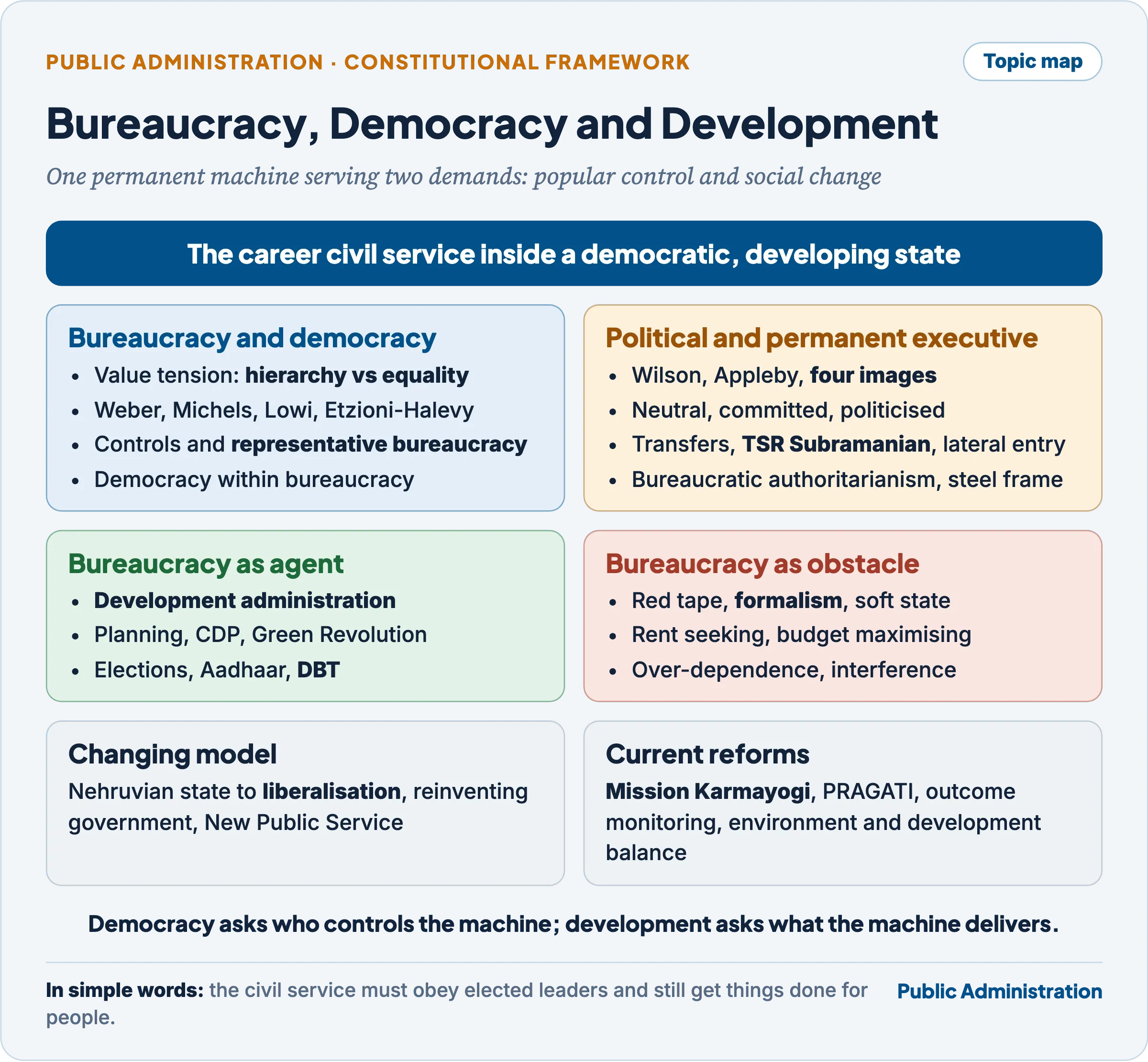
India runs a parliamentary democracy through a permanent, merit-recruited civil service that it inherited from colonial rule and then asked to become the main engine of planned development. These two demands pull in different directions. Democracy asks who controls the officials, how open they are and whether they listen to people. Development asks whether the same officials can plan, build, deliver and change society quickly. This article studies both relationships: how far a hierarchical, expert, permanent bureaucracy can be squared with equality, openness and popular control, and whether that bureaucracy has been an agent or an obstacle of India’s development.
In simple words
Think of a hired driver for a family car. The family (the voters, through the minister) decides where to go. The driver (the civil servant) knows the roads and the engine. If the driver ignores the family, the trip is no longer theirs. If the family grabs the steering wheel at every turn, the car crashes. A good trip needs both: the family choosing the destination, the driver doing the driving well.
1. Bureaucracy and Democracy: A Necessary but Uneasy Partnership
In simple words
A democracy is government by elected people who can be voted out. A bureaucracy is government by appointed officials who stay for a whole career. Elected leaders cannot run a modern state without officials, but officials who are too powerful can quietly take over the decisions that voters were meant to make.
1.1 The two terms
- Bureaucracy. A system of administration by appointed, salaried, full-time officials, arranged in a hierarchy, working under written rules, keeping files, recruited and promoted on merit and seniority, with security of tenure. Max Weber, the German sociologist, described it in Economy and Society (published 1922) as the purest form of legal-rational authority and the most efficient instrument of large-scale administration.
- Democracy. Government in which political authority comes from the people, exercised through elected representatives who are accountable at regular elections, under conditions of equality, free debate, open information and participation. In India it is anchored in the Preamble (“We, the people”), universal adult franchise (Article 326) and responsible government (Articles 75 and 164).
- Why the question arises. In a democracy the voter is sovereign, but most decisions that touch a citizen (a ration card, a land record, a police complaint, a building permit) are made by officials whom no one elects. The question is how a body built on command, secrecy and expertise can serve a polity built on consent, openness and equality.
1.2 The core tension in values
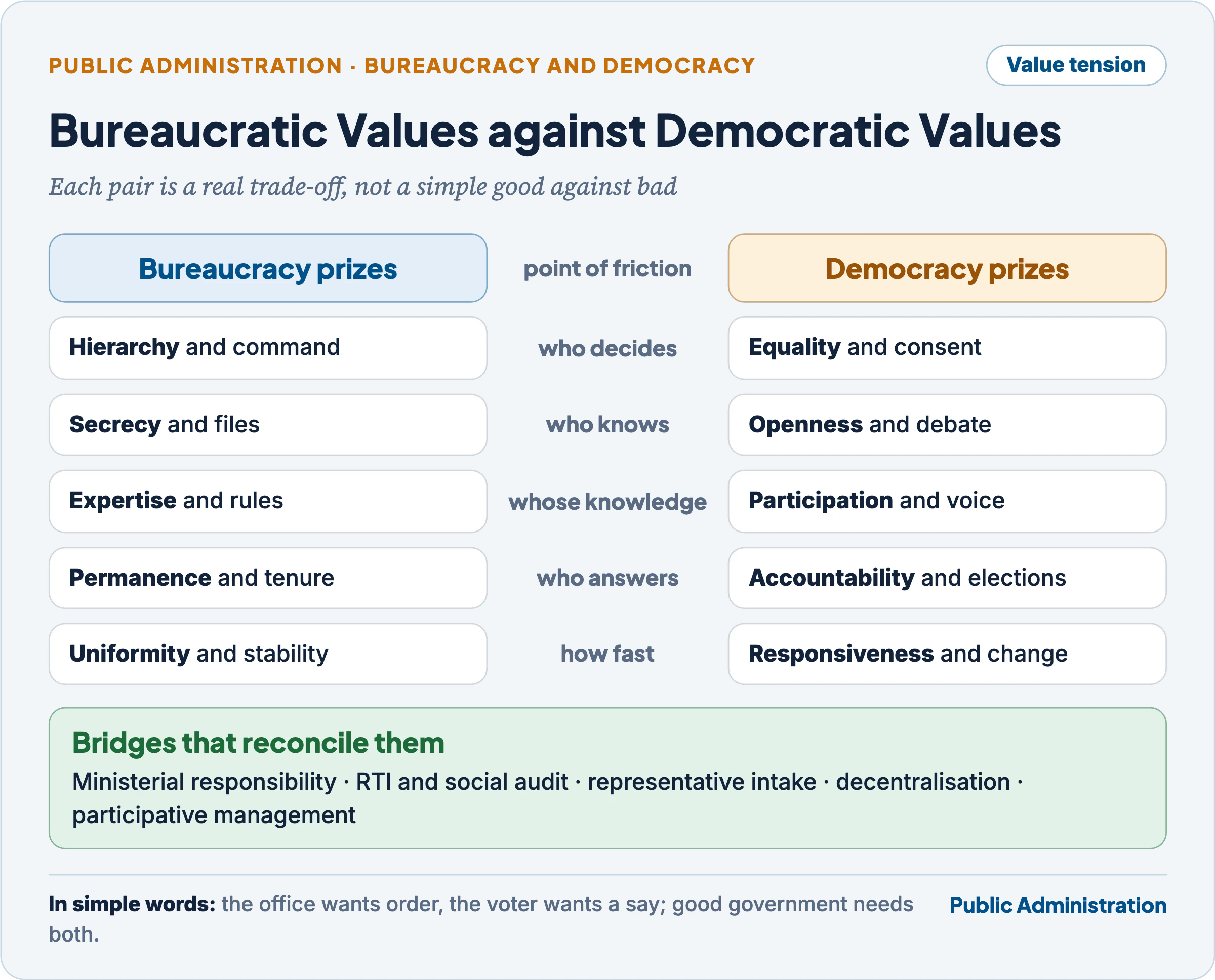
The table sets out the five main points where the logic of the office collides with the logic of the vote.
| Bureaucratic value | Democratic value | Point of friction |
|---|---|---|
| Hierarchy, unity of command | Equality, one person one vote | Who decides: the superior officer or the people? |
| Secrecy, confidential files (Official Secrets Act, 1923) | Openness, public debate, right to know | Who knows: the file-holder or the citizen? |
| Expertise, technical rules | Participation, lay voice | Whose knowledge counts: the expert’s or the community’s? |
| Permanence, security of tenure | Accountability, removal at elections | Who answers: the minister who goes or the official who stays? |
| Uniformity, precedent, stability | Responsiveness, change, local variety | How fast and how flexibly to act? |
- Hierarchy against equality. A bureaucracy rests on unequal authority: the Secretary can overrule the Under Secretary. Democracy rests on equal citizenship. The citizen at the counter often meets not an equal but a superior, the colonial mai-baap (parent-like) image of the official.
- Secrecy against openness. Bureaucratic power grows from control of information. Weber called the “official secret” the bureaucracy’s own invention to protect its superior knowledge. Democracy needs informed citizens; India’s Right to Information Act, 2005 reversed the presumption from secrecy to disclosure.
- Expertise against participation. Officials claim authority from technical competence; democracy claims it from numbers and consent. When an expert committee decides where a dam goes, the displaced village asks why its view counts for less.
- Permanence against accountability. Ministers come and go; Secretaries stay. Permanence gives continuity and memory, but it also lets officials outlast and outmanoeuvre elected leaders (the “Yes Minister” syndrome: ministers depend on officials for facts and drafting).
- Uniformity against responsiveness. Rules protect equal treatment, yet a democracy wants government to respond to particular needs and to change when voters change their minds.
1.3 Why democracy still needs bureaucracy
The tension is real, but democracy cannot do without a professional bureaucracy. The case rests on six arguments.
- Turning votes into action. Laws and promises mean nothing until officials implement them. A Parliament can pass a food-security law; only an administration can issue ration cards in every village.
- Equal treatment under law. Weber’s impersonality (“without hatred or passion”) is itself a democratic value: the official must treat a rich and a poor applicant alike. Rule-bound administration protects citizens from the arbitrary favours of politicians.
- Continuity across governments. Elections change governments; the civil service keeps the state running in between, through coalition collapses, President’s Rule and caretaker periods.
- Conducting democracy itself. Indian elections are run by civil servants on deputation to the Election Commission (Article 324). In the 2024 Lok Sabha election about 97.98 crore electors voted at about 10.5 lakh polling stations, with around 1.5 crore polling and security personnel deployed.
- The main point of contact between state and citizen. As elections draw fewer participants, party membership falls and parliaments lose ground to executives, much of a citizen’s daily experience of democracy happens at the office counter. E-government, grievance portals and citizen engagement are run largely by officials and can give quicker, personal redress than elections can.
- A site for deliberation. Public hearings, social audits and consultations around administrative decisions allow a deliberative democracy that is harder to build around party politics. The risk, however, is that such forums are local and sector-specific and may tilt towards the organised, articulate and affluent.
1.4 Theorists of bureaucratic power
Classical and modern theorists differ on whether bureaucracy is a servant or a rival of democracy. Their arguments supply most of the vocabulary of this debate.
- Max Weber: indispensable but dangerous. Weber saw bureaucracy as technically superior to every other form of organisation, and therefore inescapable in mass democracy. But he feared that its power, built on expert knowledge and official secrecy, would make it the real ruler, leaving elected politicians as “dilettantes” facing “experts”. His essay Parliament and Government in a Reconstructed Germany (1918) argued for a strong parliament with powers of inquiry and charismatic, plebiscitary leaders to keep officials in check. His warning about an “iron cage” of rationalisation expresses the fear that rule-bound life may crush freedom. See the article on Weber and Bureaucracy.
- Robert Michels: the iron law of oligarchy. Michels, a German-Italian sociologist, studied the German Social Democratic Party in Political Parties (1911) and concluded that every large organisation, even a democratic one, is ruled by a small oligarchy of leaders and full-time officials, because they control information, funds and organisation. “Who says organisation, says oligarchy.” If even socialist parties become oligarchic, the state bureaucracy will too.
- Gaetano Mosca and elite theory. Mosca (The Ruling Class) and Vilfredo Pareto argued that every society is governed by an organised minority; C. Wright Mills (The Power Elite, 1956) found a fusion of corporate, military and political elites in the United States. Elite theorists treat the higher civil service as part of this ruling minority (Section 6.2).
- Hegel and Marx. G.W.F. Hegel called the bureaucracy the “universal class” that stands above private interests and represents the general interest of the state. Karl Marx replied that this was an illusion: the bureaucracy treats the state as its private property and serves the ruling class. India’s 2nd ARC itself complained that the civil service still behaves as Hegel’s universal class, deriving legitimacy from its own rules rather than from the people.
- Theodore Lowi: interest-group liberalism. Lowi, an American political scientist, argued in The End of Liberalism (1969) that legislatures pass vague laws and hand wide discretion to agencies, which then bargain with organised interest groups. Policy is made not by elected representatives but by agencies and lobbies. His remedy, “juridical democracy”, asks legislatures to write clear rules that bind administrators.
- Eva Etzioni-Halevy: the democratic dilemma. In Bureaucracy and Democracy: A Political Dilemma (1983), Etzioni-Halevy argued that a powerful, independent bureaucracy threatens democracy, yet is indispensable to it. Independence protects against party patronage, electoral manipulation and corruption (officials who cannot be sacked refuse to rig elections or hand out jobs to party workers). The same independence lets officials resist elected governments. Democracy must therefore live with a built-in dilemma, not solve it once and for all.
- Merle Fainsod: five types of bureaucracy. Fainsod classified bureaucracies by their relation to political authority:
- representative bureaucracies, responsible to elected organs in a democracy;
- party-state bureaucracies, penetrated and controlled by a single party (the Soviet model);
- military-dominated bureaucracies, directed by the armed forces;
- ruler-dominated bureaucracies, personal instruments of an autocrat;
- ruling bureaucracies, where the bureaucracy itself governs, as in colonial India.
- Fred Riggs: the imbalance thesis. Riggs, the American theorist of comparative administration, argued in “Bureaucrats and Political Development: A Paradoxical View” (1963) that in new states the bureaucracy often grows faster than political institutions (parties, legislatures, interest groups). An over-developed bureaucracy facing weak political control slides towards bureaucratic rule, so administrative development may hinder political development. Joseph La Palombara, in Bureaucracy and Political Development (1963), made the same point about the imbalance between bureaucratic and political growth.
Common confusion
Is a strong bureaucracy bad for democracy and a weak one good? No. Weber and Etzioni-Halevy both show that democracy needs a capable, independent bureaucracy: a weak one invites patronage, corruption and failed delivery, which discredit democracy itself. The concern is not strength but strength without control. The goal is a bureaucracy that is strong in capacity and weak in autonomy from democratic direction.
1.5 The design problem: strong enough to govern, not strong enough to rule
- Empowerment is unavoidable. Modern states provide a huge range of technical services. Officials need authority to act on expertise, not by taking votes. The more they are empowered, however, the harder it is to hold them to account.
- Representative institutions must be able to manage bureaucracy. Democracy survives only if legislatures, courts and chief executives can direct and monitor officials. Where they cannot, officials drift into corruption, abuse of power and inertia, and maladministration discredits democracy.
- Maladministration is more than bureaupathology. Every bureaucracy has bureaupathologies (petty delays, rudeness, red tape) that reforms can correct. Maladministration is deeper: the basic inability of officials to perform expected functions, often ending in disorder.
- Colonial successor states. In many post-colonial countries, indigenous officials replaced expatriates but authoritarian practices survived. Where new representative institutions were too weak to control the inherited bureaucracy, military officers often seized power. Foreign aid in public administration sometimes made things worse by strengthening officials without strengthening the institutions that hold them accountable.
- Mandarin and retainer bureaucracies. Colonial empires such as the British built mandarin bureaucracies of career officials selected by examination, a principle first developed in imperial China. The Spanish and Portuguese empires left retainer bureaucracies of patronage appointees who banded together to defend their privileges. Both types could seize power in a crisis.
- The American exception. The Pendleton Act (1883) created a merit-based career service in the United States but kept a layer of political “in-and-outer” appointees at the top. Transient appointees cannot conspire to replace elected officials, and career specialists below them are trained for specific posts rather than as a mandarin class. The design traded some administrative quality for democratic safety.
- Lesson. A democracy should give officials enough power to administer well but not enough to seize power when a crisis tests representative institutions. India’s answer has been ministerial responsibility, constitutional protection under Article 311, an independent UPSC, and judicial review.
Indian Connect — Indian Connect: the Emergency and the “triple chain”
- During the Emergency (1975–77) large parts of the civil service carried out illegal arrests, forced sterilisation targets and demolitions on oral orders. The Shah Commission (Justice J.C. Shah, appointed 28 May 1977, final report August 1978) documented how officials abdicated their duty to the law to please political masters.
- In Government of NCT of Delhi v. Union of India (11 May 2023), a Constitution Bench described a “triple chain of accountability” in cabinet government: civil servants are accountable to ministers, ministers to the legislature, and the legislature to the electorate. If officials stop answering to the elected government, the whole chain breaks.
2. How Democracy Controls Bureaucracy
In simple words
If officials are not elected, how do voters reach them? Through the people they do elect. Ministers answer to Parliament for what their officials do; Parliament questions and audits; courts strike down unlawful orders; and citizens use tools such as the right to information to look inside the office.
The table sums up the main channels of democratic control in India. Each is studied in detail in the article on Accountability and Control; here the point is how each reconciles bureaucracy with democracy.
| Channel | Indian instruments | Limits in practice |
|---|---|---|
| Ministerial responsibility | Collective responsibility (Articles 75(3), 164(2)); Rules of Business (Articles 77(3), 166(3)); minister as head of department | Ministers lack time and expertise; officials shield behind ministers |
| Parliamentary | Questions, debates; Public Accounts, Estimates and Subordinate Legislation committees; department-related standing committees (1993); CAG (Articles 148–151) | Party discipline, short sessions, little technical staff |
| Judicial | Writs under Articles 32 and 226; Article 311 safeguards; natural justice; PIL; tribunals | Delay; courts cannot run administration |
| Citizen and social | RTI Act, 2005; social audit; Citizen’s Charters; grievance portal (CPGRAMS); media; Lokpal and Lokayuktas Act, 2013 | Weak enforcement; capture by the organised |
| Internal and institutional | CVC (statutory since 2003); conduct rules; vigilance; performance appraisal | Self-policing; fear-driven risk aversion |
- Ministerial responsibility as the master control. In a Westminster system the minister answers to Parliament for everything done in the department, and the civil servant stays anonymous. This is the democratic link between voter and official.
- “Bureaucracy thrives under the cloak of ministerial responsibility.” The same doctrine can hide officials. Because the minister takes the blame, officials escape public scrutiny, while ministers often cannot master the files they answer for. The British Crichel Down affair (1954), where a minister resigned for officials’ misconduct, showed the doctrine at its strictest; later practice has distinguished policy (minister’s responsibility) from operational failures (official’s responsibility). In India ministers rarely resign for administrative lapses, so the cloak protects both.
- Rising controls from below. Since 2005 the RTI Act, social audits (first made statutory under the rural employment law) and e-governance have given citizens direct levers on officials, partly bypassing the long chain through ministers and Parliament.
3. Representative Bureaucracy and Reservation
In simple words
If almost all officers come from one class, caste or region, they may not understand or care about other groups. Representative bureaucracy is the idea that the civil service should look like the society it serves, so that every group sees itself inside government and trusts it more.
3.1 The idea and its thinkers
- J. Donald Kingsley coined the term in Representative Bureaucracy (1944), a study of the British civil service. He argued that the neutrality of British officials worked only because they shared the middle-class outlook of the ruling parties. A bureaucracy drawn from a narrow class would sabotage a government whose policies hurt that class. Only a socially representative service would serve any elected government faithfully; in his view, only a representative service lets the state liberate its people rather than dominate them.
- Frederick Mosher, in Democracy and the Public Service (1968), distinguished:
- passive (sociological) representation: the service mirrors the population’s social composition;
- active representation: officials actively press the interests of the group they come from.
Mosher valued passive representation but feared active representation could become group favouritism.
- Samuel Krislov, in Representative Bureaucracy (1974), argued that a representative service gives government legitimacy, brings varied perspectives into policy, and improves communication with diverse publics.
3.2 Arguments for and against
| For representative bureaucracy | Against it |
|---|---|
| A democracy needs a representative legislature, executive and civil service | Officials’ outlook is shaped by education, training and socialisation more than by birth |
| Welfare reaches the poor better when some officials share their background | Upward-mobile recruits often shed their class sympathies |
| Reduces social distance between ministers (increasingly from lower strata) and officials | Ascriptive quotas may weaken merit and efficiency |
| Builds legitimacy and trust among excluded groups | In a plural society it may bring parochialism and a “house divided” |
| Corrects the elite bias of examination-based recruitment | Bureaucracy rests on professional homogeneity; social heterogeneity can undermine it |
- V. Subramaniam’s critique. In “Representative Bureaucracy: A Reassessment” (1967), the Indian scholar V. Subramaniam questioned both assumptions: political power is never shared equally among groups, and officials do not simply carry their group’s attitudes into office. Aristocrats sometimes champion workers, while many who climb out of poverty abandon their class sympathies midway.
- Synthesis. What matters most for democracy is that bureaucracy is responsive, responsible and efficient. Representation makes a modest contribution to legitimacy and stability, but it cannot replace accountability mechanisms.
3.3 India: the constitutional scheme
India adopted representative bureaucracy through constitutional reservation, not merely through outreach.
- Article 16(4): reservation of posts for backward classes not adequately represented in the services.
- Article 16(4A) (77th Amendment, 1995; amended by the 85th, 2001): reservation in promotion for SCs and STs, with consequential seniority.
- Article 16(4B) (81st Amendment, 2000): unfilled reserved vacancies can be carried forward beyond the 50 per cent ceiling.
- Article 335: claims of SCs and STs to be considered consistently with the maintenance of efficiency; a proviso (82nd Amendment, 2000) allows relaxation of qualifying marks.
- Article 16(6) (103rd Amendment, 2019): up to 10 per cent reservation for economically weaker sections.
- Judicial balance.
- Indra Sawhney v. Union of India (1992) upheld OBC reservation, set a 50 per cent ceiling and excluded the creamy layer.
- M. Nagaraj (2006) required data on backwardness, inadequacy of representation and administrative efficiency for reservation in promotion; Jarnail Singh (2018) removed the need to show the backwardness of SCs and STs.
- Janhit Abhiyan (2022) upheld EWS reservation by 3:2.
- State of Punjab v. Davinder Singh (1 August 2024): a seven-judge bench allowed States to sub-classify SCs so that the most backward among them benefit.
- Results. Reservation, age relaxation, fee exemptions and Indian-language papers (since the Kothari Committee reforms of 1979) have broadened the intake of the higher services well beyond the urban, upper-caste, English-educated base of the early decades. Studies of the IAS still find over-representation of urban, professional and better-off families, because the gap opens earlier, in schooling and higher education.
- Lateral entry and reservation. In August 2024 a lateral-entry advertisement for 45 posts was cancelled because single-post appointments carried no reservation (Section 5.9). The episode showed that in India representativeness is treated as a democratic requirement of the bureaucracy itself.
Common confusion
Is representative bureaucracy the same as reservation? No. Representative bureaucracy is a principle: the civil service should reflect the society it serves. Reservation is one instrument to achieve it, chosen by India’s Constitution. Other instruments include outreach, scholarships, language options, recruitment in regional centres and diversity monitoring (as in Britain and the United States). One can accept the principle and still debate the instrument.
4. Democracy within Bureaucracy
In simple words
So far the question was whether the bureaucracy obeys democracy outside it. A second question is whether the bureaucracy can be run democratically inside: can junior staff have a say in decisions, form associations and be consulted, instead of only taking orders?
4.1 What it means
- Internal democratisation means applying democratic values (participation, consultation, voice, consent) to the internal working of administrative organisations.
- Its forms:
- participative management: subordinates share in setting goals and making decisions;
- consultative machinery: formal bodies where staff and management negotiate service conditions;
- staff associations and unions;
- flatter structures, teams and task forces in place of tall hierarchies;
- delegation and decentralisation of authority to field and junior levels.
4.2 The theoretical case
- Mary Parker Follett argued for “power with” rather than “power over”, and for the law of the situation, in which orders arise from the facts of a task, not from rank.
- Douglas McGregor‘s Theory Y (The Human Side of Enterprise, 1960) assumed that people seek responsibility and can direct themselves.
- Rensis Likert‘s System 4 (participative group) management, in New Patterns of Management (1961), was found to go with higher productivity and morale than exploitative-authoritative systems.
- Chris Argyris (Personality and Organization, 1957) showed that rigid hierarchy keeps adults in an infantile, dependent state and breeds apathy or hostility.
- The New Public Administration (Minnowbrook, 1968) asked for participative, client-focused, less hierarchical organisations; Warren Bennis predicted the “end of bureaucracy” in favour of adaptive, temporary task systems.
- See the article on Participative Management.
4.3 India: staff associations and joint consultation
- Article 19(1)(c) guarantees the right to form associations or unions, subject to reasonable restrictions.
- Recognition rules. The Central Civil Services (Recognition of Service Associations) Rules, 1993 lay down conditions for recognition.
- Joint Consultative Machinery (JCM, 1966). Modelled on Britain’s Whitley Councils, it provides councils at national, departmental and office levels where official and staff sides discuss pay, conditions and welfare, with compulsory arbitration on some matters.
- No right to strike. The CCS (Conduct) Rules forbid strikes, and in T.K. Rangarajan v. Government of Tamil Nadu (2003) the Supreme Court held that government employees have no fundamental, legal or moral right to strike.
- Participative practices. Quality circles in public enterprises, sevottam and grievance redress cells, Chintan Shivirs (brainstorming retreats) and the Capacity Building Commission’s emphasis on team learning.
4.4 Does democracy within bureaucracy reduce effectiveness?
Arguments that it does:
- Unity of command and speed. Weber and the classical theorists (Fayol, Gulick) held that hierarchy gives clear authority, quick decisions and fixed responsibility. Committees and voting slow decisions and blur who is answerable.
- External accountability. In a democracy the bureaucracy must obey the elected government. If staff decide by internal vote, they may override the minister’s mandate: internal democracy can become external oligarchy, the very danger Michels described.
- Sectional interests. Staff associations may push pay, promotion and job security rather than public service; militant unionism in some public enterprises lowered productivity.
- Expertise. Many administrative decisions are technical; majority voting among unequal experts may produce worse decisions.
Arguments that it does not:
- Motivation and morale. Likert’s and Herzberg’s findings link participation to commitment and performance; alienated staff work to rule.
- Better information. Frontline staff know ground realities; consulting them improves policy design and implementation. Michael Lipsky‘s street-level bureaucrats make policy in practice anyway.
- Innovation. Participative teams adapt faster to complex, non-routine tasks (disaster response, digital projects).
- Democratic consistency. An organisation that serves a democracy should not itself be an autocracy; officials used to voice inside are more likely to respect citizens’ voice outside.
Synthesis.
- The answer depends on the kind of task: routine, regulatory and emergency work needs clear hierarchy; developmental, innovative and service tasks gain from participation.
- Consultation, not co-decision, is the workable middle: staff are heard on design and conditions, but final authority and accountability stay with the line hierarchy and the minister.
- India’s JCM, grievance machinery and team-based missions (Aspirational Districts, digital missions) follow this middle path.
5. Political Executive and Permanent Executive
In simple words
The political executive is the minister, who is elected and stays for a few years. The permanent executive is the civil servant, who is selected by examination and stays for a whole career. Their relationship decides whether government is both democratic and competent.
5.1 From dichotomy to continuum
- Woodrow Wilson, in “The Study of Administration” (1887), separated politics (deciding what the state should do) from administration (doing it efficiently). Frank Goodnow (Politics and Administration, 1900) gave the dichotomy its classic form. The aim was to protect administration from the spoils system. See the article on Wilson and Evolution of the Discipline.
- Herbert Simon (Administrative Behavior, 1947) relocated the line: value premises belong to politicians, factual premises to administrators; but almost every decision mixes both, so the line is analytical, not institutional.
- Paul Appleby, an American administrator and scholar, argued in Policy and Administration (1949) that politics and administration form a seamless continuum: administrators make policy through discretion, and politicians enter administration. Administration is itself a political process. Appleby also wrote two reports on Indian administration (1953 and 1956), which led to the Indian Institute of Public Administration (1954) and an O&M Division.
- James Svara (2001) called the dichotomy a myth and proposed complementarity: politicians and administrators have distinct but overlapping roles, with officials respecting political supremacy and politicians respecting professional competence.
5.2 The four images of Aberbach, Putnam and Rockman
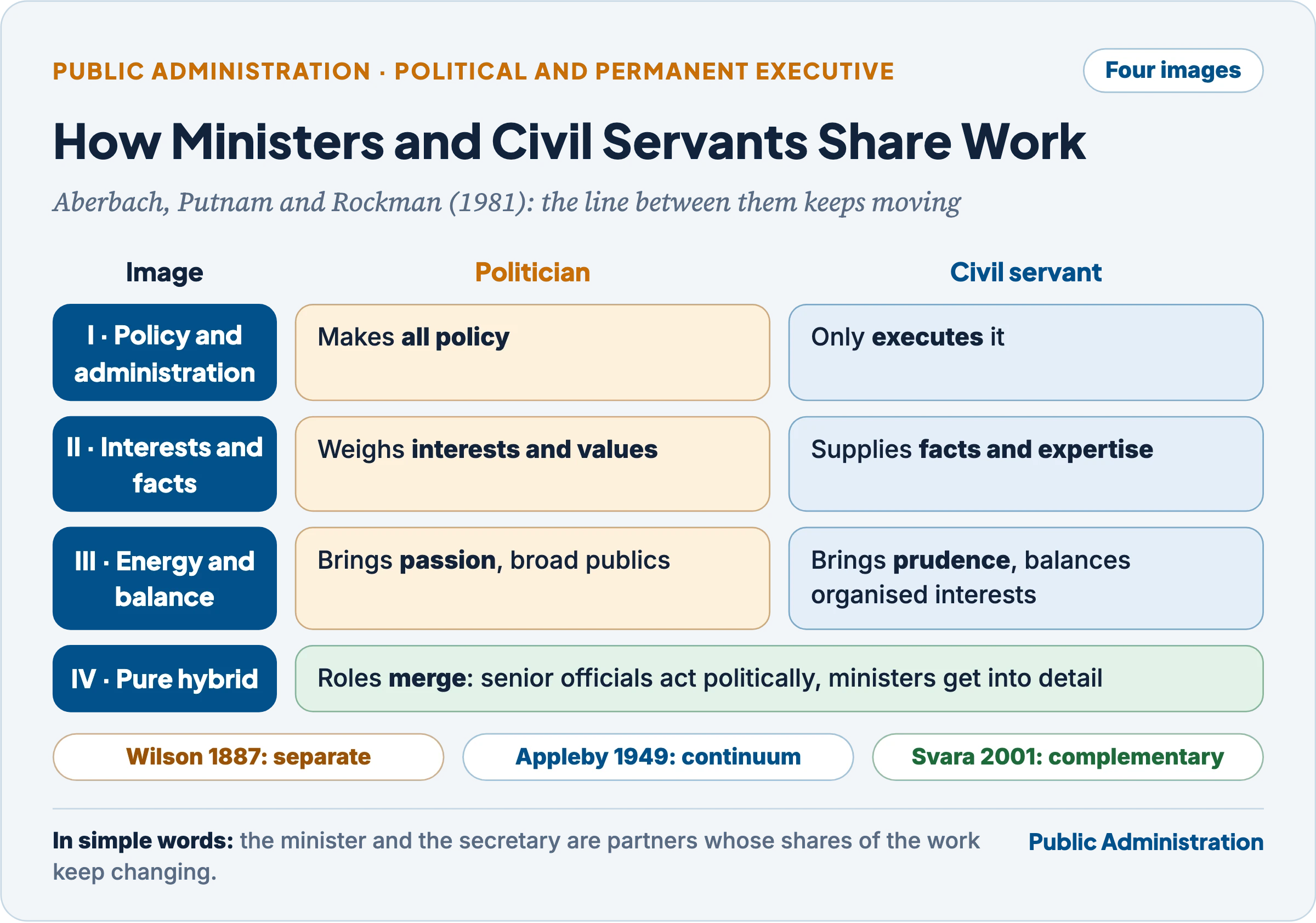
Joel Aberbach, Robert Putnam and Bert Rockman, in Bureaucrats and Politicians in Western Democracies (1981), surveyed senior officials and legislators in seven countries and described four “images” of how roles are divided. Each image gives the civil servant a larger political role than the one before.
| Image | Politician | Civil servant |
|---|---|---|
| I: Policy and administration | Makes all policy | Executes it neutrally (Wilson, Weber) |
| II: Interests and facts | Brings values and interests | Brings facts and expertise; both shape policy |
| III: Energy and equilibrium | Mobilises broad, unorganised publics; passionate, ideological | Mediates narrow, organised interests; prudent, incremental |
| IV: Pure hybrid | Roles converge: officials politicise, politicians bureaucratise | Senior officials act as policy entrepreneurs |
- The authors found Image III closest to reality in the 1970s and saw a drift towards Image IV, with the rise of political advisers, policy units and officials who build coalitions for policies.
- Indian application. At the district level the Collector is closer to Image I; at the Secretary level Image III or IV applies, as Secretaries draft Cabinet notes, negotiate with States and defend policy in parliamentary committees. The line between political and administrative jurisdiction becomes more blurred as one descends from the Union to the State and local levels, where ministers and MLAs intervene directly in postings, schemes and individual cases.
5.3 Four models of the civil servant
Four organising concepts summarise the possible relationships.
| Model | Meaning | Risk |
|---|---|---|
| Neutral | Serves any government loyally; impartial advice; anonymity; no party role | Can mask inertia and class bias |
| Representative | Mirrors society; sympathetic to all groups | Group favouritism |
| Committed | Committed to the goals of the Constitution and the programmes of the state | Slides into loyalty to a party or person |
| Politicised | Serves a party’s interests, bends rules, covert partisanship | Destroys rule of law; a deviation in a multi-party democracy |
- Neutrality and its preconditions. Neutrality works where there is class and cultural congruence between ministers and officials, consensus on core social values, and a shared belief system. Britain had these; most post-colonial states did not, so neutrality could mean status-quo maintenance.
- Neutrality as myth. Brian Chapman (The Profession of Government, 1959) called neutrality a myth that shields officials from scrutiny and risks moral corruption: an official ready to serve every government equally could serve a dictator. C.P. Bhambri (Bureaucracy and Politics in India, 1971) described the Indian bureaucracy as a powerful social group whose neutrality in politics is a myth.
- Political responsiveness without politicisation. Peter Self (Administrative Theories and Politics, 1972) wanted the official to be less a “political eunuch” than a “political chameleon”: sensitive to the values of each government and offering frank advice in their light. A politicised official, by contrast, serves a party covertly, through secrecy and breach of rules. Partisan activity is barred in India by the All India Services (Conduct) Rules, 1968 (Rule 5) and the CCS (Conduct) Rules, 1964.
- Peter Self’s four areas of interaction:
- policy-making, where politicians hold formal responsibility but officials supply much of the content;
- arbitration of interests, a political act in which officials also take part (labour disputes, ethnic conflicts);
- individual and local claims, where officials defend uniform rules against politicians’ wish to help supporters, the main source of friction and patronage;
- the balance between political accountability and administrative discretion, an inevitable point of conflict.
5.4 The Indian constitutional and legal frame
- Executive power vests in the President (Article 53) and Governor (Article 154), exercised on the advice of ministers (Articles 74, 163).
- Rules of Business under Articles 77(3) and 166(3) allocate work among ministries and define the roles of Minister and Secretary: the minister decides policy; the Secretary is the administrative head and chief adviser.
- Article 309 lets legislatures regulate service conditions; Article 310 embodies the doctrine of pleasure; Article 311 protects civil servants from dismissal without inquiry. Article 312 created the All India Services, which serve both Union and States.
- Conduct rules.
- Rule 3(3)(iii) of the AIS (Conduct) Rules requires orders from superiors to be in writing; oral orders must be confirmed in writing.
- The 2014 amendment (Rule 3(1A)) added a list of values, including integrity, political neutrality, merit, fairness, impartiality, accountability and transparency; Rule 3(2B) requires every officer to uphold the supremacy of the Constitution and democratic values, which is the legal form of “commitment” in the constitutional sense.
5.5 The committed bureaucracy debate of the 1970s
- Context. After the Congress split of 1969, Indira Gandhi‘s government pursued bank nationalisation (1969), abolition of privy purses and land reform. Its leaders complained that the ICS-trained, upper-class civil service was status-quo minded and a stumbling block to socialist change, and called for officials with commitment to national development.
- Two meanings of commitment.
- Commitment to constitutional goals: to the Preamble and Directive Principles, to a society without exploitation and with equality of opportunity. Senior Congress leaders, notably Jagjivan Ram, said commitment meant this and not attachment to a party; officials should still advise fearlessly.
- Commitment to the party or leader: officials who say yes, implement whatever is ordered, and are rewarded with postings.
- Degeneration. In practice the debate fed politicisation. During the Emergency many officers obeyed illegal oral orders; the Shah Commission recorded how officers bent laws on arrests, sterilisation and demolitions out of fear or ambition.
- Lasting lessons.
- A civil servant must be committed to the Constitution and the rule of law, not to the ruling party.
- Neutrality in the Indian sense is non-partisanship, not indifference to constitutional goals: a “committed and neutral” civil servant is possible.
- Generalist, all-India services, with security under Article 311 and recruitment by the UPSC, act as a bulwark against a party-loyal bureaucracy.
Common confusion
Is a “committed” civil servant the same as a “politicised” one? No. Commitment means devotion to the values of the Constitution (social justice, equality, development) and to the programmes lawfully adopted by the government of the day, while offering frank advice. Politicisation means serving the party or person in power, breaking rules for partisan ends. The first is compatible with neutrality as non-partisanship; the second destroys it. India’s 1970s debate failed because the first meaning was invoked and the second practised.
5.6 Present-day pathologies in the relationship
- Transfers as reward and punishment. Frequent, premature transfers are the most common lever of political control, especially in the States. Officers who resist pressure are moved; pliable ones get “plum postings“. A transfer and posting industry, with money changing hands, has been reported in several States.
- Caste, region and party alignment. Officers are increasingly identified with particular parties or leaders, and postings change wholesale after elections.
- Collusion and nexus. The Vohra Committee (1993) reported a nexus of politicians, criminals and bureaucrats “virtually running a parallel government” in some areas.
- Post-retirement sinecures. Tribunal, commission and governorship posts after retirement can make officers eager to please in their last years of service.
- Fear and risk aversion. The reverse problem: officers fear vigilance, audit and investigative agencies (sometimes summarised as the “four Cs“: courts, CBI, CVC, CAG) for bona fide decisions, producing policy paralysis. Section 17A of the Prevention of Corruption Act (inserted in 2018) requires prior approval before an inquiry into decisions taken in official functions.
- Bureaucratic dominance. Where ministers lack expertise or interest, officials dominate policy, and the minister becomes a figurehead: the opposite failure of democratic control.
5.7 Reform proposals and the courts
- Santhanam Committee on Prevention of Corruption (1962–64) urged that officers record oral instructions; its report led to the CVC (1964).
- Surinder Nath Committee (2003) reviewed performance appraisal, promotion, empanelment and placement of the All India Services; it proposed objective appraisal against work plans and the mapping of officers to domains for senior placements.
- Hota Committee on Civil Service Reforms (P.C. Hota, 2004):
- a Civil Services Act under Article 309 to make Civil Services Boards statutory, since boards created by executive order merely formalised Chief Ministers’ wishes;
- fixed tenure; a Chief Minister or minister overruling the Board to record reasons;
- an ombudsman for prematurely transferred officers;
- a code of ethics and protection of honest officers from malicious prosecution.
- 2nd Administrative Reforms Commission (chaired by Veerappa Moily until March 2009, then V. Ramachandran as acting chair):
- Fourth Report, Ethics in Governance (2007): codes of ethics for ministers and civil servants.
- Tenth Report, Refurbishing of Personnel Administration (2008): a chapter on the relation between the political executive and civil servants, which holds that the onus for a healthy relationship lies equally on both; a Civil Services Law setting out values and an independent body for senior appointments and tenure; domain competency; lateral entry; performance management and exit for non-performers.
- Fifteenth Report, State and District Administration (2009): selection of the Chief Secretary from a panel and a minimum tenure for key posts.
- T.S.R. Subramanian v. Union of India (31 October 2013): a bench of Justices K.S. Radhakrishnan and P.C. Ghose directed:
- Civil Services Boards of senior serving officers at the Centre and in States, until Parliament legislates under Article 309;
- minimum tenure for civil servants, because repeated shuffling harms good governance;
- that civil servants act on written orders; oral instructions must be recorded, in line with Rule 3(3) and the RTI Act.
- Follow-up. The IAS (Cadre) Amendment Rules, 2014 (notified 28 January 2014) provide that cadre postings be made on the Civil Services Board’s recommendation and that an officer hold a post for at least two years; the competent authority may overrule the Board only by recording reasons. Similar rules were made for the IPS and IFoS.
- The police parallel. Prakash Singh v. Union of India (2006) ordered fixed tenures for police chiefs and Police Establishment Boards; compliance has been partial in many States.
- Assessment. Boards chaired by the Chief Secretary, who is himself chosen by the Chief Minister, offer limited insulation; a Civil Services Act has not been enacted. Tenure has improved at the Centre but premature transfers remain common in States.
5.8 How the changing relationship has affected administration
- 1950s–60s: partnership with deference. Nehru and Patel retained the ICS tradition; senior officers enjoyed prestige and influence, and the political leadership largely respected professional advice.
- 1970s: commitment and the Emergency. Demands for commitment, followed by the Emergency, weakened neutrality norms and made loyalty a career asset.
- 1980s–2000s: coalitions and regional parties. Frequent changes of government, especially in States, multiplied transfers, caste-based alignment and local political intervention in schemes and postings.
- 2010s onward: strong executives and monitoring. Stable majorities at the Centre brought centralised, PMO-driven monitoring (PRAGATI, dashboards), outcome targets and a demand for speed; officers gained clearer direction but less room for dissent, and lateral entry opened top posts to outsiders.
The overall effects on administration are mixed:
- Positive: quicker implementation of flagship programmes, digital delivery, more performance pressure.
- Negative: erosion of tenure and morale, risk aversion, politicised postings, weakened frank and fearless advice, and civil servants tending to adopt the values and ethical frame of the political executive under whom they work.
5.9 Lateral entry
- Meaning. Appointment of specialists from outside the career services (private sector, academia, PSUs, State services) to senior posts, on contract or deputation.
- Origins. Recommended by the 2nd ARC (2008) and reflected in the Sixth Central Pay Commission; earlier there were many ad hoc lateral appointees (economic advisers, heads of UIDAI and others).
- The scheme.
- Launched in 2018, with rounds in 2018, 2021 and 2023.
- 63 appointments at Joint Secretary, Director and Deputy Secretary levels, 35 on contract and 28 on deputation (DoPT, Parliament reply of February 2026 and press conference of June 2026).
- Withdrawal.
- On 17 August 2024 the UPSC advertised 45 posts (10 Joint Secretaries, 35 Directors or Deputy Secretaries).
- On 20 August 2024 the Personnel Minister asked the UPSC to cancel it, because single-post cadres carried no reservation, and the advertisement was withdrawn the same day.
- In June 2026 the Minister said the scheme was not suspended but no feasible model for reservation in stand-alone posts had emerged; no new recruitment has taken place since 2023.
The arguments on lateral entry divide as follows:
| For | Against |
|---|---|
| Domain expertise in complex sectors | Risk of politicisation and back-door entry of favourites |
| Competition and fresh ideas against complacency | Short tenure, weak institutional memory |
| Fills a shortage of officers at middle levels | Accountability and conflict-of-interest concerns |
| Global practice (US, UK, Australia) | No reservation; effect on representativeness |
| Morale of career officers |
- Democratic angle. Lateral entry moves India slightly towards the American in-and-outer model. It strengthens political control over expertise, but without transparent selection by the UPSC and fixed terms it could revive patronage, the very evil merit systems were created to end.
6. Bureaucratic Authoritarianism, Elite Theory and the Steel Frame
In simple words
Sometimes officials and generals stop serving elected leaders and run the country themselves, promising efficiency in place of politics. In India the danger has been milder but persistent: a small, proud, highly educated service that was built to rule a colony has had to learn to serve a democracy.
6.1 Bureaucratic authoritarianism (Guillermo O’Donnell)
- Who and where. Guillermo O’Donnell, an Argentine political scientist, coined the term in Modernization and Bureaucratic-Authoritarianism (1973), studying military-technocratic regimes in Brazil (from 1964) and Argentina (from 1966), later Chile and Uruguay (1973).
- His argument. Modernisation theory (S.M. Lipset) had predicted that economic development would bring democracy. O’Donnell found the opposite in late-industrialising South America: high modernisation produced authoritarianism. Growth created technocratic roles (planners, engineers, managers, officers) in the bureaucracy, army and big firms. Frustrated by populist politics and organised labour, these technocrats formed coalitions with the military and seized power to impose “rational” policies.
- Defining features (O’Donnell, 1978):
- top posts held by people from complex bureaucratic organisations: the armed forces, the public bureaucracy and large firms;
- political exclusion of the popular sector (workers, peasants) through repression and corporatist control of unions;
- economic exclusion: postponing the popular sector’s share in growth;
- depoliticisation: treating social and political issues as technical problems to be solved by experts;
- deepening of industrialisation in a peripheral, dependent capitalism, in alliance with international capital.
- Why it is a model of non-democratic rule.
- Legitimacy comes from efficiency and order, not elections.
- Politics is suppressed, not managed.
- Public bureaucracy and army become the regime, Fainsod’s “ruling bureaucracy” in modern form.
- It differs from traditional authoritarianism (personal, patrimonial), populism (mass mobilisation) and fascism (ideological mobilisation): it is technocratic, exclusionary and demobilising.
- Related ideas.
- Riggs described Thailand as a “bureaucratic polity” (1966), in which officials themselves were the main political actors.
- East Asian developmental states (South Korea, Taiwan) combined authoritarian rule with strong bureaucracies before democratising.
- India. India never became a bureaucratic-authoritarian state: civilian supremacy over the military, competitive elections and judicial review held. But traces appear:
- the Emergency, when officials governed by decree;
- critiques of technocratic depoliticisation, where expert committees and “mission mode” bypass legislatures and local bodies;
- the colonial ruling bureaucracy tradition.
6.2 Macaulay and the elite theory of bureaucracy
- Macaulay’s design. The committee chaired by Thomas Babington Macaulay (report of 1854) recommended an open competitive examination, held in London, for young men with a liberal university education, on the belief that the best-educated “gentlemen” would make the best administrators. The ICS became a small, well-paid, high-status corps that governed India. See the article on Legacy of British Rule.
- Elite theory of bureaucracy. Elite theory (Mosca, Pareto, Mills) sees the higher civil service as a ruling minority: socially exclusive, culturally distinct, self-perpetuating and bound by esprit de corps. Macaulay’s ICS fits closely:
- recruitment from an educated upper stratum;
- guardianship: officials as Platonic guardians ruling for the people, not with them;
- social distance and a mai-baap image;
- generalist prestige over specialist knowledge.
- Persistence after 1947. The model survives in:
- the small size and high status of the IAS and its dominance of top posts;
- examination mystique, an English-language and urban advantage, and long, costly preparation;
- cadre consciousness and resistance to lateral entry and specialists;
- a culture of paternalism towards citizens.
- Counter-trends.
- Reservation has widened the social base; candidates may write in Indian languages (from 1979).
- Entrants from rural and modest backgrounds have grown.
- RTI and social audit expose officials to citizens; 73rd and 74th Amendments placed elected local bodies above some district functions.
- The service today is less an exclusive caste and more a meritocratic elite, but elite attitudes have changed more slowly than elite composition.
- Colonial idea of a privileged elite and resistance to change. Many Asian and African states inherited the civil service as a privileged elite. Its high social status makes it protective of privilege, suspicious of political leaders from humbler backgrounds and slow to accept the loss of control that development and decentralisation require.
6.3 The steel frame and its persistence
- Origin of the phrase. British Prime Minister David Lloyd George called the ICS the “steel frame” of British rule in a 1922 speech. Sardar Patel used the same idea in the Constituent Assembly (10 October 1949) to defend the All India Services as essential to national unity; Article 312 followed.
- What the steel frame means today.
- The All India Services binding Centre and States;
- the district Collector as the State’s integrated agent;
- a generalist, career, examination-recruited elite;
- secrecy and file culture (Official Secrets Act, 1923);
- hierarchical, centralised procedures.
- “Soft outer shell” and “steel frame” beneath. Democratic institutions (elected governments, panchayats, RTI, citizen’s charters) form an outer layer, but the core administrative structure has changed little:
- the Collector remains more powerful than the elected zilla parishad chairperson in most States;
- the Official Secrets Act survives alongside RTI;
- rules of business, file noting and hierarchical clearance still govern work;
- generalist dominance continues despite domain reforms.
- Persistence and change in recent years.
- Persistence: centralised monitoring from the PMO and Chief Ministers’ offices has, if anything, strengthened the frame; the Collector has become the nodal officer for almost every flagship scheme.
- Change: digital delivery (Aadhaar-based DBT) has removed many discretionary points; lateral entry, Mission Karmayogi and outcome dashboards press for competence; Aspirational Districts rank districts publicly.
- Assessment. The frame has proved flexible: it served empire, then national integration, then planning, and now digital delivery. Its strength (continuity, unity, capacity) is also its weakness (rigidity, elitism, distance from citizens).
7. Bureaucracy as an Agent of Development
In simple words
After independence India had little private capital, few roads, mass illiteracy and recurring famine. The government decided to plan the economy and change society, and the only organisation that reached every district was the civil service. So officials who had collected taxes now had to build dams, spread new seeds and run schools.
7.1 Development administration
- Origin. The term development administration was first used by the Indian civil servant U.L. Goswami in 1955 and was popularised by Edward Weidner, George Gant and Fred Riggs in the 1960s.
- Weidner’s definition. Development administration is action-oriented, goal-oriented administration directed to planned change towards nation-building and socio-economic progress.
- Riggs’ two sides:
- administration of development: running programmes of economic and social change;
- development of administration: building the capacity of the machinery itself (training, structures, procedures, integrity).
- Gant’s three tests: the purposes of development administration are change and innovation; its loyalties are to the people, not to a king or vested interests; its attitudes are positive, persuasive and innovative, not rule-bound and passive.
- Contrast with traditional administration.
| Feature | Traditional (law and order, revenue) | Development administration |
|---|---|---|
| Goal | Order, revenue, stability | Planned change, growth, equity |
| Orientation | Rules and process | Results and outcomes |
| Structure | Tall hierarchy, centralised | Flexible, decentralised, field-oriented |
| Citizen | Subject, applicant | Participant, co-producer |
| Time | Routine, continuous | Time-bound, mission mode |
- Development administration still needs law and order: without basic order no programme works, so the two are complementary.
- The functions of development administration include formulating goals and policies, programme and project management, reorganising structures and procedures, evaluating results, securing people’s participation, and building social and political infrastructure.
- See the article on Development Administration.
7.2 The Nehruvian model: the state as planner and provider
- Philosophy. A mixed economy with the state at the “commanding heights” (Industrial Policy Resolution, 1956), five-year plans drawn up by the Planning Commission (1950), import substitution and heavy industry, with land reform and community development for rural change.
- The bureaucracy’s role:
- planning and allocating resources through the Planning Commission and ministries;
- running public sector undertakings (steel, power, oil, banks after 1969);
- licensing and controls over private industry;
- extension and welfare in villages.
- Community Development Programme (2 October 1952) and the National Extension Service (1953) created development blocks under a Block Development Officer and village-level workers. The Balwant Rai Mehta Committee (1957) found people’s participation weak and recommended democratic decentralisation (panchayati raj).
- The Green Revolution. The Intensive Agricultural District Programme (1960–61) and the HYV Programme (1966–67), which spread new dwarf varieties of wheat and rice, were administered through district officials, extension workers, the Food Corporation of India (1965) and agricultural universities; India moved from food imports to food self-sufficiency within a decade.
- Other achievements. Integrating the princely states, managing Partition refugees, building dams and steel plants, famine prevention, elections on a continental scale, and later the eradication of smallpox and polio.
7.3 Recent evidence of developmental capacity
- Elections. The 2024 Lok Sabha election (Section 1.3) was run entirely by civil servants on election duty.
- Aadhaar and Direct Benefit Transfer. The Aadhaar Act, 2016 (upheld with limits in K.S. Puttaswamy v. Union of India, 2018) and the JAM trinity (Jan Dhan accounts, Aadhaar, mobile phones) let officials pay subsidies and wages directly into bank accounts. The government’s DBT Mission estimates cumulative gains of about ₹5.14 lakh crore up to March 2025 from removing duplicate and fake beneficiaries (largely in PDS, LPG and the rural employment scheme).
- Aspirational Districts Programme (2018). 112 backward districts are ranked monthly on health, education, agriculture, infrastructure and financial inclusion, with Collectors as “champions of change”: a competitive, data-driven form of development administration.
- Rural employment. The Viksit Bharat – Guarantee for Rozgar and Ajeevika Mission (Gramin) Act, 2025 replaced MGNREGA from 1 July 2026, raising the guarantee to 125 days, with wages paid through the DBT-SPARSH platform and gram panchayats retaining a role.
Indian Connect — Indian Connect: why the bureaucracy became the main agent
- No alternative organisation reached every district in 1950: private capital was weak, NGOs few, panchayats nominal.
- The Constitution (Directive Principles) and the Plans assigned the state the task of social and economic transformation.
- The ICS tradition of all-round district management could be redirected from revenue to development.
- Its national reach and continuity suited long-term programmes such as irrigation, family planning and literacy.
8. Bureaucracy as an Obstacle to Development
In simple words
The same office that can deliver a new seed variety can also lose the file for months, insist on ten signatures, demand a bribe, or follow a rule even when the rule makes no sense on the ground. These habits turn a development agency into a development brake.
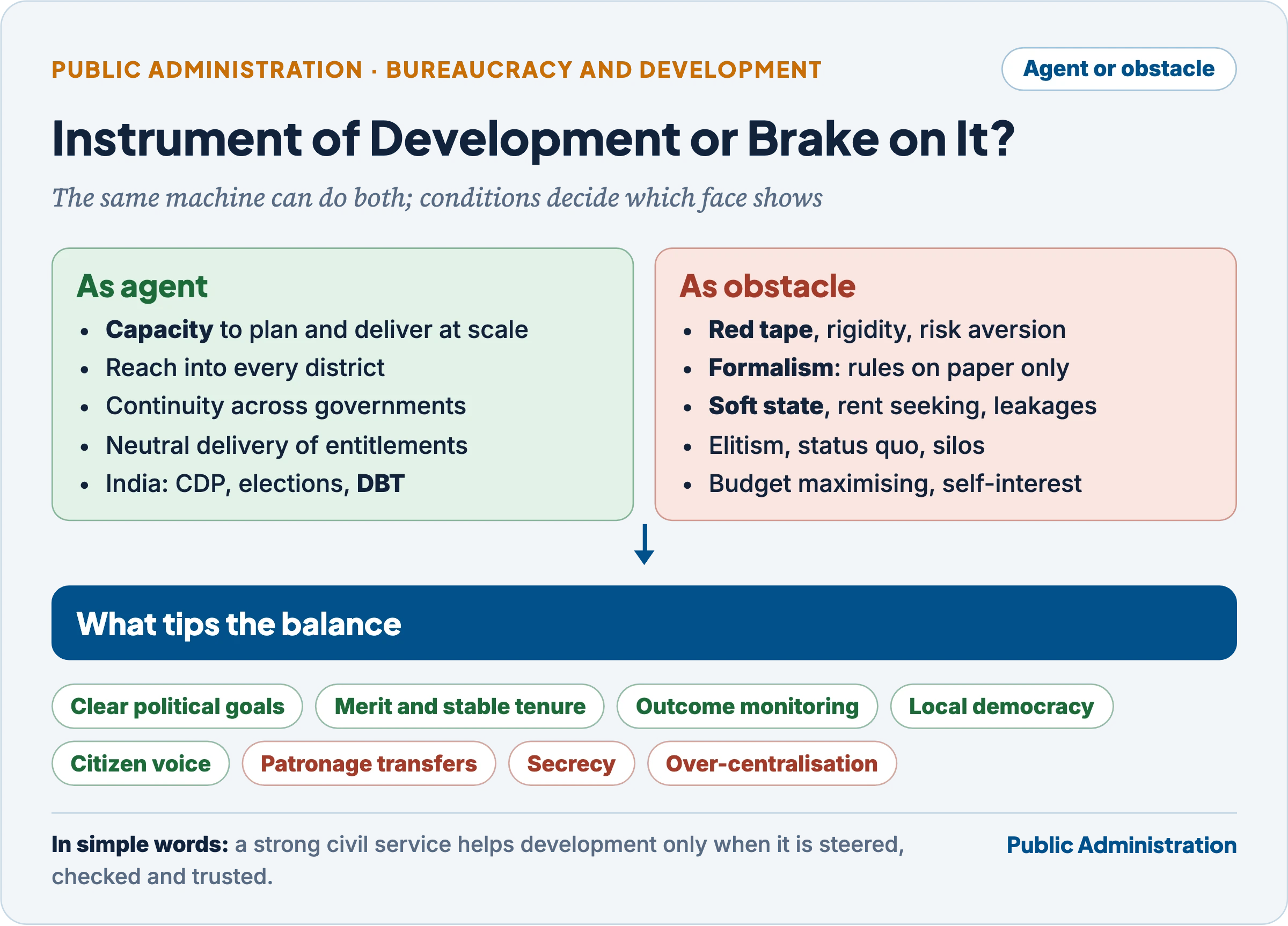
8.1 Why critics call bureaucracy an impediment
- Red tape and proceduralism. Excessive forms, approvals and checks delay projects. Robert Merton (“Bureaucratic Structure and Personality”, 1940) showed how rules become ends in themselves (displacement of goals) and how training produces “trained incapacity” to deal with new situations. Officers fuss over utilisation certificates while the school still lacks a working toilet.
- Rigidity and status quo. Weber’s model was designed for stability and predictability, not radical change. Michel Crozier (The Bureaucratic Phenomenon, 1964) described the vicious circle in which rules breed rigidity, which breeds more rules.
- Formalism (Riggs). In prismatic societies, modern structures are formally in place but behaviour follows traditional, personal and caste ties: laws exist on paper but are not enforced as written. Riggs’ sala model describes an office that is formally rational but in practice run on favouritism, nepotism and “bazaar-canteen” price bargaining for services. See the article on Riggsian Models.
- The soft state (Myrdal). Gunnar Myrdal, in Asian Drama (1968), called South Asian countries “soft states”: they make laws but lack social discipline to enforce them. Officials disobey rules, collude with the powerful people they are meant to regulate, and corruption is widespread. Myrdal also described underdevelopment as cumulative circular causation, in which low income, low productivity and weak institutions reinforce each other.
- Rent seeking. Gordon Tullock (1967) and Anne Krueger (“The Political Economy of the Rent-Seeking Society”, 1974, with India as a key case) showed that licences, quotas and controls create artificial scarcities (rents); firms then spend resources lobbying and bribing officials for them. The licence-permit raj turned officials into gatekeepers of rents.
- Budget maximisation (Niskanen). William Niskanen (Bureaucracy and Representative Government, 1971), a public-choice theorist, argued that bureaucrats maximise their bureau’s budget (for salary, prestige and power) and, because they know the true cost of output better than legislators, over-supply services at excess cost.
- Bureau-shaping (Dunleavy). Patrick Dunleavy (Democracy, Bureaucracy and Public Choice, 1991) replied that senior officials care less about budget size than about work quality: they reshape their bureaus into small, elite, policy-making units and hive off routine delivery to agencies and contractors. His model explains the move to executive agencies and outsourcing better than Niskanen’s.
- Elitism and social distance. A service recruited from a narrow elite and trained for revenue and order may not understand the poor it is meant to develop (Section 6.2).
- Structural problems in developing-country civil services, under four heads:
- personnel regulations: merit on paper but recruitment by political, family, ethnic or religious ties; promotion by seniority; almost no dismissal;
- qualifications: entrants via influence lacking skills; weak training; filling slots rather than matching skills to posts;
- organisational structure: centralisation, overlapping agencies and silos;
- work environment: poor pay at lower levels, low motivation, weak equipment.
- Silos and turf wars. Health, agriculture, rural development and education departments often work as separate fiefdoms, though development problems (malnutrition, water) cut across them.
- Elite capture. An iron triangle of politicians, officials and local elites can capture subsidies and contracts, diverting benefits from target groups.
8.2 Over-dependence on bureaucracy
- What it means. Treating the bureaucracy as the sole instrument of development, to the neglect of panchayats and municipalities, cooperatives, civil society, self-help groups and markets.
- Why it proved dysfunctional in India:
- Leakage and corruption: in 1985 Prime Minister Rajiv Gandhi remarked that only about 15 paise of every rupee spent on the poor reached them.
- Top-down targets: programmes designed in Delhi failed local conditions (family planning targets during the Emergency; uniform schemes in diverse regions).
- Crowding out local democracy: the Collector and line departments kept functions that the 73rd and 74th Amendments meant for elected bodies; panchayats remained agents of departments.
- Dependency culture: people became beneficiaries waiting for officials, not participants.
- Overload: a small elite service cannot manage the whole range of modern development tasks.
- Remedies:
- democratic decentralisation (devolving funds, functions and functionaries to local bodies);
- SHGs and community organisations (Kudumbashree in Kerala, the National Rural Livelihoods Mission);
- NGOs and civil society as partners and watchdogs (social audit);
- markets and PPPs for infrastructure;
- disintermediation through DBT, which removes discretionary middle layers.
8.3 Political interference in the development process
- Forms of interference:
- beneficiary selection by party affiliation;
- siting of projects by electoral calculation rather than need;
- transfers of officers who resist pressure (Section 5.6);
- populist announcements without funding or design;
- contractor–politician links in public works;
- electoral cycles, with spending bunched before elections and projects stalled after a change of government.
- Effects:
- cost and time overruns;
- misallocation of scarce funds;
- demoralised and risk-averse officers;
- loss of trust in schemes;
- fiscal stress from freebies that crowd out capital spending.
- A balanced view. Not all political involvement is interference. Political will is essential for development: the Green Revolution, the rural employment guarantee and DBT needed political leaders to push officials past inertia. Interference is the partisan or private use of administration; direction is the legitimate setting of goals.
- Remedies:
- fixed tenure and Civil Services Boards (T.S.R. Subramanian);
- written orders;
- objective beneficiary lists (Socio-Economic Caste Census data, Aadhaar);
- independent evaluation;
- transparent dashboards and social audit;
- fiscal rules limiting pre-election spending.
8.4 The collision of bureaucratic and democratic values
The claim that a constant collision between bureaucratic and democratic values hurts development can be examined point by point.
| Collision | Effect on development | Reconciliation |
|---|---|---|
| Hierarchy vs participation | Top-down plans ignore local knowledge | Gram sabha planning, participatory budgeting |
| Secrecy vs transparency | Leakages, elite capture | RTI, proactive disclosure, social audit |
| Rules vs responsiveness | Delay, rigid schemes | Flexi-funds, outcome budgets, mission mode |
| Expertise vs popular demand | Technically sound but unpopular projects stall | Consultation, public hearings, deliberation |
| Permanence vs electoral cycle | Officials outlast, or are captured by, short-term politics | Tenure plus accountability for results |
- The collision is not total. Democratic values (participation, transparency, accountability) often improve development outcomes: social audit of the rural employment scheme, RTI exposure of PDS leakages and gram sabha decisions on forest rights show democratic tools making bureaucracy more developmental.
- Bureaucratic values also serve democracy. Rule-following ensures equal treatment, and continuity protects programmes from electoral whims.
- The synthesis is a “democratic development bureaucracy”: hierarchical enough to deliver, open and participative enough to be legitimate.
Criticism — Criticism: bureaucracy as an impediment to development
- Red tape and formalism turn rules into ends and slow every project.
- Soft-state indiscipline and rent seeking divert resources to officials and the powerful.
- An elite, colonial-minded service distrusts people and resists decentralisation.
- Budget maximisation and turf protection put the bureau’s interest above the public’s.
- Over-centralisation and silos produce uniform schemes that fail local needs.
- India’s slow growth before 1991 and persistent leakages are cited as evidence.
Defence — Defence: bureaucracy as an instrument of development
- No development is possible without state capacity: Weberian, merit-based bureaucracies are linked to faster growth in cross-country studies (Peter Evans and James Rauch, 1999).
- India’s bureaucracy delivered food self-sufficiency, elections, integration and digital public infrastructure at continental scale.
- Many failures come from political interference, unclear goals and poor pay at lower levels, not from bureaucracy as such.
- The East Asian developmental states show that a strong, autonomous but embedded bureaucracy can drive rapid development.
- Reforms (DBT, PRAGATI, Mission Karmayogi, outcome monitoring) show the bureaucracy can adapt.
- The real choice is not bureaucracy or no bureaucracy but which kind of bureaucracy.
9. From the Nehruvian Model to Liberalisation and Reinventing Government
In simple words
For forty years India’s officials ran factories, issued licences and decided what businesses could produce. In 1991 a payments crisis forced a change: government stepped back from running things and moved towards setting rules, enabling private activity and delivering services better. Officials had to learn a new job.
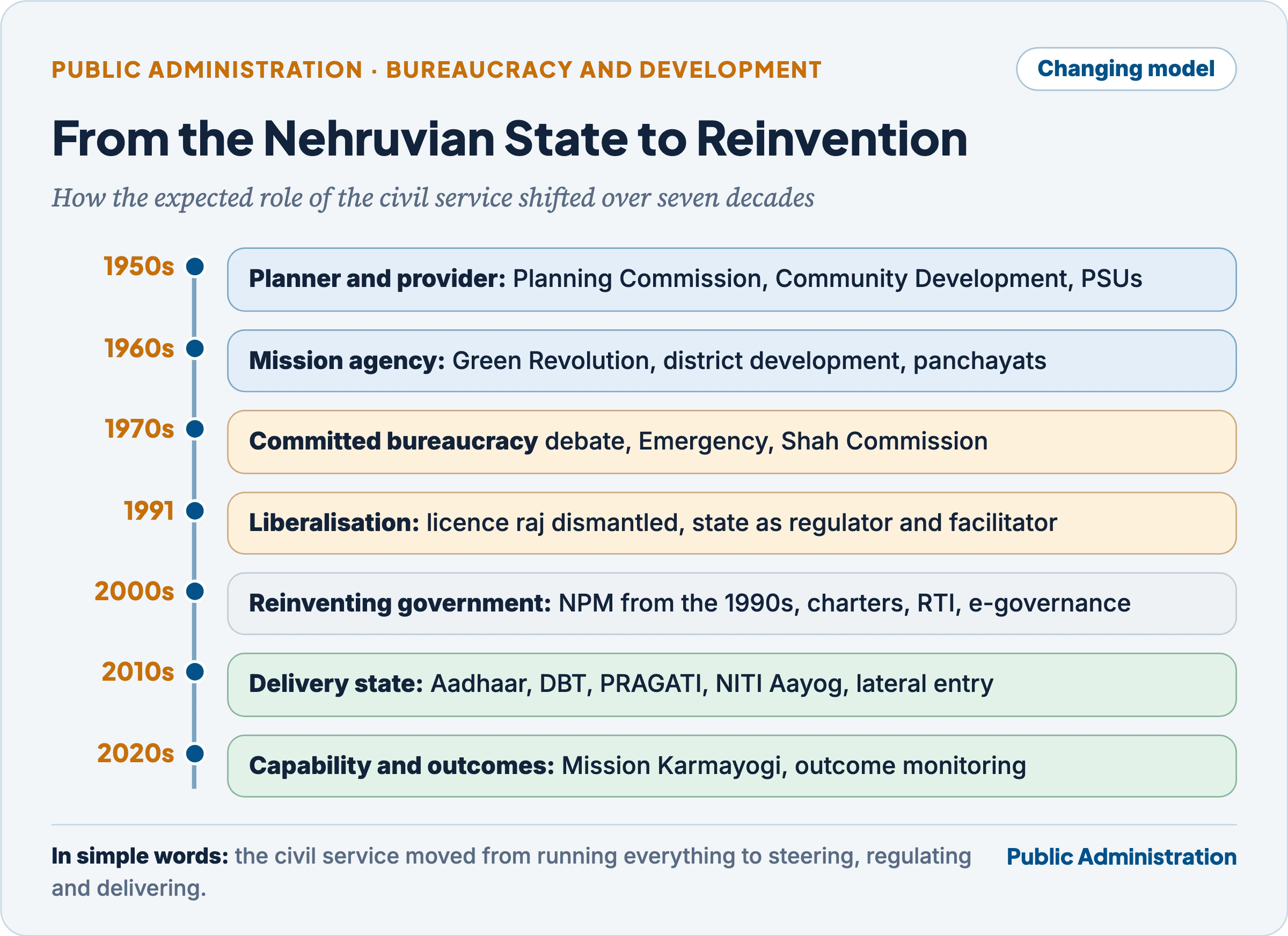
9.1 Why the Nehruvian model gave way
- Fiscal and balance-of-payments crisis of 1991, after years of low growth (the so-called “Hindu rate of growth”), large deficits and inefficient public enterprises.
- Licence-permit raj: controls bred rent seeking, delay and corruption.
- Global shifts: the collapse of the Soviet model, the Washington Consensus and the success of export-led East Asia.
- Intellectual shift from market failure to government failure (public choice, NPM). See the article on Bureaucracy, State, Market and Liberalisation.
9.2 What liberalisation demanded of the bureaucracy
- From controller to facilitator. Dismantling industrial licensing (New Industrial Policy, July 1991), opening trade and foreign investment.
- From provider to regulator. Independent regulators (SEBI made statutory in 1992, TRAI 1997, electricity regulatory commissions) took over functions once done by ministries.
- From producer to partner. Disinvestment and strategic sale of PSUs; PPPs in roads, ports and airports.
- Ease of doing business, single-window clearances and the decriminalisation of minor offences (Jan Vishwas (Amendment of Provisions) Act, 2023).
- NITI Aayog (1 January 2015) replaced the Planning Commission as a policy think tank, ending central plan allocation.
9.3 Reinventing government
- David Osborne and Ted Gaebler, in Reinventing Government (1992), argued that rigid bureaucracies should be replaced by an entrepreneurial government. Their ten principles, with Indian illustrations:
- catalytic (steering rather than rowing): PPPs, viability-gap funding;
- community-owned (empowering rather than serving): SHGs, panchayats;
- competitive: competitive bidding, ranking of States and districts;
- mission-driven rather than rule-driven: national missions;
- results-oriented (funding outcomes): outcome budgets;
- customer-driven: citizen’s charters, Sevottam;
- enterprising (earning rather than spending): asset monetisation;
- anticipatory (prevention rather than cure): disaster preparedness;
- decentralised: 73rd and 74th Amendments;
- market-oriented (leveraging change through the market): DBT replacing in-kind subsidies.
- New Public Management (NPM), described by Christopher Hood (1991), shares this outlook: managerial autonomy, performance targets, competition, contracting out and customer focus. See the article on New Public Management and After.
- Why the shift “necessitated” reinvention. A state that no longer runs everything must do fewer things better: regulate fairly, deliver services efficiently and partner with markets and civil society. A rule-bound, control-oriented bureaucracy is ill-suited to that role.
- Crisis of credibility. Public distrust of a slow, corrupt and unresponsive administration in the 1980s–90s made reinvention a means of restoring legitimacy, not only efficiency.
9.4 Critique and the New Public Service
- Critique of reinvention and NPM.
- Treating citizens as customers weakens citizenship;
- contracting out can hollow out state capacity;
- performance targets breed gaming;
- managerial autonomy may weaken accountability;
- the poor, who lack purchasing power, risk being under-served.
- The New Public Service (NPS). Janet and Robert Denhardt (“The New Public Service: Serving Rather than Steering”, 2000; book, 2003) argued that government should serve citizens, not customers, seek the public interest through dialogue, value citizenship over entrepreneurship, and recognise that accountability is multi-dimensional. India’s rights-based laws (RTI 2005, the rural employment guarantee 2005, the Right to Education 2009, the National Food Security Act 2013) and Right to Services Acts in many States reflect this shift from customers to rights-holders.
- Synthesis. India’s present model combines NPM tools (targets, PPPs, digital delivery) with NPS values (rights, participation) under a strong, centralised political executive, a mix that some describe as neo-Weberian: a reformed but still central role for a professional bureaucracy.
10. Bureaucracy, Environment and Development
In simple words
A highway, a mine or a dam creates jobs and income, but it may also cut a forest, displace a village or pollute a river. Officials must decide whether, where and how such projects go ahead. They have to weigh growth today against the environment that future growth depends on.
10.1 The dilemma
- Developmental imperative. India needs infrastructure, energy, housing and jobs for a large, young population; delays in clearances raise costs and stall investment.
- Environmental imperative. Climate change, air pollution, water stress, forest loss and fragile Himalayan and coastal ecosystems demand restraint. Ecological damage also hurts the poor and tribal communities first.
- The bureaucracy plays both sides. Promoting ministries (roads, power, mines, industry) push projects; regulating bodies (Environment Ministry, State Pollution Control Boards, forest departments) must assess and restrain them. The same Collector may chair both the land-acquisition process and the district environment committee.
10.2 The legal and administrative tools
- Constitution:
- Article 48A (State to protect and improve the environment);
- Article 51A(g) (citizens’ duty);
- Article 21, read by courts to include the right to a wholesome environment.
- Laws and rules:
- Water Act, 1974, Air Act, 1981, Environment (Protection) Act, 1986;
- Forest (Conservation) Act, 1980, amended in 2023 and renamed the Van (Sanrakshan Evam Samvardhan) Adhiniyam, which exempted some categories of land and strategic linear projects;
- Forest Rights Act, 2006;
- EIA Notification, 2006, with public hearings;
- the PARIVESH online clearance portal (2018);
- the National Green Tribunal Act, 2010.
- Judicial principles:
- sustainable development, precautionary principle and polluter pays (Vellore Citizens’ Welfare Forum, 1996);
- the dictionary meaning of “forest” (T.N. Godavarman Thirumulpad, 1996 onwards).
10.3 Cases that show the balance
- Niyamgiri (Orissa Mining Corporation v. Ministry of Environment and Forests, 2013). The Supreme Court left it to the gram sabhas of the Dongria Kondh to decide whether bauxite mining would affect their religious and cultural rights; they rejected it. Democratic participation decided a development–environment conflict.
- Ex post facto clearances (Vanashakti). On 16 May 2025 a two-judge bench struck down the 2017 notification and a 2021 Office Memorandum that allowed ex post facto environmental clearance to projects begun without it. On 18 November 2025, on review petitions by builders, SAIL and Karnataka, a three-judge bench recalled that judgment by 2:1, citing public projects (hospitals, airports) worth thousands of crores that would otherwise be demolished; Justice Ujjal Bhuyan dissented. The case shows the courts themselves struggling with the trade-off.
- Himalayan fragility. Land subsidence at Joshimath (January 2023) and the Silkyara tunnel collapse (November 2023) raised questions about road and tunnel projects in fragile terrain and about cumulative impact assessment.
10.4 How the bureaucracy can strike the balance
- Integrated, early planning. Environmental appraisal at the plan and policy stage (strategic environmental assessment), not only at the project stage; use of PM GatiShakti layers to avoid sensitive areas.
- Credible, independent appraisal. Expert committees free of conflicts of interest; the Supreme Court in Lafarge Umiam Mining (2011) called for a national regulator for appraisal.
- Participation. Genuine public hearings and gram sabha consent under the Forest Rights Act.
- Time-bound, transparent clearance to avoid both delay and rubber-stamping.
- Monitoring and enforcement of conditions after clearance, the weakest link in practice.
- Green accounting and budgeting, compensatory afforestation (CAMPA), and capacity building in environmental science through Mission Karmayogi.
- Values. The bureaucrat as trustee of future generations (the public trust doctrine, M.C. Mehta v. Kamal Nath, 1997), not merely a project facilitator.
11. Current Reforms: Towards a Capable and Accountable Bureaucracy
In simple words
Recent reforms try to fix both problems at once: make officials more skilled and focused on results, and make their work more visible to leaders and citizens. Training platforms, project dashboards and direct cash transfers are the main tools.
11.1 Mission Karmayogi
- Approved by the Union Cabinet on 2 September 2020 as the National Programme for Civil Services Capacity Building (NPCSCB).
- Institutions:
- the Prime Minister’s Public Human Resources Council;
- a Capacity Building Commission to set standards and supervise central training institutes;
- Karmayogi Bharat, a not-for-profit special purpose vehicle running the iGOT Karmayogi online platform;
- a coordination unit under the Cabinet Secretary.
- Principles: a shift from “rules-based” to “roles-based” HR management; a Framework of Roles, Activities and Competencies (FRACs) for every post; behavioural, functional and domain competencies; on-site and continuous learning.
- Scale. By May 2025 iGOT Karmayogi had crossed 1 crore registered civil servants, with over 2,400 courses in 16 languages.
- Significance. It addresses the generalist–specialist gap without abandoning the career service, the development of administration side of Riggs’ formula.
11.2 Outcome monitoring
- The Development Monitoring and Evaluation Office (DMEO) of NITI Aayog (2015) evaluates schemes and runs the Output–Outcome Monitoring Framework, which links budget allocations to measurable outputs and outcomes for central schemes.
- Outcome budgets, dashboards for flagship schemes, the Aspirational Districts rankings and State rankings (good governance index, ease of doing business) make bureaucratic performance visible and comparable.
- Limits. Indicators can be gamed; data quality varies; outcomes depend on factors beyond officials’ control.
11.3 PRAGATI
- Pro-Active Governance and Timely Implementation, launched on 25 March 2015, is an ICT platform through which the Prime Minister reviews stalled projects, schemes and public grievances directly with Union Secretaries and State Chief Secretaries by video conference.
- At its 50th meeting (31 December 2025) the government reported that 377 projects had been reviewed since 2014, about 94 per cent of identified issues resolved, and projects worth more than ₹85 lakh crore accelerated.
- Assessment.
- Strengths: breaks inter-ministerial and Centre–State silos, fixes accountability at the top, uses geo-spatial data.
- Concerns: heavy centralisation in the PMO, dependence on personal prime-ministerial attention, and pressure that can override environmental or procedural checks.
11.4 Other reforms
- Direct Benefit Transfer and e-office reduce discretion and paper.
- CPGRAMS (centralised grievance redress) with time limits and feedback.
- Jan Vishwas Act, 2023 decriminalises minor offences across many central laws, reducing the inspector raj.
- Lateral entry remains in limbo after August 2024 (Section 5.9).
- Tenure and Civil Services Boards under the 2014 Cadre Rules.
Theory lens: reading Indian bureaucracy through Paper I ideas
- Weber’s legal-rational bureaucracy. Max Weber (Economy and Society, 1922) explains both the strengths of the Indian civil service (merit, hierarchy, impersonality, continuity) and the democratic fear of it (power through expertise and secrecy). India’s controls (ministerial responsibility, RTI, courts) are attempts to tame Weber’s “overtowering” bureaucracy. See the article on Weber and Bureaucracy.
- Riggs’ prismatic model and formalism. Fred Riggs (Administration in Developing Countries, 1964) explains the gap between India’s formal rules (tenure, neutrality, decentralisation) and practice (transfers, patronage, Collector dominance), and his imbalance thesis explains why a strong bureaucracy with weak political institutions threatens democracy. See the article on Riggsian Models.
- Development administration. U.L. Goswami (1955) and Edward Weidner frame the Indian bureaucracy’s post-1947 task as goal-oriented, planned change; Riggs’ pairing of administration of development and development of administration maps onto India’s schemes on one side and Mission Karmayogi on the other. See the article on Development Administration.
- Public choice. William Niskanen‘s budget-maximising bureaucrat, Patrick Dunleavy‘s bureau-shaping officials and Anne Krueger‘s rent seeking explain licence-raj corruption, departmental expansion and the hiving-off of delivery to agencies and contractors; they also supplied the case for liberalisation. See the article on New Public Administration and Public Choice.
- NPM, reinventing government and the New Public Service. Osborne and Gaebler‘s entrepreneurial government explains PPPs, outcome budgets and DBT; Denhardt and Denhardt‘s New Public Service explains rights-based laws and citizen-centric reforms that correct NPM’s “customer” view. See the article on New Public Management and After.
- Appleby’s politics–administration continuum. Paul Appleby (Policy and Administration, 1949) explains why Indian Secretaries inevitably shape policy and why ministers enter administration; the Aberbach–Putnam–Rockman images describe its stages. See the article on Wilson and Evolution of the Discipline.
- Principal–agent theory. Voters are principals of ministers, and ministers principals of officials; information asymmetry lets agents pursue their own goals. Written orders, tenure rules, performance dashboards and RTI are devices to reduce agency loss. See the article on Accountability and Control.
- Elite theory and representative bureaucracy. Mosca, Pareto and Mills explain the Macaulay legacy; Kingsley, Mosher and Krislov explain reservation and the 2024 lateral-entry controversy as democratic correctives. See the article on Recruitment, Training and Career.
Key Terms
| Term | Meaning in simple words |
|---|---|
| Bureaucracy | Government by appointed, salaried, career officials working under rules in a hierarchy |
| Political executive | Elected ministers who head departments and answer to the legislature |
| Permanent executive | Career civil servants who stay through changes of government |
| Politics–administration dichotomy | Wilson’s idea that deciding policy and carrying it out are separate tasks |
| Continuum (Appleby) | The view that policy and administration blend into each other |
| Iron law of oligarchy | Michels’ claim that every large organisation ends up ruled by a few |
| Juridical democracy | Lowi’s remedy: legislatures should write clear rules that bind agencies |
| Representative bureaucracy | A civil service whose social make-up mirrors the population |
| Passive and active representation | Mirroring society (passive) versus pushing one’s group’s interests (active) |
| Democracy within bureaucracy | Participation, consultation and staff voice inside administrative organisations |
| Neutrality | Serving every lawful government impartially, without party involvement |
| Committed bureaucracy | Officials committed to constitutional and developmental goals; in its distorted form, to a party |
| Politicisation | Use of civil servants for party ends; bending rules for partisan benefit |
| Civil Services Board | Committee of senior officers that recommends postings and checks premature transfers |
| Lateral entry | Appointment of outside specialists to senior government posts |
| Bureaucratic authoritarianism | O’Donnell’s term for rule by military–technocratic coalitions that exclude the popular sector |
| Elite theory | The view that a small organised minority always rules |
| Steel frame | The All India Services as the structure that holds the state together |
| Development administration | Goal-oriented administration for planned socio-economic change |
| Formalism | Gap between formal rules and actual behaviour (Riggs) |
| Soft state | Myrdal’s term for states that make laws but cannot enforce them |
| Rent seeking | Spending resources to capture artificial profits created by government controls |
| Budget-maximising bureaucrat | Niskanen’s official who seeks a bigger budget for the bureau |
| Bureau-shaping | Dunleavy’s official who reshapes the bureau into a small policy unit |
| Reinventing government | Osborne and Gaebler’s model of entrepreneurial, results-driven government |
| New Public Service | Denhardts’ model: serve citizens, not customers; steer through dialogue |
| Direct Benefit Transfer | Paying subsidies and benefits straight into beneficiaries’ bank accounts |
| Ex post facto clearance | Environmental approval granted after a project has already begun |
Commissions, Committees and Judgments
The bodies and cases below shaped the relation between India’s bureaucracy, its democracy and its development, listed by year.
| Body / case | Year | Key point |
|---|---|---|
| Macaulay Committee (T.B. Macaulay) | 1854 | Open competition, liberal education: the elite generalist model |
| Community Development Programme | 1952 | Blocks and village-level workers: bureaucracy as development agent |
| Balwant Rai Mehta Committee (Balwant Rai Mehta) | 1957 | Weak participation; democratic decentralisation |
| Santhanam Committee (K. Santhanam) | 1962–64 | Record oral instructions; led to the CVC |
| Kothari Committee (D.S. Kothari) | 1976 | Three-stage exam from 1979; Indian-language option |
| Shah Commission (J.C. Shah) | 1977–78 | Emergency excesses; officials obeyed illegal orders |
| Indra Sawhney v. Union of India | 1992 | OBC reservation upheld; 50% ceiling; creamy layer |
| Vohra Committee (N.N. Vohra) | 1993 | Politician–criminal–bureaucrat nexus |
| Vellore Citizens’ Welfare Forum v. Union of India | 1996 | Sustainable development, precautionary and polluter-pays principles |
| Surinder Nath Committee (Surinder Nath) | 2003 | Objective appraisal; domain-based placement of AIS officers |
| T.K. Rangarajan v. Government of Tamil Nadu | 2003 | No right to strike for government employees |
| Hota Committee (P.C. Hota) | 2004 | Statutory Civil Services Boards, fixed tenure, reasons for overruling |
| Prakash Singh v. Union of India | 2006 | Police tenure and Establishment Boards to curb interference |
| M. Nagaraj v. Union of India | 2006 | Conditions for reservation in promotion |
| 2nd ARC, 4th Report (Veerappa Moily) | 2007 | Ethics in governance; codes for ministers and civil servants |
| 2nd ARC, 10th Report (Veerappa Moily) | 2008 | Civil Services Law, tenure, domains, lateral entry, minister–official relations |
| 2nd ARC, 15th Report (V. Ramachandran, acting chair) | 2009 | Chief Secretary from a panel; minimum tenure |
| Orissa Mining Corporation v. MoEF (Niyamgiri) | 2013 | Gram sabhas decide on forest rights before mining |
| T.S.R. Subramanian v. Union of India | 2013 | Civil Services Boards, minimum tenure, written orders |
| IAS (Cadre) Amendment Rules | 2014 | Two-year minimum tenure; Board recommends postings |
| K.S. Puttaswamy v. Union of India (Aadhaar) | 2018 | Aadhaar for welfare upheld with privacy limits |
| Jarnail Singh v. Lachhmi Narain Gupta | 2018 | No data on SC/ST backwardness needed for promotion quota |
| Janhit Abhiyan v. Union of India | 2022 | EWS reservation upheld (3:2) |
| Government of NCT of Delhi v. Union of India | 2023 | Triple chain: officials to ministers, ministers to legislature, legislature to voters |
| State of Punjab v. Davinder Singh | 2024 | States may sub-classify SCs |
| Vanashakti v. Union of India and review | 2025 | Ex post facto clearances struck down (May); judgment recalled 2:1 (November) |
Contemporary Developments
- Lateral entry in limbo (2024–2026). The UPSC’s 17 August 2024 advertisement for 45 posts was cancelled on 20 August 2024 over the absence of reservation. A Parliament reply of February 2026 put lateral appointments since 2018 at 63; in June 2026 the Personnel Minister said the scheme was not suspended but no workable reservation model had been found.
- Mission Karmayogi at scale (May 2025). The iGOT Karmayogi platform crossed 1 crore registered civil servants, with over 2,400 courses in 16 languages aligned to the Karmayogi Competency Model.
- PRAGATI’s 50th meeting (31 December 2025). The government reported 377 projects reviewed since 2014, about 94 per cent of issues resolved and projects worth over ₹85 lakh crore accelerated; the Prime Minister urged States to build similar mechanisms for the social sector.
- DBT gains (March 2025). The DBT Mission estimated cumulative savings of about ₹5.14 lakh crore from removing duplicate and fake beneficiaries, mainly in PDS, LPG and rural employment.
- Rural employment law replaced (1 July 2026). The VB–G RAM G Act, 2025 replaced MGNREGA, guaranteeing 125 days of work with wages paid through DBT-SPARSH.
- Environment versus development in court (2025). The Vanashakti judgment of 16 May 2025 barring ex post facto clearances was recalled on 18 November 2025 by a 2:1 bench, leaving the matter to a larger bench.
- Representative bureaucracy (1 August 2024). In Davinder Singh a seven-judge bench allowed sub-classification of Scheduled Castes for reservation, sharpening the debate on whose representation reservation should secure.
- Elections as administrative feat (2024). The 2024 Lok Sabha poll mobilised about 1.5 crore polling and security personnel for nearly 98 crore electors.
Revision Grid
| Thinker / body | Work or report (year) | Key idea |
|---|---|---|
| Woodrow Wilson | The Study of Administration (1887) | Politics–administration dichotomy |
| Max Weber | Economy and Society (1922); Parliament and Government (1918) | Bureaucracy indispensable but a threat; parliament must control it |
| Robert Michels | Political Parties (1911) | Iron law of oligarchy |
| J. Donald Kingsley | Representative Bureaucracy (1944) | Neutrality depends on class congruence; service must be representative |
| Paul Appleby | Policy and Administration (1949); India reports (1953, 1956) | Politics–administration continuum |
| Brian Chapman | The Profession of Government (1959) | Neutrality is a myth |
| Fred Riggs | Administration in Developing Countries (1964); 1963 essay | Formalism, sala; bureaucracy outgrowing politics |
| Joseph La Palombara | Bureaucracy and Political Development (1963) | Imbalance between bureaucracy and political institutions |
| Gunnar Myrdal | Asian Drama (1968) | Soft state, circular causation |
| Frederick Mosher | Democracy and the Public Service (1968) | Passive and active representation |
| Theodore Lowi | The End of Liberalism (1969) | Interest-group liberalism; juridical democracy |
| C.P. Bhambri | Bureaucracy and Politics in India (1971) | Bureaucracy as a powerful social group |
| William Niskanen | Bureaucracy and Representative Government (1971) | Budget-maximising bureaucrat |
| Guillermo O’Donnell | Modernization and Bureaucratic-Authoritarianism (1973) | Technocratic-military rule excluding the popular sector |
| Anne Krueger | Rent-seeking society (1974) | Controls create rents and corruption |
| Samuel Krislov | Representative Bureaucracy (1974) | Representation builds legitimacy |
| Aberbach, Putnam, Rockman | Bureaucrats and Politicians in Western Democracies (1981) | Four images of the relationship |
| Eva Etzioni-Halevy | Bureaucracy and Democracy: A Political Dilemma (1983) | Independent bureaucracy both needed and dangerous |
| Patrick Dunleavy | Democracy, Bureaucracy and Public Choice (1991) | Bureau-shaping |
| Osborne and Gaebler | Reinventing Government (1992) | Entrepreneurial government, ten principles |
| Denhardt and Denhardt | The New Public Service (2000) | Serve citizens, not customers |
| U.L. Goswami; Edward Weidner | 1955; 1960s | Development administration |
| Hota Committee | 2004 | Statutory boards, fixed tenure |
| 2nd ARC | 10th Report (2008) | Civil Services Law, tenure, lateral entry |
| Supreme Court | T.S.R. Subramanian (2013) | Boards, tenure, written orders |
Previous Year Questions
- 2024Examine the impact on administration in view of changing relations between political and permanent executive.
- 2024The concept of bureaucratic authoritarianism is one of the models of non-democratic rules. Explain.
- 2023Critics, sometimes, argue that bureaucracy is an impediment to a nation’s development. Analyse.
- 2023“Excessive political interference in development process has become a cause of concern in achieving national goals. Examine.
- 2020There is a constant and continuous collision between bureaucratic values and democratic values which adversely affects development. Do you agree? Elaborate.
- 2019Macaulay’s ideas on Indian Civil Service Corresponded to the elite theory of bureaucracy, which continue to persist. Do you agree? Justify.
- 2018It is apprehended that lateral entry will lead to politicisation of bureaucracy. Do you agree? Justify
- 2017“Bureaucracy has to make a balance between the need for environmental sustainability and developmental imperatives.” Discuss.
- 2015“Democracy within bureaucracy is likely to reduce its effectiveness.” Do you agree with this view? Argue your case.
- 2014“Beneath the soft outer shell of democratic administrative framework lies unscathed the steel frame of Indian administration which has survived through ages.” In the light of this statement, examine the relationship between bureaucracy and development in the last one decade.
- 2012‘Bureaucrats should not play politics, but understand how politics Works.’ Comment.
- 2011“Over-dependence on bureaucracy for bring about socio-economic development in India has proved to be dysfunctional.” Comment.
- 2010Comment on the following statements: – “The more developed an administrative system became the greater the likelihood that it would have developmental effects.” “The thrust of development administration failed to energise the Indian bureaucracy.”
- 2008‘The shift from the Nehruvian to the liberalisation model of development has necessitated reinventing government.’ Comment.
- 2008There is constant and continuous collision between bureaucratic values and democratic values which adversely affects development. In the light of this statement examine the role of bureaucracy in development.
- 1993“The incumbents to civil service posts and political offices, who derive, their legitimacy and strength from intellectual merit and popular support respectively, cannot have identical perspectives on development. Naturally, therefore, the former has a higher & heavier responsibility to avoid conflict & preserve integrity in development administration.” Comment.
- 1992‘Reservation Policy in Public Services as a mandate from the Constitution has been conducive to the promotion of Social Justice.’ Discuss and illustrate.
- 1992‘The Indian Constitution provides a mere environmental setting for our politics and administration but the state of conflict arises from the mass base and the elitist orientations of the two respectively.’ Comment.
- 1990‘The line of demarcation between the spheres of Jurisdiction of the political executive and the Civil Servants get blurred more vividly as we descend from the Union to the State and further to the local level.’ Comment.
- 2024Bureaucracy in developing countries faces several challenges, and tackling of these will make them more responsive, adaptive, and align with development needs. Discuss.
- 2023“In career advancement, civil servants are necessitated to political superiors and hence the phenomenon poses the challenges to civil service neutrality.” Comment.
- 2021Civil servants generally tend to exhibit the values and ethical framework of the political executives under whom they function. Explain.
- 2019Is William Niskanen’s “Budget Maximising Model” relevant today? Argue.
- 2018In order to be development-oriented, bureaucracies need to be innovative, flexible, citizen-centric and result-oriented, but they are slow in imbibing these virtues in a democratic system. Do we need to go beyond the traditional models of bureaucracy and create alternative structures? Elaborate.
- 2017“Bureaucracy has inbuilt limitations to act as the prime catalyst to multi-faceted development in a democratic country”. Analyse this statement with appropriate examples.
- 2016“Bureau-Shaping Model has been developed as a response to the Budget-Maximizing Model.” Comment.
- 2014“Many Asian and African countries have inherited the colonial idea of civil service as a privileged elite. Hence, the social status of the civil services is an important aspect of the bureaucracy’s unsuitability for change.” Comment.
- 2011‘A crisis of credibility’ in the administrative system can be overcome only by ‘reinventing government’. Comment.
- 2008“In certain discourses, there is a reflected basic distrust against bureaucracy as an instrument of development.” Do you think bureaucracy is more appropriate for regulatory administration than for development administration? In the changing profile of development, what role of bureaucracy can be envisaged?
- 1999“It is not weak but strong bureaucracy that creates concern in democracy.” Comment.
- 1999“The principle of bureaucratic neutrality is more superfluous and redundant in the context of developing countries.” Comment.
- 1999“The basic question in the relationship between political and permanent executives is the separation of facts and values at the operational level.” Comment.
- 1997How far is it true to state that for a developing democracy the concept of civil service neutrality is outdated; instead there is a need for a civil service with professional competence and commitment?
- 1996“Committed bureaucracy is unsuitable in a Parliamentary democracy.” Comment.
- 1992‘Bureaucracy thrives under the cloak of ministerial responsibility in a parliamentary democracy; Comment.