

Kautilya’s Arthashastra; Mughal administration; Legacy of British rule in politics and administration – Indianization of public services, revenue administration, district administration, local self-government.
This article: Company rule and constitutional evolution as it shaped administration (Clive’s double government, Regulating Act 1773, Pitt’s India Act 1784, Charter Acts 1793–1853, regulation and non-regulation provinces, Act of 1858, Indian Councils Acts 1861, 1892 and 1909, Government of India Acts 1919 and 1935, Indian Independence Act 1947); rational-legal modernisation 1830–1865; the secretariat and portfolio systems; civil services from covenanted service to ICS, Haileybury, the Macaulay Report, open competition, the Aitchison, Islington and Lee Commissions, the Public Service Commission of 1926 and Indianisation; the generalist–neutral model and the “steel frame”; revenue administration (Permanent, Ryotwari and Mahalwari settlements; budget and audit); district administration (the Collector-cum-District Magistrate, Cornwallis and Munro schools, the prefectorial system, police after 1861, judicial administration from 1774 to the Federal Court); local self-government (Mayo 1870, Ripon 1882, the Decentralisation Commission, the 1919 transfer); the overall legacy, its persistence after 1947 and the changes since.
Official Syllabus: Paper II · Unit 2-01 Evolution of Indian Administration
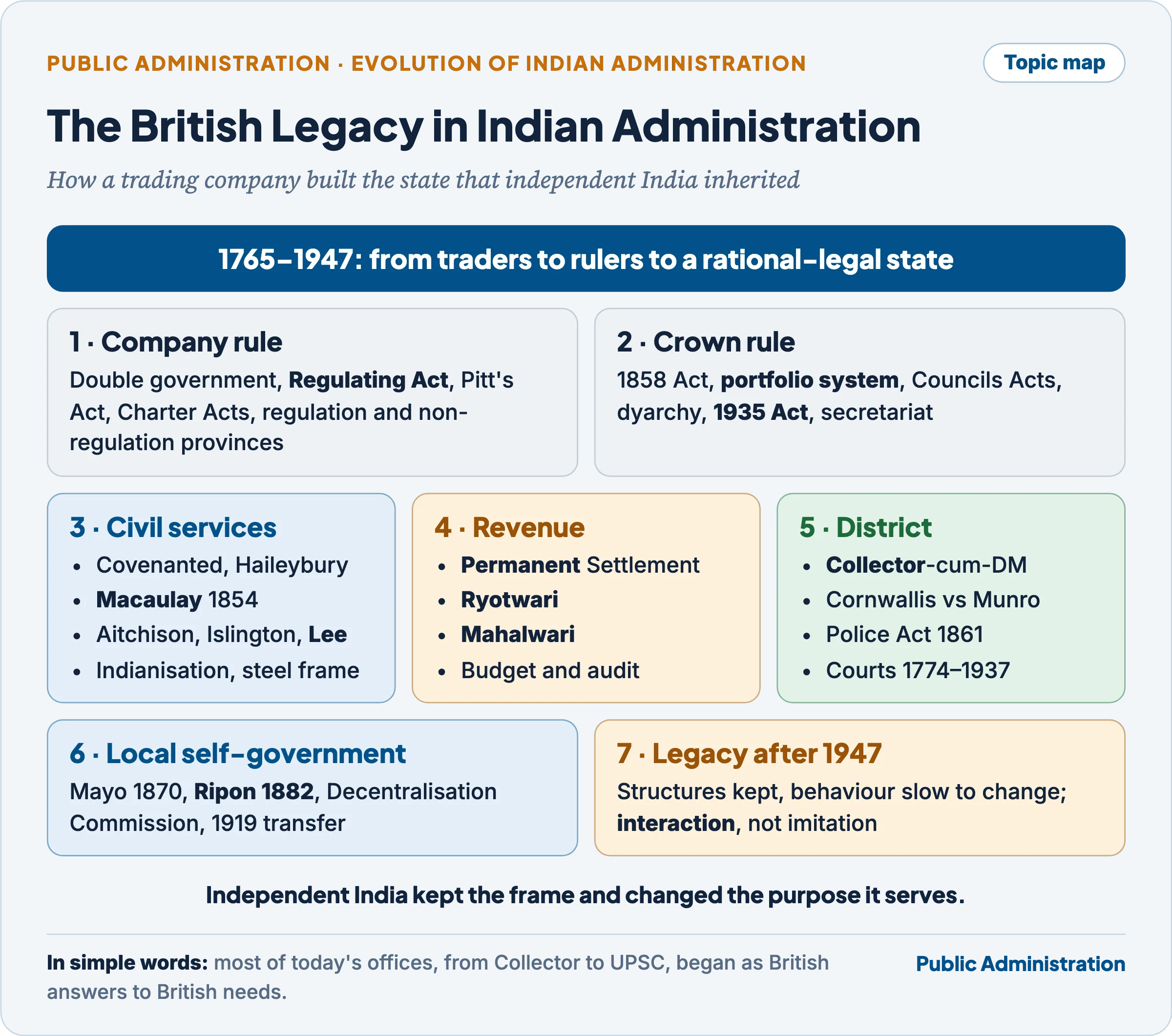
The administrative system of independent India was not designed on a clean slate in 1947. Its All India Services, public service commissions, secretariat, district Collector, land records, police, courts, budget and audit, and even large parts of the Constitution grew out of nearly two centuries of British rule. That system was built for a colonial purpose: to collect revenue, keep order and hold a vast country with a small number of foreign officials. Independent India kept most of the structure and tried to turn it to the purposes of democracy, welfare and development. Understanding where each institution came from explains both its strengths (continuity, integrity, an all-India outlook) and its weaknesses (centralisation, secrecy, distance from citizens, red tape).
In simple words
Think of a large old house bought by a new family. The walls, rooms and wiring were laid out by the previous owner for his own habits. The new family keeps the house because rebuilding is costly, but it knocks down some walls, adds new rooms and slowly changes how the house is used. Indian administration after 1947 is that house.
1. From Trading Company to Government: Company Rule, 1600–1858
In simple words
The East India Company came to India to buy and sell goods. Over about a hundred years it began collecting taxes, judging cases and commanding armies. The British Parliament then passed one Act after another to control this strange company that had become a government.
1.1 The Company as a commercial body
- Origins. On 31 December 1600 the British Crown granted a group of London merchants a monopoly of trade in the eastern seas. Until the 1750s the East India Company was a trading corporation whose charter Parliament renewed from time to time.
- Commercial staffing. A trading station was a factory; its employees were graded as apprentices, writers, factors and merchants. Appointments were by patronage of the Company’s Directors, pay was low, and servants made their fortunes through private trade and presents. The old Company habit of low pay plus private gain is one source of the later tradition of corruption in public office.
- Government by council, by boards and by record. Three habits of the trading Company passed into the government it became:
- Collective decision-making in a council, with the President (later Governor-General) having a casting vote.
- Boards for each line of business (Board of Trade, Military Board, Board of Revenue), which allowed deliberation and later became the model for the Railway Board and the Board of Revenue.
- Government by record: notes, minutes, despatches and reports, because a Company headquartered in London could control distant servants only through paper. This is the root of the Indian file-and-noting culture.
1.2 Diwani and Clive’s double government (1765–1772)
- After Plassey (1757) and Buxar (1764), the Mughal emperor Shah Alam II granted the Company the diwani (the right to collect revenue and decide civil cases) of Bengal, Bihar and Orissa in 1765.
- Robert Clive did not take over administration directly. He set up a double (dual) government:
- the Company held the diwani and the real power (army and money);
- the Nawab kept the nizamat (criminal justice and police) and the formal responsibility, through Indian deputies such as Muhammad Reza Khan in Bengal.
- Why Clive chose it. The arrangement masked the Company’s sovereignty:
- it avoided alarming the British Parliament and the Crown, which might claim the territory;
- it avoided provoking the French, Dutch and other European rivals, who could still deal with a “Nawab”;
- the Company’s servants lacked knowledge of revenue law and local languages, so leaving Indian officials in place was convenient;
- it gave the Company Mughal legitimacy without the cost of governing.
- Result: power without responsibility. The Company took the revenue; the Nawab’s officials bore the blame; nobody protected the cultivator. Exactions were extreme, and the Bengal famine of 1770 exposed the system.
- End. In 1772 the Company decided to “stand forth as Diwan“: Warren Hastings abolished the double government, moved the treasury to Calcutta and placed Company servants as Collectors in the districts.
Common confusion
Was double government the same as dyarchy? No. Clive’s double government (1765–72) divided real power (Company) from formal authority (Nawab) in Bengal, to hide the Company’s sovereignty. Dyarchy (1919) divided provincial subjects between officials answerable to the Governor (reserved) and Indian ministers answerable to the legislature (transferred). The first concealed foreign rule; the second was a cautious step towards responsible government.
1.3 The Regulating Act, 1773
Why it came. Corruption by Company servants (the “nabobs”), the famine of 1770 and the Company’s near-bankruptcy (it sought a loan of about £1.4 million from the government) gave Parliament its chance to regulate the Company.
Main provisions
- The Governor of Bengal became Governor-General of Bengal (Warren Hastings), with a Council of four (Clavering, Monson, Francis and Barwell). Decisions were by majority, the Governor-General having only a casting vote.
- The presidencies of Bombay and Madras were subordinated to Bengal in matters of war and peace.
- A Supreme Court of Judicature at Calcutta was set up (it began work in 1774, with Sir Elijah Impey as Chief Justice and three judges).
- Company servants were forbidden to engage in private trade or to accept presents and bribes; salaries were to be paid instead.
- The Court of Directors had to place all revenue, civil and military correspondence before the British government. The Court of Proprietors and the Court of Directors were reorganised for continuity.
Why it introduced values and centralisation
- Values in administration. For the first time a statute put public duty above private profit: officials were to live on salaries, not on gifts and trade. It also introduced collective responsibility (council decisions), judicial review of executive acts (the Supreme Court), and accountability to Parliament. These are the earliest seeds of the probity and rule-of-law values of the later civil service.
- Foundation of centralisation. It created a central authority in Calcutta over the other presidencies, and placed that authority under London. The line of command (Parliament, Company, Governor-General in Council, presidencies, districts) became the spine of a centralised administration that the 1784, 1833 and 1858 Acts tightened.
- Defects. The Governor-General could be outvoted by his council (Francis and his allies obstructed Hastings for years); the jurisdiction of the Supreme Court versus the Council was undefined, causing clashes; the subordination of Bombay and Madras was weak in practice. The Act of Settlement (Amending Act) of 1781 removed revenue matters and Company servants acting officially from the Supreme Court’s jurisdiction and recognised the personal laws of Hindus and Muslims.
1.4 Pitt’s India Act, 1784, and the Act of 1786
- Dual control. A Board of Control of six commissioners (including a Secretary of State and the Chancellor of the Exchequer) in London was empowered to “superintend, direct and control” the civil, military and revenue affairs of the Company. The Court of Directors kept commerce and patronage. This system of dual control lasted until 1858.
- The Governor-General’s Council was reduced to three, so he needed only one supporter to have a majority. The Act of 1786 let him override his council in extraordinary cases, and allowed Cornwallis to be both Governor-General and Commander-in-Chief.
- The supremacy of Bengal over Bombay and Madras was made clear in war, diplomacy and revenue. Centralisation, begun in 1773, was now real.
1.5 Cornwallis and the making of a professional service (1786–1793)
Lord Cornwallis is often called the father of the civil service in India. His reforms set its basic character for a century.
- Pay instead of perquisites. He gave covenanted servants liberal salaries, ending the old choice between “poverty and dishonesty”, and banned private trade by revenue officers.
- Europeanisation. All higher posts were reserved for covenanted British servants; Indians were confined to subordinate posts. The Charter Act of 1793 gave this statutory force. This exclusion was the weakest point of his system and the starting point of the long struggle for Indianisation.
- The Cornwallis Code (1793), a set of Regulations, defined the powers of every officer in revenue, police, civil and criminal justice, provided regular appeals, and separated revenue collection from judicial work. It expressed the idea of the rule of law: officials bound by written rules and checked by courts.
- Police reform (1792). Zamindars lost their police powers; each district was divided into thanas under a salaried daroga, supervised by the district magistrate.
- Permanent Settlement (1793) of land revenue in Bengal (see section 4).
1.6 The Charter Acts, 1793–1853
Every twenty years Parliament renewed the Company’s charter, and each renewal added a layer to the administration.
| Act | Main administrative changes |
|---|---|
| Charter Act 1793 | Charter renewed for 20 years; Cornwallis’s Regulations given statutory backing; senior posts reserved for covenanted servants; Board of Control members paid from Indian revenues |
| Charter Act 1813 | Trade monopoly ended, except in tea and the China trade; a sum set aside for education; missionaries allowed in; Crown’s sovereignty over Company territories asserted |
| Charter Act 1833 | Governor-General of Bengal became Governor-General of India (first: Bentinck); all legislative power centralised in him; a Law Member added (Macaulay); a Law Commission set up; the Company’s commercial functions ended; Section 87: no Indian to be disabled from office by religion, birth, descent or colour; an attempt to introduce competition |
| Charter Act 1853 | Legislative and executive functions separated: six legislative members added, forming a separate Legislative Council; members from Bengal, Madras, Bombay and Agra; patronage abolished, open competition for the covenanted service; charter not renewed for a fixed term |
The table shows the direction of change: from a company that governed to a government that no longer traded; from patronage to merit; and from a single council doing everything to a separate law-making body.
Why the Charter Act of 1853 is called the beginning of a parliamentary system
- It created, for the first time, a legislature distinct from the executive: the Governor-General’s Council sitting in its legislative capacity with additional members, including four representatives of the provincial governments.
- The Legislative Council worked like a small parliament: it met in public, debated Bills in stages, referred them to select committees, and asked the executive for information. Its sessions were reported.
- It introduced the principle of local representation (members drawn from the different presidencies) in central law-making.
- The executive soon complained that the council was behaving like a House of Commons and questioning government. That is exactly why it is seen as the embryo of parliamentary government. The Indian Councils Act of 1861 curtailed it to a purely law-making body, but the idea had taken root.
- Limits. All members were officials; there was no Indian member, no election and no responsibility of the executive to the council. It was a parliamentary form without parliamentary substance.
1.7 Regulation and non-regulation provinces
- Regulation provinces. The three old presidencies (Bengal, Madras and Bombay) were governed by formal Regulations passed by the Governor-General or Governor in Council (the Cornwallis Code of 1793 in Bengal, later codes in Madras and Bombay). Powers were divided: the Collector collected revenue, a separate judge decided cases, and officers were bound by detailed written rules and appeals.
- Non-regulation provinces. Territories acquired later, such as Assam, Punjab, Oudh, the Central Provinces, the North-West Frontier and Burma, were placed under Chief Commissioners and run by executive orders, not by the full body of Regulations.
- The district officer, called the Deputy Commissioner, combined revenue, magisterial, police and civil-judicial powers in one person.
- Officers were drawn from both the covenanted civil service and the army, and were chosen for vigour rather than legal learning.
- The model was “personal rule”: a strong officer close to the people, settling disputes quickly and simply. The Punjab School of John and Henry Lawrence (Board of Administration, 1849) was its best-known example.
- Why the distinction existed. Newly conquered, often frontier areas needed speedy, flexible and strong government; the elaborate, lawyer-ridden Regulations were thought unsuited to them. It also reflected the debate between the Cornwallis school (rule of law, separation of powers) and the Munro school (paternal, concentrated authority), discussed in section 5.
- Decline. After the Indian Councils Act of 1861 gave law-making power to legislative councils for all provinces, and the codes of 1859–1882 applied uniformly, the distinction faded. Its traces survive in the title Deputy Commissioner in several states (Punjab, Assam and others) and in the tradition of the all-powerful district officer.
1.8 Rational-legal modernisation, 1830–1865
Max Weber, the German sociologist, in Economy and Society (1922), described legal-rational authority: power exercised through impersonal rules, by salaried, trained, career officials appointed on merit, working in a hierarchy of offices with written files. Between about 1830 and 1865, the British turned Indian administration decisively in this direction. The shift owed much to the Utilitarians (Bentham, James Mill) and liberal reformers (Bentinck, Macaulay), whose ideas the historian Eric Stokes traced in The English Utilitarians and India (1959).
| Weberian feature | British measure, 1830–1865 |
|---|---|
| Rule by uniform law | Law Commission (1834) under Macaulay; Indian Penal Code drafted 1837, enacted 1860; Code of Civil Procedure 1859; Code of Criminal Procedure 1861 |
| Merit, not patronage | Charter Act 1853; Macaulay Report 1854; first open competition 1855; Haileybury closed 1858 |
| Hierarchy and specialised offices | Divisional Commissioners (1829); four central departments (1843); Public Works Department (1854–55); portfolio system (1859, legalised 1861) |
| Unified courts | High Courts at Calcutta, Bombay and Madras under the Indian High Courts Act 1861 (opened 1862) |
| Rational finance | First budget by James Wilson (7 April 1860); Auditor General (1860); Paper Currency Act 1861 |
| Professional police | Police Act 1861: a uniform, provincial, salaried constabulary |
| Records and communication | Railways (1853), telegraph, the Post Office Act (1854), regular reports and statistics |
- Bentinck (1828–35) cut costs, abolished the provincial courts of appeal and circuit, created the post of Commissioner of Revenue and Circuit, opened judicial posts to Indians (Sadr Amins and Principal Sadr Amins) and made English the language of higher education and administration (Macaulay’s Minute of 1835).
- Dalhousie (1848–56) built an all-India communications state: railways, telegraph, a uniform postal system and a central Public Works Department.
- After 1857, the Crown completed the work: codes, courts, budget, audit, police and the portfolio system were all in place by 1861–62.
- Limits of the “rational-legal” label. Rules were rational, but the purpose was colonial: officials were answerable to London, not to Indians; laws such as the IPC also carried sedition and other repressive provisions; and Indians were excluded from the higher posts. In Weber’s terms India got rational-legal administration without democratic legitimacy.
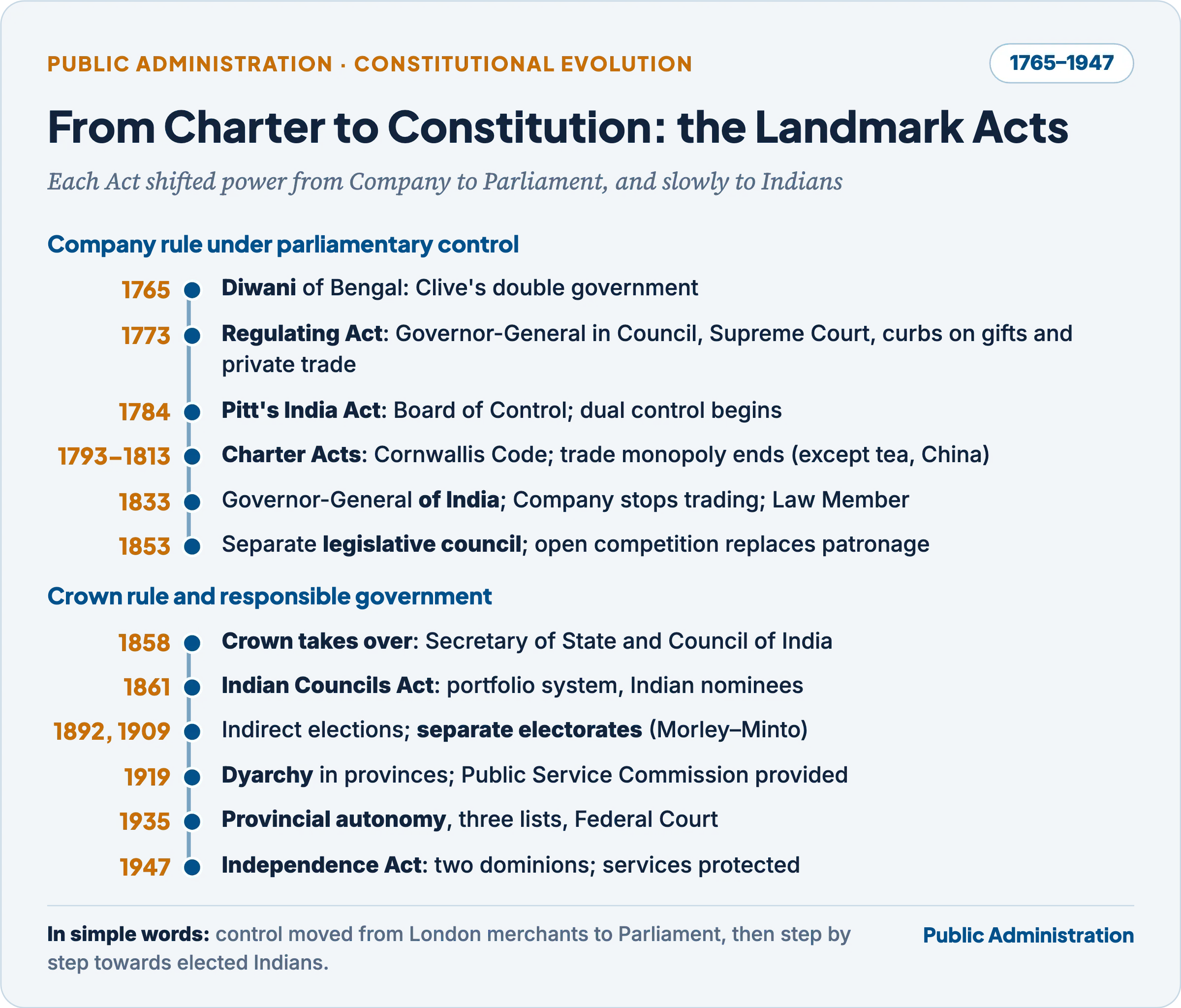
2. Crown Rule and Constitutional Evolution, 1858–1947
In simple words
After the revolt of 1857 the British Crown took India from the Company. For the next ninety years, every new Act gave Indians a little more voice, first as nominees, then as elected members, and finally as ministers running parts of provincial government.
2.1 The Government of India Act, 1858
- Crown takes over. The government, territories and revenues of India passed from the Company to the Crown. The Board of Control and Court of Directors were abolished; dual control ended.
- A Secretary of State for India (a British Cabinet minister; the first was Lord Stanley) was created, advised by a Council of India of fifteen members. The Governor-General became also the Viceroy, the Crown’s representative (first: Canning).
- The Queen’s Proclamation (1 November 1858) promised that Indians of every race and creed would be freely and impartially admitted to offices in the service for which they were qualified. It became the charter Indian leaders quoted for the next sixty years.
- Character. The Act changed the master, not the machine: the administration became more centralised and more firmly controlled from London. The Secretary of State now fixed service conditions, and the Governor-General remained all-powerful in India.
2.2 The portfolio system and the beginnings of cabinet government
- In 1859 Canning introduced the portfolio system: each member of the Governor-General’s Council was placed in charge of one or more departments, and could dispose of routine business of his department himself; only important matters went to the full council or the Governor-General.
- The Indian Councils Act of 1861 gave it legal sanction. Finance and Home had to be consulted on matters of finance and internal administration, an early form of today’s mandatory inter-departmental consultation under the business rules.
- Significance.
- It replaced the slow, collective handling of every file by the whole council with departmental responsibility, so business moved faster.
- It contained the seeds of a cabinet: each “member” was in effect a minister heading a department, though appointed, not elected.
- After independence the Government of India (Allocation of Business) Rules and (Transaction of Business) Rules, 1961, framed under Article 77(3), continue the same idea: ministers in charge of departments, with defined consultations.
- Cabinet committees, which grew out of this collective-plus-departmental pattern, now act as forums where ministers and senior officials work together on policy (for example the Committees on Appointments, Security, Economic Affairs and Political Affairs). They provide an interface between the political (non-official) and official elements of policy-making, which the portfolio system began.
2.3 The Indian Councils Acts, 1861, 1892 and 1909
| Act | Administrative and political changes |
|---|---|
| 1861 | Portfolio system legalised; legislative councils restored to Bombay and Madras and later created in other provinces; Indians nominated as non-official members (the Raja of Benares, the Maharaja of Patiala and Sir Dinkar Rao in 1862); ordinance power to the Governor-General; decentralisation of law-making begins |
| 1892 | Larger councils; indirect election in effect (bodies such as municipalities, district boards and universities recommended members); right to discuss the budget and ask questions |
| 1909 (Morley–Minto) | Councils enlarged; non-official majority in provincial councils; right to move resolutions; separate electorates for Muslims; S.P. Sinha became the first Indian member of the Viceroy’s Executive Council |
- The series moved Indians from petitioners to nominees to (indirectly) elected members, but executive power stayed with officials. Councils could debate and criticise; they could not remove anyone.
- The 1909 introduction of communal representation later shaped local bodies too: separate seats spread into municipal laws, for example the UP Municipalities Act of 1916.
2.4 The Government of India Act, 1919 and dyarchy
The Montagu–Chelmsford Report (1918) proposed, and the 1919 Act introduced, a limited form of responsible government in the provinces.
- Dyarchy (dual rule) in the provinces. Provincial subjects were split into:
- Reserved subjects (law and order, police, land revenue, finance, irrigation, justice), administered by the Governor with executive councillors not responsible to the legislature;
- Transferred subjects (local self-government, education, public health, agriculture, industries), administered by Indian ministers chosen from elected members and responsible to the legislature.
- Other changes. A bicameral central legislature with direct elections on a limited franchise; separation of central and provincial subjects and revenues; the Auditor General given statutory independence; Section 96C provided for a Public Service Commission; a High Commissioner for India in London; local self-government transferred to Indian ministers.
- Why dyarchy failed.
- Government is an organic whole: splitting it into two halves with different masters destroyed unity of purpose.
- Finance was reserved, so ministers depended on a hostile Finance Department for funds; transferred subjects were starved.
- Ministers had no control over the ICS officers who ran their departments; these officers were appointed and protected by the Secretary of State and often dealt directly with the Governor.
- The Governor did not encourage collective responsibility of ministers and could overrule them.
- The political climate (Non-Cooperation, Swarajist obstruction from 1923) denied it a fair trial.
- The critique that dyarchy was a “fine art of deception” draws on these points: it looked like self-government but kept the levers (finance, police, services) in official hands. Its one lasting gain was that Indians learnt the practice of ministerial office, and that local government, education and health came under Indian ministers for the first time.
2.5 The Government of India Act, 1935
The longest statute the British Parliament had passed (321 sections and 10 schedules), it is the single most important source of the structural part of the Constitution of 1950.
| Feature | What it provided | Fate or legacy |
|---|---|---|
| All-India Federation | Provinces and princely states (states could choose to join) | Never formed, because the princes did not join |
| Provincial autonomy | Dyarchy ended in provinces; ministries responsible to legislatures, from 1 April 1937 | Congress ministries 1937–39; became the model of state governments |
| Dyarchy at the Centre | Defence and external affairs reserved | Never came into operation |
| Three lists | Federal (59), Provincial (54), Concurrent (36); residuary power with the Governor-General | Basis of the Seventh Schedule |
| Federal Court | Interpreted the Act, decided disputes between units; began 1 October 1937 | Forerunner of the Supreme Court |
| Public Service Commissions | Federal PSC and provincial PSCs | Basis of Articles 315–323 |
| Others | Council of India abolished; bicameral legislatures in six provinces; franchise extended; Burma separated; Governor’s discretionary and emergency powers | Governor’s office, Article 356 traces back to Section 93 |
- Why the Constituent Assembly took it as a base. It was a tested, detailed, federal framework already familiar to Indian administrators; it suited a country needing a strong centre after Partition; and it allowed the Assembly to focus its energy on the new philosophical parts (rights, directive principles, adult franchise, parliamentary responsibility). Around 250 provisions of the Constitution are based, closely or loosely, on it.
- The critique. The Act carried colonial safeguards: wide discretionary and emergency powers of the Governor and Governor-General, a centralising bias, and the protection of the Secretary of State’s services. By borrowing its frame, the Constitution also borrowed some of its centralism (emergency provisions, the Governor’s discretion), which later caused Union–State friction.
2.6 The Indian Independence Act, 1947 and the transition
- The Indian Independence Act (18 July 1947) created the two dominions of India and Pakistan from 15 August 1947, ended the office of the Secretary of State, and let each Constituent Assembly act as its legislature.
- It protected the service conditions of officers appointed by the Secretary of State. The Constitution continued this through Article 314 (later omitted by the Twenty-eighth Amendment, 1972, which inserted Article 312A).
- At the Premiers’ (Chief Ministers’) Conference of October 1946, it was agreed to replace the ICS and the Indian Police with the Indian Administrative Service and the Indian Police Service, recruited by an Indian commission and serving both the Union and the provinces. Article 312 and the All India Services Act, 1951 gave them their present basis.
2.7 The secretariat system
Origins. The modern secretariat began in the office of the factory writers: a Secretary to the Council with a few assistants. As territory grew, departments multiplied.
- 1756–1800. One general department split into Public and Secret departments; a Foreign department (1783) and Military department (1777) followed. Cornwallis created a Secretary-General over the departments and a separate Judicial department; Wellesley raised the status and pay of secretaries.
- 1843. The Central Secretariat was reorganised into four departments: Home, Foreign, Finance and Military. A Public Works Department followed in 1855, a Department of Revenue, Agriculture and Commerce in 1871, and the Railway Board in 1905.
- 1859–1861. The portfolio system gave each department a member of council at its head, so the secretariat became the staff of a minister.
- The tenure system (1905). Under Curzon, officers from the provinces were brought to the central secretariat for a fixed tenure and then sent back, so that policy was made by men with field experience. This is the origin of today’s Central Staffing Scheme and the deputation of All India Service officers.
- Split system. The secretariat makes policy; separate executive heads of departments (directorates, attached offices) carry it out. The secretariat thus stays small, policy-focused and free of daily execution, at the cost of duplication and delay.
Reform committees of the British period
| Committee | Year | Key point |
|---|---|---|
| Secretariat Procedure Committee (Llewellyn Smith) | 1919 | Pyramidal department: Secretary at top, Deputy Secretaries below; created the Imperial Secretariat Service; a Staff Selection Board for clerks |
| Wheeler Committee | 1936 | Studied delays in secretariat work and procedures for noting |
| Maxwell Committee | 1937 | Organisation and procedure; the Secretary as the minister’s principal adviser; ministerial staff split into assistants (who note) and clerks |
| Tottenham Committee | 1945–46 | Reorganisation of the central government; found “too few officers of the right kind and too many clerks of the wrong kind”; defined grades and nomenclature |
- Legacy. The Imperial Secretariat Service became the Central Secretariat Service. The habits of heavy reliance on precedents, multi-level noting, reluctance of junior staff to take responsibility and excessive record-keeping survive in the Central Secretariat Manual of Office Procedure, and are a major source of red tape.
3. The Civil Services and Their Indianisation
In simple words
At first only Englishmen chosen by the Company’s directors could hold the top jobs. Then the jobs were opened to anyone who could pass an exam, but the exam was held in England. Step by step, under pressure from Indians, more Indians got in, until by the 1940s they were the majority.
3.1 Covenanted and uncovenanted services
- Covenanted Civil Service. Englishmen who signed a covenant (a bond) with the Company promising not to trade privately or accept presents, in return for high salaries. They held the senior judicial, political, revenue and commercial posts. They were the forerunners of the ICS.
- Uncovenanted Civil Service. Indians, Eurasians and some Europeans employed for subordinate and clerical work (the “monthly writers”), with no covenant, no cadre and low pay. Indians in this service were concentrated in the revenue and judicial branches, and their numbers rose steadily in the 1830s and 1840s as the work of courts and collectorates grew.
- The division was racial in practice: covenanted meant British; uncovenanted meant mostly Indian. This dual structure with a pay gap persisted till the end of British rule and survives in the steep status gap between the All India Services and subordinate staff.
3.2 Training: Fort William College and Haileybury
- Fort William College (Calcutta, 1800). Lord Wellesley set it up without waiting for the Directors’ approval, arguing that Company servants were “no longer agents of a commercial concern” but officers of a sovereign: magistrates, judges, ambassadors and governors. The three-year course taught Indian languages, law, history and ethics. The Directors disapproved; it survived mainly as a language school.
- East India College, Haileybury. Opened at Hertford Castle in 1806 and moved to Haileybury in 1809, under the Directors’ control. Entrants were nominees of the Directors; they studied Indian languages, political economy, law, history and classics for two years. It built a strong corporate spirit among its products but its standards were modest because admission was by patronage. It was closed in 1858, after open competition began.
- Legacy. Formal pre-entry and induction training, emphasis on languages and local law, and district training as probationers (introduced after 1855) are ancestors of today’s training at LBSNAA and of district attachment for probationers.
3.3 Open competition: the Charter Act of 1853 and the Macaulay Report of 1854
- The Charter Act of 1853 abolished patronage for the covenanted service and introduced open competition.
- A committee chaired by Thomas Babington Macaulay (the Macaulay Report, 1854) laid down the scheme:
- recruitment by a competitive examination open to all British subjects, held in London;
- candidates aged roughly 18 to 23, holding a liberal university education;
- an examination in subjects of general liberal study (English language and literature, classics, mathematics, sciences, philosophy, with Sanskrit and Arabic as options), on the belief that the best-educated young men would make the best administrators, whatever their specialism;
- a period of probation and further study after selection.
- A Civil Service Commission was created in London in 1855, and the first open examination was held in 1855.
- Parallel in Britain. The Northcote–Trevelyan Report (1854) recommended the same merit principle for the British Home Civil Service; Indian administration was in some ways the testing ground for it.
- Significance. The Macaulay Report is regarded as the charter of merit recruitment, the generalist ideal, and the independence of the recruiting agency from patronage. Its three principles (competitive entry, generalist liberal education, a neutral recruiting body) still underpin the Civil Services Examination conducted by the UPSC.
Macaulay and the elite theory of bureaucracy
- Elite theory (associated with Mosca, Pareto and C. Wright Mills) holds that every society is ruled by a small, organised minority. Applied to bureaucracy, it sees the higher civil service as a power elite, socially exclusive, culturally distinct and largely self-perpetuating.
- Macaulay’s design fits this theory: he wanted a small corps of gentlemen from the best universities, chosen for intellect and character, who would rule as guardians. Philip Woodruff (pen-name of Philip Mason), in The Men Who Ruled India (1953–54), called the later ICS men “the Guardians“, in Plato’s sense.
- Persistence today. Critics point to continuities: the small size and high status of the IAS, a preponderance of entrants from urban, English-educated, professional families, the mystique of the exam, and an outlook that treats citizens as subjects. Against this: reservations (Articles 16(4), 335), Indian-language options since 1979, and entrants from rural and less privileged backgrounds have broadened the social base, so the service today is less an exclusive caste and more a meritocratic elite.
3.4 The Indian Civil Service
- The ICS was the most important legacy of British rule: the visible presence of the Raj, through which authority was exercised in every district. Its members held the posts of Collector, Divisional Commissioner, Secretary to Government, Chief Secretary, judges and many political posts.
- Features. A small cadre (about a thousand officers for the whole of British India), generalist, recruited young, trained in the district, moved across posts, well paid and pensioned, with security of tenure guaranteed by the Secretary of State, and a strong esprit de corps.
- Mixed image. It was hard-working, efficient and largely incorruptible at the top; but to many Indians it was a ruling caste, aloof, paternal and feared. Its “mai-baap” (parent-like) image bred an attitude of dependence and obedience among the people.
- Nationalist views. Jawaharlal Nehru criticised the ICS as neither Indian in spirit nor a service of the people, but after 1947 he and Sardar Patel saw at close quarters its role in integrating the princely states, managing Partition and holding the country together, and they retained its successor.
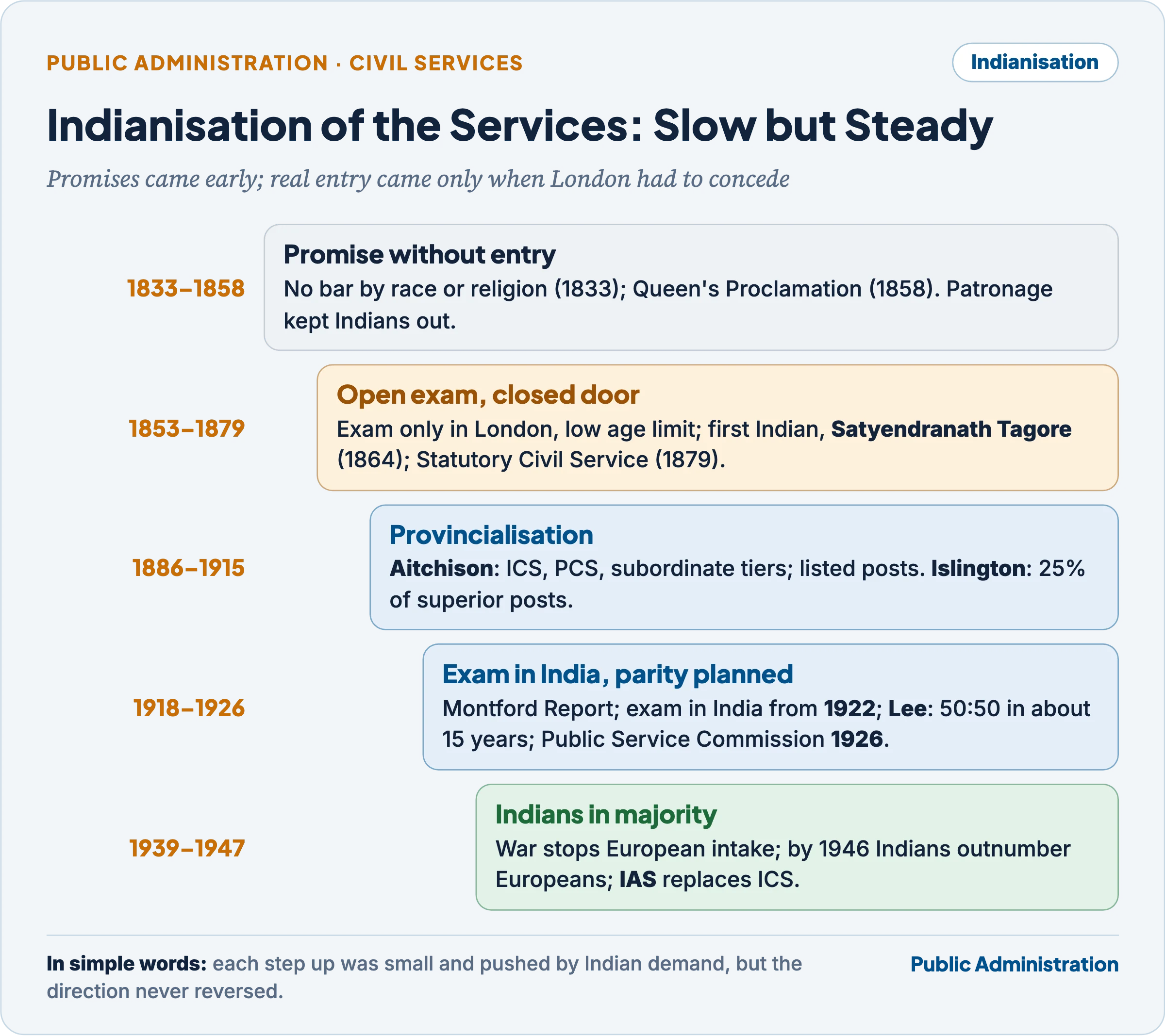
3.5 Indianisation: a slow but steady process
Indianisation means the progressive entry of Indians into the higher (superior) services that had been reserved for the British. It moved through clear stages, each forced by Indian demand and each limited by British caution.
| Stage | Measure | What it did for Indians |
|---|---|---|
| 1833 | Charter Act, Section 87 | No disability by religion, birth, descent or colour; but patronage still excluded Indians |
| 1853–55 | Open competition in London | Door opened in law, but the London venue, cost, travel and low age limit kept Indians out |
| 1858 | Queen’s Proclamation | Promise of impartial admission |
| 1864 | Satyendranath Tagore | First Indian to enter the ICS through the examination |
| 1870, 1879 | Act of 1870; Statutory Civil Service under Lytton’s rules (1879) | Indians of “proved merit” nominated in India to a share (up to about one-sixth) of covenanted posts; small numbers, unpopular |
| 1870s | Maximum age cut to 19 | Made it harder for Indians; provoked the first all-India agitation on the services |
| 1886–87 | Aitchison Commission (Public Service Commission, chaired by Sir Charles Aitchison) | Rejected simultaneous exams; created three tiers: Imperial (ICS), Provincial (PCS), Subordinate; abolished the Statutory Civil Service; some ICS posts “listed” for PCS officers; age limit raised |
| 1892 | Implementation | Covenanted service called the Indian Civil Service; uncovenanted upper posts formed the PCS |
| 1893 | House of Commons resolution | Favoured simultaneous exams in India; not implemented |
| 1912–15 | Islington Commission (Royal Commission on the Public Services in India, chaired by Lord Islington; report 1917) | 25% of superior posts for Indians, partly by direct recruitment in India and partly by promotion; rejected simultaneous exams; time-scale pay; Class I and Class II |
| 1917–19 | Montagu Declaration (20 August 1917); Montagu–Chelmsford Report (1918) | Increasing association of Indians with every branch of administration; about one-third of ICS recruitment in India, rising year by year |
| 1922 | First ICS examination held in India (Allahabad) | Simultaneous exams at last |
| 1923–24 | Lee Commission (Royal Commission on the Superior Civil Services in India, chaired by Viscount Lee of Fareham) | ICS recruitment 40% European, 40% Indian direct, 20% promotion from PCS, producing 50:50 parity in about fifteen years; a Public Service Commission without delay; better pay and pensions for British officers |
| 1926 | Public Service Commission set up (1 October 1926) | Independent recruiting agency in India |
| 1939–43 | War | European recruitment stopped; Indian intake continued |
| 1946 | Indians outnumbered Europeans in the ICS (629 Indians to 560 Europeans, as stated in the UK House of Commons, March 1946) | |
| 1946–47 | Premiers’ Conference; independence | IAS and IPS replace ICS and IP |
Why it was slow
- Imperial interest. The ICS was the “steel frame” of the Raj; British governments feared that too many Indians at the top would weaken control and the loyalty of the service.
- Structural barriers. Examination only in London; cost and caste taboos on sea travel; a syllabus weighted towards European classics; and age limits as low as 19 in the late 1870s.
- Indianisation by provincialisation. Instead of opening the ICS, the British created separate, lower services (PCS, subordinate services) for Indians. Indians filled more posts, but mostly below the line of real power. Promoted PCS officers on “listed posts” got the rank but not membership of the ICS, and few such posts existed.
- Racial attitudes after 1857 and after the Ilbert Bill controversy (1883), when Europeans resisted being tried by Indian judges.
- Delay in implementing reports: the Islington Report, finished in 1915, was published only in 1917, overtaken by war and politics.
Why it was steady
- Indian demand never let up: the Indian Association (1876), the Indian National Congress from 1885, the Moderates who made simultaneous examination a standing demand, and later mass movements.
- Every promise (1833, 1858) became a lever for the next demand.
- Constitutional reform required Indian officers: the Montagu–Chelmsford Report argued that responsible government needed Indians trained in administration.
- British recruits dried up after the First World War (lower pay compared with careers at home, uncertainty about India’s future), so vacancies had to be filled by Indians.
- Institutions, once created, kept working: the PCS, simultaneous examinations and the Public Service Commission all expanded Indian entry automatically, year by year.
Common confusion
Was the body created in 1926 the “Federal Public Service Commission”? Many notes say so, but the body set up on 1 October 1926 under Section 96C of the 1919 Act was called simply the Public Service Commission (chairman Sir Ross Barker, with four members). It became the Federal Public Service Commission only when the 1935 Act came into force on 1 April 1937, and the Union Public Service Commission on 26 January 1950 (Article 378). Its role before independence was advisory.
3.6 The Public Service Commission and the idea of an independent recruiting agency
- Origin. The Government of India’s despatch of March 1919 on constitutional reforms called for a permanent office to regulate service matters; the 1919 Act provided for it; the Lee Commission pressed for it; it began on 1 October 1926.
- Functions. Mainly recruitment to the All India and central services; it could be consulted on discipline, but its advice was not binding.
- Secretariat staffing. Before 1920 each department recruited its own clerks; after the 1919 committee, a Central Staff Selection Board recruited for the Imperial Secretariat Service. Its work passed to the Public Service Commission in 1926. The idea of a central pool of secretariat staff survives in today’s Central Secretariat Service and the Staff Selection Commission.
- Legacy. Articles 315–323 give the UPSC and State PSCs constitutional status, independence of members (removal only under Article 317) and mandatory consultation on recruitment, promotion and discipline (Article 320).
3.7 Pay, promotion, transfers and the Provincial Civil Service
- Pay structure. Posts were divided into superior and inferior categories (1918). The Islington Commission set the principle that pay should be enough to attract recruits of the right stamp and keep them free from temptation, and replaced grade pay with time-scales. Racial differences in pay were kept but softened (officers recruited in England got the same pay whether European or Indian). The First Central Pay Commission (1946–47) began the modern series of pay commissions.
- Promotion. Promotion by seniority, conduct and performance, with annual returns on subordinates’ merit from as early as the 1830s, gave Indians in the lower services a measure of social mobility in a caste-bound society.
- Listed posts. From 1892 PCS officers could be promoted to some listed ICS posts (district and sessions judge, Collector); later the Lee Commission fixed 20% of superior posts for promotion. This is the ancestor of today’s promotion quota (one-third of IAS posts filled from State Civil Services).
- Transfers and the “mobility syndrome”. Frequent transfers were meant to stop officers forming local vested interests, but they weakened knowledge of districts: sub-divisions sometimes saw three or four officers in a year, and officers moved too fast to understand local problems. The same complaint, short tenures of Collectors and Secretaries, recurs in the reports of the 2nd ARC and in the T.S.R. Subramanian v Union of India (2013) judgment, which asked for minimum fixed tenure and Civil Services Boards.
- Provincial Civil Service. Created on the Aitchison scheme, recruited separately in each province, it combined competition with nomination so that different communities got representation: an early mix of efficiency and social justice. Today’s State Civil Services descend from it.
3.8 The generalist–neutral model and the “steel frame”
The generalist. A generalist is an administrator selected for general intelligence and education rather than technical knowledge, and moved across many fields (revenue, police, finance, development) over a career. A specialist is selected and promoted for expertise in one field (engineering, medicine, economics).
- Why the British chose it. The ICS had to govern a district as a whole, with very few officers, so it needed all-rounders who could combine revenue, magistracy and coordination. Macaulay and Northcote–Trevelyan believed a liberal education produced the best judgment.
- Why it fits a parliamentary democracy. In a Westminster system, ministers who are themselves generalists need generalist advisers who can see a problem whole, weigh political, financial and administrative aspects, and coordinate specialists. Generalists also move easily between the field and the secretariat (the tenure system), linking policy with ground reality. India, familiar with the British pattern, kept it.
- Criticism. The Fulton Committee in Britain (1968) called the generalist ideal the “cult of the amateur”. In India, the First ARC and the 2nd ARC (Tenth Report, Refurbishing of Personnel Administration, 2008) urged domain expertise, competency frameworks and wider entry. Mission Karmayogi (2020) aims to build role-based competencies in a generalist service.
Neutrality. The British model of political neutrality asks civil servants to serve any government loyally, give impartial advice, stay out of party politics and remain anonymous. In India the conduct rules (All India Services (Conduct) Rules, 1968) codify it. The debate after 1947 has been between neutrality and commitment (to the Constitution’s goals or, in its distorted form, to the ruling party).
The “steel frame”. David Lloyd George, the British Prime Minister, described the ICS in a 1922 speech in the House of Commons as the steel frame of the whole structure of government in India. In the Constituent Assembly (10 October 1949), Sardar Patel defended the All India Services in the same spirit: without a good all-India service with independence to speak its mind, there would be no united India. Patel’s view prevailed, and Article 312 was written into the Constitution.
Common confusion
Did Sardar Patel coin the phrase “steel frame”? No. The phrase is usually traced to Lloyd George’s 1922 speech about the ICS as the frame of British rule. Patel used the idea in 1947–49 to argue that the All India Services were necessary for the unity of independent India. The same metaphor thus served two opposite purposes: holding an empire and holding a new nation together.
3.9 Neutrality and the refusal to serve commercial interests
- An observation usually credited to the historian K.M. Panikkar holds that an important characteristic of the ICS was its open refusal to be influenced by commercial and industrial interests in India.
- What this meant in practice.
- The ICS saw itself as a guardian above all interests, including British business. District officers often sided with the peasant against the planter, moneylender or zamindar, as in the inquiry into indigo cultivation (1860), the Deccan Agriculturists’ Relief Act (1879) and the Punjab Land Alienation Act (1900), which protected cultivators from moneylenders.
- Officers were barred from private trade after Cornwallis, and the old Company tradition of officials doing business was ended.
- Recruitment by liberal education and a code of gentlemanly disinterest placed the officer above commerce, in line with Weber’s model of a salaried official separated from the means of administration and from private gain.
- Why it was done “in the name of neutrality”. Staying out of commerce let the ICS claim impartiality and so legitimacy: a ruler who seemed above interests could present itself as a trustee of all Indians.
- The limits.
- Neutrality between Indian interests did not mean neutrality between Britain and India: tariff, currency, railway and “Home Charges” policies served British capital, as Dadabhai Naoroji (Poverty and Un-British Rule in India, 1901) and R.C. Dutt (The Economic History of India, 1902–04) argued.
- Distance from Indian industry also meant a suspicion of business and enterprise that passed into the post-1947 licence-permit raj and the bureaucracy’s discomfort with markets.
- Neutrality was political, not social: the ICS was paternal, not participatory.
3.10 From Company agents to magistrates and governors: the colonial inheritance
Wellesley observed in 1800 that the Company’s servants had become statesmen, magistrates, ambassadors and governors, no longer merchants. The transformation left marks that explain many problems of independent India:
- Extraction before service. The first task of the Company-state was revenue; the district was organised around collection, not welfare. The revenue and regulatory orientation of district offices outlived its purpose.
- Control before consent. The Police Act of 1861 created a force to keep order for the ruler, not to serve citizens; the Official Secrets Act, 1923 made secrecy the default.
- Distance and status. The officer as a ruler (“Sahib”, “mai-baap”) created a gulf between administration and people, still visible in protocol, VIP culture and inaccessibility.
- Centralisation. Authority flowed from London to Calcutta to the district; local bodies were tutored, not trusted.
- Proceduralism. “Government by record” became red tape: rules and files valued over results.
4. Revenue Administration
In simple words
The British needed money to run their government and armies, and most of it came from land tax. To collect it, they had to decide who owned land, how much each person should pay and who would collect it. Their answers created landlords in some places and made farmers pay directly in others, and built the revenue office that still keeps our land records.
4.1 From diwani to the Collector
- 1765–1772. The Company held the diwani but left collection to Indian officials (double government).
- 1769–70. British Supervisors were placed in districts to study resources and abuses; Controlling Councils of Revenue at Murshidabad and Patna (1770).
- 1772. Hastings made the Supervisors Collectors; a Committee of Circuit toured the districts; the revenue was farmed out to the highest bidders for five years, which caused distress. The treasury moved to Calcutta.
- 1781. A Committee of Revenue at Calcutta controlled collections.
- 1786. A Board of Revenue was created at Calcutta, the district became the basic unit of revenue administration, and the Collector was restored as its head.
- 1793. The Permanent Settlement.
- 1829. Divisional Commissioners (Commissioners of Revenue and Circuit), on the plan of William Butterworth Bayley adopted under Bentinck on 1 January 1829, were placed over groups of districts to supervise Collectors closely.
4.2 The Permanent Settlement (1793)
- What. In Bengal, Bihar and Orissa (later extended to Banaras and parts of Madras), Lord Cornwallis settled the land revenue permanently with the zamindars, who were recognised as owners of the land. The demand was fixed at about ten-elevenths of the rental they collected; the state’s share was never to be raised.
- Why. To secure a stable and predictable revenue; to create a class of loyal landlords who would improve agriculture as English landlords did; and to reduce the cost and corruption of annual assessment.
- The “sunset law”. Zamindars who failed to pay by sunset on the due date lost their estates at auction; many old families were ruined and replaced by urban speculators and absentee landlords.
- Effects.
- The state lost all share of later increases in land value.
- Cultivators became tenants-at-will, exposed to rack-renting (rents pushed to the limit), until tenancy laws (1859, 1885) gave some protection.
- Subinfeudation (layers of intermediaries) grew; agriculture stagnated.
- Administratively, it separated revenue from the land record: with revenue fixed, there was little need for a detailed village record, so Bengal’s land records lagged behind those of ryotwari areas.
4.3 The Ryotwari Settlement
- Who. Alexander Read and Thomas Munro began it in the Baramahal region (1790s); Munro, as Governor of Madras (1820–27), made it general in Madras. In Bombay it was developed under Mountstuart Elphinstone and its survey settlement under Wingate and Goldsmid. It also covered Assam and Coorg.
- What. The state settled directly with each ryot (cultivator), recognised as the holder of the land so long as he paid revenue. There was no intermediary.
- Assessment. Based on a survey of each field and its soil; revised periodically (usually every 20–30 years).
- Merits and problems. It created a direct link between state and peasant, and a detailed field-by-field record of rights. But the demand was often very high, rigid in bad years, and pushed peasants into the hands of moneylenders; the state itself became a giant landlord.
4.4 The Mahalwari Settlement
- Who and where. Proposed by Holt Mackenzie (Regulation VII of 1822) for the North-Western Provinces; revised and put on a workable footing by Regulation IX of 1833 under Bentinck, with the survey and settlement of R.M. Bird and James Thomason. Later extended to Punjab and the Central Provinces.
- What. Revenue was settled with the mahal (an estate or village), collectively, through village headmen (lambardars); the village body was jointly responsible.
- Assessment. Periodic, based on survey and estimated produce or rent.
- Merits and problems. It kept the village community as a unit and produced good records of rights; but it favoured headmen and dominant proprietors, and early assessments were heavy.
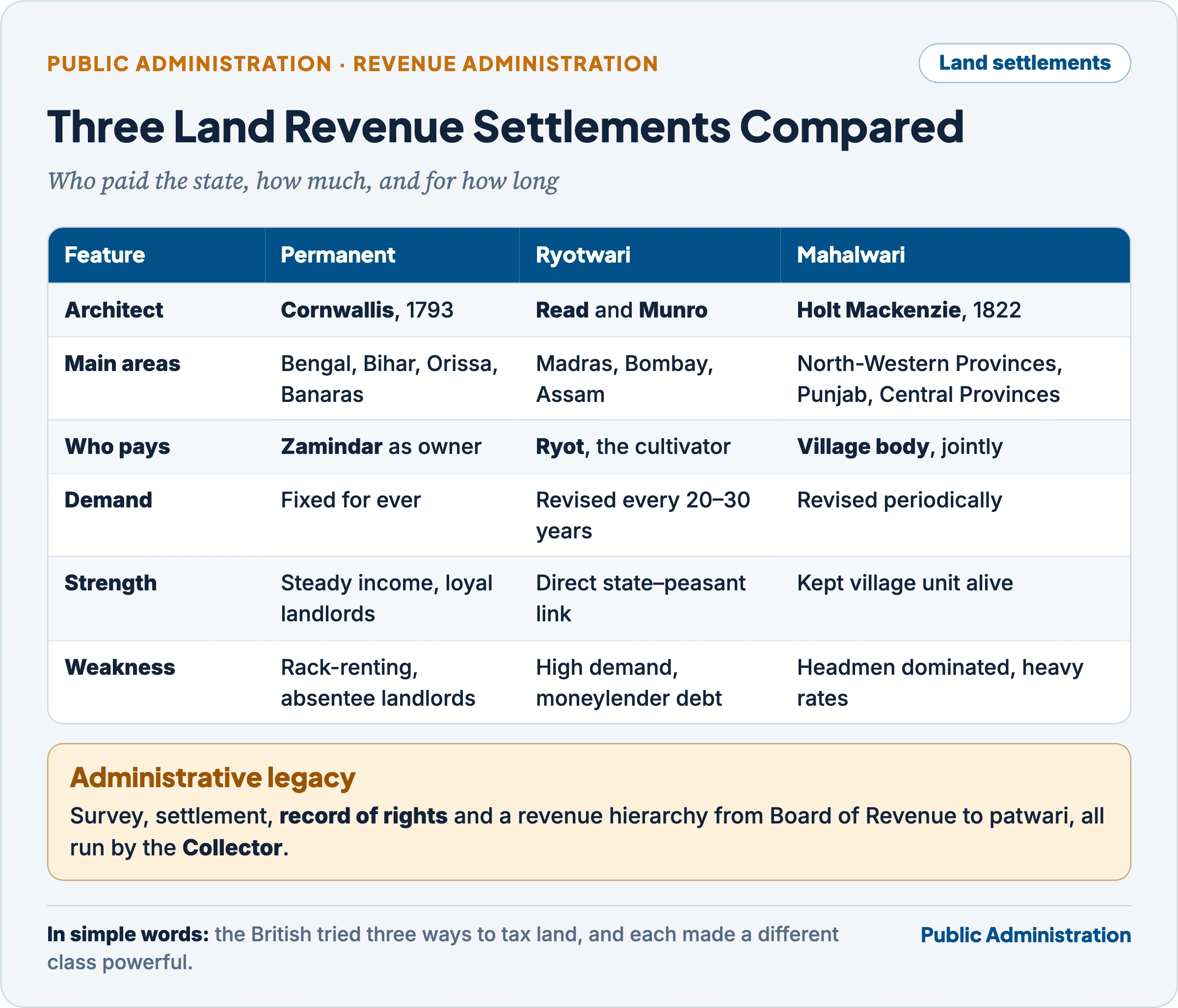
By common estimates, the Permanent Settlement covered about a fifth of British India’s area, the Mahalwari about three-tenths and the Ryotwari about half. Each settlement made a different group powerful: zamindars in the east, the state’s own revenue officials in the south and west, village proprietors in the north. Abolishing intermediaries became the first task of land reform after 1947.
4.5 The revenue hierarchy: British design, Mughal foundations
- Board of Revenue (1786). The chief revenue authority of the province and the highest revenue court of appeal. The Montagu–Chelmsford Report noted that every major province except Bombay had a Board of Revenue or a Financial Commissioner, both of which survive in several states.
- Divisional Commissioner (1829). Supervisor of four to six districts. Critics called him the “fifth wheel of the coach”: witnesses before the Decentralisation Commission said he was like a king whose subjects did not know he existed. The post survives in many states.
- Collector. Head of the district for revenue, treasury and land records.
- Sub-Divisional Officer. In charge of a sub-division (often a PCS officer): land records, minor cases, emergencies, inspection of tehsils.
- Tehsildar, Qanungo and Patwari. Older Mughal offices that the British retained and regularised: the tehsildar at the tehsil (the basic unit of revenue administration); the qanungo (records and supervision of patwaris, reconstituted in the late eighteenth and early nineteenth centuries); the patwari (village accountant and keeper of land records).
- Significance. The British superimposed a European chain of command (Board, Commissioner, Collector) on an inherited Mughal revenue structure (pargana, tehsil, qanungo, patwari). The Mughal sarkar and its amalguzar were the ancestors of the district and its Collector.
4.6 Financial administration: budget, audit and accountability
- Accounts. Control of finances initially lay with the Accountant General of Fort William; in 1846 the Finance Secretary became ex-officio Accountant General of India, and a general Department of Accounts replaced separate presidency accounts.
- Budget. James Wilson, the first Finance Member after 1858, presented India’s first budget on 7 April 1860: estimates of income and expenditure were to be prepared and sanctioned before the year began. An income tax was introduced the same year.
- Audit. An Auditor General was appointed in 1860 (the ancestor of the CAG, Article 148); the 1919 Act made the Auditor General statutorily independent of the Government of India.
- Currency. The Paper Currency Act, 1861 gave the government the monopoly of note issue; the Reserve Bank of India was set up under the RBI Act, 1934 and began on 1 April 1935.
- Legislative control. After 1919, a Public Accounts Committee (first constituted in 1921, chaired by the Finance Member) examined the Auditor General’s reports, and a Standing Finance Committee scrutinised new expenditure. Provincial PACs followed.
- Financial decentralisation. Mayo’s resolution of 1870 gave provinces fixed grants for services such as jails, police, education and roads, to manage on their own; later settlements (1877, 1882) shared revenues. This is the earliest root of Centre–province fiscal arrangements that the Finance Commission now handles.
- Legacy. Line-item budgeting, the Finance Department’s dominance over spending departments (a grievance of dyarchy’s ministers), treasury control in the district, and ex-post audit all came from this period.
5. District Administration
In simple words
In every district the British placed one powerful officer, the Collector, who collected taxes, kept the peace, controlled the police and spoke for the government. Ordinary people saw him as the government itself. Independent India kept this officer and gave him the extra job of development.
5.1 The district as the unit of administration
- Continuity. The district has a long history: the Mauryan ahara, the Mughal sarkar headed by the faujdar (law and order) and amalguzar (revenue). The British used the word district for a territory marked off for administration.
- The British district. Typically divided into sub-divisions, tehsils (or taluks) and villages, with divisions above. S.S. Khera, in District Administration in India (1964), called the district the convenient geographical unit where the total apparatus of public administration can be concentrated and where it comes into direct contact with the people.
- Inside the district. Over time the Collector was joined by the Superintendent of Police, Civil Surgeon, District Judge, Superintendent of Jails, District Inspector of Schools, Executive Engineers and other department heads, but the Collector remained the hub.
5.2 Evolution of the Collector’s office, 1772–1859
The Collector’s office was not created whole; it swung between concentration and separation of powers for nearly ninety years.
| Year | Change |
|---|---|
| 1772 | Hastings makes Supervisors Collectors (revenue plus civil justice) |
| 1773–1781 | Collectors withdrawn, then restored |
| 1787 | Collector combines revenue, civil justice and magistracy |
| 1793 | Cornwallis Code: Collector confined to revenue; a separate Judge-Magistrate for civil justice, magistracy and police |
| 1829–31 | Divisional Commissioners; magisterial powers given to the Collector again; civil justice left with the judge |
| 1837–1859 | Experiments with separate Magistrate and Collector in Bengal |
| 1859 | Collector and District Magistrate finally united in one officer |
| 1861 | Police Act and CrPC: DM controls district police in general matters |
- By the end of the century the Collector-cum-District Magistrate was the “little Napoleon” of the district: revenue collector, treasurer, magistrate, controller of police and jails, head of local bodies, and the government’s eyes and ears. All other officers reported to him or through him.
5.3 The Cornwallis and Munro schools of district administration
Before 1857, British officials argued over what kind of state they were building. The argument was settled district by district.
| Cornwallis school | Munro school | |
|---|---|---|
| Leading figures | Cornwallis, the Bengal Regulations | Thomas Munro, Mountstuart Elphinstone, John Malcolm, Charles Metcalfe |
| Idea of government | Rule of law: impersonal rules, courts, appeals; separation of powers | Personal, paternal rule suited to Indian tradition; strong officer close to the people |
| District officer | Collector only collects revenue; judge and magistrate separate | One officer combines revenue, magistracy and police |
| Land | Permanent Settlement with zamindars | Ryotwari, direct with cultivators |
| Indians | Excluded from higher posts; Europeanisation | Wider use of Indian agency, respect for indigenous institutions |
| Where it prevailed | Bengal and the regulation provinces | Madras, Bombay; model for the non-regulation provinces |
- Why the struggle mattered. The Cornwallis school reflected Whig and later Utilitarian faith in law; the Munro school reflected Burkean conservatism and paternalism, distrustful of abstract rules in an unfamiliar society.
- Outcome. The Munro view of concentrated authority largely won in the district: the reunion of Collector and Magistrate (1859), the non-regulation model, and the post-1861 DM-led police all followed it. The Cornwallis view won in codified law, courts and appeals. The Indian district thus combined Munro’s all-powerful officer with Cornwallis’s body of law, a tension that persists in debates on the Collector’s magisterial powers and separation of the executive from the judiciary (Article 50).
5.4 The prefectorial system superimposed on the inherited district
Prefectorial and functional systems. In Paper I’s discussion of headquarters–field relationships, two models of field administration stand out:
- In a prefectorial system (named after the French prefect), a general representative of the central government in each territorial unit coordinates and supervises the field officers of all departments. In the integrated form (France, British India), the prefect is the superior of departmental field officers; in the unintegrated form (Italy), he coordinates but does not command them.
- In a functional system (the USA, the UK at home), each department runs its own field offices directly from headquarters, without a territorial chief.
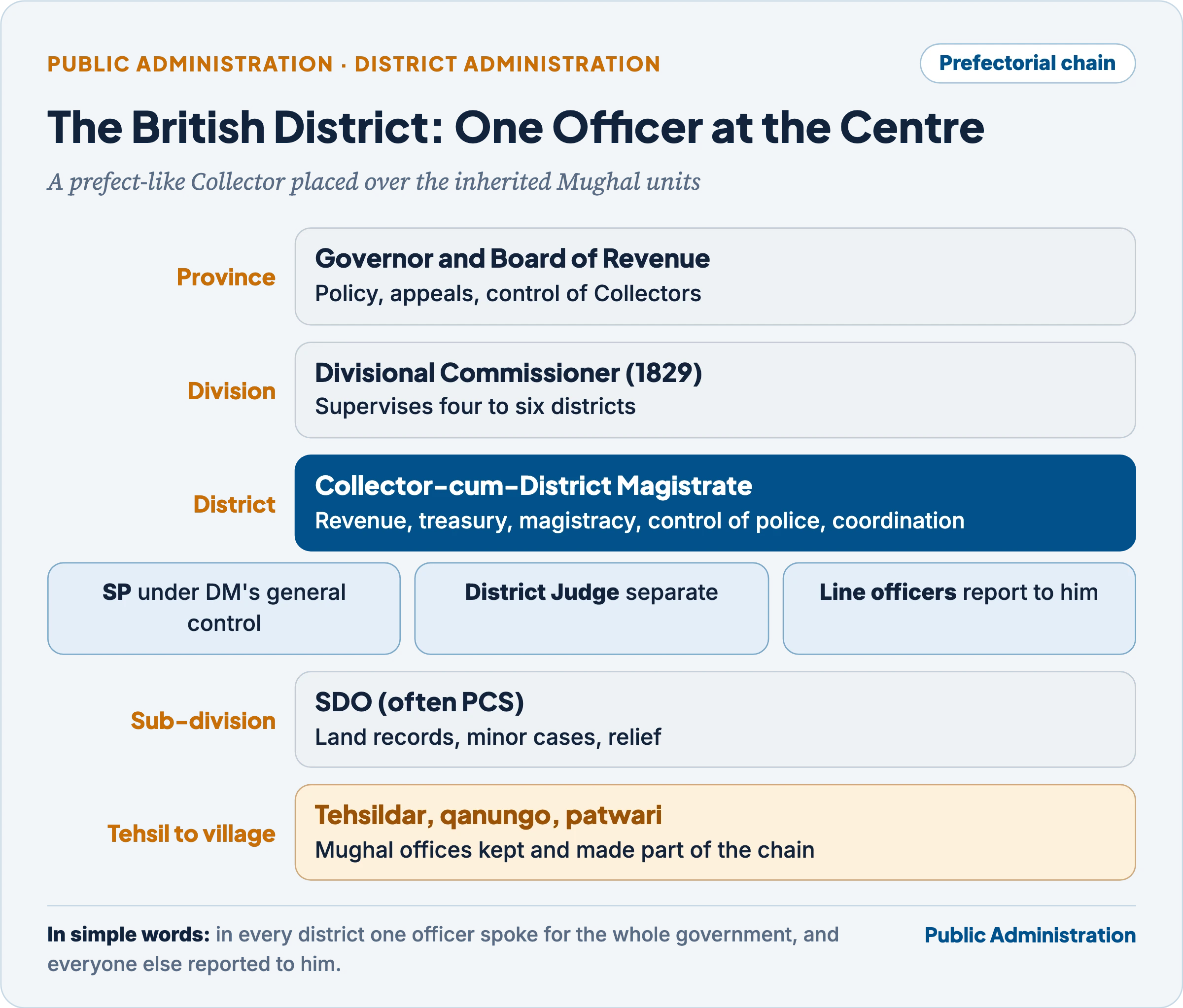
- What the British did. They took the historically inherited district (the Mughal sarkar with its tehsil, qanungo and patwari) and placed over it a prefect-like officer, the Collector-cum-DM, who represented the whole government and controlled the field officers of all departments. It was an integrated prefectorial system.
- Why in the absence of rural local government. There were no elected district-level bodies to share or check power: the district boards set up after 1882 were usually chaired by the Collector and dominated by officials. With no local representative institutions, all authority converged on the prefect.
- Consequences. It ensured unity of command, speed in crisis and imperial control with few officers; but it made the district centralised, paternal and official-centred, and left little room for local democracy.
- After 1947. India kept the prefectorial Collector but added development (Community Development, 1952; blocks), democratic decentralisation (Panchayati Raj, 1959; the 73rd Amendment, 1992), and line departments with their own chains. The system has become mixed: prefectorial for law and order, revenue and disaster, functional for many development sectors.
5.5 Police administration
- Before 1861. Cornwallis’s daroga system (1792): thanas under salaried darogas, supervised by the magistrate; zamindari police abolished. It lacked roots in society; darogas were ill-paid, corrupt and feared, and crime rose.
- The Police Act, 1861. After 1857, a Police Commission (1860) led to the Police Act (Act V of 1861):
- a provincial, uniformed, salaried constabulary organised on military lines;
- an Inspector General of Police at the head of each province, a District Superintendent of Police in each district, and inspectors, head constables and constables below;
- the District Magistrate kept general control and direction of the police in the district; the SP managed internal organisation, pay and discipline under the IG. This dual control remains in the commissionerate debate today.
- The Indian Police Commission (1902–03), chaired by Sir Andrew Fraser, kept the DM’s supremacy but asked him to interfere rarely in day-to-day policing or investigation. It organised the force into a European (imperial) service recruited in England, a provincial service recruited in India, upper subordinate (inspectors, sub-inspectors) and lower subordinate (head constables, constables) ranks, and divided provinces into ranges under Deputy Inspectors General. Indian Deputy Superintendents were introduced in 1905.
- Legal framework. The IPC (1860), CrPC (1861, recast in 1882 and 1898) and the Evidence Act (1872) governed policing till 30 June 2024.
- The legacy. The 1861 force was designed for control of a subject population after a rebellion: ruler-oriented, coercive, centralised and unaccountable to the public. This explains why, after independence, the police often appeared as an agency enforcing the will of the government in power rather than an impartial enforcer of law, as the National Police Commission (1977–81) observed. The Prakash Singh v Union of India (2006) judgment ordered State Security Commissions, fixed tenures and separation of investigation from law and order; many states have since passed new Police Acts, but the 1861 Act still applies in several.
5.6 Judicial administration, 1772–1950
| Year | Landmark |
|---|---|
| 1772 | Hastings’ Judicial Plan: a Diwani Adalat (civil) and Faujdari Adalat (criminal) in each district; Sadar Diwani and Sadar Nizamat Adalats at the top; Collector presides over civil court |
| 1774 | Supreme Court at Calcutta under the Regulating Act (Chief Justice Elijah Impey) for British subjects and Calcutta; English law |
| 1781 | Act of Settlement limits the Supreme Court; personal laws of Hindus and Muslims recognised |
| 1793 | Cornwallis Code: judiciary separated from revenue; zila and city courts, four provincial courts of appeal, Sadar Adalats at top; European judges |
| 1801, 1823 | Supreme Courts at Madras and Bombay |
| 1828–35 | Bentinck: provincial courts of appeal and circuit abolished; Commissioners of Revenue and Circuit; Indian judges (Sadr Amins, Principal Sadr Amins) given original civil jurisdiction; local languages in lower courts |
| 1834–37 | Law Commission under Macaulay; draft Penal Code |
| 1859–72 | Codification: CPC 1859, IPC 1860, CrPC 1861, Evidence Act 1872 |
| 1861–62 | Indian High Courts Act: Supreme Courts and Sadar Adalats merged into High Courts at Calcutta, Bombay and Madras; Allahabad 1866 |
| 1883 | Ilbert Bill controversy over Indian judges trying Europeans |
| 1911 | Indian High Courts Act 1911 enables new High Courts (Patna, Lahore followed) |
| 1937 | Federal Court (1 October 1937, Chief Justice Sir Maurice Gwyer) under the 1935 Act; appeals still to the Privy Council |
| 1949–50 | Privy Council jurisdiction abolished (1949); Supreme Court of India (28 January 1950) |
Legacies that persist
- Codified law and rule of law: equality before law, binding precedent and the doctrine that government is subject to courts. Sir Percival Griffiths regarded the rule of law as the most notable British contribution.
- Hierarchy of courts (district courts, High Courts, apex court) and the adversarial procedure.
- English as the language of higher courts, which keeps justice distant from many litigants.
- Delays, expense and formalism, and the executive magistracy: the CrPC of 1973 separated judicial from executive magistrates under Article 50, but the DM’s preventive and order-maintenance powers remain.
- Reforms in the twentieth century and after: Federal Court (1937), Supreme Court (1950), Law Commissions, Lok Adalats (Legal Services Authorities Act, 1987), and the replacement of the colonial criminal codes in 2024.
5.7 The Collector after 1947
- Expansion of role. As the state took on development, the Collector became the coordinator of development: Community Development (1952), the Block Development Officer, the DRDA, district planning, and every flagship scheme. Revenue declined in relative weight; law and order and development grew.
- Democratic decentralisation. Balwant Rai Mehta (1957) placed elected zila parishads beside the Collector; the 73rd and 74th Amendments (1992) gave panchayats and municipalities constitutional status. In practice the Collector often remained the superior of all staff and, where local bodies were superseded, their administrator.
- Disaster and climate. Under the Disaster Management Act, 2005 (Section 25), the Collector chairs the District Disaster Management Authority. Floods, heatwaves, cyclones and droughts linked to climate change demand that the district move from relief after the event to preparedness: heat action plans, early warning, climate-resilient infrastructure, and coordination of line departments and local bodies. The prefectorial Collector, with control over all departments, is the natural coordinator, but needs data, technical support and community participation to be proactive.
- Survival and critique. The office has survived because it is flexible: it absorbed development, elections, disaster and welfare delivery. Critics say it has become a “bureau for funnelling schemes, collecting statistics and attending VIP duties”, insulated from professional management, overloaded and frequently transferred.
- 2nd ARC (Fifteenth Report, State and District Administration, 2009) recommended that the Collector be the coordinator and facilitator of the district, that regulatory and development functions be organised so that elected local bodies own development, that tenures be stable, and that the Collector work under the oversight of district-level democratic bodies over time.
6. Local Self-Government
In simple words
Local self-government means people of a town or village choosing their own representatives to look after roads, water, schools and sanitation. The British set up such bodies, especially in towns, but kept officials in charge for most of the time, so the bodies rarely grew strong.
6.1 Urban beginnings
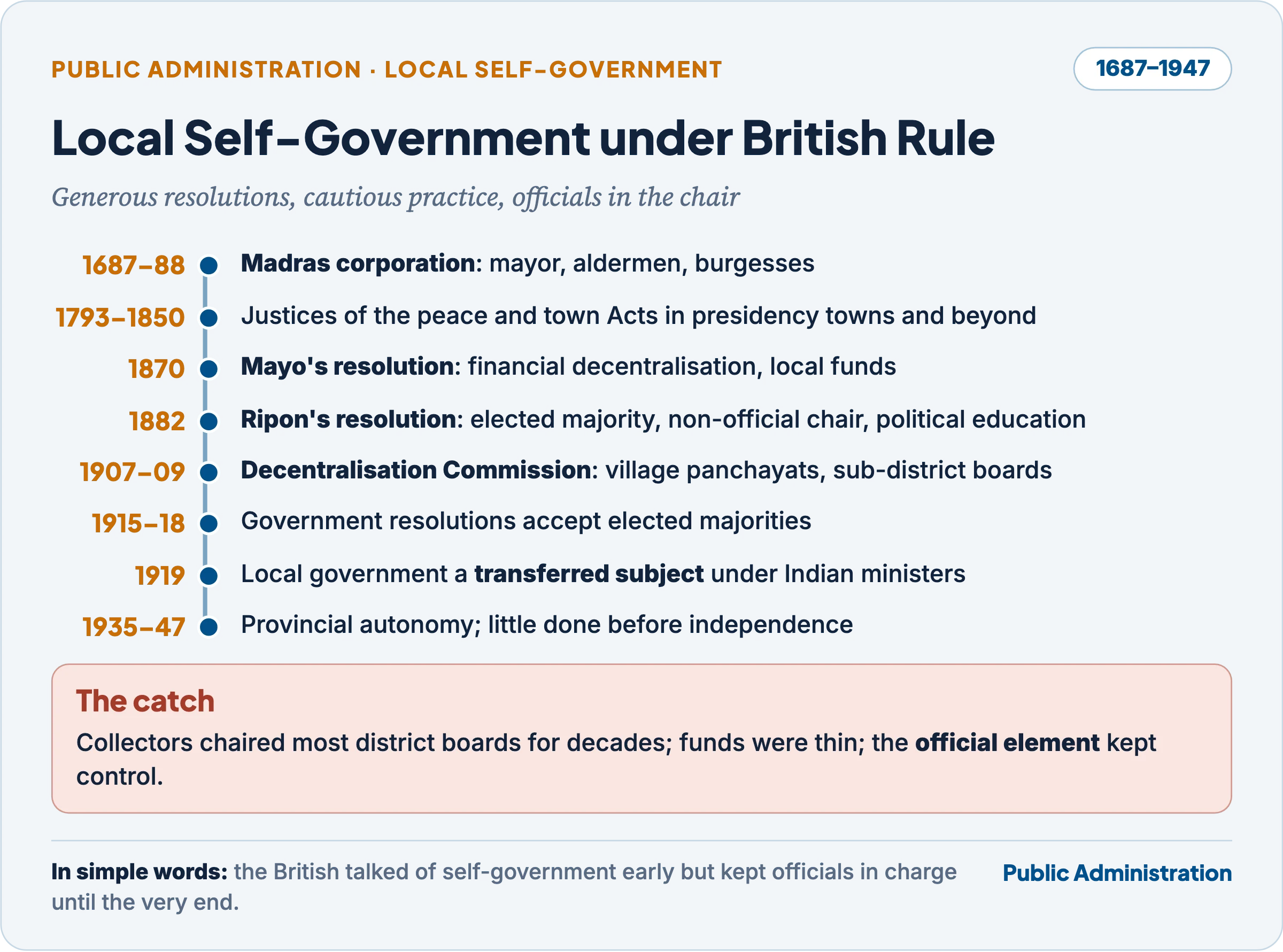
- Madras (1687–88). The Directors of the Company created a Municipal Corporation for Madras, with a mayor, twelve aldermen and sixty burgesses, for local taxation: the earliest local body on the British model.
- 1726. Mayor’s Courts and corporations for Calcutta, Bombay and Madras.
- Charter Act 1793. Gave statutory basis to municipal administration in the presidency towns through justices of the peace who could levy taxes for scavenging, policing and repair of streets.
- 1840s–1870s. Acts for Calcutta, Bombay and Madras gradually added elected commissioners; the Act of 1850 allowed municipal bodies in other towns; after the annexation of Punjab (1849) committees were set up in its principal towns. The motive was mostly sanitation and finance (to make towns pay for their own services) rather than democracy.
6.2 Mayo’s resolution of 1870
- Lord Mayo’s resolution (1870) on financial decentralisation handed provinces fixed grants for certain services and urged them to develop local self-government to manage local funds for education, sanitation, medical relief and public works.
- It argued that local interest and supervision were needed to make such services efficient, and that local bodies would associate Indians with administration.
- Its main purpose was financial: shifting costs to local taxation. But it brought elected or nominated Indians into municipal committees in many towns.
6.3 Ripon’s resolution of 1882
Lord Ripon (Viceroy 1880–84) issued the Resolution on Local Self-Government of 18 May 1882, often called the Magna Carta of local self-government in India, and earned the title “father of local self-government”.
Main provisions
- Network of local boards: rural local boards at the sub-division, tehsil or taluk level, and district boards above them, with municipalities in towns.
- Elected majority: official members not to exceed one-third; elections wherever possible.
- Non-official chairman: an elected non-official should ordinarily preside.
- Financial decentralisation: local bodies to get defined sources of revenue and budgetary freedom.
- External, not internal, control: government should revise and check from outside, not direct from within; power to supersede only in case of gross abuse.
Why it was a fundamental change in approach
- Before 1882, local bodies were means of administrative convenience and finance. Ripon declared that local self-government was “chiefly desirable as an instrument of political and popular education“, a training ground for both electors and elected.
- He accepted that Indians would make mistakes: if the British truly meant to train Indians in local affairs, they must give them a fair opportunity and let them learn by experience. This rejected the official view that Indians were indifferent to self-government.
- It was a policy statement, not a law: provinces implemented it through Local Boards and Municipal Acts (1883–85), unevenly.
Why Ripon is called the prophet of local government
- His was a vision ahead of its time: elected local bodies as schools of democracy, close to the ideas of J.S. Mill, who in Considerations on Representative Government (1861) argued that local institutions were the school of political capacity.
- He criticised the bureaucracy as “jealous” of allowing non-officials any share in administration, an insight later commissions confirmed.
- But, like a prophet, his message was largely ignored in practice: officials stayed in control, district boards were usually chaired by Collectors, funds were thin, and the elective principle spread slowly (it did better in some provinces, such as the Central Provinces, than in others, such as Punjab).
6.4 The Royal Commission upon Decentralization (1907–09)
- Composition. Appointed in September 1907, first under Sir Henry Primrose and then chaired by C.E.H. Hobhouse; R.C. Dutt was a member. It reported in 1909.
- Recommendations on local government.
- Village panchayats to be revived and given small civil and criminal jurisdiction and local functions: the village as the basic unit.
- Sub-district (taluk or tehsil) boards in every sub-division, with district boards above.
- Elected majorities in municipal boards; ordinarily an elected non-official chairman of municipalities; the Collector to continue as chairman of the district board.
- Lighter government control and more financial resources.
- Divisional Commissioners and Collectors to have more delegated powers; officers to be better trained in Indian manners and courtesy.
- The judgement of history. A widely shared verdict among historians of Indian local government is that the Commission did little more than echo Ripon’s resolution of 1882, and that even these conservative proposals were postponed for another ten years (until the 1915 and 1918 resolutions). Those years were the last opportunity for British statesmen to build real local democracy before nationalist politics overtook it.
- Why the delay. Bureaucratic reluctance; fear that local bodies would become nationalist platforms; financial stringency; and the war. A 1915 government resolution blamed failure on lack of funds, public apathy and lack of interest in elections. Lord Morley accused the Indian bureaucracy of a “professional contempt for the inexpert outsider“.
6.5 From 1918 to 1947
- The Government of India Resolution of 1918 accepted elected majorities on all boards, elected chairmen, and wider franchise, and favoured village panchayats.
- 1919. Local self-government became a provincial, transferred subject under Indian ministers. Every province passed village panchayat Acts in the 1920s (for example in Bengal, Madras, Bombay, the United Provinces and Punjab); municipal boards got elected chairmen and larger elected majorities.
- Problems. Elected bodies often became arenas of faction, caste and communal politics (separate electorates after 1909 had spread into municipalities) and of patronage; resources were tiny; and the Swarajists’ obstruction and communal riots of the 1920s disrupted them. The historian B.B. Misra concluded that elected majorities often converted local self-government into an instrument of personal and sectional interests.
- 1935–47. Provincial autonomy raised hopes, but the war and the resignation of ministries in 1939 meant little further progress until independence.
6.6 How the British bureaucracy stifled village self-rule
- Destruction of the old village community. Charles Metcalfe described Indian villages in 1830 as “little republics”, almost self-sufficient. British rule weakened them:
- Ryotwari and Permanent settlements dealt with individuals or zamindars, ignoring the collective role of the village in revenue.
- Courts and codified law displaced the panchayat’s role in justice.
- Police and revenue officials (daroga, patwari as state servant) replaced village self-policing and community record-keeping.
- Commercialisation and land transfers broke old social bonds.
- Centralised district rule. The Collector-centred prefectorial district left no room for elected rural government at the district level: district boards were chaired by the Collector, staffed by government officers, financed by grants and controlled taxes.
- Bureaucratic attitude. Officials regarded local bodies as tutees, not partners. Ripon, Morley and Montagu all noted the distrust between officials and Indian representatives. Supersession, nominated members and official chairmen kept the official element dominant.
- Starved finances. Local bodies got narrow tax bases (cesses, octroi, tolls) and conditional grants, so they could not act independently.
- Counter-view. The British did create the first elected local bodies, introduced elections, budgets and municipal law, and trained a generation of Indian leaders (many national leaders, such as Pherozeshah Mehta, C.R. Das, Vallabhbhai Patel and Jawaharlal Nehru, began in municipal politics). The stifling came from official control and poverty of resources, not from absence of institutions.
6.7 Values of local government and the problem of capacity
Why local government matters (“the government next door”). The government nearest to people is the one they meet daily: drinking water, drains, streetlights, birth certificates, schools. Its values, drawn from decentralisation theory, are:
- Participation and democracy. Alexis de Tocqueville, in Democracy in America (1835), saw town meetings as to liberty what primary schools are to science; J.S. Mill saw local bodies as the school of political education, the same argument Ripon made in 1882.
- Efficiency and local knowledge. Local bodies know local needs and preferences better than distant officials; the economists’ principle of subsidiarity (and fiscal federalism) holds that functions should be assigned to the lowest level that can perform them.
- Accountability and responsiveness. Citizens can see and reach local representatives; feedback is quick.
- Equity and empowerment. Reservation for women, SCs and STs in panchayats and municipalities (73rd and 74th Amendments) brings excluded groups into power.
- Gandhian gram swaraj. Gandhi saw self-governing villages as the foundation of Indian democracy; Article 40 directs the state to organise village panchayats.
Capacity of elected representatives. Ripon expected Indians to learn by doing. After 1992, lakhs of new representatives, many first-time and many women, needed skills in planning, budgeting, procurement, social audit and digital systems. Weak capacity, combined with dependence on officials, thin funds and limited devolution of functions, funds and functionaries, leaves many bodies dependent on the bureaucracy: an echo of the colonial pattern. Programmes such as the Rashtriya Gram Swaraj Abhiyan fund training, but their reach and quality are uneven.
7. The Legacy and Its Persistence after 1947
In simple words
When the British left, India did not throw away their administrative machine. It kept the services, the districts, the laws and the offices, because they worked and because the new country needed stability. But the machine also carried old habits, like secrecy and distance from people, which have been harder to change than the buildings.
7.1 Structural legacy: what India inherited
| British institution | Origin | Present form |
|---|---|---|
| ICS and Indian Police | 1853–55; 1893 for police | IAS, IPS (Article 312; All India Services Act, 1951) |
| Public Service Commission | 1926; Federal PSC 1937 | UPSC and State PSCs (Articles 315–323) |
| Secretariat and portfolio system | 1843; 1859–61 | Ministries, business rules (Article 77), Central Secretariat Service |
| Tenure system | 1905 | Central Staffing Scheme, deputation |
| Collector-cum-DM | 1772; united 1859 | District Collector / Deputy Commissioner |
| Divisional Commissioner, Board of Revenue | 1829; 1786 | Survive in many states |
| Land records hierarchy | Mughal base, British system | Tehsildar, patwari; digitised under land-records modernisation |
| Police Act 1861 | 1861 | Still in force in several states; new state Acts in others |
| Codes | 1860–1872 | BNS, BNSS, BSA from 1 July 2024 |
| Budget, Auditor General, PAC | 1860; 1919; 1921 | Union Budget, CAG (Article 148), PAC |
| Federal structure | 1935 Act | Seventh Schedule, Governor, emergency provisions |
| Local bodies | 1687; 1882; 1919 | Panchayats and municipalities (73rd and 74th Amendments) |
7.2 Behavioural legacy
- Aloofness and status-consciousness. The “sahib” culture, protocol, the gap between the officer and the citizen; the mai-baap expectation among people.
- Secrecy. The Official Secrets Act, 1923, and the habit of treating information as the government’s property. The Right to Information Act, 2005 reversed the principle; the 2nd ARC (First Report, 2006) recommended repealing the OSA and placing secrecy provisions in a new law.
- Red tape and proceduralism. Government by record, multiple levels of noting, reliance on precedent, and fear of audit turn rules into ends in themselves.
- Robert Merton, the American sociologist, called this goal displacement and trained incapacity: officials so trained in rules that they cannot adapt when circumstances change.
- Red tape obstructs good governance because it delays service, raises the cost of compliance, breeds corruption (speed money), and blurs accountability (everyone has noted, no one has decided).
- Remedies tried: e-Office, delayering, self-certification, time-bound service guarantee laws (Madhya Pradesh, 2010 onwards), decriminalisation of minor offences (Jan Vishwas laws), and outcome-focused monitoring.
- Centralisation. Decisions pushed upwards; reluctance to delegate; distrust of local bodies.
- Control over development. A law-and-order, regulatory mind-set carried into development work, producing target-driven, top-down programmes.
7.3 “Not by imitation but by interaction”
The statement that British rule generated most of the structural and behavioural values of Indian administration through interaction, not imitation means:
- The British did not transplant English administration wholesale. England had no Collector, no district magistrate, no ryotwari settlement, no all-India service, no tenure system. These were Indian creations produced when British ideas met Indian conditions.
- They adapted Mughal institutions: the sarkar became the district; the amalguzar and faujdar merged into the Collector-Magistrate; the qanungo, patwari and tehsildar were kept; Persian was the court language until 1837.
- Indians shaped the outcome: the demand for simultaneous examinations, Indianisation, elected councils and local bodies; the Moderates’ use of British liberal principles against British practice; the working of dyarchy by Indian ministers. Many values (merit, rule of law, neutrality) became Indian values because Indians used them in the struggle for self-government.
- Even the Constitution adapted the 1935 Act through Indian debate, adding adult franchise, rights and directive principles.
- Riggs’ prismatic theory helps here: a society in transition (prismatic) does not copy a foreign model; it blends modern formal structures with older practices, producing something new (and with its own pathologies, such as formalism).
7.4 Did British rule unify India’s administration?
- Unifying forces. An all-India service, a uniform legal code, a single currency and budget, railways, telegraph and post, a common language of administration (English), and a central secretariat. These created an administrative unity India had not had before.
- Why the claim is “not wholly correct”.
- Two Indias: British India and over 550 princely states with very different administrations; British policy preserved the states as allies, keeping India administratively divided.
- Provincial diversity: regulation and non-regulation provinces, three land settlements, different services in each province.
- Divide and rule: separate electorates (1909, 1919, 1935) and communal representation in local bodies.
- Partition (1947) was itself the final failure of unity.
- The real administrative unification came after 1947: integration of the princely states (Patel and V.P. Menon), the All India Services spanning all states, and the reorganisation of states.
7.5 Continuity and change after 1947
Why the colonial system continued
- Crisis of 1947: Partition, refugees, integration of states, war in Kashmir; there was no time to build a new machine.
- Leaders’ choice: Patel and the Constituent Assembly decided to keep the services; the 1935 Act was the template.
- Familiarity: Indian leaders had worked the British system in councils, municipalities and provincial ministries.
- Institutional inertia: rules, manuals, cadres and training continue unless deliberately changed.
What has changed since 1947
| Area | Colonial position | Since independence |
|---|---|---|
| Purpose | Order and revenue for an empire | Welfare state, development, social justice (Directive Principles) |
| Accountability | To London and the Secretary of State | To Parliament, legislatures, courts, citizens (RTI, Lokpal) |
| Political system | Unitary, limited franchise | Federal, adult franchise, coalition and multi-party politics |
| Social base of services | European and elite Indian | Reservations, regional languages, wider social intake |
| District | Collector as ruler | Collector as development coordinator, alongside elected panchayats |
| Local government | Advisory, official-led | Constitutional status (1992), State Finance and Election Commissions |
| Laws | IPC, CrPC, Evidence Act, OSA | BNS, BNSS, BSA (2024), RTI (2005), repeal of obsolete laws |
| Capacity | Generalist, learned on the job | Mission Karmayogi, competency frameworks, lateral entry experiments |
| Technology | Paper files | e-Office, digital public infrastructure, direct benefit transfer |
Assessment. The structures have been adapted and expanded, but behaviour has changed more slowly. Critics argue that India kept a colonial bureaucracy and dressed it in democratic clothes: a “soft outer shell” of democratic institutions with an intact steel frame inside. Defenders reply that the same frame held India together, ran elections for hundreds of millions, and delivered green revolution, welfare schemes and disaster response, and that the problems come as much from Indian politics and society as from the British.
Criticism — The case against the colonial legacy
- Designed for control and extraction, not service; its purpose clashes with democracy.
- Centralised and prefectorial, stifling local self-government.
- Secretive, status-conscious and paternal; citizens treated as subjects.
- Proceduralist: red tape, file-centred work, fear of audit and initiative.
- Generalist without domain expertise; slow to adapt to economic and technological change.
- Coercive police design and distant courts persist.
Defence — The case for the colonial legacy
- Gave India a rational-legal framework: merit, rule of law, codified law, audit.
- The All India Services provided unity and continuity through Partition and integration.
- Traditions of integrity and neutrality at senior levels.
- A district system able to absorb new tasks (development, elections, disasters).
- Institutions of accountability (PSCs, Auditor General, PAC) that democracy could build on.
- Changeable from within: India has reformed much of it without breaking continuity.
Theory lens: reading the British legacy through Paper I ideas
- Weber’s bureaucracy. Max Weber, in Economy and Society (1922), described legal-rational authority. The British built its forms in India (merit, hierarchy, files, salaried careers) but without democratic legitimacy; the Indian bureaucracy inherited Weberian structures with a patrimonial-colonial culture. See the article on Weber and Bureaucracy.
- Riggs’ prismatic society and formalism. Fred Riggs, in Administration in Developing Countries (1964), described prismatic societies where modern structures overlay traditional behaviour, and formalism, the gap between formal rules and actual practice. Indian administration after 1947 (rules on transfers, local self-government or police neutrality that are not followed in practice) fits the model. See the article on Riggsian Models.
- Prefectorial model (headquarters–field relations). The British Collector is a classic integrated prefect; India’s shift towards line departments and panchayats is a move towards a mixed prefectorial-functional pattern. See the article on Structure and Forms of Organisation.
- Generalist versus specialist. The Macaulay–Northcote–Trevelyan generalist ideal, critiqued by Fulton (1968) as the cult of the amateur, frames India’s debates on domain expertise, lateral entry and Mission Karmayogi. See the article on Recruitment, Training and Career.
- Neutrality versus commitment. The British model of political neutrality and anonymity collided after 1947 with demands for a committed bureaucracy; the colonial service’s “neutrality” was itself selective, serving the empire. See the article on Weber and Bureaucracy.
- Colonial bureaucracy versus development administration. The term development administration, first used by U.L. Goswami (1955) and popularised by Edward Weidner and Riggs, distinguished a change-oriented, goal-oriented administration from the law-and-order, revenue administration of colonial states. India tried to convert the Collector into a development administrator. See the article on Development Administration.
- Elite theory and representative bureaucracy. Macaulay’s design matches the elite model; Donald Kingsley‘s idea of representative bureaucracy (Representative Bureaucracy, 1944) explains India’s reservations and wider social intake as a corrective. See the article on Recruitment, Training and Career.
- Decentralisation theory. J.S. Mill (local bodies as schools of political education), Tocqueville, and the principle of subsidiarity explain why Ripon’s vision mattered and why colonial centralisation stifled it; the 73rd and 74th Amendments are the belated answer. See the article on Bureaucracy, State, Market and Liberalisation.
Key Terms
| Term | Meaning in simple words |
|---|---|
| Diwani | Right to collect land revenue and decide civil cases, granted to the Company in 1765 |
| Nizamat | Criminal justice and police, left with the Nawab under double government |
| Double government | Clive’s 1765–72 system: Company held real power, Nawab held formal responsibility |
| Covenanted service | British officers who signed a covenant with the Company; forerunner of the ICS |
| Uncovenanted service | Lower, mostly Indian employees without covenant or cadre |
| Patronage | Appointment by a director’s personal nomination, not merit |
| Open competition | Recruitment by a public examination open to all eligible candidates |
| Statutory Civil Service | 1879 scheme for nominating Indians of proven merit to a share of covenanted posts |
| Listed posts | ICS posts opened to promoted PCS officers after 1892 |
| Indianisation | Gradual entry of Indians into the higher services reserved for the British |
| Regulation province | Province governed by formal Regulations and separated powers (Bengal, Madras, Bombay) |
| Non-regulation province | Province governed by executive orders under a Chief Commissioner, with a powerful Deputy Commissioner |
| Portfolio system | Each council member in charge of a department; seed of cabinet government |
| Dyarchy | 1919 split of provincial subjects into reserved (officials) and transferred (Indian ministers) |
| Provincial autonomy | 1935 system of responsible ministries in provinces |
| Tenure system | Officers serve a fixed term in the central secretariat, then return to the field |
| Permanent Settlement | 1793 fixed land revenue with zamindars as owners |
| Ryotwari | Settlement directly with each cultivator, revised periodically |
| Mahalwari | Settlement with the village or estate as a joint unit |
| Collector | Head of district revenue administration; also District Magistrate since 1859 |
| Prefectorial system | Field system in which one general representative of government coordinates all departments in an area |
| Daroga | Salaried police officer in charge of a thana under Cornwallis’s 1792 system |
| Steel frame | Metaphor for the ICS (and later the All India Services) as the structure holding the state together |
| Generalist | Administrator chosen for general ability, moved across fields |
| Red tape | Excessive rules and procedures that delay decisions |
| Mai-baap culture | People treating officials as parents who provide and punish |
| Magna Carta of local self-government | Description of Ripon’s 1882 resolution |
Commissions, Committees and Judgments
The table lists the Acts, commissions and committees that shaped the British legacy and its reform, in order.
| Body or Act | Year | Key point |
|---|---|---|
| Regulating Act | 1773 | Governor-General in Council; Supreme Court; no gifts or private trade |
| Pitt’s India Act | 1784 | Board of Control; dual control until 1858 |
| Cornwallis Code | 1793 | Revenue separated from justice; rule-bound administration |
| Charter Act | 1833 | Governor-General of India; Section 87 non-discrimination; Law Commission |
| Charter Act | 1853 | Separate Legislative Council; open competition |
| Macaulay Committee (Macaulay) | 1854 | Competitive exam, liberal education, age 18–23 |
| Government of India Act | 1858 | Crown rule; Secretary of State and Council of India |
| Indian Councils Act | 1861 | Portfolio system; Indian nominees; provincial legislatures |
| Police Act (Act V) | 1861 | Provincial constabulary; DM’s general control |
| Indian High Courts Act | 1861 | High Courts at Calcutta, Bombay, Madras (1862) |
| Aitchison Commission (Sir Charles Aitchison) | 1886–87 | Imperial, Provincial, Subordinate services; listed posts |
| Indian Police Commission (Sir Andrew Fraser) | 1902–03 | Police tiers, ranges, DM to interfere rarely |
| Decentralisation Commission (C.E.H. Hobhouse) | 1907–09 | Village panchayats, sub-district boards, elected majorities |
| Islington Commission (Lord Islington) | 1912–15 | 25% superior posts to Indians; time-scale pay |
| Secretariat Procedure Committee (Llewellyn Smith) | 1919 | Pyramidal department; Imperial Secretariat Service |
| Government of India Act | 1919 | Dyarchy; Public Service Commission (s.96C) |
| Lee Commission (Viscount Lee of Fareham) | 1923–24 | 40:40:20 ICS intake; 50:50 parity; PSC without delay |
| Public Service Commission (Sir Ross Barker) | 1926 | First recruiting commission in India |
| Wheeler Committee | 1936 | Secretariat delays and noting |
| Maxwell Committee (R.M. Maxwell) | 1937 | Secretariat organisation and procedure |
| Government of India Act | 1935 | Provincial autonomy; three lists; Federal Court; FPSC |
| Tottenham Committee (Sir Richard Tottenham) | 1945–46 | Reorganisation of central secretariat |
| Indian Independence Act | 1947 | Two dominions; service conditions protected |
| Balwant Rai Mehta Committee | 1957 | Three-tier Panchayati Raj beside the Collector |
| National Police Commission (Dharma Vira) | 1977–81 | Police seen as ruler-oriented; reform of 1861 Act |
| Prakash Singh v Union of India | 2006 | Seven directives on police autonomy and accountability |
| 2nd ARC, First Report (Veerappa Moily) | 2006 | Repeal Official Secrets Act; place secrecy in a new law |
| 2nd ARC, Tenth Report | 2008 | Domain competency, performance management in the services |
| 2nd ARC, Fifteenth Report | 2009 | Collector as coordinator; strengthen district democracy |
| T.S.R. Subramanian v Union of India | 2013 | Minimum tenure, Civil Services Boards, written orders |
Contemporary Developments
- Colonial criminal codes replaced (1 July 2024). The Bharatiya Nyaya Sanhita, Bharatiya Nagarik Suraksha Sanhita and Bharatiya Sakshya Adhiniyam replaced the IPC (1860), the CrPC (1973, successor to the colonial codes of 1861–1898) and the Evidence Act (1872), ending the most visible part of the British legal legacy in policing and courts.
- Lateral entry advertisement withdrawn (August 2024). The UPSC advertisement for lateral recruitment to senior posts was withdrawn after objections about reservation, showing the continuing tension between the closed generalist career service inherited from the ICS and the push for domain specialists.
- “Raj Bhavan” becomes “Lok Bhavan” (25 November 2025). The Union Home Ministry asked all Governors and Lieutenant Governors to rename their offices Lok Bhavan and Lok Niwas, stating that “Raj Bhavan” carried colonial associations; states began renaming within days.
- Repealing and Amending Act, 2025 (assent 20 December 2025). Parliament repealed or amended 71 obsolete laws, continuing the post-2014 clean-up of colonial-era and redundant statutes. The Indian Ports Act, 2025 (passed August 2025) repealed the Indian Ports Act, 1908.
- Seva Teerth and Kartavya Bhavan (13 February 2026). The Prime Minister’s Office moved from South Block to a new complex named Seva Teerth, and ministries to Kartavya Bhavans; the Cabinet resolved that the North and South Blocks, built for the colonial government after the capital moved to Delhi in 1911, become part of a national museum.
- Jan Vishwas (Amendment of Provisions) Bill, 2026 (passed April 2026). The second Jan Vishwas law further decriminalises minor offences in economic and regulatory statutes, reducing the coercive, penal approach to compliance inherited from colonial regulation.
- Mission Karmayogi. The National Programme for Civil Services Capacity Building (since 2020) continues to build role-based competencies through the iGOT Karmayogi platform, an attempt to move beyond the colonial generalist, rule-bound training model.
Revision Grid
| Thinker or body | Work or report (year) | Key idea |
|---|---|---|
| Robert Clive | Double government (1765) | Real power with the Company, formal authority with the Nawab |
| Cornwallis | Cornwallis Code (1793) | Rule of law, separation of revenue from justice, Europeanisation |
| Thomas Munro | Ryotwari; minutes as Governor of Madras (1820–27) | Paternal, concentrated district authority; Indian agency |
| Charles Metcalfe | Minute on village communities (1830) | Villages as “little republics” |
| Wellesley | Fort William College (1800) | Company servants as officers of a sovereign |
| T.B. Macaulay | Macaulay Report (1854) | Merit, competitive exam, generalist liberal education |
| Northcote and Trevelyan | Report (1854) | Merit-based civil service in Britain |
| Canning | Portfolio system (1859) | Departmental responsibility; seed of cabinet |
| Ripon | Resolution of 18 May 1882 | Local self-government as political education |
| Lloyd George | House of Commons speech (1922) | ICS as the “steel frame” |
| Sardar Patel | Constituent Assembly (10 October 1949) | All India Services needed for a united India |
| Max Weber | Economy and Society (1922) | Legal-rational bureaucracy |
| Fred Riggs | Administration in Developing Countries (1964) | Prismatic society, formalism |
| Eric Stokes | The English Utilitarians and India (1959) | Utilitarian and paternalist schools in British policy |
| B.B. Misra | The Administrative History of India 1834–1947 (1970) | Colonial roots of Indian administrative ethos |
| Philip Woodruff | The Men Who Ruled India (1953–54) | ICS as Platonic “guardians” |
| S.S. Khera | District Administration in India (1964) | District as the point of total administrative contact |
| Paul Appleby | Public Administration in India: Report of a Survey (1953) | Able service, but over-centralised and procedure-bound |
Previous Year Questions
- 2026An important characteristic of the British Civil Service was its open refusal to be influenced by commercial and industrial interests of India in the name of neutrality. Explain.
- 2025“The colonial legacy is responsible for many administrative problems in independent India as the role of company agents and traders evolved into Magistrates, Governors and Civil Servants.” Analyze.
- 2022“The Government of India Act, 1935 is the most important source of Indian constitution”. Identify its features.
- 2022“The office of the District Collector admirably survived the changing times from colonialism to the present times”. Comment.
- 2021Red-tapism is a major obstacle to the implementation of ‘good governance. Comment.
- 2020The public services in India are an evolution of the British Raj. Trace the Indianization of the services.
- 2019Macaulay’s ideas on Indian Civil Service Corresponded to the elite theory of bureaucracy, which continue to persist. Do you agree? Justify.
- 2018“A government next-door is the government that matters most for the people.” Discuss the statement with special reference to the values of local government.
- 2018Climate change issues pose new challenges for district administration to be proactive.” Elaborate
- 2017“Effectiveness of local self-government institutions is hampered due to the lack of capacity building of the elected representatives.” Elaborate
- 2017“Indianisation of Public Services is a slow but steady process.” Explain.
- 2016“The Regulating Act of 1773 not only introduced values in administration but also laid the foundation of centralized administration in India.” Explain.
- 2014“District collector is a legacy of the British Raj and has largely remained insulated from the demands of contemporary professionalism.” Discuss.
- 2013“The Charter Act of 1853 marked the beginning of parliamentary system in India.” Explain.
- 2010It is said that British made a significant contribution towards modernising the Indian Administrative System on a ‘rational-legal’ basis. Justify the assessment with reference to the period from 1830 to 1865.
- 2009“Bureaucracy developed by the British stifled the village self-rule.” Comment.
- 2004“The main features of British governmental and administrative system continue to influence the present Administrative System.” Comment.
- 2003“Though India emerged as a sovereign state after Independence, the administrative system remained the same as was during the British period.” Comment.
- 2002“After independence, despite the change in socio-economic and political milieu, the basic features of colonial on administration continues to exist in our administrative system.” Comment.
- 2000“The period of British rule generated most of the structural and behavioural values of Indian Administration not by imitation but through interaction.” Comment.
- 1997“Under the Company’s rule a distinction was drawn between Regulation and Non-Regulation Provinces.” Comment.
- 1996“It is not wholly correct to suggest that British rule had seriously attempted to bring about unity in India’s administration.” Comment.
- 1995“The purpose of Clive’s famous ‘double government’ was to mask Company’s sovereignty.” Comment.
- 1994“In framing a Federal Constitution the Constituent Assembly had many models to draw upon, but it wisely decided to take the Government of India Act, 1935 as the basis on which the new Constitution was to be framed.” Critically examine this statement.
- 1993Trace the evolution of Judicial Administration in India during the British period and highlight the legacies that persist and the judicial reforms that have followed during the Twentieth Century.
- 1993“The generalist-neutralist model of Civil Service, more than any other model of Civil Service, fits in framework of parliamentary democracy in India, a legacy of the British pattern with which Indians have been familiar.” Comment.
- 1993“The British colonial administration superimposed the prefectorial system on the historically inherited district administration in India, in the absence of rural local governments at the district level.” Comment.
- 1992‘Lord Ripon was the prophet of local government in India.’ Comment.
- 1992‘The office of collector created by the British forms the basis of district administration in India, but today it needs a new look to metamorphise itself into a Key office of District Government.’ Comment.
- 1991‘The fine art of deception which the British Practised in the name of “Dyarchy” was too crude for it to pass the test of self- government. It hastened “Provincial Autonomy” but this too did not promote parliamentary democracy of federalism.” Comment.
- 1990‘The proposals of the Royal Commission on Decentralisation (1907-1909) did little more than echo the resolution of May, 1882, yet even such entirely conservative reforms were postponed for a further ten years: the last of the years of opportunity for British statesmen and officials and they passed away unused.’ Comment.
- 1990‘The Present culture of the Indian police system appears as continuation of what obtained under the British regime. In public estimate the police appears as an agency more to implement and enforce the objectives of the Government in power as district from enforcing law as such as an independent and impartial agency.’ Comment.
- 1989‘The Cabinet Committees provide a useful forum for interface between officials and non-officials in participatory situation in “Policy Administration” in a Parliamentary Democracy’. Comment.
- 1989‘Lord Ripon’s Resolution of 1882 has been described as the Magna Carta of Local Self-Government in India. It was a Policy Statement and marked a fundamental change in the basic approach.’ Comment.
- 1989Trace the evolution of Judicial Administration in India during the Mughal and British periods of Indian History and highlight the major landmarks of this evolution from 1774 to 1911.
- 1988“The formative stage of administration, preceding the Indian mutiny of 1857 witnessed a struggle between the ‘Cornwallis’ and ‘Munro’ schools of district administration.” Comment.
- 1988Trace the evolution of Secretariat system in India during the British period of administrative history with special reference to the structure of central administration and its field organisations.
- 1987Trace the evolution of the system of Public Administration in India from 1858 to 1919, highlighting the major landmarks of this period of administrative history.
- 2014“Many Asian and African countries have inherited the colonial idea of civil service as a privileged elite. Hence, the social status of the civil services is an important aspect of the bureaucracy’s unsuitability for change.” Comment.