

Financial Administration: Monetary and fiscal policies; Public borrowings and public debt; Budgets – types and forms; Budgetary process; Financial accountability; Accounts and audit.
This article: Meaning and forms of financial accountability and the accountability chain; internal financial control (Finance Ministry, Integrated Financial Advisers, Chief Accounting Authority, Chief Controller of Accounts, internal audit); parliamentary financial committees (PAC, Estimates Committee, COPU); separation of accounts from audit (1976) and the Controller General of Accounts; structure and classification of government accounts; cash and accrual accounting; Finance and Appropriation Accounts; PFMS; meaning and types of audit (regularity, propriety, financial, performance, IT, environmental, social); the CAG (Articles 148–151, the 1971 Act, independence, major reports, limits, reforms); the UK, US, French and board models of public audit; INTOSAI and the Lima Declaration; principal–agent theory, the Friedrich–Finer debate and NPM’s turn to performance audit.
Official Syllabus: Paper I · Unit 1-12 Financial Administration
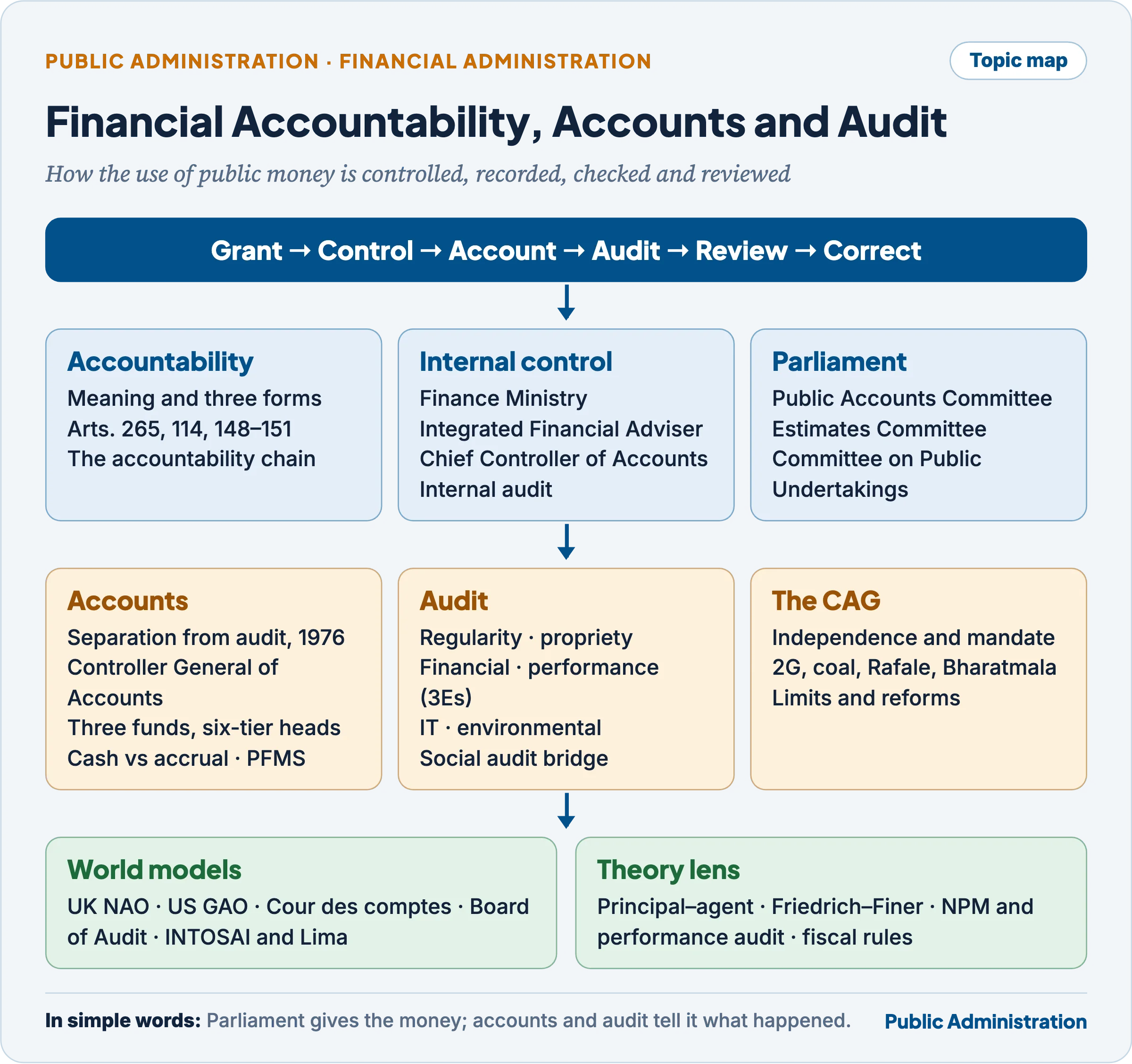
Financial accountability is the duty of the executive to answer for every rupee it raises and spends: to the legislature that authorised the money, to the auditor who checks it, and ultimately to the citizen who paid it. A budget is only a promise; accounts record what was actually done with the money, and audit tells Parliament whether the promise was kept, legally, wisely and with results. Without these two instruments the “power of the purse”, the oldest weapon of representative government, would end the day the budget is passed.
- The other two articles of this unit cover monetary and fiscal policy and public debt, and budgets and the budgetary process (the ex ante stage, when Parliament grants money). This article covers the ex post stage: how the spending is controlled inside the executive, recorded in accounts, audited, and examined by Parliament’s financial committees.
- The general theory of accountability (legislative, executive, judicial and citizen control) is in the articles on accountability and control; social audit is treated fully in the article on Citizen’s Charters, RTI and social audit. Here they appear only as bridges.
In simple words
A family gives its eldest son ₹50,000 to run the house for a month. At the end of the month he shows a notebook of every payment (the accounts). An uncle who did not spend the money goes through the notebook and the bills, and also asks whether buying a new television while the roof leaked was sensible (the audit). The family then sits together and decides what must change next month (the PAC). Government finance runs on exactly this cycle, only at a scale of crores.
1. Financial Accountability: Meaning, Forms and the Chain
In simple words
Accountability means having to explain yourself to someone who can question you and correct you. In money matters, the government has to explain three things: was the money spent as the law allowed, was it spent sensibly, and did it achieve anything.
1.1 Meaning
- Financial accountability is the obligation of those who raise, hold and spend public money to render an account of it to an authority that can examine, judge and sanction them.
- It has two parts: answerability (the duty to give information and justify decisions) and enforceability (the possibility of correction or penalty).
- In a parliamentary democracy the executive spends, but the legislature authorises; accountability closes the loop between the two.
- It answers three questions, which correspond to the three historic layers of audit:
- Legality (regularity): was the money spent only on what Parliament voted, within the amount voted, with proper sanction?
- Propriety: was it spent with the wisdom, faithfulness and economy of a prudent person spending his own money?
- Performance: did the spending achieve its objectives economically, efficiently and effectively?
- A fourth, newer layer is fiscal transparency: are all liabilities (borrowings off the budget, guarantees, pension commitments) disclosed, so that the true fiscal position is visible?
1.2 Three forms of financial accountability
The accountability of public money runs through three channels that work in sequence. Each has its own institutions and its own limits.
| Form | Who holds whom to account | Main instruments | Nature |
|---|---|---|---|
| Executive (internal) | Finance Ministry and departmental heads over spending units | Expenditure sanction, Integrated Financial Advisers, Pay and Accounts Offices, internal audit, re-appropriation rules | Continuous, preventive, hierarchical |
| Legislative | Parliament over the executive | Budget vote, cut motions, questions, PAC, Estimates Committee, COPU, standing committees | Ex ante (grant) and ex post (review) |
| Audit | An independent auditor on behalf of Parliament | CAG’s compliance, financial and performance audits; reports under Article 151 | Ex post, independent, expert |
- The three are complementary, not alternatives. Internal control prevents mistakes, audit detects them, and Parliament judges them and forces correction.
- Two further channels support them: judicial accountability (courts act on audit findings, as in the 2G and coal cases) and citizen accountability (social audit, RTI, public scrutiny of CAG reports through the media).
1.3 Constitutional foundations
The Constitution builds financial accountability into a set of articles that together say: no tax without law, no spending without appropriation, and an independent auditor to check both.
| Article | Provision | Accountability role |
|---|---|---|
| 265 | No tax shall be levied or collected except by authority of law | Legislative control over raising money |
| 266(1), 266(2) | Consolidated Fund of India; Public Account of India | Defines where public money sits |
| 267 | Contingency Fund of India | Emergency spending, recouped by later vote |
| 112, 113, 114 | Annual Financial Statement; Lok Sabha votes demands; no withdrawal from the Consolidated Fund except under an Appropriation Act | Legislative control over spending |
| 115 | Supplementary, additional and excess grants | Regularising overspending after PAC scrutiny |
| 148–151 | CAG: appointment, duties, form of accounts (150), audit reports laid before Parliament and State Legislatures (151) | Independent audit |
| 279 | CAG certifies the net proceeds of taxes (his certificate is final) | Fiscal federalism |
- Article 265 is the financial form of the rule of law: the executive cannot tax by order. Courts strike down levies imposed by executive instruction, and a “tax” collected without legal backing must be refunded. It is the revenue twin of Article 114, which forbids spending without an Appropriation Act.
- Together the two embody the old principle “no taxation without representation” and its corollary “no expenditure without appropriation“.
1.4 The accountability chain
The chain runs from Parliament’s grant to Parliament’s review. Each link depends on the one before it; a weak link anywhere (late accounts, a delayed audit, a report never discussed) breaks the cycle.
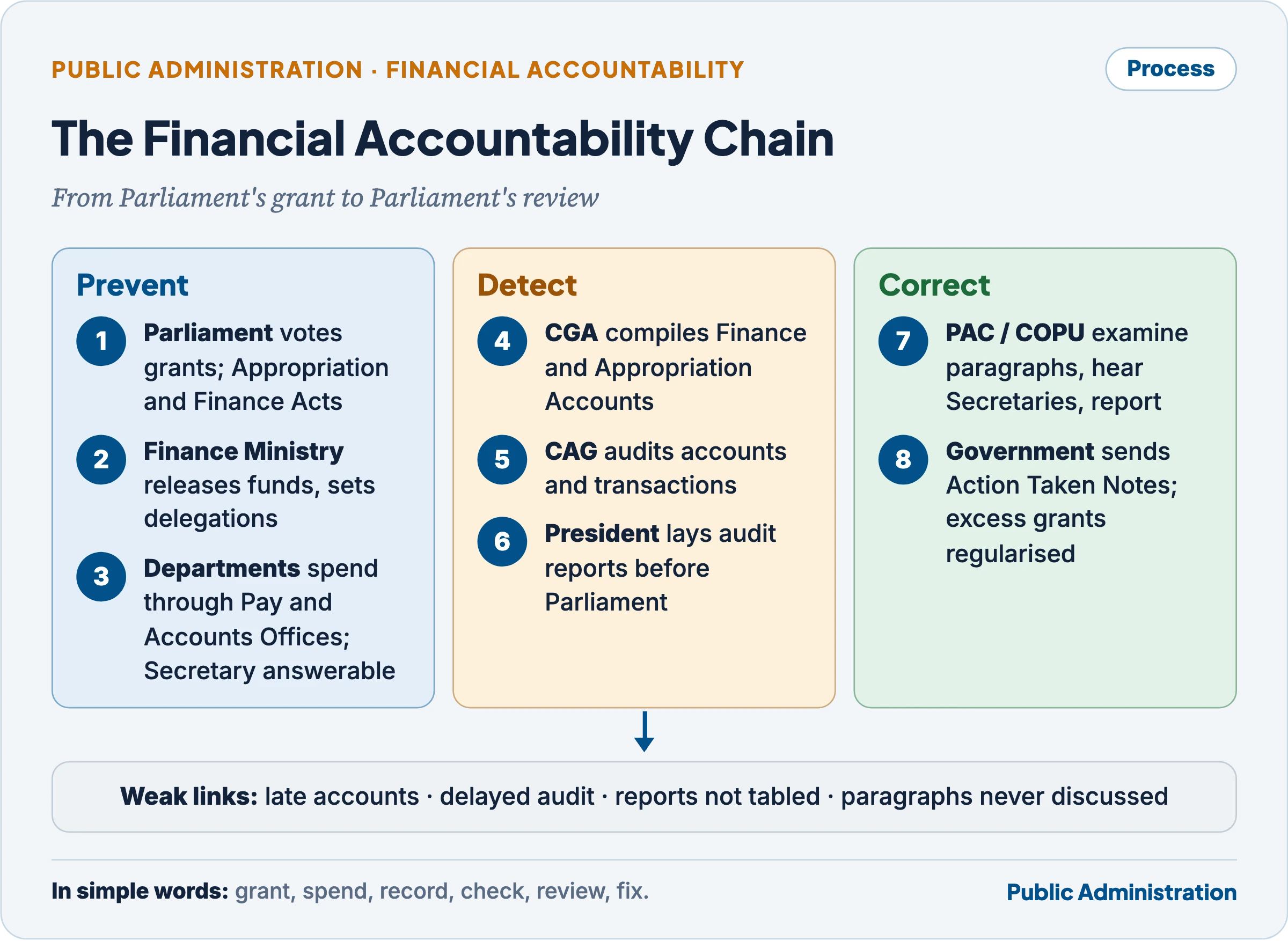
- Parliament votes demands for grants and passes the Appropriation Act and the Finance Act.
- The Ministry of Finance (Department of Expenditure) releases funds, sets delegations and monitors spending.
- Ministries and departments spend through Drawing and Disbursing Officers and Pay and Accounts Offices; the Secretary is the Chief Accounting Authority of the ministry.
- The Controller General of Accounts (CGA) consolidates the Union’s accounts and prepares the Finance Accounts and Appropriation Accounts.
- The CAG audits these accounts and the underlying transactions and reports under Article 151.
- The President causes the reports to be laid before each House.
- The Public Accounts Committee (and COPU for public undertakings) examines selected paragraphs, takes evidence and reports.
- The government furnishes Action Taken Notes; the PAC presents Action Taken Reports; excess spending is regularised by an excess grant.
- Prevent, detect, correct. Steps 2–3 are preventive control, steps 4–5 detective control, steps 7–8 corrective control.
- Time lag. Because the accounts close only after 31 March and audit follows, the PAC often examines spending two or three years old. This “post-mortem” character is the chain’s main weakness (Section 6.7).
Common confusion
Does the Comptroller and Auditor General “control” the issue of money from the Consolidated Fund? No. Despite the title, the Indian CAG performs only the auditor-general function. Money is drawn from the Consolidated Fund by departmental officers on the executive’s own authority, and the CAG comes in after the payment, at the audit stage. In the United Kingdom, by contrast, the Comptroller and Auditor General still has a genuine comptroller function: he approves the Treasury’s requests for issues from the Consolidated Fund. The Indian title is a survival of the British model; the substance is that of an auditor.
2. Internal Financial Control: the Executive’s Own Checks
In simple words
Before an outside auditor looks at the books, the government checks itself. The Finance Ministry acts like the household’s careful elder who must approve big purchases, and every ministry has a finance officer who watches each payment before it is made.
2.1 The Ministry of Finance as controller
The Ministry of Finance, mainly through its Department of Expenditure, is the executive’s own guardian of the purse. The classic justification is that the taxpayer cannot be left to the spending departments: some authority not directly concerned with the spending must weigh each item against the others and against available resources.
- Control at the budget stage. It scrutinises every proposal with financial implications, cuts inflated estimates, rejects technically unsound schemes and fixes priorities across ministries. Its typical questions: is the expenditure proper, does the ministry have authority, is it necessary, are costs excessive, are there cheaper alternatives?
- Control during execution. After the budget is passed, its prior concurrence is needed for expenditure beyond delegated limits, for re-appropriation between heads in certain cases, for new services, and for appraisal of large projects (Expenditure Finance Committee, Public Investment Board procedures). It reviews expenditure periodically to judge whether supplementary grants or savings will arise.
- Miscellaneous control. Grants-in-aid rules, write-off of losses, waivers of recovery, contracts, and staff strength (through the Staff Inspection Unit).
Critique and balance.
- Critics, including Paul Appleby in his 1953 and 1956 reports on Indian administration, held that detailed Finance Ministry control produced delay, a “saving candle ends” mentality, an attitude of accepting precedent and refusing risk, and a culture in which departments inflated estimates because they expected cuts. The Finance Ministry was said to strain at the gnat (small establishment items) and swallow the camel (large programmes it could not judge technically).
- The answer adopted in India was delegation with accountability: more financial powers to administrative ministries (codified in the Delegation of Financial Powers Rules, 1978, as amended), exercised with an in-house financial adviser. This is the logic of the Integrated Financial Adviser.
2.2 Financial advisers and the Integrated Financial Adviser (1975)
- 1968: each ministry got an Internal Financial Adviser for matters within delegated powers, while matters beyond them went to an “associate” Financial Adviser sitting in the Department of Expenditure.
- 6 October 1975: the Department of Expenditure’s Office Memorandum introduced the scheme of Integrated Financial Adviser (IFA), merging the two roles in one officer placed inside the administrative ministry, alongside a large enhancement of the ministry’s delegated powers.
- Dual responsibility: the IFA is responsible both to the Secretary of the administrative ministry and to the Ministry of Finance. Within delegated powers he helps the ministry use its freedom well; outside them he works under the Finance Ministry’s general guidance.
- Functions:
- association with scheme formulation from the initial stage, scrutiny of projects and programmes;
- budget formulation and post-budget vigilance (no large shortfalls, no unforeseen excesses);
- preparation of the ministry’s performance and outcome budget and monitoring of schemes against it;
- oversight of the ministry’s accounting and internal audit organisation.
Indian Connect — The Integrated Financial Adviser: control from inside, not from above
The IFA system was India’s answer to the Appleby-era complaint that the Finance Ministry controlled spending from outside and too late in the process. By placing a Finance Ministry nominee inside each ministry, from the drafting of a scheme to its monitoring, control became concurrent and advisory rather than a gate at the end. The Ministry of Defence adopted the system later (Defence Production in 1976, Defence in 1983). The weakness is the IFA’s divided loyalty: if he leans towards the ministry he dilutes the Finance Ministry’s check; if he leans towards the Finance Ministry he becomes the old obstructive gatekeeper under a new name.
2.3 The accounting machinery inside a ministry
After the 1976 departmentalisation (Section 4.2), each civil ministry runs its own payment and accounting organisation. The table sets out who does what.
| Officer | Role in financial accountability |
|---|---|
| Secretary of the ministry | Chief Accounting Authority: responsible for the ministry’s spending, its accounts and their certification; appears before the PAC as the principal witness |
| Integrated Financial Adviser | Advises the Secretary; heads the ministry’s finance, budget and accounting set-up on his behalf |
| Principal Chief / Chief Controller of Accounts | Heads the ministry’s accounting organisation: Pay and Accounts Offices, consolidation of the ministry’s accounts, preparation of its Appropriation Accounts, and the internal audit wing |
| Pay and Accounts Officer (PAO) | Pre-checks and makes payments; maintains primary accounts |
| Drawing and Disbursing Officer (DDO) | Draws money for an office and pays individual claims |
| Controlling Officer | Head of a department controlling a grant: distributes funds and watches progress of expenditure |
- The arrangement puts payment, accounting and internal audit inside the executive, leaving the CAG as a purely external auditor.
- It also makes the Secretary personally answerable before the PAC, the Indian version of the British “accounting officer” principle.
2.4 Internal audit
- Meaning. Internal audit is an independent, objective review within the organisation of whether its controls, risk management and operations work as intended. It is management’s own audit: it reports to the head of the department, not to the legislature.
- In the Union government, internal audit is carried out by the Internal Audit Wings under each Chief Controller of Accounts, with norms set by the CGA. In most States it is weaker, often limited to pre-checking of bills in treasuries.
- Internal vs external audit compared:
| Basis | Internal audit | External (statutory) audit |
|---|---|---|
| Agency | Within the executive (CCA’s internal audit wing) | Independent constitutional body (CAG) |
| Reports to | Secretary / management | Parliament through the President |
| Timing | Concurrent, continuous | Mostly ex post |
| Purpose | Improve controls, prevent loss, help managers | Hold the executive accountable to the legislature |
| Coverage | Whole of operations, risk-based | Test-check on a sample basis |
| Independence | Limited (part of management) | High (constitutional safeguards) |
Why internal audit matters for performance.
- It is concurrent, so it can stop a loss before it happens; external audit usually reports after the money is gone.
- It reviews systems (procurement, inventory, IT controls, fund flow to implementing agencies), so it improves performance and service delivery, not just compliance.
- It reduces the external auditor’s burden: a strong internal control system allows the CAG to rely on it and concentrate on high-risk areas.
- It supports risk management: modern internal audit ranks activities by risk and audits the riskiest first.
Weaknesses and reform.
- In practice Indian internal audit has remained a routine regularity check, poorly staffed and not independent of the management it audits.
- A Task Force constituted by the CAG in July 2006 at the Finance Ministry’s request found internal audit severely restricted in mandate and ignored by management, and favoured a professionally trained Chief Internal Auditor.
- The 2nd Administrative Reforms Commission, 14th Report, Strengthening Financial Management Systems (April 2009), recommended a statutory Chief Internal Auditor in ministries, an Audit Committee in each ministry, a shift to risk-based internal audit, and stronger internal control in States (where it proposed that the IFA be responsible for both internal audit and accounting).
- Different principals, not a smaller CAG. Internal audit serves management (helping the Secretary run the ministry and catch problems early); CAG audit serves Parliament. A good internal audit sharpens external audit, but neither can replace the other.
3. Legislative Accountability: Parliament’s Financial Committees
In simple words
The whole Parliament cannot examine thousands of pages of accounts. So it sends small groups of its members to do the detailed checking for it. These groups question senior officers, read the auditor’s findings and report back to the House.
3.1 The instruments of parliamentary financial control
Parliament’s financial control has an ex ante part (granting money) and an ex post part (reviewing its use). The budgetary stage is covered in the article on budgets and the budgetary process; it is summarised here only to show where the committees fit.
| Stage | Instruments | What it achieves |
|---|---|---|
| Before spending (ex ante) | General discussion of the budget; scrutiny of demands for grants by Departmentally Related Standing Committees (from 1993); voting of demands, cut motions; Appropriation and Finance Bills | Authorisation and its limits |
| During the year | Questions, calling attention, debates; supplementary and additional grants; vote on account | Continuous scrutiny of policy and spending |
| After spending (ex post) | PAC on Appropriation and Finance Accounts and CAG reports; COPU on public undertakings; excess grants (Article 115) | Review, correction, regularisation |
| Estimates scrutiny | Estimates Committee examines selected estimates and suggests economies | Efficiency and economy of administration |
- The three financial committees, the PAC, the Estimates Committee and COPU, are standing committees of the Lok Sabha; no Minister can be a member, and a member who becomes a Minister ceases to be a member.
3.2 The Public Accounts Committee (PAC)
Origin and composition.
- First set up in 1921 under the Montagu–Chelmsford Reforms (Government of India Act, 1919); the Finance Member was its chairman and the Finance Department its secretariat. After independence the Finance Minister continued as chairman until the Constitution came into force in 1950, when it became a full parliamentary committee under the Speaker with a non-official chairman.
- Constituted every year under Rule 308 of the Lok Sabha Rules: not more than 22 members, 15 elected by the Lok Sabha and 7 by the Rajya Sabha (associated since 1954–55), by proportional representation through the single transferable vote. Term: one year.
- Opposition chairmanship: till 1966–67 a senior ruling-party member chaired it; in 1967, for the first time, the Speaker appointed a member of the Opposition as chairman, a convention followed ever since. In August 2024 K.C. Venugopal of the Congress was named chairman for the 18th Lok Sabha.
- The PAC completed a hundred years in 2021.
Functions.
- Examines the Appropriation Accounts and the Finance Accounts of the Union and the CAG’s audit reports on them, on revenue receipts, and on autonomous bodies audited by the CAG.
- Satisfies itself that:
- money shown as spent was legally available for the purpose to which it was applied;
- the expenditure conforms to the authority governing it;
- every re-appropriation was made under the rules.
- Examines cases of excess over voted grants and recommends their regularisation by an excess grant (a practice dating back to the PAC’s first report on accounts in 1921). It treats savings from bad estimation no more leniently than excesses.
- Goes beyond formal legality to the “wisdom, faithfulness and economy” of spending: losses, wasteful expenditure, weak systems.
Method of working.
- The CAG is its “friend, philosopher and guide”: he briefs the chairman, helps select the paragraphs to examine, sits through the evidence, and vets the draft report for facts. The PAC works almost entirely on the basis of CAG reports.
- Ministries give explanatory notes; the Secretaries appear as witnesses; proceedings are private and non-partisan by convention; the report is adopted by consensus.
- After the report, ministries furnish Action Taken Notes; the PAC presents Action Taken Reports sorting the government’s replies into accepted, not pursued, not accepted (reiterated) and interim.
- Sub-committees and study groups (from 1952–53) take up large subjects.
Significance.
- It is “the best medium through which the taxpayer sees what has been done with his money“, an old description that still captures its role.
- Opposition chairmanship and consensus working make it the most credible check on the executive’s money; its recommendations, though not legally binding, are by convention accepted in the great majority of cases and are treated almost as the House’s own view.
- It acts as a deterrent: the prospect of appearing before the PAC is one of the strongest pressures on a Secretary to keep proper records and avoid irregular spending.
- It has driven systemic reforms: it pressed for the separation of accounts from audit (achieved in 1976), for performance reviews, and for better accounting in large spending departments.
Limitations.
- Post-mortem: it examines accounts two or three years after the spending, when officers have moved and the loss cannot be undone.
- Cannot examine policy: it judges whether money was spent well within a policy, not whether the policy was right, though the line between the two is thin (a wasteful deal often reflects a flawed policy).
- Cannot disallow any expenditure; it can only draw attention.
- Dependent on the CAG: its scope is largely coextensive with audit reports; weak or delayed audit means weak PAC scrutiny.
- Selective coverage: it can examine only a small fraction of the paragraphs in each year’s reports; the rest are never discussed.
- One-year tenure prevents specialisation; reports are rarely debated in the House.
- State PACs carry large backlogs, and in some States do not meet regularly (in the Bihar fodder case, excess drawals reported by audit were not taken up in time).
Indian Connect — From audit paragraph to PAC report: the Bharatmala case
The CAG’s performance audit of Phase I of Bharatmala Pariyojana (Report No. 19 of 2023, tabled 10 August 2023) found, among other things, that the Dwarka Expressway had been sanctioned at ₹250.77 crore per km against the ₹18.20 crore per km approved by the Cabinet Committee on Economic Affairs for the programme, because the Haryana stretch was built as an elevated eight-lane road. The PAC took up the report and examined it in its 144th Report of the 17th Lok Sabha. The case shows the chain working end to end: audit finding, public attention, committee examination, and a formal record requiring the ministry to justify or correct.
3.3 The Estimates Committee
- Origin: traced to the Standing Finance Committee (1921), chaired by the Finance Member; the first post-independence Estimates Committee was constituted in April 1950.
- Composition: 30 members, all from the Lok Sabha (the Rajya Sabha has no place), elected every year; chairman appointed by the Speaker, usually from the ruling party.
- Functions (Lok Sabha Rules):
- to report what economies, improvements in organisation, efficiency or administrative reform, consistent with the policy underlying the estimates, may be effected;
- to suggest alternative policies to bring about efficiency and economy (added in 1953);
- to examine whether the money is well laid out within the limits of the policy;
- to suggest the form in which estimates are presented to Parliament.
- Working: selective: a few ministries and a few subjects each year; questionnaires, study tours, evidence of officials and non-officials; reports followed by Action Taken Reports. By the end of the 17th Lok Sabha it had presented 1,184 reports since 1950.
- Often called a “continuous economy committee” because it can examine estimates throughout the year and keeps returning to the economy and efficiency of administration. Its early report on the reorganisation of the Central Secretariat was in effect an organisation and methods study.
Limitations.
- It examines estimates after they are presented; demands are voted regardless of whether it has reported, so it has no role in framing or passing them.
- No CAG to guide it, so it starts from scratch; members are laymen with one-year terms.
- Its recommendations are advisory; critics have called its reports “a big list of advices” and accused it of straying into administrative reorganisation beyond its remit.
- Selective coverage means a ministry may be scrutinised once in several years.
- Defence: its lay character keeps it from being captured by experts; it is the only body that looks at organisation and economy forward-looking, and its reports educate both Parliament and public.
3.4 The Committee on Public Undertakings (COPU)
- Origin: a resolution moved by Lanka Sundaram in December 1953 argued that the PAC and Estimates Committee could not give public enterprises the attention they needed; the V.K. Krishna Menon Committee examined the idea; COPU came into existence on 1 May 1964, on the pattern of the British Select Committee on Nationalised Industries.
- Composition: 22 members, 15 from the Lok Sabha and 7 from the Rajya Sabha, one-year term.
- Functions: examines the reports and accounts of specified public undertakings and the CAG’s reports on them; examines whether their affairs are managed in accordance with sound business principles and prudent commercial practice, in the context of their autonomy and efficiency.
- Excluded: matters of major government policy, day-to-day administration, and matters for which special machinery exists under a statute.
- Working: individual enterprise reports, horizontal studies across a sector (personnel policy, financial management, foreign collaboration), and Action Taken Reports. The 1st ARC favoured horizontal studies over enterprise-by-enterprise scrutiny.
- Limitations: cannot cover all enterprises (some, including defence undertakings, kept outside); lower status of its recommendations than the PAC’s; little House discussion; one-year tenure; occasional charge of being either too harsh or of usurping other controllers’ roles.
3.5 The three committees compared
The table brings the three committees together. The key contrast is time: the PAC looks back, the Estimates Committee looks forward, and COPU does both for one sector.
| Basis | PAC | Estimates Committee | COPU |
|---|---|---|---|
| Set up | 1921 (parliamentary committee from 1950) | 1950 | 1964 |
| Members | 22 (15 LS + 7 RS) | 30 (LS only) | 22 (15 LS + 7 RS) |
| Chair | Opposition member (since 1967) | Usually ruling party | Usually ruling party |
| Main material | Appropriation and Finance Accounts, CAG reports | Budget estimates of selected ministries | Reports, accounts and CAG audit of PSUs |
| Orientation | Ex post, legality and propriety | Forward-looking, economy and efficiency | Commercial efficiency and autonomy |
| CAG support | Yes, continuous | No | Yes, for audit reports |
| Typical description | Watchdog of public expenditure; post-mortem scrutiny of accounts | Continuous economy committee | Guardian of public enterprise accountability |
3.6 Is parliamentary financial control declining?
- Arguments that it is:
- most demands for grants are passed by the guillotine without discussion (see the article on the budgetary process);
- committee reports are rarely debated; Action Taken Reports trail years behind;
- the number of CAG reports on the Union tabled in Parliament has fallen: an analysis of tabled reports found only 18 in 2023, and an average of 22 a year in 2019–2023 against 40 in 2014–2018;
- large spending flows through off-budget borrowings, special purpose vehicles, PPPs and transfers to local bodies and societies, partly outside the committees’ reach;
- low attendance and one-year tenures limit specialisation.
- Arguments that it is evolving rather than declining:
- Departmentally Related Standing Committees (1993) now examine every ministry’s demands;
- the PAC continues to take up high-profile audits (2G, coal, Bharatmala);
- digital systems (PFMS, online Action Taken Note monitoring) make tracking easier.
- Reforms commonly proposed: longer committee tenure (co-terminous with the Lok Sabha, one-third retiring each year), PAC examination of all audit reports within a time limit, research staff and expert advisers, mandatory House discussion of committee reports where the government disagrees, statutory deadlines for tabling CAG reports and for Action Taken Notes, and better training of members in financial management.
4. Accounts: Recording the Use of Public Money
In simple words
Accounts are the government’s money diary. They record every rupee that comes in and goes out, under a fixed set of headings, so that anyone can later check where the money went and compare it with what Parliament allowed.
4.1 Meaning and purposes of government accounts
- Accounts are “statements of facts relating to money or things having money value”: the systematic recording, classifying and summarising of financial transactions and the interpretation of the results.
- Purposes (following L.D. White, the American scholar of administration, in Introduction to the Study of Public Administration, 1926):
- to establish the fidelity of those handling funds and to protect honest officials;
- to give information for policy-making and management;
- to keep spending within budget provisions and limits;
- to reveal the financial condition of the organisation in all its branches;
- to permit adjustments in the rate of spending during the year;
- to aid audit.
- Government vs commercial accounting. A firm keeps accounts mainly to measure profit and net worth. Government keeps them mainly to show compliance with legislative appropriation and the fiscal result (surplus or deficit) of its operations. This is why Indian government accounts have been cash-based and appropriation-oriented rather than accrual-based.
4.2 Separation of accounts from audit (1976)
The old position. From 1860 the Auditor General handled both accounts and audit; the Government of India Act, 1935 and the Audit and Accounts Order of 1936 kept the combination, and after 1950 the CAG compiled the accounts of the Union and the States as well as auditing them. Railway and Defence accounts were already maintained departmentally.
The criticism.
- An auditor who compiles the accounts he audits is in an embarrassing position; independence demands that the one who keeps the books should not certify them.
- Accounting is an executive function; audit is a quasi-parliamentary function. Mixing them blurs accountability.
- An agency outside the ministry kept its accounts, so ministries lacked timely data for management, project monitoring and performance budgeting.
- The PAC repeatedly pressed for separation. (The 1st Administrative Reforms Commission, interestingly, had seen no inherent conflict in the combination.)
The reform.
- The Cabinet approved departmentalised accounting in June 1975; the Finance Minister’s budget speech for 1976–77 argued that accounts and finance must be an integral part of management.
- Implemented through Ordinances, later replaced by the CAG’s (Duties, Powers and Conditions of Service) Amendment Act, 1976 and the Departmentalisation of Union Accounts (Transfer of Personnel) Act, 1976 (assented to on 8 April 1976, deemed in force from 1 March 1976). Under the proviso to Section 10 of the 1971 Act, the President relieved the CAG of compiling Union accounts.
- Departmentalised accounting began in a few departments on 1 June 1976 and in all other ministries from 1 October 1976.
- A new office of the Controller General of Accounts was created within the Department of Expenditure as the Union’s principal accounting authority, with the Indian Civil Accounts Service carved out of the Indian Audit and Accounts Service. 1 March is observed as Civil Accounts Day.
- States: the reform applied to the Union. The CAG’s offices (Accountants General, Accounts and Entitlement) still compile the accounts of all States except Goa; since 1984 the State accounting and audit offices have been separate wings within the CAG’s department, so that the office that compiles accounts does not audit them.
Common confusion
Is it the “Departmentalisation of Union Accounts (Transfer of Functions) Act”? No. The statute is the Departmentalisation of Union Accounts (Transfer of Personnel) Act, 1976. It provided for the transfer of officers of the Indian Audit and Accounts Department to ministries so that they could compile their own accounts. The transfer of the accounting function itself was done by relieving the CAG under the proviso to Section 10 of the 1971 Act (amended in 1976). Many notes merge the two steps into one wrongly named Act.
Arguments for the separation.
- Independence of audit: the CAG no longer audits his own work.
- Better financial management: each ministry gets timely, relevant accounts for monitoring, budgeting and decision-making.
- Responsibility: spending departments become responsible for payment and accounting together, which makes them careful not to exceed appropriations.
- Efficiency of audit: the CAG’s department can concentrate on audit.
Problems noticed. Staff and costs increased; States were slow to follow; and with payment, accounting and internal audit all inside the ministry, internal checks depend on the ministry’s own integrity more than before.
4.3 The Controller General of Accounts (CGA)
The CGA, in the Department of Expenditure, is the principal accounts adviser to the Government of India and the head of the Union’s accounting system. His functions:
- Rules and form: frames accounting rules and manuals (the Civil Accounts Manual, Receipts and Payments Rules) and administers the List of Major and Minor Heads; the form of accounts itself is prescribed by the President on the advice of the CAG (Article 150).
- Payments and receipts: budget control, payments and receipt accounting for civil ministries through Pay and Accounts Offices.
- Consolidation and reporting: consolidates monthly accounts of the Union and publishes fiscal data (monthly receipts, expenditure and deficit) giving the Finance Minister and the public an early picture of the year; prepares the Union Government Finance Accounts and the Appropriation Accounts (Civil) for audit by the CAG and laying before Parliament; publishes “Accounts at a Glance”.
- Internal audit of civil ministries and technical advice on accounting matters, binding on ministries.
- Pensions of civil Central government employees (through the Central Pension Accounting Office).
- PFMS: owns and runs the Public Financial Management System.
- Cadre management of the Indian Civil Accounts Service.
- Significance for public financial management: the CGA is the bridge between budget and actuals; timely, accurate accounts are what make fiscal rules, cash management and performance monitoring possible.
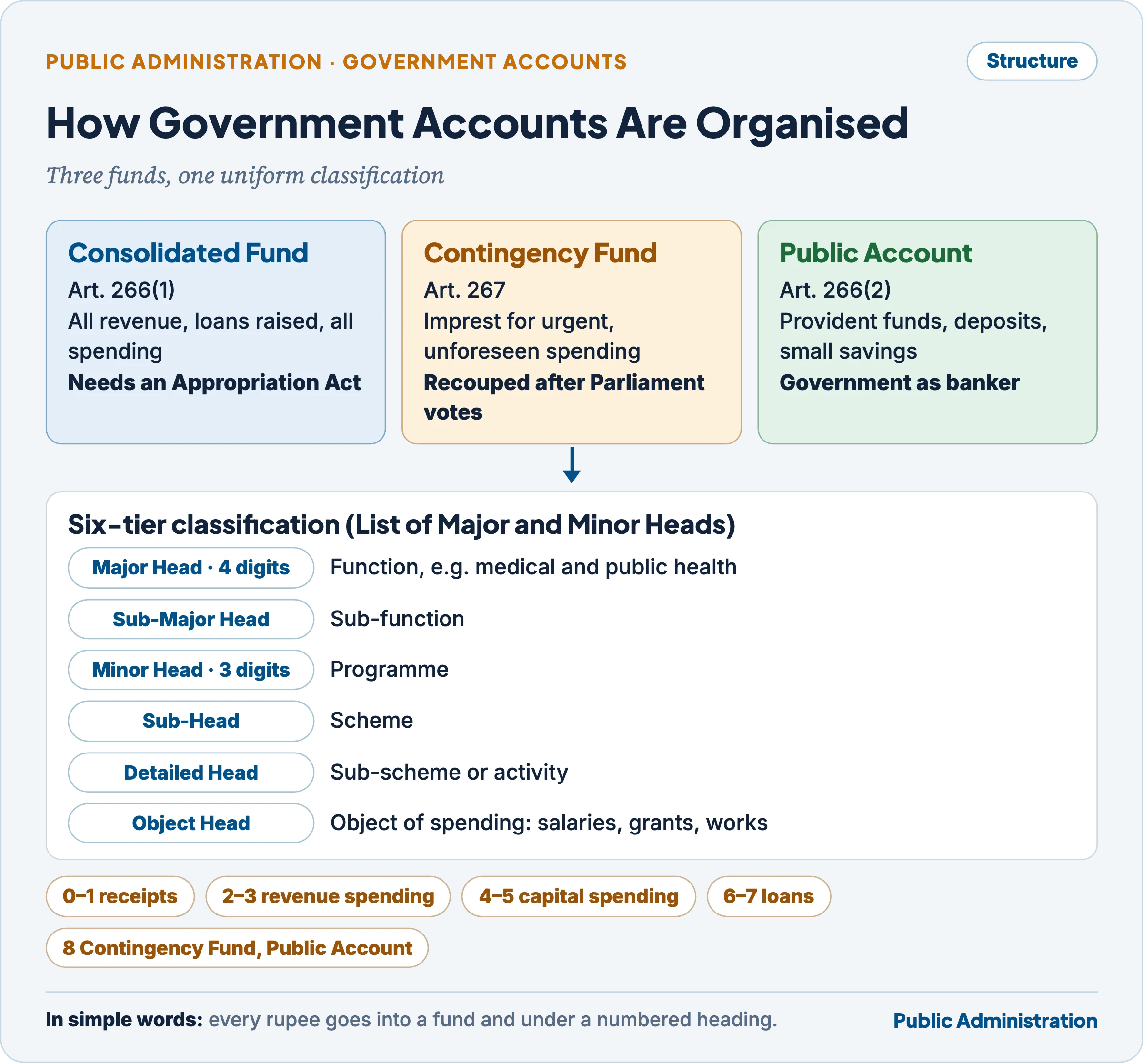
4.4 The structure of government accounts: three parts
Since 1950 the accounts of the Union (and of each State) are kept in three parts, mirroring the Constitution.
| Part | Article | What goes in | Legislative control |
|---|---|---|---|
| Consolidated Fund of India | 266(1) | All revenues, loans raised (market borrowings, treasury bills, external loans), repayments of loans given by the government; all expenditure | No withdrawal without an Appropriation Act (Article 114); charged items not voted |
| Contingency Fund of India | 267 | An imprest for urgent, unforeseen expenditure, held by a Finance Secretary on behalf of the President; corpus ₹30,000 crore since the Finance Act, 2021 (it had been ₹500 crore) | Advances recouped after Parliament authorises the expenditure |
| Public Account of India | 266(2) | Money the government holds as a banker or trustee: provident funds, small savings, deposits, reserve funds, remittances | No appropriation needed (it does not belong to the government), but transactions are audited |
- Charged expenditure (salary of the President, judges, the CAG; debt charges; decrees of courts) is shown in the budget but not voted; it is still audited and examined by the PAC.
- States have the same three parts under Articles 266 and 267.
4.5 Classification of transactions
- India has a uniform classification of transactions for the Union and the States down to the minor-head level, prescribed in the List of Major and Minor Heads of Account (LMMH). Uniformity lets the accounts of the Union and all States be compared and consolidated.
- A revised structure from 1974 linked the classification to functions, programmes and schemes to suit performance budgeting.
- The six tiers of classification:
- Major Head (four digits): a function of government, such as medical and public health;
- Sub-Major Head (two digits): a sub-function;
- Minor Head (three digits): a programme;
- Sub-Head: a scheme;
- Detailed Head: a sub-scheme or activity;
- Object Head: the object of spending (salaries, office expenses, grants, capital works), which gives item-wise control.
- The first digit of a major head tells the type of transaction: 0 and 1 receipts; 2 and 3 revenue expenditure; 4 and 5 capital expenditure; 6 and 7 loans and advances; 8 Contingency Fund and Public Account.
- Illustratively, a hospital’s medicines would be booked under major head 2210 (Medical and Public Health, revenue), while building the hospital would go under 4210 (capital outlay on the same function).
- Changes in major and minor heads need the CAG’s advice under Article 150, which keeps the structure stable across governments.
- After the merger of the Plan and Non-Plan distinction (from 2017–18), schemes are classified as Central Sector and Centrally Sponsored, with a revenue and capital split (detailed in the budgets article).
4.6 Cash vs accrual accounting
Meaning.
- Cash accounting records a transaction when cash is received or paid. It is simple, objective and directly tied to appropriation: Parliament grants cash, and the accounts show cash spent.
- Accrual accounting records a transaction when the economic event occurs, when value is created, transferred or consumed, whether or not cash moves. It records assets and liabilities, charges depreciation on long-lived assets, and recognises receivables and payables.
- Example (illustrative): a ministry receives medical equipment worth ₹10 crore in March but pays in May. Cash accounting shows nothing this year and ₹10 crore next year. Accrual accounting records an asset and a liability this year, and spreads the equipment’s cost over its useful life through depreciation.
The two systems compared:
| Basis | Cash accounting | Accrual accounting |
|---|---|---|
| When recorded | When cash moves | When economic value is created or consumed |
| Shows | Receipts, payments, deficit | Plus assets, liabilities, net worth, full cost of services |
| Liabilities | Hidden (pensions, guarantees, unpaid bills) | Disclosed |
| Assets | Not tracked after purchase | Tracked, depreciated |
| Link to appropriation | Direct | Needs reconciliation |
| Risk of manipulation | Deferring bills, advancing receipts to dress the deficit | Judgement in estimates and valuations |
| Cost and skill | Low | High (standards, asset registers, trained staff) |
Why accrual is advocated.
- Full picture of liabilities: unfunded pensions, guarantees to public enterprises, arrears and deferred payments do not appear in cash accounts.
- Full cost of services, needed to link inputs to outputs and outcomes and to compare delivery options.
- Asset stewardship: assets created with public money are tracked.
- Curbs fiscal opportunism: cash accounts can be flattered by deferring payments or taking one-time receipts; accrual makes such moves visible.
Difficulties. Valuing public assets (roads, heritage); deciding when a disputed tax demand is revenue; estimating pension liabilities; cost of systems and training; the risk that judgement-based estimates can themselves be used to hide and distort. Many experts therefore favour cash and accrual running in parallel, with supplementary statements, rather than a wholesale switch.
The Indian roadmap.
- 12 August 2002: the CAG constituted the Government Accounting Standards Advisory Board (GASAB) under Article 150 to formulate standards for the Union and States.
- Twelfth Finance Commission (2004) recommended accrual accounting for the Union and States; the Union accepted it in principle and asked GASAB to draw up a roadmap and operational framework; the Thirteenth Finance Commission noted the work in progress.
- 2nd ARC, 14th Report (2009): move to accrual through a task force and pilots before wider adoption.
- Standards: Indian Government Accounting Standards (IGAS), for the cash system, become mandatory once notified by the government; four have been notified (IGAS 1 on disclosure of guarantees, IGAS 2 on grants-in-aid, IGAS 3 on loans and advances, IGAS 4 on prior-period adjustments). Indian Government Financial Reporting Standards (IGFRS), for the accrual system, remain recommendatory for pilot studies.
- Present position: Union and State accounts remain cash-based, with growing disclosure statements (guarantees, liabilities, extra-budgetary resources) that move them towards a modified cash system.
4.7 Finance Accounts and Appropriation Accounts
The two annual accounts are the raw material of parliamentary financial control. One shows the financial position, the other shows obedience to the vote.
| Basis | Finance Accounts | Appropriation Accounts |
|---|---|---|
| Shows | Annual receipts and disbursements under each head, the Consolidated Fund, Contingency Fund and Public Account balances, debt and guarantees | Grant-wise comparison of the amount voted or charged with the actual expenditure, and explanations for excesses and savings |
| Purpose | Overall fiscal position | Compliance with the Appropriation Act |
| Union | Prepared by the CGA (civil); Railways and Defence prepare their own appropriation accounts | Prepared by ministries and CGA |
| States | Prepared by the CAG’s Accountants General | Prepared by the Accountants General |
| Audit | Audited and certified by the CAG | Audited by the CAG; report examined by the PAC |
- Excess over grant found in the Appropriation Accounts must be regularised by Parliament through an excess grant under Article 115, but only after the PAC has examined it and recommended regularisation.
4.8 PFMS and the digital treasury
- Public Financial Management System (PFMS): a web-based application of the CGA. It began in 2009 as the Central Plan Scheme Monitoring System to track funds released under central schemes down to the implementing agency and report expenditure in real time; its scope was enlarged to direct payments to beneficiaries (the backbone of Direct Benefit Transfer) and later to all payments, receipts and the compilation of accounts of the Union.
- Treasury computerisation in the States (Integrated Financial Management Systems) brought online budget control, e-payments, and same-day accounting, and integrates with PFMS.
- Single Nodal Agency (SNA) model (2021) and SNA-SPARSH (Department of Expenditure OM of 13 July 2023): Centrally Sponsored Scheme funds are released “just in time” through the RBI’s e-Kuber platform, the Centre’s share moving only when the implementing agency actually incurs expenditure, ending the parking of unspent balances in agency bank accounts.
Indian Connect — Computerised treasuries and PFMS: what changed for accountability
Before computerisation, the Union learnt how much a scheme had actually spent only months later, from utilisation certificates. Large sums sat unspent in the bank accounts of societies and agencies while the books showed them as “spent” the day they left the Consolidated Fund. PFMS and SNA-SPARSH changed this in three ways: real-time visibility of the fund flow down to the last agency, just-in-time release that reduces idle balances and interest cost, and an audit trail that the CAG can analyse with data tools. The CAG’s own 2023 audit of Ayushman Bharat noted that instructions to track expenditure through PFMS had not been fully followed, showing that the system works only where it is used.
5. Audit: Meaning, Purposes and Types
In simple words
Audit is an independent check on whether money was spent as allowed, spent sensibly, and spent with results. It is like a teacher marking a student’s homework: the student did the work, the teacher checks it and points out mistakes so they are not repeated.
5.1 Meaning and purposes
- Audit is an independent examination of accounts and transactions to discover and report to the legislature unauthorised, illegal or irregular expenditure and unsound financial practices, and increasingly to judge performance.
- James C. Charlesworth’s often-quoted formulation treats audit as the process of ascertaining whether the administration has spent, or is spending, its funds in accordance with the terms of the legislative instrument that appropriated the money. This is the appropriation view of audit: audit as the legislature’s instrument for enforcing its own grant.
- Purposes:
- legislative control over the executive in the financial field;
- detection and deterrence of fraud, waste and misuse;
- assurance that accounts are accurate and complete;
- improvement of systems and procedures;
- information for Parliament and the public.
- S.L. Goel, the Indian scholar of financial administration, adds three roles: preventive audit (finding procedural errors before they recur), curative audit (detecting embezzlement and leading to disciplinary action) and promotive audit (helping administrative improvement through new procedures).
- Ashok Chanda, CAG from 1954 to 1960, argued that in mature democracies audit is not tolerated as a necessary evil but welcomed as a valued ally of administration, the two playing complementary roles in toning up government.
By timing:
- Pre-audit: before payment (the old treasury check; still done by Pay and Accounts Offices).
- Concurrent audit: during the transaction (internal audit, some audits of large projects).
- Post-audit: after payment; the CAG’s audit is essentially post-audit.
5.2 Types of audit by focus
The types below developed in layers, from narrow legality to broad performance. They are not alternatives: a single CAG report often combines several.
| Type | Question asked | Example |
|---|---|---|
| Regularity / compliance audit | Was the expenditure legal, within the grant, properly sanctioned, supported by vouchers? Includes audit against provision of funds and audit of sanctions | Spending without a sanction; drawal in excess of grant |
| Propriety audit | Was it wise, faithful and economical, as a prudent person would spend his own money? | Buying costly equipment that lies unused |
| Financial (attest) audit | Do the financial statements present a true and fair view? | Certification of Finance and Appropriation Accounts; audit of accounts of government companies |
| Performance audit | Did the programme achieve economy, efficiency and effectiveness? | Bharatmala, Ayushman Bharat, Namami Gange audits |
| Revenue (receipt) audit | Were taxes correctly assessed and collected? | Under-assessment of income tax or GST |
| Commercial audit | Are public undertakings run efficiently? Supplementary audit of government companies | Audit of PSU accounts after the statutory auditor |
| IT audit | Are computerised systems secure, reliable, with proper controls? | Audit of PFMS, GSTN, beneficiary databases |
| Environmental audit | Did programmes comply with and achieve environmental goals? | River cleaning, pollution control, mining compliance |
| Social audit | Did benefits reach people as recorded? Conducted by the community | MGNREGA Gram Sabha audits |
Propriety audit in detail.
- The canons of financial propriety in the General Financial Rules require, among other things, that every officer exercise the same vigilance as a person of ordinary prudence would over his own money; that expenditure be no more than the occasion demands; that no authority sanction expenditure that benefits itself; and that public money not be used for a particular person or section unless the law allows.
- Regularity audit is obligatory for the CAG; propriety audit is discretionary in the sense that it involves judgement and is applied selectively. It is the propriety audit that most clearly distinguishes the CAG from a professional auditor, who certifies accounts but does not judge the wisdom of decisions.
5.3 Performance audit: value for money and the 3Es
Meaning. Performance audit is an independent, objective and systematic examination of whether government programmes, organisations or activities are operating in accordance with the principles of economy, efficiency and effectiveness, and whether there is room for improvement. It is also called value-for-money (VFM) audit or 3E audit; in India it was earlier called efficiency-cum-performance audit.
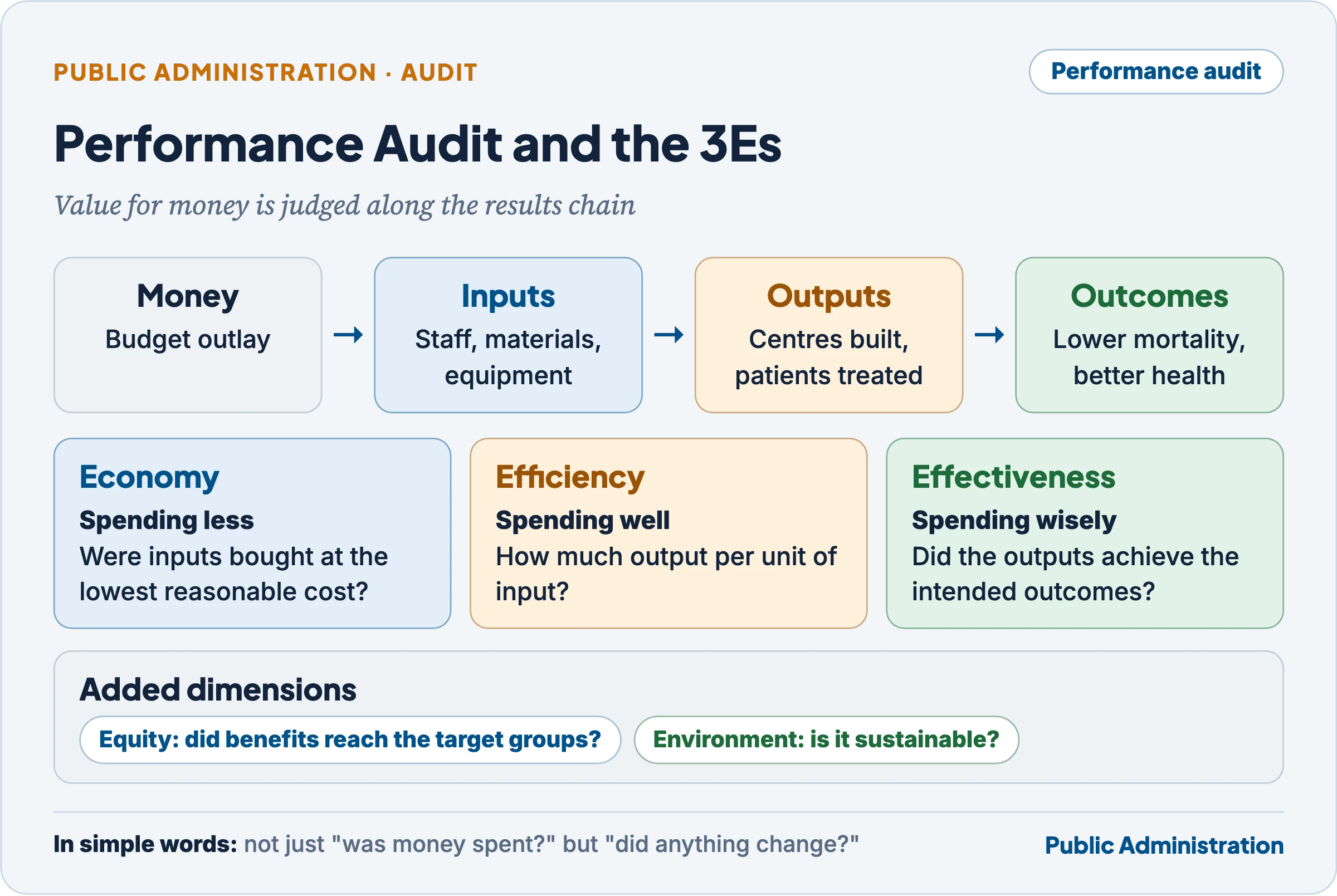
- Economy (spending less): minimising the cost of inputs of the right quality. Were materials bought at the lowest reasonable price?
- Efficiency (spending well): the relationship between inputs and outputs. How much did each health centre cost to build and run, compared with norms?
- Effectiveness (spending wisely): the relationship between intended and actual results, the outcomes. Did institutional deliveries rise and maternal deaths fall?
- Many audit offices now add equity (did benefits reach the intended, especially the disadvantaged, groups?) and environment (was the programme sustainable?), the “4th and 5th E“.
Worked example (illustrative). A State sanctions ₹200 crore to build 100 primary health centres in tribal blocks.
- Economy: auditors compare the price paid for cement and equipment with market and schedule rates; a 15 per cent premium paid to a single supplier is an economy failure.
- Efficiency: they compare cost per centre and time taken with norms; centres finished but without doctors or electricity are inputs that produced no usable output.
- Effectiveness: they compare outcomes (institutional deliveries, immunisation) before and after; if outcomes did not improve because centres were sited far from habitations, the programme was ineffective even if built cheaply.
- Equity: they check whether the most remote blocks got their share.
Distinctive features of performance audit.
- It is selective (topics chosen by risk and significance), analytical (uses data, surveys, field visits, beneficiary interviews), criteria-based (judges against objectives, norms, benchmarks or good practice), and forward-looking (makes recommendations for improvement).
- It does not question policy objectives themselves, but examines whether the means chosen achieve them; in practice the line is contested.
- The CAG issued Performance Auditing Guidelines (2014) aligned to international standards.
Performance indicators and non-financial measures. Performance measurement uses a family of indicators, many of them non-financial:
- input (staff, money), output (roads built, patients treated), outcome (travel time saved, mortality reduced);
- efficiency ratios (cost per unit of output), quality (accuracy, waiting time, error rates);
- equity (coverage of target groups), timeliness (delivery within charter standards);
- citizen satisfaction (surveys, grievance data), sustainability (asset maintenance, environmental impact);
- process and capacity indicators (staff training, digital adoption).
- Relying only on fund utilisation (“money spent = success”) misses whether anything changed for citizens; the outcome budget’s Output-Outcome Monitoring Framework and the scheme dashboards attempt to supply such measures.
Performance audit and performance budgeting.
- The claim that there can be no performance auditing without performance budgeting rests on a sound point: performance audit needs stated objectives, targets and indicators as its criteria, and a performance or outcome budget supplies exactly these. Where the budget states only lump-sum inputs, the auditor has nothing objective to measure results against. Indeed, one stated aim of introducing performance budgeting in India was to make performance audit more effective and to bring accounting into line with a programme classification (hence the revised accounts structure of 1974).
- But the relationship is not absolute. Auditors can derive criteria from scheme guidelines, statutes, sanctioned norms, sectoral benchmarks and international good practice; the CAG was reporting performance reviews of schemes and enterprises for decades before outcome budgets arrived (2005). Performance audit can even push a government towards clearer objectives.
- The real interdependence: budgeting sets the promises (outlay–output–outcome), accounting records the inputs, and performance audit verifies the delivery. Each is weaker without the others.
How performance audit differs from evaluation. Evaluation (by NITI Aayog’s Development Monitoring and Evaluation Office or by ministries) is commissioned by the executive to learn and redesign; performance audit is done independently, for the legislature, and carries accountability consequences.
5.4 IT audit and environmental audit
- IT audit checks the general and application controls of computerised systems: data integrity, access control, validation checks, business continuity. As payments, tax and welfare move online, IT audit becomes central. The CAG’s audit of Ayushman Bharat–PM-JAY (Report No. 11 of 2023) found weak validation in the beneficiary database: in one instance 7,49,820 beneficiaries were registered against a single dummy mobile number made up of ten nines, and in some States claims were paid in death cases without the required death summaries and mortality audits. Such findings come from data analytics, not from vouchers.
- Environmental audit examines environmental programmes and the environmental compliance of other programmes (pollution control, waste management, mining, forests), applying the 3Es plus sustainability. The CAG’s performance audit of the Namami Gange river rejuvenation programme (2017) is an example.
5.5 Social audit: the bridge
- Social audit is an audit by the people, especially the intended beneficiaries: official records are verified against ground reality and findings are read out in a public forum (the Gram Sabha), where officials must respond.
- Legal basis in MGNREGA: Section 17 requires the Gram Sabha to conduct regular social audits of all works; the MGNREGA Audit of Schemes Rules, 2011 were framed by the Centre in consultation with the CAG; a joint Ministry of Rural Development–CAG task force (2015) led to the Auditing Standards for Social Audit, notified in December 2016.
- Statutory and social audit compared:
| Basis | Statutory (CAG) audit | Social audit |
|---|---|---|
| Who audits | Professional, independent auditor | Community, beneficiaries, with a social audit unit |
| Reports to | Legislature | Gram Sabha, then administration |
| Focus | Legality, propriety, performance | Whether benefits reached people; local truth |
| Method | Records, sampling, analysis | Door-to-door verification, public hearing |
| Strength | Independence, expertise, legal backing | Local knowledge, immediacy, empowerment |
| Weakness | Distant, late, sample-based | No punitive power, capture by local elites, uneven quality |
- The two are complementary rather than identical: social audit supplies ground evidence and timeliness that a distant auditor lacks; statutory audit supplies independence, expertise and enforcement through Parliament. The CAG’s role in framing social audit standards shows the bridge. The full treatment is in the article on Citizen’s Charters, RTI and social audit.
Common confusion
Is value-for-money audit about economy, performance audit about efficiency, and social audit about effectiveness? Only loosely. In standard usage value-for-money audit and performance audit are the same thing, and both cover all three Es: economy, efficiency and effectiveness. Social audit differs not in which “E” it measures but in who audits and how: the community verifies records in public, which brings out effectiveness and equity at the ground level that professional audits often miss. So the neat three-way split is a useful teaching contrast, not an exact classification.
6. The Comptroller and Auditor General of India
In simple words
The CAG is the nation’s chief auditor. He is appointed by the President but cannot be removed by the government at will. His job is to check the accounts of the Union and the States and tell Parliament and the State legislatures what he found.
6.1 Evolution
- 1858–1860: after the Crown took over from the East India Company, an Accountant General to the Government of India was appointed and, in 1860, the first Auditor General, with both accounts and audit functions.
- Government of India Act, 1919: the Auditor General in India received statutory recognition, appointed by the Secretary of State in Council; the PAC began in 1921.
- Government of India Act, 1935: the Auditor General of India, appointed by the Crown, removable only like a Federal Court judge; the Constitution’s provisions are modelled on this.
- Constitution (1950): Articles 148–151; the first CAG was V. Narahari Rao (1948–54).
- CAG’s (Duties, Powers and Conditions of Service) Act, 1971, amended in 1976 to separate accounts from audit.
6.2 Constitutional provisions
| Article | Content |
|---|---|
| 148(1) | Appointed by the President by warrant under his hand and seal; removable only in like manner and on like grounds as a Supreme Court judge (proved misbehaviour or incapacity, by an address of both Houses passed by a special majority) |
| 148(2) | Oath before the President (Third Schedule): to uphold the Constitution and the laws |
| 148(3) | Salary and conditions fixed by Parliament by law; not to be varied to his disadvantage after appointment |
| 148(4) | Not eligible for further office under the Union or any State after ceasing to hold office |
| 148(5) | Conditions of service of the Indian Audit and Accounts Department and his administrative powers prescribed by the President after consultation with the CAG |
| 148(6) | Administrative expenses of his office, including salaries and pensions, charged on the Consolidated Fund |
| 149 | Duties and powers as prescribed by parliamentary law (now the 1971 Act) in relation to the accounts of the Union, the States and any other authority or body |
| 150 | Accounts of the Union and States kept in the form the President prescribes on the CAG’s advice |
| 151 | Audit reports on Union accounts to the President, who lays them before Parliament; on State accounts to the Governor, who lays them before the State Legislature |
| 279 | Certifies the net proceeds of taxes; his certificate is final |
- Unitary audit in a federal set-up: a single CAG audits the Union and all States, unlike federations such as the United States or Australia where States have their own auditors. Accountants General in the States are part of his department.
6.3 The 1971 Act: duties and powers
- Section 4: term of six years or until the age of 65, whichever is earlier.
- Section 10: compilation of accounts; the proviso allowed the President (and Governors) to relieve him of this, used for the Union in 1976.
- Section 13: audit of all expenditure from the Consolidated Funds of the Union, States and Union Territories with legislatures (whether money was legally available and spent in conformity with authority); transactions of Contingency Funds and Public Accounts; trading and manufacturing accounts of departments.
- Section 14: bodies substantially financed by government: grants or loans of at least ₹25 lakh a year amounting to at least 75 per cent of the body’s expenditure; or, with the President’s or Governor’s approval, any body receiving at least ₹1 crore. Audit continues for two further years once begun.
- Section 15: audit of grants and loans to examine whether the conditions of the grant are met.
- Section 16: audit of receipts into the Consolidated Funds (taxes, non-tax revenue).
- Section 17: audit of stores and stock.
- Section 18: powers to inspect offices, call for records and put questions.
- Section 19: audit of government companies (now under the Companies Act, 2013: the CAG appoints their statutory auditors and may conduct a supplementary audit) and of statutory corporations under their own laws.
- Section 20: audit of other bodies on request or entrustment in the public interest.
- Section 7A of the FRBM Act (inserted in 2012) lets the government entrust the CAG with periodic reviews of compliance with fiscal rules; the first such report covered 2014–15.
The 2014 telecom judgment. In Association of Unified Telecom Service Providers of India v. Union of India (Supreme Court, 17 April 2014), private telecom companies argued that the CAG could not audit them. The Court held that the licence fee and spectrum charges paid under revenue-sharing arrangements are receipts of the Consolidated Fund (Article 266, Section 16), so the CAG can examine the underlying records of private operators to verify that the government’s share was correctly computed. The judgment extended the CAG’s reach into private entities that share public revenue, a principle relevant to PPPs and natural-resource contracts.
6.4 Independence
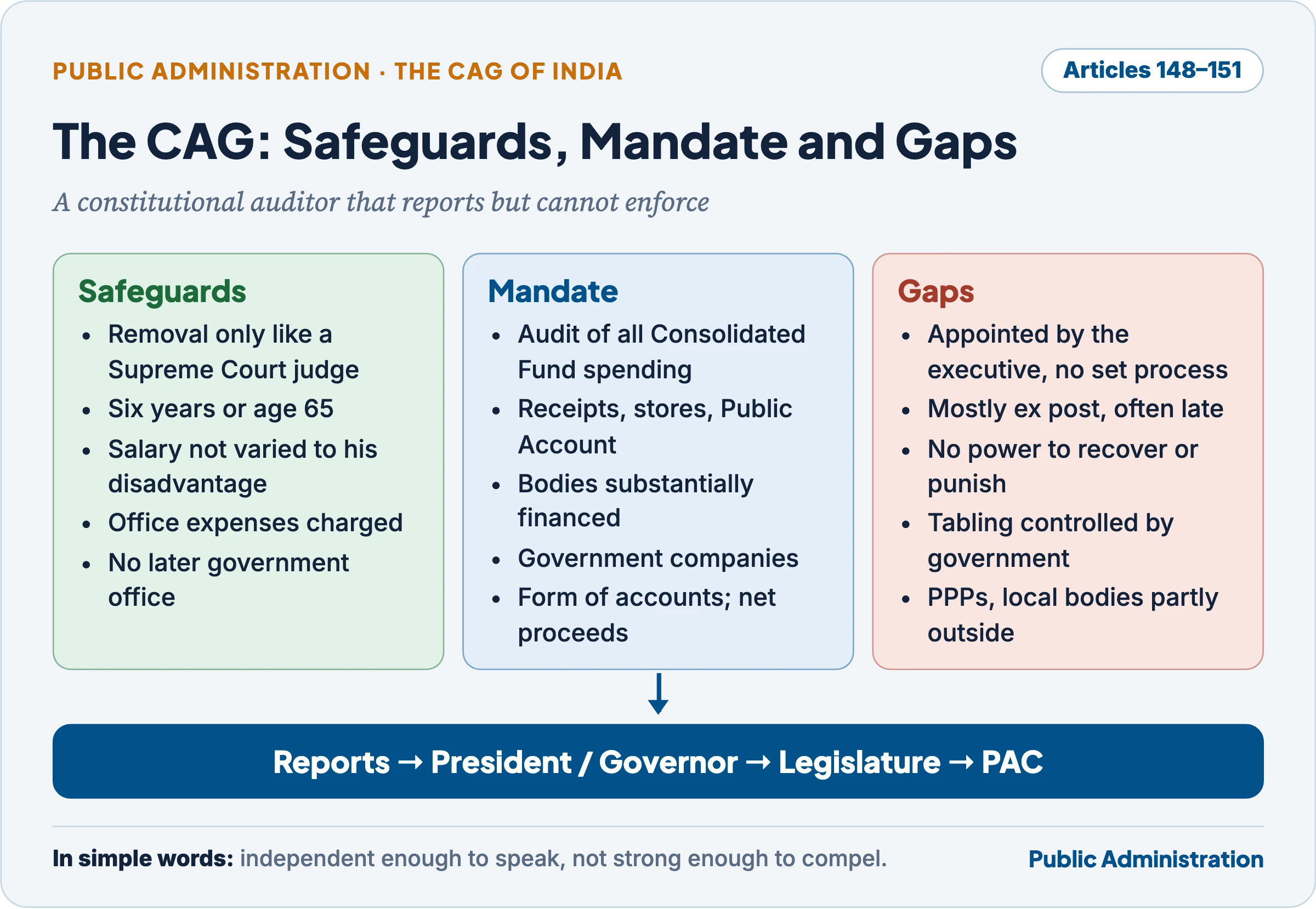
- Security of tenure: removal only like a Supreme Court judge; does not hold office at the President’s pleasure.
- Financial security: salary equal to a Supreme Court judge; conditions not variable to his disadvantage; office expenses charged.
- No post-retirement office under any government, removing the temptation to please.
- Control over his department: service rules made only after consulting him.
- No minister represents him in Parliament; he is answerable to Parliament through his reports, not to the government.
- B.R. Ambedkar told the Constituent Assembly in 1949 that the CAG was “probably the most important officer” under the Constitution, because he was to see that not a farthing was spent without the authority of the legislature; he ranked the office with the judiciary, the Election Commission and the UPSC among the bulwarks of democratic government.
- Dual role: the CAG acts for Parliament (checking that the executive obeys the law and the grant) and, within the executive, for the government (checking that subordinate authorities follow its rules). He is neither part of the legislature nor of the executive.
Gaps in independence.
- Appointment by the executive with no prescribed qualifications or selection procedure. In 2013 a group of former officials challenged the appointment of Shashi Kant Sharma, a former Defence Secretary, on grounds of conflict of interest and lack of a transparent procedure; the Supreme Court sent them to the High Court, and the Delhi High Court (August 2014) upheld the appointment, leaving the method to the executive.
- Background: since the 1980s CAGs have usually come from the IAS rather than the Indian Audit and Accounts Service; critics argue this departs from the Constituent Assembly’s expectation of financial expertise and puts former administrators in charge of auditing their former colleagues. The current CAG, K. Sanjay Murthy (IAS, 1989, Himachal Pradesh cadre), was sworn in on 21 November 2024.
- Dependence on the executive for tabling (the government decides when reports are laid), for replies to audit queries, and for the department’s budget growth.
6.5 What the CAG produces
- Compliance audit reports (regularity and propriety) on Union civil ministries, Defence, Railways, revenue receipts, and on each State.
- Performance audit reports on schemes and programmes.
- Financial audit: certification of the Finance Accounts and Appropriation Accounts; audit of government companies and corporations.
- State Finances Audit Reports analysing each State’s fiscal position, debt, off-budget borrowings and budget management; in September 2025 the CAG released its first decadal compendium on State finances, showing the combined public debt of the 28 States rising from ₹17.57 lakh crore (2013–14) to ₹59.60 lakh crore (2022–23), about 23 per cent of their GSDP.
- FRBM compliance reviews for the Union.
- Technical guidance and support to local fund auditors for Panchayats and Municipalities (recommended by the Eleventh Finance Commission); the CAG audits local bodies only where State law or entrustment allows.
- International audits: the CAG has served as external auditor of several United Nations bodies.
6.6 Major reports and their impact
The reports below show the range of the CAG’s work: from presumptive-loss estimates that shook governments to performance audits of flagship schemes. Their impact depended on what Parliament, courts and investigators did next.
| Report | Year | Core finding | What followed |
|---|---|---|---|
| 2G spectrum (Report No. 19 of 2010) | Tabled 16 Nov 2010 | 122 licences issued in January 2008 at 2001 prices; presumptive loss up to ₹1.76 lakh crore | PAC and JPC inquiries; CBI case; Supreme Court cancelled the 122 licences (Centre for PIL v. Union of India, February 2012); trial court acquitted the accused in December 2017, showing the gap between audit loss and criminal proof |
| Coal block allocation | Tabled 17 Aug 2012 | Allocation without competitive bidding gave private allottees a financial gain of about ₹1.86 lakh crore | Supreme Court declared allocations since 1993 illegal and cancelled 214 blocks (Manohar Lal Sharma, 2014); auction regime under the Coal Mines (Special Provisions) Act, 2015 |
| Rafale / capital acquisition in IAF (Report No. 3 of 2019) | Tabled 13 Feb 2019 | The 2016 deal for 36 aircraft was 2.86 per cent cheaper than the audit’s aligned price of the 2007 bid; delivery only one month faster; prices redacted at the Defence Ministry’s insistence | Political debate; showed both the reach of audit into defence deals and the limits set by confidentiality |
| Bharatmala Pariyojana Phase I (Report No. 19 of 2023) | Tabled 10 Aug 2023 | Cost escalation, weak project preparation; Dwarka Expressway at ₹250.77 crore/km against ₹18.20 crore/km approved | Examined by the PAC; ministry defended design choices |
| Ayushman Bharat–PM-JAY (Report No. 11 of 2023) | Tabled 8 Aug 2023 | Database errors, invalid mobile numbers, claims for dead patients, excess payments | Changes in the beneficiary system (BIS 2.0) |
| Delhi Excise Policy 2021–22 (State report) | Tabled 25 Feb 2025 | Revenue loss of about ₹2,002 crore; expert advice ignored; exemptions without Cabinet approval | Referred to the Delhi Assembly’s PAC |
- Lesson of the “presumptive loss” debate. The 2G and coal figures were estimates of revenue foregone, not cash stolen; critics called them speculative and argued that the CAG had questioned policy choices (first-come-first-served, nomination allocation). Defenders replied that the CAG’s job is to quantify the cost of a decision so that Parliament can judge it. The courts, by cancelling the allocations, upheld the substance of the audit criticism even where the exact numbers were contested.
Indian Connect — Audit, Parliament and courts: how CAG findings travel
A CAG report has no legal force of its own. Its impact depends on three relays: Parliament (PAC examination and debate), investigating agencies (which may use audit evidence to register cases) and courts (which may act in public interest litigation). The 2G and coal reports reached all three; the Bharatmala report reached the PAC; many others are tabled and forgotten. The Delhi excise report of 2025, tabled only after a change of government, also shows the fourth relay, the executive’s control over timing: a report that is not laid cannot be examined.
6.7 Limits of the CAG and of audit
- Ex post audit. The CAG mainly performs post-audit: the money is spent, often years earlier, before he reports, a “dissection after rigor mortis”. Unlike some audit institutions abroad, he has no pre-audit or concurrent power over the release of money.
- Delay. Accounts close after the year; audit follows; reports are tabled a year or more later; the PAC takes them up later still. Officers move, records fade, recovery becomes impossible.
- Slow and evasive replies. Ministries are not legally bound to reply to audit queries within a time limit; in 2010 the CAG sought an amendment requiring replies within 30 days.
- Tabling depends on the government. Reports on the Union are laid by the President and on States by the Governor, in practice when the government chooses; there have been long delays in tabling inconvenient reports at State level.
- PAC backlog. Only a small fraction of audit paragraphs are ever discussed; State PACs fall even further behind.
- No enforcement or surcharge power. The CAG can only report. He cannot recover losses, surcharge a negligent official, or initiate disciplinary or criminal action. Audit institutions such as Japan’s Board of Audit (which can demand indemnity and disciplinary action) and the French Cour des comptes (which can fine public managers) show the alternatives. Hence the famous description of the Indian CAG as a prosecutor with a law that hobbles it, a judge without the power to sentence and a litigant with no right of appeal.
- Coverage gaps:
- PPPs and private concessionaires: the 1971 Act did not anticipate them; access depends on contract terms and on cases like the 2014 telecom judgment.
- Panchayats and municipalities: funds routed to local bodies, societies and NGOs under schemes such as MGNREGA, SSA and NRHM were partly beyond regular audit; by some estimates in 2010, more than ₹80,000 crore a year flowed through such channels.
- Autonomous bodies below the Section 14 thresholds; secret service expenditure (the CAG accepts a certificate from the competent authority).
- Government companies: the primary audit is by chartered accountants; the CAG’s is supplementary.
- Fewer reports. The decline in the number of Union audit reports tabled (only 18 in 2023) has been read by critics as reduced audit output or reluctance to report.
- The “overreach” and “paralysis” charges.
- Audits of policy-linked decisions (spectrum, coal, airports) led governments to accuse the CAG of second-guessing policy with hindsight and of becoming a political weapon.
- Officials argue that fear of audit, alongside vigilance agencies, investigators and courts, produces risk-aversion and decision paralysis: files are pushed upward, decisions delayed, innovation avoided. This revives Appleby’s 1953 critique that Indian audit bred timidity and treated auditing expertise as if it were administrative judgement.
- The classic standard for the auditor’s attitude is the English judge Lord Justice Lopes’s remark in the Kingston Cotton Mill case (1896) that an auditor is “a watchdog, but not a bloodhound”: he must be vigilant and sceptical, but need not presume dishonesty in every transaction.
Criticism — Audit as impediment and post-mortem
- Hindsight bias: audit judges decisions taken under uncertainty and time pressure with full knowledge of how they turned out.
- Rule-mindedness over results: auditors trained in compliance push administrators to protect themselves with procedure rather than achieve outcomes.
- Decision paralysis: fear of an adverse paragraph makes officers avoid risk, especially in procurement, PPPs and innovation.
- Post-mortem: findings arrive years later, when nothing can be undone.
- Overreach: presumptive-loss estimates on policy choices turn the auditor into a political actor without political accountability.
- Impotence: without enforcement powers, many findings change nothing, so audit becomes ritual.
Defence — Audit as a protector of democracy
- Power of the purse: without an independent auditor, Parliament’s grant would be unenforceable; audit is the instrument by which the legislature’s control becomes real.
- Deterrence: the certainty of audit prevents much misconduct that never shows up in reports.
- Systemic learning: performance audits identify weak design, poor data and bad targeting, as in Bharatmala and PM-JAY, and lead to system changes.
- Information for citizens: CAG reports are among the most credible public sources on how government actually works.
- Courts and Parliament validate it: the 2G and coal judgments upheld the substance of audit criticism.
- The remedy for paralysis is clearer delegation, protection of bona fide decisions and better audit quality, not weaker audit.
6.8 Reforms and the changing role of the CAG
Reforms proposed or under way:
- Selection and qualifications: a transparent, broad-based selection committee and prescribed qualifications, as petitioners sought in 2013; some propose a multi-member audit board on the lines of the Election Commission, as exists in Japan, Germany and Korea.
- Amending the 1971 Act (the CAG’s 2010 proposals, pressed under Vinod Rai, CAG from 2008 to 2013): time-bound replies to audit queries; time-bound tabling of reports; and an explicit mandate to audit PPPs, joint ventures and funds routed through PRIs and NGOs.
- Enforcement powers: powers to summon officials, fix responsibility and recover losses, with an appeal mechanism, on the lines of other audit institutions.
- Real-time and concurrent audit: using PFMS and other databases for continuous, data-driven audit so that findings come while correction is still possible.
- Local bodies: strengthening local fund audit with the CAG’s technical guidance; the Fifteenth Finance Commission made the online availability of audited accounts a condition for local-body grants.
- Quality and standards: the CAG’s Audit Quality Management Framework (issued in 2009 and revised in 2014) sets policies for leadership, ethics, human resources, audit performance, stakeholder relations and continuous improvement, in line with INTOSAI and ASOSAI standards; the Performance Auditing Guidelines (2014); a Strategic Plan of SAI India 2023–2030; and a 2014 protocol for direct access to private-sector records.
- Balanced reporting: the 2nd ARC asked for timely and balanced CAG reports and systematic tracking of pending audit paragraphs; within government, a monitoring system tracks Action Taken Notes on audit paragraphs.
Outward role. In September 2024 the CAG of India assumed the chair of ASOSAI (the Asian Organisation of Supreme Audit Institutions, founded in New Delhi) for 2024–2027 at its 16th Assembly in New Delhi, promising a focus on technology-driven audits and the audit of local bodies.
7. Comparative Models of Public Audit
In simple words
Every democracy has a national auditor, but they are built differently. In some the auditor is a servant of Parliament, in some a court that can punish, and in some a board of several members who decide together.
7.1 The three models
- Westminster (parliamentary, monocratic) model: a single Auditor General, closely tied to Parliament and its Public Accounts Committee, reporting findings without judicial powers. India, the UK, Canada, Australia and most Commonwealth countries.
- Judicial (court) model: a court of audit whose members are magistrates with judicial independence; it audits and can judge and sanction public accountants and managers. France, Italy, Spain, Portugal, much of francophone Africa and Latin Europe.
- Board (collegiate) model: a board or college of members decides together, without full judicial powers. Japan’s Board of Audit (a constitutional body headed by a three-member Audit Commission), Germany’s Federal Court of Audit (a collegiate body whose members enjoy judicial independence but which does not judge cases), Indonesia’s BPK.
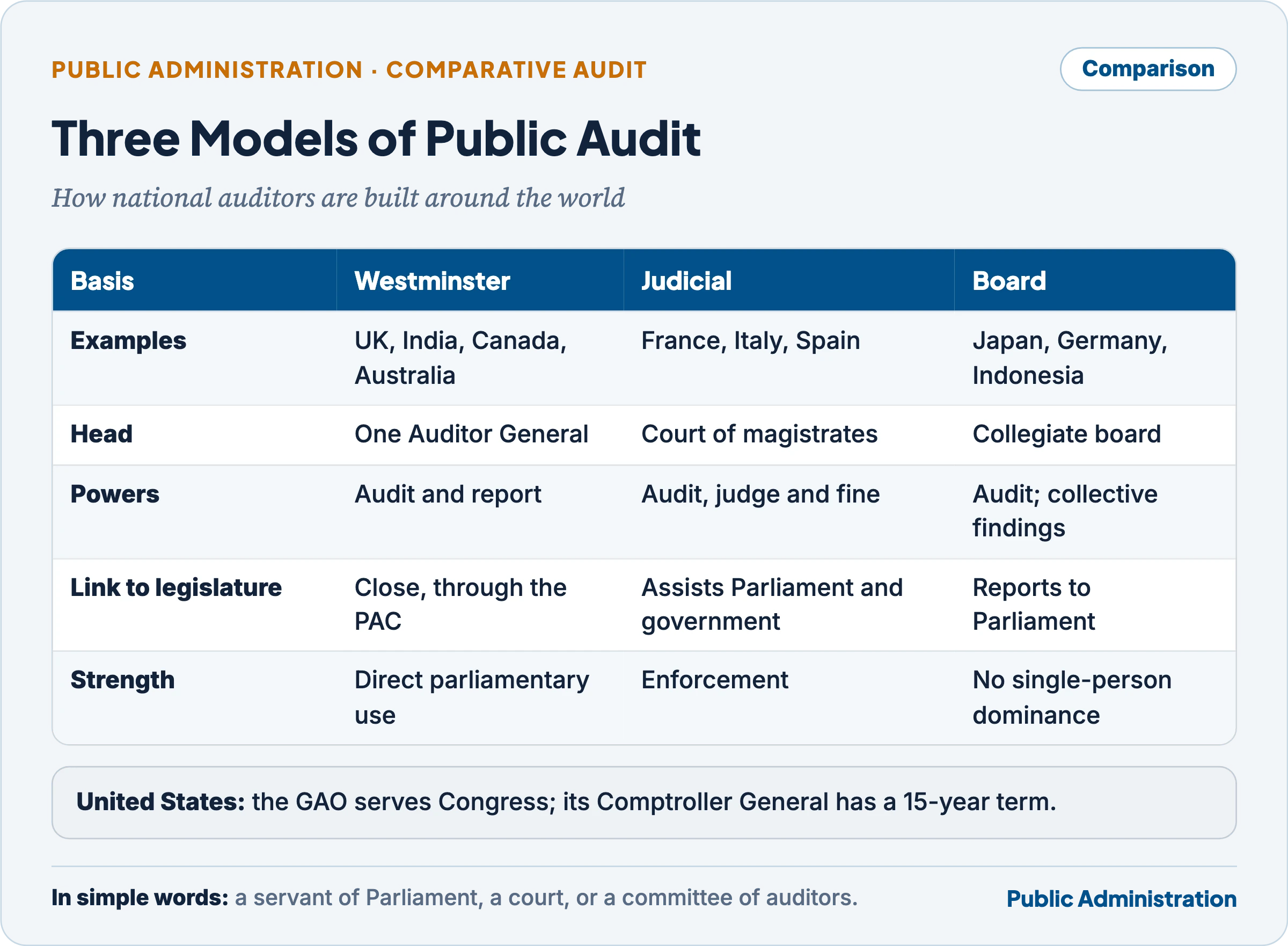
7.2 Four institutions compared
| Basis | UK: NAO / C&AG | US: GAO | France: Cour des comptes | India: CAG |
|---|---|---|---|---|
| Model | Westminster | Legislative agency | Judicial | Westminster |
| Head | Comptroller and Auditor General, an officer of the House of Commons | Comptroller General | First President, with magistrate members | Comptroller and Auditor General, a constitutional authority |
| Appointment | By the Crown on an address of the Commons moved by the PM with the agreement of the PAC chair | By the President from a list proposed by a bipartisan congressional commission, with Senate confirmation | By decree; members are irremovable magistrates | By the President (in effect the Union government) |
| Term | 10 years, non-renewable (Budget Responsibility and National Audit Act, 2011) | 15 years | Life career as magistrates | 6 years or age 65 |
| Powers | Audit, VFM reports; comptroller function over issues from the Consolidated Fund | Audits, investigations, legal opinions for Congress | Audit and jurisdictional powers; since 1 January 2023 a unified regime makes public managers liable to fines for serious financial faults, with a new financial court of appeal (2023) | Audit and reporting only |
| Relationship with legislature | Works hand in hand with the PAC; budget set by a parliamentary commission | Serves Congress; renamed Government Accountability Office in 2004 | Assists both Parliament and government (Article 47-2 of the Constitution) | Reports through the President; PAC relies on it |
- UK history: the Exchequer and Audit Departments Act, 1866 created the Comptroller and Auditor General and the annual appropriation accounts, completing the cycle of grant, account, audit and PAC review; the National Audit Act, 1983 created the National Audit Office and made the C&AG an officer of the House of Commons; the 2011 Act added a governing NAO Board.
- What India can learn: legislative involvement in appointment (UK, US), a long single term (UK, US), parliamentary control over the audit budget (UK), and enforcement powers (France, Japan). What India already has that others lack: constitutional status and a unitary audit of the Union and all States.
7.3 INTOSAI and the Lima Declaration
- INTOSAI (International Organisation of Supreme Audit Institutions), founded in 1953 in Havana, is the umbrella body of national audit offices; India is a founding member. Its regional groups include ASOSAI for Asia.
- Lima Declaration of Guidelines on Auditing Precepts (1977), adopted at the IX INCOSAI in Lima, Peru, often called the Magna Carta of government auditing:
- independence of the Supreme Audit Institution, of its members and of its finances, anchored in the constitution;
- both pre-audit and post-audit have value, post-audit being indispensable;
- internal and external audit are distinct but should cooperate;
- audit covers legality and regularity and also performance (economy, efficiency, effectiveness);
- the SAI must have access to all records, report annually and independently to Parliament, and publish its reports.
- Mexico Declaration on SAI Independence (2007) set out eight principles of independence (legal framework, tenure, mandate, access, right and duty to report, freedom to decide content and timing, follow-up mechanisms, financial and administrative autonomy).
- The UN General Assembly endorsed the Lima and Mexico declarations (resolution of December 2011).
- Measured against these standards, India’s CAG scores well on constitutional status, tenure and mandate, but less well on freedom over the timing of publication (tabling depends on the executive), follow-up mechanisms and financial autonomy.
8. Theory Lens: Why Accountability Needs Accounts and Audit
In simple words
Theories of administration explain why we need an auditor at all: the people who give the money cannot watch every use of it, so they hire an independent checker. They also explain why auditing has shifted from counting vouchers to measuring results.
8.1 Principal–agent theory
- Principal–agent theory (from the economics of the firm, notably Michael Jensen and William Meckling, 1976) studies relationships in which a principal delegates work to an agent whose interests may differ and who knows more than the principal (information asymmetry).
- Applied to public finance, there is a chain of principals and agents: citizens → Parliament → ministers → Secretaries → spending units. At each link the agent may shirk, waste or divert money (moral hazard), and the principal cannot see it directly.
- Accounts and audit are monitoring devices that reduce information asymmetry:
- accounts are the agent’s report;
- audit is independent verification of that report;
- the PAC is the principal’s sanctioning mechanism.
- Independence matters because an auditor controlled by the agent (the executive) would not reduce asymmetry; hence the constitutional safeguards for the CAG.
- Limits of the theory: public agents serve multiple principals with conflicting goals (Parliament, ministers, courts, citizens), outcomes are hard to measure, and too much monitoring raises agency costs and induces defensive behaviour (the paralysis problem).
8.2 The Friedrich–Finer debate applied to financial accountability
- Herman Finer (1941) argued that democratic accountability requires external, objective controls: the official must answer to an outside body that can punish. Carl Friedrich (1940) argued that external controls can never catch everything; real responsibility comes from professional standards and inner conscience.
- In financial administration both are needed:
- Finer’s side: the CAG’s statutory audit and the PAC are classic external controls;
- Friedrich’s side: internal control, internal audit, professional accounting standards, the canons of financial propriety and the IFA’s advisory role rely on professional responsibility within the executive.
- The paralysis debate is a Friedrich–Finer debate in modern form: too much external control produces defensive compliance; too little invites misuse. The balance lies in strong internal controls plus credible external audit, with protection for bona fide decisions.
- Barbara Romzek and Melvin Dubnick (1987) distinguished hierarchical, legal, professional and political accountability; audit sits mainly in the legal type, internal audit in the hierarchical, and the PAC in the political.
8.3 New Public Management and the turn to performance audit
- NPM (from the 1980s) shifted public management from inputs and procedures to outputs, outcomes and managerial freedom: “let the managers manage” but hold them to results.
- Effects on audit:
- from compliance audit to performance (VFM) audit;
- from cash to accrual accounting and full costing of services;
- outcome budgets and performance indicators as audit criteria;
- risk-based internal audit and audit committees borrowed from the corporate sector;
- auditing of agencies, contracts and PPPs, not only departments.
- Critiques:
- Michael Power, in The Audit Society: Rituals of Verification (1997), warned that the spread of audit can produce rituals of verification that create comfort without real control, and that organisations reshape themselves to be auditable rather than better.
- The 3Es can crowd out equity: an emphasis on cost control and economy can divert budgets from their older purposes of reallocating resources, stabilising the economy and promoting social equity. A cheap programme that excludes the poorest is “efficient” but unjust. Hence the push for a fourth E, equity, in performance audit and in outcome measurement.
- New Public Governance (networks, PPPs, third-sector delivery) disperses accountability: when money flows through companies, societies and local bodies, the traditional chain (department → CAG → PAC) loses sight of it. This is why the CAG’s mandate over PPPs and local bodies has become the frontier issue.
8.4 Fiscal accountability, rules and populism
- Sound public finance has long been treated as the backbone of administration: without it no programme is sustainable. Pressures of electoral competition push governments towards freebies, untargeted subsidies, off-budget borrowing and deferred liabilities, whose costs fall on future budgets.
- Accountability responses:
- Fiscal rules under the FRBM Act, 2003, with CAG compliance reviews under Section 7A (from 2012);
- disclosure of extra-budgetary borrowings, guarantees and contingent liabilities in budget documents;
- State Finances Audit Reports that expose off-budget borrowings, guarantees and unpaid liabilities in each State; the CAG’s 2025 decadal analysis showing States’ debt more than tripling in ten years;
- accrual-based disclosure to reveal pension and guarantee liabilities hidden by cash accounts;
- proposals for an independent fiscal council (made by the FRBM Review Committee, 2017, but not set up).
- The limits: rules have escape clauses, disclosure is not enforcement, and audit reports on State finances are rarely debated. Financial accountability can reveal populist fiscal choices; only the legislature and voters can correct them. The macro-fiscal side is covered in the article on fiscal policy and public debt.
Indian Connect — What a full accountability system for public money would look like in India
Putting the threads together: IFAs and risk-based internal audit inside every ministry; PFMS and SNA-SPARSH for real-time fund tracking; accrual-style disclosure of all liabilities; a CAG with a transparent appointment, time-bound replies and tabling, and access to PPPs and local bodies; social audits with legal follow-up at the grassroots; and a PAC with longer tenure, research support and the power to take up every audit report within a fixed time. Most elements exist in part; the weakness lies in the links between them, especially follow-up.
Key Terms
| Term | Meaning in simple words |
|---|---|
| Financial accountability | Duty of those who raise and spend public money to explain and justify its use to an authority that can correct them |
| Appropriation | Parliament’s legal authorisation to spend a stated sum on a stated purpose (Article 114) |
| Charged expenditure | Spending fixed by the Constitution or law that is not voted, though it is discussed and audited |
| Chief Accounting Authority | The Secretary of a ministry, answerable for its spending and accounts |
| Integrated Financial Adviser | Finance officer inside a ministry, answerable to both the ministry and the Finance Ministry (since 1975) |
| Controller General of Accounts (CGA) | Head of the Union’s accounting system in the Department of Expenditure (since 1976) |
| Departmentalisation of accounts | Transfer of accounting from the CAG to the ministries themselves (1976) |
| Consolidated Fund | The main account into which all revenue and borrowing go and from which all spending is made |
| Public Account | Money the government holds as banker or trustee (provident funds, deposits) |
| Contingency Fund | An imprest for urgent unforeseen spending, recouped after Parliament’s approval |
| LMMH | List of Major and Minor Heads: the uniform classification of government transactions |
| Cash accounting | Records transactions when cash is received or paid |
| Accrual accounting | Records transactions when value is created or consumed, showing assets and liabilities |
| GASAB | Government Accounting Standards Advisory Board, set up by the CAG in 2002 |
| Finance Accounts | Annual statement of all receipts, payments, balances and debt |
| Appropriation Accounts | Annual comparison of grants voted with actual spending, explaining excesses and savings |
| Excess grant | Parliament’s later approval of spending beyond the grant, after PAC scrutiny (Article 115) |
| Regularity audit | Checks that spending was legal, authorised and within the grant |
| Propriety audit | Checks that spending was wise, faithful and economical |
| Performance (VFM) audit | Checks economy, efficiency and effectiveness of programmes |
| 3Es | Economy (spending less), efficiency (spending well), effectiveness (spending wisely) |
| Internal audit | Management’s own continuous review of controls and operations |
| Social audit | Verification of records against ground reality by the community, in a public forum |
| Supreme Audit Institution (SAI) | A country’s national public auditor (the CAG in India) |
| Action Taken Note | Government’s reply on what it has done about an audit paragraph or PAC recommendation |
| Presumptive loss | An audit estimate of revenue foregone because of a decision, not money actually stolen |
Commissions, Committees and Judgments
| Body / case | Year | Key point |
|---|---|---|
| Government of India Act, 1919 | 1919 | Statutory Auditor General; PAC set up in 1921 |
| Government of India Act, 1935 | 1935 | Auditor General of India, removable only like a Federal Court judge |
| Constituent Assembly (Ambedkar) | 1949 | CAG “probably the most important officer” under the Constitution |
| Estimates Committee | 1950 | 30 Lok Sabha members; economy and efficiency of estimates |
| Appleby reports | 1953, 1956 | Criticised detailed financial control and audit as sources of delay and timidity |
| Krishna Menon Committee; COPU | COPU from 1 May 1964 | Separate parliamentary scrutiny of public undertakings |
| PAC Opposition chairmanship | 1967 | Convention of an Opposition member as PAC chairman |
| CAG (DPC) Act | 1971 | Duties, powers and conditions of service of the CAG |
| Scheme of Integrated Financial Adviser | 6 October 1975 | One financial adviser inside each ministry, answerable to it and to Finance |
| Departmentalisation of Union Accounts (Transfer of Personnel) Act | 1976 | Separation of accounts from audit; CGA created |
| GASAB | 12 August 2002 | Accounting standards for Union and States |
| Twelfth Finance Commission | 2004 | Recommended accrual accounting |
| CAG Task Force on internal audit | 2006 | Internal audit weak; Chief Internal Auditor proposed |
| 2nd ARC, 14th Report | April 2009 | Internal audit, Audit Committees, accrual pilots, timely CAG reports, fund-flow tracking |
| FRBM Act, Section 7A | 2012 | CAG review of compliance with fiscal rules |
| Centre for PIL v. Union of India | 2012 | 2G licences cancelled |
| Association of Unified Telecom Service Providers v. Union of India | 17 April 2014 | CAG can examine records of private telecom firms sharing revenue with government |
| Manohar Lal Sharma v. Principal Secretary (Supreme Court) | 2014 | Coal block allocations cancelled |
| Manohar Lal Sharma v. Principal Secretary (Delhi High Court) | 13 August 2014 | Upheld the appointment of the CAG; no prescribed selection procedure |
| Auditing Standards for Social Audit (MoRD with CAG) | December 2016 | Standards for MGNREGA social audits |
| Kingston Cotton Mill (English Court of Appeal) | 1896 | The auditor is “a watchdog, but not a bloodhound” |
Contemporary Developments
- September 2025: the CAG released its first decadal publication on State finances, showing the combined public debt of 28 States rising from ₹17.57 lakh crore in 2013–14 to ₹59.60 lakh crore in 2022–23 (about 23 per cent of GSDP).
- 25 February 2025: the CAG’s report on the Delhi Excise Policy 2021–22, tabled in the Delhi Assembly after a change of government, estimated a revenue loss of about ₹2,002 crore and was referred to the Assembly’s PAC, highlighting the executive’s control over when audit reports are tabled.
- 21 November 2024: K. Sanjay Murthy, a 1989-batch IAS officer and former Higher Education Secretary, was sworn in as Comptroller and Auditor General of India, succeeding Girish Chandra Murmu.
- 24–25 September 2024: at the 16th ASOSAI Assembly in New Delhi, the CAG of India assumed the chair of ASOSAI for 2024–2027, with a focus on technology-driven audit and the audit of local bodies.
- August 2024: K.C. Venugopal was named chairman of the PAC for the 18th Lok Sabha, continuing the convention of Opposition chairmanship begun in 1967.
- December 2023: an analysis of tabled reports showed only 18 CAG audit reports on the Union laid in Parliament in 2023, against an average of 40 a year in 2014–2018, prompting concern about declining audit output.
- August 2023: performance audits of Bharatmala Pariyojana Phase I (Dwarka Expressway at ₹250.77 crore/km against ₹18.20 crore/km approved) and Ayushman Bharat–PM-JAY (7.49 lakh beneficiaries on one dummy mobile number) showed the shift to data-driven performance audit; the PAC later examined the Bharatmala report.
- 13 July 2023: the Department of Expenditure notified SNA-SPARSH for just-in-time release of Centrally Sponsored Scheme funds through PFMS and the RBI’s e-Kuber, reducing idle balances outside the Consolidated Fund.
Revision Grid
| Thinker / body | Work or report (year) | Key idea |
|---|---|---|
| B.R. Ambedkar | Constituent Assembly debates (1949) | CAG probably the most important officer; guardian of the public purse |
| L.D. White | Introduction to the Study of Public Administration (1926) | Purposes of public accounts: fidelity, information, control, aid to audit |
| James C. Charlesworth | Definition of audit | Audit checks spending against the legislative instrument of appropriation |
| Paul Appleby | Reports on Indian administration (1953, 1956) | Detailed financial control and audit breed delay and timidity |
| Ashok Chanda | CAG (1954–60); writings on Indian administration | Audit as a valued ally of administration, not a necessary evil |
| S.L. Goel | Writings on financial administration | Preventive, curative and promotive roles of audit |
| Lord Justice Lopes | Kingston Cotton Mill (1896) | Auditor a watchdog, not a bloodhound |
| Carl Friedrich / Herman Finer | Debate on responsibility (1940, 1941) | Inner professional responsibility vs external control |
| Romzek and Dubnick | Accountability in the public sector (1987) | Hierarchical, legal, professional, political accountability |
| Jensen and Meckling | Theory of the firm (1976) | Principal–agent problem; monitoring reduces information asymmetry |
| Michael Power | The Audit Society: Rituals of Verification (1997) | The spread of audit can become ritual verification |
| INTOSAI | Lima Declaration (1977); Mexico Declaration (2007) | Independence, pre- and post-audit, performance audit, publication |
| Twelfth Finance Commission | Report (2004) | Accrual accounting for Union and States |
| 2nd ARC | 14th Report, Strengthening Financial Management Systems (2009) | Internal audit, Audit Committees, accrual pilots, timely and balanced audit |
| Vinod Rai | CAG (2008–13) | Pressed for amendments to the 1971 Act: time-bound replies and tabling, audit of PPPs and PRI-routed funds |
| K. Sanjay Murthy | CAG from 21 November 2024 | Current CAG; first decadal State finances publication (2025) |
Previous Year Questions
- 2026“No tax shall be levied or collected except by authority of law.” Analyse.
- 2026Financial integrity, compliance with laws and performance standards, and efficient, economical and effective service delivery performance are mandatory for every government. Discuss the existing practices in ensuring public financial accountability and also give suggestions to improve it.
- 2024Auditing is not about finding faults, it is about ensuring the accuracy and integrity of financial information. Analyse.
- 2023“The management of sound public finances used to be the backbone of administrative systems; but unfortunately, it has become the prisoner of populist policies.” Critically evaluate.
- 2022The audit function has always been viewed as an integral part of government financial management. Discuss the significance of internal audit in improving the performance of the government sector.
- 2021Emphasis on cost control and reducing public expenditure has diverted the focus of government budgets from the basic objectives of reallocation of resources, bringing economic stability and promoting social equity. Examine.
- 2019Performance measurement remains an emerging issue but it is relegated to exclusively monitor and assess the use of funds. In light of the statement discuss various non-financial parameters of performance measurement to evaluate public sector organizations.
- 2018“Sound Performance Auditing is impossible without systematic Performance or Outcome Budgeting.” Explain the relationship between the two.
- 2017“There can be no performance auditing without performance budgeting “.
- 2017Can we say that statutory audit and social audit are two sides of the same coin? Or are they two separate coins with varying values?
- 2014“The fact that we call something performance auditing means that we imply salient features which can distinguish it from other forms of enquiry.” Discuss with reference to the main measures or indicators of performance measurement.
- 2011Whereas ‘value for money’ audit aims at economy and ‘performance’ audit seeks efficiency, ‘social’ audit goes beyond both, to examine the effectiveness of a programme or activity. Examine this statement with suitable illustrations.
- 2006“Audit continues to be considered as something alien, something extraneous and something of the nature of an impediment.” Explain.
- 2003“Legislative controls over finances are inadequate and incomplete.” Comment.
- 2002“Auditing in Government is an exercise in post-mortem.” – Examine.
- 2001‘Statutory External auditing is one of the protectors of democracy in the parliamentary form of Government.’ Comment.
- 1995Describe the methods by which the Public Accounts Committee and the Estimates Committee control administration.
- 1993“Government has numerous ideal objectives, and three of these are closely linked to accounting and finance: efficiency, effectiveness and equality.” Comment.
- 1991‘It (Audit) is the process of ascertaining whether the administer has spent or is spending its fund in accordance with the terms of legislature which appropriated money.’ Comment.
- 1991Examine the nature of parliamentary control over the National Finances in India.
- 1990‘What the auditors know is auditing……. Which is not administration.’ Comment on the nature, importance and role of audit in administration.
- 1989“Public bureaucracies have not grown yet to adopt their accounting and auditing mechanisms to the ever-growing automation within them.” Comment.
- 1987‘The financial administration in modern times needs updating administrative cybernetics and Audit reforms.’ Comment.
- 2024The office of the Comptroller and Auditor General of India and its functioning is away from the public eye. Still it is one of the most important office under the constitution. Discuss.
- 2024“Parliamentary control over public expenditure is declining.” Comment.
- 2023Accountability of the Executive to the Parliament in the domain of financial administration is secured through CAG reports. Discuss.
- 2023Computerization of treasuries has revolutionized the accounting and budget planning process, Comment.
- 2022Comptroller and Auditor General (CAG) is today a primary cause of widespread and paralysing unwillingness on the part of government institutions to decide and act. Discuss.
- 2020The office of the Comptroller and Auditor General of India stands on the pillar of autonomy. Discuss the major lacunae in the functioning of this constitutional body and also suggest measures for its strengthening.
- 2018“Social audit has lent a critical edge to the implementation of programmes such as MGNREGA.” Comment.
- 2017“The office of the Controller General of Accounts (CGA) is expected to strengthen public financial management in India.“ Discuss its mandate.
- 2014Discuss the changes in the powers of Controller and Auditor General (CAG) of India, following a recent Supreme Curt judgement concerning a private service provider.
- 2014“Social auditing of flagship programmes of the Central government facilitates the performance of the Comptroller and Auditor-General.” Elaborate the statement with appropriate examples.
- 2013“Accounting is the essence of producing promptly and clearly the facts relating to financial conditions and operations that are required as a basis of management.” Substantiate the statement in the context of accounting methods and techniques in government.
- 2013“The concept of social audit is more comprehensive that of traditional audit.” Comment.
- 2011Comment on the following statement: “The Comptroller and Auditor-General (CAG) of India is a prosecutor with a law that hobbles its functioning, a judge without the power to sentence and a litigant with no right to appeal.”
- 2006“Audit, like the judiciary, the executive and the legislature is one of the important ingredients of democracy.” Comment.
- 2005“Public Accounts Committee conducts a post-mortem examination of Public Accounts.” Comment.
- 2005“Audit provides a healthy safeguard against public money going down the drain.” Comment.
- 2004“The Estimates Committee is – ‘a continuous economy committee’.” Comment.
- 2002“The role of Comptroller and Auditor General is a limited one.” Comment.
- 2001“It is the audit of propriety that distinguishes the audit of the Comptroller and Auditor General of India (CAG) from the audit made by any professional auditor.” Comment.
- 2001“Control over public expenditure is an essential feature of accountable and responsible financial administration.” In the light of this statement discuss various methods of control over public expenditure which are exercised by the Indian Parliament.
- 1999“The Public Accounts Committee is probably the best medium through the eyes of which the tax-payer sees what has been done with his money.” Comment.
- 1999Do you think the Comptroller and Auditor-General’s role is to maintain the dignity, independence, detachment of outlook and fearlessness necessary for a fair, impartial and dispassionate assessment’ of the actions of the executive in the financial field? Give arguments.
- 1998“CAG should be watch-dog and not a blood-hound.” Comment.
- 1997“The main function of the Public Accounts Committee is to ascertain that the money granted by Parliament has been spent by the government within the scope of the demand.” Comment.
- 1996“CAG is the friend, philosopher and guide of the Public Accounts Committee.” Comment.
- 1995“The Estimates Committee merely gives a big list of advices.” Comment.
- 1994“As an auditor, the Comptroller and Auditor-General’s functions and authority are wider and more comprehensive that those exercised by professional auditors.” Comment.
- 1993“The Comptroller and Auditor General’s audit of Public Undertakings is an effective instrument of parliamentary control, but the form, content and the approach of this audit have affected the efficiency and profitability of the Public Undertakings in India.” Comment.
- 1992‘Public Accounts Committee of Parliament is the real watch dog of financer of Union Govt.’ Comment.
- 1991‘The office of the Comptroller and Auditor General of India is a Constitutional device to ensure parliamentary accountability, federal supervision and expert administrative control over expenditure in the Financial administration of the nation.’ Comment.
- 1990‘Whereas the control over expenditure, as well as on actual expenditure, incurred after the accounts are closed and audited, is essential, it appears to be neither necessary nor desirable to scrutinise the estimate before their inclusion in the budget in a parliamentary system of government.’ Comment.
- 1988“Unlike Finance Ministry, the Comptroller and Auditor General of India do not control public expenditure. He only offers an objective-oriented mechanism which is conductive to popular control of public expenditure.” Comment.
- 1987What have you to suggest to make legislative control over public administration healthy and purposeful?