

Financial Administration: Monetary and fiscal policies; Public borrowings and public debt; Budgets – types and forms; Budgetary process; Financial accountability; Accounts and audit.
This article: Meaning, nature and functions of the budget (Schick’s control, management and planning orientations; Burkhead; Musgrave’s economic functions); budget as an instrument of policy, coordination, socio-economic change and legislative control; budgeting as politics (Key, Lewis, Wildavsky’s incrementalism, aids to calculation, guardians and spenders, Niskanen and Dunleavy); principles of budgeting and their Indian exceptions; forms and classifications (capital and revenue, cash and accrual, single and plural, balanced and deficit, multi-year and MTEF, top-down and bottom-up, line-item, functional and economic); budgeting systems (line-item, performance, PPBS, MBO, ZBB and sunset laws, target-based, outcome and results-based budgeting, gender, green and participatory budgeting); budgetary capacity after PPBS and ZBB; the budgetary process in India (preparation, enactment, execution, control) and recent reforms; comparison with the UK and the USA.
Official Syllabus: Paper I · Unit 1-12 Financial Administration
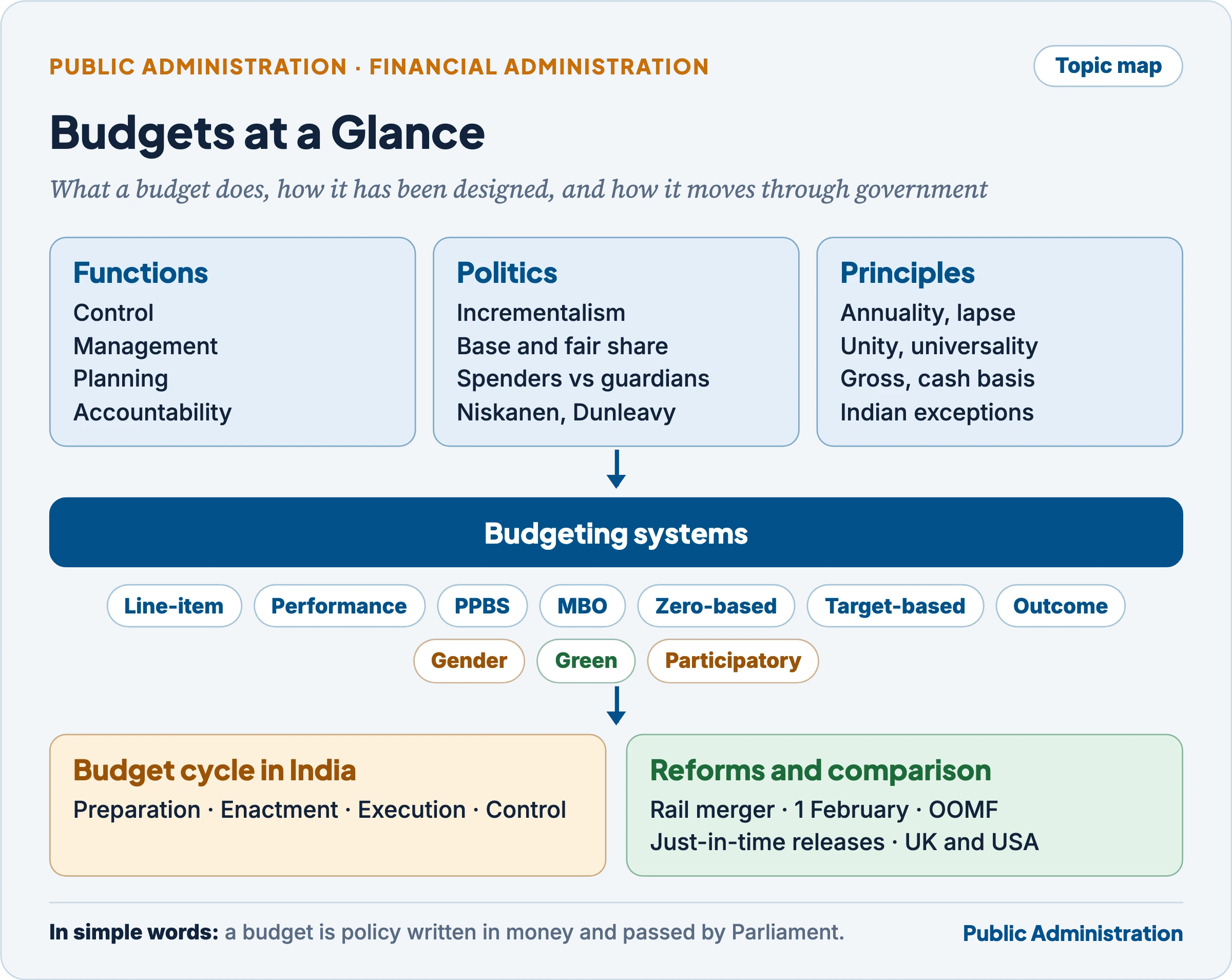
The budget is the single document in which a government says, in numbers, what it intends to do. Every scheme, salary, subsidy and tax change has to pass through it, so the budget is where policy meets money, where the executive answers to the legislature, and where rival claims on scarce resources are settled. Public administration studies the budget from three angles: as a process (how it is prepared, passed, executed and audited), as a set of techniques (line-item, performance, PPBS, zero-based, outcome budgeting) and as politics (who gets what, and why budgets change so slowly).
In simple words
A family sits down at the start of the year and decides how much will go on rent, food, school fees and savings, and where the money will come from. Writing this down does three jobs: it stops overspending (control), it helps run the house smoothly (management) and it forces the family to decide what matters most this year (planning). A government budget does the same three jobs, but for a country, in public, and under the eye of Parliament.
1. The Budget: Meaning, Nature and Functions
In simple words
A budget is a plan for money: how much will come in, how much will go out, and for what. In a democracy it is also a permission slip, because the government cannot tax or spend a rupee unless the elected legislature agrees to the plan.
1.1 Origin of the word and definitions
- Origin. The word comes from the old French bougette, a small leather bag. The British Chancellor of the Exchequer carried his financial papers to the House of Commons in such a bag and “opened the budget”. The modern sense became fixed after a satirical pamphlet, The Budget Opened (1733), aimed at Robert Walpole‘s excise scheme.
- Legal meaning in India. The Constitution does not use the word “budget”. Article 112 requires the President to lay before both Houses an Annual Financial Statement: the estimated receipts and expenditure of the Union for the coming financial year.
The classic definitions fall into two groups: those that see the budget as a financial statement and those that see it as a plan of action.
| Thinker | Definition (paraphrased unless quoted) | What it stresses |
|---|---|---|
| Aaron Wildavsky, The Politics of the Budgetary Process (1964) | “a series of goals with price tags attached” | Budget as policy expressed in money |
| Jesse Burkhead, Government Budgeting (1956) | A vehicle of fiscal policy and a tool of management | Economic and managerial roles together |
| Marshall Dimock | A financial plan that summarises past financial experience, states a current plan and projects it over a future period | Past, present and future in one document |
| W.B. Munro | A plan of financing for the coming fiscal year, with itemised estimates of all revenues and expenditures | Itemised estimates |
| René Stourm, French budget theorist | A document containing a preliminary approved plan of public revenue and expenditure | Approval by competent authority |
- Budget versus the Acts. A budget is the act of the executive: a proposal. The Appropriation Act (authority to spend) and the Finance Act (authority to tax) are the acts of the legislature that give it legal force. Many definitions blur this line.
- A budget is more than estimates. It reports how the government handled last year’s money, describes the present state of the treasury, and sets out the programme of work for the next year and how it will be financed. It is therefore a report, a plan and a request at once.
Common confusion
Is the “Union Budget” the same as the Annual Financial Statement? Not quite. The Annual Financial Statement under Article 112 is only one budget document. The “budget” in common usage is the whole package laid on budget day: the Statement, the Demands for Grants (Article 113), the Finance Bill, the Receipt and Expenditure Budgets, the fiscal policy statements required by the FRBM Act, and the Output-Outcome Framework. The Appropriation Bill (Article 114) comes later, after the Demands are voted.
1.2 Government budget and commercial budget
A firm and a government both budget, but for different purposes and under different rules.
| Basis | Commercial budget | Government budget |
|---|---|---|
| Aim | Profit and growth of the firm | Public welfare, equity, stability, development |
| Order of decisions | Expenditure is fitted to expected income | Expenditure needs often come first; revenue is raised to meet them |
| Authority | Internal management | Legislative approval (Articles 114 and 265: no expenditure or tax without law) |
| Secrecy | Private | Public after presentation; confidential only before it |
| Measure of success | Return on investment | Outcomes for citizens, often unquantifiable |
| Time horizon | Flexible | Mainly annual, bound by the rule of lapse |
| Accountability | Shareholders | Legislature, audit, citizens |
- The government budget reflects policy: what it chooses to tax, subsidise or neglect shows its priorities. That is why a government budget can be read as a statement of ideology, which a commercial budget never is.
1.3 Functions of the budget: Schick’s three orientations
Allen Schick, the American budget scholar, in “The Road to PPB: The Stages of Budget Reform” (Public Administration Review, 1966), argued that every budget system serves three functions, and that budget reforms differ in which one they put first.
| Function | Question it answers | Typical tool | Era of dominance (USA) |
|---|---|---|---|
| Control | Is money spent only as authorised, and honestly? | Line-item budget, object heads, audit | c. 1920–1935 |
| Management | Is the work done efficiently, at reasonable unit cost? | Performance budgeting, work measurement | c. 1935–1960 |
| Planning | Are we spending on the right objectives, compared with alternatives? | PPBS, cost–benefit analysis | from the 1960s |
- Control looks downwards and backwards: it holds subordinate units to legislative intent. Management looks at the middle: how activities are run. Planning looks upwards and forwards: which goals and programmes deserve money at all.
- Schick’s insight is that the functions compete for the attention of the budget office. A budget office staffed by accountants will stress control; one staffed by economists and analysts will stress planning. This is why a budget office needs accountants, statisticians and procedure analysts, and a climate in which their specialist skills are applied within a general policy view.
- Accountability is often listed as a fourth function, though in Schick’s scheme it is part of control: the executive answers to the legislature, and each subordinate authority to the one above it.
Operational, managerial and strategic issues. The same three layers appear when a budget officer works: operational issues (releasing funds on time, avoiding cost overruns), managerial issues (unit costs, performance targets, coordination between departments) and strategic issues (which programmes to expand, cut or end; the fiscal stance for the year). A good budget system must handle all three at once.
1.4 The economic functions: Musgrave
Richard Musgrave, the German-American public finance economist, in The Theory of Public Finance (1959), gave the budget three economic “branches”:
- Allocation: providing public goods the market will not supply (defence, roads, basic research).
- Distribution: adjusting income and wealth through progressive taxes, transfers and subsidies.
- Stabilisation: using taxes and spending to smooth booms and slumps (the Keynesian function; see the article on Monetary and Fiscal Policies, Public Borrowing and Debt for deficits and fiscal rules).
These three functions explain why a narrow focus on cutting costs can distort the budget. If every reform measures success only by savings, the budget’s allocative, redistributive and stabilising roles are pushed aside. A budget that saves money by starving maintenance, or by cutting a programme that reduces inequality, has failed in its wider purpose.
1.5 The budget as a tool of management, coordination and discipline
- Communication. The annual budget exercise forces every unit to state what it does, what it needs and why. Information flows up (estimates, justifications) and decisions flow down (allocations, ceilings, conditions). The budget is the one occasion each year when the whole administration talks to itself in a common language: money.
- Coordination. Because all claims compete for one pool, the budget office must reconcile them: a road scheme and an irrigation scheme in the same district, or a health mission and a nutrition scheme for the same mothers. This is why the budget has been called an instrument of coordination: it is the point where scattered departmental plans are fitted into one government plan.
- Administrative discipline. Sanctioned grants, object heads, re-appropriation rules and audit set limits on what each officer may spend. The controlling officer in each ministry watches the flow of expenditure; the Financial Adviser checks it; the auditor reviews it later. The budget thus carries the chain of command into financial matters.
- Executive control and delegation. A budget also allows the top to delegate safely: once allocations and targets are fixed, lower officers can be given freedom to spend within them.
1.6 The budget as an instrument of policy, socio-economic change and legislative control
Indian Connect — The budget as a policy statement in India
- Development: since the 1950s the Union budget financed the Five-Year Plans; it still carries the government’s capital expenditure push (about ₹11 lakh crore of capital expenditure in the Revised Estimates of 2025-26).
- Equity: the Gender Budget Statement, tribal and scheduled caste allocations, food subsidy and rural employment are budget-level expressions of social policy.
- Federal balance: Finance Commission grants and devolution flow through the Union budget; the Sixteenth Finance Commission report (submitted 17 November 2025) was laid with the Budget 2026-27, retaining the States’ share of the divisible pool at 41%.
- Fiscal policy: the Budget 2026-27 adopted a debt-to-GDP anchor (target 50±1% by 2030-31), with the fiscal deficit (estimated at 4.3% of GDP for 2026-27) as the operating instrument.
- Instrument of public policy. Every major policy needs money; the budget decides how much each policy gets and therefore which policies are real and which remain words. Tax measures (incentives, cesses, exemptions) are policies in their own right.
- Instrument of socio-economic transformation. In a poor country the budget is the main lever of change: it builds infrastructure, funds schools and hospitals, transfers income, and shapes private investment through taxes and incentives. This is why financial administration is a vital institution of economic and social progress in developing countries, where markets alone cannot carry development.
- Tool of legislative control. No tax may be levied except by law (Article 265), and no money may be withdrawn from the Consolidated Fund except under an appropriation made by law (Article 266(3) and Article 114(3)). The budget is the occasion on which Parliament exercises these powers, debates the government’s whole policy and holds it to account.
- Indicator of financial health. The budget’s statements of receipts and expenditure show the deficit, the debt, the interest burden and the quality of spending (capital versus revenue). It is the most complete annual picture of a polity’s fiscal condition, and one reason it has been called more than “the economic horoscope of the nation”: it is also a political and administrative document.
- Instrument of trust. A budget system that publishes its numbers, consults citizens and reports results gives citizens reason to believe the government is listening. The OECD’s Recommendation on Budgetary Governance (2015) lists transparency, openness, inclusive and participative debate, and performance information among its ten principles of good budgetary governance.
2. Budgeting as Politics: Key, Wildavsky and Incrementalism
In simple words
Imagine ten children sharing one cake. A neat formula for dividing it rarely survives the argument: each child remembers what he got last time and expects about the same again, plus a little more. Budget-makers behave the same way, and that is what the “politics of budgeting” school says out loud.
2.1 The search for a budgetary theory: Key and Lewis
- V.O. Key Jr., the American political scientist, in “The Lack of a Budgetary Theory” (American Political Science Review, 1940), posed the central question: on what basis shall it be decided to allocate X dollars to activity A instead of activity B? He argued that budgeting had procedures but no theory of choice.
- Verne B. Lewis, in “Toward a Theory of Budgeting” (Public Administration Review, 1952), answered with economic reasoning: relative value (compare returns at the margin), incremental analysis (examine the effect of adding or cutting a slice of money) and alternative budgets (ask each agency to show what it would do at, say, 80%, 100% and 110% of its current level). This “alternative budgeting” idea later reappeared in the decision packages of zero-based budgeting.
2.2 Wildavsky’s The Politics of the Budgetary Process (1964)
Aaron Wildavsky, the American political scientist who became the leading theorist of public budgeting, studied how the US federal budget was actually made, through interviews with agency officials, the Bureau of the Budget and Congressional appropriations committees.
- The budget records the outcome of political conflict. If politics is the struggle over whose preferences shall prevail, the budget is the record of who won. Budgeting is therefore not a neutral technical exercise but the heart of the political process.
- The problem of calculation. Budget-makers face an impossible burden: thousands of items, no common measure of value, little time and incomplete information. They cope with “aids to calculation”, simplifying rules of thumb (heuristics):
- Incrementalism: take last year’s budget as the base and argue only about the increment (the small increase or decrease).
- The base: the established expectation that existing programmes will continue at roughly current levels; the base is rarely examined.
- Fair share: each agency expects to share proportionately in any increase or cut.
- Specialisation and fragmentation: decisions are split among specialised subcommittees and officials, each looking at a small part.
- Satisficing and sequential attention: settle for what is acceptable rather than optimal (an idea taken from Herbert Simon), and deal with problems one after another, correcting errors next year.
- Reliance on others: each participant assumes the others will catch what he misses (the agency asks for more, the budget office cuts, the legislature adjusts).
- Roles. The process works because participants play stable roles: agencies are advocates who ask for more; the budget bureau (Treasury, Finance Ministry) acts as guardian of the public purse and cuts; the lower house’s appropriations committee guards the Treasury; the upper house acts as an appeals court for agencies. Conflict between spenders and guardians is built into the system, and it produces a workable result.
- Strategies. Agencies use ubiquitous strategies (cultivate a clientele, win the confidence of the budget office and legislators) and contingent strategies (pad the request in expectation of a cut, show a “camel’s nose” by starting a programme small, link a request to a crisis).
- Wildavsky’s summary. Budgeting turns out to be incremental, proceeding from an historical base, guided by accepted notions of fair shares, with decisions fragmented, made in sequence by specialised bodies, and coordinated through repeated attacks on problems. Later quantitative work with Otto Davis and M.A.H. Dempster (1966) showed that agency requests and appropriations could be predicted well by simple incremental rules from the previous year’s figures.
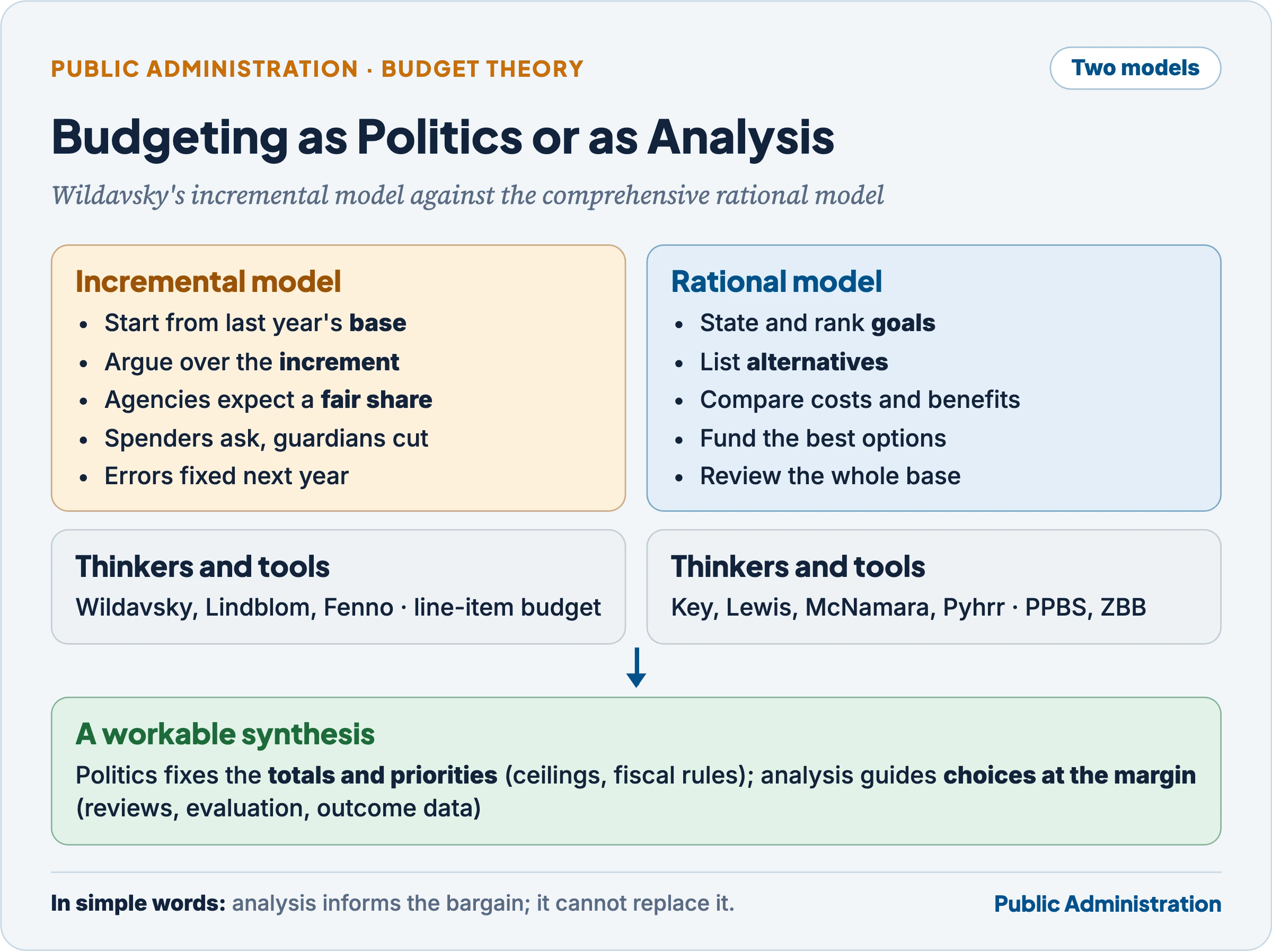
2.3 “No significant change in the budgetary process without affecting the political process”
In “Political Implications of Budgetary Reform” (Public Administration Review, 1961) Wildavsky argued that reformers who want a comprehensive, programme-based, executive-centred budget are really asking for a different political system:
- A budget determines who gets what. Changing the rules by which it is made changes the distribution of power between President and Congress, between central budget office and agencies, and between interest groups.
- A truly comprehensive budget would require agreement on goals and their ranking. In a pluralist democracy such agreement does not exist; conflict is resolved through bargaining, which incrementalism makes possible.
- Hence reformers who claim only to want “better budgeting” are proposing political change in technical language. That is why most budget reforms either failed or were quietly absorbed into the old incremental practice.
Redefining political institutions instead of the budget process. In his later work Wildavsky drew the logical conclusion. If budget outcomes reflect political rules, then improving outcomes means changing the rules of the political game, not the techniques of budget preparation. In How to Limit Government Spending (1980) he proposed a constitutional limit on total spending, so that rival interests would have to compete within a fixed total, and in The New Politics of the Budgetary Process (1988) he described how the old consensus had collapsed into dissensus over the size of government, so that budgeting had become a continuous battle (repeated budget resolutions, deficits, shutdown threats). His prescription was institutional: fix the totals by political agreement and constitutional rule, then let incremental bargaining work within them. This is the root of today’s fiscal rules and top-down budgeting.
2.4 Budgeting as politics versus budgeting as analysis
The debate has two camps.
| Basis | Budgeting as analysis (rational model) | Budgeting as politics (incremental model) |
|---|---|---|
| Key thinkers | Key, Lewis, Hitch and McKean, McNamara’s analysts, Pyhrr | Wildavsky, Lindblom, Fenno |
| Assumption | Goals can be stated, ranked and costed | Goals are contested; agreement is on programmes, not values |
| Method | Compare alternatives on costs and benefits | Bargain over increments from the base |
| Techniques | PPBS, ZBB, cost–benefit analysis, outcome budgets | Line-item budget, fair shares, appeals |
| Strength | Raises the quality of choices; exposes waste | Reduces conflict and calculation; politically workable |
| Weakness | Ignores politics; data-hungry; paperwork | Protects the base; slow to cut obsolete programmes; favours the organised |
Why the issue still matters, and how a synthesis is possible.
- Every budget reform since the 1990s (performance, outcome and results-based budgeting) is an attempt to inject analysis into a political process. Whether it succeeds depends on whether politicians and agencies have incentives to use the analysis.
- A workable synthesis combines the two: politics sets the totals and broad priorities (top-down ceilings, fiscal rules), and analysis informs choices at the margin (spending reviews, evaluations, outcome data used in the next year’s allocations). Analysis feeds the bargaining instead of trying to replace it.
- Illustration from India: fiscal ceilings come from the FRBM framework and the Cabinet; Finance Ministry ceilings then go to ministries; NITI Aayog’s evaluations and the Output-Outcome Monitoring Framework inform which schemes are continued, merged or closed at the end of each Finance Commission cycle (the “sunset” review of centrally sponsored schemes). Politics decides the shape; analysis trims and redirects.
2.5 Tensions among budget actors
Budget allocation is a set of tensions between actors with different backgrounds, orientations and interests, and between short-term goals and long-term institutional needs.
- Spenders versus guardians: line ministries want more for their schemes; the Finance Ministry wants control of the deficit.
- Politicians versus officials: ministers want visible new schemes before elections; officials want to fund maintenance, salaries and committed liabilities.
- Centre versus states: centrally sponsored schemes, conditional grants and tax devolution are a constant bargaining ground.
- Generalists versus specialists: the budget office examines spending from a financial view; the technical department from a professional one.
- Short term versus long term: capital maintenance, pension liabilities, research and institution-building lose to immediate demands (subsidies, salary revisions, election promises). The annual budget’s short horizon sharpens this bias.
- Legislature versus executive: the legislature wants detailed control; the executive wants flexibility and lump sums.
These tensions are not failures: they are how a pluralist system produces a budget. The design problem is to keep them productive through clear ceilings, rules for new schemes, multi-year frameworks and independent scrutiny.
2.6 Bureaucrats and budgets: Niskanen and Dunleavy
- William Niskanen, the American economist of the public choice school, in Bureaucracy and Representative Government (1971), modelled the bureau chief as a budget maximiser. Salary, power, prestige, patronage and ease of management all rise with the bureau’s budget. Because the bureau knows its true costs and the legislature does not (an information asymmetry in a bilateral monopoly), the bureau obtains a budget larger than the socially efficient level, producing oversupply of public output.
- Relevance today. The model explains the familiar padding of estimates, end-of-year spending rushes, empire-building and resistance to closure of schemes. It also underlies New Public Management remedies: contracting out, performance contracts, competition, and outcome-based budgets that weaken the link between budget size and a manager’s status.
- Critique. Bureaucrats are constrained by political masters, central finance ministries, audit and public scrutiny; many senior officials value policy influence or professional standards more than budget size; Indian budgets are tightly controlled by the Finance Ministry, so line agencies rarely “maximise” freely.
- Patrick Dunleavy, the British political scientist, in Democracy, Bureaucracy and Public Choice (1991), offered the bureau-shaping model as a response. Senior officials gain little personally from a bigger budget, much of which goes to programmes they do not control. They prefer to shape their bureaus into small, elite, policy-making units close to ministers, hiving off routine delivery to agencies or contractors. This explains the agencification of the 1980s and 1990s (for example the UK’s Next Steps agencies) better than Niskanen’s model.
The public choice side of these models is treated in the article on New Public Administration and Public Choice.
2.7 Budgeting in poor and unstable environments
- Naomi Caiden and Aaron Wildavsky, in Planning and Budgeting in Poor Countries (1974), found that poverty and uncertainty produce repetitive budgeting: the budget is remade many times during the year as revenue falls short, releases are delayed and cuts are imposed. Formal plans and budgets lose meaning; finance ministries ration cash month by month.
- Lesson: budgeting succeeds or fails not only through its internal techniques but through its environment: the stability of revenue, the political system, administrative capacity, the honesty of estimates and the culture of compliance. A technique imported from a rich, stable country often fails in a poor, uncertain one.
- Competitive politics. Where parties compete fiercely, short-term electoral gains (loan waivers, unfunded subsidies, populist transfers) can override sound economics. Hence the claim that good economics and bad politics cannot coexist in a sound budgetary process: if the political incentives are wrong, technical quality does not survive. Fiscal rules, independent fiscal institutions and transparent off-budget reporting are the institutional answers.
- Incentive structures. Any budgeting approach succeeds only if participants have favourable incentives to use it: managers must gain (flexibility, recognition, retained savings) from honest reporting; departments must not be punished with cuts for revealing savings; politicians must see value in performance information. Without such incentives, performance budgets become paperwork and ZBB becomes ritual.
2.8 Critiques of incrementalism
- Normative weakness: incrementalism protects the base, so obsolete programmes survive, and it favours organised interests with established shares.
- Empirical limits: Allen Schick, in “Incremental Budgeting in a Decremental Age” (1983), showed that when resources shrink the comfortable logic of fair-share increments breaks down; budgeting becomes decremental and conflictual. Studies of punctuated equilibrium (Frank Baumgartner and Bryan Jones, Agendas and Instability in American Politics, 1993, and later work with James True) found that budgets show long periods of small changes broken by large jumps when attention shifts.
- Definitional vagueness: critics such as John Wanat and Lance LeLoup noted that “incremental” was used loosely: is a 10% change incremental? Measured at the programme level, many budgets change much more than the aggregates suggest.
- Defence: incrementalism remains the best description of how most budgets are made most of the time, and it has real virtues in a democracy: it limits conflict, reduces calculation, and allows mistakes to be corrected each year.
3. Principles of Budgeting and Their Indian Exceptions
In simple words
Principles of budgeting are the “house rules” that keep the budget honest and controllable: one budget, covering everything, for one year, showing full amounts, approved in advance and spent as approved. Each rule has a good reason behind it, and in practice each one also has exceptions.
The principles grew out of the struggle of legislatures to control executives. Harold D. Smith, Director of the US Bureau of the Budget (1939–46), later added principles of executive budget management (executive programming, executive responsibility, reporting, adequate tools, multiple procedures, executive discretion, flexibility in timing and a two-way budget organisation), reflecting the shift from control to management.
| Principle | Meaning and purpose | Indian practice and exceptions |
|---|---|---|
| Annuality | Grants are for one year only; Parliament must re-authorise each year | Followed (Articles 112, 114). Exceptions: vote on account, multi-year projects funded year by year, non-lapsable funds (for example the Non-Lapsable Central Pool of Resources for the North-East) |
| Rule of lapse (corollary) | Unspent money lapses on 31 March | Followed; causes the March rush of spending. Exceptions: non-lapsable pools, funds held in the Public Account |
| Unity | One budget for all transactions | Separate Railway Budget from 1924 to 2016-17; merged from 2017-18 |
| Universality / comprehensiveness | Every receipt and expenditure appears in the budget | Public Account transactions are outside the vote; extra-budgetary resources of public enterprises; off-budget borrowings (for example loans to FCI from the National Small Savings Fund, brought on budget from 2021-22) |
| Gross budgeting | Show receipts and expenditure in full, not netted | Followed; departmental receipts are not deducted from expenditure. Limited exceptions where recoveries are shown as reductions of expenditure |
| Balance | Expenditure should not exceed revenue | Not followed: deficits are normal; discipline comes instead from the FRBM Act, 2003 and its targets |
| Cash basis | Record transactions when cash is received or paid | Followed (cash-based accounts); accrual accounting recommended but not adopted |
| Executive initiative | Only the executive proposes expenditure and taxes | Article 113(3) and Article 117: no demand or money bill except on the President’s recommendation; Parliament may reduce but not increase a demand |
| Specificity / closeness | Estimates must be precise; no lump sums | Followed in principle; tendency to under-estimate revenue and over-estimate expenditure |
| Form of estimates = form of accounts | Budget heads match accounting heads | Followed: uniform classification (major, minor, sub-heads) for Union and States |
| Revenue and capital kept distinct | Separate current and capital transactions | Followed: Revenue and Capital budgets |
| Publicity and clarity | Budget is public and understandable | Followed after presentation; confidential before |
| Integrity | Budget is executed as enacted | Departures need supplementary or excess grants and are examined by the CAG and PAC |
- Why exceptions are allowed. Strict annuality conflicts with multi-year projects and planning; strict unity conflicts with the autonomy of commercial undertakings; strict balance conflicts with Keynesian stabilisation. Modern practice keeps the control purpose of each rule while softening its form: multi-year frameworks alongside annual votes, a single budget with separate accounts for commercial bodies, and fiscal rules in place of an annual balance.
- The rule of lapse illustrates the trade-off. It keeps Parliament in control, but it encourages wasteful year-end spending. The Finance Ministry therefore limits spending in the last quarter to about one-third and in March to 15% of the year’s budget estimate, and uses just-in-time release of funds (Section 15).
4. Forms and Classifications of Budgets
In simple words
Budgets can be sorted in many ways: by what they cover, how long they run, whether they balance, how they count money, who prepares them and how they group spending. These are not rival “techniques” so much as different lenses on the same budget.
4.1 By what and how they record
| Classification | Types | Key point |
|---|---|---|
| By account | Revenue budget (tax and non-tax receipts; current spending such as salaries, interest, subsidies) and capital budget (borrowings, loan recoveries, disinvestment; spending on assets and loans) | A revenue deficit means borrowing to pay for current consumption, the weakest kind of deficit |
| By basis of recording | Cash budget (counts what is received or paid in the year) and accrual / revenue-accrual budget (counts what is earned or owed in the year, whether paid or not) | India, like most Commonwealth countries, uses cash; New Zealand, Australia and the UK use accrual budgets |
| By number | Single (one budget for all) and plural (separate budgets, for example railways till 2016-17) | Single budgets show the whole fiscal position |
| By balance | Balanced, surplus, deficit | Deficit budgeting became normal after Keynes; see the article on Monetary and Fiscal Policies for deficits |
| By period | Annual and multi-year | India: annual votes plus three-year rolling fiscal targets |
| By who prepares it | Legislative (prepared by a legislative committee), executive (prepared by the executive) and board or commission (a mixed body, found in some US states and cities) | The executive budget is now the universal norm |
4.2 Cash and accrual budgeting
- Cash basis. Simple, objective and easy to audit; it shows how much cash the government needs and fits the appropriation logic (Parliament votes cash). But it hides liabilities (unpaid bills, pensions, guarantees), ignores the consumption of assets (no depreciation), and allows fiscal window-dressing (deferring payments to the next year, or taking one-time receipts).
- Accrual basis. Records revenue when earned and expenses when incurred; it captures assets, liabilities and full costs, supports cost per output and outcome budgeting, and shows the government’s net worth. Its problems are complexity, need for accounting standards, valuation of public assets (roads, heritage) and the risk of creative accounting through judgements.
- Indian position. The Twelfth Finance Commission (2004) recommended a move to accrual accounting; the Government accepted it in principle and asked the Government Accounting Standards Advisory Board (GASAB, set up in 2002 under the CAG) to prepare a roadmap. The Second Administrative Reforms Commission, in its 14th Report Strengthening Financial Management Systems (2009), favoured a phased move. Union accounts remain on a cash basis, with supplementary statements of liabilities and assets. The accounting side is treated in the article on Financial Accountability, Accounts and Audit.
4.3 Classification of expenditure
| Classification | How expenditure is grouped | Purpose | Limitation |
|---|---|---|---|
| Object-wise (line-item) | By inputs: salaries, wages, travel, office expenses, works, grants | Control and accountability | Says nothing about results |
| Organisational | By ministry, department, unit | Fixing responsibility | Hides cross-cutting programmes |
| Functional | By function → programme → activity/project (for example Health → disease control → vaccine storage) | Management and performance measurement | Needs matching accounts |
| Economic | By economic character: consumption, transfers (interest, subsidies, grants), capital formation | Analysing the budget’s impact on the economy | Not useful for managers |
Functional classification is the backbone of performance budgeting: unless spending is grouped by programmes and activities, it cannot be related to outputs. Economic classification serves fiscal policy: it shows whether a rising budget means more capital formation or only more consumption.
4.4 Top-down and bottom-up budgeting
- Bottom-up budgeting: agencies build requests from below; the budget office cuts them; the chief executive decides appeals. It uses operational knowledge but produces inflated requests and an endless cycle of padding and cutting (Wildavsky’s advocates and guardians).
- Top-down budgeting: the government first fixes the aggregate (from fiscal rules and the macroeconomic outlook) and sectoral ceilings; agencies then allocate within their ceilings. It enforces fiscal discipline and gives agencies freedom within limits. Target-based budgeting in the USA (Section 8) and the expenditure ceilings of Sweden, the Netherlands and the UK’s Spending Reviews are examples.
- India’s practice is a hybrid: the Finance Ministry issues indicative ceilings, ministries prepare estimates within them, and the Revised and Budget Estimates are settled in pre-budget meetings with the Expenditure Secretary.
4.5 Multi-year budgeting and the MTEF
- Why multi-year? Annual budgets are short-sighted: commitments made this year (a new scheme, a pay revision, a project) bind future years. A medium-term expenditure framework (MTEF) projects revenue and expenditure for three to five years, so that new commitments can be judged against future resources.
- OECD experience. Multi-year budgeting spread in OECD countries from the 1970s. A known problem: ministries began to treat out-year projections as entitlements, so the frameworks became floors instead of ceilings. Successful versions treat out-year figures as ceilings reviewed each year (rolling frameworks).
- India. The FRBM Act, 2003 requires three fiscal policy statements with the budget, including the Medium-term Fiscal Policy Statement with rolling three-year targets for fiscal and revenue deficits, tax revenue and debt. An amendment in 2012 added a Medium-term Expenditure Framework Statement, laid in the session after the budget, with three-year expenditure ceilings. The C. Rangarajan High Level Expert Committee on Efficient Management of Public Expenditure (2011) recommended a multi-year horizon and the removal of the Plan/Non-Plan distinction, which was done from 2017-18.
- Limits in India: the MTEF statement remains largely indicative; ministries do not receive binding three-year envelopes, and scheme approvals are tied instead to the five-year Finance Commission cycle.
Common confusion
Is the revenue budget the same as a “revenue budget” in the sense of accrual budgeting? No. In India, the revenue budget means the part of the budget covering revenue receipts and revenue (current) expenditure, as opposed to the capital budget. Older textbooks also use “revenue budget” for an accrual-type budget (one that books revenues and expenses in the year they accrue, as against a cash budget). The first is about the nature of transactions; the second is about the timing of recording them. India’s revenue budget is prepared on a cash basis.
5. Line-Item or Traditional Budgeting
In simple words
A line-item budget is a shopping list with prices: salaries ₹10 lakh, travel ₹1 lakh, stationery ₹20,000. It tells you exactly what the office will buy, but nothing about what the office will achieve.
- Meaning. The line-item or object-of-expenditure budget allocates money by inputs (salaries, wages, travel, office expenses, equipment, works, grants), each shown on its own “line” with its cost. It grew out of the American reform movement of the early twentieth century (the Budget and Accounting Act, 1921 created the US Bureau of the Budget) and out of British and colonial Indian treasury practice.
- Orientation: control. Its purpose is to stop fraud and waste and to make sure money is spent only on authorised objects, by authorised officers, within authorised limits.
- Policy-making style: incremental. Next year’s allocation for each line is this year’s plus an adjustment for prices and pay.
Merits
- Simple and familiar: easy to prepare, understand and audit.
- Strong control: fits regularity audit and legislative appropriation; makes comparison across years and units easy.
- Useful in hard times: across-the-board cuts can be made on particular objects (travel, new vehicles, consultants).
- Suitable at lower levels of the organisation, where managers spend on inputs.
Limitations
- Silent on purpose and results: it shows what is bought, not what is achieved; spending the allocation becomes a virtue in itself.
- Procedure over performance: attention goes to legality and regularity, not value for money.
- Hides duplication: the same objective may be funded in several departments without anyone noticing.
- Short-sighted: long-term programmes lose to pressing current demands.
- Micro-management: legislators and finance officials scrutinise trivia (as one critic put it, “paperclips”) instead of policy.
The line-item budget has never disappeared. Even in India’s outcome-budget era, Parliament still votes Demands for Grants classified by object heads, and the CAG audits against them. Later systems were added on top of it rather than replacing it, which is Wildavsky’s point in “A Budget for All Seasons? Why the Traditional Budget Lasts” (Public Administration Review, 1978): the traditional budget survives because it is simple, supports control and bargaining, and does not demand agreement on objectives.
6. Performance Budgeting
In simple words
A performance budget does not just say “₹80 crore for rural roads”. It says “₹80 crore to build 100 km of rural roads at ₹80 lakh per km, compared with 90 km last year”. Money is linked to work done, so you can judge whether the work was worth the money.
6.1 Meaning and origin
- Definition. Performance budgeting presents government expenditure in terms of functions, programmes, activities and projects, and links the money asked for to the work to be done and its unit cost. Its emphasis is on accomplishment rather than the means of accomplishment: the purpose of spending matters more than the object of spending.
- Origin. Cities such as New York had experimented with programme and activity budgets before the 1930s, and the US Department of Agriculture and the Tennessee Valley Authority used programme budgets in the New Deal years. The term “performance budget” was coined by the First Hoover Commission (Commission on Organization of the Executive Branch of the Government, chaired by former President Herbert Hoover), in its 1949 report on budgeting and accounting.
- Legal adoption in the USA. Amendments to the National Security Act (1949) required performance budgets in the Defense Department; the Budget and Accounting Procedures Act, 1950 extended the approach to federal agencies.
- Orientation: management (Schick). Skills needed shift from accountants to managers and work-measurement analysts.
6.2 Elements and steps
Vital elements of a performance budget
- A programme and activity classification that covers the range of work of each organisation.
- Objectives for each programme.
- Targets of work or achievement for the year.
- Workload factors, unit costs and performance ratios that justify the money asked for.
- Narrative statements explaining past performance and proposed work.
Steps in introducing it
- Establish a meaningful functional classification of expenditure (function → programme → activity/project).
- Bring accounting and financial management into line with that classification.
- Develop work measurement, performance standards and unit costs for every measurable activity.
- Create a cost and performance reporting system that compares targets and results through the year.
Formulation. Each performance budget begins with the agency’s organisational structure and objectives, followed by a financial requirements table with three parts: the programme and activity classification; an object-wise classification of the same money (establishment, supplies and so on); and the sources of finance with the budget heads. Narrative explanations add targets, achievements, workload and past performance. It accompanies the Demands for Grants, which remain the instrument of appropriation control.
6.3 Objectives of performance budgeting
The Administrative Reforms Commission (1968) summarised its objectives in five points, still the standard list:
- present clearly the purposes and objectives for which funds are sought, and the programmes and accomplishments in financial and physical terms;
- help the legislature understand and review the budget better;
- improve budget formulation and decision-making at all levels;
- enhance managerial accountability and give management an extra tool of control over financial operations;
- make performance audit more purposeful and effective.
6.4 “The key lies beneath the word ‘result'”
Modern performance-based budgeting (sometimes called new performance budgeting or results-based budgeting) asks not only how much work was done but what results it produced. Its elements:
- Strategic objectives for each ministry, derived from government priorities.
- Performance indicators at four levels: inputs (money, staff), outputs (services delivered), outcomes (changes in citizens’ condition) and efficiency (cost per output).
- Targets set in advance and reported against at year-end.
- Managerial flexibility (fewer line-item controls, carry-over of savings) in exchange for accountability for results.
- Use of performance information in budget decisions, through programme reviews, spending reviews and evaluation.
- Performance audit by the supreme audit institution to verify reported results.
The word “result” is the key because the earlier generation of performance budgeting stopped at outputs (kilometres built, patients treated), which managers control; results-based budgeting reaches for outcomes (lives saved, travel time reduced), which matter to citizens but depend on many factors outside the agency’s control.
6.5 Performance budgeting in India
Indian Connect — Performance budgeting in India
- Early demands: the Estimates Committee of the Lok Sabha, in its 20th Report (late 1950s), recommended a “performance-cum-programme” system for developmental activities, to be reached gradually; it pressed the point again in its 73rd Report (1960).
- Planning Commission: the Committee on Plan Projects set up a performance budgeting unit in the mid-1960s and issued a memorandum (1966) on introducing it.
- ARC 1968: the Administrative Reforms Commission, in its Report on Finance, Accounts and Audit (1968), recommended performance budgeting for all departments in direct charge of development programmes. Performance budgets for a few organisations were laid in 1968; from 1969 the system was introduced in development ministries, and later extended to most development departments of the Union and to several States (Maharashtra, Rajasthan, Tamil Nadu, Uttar Pradesh among others).
- Status: performance budgets remained supplementary documents, presented after the main budget, so they rarely influenced allocations. In 2007-08 they were merged with the outcome budgets into a single document; since 2017-18 outputs and outcomes are presented with the budget itself (Section 10).
6.6 Merits, limitations and why it struggled
Merits
- Links physical and financial aspects of programmes; budget and plan speak a common language.
- Improves legislative review by showing what money buys.
- Supports decentralisation: authority can be delegated to managers whose results are measured.
- Enables performance audit, which is more meaningful than regularity audit.
- Improves public relations and citizen understanding of government’s work.
Limitations
- Classification problems: government work does not fall neatly into programmes and activities; categories are often too broad to reveal significant activities.
- Measurement problems: many activities (diplomacy, defence, policing, research, regulation) have no meaningful unit of output; the system then measures what is easy rather than what matters.
- Quantity over quality: it focuses on quantitative over qualitative evaluation.
- Cost allocation across activities is difficult; overheads are arbitrarily apportioned.
- Annual horizon clashes with long-gestation projects.
- It aids but does not make choices: it cannot compare the value of one programme against another unless supported by cost–benefit analysis.
- Weak accounting support: without accrual and cost accounting, unit costs are guesses.
Why it failed in Indian Union ministries. Critics point to four reasons: (i) performance budgets were parallel documents prepared after allocations had already been decided; (ii) the accounting system was not reorganised on functional lines, so financial and physical data did not match; (iii) no incentives: managers gained nothing from good performance and lost nothing from poor; (iv) it was applied to sectors where quantitative evaluation was not feasible, and targets were set without norms. The Union therefore continued with a traditional, incremental line-item budget, supplemented by plan schemes, because it suited parliamentary control, the cash accounting system and the bargaining between the Finance Ministry and line ministries.
Common confusion
Is performance budgeting just a tool of business management? Partly. It borrows business tools (unit costs, work measurement, cost centres), and early critics called it a “business management technique”. But in government it also serves legislative accountability and public information, which have no business parallel, and it must handle outputs that are not sold in a market. It is better described as a management tool adapted to public accountability.
6.7 Programme budgeting and performance budgeting
The two terms are often used interchangeably, and in the USA of the 1950s a single “programme/performance budget” did both jobs. In theory they differ:
| Basis | Programme budgeting | Performance budgeting |
|---|---|---|
| Focus | What the government does: classifies spending by programmes serving objectives | How well it does it: relates costs to work done |
| Level | Policy and planning (upper levels) | Management and operations (lower levels) |
| Key question | Which programmes, at what scale? | What does each unit of output cost? |
| Measures | Programme costs, often multi-year | Workload, unit costs, efficiency ratios |
| Descendant | PPBS | Results-based budgeting |
7. Planning-Programming-Budgeting System (PPBS)
In simple words
Before buying a new bus, a city using PPBS would first ask, “What is our goal? To move people quickly.” Then, “What are the ways: buses, a metro, cycle lanes, staggered office hours?” Then, “What does each cost over ten years, and what does each achieve?” Only then would it put the cheapest effective option in the budget.
7.1 Origins
- Private roots: General Motors used planning-programming ideas as early as the 1920s, and the US War Production Board’s Controlled Materials Plan applied them in the Second World War.
- Intellectual roots: the RAND Corporation’s systems analysis; Charles Hitch and Roland McKean, The Economics of Defense in the Nuclear Age (1960).
- Defense Department, 1961: Robert McNamara, the former Ford Motor Company president who became Secretary of Defense in 1961, brought Hitch as Comptroller and installed PPBS in the Pentagon to end the services’ competition for weapons systems and to compare missions across the Army, Navy and Air Force.
- Federal government, 1965: impressed by the Pentagon’s results, President Lyndon B. Johnson ordered PPBS for all federal departments in August 1965.
- Abandonment, 1971: under President Nixon, the Office of Management and Budget formally dropped the PPBS requirement in 1971. It survived in the Defense Department, where a successor system (Planning, Programming, Budgeting and Execution) is still used.
7.2 What PPBS involves
Definition. A system of resource allocation designed to improve government efficiency and effectiveness by establishing long-range planning goals, analysing the costs and benefits of alternative programmes to meet them, and presenting programmes as budgetary and legislative proposals with long-term projections.
| Component | What it does |
|---|---|
| Planning | Defines objectives and evaluates alternative ways of reaching them |
| Programming | Groups activities into programmes by objective (not by department) and costs them over five or more years (programme and financial plan) |
| Budgeting | Translates the first year of the programme plan into the annual budget request |
| Analysis | Programme memoranda and special analytical studies compare alternatives through cost–benefit and cost–effectiveness analysis |
- PPBS is concerned not only with inputs and outputs but with effects and alternatives. Decision-making becomes less incremental and more systematic; the budget agency becomes a policy-making body.
- Skills required: economic analysis, systems analysis and planning, alongside accountancy and administration.
- Orientation: planning (Schick).
7.3 Why PPBS failed in civilian government
- Wildavsky’s critique, in “The Political Economy of Efficiency” (Public Administration Review, 1966) and “Rescuing Policy Analysis from PPBS” (1969): PPBS assumed agreement on objectives, measurable benefits and a central analytical capacity that did not exist. It sought to replace political choice with analytical choice, and politicians would not accept it.
- Information overload: demands for programme memoranda, multi-year plans and analyses buried agencies in paperwork.
- Lack of analysts in agencies; the Bureau of the Budget could not review the analyses.
- Programme structures cut across departments, but appropriations, accounts and Congressional committees remained organised by department.
- Congress was not involved and saw PPBS as a tool to shift power to the executive.
- Timing and politics: introduced hastily across agencies, without pilot testing, at a time of the Vietnam War and budget stress; political dissension over priorities left no room for “rational” ranking.
- Benefits of social programmes (education, welfare, urban renewal) could not be quantified as defence systems could.
Legacy. PPBS left a permanent mark: programme classification, multi-year cost projections, policy analysis units and cost–benefit appraisal of large projects are now standard. India’s project appraisal system (Public Investment Board, Expenditure Finance Committee) and its programme-wise grouping of schemes descend partly from it.
7.4 PPBS and performance budgeting compared
| Basis | Performance budgeting | PPBS |
|---|---|---|
| Orientation | Management | Planning |
| Main concern | Efficiency (work done per rupee) | Effectiveness and choice among alternatives |
| Scope | Inputs and outputs | Inputs, outputs, effects and alternatives |
| Time span | Mainly annual | Multi-year (five or more years) |
| Level of decision | Operating and middle management | Top policy level; centralised |
| Unit of analysis | Activity within an organisation | Programme across organisations |
| Skills | Management, cost accounting | Economics, systems analysis |
| Relation to past | Incremental | Seeks to break from incrementalism |
8. Budgeting by Objectives and Target-Based Budgeting
In simple words
After PPBS, governments tried simpler ideas. One said: let managers set their own objectives and judge them on whether they meet them. Another said: let the top fix the total each agency may spend, and let the agency decide how best to use it.
- Management by Objectives (MBO), popularised by Peter Drucker in The Practice of Management (1954), was adopted in US federal budgeting under President Nixon (from about 1973) as budgeting by objectives. Objectives are set with the participation of managers; resources are allocated according to the degree to which objectives are met.
- It deals with inputs, outputs and effects but not alternatives; it is close to performance budgeting.
- Its style is decentralised and managerial; it worked better in local governments than at the federal level.
- Target-based budgeting (TBB), also called fixed-ceiling or top-down budgeting, spread quietly in the USA from about 1980.
- The chief executive sets spending limits (targets) for each agency, often with goals; agencies decide how to meet their goals within the limit.
- Agencies may submit a second list of requests beyond the target, ranked by priority: an echo of ZBB without its paperwork.
- It is revenue-driven and therefore realistic; it centralises totals while decentralising use.
- It reversed the old bottom-up flow of budgeting: agencies no longer ask and get cut; they are told what they may spend.
- Budgeting for results (from the 1990s) added NPM ideas: performance agreements, outcome measures and managerial freedom, embodied in the US Government Performance and Results Act, 1993 and its 2010 modernisation.
9. Zero-Based Budgeting (ZBB)
In simple words
Under normal budgeting, an office assumes it will get last year’s money again and argues only about the extra. Under zero-based budgeting it must start from nothing each year and prove why every activity deserves money at all, as if it were being set up afresh.
9.1 Meaning
- Definition. ZBB is an operating, planning and budgeting process that requires each manager to justify the entire budget request in detail from scratch, and shifts the burden of proof to the manager to show why any money should be spent at all and how the job could be done better. No department may defend its request by referring to the previous year’s appropriation.
- Peter Sarant, in his US government handbook on ZBB (1978), described it as a technique that complements existing planning, budgeting and review, identifies alternative and efficient ways of using limited resources, and provides a credible rationale for re-allocating resources through systematic review of the funding and performance of current programmes.
- Orientation: ZBB pays little attention to the measurement of inputs, outputs and effects; its core question is about alternatives and priorities: what should we do instead, and what matters most?
9.2 Origins
- Idea: the English budget authority E. Hilton Young urged annual re-justification of programmes in the 1920s; the US Department of Agriculture tried a zero-base exercise in 1962–64, which failed because agencies assumed their programmes were necessary.
- Design: Peter Pyhrr, a staff control manager at Texas Instruments, designed the working method in 1969 for the company’s staff and research divisions. His article “Zero-Base Budgeting” (Harvard Business Review, 1970) and book Zero-Base Budgeting: A Practical Management Tool for Evaluating Expenses (1973) spread the idea.
- State government: Jimmy Carter, then Governor of Georgia, invited Pyhrr to install ZBB for the state budget of fiscal year 1973.
- Federal government: as President, Carter ordered ZBB for all federal agencies in 1977, for the fiscal year 1979 budget. The Office of Management and Budget issued guidelines that year. President Reagan discontinued it in 1981.
9.3 Steps and decision packages
- Identify decision units: the lowest organisational units whose managers can make meaningful decisions on spending and the scope and quality of work.
- Prepare decision packages for each unit: documents describing an activity so that management can evaluate it, rank it against competing activities and approve or reject it. Each package states:
- the activity and its objectives;
- alternative ways of doing it (contracting out, merging with another unit, technology);
- funding levels, usually a minimum level (below current), the current level, and one or more enhanced levels;
- the costs and benefits at each level and the consequences of not funding it;
- performance measures.
- Rank the packages in order of priority, first within each unit, then consolidated at higher levels, so that management sees where to spend first, how much, and what is lost below the line.
- Allocate resources down the ranking until the available money runs out (the cut-off line), and prepare detailed operating budgets.
ZBB is thus top-down at the start (top management decides which units prepare packages and issues guidance) and bottom-up in operation (managers prepare and rank packages).
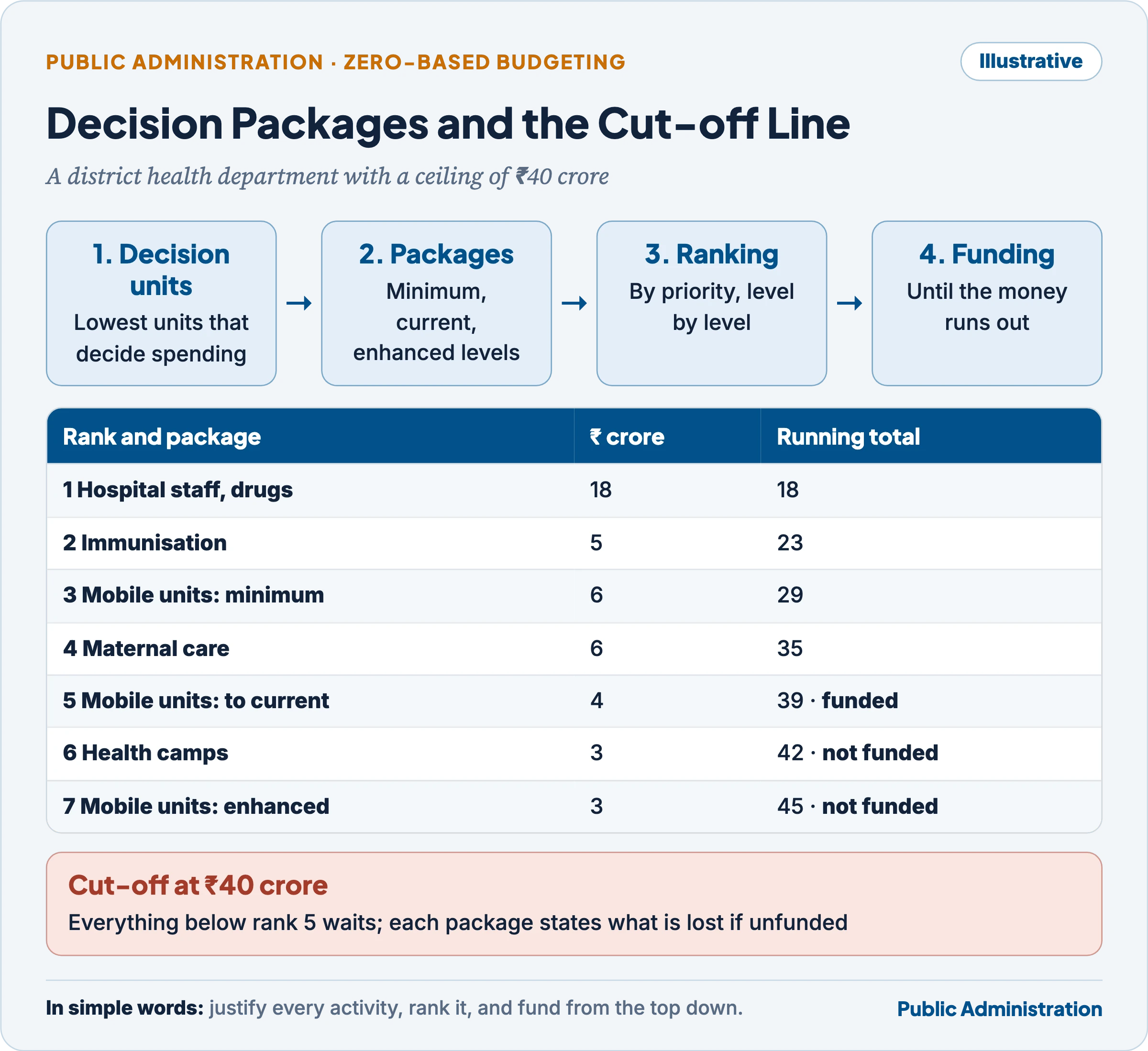
9.4 A worked example (illustrative numbers)
The figures below are illustrative only, to show the mechanics. A district health department has a ceiling of ₹40 crore for the coming year. One of its decision units runs mobile medical units (MMUs) for remote villages, at a current cost of ₹10 crore.
Decision package: Mobile medical units
| Element | Content (illustrative) |
|---|---|
| Objective | Primary care within 10 km of every remote habitation |
| Alternatives considered | (a) department-run vans; (b) vans run by an NGO under contract; (c) telemedicine at sub-centres plus fewer vans |
| Chosen method | (b), contracted vans, about 15% cheaper per visit than (a) |
| Level 1 (minimum) | ₹6 crore: 6 vans, 120 villages, fortnightly visits |
| Level 2 (current) | ₹10 crore (cumulative): 10 vans, 200 villages, weekly visits |
| Level 3 (enhanced) | ₹13 crore (cumulative): 13 vans, 260 villages, weekly visits plus diagnostics |
| Consequence of not funding | About 40,000 people lose regular access to primary care; rise in emergency referrals |
Ranking across the department (illustrative)
| Rank | Package and level | Cost (₹ crore) | Cumulative (₹ crore) |
|---|---|---|---|
| 1 | Hospital staff and drugs: minimum | 18 | 18 |
| 2 | Immunisation: current | 5 | 23 |
| 3 | MMUs: Level 1 | 6 | 29 |
| 4 | Maternal care: current | 6 | 35 |
| 5 | MMUs: Level 2 increment | 4 | 39 |
| 6 | Health education camps: current | 3 | 42 (above the ₹40 crore line) |
| 7 | MMUs: Level 3 increment | 3 | 45 |
- The cut-off falls after rank 5. MMUs are funded at the current level; the enhanced level and the education camps are not funded this year, and the camps’ managers must redesign or merge them.
- The exercise has re-allocated money by priority (camps lose, MMUs hold), found a cheaper method (contracting), and made the consequences of every cut visible.
9.5 Advantages of ZBB over the traditional budget
- Programme efficiency, not budget history: every rupee is justified by what it achieves now, not by what was spent last year.
- Eliminates or merges obsolete, low-priority and duplicated activities.
- Re-allocates resources from low to high priorities in a systematic way.
- Searches for alternatives: cheaper or better ways of doing the same job.
- Quick adjustment: ranked packages show what to cut first if revenue falls during the year.
- Participation: involves managers at all levels in planning and budgeting, improving their understanding and motivation.
- Selective use: it can be applied only to priority areas, not necessarily the whole budget.
9.6 Problems in implementation
- Paperwork: thousands of decision units and packages; one study found federal budget paperwork rose sharply in ZBB’s first year.
- Time and skill: requires trained staff, good cost data and management commitment.
- Ranking difficulties: comparing unlike packages (immunisation versus roads) is a political judgement; ranking committees become battlegrounds, and managers rank their own packages high.
- Arbitrary minimum levels: the “minimum” is usually fixed as a percentage of the current budget.
- Committed expenditure: salaries, pensions, interest and statutory entitlements cannot be cut to zero; only a small discretionary margin is really open.
- Resistance: managers resent having to justify established activities each year.
9.7 “Intended to end incrementalism, it became the most incremental of all”
Empirical studies of ZBB in US federal, state and local governments found it worked only within narrow limits:
- Programmes were almost never cut to zero. Agencies typically set their minimum level at 75–90% of last year’s budget, so the real debate was again over the top 10–25%: the increment.
- The base was protected by the minimum package, exactly as in incremental budgeting.
- ZBB was useful for comparing and ranking programmes at the margin, but it did not identify issues, set objectives or find radical alternatives.
- It coexisted easily with other budget processes, which shows it was a marginal, incremental tool rather than a revolution.
- It did not measurably reduce total spending, especially where expenditure was fixed by formula-based programmes.
This is why Wildavsky and others argued that ZBB, designed to escape incrementalism, ended up as a highly incremental technique: the ranking of increments above a protected minimum is incrementalism under another name. Its lasting value lies in the habit of periodic review, not in annual zero-basing.
9.8 ZBB in India
Indian Connect — Zero-based budgeting in India
- Private sector first: firms such as Britannia Industries and Union Carbide used ZBB-like methods from the late 1970s.
- Department of Science and Technology, 1983: first government application.
- All ministries, 1986-87: with resources strained in the Seventh Plan, the Finance Ministry’s circular of 10 July 1986 asked all ministries, State governments and public enterprises to apply ZBB to schemes above ₹1 crore, from 1987-88; a central monitoring cell was set up and about 150 low-priority schemes were identified for elimination.
- States: Maharashtra applied ZBB in many departments in the late 1980s; Karnataka experimented in health and agriculture.
- Outcome: the full method did not take root, owing to paperwork, committed expenditure and lack of skills. Its spirit survives in the periodic evaluation and rationalisation of centrally sponsored schemes: schemes are now approved only up to the end of a Finance Commission cycle and must be evaluated (largely by NITI Aayog’s Development Monitoring and Evaluation Office) before continuation; and in States’ periodic zero-base reviews of schemes.
9.9 Sunset legislation
- Meaning: a sunset law provides that an agency, programme or regulation will automatically terminate on a fixed date unless the legislature, after review, positively renews it. The burden of proof shifts to those who want it continued, which is the ZBB logic applied to institutions and laws rather than annual budgets.
- Origin: Colorado passed the first general sunset law in 1976; many US states followed in the late 1970s, alongside ZBB.
- Experience: reviews were often perfunctory and few agencies were actually abolished, but the threat of termination improved performance reporting.
- India: sunset clauses appear in specific laws and schemes (time-bound cesses, scheme approvals tied to the Finance Commission cycle). The Second ARC favoured periodic review of laws and institutions; and the Repealing and Amending Acts of 2015–2019 removed well over a thousand obsolete Central laws, a sunset-like clean-up.
10. Outcome Budgeting and the Output-Outcome Framework
In simple words
Building 100 new school rooms is an output. Children actually learning to read better is the outcome. Outcome budgeting asks the government to promise and report both, so that money is judged by the difference it makes to people’s lives.
10.1 The results chain
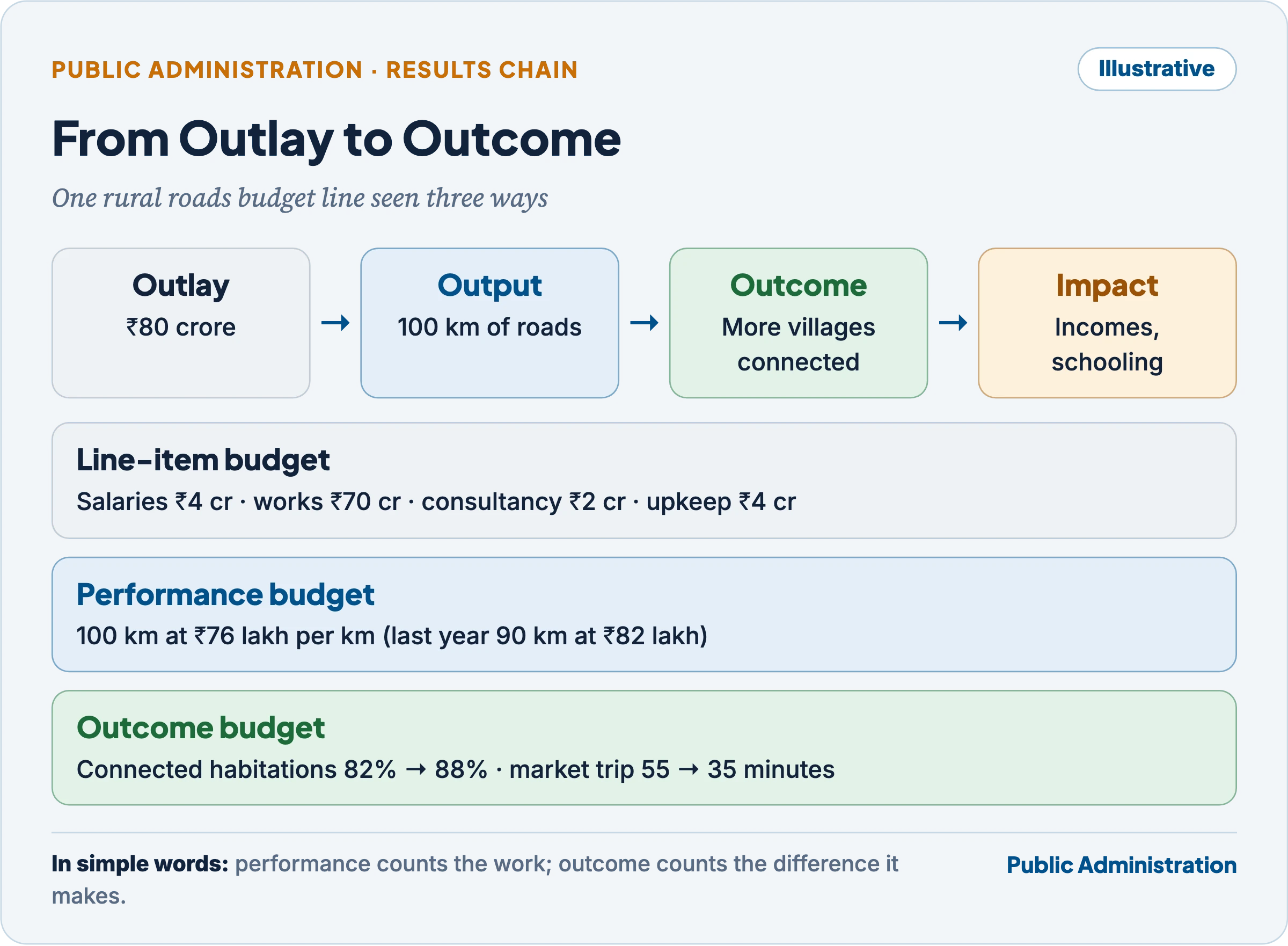
| Term | Meaning | Example (rural roads) |
|---|---|---|
| Outlay | Money provided in the budget | ₹80 crore |
| Activity | What is done with it | Survey, tendering, construction |
| Output | Direct, measurable product | 100 km of all-weather roads |
| Outcome | Change in citizens’ conditions | Share of habitations connected rises; travel time to market falls |
| Impact | Long-term, wider effect | Higher farm incomes, school attendance, access to health care |
10.2 Outcome budgeting in India
- 2005: Finance Minister P. Chidambaram, in the Budget speech for 2005-06, observed that outlays do not necessarily mean outcomes. The first Outcome Budget 2005-06 was presented to Parliament on 25 August 2005, as a consolidated document covering the Plan expenditure of all ministries.
- 2006-07: each ministry presented its own Outcome Budget.
- 2007-08: the Performance Budget and Outcome Budget were merged into a single document for each ministry.
- 2017-18: with the Plan/Non-Plan distinction removed, the outlays, outputs and outcomes of schemes of 68 ministries and departments were presented in a single consolidated document with the Budget, prepared with NITI Aayog. The Development Monitoring and Evaluation Office (DMEO) of NITI Aayog developed the Output-Outcome Monitoring Framework (OOMF) in mid-2017.
- Since 2019: the OOMF for schemes with an annual outlay of ₹500 crore or more is tabled in Parliament alongside the Union Budget each year; smaller schemes’ frameworks are laid by ministries with their Detailed Demands for Grants. Indicators are tracked quarterly or annually on an online OOMF dashboard, and the framework covers roughly 40% of the Union’s expenditure budget. Rule 54 of the General Financial Rules, 2017 makes the output-outcome framework part of ministries’ budget process.
10.3 Performance budget and outcome budget compared, with an example
| Basis | Performance budget | Outcome budget |
|---|---|---|
| Focus | Efficiency: outputs per rupee | Effectiveness: change in citizens’ condition |
| Main measure | Workload, unit cost, physical targets | Outcome indicators with baselines and targets |
| Question | Did we do the work? At what cost? | Did the work make a difference? |
| Monitoring | Annual, after the event | Built in: quarterly targets and dashboards |
| Accountability | Of managers for activities | Of ministries for results |
| Use in allocation | Weak (parallel document) | Intended to inform allocations; still weak |
A budget line in three forms (illustrative numbers): Rural roads programme in a State.
- Line-item form: Salaries ₹4 crore; materials and works ₹70 crore; consultancy ₹2 crore; maintenance ₹4 crore. Total ₹80 crore. (Says nothing about results.)
- Performance form: ₹80 crore for 100 km of new all-weather roads (unit cost ₹76 lakh per km against a norm of ₹80 lakh) plus routine maintenance of 400 km; last year 90 km at ₹82 lakh per km. (Shows work and efficiency.)
- Outcome form: ₹80 crore to raise the share of habitations above 250 people with all-weather access from 82% to 88%; cut average travel time to the nearest market from 55 to 35 minutes; keep 95% of built roads in “good” condition after five years. (Shows what citizens gain.)
10.4 Does outcome budgeting address the weaknesses of performance budgeting?
Where it improves
- It moves the question from work done to difference made, answering the main criticism that performance budgets counted activity, not results.
- It sets baselines, targets and timelines in advance and tracks them through the year, instead of reporting only after the event.
- It is presented with the budget, not months later, and covers all major schemes.
- It strengthens parliamentary and public scrutiny and creates the basis for performance audit and evaluation.
Where weaknesses remain
- Attribution: outcomes depend on many factors (other schemes, States, markets, weather); a ministry cannot fairly be held solely responsible.
- Indicators: many “outcomes” in Indian frameworks are still outputs in disguise; data come late or from administrative sources of doubtful reliability.
- Weak link to allocation: outcome data seldom change the next year’s money, so the incentive to use them is weak.
- Accounting support: without cost and accrual accounting, cost per outcome is hard to compute.
- Federal complication: most outcomes of centrally sponsored schemes are delivered by States, whose own budgets and data systems vary.
10.5 Performance budgeting and performance auditing
- Performance audit (the CAG’s audit of economy, efficiency and effectiveness) asks whether programmes achieved their objectives at reasonable cost. To do so it needs stated objectives, measurable targets, baselines and cost data.
- A systematic performance or outcome budget supplies exactly these, laid before Parliament in advance. Without it, the auditor must first reconstruct what the programme was meant to achieve, and the audited agency can dispute any yardstick.
- The relationship runs both ways: performance audits reveal weak indicators and unreliable data, which improves the next round of outcome budgets. Hence the claim that sound performance auditing is impossible without systematic performance or outcome budgeting. The CAG’s performance audits are discussed in the article on Financial Accountability, Accounts and Audit.
11. Budgeting for Equity, Environment and Participation
In simple words
Some budgets ask not “how much” but “for whom” and “at what cost to the planet”. Gender budgets check whether spending reaches women and girls; green budgets check its effect on climate and nature; participatory budgets let citizens themselves choose some of the projects.
11.1 Gender budgeting
- Meaning. Gender-responsive budgeting is not a separate budget for women. It is the analysis of the whole budget for its different effects on women and men, and the use of that analysis to change allocations, programme design and revenue measures. It is a tool of gender mainstreaming.
- Origin: Australia’s “women’s budget statements” from 1984; South Africa’s Women’s Budget Initiative (1995); promoted after the Beijing Platform for Action (1995).
- India:
- A Gender Budget Statement has been part of the Union Budget since 2005-06; ministries set up Gender Budgeting Cells from the same period.
- The Statement has three parts: Part A (schemes with 100% allocation for women and girls), Part B (30–99%) and, since 2024-25, Part C (below 30%).
- In 2026-27 the Statement reports ₹5.01 lakh crore, about 9.37% of the Union budget (up from ₹4.49 lakh crore and 8.86% in 2025-26), reported by 53 ministries and departments and 5 Union Territories.
- Rethinking beyond allocations. Allocations alone say little: much of Part B is large general schemes (housing, food, rural employment) attributed to women by assumption. A powerful gender budget needs sex-disaggregated data, gender audits of schemes, outcome indicators (women’s labour force participation, safety, health), attention to unpaid care work, gender analysis of taxes, and participation of women in setting priorities (for example through gram sabhas and SHG federations).
- Accountability effect. Gender budgeting has made planning departments answerable for what reaches women: ministries must state their gender allocations, and parliamentary committees and civil society can track them. Its effect is still limited by attribution practices and weak outcome measurement.
11.2 Green and climate budgeting
- Meaning. Green budgeting uses budget tools to show how spending and taxes affect climate and environmental goals: tagging climate-relevant expenditure, environmental impact assessment of budget measures, and green bonds.
- International: the OECD’s Paris Collaborative on Green Budgeting was launched at the One Planet Summit in Paris on 12 December 2017. France published the first “green budget” of a national government in 2020.
- India: Odisha presented a Climate Budget document with its 2020-21 budget, the first by an Indian State; Bihar also published one for 2020-21, and Assam, Meghalaya and Puducherry have followed. At the Union level, India issues sovereign green bonds (from 2022-23) to finance green projects.
11.3 Participatory budgeting
- Meaning. Citizens directly decide or propose how part of a public budget, usually local capital works, will be spent.
- Porto Alegre, 1989: in the Brazilian city, the Workers’ Party administration created neighbourhood and thematic assemblies that set investment priorities, which were then weighted towards poorer districts. The model spread to thousands of cities across the world.
- India:
- Pune: the Municipal Corporation introduced participatory budgeting in 2006-07, under Municipal Commissioner Nitin Kareer, with civil society partners. Citizens propose ward-level works (footpaths, streetlights, drains, toilets) within a fixed allocation per ward; works are limited to small amounts (about ₹5 lakh each in recent years).
- Bengaluru’s citizen budget campaigns and Kerala’s People’s Plan Campaign (1996), which devolved a large share of plan funds to panchayats for locally decided projects, are related experiments.
- Merits: transparency, trust, redistribution towards neglected areas, civic education, reduced corruption.
- Limits: small share of the budget; capture by organised middle-class groups; weak follow-up on implementation; tension with elected councillors who see their role bypassed.
12. After PPBS and ZBB: Budgetary Capacity and New Models
In simple words
After grand techniques like PPBS and ZBB faded, governments stopped looking for one perfect method. They focused instead on the basic ability to control the total, set priorities and run programmes well, using a mix of simpler tools.
12.1 Capacity and incapacity to budget
- Allen Schick, in The Capacity to Budget (1990), argued that the real problem of modern budgeting was not technique but capacity: the ability of the political system to control totals, make allocative choices and run programmes efficiently. In the USA of the 1980s, deficits, entitlement growth and conflict between President and Congress had produced budgetary incapacity: continuous budgeting, missed deadlines, continuing resolutions and shutdowns.
- Budgetary incapacity shows itself in chronic deficits, rising mandatory or committed spending (entitlements, interest, salaries, pensions) that leaves little room for choice, repeated revisions during the year (Caiden and Wildavsky’s repetitive budgeting), and avoidance of hard choices through off-budget devices.
- Schick also described how governments adapted to fiscal stress in the 1980s: by centralising the budget process, imposing top-down ceilings, using multi-year frameworks, and adopting fiscal rules.
12.2 The new models that emerged
| Model | Core idea | Examples |
|---|---|---|
| Top-down / ceiling budgeting | Fix aggregate and sectoral limits first; agencies allocate within them | Sweden (1990s), Netherlands, UK Spending Reviews |
| Fiscal rules and independent fiscal councils | Legal limits on deficits, debt or spending; independent forecasting | EU fiscal rules, UK Office for Budget Responsibility (2010), India’s FRBM Act (2003) |
| Medium-term expenditure frameworks | Rolling three-to-five-year ceilings | Australia, UK; India’s MTEF statement (2012) |
| Performance and results-based budgeting | Output and outcome targets with managerial freedom | New Zealand’s output budgeting (1989 reforms), US GPRA (1993), India’s OOMF (2017) |
| Spending reviews | Periodic in-depth review of baseline spending | UK, Netherlands, OECD countries; India’s scheme rationalisation at the end of each Finance Commission cycle |
| Accrual budgeting | Full costs and liabilities in the budget | New Zealand, Australia, UK |
Programme budgeting, output budgeting and new performance budgeting, and what they share with PPBS
- Programme budgeting: groups spending by programmes serving objectives, across organisational lines.
- Output budgeting: (New Zealand, Australia) appropriates money for outputs that ministers “purchase” from departments, with chief executives accountable for delivery and ministers for outcomes.
- New performance budgeting: (1990s onward) combines performance targets, managerial flexibility and accountability for results.
- Common ground with PPBS: all classify spending by purpose rather than object, use multi-year perspectives, try to link money to results and to objectives, and depend on performance information and analysis. The difference is that the new models are less centralised and less comprehensive: they do not try to rank all programmes analytically at the centre, but give managers freedom and hold them to targets.
13. The Budgetary Process in India: Preparation
In simple words
Preparing the Union budget is like a very large household making its annual plan: every member writes down what they need, the person who manages the money checks and trims each list against what the family can afford, and the head of the family takes the final call on the hard cases.
The budget cycle has four overlapping stages: preparation, enactment, execution and control (accounts and audit). At any moment three budgets are alive: last year’s is being audited, this year’s is being executed, and next year’s is being prepared.
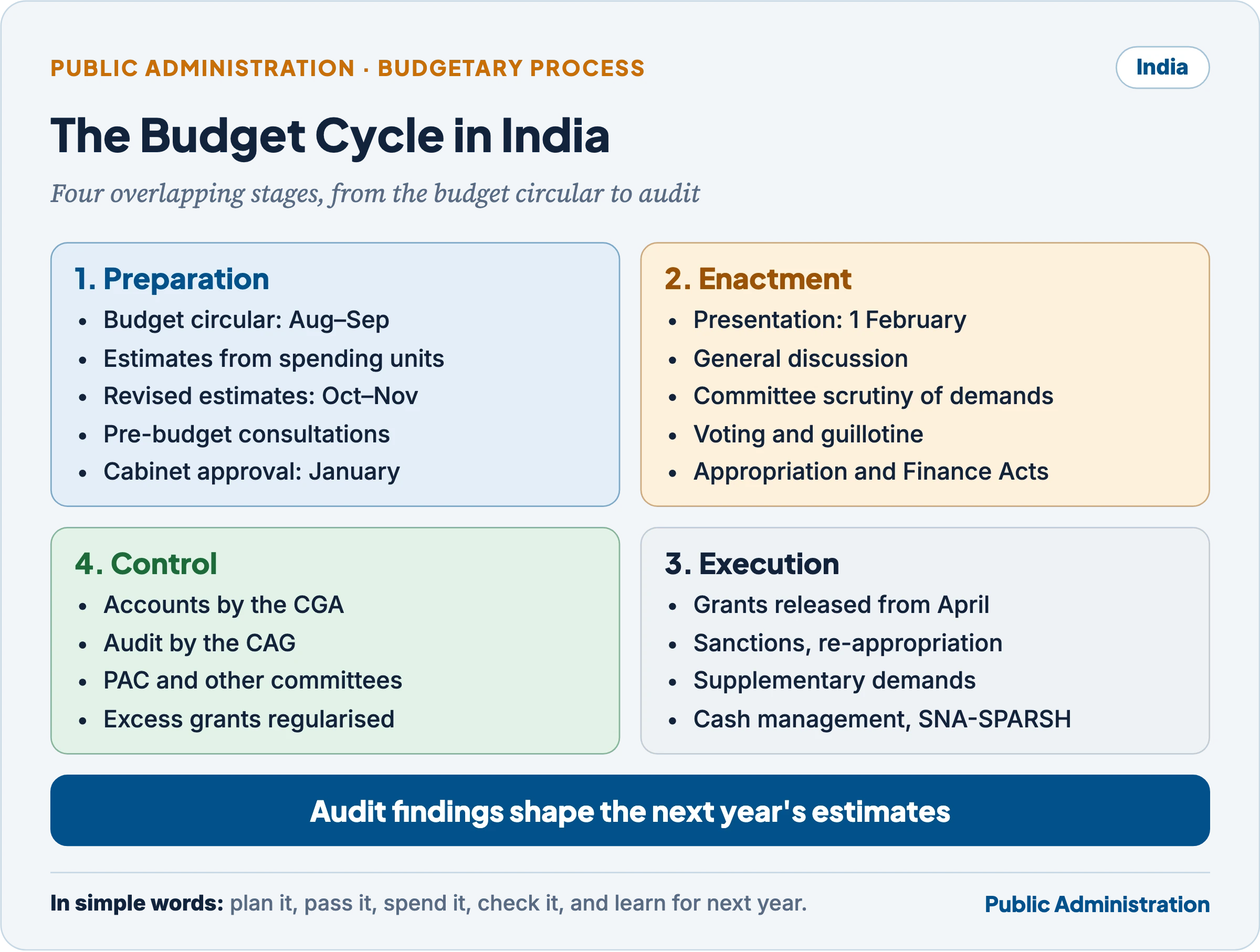
13.1 Constitutional and institutional framework
| Provision | Content |
|---|---|
| Article 112 | Annual Financial Statement laid before both Houses; charged expenditure shown separately |
| Article 113 | Charged expenditure not voted (may be discussed); other expenditure presented as Demands for Grants to the Lok Sabha, which may assent, refuse or reduce them; no demand except on the President’s recommendation |
| Article 114 | Appropriation Bill; no amendment varying the amount or destination of a grant or charged expenditure; no withdrawal from the Consolidated Fund except under appropriation by law |
| Article 115 | Supplementary, additional and excess grants |
| Article 116 | Votes on account, votes of credit and exceptional grants |
| Article 117 | Financial Bills need the President’s recommendation |
| Article 110 | Money Bills; Rajya Sabha can only recommend, within 14 days (Article 109) |
| Article 265 | No tax except by authority of law |
| Articles 266, 267 | Consolidated Fund, Public Account, Contingency Fund |
| Articles 202–207 | Corresponding provisions for the States |
- Consolidated Fund of India: all revenues, loans raised and loan recoveries; all expenditure is from it, and nothing may be withdrawn without appropriation by law.
- Public Account: money the government holds as a banker or trustee (provident funds, small savings, deposits); payments do not need appropriation.
- Contingency Fund of India: an imprest at the President’s disposal for urgent unforeseen expenditure, recouped later after Parliament approves; its corpus was raised from ₹500 crore to ₹30,000 crore by the Finance Act, 2021.
- Charged expenditure: salaries and allowances of the President, presiding officers, judges of the Supreme Court, the CAG; debt charges; court decrees, among others. It is not voted but may be discussed.
Machinery: the Budget Division of the Department of Economic Affairs, Ministry of Finance, prepares the budget; the Department of Expenditure examines expenditure estimates; the Department of Revenue (with the Central Board of Direct Taxes and the Central Board of Indirect Taxes and Customs) prepares revenue estimates and tax proposals; Financial Advisers in each ministry scrutinise departmental estimates; the Controller General of Accounts supplies accounting data; NITI Aayog advises on scheme priorities and outcomes.
13.2 Steps in preparation
- Budget circular (August–September). The Budget Division issues the annual circular with timelines, formats and instructions; ministries enter estimates in the Union Budget Information System online.
- Estimates from below. The principle is that “he who spends the money should prepare the estimates”. Heads of offices prepare estimates, which controlling officers scrutinise and consolidate. Estimates show: actuals of the previous year, the budget estimate and revised estimate of the current year, and the proposed budget estimate for the next year, with reasons for variations. They separate committed expenditure (salaries, continuing schemes) from new expenditure (expansion or new schemes, which need prior appraisal and approval).
- Revised Estimates and pre-budget meetings (October–November). The Expenditure Secretary holds meetings with each ministry to settle the current year’s revised estimates and next year’s allocations within the ceilings.
- Revenue estimates and tax proposals. The Department of Revenue forecasts receipts at existing rates and proposes changes; disinvestment and non-tax receipts are estimated separately.
- Pre-budget consultations (November–December). The Finance Minister meets representatives of industry, trade unions, farmers, economists and State Finance Ministers.
- Finalisation (January). The Finance Minister settles the budget in consultation with the Prime Minister; disputes between the Finance Ministry and spending ministries go to the Prime Minister or the Cabinet. The Cabinet approves the budget shortly before presentation; the President’s recommendation is obtained.
- Economic Survey. Prepared by the Chief Economic Adviser and laid in Parliament before the budget, it reviews the economy and frames the budget’s context.
Scrutiny by the Finance Ministry is least for charged items, light for standing charges, and detailed for new items, which cannot be included without its prior approval. Large new schemes and projects are appraised by the Expenditure Finance Committee or Public Investment Board before inclusion.
14. The Budgetary Process in India: Enactment
In simple words
Once the budget is ready, the government must win Parliament’s permission. The Lok Sabha first debates the overall plan, then examines each ministry’s demand, then passes one law to allow spending and another to allow taxes. Until both are passed, the government cannot legally spend new money or collect new taxes.
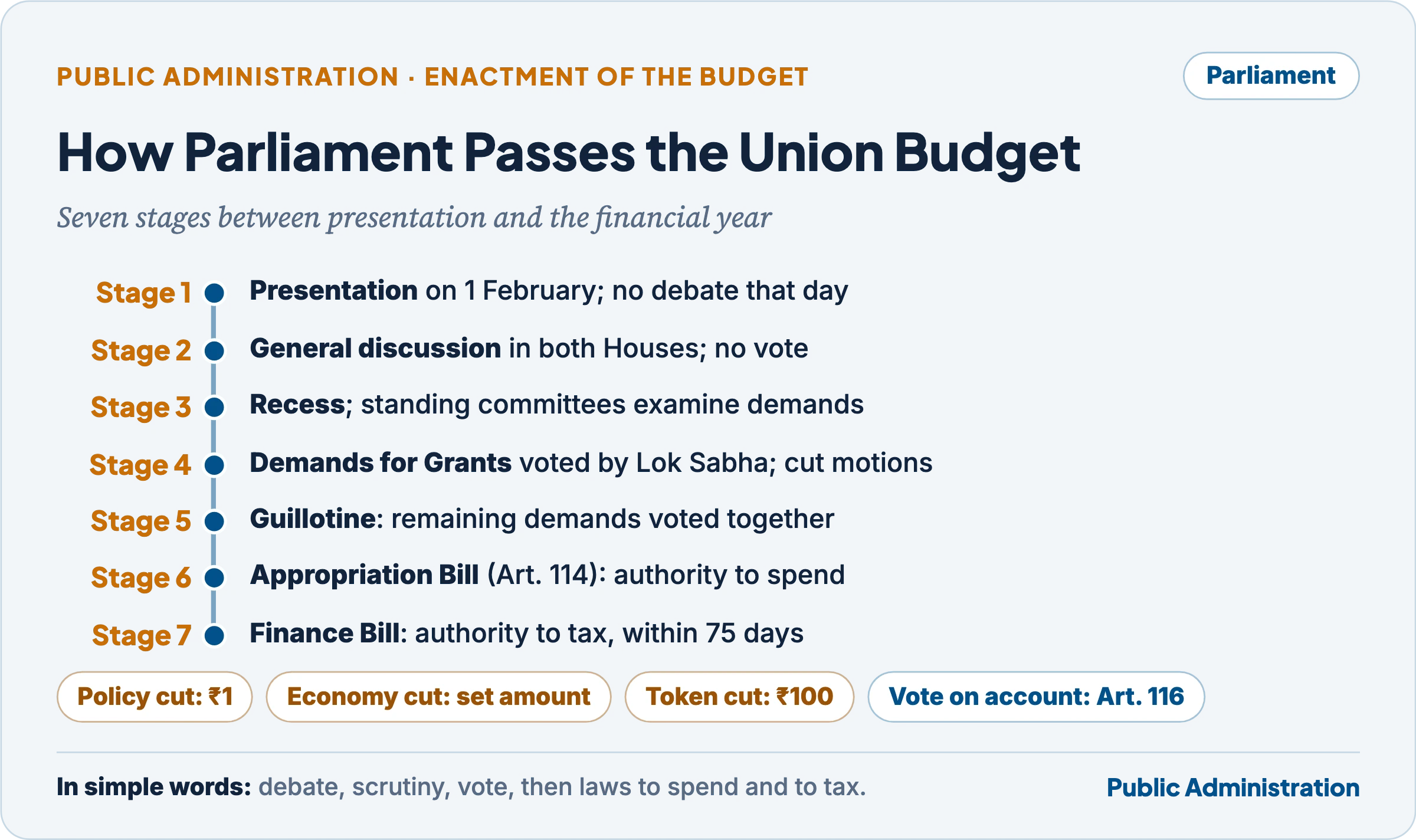
14.1 The stages
- Presentation. Since 2017-18 the Union Budget is presented on 1 February (earlier the last working day of February), so that the whole process is complete before the financial year begins on 1 April. The Finance Minister’s speech has a Part A (economy, expenditure, schemes) and a Part B (tax proposals). No discussion takes place on the day of presentation.
- General discussion in both Houses, on the budget as a whole and its underlying policy. No motion is moved and nothing is voted; the Finance Minister replies at the end.
- Recess and committee scrutiny. The Houses adjourn for about three to four weeks. The Departmentally Related Standing Committees (DRSCs, set up in 1993; now 24, of which 16 are serviced by the Lok Sabha and 8 by the Rajya Sabha) examine the Demands for Grants of their ministries and report. They cannot propose cut motions but may recommend changes.
- Discussion and voting on Demands for Grants (Lok Sabha only). The Business Advisory Committee selects a few ministries for detailed discussion. Members may move cut motions:
- Policy cut: reduce the demand to ₹1, expressing disapproval of the underlying policy.
- Economy cut: reduce it by a specified amount, suggesting economy.
- Token cut: reduce it by ₹100, to ventilate a specific grievance.
Since a cut carried against the government amounts to a loss of confidence, cut motions are instruments of debate, not of change.
- Guillotine. On the last day allotted, the Speaker puts all remaining demands to vote together, whether discussed or not.
- Appropriation Bill (Article 114). It authorises withdrawal from the Consolidated Fund of the sums voted and the charged expenditure. No amendment may vary the amount or destination of any grant. The Rajya Sabha, being unable to amend a Money Bill, returns it, and the Act receives assent.
- Finance Bill. It gives effect to the tax proposals. Under the Provisional Collection of Taxes Act, 1931, new duties declared in the Bill may be collected immediately, but the Bill must be passed within 75 days. Debate on the Finance Bill is wide, on the principle of “no taxation without representation”.
Other grants (Articles 115 and 116)
| Grant | When used |
|---|---|
| Vote on account | Advance grant for part of the year (usually about two months) until the budget is passed; routine before 2017 and now used mainly in election years with an interim budget |
| Supplementary grant | When the sum authorised for a service in the current year proves insufficient |
| Additional grant | For a new service not contemplated in the budget |
| Excess grant | When more than the granted amount has been spent; voted only after the Public Accounts Committee examines it |
| Vote of credit | For an unexpected demand whose magnitude or nature cannot be stated in detail (for example a war) |
| Exceptional grant | For a purpose that forms no part of the current service of any year |
| Token grant | A nominal sum voted to allow a new service to be funded by re-appropriation |
14.2 How effective is parliamentary scrutiny?
Indian Connect — The guillotine and the decline of budget scrutiny
- In the Budget Session of 2023, the proposed expenditure of all ministries (about ₹42–45 lakh crore) was passed without any discussion; the five ministries listed for discussion were never taken up.
- Over the seven years to 2023, on average about 79% of the Union budget was passed without discussion (PRS Legislative Research); in 2018-19 and 2023-24 all Demands for Grants were guillotined.
- The Finance Bill, which in recent years has also carried amendments to non-tax laws, has at times been passed without debate.
Factors that constrain effective scrutiny of budget proposals
- Time: a few weeks for an expenditure of over ₹50 lakh crore; the guillotine passes most demands undiscussed.
- Party discipline and confidence: any cut is treated as a vote of no confidence, so the majority never amends; the opposition uses cut motions only to protest.
- Constitutional limits: Parliament can reduce but not increase or reallocate; charged expenditure is not voted.
- Disruptions of proceedings, which have eaten into budget time.
- Complexity and volume of documents; weak research support for members compared with the US Congressional Budget Office.
- Limited role of DRSCs: short time, non-binding reports, no power over taxes or totals, and reports that seldom reach the floor before the guillotine.
- Ex-post committees: the Estimates Committee and Public Accounts Committee examine spending after the event; the Estimates Committee no longer examines the budget before it is voted.
- Money Bill route: the Rajya Sabha cannot amend; non-financial measures placed in Finance Bills escape fuller scrutiny.
- States: legislatures sit even fewer days; budgets are often passed within days.
Should Parliament scrutinise estimates before they are voted? One view, rooted in the British tradition, holds that in a parliamentary system the government is responsible for the estimates and Parliament’s real control lies in ex-post audit and the PAC, so detailed prior scrutiny is neither necessary nor desirable. The opposite view, which led to the DRSC system in 1993, holds that ex-post control is “crying over spilt milk”; Parliament needs prior examination of policy and allocations, through committees, while leaving the details of estimates to the executive. Proposals to strengthen scrutiny include a Parliamentary Budget Office, longer budget sessions, DRSC reports discussed on the floor before voting, and a pre-budget debate on fiscal strategy.
15. The Budgetary Process in India: Execution
In simple words
After Parliament says yes, the money still has to reach the right place at the right time and be spent on the right things. Execution is the plumbing of the budget: releasing funds, watching how fast they are spent, moving money between heads when needed, and keeping cash in the treasury from sitting idle.
15.1 The machinery
- Distribution of grants: after the Appropriation Act, the Finance Ministry communicates allocations; the controlling officer of each ministry (normally its Secretary) distributes them to drawing and disbursing officers.
- Financial sanction: expenditure needs the sanction of a competent authority under the General Financial Rules, 2017 and the Delegation of Financial Powers Rules.
- Integrated Finance Division: under the Financial Adviser system (established with the departmentalisation of accounts in the mid-1970s), each ministry has an Integrated Finance Division that gives prior concurrence for expenditure beyond delegated powers, monitors spending and advises on schemes.
- Payment and accounts: since the departmentalisation of accounts (1976), ministries make payments through their own Pay and Accounts Offices under Chief Controllers of Accounts, with the Controller General of Accounts at the apex. Revenue collection is supervised by the CBDT and CBIC; the Reserve Bank of India is the government’s banker; authorised banks and treasuries handle receipts and payments.
15.2 Re-appropriation and supplementary demands
- Re-appropriation is the transfer of savings from one unit of appropriation to another within the same grant. It is not allowed between grants, from voted to charged (or the reverse), or to fund a New Service or New Instrument of Service, which needs Parliament’s approval.
- Supplementary demands are presented in batches (usually in the Monsoon and Winter sessions and the Budget session) when needs exceed grants; excess spending is regularised later after PAC scrutiny.
15.3 Cash management and fund flow
- Expenditure planning: ministries prepare monthly and quarterly expenditure plans; spending in the last quarter is capped at about 33%, and in March at 15%, of the budget estimate, to curb the March rush.
- Public Financial Management System (PFMS): developed by the Controller General of Accounts from the Central Plan Scheme Monitoring System (2009), it tracks releases and expenditure down to the last implementing agency, and is the platform for Direct Benefit Transfer payments.
- Single Nodal Agency (SNA) model, 2021: for centrally sponsored schemes, each State designates one SNA per scheme with a single bank account; implementing agencies draw through zero-balance subsidiary accounts; funds are released according to the pace of spending. The model took effect from 1 July 2021.
- SNA-SPARSH, 2023: a just-in-time release system integrating PFMS, State treasury systems and the RBI’s e-Kuber platform, so that Central and State Consolidated Funds are debited only when an actual payment is due; piloted in August 2023 in six States for two schemes, and extended in phases to most centrally sponsored schemes by late 2025. It reduces idle parking of funds and the interest cost of borrowing money that then sits unspent.
- Treasury computerisation: State Integrated Financial Management Information Systems (IFMIS) and e-treasuries have made budget allocation, bill passing, payment and accounting a single online flow, with real-time data for budget planning and cash management.
16. The Budgetary Process in India: Control
In simple words
The last stage asks: was the money spent as Parliament allowed, honestly and well? Accountants record every rupee, the auditor checks the records independently, and a committee of Parliament questions the government on what the auditor found.
- Accounts: the Controller General of Accounts compiles the Union’s accounts; the Appropriation Accounts (spending against each grant) and Finance Accounts (receipts, expenditure, debt) are laid before Parliament.
- Audit: the Comptroller and Auditor General of India (Articles 148–151) audits these accounts and reports to the President, who lays the reports before Parliament. Audit covers regularity (compliance with law and appropriation) and performance (economy, efficiency, effectiveness).
- Parliamentary committees: the Public Accounts Committee examines the Appropriation Accounts and CAG reports, and recommends regularisation of excess grants; the Estimates Committee examines the policy and economy behind estimates; the Committee on Public Undertakings examines public enterprises.
- Internal control: internal audit wings of the Chief Controllers of Accounts and the Integrated Finance Divisions.
These institutions are the subject of the article on Financial Accountability, Accounts and Audit; the Finance Ministry and parliamentary control are taken further in the Paper II articles on Financial Management.
17. Budget Reforms in India since 2016
In simple words
Since 2016 India has changed several old habits of its budget: one budget instead of two, budget day moved up to 1 February, no more “plan” and “non-plan” boxes, outcome targets printed with the money, and funds released only when they are actually needed.
| Reform | Year | What changed | Why |
|---|---|---|---|
| Merger of the Railway Budget with the Union Budget | 2017-18 | A separate Railway Budget, presented since 1924 after the Acworth Committee, ended; railways remain a departmental commercial undertaking with functional autonomy; the dividend liability on capital-at-charge was wiped off | Holistic fiscal picture; less procedure; focus on delivery (the Bibek Debroy committee on railway restructuring, 2015, and a NITI Aayog paper had recommended it) |
| Advancement of budget date to 1 February | 2017-18 | Budget passed before 1 April; no routine vote on account | Ministries can spend from the start of the year and use the working season, including the first quarter before the monsoon |
| Merger of Plan and Non-Plan classification | 2017-18 | Only the revenue–capital distinction remains; SC/ST and North-East earmarking continue | Plan bias had starved maintenance and establishment needs; outlays could not be linked to outcomes (recommended by the Rangarajan committee, 2011) |
| Output-Outcome framework with the budget | 2017-18 | Outputs and outcomes of schemes presented with outlays | Results orientation |
| Disclosure of extra-budgetary resources and ending of off-budget food subsidy borrowing | 2019-20 and 2021-22 | Statements of off-budget borrowings; FCI’s loans from the National Small Savings Fund replaced by budgetary provision | Transparency of the true deficit |
| Single Nodal Agency and SNA-SPARSH | 2021 and 2023 | Just-in-time fund flow for centrally sponsored schemes | Cash management, less float |
| Debt anchor in fiscal policy | 2025-26 onwards | Central government debt-to-GDP target of 50±1% by 2030-31; fiscal deficit as the operating target | Sustainable debt path after the pandemic |
| Rationalisation of schemes with the Finance Commission cycle | ongoing | Schemes appraised and evaluated before continuation in each cycle | Periodic zero-base review in practice |
Merits of merging the Railway Budget: a single, comprehensive statement of the Union’s finances (the unity principle); the end of the railways’ dividend burden; rail capital expenditure placed within overall fiscal priorities; parliamentary time saved; railway decisions freed from the populist annual announcement of new trains and projects. Concerns: loss of a separate occasion for scrutiny of a huge undertaking, and possible dilution of railway autonomy.
Did the merger of the Plan and Non-Plan heads end planning in the budget? No. It ended an accounting classification, not planning. The distinction had linked “Plan” to the Planning Commission’s annual plans, which ended when NITI Aayog replaced the Commission in 2015. Since 2017-18 expenditure is classified as revenue or capital, and schemes are grouped as Central Sector or Centrally Sponsored, with outputs and outcomes. Earmarking for Scheduled Castes, Scheduled Tribes and the North-East continues.
18. Budgeting in the UK and the USA
In simple words
Britain and America both budget democratically, but in opposite styles. In Britain the government’s budget almost always passes as presented, because the government controls the House. In America the President only proposes; Congress writes the spending laws itself, and deadlock can shut the government down.
| Basis | India | United Kingdom | United States |
|---|---|---|---|
| System | Parliamentary, executive budget | Parliamentary, executive budget (model for India) | Presidential, separation of powers |
| Who prepares | Finance Ministry | HM Treasury; Chancellor of the Exchequer presents the Budget | Office of Management and Budget (1970; earlier Bureau of the Budget, 1921) prepares the President’s budget |
| Multi-year frame | Annual votes; three-year FRBM targets | Spending Reviews set multi-year departmental limits; annual Estimates voted | Annual appropriations; ten-year projections by the Congressional Budget Office |
| Legislature’s role | Lok Sabha votes demands; cannot increase | Commons votes Estimates (Supply and Appropriation Acts); rarely amends | Congress passes a budget resolution and about 12 appropriation bills; it can add, cut and rewrite |
| Independent fiscal body | None at the Union (no parliamentary budget office) | Office for Budget Responsibility (2010) produces official forecasts | Congressional Budget Office (1974) |
| Financial year | 1 April–31 March | 1 April–31 March | 1 October–30 September |
| If not passed in time | Vote on account | Votes on account for Estimates | Continuing resolutions; if none, a shutdown |
| Audit | CAG (constitutional) | Comptroller and Auditor General and National Audit Office, reporting to the PAC | Government Accountability Office (legislative agency) |
- US features: the Budget and Accounting Act, 1921 created the executive budget; the Congressional Budget and Impoundment Control Act, 1974 created the budget committees and the CBO, and limited the President’s power to withhold appropriated funds. The Supreme Court struck down the statutory line-item veto in Clinton v. City of New York (1998). From 1 October to 12 November 2025, the federal government underwent its longest shutdown (43 days) when appropriations for fiscal year 2026 lapsed. This illustrates Wildavsky’s “new politics” of dissensus.
- UK features: the Treasury’s control over departmental spending is strong; Parliament’s formal role over Estimates is limited, but the Public Accounts Committee and the National Audit Office are powerful; independent forecasts by the OBR are a check on optimistic budgets.
- Lesson for India: India shares the UK’s executive dominance and weak legislative amendment, without the UK’s multi-year spending reviews or independent fiscal council. Proposals for a fiscal council (recommended by the Fourteenth and Fifteenth Finance Commissions and the N.K. Singh FRBM Review Committee, 2017) and a parliamentary budget office draw on both models.
Criticism — The case against rational budgeting reforms
- Wildavsky: comprehensive techniques (PPBS, ZBB) assume agreement on goals and unlimited capacity to calculate; neither exists in a pluralist democracy.
- Paperwork and overload: PPBS and ZBB produced mountains of documents that decision-makers did not read.
- Capture of the base: ZBB’s minimum packages protected 75–90% of existing budgets; outcome budgets often relabel outputs as outcomes.
- Measurement problems: performance and outcome budgets measure what is countable, distorting priorities in services whose results are long-term or intangible.
- Weak incentives: managers gain nothing from honest performance data; ministries fear cuts if they reveal savings.
- Indian experience: performance budgets stayed parallel documents; ZBB faded after 1986-87; outcome data still seldom drive allocations.
Defence — The case for continued budget reform
- Lasting legacies: each reform left something permanent: programme classification, multi-year costing, decision packages, output and outcome indicators, project appraisal.
- Accountability: results information strengthens Parliament, audit, the media and citizens, even when it does not change allocations directly.
- Fiscal stress: debt, ageing and climate pressures make periodic review of the base unavoidable; spending reviews and scheme rationalisation are ZBB in practical form.
- Synthesis is possible: politics sets totals and priorities; analysis informs choices at the margin. Top-down ceilings plus outcome frameworks plus evaluation is that synthesis.
- Technology: PFMS, dashboards and just-in-time releases make performance tracking cheaper than in the paper era of PPBS.
Key Terms
| Term | Meaning in simple words |
|---|---|
| Annual Financial Statement | The constitutional name (Article 112) for the statement of estimated receipts and expenditure |
| Demands for Grants | Ministry-wise requests for voted expenditure, voted by the Lok Sabha (Article 113) |
| Charged expenditure | Expenditure on the Consolidated Fund that Parliament may discuss but not vote on |
| Appropriation Bill | The law authorising withdrawal of voted and charged sums from the Consolidated Fund (Article 114) |
| Finance Bill | The bill giving effect to the year’s tax proposals |
| Vote on account | Advance grant for part of the year until the full budget is passed (Article 116) |
| Guillotine | Putting all undiscussed demands to vote together on the last allotted day |
| Cut motion | Motion to reduce a demand: policy cut (to ₹1), economy cut (specified amount), token cut (₹100) |
| Re-appropriation | Shifting savings from one head to another within the same grant |
| Line-item budget | Budget by objects of expenditure (inputs), oriented to control |
| Performance budget | Budget by functions, programmes and activities, linking money to work done and unit cost |
| PPBS | Planning-programming-budgeting system: multi-year programme budgeting with cost–benefit comparison of alternatives |
| Zero-based budgeting | Every activity justified afresh each year through ranked decision packages |
| Decision package | ZBB document describing an activity at alternative funding levels, with costs, benefits and consequences of not funding |
| Sunset law | A law under which an agency or programme ends on a fixed date unless renewed after review |
| Target-based budgeting | Top-down budgeting in which the chief executive fixes spending limits for agencies |
| Outlay, output, outcome | Money provided; direct product of activity; change in citizens’ conditions |
| Outcome budget | Budget that sets outcome targets and reports on them alongside outlays |
| OOMF | Output-Outcome Monitoring Framework of NITI Aayog’s DMEO, laid with the budget since 2019 |
| Incrementalism | Budgeting by small changes to last year’s base |
| Gender budgeting | Analysis and adjustment of the whole budget for its effects on women and men |
| Green budgeting | Tagging and assessing budget measures for their climate and environmental effects |
| Participatory budgeting | Citizens deciding or proposing part of a public budget |
| MTEF | Medium-term expenditure framework: rolling multi-year expenditure ceilings |
| SNA-SPARSH | Just-in-time release of centrally sponsored scheme funds through PFMS, State treasuries and RBI’s e-Kuber |
Commissions, Committees and Judgments
| Body or case | Year | Key point |
|---|---|---|
| Budget and Accounting Act (USA) | 1921 | Executive budget; Bureau of the Budget; General Accounting Office |
| First Hoover Commission (chair: Herbert Hoover) | 1949 | Coined “performance budget”; budget by functions and activities |
| Estimates Committee, 20th and 73rd Reports | late 1950s; 1960 | Recommended a performance-cum-programme budget for development activities |
| Administrative Reforms Commission, Report on Finance, Accounts and Audit | 1968 | Performance budgeting in development departments; separation of accounts from audit |
| Congressional Budget and Impoundment Control Act (USA) | 1974 | Budget committees, CBO, limits on impoundment |
| Twelfth Finance Commission | 2004 | Recommended accrual accounting |
| FRBM Act (amended 2012, 2018) | 2003 | Fiscal targets; Medium-term Fiscal Policy Statement; MTEF statement from 2012 |
| Second ARC, 14th Report, Strengthening Financial Management Systems | 2009 | Outcome budgeting, accrual accounting, stronger parliamentary scrutiny |
| C. Rangarajan High Level Expert Committee on Efficient Management of Public Expenditure | 2011 | Remove Plan/Non-Plan distinction; multi-year budgeting |
| Expenditure Management Commission (chair: Bimal Jalan) | 2014 | Reviewed expenditure management and fiscal framework |
| Committee on restructuring of Railways (chair: Bibek Debroy) | 2015 | Recommended phasing out a separate Railway Budget |
| FRBM Review Committee (chair: N.K. Singh) | 2017 | Debt as the anchor; fiscal council |
| Clinton v. City of New York (US Supreme Court) | 1998 | Statutory line-item veto struck down |
| Sixteenth Finance Commission (chair: Arvind Panagariya) | report 2025 | Vertical devolution kept at 41%; report laid with Budget 2026-27 |
Contemporary Developments
- Budget 2026-27 (1 February 2026): total expenditure estimated at ₹53.5 lakh crore; fiscal deficit 4.3% of GDP, down from 4.4% in 2025-26 (RE); Union debt estimated at 55.6% of GDP, on a path to 50±1% by 2030-31, the new debt anchor of fiscal policy. The new Income-tax Act, 2025 takes effect from April 2026.
- Sixteenth Finance Commission (report submitted 17 November 2025): laid with the Budget 2026-27; the government accepted the vertical devolution of 41% and provided about ₹1.4 lakh crore of Finance Commission grants for 2026-27.
- Gender Budget Statement 2026-27: ₹5.01 lakh crore, 9.37% of the Union budget, reported by a record 53 ministries and departments (February 2026).
- SNA-SPARSH rollout: after the August 2023 pilot, centrally sponsored schemes were brought onto just-in-time release in phases (May 2024, June 2025, November 2025); 50 of 81 notified schemes had been onboarded by December 2025.
- OOMF institutionalised: NITI Aayog’s DMEO published a review of the framework’s journey (2026); the framework is laid with every Union Budget and covers about 40% of Union expenditure.
- US shutdown (1 October–12 November 2025): the longest in US history, 43 days, after fiscal year 2026 appropriations lapsed.
- Climate budgeting in States: Odisha, Bihar, Assam, Meghalaya and Puducherry now publish climate or green budgets; Odisha announced work on a carbon budget in 2024.
Revision Grid
| Thinker / body | Work or report (year) | Key idea |
|---|---|---|
| V.O. Key | “The Lack of a Budgetary Theory” (1940) | Why X to A rather than B? Budgeting lacks a theory of choice |
| Verne Lewis | “Toward a Theory of Budgeting” (1952) | Relative value, incremental analysis, alternative budgets |
| Jesse Burkhead | Government Budgeting (1956) | Budget as vehicle of fiscal policy and tool of management |
| Richard Musgrave | The Theory of Public Finance (1959) | Allocation, distribution, stabilisation |
| Aaron Wildavsky | The Politics of the Budgetary Process (1964) | Incrementalism, base, fair share, aids to calculation; budget as politics |
| Aaron Wildavsky | “Political Implications of Budgetary Reform” (1961) | Budget reform is political reform |
| Aaron Wildavsky | How to Limit Government Spending (1980); The New Politics of the Budgetary Process (1988) | Change political rules (spending limits); dissensus |
| Caiden and Wildavsky | Planning and Budgeting in Poor Countries (1974) | Repetitive budgeting under poverty and uncertainty |
| Allen Schick | “The Road to PPB” (1966) | Control, management, planning orientations |
| Allen Schick | The Capacity to Budget (1990) | Budgetary capacity and incapacity |
| William Niskanen | Bureaucracy and Representative Government (1971) | Budget-maximising bureaucrat |
| Patrick Dunleavy | Democracy, Bureaucracy and Public Choice (1991) | Bureau-shaping model |
| Hoover Commission | Report (1949) | Performance budgeting |
| Robert McNamara | US Defense Department (1961); federal PPBS (1965–1971) | Planning-programming-budgeting system |
| Peter Pyhrr | Texas Instruments (1969); Zero-Base Budgeting (1973) | Decision units, decision packages, ranking |
| Jimmy Carter | Georgia (FY 1973); federal (FY 1979) | ZBB in government |
| Peter Drucker | The Practice of Management (1954) | Management by objectives |
| P. Chidambaram | Outcome Budget (2005) | Outlays are not outcomes |
| NITI Aayog DMEO | OOMF (2017; with budget since 2019) | Output and outcome indicators with the budget |
Previous Year Questions
- 2023“Zero-based budgeting (ZBB) is based on programme efficiency rather than budget history.” In the light of this, examine the advantages of ZBB over traditional budget.
- 2022‘Outcome budgeting addresses the weaknesses of performance budgeting.’ Elaborate.
- 2022A sound budgeting system is one which engenders trust among citizens that the government is listening to their concerns. Elaborate this in the context of budgetary governance.
- 2021Zero-based budgeting was intended to get away from incrementalism, but ended up being the most incremental of any budgetary approach. Discuss.
- 2021Emphasis on cost control and reducing public expenditure has diverted the focus of government budgets from the basic objectives of reallocation of resources, bringing economic stability and promoting social equity. Examine.
- 2020“Objectives of performance budgeting include improving expenditure prioritization, effectiveness and efficiency.” Has performance budgeting worked effectively in governmental system? Argue.
- 2019Is William Niskanen’s “Budget Maximising Model” relevant today? Argue.
- 2018“Sound Performance Auditing is impossible without systematic Performance or Outcome Budgeting.” Explain the relationship between the two.
- 2017“Budgeting is a political process” – (Aaron Wildavsky)
- 2017“There can be no performance auditing without performance budgeting “.
- 2016“The key to understanding performance-based budgeting lies beneath the word ‘result’.” In the light of the statement, examine the elements of performance-based budgeting.
- 2016“Bureau-Shaping Model has been developed as a response to the Budget-Maximizing Model.” Comment.
- 2015“No significant change can be made in the budgetary process without affecting the political process.” (Wildavsky). Analyse.
- 2014“Instead of reforms to budgetary process Wildavsky proposes to redefine the role of political institutions and rules by which politics leads to agreement on budget.” Explain.
- 2014Identify the main elements of program budgeting, output budgeting and new performance budgeting. What do they have in common with PPBS?
- 2013What new models of budgetary capacity and incapacity have emerged after the decline of Planning Programming Budgeting and Zero-based Budgeting?
- 2013Budget allocation involves series of tensions between actors with different backgrounds, orientations and interests and between short-term goals and long-term institutional requirements. Discuss.
- 2012‘Those who budget, deal with their overwhelming burdens by adopting heuristic aids to calculation’ (Wildavsky). Explain.
- 2011An administrator uses the budget as a framework for communication and co-ordination, as well as for exercising administrative discipline throughout the administrative structure. Explain.
- 2011‘Budget is a series of goals with price-tags attached.’ Explain.
- 2010Distinguish between PPBS and performance budgeting.
- 2008“Good economics and bad politics cannot coexist a sound budgetary process.” Discuss this statement in the context of the developmental challenges in countries experiencing competitive politics.
- 2007What is performance budgeting? Bring out its merits, limitations and difficulties.
- 2006“Successfully implementing budgeting approach requires favourable incentive structures.” Discuss.
- 2005Why does the issue of budgeting as politics versus budgeting as analysis remain important in the budgeting process? Do you agree that some synthesis of the two positions seems possible? Illustrate.
- 2005“The budget is an instrument of coordination.” Explain.
- 2002Examine the government budget as an instrument of public policy and a tool of legislative control.
- 2001Burekehead says: ‘Budget in Government is a vehicle of fiscal policy and a tool of management.’ Examine this statement.
- 2000Give reasons for the failure of Government of India to introduce the performance programme budgetary technique in Union Ministries. What type of budgetary system is being currently practiced in India and why?
- 2000Write short note on Budget as an instrument of socio-economic transformation.
- 1998“Budget is a tool which serves many purposes.” Comment.
- 1996“Budgeting and fiscal administration require the public administrator to resolve a variety of operational, managerial and strategic issues.” Examine.
- 1995Program budgeting is often considered interchangeable with performance budgeting, but there is a significant difference, at least in theory. Comment.
- 1994Examine the view that during the last two decades Programming, Planning and Budgeting system and even Zero Base Budgeting have been driven out by political dissensions.
- 1993Explain the principle involved in the preparation of budget. Assess the scope of budgetary techniques in financial management.
- 1992What is performance budgeting? Do you agree with the statement that it is a tool of business management?
- 1992‘Financial administration is a vital institution for economic and social in a poor country.’ Comment.
- 1990‘…….. budget office needs accountants, statisticians and procedure analysis; it must provide a working climate in which these specialist skills are applied in a general context.’ Comment.
- 1989Give reasons for the failures on the part of bureaucracy and the legislature to supervise the enactment of the budgetary provisions.
- 1988“In so far as budgeting is successful or otherwise, if depends not only on its internal workings but upon the environment in which it operates.” Explain.
- 1987Explain Performance Budgeting and illustrate its need and utility in development administration.
- 2025The ‘guillotine’ hastens the budgetary process to meet the timeline. Evaluate the procedure.
- 2025Budget is the pivot around which the whole financial administration revolves. Discuss the socio-economic and political implications of budget.
- 2023Computerization of treasuries has revolutionized the accounting and budget planning process, Comment.
- 2021Budget proposals in the Parliament/ State Legislatures fail to ensure their effective scrutiny. Identify the factors which constrain effective scrutiny of the budget proposals.
- 2020Budget is an indicator of financial health of a polity which is reflected in the statement of income and expenditure. Discuss.
- 2018“Gender budgeting requires rethinking beyond allocations to become a powerful tool of gender mainstreaming.” Discuss.
- 2016What merits do you foresee in the proposed merger of the Railway Budget with the General Budget?
- 2015Explain how budget can be used as a political instrument.
- 2014“Gender responsive budgeting has infused greater accountability of planning departments towards women empowerment programs.” Examine the statement.
- 2013“Performance budgeting failed because it was applied to sectors/programmes where quantitative evaluation was not feasible.” Examine the principles underlying performance budgeting techniques.
- 2012What is an output-based performance budgeting system? Analyse this system in the context of India.
- 2008‘The Budget is more than the economic horoscope of the nation.’ Comment.
- 2001“The policy of the government is reflected by various items of the budget.” Explain by distinguishing between a commercial budget and a government budget.
- 1990‘Whereas the control over expenditure, as well as on actual expenditure, incurred after the accounts are closed and audited, is essential, it appears to be neither necessary nor desirable to scrutinise the estimate before their inclusion in the budget in a parliamentary system of government.’ Comment.