

Concept of development; Changing profile of development administration; ‘Anti-development thesis’; Bureaucracy and development; Strong state versus the market debate; Impact of liberalisation on administration in developing countries; Women and development – the self-help group movement.
This article: Bureaucracy and development; Strong state versus the market debate; Impact of liberalisation on administration in developing countries
Official Syllabus: Paper I · Unit 1-08 Development Dynamics
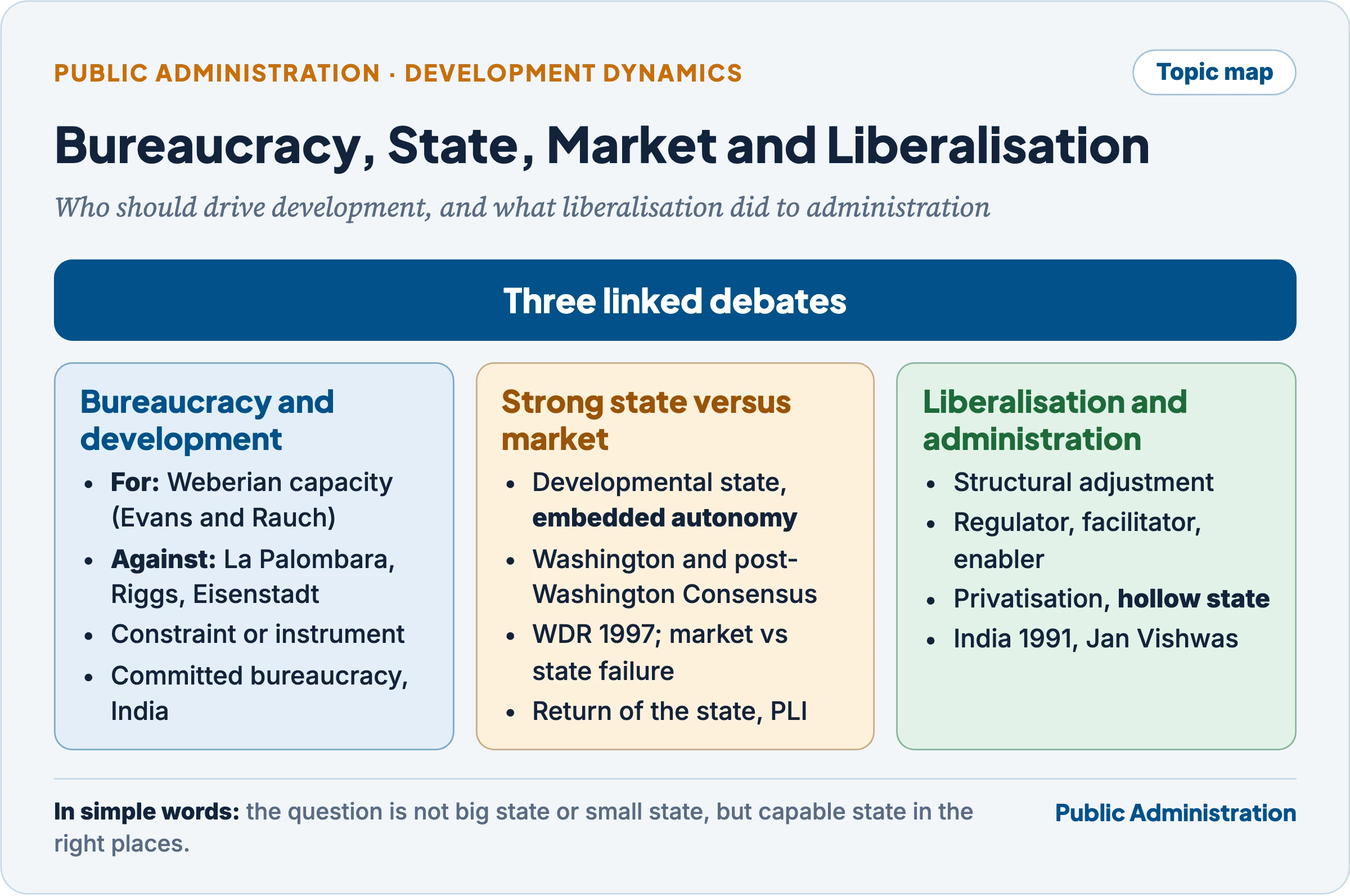
Every developing country has had to answer three linked questions. Can the bureaucracy it inherited carry out development? Should the state or the market lead the economy? And what happens to administration when a country liberalises? The answers have swung over seventy years: from bureaucracy-led planning in the 1950s, to “roll back the state” in the 1980s, to today’s search for a capable state that works with markets. These three debates decide what kind of administration a developing country builds, which is why they sit together here.
In simple words
Think of a family deciding how to run a small farm. One cousin says the eldest uncle should decide everything; another says each person should sell to whoever pays most. The farm does best when the uncle is honest and skilled, the buyers compete, and someone keeps the accounts straight. Countries face the same choice between a strong planner (the state), free buyers and sellers (the market) and good management (the bureaucracy).
The concept of development, the changing profile of development administration and the anti-development thesis are covered in the companion article on the concept of development and development administration. Women and development and the self-help group movement are covered in the third article of this unit. This article assumes those basics in a line or two where needed.
1. Bureaucracy and Development: Why the Question Arises
In simple words
After independence, new countries had few businesses, few strong political parties and many poor people. The one organised body they had was the civil service left by the colonial rulers. So the obvious question was whether this old machine could be used to build a new nation.
- The inherited machine. Most post-colonial states received a centralised, hierarchical civil service built for two jobs: law and order and revenue collection. In India this was the Indian Civil Service, the “steel frame”.
- Development needs different things: speed, innovation, field-level discretion, people’s participation and results, not only rule-compliance.
- So the core question was whether a regulatory bureaucracy (one that enforces rules) could become a developmental bureaucracy (one that brings about planned change).
- Bureaucracy-led development, 1950s–1970s. In the “golden age” of development, foreign aid, planning and industrialisation were run top-down by bureaucracies. Western administrative structures were transplanted, and the trickle-down theory (that growth at the top would spread benefits downward) was assumed.
- Weber’s ideal type as the yardstick. Max Weber, the German sociologist, described the ideal type of bureaucracy in Economy and Society (published 1922): hierarchy, written rules, merit-based career officials, impersonality and specialisation. Weber saw it as the most efficient form of organisation, a “precision instrument”.
- The paradox is that Weber’s model was designed for predictability and stability, while development demands change. Hence two schools: one that says bureaucracy is the instrument of development, and one that says it is a constraint.
- Two meanings of “bureaucracy and development”. The phrase covers two different relationships, which Riggs called the “chicken and egg” link.
- Administration of development: bureaucracy as the agent that runs development programmes.
- Development of administration (administrative development): improving the bureaucracy itself, its skills, structure and values, so that it can do the first job.
Common confusion
Is “bureaucracy and development” the same as “development administration”? No. Development administration is the broader field: administration geared to planned socio-economic change, whoever carries it out. “Bureaucracy and development” is one question inside it: whether the permanent civil service in particular helps or hinders that change. A country can practise development administration through panchayats, cooperatives, NGOs and self-help groups as well as through the bureaucracy.
2. The Case for Bureaucracy as an Instrument of Development
In simple words
A country cannot vaccinate every child, build roads in every district or run elections without a large, trained, organised body of officials. Studies across many countries show that where officials are hired on merit and have secure careers, economies tend to grow faster.
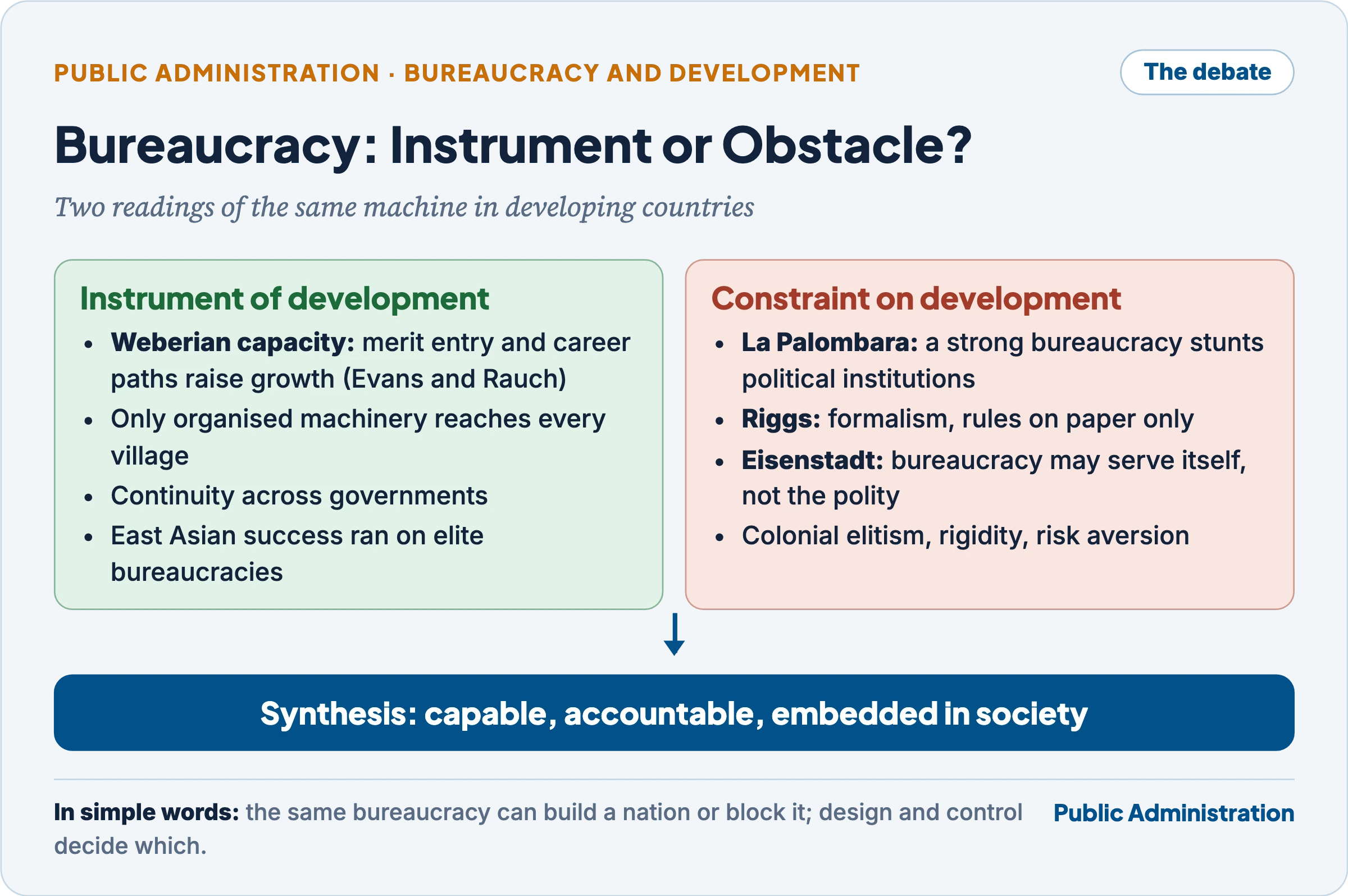
Weberian capacity: the Evans and Rauch evidence
- The study. Peter Evans and James Rauch, American sociologist and economist, published “Bureaucracy and Growth: A Cross-National Analysis of the Effects of ‘Weberian’ State Structures on Economic Growth” in the American Sociological Review (1999).
- They built a “Weberianness” scale for core economic agencies in 35 developing countries (1970–1990), rating two features: meritocratic recruitment (entry by examination or qualifications) and predictable, rewarding long-term careers (internal promotion, competitive pay, security).
- Finding: countries with more Weberian bureaucracies had significantly higher growth, even after controlling for initial income and education.
- Why it works. Merit entry brings competence; a long career gives officials a stake in the organisation’s reputation and a time horizon longer than one election, which reduces corruption and short-termism. Shared training builds an esprit de corps that resists capture by private interests.
- What it means. The problem in many poor countries is not too much bureaucracy but too little real bureaucracy: patronage appointments and personal rule pass themselves off as bureaucracy. This is the opposite of the 1980s view that bureaucracy itself was the disease.
Other arguments in favour
- Reach and continuity. Only the bureaucracy has a presence down to the block and village; it gives continuity across changing governments and coalitions.
- Expertise and memory. It holds technical knowledge, data and institutional memory that politicians and private actors lack.
- Neutral delivery. In a diverse society, a rule-bound bureaucracy can deliver services impartially across caste, religion and region.
- Crisis management. Bureaucracies have proved effective in emergencies: elections, famine relief, disasters, the Covid-19 vaccination drive.
- The East Asian evidence. Japan’s Ministry of International Trade and Industry, South Korea’s Economic Planning Board and Singapore’s elite service show that a highly capable, merit-based bureaucracy can steer rapid industrialisation (Section 5).
- Reformable, not disposable. Defenders argue that what is needed is a developmental bureaucracy, made through training, motivation, new structures and accountability, not the abolition of bureaucracy. George Grant described development administration as marked by its purposes, loyalties and attitudes: purposes of social and economic progress, loyalty to the public, and outward-reaching, positive, innovative attitudes.
Indian Connect — Bureaucracy as an instrument in India
- Green Revolution (late 1960s): extension officers, seed corporations and the Food Corporation of India (1965) carried new varieties and procurement to farmers.
- Elections: the Election Commission runs the world’s largest elections through deputed civil servants; the 2024 Lok Sabha election had over 96 crore registered electors.
- Digital delivery: Aadhaar, Direct Benefit Transfer and Jan Dhan accounts were built and run by public agencies.
- Aspirational Districts Programme (2018): district collectors are ranked on health, education, agriculture and infrastructure indicators, using the bureaucracy’s field reach with data-driven competition.
- Covid-19: CoWIN and the district machinery delivered over 220 crore vaccine doses.
3. The Case Against: Bureaucracy as a Constraint
In simple words
A strong, educated civil service in a poor country can also become a ruling class of its own. It may follow rules on paper while real decisions are made through connections, and it may care more about its own power and comfort than about the people.
Joseph La Palombara: imbalance between bureaucracy and politics
- Who and where. Joseph La Palombara, American political scientist, edited Bureaucracy and Political Development (1963), the Social Science Research Council volume that set this debate.
- The argument. In new states the bureaucracy is far stronger than parties, legislatures, interest groups and local bodies. A powerful bureaucracy in a weak political system tends to fill the vacuum, take over policy-making and stunt the growth of democratic institutions.
- He warned that aid aimed at strengthening bureaucracies alone could delay political development.
- His prescription was balanced growth: develop political institutions alongside the bureaucracy, so that the bureaucracy is controlled and politics stays responsible.
- Why it holds. Military and bureaucratic regimes in Pakistan, Indonesia and parts of Africa and Latin America in the 1960s–1980s fit his warning closely.
Fred Riggs: formalism and the balanced thesis
- Formalism. Fred W. Riggs, in Administration in Developing Countries: The Theory of Prismatic Society (1964), described the prismatic society, in which modern structures exist alongside old practices. Its sala administration shows formalism: a gap between formal rules and actual behaviour. Laws, plans and procedures exist on paper but are not enforced as written.
- Development plans therefore look impressive but fail at implementation; officials follow the letter of procedure while outcomes are decided by kinship, caste or bribes.
- Bureaucratic polity. In Thailand: The Modernization of a Bureaucratic Polity (1966), Riggs showed a state where officials themselves dominate politics, with no strong outside check.
- The balanced thesis. Riggs argued that when the bureaucracy grows faster than the “constitutive system” (legislature, parties, courts, elections), it becomes more powerful and less efficient: free of control, it pursues its own interest. Effective development needs balanced growth of bureaucracy and political institutions. (The full Riggsian models are in the article on Riggsian models.)
S.N. Eisenstadt: bureaucracy serving itself
- Who. S.N. Eisenstadt, Israeli sociologist, in The Political Systems of Empires (1963) and in his essay in La Palombara’s volume, studied how bureaucracies behave in historical empires and new nations.
- The argument. A bureaucracy can take three orientations:
- Service orientation to the rulers and to the public (developmental);
- Total subservience to the rulers (a mere tool);
- Self-orientation, pursuing its own power, status and privileges, becoming a group “for itself”.
- For new states he warned that bureaucracies, given scarce resources and weak political control, drift towards self-orientation and debureaucratisation (rules bent by outside social pressure), both bad for development.
Other critics and lines of attack
- Colonial elitism. Civil services in Asia and Africa inherited the colonial idea of a privileged elite, urban, English-educated and socially distant from the rural poor. Their social status makes them resist change and treat citizens as subjects, the mai-baap (parent-figure) attitude.
- Ferrel Heady, American comparativist, in Public Administration: A Comparative Perspective (1966), noted that developing-country bureaucracies combine imitative structures, scarce skilled personnel, emphasis on non-production goals (status, security), formalism and operational autonomy from political control.
- Rigidity and the end-of-bureaucracy thesis. Tom Burns and G.M. Stalker, in The Management of Innovation (1961), showed that mechanistic (rule-bound) organisations suit stable settings, while organic (flexible, lateral, participatory) ones suit changing settings. Warren Bennis, in “The Coming Death of Bureaucracy” (1966) and Changing Organizations (1966), predicted that bureaucracy would be replaced by adaptive, temporary systems of diverse specialists linked by coordinating executives: an “organic-adaptive” structure, an early form of the adhocracy idea. Development, being a changing setting, needs the organic form.
- Strength of the thesis: project teams, task forces, missions and network organisations have spread.
- Limits: Weberian hierarchy has not died; large states still need rules, records and accountability chains. Temporary systems can be unaccountable, and in low-capacity states removing rules can increase discretion and corruption.
- Public choice critics. William Niskanen, Bureaucracy and Representative Government (1971), argued that bureaucrats act like rational utility-maximisers who seek to maximise their budgets, producing oversupply and waste. Patrick Dunleavy, Democracy, Bureaucracy and Public Choice (1991), answered with the bureau-shaping model: senior officials care less about budget size than about work quality (staff functions, policy work, central location, prestige), so they reshape bureaus, hiving off routine delivery to agencies and contractors. Bureau-shaping thus explains why officials supported agencification and contracting in the 1980s–1990s, which budget maximisation cannot.
- Displacement of goals. Robert Merton (1940) noted that rules become ends in themselves, the trained incapacity of officials; in development work this means vouchers and utilisation certificates matter more than outcomes.
- Elite capture and the iron triangle. Politicians, officials and local elites can capture development funds and divert subsidies away from target groups.
Common confusion
Did La Palombara and Riggs say that bureaucracy is bad for development? Not exactly. Both accepted that a competent bureaucracy is necessary. Their warning was about imbalance: a bureaucracy that grows stronger than the political institutions meant to control it. Both prescribed balanced growth of bureaucracy and political institutions, not the weakening of the bureaucracy.
4. Constraint or Instrument: Synthesis and the Indian Experience
In simple words
The honest answer is “it depends”. The same civil service built India’s elections and its digital payments, and also delays files for years. What decides the outcome is how the bureaucracy is recruited, controlled, trained and held to account.
Conditions under which bureaucracy becomes an instrument
The two schools can be reconciled by asking what conditions turn bureaucracy one way or the other. The table sets out the main conditions drawn from the debate.
| Condition | Bureaucracy as constraint | Bureaucracy as instrument |
|---|---|---|
| Recruitment | Patronage, personal loyalty | Merit, open competition (Evans–Rauch) |
| Political system | Weak parties, legislature, courts | Balanced institutions (La Palombara, Riggs) |
| Orientation | Self-oriented, status-seeking | Service-oriented (Eisenstadt) |
| Structure | Mechanistic, centralised | Organic, decentralised, mission-based |
| Links to society | Isolated or captured | Embedded autonomy (Evans) |
| Accountability | Process, inputs | Outcomes, citizens, social audit |
The table shows that “bureaucracy versus development” is a false choice. Both the critics and the defenders agree on the variables; they disagree about which conditions a given country has. The policy task is to move each row from the left column to the right.
Committed bureaucracy
- Meaning. A committed bureaucracy is one whose officials actively identify with and push the goals of development and social change, rather than staying detached. The phrase entered Indian debate in the early 1970s, after the 1969 Congress split, when the Indira Gandhi government called for civil servants (and judges) “committed” to its socialist programme; minister Mohan Kumaramangalam was its best-known advocate.
- Two readings.
- Partisan commitment: loyalty to a party, a leader or an ideology. This is incompatible with parliamentary democracy, where civil servants serve successive governments of different parties at the Union and in the States.
- Constitutional commitment: loyalty to the Preamble, Fundamental Rights, Directive Principles and the lawful policies of the government of the day, carried out with energy and empathy for the weaker sections. This is widely accepted.
- Neutrality versus commitment. The British tradition, stated by Sir Warren Fisher, holds that officials give frank advice while policy is formed, then carry out the decision with equal energy whether they agree or not. Critics in developing countries argue that value-neutrality became an excuse for status quo and indifference to the poor.
- Indian position today. The All India Services (Conduct) Rules, 1968 require political neutrality and integrity; the 2nd Administrative Reforms Commission (chair Veerappa Moily, later V. Ramachandran; tenth report Refurbishing of Personnel Administration, 2008) recommended a code of ethics and values centred on the Constitution. In practice the accepted synthesis is neutral in party terms, committed in constitutional and developmental terms. (Neutrality and activism in Indian civil services are treated in Paper II.)
Indian Connect — The Indian experience of bureaucracy and development
- Constraint side: colonial law-and-order and revenue orientation carried into development work; generalist dominance and frequent transfers that cut tenure in a post; procedural delay; the 1970s–1980s “licence-permit raj”, in which discretion over permits bred rent-seeking.
- Committees: the Administrative Reforms Commission (1966), chaired first by Morarji Desai and then K. Hanumanthaiya, sought specialisation and performance budgeting; the Kothari Committee (1976) reformed recruitment; the 2nd ARC (2005–2009) pushed outcome orientation, citizen-centricity and decentralisation.
- Instrument side: community development (1952), the Green Revolution, elections, the Aadhaar–DBT system, and the Aspirational Districts Programme.
- Recent capacity reforms: Mission Karmayogi (National Programme for Civil Services Capacity Building, 2020) and the Capacity Building Commission (2021) shift training from rules to roles; lateral entry at Joint Secretary level began in 2018, though the August 2024 advertisement was withdrawn after objections about reservation.
Making bureaucracy developmental: the remedies
- Structural: decentralisation to panchayats and municipalities (73rd and 74th Amendments, 1992); mission-mode bodies and special purpose vehicles; flatter, cross-functional teams.
- Personnel: merit entry, stable tenure (the Supreme Court in T.S.R. Subramanian v. Union of India (2013) asked for fixed tenure and civil services boards for transfers), domain specialisation, performance appraisal, training.
- Procedural: simplification, digitisation, time-bound delivery (Right to Services Acts in many States), social audit, outcome budgets.
- Accountability: RTI (2005), citizen’s charters, grievance redress (CPGRAMS), Lokpal.
- Attitudinal: empathy for the poor, ethics, innovation awards (the PM’s Awards for Excellence in Public Administration).
5. The Developmental State: the Strong-State Argument
In simple words
Japan, South Korea and Taiwan grew from poverty to wealth in about one generation. They did it not by leaving everything to the market, but with governments that picked industries, gave them cheap credit and pushed them to export, while punishing firms that failed.
Chalmers Johnson and the idea of the developmental state
- The work. Chalmers Johnson, American political scientist, coined the developmental state in MITI and the Japanese Miracle: The Growth of Industrial Policy, 1925–1975 (1982).
- The distinction. He contrasted the regulatory, market-rational state (the USA, which sets rules but does not choose industries) with the developmental, plan-rational state (Japan, which sets substantive goals for the economy).
- Features of Japan’s model.
- A small, elite, merit-based bureaucracy recruited from the best universities, centred on the Ministry of International Trade and Industry (MITI), a “pilot agency”.
- A political system that lets the bureaucracy take initiative; politicians “reign” while bureaucrats “rule”.
- Market-conforming intervention: administrative guidance, targeted credit, licensing of technology, cartels for restructuring, rather than state ownership.
Alice Amsden and Robert Wade
- Alice Amsden, Asia’s Next Giant: South Korea and Late Industrialization (1989): late industrialisers must deliberately “get prices wrong” (subsidised credit, protection) to build industries, but the Korean state attached discipline to subsidies: firms received support only if they met export and performance targets. This reciprocity (support in return for performance) is the core lesson.
- Robert Wade, Governing the Market: Economic Theory and the Role of Government in East Asian Industrialization (1990): Taiwan’s government “governed the market”: it led in some sectors and followed in others, steering investment rather than replacing private enterprise.
Peter Evans: embedded autonomy
- The work. Peter Evans, Embedded Autonomy: States and Industrial Transformation (1995), comparing South Korea, Brazil, India and Zaire in the information-technology sector.
- The concept. A developmental state needs two properties at once:
- Autonomy: a coherent, Weberian, merit-based bureaucracy that is not captured by private interests and can pursue national goals.
- Embeddedness: dense ties to society, especially industry, so that officials know what firms need and can negotiate and revise goals.
- Autonomy without embeddedness gives an aloof, ignorant state; embeddedness without autonomy gives a captured, corrupt state.
- Evans’s typology.
| Type | Example in Evans | Features |
|---|---|---|
| Predatory state | Zaire under Mobutu | Personal rule, no coherent bureaucracy, extracts wealth |
| Intermediate state | India, Brazil | Pockets of efficiency within patchy bureaucracy; partial success |
| Developmental state | South Korea, Japan, Taiwan | Embedded autonomy; transformative industrial policy |
- India’s place. Evans saw India as an intermediate case: an able elite service and successful islands (the software sector, space and atomic energy) but too little embeddedness with industry and too much regulation that turned into control. The licence raj was autonomy without embeddedness.
- Roles of the state. Evans named four roles: custodian (regulator), demiurge (direct producer), midwife (helps new private firms emerge) and husbandry (nurtures and prods existing firms). Successful states played mainly midwife and husbandry.
The East Asian model in summary
- Elements: export orientation; high savings and investment; universal basic education and land reform; a merit bureaucracy with a pilot agency; performance-disciplined subsidies; macro-economic stability; a “hard state” able to impose discipline on business and labour.
- The World Bank’s reading. The East Asian Miracle: Economic Growth and Public Policy (1993) credited the “fundamentals” (stability, education, export push) and was sceptical of industrial policy, a reading Wade and others criticised as playing down the state’s role.
- Limits of the model.
- It grew under authoritarian regimes (Park Chung-hee in Korea, the Kuomintang in Taiwan); repressed labour and limited democracy.
- Cronyism and moral hazard contributed to the 1997 Asian financial crisis, especially in Korea’s chaebol and Indonesia.
- It depended on Cold War US support and open Western markets that later late-comers cannot assume.
- Transferability is doubtful: it needs a capable, uncaptured bureaucracy that most developing countries lack.
Indian Connect — India and the developmental state
- Nehru–Mahalanobis model (1950s–1980s): the state occupied the “commanding heights” through public sector undertakings, the Industrial Policy Resolution of 1956 and licensing under the Industries (Development and Regulation) Act, 1951. It was a strong but not developmental state in Evans’s sense: it controlled more than it disciplined or nurtured.
- Islands of success: ISRO, the atomic energy programme, the Green Revolution, the IITs and the software sector show embedded autonomy in pockets.
- Today’s industrial policy: PLI schemes, the India Semiconductor Mission and the National Manufacturing Mission represent a move from control to performance-linked support, closer to Amsden’s reciprocity (Section 8).
6. Market Alternatives: the Washington Consensus and its Successor
In simple words
In the 1980s many poor countries ran out of money and borrowed from the IMF and the World Bank. The lenders said: cut spending, sell state companies, open your borders and let the market set prices. This package became known as the Washington Consensus.
Why the pendulum swung to the market
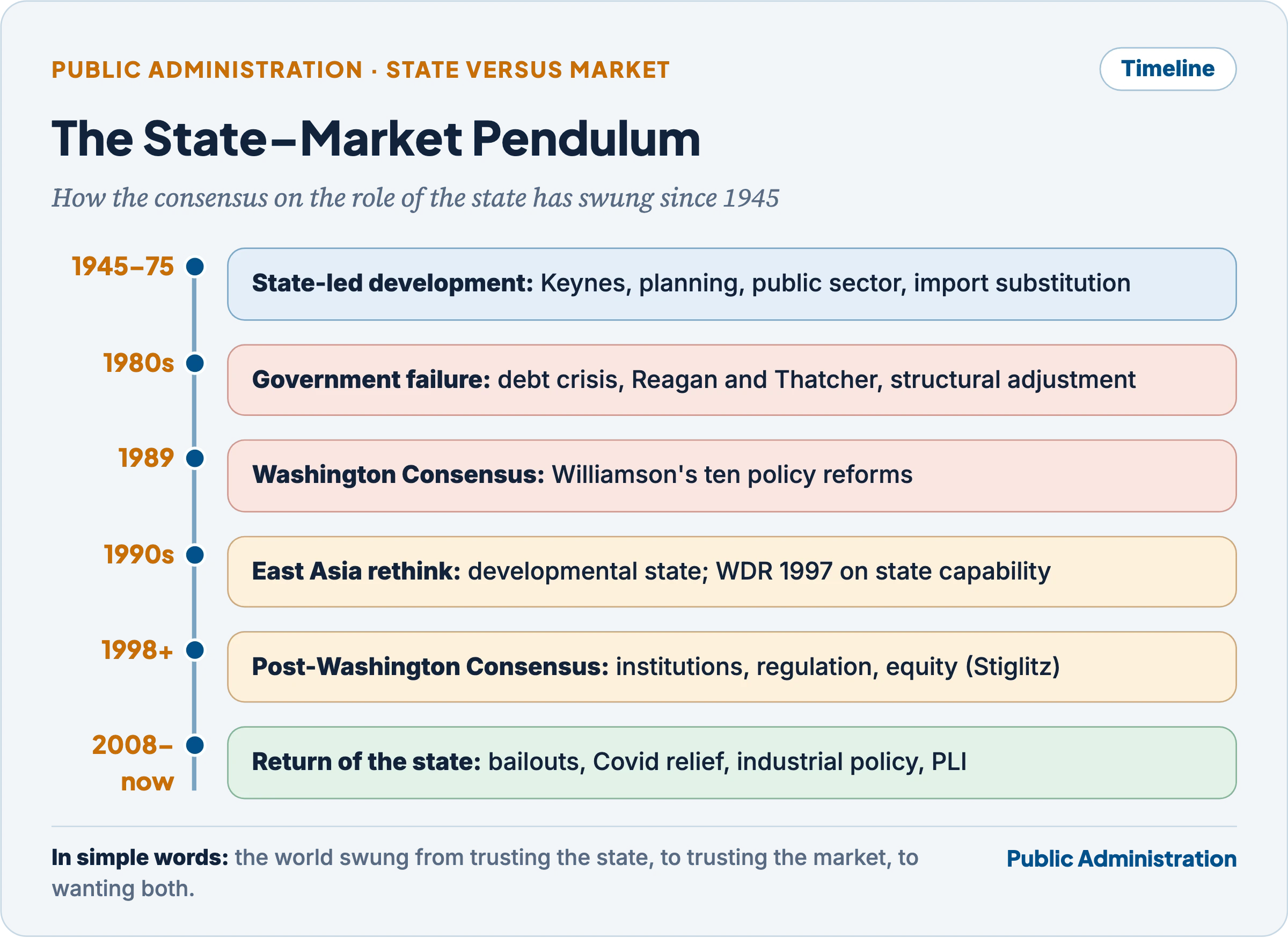
- Government failure. After four decades, critics showed that states also fail: misallocation by planners, rent-seeking (firms spending effort to win licences and favours instead of producing), loss-making public enterprises (“white elephants”), corruption and fiscal deficits.
- Public choice theory (James Buchanan, Gordon Tullock, Niskanen) gave this a theory: politicians and bureaucrats pursue self-interest, so government is not a benevolent planner. Anne Krueger (“The Political Economy of the Rent-Seeking Society”, 1974) used India and Turkey as examples of rent-seeking.
- Events. The 1970s oil shocks and stagflation; the 1982 Latin American debt crisis; the rise of Reagan (1981) and Thatcher (1979) with “Reaganomics” and “Thatcherism”; the collapse of the Soviet bloc in 1989–1991.
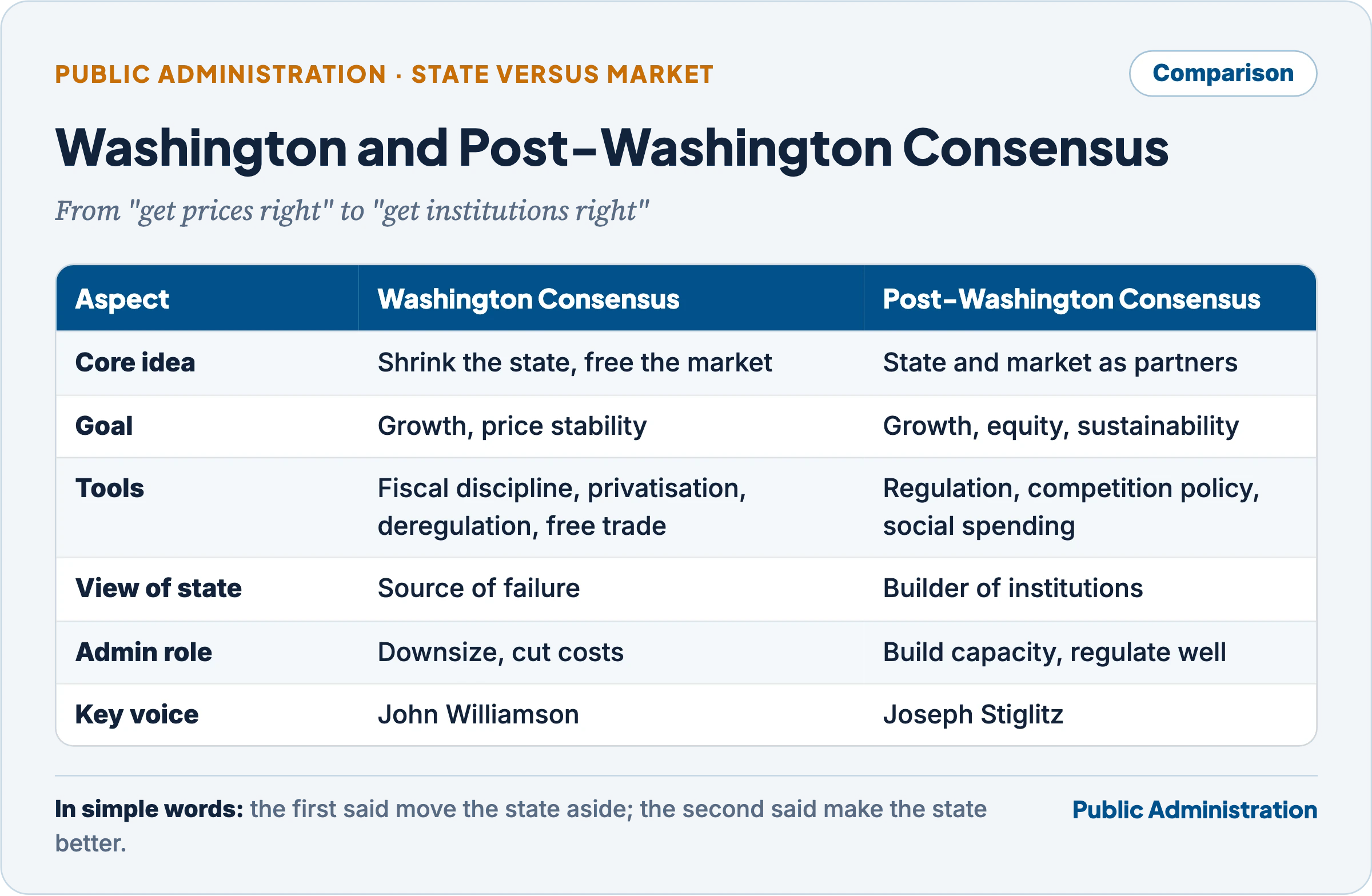
The Washington Consensus (Williamson, 1989)
- Origin. John Williamson, British economist at the Institute for International Economics, coined the term in “What Washington Means by Policy Reform”, a paper for a 1989 conference (published 1990). It summarised the reforms on which the IMF, the World Bank and the US Treasury, all based in Washington, broadly agreed for Latin America.
- The ten reforms.
- Fiscal discipline (small budget deficits)
- Reordering public spending towards health, education and infrastructure, away from indiscriminate subsidies
- Tax reform (broad base, moderate marginal rates)
- Market-determined interest rates (financial liberalisation)
- Competitive exchange rates
- Trade liberalisation
- Openness to foreign direct investment
- Privatisation of state enterprises
- Deregulation (removing barriers to entry and exit)
- Secure property rights
- Administrative implications. Downsizing, wage freezes, closure of parastatals, user charges, contracting out and the arrival of New Public Management (running government like a business).
Results and critique
- Mixed results. Many Latin American and African countries saw stabilisation but slow growth, rising inequality and social cuts in the “lost decade” of the 1980s and in the 1990s. The transitional economies of the former Soviet bloc suffered deep output collapses after “shock therapy” in Russia; the 1994 Mexican, 1997 Asian and 1998 Russian crises followed.
- Critics.
- Joseph Stiglitz, then World Bank Chief Economist: the package confused means (privatisation, liberalisation) with ends; it ignored institutions, regulation, competition and sequencing. In Globalization and Its Discontents (2002) he attacked IMF conditionality.
- Dani Rodrik: “one economics, many recipes”; growth needs local experimentation, and East Asia and China succeeded with heterodox policies.
- Ha-Joon Chang, Kicking Away the Ladder (2002): rich countries themselves industrialised with protection and subsidies, and now deny these tools to poor countries.
- Williamson himself said his list had been misread as “market fundamentalism” and did not include capital-account liberalisation.
The post-Washington Consensus
- Origin. Stiglitz’s WIDER annual lecture, “More Instruments and Broader Goals: Moving Toward the Post-Washington Consensus” (Helsinki, 1998).
- Main shifts.
- Broader goals: not only GDP growth but equitable, sustainable and democratic development, with better living standards.
- More instruments: financial regulation, competition policy, technology policy, education and health, social safety nets.
- Institutions matter: markets need property rights, contract enforcement, regulators and courts; privatisation without regulation creates private monopolies.
- State and market as complements, not substitutes.
- Sequencing and ownership: reforms must be paced and owned by the country, not imposed.
- Linked frameworks. The World Bank’s Comprehensive Development Framework (1999), Poverty Reduction Strategy Papers (1999), the good governance agenda and the Millennium Development Goals (2000) carried these ideas into practice.
- Critique of the post-Washington Consensus. Radical critics see it as the same market agenda with a social face (“augmented” Washington Consensus), with governance conditionality replacing economic conditionality.
Common confusion
Did the Washington Consensus ask for a minimal state? Williamson’s original list did not ask for the state to vanish: it asked for spending to be redirected to health, education and infrastructure, and for secure property rights, both of which need a capable state. The “minimal state” reading came from how the IMF and World Bank applied the package through structural adjustment, and from the neoliberal politics of the 1980s. That is why critics distinguish Williamson’s list from “market fundamentalism”.
7. World Development Report 1997 and Market Failure versus State Failure
In simple words
Markets fail when they leave out the poor or cause pollution; governments fail when officials are corrupt or slow. The World Bank’s 1997 report said the question is not big or small government, but whether a government can do well the jobs it takes on.
Market failure and state failure
The debate rests on two lists of failures. The state is justified where markets fail; the market is preferred where the state fails more badly.
| Market failure | State (government) failure |
|---|---|
| Public goods (defence, street lights) are under-supplied | Rent-seeking and corruption |
| Externalities (pollution) are ignored | Information problems: planners lack local knowledge |
| Monopoly power raises prices | Budget-maximising bureaucrats, waste (Niskanen) |
| Information asymmetry (insurance, credit) | Capture by interest groups |
| Inequality: markets serve buying power only | Short-term electoral cycles |
| Myopia: little investment in long-gestation projects | Soft budget constraints for public enterprises |
- Implication. Neither failure alone settles the question. As Charles Wolf argued in Markets or Governments (1988), the real choice is between imperfect markets and imperfect governments. Intervention is justified where market failure is serious and the state has the capacity to correct it without worse failure.
- Double market failure. Some economists argue that the state should produce directly only when both the market fails and lighter instruments (tax, subsidy, regulation) also fail.
- The role of the state, item by item. The state is preferred for defence, law and order, basic infrastructure with long gestation, welfare of those outside the market, environmental protection and inter-generational equity; markets are preferred for most production of private goods, where competition gives efficiency.
The World Development Report 1997: The State in a Changing World
- Context. After a decade of “rolling back the state”, the World Bank’s own report (team led by Ajay Chhibber) admitted that the state matters: development without an effective state had failed in the ex-Soviet states and sub-Saharan Africa, while East Asia’s success involved effective states.
- Core message. An effective state, not a minimal one, is central to development, but as a partner, catalyst and facilitator, not as the direct provider of growth.
- Two-part strategy.
- Matching the state’s role to its capability. States with weak capacity should focus on fundamentals: law, macro-economic stability, basic social services and infrastructure, protection of the vulnerable and the environment. Do fewer things, and do them well.
- Raising state capability by reinvigorating public institutions. Effective rules and restraints (judicial independence, checks against arbitrary action and corruption); more competition in the public sector (merit recruitment, contracting, competitive service delivery); and bringing the state closer to people (voice, participation, decentralisation).
- Functions of the state. The report grouped functions as minimal (pure public goods, macro stability, anti-poverty programmes), intermediate (externalities, education, environment, regulation of monopoly, social insurance) and activist (coordinating private activity, industrial policy, redistribution). Weak states should not start with the activist ones.
- Earlier and later Bank thinking. The WDR 1991 (The Challenge of Development) had set out the “market-friendly” approach: intervene reluctantly, apply checks and balances (expose interventions to markets) and intervene openly (simple, transparent, rule-based). The WDR 1997 built on it but gave much more weight to state capability and institutions; the WDR 2002 (Building Institutions for Markets) and WDR 2017 (Governance and the Law) continued the line.
The “smart state” and the symbiosis of strong states and strong markets
- Scope versus strength. Francis Fukuyama, State-Building (2004), separated the scope of the state (how many functions it takes on) from its strength (how well it carries them out). The best combination is often limited scope with high strength; many developing states have wide scope and low strength.
- The smart state. The phrase is used for a state that is selective and strategic: it sets direction, regulates well, invests in capabilities, uses data and digital platforms, and partners with markets and civil society, rather than either doing everything or doing nothing.
- The entrepreneurial state. Mariana Mazzucato, The Entrepreneurial State (2013), showed that the state funded the riskiest early stages of innovations (the internet, GPS, touch screens) and should be seen as a market-shaper and investor, not only a fixer of market failures.
- Symbiosis. Historically, strong states and strong markets grew together: markets need the state for property rights, contracts, infrastructure, education and stable money; states need markets for revenue and growth. Daron Acemoglu and James Robinson (The Narrow Corridor, 2019) describe liberty and prosperity as lying in a “corridor” where a strong state is balanced by a strong society.
- Balance as the outcome. Hence the World Bank’s own formula in the WDR 1997 spirit: markets where possible, the state where necessary. The quality and effectiveness of intervention, not its quantity, decides outcomes.
Criticism — Is state-led development a distortion of the market?
- Government failure is real: licence raj, loss-making public enterprises, rent-seeking and corruption (Krueger, public choice).
- Planners lack information that prices carry (Hayek); picking winners often picks losers.
- Fiscal cost: subsidies and bailouts crowd out spending on health and education.
- Capture: industrial policy can become crony capitalism, as before the 1997 Asian crisis.
- The 1980s debt crisis and Soviet collapse showed the limits of state-led growth.
Defence — The state as a builder of markets
- No country industrialised under laissez-faire (Chang); East Asia’s growth was state-guided (Johnson, Amsden, Wade).
- Markets themselves are created by states: property rights, contracts, money, infrastructure.
- Market failures in public goods, externalities, inequality and long-gestation investment need the state.
- Embedded autonomy shows how intervention can be disciplined, not distorting (Evans).
- 2008 and Covid-19 showed that only the state can stabilise markets in crisis.
8. The Return of the State after 2008 and Covid-19
In simple words
When banks collapsed in 2008 and when Covid shut down the world in 2020, governments everywhere spent huge sums to save jobs and companies. Since then, even the richest market economies have openly paid companies to build factories at home.
- The 2008 global financial crisis. The collapse of Lehman Brothers (September 2008) showed financial market failure: deregulated finance created systemic risk. Governments responded with bank bailouts (the US Troubled Asset Relief Program, 2008), stimulus packages and tighter regulation (the US Dodd–Frank Act, 2010; Basel III). The IMF and World Bank accepted a larger role for counter-cyclical policy and regulation; Keynesian ideas returned.
- Covid-19 (2020–2022). States became insurers of last resort: wage subsidies, cash transfers, free food grain (India’s PM Garib Kalyan Anna Yojana from April 2020), emergency credit guarantees for small firms, vaccine development and distribution. Supply-chain shocks raised concern about dependence on single suppliers.
- The new industrial policy. Rich market economies now practise industrial policy openly:
- United States: the CHIPS and Science Act and the Inflation Reduction Act (both August 2022) offer large subsidies and tax credits for semiconductors and clean energy produced at home.
- European Union: the European Chips Act (2023) and the Green Deal Industrial Plan.
- Drivers: geopolitical rivalry with China, supply-chain resilience (“friend-shoring”), climate transition and technological leadership.
- India’s version.
- Production Linked Incentive (PLI) schemes, launched from April 2020 and now covering 14 sectors with an outlay of ₹1.97 lakh crore. Firms get incentives only on incremental production or sales above a base year: a performance-linked design close to Amsden’s reciprocity. By September 2025, actual investment exceeded ₹2 lakh crore and incentives of about ₹23,946 crore had been disbursed across 12 sectors (Economic Survey 2025–26).
- India Semiconductor Mission (December 2021) with a ₹76,000 crore support programme for chip and display fabs.
- National Manufacturing Mission, announced in the Union Budget 2025–26.
- Administrative demands of the new industrial policy. Selecting sectors, setting and verifying performance targets, disbursing incentives without favouritism, and withdrawing support from failing firms need a capable, autonomous yet embedded bureaucracy. Critics point to slow disbursement in some PLI sectors, low domestic content in assembly-led sectors, and the risk of lobbying and capture.
- What has not returned. The new activism is not a return to the licence raj or public ownership of industry: it uses incentives, regulation and partnership. The state is a strategist and co-investor, not the sole producer.
9. Liberalisation and Administration: Structural Adjustment
In simple words
When a country borrowed from the IMF in a crisis, the loan came with conditions: cut the deficit, sell state companies, open trade, stop controlling prices. Each of these changed what government offices did every day.
- Liberalisation defined. Liberalisation means reducing state controls on economic activity: removing licences, opening trade and investment, freeing prices and interest rates, and allowing private entry into sectors once reserved for the state. It usually comes with privatisation and globalisation (LPG). (The wider LPG and good-governance debate in the discipline is covered in the article on LPG and good governance in Unit 1-01.)
- Structural adjustment programmes (SAPs). From the 1980s, the IMF (stabilisation) and World Bank (structural adjustment loans, from 1980) lent to crisis-hit countries on conditionality.
- Stabilisation: cut fiscal deficits, devalue the currency, tighten money.
- Structural adjustment: trade liberalisation, privatisation, deregulation, removal of subsidies, civil service reform.
- Administrative content of SAPs.
- Civil service reform: downsizing (retrenchment, hiring freezes, voluntary retirement), pay reform, removal of “ghost workers”.
- Public enterprise reform: commercialisation, closure, sale.
- Cost recovery: user fees in health, education and water.
- De-administered development: the idea that fewer state functions mean fewer chances for corruption; aid was made conditional on shrinking the bureaucracy.
- Effects in developing countries.
- Positive: macro-economic stability in several countries, reduced inflation, more competition, better tax administration.
- Negative: cuts in health and education hit the poor (“adjustment with a human face” was UNICEF’s 1987 critique, by Giovanni Andrea Cornia, Richard Jolly and Frances Stewart); user fees reduced school and clinic attendance in parts of Africa; demoralised and underpaid civil servants; brain drain from the public sector; weak ownership because reforms were imposed from outside.
- Sovereignty and accountability: policy was shaped by lenders rather than legislatures; citizens could not hold external actors accountable.
10. Changing Roles: Regulator, Facilitator, Enabler
In simple words
Before liberalisation, the government made steel, ran airlines and decided who could open a factory. After it, private firms do much of this; the government’s job became making fair rules, clearing the path and building roads, skills and digital systems that everyone can use.
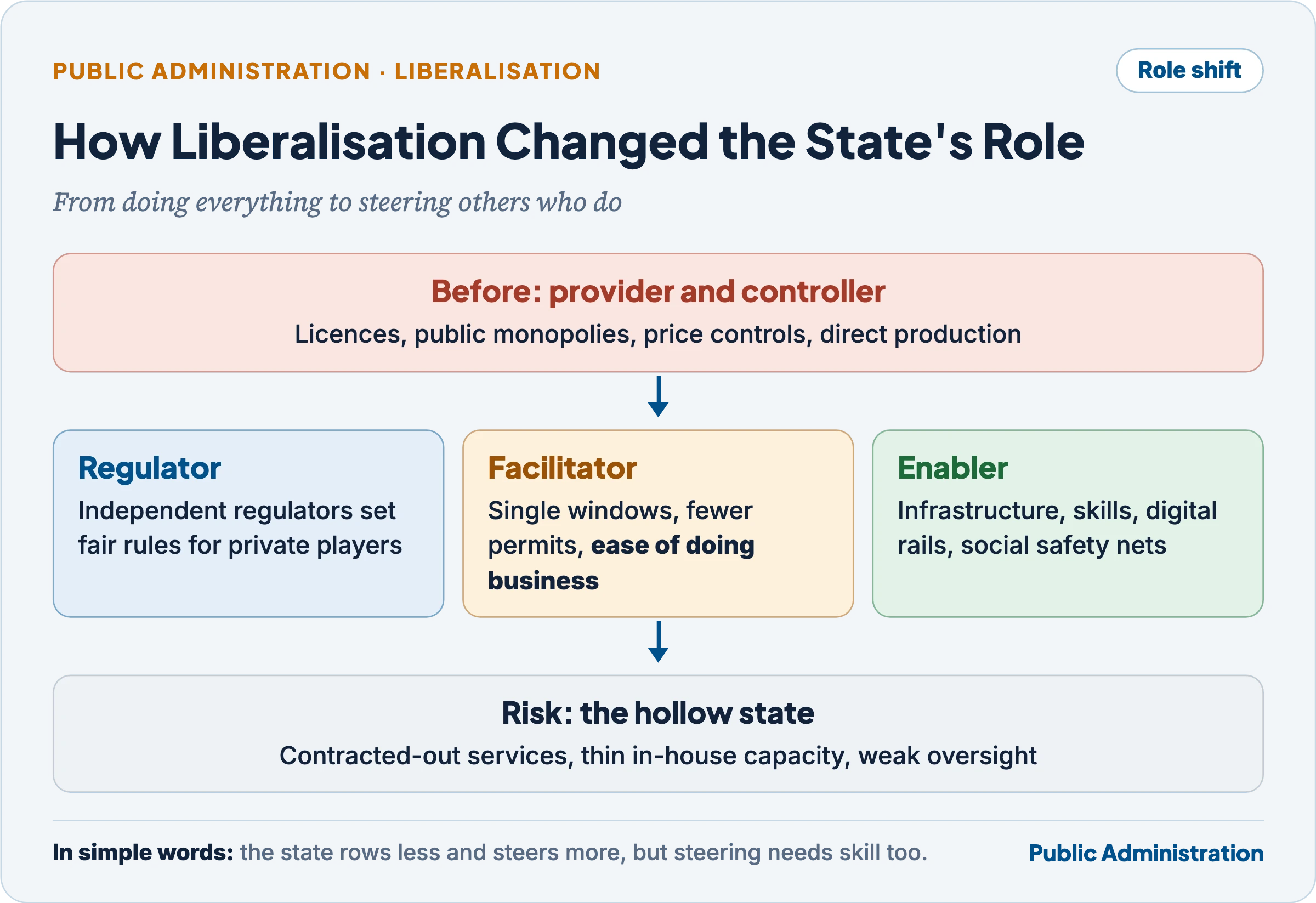
The shift is often summarised in David Osborne and Ted Gaebler’s phrase from Reinventing Government (1992): the state should “steer rather than row”. Each new role makes its own demands on administration.
| Role | What it means | Indian examples | Administrative demand |
|---|---|---|---|
| Regulator | Sets and enforces fair rules for private and public players | SEBI (statutory 1992), TRAI (1997), CERC (1998), IRDAI, CCI (2002 Act; operational 2009) | Technical expertise, independence, transparency |
| Facilitator | Removes obstacles; makes it easy to start and run business | Single-window clearances, Business Reforms Action Plan (from 2014), National Single Window System (2021), Jan Vishwas | Process re-engineering, speed, client orientation |
| Enabler | Provides public goods and platforms others build on | Digital public infrastructure (Aadhaar, UPI, ONDC), Skill India, roads, safety nets | Long-term planning, platform design, partnership |
| Partner | Shares risk and delivery with private and civil society actors | PPPs in highways and airports; NGOs and SHGs in delivery | Contract design and management, monitoring |
The table shows that liberalisation did not reduce the need for administrative skill; it changed its kind. Instead of running factories, officials now need to draft regulations, manage contracts, price risk and analyse data, skills that a generalist law-and-order service did not have.
Regulation: the regulatory state
- The regulatory state (Giandomenico Majone’s term for Europe in the 1990s) governs through rule-making by independent agencies rather than ownership and taxation.
- Issues in developing countries: regulatory capture by the regulated industry; overlapping jurisdictions (for example between sectoral regulators and the Competition Commission); retired officials filling regulatory posts, which weakens independence; and a need for regulatory impact assessment.
- Indian reform proposals: the Financial Sector Legislative Reforms Commission (chair Justice B.N. Srikrishna, report 2013) proposed a unified financial code; a high-level committee for regulatory reforms in non-financial sectors was announced in the Union Budget 2025–26.
Facilitation: ease of doing business
- Ease of doing business means cutting the time, cost and number of procedures needed to start, run and close a firm.
- India’s rank in the World Bank’s Doing Business report rose from 142 in 2014 to 63 in 2019 (the Doing Business 2020 report). The World Bank discontinued the report in September 2021 after data irregularities; its successor, Business Ready (B-READY), began in 2024.
- Domestic tools: the Business Reforms Action Plan ranks States on reform implementation, creating competitive federalism; the National Single Window System (2021); compliance reduction exercises that removed thousands of compliances; the Insolvency and Bankruptcy Code, 2016 for exit; the four labour codes (in force from 21 November 2025) consolidating 29 labour laws.
- Ease of living: the same logic applied to citizens: self-certification, removal of affidavits and attestation, faceless assessment in income tax (2020).
Jan Vishwas: decriminalisation as administrative reform
- The problem. Many Indian laws punished minor, technical or procedural lapses with imprisonment, which created fear of officials, discretion for inspectors and rent-seeking (“inspector raj”).
- The Jan Vishwas (Amendment of Provisions) Act, 2023 (notified 11 August 2023) decriminalised 183 provisions in 42 Central Acts administered by 19 ministries and departments, replacing jail terms with monetary penalties, warnings or administrative adjudication.
- Jan Vishwas 2.0. A Bill introduced on 18 August 2025 (355 provisions in 16 Acts) went to a Lok Sabha Select Committee chaired by Tejasvi Surya, which reported on 13 March 2026 and recommended going much further. The revised Jan Vishwas (Amendment of Provisions) Act, 2026 received assent on 7 April 2026: it amends 784 provisions across 79 Central Acts administered by 23 ministries, decriminalising 717 for ease of doing business and amending 67 for ease of living.
- Administrative design: adjudicating officers levy penalties through administrative processes (reducing the burden on courts); first-time contraventions attract an advisory or warning in many cases; graduated penalties for repeat offences; an automatic 10 per cent increase in fines every three years.
- Significance: a shift from “distrust-based” to “trust-based” governance, with enforcement through proportionate civil penalties. Concerns: dilution of deterrence in environmental, food-safety or consumer-protection laws, and more discretion for adjudicating officers unless checked by appeal and transparency.
11. Privatisation, Capacity Erosion and the Hollow State
In simple words
When a government hands its jobs to private contractors, it saves effort in the short run. But if it also lets go of the people who understand those jobs, it can no longer tell whether the contractors are doing them well. The government becomes an empty shell, a “hollow state”.
Privatisation and its forms
- Forms of privatisation.
- Disinvestment: sale of part of the government’s shares while keeping control.
- Strategic sale: transfer of management control to a private buyer (Air India to the Tata group, January 2022).
- Contracting out and outsourcing of services (sanitation, IT, facility management).
- Public–private partnerships (build–operate–transfer, hybrid annuity model in highways).
- Load-shedding: the state simply stops providing a service.
- User charges and vouchers.
- Indian milestones. The Department of Disinvestment (1999) became the Department of Investment and Public Asset Management (DIPAM) in 2016; the New Public Sector Enterprise Policy (2021) keeps a bare minimum presence in four strategic sectors and aims to privatise or close public enterprises elsewhere; the National Monetisation Pipeline (2021) leases operating assets.
- Contractualism. Relations once governed by hierarchy are now governed by contracts: between ministries and agencies (performance agreements), between government and providers (outsourcing), and between government and staff (fixed-term contracts). Supporters cite clarity and accountability for results; critics cite incomplete contracts, high transaction costs, precarious employment of contract staff, loss of public-service ethos and blurred accountability.
Capacity erosion
- What erodes. When governments outsource and downsize, they lose in-house expertise, institutional memory and the ability to specify, monitor and evaluate contracts. This is the “capacity paradox”: liberalisation demands more sophisticated state skills (regulation, contract management) at the very moment it cuts the staff who would provide them.
- Signs in developing countries: long-term hiring freezes and large vacancies, contract and “scheme” workers doing core functions (health workers, teachers, data-entry operators), heavy reliance on consultancies for policy design, and weak regulators.
- Lant Pritchett and colleagues warned of capability traps and isomorphic mimicry: states copy the forms of modern institutions (laws, regulators, e-portals) without the capability to make them work, a modern echo of Riggs’s formalism.
The hollow state
- The concept. H. Brinton Milward and Keith Provan used hollow state (“What Does the ‘Hollow State’ Look Like?”, 1993; “Governing the Hollow State”, 2000) for a government that funds services but delivers almost none itself, relying on networks of contractors and non-profits. R.A.W. Rhodes spoke of the “hollowing out of the state” in Britain (1994): loss of functions upward to the European Union, downward to agencies and outward to markets.
- Related ideas. Third-party government (Lester Salamon): public purposes delivered through private and voluntary third parties. Governance as networks rather than hierarchy.
- Problems of the hollow state.
- Accountability gaps: citizens cannot easily tell who is responsible when a contracted service fails; RTI may not reach private contractors.
- Coordination: a web of contracts is harder to steer than a department.
- Loss of control over quality and over strategic knowledge.
- Equity: private providers may avoid poor or remote clients (“cream-skimming”).
- Responses: re-municipalisation of some utilities in Europe; insourcing of core functions; strong contract management units; social audits of outsourced services; the New Public Governance emphasis on collaboration with accountability. (These paradigms are covered in the article on NPM and after.)
Indian Connect — The hollow state question in India
- Contract staffing: schemes such as the National Health Mission run largely on contractual staff; States engage guest teachers and outsourced data operators.
- Consultants: ministries and States have relied on project management units staffed by private consultancies; parliamentary committees and media have questioned the cost and accountability of this.
- PPP lessons: the Vijay Kelkar Committee on revisiting and revitalising PPPs (report 2015) found poor risk allocation and recommended renegotiation frameworks and an independent PPP review mechanism.
- Counter-trend: the build-up of digital public infrastructure (Aadhaar, UPI, DigiLocker) keeps core platforms in public or not-for-profit hands while private firms build services on top, a model of enabling without hollowing.
12. India’s 1991 Reforms and their Administrative Consequences
In simple words
In 1991 India had foreign exchange left for only a couple of weeks of imports. The government sold gold, borrowed from the IMF and then removed most industrial licences, cut import duties and opened the economy. Over the next thirty years, the work of government offices changed as a result.
The crisis and the reforms
- The crisis. A balance-of-payments crisis in 1990–91 (Gulf war oil shock, high fiscal deficit, falling remittances, political instability) left reserves enough for about two weeks of imports; gold was pledged and an IMF loan taken.
- The reforms (Narasimha Rao government, Finance Minister Manmohan Singh).
- New Industrial Policy, 24 July 1991: industrial licensing abolished except for a short list of industries (security, strategic, hazardous, environmental and elitist-consumption grounds); the list reserved for the public sector pruned to 8 industries (today only two: atomic energy and railway operations); MRTP pre-entry restrictions removed; automatic approval for foreign investment up to 51 per cent in priority industries.
- Trade: devaluation (July 1991), steady cuts in tariffs, removal of import licensing.
- Finance: banking reforms after the Narasimham Committee (1991); SEBI given statutory powers (1992); capital markets opened.
- Fiscal and tax: reforms after the Raja Chelliah Committee (1991–93); later the FRBM Act (2003) and GST (2017).
- Phases. Stabilisation and structural reform (1991–96); second-generation reforms (from late 1990s: disinvestment, insurance, telecom, FRBM); third phase (2014 on: GST, IBC, DBT, ease of doing business, PLI, labour codes, Jan Vishwas).
Administrative consequences
- From controller to regulator. The licensing apparatus shrank; independent regulators grew (SEBI, TRAI, electricity regulatory commissions, IRDAI, PFRDA, CCI). Administration had to learn arm’s-length regulation.
- Public sector reform. Memoranda of understanding (from 1987–88), the Navratna (1997), Maharatna (2010) and Miniratna schemes granted autonomy; disinvestment and later strategic sale (DIPAM).
- New management ideas. NPM-style reforms: citizen’s charters (from 1997), outsourcing, performance and outcome budgets (outcome budget from 2005), results-framework documents (2009), e-governance (National e-Governance Plan, 2006).
- Competitive federalism. States now compete for investment; single-window systems, investor summits and State rankings changed State administration.
- Changing civil service role. From permit-giver to facilitator and manager of partnerships; growing demand for domain specialists, lateral talent and training (Mission Karmayogi).
- Welfare and rights. Paradoxically, liberalisation was followed by a rights-based welfare expansion: RTI (2005), MGNREGA (2005), Right to Education (2009), National Food Security Act (2013). The state’s welfare functions grew even as its production functions shrank.
- Persisting problems. Regulatory capture and overlap; crony capitalism and scandals in natural-resource allocation (the 2G and coal-block cases, in which the Supreme Court cancelled 122 telecom licences in 2012 and 214 coal blocks in 2014); “inspector raj” at State and local levels; contract employment; uneven benefits across regions and classes.
- Size of government. Contrary to “minimum government” rhetoric, total public spending and the number of functions did not fall; the composition changed (fewer factories, more welfare, regulation, infrastructure and digital platforms). This explains the paradox that LPG and NPM aimed to limit government but functions and expenditure increased.
Indian Connect — From the Nehruvian model to the liberalisation model: milestones
- 1948 and 1956: Industrial Policy Resolutions; the public sector given the commanding heights.
- 1951: Industries (Development and Regulation) Act; licensing begins.
- 1969: bank nationalisation; MRTP Act; the peak of state control in the 1970s.
- 1980s: partial liberalisation (de-licensing of some industries, telecom and computer policy).
- 1991: New Industrial Policy, trade and financial reforms.
- 2014 onward: Make in India (2014), GST (2017), IBC (2016), PLI (2020), Jan Vishwas (2023, 2026).
- The administrative arc: from a “control” state to a “regulatory and enabling” state, with the bureaucracy remaining central throughout.
Impact on development administration as a field
- LPG transformed development administration from a state-monopoly, bureaucracy-led enterprise into a plural, networked one involving markets, civil society, self-help groups and local governments.
- Shift in values: from planning and control to efficiency, competition and customer orientation, then to governance, participation and rights.
- The market as the new icon of developmentalism. In the 1990s, market liberalisation was itself treated as development, a position later moderated by the post-Washington Consensus and the return of the state.
- Social equity concerns. Critics hold that the market emphasis undermined equity goals; defenders point to faster growth, which financed welfare, and to large falls in poverty since the 1990s.
Key Terms
| Term | Meaning in simple words |
|---|---|
| Weberianness | How far a bureaucracy has merit recruitment and secure, rewarding careers (Evans and Rauch) |
| Formalism | A gap between written rules and what officials actually do (Riggs) |
| Balanced thesis | Bureaucracy and political institutions must grow together, or the bureaucracy goes uncontrolled |
| Committed bureaucracy | Officials who actively pursue development goals; acceptable when committed to the Constitution, not a party |
| Bureau-shaping | Senior officials reshape their agencies for better work, rather than maximise budgets (Dunleavy) |
| Budget-maximising model | Bureaucrats push for larger budgets in their own interest (Niskanen) |
| End of bureaucracy thesis | Bennis’s prediction that flexible temporary teams will replace hierarchies |
| Developmental state | A state that sets and pursues national economic goals through an elite bureaucracy (Johnson) |
| Embedded autonomy | A bureaucracy independent of capture yet closely connected to society (Evans) |
| Pilot agency | A lead ministry that steers industrial policy, such as MITI in Japan |
| Reciprocity | State support given only in return for performance, such as export targets (Amsden) |
| Washington Consensus | Williamson’s ten market-oriented reforms favoured by the IMF, World Bank and US Treasury (1989) |
| Post-Washington Consensus | Wider goals and instruments, with institutions and regulation, beyond market reforms (Stiglitz, 1998) |
| Market failure | When markets fail to give efficient or fair results: public goods, externalities, monopoly |
| State failure | When government intervention makes outcomes worse: rent-seeking, capture, waste |
| Rent-seeking | Spending effort to win favours or licences instead of producing value |
| Structural adjustment | Lender-imposed reforms (cuts, privatisation, deregulation) attached to loans |
| Regulatory state | A state that governs by rules and independent agencies, not ownership |
| Hollow state | A state that funds services but delivers almost none itself (Milward and Provan) |
| Contractualism | Replacing hierarchy with contracts inside and outside government |
| Capacity erosion | Loss of in-house skills and knowledge after downsizing and outsourcing |
| Isomorphic mimicry | Copying the form of modern institutions without their function |
| PLI scheme | Incentives paid on incremental production above a base year |
| Decriminalisation | Replacing jail terms for minor lapses with civil penalties (Jan Vishwas) |
| Smart state | A selective, strategic state that steers and enables rather than doing everything |
Commissions, Committees and Judgments
| Body / case | Year | Key point |
|---|---|---|
| Administrative Reforms Commission (Morarji Desai, then K. Hanumanthaiya) | 1966–1970 | Specialisation, performance budgeting, reorganisation |
| Narasimham Committee on the Financial System | 1991 | Banking sector reforms after liberalisation |
| Raja Chelliah Tax Reforms Committee | 1991–1993 | Simpler, broader tax system |
| 2nd Administrative Reforms Commission (Veerappa Moily, later V. Ramachandran) | 2005–2009 | Citizen-centric, outcome-oriented administration; ethics; personnel reforms |
| T.S.R. Subramanian v. Union of India | 2013 | Fixed tenure and civil services boards for transfers |
| Financial Sector Legislative Reforms Commission (Justice B.N. Srikrishna) | 2013 | Unified financial code; principles for independent regulators |
| Kelkar Committee on PPPs | 2015 | Better risk sharing, renegotiation, independent review |
| Supreme Court 2G judgment (Centre for PIL v. Union of India) | 2012 | 122 telecom licences cancelled; natural resources to be allocated fairly |
| Supreme Court coal-block judgment (Manohar Lal Sharma v. Principal Secretary) | 2014 | 214 coal-block allocations cancelled |
| Lok Sabha Select Committee on Jan Vishwas Bill (Tejasvi Surya) | 2026 | Widened decriminalisation to 79 Acts |
Contemporary Developments
- April 2026: the Jan Vishwas (Amendment of Provisions) Act, 2026 received assent on 7 April 2026, amending 784 provisions across 79 Central Acts (717 decriminalised), after a Select Committee report of 13 March 2026.
- January 2026: the Economic Survey 2025–26 reported PLI investment of over ₹2 lakh crore, incremental production of over ₹18.7 lakh crore and incentives of ₹23,946 crore disbursed by September 2025.
- 21 November 2025: the four labour codes were brought into force, consolidating 29 central labour laws, a long-pending liberalisation reform.
- February 2025: the Union Budget 2025–26 announced the National Manufacturing Mission and a high-level committee for regulatory reforms in non-financial sectors.
- August 2024: the UPSC lateral-entry advertisement for 45 senior posts was withdrawn at the government’s request, showing the political limits of opening the bureaucracy.
- 2024: the World Bank launched Business Ready (B-READY), replacing the discontinued Doing Business report as its measure of the business environment.
- 2022 onward: the US CHIPS and Science Act and Inflation Reduction Act (August 2022) and the EU Chips Act (2023) marked the open return of industrial policy in market economies.
Revision Grid
| Thinker / body | Work or report (year) | Key idea |
|---|---|---|
| Max Weber | Economy and Society (1922) | Ideal-type rational bureaucracy |
| Evans and Rauch | “Bureaucracy and Growth”, ASR (1999) | Weberian structures raise growth |
| Joseph La Palombara | Bureaucracy and Political Development (1963) | Strong bureaucracy stunts political institutions |
| Fred Riggs | Administration in Developing Countries (1964) | Formalism; balanced growth of bureaucracy and polity |
| S.N. Eisenstadt | The Political Systems of Empires (1963) | Service, subservient or self-oriented bureaucracy |
| Ferrel Heady | Public Administration: A Comparative Perspective (1966) | Features of developing-country bureaucracies |
| Warren Bennis | “The Coming Death of Bureaucracy” (1966) | Temporary adaptive systems replace bureaucracy |
| William Niskanen | Bureaucracy and Representative Government (1971) | Budget-maximising bureaucrats |
| Patrick Dunleavy | Democracy, Bureaucracy and Public Choice (1991) | Bureau-shaping model |
| Chalmers Johnson | MITI and the Japanese Miracle (1982) | The developmental state |
| Alice Amsden | Asia’s Next Giant (1989) | Getting prices wrong; reciprocity |
| Robert Wade | Governing the Market (1990) | State leads and follows the market |
| Peter Evans | Embedded Autonomy (1995) | Autonomy plus embeddedness |
| John Williamson | “What Washington Means by Policy Reform” (1989/90) | Ten-point Washington Consensus |
| Joseph Stiglitz | WIDER lecture (1998) | Post-Washington Consensus |
| World Bank | WDR 1991; WDR 1997 The State in a Changing World | Market-friendly approach; match role to capability |
| Francis Fukuyama | State-Building (2004) | Scope versus strength of the state |
| Mariana Mazzucato | The Entrepreneurial State (2013) | State as market-shaper and investor |
| Milward and Provan | “Governing the Hollow State” (2000) | Hollow state |
Previous Year Questions
- 2026Is state-led development an artificial distortion of market forces? Analyse.
- 2026“Liberalization, Privatization and Globalization (LPG) successfully resolved the structural crisis of the welfare state with emphasis on market efficiency, undermining the social equity goals essential to public service.” Explain.
- 2025The role and responsibility of the State in the development process has been overemphasized and given undue importance. Critically examine.
- 2025The objective of Liberalization, Privatization and Globalization and of New Public Management was to limit government functions and reduce public expenditure. However both functions and expenditure has increased. Account for the paradox.
- 2024Balancing State intervention and Market freedom is the need of developing countries. Comment.
- 2024Bureaucracy in developing countries faces several challenges, and tackling of these will make them more responsive, adaptive, and align with development needs. Discuss.
- 2022The results of Washington Consensus were far from optimal for transitional economies. In this background, discuss the change of direction towards post-Washington Consensus.
- 2021It is widely agreed that the government ought to provide ‘the goods that market fails to provide or does not provide efficiently. Argue.
- 2021A striking feature of economic development is an apparent symbiotic evolution of strong States and strong market economies. Analyze.
- 2020The movement towards governance as an organizing concept for public administration and management is because the focus of administration has been shifting from the bureaucratic state to the ‘hollow state’ and ‘third-party government’. Critically examine.
- 2019Contractualism has become a favourite policy of the neoliberal forces, but not without its share of controversy. Argue.
- 2018In order to be development-oriented, bureaucracies need to be innovative, flexible, citizen-centric and result-oriented, but they are slow in imbibing these virtues in a democratic system. Do we need to go beyond the traditional models of bureaucracy and create alternative structures? Elaborate.
- 2017“Liberalisation, privatisation and globalisation have transformed the nature of development administration.” Discuss.
- 2017“Bureaucracy has inbuilt limitations to act as the prime catalyst to multi-faceted development in a democratic country”. Analyse this statement with appropriate examples.
- 2016“The problem is to achieve the right balance between a competitive market economy and an effective State: markets where possible; the State where necessary.” Justify your answer.
- 2016“Bureau-Shaping Model has been developed as a response to the Budget-Maximizing Model.” Comment.
- 2014“Adaptive, problem-solving, temporary systems of diverse specialists, linked together by coordinating executives in an organic flux-this is original form that will gradually replace bureaucracy”. Discuss, in the light of this statement, the ‘end of bureaucracy’ thesis and its strengths and limitations.
- 2014“Many Asian and African countries have inherited the colonial idea of civil service as a privileged elite. Hence, the social status of the civil services is an important aspect of the bureaucracy’s unsuitability for change.” Comment.
- 2011Indicate the milestones in the story of development from the Nehruvian Model to the Liberalisation Model.
- 2010“The market has become the new icon of developmentalism.” Comment.
- 2008“In certain discourses, there is a reflected basic distrust against bureaucracy as an instrument of development.” Do you think bureaucracy is more appropriate for regulatory administration than for development administration? In the changing profile of development, what role of bureaucracy can be envisaged?
- 1999“The principle of bureaucratic neutrality is more superfluous and redundant in the context of developing countries.” Comment.
- 1996“Committed bureaucracy is unsuitable in a Parliamentary democracy.” Comment.
- 2025Liberalization of Indian economy has forced public enterprises to enhance their efficiency, but the effects of these reforms have been a topic of debate. Analyze.
- 2021Recent market approaches to public services present serious challenges to traditional and state-sponsored public service values. Evaluate the statement in the context of Indian administration.
- 2017“The market reforms have not infringed the basic structure of the Constitution of India, but have largely compromised the realisation of the ideals of social and economic justice.” Comment.
- 2014“Beneath the soft outer shell of democratic administrative framework lies unscathed the steel frame of Indian administration which has survived through ages.” In the light of this statement, examine the relationship between bureaucracy and development in the last one decade.
- 2008‘The shift from the Nehruvian to the liberalisation model of development has necessitated reinventing government.’ Comment.