

Administrative Law: Meaning, scope, and significance; Dicey on Administrative law; Delegated legislation; Administrative Tribunals.
This article: Meaning and forms of delegated (subordinate) legislation; reasons for its growth (Carr, Hewart’s The New Despotism, the Donoughmore Committee); types (skeleton legislation, Henry VIII clause, conditional legislation, sub-delegation, delegation of taxing power); limits under the doctrine of excessive delegation and essential legislative functions (In re Delhi Laws Act to Naresh Chandra Agrawal); parliamentary, judicial and procedural controls; the Committees on Subordinate Legislation and their effectiveness; merits and dangers and the rise of executive law-making in India (IT Rules, the fact-check unit, Covid orders, delays in framing rules); ordinances compared; the UK, US and Indian models; reform proposals.
Official Syllabus: Paper I · Unit 1-06 Administrative Law
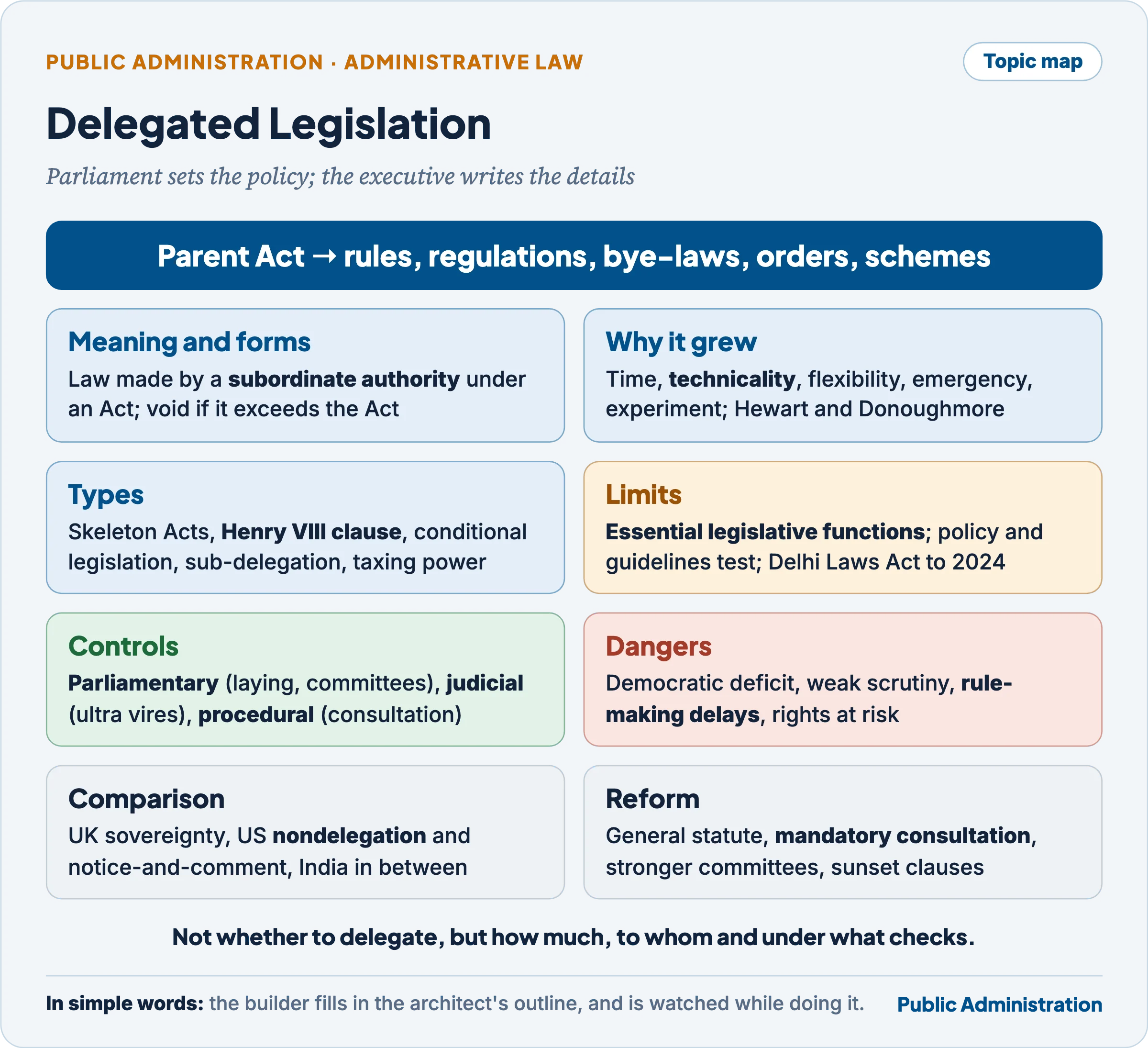
Delegated legislation is law made not by the legislature itself but by the executive or another body to which the legislature has handed a part of its law-making power. Parliament passes an Act that settles the policy; the government, a regulator or a municipality then writes the rules, regulations and bye-laws that make the Act work. In a modern state most of the law that actually touches a citizen, from the fee for a passport to the emission limit for a factory, comes from this second tier.
- It is the clearest example of the administrative state: the executive no longer only executes law; it also makes much of it.
- It therefore raises the central questions of administrative law: How much law-making can a legislature hand over? Who checks the delegate? What can a citizen do when a rule goes too far?
- The companion articles cover the meaning and scope of administrative law and Dicey’s rule of law (see the article on Administrative Law and Dicey), and the adjudicating side of the administrative state (see the article on Administrative Tribunals). This article covers the law-making side.
In simple words
A school’s managing committee decides that students must wear a uniform. It does not choose the shade of blue, the supplier or the winter jacket; it leaves that to the principal. The committee keeps the right to overrule the principal, and parents can complain if the principal demands something absurd. Parliament and the government work the same way: Parliament sets the policy, the government fills in the details, and both Parliament and the courts keep a watch on how the details are filled in.
1. Meaning and Nature of Delegated Legislation
In simple words
An Act of Parliament is like the outline of a house drawn by an architect. The builder adds the doors, wiring and plumbing. Delegated legislation is the builder’s work: it must follow the outline, and if the builder adds a floor the architect never approved, it can be pulled down.
1.1 Definitions
- Core idea: delegated legislation is law made by an authority subordinate to the legislature, under powers conferred by a statute called the parent Act, enabling Act or empowering Act.
- Sir John Salmond, the jurist, described subordinate legislation as legislation that “proceeds from any authority other than the sovereign power and is, therefore, dependent for its continued existence and validity on some superior or supreme authority”.
- Two names, one thing:
- It is delegated because the power is handed down by the legislature.
- It is subordinate because the rule ranks below the Act and is void if it conflicts with the Act or the Constitution.
- A derivative power: the executive has no inherent law-making power under a statute. Every rule must trace its authority to a specific section of a parent Act (or to a provision of the Constitution). Remove the parent provision and the rule falls with it.
- Also called secondary legislation (UK usage), executive legislation or statutory instruments. The Law Commission of India in its 60th Report on the General Clauses Act, 1897 suggested “statutory instrument” as a single name for rules, orders, bye-laws, schemes, forms and notifications.
1.2 Forms of delegated legislation
The same power appears under many labels. The label does not decide validity; what matters is whether the instrument has binding legal force and rests on a statutory or constitutional power.
| Form | What it usually is | Indian example |
|---|---|---|
| Rules | General provisions to carry out an Act, made by the government | Rules under the Digital Personal Data Protection Act, 2023 |
| Regulations | Detailed provisions made by a statutory body or regulator | SEBI and RBI regulations |
| Bye-laws | Rules of local application made by local bodies or societies | Municipal bye-laws on building, markets, sanitation |
| Orders | Directions on particular matters, often of temporary effect | Orders under the Essential Commodities Act, 1955 |
| Notifications | Instruments that bring an Act into force, extend it, exempt or include classes | Commencement notifications; inclusion of items in a schedule |
| Schemes | Elaborate programmes framed under statutory power | Statutory schemes under social security laws |
| Directions, codes, guidelines | Instruments with legal effect when the Act gives them force | Codes of practice issued under regulatory statutes |
- Publication: central rules are published in the Gazette of India and numbered as G.S.R. (General Statutory Rules) or S.O. (Statutory Orders). Publication gives each instrument an identity and a date.
- Rules under the Constitution: some rule-making flows directly from the Constitution rather than from an Act, for example service rules under the proviso to Article 309, rules of business under Article 77(3), and rules of procedure of the Houses under Article 118. The Rajya Sabha amended its rules in 1972 so that its scrutiny committee could examine such constitution-based rules too.
1.3 Delegated legislation and executive action compared
The executive does three different things that are often confused: it makes rules, it issues executive instructions, and it decides individual cases.
| Feature | Delegated legislation | Executive instructions | Administrative (quasi-judicial) decision |
|---|---|---|---|
| Source | A statute or the Constitution | General executive power (Articles 73 and 162) | A statute conferring a power to decide |
| Reach | General, prospective, binds everyone covered | Internal guidance; cannot override law | Applies to particular persons |
| Hearing needed? | No individual hearing (legislative in character) | No | Yes, natural justice applies |
| Control | Laying, committees, judicial review | Judicial review if it affects rights | Appeals, tribunals, writs |
- The difference matters. The Lok Sabha Committee on Subordinate Legislation, examining the Pravasi Bharatiya Bima Yojana of 2003 and 2006, objected that a scheme with binding effect had been issued as a mere executive order; it held that such a scheme should have been framed as a statutory scheme under the Emigration Act, 1983 so that Parliament could scrutinise it.
- Because a rule is legislative in character, the courts do not insist on a personal hearing before it is made. In Tulsipur Sugar Co. v Notified Area Committee (1980) the Supreme Court held that a notification under the U.P. Town Areas Act, being an act of conditional legislation, did not attract the rule of hearing.
Common confusion
Is an ordinance a piece of delegated legislation? No. An ordinance under Article 123 (or Article 213 in the States) is made by the President or Governor under a power the Constitution itself gives, not under a power delegated by an Act. It has the same force as an Act and can even amend an Act; a rule cannot. Delegated legislation is always subordinate to its parent Act. Both, however, are forms of executive law-making, and both raise the same worry about bypassing the legislature (see Section 7.4).
2. Why Delegated Legislation Grew
In simple words
A cricket board writes the laws of the game once, but the playing conditions for each tournament (ball type, over-rate fines, rain rules) change every season. If the full board had to meet for every change, nothing would be decided in time. So the board lets a technical committee make the playing conditions. Parliament faces the same problem with millions of details.
2.1 From the negative state to the positive state
- The nineteenth-century liberal state kept order, collected revenue and defended the borders. Its laws were few and general; Parliament could write them in full.
- The positive or welfare state of the twentieth century took on regulation of industry, labour, health, education, transport, environment and social security. The volume and technicality of law exploded.
- Dwight Waldo, the American scholar who coined the phrase in The Administrative State (1948), showed that public administration had become a centre of political power. Delegated legislation is the legal channel through which that power flows.
- In India the Directive Principles (especially Article 38 on a social order of justice) committed the State to planned socio-economic change from 1950. Laws on land reform, essential supplies, industries and welfare all left wide rule-making powers to the executive.
- Result: the number of rules dwarfs the number of Acts. Between June 2009 and September 2012, 4,731 rules and regulations were laid before the Indian Parliament, while Parliament passes only a few dozen Acts a year. In the UK the Parliament has passed an average of about 36 Acts a year over the last decade, while 1,500 to 2,000 statutory instruments are made each year.
2.2 Reasons for growth
The reasons are usually grouped under time, expertise, flexibility, emergency and experiment. Each is explained below with an Indian illustration.
| Reason | How it works | Illustration |
|---|---|---|
| Pressure on parliamentary time | Parliament has sat fewer than 70 days a year in recent Lok Sabhas and must spend them on policy; details go to the executive | Fee schedules, forms, procedures under hundreds of Acts |
| Technicality | Members are generalists; specialists in ministries and regulators write technical standards | Emission norms, drug standards, spectrum rules |
| Flexibility | Rules can be amended in days; an Act needs a Bill, three readings in each House and assent | Changing the list of essential commodities |
| Unforeseen contingencies and emergency | Wars, epidemics and financial crises need immediate rules | Covid-19 orders under the Disaster Management Act, 2005 |
| Experimentation | A rule can be tried in a pilot area, evaluated and changed without a new Act | Phased commencement of a law in selected districts |
| Local knowledge | Local bodies know local conditions better than a national legislature | Municipal bye-laws on markets and building lines |
| Consultation | Rule-makers can consult affected interests more easily than a House can | Draft rules published for comment |
| International obligations | Treaty commitments can be given effect through rules within the policy of an Act | Customs and trade notifications |
| Volatile environment and new economic issues | A globalised economy needs frequent adjustment of rules | Foreign exchange and investment rules |
- Griffith and Street, the British scholars of administrative law, drew two consequences from the inevitability of delegation:
- Bills should contain the matters of principle that Parliament is fitted to examine, leaving only details to rules.
- Because details escape full parliamentary debate, those affected by them must be consulted, for example through advisory committees of affected interests.
- The Law Commission of India, in its 14th Report (1958), traced the growth to the same cause: the legislature can only lay down broad policy and must leave the detailed working out, through rules, regulations, orders and directions, to the executive, which alone has the trained personnel to do it.
- The Supreme Court summed up the rationale in Gwalior Rayon (1974): delegation is provided “to obtain flexibility, elasticity, expedition and opportunity for experimentation”, and it “has evolved out of practical necessity and pragmatic needs of a modern welfare State”.
2.3 The British alarm: Carr, Hewart and the Donoughmore Committee
The debate on delegated legislation began in Britain, where Parliament’s sovereignty meant that nothing in law limited how much it could hand over.
- Sir Cecil Carr, Delegated Legislation (1921), was among the first to describe the scale of rule-making by departments and to argue that it was inevitable but needed safeguards.
- Lord Hewart, then Lord Chief Justice of England, attacked the trend in The New Despotism (1929).
- His charge: civil servants were using wide statutory powers to make law and decide disputes beyond the control of Parliament and the courts, creating a “despotism” of the bureaucracy.
- His targets included clauses that made ministerial orders “as if enacted in this Act” and the Henry VIII clause that let ministers amend Acts.
- W.A. Robson, Justice and Administrative Law (1928), took the opposite line: administrative powers were a rational response to new needs, and the task was to structure them, not abolish them.
- The Committee on Ministers’ Powers, chaired first by Lord Donoughmore, was appointed in 1929, largely in response to Hewart. It reported in April 1932 (Cmd 4060).
- It accepted delegation as inevitable and useful, but not unlimited.
- It recommended that the Henry VIII clause be abandoned in all but the most exceptional cases, be used only to bring an Act into operation, and be limited to one year from the passing of the Act.
- It recommended a standing committee in each House to examine Bills conferring legislative powers and the rules made under them.
- It held that the jurisdiction of the courts should not be curtailed: regulations should remain open to challenge unless Parliament deliberately decides otherwise in the public interest.
- It also urged consultation with affected interests, explanatory notes, uniform numbering and publication, and that publication be a condition of a rule coming into force.
- Parliament acted slowly. A House of Commons Select Committee on Statutory Rules and Orders was set up only in 1944; Herbert Morrison, then Home Secretary, accepted the motion, insisting that the committee protect the authority of Parliament without doing the work of the courts. The Statutory Instruments Act, 1946 then standardised numbering, printing, publication and laying.
2.4 “A necessary evil”
The phrase sums up the settled view of the twentieth century.
- Necessary, because no legislature can write all the law a welfare state needs, in time and with the required expertise.
- Evil (or at least risky), because each grant of power moves law-making away from elected representatives towards officials, and because the volume makes real scrutiny difficult.
- The modern position goes one step further: delegated legislation is not an exception to be tolerated but a permanent feature to be governed. The question is no longer whether to delegate but how much, to whom, with what guidance and under what checks.
Indian Connect — Delegated legislation in the Indian welfare state
- India inherited the British practice but placed it inside a written Constitution with judicial review, so Indian courts can strike down an Act for excessive delegation, which British courts cannot.
- The first Speaker of the Lok Sabha, G.V. Mavalankar, who set up the Committee on Subordinate Legislation in 1953, called its members “the only protectors of the people against the ‘new despotism’ getting aggressive”, consciously borrowing Hewart’s phrase.
- Rule-making under the Essential Commodities Act, 1955 and the Minimum Wages Act, 1948 shows how wide the delegation can be: in both cases the courts upheld the Acts despite the breadth of power, because the policy was found in the Act itself.
3. Types of Delegated Legislation
In simple words
Some Acts are full maps with only street names left blank; others are just a rough sketch of the city. Some Acts are ready but wait for a switch to be turned on; in others the government is even allowed to redraw a few roads. These differences are the “types” of delegation.
3.1 By the extent of power delegated
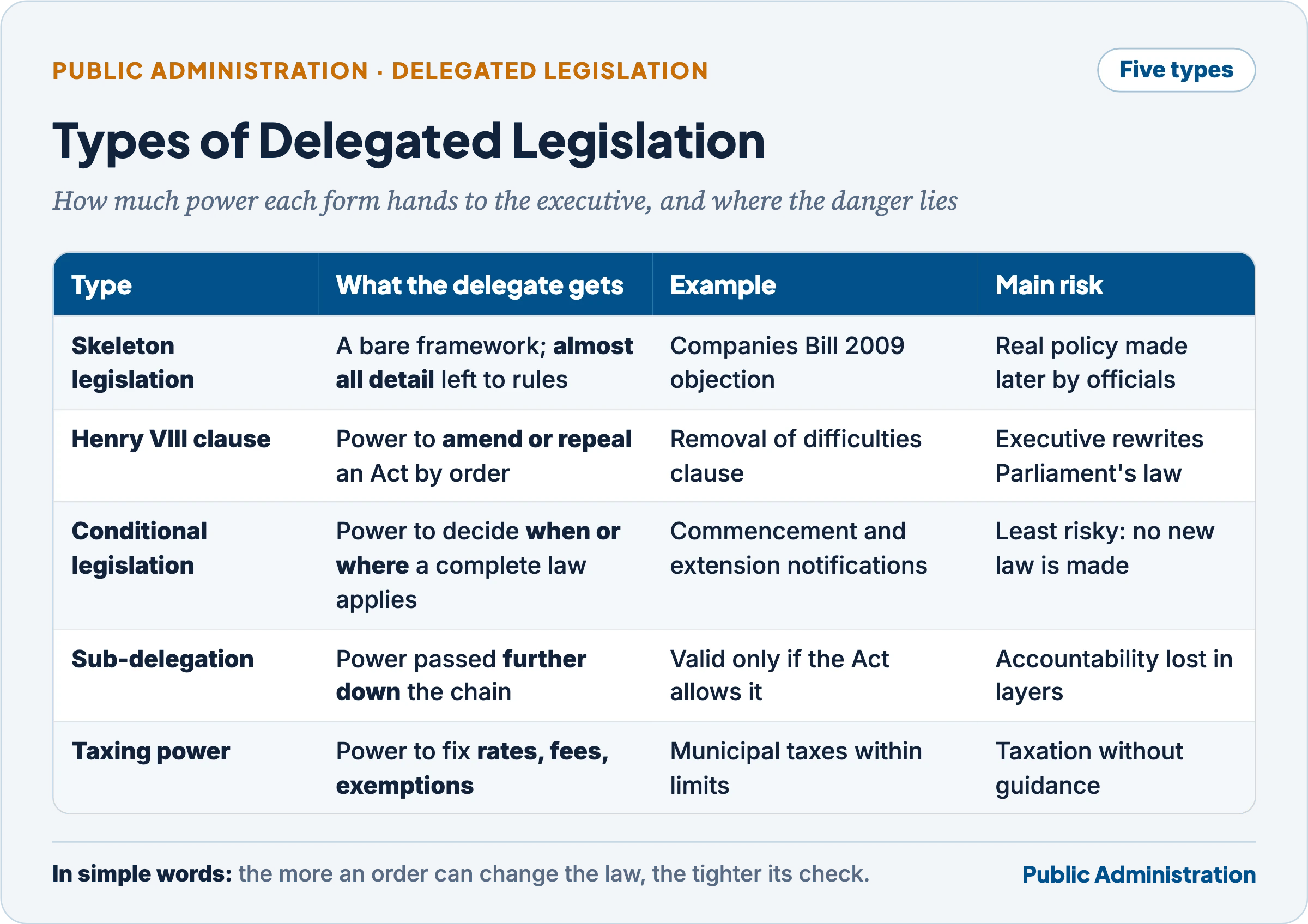
- Skeleton (framework) legislation
- The Act contains little more than a framework of principles; almost everything is left to rules.
- Why used: fast-changing or highly technical fields; politically quick enactment.
- Risk: Parliament approves a blank cheque; the real policy is made later by the executive. The UK House of Lords’ Delegated Powers and Regulatory Reform Committee and Secondary Legislation Scrutiny Committee reported in 2021 that skeleton Bills were “rarely justified” and that the Brexit and Covid years had made the trend worse.
- Indian illustration: the Standing Committee on Finance found excessive delegation in the Companies Bill, 2009 because substantive provisions had been left to rules, and asked that they be written into the Bill.
- Henry VIII clause
- A provision that lets the executive amend or repeal the parent Act or other Acts by order. It is named after the Statute of Proclamations, 1539, which allowed the King’s proclamations to have the force of statute.
- Common Indian form: the removal of difficulties clause, which allows the government to make orders, not inconsistent with the Act, to remove difficulties in giving effect to it. Modern Acts limit such orders to a fixed period after commencement (often two or three years) and require them to be laid before Parliament. Article 392 of the Constitution gave the President a similar power for the transition to the new Constitution.
- Judicial view: in Jalan Trading Co. v Mill Mazdoor Sabha (AIR 1967 SC 691) the Supreme Court struck down section 37 of the Payment of Bonus Act, 1965, which let the government make orders to remove doubts or difficulties and made them final, as excessive delegation: it handed the executive the power to decide what the Act meant.
- Conditional (contingent) legislation
- The legislature makes a complete law but leaves to the executive the decision when, where or whether it will apply, on the existence of certain facts.
- Classic authority: Queen v Burah (1878), where the Privy Council upheld a law that let the Lieutenant-Governor of Bengal decide when to extend it to the Garo Hills.
- Indian examples: notifications bringing an Act into force, extending it to an area, or declaring an area to be a town area. In Tulsipur Sugar (1980) such a declaration was held to be conditional legislation, needing no prior hearing.
- Why it matters: the delegate makes no new law; it only applies the legislature’s law to facts. Courts therefore treat it more leniently than true rule-making.
Common confusion
Is conditional legislation the same as delegated legislation? Not quite. In conditional legislation the law is complete when it leaves the legislature; the executive only decides the condition that triggers it (a date, an area, a state of facts). In delegated legislation the executive adds content: it writes rules that the Act left unwritten. The line is fine, and Indian courts often discuss the two together, but conditional legislation involves no transfer of law-making power, so it is rarely struck down for excessive delegation.
3.2 Sub-delegation
- Meaning: the delegate passes its power further down: Parliament to the Central Government, the Central Government to a State Government or an officer, and so on.
- Rule: delegatus non potest delegare, a delegate cannot delegate. Sub-delegation is valid only if the parent Act expressly or by necessary implication permits it. In Sahni Silk Mills v Employees’ State Insurance Corporation (1994) the Supreme Court applied this rule to a power that had been passed on without such authority.
- Why it is risky: each layer moves law-making further from Parliament and makes accountability harder to trace (Parliament to minister to department to an expert group). The UK Lords’ 2021 report called this “tertiary legislation” and judged it “potentially a more egregious erosion of democratic accountability” than ordinary delegation.
- The Lok Sabha Committee on Subordinate Legislation has recommended that safeguards be built in before a delegate is given wide powers to sub-delegate.
3.3 Delegation of taxing and fee-fixing power
- Principle: taxation is the core of legislative power (Article 265: no tax except by authority of law), so courts look hard at delegation in this field.
- What may be delegated: fixing rates within limits, granting exemptions, and the details of assessment and collection, provided the Act lays down policy and guidance.
- What may not: handing over the choice of whether and on whom to tax without any guidance.
- Leniency for elected local bodies: courts allow wider delegation to municipal bodies, because they are representative, answerable to their voters and need revenue for statutory duties (Corporation of Calcutta v Liberty Cinema (1965), Municipal Corporation of Delhi v Birla Cotton Mills (1968), Avinder Singh (1978)).
- The leading taxing cases are discussed in Section 4.
3.4 Other classifications
| Basis | Types | Note |
|---|---|---|
| By function | Supplementary (fills in details), interpretative (clarifies the Act), contingent (applies the Act on facts) | A common academic grouping |
| By authority | Central Government, State Governments, statutory regulators, local bodies, courts (rules of procedure), universities | Regulators such as SEBI and RBI now make a large share |
| By source | Under an Act; under the Constitution | Article 309, 77(3), 145 and 118 rules are constitution-based |
| By control | Laid simply; subject to negative resolution; subject to affirmative resolution; laid in draft | See Section 5.1 |
| By character | Normal (procedure, forms, fees) and exceptional (power to tax, to amend Acts, to bar courts, to act retrospectively) | The Donoughmore Committee’s distinction, still used in Bill memoranda |
4. Limits of Delegation: Excessive Delegation and Essential Legislative Functions
In simple words
A manager may ask an assistant to plan the office party, but cannot tell the assistant “decide whether we should even stay in business”. Some decisions belong to the person who was given the job. In law, the decisions that belong only to the legislature are called its essential legislative functions.
4.1 The basic doctrine
- No express clause: the Indian Constitution does not mention delegated legislation. The limits are judge-made, drawn from the scheme of Articles 245 and 246 (the legislature is given the power to make laws) and from the idea that a power given by the people’s Constitution to the legislature cannot be abdicated.
- Essential legislative functions that cannot be delegated:
- Determining the legislative policy and formulating it as a binding rule of conduct.
- Laying down standards or guidelines for the delegate.
- Repealing or materially altering existing law, changing the policy of an Act, or giving rules retrospective effect without authority.
- What can be delegated: the details needed to carry the policy into effect, the power to bring an Act into force, to apply it to areas or classes, to fix rates within guidance, and to modify an Act without touching its essential policy.
- Effect of excess: if the parent Act confers power without policy or guidance, the Act itself is struck down for excessive delegation. If the Act is valid but the rule goes beyond it, the rule is struck down as ultra vires.
4.2 The leading cases
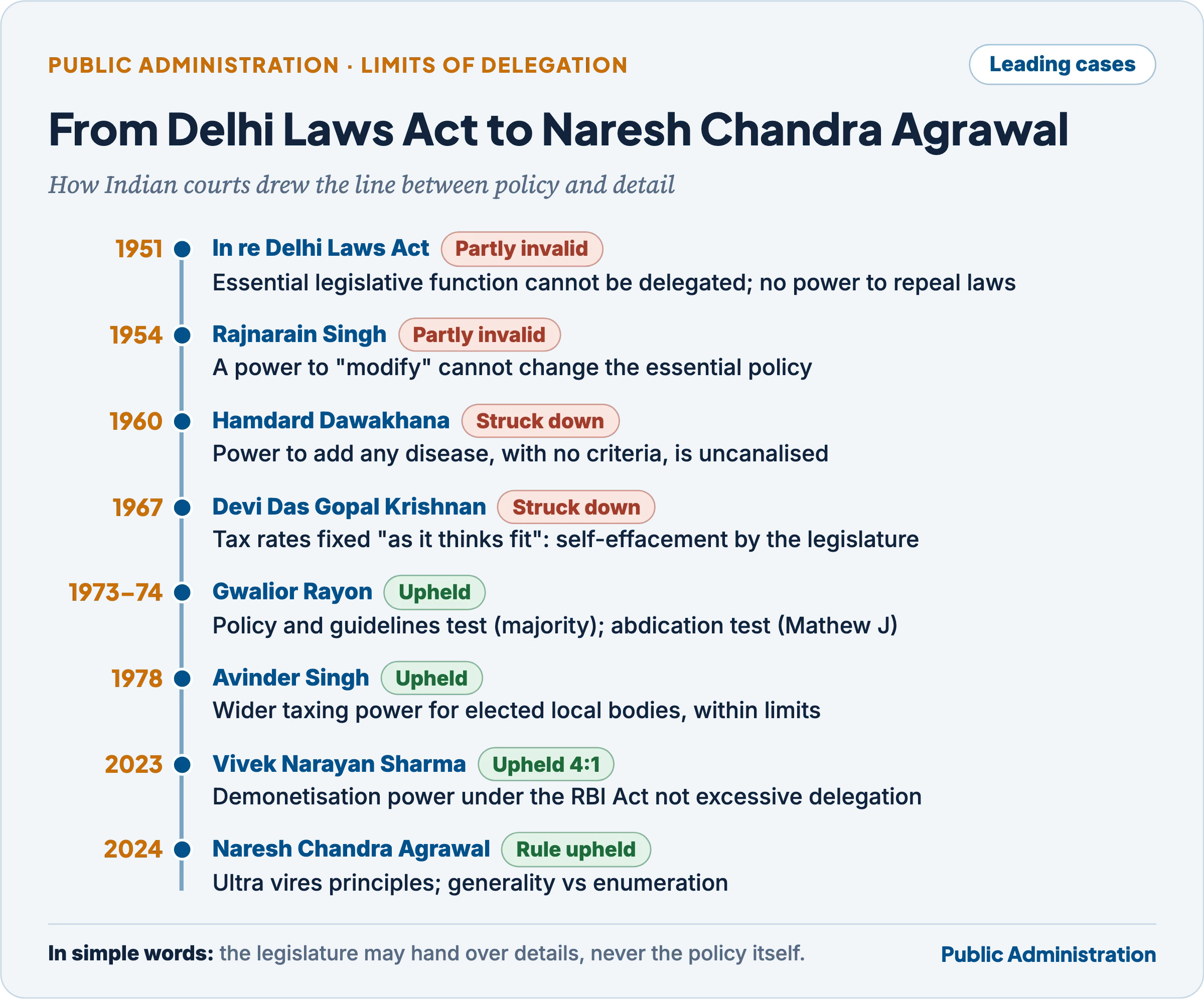
The Indian law was built in a sequence of cases. The table gives each case, and the text below explains what it settled.
In re Delhi Laws Act (1951)
- Setting: the first presidential reference under Article 143, heard by a seven-judge bench. It concerned laws that let the government extend to Delhi and other areas laws in force in any province, “with such restrictions and modifications as it thinks fit”, and, in one provision, to repeal or amend existing laws in those areas.
- Views: the judges wrote seven opinions. Broadly, they agreed that the legislature may delegate but must not abdicate or efface itself; Justice Mukherjea put it most clearly: the legislature must retain the essential legislative function, which consists in declaring the policy and laying down the standard, and may delegate only what is ancillary.
- Holding: the power to extend laws with restrictions and modifications was valid; the power to repeal or amend laws already in force was invalid, because it touched the essential legislative function.
- Significance: the foundation of the Indian doctrine. Later cases repeatedly return to Mukherjea’s test.
Rajnarain Singh v Chairman, Patna Administration Committee (1954)
- A power to extend an enactment “with such restrictions and modifications” as the government thought fit was used to apply a section of a municipal law while changing its policy.
- Holding: a power to modify does not include a power to alter the essential policy of the law extended. The notification was struck down to that extent.
- Lesson: “modification” means adjustment to local conditions, not a change of principle.
Harishankar Bagla v State of Madhya Pradesh (1954)
- The Essential Supplies (Temporary Powers) Act, 1946 let the government make orders regulating essential commodities, and gave those orders effect notwithstanding other laws.
- Holding: upheld. The Act’s preamble and scheme supplied enough policy (securing equitable distribution and availability at fair prices), and the order did not repeal other laws but only overrode them while in force.
- Lesson: courts look for policy in the preamble, objects and scheme of the Act, not only in the section that delegates.
Hamdard Dawakhana v Union of India (1960)
- The Drugs and Magic Remedies (Objectionable Advertisements) Act, 1954 banned advertisements of drugs for listed diseases, and section 3(d) let the government add any other disease to the list.
- Holding: section 3(d) was struck down as excessive delegation. The Act laid down no criteria for choosing diseases; the government could extend a criminal prohibition to any disease at will.
- Lesson: an uncanalised and uncontrolled power, especially one that extends criminal liability, will not survive.
Devi Das Gopal Krishnan v State of Punjab (1967)
- Section 5 of the East Punjab General Sales Tax Act, 1948 let the State Government fix sales tax “at such rates as it thought fit”.
- Holding: struck down. Chief Justice K. Subba Rao held that the needs of the State and the purposes of the Act gave no real guidance for fixing rates. He warned that an overburdened legislature, or one controlled by a powerful executive, may confer arbitrary power on the executive to change its policy “without reserving for itself any control”; such self-effacement is beyond the permissible limits of delegation.
- Lesson: rate-fixing can be delegated, but only with guidance.
Gwalior Rayon Silk Mfg. v Assistant Commissioner of Sales Tax (decided December 1973; reported 1974)
- Section 8(2)(b) of the Central Sales Tax Act, 1956 fixed the central sales tax on certain inter-State sales at 10 per cent or the local sales tax rate of the State, whichever was higher, so Parliament did not fix the final rate itself.
- Holding: upheld, with two lines of reasoning.
- Policy and guidelines test (majority, Justice H.R. Khanna): there was a clear policy, that the central rate should never be lower than the local rate (to prevent evasion and diversion of trade). The legislature must lay down guidelines, principles or policy for the delegate; here it had.
- Abdication test (Justice K.K. Mathew, concurring): delegation is valid so long as the legislature retains control and can repeal or withdraw the power; only a total surrender is invalid.
- Significance: the policy and guidelines test became the governing standard; the abdication test was not adopted, because a legislature that can always repeal would then be free to delegate anything.
Avinder Singh v State of Punjab (1978)
- The Punjab Municipal Corporation Act allowed corporations to levy certain taxes within limits.
- Holding (Justice V.R. Krishna Iyer): upheld. The legislature cannot efface itself, but it may delegate taxing power to elected local bodies if it fixes the taxes, their maximum rates and the purposes, and keeps supervisory control.
- Lesson: the character of the delegate matters: more latitude for representative bodies than for officials.
Recent decisions
- Vivek Narayan Sharma v Union of India (2023), the demonetisation case: a five-judge bench held by 4:1 that the power under section 26(2) of the RBI Act, 1934, to declare any series of bank notes to cease to be legal tender, did not suffer from excessive delegation, because the Act and its working with the RBI supplied the policy and safeguards. Justice B.V. Nagarathna, dissenting, held that demonetisation of all series of notes should have been done by legislation or an ordinance, not by a notification.
- Naresh Chandra Agrawal v Institute of Chartered Accountants of India (8 February 2024): the Supreme Court summarised the principles for judging whether a rule is ultra vires its parent Act:
- A rule-making body has no inherent power; it must stay within the statute.
- Ultra vires may arise from excess of power, inconsistency with the Act, or non-compliance with mandatory procedure.
- The court identifies the source of power, the meaning of the rule, and whether the rule falls within the delegated power.
- Generality vs enumeration: where an Act gives a general power and then lists particular matters “without prejudice to the generality” of it, the list is illustrative; a rule outside the list can still be valid under the general power if it serves the object of the Act.
| Case | Year | Test or principle | Outcome |
|---|---|---|---|
| In re Delhi Laws Act | 1951 | Essential legislative function; no abdication | Power to repeal existing laws invalid |
| Rajnarain Singh | 1954 | “Modify” cannot change essential policy | Notification partly invalid |
| Harishankar Bagla | 1954 | Policy may be found in preamble and scheme | Upheld |
| Hamdard Dawakhana | 1960 | No criteria = uncanalised power | Section 3(d) struck down |
| Devi Das Gopal Krishnan | 1967 | Rate-fixing needs guidance; no self-effacement | Section 5 struck down |
| Gwalior Rayon | 1973–74 | Policy and guidelines test (majority) vs abdication test (Mathew J) | Upheld |
| Avinder Singh | 1978 | Wider latitude for elected local bodies | Upheld |
| Vivek Narayan Sharma | 2023 | Policy read from the RBI Act’s scheme | Upheld (4:1) |
| Naresh Chandra Agrawal | 2024 | Generality vs enumeration | Rule upheld |
The arc is clear: Indian courts accept wide delegation and strike down an Act only when it gives the executive power without any discernible policy. They read policy generously from the preamble, scheme and object of the Act. The real working check has therefore shifted from “Is the delegation excessive?” to “Has the rule stayed within the Act and the Constitution?”, which is the subject of judicial control (Section 5.2).
Indian Connect — Essential legislative function in today’s laws
- The Supreme Court’s caution in Hamdard and Devi Das shows up in modern drafting: Acts now usually list heads on which rules may be made, state the objects of the law, and cap rates or penalties.
- The Lok Sabha Committee on Subordinate Legislation has repeatedly said that substantive matters, such as the power to levy fees, to recover dues as arrears of land revenue, or to give retrospective effect, must be in the Act, not left to rules.
- Under Rule 70 of the Lok Sabha’s Rules of Procedure, every Bill that delegates legislative power must carry a memorandum explaining the delegation, its scope, and whether it is of a normal or exceptional character. The Committee has held this requirement to be mandatory.
5. Controls over Delegated Legislation
In simple words
Lending power is safe only if someone checks how it is used. Parliament watches the rules it allowed, courts cancel rules that break the law, and fair procedure lets the public see and comment on rules before they bind.
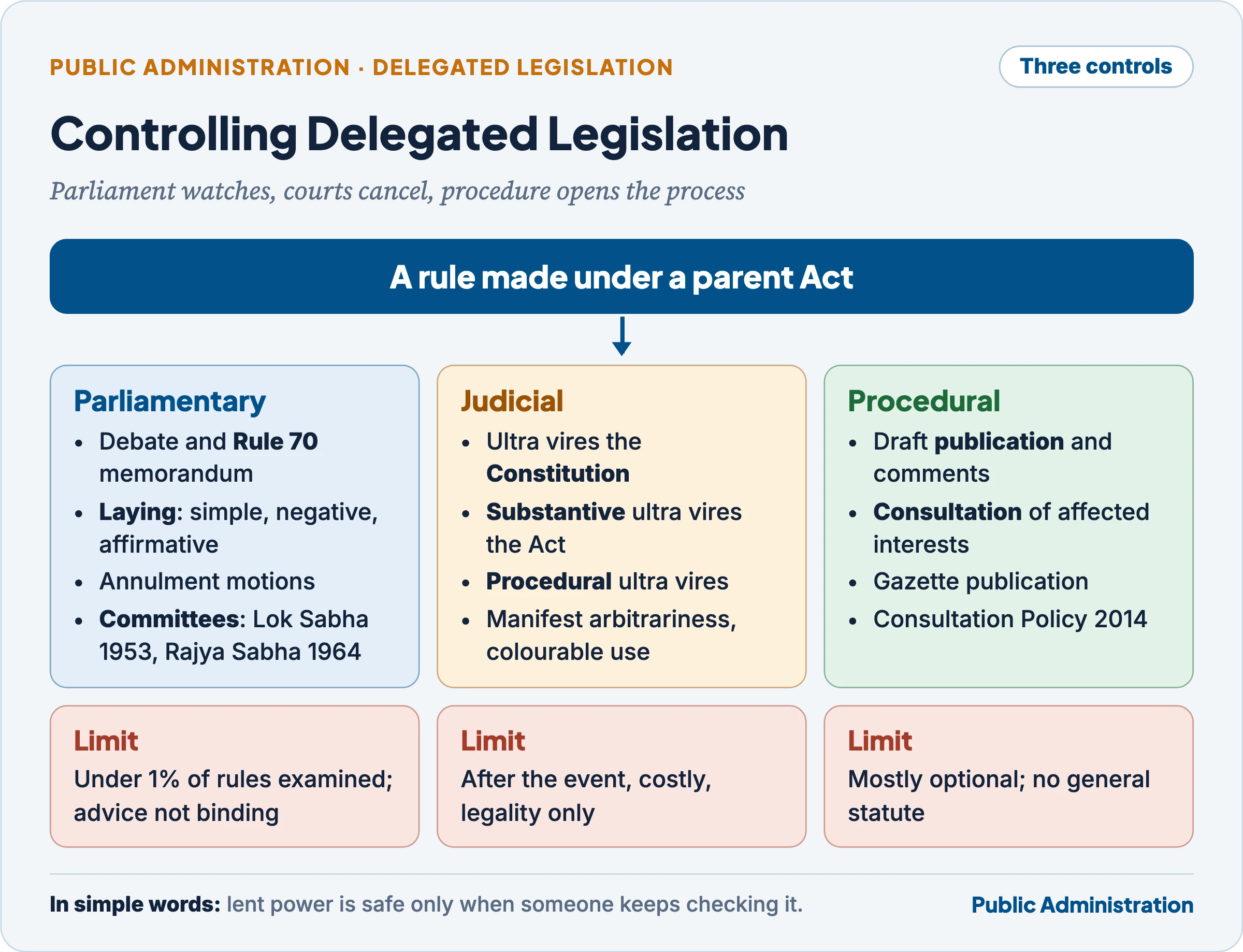
Because delegation cannot be avoided, the debate turns on control. Three kinds of control work together: parliamentary (before and after rules are made), judicial (when a rule is challenged) and procedural (consultation and publication while a rule is being made).
5.1 Parliamentary control
In simple words
The person who lends you a car keeps the right to check how you drive it. Parliament lends its law-making power to the government, so it keeps the right to see every rule, to change or cancel it, and to ask questions about it.
Stage 1: At the time of delegation
- Debate on the Bill: members can question the breadth of rule-making clauses. The Rule 70 memorandum tells them what is being delegated.
- Departmentally Related Standing Committees examine Bills and can object to excessive delegation, as the Finance Committee did on the Companies Bill, 2009.
- Committee examination of Bills: the Speaker may refer a Bill with delegation clauses to the Committee on Subordinate Legislation, which can report, before the Bill is considered, that a delegation should be cut down or amended.
Stage 2: Laying on the table
- Meaning: the parent Act requires the rules to be laid before each House. Laying gives Parliament knowledge of the rules and the chance to act on them.
- Kinds of laying (the classification used in Britain and adopted in Indian Acts):
| Kind | What happens | Strength of control |
|---|---|---|
| Simple laying | Rules laid for information only; no procedure to annul | Weakest |
| Negative resolution | Rules take effect at once, but either House may annul or modify them within a fixed period | Most common in India |
| Affirmative resolution | Rules do not take effect (or cease to have effect) unless approved by resolution | Strongest; used for sensitive powers |
| Laying in draft | Draft rules laid before they are made, subject to approval or disapproval | Gives Parliament a say before the rule binds |
- The standard Indian clause: most Acts provide that every rule shall be laid, as soon as may be after it is made, before each House for a total of 30 days (in one session or two successive sessions); if both Houses agree to modify or annul it before the end of the next session, the rule has effect only in modified form or not at all, without affecting anything already done under it.
- Time limit for laying: the Ministry of Parliamentary Affairs’ Manual of Parliamentary Procedures requires rules to be laid within 15 days of publication if Parliament is in session, or within 15 days of the start of the next session; late laying must carry a statement of reasons.
- No general statute: unlike Britain, India has no single Act on laying; each parent Act carries its own clause. The Lok Sabha Committee pressed from the 1950s for uniform laying provisions, and the Law Commission’s 14th Report (1958) noted this recommendation.
Stage 3: Motions, questions and debate
- Statutory motion: a member may move to annul or modify a rule within the laying period. In the 2012 Budget Session, motions were moved in the Rajya Sabha to annul the Information Technology (Intermediaries Guidelines) Rules, 2011 and to modify airport development fee rules; both were discussed and withdrawn after ministerial assurances.
- Questions: rules can be raised in Question Hour, though this is rarely used for rules.
Stage 4: Committees on Subordinate Legislation
- Lok Sabha: first constituted in December 1953; governed by Rules 317–322 and Directions 103–108 of the Speaker; up to 15 members nominated by the Speaker; no minister may be a member; term one year.
- Rajya Sabha: first constituted on 30 September 1964; governed by Rules 204–212; 15 members nominated by the Chairman; its scope was widened in 1972 to cover rules made under the Constitution.
- What the committees examine (Lok Sabha Rule 320; Rajya Sabha Rule 209 is near-identical). Whether a rule:
- accords with the Constitution or the parent Act;
- contains matter that should properly be in an Act of Parliament;
- imposes a tax;
- directly or indirectly bars the jurisdiction of courts;
- gives retrospective effect without express power;
- involves expenditure from the Consolidated Fund or public revenues;
- makes some unusual or unexpected use of the power conferred;
- shows unjustifiable delay in publication or laying;
- needs elucidation in form or purport.
- Scope: the committees examine all “orders”, whether laid or not, and also watch delays in framing rules. They do not judge the policy merits; they judge legality and propriety.
- Standing recommendations of the committees (now largely in the Manual of Parliamentary Procedures):
- Rules should be framed within six months of the Act coming into force; extensions only from the committees, three months at a time, with reasons.
- Draft rules published for comment should allow at least 30 clear days, and final rules should follow within three months of comments.
- Rules must not impose fees or charges without express authority, must not be retrospective without express authority, must not bar the courts, must respect natural justice, and should avoid vague expressions.
- Rules laid should carry a statement of objects and reasons and explanatory notes; amendments should be laid with the relevant extracts of the original rules.
- Ministries should send quarterly reports on pending rules; the Cabinet Secretary should call Secretaries to explain delays (Rajya Sabha Committee, 2016).
How effective is parliamentary control?
- Volume beats capacity: of 4,731 rules and regulations laid in the 15th Lok Sabha (June 2009 to September 2012), the Lok Sabha committee examined 40, less than 1 per cent; 552 (11.7 per cent) were laid late (PRS, 2012).
- Recommendations are advisory. In its 21st Report (December 2011) the Lok Sabha committee complained of the “non-implementation of oft-repeated recommendations” and said the Ministry of Parliamentary Affairs had failed as the nodal agency; it asked for law officers in every ministry to cut delays.
- Chronic delays in framing rules: in December 2023 the Rajya Sabha committee, chaired by Laxmikant Bajpayee, found that ministries treated rule-making “in a very casual manner”. Its examples included State rules under the National Food Security Act, 2013 still pending a decade later, rules under the Arbitration and Conciliation (Amendment) Act stalled for four years, the Petroleum and Natural Gas Regulatory Board Act, 2006, statutes of central universities created in 2006–2009, and the AYUSH commissions of 2020. It noted that without rules, “the Acts cannot be operated”.
- Structural weaknesses:
- Members are generalists with little legal staff; the committees work part-time.
- Party discipline means a ruling majority rarely annuls its own government’s rules, and statutory motions usually end in withdrawal after a minister’s assurance, as in 2012.
- Laying is after the event: rules are already in force, often for months, before anyone examines them.
- Annulment is all or nothing in practice; a House cannot redraft a technical rule on the floor.
- The committees cannot examine merits, so a lawful but unwise rule passes.
- Value despite weaknesses: the committees’ constant pressure produced the six-month rule, the 15-day laying rule, the 30-day comment rule and the practice of explanatory notes. Their reports also deter ministries, since an adverse report embarrasses a department. Mavalankar called the committee the custodian that keeps the administration within the bounds Parliament intended.
5.2 Judicial control
In simple words
If a referee makes a rule the tournament charter never allowed, a player can ask the appeals panel to cancel it. Courts are that appeals panel for rules: they cannot ask whether a rule is wise, only whether it is allowed.
Grounds of challenge
The Supreme Court in State of Tamil Nadu v P. Krishnamurthy (2006) listed the grounds on which subordinate legislation can be challenged; the cases below show each ground at work.
- Ultra vires the Constitution
- The rule violates a fundamental right (Part III) or another constitutional provision, or the parent Act itself lacks legislative competence.
- Example: in Kunal Kamra v Union of India (Bombay High Court, September 2024), the 2023 amendment to Rule 3(1)(b)(v) of the IT Rules, 2021, which let a government fact-check unit flag “fake, false or misleading” information about the business of the Central Government, was struck down. The deciding judge, Justice A.S. Chandurkar, after a split between two judges, held it violated Articles 14, 19(1)(a) and 19(1)(g), used vague terms, and went beyond the IT Act. The Supreme Court had already stayed the notification of the unit in March 2024; the Union’s appeal is before the Supreme Court.
- Parent Act itself invalid
- If the Act delegates without policy (excessive delegation), every rule under it falls (Hamdard, Devi Das).
- Substantive ultra vires (beyond the parent Act)
- The rule goes beyond the scope of the delegated power, conflicts with the Act, or adds what the Act did not permit (a new offence, a fee, a disqualification).
- Test: the three-step inquiry and the generality-vs-enumeration principle of Naresh Chandra Agrawal (2024).
- Procedural ultra vires
- The rule-maker ignores a mandatory procedure the Act requires: prior publication of a draft, consultation with a named body, approval of a superior authority, or publication in the Gazette.
- Courts distinguish mandatory from directory steps; failing a mandatory step voids the rule.
- Publication is essential in any case: in Harla v State of Rajasthan (1951) the Supreme Court held that a law (the Jaipur Opium Act) never properly published could not bind anyone; natural justice requires that people be able to know the law.
- Manifest arbitrariness and unreasonableness
- A rule can be struck down under Article 14 if it is manifestly arbitrary or unreasonable in a way the legislature could never have intended. In Indian Express Newspapers v Union of India (1985) the Court held that subordinate legislation can be questioned on any ground on which plenary legislation can be, and additionally on the ground that it does not conform to the parent Act or is manifestly arbitrary; but it cannot be struck down merely because a court thinks it unwise.
- Mala fides and colourable exercise
- A rule made for a purpose foreign to the Act, or to achieve indirectly what the Act does not allow directly, is a colourable exercise of power and is invalid.
- Mala fides in the sense of personal bad faith is rarely proved against general rules, because they are legislative acts made by a collective authority; courts more often find improper purpose or irrelevant considerations.
- Colourable legislation in the strict sense is a doctrine about the legislature’s own competence (doing under one entry what belongs to another); applied to rules, it becomes the doctrine of colourable exercise of power.
- Other recognised defects
- Retrospective effect without express authority in the Act.
- Ousting the courts: a rule cannot bar judicial review.
- Sub-delegation without authority (Sahni Silk Mills).
- Henry VIII-type finality clauses that let the executive decide what the Act means (Jalan Trading).
How courts approach rules
- Presumption of validity: rules are presumed valid; the challenger must show the defect.
- Reading down: a court prefers to interpret a rule narrowly so that it stays within the Act, rather than strike it down.
- No hearing before rule-making: natural justice does not apply to legislative acts (Tulsipur Sugar), though the Act may require consultation.
- Interim relief: courts may stay contested rules. In August 2021 the Bombay High Court stayed Rule 9(1) and 9(3) of the IT Rules, 2021, which subjected digital news publishers to a code of ethics and a three-tier oversight structure, on the ground that they prima facie went beyond the IT Act and chilled free speech.
Limits of judicial control
- It is reactive: a rule operates until someone challenges it.
- It is costly and slow; ordinary citizens rarely litigate.
- It is legality-only: courts do not review the wisdom or efficiency of a rule.
- Courts are deferential in economic and technical fields, and the excessive-delegation doctrine has struck down few statutes since the 1960s.
5.3 Procedural control
In simple words
Before a housing society changes its parking rules, it should put up a notice, hear the residents and publish the final rule on the board. Procedural control asks the government to do the same before a rule binds the public.
- Prior publication of drafts: where an Act requires rules to be made “after previous publication”, section 23 of the General Clauses Act, 1897 requires the draft to be published, objections and suggestions invited by a specified date, and the government to consider them before finalising. Most Indian Acts, however, do not require prior publication.
- Consultation with affected interests or expert bodies: some Acts name bodies that must be consulted (for example a board or council); others leave consultation to the government’s discretion. The Donoughmore Committee and Griffith and Street both saw consultation as the main substitute for parliamentary debate on details.
- Publication after making: rules are published in the Gazette; publication fixes the date of operation and makes the law knowable (Harla). The Lok Sabha committee has said all statutory rules must be published.
- Explanatory memoranda: rules should come with objects and reasons and plain-language notes.
- Pre-Legislative Consultation Policy, 2014
- Decided by the Committee of Secretaries under the Cabinet Secretary on 10 January 2014 and circulated by the Legislative Department, on the recommendations of the National Advisory Council and the National Commission to Review the Working of the Constitution.
- Ministries should place draft legislation, or at least its justification, essential elements, financial implications and impact on rights, livelihoods and environment, in the public domain for at least 30 days.
- The policy “should also guide and govern the handling of subordinate legislations“; new Acts should, as a practice, provide for previous publication of rules; every draft law or rule should carry an explanatory note in simple language; a summary of feedback should be published; the Law Ministry should check compliance when vetting.
- Weakness: it is an executive policy, not a law. A ministry may skip it by recording reasons in the Cabinet note, and compliance is uneven.
- Good practice abroad: the UK Statutory Instruments Act, 1946 and the US Administrative Procedure Act, 1946 (notice-and-comment rule-making under section 553) put these duties into a general statute (Section 7.5).
Indian Connect — Consultation in recent Indian rule-making
- The Digital Personal Data Protection Rules, 2025 were notified in November 2025 after draft rules were opened to public consultation; the government reported 6,915 inputs received. The Rules phase in obligations over 18 months.
- The draft rules under the four Labour Codes were published for comment several times between 2020 and 2025; the final central rules were notified on 8 May 2026.
- By contrast, the 2023 fact-check unit amendment to the IT Rules and some Covid-era orders were made with little or no prior consultation, and both drew court challenges.
6. Ordinances and Other Forms of Executive Law-Making
In simple words
Delegated legislation is the government filling in the blanks Parliament left. An ordinance is the government writing a whole new page while Parliament is away. Both let the executive make law, but an ordinance is far more powerful.
- Article 123 lets the President promulgate an ordinance when either House is not in session and he is satisfied that circumstances require immediate action; Article 213 gives Governors the same power. An ordinance has the force of an Act and must be laid before Parliament; it lapses six weeks after Parliament reassembles unless replaced by an Act.
- Judicial limits:
- R.C. Cooper v Union of India (1970) treated ordinance-making as legislative power subject to the same limits as an Act.
- The 38th Amendment (1975) made the President’s satisfaction final; the 44th Amendment (1978) removed that clause, restoring review.
- D.C. Wadhwa v State of Bihar (1987) condemned the Bihar practice of re-promulgating ordinances for years without placing them before the legislature as a “fraud on the Constitution”.
- Krishna Kumar Singh v State of Bihar (2017), a seven-judge bench, held that re-promulgation is a fraud on the Constitution, that the satisfaction behind an ordinance is open to judicial review, and that failure to lay an ordinance before the legislature is a serious constitutional infraction.
- Why ordinances need restraint: they bypass debate, committee scrutiny and the second chamber; frequent ordinances suggest that the executive is using a power meant for emergencies as a routine legislative route, which is the same danger Hewart saw in delegated legislation, in sharper form.
- Other executive law-making: executive instructions under Articles 73 and 162, guidelines with binding effect, and “disguised legislation” such as protocols, codes and directions. The UK Lords’ 2021 reports called disguised legislation “perhaps the most striking and disturbing recent development”.
7. Merits, Dangers and the Rise of Executive Law-Making
In simple words
A good assistant saves the boss time and knows the details better. A bad or over-trusted assistant ends up running the office without anyone noticing. Delegated legislation can be either; what decides it is how closely it is watched.
7.1 Merits
- Saves legislative time for policy and principle.
- Brings expertise to technical subjects (standards, tariffs, safety norms).
- Flexibility and speed in a changing economy and in emergencies.
- Experimentation: rules can be piloted and revised.
- Local adaptation through bye-laws.
- Consultation with affected groups is easier than in a full House.
- Less partisan conflict over technical details, which are settled by administrators rather than fought over on the floor.
- Makes laws implementable: an Act without rules is often a dead letter.
7.2 Dangers
- Democratic deficit: law is made by unelected officials, often in private, without the debate an Act receives. Liberal critics of the rule of law drew exactly this line: a law is passed by Parliament after full debate, while a regulation, however wise, is drafted in a department and may be signed by a fairly junior official.
- The “new despotism”: power concentrates in the executive, which both makes and enforces the law, blurring the separation of powers.
- Weak scrutiny: the volume and technicality of rules defeat parliamentary control; less than one per cent are examined in committee.
- Layers of delegation make accountability hard to trace (Parliament to minister to department to agency).
- Policy by rule: skeleton Acts let the executive make the real policy later; Henry VIII clauses let it amend Acts.
- Threat to rights: vague rules can restrict speech, trade or liberty (the fact-check unit), and unguided powers can extend criminal liability (Hamdard).
- Political misuse: rules can be timed or shaped for short-term political advantage.
- Uncertainty and instability: frequent changes to rules make the law hard to know; citizens and even lawyers struggle to keep up.
- Delay as a hidden veto: by not framing rules, the executive can keep an Act passed by Parliament from operating.
7.3 Indian cases of executive law-making
Digital regulation through rules
- The Information Technology (Intermediary Guidelines and Digital Media Ethics Code) Rules, 2021, made under section 87 of the IT Act, 2000, extended obligations to social media platforms and created an ethics code and grievance structure for digital news and OTT publishers, a field the IT Act did not expressly address. Parts were stayed by the Bombay and Madras High Courts in 2021.
- The 2023 amendment creating a government fact-check unit was struck down by the Bombay High Court in September 2024 (Section 5.2).
- Further amendments came by rule, not by Act:
- 22 October 2025 (in force 15 November 2025): reasoned takedown intimations under Rule 3(1)(d) may come only from specially authorised senior officers (for the police, not below DIG rank).
- 10 February 2026 (in force 20 February 2026): rules on synthetically generated information (deepfakes), labelling duties for platforms, and a cut in the takedown window after actual knowledge from 36 hours to 3 hours.
- Issue: major choices about speech online are being made through delegated legislation under a 2000 Act, with limited parliamentary debate.
Covid-19 and emergency rule-making
- On 24 March 2020 the National Disaster Management Authority, using section 6(2)(i) of the Disaster Management Act, 2005, directed measures to contain Covid-19, and the Union Home Secretary, as Chairperson of the National Executive Committee, issued the national lockdown order under section 10(2)(l), initially for 21 days.
- States used section 2 of the Epidemic Diseases Act, 1897 to frame regulations on testing, quarantine and movement. The Act was amended in 2020, first by ordinance and then by the Epidemic Diseases (Amendment) Act, 2020, to protect health workers against violence.
- Assessment: the orders showed the speed that delegated powers allow in an emergency. They also showed the dangers: nationwide restrictions on movement, trade and livelihoods were imposed by executive orders under a disaster law never designed for a pandemic, with Parliament not sitting and no laying or committee scrutiny at the time.
Demonetisation by notification
- The 8 November 2016 demonetisation of ₹500 and ₹1,000 notes was done by a notification under section 26(2) of the RBI Act, upheld in Vivek Narayan Sharma (2023); the dissent argued that a measure of this scale belonged to Parliament.
Delays in framing rules
- Citizenship (Amendment) Act, 2019: in force from January 2020; rules notified only on 11 March 2024, after repeated extensions granted by the parliamentary committees.
- Labour Codes: the Code on Wages (2019) and the other three Codes (2020) were brought into force on 21 November 2025; the final central rules were notified on 8 May 2026, about six years after Parliament passed them.
- Digital Personal Data Protection Act, 2023: assented to in August 2023; rules notified in November 2025, with most duties operative only 18 months later.
- Older pattern: PRS found that the Clinical Establishments Act, 2010 had no rules 27 months after passage, and the Civil Liability for Nuclear Damage Act, 2010 waited 15 months.
- Why it matters: the Manual allows six months. Long delays mean that the executive, not Parliament, decides when a law takes effect, a quiet transfer of power that laying and judicial review cannot touch.
Criticism — The case against wide delegated legislation
- Hewart: wide rule-making powers create a “new despotism” of officials beyond the control of Parliament and the courts.
- Democratic theory: laws binding citizens should be made by their elected representatives after open debate; rules are drafted inside ministries.
- Evidence of weak scrutiny: less than 1 per cent of rules are examined by Parliament’s committees; annulment motions rarely succeed.
- Rights at risk: vague rules on speech and online content (the fact-check unit, the digital media code) show how a rule can restrict fundamental rights without a debate.
- Executive control of timing: years of delay in framing rules (CAA, Labour Codes, DPDP) let the executive suspend the will of Parliament.
- Emergency creep: Covid-era orders and demonetisation show that sweeping national measures can be taken by notification.
Defence — The case for delegated legislation, properly controlled
- Inevitability: no legislature can write the volume and technical detail a modern state needs; the Supreme Court called delegation a “practical necessity” of the welfare state (Gwalior Rayon).
- Robson and the Donoughmore Committee: the answer to abuse is structured delegation with safeguards, not its abolition.
- Layered checks: essential legislative functions cannot be delegated; rules must stay within the Act and the Constitution; courts strike down excess (Hamdard, Devi Das, Kunal Kamra).
- Consultation can make rules more democratic than Acts: draft rules can be opened to the whole public (6,915 inputs on the DPDP Rules), which a floor debate cannot match.
- Flexibility saves lives and money: emergencies, markets and technology move faster than Bills.
- Synthesis: delegated legislation is legitimate when Parliament sets clear policy, the rule-making process is open, Parliament can see and stop the rules, and the courts can strike them down; the reform task is to strengthen each of these links.
8. Comparative Perspective: UK, USA and India
In simple words
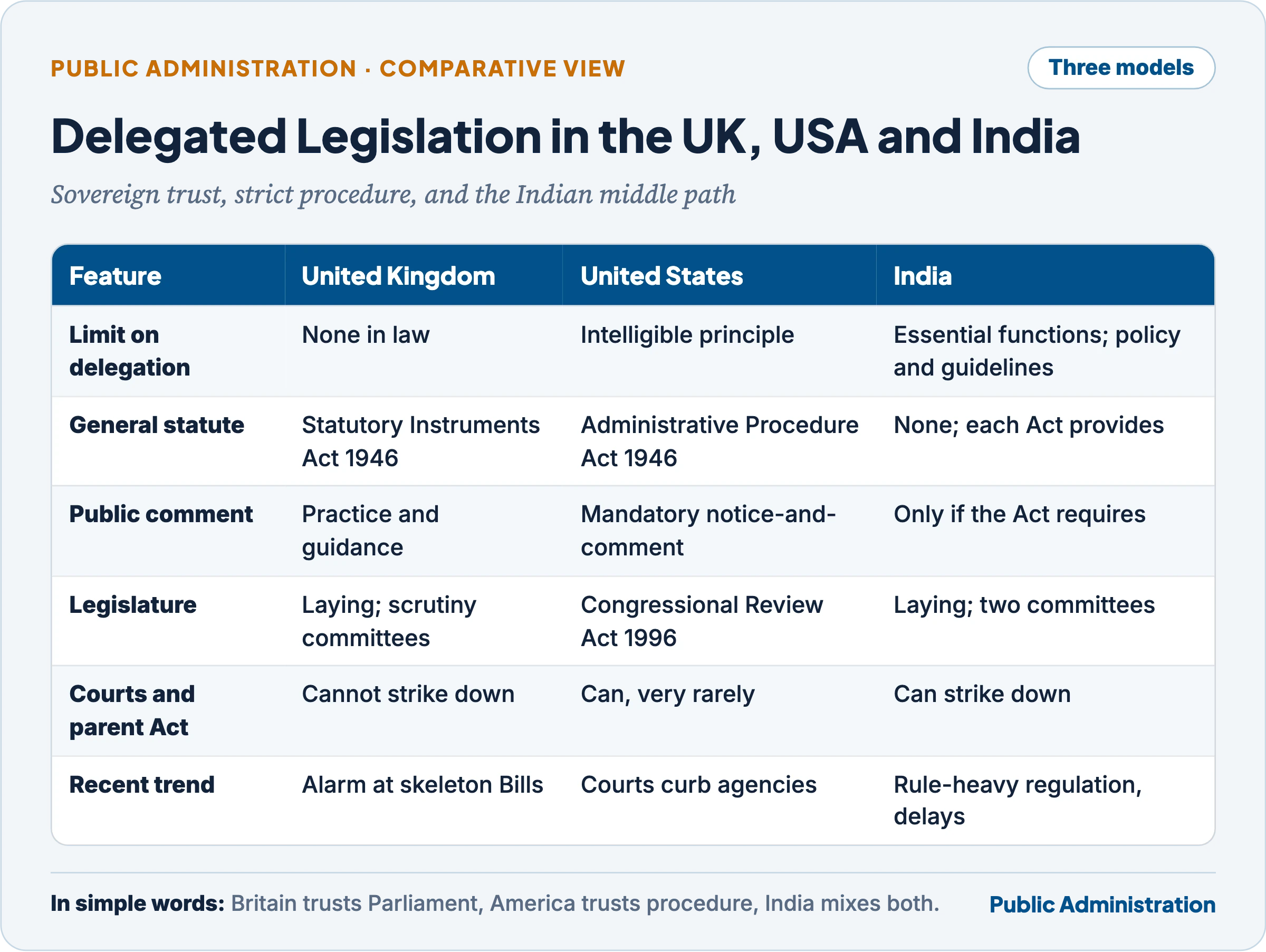
Three families let their eldest child manage the household budget. One family trusts completely but checks the accounts later. Another writes strict rules in advance and lets anyone object. The third sits in between. Britain, America and India have chosen these three styles for delegated legislation.
8.1 United Kingdom
- Constitutional base: parliamentary sovereignty; there is no legal limit on how much Parliament may delegate, and courts cannot strike down an Act for excessive delegation. Henry VIII clauses are lawful.
- General statute: the Statutory Instruments Act, 1946 governs numbering, printing, publication and laying; where an instrument is subject to annulment, either House may pray against it within 40 days.
- Scrutiny bodies: the Joint Committee on Statutory Instruments (technical and legal scrutiny); the Lords’ Secondary Legislation Scrutiny Committee (policy merits, established 2003); the Lords’ Delegated Powers and Regulatory Reform Committee (examines delegation in Bills).
- Limits of control: instruments cannot be amended, only accepted or rejected; rejection is extremely rare. The two Lords committees’ 2021 reports (Democracy Denied? and Government by Diktat) warned that Brexit and Covid had accelerated skeleton Bills, Henry VIII powers and disguised legislation.
- Courts: can quash an instrument as ultra vires the Act or for procedural failure, but not the Act itself.
8.2 United States
- Constitutional base: strict separation of powers. Article I vests “all legislative powers” in Congress, so a nondelegation doctrine exists: Congress must give the agency an intelligible principle (J.W. Hampton v United States, 1928).
- Only two strikes: the Court struck down federal statutes for excessive delegation only in Panama Refining and Schechter Poultry (both 1935). In FCC v Consumers’ Research (27 June 2025) it again upheld a broad delegation (the Universal Service Fund) under the intelligible-principle test, by 6–3.
- Procedure by statute: the Administrative Procedure Act, 1946 requires notice-and-comment rule-making: publication of proposed rules in the Federal Register, public comments, and a reasoned final rule. Executive orders add cost-benefit analysis for major rules.
- Congressional control: the legislative veto was held unconstitutional in INS v Chadha (1983); the Congressional Review Act, 1996 lets Congress disapprove a rule by joint resolution (subject to presidential veto).
- Judicial review of agency interpretation: West Virginia v EPA (2022) applied the major questions doctrine (agencies need clear authorisation for decisions of vast economic and political significance); Loper Bright Enterprises v Raimondo (28 June 2024) overruled the Chevron rule of deference, so courts now decide for themselves what a statute means.
8.3 India: the middle path
| Feature | United Kingdom | United States | India |
|---|---|---|---|
| Limit on delegation | None in law (sovereignty) | Nondelegation: intelligible principle | Essential legislative functions; policy and guidelines test |
| General statute on rule-making | Statutory Instruments Act, 1946 | Administrative Procedure Act, 1946; Congressional Review Act, 1996 | None; each Act provides; General Clauses Act, 1897 s.23 |
| Public consultation | Practice and guidance | Mandatory notice-and-comment | Only where the Act requires; Pre-Legislative Consultation Policy, 2014 (non-binding) |
| Legislative scrutiny | Laying; JCSI, SLSC, DPRRC | Committee oversight; CRA disapproval | Laying (mostly negative); Committees on Subordinate Legislation (1953, 1964) |
| Can courts strike down the parent Act? | No | Yes, rarely | Yes (Hamdard, Devi Das) |
| Can courts strike down rules? | Yes, ultra vires | Yes; APA “arbitrary and capricious” review | Yes: ultra vires, Part III, manifest arbitrariness |
| Recent trend | Concern over skeleton Bills and Henry VIII powers | Courts reining in agencies (major questions, end of Chevron) | Rule-heavy digital and economic regulation; delays in framing rules |
- India’s position: like the US, India has a written Constitution and judicial review of the parent Act; like the UK, it relies on laying and parliamentary committees and has no general procedure statute. Indian courts accept very wide delegation in practice, so procedure and parliamentary scrutiny carry more of the burden than in the US, but with weaker tools than either.
9. Reform Proposals
In simple words
If a school’s rule book keeps growing and nobody reads the new pages, the answer is not to stop writing rules. It is to number the pages, show drafts to parents first, put a checker on the committee and throw out old rules every few years.
9.1 Official recommendations in India
- Committees on Subordinate Legislation (both Houses): six-month deadline for rules; 15-day laying; reasons for delay; 30 days for comments on drafts; no fees, retrospective effect or ouster of courts without express authority; statements of objects and reasons; law officers in every ministry (Lok Sabha committee, 2011); quarterly status reports and review of delays by the Cabinet Secretary (Rajya Sabha committee, 2016); a statement to Parliament where a ministry decides that a rule is unnecessary.
- Law Commission of India: its 14th Report (1958) recorded the Lok Sabha committee’s call for uniform laying provisions; its 60th Report on the General Clauses Act, 1897 discussed standardising safeguards (antecedent publicity, consultation, laying) and proposed the common term “statutory instrument”.
- National Commission to Review the Working of the Constitution (2002): proposed a new Legislation Committee of Parliament to oversee and coordinate legislative planning, and suggested that separate committees such as those on Estimates, Public Undertakings and Subordinate Legislation need not be continued, their work being absorbed by the subject committees. The Commission’s ideas on consultation also fed into the 2014 consultation policy.
- Second Administrative Reforms Commission:
- Its 4th Report, Ethics in Governance (2007), asked that procedures, rules and regulations that lead to corruption be identified, and that a framework be created for their periodic review in consultation with stakeholders.
- Its 6th Report, Local Governance (2007), proposed that every new law carry a “local government memorandum”, on the analogy of the financial memorandum and the memorandum on delegated legislation, and that subject laws provide for devolution either in the Act or in subordinate legislation.
- Financial Sector Legislative Reforms Commission (FSLRC): proposed that regulators publish draft regulations with a statement of objects and reasons and a cost-benefit analysis, respond to public comments, and give final regulations a prospective date.
9.2 Good-practice measures
- A general Act on subordinate legislation for India, on the lines of the UK and US statutes, covering drafting standards, mandatory consultation, explanatory memoranda, a single online register of draft and final rules, and timelines.
- Mandatory prior publication of significant draft rules with at least 30 days for comments, and a published response to comments.
- Regulatory impact assessment for major rules, as the FSLRC proposed.
- Stronger committees: legal and technical staff, automatic referral of rules flagged as exceptional, scrutiny of draft rules for important Acts, and a requirement that the government respond to adverse reports within a fixed time.
- Affirmative procedure for Henry VIII-type powers, taxing powers and rules affecting fundamental rights.
- Limits on skeleton legislation and sub-delegation, with full justification in the Rule 70 memorandum.
- Sunset and review clauses so that rules lapse or are reviewed unless renewed, keeping the rule book current.
- Enforced deadlines for framing rules, with reasons laid before Parliament for every delay.
Indian Connect — Reform in practice
- The Manual of Parliamentary Procedures already fixes the six-month and 15-day limits and the three-month extension rule; the problem is compliance, not the absence of norms.
- The Pre-Legislative Consultation Policy, 2014 could be given statutory force, so that skipping consultation would make a rule open to challenge as procedurally ultra vires.
- The success of open consultation on the DPDP Rules and the Labour Code rules shows that public comment on draft rules is workable at scale in India.
Key Terms
| Term | Meaning in simple words |
|---|---|
| Delegated (subordinate) legislation | Law made by the executive or another body under power given by an Act or the Constitution |
| Parent (enabling) Act | The Act that gives the power to make rules |
| Rules, regulations, bye-laws | Main forms of delegated legislation; bye-laws are local |
| Statutory instrument | A general name for all such rules, orders and schemes |
| Essential legislative function | Laying down policy and standards, which the legislature cannot hand over |
| Excessive delegation | Delegation without policy or guidance; makes the parent Act invalid |
| Policy and guidelines test | The legislature must give the delegate a policy to follow (Gwalior Rayon) |
| Abdication test | Delegation is valid while the legislature keeps the power to withdraw it (Mathew J) |
| Skeleton legislation | An Act that gives only a framework and leaves almost everything to rules |
| Henry VIII clause | A power to amend or repeal an Act by executive order |
| Removal of difficulties clause | An Indian form of the Henry VIII clause, usually time-limited |
| Conditional legislation | A complete law whose application depends on a condition decided by the executive |
| Sub-delegation | A delegate passing its power further down; needs authority in the Act |
| Laying | Placing rules before each House so that it can annul or modify them |
| Negative and affirmative resolution | Rules stand unless annulled, or need approval to stand |
| Ultra vires | Beyond power; substantive (beyond the Act) or procedural (ignoring required steps) |
| Manifest arbitrariness | A ground under Article 14 to strike down an irrational rule |
| Colourable exercise of power | Using a power for a purpose the Act did not intend |
| Generality vs enumeration | A listed head of rule-making does not limit a general rule-making power |
| Rule 70 memorandum | Statement with a Bill explaining the delegation it makes |
| Committee on Subordinate Legislation | Parliamentary committee that scrutinises rules (Lok Sabha 1953, Rajya Sabha 1964) |
| Pre-legislative consultation | Publishing draft laws and rules for public comment before they are finalised |
| Notice-and-comment | US procedure requiring proposed rules to be published for public comment |
| Nondelegation doctrine | US rule that Congress must give agencies an intelligible principle |
| Ordinance | Law made by the President or Governor under Article 123 or 213 when the legislature is not in session |
Commissions, Committees and Judgments
| Body or case | Year | Key point |
|---|---|---|
| Queen v Burah (Privy Council) | 1878 | Conditional legislation valid |
| Committee on Ministers’ Powers (Donoughmore) | 1929–1932 | Delegation inevitable; limit Henry VIII clauses; scrutiny committees; keep courts’ jurisdiction |
| Commons Select Committee on Statutory Rules and Orders | 1944 | First UK scrutiny committee for delegated legislation |
| In re Delhi Laws Act | 1951 | Essential legislative function cannot be delegated; power to repeal laws invalid |
| Harla v State of Rajasthan | 1951 | Unpublished law cannot bind |
| Lok Sabha Committee on Subordinate Legislation | December 1953 | Rules 317–322; nine grounds of scrutiny |
| Rajnarain Singh | 1954 | Power to modify cannot alter essential policy |
| Harishankar Bagla | 1954 | Policy may be read from preamble and scheme |
| Hamdard Dawakhana | 1960 | Uncanalised power to add diseases struck down |
| Rajya Sabha Committee on Subordinate Legislation | September 1964 | Rules 204–212; scope widened to constitutional rules in 1972 |
| Devi Das Gopal Krishnan | 1967 | Unguided power to fix tax rates struck down |
| Jalan Trading Co. | 1967 | Removal-of-difficulty power making orders final struck down |
| Gwalior Rayon | 1973–74 | Policy and guidelines test; Mathew J’s abdication test |
| Avinder Singh | 1978 | Taxing power may be delegated to elected local bodies with limits |
| Tulsipur Sugar | 1980 | No hearing needed for conditional legislation |
| Indian Express Newspapers | 1985 | Rules open to Part III and manifest arbitrariness review |
| D.C. Wadhwa | 1987 | Re-promulgation of ordinances is a fraud on the Constitution |
| Sahni Silk Mills | 1994 | Sub-delegation needs authority in the Act |
| NCRWC | 2002 | Legislation Committee; pre-legislative consultation |
| State of Tamil Nadu v P. Krishnamurthy | 2006 | Grounds for challenging subordinate legislation |
| Second ARC, 4th and 6th Reports | 2007 | Periodic review of rules; local government memorandum |
| Pre-Legislative Consultation Policy | 2014 | 30-day public consultation, including on subordinate legislation |
| Krishna Kumar Singh | 2017 | Ordinance satisfaction reviewable; laying mandatory |
| Vivek Narayan Sharma | 2023 | Section 26(2) RBI Act not excessive delegation (4:1) |
| Rajya Sabha Committee report on delays | December 2023 | Ministries “casual” about framing rules |
| Naresh Chandra Agrawal | 2024 | Principles for ultra vires review; generality vs enumeration |
| Kunal Kamra (Bombay High Court) | 2024 | Fact-check unit rule struck down |
Contemporary Developments
- 8 February 2024: in Naresh Chandra Agrawal v ICAI the Supreme Court restated the principles for testing whether a rule is ultra vires its parent Act, including the generality vs enumeration rule.
- 11 March 2024: the Citizenship (Amendment) Rules, 2024 were notified, more than four years after the Act came into force, following repeated extensions for framing rules.
- 20 September 2024: the Bombay High Court, by the tie-breaking opinion of Justice A.S. Chandurkar in Kunal Kamra v Union of India, struck down the IT Rules amendment creating a government fact-check unit.
- 22 October 2025: an amendment to Rule 3(1)(d) of the IT Rules (in force 15 November 2025) restricted takedown intimations to specially authorised senior officers.
- 13–14 November 2025: the Digital Personal Data Protection Rules, 2025 were notified after consultation that drew 6,915 inputs, with an 18-month phased start, more than two years after the 2023 Act.
- 21 November 2025 and 8 May 2026: the four Labour Codes were brought into force, and their final central rules were notified about six months later, roughly six years after Parliament passed the Codes.
- 10 February 2026: the IT Rules were amended (in force 20 February 2026) to regulate synthetically generated information and cut the takedown window to three hours, again by delegated legislation.
- 28 June 2024 and 27 June 2025: in the United States, Loper Bright ended Chevron deference to agencies, while FCC v Consumers’ Research upheld a broad delegation under the intelligible-principle test.
Revision Grid
| Thinker / body | Work or report (year) | Key idea |
|---|---|---|
| Sir Cecil Carr | Delegated Legislation (1921) | Delegation inevitable; needs safeguards |
| Lord Hewart | The New Despotism (1929) | Rule-making by officials as a new despotism |
| W.A. Robson | Justice and Administrative Law (1928) | Administrative powers rational; structure, not abolish |
| Donoughmore Committee | Report on Ministers’ Powers (1932) | Limit Henry VIII clauses; scrutiny committees; courts’ jurisdiction intact |
| Dwight Waldo | The Administrative State (1948) | Administration as a centre of political power |
| Griffith and Street | British administrative law writing | Principles in Bills, details in rules; consult affected interests |
| Herbert Morrison | 1944 Commons debate | Parliament must keep a watchful eye on delegated legislation |
| G.V. Mavalankar | Lok Sabha Committee (1953) | Committee members as protectors against the “new despotism” |
| Justice Mukherjea | In re Delhi Laws Act (1951) | Legislature must keep the essential legislative function |
| Justice Subba Rao | Devi Das (1967) | No self-effacement by the legislature |
| Justices Khanna and Mathew | Gwalior Rayon (1973–74) | Policy and guidelines test vs abdication test |
| Justice Krishna Iyer | Avinder Singh (1978) | Wider delegation to elected local bodies |
| Law Commission of India | 14th (1958) and 60th Reports | Uniform laying; standard safeguards; “statutory instrument” |
| NCRWC | Report (2002) | Legislation Committee; consultation |
| Second ARC | 4th and 6th Reports (2007) | Periodic review of rules; local government memorandum |
| Committee of Secretaries | Pre-Legislative Consultation Policy (2014) | 30-day consultation for laws and rules |
| UK Lords committees | Democracy Denied? and Government by Diktat (2021) | Skeleton Bills, Henry VIII powers, disguised legislation |
Previous Year Questions
- 2026Examine the tension between the functional efficiency of delegated legislation and the risks it poses to accountability and the rule of law.
- 2025“Delegated legislation should be clear and should confine to the limits determined by the legislature.” In light of the statement explain how misuse of administrative discretion can be checked?
- 2023“Subordinate legislation has its drawbacks; this does not negate the fact that it is also quite beneficial.” Examine.
- 2022‘The administrative state is the creation of a power to bind us, with rules … that are not made by legislature.’ Discuss the constitutionality of the administrative state and its future.
- 2019“Delegated legislation has become a strategic tool in the hands of the executive despite its utility.” Comment.
- 2017The principle of delegated legislation is, I think right, but I must emphasise that it is well for Parliament to keep a watchful and even zealous eye on it at all stages “- (Herbert Morrison) Analyze.
- 2015“Delegated Legislation is a necessary evil.” Comment.
- 2011Make out a case for Delegated Legislation.
- 2007“Delegated legislation is a necessary evil.” Examine.
- 2004Delegated Legislation is not absolute. Explain.
- 1999“Increased delegated legislation is a phenomenon of a modern positive state.” Elucidate.
- 1997How fae is it true to state that delegated legislation has become a present day necessity and it has come to stay, it is both inevitable and indispensable?
- 1995Bring out the reasons for the growth and the dangers of delegated legislation.
- 1993“The most effective safeguard against the abuse of delegated legislation is not to delegate it in such a manner that it may invite abuse.” Comment.
- 1992‘Increased legislative delegation should be considered as a phenomenon of the modern positive state.’ Discuss.
- 2015“Ordinance-making power of the Executive needs to be suitably restrained.” Examine it critically.