

Administrative Thought: Scientific Management and Scientific Management movement; Classical Theory; Weber’s bureaucratic model – its critique and post-Weberian Developments; Dynamic Administration (Mary Parker Follett); Human Relations School (Elton Mayo and others); Functions of the Executive (C.I. Barnard); Simon’s decision-making theory; Participative Management (R. Likert, C. Argyris, D. McGregor).
This article: Follett’s life and works; the group principle and The New State; constructive conflict and integration; circular response; the giving of orders and the law of the situation; power-over and power-with; authority, responsibility and control; leadership; coordination; her place between the classical and human relations schools; critique and contemporary relevance.
Official Syllabus: Paper I · Unit 1-02 Administrative Thought
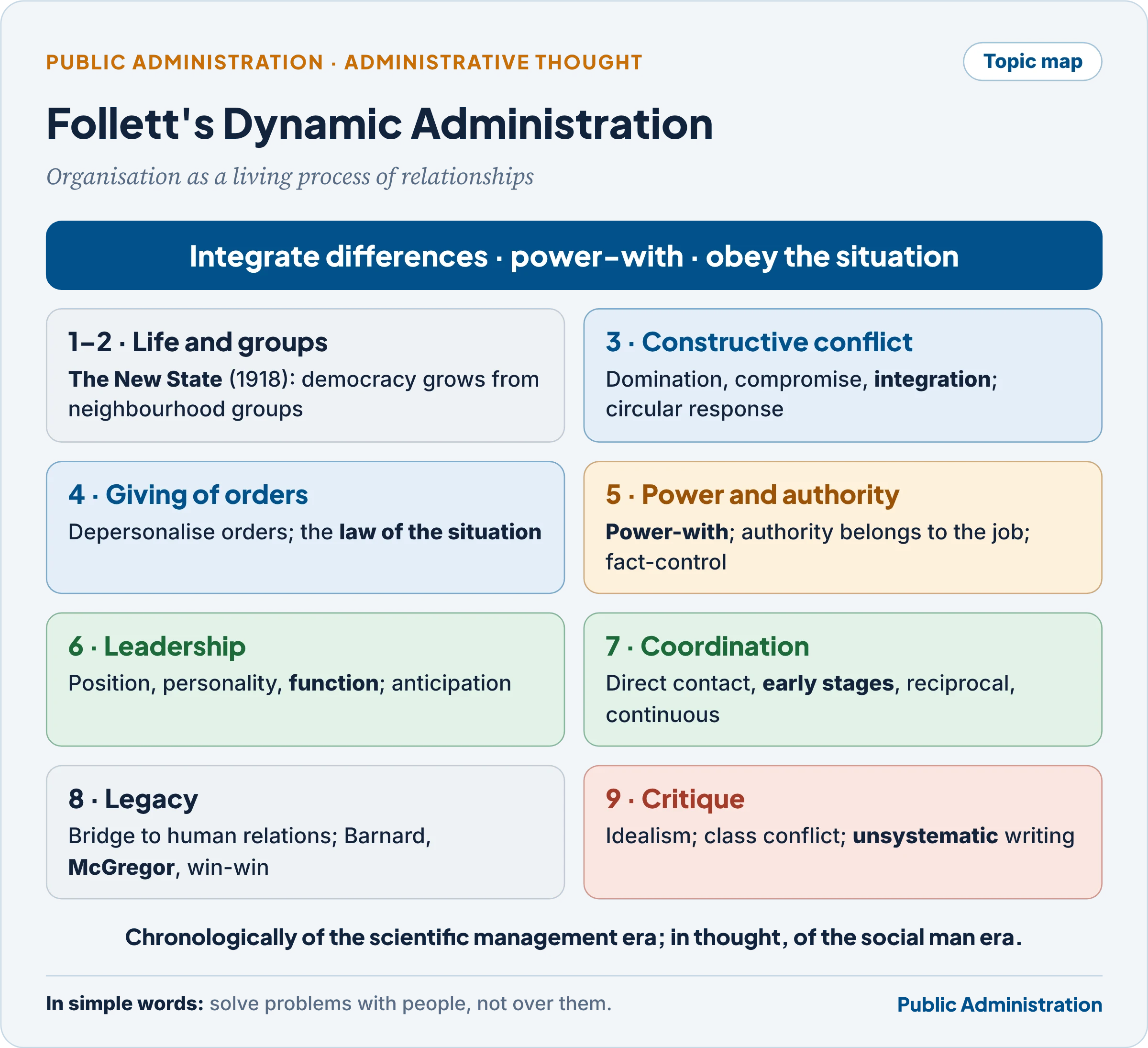
Mary Parker Follett (1868–1933), an American political philosopher, social worker and management thinker, called administration dynamic because she saw an organisation not as a fixed chart of offices but as a continuous process of human relationships: people, groups and situations constantly influencing one another. Her central idea was integration: differences between people are not to be suppressed (by domination) or split (by compromise) but woven into a new solution that satisfies the real needs of all sides.
- Where she stands: she wrote during the Scientific Management era (1910s–1920s) but anticipated the human relations and behavioural schools by a decade or more. The management historian Daniel Wren put it neatly: chronologically she belonged to the scientific management era; philosophically, to the social man era.
- Why she matters for public administration: her ideas of participation, coordination by direct contact, authority based on knowledge, and “power-with” anticipate today’s collaborative governance, mediation, cooperative federalism and team-based administration.
In simple words
Two officers in a district argue: the PWD engineer wants to close a road for repairs in June; the Collector wants it open for school reopening. One can overrule the other (domination), or they can split the difference and repair half the road (compromise). Follett would ask what each really needs: the engineer needs a dry, traffic-free window; the Collector needs safe access for children. Repairing at night in May satisfies both. That creative third way is integration.
1. Life, Works and Intellectual Roots
In simple words
Follett came to management late, after twenty years of community work and political writing. That is why her management ideas are really ideas about democracy, applied inside organisations.
1.1 Life
- Born on 3 September 1868 in Quincy, Massachusetts; educated at Thayer Academy and the Society for the Collegiate Instruction of Women (later Radcliffe College), with a year at Newnham College, Cambridge; graduated summa cum laude in 1898 in economics, government, law and philosophy.
- Community work (1900–1908 onwards): social work in Boston’s Roxbury neighbourhood; led the movement to use school buildings as evening community centres; later served on the Massachusetts Minimum Wage Board, where watching employers and workers bargain shaped her theory of group conflict.
- Management phase (mid-1920s–1933): lectured to the Bureau of Personnel Administration in New York (invited by Henry Metcalf), to the Rowntree lecture conferences in Oxford and at the London School of Economics. She lived in England from 1929 and died in Boston on 18 December 1933.
- Neglect and rediscovery: largely forgotten in America after her death, she was revived by British management writers (Lyndall Urwick) and, from the 1990s, by Pauline Graham‘s Mary Parker Follett: Prophet of Management (1995), with an introduction by Peter Drucker, who regarded her as one of his “gurus”.
1.2 Major works
| Work | Year | Theme |
|---|---|---|
| The Speaker of the House of Representatives | 1896 | Her Radcliffe thesis; a study of political leadership praised by Theodore Roosevelt |
| The New State: Group Organization the Solution of Popular Government | 1918 | Democracy built from neighbourhood groups; the group principle |
| Creative Experience | 1924 | Integration, circular response, power-with; psychology of group process |
| Papers: “Constructive Conflict”, “The Giving of Orders”, “Power”, “Business as an Integrative Unity” | 1925 | Lectures to the Bureau of Personnel Administration |
| “The Illusion of Final Authority” | 1926 | Authority belongs to the job; cumulative responsibility |
| LSE lectures: “The Essentials of Leadership”, “Co-ordination”, “The Process of Control” | 1933 | Leadership of function; four principles of coordination |
| Dynamic Administration (ed. H.C. Metcalf and L. Urwick) | 1941 (US 1942) | Collected management papers; new edition by Urwick and E.M. Fox, 1973 |
| Freedom and Co-ordination (ed. L. Urwick) | 1949 | The LSE lectures |
1.3 Intellectual roots
- Hegelian idealism (through her teacher Anna Boynton Thompson): the whole is more than its parts; opposites can be reconciled in a higher unity.
- Gestalt psychology and the behaviourist E.B. Holt (The Freudian Wish, 1915): behaviour as a relation between organism and environment, not a one-way response.
- Pragmatism (William James, John Dewey): truth is found in experience and experiment, not in fixed principles.
- Her own fieldwork: community centres, wage boards and industrial disputes gave her a stock of cases that fill her books.
Common confusion
Was Follett a classical thinker or a human relationist? Neither fully. Like the classical writers she believed in principles of organisation and accepted that orders must be given; she even framed four “principles” of coordination. But her principles are about relationships, participation and situations, not structure. She criticised classical theory for being mechanical and one-sided. The fairest description is the one in most texts: a bridge between the classical and the human relations-behavioural approaches.
2. The Group Principle and the New State
In simple words
Follett believed that people do not become good citizens by voting once in five years. They learn democracy by solving problems together in their neighbourhood, union or office. Groups, not isolated individuals or a distant state, are where democracy is made.
- Core claim of The New State (1918): “The study of democracy has been based largely on the study of institutions; it should be based on how men behave together.” True democracy grows from neighbourhood groups in which people discover common purposes through discussion.
- Elements of her political theory (as summarised by Gisela Konopka):
- social experience is the basis of the state’s structure;
- sovereignty is the capacity to govern oneself, one’s group or one’s state, and is relative, not absolute;
- the will of a group is not the sum of separate wills but a common will that grows out of them;
- rich experience comes only from living in many groups, since no single group can exhaust a citizen’s capacities;
- individual and group, citizen and state, freedom and determinism, self and others are not opposites.
- Her quarrel with the pluralists: against Harold Laski‘s pluralism (sovereignty divided among competing groups), Follett argued that groups should integrate their interests into a larger unity, not simply coexist and bargain.
- From politics to business: after 1924 she turned to industry. In a lecture in England she explained why: businessmen showed “the greatest vitality of thinking”, industry was “the most important field of human activity”, and “the principles of organization and administration which are discovered as best for business can be applied to government or international relations”. She studied the business enterprise as a laboratory for the larger machinery of government.
Indian Connect — Follett’s group principle in Indian governance
- Gram Sabha: the 73rd Amendment (1992) made the Gram Sabha (Article 243A) the base of rural democracy, the kind of face-to-face assembly Follett saw as the school of citizenship; the PESA Act, 1996 gave Gram Sabhas in Scheduled Areas powers over local resources and dispute resolution.
- Self-help groups: about 90.9 lakh SHGs with 10.05 crore women members under DAY-NRLM (PIB, 2025) organise rural women into groups that save, borrow, plan and negotiate together; they show her claim that capacity grows through group experience.
- Cooperatives: the Ministry of Cooperation (created July 2021) and dairy cooperatives such as Amul illustrate “business as an integrative unity” of producers, managers and consumers.
3. Constructive Conflict and Integration
In simple words
Most managers treat conflict like a fire to be put out. Follett treated it like friction in a machine: wasteful if ignored, but useful if you put it to work. The task is not to end difference but to use it to find better answers.
3.1 Conflict as difference
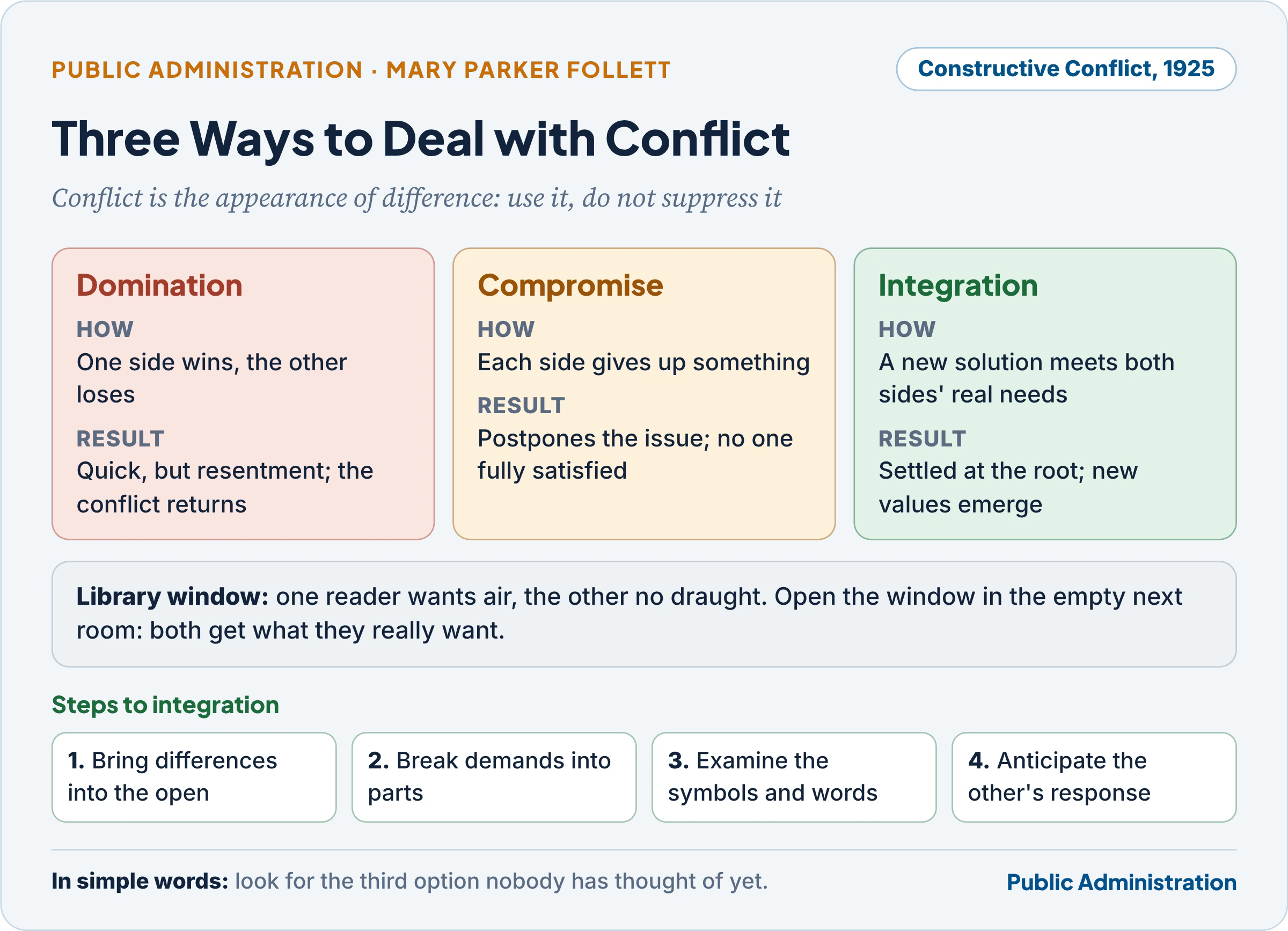
- In her 1925 paper “Constructive Conflict”, Follett asked her audience to think of conflict “as the appearance of difference, difference of opinions, of interests”. Conflict is therefore normal, inevitable and neither good nor bad in itself; since we cannot avoid it, we should use it.
- Friction analogy: the engineer does not abolish friction; the belt grips the pulley by friction. Conflict, likewise, can be “capitalised” to produce something new.
- Constructive conflict: conflict that ends in a better solution, raising the effectiveness of the organisation and the growth of the people in it.
3.2 Three ways of dealing with conflict
| Method | What happens | Result |
|---|---|---|
| Domination | One side wins, the other loses (victory of the stronger) | Quickest, but leaves resentment; the defeated side waits for revenge; the conflict returns |
| Compromise | Each side gives up part of what it wants | Common in collective bargaining; postpones rather than solves the issue; nobody gets what they really need |
| Integration | Both sides’ real desires find a place in a new solution; neither sacrifices anything | The conflict is settled at its root; new values and a new situation emerge |
- Her own example: in a small room of the Harvard library, someone wanted the window open and she wanted it shut. They opened the window in the next room, where no one was sitting. Neither gave anything up: the other reader wanted fresh air, she wanted no draught on her.
- The dairymen’s example: a cooperative of dairy farmers quarrelled over the order in which uphill and downhill farmers would unload milk cans at the creamery platform. Arguments about precedence went nowhere until someone proposed moving the platform so that both could unload at once.
- Why integration is superior: it settles the issue permanently by going to its roots; it is creative (invents something new instead of dividing what exists); it uses better techniques and saves time and resources in the long run; it builds trust for future problems.
3.3 How to achieve integration
Follett’s steps:
- Bring the differences into the open: put the real interests “on the table” instead of hiding them.
- Break up the whole demands into their constituent parts: a “demand for higher wages” may really be a demand for security, fairness or recognition, some of which can be met in other ways.
- Examine the symbols: look behind words and slogans to the real meaning (language often hardens positions).
- Anticipate the response of the other side and prepare for it; “the response is always to a relating”.
3.4 Obstacles to integration
- It requires high intelligence, keen perception and inventiveness, which are rare.
- Many people are habituated to domination and enjoy winning; integration seems tame.
- People theorise about it instead of trying it.
- Leaders are obsessed with power-over.
- Language that arouses antagonism.
- Lack of training in the method: Follett thought this the biggest obstacle and argued that integration can be learned.
3.5 Circular response
- In Creative Experience (1924) Follett rejected the idea of a one-way stimulus and response in human relations. When two people interact, each responds not to the other alone but to the relationship, which changes as they respond: “I never react to you but to you-plus-me”.
- Meaning for administration: a manager’s order changes the worker’s situation; the worker’s reaction changes the manager’s next move; the situation itself evolves. Leadership, control and conflict resolution are therefore circular, reciprocal processes, not commands travelling one way.
- Link to systems thinking: circular response anticipates the feedback idea of later systems theory (Easton, cybernetics), which is why some writers call her one of the first systems thinkers in management.
4. The Giving of Orders and the Law of the Situation
In simple words
Nobody likes being bossed. But nobody minds doing what the situation obviously demands: when the river is rising, everyone fills sandbags without being ordered. Follett wanted orders to come from the facts of the situation, not from the person who happens to be senior.
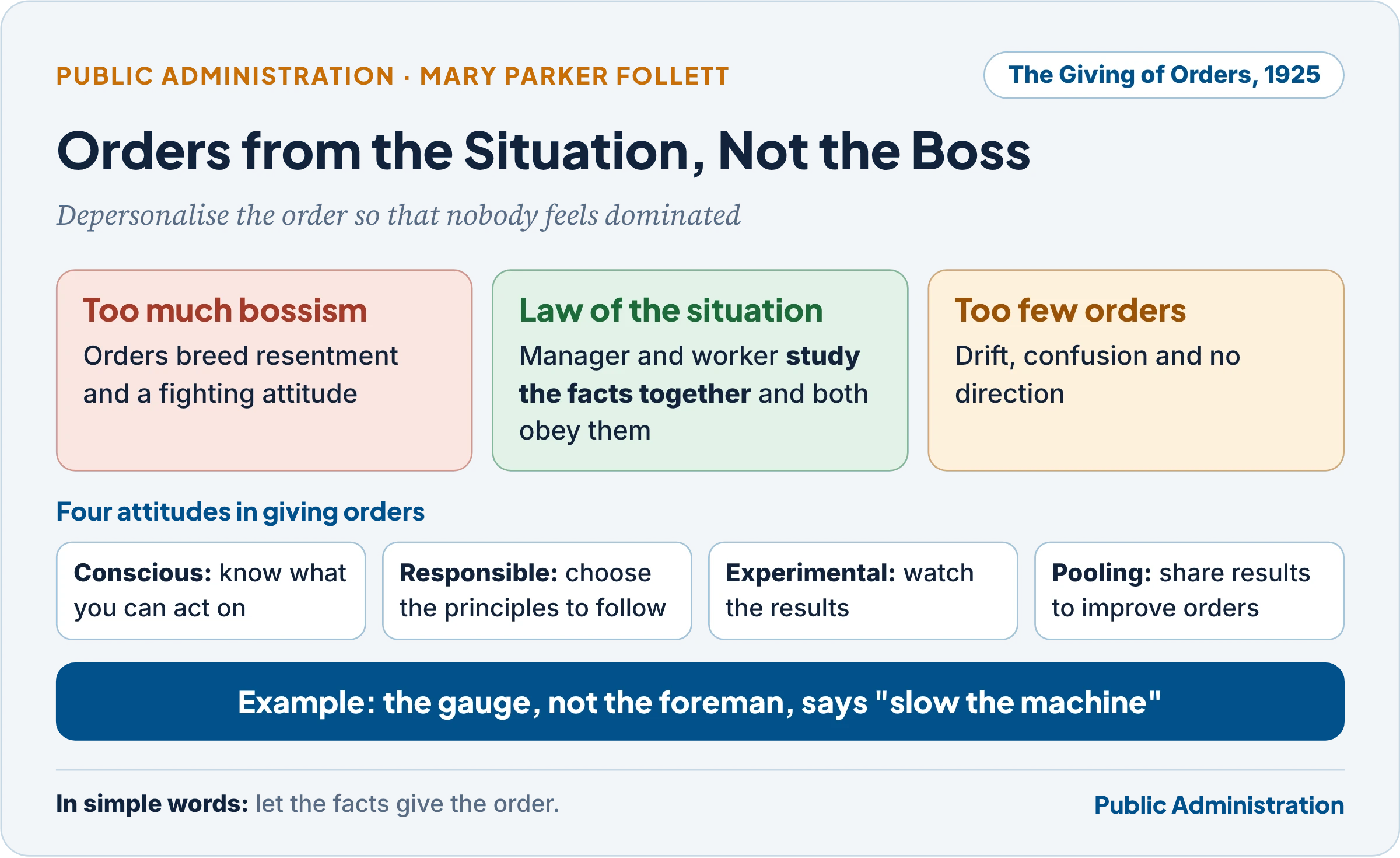
- Orders are necessary: like Taylor, Fayol and Gulick, Follett accepted that organisations must give orders. Her 1925 paper “The Giving of Orders” asked how to give them so that they are willingly obeyed.
- Two extremes to avoid: too much bossism (orders that arouse resentment, a “fighting attitude”) and too little giving of orders (drift and confusion).
- Four attitudes in giving orders:
- a conscious attitude: know the principles on which it is possible to act;
- a responsible attitude: decide which of those principles should guide action;
- an experimental attitude: treat orders as experiments and watch their results;
- pooling the results: share experience so that orders improve over time.
- Depersonalising orders: “My solution is to depersonalize the giving of orders, to unite all concerned in a study of the situation, to discover the law of the situation and obey that.” Then “one person should not give orders to another person, but both should agree to take their orders from the situation”.
- Example: a foreman does not order a worker to slow the machine; both read the temperature gauge and see that the bearing is overheating. The gauge, not the foreman, gives the order.
- Effect: removes the sense of personal domination; makes orders integral to the situation; invites the subordinate’s knowledge into the decision; reduces resentment and conflict.
- Re-personalising: depersonalising orders does not mean making relations mechanical. Follett insisted that once orders rest on the situation, the relationship between people can become more human, since neither side feels dominated.
- Contrast with Weber: Weber’s impersonality rests on rules from the top; Follett’s depersonalisation rests on joint study of facts from below and across. Weber views authority from the standpoint of the ruler; Follett from the standpoint of the worker and the situation.
5. Power, Authority, Responsibility and Control
In simple words
Power is not a cake that one side eats and the other loses. When a team learns to work together, the whole team can do more than any member could alone. Follett called this “power-with”.
5.1 Power-over and power-with
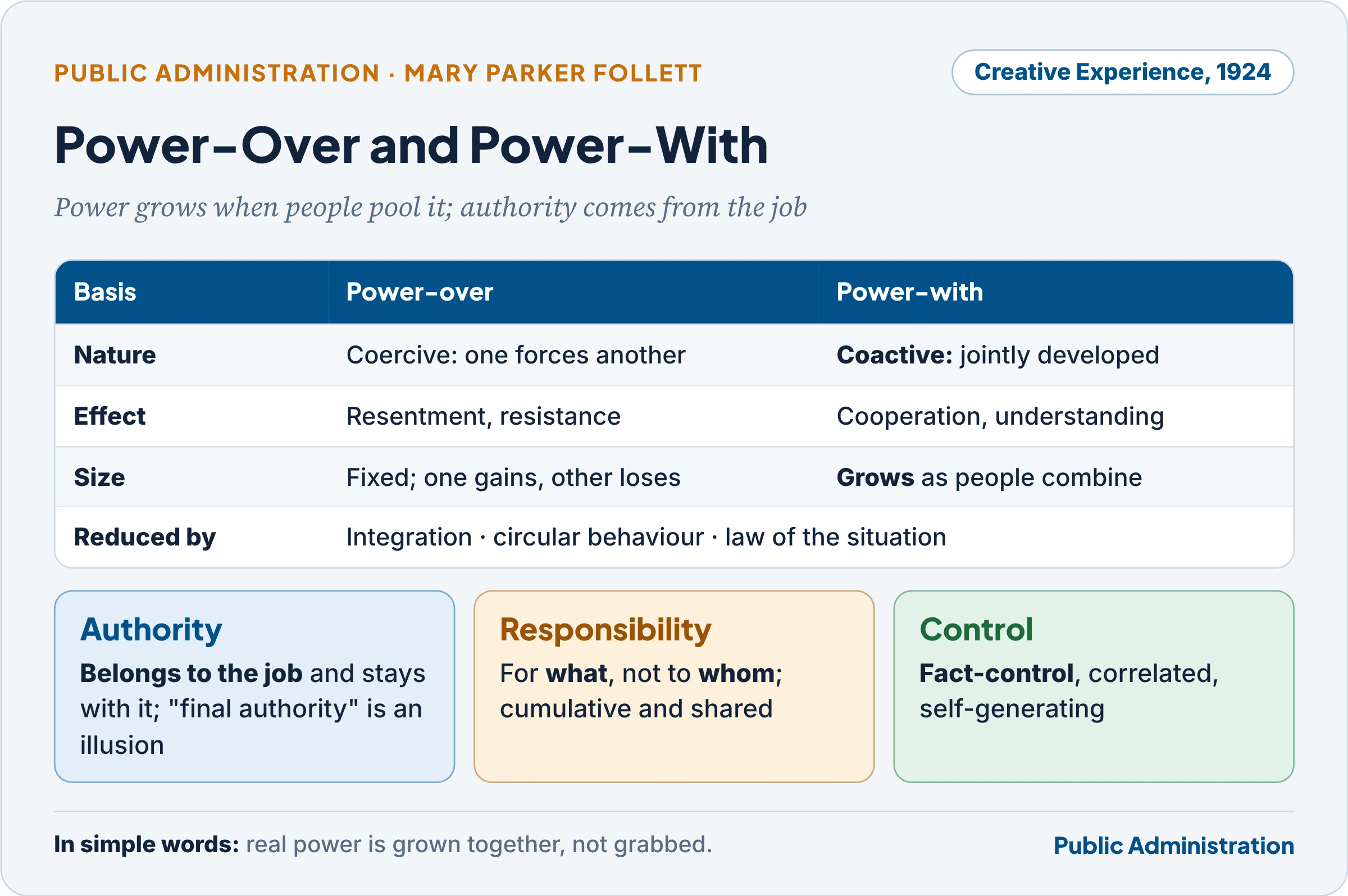
- Power is “simply the ability to make things happen, to be a causal agent, to initiate change”.
- Power-over (coercive power): one person or group forces its will on another; it breeds resentment and resistance. It cannot be abolished but should be reduced.
- Power-with (coactive power): jointly developed power, created when people pool their capacities. “Genuine power can only be grown”; “coercive power is the curse of the universe; coactive power, the enrichment and advancement of every human soul” (Creative Experience).
- How to reduce power-over: by integration, by circular behaviour (recognising mutual influence), and by obeying the law of the situation.
- Why people use power-over: “people will not wait for the slower process of education”. Power-with is “what democracy should mean in politics or industry”.
- Power cannot be delegated or conferred: a superior can only create opportunities for subordinates to develop their own power.
5.2 Authority belongs to the job
- Authority is vested power, the right to develop and exercise power. In “The Illusion of Final Authority” (1926), Follett argued that authority comes from the function performed, not from position in the hierarchy: “authority belongs to the job and stays with the job”.
- Consequences:
- the person who does a job has the authority it requires, whether the superior likes it or not;
- authority “cannot be delegated” in the usual sense; “delegation of authority” is an obsolete expression;
- authority is pluralistic and cumulative: spread throughout the organisation, not concentrated at the top. The so-called final authority of the chief executive is an illusion: a final decision is merely the last step of a process built from many smaller decisions and contributions below.
- Example: a district’s chief medical officer’s authority over hospital protocol comes from her expertise and function; the Collector’s signature on a file is the last link in a chain of judgments, not the source of them.
5.3 Responsibility
- Responsibility, like authority, attaches to the function and the situation. The right question is “for what is one responsible?” rather than “to whom is one responsible?”
- She favoured functional, pluralistic, cumulative or group responsibility: lower-level participation in policy formation and workers’ participation in management.
5.4 Control
- Fact-control rather than man-control: control should come from the facts of the situation, not from a person.
- Correlated control rather than superimposed control: control should emerge from the interweaving of many people’s activities, not be imposed from above.
- Control as a self-generating process: the most important control of all is self-control; in an integrated organisation, the parts adjust to one another and to the whole.
6. Leadership
In simple words
In Follett’s view, the leader is not whoever sits in the biggest chair. It is whoever understands the situation best and can help the group see where it is heading.
- Who is a leader: not the head of the department or the president, but one “who can see all around a situation”, who sees it as related to purposes and policies, who “sees it evolving into the next situation” and who understands how to pass from one situation to the next. Such people are found throughout the organisation, not only at the top.
- Three types of leadership:
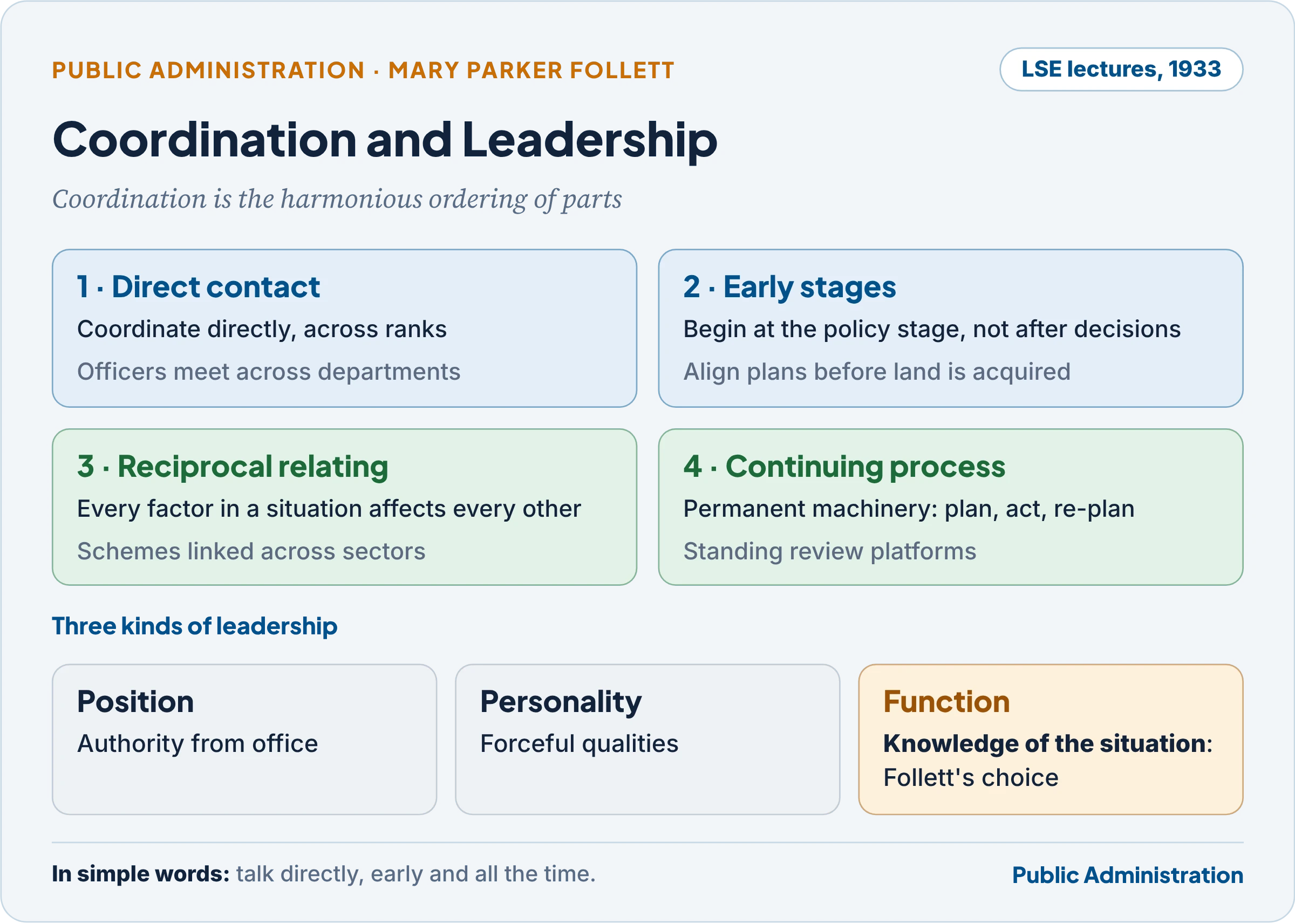
- leadership of position: authority from formal office;
- leadership of personality: forceful personal qualities;
- leadership of function: authority from knowledge and technique relevant to the situation. Follett held that in modern organisations, those with functional knowledge lead, and the organisation must be flexible enough to let functional leadership operate.
- Functions of the leader:
- coordination: integrate different parts into an effective unity;
- definition of purpose: make clear the common purpose of the organisation;
- anticipation: foresee the next situation, and indeed help make it, not merely meet it;
- organising the experience of the group and transforming it into group power;
- developing leadership in subordinates: teaching them to control situations themselves.
- Reciprocity: the leader influences the group and is influenced by it (circular response); the leader is also influenced by experts within the organisation (“Leader and Expert”).
- Leaders can be made: she rejected the idea of a mysterious inborn quality; leadership can be learned.
7. Planning and Coordination
In simple words
Coordination is not a meeting called after things go wrong. It is people who depend on one another talking directly, early and continuously, so that their work fits together from the start.
- Follett defined coordination as the “harmonious ordering of parts” and saw it as the heart of administration. Central planning imposed from the top on local units, she argued, fails for want of coordination; planning should be a mechanism that facilitates coordination.
- Four principles of coordination (LSE lectures, 1933):
| Principle | Meaning | Example |
|---|---|---|
| Direct contact | Responsible people concerned should coordinate directly, regardless of rank; horizontal communication is as important as the vertical chain | Health and police officers coordinating directly in a disaster, not through their headquarters |
| Early stages | Coordination should begin at the policy-making stage, not after decisions are made | Involving the forest department while a highway is still being aligned, not after land is acquired |
| Reciprocal relating of all factors | Every factor in a situation affects every other; coordination relates them all to one another | A school meal scheme that links agriculture, health, education and transport |
| Continuing process | Coordination is continuous, from planning to activity and back to planning; it needs permanent machinery | Standing inter-ministerial groups and project monitoring platforms |
- Research base: these principles should be backed by continuous research and information.
- Comparison with the classical view: Gulick and Urwick saw coordination as achieved by organisation (hierarchy) or by the dominance of an idea; Follett saw it as achieved by people in direct, continuous interaction, closer to Fayol’s gangplank than to the scalar chain.
Indian Connect — Follett’s coordination and conflict ideas in Indian administration
- Coordination by direct contact: PRAGATI (launched 25 March 2015) lets the Prime Minister review stalled projects directly with Union Secretaries and State Chief Secretaries by video link; by May 2025 it had reviewed 373 projects worth about ₹20.64 lakh crore (PIB).
- Coordination in the early stages: PM Gati Shakti National Master Plan (October 2021) puts the plans of infrastructure ministries on one GIS platform so that roads, railways, pipelines and forests are aligned before projects begin.
- Integration rather than domination: the GST Council (Article 279A) takes decisions by a weighted three-fourths vote but has worked mostly by consensus, integrating Union and State interests into a common tax.
- Constructive conflict in justice: the Mediation Act, 2023 (assent 14 September 2023; first provisions in force 9 October 2023) and Lok Adalats seek interest-based settlements; the “Mediation for the Nation” drive (1 July–30 September 2025) referred pending cases from every tier of courts to mediation.
- Law of the situation: the Incident Response System in disaster management (NDMA guidelines, 2010) assigns command by function at the site, not by rank.
8. Follett’s Place in Administrative Thought
In simple words
Follett wrote about teamwork, empowerment and win-win negotiation before those words existed. Many of her ideas reached management through others who did not always credit her.
8.1 Pioneer of the socio-psychological approach
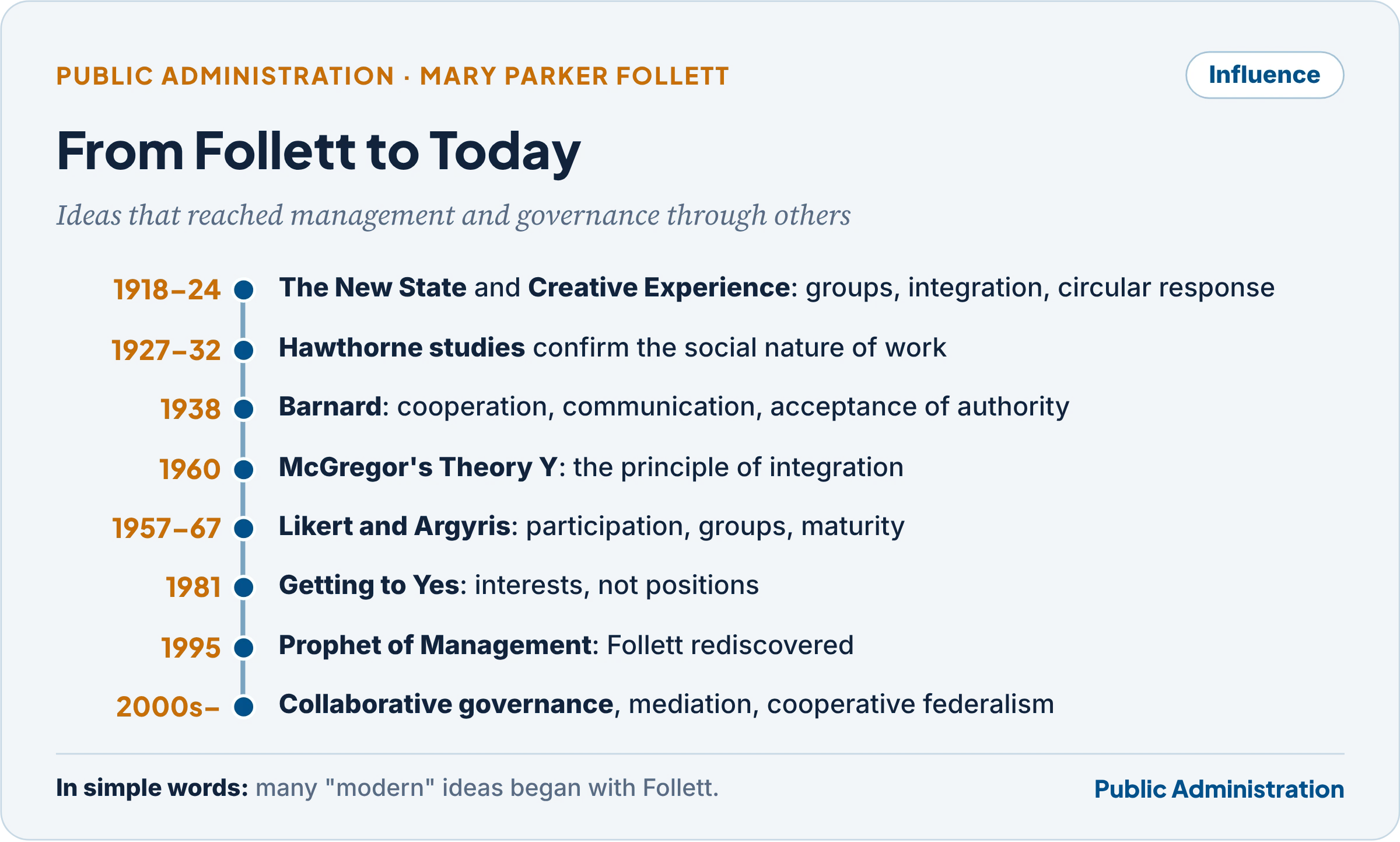
- Before Hawthorne: Creative Experience (1924) analysed group process, circular response and the psychology of conflict before the Hawthorne findings (1927–1932) made the social nature of work famous.
- What she added:
- organisation as a social system and administration as a social process;
- the psychological basis of authority, obedience and conflict;
- the importance of groups and relationships over structure;
- participation of workers in control and policy;
- the situational nature of leadership and orders.
- Urwick and Metcalf’s verdict: “her conceptions were in advance of her time. They are still in advance of current thinking. But they are a gold-mine of suggestions for anyone who is interested in the problems of establishing and maintaining human cooperation in the conduct of an enterprise.”
- Claude George called her “a true management philosopher” who spanned the gap between Taylor’s mechanistic approach and the human emphasis of later writers. Bertram Gross compared her with Florence Nightingale (the founder of modern nursing) as an innovator but noted that her intellectual horizons were much broader.
8.2 Influence on later thinkers
| Later thinker or idea | What came from Follett |
|---|---|
| Chester Barnard (Functions of the Executive, 1938) | Cooperation, communication, informal processes and acceptance of authority, an influence Barnard did not openly acknowledge |
| Human relations school (Mayo) | Social nature of work; groups; supervision without domination |
| Douglas McGregor (The Human Side of Enterprise, 1960) | Theory Y’s central “principle of integration” of individual and organisational goals; control through self-direction rather than external control |
| Participative management (Likert, Argyris) | Group decision-making; linking people across levels; criticism of authority as domination |
| Contingency and situational leadership | Leadership and orders depend on the situation |
| Win-win negotiation (Fisher and Ury, Getting to Yes, 1981) | Focus on interests behind positions; inventing options for mutual gain |
| Empowerment, teams, learning organisations, collaborative governance | Power-with; authority from knowledge; continuous coordination across boundaries |
8.3 Far ahead of her times
- Ideas now standard in management and governance (empowerment, cross-functional teams, flat structures, knowledge workers, stakeholder engagement, interest-based negotiation, co-production of public services) were stated by Follett in the 1920s. The 1995 collection of her papers, introduced by Drucker, was aptly titled Prophet of Management: the field took decades to catch up with her.
- Why she was neglected: the Depression and the war favoured hierarchical, production-centred management; she wrote papers rather than a systematic treatise; she was a woman outside academia; and her ideas reached readers mainly through others.
8.4 McGregor and the complex organisation
- Conflict: McGregor accepted Follett’s view that conflict is normal and can be productive; his effective managerial team “works through” differences rather than suppressing them.
- Integration: McGregor’s Theory Y rests on the principle of integration: creating conditions in which members can best achieve their own goals by directing their efforts towards the success of the enterprise. This is Follett’s integration applied to the individual–organisation relationship.
- Control: both reject external control by authority in favour of self-control and commitment; Follett’s “fact-control” becomes McGregor’s management by objectives and self-appraisal.
- Complex organisations: McGregor extended her face-to-face ideas to large firms with specialised staff, line–staff relations and management development, arguing that the professional manager must build teams across functions (see the article on Participative Management).
Criticism — The case against Follett’s dynamic administration
- Idealism: she assumes that integration is almost always possible; many conflicts (scarce budgets, land, posts) are zero-sum.
- Power and class blindness: integration cannot remove the structural conflict between owners and workers; it may disguise it as a problem of attitudes.
- Unsystematic: her ideas are scattered across lectures; no consistent theory or empirical testing.
- Manipulation risk: “law of the situation” can let managers dress up their own preferences as objective facts.
- Neglect of formal structure: she underrates the need for hierarchy, rules and accountability in large public organisations.
Defence — The case for Follett’s dynamic administration
- Integration is a method and an aspiration, not a claim that every conflict has a perfect solution; it widens the search for options.
- Her ideas have been validated by later research on participation, teams, negotiation and collaborative governance.
- Authority based on knowledge and situation suits knowledge-based public organisations and crisis response.
- She accepted orders, planning and control; she sought to make them legitimate and effective, not to abolish them.
- Her democratic vision links administration with citizenship, a theme central to New Public Administration and New Public Service.
9. Critical Evaluation
In simple words
Follett’s ideas sound obvious today, which shows how much they have shaped modern management. But obvious-sounding ideas can still be hard to practise, especially where power and resources are unequal.
9.1 “Her idealism is showing”
- The charge: Follett argued that we can have both collectivism and individualism, both freedom and control, both circular response and authority, both aristocracy and democracy, both executive control and the supremacy of expert knowledge, both centralisation and decentralisation. Critics (Fry among them) answered that one need not question the possibility of combining these pairs to doubt the possibility of achieving all of them at once.
- Unsystematic writing: Baker observed that she was never a systematic writer; she threw out interesting ideas more or less at random, so that the thread of consistency is hard to find.
- Empiricism without social analysis: the Soviet writer D. Gvishiani granted that she made a positive contribution but held that her approach was purely empirical and did not interpret the social content of management (ownership and class).
- Response: Follett herself was not blind to the “baser side” of human nature; she named the obstacles to integration, including the love of domination. Her defenders argue that she described a direction of change backed by her own fieldwork in wage boards and disputes.
9.2 Conflict of ideas or conflict between workers and capitalists?
- The argument that her work was about structural conflict: much of Follett’s management writing grew out of industrial relations: minimum wage boards, labour disputes, employee representation plans and the Rowntree conferences on industrial welfare. Her aim was industrial peace through integration of the interests of capital and labour, not merely the resolution of intellectual disagreements.
- The critical reading: precisely because she treated labour–capital conflict as a difference of interests to be integrated, Marxist and radical critics charge that she converted a structural, class-based conflict (over ownership and surplus) into a psychological problem of attitudes, offering management a softer method of control. Daniel Bell‘s later charge against the human relations school (“cow sociology”, adjusting men to machines) applies partly to her too.
- A balanced view:
- she did not deny conflicts of interest; she denied that domination or compromise were the only outcomes;
- she accepted collective bargaining but saw it as compromise, a lower stage than integration;
- she argued for workers’ participation in control and policy, which goes beyond paternalism;
- but she did not address property relations or the unequal power that makes integration difficult; integration presupposes rough parity of power, which workers often lack.
- For public administration: the lesson is that integrative methods (mediation, consultation, cooperative federalism) work best where the parties have voice and countervailing power; otherwise “integration” can mask domination.
9.3 Relevance today
- Governance through networks: collaborative governance, public–private partnerships and inter-agency task forces depend on Follett’s coordination by direct contact and integration of interests.
- Federal relations: cooperative and competitive federalism need forums (GST Council, Inter-State Council, Zonal Councils, NITI Aayog’s Governing Council) that integrate rather than dominate.
- Dispute resolution: mediation, Lok Adalats and grievance redress move from adjudication (domination) to settlement (integration).
- Knowledge-based administration: expert bodies, regulators and specialist cadres raise Follett’s question of authority from function versus authority from position (the generalist–specialist debate).
- Limits: in strongly hierarchical bureaucracies with rigid rules and political pressure, integration is often replaced by compromise or domination; capacity building in negotiation and facilitation (her “training”) remains weak.
Key Terms
| Term | Meaning in simple words |
|---|---|
| Dynamic administration | Administration as a continuous, changing process of human relationships |
| Group principle | Democracy and organisation are built through face-to-face groups |
| Constructive conflict | Treating conflict as difference that can be used to find better solutions |
| Domination | Ending conflict by one side defeating the other |
| Compromise | Ending conflict by both sides giving up part of what they want |
| Integration | A new solution that meets the real needs of all sides without sacrifice |
| Circular response | Each party responds to the relationship, which keeps changing as they respond |
| Law of the situation | Orders should come from the facts of the situation, not from a person |
| Depersonalisation of orders | Removing the personal element of command by jointly studying the situation |
| Power-over | Coercive power of one over another |
| Power-with | Jointly developed, coactive power |
| Functional authority | Authority that belongs to the job and its knowledge, not to rank |
| Illusion of final authority | The idea that the top decision-maker alone decides; in fact decisions accumulate from below |
| Cumulative responsibility | Responsibility shared across all who contribute to a function |
| Fact-control | Control based on facts rather than on a person’s command |
| Correlated control | Control that emerges from the interweaving of activities, not imposed from above |
| Leadership of function | Leadership based on knowledge of the situation |
| Anticipation | The leader’s task of foreseeing and shaping the next situation |
| Coordination by direct contact | Coordination among responsible people directly, across ranks |
| Coordination in the early stages | Coordination at the policy stage, before decisions harden |
Contemporary Developments
- 2015 onwards: PRAGATI has institutionalised direct-contact coordination between the Prime Minister, Union Secretaries and State Chief Secretaries; 373 projects worth about ₹20.64 lakh crore had been reviewed by 28 May 2025.
- 13 October 2021: PM Gati Shakti National Master Plan launched for integrated, early-stage planning of infrastructure across ministries and States.
- 14 September 2023: the Mediation Act, 2023 received assent; its first provisions came into force on 9 October 2023, creating a statutory framework for pre-litigation, community and online mediation.
- 1 July–30 September 2025: the nationwide “Mediation for the Nation” drive by NALSA and the Supreme Court’s Mediation and Conciliation Project Committee referred pending cases in all court tiers to mediation.
- Continuing: renewed academic interest in Follett as a founder of collaborative governance, deliberative democracy and relational leadership.
Revision Grid
| Thinker / body | Work or report (year) | Key idea |
|---|---|---|
| Mary Parker Follett | The Speaker of the House of Representatives (1896) | Political leadership |
| Mary Parker Follett | The New State (1918) | Group principle; democracy from neighbourhood groups |
| Mary Parker Follett | Creative Experience (1924) | Integration; circular response; power-with |
| Mary Parker Follett | “Constructive Conflict”, “The Giving of Orders” (1925) | Conflict as difference; law of the situation |
| Mary Parker Follett | “The Illusion of Final Authority” (1926) | Authority belongs to the job |
| Mary Parker Follett | LSE lectures (1933); Freedom and Co-ordination (1949) | Four principles of coordination; leadership of function |
| Metcalf and Urwick (eds.) | Dynamic Administration (1941) | Collected management papers |
| Daniel Wren | History of management thought | Scientific management era in time, social man era in thought |
| Pauline Graham (ed.) | Prophet of Management (1995) | Rediscovery of Follett, with Drucker’s introduction |
| Douglas McGregor | The Human Side of Enterprise (1960) | Principle of integration in Theory Y |
| Fisher and Ury | Getting to Yes (1981) | Interest-based, win-win negotiation |
| Mediation Act | 2023 | Statutory mediation framework in India |
Previous Year Questions
- 2025Mary Parker Follett pioneered the evolution of socio-psychological approach to the study of organizations. Explain.
- 2023Follett firmly advocated for cultivating interdependence and collaboration among individuals as the key to resolving conflicts and establishing more harmonious and all encompassing social structures. Discuss.
- 2019Mary Parker Follett traced the foundational value of business and enterprise on her way to understand the organism of governmental machinery. Comment.
- 2017“Conflict is the appearance of differences— differences of opinions and of interests”. (Mary Parker Follett). Comment
- 2015“Follett’s work was not directed towards the resolution of the conflict of ideas, but towards the resolution of structural conflicts between workers and capitalists.” In the light of the statement critically evaluate Follett’s idea of dynamic administration.
- 2011Critically examine conflict resolution according to M.P. Follett. Explain how McGregor took forward her ideas to the context of complex organizations.
- 2008“Mary Parker Follett was for ahead of her times.” Discuss.
- 2006“The main problem with Mary Parker Follett’s work is that her idealism is showing.” Explain.
- 2005In Follett’s view, “authority belongs to the job and stays with the job.” Explain.