

Administrative Thought: Scientific Management and Scientific Management movement; Classical Theory; Weber’s bureaucratic model – its critique and post-Weberian Developments; Dynamic Administration (Mary Parker Follett); Human Relations School (Elton Mayo and others); Functions of the Executive (C.I. Barnard); Simon’s decision-making theory; Participative Management (R. Likert, C. Argyris, D. McGregor).
This article: Weber’s theory of authority and the ideal-type bureaucracy; Marx’s view of bureaucracy; the critique of Weber; post-Weberian developments (Merton, Selznick, Gouldner, Blau, Crozier, Thompson, Presthus, Bennis, Riggs, the Rudolphs, Offe, feminist critiques); bureaucracy and democracy; the persistence of bureaucracy; the Neo-Weberian State.
Official Syllabus: Paper I · Unit 1-02 Administrative Thought
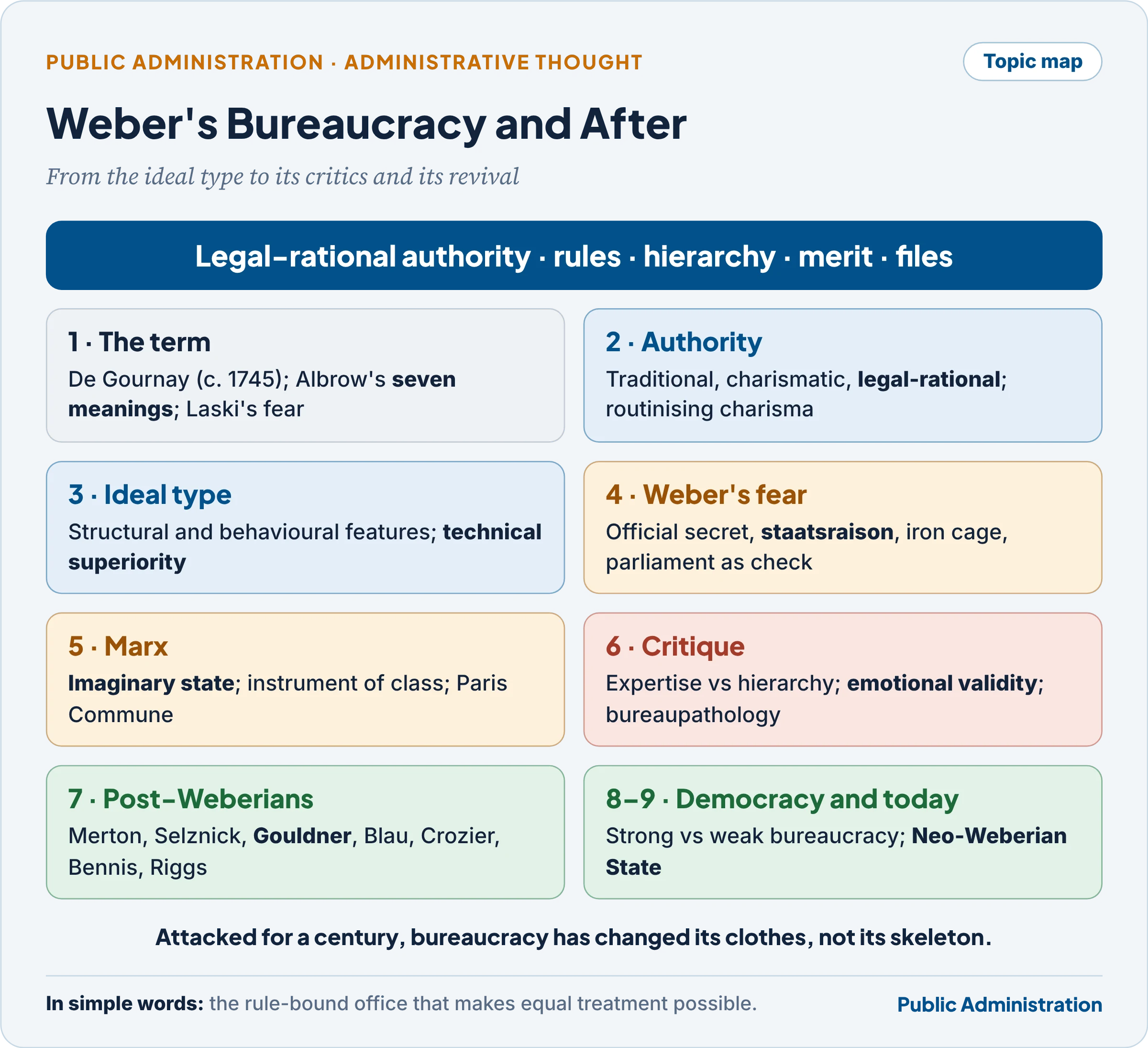
Bureaucracy is the most studied, most criticised and most durable form of organisation in the modern world. The German sociologist Max Weber (1864–1920) gave it its classic analysis: bureaucracy is the administrative apparatus of legal-rational authority, an organisation of appointed, trained, salaried officials working within a hierarchy under written rules, without favour or hatred. For Weber it was technically the most efficient form of administration ever devised, and also, potentially, an “iron cage” that could trap human freedom and overpower democratic politics.
- Why it matters: every government ministry, district office, police force, hospital and large company is organised, at least in part, on Weber’s lines. India’s civil services, from UPSC recruitment to Article 311 protection, are a Weberian design.
- Why it is controversial: sociologists after Weber (Merton, Selznick, Gouldner, Blau, Crozier) showed that the same features that make bureaucracy efficient also make it rigid, self-serving and inefficient in practice; scholars of developing countries questioned whether it suits non-Western societies; reformers from New Public Management onwards tried to replace it.
- Why it persists: despite a century of attack, bureaucracy has not disappeared. The Neo-Weberian State and the “rediscovery of bureaucracy” show why rule of law, merit, continuity and impartiality remain indispensable.
In simple words
When you apply for a passport, you do not need to know the officer, bribe anyone or belong to the right caste. You fill a standard form, attach documents, and an official who has passed an examination checks them against written rules; if refused, you can appeal to a higher officer. That impersonal, rule-based, appealable process is Weber’s bureaucracy at its best. When the same officer refuses because one form field is in the wrong ink, that is bureaucracy at its worst.
1. Bureaucracy: The Term and its Meanings
In simple words
“Bureaucracy” began as a sneer: rule by desks. Over time it came to mean several different things: the civil service, rule by officials, any big organisation, or an efficient rational system. Knowing which meaning a writer uses avoids confusion.
1.1 Origin of the term
- The word was coined around 1745 by the French economist Vincent de Gournay (1712–1759), joining bureau (desk, office) and the Greek kratos (rule). He complained of “an illness in France” called bureaumania. As Fritz Morstein Marx noted, it spread to Germany as Bürokratie in the nineteenth century and then into English; Thomas Carlyle called it “the continental nuisance”.
- Earlier writers treated it as rule by officials: J.S. Mill contrasted bureaucracy with representative government; Gaetano Mosca (Elementi di scienza politica, 1896; The Ruling Class, 1939) classified all political systems as either feudal or bureaucratic; Robert Michels (Political Parties, 1911) formulated the iron law of oligarchy: every large organisation, even a democratic socialist party, develops a bureaucratic structure in which a few leaders control the many.
- Max Weber freed the term from its purely pejorative sense and made it a tool of sociological analysis.
1.2 Seven meanings of bureaucracy (Martin Albrow)
Martin Albrow (Bureaucracy, 1970) identified seven modern concepts:
| Meaning | Sense | Typical user |
|---|---|---|
| Rational organisation | An efficient organisation based on rules and expertise | Weber, Blau |
| Organisational inefficiency | Red tape, rigidity, delay | Merton, popular usage |
| Rule by officials | Officials hold political power | Mosca, Laski, Mill |
| Public administration | The civil service of the state | Common in public administration |
| Administration by officials | Any organisation run by salaried officials | Parsons |
| The organisation | Any large-scale organisation | Blau and Scott |
| Modern society | A society dominated by large organisations | Critics of mass society |
1.3 Types of bureaucracy (Morstein Marx)
Fritz Morstein Marx (The Administrative State, 1957) classified historical bureaucracies into four types:
- Guardian bureaucracy: officials selected for learning and moral character, custodians of the public interest (Confucian China; Plato’s guardians). Tends to become conservative and aloof.
- Caste bureaucracy: recruitment from one class or caste; qualifications linked to class (ancient India, aristocratic England, pre-war Japan).
- Patronage bureaucracy: jobs distributed as political favours (the American spoils system; Britain before the Northcote–Trevelyan reforms of 1854).
- Merit bureaucracy: recruitment and promotion by objective qualifications, with security of tenure and political control (modern civil services).
1.4 Laski: bureaucracy as a threat to liberty
Harold Laski defined bureaucracy as “a system of government the control of which is so completely in the hands of officials that their power jeopardizes the liberties of ordinary citizens.”
- The fear: officials who are permanent, expert and unelected accumulate power through control of information, discretion and the drafting of rules; elected leaders become dependent on them; citizens face an unaccountable apparatus.
- Its sources: routine, secrecy, delegated legislation, the expertise gap between ministers and officials, and the weakness of legislatures in overseeing administration.
- Limits of the definition: it describes a pathology, not bureaucracy as such. Merit bureaucracies under democratic control (parliamentary oversight, courts, RTI, ombudsmen) protect liberty by applying law equally; arbitrary rule by persons is the greater danger.
2. Weber’s Theory of Authority
In simple words
Why do people obey? Some obey because “it has always been so” (a king, a village elder). Some obey a remarkable person they believe in (a prophet, a freedom-fighter). Modern people mostly obey the law and the office, not the person. Weber built his theory of bureaucracy on this third kind of obedience.
2.1 Power, authority and legitimacy
- Power (Macht): “the probability that one actor within a social relationship will be in a position to carry out his own will despite resistance.”
- Authority / domination (Herrschaft): “the probability that a command with a given specific content will be obeyed by a given group of persons.” Authority is power accepted as legitimate: obedience is voluntary because the ruled believe the command is rightful.
- “All administration means domination“: for Weber, administration is the exercise of authority, not merely service.
- Five components of authority (as summarised by Reinhard Bendix): a ruler or rulers; the ruled; the will of the rulers to influence the conduct of the ruled, expressed as commands; evidence of influence in the objective degree of compliance; and evidence of the subjective acceptance with which the ruled obey.
- Legitimacy decides the type of obedience, the kind of administrative staff and the way authority is exercised.
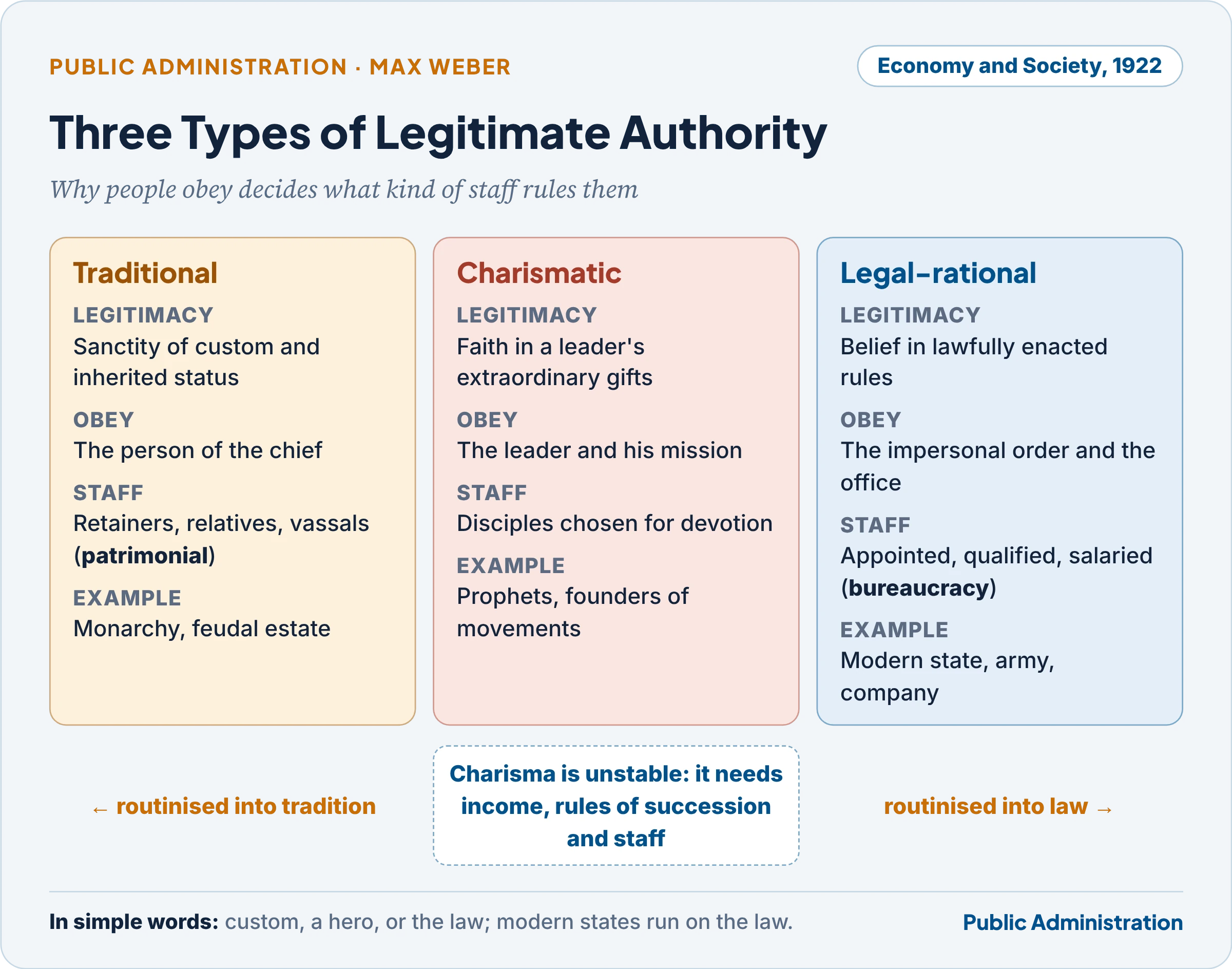
2.2 The three pure types of legitimate authority
| Basis | Traditional | Charismatic | Legal-rational |
|---|---|---|---|
| Source of legitimacy | Sanctity of immemorial traditions and of the status of those who rule by them | Devotion to the exceptional sanctity, heroism or exemplary character of a person | Belief in the legality of enacted rules and the right of those appointed under them to command |
| Obedience owed to | The person of the chief, within tradition | The person of the leader and his revelation | The impersonal legal order and the office |
| Administrative staff | Personal retainers, household officials, relatives, favourites (patrimonial); or feudal vassals (feudal) | Disciples and followers chosen for devotion and charisma | Bureaucracy: appointed, qualified, salaried officials |
| Character | Customary plus personal arbitrariness | Revolutionary, unstable, anti-routine | Continuous, rule-bound, calculable |
| Example | Monarchy, patriarchy, feudal estate | Prophets, Gandhi, Napoleon, founders of movements | Modern state, army, corporation |
- Pure types are rarely found pure: real systems combine elements; one type tends over time to acquire features of another.
- Weber preferred legal-rational authority as the type suited to modern government because of its rationality.
2.3 The routinisation of charisma
- Pure charisma is revolutionary (“It is written…, but I say unto you…”) and unstable: it depends on the leader proving his gifts and lasts only while followers believe. It breaks down when the leader dies or fails.
- To survive, charisma must be routinised (Veralltäglichung): transformed into traditional authority (hereditary succession, a dynasty) or legal-rational authority (an office, a party organisation, elections), in either an authoritarian or a democratic direction.
- Charisma’s anti-economic character: pure charisma is “foreign to economic considerations“: the leader and disciples live on gifts, booty or voluntary support and despise regular, methodical earning. For charisma to become a permanent routine structure, this anti-economic character must be altered: the followers need regular income (benefices, fees, salaries, taxes), property and rules of succession. In other words, a lasting organisation needs an economic base and an administrative staff, which is exactly what bureaucratisation supplies.
- Example: a national movement led by a charismatic leader becomes, after independence, a party with paid functionaries, membership dues and a constitution; a religious founder’s community becomes a church with priests, endowments and hierarchy.
2.4 The beliefs that underpin legal-rational authority
Martin Albrow summarised five beliefs on which legal authority rests:
- a legal code can be established that claims obedience from members;
- law is a system of abstract rules applied to particular cases; administration pursues the organisation’s interests within the limits of law;
- the person exercising authority also obeys this impersonal order;
- members obey the law only as members (qua member), not as persons;
- obedience is owed not to the person holding authority but to the impersonal order that appointed him.
Bureaucracy: the purest, but not the only, form of legal authority.
- Weber called bureaucratic administration “the purest type of legal authority”: a staff of appointed, qualified officials applying rules is where legal-rational domination is most fully realised.
- But legal authority is not exercised only through bureaucracy. It also works through elected heads of government, collegial bodies (cabinets, boards), parliaments, courts and honorary officials. Weber himself noted that “at the top of a bureaucratic organisation there is necessarily an element which is at least not purely bureaucratic“: the minister or president who holds office by election, succession or appointment from outside the career ladder.
- Implication: bureaucracy is a means of legal domination, not its whole content; the political head supplies goals and legitimacy, and the bureaucracy supplies continuous, expert execution. That division is the root of the politics–administration relationship (and of Weber’s demand for strong political leadership, Section 4.5).
3. The Ideal-Type Bureaucracy
In simple words
Weber did not describe any real office. He built a “pure model” by exaggerating the features that make modern administration rational, so that real offices could be measured against it, the way a perfect circle helps you see how round a real wheel is.
3.1 The ideal type as a method
- An ideal type is a mental construct, formed by “one-sided accentuation” of certain features of reality into a logically consistent picture. “Ideal” means pure or logically complete, not morally desirable.
- It is not a description of any real bureaucracy, nor a hypothesis, nor an average; it is a yardstick for comparison, classification and causal analysis (“it is not a description of reality but it aims to give unambiguous means of expression to such a description”).
- Weber used ideal types to solve the problem of objectivity in the social sciences: they let researchers compare different societies and periods systematically.
- Carl Friedrich complained that “ideal” and “type” cancel each other; defenders reply that Weber’s meaning is purely methodological.
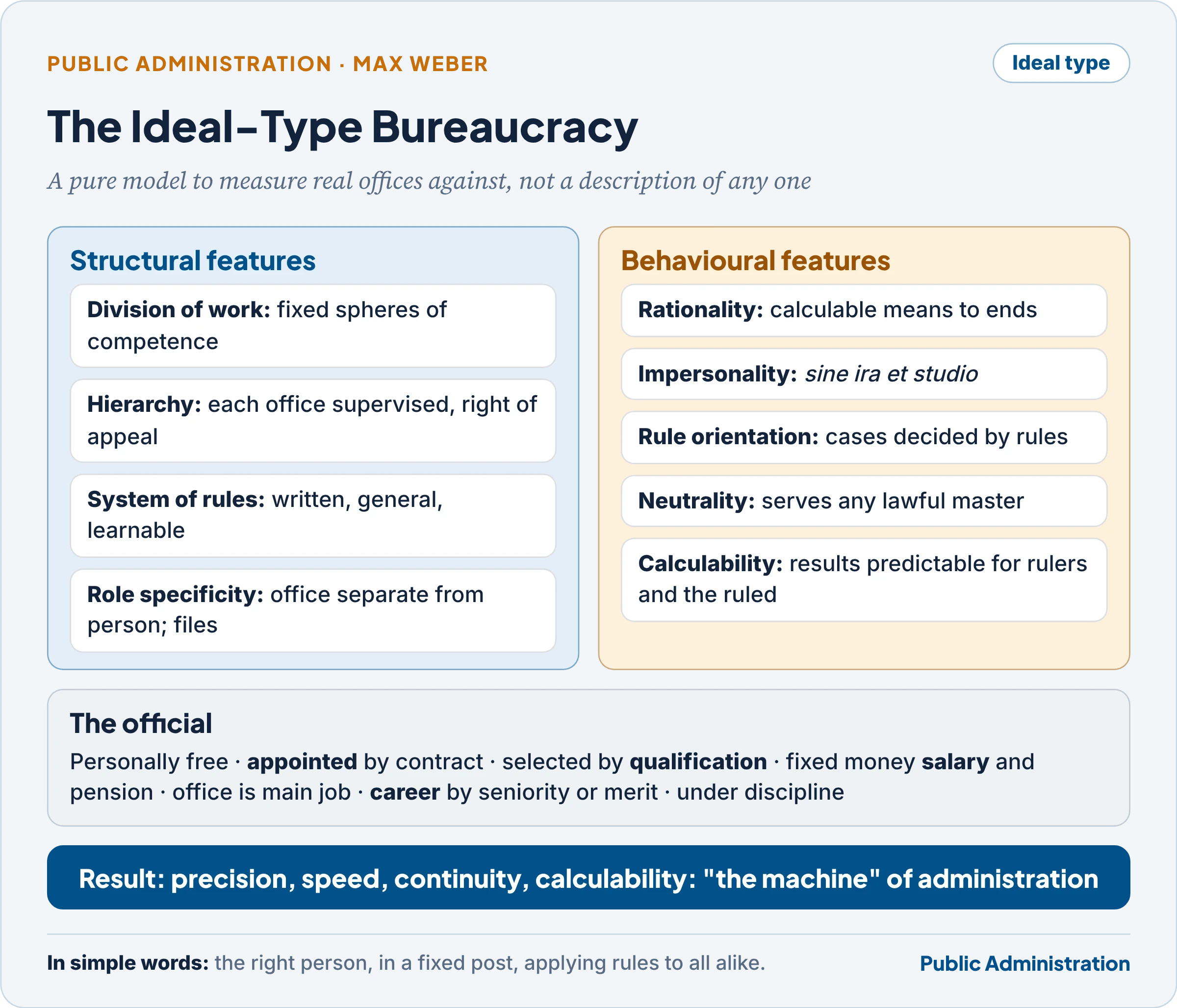
3.2 The structural features
Weber’s account in Economy and Society (Wirtschaft und Gesellschaft, published posthumously in 1922; English translations 1947 and 1968) can be grouped as follows.
The organisation of offices
- Continuous, rule-bound conduct of official business.
- Fixed jurisdictional areas (spheres of competence): each office has defined duties, the authority to carry them out, and strictly limited means of compulsion.
- Hierarchy (Amtshierarchie): each lower office is under the control and supervision of a higher one, with a right of appeal.
- Rules, technical or legal, whose application requires trained officials.
- Separation of office and person: officials do not own the means of administration; official property and private property, office and home, are strictly separated.
- No appropriation of office: the post cannot be sold or inherited.
- Written documents (files): acts, decisions and rules are recorded in writing even when discussion is oral; files plus continuous operation constitute the “bureau“.
The position of the official
- Personally free, subject to authority only in official obligations.
- Appointed, not elected, through a free contract.
- Selected for technical qualifications, ideally tested by examination or certified by diploma.
- Paid a fixed salary in money, usually with pension, graded by rank.
- The office is his sole or primary occupation.
- A career: promotion by seniority or achievement, or both, on the judgement of superiors.
- Subject to strict and systematic discipline and control.
Martin Albrow counted ten features as Weber’s “ideal, pure or most rational type of bureaucracy”.
3.3 Structural and behavioural characteristics
Mohit Bhattacharya distinguishes two sets of properties in the Weberian model:
| Structural characteristics | Behavioural characteristics |
|---|---|
| Division of work (specialisation) | Rationality (calculable means to ends) |
| Hierarchy | Impersonality (sine ira et studio) |
| System of rules | Rule orientation |
| Role specificity | Neutrality |
- Sine ira et studio (“without hatred or passion”): “Bureaucracy develops the more perfectly, the more it is ‘dehumanised‘, the more completely it succeeds in eliminating from official business love, hatred, and all purely personal, irrational, and emotional elements which escape calculation. This is the specific nature of bureaucracy, and it is appraised as its special virtue.”
- Three ways of reading Weber: structurally (division of work, hierarchy), behaviourally (impersonality, rule-following), and instrumentally (Peter Blau: “an organisation that maximises efficiency in administration”). Critics usually attack one reading and ignore the others.
3.4 Why bureaucracy is superior: rationality and efficiency
- Technical superiority: “The decisive reason for the advance of bureaucratic organisation has always been its purely technical superiority over any other form of organisation. The fully developed bureaucratic apparatus compares with other organisations exactly as does the machine with the non-mechanical modes of production.”
- Its virtues: “Precision, speed, unambiguity, knowledge of the files, continuity, discretion, unity, strict subordination, reduction of friction and of material and personal costs: these are raised to the optimum point in the strictly bureaucratic administration, and especially in its monocratic form.”
- Calculability: bureaucracy makes possible “a high degree of calculability of results for the heads of the organisation and for those acting in relation to it”.
- Indispensability: “For the needs of mass administration today, it is completely indispensable. The choice is only that between bureaucracy and dilettantism in the field of administration.”
Rationality and efficiency intertwined. Weber’s bureaucracy is “rational” in a specific sense, formal or instrumental rationality (Zweckrationalität): the systematic, calculable choice of means to given ends through rules and expertise. Its efficiency follows from this rationality:
- Rules make decisions predictable and consistent: calculable efficiency.
- Expertise (selection by qualification, specialisation, training, files) gives technical competence: knowledge-based efficiency.
- Hierarchy and discipline coordinate effort and reduce friction.
- Impersonality removes favouritism and emotion, so that cases are decided on objective grounds.
- Continuity (files, careers) preserves institutional memory.
But the two concepts are not identical:
- Weber’s German term was Rationalität; English readers translated his claims into “efficiency“, a word he did not use in the modern managerial sense (Albrow). His claim was comparative: bureaucracy is more rational than patrimonial or charismatic administration, not maximally efficient in every case.
- Formal rationality can produce substantive irrationality: rules followed for their own sake (Merton), procedures that defeat purposes, “rational” systems that serve inhuman ends.
- So rationality and efficiency are intertwined (one produces the other in routine, stable tasks) but can diverge (in novel, changing or human-service situations).
3.5 Hierarchy, rules and depersonalisation
- Hierarchy fixes who commands and who obeys, so that authority attaches to the office, not the person; rules fix how authority is exercised. Together they ensure depersonalisation: the official treats every citizen as a case under a rule, and the citizen obeys the office, not the individual.
- Depersonalisation produces equality before the law (no favours), predictability and efficiency in mass administration.
- The counter-argument: depersonalisation also produces alienation, indifference to individual needs, “trained incapacity” and rigidity; hierarchy produces mutual suspicion and blocked upward communication (Section 6).
3.6 The historical conditions of bureaucratisation
Weber traced the rise of bureaucracy to:
- A developed money economy: “The development of the money economy, in so far as a pecuniary compensation of the officials is concerned, is a presupposition of bureaucracy.” Officials must be paid regular salaries.
- A stable system of taxation: “a precondition for the permanent existence of bureaucratic administration”.
- The growth of administrative tasks in size and complexity: large territories, standing armies, public works (canal administration in ancient Egypt), modern communications.
- Capitalism: “Today it is primarily the capitalist market economy which demands that the official business of the administration be discharged precisely, unambiguously, continuously, and with as much speed as possible.” Large capitalist enterprises are “unequalled models of strict bureaucratic organisation”.
- Mass democracy: “Bureaucracy inevitably accompanies modern mass democracy”, because democracy demands equality before the law and rejects privilege and doing business “from case to case”. Bureaucracy has a levelling effect on social classes.
- Rationalisation of culture: the Protestant ethic (The Protestant Ethic and the Spirit of Capitalism, 1904–05) encouraged methodical, disciplined, calculating conduct.
- Critics: Peter Blau noted bureaucracies paid in kind (Egypt, Rome, China), so a money economy is not absolutely necessary; H.G. Creel showed that many Weberian features existed in China by about 200 BC.
4. Weber’s Fear: Bureaucratic Power and the Iron Cage
In simple words
Weber admired bureaucracy as a machine but feared what it might do to people and to democracy. A machine that knows everything, keeps secrets and never dies can end up ruling those it was built to serve.
4.1 Beetham’s three aspects of Weber’s theory
David Beetham (Max Weber and the Theory of Modern Politics, 1974) showed that Weber’s view was more complex than the ideal type:
- Bureaucracy as a technically efficient instrument (Economy and Society): the familiar view of a neutral tool.
- Bureaucracy as a power group: it has an inherent tendency to exceed its instrumental function, become a separate status group and usurp the goal-setting role of politicians. Weber’s political writings concentrate on this negative side: what bureaucracy cannot do (lead, take political responsibility, set values).
- Bureaucracy as reflecting class: it cannot free itself from the outlook of the classes from which it is recruited and with which it is allied.
Alfred Diamant speaks of a dualism in Weber: the neutral tool of the ideal type and the power-hungry apparatus of his political experience.
4.2 Knowledge, secrecy and staatsraison
- Power through knowledge: “Bureaucratic administration means fundamentally domination through knowledge.” The bureaucrat has technical expertise plus knowledge of the files (service knowledge), which the political master lacks: “The political master finds himself in the position of the dilettante who stands opposite the expert.”
- The official secret: “The concept of the ‘official secret‘ is the specific invention of bureaucracy, and nothing is so fanatically defended by the bureaucracy as this attitude.” Bureaucracy “naturally welcomes a poorly informed and hence a powerless parliament“.
- Staatsraison: “In the canonisation of the abstract idea of ‘staatsraison‘ (reason of state) are inseparably woven the sure instincts of the bureaucracy for the conditions which preserve its own power in the State.”
- Meaning: officials justify secrecy, discretion and resistance to scrutiny by appealing to an abstract “interest of the state” (national security, public order, administrative necessity).
- The real function: this lofty doctrine also, and inseparably, protects the bureaucracy’s own power: secrecy shields it from parliament and public; “the needs of the state” become a reason to expand its own sphere.
- Example: colonial and post-colonial secrecy laws (India’s Official Secrets Act, 1923) and claims of privilege before courts; the classification of routine information.
- Counter-measures: parliamentary inquiry, freedom of information laws, judicial review, a free press.
4.3 The hardest structure to destroy
- “Once it is fully established, bureaucracy is among those social structures which are the hardest to destroy.” It is “practically unshatterable” as an instrument for “societalising” relations of power.
- Why: the individual official is “a single cog in an ever-moving mechanism which prescribes to him an essentially fixed route of march”; the ruled depend on its continuous functioning (“the material fate of the masses depends upon the steady and correct functioning of the increasingly bureaucratic organisations”); its knowledge and files are indispensable to any new ruler; revolutions and conquests capture the apparatus rather than abolish it.
- Evidence: the Russian Revolution kept and expanded the bureaucracy; newly independent states, including India, retained colonial administrative structures; privatisation and New Public Management transferred tasks but created new regulatory bureaucracies.
4.4 The iron cage
- In The Protestant Ethic, Weber wrote that the care for external goods, which should lie on the saint’s shoulders like a light cloak, had become a stahlhartes Gehäuse, translated by Talcott Parsons as an “iron cage” (literally a “shell as hard as steel”).
- In Economy and Society he warned that bureaucracy, with machines, is building “the shell of bondage” (Gehäuse der Hörigkeit) into which people may be forced, like the fellahs of ancient Egypt, if a technically good, rational administration becomes the only value deciding their affairs.
- Meaning: rationalisation could produce “specialists without spirit, sensualists without heart“, a world of rule-bound routine that crushes individual freedom, charisma and moral leadership.
4.5 Weber’s mechanisms to control bureaucracy
Martin Albrow identified five mechanisms in Weber’s writings:
- Collegiality: more than one person takes part in decisions (cabinets, boards); limits monocracy but slows decisions and blurs responsibility.
- Separation of powers: responsibility for the same function divided between two or more bodies (budget between crown and parliament); inherently unstable.
- Amateur administration: unpaid notables; no match for professionals in modern conditions.
- Direct democracy: short terms, rotation, election, recall, officials guided by an assembly; workable only in small units.
- Representation: elected parliaments with strong parties. Weber saw this as the greatest check: a strong, working parliament with powers of inquiry, training politicians “with a grasp of reality”, would supply leadership and control the officials (Parliament and Government in a Reconstructed Germany, 1918). He also valued plebiscitary leadership, a charismatic political leader elected by the people, to counter “rule by officials” (Beamtenherrschaft).
Indian Connect — Weber in the Indian civil services
- Merit and career: recruitment by the UPSC (Articles 315–320) through competitive examination, the All India Services (Article 312; All India Services Act, 1951), pay scales, pensions and promotion rules embody Weber’s official.
- Tenure and protection: Article 311 protects civil servants from dismissal without inquiry, securing the independence Weber thought necessary; the pleasure doctrine of Article 310 keeps it subject to law.
- Written documents: in T.S.R. Subramanian v. Union of India (31 October 2013), the Supreme Court directed the setting up of Civil Services Boards, a minimum fixed tenure, and that civil servants should act on written instructions, recording oral instructions from political superiors, a direct application of Weber’s principle of files to protect neutrality.
- The office secret and its reversal: the Official Secrets Act, 1923, embodied Weber’s “official secret”; the Right to Information Act, 2005 reversed the presumption (Section 22 gives it overriding effect over inconsistent laws, including the Official Secrets Act). The 2nd ARC’s first report (2006) recommended repealing the Official Secrets Act.
- Kautilya and Weber: the Arthashastra already described salaried officials, departmental superintendents, written records, audit and tests of integrity, many features of Weber’s model, though in a patrimonial monarchy.
5. Marx on Bureaucracy
In simple words
Weber saw bureaucracy as the rational tool of the modern state. Marx saw it as the tool of the ruling class, dressed up as the guardian of the general interest. For Marx, the bureaucrat’s claim to serve “the state” hides service to property and to the bureaucracy itself.
5.1 The critique of Hegel (1843)
- Hegel (Philosophy of Right, 1821) saw the civil service as the “universal class“: a neutral bridge between the state (the general interest) and civil society (particular interests), recruited by examination and dedicated to the common good.
- Marx, in his Critique of Hegel’s Philosophy of Right (1843), rejected this:
- “The bureaucracy is the imaginary state alongside the real state; it is the spiritualism of the state.“
- Imaginary state: bureaucracy presents itself as the embodiment of the state’s universal purpose, but this universality is an illusion; behind it the bureaucracy pursues its own corporate interest and the interests of the dominant class. It “takes itself to be the ultimate purpose of the state”.
- Spiritualism of the state: as a church claims to embody the spirit of religion, bureaucracy claims to embody the spirit of the state; its formalism, rituals, hierarchy and worship of authority make the state appear as something above society. “The general spirit of the bureaucracy is the secret, the mystery, preserved within itself by hierarchy and against the outside world by being a closed corporation.”
- Knowledge as mystery: “The top entrusts the understanding of particulars to the lower levels, whereas the lower levels credit the top with understanding of the universal, and so they deceive each other.” Hierarchy is a hierarchy of knowledge, so no one grasps the whole; competence turns into mystery, knowledge into secrecy.
- Careerism: “As far as the individual bureaucrat is concerned, the end of the state becomes his private end: a pursuit of higher posts, the building of a career.”
- Examinations are a mere “baptism of bureaucratic knowledge“, not an objective bond between individual and state.
- Passive obedience to the next higher rank is the only bond between bureaucratic minds.
- Early journalism: in the Rheinische Zeitung (1842), Marx attacked press censorship as a bureaucratic instrument and the law on thefts of wood that criminalised peasants’ customary rights to protect forest owners: the state as an instrument of private property.
5.2 Bureaucracy and the history of the state
Marx’s view of bureaucracy changes with the type of state he is analysing, which is why his interpretation is “rooted in the history of the nature of the state”:
- Absolutism and the rise of capitalism: bureaucracy arose with the absolute monarchy and the nation state (sixteenth century onwards), serving merchant capital and the king against feudal lords; it “sprang up in the days of the absolute monarchy, with the decay of the feudal system, which it helped to hasten”.
- The capitalist state: “The executive of the modern state is but a committee for managing the common affairs of the whole bourgeoisie” (Communist Manifesto, 1848). Bureaucracy is the instrument of the dominant class; its interests are linked to those of capital and the state.
- Bonapartism and relative autonomy: in The Eighteenth Brumaire of Louis Bonaparte (1852), Marx described the French executive as “an appalling parasitic body which enmeshes the body of French society like a net and chokes all its pores”. Under Louis Bonaparte, when no class could rule decisively, the state and its bureaucracy appeared independent of all classes, though it rested on the mass of small-holding peasants. Later Marxists developed this into the relative autonomy of the state.
- Factory inspectors (Capital): Marx praised the British factory and health inspectors who recorded facts and pressed for regulation against employers’ resistance, showing that parts of the bureaucracy can serve wider social interests under pressure from below.
- The Paris Commune (1871): in The Civil War in France, Marx saw the abolition of the bureaucratic state: officials elected, recallable at any time, paid workmen’s wages; the standing army replaced by the armed people; executive and legislative combined.
- The withering away of the state: under communism, class domination ends, and with it the need for a separate bureaucracy; administration becomes the “administration of things” (Engels). Lenin (The State and Revolution, 1917) promised that every cook could govern; in practice the Soviet state built one of the largest bureaucracies in history, which Trotsky later denounced as a privileged caste.
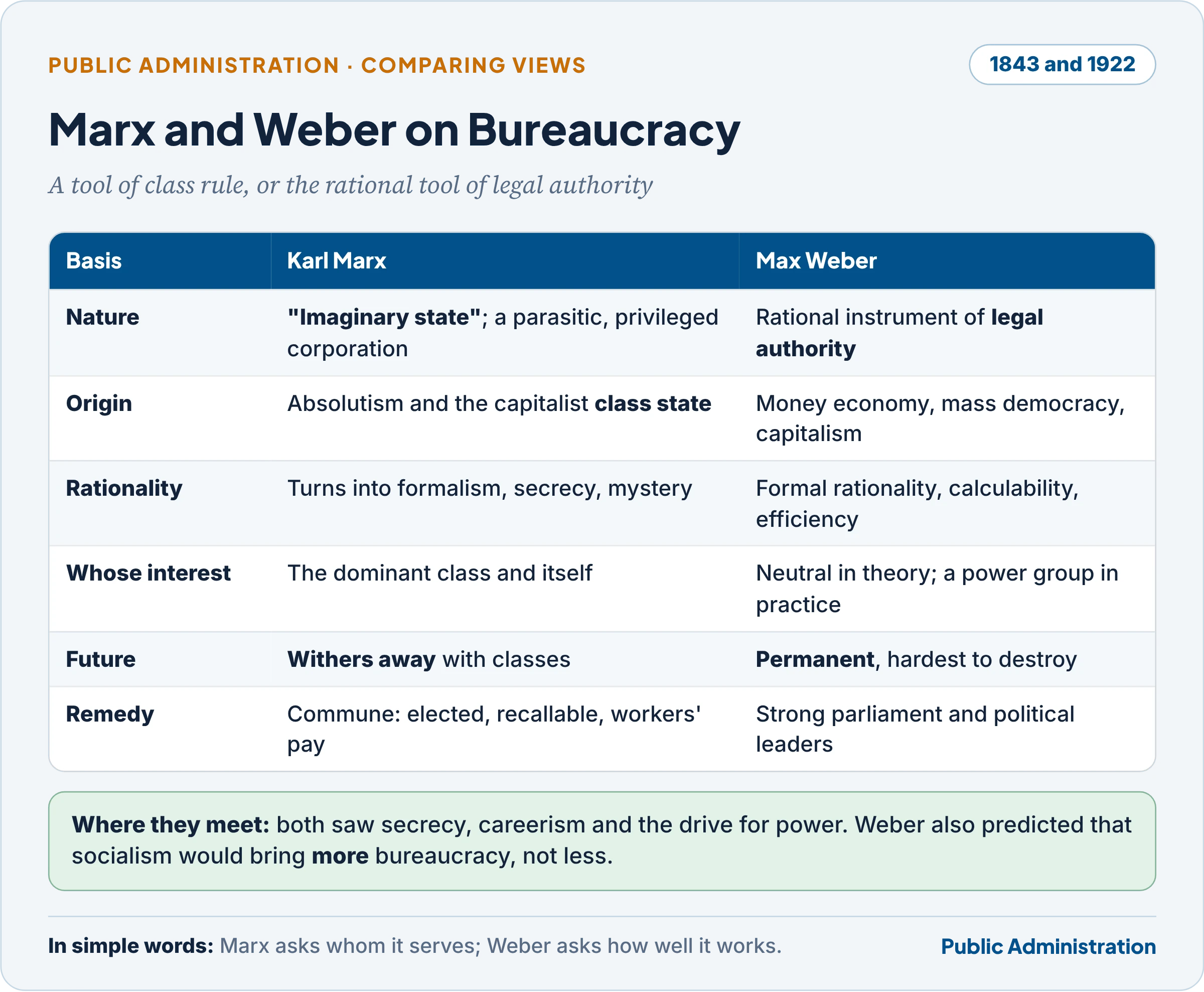
5.3 Weber and Marx compared
| Basis | Marx | Weber |
|---|---|---|
| Nature of bureaucracy | Instrument of class domination; a parasitic, privileged corporation | Rational instrument of legal authority; technically superior |
| Origin | Absolutism and capitalism; class state | Money economy, mass democracy, capitalism, rationalisation |
| Rationality | Rationality turned into its opposite: formalism, secrecy, mystery | Formal rationality, calculability, efficiency |
| Interest | Serves dominant class and its own corporate interest | Ideally neutral; in practice may become a power group |
| Future | Will wither away with classes (Commune model) | Permanent and indispensable; can only be checked |
| Remedy | Abolish class rule; elected, recallable officials | Strong parliament, political leadership |
| Method | Historical, dialectical, critical | Ideal type, comparative-historical |
- Convergence: both saw bureaucracy’s tendency to secrecy, careerism and power; Weber’s political writings echo Marx’s critique.
- Divergence: Weber thought socialism would mean more bureaucracy, not less, a prediction borne out by the Soviet experience; Marx thought bureaucracy was a feature of class society that could be abolished.
6. The Critique of Weber’s Model
In simple words
Weber’s critics did not say he was simply wrong. They said his model leaves out people, power, environment and culture, and that its own rules contain contradictions. Each criticism opened a new field of research.
6.1 Three grounds of criticism
Critics attacked the model on three grounds (Albrow):
- Rationality: the model’s rationality is doubtful, both because of factors it omits (informal organisation, power, emotions) and because of internal inconsistency;
- Cultural fit: the degree of rationality depends on the cultural context; Western bureaucracy may not suit other societies;
- Method: the very basis of the ideal type is invalid (Friedrich).
6.2 Internal contradictions
- Expertise versus hierarchy (Parsons, Gouldner): Talcott Parsons, translator of Economy and Society, noted that Weber grounds authority both in technical competence and in position in the hierarchy. A superior in rank may not be superior in expertise. Then whom should the subordinate obey: the person with the right to command or the person who knows more? Alvin Gouldner found this tension between “claims of expertise” and “claims of obedience” in his empirical study.
- Impersonal detachment versus esprit de corps (Mouzelis): Weber wants officials to treat one another and the public with impersonal detachment, sine ira et studio, yet a bureaucracy also needs loyalty, solidarity and team spirit (esprit de corps) to function. Nicos Mouzelis argued that the two are incompatible: if relations among staff are governed by impersonal detachment, it is difficult to see how esprit de corps can emerge.
- The defence: they operate at different levels. Detachment governs relations with clients and the application of rules; esprit de corps is a professional loyalty to the service and its ethos (the “steel frame” pride of the ICS and IAS). Professional identity can coexist with impersonal case-handling.
- The danger: esprit de corps can become group self-interest and closed ranks against outsiders, exactly what Marx and Laski feared.
- Seniority versus merit: promotion by seniority conflicts with promotion by achievement.
- Hierarchy and communication: rigid hierarchy breeds mutual suspicion; subordinates conceal defects, blocking the upward flow of information (Mouzelis).
6.3 Neglect of people, informal organisation and power
- Informal organisation (Barnard, Simon, Blau): “informal organisations are necessary to the operation of formal organisation” (Barnard); informal relations and unofficial practices often increase efficiency (Blau).
- Human behaviour: March and Simon placed Weber with the classical “machine model” writers; Waldo said Weber over-stressed the functional side and elevated position over knowledge.
- Power: Selznick and others criticised Weber for neglecting the power the bureaucrat acquires, “increasingly preoccupied with his own social position”, subverting organisational goals.
- Psychological growth: Argyris argued that bureaucracies restrict the individual’s psychological growth and produce feelings of failure, frustration and conflict.
6.4 Lack of empirical and emotional validity in democratic administration
Lack of empirical validity:
- The model is an ideal type, so no real bureaucracy matches it; empirical studies (Gouldner, Blau, Crozier, Selznick) found informal norms, power games, rule-bending and goal displacement everywhere.
- Democratic administration differs from the model: officials work under political direction, public scrutiny, interest-group pressure, courts, media and citizen participation; they make policy, use discretion and negotiate; neutrality and impersonality are only partly achieved.
- Many Weberian features (life tenure, seniority promotion, strict hierarchy) have been modified by performance management, contracts, lateral entry and decentralisation.
Lack of “emotional validity”:
- Democratic administration requires responsiveness, empathy and human concern for citizens, especially the poor; Weber’s “dehumanised”, sine ira et studio official treats people as cases, producing alienation and distrust. Ralph Hummel (The Bureaucratic Experience) described how bureaucracy makes the official’s self-concept dependent on the organisation and reduces human relations to functional ones.
- Inside the organisation, impersonality ignores the emotional needs of employees (belonging, recognition), which the human relations school showed to be decisive.
The defence:
- Weber’s model is a yardstick, not a description; its “invalidity” is the point: it shows how far real administration deviates.
- Impersonality protects the weak against favouritism; in caste-ridden or clientelist societies, impartial treatment is itself a democratic value (Article 14 equality).
- Bureaucracy and democracy share the principle of equality before the law; Weber himself saw bureaucracy as accompanying mass democracy.
6.5 Unsuitability for developing societies
- Presthus: Weber’s assumptions about motivation are not necessarily valid in non-Western environments.
- Delaney: patrimonial bureaucracy may be more conducive to growth in under-developed societies than rational bureaucracy.
- La Palombara: a bureaucracy heavily encumbered by Weberian norms “may be a less efficacious instrument of economic change”; “in a place like India, public administrators steeped in the tradition of the Indian Civil Service may be less useful as development entrepreneurs than those who are not so rigidly tied to notions of bureaucratic status, hierarchy and impartiality.”
- The Rudolphs (Lloyd and Susanne Rudolph, 1979): formal rationality can alienate and fuel power struggles; the persistence of patrimonial elements in bureaucratic administration can mitigate these, just as bureaucratic features in patrimonial administration (Mughal, Rajput states) raised its efficiency.
- Development administration demands flexibility, initiative, risk-taking and goal-orientation; Weber’s fixed spheres of competence, rules and hierarchy encourage officials to shirk responsibility and wait for clarifications.
- Spitzer and Burin: Weber understated the comprehensive role of officials like the French prefect and the impact of public liability and accountability doctrines on bureaucracy.
6.6 Bureaupathology: Victor Thompson
- Victor Thompson (Modern Organization, 1961) called the dysfunctional behaviour of bureaucrats bureaupathology.
- The cause: a growing gap between authority and ability. Modern organisations depend on specialists, but authority remains with hierarchical superiors who often lack the specialist knowledge to judge the work they supervise.
- The result: insecure superiors protect themselves through excessive control, insistence on rules, resistance to change, impersonality, defensive secrecy and “drives to dominate”; they emphasise the rights of position over the requirements of the task.
- How bureaupathology denigrates competence:
- Status over skill: rank, seniority and procedure are rewarded more than expertise and results; specialists must defer to generalist superiors who understand less.
- Credit and blame: superiors claim credit for subordinates’ work and blame them for failures; initiative becomes risky.
- Conformity over innovation: competent people who question rules are seen as troublemakers; those who play safe rise (a link to the Peter Principle).
- Ritual over purpose: competence is judged by procedural compliance, not by solving problems.
- Remedies: dual career ladders for specialists, team-based and matrix structures, authority based on knowledge, performance appraisal on outcomes, and leadership that is secure enough to share authority. Thompson also described bureausis, the client’s frustration with impersonal bureaucracy.
Common confusion
Is Weber an uncritical admirer of bureaucracy? No. In Economy and Society he described the technical superiority of the ideal type, but his political writings (especially Parliament and Government, 1918) are some of the sharpest criticisms of rule by officials ever written: bureaucracy hoards secrets, prefers a weak parliament, cannot provide political leadership, and threatens to build an “iron cage”. As David Beetham showed, any assessment must take his whole work into account. Weber thought bureaucracy indispensable, not good in itself.
7. Post-Weberian Developments
In simple words
After Weber, sociologists went inside real bureaucracies (a tax office, a gypsum mine, the Tennessee Valley Authority, a French tobacco monopoly) and found that rules, hierarchy and specialisation had unintended effects. Others asked what would replace bureaucracy, and later reformers rediscovered why it is still needed.
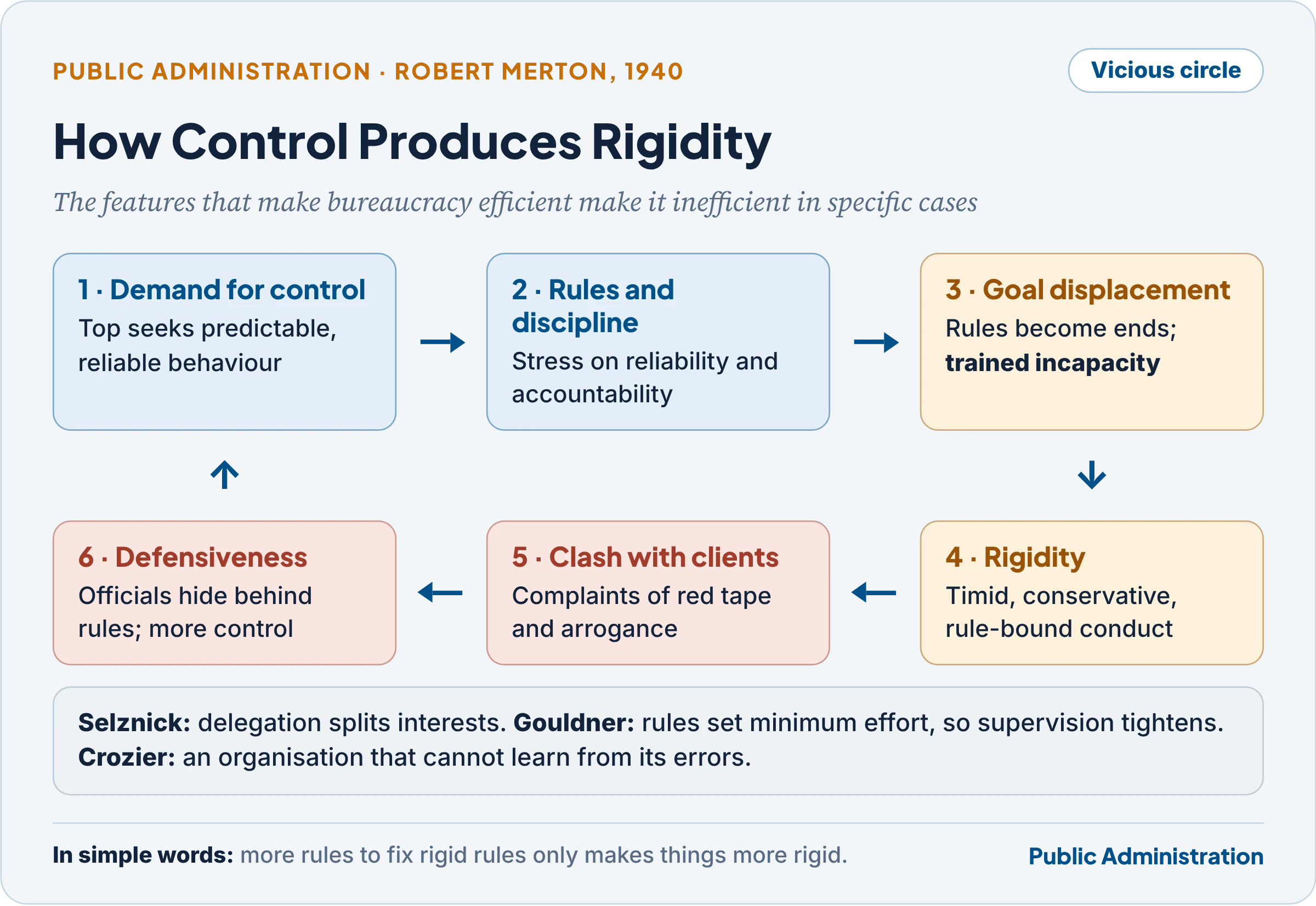
7.1 Merton: trained incapacity and goal displacement
Robert K. Merton, “Bureaucratic Structure and Personality” (1940), reprinted in Social Theory and Social Structure (1949):
- Trained incapacity: borrowing Thorstein Veblen‘s concept, Merton argued that the very training and skills that make an official effective in routine situations become blind spots when conditions change: “actions based upon training and skills which have been successfully applied in the past may result in inappropriate responses under changed conditions.” (Kenneth Burke’s example: chickens conditioned to come to a bell continue to come when the bell now calls them to slaughter.) Veblen’s concept thus provides the transition from studying bureaucracy’s efficiency to studying its negative aspects: the same structure produces both.
- Displacement of goals: “Adherence to the rules, originally conceived as a means, becomes transformed into an end in itself; there occurs the familiar process of displacement of goals whereby an instrumental value becomes a terminal value.” Rules become more important than the game.
- The bureaucratic personality: strict discipline and career incentives produce timidity, conservatism, technicism and over-conformity; the “bureaucratic virtuoso” never forgets a single rule.
- The vicious circle: “the very elements which conduce toward efficiency in general produce inefficiency in specific instances”: demand for control → emphasis on reliability and rules → rigidity and defensiveness → difficulty with clients → felt need to defend actions by rules → more rigidity.
- Conflict with the public: depersonalised treatment and esprit de corps produce arrogance and conflict with clients, who want personal, sympathetic treatment.
- Other dysfunctions listed by later writers: buck-passing, red tape, excessive impersonality, over-secretiveness, unwillingness to delegate and reluctance to use discretion.
7.2 Selznick: delegation, bifurcation and co-optation
Philip Selznick, TVA and the Grass Roots (1949), studied the Tennessee Valley Authority:
- Delegation to sub-units creates specialised competence but also bifurcation of interests: sub-units develop goals of their own that may conflict with the organisation’s goals, and members internalise these sub-goals.
- Co-optation: “the process of absorbing new elements into the leadership or policy-determining structure of an organisation as a means of averting threats to its stability or existence.”
- Formal co-optation: sharing the symbols of authority (advisory committees) without real power, to gain legitimacy.
- Informal co-optation: sharing real power with powerful local interests. The TVA’s “grass-roots democracy” partnered with local agricultural elites (land-grant colleges, farm bureaus), whose interests then shaped TVA policy, against poorer tenants.
- Lesson: organisations are not just instruments; they are adaptive social systems whose need to survive can change their goals. Selznick founded the institutional school (Leadership in Administration, 1957: organisations become “infused with value” beyond their technical function).
7.3 Gouldner: three patterns of bureaucracy
Alvin Gouldner, Patterns of Industrial Bureaucracy (1954), studied a gypsum plant and mine:
| Pattern | Who makes the rules | Who accepts them | Result |
|---|---|---|---|
| Mock bureaucracy | An outside agency (e.g. a no-smoking rule imposed by the insurer) | Neither management nor workers; ignored by both | Rules exist on paper; little conflict |
| Representative bureaucracy | Rules jointly made or accepted by both sides (e.g. safety rules) | Both, as technically necessary and in their interest | Cooperation; rules legitimate |
| Punishment-centred bureaucracy | One side imposes rules on the other, enforced by sanctions | Only the imposing side | Tension, conflict, resistance |
- Rules define minimum acceptable behaviour: employees learn exactly how little they can do without sanction (“acceptable apathy“); managers respond with closer supervision and more rules, raising tension: the bureaucratic response produces its own reaction.
- Formal and informal interlinked: Gouldner argued that the “informal organisation” is a residual, “cafeteria” concept into which everything not formal is dumped; he showed how formal rules and informal practices interpenetrate (rules are used as bargaining chips; their enforcement or leniency is a currency of exchange), so neither can be understood alone.
- Weber’s model, Gouldner said, ignored the orientation of members towards rules, which decides whether rules produce cooperation or conflict.
7.4 Blau: the dynamics of bureaucracy
Peter Blau, The Dynamics of Bureaucracy (1955), studied a state employment agency and a federal law-enforcement agency:
- Officials adapted and violated formal rules (consulting colleagues instead of supervisors, using informal statistics) to achieve the agency’s real goals; such informal practices often increased efficiency.
- Statistical performance records changed behaviour, sometimes towards the measure rather than the goal (an early warning about targets).
- Efficiency requires that officials identify with the organisation’s purposes and adjust behaviour to changing circumstances; rigid rules cannot guarantee it. “The attainment of organisational objectives depends on perpetual change in the bureaucratic structure.”
- Blau and Scott (Formal Organizations, 1962) proposed a typology by who benefits (cui bono): mutual-benefit associations (members), business concerns (owners), service organisations (clients) and commonweal organisations (the public at large, e.g. government agencies).
7.5 Crozier: the bureaucratic vicious circle
Michel Crozier, The Bureaucratic Phenomenon (1963; English 1964), studied French state agencies:
- A bureaucratic organisation is one that cannot correct its behaviour by learning from its errors.
- The vicious circle: impersonal rules and centralisation are adopted to eliminate personal power and uncertainty; but they create rigidity and isolate strata from one another; problems are pushed up to a remote centre; dissatisfaction leads to more rules and centralisation.
- Power and uncertainty: groups that control the remaining zones of uncertainty (in his tobacco factory, the maintenance workers who alone could fix the machines) gain power. Power in organisations flows from control of uncertainty, not from formal position.
- Change comes only through periodic crises, not continuous adaptation; Crozier linked this to French cultural traits (fear of face-to-face relations, preference for impersonal rules).
7.6 Presthus: three types of personal accommodation
Robert Presthus, The Organizational Society (1962), described how individuals adapt to bureaucratic organisations:
- Upward-mobiles: identify with the organisation, accept its values and authority, and seek promotion; they succeed and are rewarded.
- Indifferents: the majority; reject the organisation’s values, do the minimum, and seek satisfaction outside work (family, hobbies).
- Ambivalents: creative, independent-minded professionals who want the organisation’s rewards but cannot accept its authority and conformity; anxious, often marginal, but a source of innovation.
7.7 The “end of bureaucracy” thesis: Bennis and Toffler
- Warren Bennis (“The Coming Death of Bureaucracy”, 1966; The Temporary Society, with Philip Slater, 1968) predicted that bureaucracy would be replaced within decades because it cannot cope with rapid change, complexity, diversity and educated professional workforces: “it is the requirement of adaptability to the environment which leads to the predicted demise of bureaucracy.”
- The replacement: “adaptive, problem-solving, temporary systems of diverse specialists, linked together by coordinating executives in an organic flux“. Organisations would be built around problems, not functions; project teams and task forces that dissolve when the task ends; authority based on competence, not rank.
- Alvin Toffler (Future Shock, 1970) called such organisations adhocracy; Henry Mintzberg later made adhocracy one of his five organisational configurations.
- Characteristics of the organic-adaptive organisation: temporary, problem-centred, matrix-based; differentiation by skill rather than rank; horizontal, network-style links (Larry Hill); bottom-up authority; heavy reliance on information technology; attention to non-economic motivation, participation, quality circles and Japanese-style management.
- Strengths of the thesis: it anticipated matrix, project and network organisations, task forces, start-up cultures, agile government teams and knowledge work; it rightly stressed adaptability.
- Limitations:
- bureaucracy did not die; it adapted (flatter hierarchies, e-government) and still dominates public administration;
- temporary systems suit innovative, non-routine tasks, not mass, repetitive, rights-based services (pensions, licences, policing);
- adhocracies raise problems of accountability, continuity, coordination and insecurity for members (Bennis himself noted the psychological costs);
- they presuppose educated, professional, trusting workforces and stable resources;
- Bennis later admitted that his prediction was premature.
7.8 Bureaucracy in developing and comparative settings
- Fred Riggs: in prismatic societies (formally differentiated but functionally fused), Weberian structures coexist with formalism (gap between rules and practice), nepotism and the “sala” (office mixed with household and community); bureaucrats tend to dominate weak political institutions, producing unbalanced polities (see the article on Riggsian models).
- Weber as mentor of comparative public administration: his comparative-historical method (China, India, Egypt, Rome, Europe), his typology of authority (adapted by Riggs into fused–prismatic–diffracted) and his ideal type became the starting point of comparative public administration. Ferrel Heady used the Weberian model to compare bureaucracies across political systems; Riggs’s critique was itself framed against Weber.
- The heuristic value of the ideal type: it gave comparative research a common yardstick (degree of hierarchy, merit, rule-orientation, impersonality), generated testable questions (Does merit recruitment reduce corruption? Do Weberian bureaucracies promote growth?) and was used in empirical work such as Evans and Rauch (1999), who found that countries whose bureaucracies scored higher on “Weberianness” (meritocratic recruitment, predictable careers) had higher economic growth. Its limits: it carried a Western bias and encouraged studies that measured deviations rather than explaining local logics.
- Claus Offe (Disorganized Capitalism, 1985): bureaucratic “organisational rationality” (blind application of rules) may conflict with “systemic rationality” (meeting the functional needs of society) under welfare-state and rapidly changing conditions. In such conditions, “the premises of administrative action are no longer rules to be imperatively complied with, but are instead treated as resources which are to be weighed from the standpoint of their adequacy for specific tasks.” Rule-bound bureaucracy in developing countries is therefore often incompatible with complex development tasks.
7.9 Gender and representative bureaucracy
- The merit myth: Weber’s model claims that only technical competence counts, regardless of gender or ethnicity. Feminist scholars (Kathy Ferguson, The Feminist Case Against Bureaucracy, 1984; Rosabeth Moss Kanter, Men and Women of the Corporation, 1977) showed that the “discourse of bureaucracy” (rationality, objectivity, impersonality) was historically associated with maleness, while women were confined to lower ranks by an “opportunity structure“.
- Representative bureaucracy: J. Donald Kingsley (Representative Bureaucracy, 1944) argued that a civil service should reflect the society it serves; Indian reservations for Scheduled Castes, Scheduled Tribes, OBCs and EWS apply this principle.
7.10 Simon and March: flesh on the Weberian skeleton
- Weber gave the structure (anatomy) of bureaucracy: hierarchy, rules, offices. Herbert Simon (Administrative Behavior, 1947) and March and Simon (Organizations, 1958) explained the behaviour inside that structure: how bounded rationality, decision premises, identification, the zone of acceptance and the “inducements–contributions” balance actually make a hierarchy work.
- In March and Simon’s terms, rules, programmes and standard procedures are devices to cope with bounded rationality; hierarchy is a way of factoring decisions; specialisation reduces complexity. They thus supplied the “muscle and flesh” (the cognitive and motivational mechanisms) to Weber’s “skeleton”, “somewhat unwittingly”, because their aim was a general behavioural theory of organisation, not a defence of Weber.
- They also modelled the dysfunctions found by Merton (rigidity), Selznick (sub-goal identification) and Gouldner (minimum acceptable behaviour), turning post-Weberian sociology into a systematic theory (see the article on Simon).
8. Bureaucracy and Democracy
In simple words
Democracy needs bureaucracy to deliver equal treatment to millions of citizens, but a strong, permanent, expert bureaucracy can quietly overpower elected leaders and citizens. The challenge is to keep the bureaucracy strong enough to work and accountable enough to serve.
8.1 The tension
- Wilson’s dichotomy: Woodrow Wilson (“The Study of Administration”, 1887) warned that “bureaucracy can exist only where the whole service of the state is removed from the common political life of the people, its chiefs as well as its rank and file. Its motives, its objects, its policy, its standards, must be bureaucratic.” He feared a Prussian-style official caste, cut off from public opinion, and argued that American administration must remain sensitive to public opinion while being businesslike and efficient. His remedy was a professional but politically controlled civil service.
- Strong, not weak, bureaucracy is the concern: a weak bureaucracy produces inefficiency and corruption, a problem of capacity; a strong bureaucracy (expert, permanent, cohesive, secretive) threatens democratic control: it can shape policy, resist ministers, capture parliament’s agenda and escape accountability. That is Weber’s and Laski’s fear. Yet a weak bureaucracy also threatens democracy, by failing to deliver rights and inviting arbitrariness; the goal is a strong but accountable bureaucracy.
- The cloak of ministerial responsibility: Ramsay Muir (How Britain is Governed, 1930) argued that in parliamentary democracies bureaucracy thrives under the cloak of ministerial responsibility: since ministers answer to parliament for everything done in their departments, officials remain anonymous and shielded from public criticism, while ministers, dependent on their advice and expertise, often merely front for them. Parliament holds the minister accountable, but the real decisions are made by unseen officials.
- Remedies: departmental committees of parliament, public accounts committees, citizen’s charters, RTI, ombudsmen (Lokpal), judicial review, social audit.
- Counter-view: ministerial responsibility also protects neutrality: officials can advise frankly because ministers take public responsibility.
8.2 Weber’s model and Barnard’s acceptance theory of authority
| Basis | Weber | Barnard |
|---|---|---|
| Source of authority | Legitimacy of the legal order and the office (top-down) | Acceptance by the subordinate (bottom-up) |
| Nature | Objective, attached to position | Subjective, “the character of a communication” accepted |
| Compliance | Disciplined obedience to rules and superiors | Orders accepted within the zone of indifference if understood, consistent with purpose, compatible with personal interest, feasible |
| Organisation | Formal hierarchy, rules | Cooperative system; formal and informal |
| Role of executive | Command within rules | Communication, securing contributions, defining purpose; moral leadership |
| Common ground | Both stress legitimacy: Weber’s authority depends on belief in legitimacy (subjective acceptance is one of Bendix’s five components); Barnard’s “fiction of superior authority” also needs objective, formal channels |
- Critical examination: Weber explains why organisations can command (legitimacy) and how authority is structured; Barnard explains when commands actually work (acceptance, communication, incentives). Weber neglects the subordinate’s consent; Barnard understates sanctions and power. Simon’s “zone of acceptance” combined both (see the articles on Barnard and Simon).
9. The Persistence of Bureaucracy and the Neo-Weberian State
In simple words
Reformers since the 1980s have tried to replace bureaucracy with markets, contracts and networks. Yet every new model still needs officials who follow law, keep records, are recruited on merit and can be held accountable. Bureaucracy changed its clothes, not its skeleton.
9.1 From bureaucracy to post-bureaucracy
- New Public Management (1980s–90s) attacked bureaucracy as slow, rule-bound and producer-centred: Osborne and Gaebler’s Reinventing Government (1992), Michael Barzelay‘s Breaking Through Bureaucracy (1992). It promised post-bureaucratic organisations: results over rules, customers over procedures, flexibility over hierarchy.
- New Public Governance (2000s) stressed networks, partnerships and co-production (see the article on New Public Management and After).
- Digital-era governance promised to replace paper bureaucracy with platforms; critics replied that algorithms can become an even harder “iron cage“: Bovens and Zouridis (2002) described a shift from “street-level” to “screen-level” and “system-level” bureaucracy, in which discretion moves into software design.
- E-governance as the iron cage completed: rules hard-coded into software are applied with total consistency and no room for appeal to a human; decisions become opaque; citizens who do not fit the data fields (missing documents, failed authentication) are excluded; surveillance grows. Weber’s calculability is perfected.
- E-governance as a way out: the same systems cut the discretion of petty officials, expose files to the public (RTI portals, dashboards), shorten hierarchies and allow citizens to track their cases. Whether technology tightens or loosens the cage depends on transparency, grievance redress and human review built into it.
9.2 Why bureaucratic features persist
Bureaucratic features have remained constant in organisations despite NPM and governance reforms, for several reasons:
- Rule of law and equal treatment: public power must be exercised under law, with written reasons and appeal; this requires rules, files and hierarchy. Courts, auditors and RTI demand records.
- Accountability: contracts, agencies and networks multiply the need for monitoring, regulation and audit, which are bureaucratic activities; NPM created new regulators and inspectorates (“audit society”, Michael Power, 1997).
- Scale and routine: mass services (pensions, tax, licences, elections, welfare transfers) need standardisation, predictability and calculability, where bureaucracy is technically superior.
- Probity and merit: merit recruitment and tenure guard against patronage and corruption; evidence (Evans and Rauch; Dahlström and Lapuente) links Weberian features to lower corruption and better development outcomes.
- Continuity and institutional memory: governments change; files and career officials provide continuity.
- Risk aversion and blame avoidance: in politically exposed public organisations, rules protect officials and ministers from blame.
- Path dependence and institutional inertia: existing structures, cultures, unions and legal frameworks resist change (“the hardest structures to destroy”).
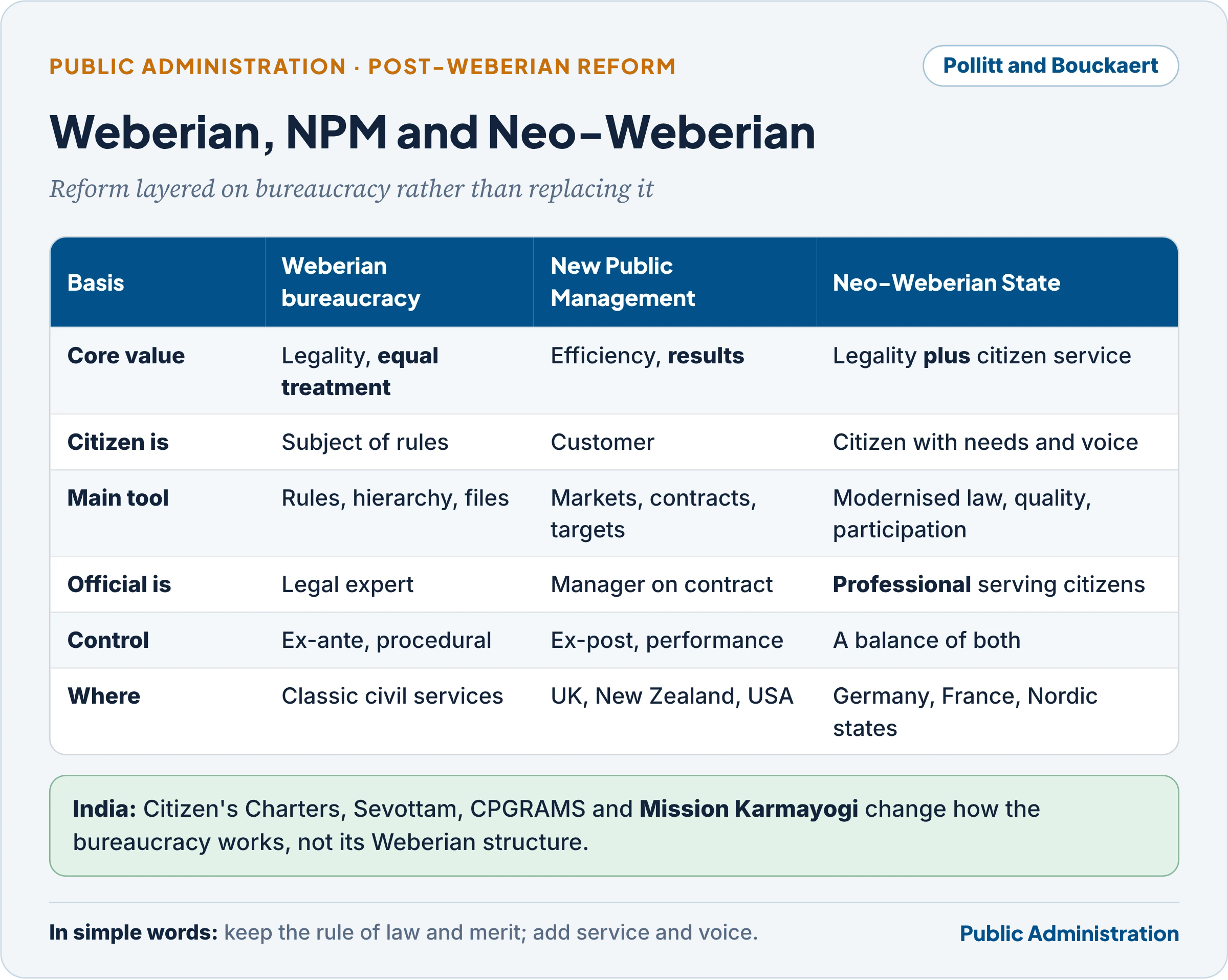
- Hybridity: reforms were layered on bureaucracy rather than replacing it; NPM’s performance targets themselves became rules and rituals (Taylorist neo-bureaucracy). Johan Olsen (“Maybe It Is Time to Rediscover Bureaucracy”, 2006) and Paul du Gay (In Praise of Bureaucracy, 2000) argued that bureaucracy is a valuable institution embodying impartiality and legality, not a relic. Charles Goodsell (The Case for Bureaucracy, 1983) showed that American bureaucracies perform better than their reputation.
- Crises: the global financial crisis and the COVID-19 pandemic showed the need for state capacity, central coordination and professional administration.
9.3 The Neo-Weberian State
Christopher Pollitt and Geert Bouckaert (Public Management Reform: A Comparative Analysis, 2004; 2011) identified the Neo-Weberian State (NWS) as the reform model of continental European countries (Germany, France, the Nordic states), distinct from Anglo-American NPM.
| “Weberian” elements retained | “Neo” elements added |
|---|---|
| Reaffirmation of the state as the main facilitator of solutions to new problems | Shift from an internal orientation towards bureaucratic rules to an external orientation towards meeting citizens’ needs and wishes, through a professional culture of quality and service, not market mechanisms |
| Reaffirmation of representative democracy as the legitimating element | Supplementing representative democracy with consultation and direct participation of citizens |
| Reaffirmation of administrative law, modernised, preserving equality before the law and legal security | Modernisation of law to encourage orientation to results, not only correct procedure; balance of ex-ante and ex-post controls |
| Preservation of a public service with a distinctive status, culture and terms and conditions | Professionalisation of the public service: the official becomes a professional manager oriented to citizens’ needs, not merely a legal expert |
- How NWS changes the model of operation: the structure remains Weberian (state, law, career service), but its operation changes from rule-following to citizen-centred performance: service standards, one-stop shops, citizen’s charters, feedback and participation, simplified procedures, measured outcomes, and managers trained in quality and service.
- Assessment: NWS shows that bureaucracy can be reformed from within without marketisation; but critics find it descriptive (a label for continental practice), vague about mechanisms, and challenged by fiscal pressures and populism.
Indian Connect — Neo-Weberian reform in India
- Citizen orientation within the Weberian state: Citizen’s Charters (from 1997), Sevottam service-quality model, CPGRAMS grievance redressal and state Right to Public Services laws change the operation, not the structure, of the bureaucracy.
- Professionalisation: Mission Karmayogi (National Programme for Civil Services Capacity Building, approved in September 2020) seeks to move civil servants from “rule-based” to “role-based” functioning, with competency frameworks and continuous learning, a professionalisation agenda close to NWS.
- Delayering and digitisation: CSMOP 2022 (delayering, delegation, e-Office) modernises procedure while keeping files and hierarchy.
- Limits of post-bureaucratic reform: the lateral entry experiment (from 2018) brought in outside specialists, but the UPSC’s advertisement of 17 August 2024 for 45 posts was cancelled on 20 August 2024 at the government’s request, to review reservation provisions, showing how merit, representation and career-service norms constrain departures from the Weberian model.
- Persistence: Direct Benefit Transfer, Aadhaar-based delivery and digital public infrastructure have reduced discretion and leakage, but they rest on bureaucratic databases, rules and audit trails: a digital Weberianism rather than its end.
Criticism — The case against Weberian bureaucracy
- Rules become ends in themselves: goal displacement, red tape, trained incapacity (Merton).
- Hierarchy and secrecy concentrate power and evade democratic control (Weber’s own fear, Marx, Laski).
- It ignores informal organisation, emotions and human growth (Barnard, Mayo, Argyris).
- It cannot adapt to rapid change and complex, non-routine tasks (Bennis, Crozier, Offe).
- Its Western, “rational” model fits poorly in developing and plural societies (Riggs, La Palombara, the Rudolphs).
Defence — The case for Weberian bureaucracy
- It secures rule of law, equal treatment and impartiality, essential values of democracy.
- Merit and tenure prevent patronage and corruption; Weberian states grow faster (Evans and Rauch).
- It is technically superior for mass, routine, rights-based administration.
- It provides continuity, records and accountability, on which every newer model (NPM, networks, digital government) depends.
- It can be reformed from within (Neo-Weberian State) without giving up its core values (Olsen, du Gay, Goodsell).
Key Terms
| Term | Meaning in simple words |
|---|---|
| Bureaucracy | Administration by appointed, trained, salaried officials working under rules and hierarchy |
| Herrschaft (domination) | Weber’s term for authority: the probability that commands will be obeyed |
| Legitimacy | Belief that a command is rightful, which turns power into authority |
| Traditional authority | Obedience based on custom and inherited status |
| Charismatic authority | Obedience based on faith in a leader’s extraordinary qualities |
| Legal-rational authority | Obedience to impersonal, lawfully enacted rules and offices |
| Routinisation of charisma | Turning a charismatic movement into a lasting traditional or legal structure |
| Ideal type | A pure mental model built by exaggerating key features, used as a yardstick |
| Sine ira et studio | “Without hatred or passion”: impersonal performance of duty |
| Monocratic bureaucracy | Bureaucracy headed by one person, which Weber thought most efficient |
| Iron cage | Weber’s image of a rationalised world that traps human freedom |
| Official secret | Bureaucracy’s invention for guarding its knowledge and power |
| Staatsraison | “Reason of state”, used by bureaucracy to justify its power and secrecy |
| Patrimonial bureaucracy | Officials as the ruler’s personal servants |
| Trained incapacity | Past training becomes a blind spot when conditions change |
| Goal displacement | Rules, meant as means, become ends in themselves |
| Bifurcation of interests | Sub-units pursuing their own goals instead of the organisation’s |
| Co-optation | Absorbing outside elements into leadership to avert threats |
| Mock, representative, punishment-centred bureaucracy | Gouldner’s three patterns, by who makes and accepts rules |
| Bureaupathology | Thompson’s term for dysfunctional bureaucratic behaviour from insecure authority |
| Adhocracy | Temporary, problem-centred, flexible organisation (Toffler, Bennis) |
| Representative bureaucracy | A civil service that reflects the composition of society |
| Neo-Weberian State | Weberian state, law and career service, modernised to serve citizens’ needs |
| Screen-level bureaucracy | Bureaucracy in which decisions are mediated by computer systems |
Commissions, Committees and Judgments
| Body / case | Year | Key point |
|---|---|---|
| Northcote–Trevelyan Report (UK) | 1854 | Merit recruitment by open competitive examination; foundation of modern merit bureaucracy |
| Official Secrets Act (India) | 1923 | Weber’s “official secret” in statute; criticised as a barrier to transparency |
| All India Services Act | 1951 | Statutory basis of the All India Services (Article 312) |
| Right to Information Act | 2005 | Reversed the presumption of secrecy; Section 22 overrides inconsistent laws |
| 2nd ARC, 1st Report Right to Information: Master Key to Good Governance | 2006 | Recommended repeal of the Official Secrets Act |
| T.S.R. Subramanian v. Union of India | 2013 | Civil Services Boards, fixed tenure, written instructions to protect neutrality |
| Mission Karmayogi | 2020 | Shift from rule-based to role-based civil service; competency-based capacity building |
| US Executive Order 14171 and OPM final rule | 2025–26 | “Schedule Policy/Career”: policy-influencing career posts made at-will, a direct challenge to Weberian tenure |
Contemporary Developments
- 20 August 2024: UPSC cancelled the lateral-entry advertisement of 17 August 2024 (45 posts of Joint Secretary, Director and Deputy Secretary) at the government’s request, to review reservation in such appointments.
- 20 January 2025: US Executive Order 14171 revived the idea of making policy-influencing career positions at-will (“Schedule Policy/Career”); OPM’s final rule (6 February 2026, effective 9 March 2026) authorised moving such posts out of adverse-action protections, reopening the Weberian debate on tenure, neutrality and political control.
- 2020 onwards: Mission Karmayogi and the Capacity Building Commission continue to reshape the Indian civil service towards role-based, competency-driven professionalism.
- 5 August 2022: CSMOP 2022 introduced delayering, delegation and e-Office 7.0, modernising rather than abandoning the file-based, hierarchical system.
- Continuing: the use of algorithms in welfare delivery and policing has revived the “iron cage” debate, with calls for transparency and human oversight of automated administrative decisions.
Revision Grid
| Thinker / body | Work or report (year) | Key idea |
|---|---|---|
| Vincent de Gournay | Coined “bureaucracy” (c. 1745) | Rule by desks |
| Hegel | Philosophy of Right (1821) | Bureaucracy as the universal class |
| Karl Marx | Critique of Hegel’s Philosophy of Right (1843); Eighteenth Brumaire (1852); Civil War in France (1871) | Imaginary state, spiritualism of the state; instrument of class; Commune model |
| Woodrow Wilson | “The Study of Administration” (1887) | Bureaucracy removed from political life is dangerous |
| Gaetano Mosca | Elementi di scienza politica (1896) | Feudal or bureaucratic polities |
| Robert Michels | Political Parties (1911) | Iron law of oligarchy |
| Max Weber | Protestant Ethic (1904–05); Parliament and Government (1918); Economy and Society (1922) | Three authorities; ideal-type bureaucracy; iron cage; parliamentary control |
| Harold Laski | Definition of bureaucracy (1930) | Officials’ power jeopardises liberty |
| Ramsay Muir | How Britain is Governed (1930) | Bureaucracy thrives under the cloak of ministerial responsibility |
| Robert Merton | “Bureaucratic Structure and Personality” (1940) | Trained incapacity; displacement of goals |
| J. Donald Kingsley | Representative Bureaucracy (1944) | Civil service should mirror society |
| Philip Selznick | TVA and the Grass Roots (1949) | Bifurcation of interests; co-optation |
| Alvin Gouldner | Patterns of Industrial Bureaucracy (1954) | Mock, representative, punishment-centred |
| Peter Blau | The Dynamics of Bureaucracy (1955) | Informal adaptations raise efficiency |
| Fritz Morstein Marx | The Administrative State (1957) | Guardian, caste, patronage, merit bureaucracy |
| Victor Thompson | Modern Organization (1961) | Bureaupathology: authority–ability gap |
| Robert Presthus | The Organizational Society (1962) | Upward-mobiles, indifferents, ambivalents |
| Michel Crozier | The Bureaucratic Phenomenon (1963) | Vicious circle; power from uncertainty |
| Warren Bennis | “The Coming Death of Bureaucracy” (1966) | Temporary, adaptive systems |
| Alvin Toffler | Future Shock (1970) | Adhocracy |
| Martin Albrow | Bureaucracy (1970) | Seven concepts; Weber’s five control mechanisms |
| David Beetham | Max Weber and the Theory of Modern Politics (1974) | Three aspects of Weber’s theory |
| Lloyd and Susanne Rudolph | “Authority and Power in Bureaucratic and Patrimonial Administration” (1979) | Patrimonial elements can aid effectiveness |
| Charles Goodsell | The Case for Bureaucracy (1983) | Bureaucracy performs better than its image |
| Kathy Ferguson | The Feminist Case Against Bureaucracy (1984) | Gendered “discourse of bureaucracy” |
| Claus Offe | Disorganized Capitalism (1985) | Organisational vs systemic rationality |
| Peter Evans and James Rauch | “Bureaucracy and Growth” (1999) | Weberian features linked to growth |
| Paul du Gay | In Praise of Bureaucracy (2000) | Ethos of impartial office |
| Pollitt and Bouckaert | Public Management Reform (2004, 2011) | Neo-Weberian State |
| Johan Olsen | “Maybe It Is Time to Rediscover Bureaucracy” (2006) | Bureaucracy as a valuable institution |
Previous Year Questions
- 2026Bureaucratic features have remained constant in organisations despite the development of different forms under NPM and Public Governance approaches. Give reasons for the persistence of these bureaucratic features.
- 2025Bureaucracy constitutes the imaginary state and is the spiritualism of the State. Explain.
- 2022Weber’s construct of bureaucracy has served a great heuristic purpose in furthering research in the field of Comparative Public Administration. Do you agree with the statement ? Give reasons.
- 2021Neo-Weberian State involves changing the model of operation of administrative structures into a model focussed on meeting citizens’ needs. Discuss.
- 2019“Bureau pathology denigrates competence in organizations.” Explain.
- 2018In order to be development-oriented, bureaucracies need to be innovative, flexible, citizen-centric and result-oriented, but they are slow in imbibing these virtues in a democratic system. Do we need to go beyond the traditional models of bureaucracy and create alternative structures? Elaborate.
- 2018“The concepts of rationality and efficiency are intertwined in the bureaucratic analysis of Max Weber.” Comment.
- 2015“Weberian model of bureaucracy lacks emotional validity when applied to modern democratic administration.” Comment.
- 2014“Karl Marx’s interpretation of bureaucracy was rooted in the history of the nature of the State”. Evaluate.
- 2014“Adaptive, problem-solving, temporary systems of diverse specialists, linked together by coordinating executives in an organic flux-this is original form that will gradually replace bureaucracy”. Discuss, in the light of this statement, the ‘end of bureaucracy’ thesis and its strengths and limitations.
- 2014“The notion of informal organisation is a residual or cafeteria concept of diverse and sprawling contents.” How does Gouldner established the need for understanding the interdigitations between the formal and informal organisation?
- 2012‘In the canonization of this abstract idea of ‘staatsraison’ are inseparably woven the sure instincts of the bureaucracy for the conditions which preserve its own power in the State’ (Weber). Explain.
- 2011E-governance is the final arrival of Max Weber’s ‘iron cage of rationality’. Discuss.
- 2009Consider the statements below: “Technically, the bureaucracy represents the purest type of legal-rational authority.”; “Bureaucracy does not represent the only type of legal authority.” Identify the theoretical context and analyse the above statements.
- 2004Weber’s ideas of impersonal detachment and esprit de corps are incompatible. Explain.
- 2004“Bureaucracy can exist only where the whole service of the state is removed from the common political of the people, its chiefs as well as rank and file. Its motives, its objectives, its policy, its standards must be bureaucratic.” – Discuss.
- 2003“Weberian model of bureaucracy lacks empirical validity when applied to modern democratic administration.” Examine.
- 2001Critically examine the models of Max Weber and Chester I Barnard with reference to ‘bureaucratic authority’.
- 1999“It is not weak but strong bureaucracy that creates concern in democracy.” Comment.
- 1997“Once fully established, bureaucracy is among those social structures which are the hardest to destroy.” Comment.
- 1996Bureaucracy is “a system of government the control of which is so completely in the hands of officials that their power jeopardizes the liberties of ordinary citizens.” Comment.
- 1993“The transition to a study of the negatives aspects of bureaucracy is afforded by the application of Veblen’s concept of trained incapacity.” Examine.
- 1993“Though somewhat unwittingly, Herbert Simon and James March have provided, the muscle and the flesh to the Weberian (bureaucratic) skeleton. “Comment.
- 1992‘Bureaucracy thrives under the cloak of ministerial responsibility in a parliamentary democracy; Comment.
- 1990Discuss the major conceptual approaches to the study of Comparative Public Administration and explain how Max Weber is considered to be the foremost mentor in the field.
- 1989For charisma to be transformed into a permanent routine structure, it is necessary that its anti-economic character should be altered. (Weber). Comment.
- 1988“Hierarchy of authority and the system of rules ensure depersonalization and efficiency.” (Max Weber). Comment.
- 2022Following the onset of globalisation, the traditional bureaucratic model appears to have lost its significance. Comment.
- 2014Supreme Court ruling on 31 st October, 2013 in respect of bureaucracy’s functioning would help achieve good governance. Analyze this ruling and add your comments on it.
- 2009Comment on the view that despite different contexts, administrative maxims of Kautilya’s Arthashastra bear considerable similarity with features of Weber’s ideal bureaucratic model.