

Administrative Behaviour: Process and techniques of decision-making; Communication; Morale; Motivation Theories – content, process and contemporary; Theories of Leadership: Traditional and Modern.
This article: Motivation theories: meaning, intrinsic and extrinsic rewards, early views; content theories (Maslow, Herzberg, Alderfer, McClelland, McGregor and allied thinkers); process theories (Vroom, Porter–Lawler, Adams, Locke, Skinner, attribution); Barnard, March–Simon and Schein; contemporary theories (public service motivation, self-determination, job design, nudges) and motivation in the Indian civil services.
Official Syllabus: Paper I · Unit 1-03 Administrative Behaviour
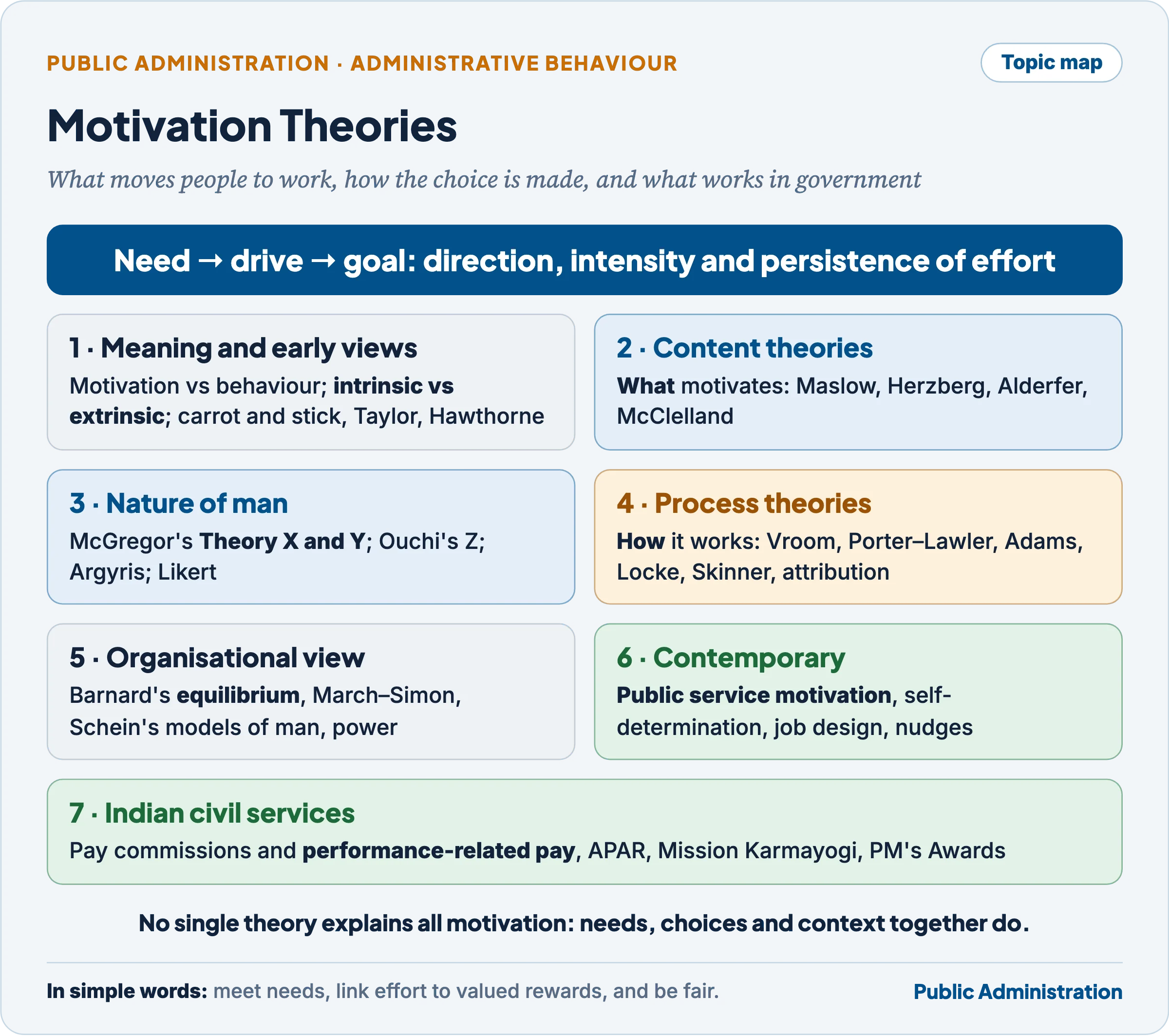
Motivation is the force that makes a person start, direct and keep up effort towards a goal. Every organisation has rules, budgets and structures, but nothing happens unless people choose to work, and work well. A district can have a well-funded health scheme and still fail if its nurses do not turn up, or turn up and do the minimum. That is why Rensis Likert called motivation “the core of management“, and why administrative thought moved from the machine-like worker of Taylor’s time to the needs, perceptions and values of the person at work.
- Content theories ask what motivates: which needs inside a person push behaviour (Maslow, Herzberg, Alderfer, McClelland, McGregor).
- Process theories ask how motivation works: how a person decides how much effort to put in (Vroom, Porter–Lawler, Adams, Locke, Skinner).
- Contemporary theories ask what sustains effort in modern, and especially public, work: public service motivation, self-determination, job design and behavioural nudges.
In simple words
Two clerks in the same office earn the same salary. One clears files early because she enjoys solving problems and is proud when a pensioner gets his money on time. The other clears files only when the boss is watching. Same pay, same rules, different motivation. Motivation theories try to explain that difference and to show how an organisation can create more of the first kind of employee.
1. Meaning and Nature of Motivation
In simple words
Motivation is the “why” behind what we do at work. A need (say, for respect) creates an inner push (a drive), and the push is directed at something that will satisfy it (a promotion, praise). When the need is met, the push weakens until a new need appears.
1.1 Definitions
The word comes from the Latin movere, “to move“. Scholars define it in slightly different ways, but all stress an inner state that energises and directs behaviour towards goals.
- Fred Luthans: motivation is a process that starts with a physiological or psychological deficiency or need that activates behaviour or a drive aimed at a goal or incentive.
- Koontz and O’Donnell: a general term for the whole class of drives, desires, needs and wishes that induce people to work.
- Berelson and Steiner: a motive is an inner state that energises, activates and moves (hence “motivation”) and that directs behaviour towards goals.
- Russell Geen: motivation explains the initiation, direction, intensity and persistence of behaviour.
From these definitions the features of motivation follow:
- It is an internal, psychological state; managers can only create conditions for it, not inject it.
- It is goal-directed: behaviour is aimed at reducing a felt need.
- It is a continuous process: satisfying one need usually brings another forward.
- It is complex and individual: the same reward moves one person and leaves another cold.
- It can be positive (reward, recognition) or negative (fear of punishment).
- Its effect on output is captured in the simple equation Performance = Ability × Motivation: a skilled but unwilling officer performs as poorly as a willing but untrained one.
1.2 Needs, drives and incentives
The process of motivation links three elements.
- Needs are deficiencies created by a physiological or psychological imbalance (hunger, insecurity, loneliness).
- Drives (motives) are deficiencies with direction: they are action-oriented and give an energising thrust towards a goal.
- Incentives are anything that alleviates a need and reduces a drive (food, a secure job, a friendly team, recognition).
Motives themselves fall into three groups:
- Primary motives: unlearned and physiological (hunger, thirst, sleep, avoiding pain).
- General motives: unlearned but not physiological (curiosity, activity, affection).
- Secondary motives: learned through society and experience (power, achievement, affiliation, status). In modern organisations these matter most, which is why McClelland built his theory on them.
1.3 Motivation is not the same as behaviour
Abraham Maslow warned that motivation theory is not synonymous with behaviour theory. Motivations are only one class of determinants of behaviour; behaviour is almost always motivated, but it is also biologically, culturally and situationally determined.
- Biological limits: a fatigued or ill employee may be eager but unable to perform.
- Culture: what counts as a reward, and how it may be pursued, is shaped by society. A promotion that separates an officer from his home state may be unwelcome in one culture and prized in another.
- Situation: rules, tools, workload and supervision channel behaviour regardless of motive. A motivated teacher in a school without blackboards still teaches badly.
- Habit and role: much routine office work is done because it is expected, not because a need presses for it.
The point for administration is practical. Low performance is not always low motivation: before blaming people, managers must check ability, resources, role clarity and procedures. Herbert Simon made the same point when he argued that organisations shape behaviour through decision premises (rules, information, training), not only through motives. The process theories (Section 9) and attribution theory (Section 9.6) build directly on this insight.
1.4 Motivation and morale
Motivation and morale are related but distinct. Motivation is an individual’s willingness to work towards goals; morale is a group’s shared attitude of confidence and enthusiasm towards the organisation and its work. Motivation is a function of needs and incentives; morale is a function of group relationships and climate. Motivation can be raised by rewards and penalties; morale is built only by positive means such as fairness, leadership and pride in the mission. High motivation usually feeds high morale, but a group can have high morale and still restrict output (the Hawthorne bank-wiring room). See the article on Communication and Morale for morale in detail.
1.5 Intrinsic and extrinsic rewards
Rewards can come from inside the work or from outside it.
| Basis | Intrinsic rewards | Extrinsic rewards |
|---|---|---|
| Source | The task itself and the person’s own feelings | The organisation or others |
| Examples | Sense of achievement, meaningful work, autonomy, learning, pride in public service | Pay, allowances, promotion, awards, job security, praise, housing |
| Control | Self-administered | Administered by superiors and rules |
| Duration | Lasting, self-renewing | Often short-lived; must be repeated |
| Theory link | Herzberg’s motivators, Maslow’s higher needs, self-determination | Herzberg’s hygiene factors, reinforcement, expectancy |
Kenneth Thomas describes intrinsic rewards in terms of four feelings: meaningfulness (the work matters), choice (freedom to decide how to do it), competence (doing it well) and progress (seeing results).
For public employees, the rewards that move people to serve both personal and organisational goals include:
- Extrinsic: a secure career and pension (Article 311 protection against arbitrary dismissal), pay revised by pay commissions, time-bound financial upgradation, promotions, postings, awards such as the Prime Minister’s Awards, foreign training, official accommodation and status.
- Intrinsic: the chance to serve the public interest, visible social impact (a District Collector seeing a flood relief operation succeed), professional autonomy, public trust and esteem, learning across varied postings, and the moral satisfaction of fairness and integrity.
Do intrinsic motives lead to better performance and creativity?
The weight of research says intrinsic motivation produces more creative and higher-quality work, while extrinsic incentives work best for simple, measurable quantity.
- Edward Deci (1971) found that people paid to solve puzzles spent less free time on them afterwards than unpaid people: the reward turned play into work. This is the overjustification or crowding-out effect.
- Teresa Amabile‘s research on creativity concluded that people are most creative when moved by interest, enjoyment and challenge; rewards experienced as controlling reduce creativity, while rewards that inform (recognition of competence) can help.
- Deci, Koestner and Ryan (1999), reviewing 128 experiments, found that expected, tangible rewards tied to doing a task undermine intrinsic motivation; unexpected rewards and positive feedback do not.
- Cerasoli, Nicklin and Ford (2014), reviewing four decades of studies, found intrinsic motivation predicted the quality of performance, while incentives predicted its quantity.
- Gneezy and Rustichini (2000) showed that when Israeli day-care centres fined parents for late pick-up, lateness rose: a moral obligation became a price. Bruno Frey (Not Just for the Money, 1997) generalised this as motivation crowding in public life.
The evidence has limits. Extrinsic rewards are necessary (no one serves well while worried about rent), they help in routine, algorithmic tasks, and they can crowd in intrinsic motivation when they signal recognition rather than control. The practical lesson is to get pay and fairness right, then design work and recognition to feed intrinsic motives.
Common confusion
Do money and other extrinsic rewards always kill intrinsic motivation? No. Crowding out occurs mainly when rewards are expected, tangible and felt as controlling (“do this and you get that”), and when the task was interesting to begin with. Pay that is fair, recognition that acknowledges competence, and unexpected rewards usually do no harm and can strengthen commitment. In public services the real danger is narrow target-linked bonuses for complex work like teaching or policing, which can shift effort to what is counted and away from what matters.
1.6 Classification of motivation theories
Motivation theories are usually grouped by the question they answer.
| Group | Core question | Main theories |
|---|---|---|
| Traditional | Can money and fear make people work? | Carrot and stick, Taylor’s piece rate |
| Content (need) theories | What needs motivate? | Maslow, Herzberg, Alderfer, McClelland; McGregor’s assumptions |
| Process theories | How is effort chosen and sustained? | Vroom, Porter–Lawler, Adams, Locke, Skinner, attribution |
| Organisational theories | Why do people join and stay? | Barnard, March and Simon, Schein |
| Contemporary theories | What sustains effort in modern and public work? | Public service motivation, self-determination, job characteristics, nudges |
2. Early Views: From Carrot and Stick to Human Relations
In simple words
The first managers believed people worked only for money and out of fear: offer a carrot, show a stick. Then researchers watching real factories found that people also work for respect, friendship and a sense of belonging.
- Traditional theory (also called the monistic, economic or carrot-and-stick approach) treated the worker as an economic man who maximises income: reward output with money, punish failure by withdrawing it.
- F.W. Taylor gave it a scientific form through the differential piece-rate system (1895): a higher rate for workers who met the scientifically set standard and a lower one for those who did not. Taylor also believed that high wages and low labour costs could coexist, and that cooperation between management and workers would end conflict. See the article on Scientific Management.
- Critics called the approach an oversimplification that ignored social and psychological needs. Taylor’s defenders reply that his emphasis on fair standards, training and shared gains already contained a humane and cooperative element; but the incentive remained essentially financial and individual, and workers had no voice in setting standards.
- The Hawthorne studies (1924–32) under Elton Mayo found that output depended on group norms, attention and belonging more than on lighting or pay. Informal groups restricted output even under incentive pay. See the article on the Human Relations School.
- Chester Barnard (1938) observed that material rewards are ineffective beyond the subsistence level for most people, who cannot be induced by them to give more than a fraction of their possible effort (Section 11).
- Likert, McGregor and Argyris then argued that organisations built on control and money suit the needs of children, not adults, and called for participation and self-direction (Section 8).
This shift set the stage for the content theories, which asked systematically which needs, beyond money, drive human behaviour.
3. Maslow’s Hierarchy of Needs
In simple words
A starving person thinks only about food. Once fed, he worries about safety; once safe, he wants friends; then respect; and finally he wants to become the best he can be. Maslow said our needs climb a ladder in this order, and only the unmet rung pulls us upward.
3.1 The thinker and his works
Abraham Maslow (1908–1970), the American psychologist who led humanistic psychology (the “third force” after behaviourism and psychoanalysis), set out the theory in “A Theory of Human Motivation” (Psychological Review, 1943) and developed it in Motivation and Personality (1954), Toward a Psychology of Being (1962) and Eupsychian Management (1965), which applied it to organisations. Managers came to know the theory mainly after Douglas McGregor built Theory Y on it (1960).
3.2 The five needs
Maslow’s central claims are that man is a perpetually wanting animal, that needs are arranged in a hierarchy of prepotency (urgency), and that a satisfied need no longer motivates.
- Physiological needs: food, water, shelter, sleep. In an organisation, a basic wage. For a starving person, Maslow observed, utopia is simply a place with plenty of food.
- Safety needs: protection from danger and uncertainty; job security, pension, insurance, safe working conditions.
- Social (belongingness) needs: friendship, acceptance by the group, affection.
- Esteem needs: self-esteem (achievement, competence, independence) and esteem from others (status, recognition, respect).
- Self-actualisation: the desire to realise one’s full potential; “What a man can be, he must be.” The term was coined by Kurt Goldstein.
Maslow grouped these in two ways:
- Lower-order needs (physiological, safety, social) are satisfied mainly from outside (pay, contracts, groups); higher-order needs (esteem, self-actualisation) are satisfied mainly from within.
- The first four are deficiency needs (D-needs): their absence creates tension, and like a thermostat they switch off once met. Self-actualisation is a growth or being need (B-need): it grows stronger as it is fed.
Maslow later described self-actualising people (he studied figures such as Lincoln, Einstein and Eleanor Roosevelt) as realistic, problem-centred, autonomous, creative and democratic, prone to peak experiences, and moved by metaneeds such as truth, justice and beauty. When these are blocked, people suffer metapathologies such as cynicism and alienation. He thought only a small minority reach this level.
3.3 Maslow’s own qualifications
Maslow did not present a rigid staircase. He noted that:
- the hierarchy is not as rigid as often implied; for some people self-esteem comes before love, and creative people may pursue self-expression despite unmet basic needs;
- a need need not be fully met before the next emerges; emergence is gradual (he gave illustrative percentages: an average person might be 85 per cent satisfied physiologically but only 10 per cent in self-actualisation);
- behaviour is multi-motivated: several needs act at once;
- needs are largely unconscious, and basic needs are broadly common across cultures, though the means of satisfying them differ.
3.4 Application to administration
- Physiological and safety: adequate pay, timely salary, security of tenure, pension, safe field conditions for police and health workers.
- Social: team-based work, staff welfare, cohesive cadres, informal associations.
- Esteem: recognition, awards, titles, fair promotions, public appreciation.
- Self-actualisation: challenging assignments, autonomy, innovation, chances to lead reform.
The theory tells a manager to diagnose which need is currently prepotent for an employee and offer the matching incentive. Offering a large bonus to someone whose pressing need is recognition, or a certificate to someone who cannot pay school fees, both fail.
3.5 Critique
- Weak evidence: Wahba and Bridwell (1976) reviewed the research and found little support for a five-level hierarchy or for the claim that a satisfied need stops motivating; at most two broad clusters (deficiency and growth) appear.
- Career stage, not hierarchy: Hall and Nougaim (1968) and Lawler and Suttle (1972) found that needs shift with career progress and age, not with satisfaction of lower needs; Lawler and Suttle found only two levels.
- Vague concepts: Cofer and Appley called self-actualisation vague and the evidence loose.
- “More interesting and popular than true”: management writers such as Bass and Barrett said its popularity rests on intuitive appeal; Michael Nash listed it among the “major wrong theories” because it cannot be turned into a practical guide for managers.
- Small, élite sample: Maslow based self-actualisation on a few admired individuals and healthy students.
- Cultural bias: the order reflects individualist American values. Edwin Nevis (1983) proposed that in China the order runs belonging, physiological, safety, self-actualisation in the service of society. Geert Hofstede (1980) questioned whether American theories apply abroad at all.
- Neglect of the organisation: it says little about how jobs, rules and leaders shape needs.
Despite this, Maslow’s lasting contribution is that he moved motivation beyond money, gave managers a simple diagnostic language, and inspired Herzberg, McGregor, Argyris and Alderfer.
Indian Connect — Maslow and the Indian public servant
- Lower needs largely met for the higher services: pay commissions, Article 311 protection and assured financial upgradation give an IAS or Central Secretariat officer considerable security. For many contractual and frontline workers (ASHA workers paid incentives, contractual teachers, sanitation staff), however, physiological and safety needs remain prepotent, so delayed honoraria or insecurity dominate their motivation.
- Esteem and self-actualisation: awards, field innovation and public recognition matter most for officers whose basic needs are met, which is why the Prime Minister’s Awards and the recognition of district innovations are aimed at higher-order needs.
- Cultural variation: Indian social life often places family, community and belonging ahead of individual self-expression, so a posting near home or a respected position in the community can outweigh a challenging assignment far away.
4. Herzberg’s Two-Factor Theory
In simple words
A clean office, fair pay and a polite boss stop people from complaining, but they do not make anyone excited about the job. What makes people go the extra mile is the work itself: a chance to achieve something, to be recognised, to take responsibility. Herzberg called the first set “hygiene” and the second “motivators”.
4.1 The thinker and the study
Frederick Herzberg (1923–2000), an American clinical psychologist, set out the theory in The Motivation to Work (1959, with Bernard Mausner and Barbara Snyderman), deepened it in Work and the Nature of Man (1966) and popularised it in the Harvard Business Review article “One More Time: How Do You Motivate Employees?” (1968), one of the most reprinted management articles ever. He is called the father of job enrichment.
- Sample and method: about 200 engineers and accountants in the Pittsburgh area were asked, by the critical incident method, to recall times when they felt exceptionally good or exceptionally bad about their jobs.
- Finding: the events behind good feelings were mostly about the job content; the events behind bad feelings were mostly about the job context. The two sets hardly overlapped.
4.2 Motivators and hygiene factors
| Motivators (satisfiers) | Hygiene factors (dissatisfiers) |
|---|---|
| Achievement | Company policy and administration |
| Recognition | Supervision |
| The work itself | Salary |
| Responsibility | Interpersonal relations (superiors, peers, subordinates) |
| Advancement | Working conditions |
| Growth | Status, job security, personal life |
| Job content, intrinsic | Job context, extrinsic |
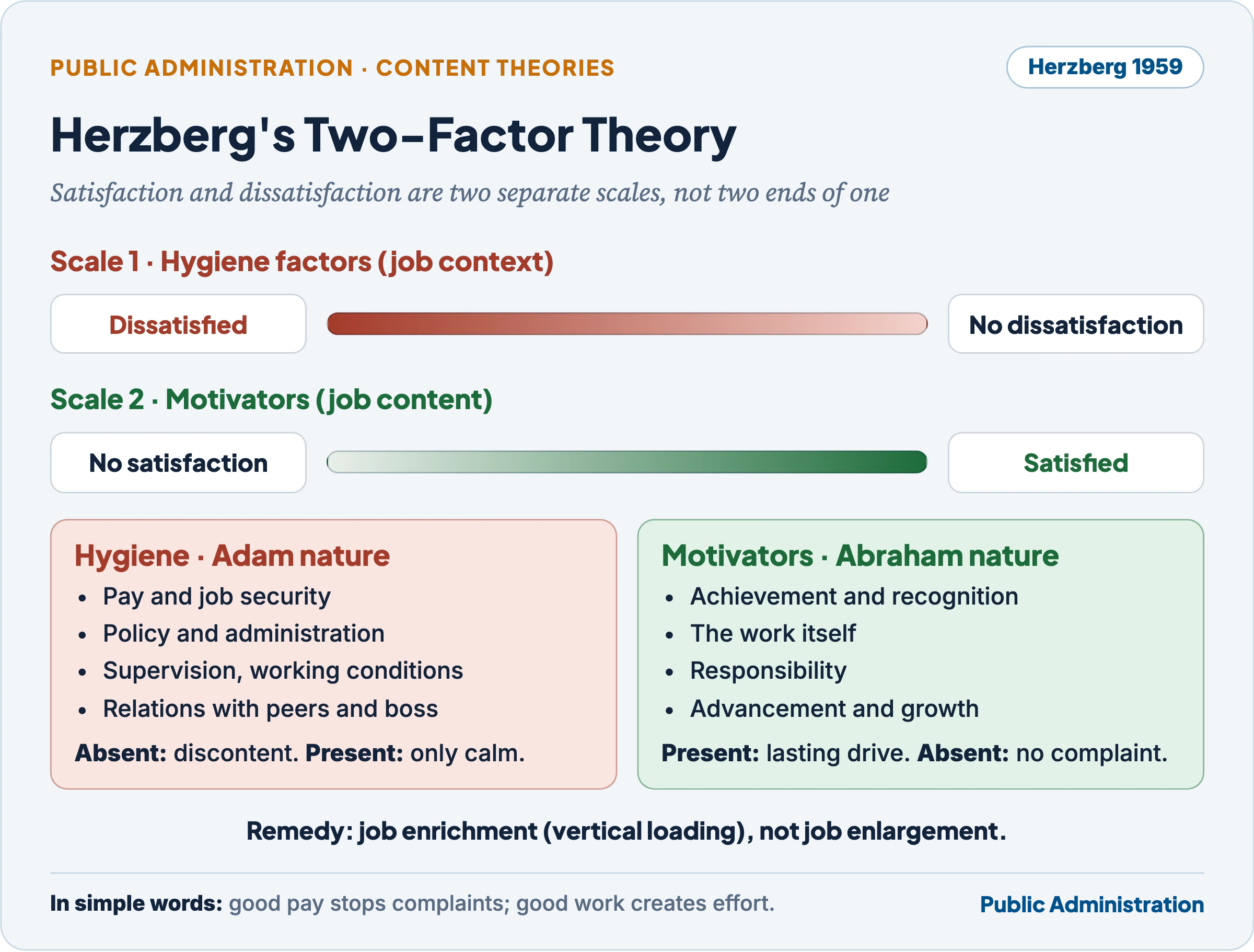
The key claim is that satisfaction and dissatisfaction are not opposite ends of one scale:
- The opposite of satisfaction is no satisfaction, not dissatisfaction.
- The opposite of dissatisfaction is no dissatisfaction, not satisfaction.
- Hygiene factors, when inadequate, cause dissatisfaction; when adequate, they only bring people to a neutral zero point. Herzberg chose the word from medicine: hygiene prevents illness but does not cure or build health.
- Motivators, when present, produce lasting satisfaction and effort; when absent, people are not necessarily unhappy, just unengaged.
- Hygiene gains are short-lived and must be constantly renewed, since the appetite for hygiene is never permanently satisfied; motivators are self-sustaining.
4.3 Adam and Abraham: the two natures of man
In Work and the Nature of Man (1966), Herzberg grounded the theory in a dual view of human nature, drawn from the Bible.
- Adam nature (animal nature): after his expulsion from Eden, Adam must avoid pain from the environment: hunger, cold, punishment. This nature is served by hygiene factors, which concern the job environment.
- Abraham nature (human nature): Abraham, chosen by God, was capable of great deeds and growth. This nature seeks psychological growth, achievement and self-realisation, served by motivators in the job content.
Herzberg’s statement that “Adam nature of man seeks the avoidance of dissatisfaction and is basically concerned with the job environment; Abraham nature of man seeks satisfaction in job content” sums up the theory. The two natures are parallel needs systems, not stages, and both exist in every person. Organisations that cater only to Adam produce people who are not unhappy but never committed.
From this he distinguished two types of employees:
| Hygiene seekers | Motivation seekers |
|---|---|
| Moved by the environment (pay, perks, policy) | Moved by the task |
| Chronically dissatisfied with context; overreact to hygiene changes | Higher tolerance for poor hygiene |
| Satisfaction from hygiene is short-lived | Real satisfaction from accomplishment |
| Little interest in the quality of work; cynical | Enjoy the work; positive towards work and life |
| Do not grow professionally from experience | Grow from experience |
| Spread an extrinsic-reward culture to subordinates | May be over-achievers |
4.4 KITA and job enrichment
Herzberg mocked conventional incentive tactics as KITA (“kick in the pants”): negative physical KITA (force), negative psychological KITA (threats, humiliation) and positive KITA (bonuses, perks, fringe benefits). KITA produces movement, not motivation: the employee moves only while the push lasts; real motivation needs a generator inside the person.
His remedy was job enrichment: redesigning jobs to build in motivators.
- Job enlargement (horizontal loading) adds more tasks of the same level. Herzberg called it “adding zero to zero“; making a clerk do two meaningless tasks instead of one is still meaningless.
- Job rotation moves people between equally routine jobs: “substituting one zero for another“.
- Job enrichment (vertical loading) adds responsibility, autonomy, a complete natural unit of work, direct feedback and new, harder tasks. A clerk who handles a pensioner’s case from receipt to payment, signs letters himself and hears back from the pensioner has an enriched job.
4.5 Critique
- Method-bound: House and Wigdor (1967) argued the results follow from the critical incident method: people credit themselves for good events and blame the environment for bad ones (a self-serving attribution, which Victor Vroom also suspected).
- Pay is both: many studies (including Lawler‘s) find salary can satisfy as recognition of achievement, not just prevent dissatisfaction. Herzberg conceded pay is “mostly” hygiene.
- No overall satisfaction measure, rater bias, and a sample of professionals: blue-collar or low-paid workers may be motivated by pay and security. Studies of Caribbean hotel staff and older kibbutz workers found context factors acting as motivators.
- Satisfaction is not performance: the theory assumes satisfied workers produce more, which research does not consistently show.
- Ignores individual differences and situational variables (Hackman and Oldham).
- Replication split: some studies using his method confirm it; studies using other methods (King, Schwab) do not.
Yet Herzberg’s contribution is lasting: he drew attention to job content, which had been neglected; gave a prescriptive tool (job enrichment) that led to the job characteristics model; and explained why pay rises often fail to improve performance.
Indian Connect — Hygiene rich, motivator poor
- Civil servants in India have strong hygiene factors: security under Article 311, regular pay revision, pension, accommodation, status. Herzberg’s theory explains why these, on their own, have not produced commitment: they remove dissatisfaction but do not motivate.
- The motivator deficit comes from frequent transfers that cut short ownership of projects, seniority-based promotion that weakens achievement and advancement, risk-averse vigilance and audit that discourage responsibility, and fragmented work in the Secretariat file system.
- Job enrichment in practice: giving District Collectors outcome ownership under the Aspirational Districts Programme, empowering desk officers to dispose of files under delayering in the Central Secretariat Manual of Office Procedure, and recognising district teams through the Prime Minister’s Awards are attempts to add motivators.
5. Maslow and Herzberg Compared
In simple words
Maslow made a list of all human needs. Herzberg asked which of those needs actually make people work harder in a job. The answer was: the higher ones. So the two theories describe the same ground, one as a ladder, the other as two separate switches.
5.1 Commonalities
- Both are content theories: they explain motivation by needs inside the person.
- Both reject the economic man: money is not the main lever once basic needs are met.
- Both distinguish lower from higher needs, and both locate lasting motivation in higher needs (esteem, growth, self-actualisation).
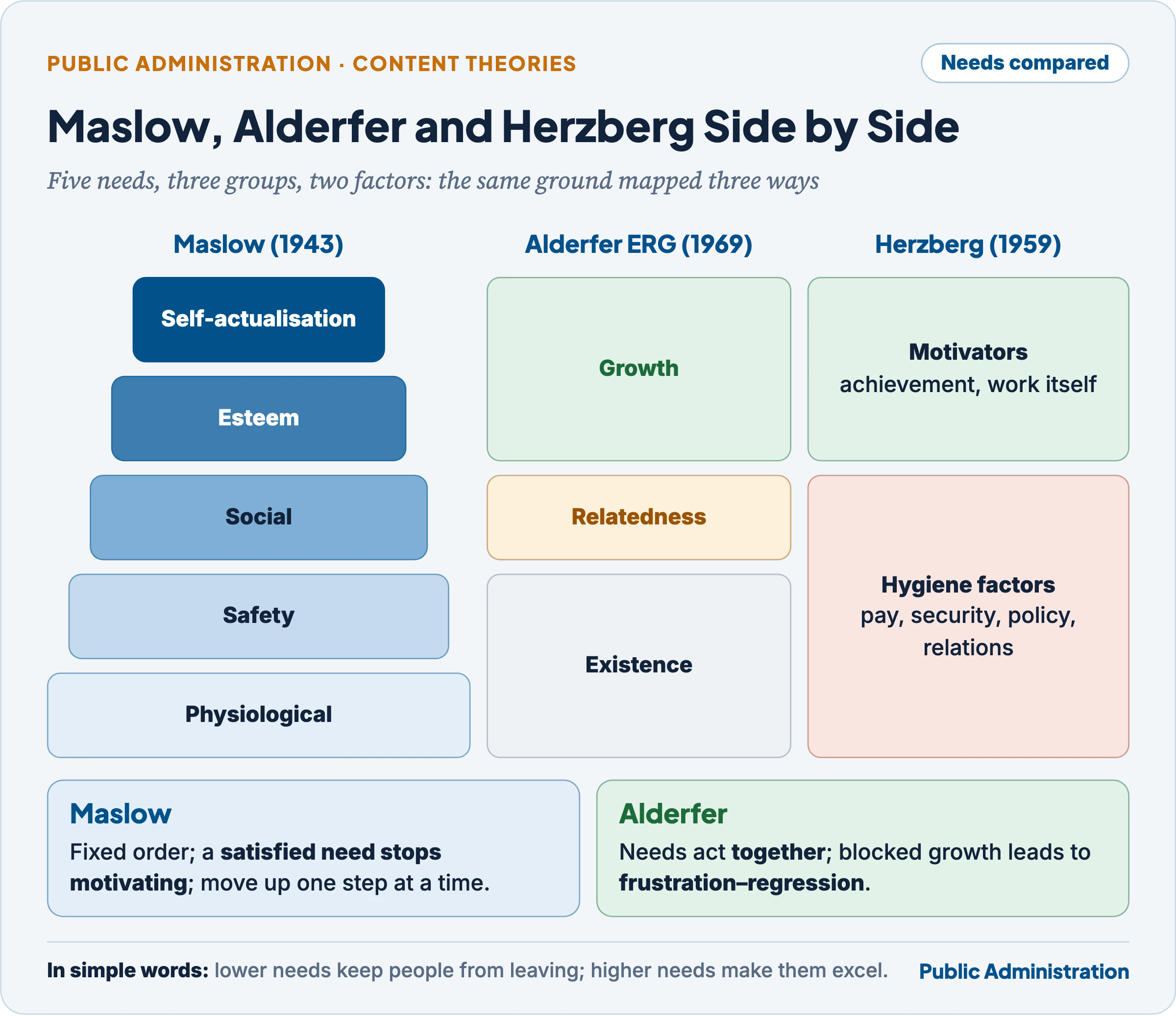
- Their categories map closely: Maslow’s physiological, safety and social needs correspond to Herzberg’s hygiene factors; esteem splits (status is hygiene; recognition and advancement are motivators); self-actualisation corresponds to growth, achievement and the work itself.
- Both emphasise human dignity and growth and influenced job enrichment, participation and human resource development.
- Both were criticised for weak empirical support and cultural bias, and Michael Nash grouped both among “major wrong theories”.
5.2 Is Herzberg an extension of Maslow?
Yes, in large part. Herzberg acknowledged his debt to Maslow (and to McGregor and Argyris). His hygiene factors are essentially Maslow’s lower needs applied to the workplace, and his motivators are the higher needs turned into features of job design. He made Maslow’s general psychology operational for management.
But also a departure:
- For Maslow, any unsatisfied need, lower or higher, motivates. For Herzberg, lower needs never motivate; they only prevent dissatisfaction.
- Maslow’s theory is one continuum (a ladder); Herzberg’s is two independent continua.
- Maslow’s is descriptive and general; Herzberg’s is prescriptive and work-specific (job enrichment).
- Maslow based his theory on clinical observation; Herzberg on an empirical field study.
So the fair conclusion is that Herzberg extended and narrowed Maslow: extended him into job design, narrowed him to the employed professional in an affluent society.
| Basis | Maslow | Herzberg |
|---|---|---|
| Nature | Descriptive; general theory of human motivation | Prescriptive; theory of work motivation |
| Structure | One hierarchy of five needs | Two separate factor sets |
| Lower needs | Motivate until satisfied | Never motivate; only prevent dissatisfaction |
| Money | Can motivate (when lower needs are prepotent) | Hygiene; does not motivate |
| Several needs at once | One prepotent need at a time | Many motivators act together |
| Evidence base | Clinical observation, few subjects | Interviews with about 200 professionals |
| Applicability | All people in society | People at work, mainly white-collar |
| Remedy offered | Meet the prepotent need | Enrich the job |
5.3 Are they universally applicable?
Not fully. Both theories were built on American, middle-class, largely male professionals in a prosperous economy.
- In developing countries with low wages and insecure jobs, pay and security do motivate: what Herzberg calls hygiene acts as a motivator, which fits Maslow better than Herzberg.
- Collectivist cultures may rank belonging above self-actualisation (Nevis’s Chinese hierarchy); high uncertainty-avoidance cultures may prize security above achievement (Hofstede).
- Within one organisation, routine and low-skilled workers respond more to context factors than professionals do.
- Yet research across many countries finds that interesting work, achievement and recognition are valued almost everywhere. The broad direction of both theories travels; the ranking and content of needs must be adapted.
5.4 Motivation, communication and the morale of public servants
- For both thinkers, communication is part of motivation. In Maslow’s terms, open two-way communication satisfies social needs (belonging), esteem needs (being heard, recognised) and self-actualisation (sharing in goals). In Herzberg’s terms, communication about policy and supervision is hygiene, but feedback on performance and recognition of achievement are motivators. A leader who praises good work specifically, explains the purpose of tasks and invites ideas motivates; one who only issues circulars at best prevents dissatisfaction. See the article on Communication and Morale.
- Their contribution to understanding the morale of public servants is that low morale in government is often a motivator problem, not a pay problem: secure, adequately paid officials can still be disengaged when work is fragmented, recognition is absent and advancement is seniority-bound. Equally, frontline staff with insecure pay suffer a hygiene problem that no amount of exhortation can fix.
6. Alderfer’s ERG Theory
In simple words
Alderfer shrank Maslow’s five steps into three groups: needs to exist, needs to relate, needs to grow. He also said people do not climb one step at a time; they can want all three together, and if they are blocked from growing, they fall back and demand more of the lower things, like more pay or more friendly company.
Clayton Alderfer (1940–2015), an American organisational psychologist at Yale, proposed the theory in “An Empirical Test of a New Theory of Human Needs” (1969) and the book Existence, Relatedness, and Growth (1972). It is a reconceptualisation of Maslow designed to fit the empirical evidence better.
6.1 The three needs
- Existence (E): material and physical survival; Maslow’s physiological and material safety needs. At work: pay, benefits, physical conditions.
- Relatedness (R): meaningful relations with others; Maslow’s social needs, interpersonal safety and esteem from others.
- Growth (G): personal development and the use of one’s capacities; Maslow’s self-esteem and self-actualisation.
6.2 How ERG reconceptualises Maslow
| Basis | Maslow | Alderfer (ERG) |
|---|---|---|
| Number of needs | Five | Three (needs on a continuum from concrete to abstract) |
| Order | Fixed hierarchy | Order may differ with person and culture |
| Activation | One need dominates at a time | Several needs active simultaneously |
| Progression | Satisfaction-progression only | Satisfaction-progression and frustration-regression |
| Satisfied need | Stops motivating | Higher needs may grow stronger when satisfied |
| Evidence | Clinical, untested | Built to fit empirical data |
- Frustration–regression: when a higher need is blocked, a person falls back and intensifies a lower need. An officer stuck in a dead-end posting with no scope for growth may begin to fight over allowances, accommodation or office politics. Maslow’s theory cannot explain this.
- Simultaneity explains the “starving artist” who pursues growth before existence needs are secure, and the doctor who wants both a good salary and challenging work.
- Implications for management: managers must address multiple needs together, and when growth opportunities are scarce they should expect, and can temporarily meet, intensified relatedness and existence demands, while restoring growth paths.
6.3 Assessment
- Strengths: more flexible and realistic than Maslow, better supported by research, and explains regression and individual differences.
- Limits: fewer studies than for Maslow; still a content theory that does not explain how people choose among actions; the boundaries between categories (especially esteem) are fuzzy; and it shares the general weakness of predicting behaviour from needs alone.
ERG thus retains Maslow’s insight that needs differ in level while removing the rigid staircase, which is why it is described as a reconceptualisation rather than a rejection.
7. McClelland’s Acquired Needs Theory
In simple words
Some people love a challenge and want to beat their own record; some love to be in charge; some just want to be liked. McClelland said these three urges are learned through life, everyone has all three in different strengths, and the mix decides what job suits a person.
7.1 The thinker and the theory
David McClelland (1917–1998), an American psychologist at Harvard, built on Henry Murray‘s theory of needs. In The Achieving Society (1961) he argued that a society’s economic growth depends on the need for achievement of its people, and with David Burnham wrote “Power Is the Great Motivator” (Harvard Business Review, 1976). Needs were measured through the Thematic Apperception Test (TAT): people write stories about ambiguous pictures, and the themes reveal their dominant motives.
His key claims: needs are acquired (learned from culture and early experience) rather than innate; everyone has three needs in different strengths; and the dominant need shapes behaviour and job suitability.
7.2 The three needs
- Need for achievement (nAch): the drive to excel against a standard of excellence.
- Prefer tasks of moderate risk (around a 50 per cent chance of success); easy tasks give no sense of achievement, very hard ones depend on luck.
- Want personal responsibility and quick, concrete feedback.
- Value the accomplishment more than the money (money matters as a scorecard).
- Make good entrepreneurs and heads of self-contained units, but not necessarily good general managers, since they want to do things themselves rather than through others.
- Need for power (nPow): the desire to influence, control and be responsible for others.
- Personal (personalised) power: dominance for its own sake; tends to exploitative, autocratic behaviour.
- Institutional (socialised) power: influence used for organisational goals; McClelland and Burnham found the best managers are high in institutional power, low in affiliation, with high self-control.
- Need for affiliation (nAff): the desire for friendly, close relationships and acceptance.
- Work well in cooperative teams, customer service and counselling roles.
- As managers they may avoid hard decisions to stay liked, and make exceptions that look unfair.
7.3 Implications and the Indian experiment
- Selection and placement: match high-nAch people to entrepreneurial or project roles, high institutional-power people to leadership, high-nAff people to coordination and public contact.
- Training can raise nAch. McClelland and David Winter, in Motivating Economic Achievement (1969), reported that achievement-motivation training for small businessmen in Kakinada, Andhra Pradesh, led them to start more ventures, invest more and create more jobs than untrained peers. India thus supplied the most famous test of the theory, and achievement-motivation training later entered entrepreneurship development programmes.
- Reward design: for achievers, give challenging, attainable goals and feedback; for power-oriented people, responsibility and authority with accountability; for affiliation-oriented people, team roles.
7.4 Maslow and McClelland critically examined
| Basis | Maslow | McClelland |
|---|---|---|
| Origin of needs | Innate, universal | Acquired through culture and experience |
| Structure | Hierarchy of five needs | No hierarchy; three needs coexist in varying strength |
| Satisfied need | Stops motivating | Achievement need can strengthen with success |
| Focus | Universal human development | Individual differences and job fit |
| Measurement | Not operationalised | Measured by the TAT |
| Unit of analysis | Individual | Individual and society (economic growth) |
| Use for managers | Diagnose the prepotent need | Select, place and train people by need profile |
- Similarities: McClelland’s achievement resembles Maslow’s esteem and self-actualisation; affiliation resembles the social need; power cuts across esteem and safety. Both reject the economic man and stress higher needs.
- Where McClelland is stronger: he explains why people at the same level of need satisfaction behave differently, offers a measurement tool, and shows that motives can be developed by training, which makes the theory more useful for human resource management in government.
- Critique of McClelland: the TAT is time-consuming and its interpretation subjective; the link between national nAch and growth is contested; the theory ignores lower needs (a worker without a living wage is not moved by achievement); and its preference for individual achievement reflects Western, entrepreneurial values. Critique of Maslow (Section 3.5) applies on the other side.
- Conclusion: the two are complementary: Maslow explains the broad sequence of human needs; McClelland explains individual differences in the needs that dominate once survival is assured.
8. McGregor, Ouchi, Argyris and Likert: Assumptions about Human Nature
In simple words
If a manager believes his staff are lazy, he watches them closely and punishes mistakes; the staff then behave exactly as he expected. If he believes they want to do good work, he gives them freedom and responsibility, and many rise to it. McGregor said what managers assume about people shapes how people behave.
8.1 Douglas McGregor: Theory X and Theory Y
Douglas McGregor (1906–1964), professor at the MIT School of Industrial Management, set out the theory in The Human Side of Enterprise (1960). His starting point: “Behind every managerial decision or action are assumptions about human nature and human behaviour.” Every managerial act rests on theory, whether the manager knows it or not.
Theory X is the traditional view of direction and control. Its assumptions:
- The average human being has an inherent dislike of work and will avoid it if he can.
- Therefore most people must be coerced, controlled, directed and threatened with punishment to make adequate effort.
- The average human being prefers to be directed, wishes to avoid responsibility, has little ambition and wants security above all.
Theory X management can be hard (coercion, close supervision, threats) or soft (permissiveness, benefits to buy harmony). Both rely on external control and on lower-order needs. McGregor’s critique, borrowing from Maslow: in a modern society where physiological and safety needs are largely met, a satisfied need no longer motivates, so Theory X appeals to needs that no longer drive behaviour and ignores the needs that do. The resulting passivity is then taken as proof of Theory X, a self-fulfilling prophecy.
Theory Y is the integration of individual and organisational goals. Its assumptions:
- Physical and mental effort in work is as natural as play or rest.
- External control is not the only means: people exercise self-direction and self-control towards objectives to which they are committed.
- Commitment is a function of the rewards associated with achievement, the most significant being satisfaction of ego and self-actualisation needs.
- Under proper conditions people learn not only to accept but to seek responsibility.
- The capacity for imagination, ingenuity and creativity is widely, not narrowly, distributed.
- Under modern industrial conditions, human intellectual potential is only partially utilised.
| Basis | Theory X | Theory Y |
|---|---|---|
| View of work | Disliked, avoided | Natural as play |
| Control | External, close supervision | Self-direction, self-control |
| Needs relied on | Lower-order (money, security) | Higher-order (esteem, self-actualisation) |
| Structure | Centralised, narrow span, scalar chain | Decentralised, delegation, wide span |
| Leadership | Autocratic | Participative, supportive |
| Appraisal | Superior judges subordinate | Self-appraisal against agreed targets |
| Central principle | Scalar principle (authority) | Integration of goals |
| Effect | Passivity, resistance, minimum effort | Commitment, creativity, growth |
8.2 How Theory X and Y give insights into motivation differently
- Theory X explains motivation from outside: carrots and sticks act on the person. It predicts short-term compliance in crises, routine or high-risk work and with new or untrained staff.
- Theory Y explains motivation from inside: the job, goals and trust release energy already present. It predicts commitment and innovation in professional and knowledge work.
- “All control is selective adaptation”: McGregor argued that just as engineers adapt to the laws of nature rather than defy them, managers should adapt control to human nature, not try to force human nature to fit the control system. When people are lazy or uncooperative, Theory Y says “the causes lie in management’s methods of organisation and control“.
- Practical instruments of Theory Y: decentralisation and delegation, job enlargement, participative and consultative management, management by objectives and self-appraisal. The Scanlon Plan (cost-reduction sharing with real participation) was his favoured example.
- Not a moral ranking: McGregor saw X and Y as assumptions to be tested, not as “bad” and “good” management styles; Theory Y is an invitation to innovate, not a prescription. In his posthumous The Professional Manager (1967) he stressed that X and Y are not two ends of one scale but two different “cosmologies”, and that authority remains appropriate in some situations. See the article on Participative Management (Likert, Argyris, McGregor) for this later work.
8.3 Critique and continuing relevance
- Too simple a dichotomy: real people and managers fall between X and Y; one person may behave as X in one role and Y in another (Schein’s “complex man”, Section 11.3).
- Contingency: John Morse and Jay Lorsch (“Beyond Theory Y”, 1970) found that structured, X-type organisation performed best for predictable manufacturing tasks and Y-type for uncertain research tasks: the best approach depends on task and people.
- Utopian about Y: many employees prefer direction and security; Theory Y may be hard on weaker members who need guidance. Edgar Schein noted that Theory Y itself risked becoming as monolithic as Theory X.
- Untested: McGregor offered little empirical proof.
- Culture and power: in hierarchical cultures and in rule-bound bureaucracies accountable for public money, full self-control is constrained by law and audit.
The message has nevertheless grown more relevant with each decade. The shift to knowledge work, educated workforces, New Public Management‘s managerial freedom, the New Public Service idea of engaged citizens and employees, and the human resource movement (“people are assets”, human resources instead of “personnel”) all rest on Theory Y assumptions. Controlling, distrustful management in government, by contrast, explains much of the risk aversion McGregor would have predicted.
Indian Connect — Theory X habits in Indian administration
- The colonial legacy of control, the file system with multiple layers of noting, attendance tracking and suspicion of discretion reflect Theory X assumptions. The 2nd ARC observed that the incentive structure in government is weak and that systems emphasise control over performance.
- Theory Y elements appear in delegation of financial powers, delayering under the Central Secretariat manual, annual capacity-building plans under Mission Karmayogi, the self-appraisal part of the APAR, and outcome-based monitoring of districts.
- Balanced reading: routine revenue or policing tasks with high risk of abuse justify clear rules (X); policy design, innovation and service delivery need autonomy and trust (Y).
8.4 Ouchi’s Theory Z
William Ouchi (Theory Z: How American Business Can Meet the Japanese Challenge, 1981) combined Japanese and American practices into a “Type Z” organisation:
- long-term (often lifetime) employment, creating loyalty and security;
- collective, consensual decision-making with individual responsibility;
- slow evaluation and promotion, which reduces short-term competition;
- non-specialised career paths through job rotation;
- holistic concern for the employee and family;
- implicit, informal control through shared culture, with explicit measures.
Theory Z adds culture and trust to McGregor: motivation comes from belonging to a community with shared values. It has echoes in the generalist, lifelong career model of the Indian civil services, though Indian practice lacks the consensual culture and trust Ouchi stressed.
8.5 Argyris and Likert in brief
- Chris Argyris (Personality and Organization, 1957) argued that healthy personalities develop along an immaturity–maturity continuum: from passivity to activity, dependence to independence, few to many behaviours, shallow to deep interests, short to long time perspective, subordinate to equal or superior position, and lack of self-awareness to self-awareness and self-control. Formal organisations, with task specialisation, chain of command and close control, treat adults like children, producing frustration, apathy, absenteeism and informal resistance. His remedies: job enlargement, participative leadership and “reality-centred” leadership. For details see the article on Participative Management.
- Rensis Likert (New Patterns of Management, 1961; The Human Organization, 1967) found that employee-centred supervisors achieved higher output than job-centred ones, and classified management into System 1 (exploitative-authoritative), System 2 (benevolent-authoritative), System 3 (consultative) and System 4 (participative-group). System 4 motivates through the principle of supportive relationships, group decision-making and high performance goals, linked by linking pins.
9. Process Theories of Motivation
In simple words
Wanting something is not enough. Before working hard, a person quietly asks: if I try, can I do it? If I do it, will I be rewarded? Is the reward worth it? Is it fair compared with what others get? Process theories study this mental arithmetic.
9.1 Vroom’s expectancy theory
Victor Vroom (born 1932), Canadian-American psychologist at Yale, published Work and Motivation (1964), drawing on Kurt Lewin and Edward Tolman‘s cognitive psychology. He rejected content theories as too simple: motivation is a conscious choice among alternatives, made to maximise expected satisfaction.
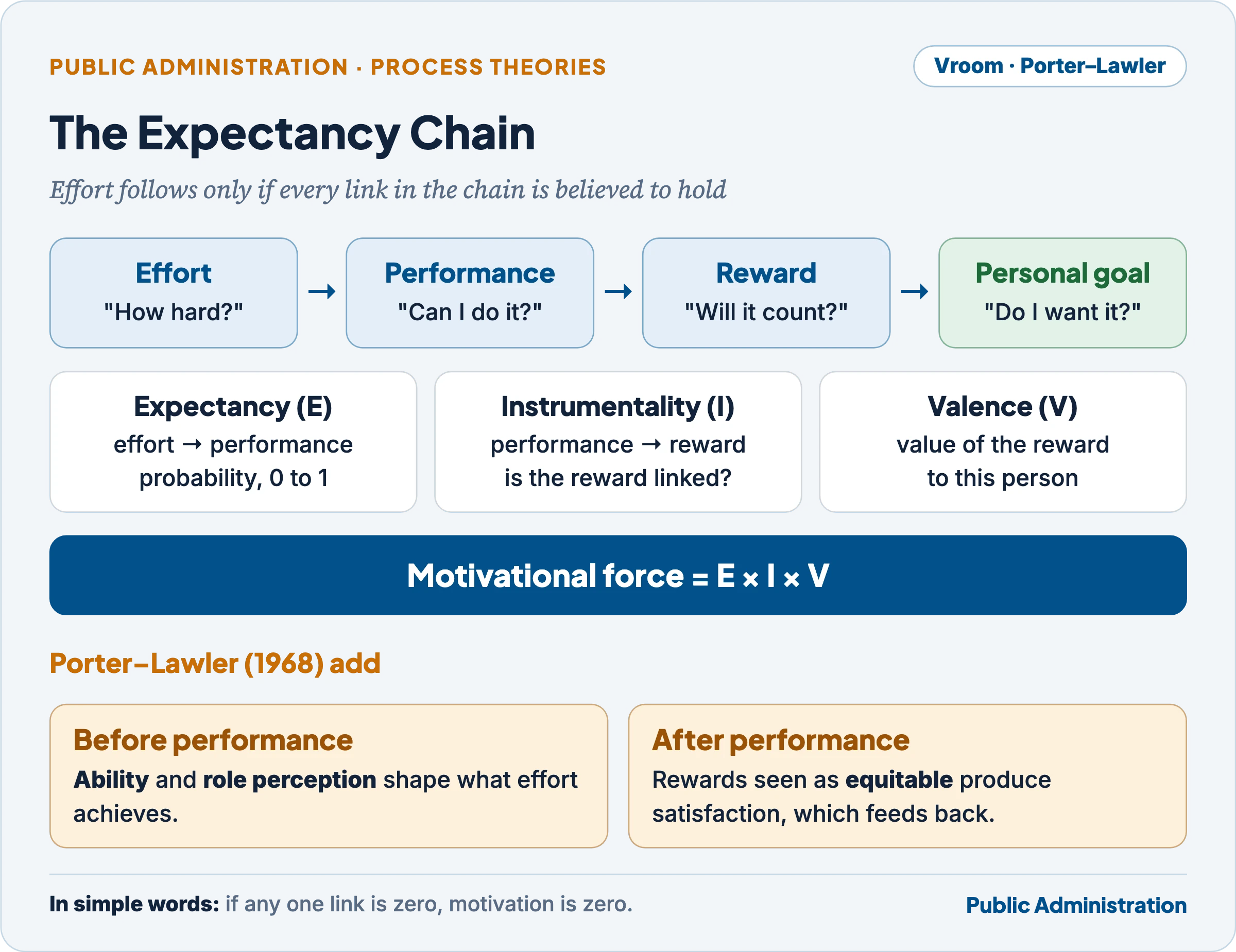
- Expectancy (E): the belief that effort will lead to performance; a probability from 0 to 1. (“If I work late, will I clear the backlog?”)
- Instrumentality (I): the belief that performance will lead to a reward, the first-level outcome leading to a second-level outcome. (“If I clear the backlog, will it count in my appraisal or promotion?”)
- Valence (V): the value the person places on the reward; it can be positive, zero or negative. (“Do I even want that posting?”)
Motivational force = Expectancy × Instrumentality × Valence, summed over all outcomes. Because the terms are multiplied, if any one is zero, motivation is zero: a highly valued promotion means nothing if the officer believes promotions go by seniority whatever she does.
Implications for management:
- Raise expectancy: training, resources, clear targets and supportive supervision so that effort can produce results.
- Raise instrumentality: tie rewards visibly to performance, not to seniority, loyalty or favouritism; keep appraisal credible.
- Raise valence: individualise rewards: some value money, others a choice posting, study leave or public recognition.
- Diagnose demotivation by finding the weak link.
Critique: it assumes people are rational calculators, which is idealistic; the variables are hard to measure; it describes the determinants of motivation but gives few specific prescriptions; and it ignores habit and emotion. Its strength is that it does not oversimplify: it explains why the same reward motivates one person and not another. It is often compared with marginal analysis in economics: no one literally calculates it, but it mirrors the logic of choice.
Common confusion
Is Vroom’s “instrumentality” the same as “expectancy”? No. Expectancy links effort to performance (“can I do it?”). Instrumentality links performance to reward (“will doing it get me anything?”). An officer can be confident of meeting a target (high expectancy) and still be unmotivated because good work is not rewarded (low instrumentality), which is the typical problem in seniority-based civil services.
9.2 The Porter–Lawler model
Lyman Porter and Edward Lawler (Managerial Attitudes and Performance, 1968) refined and extended Vroom.
- Effort depends on the value of rewards and the perceived effort–reward probability (Vroom’s logic).
- Effort does not equal performance: performance also depends on abilities and traits and role perceptions (understanding what the job requires).
- Performance brings intrinsic rewards (sense of accomplishment) and extrinsic rewards (pay, promotion).
- Rewards lead to satisfaction only if they are perceived as equitable; this links expectancy to equity theory.
- Satisfaction feeds back into the value of future rewards.
The model’s striking conclusion is that performance leads to satisfaction, not the reverse, as human relations writers had assumed. Satisfied employees are not automatically productive; productive employees who are fairly rewarded become satisfied. Practically, organisations must measure the value of rewards, clarify roles, build abilities and make rewards contingent on performance. Its weakness is complexity, which has limited its direct use in personnel practice.
9.3 Adams’ equity theory
J. Stacy Adams, an American behavioural psychologist working at General Electric, proposed the theory in “Toward an Understanding of Inequity” (1963) and “Inequity in Social Exchange” (1965), building on Leon Festinger‘s cognitive dissonance and George Homans‘ exchange theory.
- People compare the ratio of their outcomes (pay, status, promotion, recognition, interesting work) to their inputs (effort, education, experience, skill, loyalty) with the same ratio of a referent (a colleague, a batchmate, someone in another department or the private sector).
- Equity exists when the ratios feel equal. Inequity creates tension proportional to its size, and the person is motivated to restore equity.
- Under-reward produces anger; over-reward produces guilt (weaker and more easily rationalised).
- Ways to restore equity: change inputs (reduce effort, absenteeism), change outcomes (demand more pay, or take it by corruption or misuse of perks), distort perceptions of one’s own or the other’s ratio, act on the referent, change the referent, or leave the field (transfer, resignation, voluntary retirement).
- Referents may be self-inside (one’s own past in the organisation), self-outside, other-inside and other-outside.
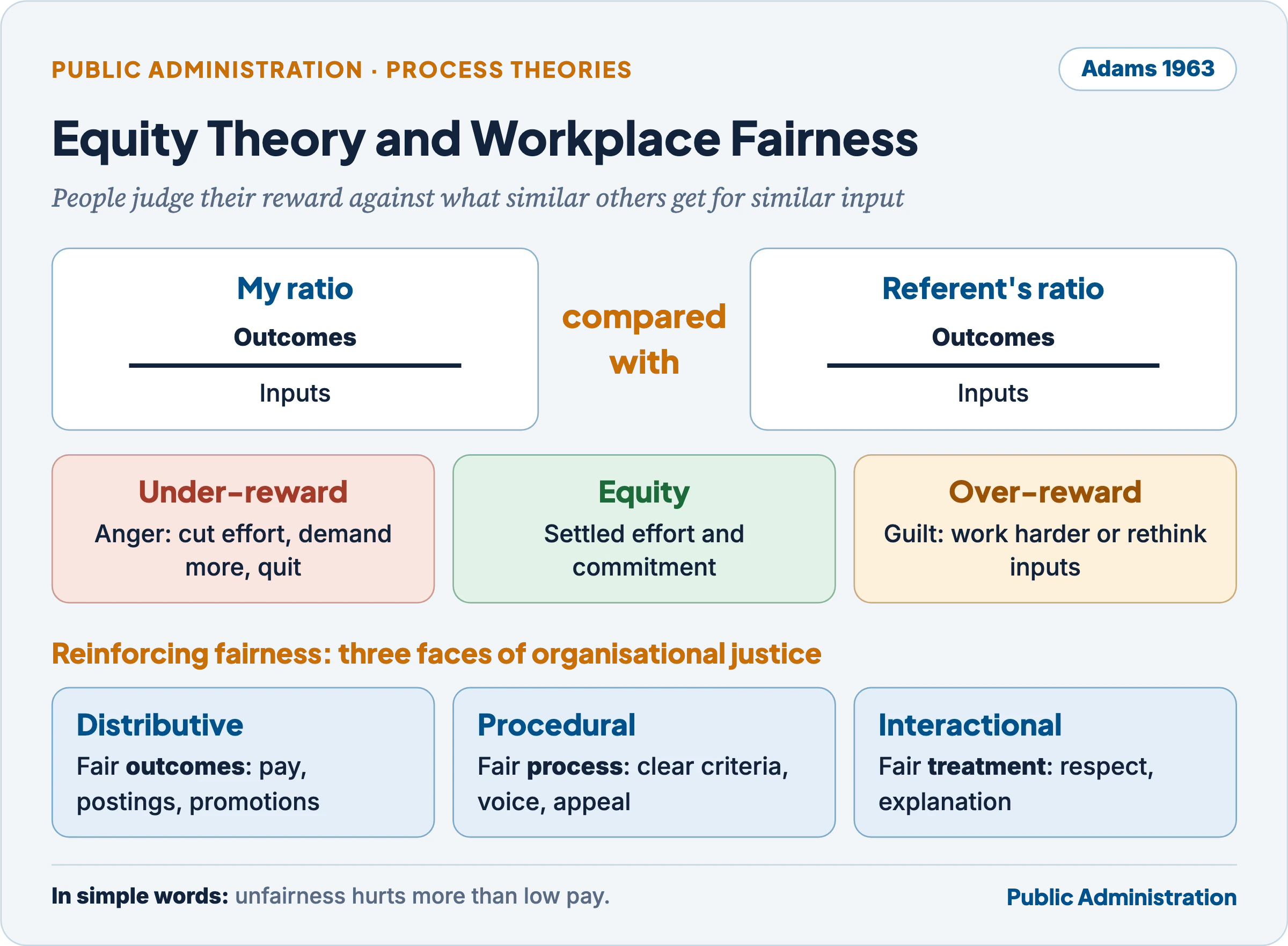
From equity to organisational justice. Later research extended Adams into organisational justice (Jerald Greenberg, 1987 onwards):
- Distributive justice: fairness of outcomes (who gets the raise, the good posting).
- Procedural justice: fairness of the process used to decide (consistent criteria, freedom from bias, accurate information, a chance to be heard, a right to appeal). Studies find procedural justice often predicts commitment and performance better than distributive justice: people accept an unwelcome outcome if the process was fair.
- Interactional justice (Bies and Moag, 1986): fairness of personal treatment (respect, dignity) and of information (honest explanation of decisions).
Meta-analyses link perceived justice to job satisfaction, commitment, organisational citizenship behaviour, lower turnover and performance, and injustice to theft, sabotage and retaliation.
How can fairness and equity be reinforced to improve productivity?
- Fair pay structures: pay that matches responsibility and market comparisons; periodic pay commissions; removal of anomalies between similar posts; parity across cadres where duties are equal.
- Transparent, criteria-based decisions on promotions, postings and transfers: published criteria, Civil Services Boards for transfers, fixed minimum tenures, rotation of hard and soft postings.
- Credible appraisal: objective targets agreed in advance, numerical grading, disclosure of the appraisal to the officer with a right to represent, multi-source feedback to reduce single-boss bias.
- Voice and appeal: grievance redressal, staff councils (the Joint Consultative Machinery), tribunals for service matters.
- Respectful treatment and explanation: courteous supervision, reasons for decisions, no humiliation; leaders who model fairness.
- Recognition that is fair: awards decided by independent committees on published criteria, open to teams and frontline staff, not only to senior officers.
- Equal opportunity: freedom from caste, gender and regional bias; protection against sexual harassment (the Sexual Harassment of Women at Workplace Act, 2013).
- Managing comparisons: explaining differences openly, because inequity is perceived: a secret bonus can demotivate the many to please the few.
Critique: equity theory does not say which referent a person will choose or which response they will adopt; people differ in sensitivity to equity (benevolents, sensitives, entitleds); and overpayment effects are weak. Its strength is explaining why pay rises and incentives can backfire if they are seen as unfair.
Indian Connect — Equity and fairness in Indian government
- Dev Dutt v. Union of India (2008): the Supreme Court held that every entry in an annual confidential report must be communicated to the employee, who can then represent against it; non-communication is arbitrary under Article 14. This turned procedural justice into a legal right and led to the open APAR system with self-appraisal, numerical grading and disclosure.
- Pay comparisons: the widening gap between government salaries at senior levels and those in the private sector and public sector corporations, and the perception that juniors in corporations earn more for less, are classic equity comparisons that affect motivation, retention and the attraction of talent; pay commissions are asked to consider private and PSU pay structures for this reason.
- Transfers and postings: arbitrary transfers are among the most damaging sources of perceived inequity; T.S.R. Subramanian v. Union of India (2013) directed fixed minimum tenure and Civil Services Boards to recommend transfers.
9.4 Locke’s goal-setting theory
Edwin Locke proposed in “Toward a Theory of Task Motivation and Incentives” (1968), and with Gary Latham in A Theory of Goal Setting and Task Performance (1990), that conscious goals and intentions are a major source of work motivation.
- Specific goals produce higher performance than vague ones (“do your best”).
- Difficult but accepted goals produce higher performance than easy ones.
- Feedback improves performance, and self-generated feedback is most powerful.
- Goals work by directing attention, mobilising effort, increasing persistence and prompting better strategies.
- Moderators: goal commitment (stronger when goals are public, self-set or explained), self-efficacy, task complexity (goals work better for simple, well-learned, independent tasks; group goals suit interdependent tasks) and national culture (it fits individualist, low power-distance cultures best).
- Participation in goal-setting does not always raise performance, but it raises acceptance.
Albert Bandura‘s self-efficacy (1977), the belief that one can perform a task, complements goal-setting: difficult goals signal the boss’s confidence and raise self-efficacy, which leads people to set higher goals. Self-efficacy grows through enactive mastery (past success), vicarious modelling, verbal persuasion (the Pygmalion and Galatea effects) and arousal.
Limits: narrow goals can produce tunnel vision, gaming and neglect of unmeasured duties; complex public goals are hard to quantify. India’s Results Framework Documents (2009–2014), outcome budgets, the Aspirational Districts dashboards and PRAGATI reviews apply goal-setting logic, with the attendant risk of chasing indicators. Management by objectives (Drucker) is its managerial form.
9.5 Skinner’s reinforcement theory
B.F. Skinner (1904–1990), the American behaviourist (Science and Human Behavior, 1953), held that behaviour is a function of its consequences; inner states need not be studied. Strictly it is a theory of behaviour change, not of motivation, but it is widely used to shape work behaviour (organisational behaviour modification).
- Positive reinforcement: a pleasant consequence after desired behaviour (praise, bonus) increases it.
- Negative reinforcement: removing an unpleasant condition after desired behaviour (lifting close supervision once targets are met) increases it.
- Punishment: an unpleasant consequence (penalty, adverse entry) decreases behaviour.
- Extinction: withholding any consequence makes behaviour disappear, which is why good work that is never acknowledged fades.
- Schedules: continuous reinforcement builds behaviour fast; intermittent (variable) schedules make it more durable.
Critique: it ignores cognition, feelings and expectations, risks manipulation, punishment breeds resentment, and it is hard to control all sources of reinforcement in an office. Its lesson for government is simple and often ignored: reward the behaviour you want, promptly and consistently, and do not let disciplinary systems punish initiative while ignoring inertia.
9.6 Attribution theory
Attribution theory studies how people explain the causes of their own and others’ behaviour.
- Fritz Heider (The Psychology of Interpersonal Relations, 1958) distinguished internal causes (ability, effort) from external causes (luck, task difficulty, rules); what matters is the perceived, not actual, cause.
- Harold Kelley (1967) said we judge using consensus (do others behave the same way?), consistency (does this person always behave so?) and distinctiveness (does he behave differently in other tasks?). High consensus, low consistency and high distinctiveness point to external causes; the reverse to internal causes.
- Julian Rotter‘s locus of control (1966): “internals” believe they control outcomes and tend to be more motivated, satisfied and better performers; “externals” credit luck or others.
- Bernard Weiner added stability (ability is stable, effort unstable): attributing success to ability and effort raises future expectancy and motivation.
- Biases: the fundamental attribution error (blaming people and ignoring the situation when judging others) and the self-serving bias (crediting oneself for success, blaming circumstances for failure). Supervisors and subordinates thus routinely make opposite attributions.
Implications: fair appraisal must separate system failures from personal failures; training that helps people attribute failure to controllable effort rather than fixed ability raises motivation. Attribution also reinforces Maslow’s caution that behaviour is not determined by motives alone.
10. Content and Process Theories: Same Focus, Different Approaches
In simple words
Content theories are like a list of the fuels that can run a car: hunger, friendship, pride. Process theories are like an explanation of how the engine burns the fuel. Both are about why the car moves; they just look at different parts.
Agreement on the focus. Both families seek to explain why people direct effort towards goals and how organisations can raise willing performance. Both reject the purely economic man, both recognise intrinsic and extrinsic rewards, and both aim to help managers design work and rewards.
Difference in approach.
| Basis | Content theories | Process theories |
|---|---|---|
| Central question | What motivates? | How is behaviour energised, directed and sustained? |
| Unit of analysis | Needs and drives within the person | Cognitive process: perceptions, expectations, comparisons, goals |
| View of person | Driven by needs, often unconscious | Rational, calculating, comparing |
| Universality | Assume needs broadly common to all | Allow individual differences in valences and referents |
| Prescription | Specific (enrich the job, meet the need) | General (link effort, performance and reward; be fair) |
| Time | Largely static snapshot of needs | Dynamic: choices change with feedback |
| Typical critique | Untested, culture-bound, oversimplified | Too rational, complex, hard to apply |
| Examples | Maslow, Herzberg, Alderfer, McClelland | Vroom, Porter–Lawler, Adams, Locke |
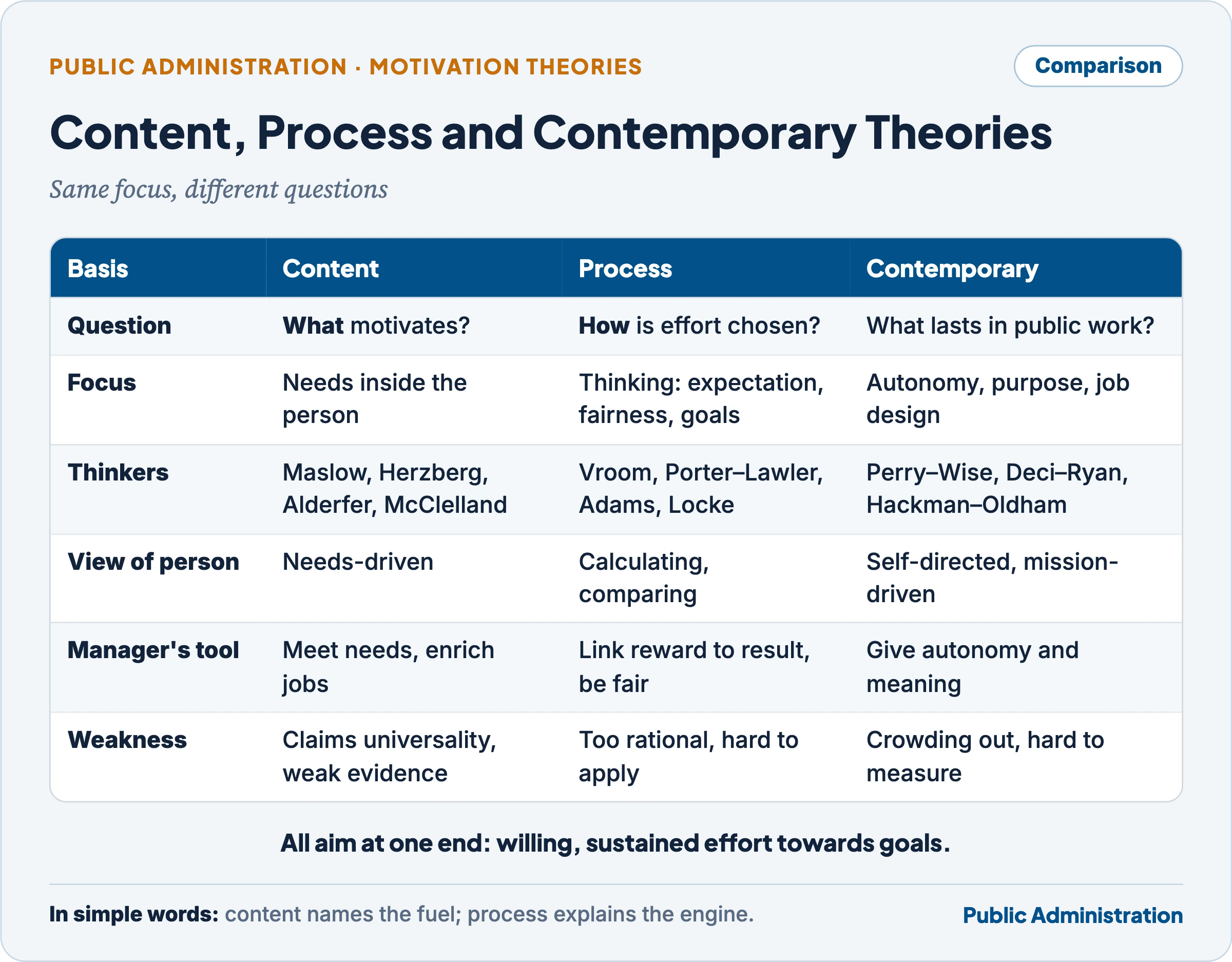
They are complementary, not rival. Content theories supply the valences that process theories leave empty: Vroom says a reward motivates if it is valued, and Maslow, Herzberg and McClelland tell us which rewards are likely to be valued. Process theories in turn explain why a needed reward still fails to motivate when the person doubts that effort will be recognised or feels the reward is unfair. Porter and Lawler explicitly integrate both, and the job characteristics model combines Herzberg’s content with Vroom-like psychological states. The statement that they have “the same focus but different approaches” is therefore accurate, with the rider that effective practice needs both: knowing what people need, and making sure the path from effort to valued, fair reward is credible.
11. Organisational Views: Barnard, March–Simon, Schein and Power
In simple words
People join an organisation and keep working for it only as long as what they get (pay, friendship, pride) is worth what they give (time, effort, freedom). A good executive keeps that balance positive for everyone whose cooperation the organisation needs.
11.1 Barnard’s contribution–satisfaction equilibrium
Chester Barnard (1886–1961), President of New Jersey Bell Telephone, argued in The Functions of the Executive (1938) that an organisation is a system of cooperation, and that individuals contribute to it only if they receive satisfactions that equal or exceed the sacrifices they make.
- Equilibrium: the organisation survives only while it can offer inducements sufficient to elicit the contributions it needs. Barnard’s “efficiency” means precisely this capacity to maintain the balance, not output per unit of input.
- Willingness to serve depends on net satisfaction; for most people it is negative or neutral, so cooperation must be constantly induced.
- Specific inducements (offered to particular individuals): material (money, things); personal non-material (distinction, prestige, power); desirable physical conditions; ideal benefactions (pride of workmanship, altruism, loyalty, patriotism).
- General incentives (offered to all): associational attractiveness (social compatibility), conformity to habitual methods, opportunity for enlarged participation, and communion (comradeship, mutual support).
- Material rewards are weak beyond subsistence; the executive must manage an economy of incentives, combining incentives with persuasion (changing what people want through education, example and propaganda).
- Authority depends on acceptance: orders fall within each person’s zone of indifference only while inducements outweigh burdens.
Is it still a logical model of organisational motivation? Largely yes.
- It explains joining, staying and leaving, which content theories ignore; modern psychological contract, employee engagement and retention research all assume an inducement–contribution balance.
- It anticipated non-financial incentives, participation and organisational culture, and it recognises that public servants may be moved by ideal benefactions such as patriotism and public spirit, the forerunner of public service motivation.
- It is a systems view: motivation is a property of the organisation’s exchange relations, not only of individual psychology.
Limits: the balance is hard to measure; it treats motivation as utilitarian exchange and underplays emotions, values and power inequalities; it is managerial (the executive decides inducements); and it explains participation better than performance. It is “logical” as a framework rather than as a predictive theory.
11.2 March and Simon: the decision to participate and the decision to produce
Herbert Simon (Administrative Behavior, 1947) adopted Barnard’s inducement–contribution balance, and James March and Herbert Simon (Organizations, 1958) distinguished two motivational decisions:
- The decision to participate (join, stay or leave) depends on the perceived desirability of leaving (job satisfaction) and the perceived ease of leaving (alternatives in the labour market).
- The decision to produce (how much effort to give while staying) depends on the evoked alternatives, perceived consequences and individual goals, including identification with the organisation and its sub-groups.
They also stressed organisational identification: people adopt the organisation’s goals as their own decision premises, which reduces the need for external incentives. This is why the Barnard–Simon theory of organisation is often called essentially a theory of motivation: it explains organisation as a balance of inducements and contributions and as a system that shapes the premises of individual decisions. The critique is that it is rationalist and conservative: Argyris argued that the “satisficing” member it assumes is shaped to fit the status quo rather than allowed to grow (see the article on Simon).
11.3 Schein’s models of man
Edgar Schein (Organizational Psychology, 1965) traced four successive assumptions about people at work:
| Model | Assumption | Managerial strategy |
|---|---|---|
| Rational-economic man | Motivated by economic self-interest; passive, manipulable | Incentives and control (Taylor, Theory X) |
| Social man | Motivated by social needs and group belonging | Attend to groups, morale, informal organisation (Mayo) |
| Self-actualising man | Seeks autonomy, growth and meaningful work | Challenge, delegation, job enrichment (Maslow, Argyris, Theory Y) |
| Complex man | Motives vary between people, over time and across situations | Diagnose and adapt; no single strategy |
Schein’s complex man is the basis of his observation that man’s motives in different organisations, or in different subparts of the same organisation, may be different:
- In a revenue collection unit with routine, rule-bound work, economic and security motives may dominate.
- In a research or policy cell, the same officer may be driven by challenge and self-actualisation.
- In a field team in a disaster, belonging and shared mission dominate.
- People also learn new motives through organisational experience, and the same person’s motives change over a career.
The managerial lesson is to be a diagnostician: match incentives, structure and leadership to the sub-unit’s task and people, which is the motivational counterpart of contingency theory. A uniform national incentive scheme for all departments ignores Schein.
11.4 The interest or power group base: motivation as negotiation
A political view of organisations treats them as coalitions of interest groups bargaining over goals and resources (Cyert and March’s behavioural theory of the firm, 1963; later Jeffrey Pfeffer’s work on power). In this view, membership of an interest or power group inside the organisation (a cadre, a service association, a union, an informal network around a powerful officer) gives a member negotiable goods:
- information and expertise others need;
- support and votes in committees and associations;
- access to decision-makers;
- control over uncertainty or critical resources;
- collective bargaining strength.
These can be cashed in for recognition, status and rewards: better postings, promotions, protection from adverse action. Motivation here is neither a need nor a calculation about the formal reward system, but exchange and bargaining within a political system (an extension of Barnard’s and Peter Blau‘s exchange logic).
- Strengths: it explains service rivalries (for example between generalist and specialist cadres), the influence of staff associations, and why informal networks often matter more than formal incentives.
- Dangers: it can reward loyalty over merit, breed factionalism, distort equity and weaken accountability; Anthony Downs (Inside Bureaucracy, 1967) showed how officials’ self-interested motives (power, income, prestige, security) shape bureau behaviour.
- Implication: formal motivation systems that are seen as unfair push people towards power-group bargaining; credible, transparent merit systems reduce it.
12. Contemporary Theories of Motivation
In simple words
Newer research asks why many people choose public service at all, often for less money than they could earn elsewhere. The answers point to a wish to serve, a need for freedom and mastery in work, and the way jobs and choices are designed.
12.1 Public service motivation
James Perry and Lois Wise, in “The Motivational Bases of Public Service” (Public Administration Review, 1990), defined public service motivation (PSM) as an individual’s predisposition to respond to motives grounded primarily or uniquely in public institutions. It challenged the public choice assumption that bureaucrats are driven mainly by self-interest.
Three types of motives (after Knoke and Wright-Isak):
- Rational: participating in policy-making (exciting, self-affirming), commitment to a public programme through personal identification, and advocacy for a special interest.
- Norm-based: a desire to serve the public interest, loyalty to duty and to the government as a whole, and social equity.
- Affective: commitment to a programme from genuine conviction about its social importance, and the “patriotism of benevolence” (Frederickson and Hart): love of regime values and of others.
Perry (1996) measured PSM through four dimensions: attraction to public policy-making, commitment to the public interest and civic duty, compassion and self-sacrifice.
Perry and Wise’s three propositions:
- The greater a person’s PSM, the more likely they are to seek membership in a public organisation.
- In public organisations, PSM is positively related to performance.
- Organisations with high-PSM members are less dependent on utilitarian (financial) incentives to manage performance.
As an inducement for efficiency in service delivery. Research over three decades broadly supports the first proposition and, more modestly, the second: PSM is associated with job satisfaction, commitment, whistle-blowing, lower turnover intention and extra-role effort. The approach suggests:
- Recruit for values as well as ability (situational judgement, ethics and public-service motivation tests; the UPSC’s ethics paper is a step in this direction).
- Socialise recruits into a public-service ethos through training and mentoring.
- Make the mission visible: connect employees with the beneficiaries of their work (an officer who meets families helped by a scheme works harder; Adam Grant’s studies of “beneficiary contact” show the effect).
- Avoid crowding out: heavy reliance on narrow performance pay can undermine PSM.
- Use transformational, mission-focused leadership that articulates public values.
Limits: PSM can be eroded by red tape, politicisation, corruption and lack of recognition (PSM “burn-out”); it is hard to measure reliably; it may vary across cultures (in India, family and social status motives for government jobs are strong); and high PSM without competence or accountability does not guarantee efficiency. It is therefore an inducement that complements, not replaces, fair pay, accountability and capacity.
Common confusion
Is public service motivation the same as altruism, and does it mean public servants do not care about pay? No. PSM includes rational motives (interest in policy, identification with a programme), norm-based motives (duty, public interest, equity) and affective ones; only part is pure self-sacrifice. People with high PSM still need fair pay and decent conditions; the theory only says they rely less on financial incentives and may be demotivated by schemes that treat them as purely self-interested.
12.2 Self-determination theory
Edward Deci and Richard Ryan (Intrinsic Motivation and Self-Determination in Human Behavior, 1985) argued that well-being and high-quality motivation depend on satisfying three basic psychological needs:
- Autonomy: feeling that one’s actions are self-chosen;
- Competence: feeling effective and capable;
- Relatedness: feeling connected to others.
Motivation runs along a continuum from amotivation, through external regulation (reward and punishment), introjected (guilt, ego), identified (personally valuing the goal) and integrated regulation, to intrinsic motivation. Autonomous motivation (identified, integrated, intrinsic) produces better performance, persistence and well-being than controlled motivation. Its earlier sub-theory, cognitive evaluation theory, explains crowding out: rewards felt as controlling reduce autonomy and intrinsic motivation; rewards that convey competence do not.
For public organisations, SDT suggests internalising public values rather than imposing them, giving discretion within rules, building competence through training, and fostering team relatedness.
12.3 The job characteristics model
J. Richard Hackman and Greg Oldham (1975–76; Work Redesign, 1980) turned Herzberg’s job enrichment into a testable model.
- Five core job dimensions: skill variety, task identity (doing a whole, identifiable piece of work), task significance (impact on others), autonomy and feedback.
- These create three critical psychological states: experienced meaningfulness (from the first three), experienced responsibility (from autonomy) and knowledge of results (from feedback).
- Outcomes: high internal motivation, quality performance, satisfaction, low absenteeism and turnover.
- Motivating Potential Score = [(skill variety + task identity + task significance) ÷ 3] × autonomy × feedback; a job with no autonomy or no feedback has no motivating potential.
- Moderators: knowledge and skill, growth-need strength and satisfaction with context factors.
Guidelines for enrichment follow: combine tasks, form natural work units, establish client relationships, load jobs vertically and open feedback channels. A single-window or “case ownership” model, where one official handles a citizen’s application end to end, applies these principles.
12.4 Pink’s Drive, nudges and appraisal
- Daniel Pink (Drive, 2009) popularised SDT and crowding-out research: “Motivation 2.0” (carrots and sticks) works for routine, algorithmic tasks, but creative, heuristic work needs “Motivation 3.0“: autonomy, mastery and purpose.
- Behavioural nudges: Richard Thaler and Cass Sunstein (Nudge, 2008) showed that choice architecture (defaults, reminders, social norms, salience, timely feedback) shapes behaviour without mandates or large incentives. India’s Economic Survey 2018–19 devoted a chapter to applying “nudge” economics to policy. Inside administration, nudges include peer comparison dashboards (district rankings), public recognition, default enrolment in learning, and timely reminders; they work alongside, not instead of, structural incentives.
- 360-degree (multi-source) appraisal gathers feedback from superiors, peers, subordinates and sometimes citizens. It improves procedural justice and self-awareness and reduces single-boss bias, supporting both equity and expectancy logic; it is used in the Government of India for empanelment of senior officers, though critics question its confidentiality and consistency. See the article on Personnel Administration.
13. Applying the Theories: Four Employees, Four Motivational Profiles
In simple words
The same organisation can contain a loner, a sociable hothead, a passionate teacher and an artist-engineer. One incentive scheme will not suit them all; each needs to be understood through the theory that fits him.
Schein’s complex man in practice. A classic illustration of Schein’s “complex man” is a set of four employees whose needs must be reconciled with the organisation’s.
| Employee | Behaviour | Motivational reading | What the organisation can do |
|---|---|---|---|
| Mr A (punctual, honest, obedient, but a loner, happy in isolation) | Accepts authority; responds politely to peers but seeks no company | Low need for affiliation (McClelland); motivated by safety, order and duty; hygiene-satisfied; fits a Theory X-compatible role without being lazy; Schein’s rational-economic or duty-bound man; possibly an introvert with intrinsic integrity | Give well-defined, independent tasks (audit, records, scrutiny) with clear rules; recognise reliability; do not force team or social roles; respect his zone of indifference |
| Mr B (efficient, outgoing, makes and breaks friends fast; calms down when appealed to in the organisation’s name) | Sociable but volatile | High need for affiliation with poor emotional regulation; strong organisational identification (March–Simon) and responsiveness to Barnard’s ideal benefactions (loyalty) | Use him in team-based and liaison roles; appeal to organisational loyalty and mission; train in conflict management; supportive supervision (Likert’s System 4) |
| Dr C (absorbed and happy teaching, welcomes heavier, new work; angry over medical-bill objections and delayed tenure) | Intrinsically motivated but dissatisfied with context | A textbook Herzberg case: motivators present (work itself, growth, responsibility) and hygiene deficient (administrative policy, job security); also equity concerns about tenure; self-actualising man | Fix the hygiene: settle medical claims fairly and promptly, decide tenure through a transparent process; protect his autonomy and teaching; otherwise frustration–regression (Alderfer) may erode his commitment |
| Mr D (innovative metallurgist, honoured for alloy work; values his painting more; hurt when the house journal rejects his sketch) | Achiever whose growth needs extend beyond the job | High nAch; self-actualisation and esteem needs that the job does not fully satisfy (Maslow); ERG shows simultaneous growth needs in two domains; complex man | Give recognition of the whole person: exhibitions, a cultural forum or a fair, explained decision on the journal cover; link creativity to work (design, innovation roles); avoid perceived interactional injustice |
The four cases show that no single theory or incentive suffices: the organisation needs diagnosis (Schein), job–person fit (McClelland, job characteristics), sound hygiene (Herzberg), fair procedures (Adams) and recognition that reaches beyond the job description (Maslow).
14. Motivation in the Indian Civil Services
In simple words
Indian civil servants have secure jobs, regular pay revisions and status, yet many observers say the system does not reward good work enough. Reforms now try to link pay and promotion more to performance, make appraisal fair, keep officers learning, and recognise excellence.
14.1 The diagnosis
- The 2nd Administrative Reforms Commission, in its 10th Report (Refurbishing of Personnel Administration, 2008), observed that the common perception is that the incentive structure in government is too weak and inadequate to motivate better performance.
- Pay and promotion are largely seniority-based; good and poor performers progress alike (low instrumentality in Vroom’s terms).
- Appraisal was secretive and inflated, so it failed to separate performance (a procedural justice gap).
- Disincentives dominate: risk of vigilance action, audit objections and arbitrary transfers punish initiative (reinforcement of inaction).
- Recommendations included performance-linked increments, a more objective and consultative appraisal, performance agreements for senior officers, mid-career reviews and removal of non-performers.
- Training as a “paid holiday” reflects a crisis of motivation: when training is not linked to postings, promotion or competence, neither trainers nor trainees value it (low valence and instrumentality). Mission Karmayogi seeks to link learning to competencies and roles.
- The emoluments gap: at senior levels government pay lags far behind the private sector and corporations, affecting the attraction and retention of specialised talent and creating equity tensions, though security, pension, power and status partly compensate (Barnard’s non-material inducements).
14.2 Pay commissions and performance-related pay
- The 6th Central Pay Commission (Justice B.N. Srikrishna, 2008) introduced pay bands with grade pay and recommended a Performance Related Incentive Scheme.
- The 7th Central Pay Commission (Justice A.K. Mathur, report November 2015) recommended Performance Related Pay for all categories of Central Government employees, based on quality Results Framework Documents, reformed APARs and broad guidelines. It also raised the benchmark for financial upgradation under MACP from “Good” to “Very Good” and proposed that annual increments be withheld for employees who fail to meet the benchmark for MACP or regular promotion in their first 20 years.
- Implementation has been limited: PRP has not been rolled out across the government; productivity-linked bonuses in departments like the Railways and Posts are older, collective schemes.
- The 8th Central Pay Commission, announced in January 2025, had its terms of reference approved on 28 October 2025 and was constituted by notification of 3 November 2025 under Justice Ranjana Prakash Desai, with 18 months to report. Its terms ask it to consider fiscal prudence and pay structures in public sector undertakings and the private sector, keeping the equity comparison alive.
Why PRP is hard in government: outputs are multiple, collective and hard to measure; performance pay can crowd out public service motivation, encourage gaming, and generate inequity perceptions if appraisal is not trusted. Theory suggests PRP works best for measurable, individual tasks, with credible appraisal and as a supplement to intrinsic and recognition-based motivation.
14.3 Appraisal, learning and recognition
- APAR (Annual Performance Appraisal Report): replaced the confidential report with self-appraisal, numerical grading (1–10) and disclosure to the officer, who may represent against it (following Dev Dutt, 2008). An online system (SPARROW) records APARs for the All India Services and many central services. Multi-source feedback is used for empanelment at senior levels.
- Mission Karmayogi (National Programme for Civil Services Capacity Building), approved on 2 September 2020, shifts from rule-based to role-based management, with a competency framework, the iGOT Karmayogi digital learning platform, annual capacity-building plans and a Capacity Building Commission (2021). In motivational terms it targets competence and growth (SDT, Herzberg’s motivators, Alderfer’s growth needs) and uses nudges such as badges, leaderboards and learning weeks.
- Prime Minister’s Awards for Excellence in Public Administration (instituted 2006) are conferred on Civil Services Day (21 April). The 2025 scheme recognised holistic development of districts, the Aspirational Blocks Programme and innovations, with a trophy, scroll and ₹20 lakh for the district or organisation to spend on public welfare. They act on esteem, recognition and team pride, and the incentive goes to the unit, not the individual, which avoids crowding out.
- Negative reinforcement and punishment: premature retirement of non-performers under FR 56(j) and related rules, and disciplinary action, are the “stick”; they must be applied with procedural fairness to avoid fear-driven risk aversion.
Indian Connect — Mission Karmayogi as motivation theory in practice
- Competence and autonomy (SDT): self-paced courses chosen by the officer, linked to the competencies of the role.
- Recognition and feedback (Herzberg, Locke): certificates, badges and visible learning hours; national learning weeks with targets.
- Valence and instrumentality (Vroom): the planned linkage of competencies to postings and career progression determines whether learning is valued; without it, online courses risk becoming the new “paid holiday”.
Criticism — The case against applying motivation theories to the public service
- Most theories were built on American private-sector professionals; they ignore collectivist cultures, low incomes and the legal-rational constraints of government (Hofstede, Nevis).
- Public outputs are collective and unmeasurable, so expectancy and goal-setting tools invite gaming and tunnel vision.
- Performance pay and targets can crowd out the intrinsic and public-service motives on which government most depends (Deci, Frey, Perry).
- Seniority, Article 311 protection, political interference and audit fear limit managers’ freedom to reward or enrich jobs, so theory has little purchase.
- Theories focused on individual psychology neglect power, coalitions and structure, which shape behaviour more (Section 11.4).
Defence — The case for applying them
- Their core insights travel: interesting work, recognition, fairness and growth motivate in almost every culture studied.
- They explain real Indian problems precisely: hygiene without motivators, broken instrumentality, inequity in transfers, training without valence.
- Reforms grounded in them are under way: APAR disclosure, Mission Karmayogi, PM’s Awards, delayering and outcome monitoring.
- Public service motivation and self-determination theory are built for, and tested in, public organisations.
- Used contingently (Schein, Morse and Lorsch), they help managers diagnose rather than impose one formula.
Key Terms
| Term | Meaning in simple words |
|---|---|
| Motivation | Inner force that starts, directs and sustains effort towards a goal |
| Need, drive, incentive | A felt lack; the push it creates; what satisfies it |
| Intrinsic reward | Satisfaction from the work itself |
| Extrinsic reward | Reward given by others: pay, promotion, praise |
| Crowding out | External rewards weakening intrinsic motivation |
| Prepotency | The urgency of the most pressing unmet need |
| D-needs and B-needs | Maslow’s deficiency needs and growth (being) needs |
| Self-actualisation | Becoming all one is capable of becoming |
| Hygiene factors | Job context factors that prevent dissatisfaction |
| Motivators | Job content factors that create satisfaction and effort |
| Adam and Abraham natures | Herzberg’s avoidance-of-pain and growth-seeking sides of human nature |
| KITA | Herzberg’s term for push-based incentives that cause movement, not motivation |
| Job enrichment | Vertical loading: more responsibility, autonomy and feedback |
| Job enlargement | Horizontal loading: more tasks of the same level |
| Frustration–regression | Falling back to lower needs when higher ones are blocked (ERG) |
| nAch, nPow, nAff | McClelland’s needs for achievement, power and affiliation |
| Theory X / Theory Y | McGregor’s control-based and integration-based assumptions about people |
| Theory Z | Ouchi’s trust-based, long-term, consensual model |
| Expectancy, instrumentality, valence | Effort→performance belief; performance→reward belief; value of reward |
| Equity / referent | Fair balance of outcomes to inputs; the person one compares with |
| Organisational justice | Distributive, procedural and interactional fairness |
| Self-efficacy | Belief in one’s ability to perform a task |
| Reinforcement | A consequence that makes behaviour more likely |
| Attribution | How people explain the causes of behaviour |
| Inducement–contribution balance | Barnard’s equilibrium of satisfactions and sacrifices |
| Complex man | Schein’s view that motives vary across people, time and sub-units |
| Public service motivation | Predisposition to serve the public interest, rooted in public institutions |
| Motivating Potential Score | Hackman–Oldham’s index of a job’s capacity to motivate |
| Nudge | A change in choice design that steers behaviour without mandates |
| Performance-related pay | Pay that varies with assessed performance |
Commissions, Committees and Judgments
| Body / case | Year | Key point |
|---|---|---|
| 2nd ARC, 10th Report Refurbishing of Personnel Administration | 2008 | Incentive structure too weak to motivate; performance-linked increments, objective appraisal, performance agreements |
| 6th Central Pay Commission (Justice B.N. Srikrishna) | 2008 | Pay bands and grade pay; Performance Related Incentive Scheme |
| Dev Dutt v. Union of India | 2008 | Every appraisal entry must be communicated; non-communication arbitrary under Article 14 |
| T.S.R. Subramanian v. Union of India | 2013 | Minimum tenure and Civil Services Boards for transfers |
| 7th Central Pay Commission (Justice A.K. Mathur) | 2015 | PRP for all categories; MACP benchmark “Very Good”; increments withheld for persistent non-performers |
| Mission Karmayogi (NPCSCB) | 2020 | Role-based, competency-driven capacity building; iGOT; Capacity Building Commission (2021) |
| 8th Central Pay Commission (Justice Ranjana Prakash Desai) | 2025 | ToR approved 28 October 2025; constituted 3 November 2025; 18 months to report |
Contemporary Developments
- 28 October 2025: the Union Cabinet approved the terms of reference of the 8th Central Pay Commission, which was constituted on 3 November 2025 under Justice Ranjana Prakash Desai with 18 months to report; its terms require it to weigh fiscal prudence and PSU and private-sector pay, the equity comparison at the heart of public pay motivation.
- 1 December 2025: the Prime Minister’s Awards for Excellence in Public Administration, 2025 received 2,035 nominations, with 737 districts (95 per cent) registered, across holistic district development, the Aspirational Blocks Programme and innovations; each award carries ₹20 lakh for the unit’s public-welfare work. The awards were scheduled for Civil Services Day, 21 April 2026.
- April 2026: the SADHANA Saptah learning week under Mission Karmayogi followed the first Karmayogi Saptah (National Learning Week, October 2024), using targets, badges and leaderboards as behavioural nudges to learning.
- 12 August 2026: the government told Parliament that iGOT Karmayogi had more than 1.7 crore registered users, over 5,600 courses and more than 14.42 crore course completions, a scale that makes the link between learning and career progression the decisive motivational question.
- 7 January 2023 onwards: the Aspirational Blocks Programme, extending the district model of ranked indicators to 500 blocks, applies goal-setting and peer comparison at the block level; it is also one of the three categories of the PM’s Awards 2025, joining recognition to competition.
Revision Grid
| Thinker / body | Work or report (year) | Key idea |
|---|---|---|
| F.W. Taylor | “A Piece-Rate System” (1895) | Differential piece rate; economic incentive |
| Elton Mayo | Hawthorne studies (1924–32) | Social needs and group norms shape output |
| Chester Barnard | The Functions of the Executive (1938) | Contribution–satisfaction equilibrium; economy of incentives |
| Abraham Maslow | “A Theory of Human Motivation” (1943); Motivation and Personality (1954) | Hierarchy of five needs; prepotency; D- and B-needs |
| Frederick Herzberg | The Motivation to Work (1959); Work and the Nature of Man (1966); HBR (1968) | Two factors; Adam and Abraham; KITA; job enrichment |
| Douglas McGregor | The Human Side of Enterprise (1960) | Theory X and Y; integration; selective adaptation |
| Chris Argyris | Personality and Organization (1957) | Immaturity–maturity continuum |
| Rensis Likert | New Patterns of Management (1961); The Human Organization (1967) | Systems 1–4; supportive relationships |
| David McClelland | The Achieving Society (1961); with Winter (1969); with Burnham (1976) | nAch, nPow, nAff; Kakinada training |
| Victor Vroom | Work and Motivation (1964) | M = E × I × V |
| J. Stacy Adams | “Toward an Understanding of Inequity” (1963) | Equity of outcome–input ratios |
| Edgar Schein | Organizational Psychology (1965) | Four models of man; complex man |
| Edwin Locke | Goal-setting (1968); with Latham (1990) | Specific, difficult, accepted goals with feedback |
| Porter and Lawler | Managerial Attitudes and Performance (1968) | Performance leads to satisfaction via equitable rewards |
| Clayton Alderfer | ERG (1969; 1972) | Existence, relatedness, growth; frustration–regression |
| March and Simon | Organizations (1958) | Decision to participate and decision to produce |
| B.F. Skinner | Science and Human Behavior (1953) | Behaviour shaped by consequences |
| Heider; Kelley; Rotter | 1958; 1967; 1966 | Attribution; consensus–consistency–distinctiveness; locus of control |
| Hackman and Oldham | Job characteristics model (1975–80) | Five core dimensions; Motivating Potential Score |
| Deci and Ryan | Intrinsic Motivation and Self-Determination (1985) | Autonomy, competence, relatedness |
| William Ouchi | Theory Z (1981) | Trust, long-term employment, consensus |
| Perry and Wise | “The Motivational Bases of Public Service” (1990) | Rational, norm-based, affective public service motives |
| Daniel Pink | Drive (2009) | Autonomy, mastery, purpose |
| Thaler and Sunstein | Nudge (2008) | Choice architecture |
| 2nd ARC | 10th Report (2008) | Weak incentive structure; performance-linked reforms |
| 7th CPC | Report (2015) | Performance Related Pay for all |
Previous Year Questions
- 2026Individuals’ perception of fairness and equity at the workplace motivates them to give their best. How can fairness and equity be reinforced to improve productivity in an entity? Discuss.
- 2026Abraham Maslow propounded the theory of needs, which identified the basic needs that human beings have in order of their importance. McClelland believes that we all have three motivators, and individuals with different motivators exhibit distinct characteristics. Critically examine.
- 2024McGregor’s Theory X and Theory Y provide insights into human motivation at the workplace differently. Examine in detail.
- 2024ERG theory of motivation attempts to reconceptualize the theory of Hierarchy of Needs. Comment.
- 2023“Intrinsic motivation in comparison to extrinsic motivation leads to enhanced performance and creativity.” Examine.
- 2023“Two-factor theory entails certain factors in workplace resulting in job satisfaction, while others, if absent, lead to dissatisfaction.” Discuss.
- 2021Examine the approach of public service motivation as an inducement to bring the desired level of efficiency in public service delivery.
- 2020“The content and process theories of motivation have the same focus but are different in approaches.” Do you agree? Give reasons.
- 2018“Chester Barnard’s model of ‘Contribution-Satisfaction Equilibrium’ is still considered a logical model of organisational motivation.” Do you agree? Give arguments.
- 2017“Abraham Maslow’s ‘Hierarchy of Needs’ and Frederick Herzberg’s “Two Factor Theory” have commonalities in the analysis of human motivation.” Comment
- 2016“Douglas McGregor’s Theory X and Theory Y describe two contrasting models of workforce motivation applied by managers in an organization.” Examine.
- 2013Read the following instances carefully and suggest what specific perspectives on organizational psychology of motivation would help the concerned organization to reconcile the needs of the following four persons with the needs of the organization: (i) Mr. A comes to his office with clocklike punctuality, does his work with impeccable honesty and integrity; takes order from above gladly; responds well to overtures by peers; but neither mixes with anyone himself nor seeks anyone’s company. What is more, he seems quite happy in his isolation. (ii) Mr. B is an efficient charge-hand at the welding shop. He is very outgoing and makes friends fast, but falls out with them very fast too. He is, however, easily pacified where anyone asks him to calm down in the name of the organization. (iii) Dr. C is completely happy and absorbed when he is teaching in the classes, and does not at all mind when his workload gets heavier and covers new areas. But he gets angry when the finance section raises objections about his medical bills; and is furious that the higher administration is yet to give him full tenure. (iv) Mr. D is a metallurgist in the forge shop of the steel plant, and has received honours for his innovativeness in modifying conventional alloys. He also paints well and values his painting skills far more than his metallurgy and is extremely unhappy that the company house journal did not finally carry his water sketch on its front cover.
- 2012‘Man’s motives … in different subparts of the same organization may be different’ (Edger Schein). Discuss.
- 2009“The Barnard – Simon Theory of Organisation is essentially a theory of motivation. “Comment.
- 2007Analyse McGregor’s Theory X and Theory Y. Do you agree with the view that with every passing year, McGregor’s message has become more relevant and more important? Substantiate your answer.
- 2007“The widening gap in emoluments of government employees versus the public sector corporations and private sector employees has a strong bearing on the motivation and ability to work.” Comment.
- 2004“Motivation theory is not synonymous with behaviour theory. The motivations are only one class of determinants of behaviour while behaviour is almost always biologically, culturally and situationally determined as well.” Comment.
- 2002Compare Abraham Maslow’s theory of motivation and Herzberg’s motivation – hygiene theory. Do you think that they are universally applicable? If not, why not?
- 1997“Frederick Herzberg’s Two-factor theory is more or less an extension of Abraham Maslow’s theory of motivation.” Explain.
- 1995“The interest or power group base provides a member of an organisation with negotiable goods that can be cashed in for recognition, status and rewards.” Examine.
- 1994“Taylor’s Scientific Management already offered a ‘humanistic’ theory of motivation, with its democratic and participatory emphases, that was hardly improved on by Elton Mayo and others.” Comment.
- 1993“A managerial leader should effectively communicate to motivate his team.” How do Maslow and Herzberg see this inter linkage between motivation and communication?
- 1991Compare the relative merits of Maslow’s Theory of Human Needs and Herzberg’s conception of Motivation and Hygiene Theory.
- 1989Outline the intrinsic and extrinsic rewards that motivate the public employees to achieve personal and organizational goals.
- 1988“Adam nature of man seeks the avoidance of dissatisfaction and is basically concerned with the job environment: Abraham nature of man seeks satisfaction in job content.” (Frederick Herzberg). Comment.
- 1987‘Contributions of Maslow and Herzberg have deepened our understanding about the State of morale and motivation of the public servants.’ Comment.
- 2010The Second Administrative Reforms Commission, in its 10 th Report, observes that “the common perception is that the incentive structure in government is too weak and inadequate to motivate better performance.” Elucidate.
- 1990‘Training is viewed as a paid holiday by a large number of public officials in India. It essentially betrays a crisis of motivation: in the process of administration, and on the part of both the trainers and trainees.’ Comment.