

Administrative Behaviour: Process and techniques of decision-making; Communication; Morale; Motivation Theories – content, process and contemporary; Theories of Leadership: Traditional and Modern.
This article: Meaning of leadership (Katz and Kahn’s “influential increment”), leadership versus management and administration (Bennis, Kotter, Schein), bases of power, functions of administrative leadership, the leader as developer of people, Barnard on the endurance of organisation; traditional theories (great man, trait, charismatic); behavioural theories (Iowa, Ohio State, Michigan, Likert’s four systems, Managerial Grid, Tannenbaum–Schmidt); situational and contingency theories (Fiedler, Hersey–Blanchard, Reddin’s 3-D model, path–goal, Vroom–Yetton); modern theories (transactional and transformational, servant, authentic, ethical, distributed, adaptive, strategic, e-leadership, emotional intelligence, leadership in conflict, accountability for failure); leadership in Indian administration.
Official Syllabus: Paper I · Unit 1-03 Administrative Behaviour
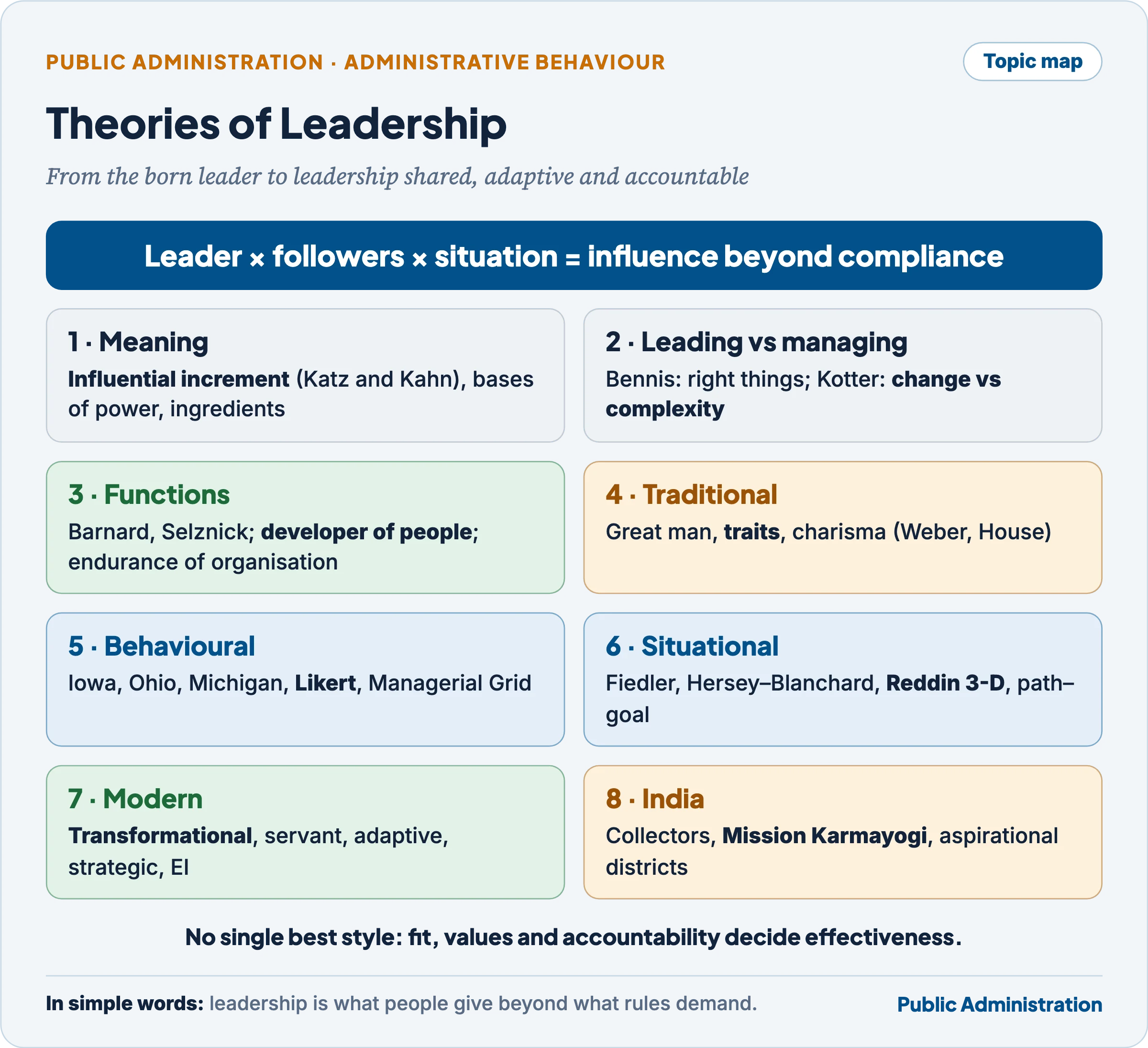
Leadership is the human force that turns an organisation chart into a working organisation. Rules, posts and budgets tell officials what they must do; leadership decides whether they do only that minimum or bring energy, judgement and commitment to the job. That is why two districts with the same staff, schemes and funds can produce very different results.
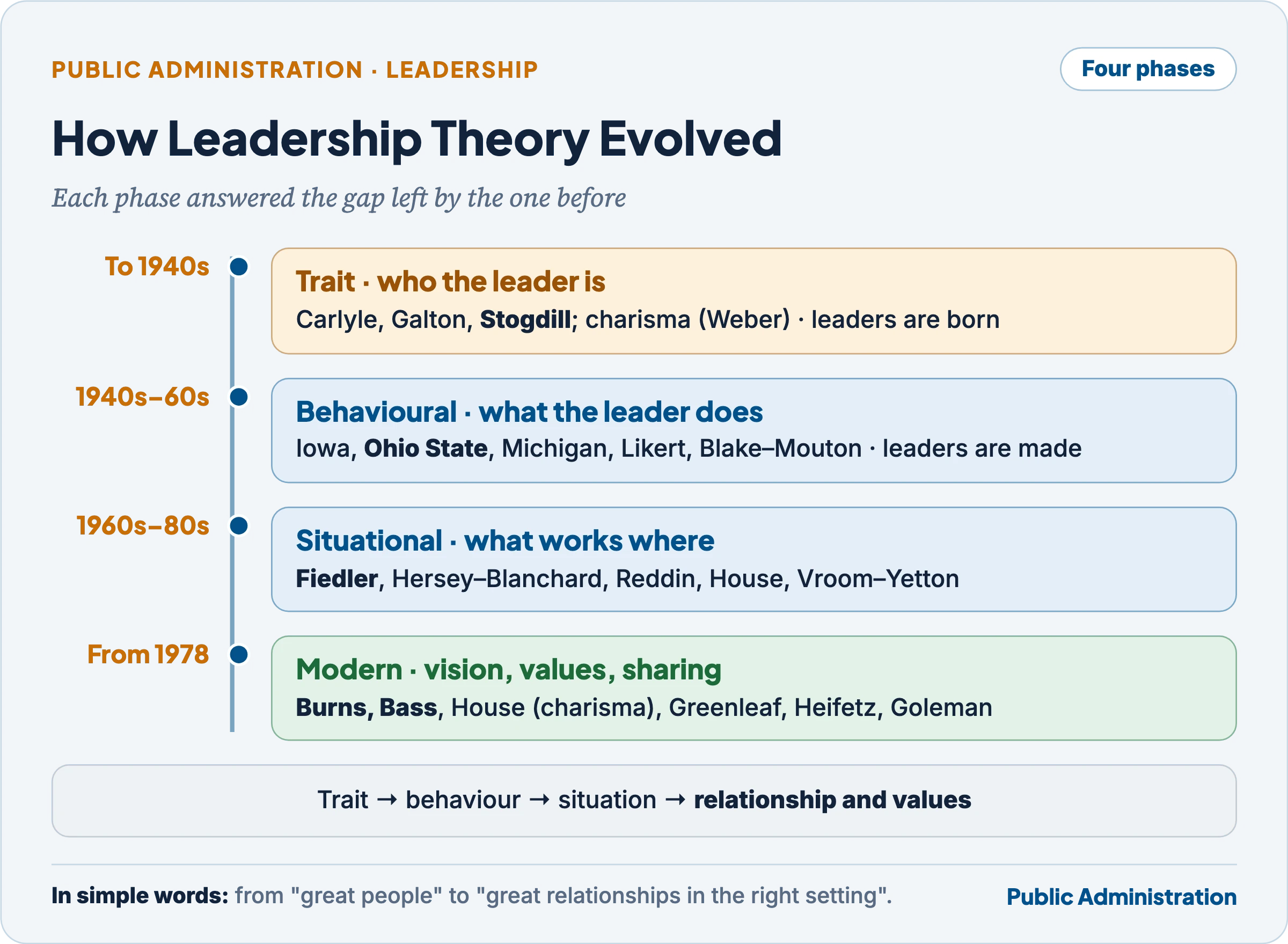
- The study of leadership has passed through four broad phases: the trait phase (who the leader is), the behavioural phase (what the leader does), the situational or contingency phase (what works where) and the modern phase (how leaders transform followers, serve them, share leadership and handle adaptive problems).
- In public administration leadership has a double setting: civil servants lead their own departments, but they work under political leaders, rules and public scrutiny. Every theory has to be read against these constraints.
In simple words
Think of two head teachers in identical government schools. One follows every circular and the school runs. The other also follows the circulars but persuades teachers to stay back for weak students, gets parents involved and makes the staff proud of the school. Both hold the same post with the same powers. What the second one adds, beyond the post, is leadership.
1. Meaning and Nature of Leadership
In simple words
Leadership is influence: getting people to do something willingly. A boss can order people around because of the chair he sits in; a leader gets them to want to do it. The best officials combine both.
1.1 Definitions
There is no single agreed definition. Ralph Stogdill, the Ohio State psychologist who compiled the first great handbook of leadership research, remarked that there are almost as many definitions of leadership as there are people who have tried to define it. Most definitions, however, share three elements: influence, willing followers and a common goal.
| Thinker | Definition (paraphrased unless quoted) | What it stresses |
|---|---|---|
| Ordway Tead, The Art of Leadership (1935) | The activity of influencing people to cooperate towards some goal which they come to find desirable | Goals the followers come to own |
| George R. Terry | “the activity of influencing people to strive willingly for group objectives” | Willingness |
| Koontz and O’Donnell (later Koontz and Weihrich) | Influencing people so that they strive willingly and enthusiastically towards group goals; leaders stand in front of the group, not behind it pushing | Leading by example and facilitation |
| Tannenbaum, Weschler and Massarik | Interpersonal influence exercised in a situation and directed, through communication, towards specified goals | Situation and communication |
| Keith Davis | The ability to persuade others to seek defined objectives enthusiastically; the human factor that binds a group together | Persuasion |
| Katz and Kahn (1966; 2nd edn 1978) | “the influential increment over and above mechanical compliance with the routine directives of the organization” | Influence beyond formal authority |
- Hersey and Blanchard summed up the common core in a formula: leadership is a function of the leader, the follower and the situation, written L = f (l, f, s). Leadership occurs whenever anyone tries to influence another person, so it is not confined to the top of a hierarchy; a section officer, a nurse or a gram sevak can lead.
- Peter Drucker described leadership as lifting a person’s vision to higher sights and building a personality beyond its normal limitations, a definition that already anticipates transformational leadership.
- G.R. Terry also stressed the energising effect: skilful leadership converts lukewarm desires for achievement into a burning passion for accomplishment.
1.2 Katz and Kahn: leadership as the “influential increment”
Daniel Katz and Robert Kahn, American social psychologists, wrote The Social Psychology of Organizations (1966), the work that applied open-systems thinking to organisations. Their definition is the most precise way of separating leadership from mere office-holding.
- Mechanical compliance is what any official gives because the rules, the post and the threat of penalty demand it: attending office, disposing of files, meeting minimum targets.
- The influential increment is the extra effort, initiative and cooperation that people give because of the person leading them, not because of the post. Leadership is that surplus.
- It therefore draws on bases of power beyond those the organisation decrees: personal liking, respect and expertise rather than only the power to reward and punish.
Why organisations need this increment. Katz and Kahn give four reasons, all highly relevant to government:
- Incompleteness of organisational design: no rulebook can foresee every case; leaders fill the gaps with judgement (a Collector improvising relief arrangements not covered by any manual).
- Changing environment: technological, legal and social change keeps altering what the organisation must do; someone must interpret and adapt.
- Internal dynamics of growth: as an organisation grows it creates new units, new coordination problems and new policies; leaders must integrate them.
- Segmental nature of membership: people bring only part of their personality to work; their behaviour is shaped by family, caste, union and party ties outside the organisation’s control, which leaders must take into account.
Three levels of leadership acts. Katz and Kahn also distinguish leadership by its effect on structure:
| Level | What the leader does | Public administration example |
|---|---|---|
| Origination (top, institutional level) | Creates or changes structure and policy | A Secretary redesigning a scheme’s delivery model |
| Interpolation (middle level) | Fills gaps in the existing structure, interprets policy for local conditions | A District Collector adapting state guidelines to local needs |
| Administration (operative level) | Uses existing structure to keep the organisation running well | A Block Development Officer ensuring timely payments |
Assessment of the definition.
- Strengths: it explains why leadership exists at every level, separates leadership from authority, and fits public organisations where formal powers are limited by rules and service law.
- Limits: the “increment” is hard to measure; it can be used for bad ends (a charismatic but corrupt officer also produces an increment); and in highly rule-bound settings the room for the increment may be small, so structure and rules matter as much as persons.
1.3 Leadership, authority and power
Leadership is a form of influence; authority is legitimate power attached to a position; power is the capacity to change others’ behaviour. A leader may have authority without being followed, and an informal leader may be followed without any authority.
John French and Bertram Raven, American social psychologists, identified the bases of social power (1959), later extended by Raven with informational power (1965):
| Base | Source | Example in a district office | Type |
|---|---|---|---|
| Legitimate | Formal position and rules | The Collector’s statutory powers | Positional |
| Reward | Ability to give benefits | Good appraisal, preferred posting | Positional |
| Coercive | Ability to punish | Show-cause notice, suspension | Positional |
| Expert | Knowledge and skill | An engineer whose technical judgement others trust | Personal |
| Referent | Personal liking, admiration, identification | An officer whose integrity staff admire | Personal |
| Informational | Control over information | The officer who alone knows the file history | Mixed |
- The first three come from the organisation; expert and referent power come from the person. The “influential increment” of Katz and Kahn rests mainly on personal power.
- Marshall and Gladys Dimock put the democratic ideal in one line: leadership is influence with people, not power over them.
- Chester Barnard‘s acceptance theory of authority adds that even a lawful order is effective only if the subordinate accepts it; good leaders widen the subordinate’s zone of indifference (the range of orders accepted without question).
- Amitai Etzioni‘s classification of control (coercive, utilitarian, normative) shows the same point at the level of organisations: most government offices run on calculative involvement (work for pay); leadership is needed to turn it into moral involvement (work as public duty).
1.4 Ingredients of leadership
Harold Koontz and his co-authors identified four ingredients that together make up the skill of leadership:
- the ability to use power effectively and responsibly;
- a fundamental understanding of people, whose motivations differ across time and situations (see the article on Motivation Theories);
- the rare ability to inspire followers to apply their full capabilities;
- the ability to create a climate that arouses and responds to motivation.
Indian Connect — Positional power and personal leadership in the district
- A District Collector holds heavy positional power: revenue, magisterial, disaster-management and coordination powers under several Acts, including chairing the District Disaster Management Authority under the Disaster Management Act, 2005.
- Yet Collectors with identical powers produce very different outcomes. The difference lies in expert and referent power: knowing the district, being trusted by line departments and panchayats, and being seen as fair. This is the “influential increment” in Indian form.
- Frequent transfers weaken it, because personal power needs time to build. In T.S.R. Subramanian v. Union of India (2013) the Supreme Court asked governments to provide a minimum assured tenure for civil servants and to set up Civil Services Boards for postings, partly for this reason.
2. Leadership, Management and Administration
In simple words
Managing is about keeping the train running on time; leading is about deciding where the railway should go next and getting everyone to believe in it. A good organisation needs both: a brilliant visionary with no one keeping the timetable is as useless as a perfect timetable for a railway going nowhere.
2.1 Bennis: “doing the right things” and “doing things right”
Warren Bennis, the American scholar who did most to popularise leadership studies, wrote with Burt Nanus in Leaders: The Strategies for Taking Charge (1985) that managers are people who do things right and leaders are people who do the right thing. Many organisations, they argued, are over-managed and under-led: they handle routine well but never ask whether the routine should be done at all. Bennis later listed the contrasts in On Becoming a Leader (1989):
| Manager | Leader |
|---|---|
| Administers | Innovates |
| Is a copy | Is an original |
| Maintains | Develops |
| Focuses on systems and structure | Focuses on people |
| Relies on control | Inspires trust |
| Short-range view | Long-range perspective |
| Asks how and when | Asks what and why |
| Eye on the bottom line | Eye on the horizon |
| Accepts the status quo | Challenges the status quo |
| Classic good soldier | Is own person |
| Does things right (efficiency) | Does the right thing (effectiveness) |
- The distinction is really between efficiency (achieving given goals with least cost) and effectiveness (choosing the right goals). Bennis drew on Abraham Zaleznik‘s article “Managers and Leaders: Are They Different?” (Harvard Business Review, 1977), which argued that the two are different personality types.
Is the distinction valid? It is useful, but only as a distinction between roles, not between types of people.
- Why it holds:
- It reminds administrators that procedural correctness is not enough; a perfectly processed file can serve a useless purpose. Public administration has long suffered from goal displacement, rules becoming ends in themselves (Robert Merton).
- It explains why reform needs leaders: changing the goals, values and culture of an organisation is different work from running it.
- It fits the evidence of the 90 leaders Bennis studied, who saw their role as setting purpose and direction.
- Why it is overstated:
- John Kotter (below) shows the two are complementary systems, not rival virtues; strong leadership with weak management is no better, and sometimes worse, than the reverse.
- Henry Mintzberg argues that separating the two is harmful: managers who do not lead are dispiriting, and leaders who do not manage are disconnected from reality; leadership is better seen as management practised well.
- In public administration, “the right things” are largely decided by the political executive and the law. A civil servant who decides on his own what is “right” may violate democratic accountability. The civil servant’s leadership is therefore exercised within a mandate.
- The slogan implies managers are morally inferior. Yet doing things right (due process, fairness, probity, financial regularity) is itself a public value; in government, how a thing is done is often part of what is right.
- Most real posts need both: a District Collector must manage elections by the rulebook and lead a campaign against malnutrition.
2.2 Kotter: change versus complexity
John Kotter, of Harvard Business School, in “What Leaders Really Do” (Harvard Business Review, 1990) argued that leadership and management are two distinct and complementary systems of action:
- Management copes with complexity. Its practices arose with large, complex twentieth-century organisations; without good management they become chaotic.
- Leadership copes with change. As environments become more competitive and volatile, more change demands more leadership.
| Task | Management (complexity) | Leadership (change) |
|---|---|---|
| Deciding what to do | Planning and budgeting: targets, steps, resources | Setting a direction: a vision and strategies |
| Creating a network of people | Organising and staffing: structure, jobs, delegation | Aligning people: communicating the direction so people believe in it |
| Getting it done | Controlling and problem-solving: monitoring against plan | Motivating and inspiring: appealing to values and emotions |
The contextuality of leadership and administration. Which of the two an organisation needs most depends on its situation:
- Stable, routine, high-volume work (issuing certificates, paying pensions, conducting examinations) depends chiefly on administration: predictable rules, standard procedures, control.
- Turbulent, novel or failing settings (a new mission, a disaster, a corrupt or demoralised department, digital transformation) depend chiefly on leadership.
- Most public organisations need a balance that shifts over time: a new scheme needs leadership to launch and management to sustain. Successful organisations are both well-led and well-managed; Kotter’s warning is that most are over-managed and under-led.
- Indian examples: the Election Commission under T.N. Seshan (Chief Election Commissioner, 1990–96) needed leadership to enforce the Model Code of Conduct seriously; the routine of conducting elections since then rests on management. The Delhi Metro under E. Sreedharan combined a strong vision (a punctual, honest, world-class metro) with tight management of deadlines and costs.
2.3 Schein and Selznick: leadership creates culture
- Edgar Schein, the MIT organisational psychologist, in Organizational Culture and Leadership (1985), held that management works within an existing culture, while the unique function of leadership is the creation, management and, when necessary, destruction of culture.
- Philip Selznick, in Leadership in Administration (1957), distinguished routine administration from institutional leadership: leaders infuse an organisation “with value”, turning it from a technical tool into an institution with a distinctive identity.
Common confusion
Is a head of office automatically a leader? No. Headship is a position conferred by the organisation; its power comes from rules and the group does not choose the head. Leadership is conferred by the followers’ acceptance. A Secretary is always a head; he becomes a leader only when staff follow him willingly. Conversely, an informal leader (a respected senior clerk, a union office-bearer) may lead without any headship.
3. Functions and Importance of Administrative Leadership
In simple words
A leader in an office is like a conductor of an orchestra. He does not play every instrument, but he decides the piece, keeps everyone in time, settles quarrels between sections, speaks for the orchestra outside, and trains young players so the orchestra will still be good after he leaves.
3.1 Why leadership matters in public administration
- Size and complexity: as government grows, division of labour separates officials from the organisation’s central purpose; each department sees problems through its own function. Only leadership can keep the whole group oriented to the common goal.
- Spirit and morale: leadership largely determines the morale and motivation of staff (see the article on Communication and Morale). An efficient organisation is not born; it is created, and its structure and working reflect the quality of its leadership.
- Explaining differences: leadership is often the best explanation for why departments with the same rules and resources perform differently.
- Born leaders are not enough: modern government needs effective leaders on many fronts and at many levels; there are not enough “born leaders” to go round, so they must be developed.
3.2 Classical statements of the functions
| Thinker | Functions of the leader or executive |
|---|---|
| Mary Parker Follett | Coordination (harmonious ordering of parts), definition of purpose, anticipation; the leader also makes followers understand the “law of the situation” |
| Chester Barnard, The Functions of the Executive (1938) | Maintaining communication; securing essential services from individuals; formulating purpose and objectives |
| Philip Selznick (1957) | Defining the institutional mission and role; the institutional embodiment of purpose; defence of institutional integrity; ordering of internal conflict |
| Krech and Crutchfield | The leader as executive, planner, policy-maker, expert, external representative, controller of internal relations, purveyor of rewards and punishments, arbitrator, exemplar, symbol of the group, ideologist, father figure and scapegoat |
| Hicks and Gullett (1975) | Arbitrating, suggesting, supplying objectives, catalysing, providing security, representing, inspiring, praising |
| A.K. Rice | Boundary control: leadership is most visible at points of discontinuity between parts of a system |
- Krech and Crutchfield’s list can be grouped into three sets: functions in achieving goals (policy-making, planning, execution), in running the organisation (expert, representative, controller of internal relations, motivator) and as a group figure (exemplar, symbol, father figure, scapegoat). The “scapegoat” role is a reminder that leaders also absorb blame for failures (section 8.10).
- Expressive and instrumental leadership. Sociologists distinguish expressive leaders, who set goals, build commitment and represent the organisation, from instrumental leaders, who secure and distribute resources, coordinate and motivate through rewards. Successful public leaders usually combine both.
- Behavioural research identifies four dimensions of leadership effectiveness: promoting satisfying relationships, making members feel important, encouraging work towards goals, and providing the resources and technical means for work. Effective leadership cares for both people and productivity.
Practical functions of an executive leader. Planning and defining policies and procedures; organising activities; delegating authority; supervising and controlling; issuing orders and guidelines; interpreting and transmitting policy; training key subordinates; coordinating; and stimulating all who contribute effort. In large organisations the top post is primarily coordinative: the leader must use experts wisely, keeping the expert “on tap, not on top”.
Communication is central to all these functions. Goal-setting needs upward information; goal-getting needs clear orders and feedback. Leaders who rely on persuasion rather than command depend most heavily on communication (see the article on Communication and Morale).
3.3 “The endurance of organisation depends upon the quality of leadership” (Barnard)
Chester Barnard, the American telephone executive and theorist, closes The Functions of the Executive (1938) with the argument that organisations survive only if they keep securing cooperation, and cooperation is created by leadership. His words: “the endurance of organization depends upon the quality of leadership; and that quality derives from the breadth of the morality upon which it rests.”
- Why endurance depends on leadership: an organisation is a system of cooperation; members contribute only when inducements equal or exceed their sacrifices. Leadership is what keeps purposes believable and contributions flowing; Barnard called leadership the indispensable “fulminator” (detonator) of cooperative forces.
- Moral creativity: the highest executive function is creating morality for others: building codes, loyalties and a sense of purpose that bind members beyond self-interest. Leaders must also resolve conflicts of codes without destroying their own integrity.
- Breadth of morality: organisations with narrow purposes (personal gain of the leader) collapse when the leader goes; those rooted in broad public purposes outlast individuals.
- Barnard’s qualities of the leader: vitality and endurance, decisiveness, persuasiveness, responsibility and intellectual capacity, in that order of importance. John Millett lists health, a sense of mission, interest in people, intelligence, integrity, persuasiveness, judgement and loyalty.
- Qualifications: endurance also depends on structure, resources, legitimacy and environment. Weber’s bureaucracy was designed precisely so that organisations would not depend on extraordinary persons; institutions such as the Comptroller and Auditor General or Union Public Service Commission endure through constitutional design and routine as much as through leaders. Barnard’s claim is strongest for new, turbulent or voluntary organisations.
3.4 The leader as a developer of people
A maxim that UPSC attributes to Napoleon calls the leader “a people’s developer”. Modern theory supports it: a leader’s lasting contribution is measured less by followers gathered than by capable people and future leaders developed.
Aspects of subordinates’ development a leader can influence:
- Competence and skill: on-the-job guidance, rotation across tasks, feedback; the leader as teacher who starts from the learner’s present level, involves the whole person and allows time.
- Confidence and judgement: delegation with real discretion lets subordinates learn by deciding; the leader accepts responsibility for how that discretion is used.
- Motivation and commitment: linking work to purpose, recognising good work, setting stretching but attainable goals (path–goal and transformational theory).
- Values and integrity: subordinates copy what leaders do; an honest leader builds an honest office (role modelling, “idealised influence”).
- Autonomy and maturity: Hersey and Blanchard treat leadership as moving followers from low to high “readiness”, ending in delegation (section 6.2); Chris Argyris saw the leader’s task as helping people grow from immaturity to maturity.
- Career growth and succession: identifying talent, mentoring and preparing successors; Greenleaf‘s test of servant leadership is whether followers grow as persons (section 8.1).
- Creativity and voice: intellectual stimulation, inviting subordinates to question old ways; psychological safety, so that they report problems early.
Limits: in Indian government, short tenures, rigid hierarchy, seniority-based promotion and fear of audit and vigilance often discourage leaders from delegating and subordinates from taking initiative. Mission Karmayogi‘s shift from rule-based to role-based, competency-based capacity building is an attempt to make development of people systematic rather than dependent on individual leaders.
3.5 Hazards of leadership
- Ego inflation: vanity, aloofness, demand for flattery, a court of yes-men.
- Emotional instability: irritability and temper, which spread fear.
- Self-doubt or an inferiority complex that paralyses decision.
- Self-righteousness: defending every past act, which followers read as hypocrisy.
- Sarcasm and cruelty towards subordinates.
- The ethical rule is to treat people as ends in themselves, not tools, and to prefer persuasion to coercion.
Indian Connect — Leadership and development in Indian administration
- Mission Karmayogi (National Programme for Civil Services Capacity Building), approved by the Union Cabinet on 2 September 2020, rests on the iGOT Karmayogi digital platform, the Capacity Building Commission (2021) and Karmayogi Bharat (2022). Its principle is the shift from rule-based to role-based human resource management.
- The Capacity Building Commission with SCOPE launched DAKSH in 2025, a twelve-month common leadership development programme to prepare senior executives of central public sector enterprises for board-level roles.
- The Rashtriya Karmayogi Jan Seva Programme (2025) trained Secretaries and Additional Secretaries first, so that they could lead the behavioural programme on seva bhava in their own ministries: a deliberate use of cascading leadership.
- The 2nd Administrative Reforms Commission, in its tenth report, Refurbishing of Personnel Administration (2008), proposed reforms including the creation of a leadership cadre incorporating elements of a position-based Senior Executive Service, along with performance management and accountability for results.
4. Traditional Theories: Great Man, Trait and Charisma
In simple words
The oldest answer to “what makes a leader?” was simple: some people are born with it. Look at Gandhi, Napoleon or Churchill and list what they had. The trouble is that every list turned out different, and many people with those qualities never led anyone.
4.1 The great man theory
- Thomas Carlyle, the Scottish historian, in On Heroes, Hero-Worship and the Heroic in History (1841), held that history is the biography of great men. Francis Galton‘s Hereditary Genius (1869) added that greatness runs in families.
- Assumptions: leadership capacity is inborn; leaders are born, not made; great leaders arise when needed. The term “great man” reflects the old view of leadership as a male and military quality.
- Implication: organisations should select leaders, not train them.
- Critique:
- Herbert Spencer replied that the great man is himself a product of his society; conditions make the man before he can remake them.
- It cannot explain why born leaders fail in some posts, or why ordinary people rise in crises.
- It is elitist and gendered, and it closes the door to leadership development.
4.2 Trait theory
The trait approach dominated research from about 1900 to the late 1940s. It kept the great man idea that leaders differ from non-leaders but tried to identify the specific traits that make the difference, so that they could be measured.
Traits studied. Physical (energy, height, appearance), intellectual (intelligence, judgement, knowledge), personality (self-confidence, dominance, integrity, adaptability) and social (cooperativeness, tact, administrative ability). Ordway Tead, Chester Barnard, John Millett and George Terry in public administration all listed qualities of good executives.
Stogdill’s synthesis. Ralph Stogdill’s Handbook of Leadership (1974) identified traits and skills that appear repeatedly among successful leaders:
| Traits | Skills |
|---|---|
| Adaptable to situations; alert to the social environment | Clever (intelligent) |
| Ambitious and achievement-oriented; assertive | Conceptually skilled; creative |
| Cooperative; decisive; dependable | Diplomatic and tactful; fluent in speaking |
| Dominant (desire to influence others); energetic | Knowledgeable about group tasks; organised |
| Persistent; self-confident; tolerant of stress | Persuasive |
| Willing to assume responsibility | Socially skilled |
Later trait research.
- Bennis, after studying 90 outstanding leaders, found four shared competencies: management of attention (a compelling vision), management of meaning (communicating it), management of trust (reliability and consistency) and management of self (knowing one’s strengths and limits). He later added business literacy, people skills, conceptual skills, track record, taste in choosing people, judgement and, above all, character.
- Morgan McCall and Michael Lombardo (1983) compared executives who reached the top with those who were “derailed” just before it. The derailed shared “fatal flaws”: insensitivity, arrogance, betrayal of trust, over-ambition, inability to delegate or think strategically. Insensitivity was the most frequent cause; untrustworthiness the most serious. Successful leaders showed emotional stability, admitting error, good interpersonal skills and intellectual breadth.
- Shelley Kirkpatrick and Edwin Locke (“Leadership: Do Traits Matter?”, 1991) concluded that traits do matter: drive, leadership motivation, honesty and integrity, self-confidence, cognitive ability and knowledge of the business. Traits are a precondition; leaders must still act on them.
- John Geier found that group members were kept out of leadership for being seen as uninformed, non-participating or extremely rigid: negative traits matter too.
Critique of trait theory.
- Ralph Stogdill‘s review of 124 studies (1948) concluded that a person does not become a leader merely by possessing a set of traits; the traits must be relevant to the situation and the followers.
- Eugene Jennings (1961) wrote that fifty years of study had failed to produce one personality trait or set of qualities that discriminates leaders from non-leaders.
- No agreed list: no two lists agree, and none says how much of a trait is needed or which traits matter most.
- Non-leaders share the traits: many intelligent, confident people never lead.
- Ignores followers and situation: the same person leads in one setting and fails in another.
- Cause or effect? Confidence may result from holding leadership rather than produce it.
- Little use for training: if traits are inborn, leadership development is pointless.
Present standing. Trait thinking has returned in refined form. Stogdill himself (1974) noted that traits increase the likelihood of effectiveness without guaranteeing it, and that their importance depends on the situation. Research on the “Big Five” personality traits, emotional intelligence and integrity in recruitment and appraisal are modern descendants.
4.3 Charismatic leadership
Max Weber, the German sociologist, in Economy and Society (published 1922), described charismatic authority as one of three pure types of legitimate authority, alongside traditional and legal-rational authority (see the article on Weber and Bureaucracy).
- Charisma (“gift of grace”) is a quality of personality by virtue of which a person is treated as extraordinary, endowed with exceptional powers. Followers obey out of devotion, not rules or custom.
- Charisma is unstable. It depends on continued proof (success, miracles) and on the leader’s life. It is revolutionary and anti-economic: pure charisma rejects routine economic activity; followers live on gifts and booty, not regular salaries.
- Routinisation of charisma: to survive the leader, the movement must turn into a permanent structure, either traditional or legal-rational. That requires a regular economic base, rules of succession and an administrative staff with fixed incomes. This is why Weber said charisma must shed its anti-economic character to become a permanent routine: a movement becomes an institution once its disciples become paid officials.
House’s theory of charismatic leadership (1976). Robert House, the American organisational psychologist, revived charisma as a subject of empirical research in “A 1976 Theory of Charismatic Leadership”.
- Personal characteristics: dominance, strong self-confidence, a strong need for influence and strong conviction in the moral rightness of one’s beliefs.
- Behaviours: acting as a role model, image-building (appearing competent), articulating ideological goals, communicating high expectations together with confidence in followers, and arousing motives relevant to the mission.
- Effects on followers: trust in the leader’s beliefs, unquestioning acceptance, affection, willing obedience, identification with the leader, emotional involvement in the mission, raised goals and confidence; performance beyond expectations.
- Situations that favour charisma: crisis, stress and followers deeply dissatisfied with the status quo.
Later developments.
- Jay Conger and Rabindra Kanungo (1987) treated charisma as an attribution: followers attribute charisma to a leader who offers a vision discrepant from the status quo, takes personal risks, uses unconventional means and reads the environment well.
- Bernard Bass treated charisma as one component of transformational leadership and later renamed it “idealised influence“.
- The dark side: Jane Howell and Bruce Avolio (1992) contrasted ethical charismatic leaders (who use power to serve others, align vision with followers’ needs, accept criticism and develop followers) with unethical ones (who use power for personal gain, demand unquestioning acceptance, use one-way communication and keep followers dependent).
Is the charismatic approach of the mid-1970s a “new version” of trait theory?
| It is a new version | It is not merely a new version |
|---|---|
| House begins with personal characteristics (dominance, self-confidence, need for influence, conviction): the vocabulary of trait theory | House adds behaviours (role modelling, articulating goals, expressing confidence) that can be observed and learned |
| Charisma is located in the person, as with the great man | Effects depend on followers’ needs and on situations of crisis: a contingency element absent in trait theory |
| It revives the “heroic” image of leadership that behavioural theory had abandoned | Conger and Kanungo make charisma an attribution by followers, a relational idea |
| Measurement relies on personality profiles | It produced testable propositions on follower outcomes (trust, performance beyond expectations) |
The balanced view is that the charismatic approach re-introduced traits after the situational turn but combined them with behaviour, followers and context; it is better described as a neo-charismatic synthesis than a simple return to the classical trait theory.
Common confusion
Is Weber’s charismatic authority the same as modern “charismatic leadership”? Not quite. Weber’s charisma is a type of legitimate domination in whole societies, opposed to routine and law, and it decays into tradition or bureaucracy. Modern charismatic leadership (House, Conger and Kanungo) is a style of influence inside organisations, often in leaders who hold formal office within a bureaucracy. A charismatic Secretary does not create a new kind of authority; he adds personal influence to legal-rational authority.
5. Behavioural Theories: What Leaders Do
In simple words
Instead of asking what kind of person a leader is, the behaviourists watched what leaders actually do: do they give orders or consult? Do they focus on the work or on the people? If leadership is a set of behaviours, it can be learned, which means leaders can be made.
The behavioural or attitudinal approach dominated from the late 1940s to the mid-1960s. Its key shift was from who the leader is to how the leader behaves, and its key assumption was that leaders are made, not born. Most studies arrived at the same two dimensions in different words: concern for the task and concern for people.
5.1 Lewin, Lippitt and White: the Iowa studies (1939)
Kurt Lewin, the German-American founder of social psychology, with Ronald Lippitt and Ralph White, studied boys’ hobby clubs at the University of Iowa under three adult leadership styles.
| Style | Behaviour | Findings |
|---|---|---|
| Autocratic (authoritarian) | Leader decides policy and methods alone; personal praise and criticism; remains aloof | High output while the leader is present; more hostility, aggression and dependence; work collapsed when the leader left |
| Democratic (participative) | Policies decided by group discussion; leader suggests alternatives; objective praise and criticism | Somewhat lower but steady output; highest satisfaction, originality and cohesion; work continued in the leader’s absence |
| Laissez-faire (free rein) | Leader gives freedom and provides information only when asked | Least and poorest work; frustration and disorganisation |
- Merits of autocratic style: quick decisions, useful in crisis, discipline. Demerits: kills initiative, treats people as cogs, breeds resentment.
- Merits of democratic style: commitment, creativity, morale. Demerits: slow, unsuitable in emergencies or when followers lack knowledge.
- Laissez-faire suits only highly motivated professionals (a research group); otherwise it is an abdication of leadership.
- Critique: the experiments were with children, the sample was tiny, and the categories are too broad; but they were the first experimental evidence that style affects group climate.
5.2 Ohio State studies (from 1945)
The Bureau of Business Research at Ohio State University, with researchers such as Ralph Stogdill, John Hemphill and Edwin Fleishman, developed the Leader Behaviour Description Questionnaire (LBDQ), filled in by subordinates, and narrowed leader behaviour to two independent dimensions:
- Initiating structure: the extent to which a leader defines and organises roles, assigns tasks, sets standards and deadlines (task orientation).
- Consideration: the extent to which a leader shows mutual trust, respect for subordinates’ ideas and concern for their feelings (people orientation).
The key finding was that the two are separate axes, not ends of one line: a leader can be high on both, low on both or high on one. This produced the four Ohio quadrants. Leaders high on both were often (not always) associated with high performance and satisfaction; later studies found exceptions depending on task and subordinates, which pushed research towards situational theories.
5.3 Michigan studies
At the University of Michigan‘s Survey Research Center, researchers led by Rensis Likert (with Daniel Katz and Robert Kahn) compared high- and low-producing work groups.
- Employee-centred (employee-oriented) supervisors emphasised relationships, took personal interest in each employee and built effective work groups.
- Job-centred (production-oriented) supervisors emphasised technical aspects and production, treating employees as tools.
- Findings: employee-centred supervision and general rather than close supervision were associated with higher productivity and satisfaction.
- Difference from Ohio State: Michigan first treated the two orientations as opposite ends of one continuum; Ohio State treated them as independent dimensions.
5.4 Likert’s four systems of management
Rensis Likert, the American organisational psychologist, developed these findings in New Patterns of Management (1961) and The Human Organization (1967) into a continuum of four management systems, assessed on leadership, motivation, communication, interaction, decision-making, goal-setting and control.
| System | Name | Leadership and motivation | Communication and decisions |
|---|---|---|---|
| System 1 | Exploitative-authoritative | No confidence in subordinates; fear, threats, occasional rewards | Downward only; all decisions at the top |
| System 2 | Benevolent-authoritative | Condescending, master–servant trust; rewards and some punishment | Mostly downward; upward information filtered to please the boss |
| System 3 | Consultative | Substantial but not complete trust; rewards and some involvement | Two-way; subordinates consulted, major decisions still at the top |
| System 4 | Participative group | Complete trust; economic rewards plus involvement in goal-setting | Down, up and sideways; group decision-making throughout |
- System 4 rests on three ideas: the principle of supportive relationships (every member should experience interactions as building his sense of worth), group decision-making through the linking pin structure (each manager is a member of a higher group and leader of a lower one), and high performance goals.
- Likert’s claim: the most productive organisations were closest to System 4, and organisations should move from System 1 towards System 4. Likert also warned that the change takes time (often two years or more) and that traits of one system cannot simply be grafted on to another.
- Likert’s own view of leadership was situational: effective supervision is adaptive and relative to the expectations and skills of the people led.
- “Every organisation starts at System 1 and ends at System 4”? This is an overstatement. Likert presented a direction of improvement, not an inevitable life cycle; many organisations stay in System 2 or 3, and some (armed forces, emergency services, prisons) need elements of authoritative control. Bureaucracies built on hierarchy and audit find System 4 hard.
- Critique: derived largely from American industrial settings; correlations do not prove that participation causes performance; it is one best way thinking, ignoring situation; and group decision-making can be slow and diffuse accountability.
- For developing democracies: participative management fits the democratic ideal and has strong Indian echoes (Panchayati Raj, social audit, quality circles, self-help groups). But hierarchical culture, low trust, capacity gaps and political pressure mean that participation must be built step by step, often through consultative (System 3) practices first.
5.5 Blake and Mouton’s Managerial Grid (1964)
Robert Blake and Jane Mouton, American management consultants, in The Managerial Grid (1964) turned the two dimensions into a 9 × 9 grid: concern for production on the horizontal axis and concern for people on the vertical axis. “Concern for” is an attitude (a predisposition), so the grid measures a manager’s values, not only behaviour. It was later renamed the Leadership Grid (with Anne Adams McCanse).
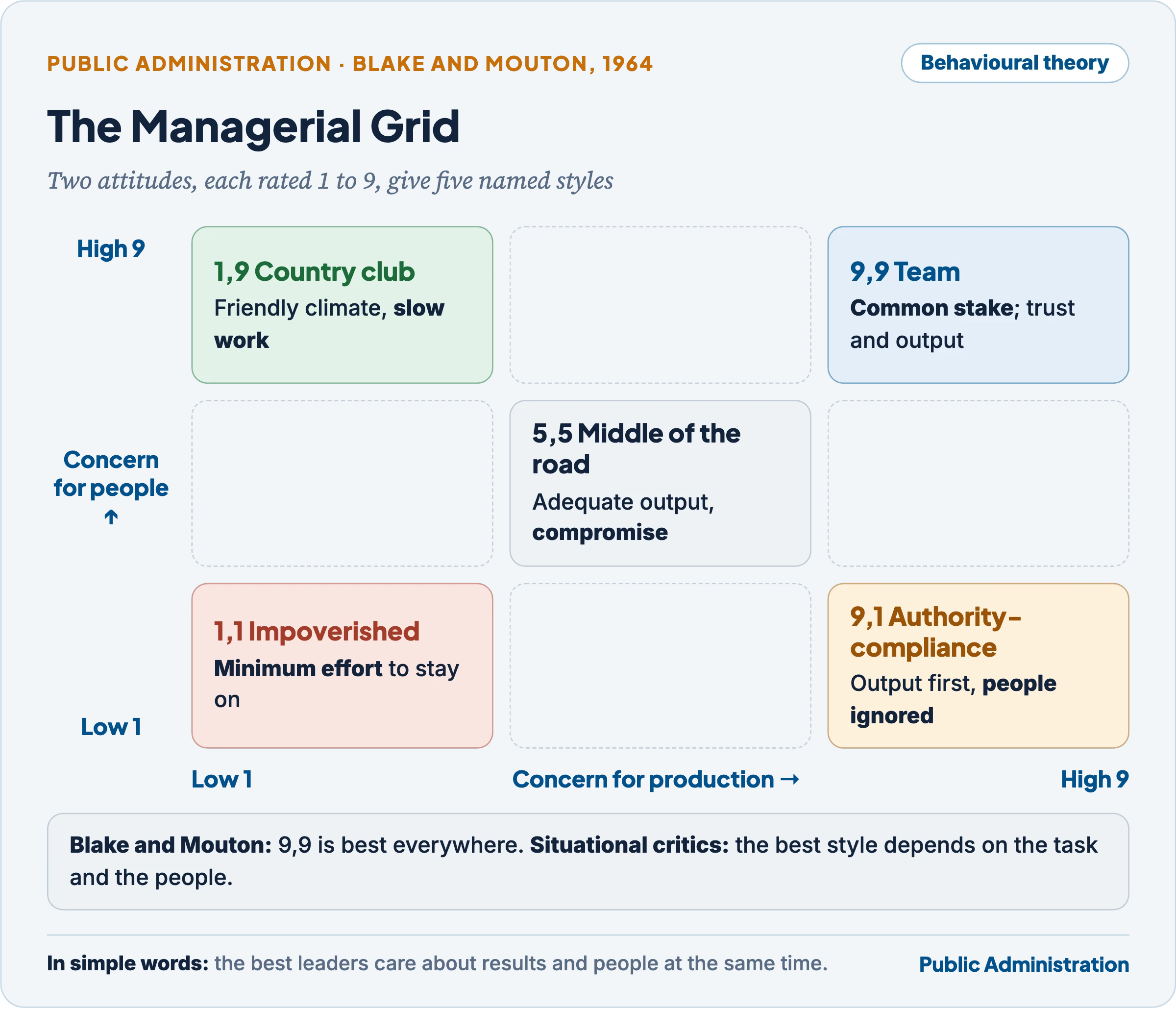
| Position | Style | Description | Typical public-sector picture |
|---|---|---|---|
| 1,1 | Impoverished | Minimum effort to get required work done and keep one’s job | The officer who “keeps his head down” and passes every file upward |
| 9,1 | Authority-compliance (task) | Efficiency by arranging work so that human elements interfere minimally | The target-driven officer who meets numbers but leaves a demoralised staff |
| 1,9 | Country club | Thoughtful attention to people’s needs; friendly atmosphere; slow work tempo | The popular officer under whom pendency keeps rising |
| 5,5 | Middle-of-the-road (“organisation man”) | Adequate performance by balancing work and morale; compromise | The safe, average administrator who avoids both conflict and excellence |
| 9,9 | Team management | Work accomplished by committed people; interdependence through a “common stake” in purpose leads to trust and respect | The leader who sets high targets and involves staff in meeting them |
- Blake and McCanse later added paternalism/maternalism (9+9: rewards loyalty, punishes dissent) and opportunism (shifting styles for personal gain).
- Which style is best? Blake and Mouton held that 9,9 team management is the one best style in all situations, because it integrates the needs of organisation and people: commitment produces production. Their training programmes were designed to move managers towards 9,9.
- Why many disagree:
- Situational theorists (Fiedler, Hersey and Blanchard, Reddin) argue there is no single best style: in a flood or riot, a 9,1 style may save lives; with expert professionals, a lower-task style may work better.
- William Reddin specifically criticised Blake for generalising from American top management to all organisations.
- Empirical support for the universal superiority of “high–high” leadership is mixed.
- Balanced answer: 9,9 is the best aspiration and default for most public organisations because it joins results with commitment; but effective leaders adjust the mix to the situation, and the grid itself does not tell them when.
5.6 Tannenbaum and Schmidt’s continuum (1958)
Robert Tannenbaum and Warren Schmidt, in “How to Choose a Leadership Pattern” (Harvard Business Review, 1958), presented leadership as a continuum from boss-centred to subordinate-centred behaviour. As one moves along it, the use of authority by the manager shrinks and the area of freedom for subordinates grows.
The seven points on the continuum:
- The manager makes the decision and announces it.
- The manager “sells” the decision.
- The manager presents ideas and invites questions.
- The manager presents a tentative decision subject to change.
- The manager presents the problem, gets suggestions, then decides.
- The manager defines the limits and asks the group to decide.
- The manager permits subordinates to function within limits defined by the superior.
Which point to choose? It depends on three sets of forces:
- Forces in the manager: values, confidence in subordinates, leadership inclinations, tolerance of uncertainty.
- Forces in the subordinates: need for independence, readiness for responsibility, tolerance of ambiguity, interest in the problem, understanding of goals, knowledge and experience, expectation of sharing decisions.
- Forces in the situation: type of organisation, group effectiveness, the nature of the problem and pressure of time.
- In their 1973 retrospective commentary, the authors renamed the ends manager power and influence and non-manager power and influence, and noted that the environment (unions, social expectations, outside stakeholders) increasingly shapes the choice.
- Significance: it was one of the first situational models; it treats laissez-faire as an absence of leadership rather than a style; and it links leadership directly to decision-making (see the article on Decision-Making).
Assessment of the behavioural school. It made leadership trainable and gave lasting concepts (task and people dimensions). But it looked for one best style, paid little attention to situation, and relied on questionnaires that measure perceptions rather than effects.
6. Situational and Contingency Theories
In simple words
A good doctor does not give every patient the same medicine. A good leader likewise reads the situation first: an inexperienced new clerk needs close instructions, a senior expert needs freedom, and a flood needs firm orders. “It depends” is the core of these theories, and their contribution is to say what it depends on.
From the early 1960s research accepted that no style is best everywhere. Two variants developed: situational theories, which tell leaders which behaviour to adopt in a given situation (often according to followers), and contingency theories, which take a wider view including the leader’s fixed style and other variables.
6.1 Fiedler’s contingency model (1967)
Fred Fiedler, the Austrian-American industrial psychologist, in A Theory of Leadership Effectiveness (1967), built the first full contingency theory.
Leadership style is fixed. It is measured by the Least Preferred Co-worker (LPC) scale: the leader thinks of the person he has worked with least well and rates that person on 16–18 bipolar adjectives (pleasant–unpleasant, friendly–unfriendly, cooperative–uncooperative) from 1 to 8.
- A high LPC total (describing even the least-liked co-worker kindly) indicates a relationship-oriented leader.
- A low LPC total indicates a task-oriented leader who derives satisfaction from getting the job done.
Situational favourableness (situational control) depends on three variables, in order of importance:
- Leader–member relations: trust, loyalty and respect followers have for the leader (good or poor).
- Task structure: how clearly goals and procedures are defined (structured or unstructured).
- Position power: the leader’s formal power to reward, punish, hire and fire (strong or weak).
Combining them gives eight situations (octants), from very favourable (good relations, structured task, strong power) to very unfavourable.
Findings:
- Task-oriented (low LPC) leaders perform best in very favourable and very unfavourable situations.
- Relationship-oriented (high LPC) leaders perform best in moderately favourable situations.
- Example: in a sudden flood (poor relations, unstructured task, weak power) the person who takes firm charge succeeds; a research team (good relations, unstructured task, weak power) does better under a considerate leader.
Leader match. Because style is fixed, effectiveness is improved by changing the situation to fit the leader (“job engineering“: altering task structure or position power) or by placing leaders in situations that suit them. Fiedler, with Martin Chemers and Linda Mahar, offered a self-paced training programme, Improving Leadership Effectiveness: The Leader Match Concept (1976). His later Cognitive Resource Theory (with Joseph Garcia, 1987) held that stress decides whether a leader’s intelligence or experience helps: under high stress, experience matters more than intelligence.
Critique:
- The LPC scale is puzzling: what it measures (a value, a motive, a cognitive style) is unclear, and scores can be unstable.
- The assumption that style is fixed contradicts other theories that leaders can flex; the only remedy for a mismatch seems to be changing the leader.
- Mixed empirical support: much of the confirming research came from Fiedler and his associates; critics (Ashour, Schriesheim and Kerr, Vecchio) disputed methods and results, though meta-analyses gave partial support.
- The “intermediate” situations are poorly explained.
- Value: it was the first theory to make the fit between leader and situation the heart of leadership, opening the contingency era.
6.2 Hersey and Blanchard’s situational leadership (1969)
Paul Hersey and Kenneth Blanchard first presented their “life cycle theory of leadership” in 1969, later renamed Situational Leadership. It is also known as the tri-dimensional leader effectiveness model, because it adds effectiveness (following Reddin) to the Ohio State dimensions, renamed task behaviour and relationship behaviour.
The key variable is the follower’s “readiness” (originally “maturity”): ability (knowledge, skill, experience) and willingness (confidence, commitment, motivation) to perform a particular task.
| Follower readiness | Description | Matching style | Task / relationship behaviour |
|---|---|---|---|
| R1 | Unable and unwilling, or insecure | S1 Telling (directing) | High task, low relationship |
| R2 | Unable but willing or confident | S2 Selling (explaining) | High task, high relationship |
| R3 | Able but unwilling or insecure | S3 Participating (supporting) | Low task, high relationship |
| R4 | Able and willing | S4 Delegating | Low task, low relationship |
- S1 and S2 are leader-directed; S3 and S4 are follower-directed.
- All four styles are effective in the right situation; the leader needs diagnostic ability to read readiness, style range (flexibility) and style adaptability (using the right one).
- Leadership as development: as followers mature, the leader should move from S1 to S4, deliberately raising readiness. A newly recruited panchayat secretary needs S1; an experienced Block Development Officer deserves S4.
- A leader must adapt to the persons led. This old statement is the core of the model: the same leader should treat different followers (and the same follower at different tasks) differently.
- Critique: weak empirical validation (later tests found support mainly for directive leadership with low-readiness followers); ambiguity about how readiness is defined and measured; it ignores group and organisational factors; and constant style-switching may appear inconsistent to followers.
6.3 Reddin’s 3-D theory of managerial effectiveness
William J. Reddin, the Canadian management theorist, first set out his 3-D management style theory in 1967 and developed it in Managerial Effectiveness (1970). It is the theory that explicitly added a third dimension, effectiveness, to the two basic dimensions identified by the Ohio State studies and the Managerial Grid.
Starting point. Reddin accepted the two dimensions, task orientation (TO) and relationships orientation (RO), and their four combinations (basic or latent styles):
- Separated (low TO, low RO);
- Related (low TO, high RO);
- Dedicated (high TO, low RO);
- Integrated (high TO, high RO).
The third dimension: effectiveness. Any basic style can be more effective or less effective, depending on whether it fits the demands of the situation. Each basic style therefore has an effective and an ineffective version, giving eight managerial styles.
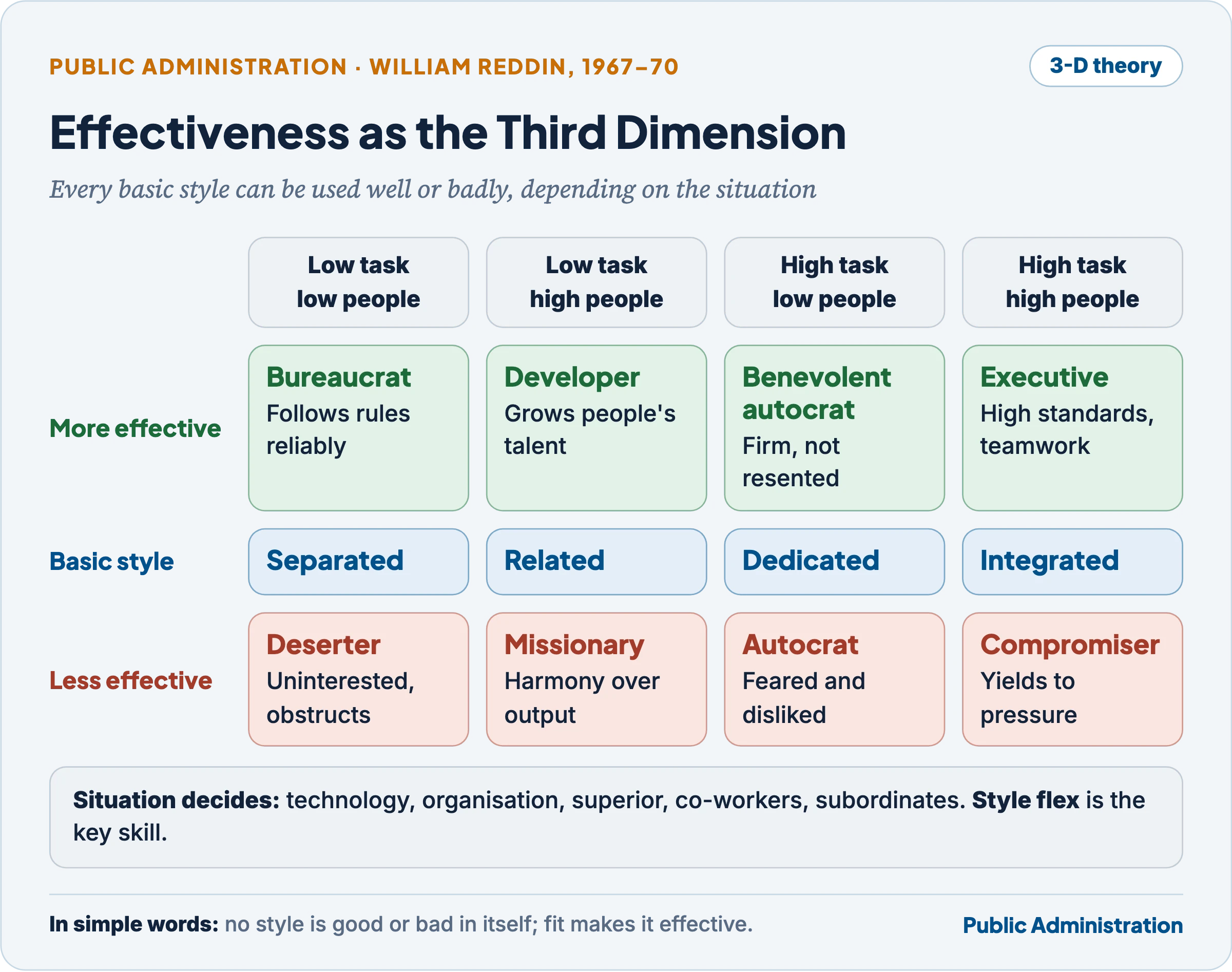
| Basic style | Less effective version | More effective version |
|---|---|---|
| Separated | Deserter: uninterested in task and people; lowers morale and may obstruct others | Bureaucrat: follows rules and procedures conscientiously; reliable where rules fit the work |
| Related | Missionary: values harmony above all; avoids conflict even at the cost of output | Developer: trusts people and develops their talents; commitment follows |
| Dedicated | Autocrat: puts the immediate task above all; feared and disliked; people work only under pressure | Benevolent autocrat: knows what he wants and gets it without causing resentment |
| Integrated | Compromiser: sees the need for both but cannot decide; yields to the latest pressure | Executive: sets high standards, treats people individually, uses teamwork |
How the third dimension changes the theory:
- Effectiveness is defined as the extent to which a manager achieves the output requirements of the position, not as his style or personality.
- The situation has five elements that make style demands: the technology (the way work is done), the organisation (its philosophy and culture), the superior, the co-workers and the subordinates.
- Style flex and situational sensitivity: an effective manager reads these demands and can change style; style drift (changing for the wrong reasons) and style resilience (holding firm when right) are also distinguished.
- No style is good or bad in itself: a “bureaucrat” may be the right person for a pension office; a “benevolent autocrat” for a disaster-response unit; a “developer” for a training academy.
Significance and critique.
- Contribution: it ended the search for one best style (Blake’s 9,9 or McGregor’s Theory Y), joined the behavioural dimensions to situational effectiveness, and directly shaped Hersey and Blanchard‘s model.
- Limits: “effectiveness” is judged after the fact, so the model risks being circular; the eight labels are vivid but hard to measure; and it says little about why a manager has a given basic style or how far he can change it.
- For public administration: Reddin’s own example was that effective styles in the army, the church, the civil service and industry may all differ. The Indian civil servant moves between all four settings over a career, so style flex is a core competence.
6.4 House’s path–goal theory (1971)
Robert House proposed the path–goal theory in 1971; with Terence Mitchell (1974) he refined it. It joins the Ohio State dimensions to Vroom’s expectancy theory of motivation (see the article on Motivation Theories).
- Core idea: the leader’s job is to help followers reach their goals by clarifying the path, removing roadblocks and increasing the rewards along the way. Leader behaviour is effective to the extent it raises followers’ expectancy that effort leads to performance and performance to valued rewards.
- The leader supplies what is missing in the situation: structure where the job is ambiguous, support where it is boring or stressful, rewards where they are lacking.
| Style | Behaviour | Works best when |
|---|---|---|
| Directive | Tells followers what to do, how and when; schedules; clarifies rules | Task is ambiguous, complex; followers inexperienced |
| Supportive | Friendly, concerned for welfare, creates pleasant climate | Work is stressful, boring or hazardous |
| Participative | Consults, uses followers’ ideas in decisions | Followers are expert and expect involvement |
| Achievement-oriented | Sets challenging goals, expects high performance, shows confidence | Task is complex; followers seek achievement |
- Two sets of contingency factors: follower characteristics (locus of control, experience, perceived ability) and environmental factors (task structure, formal authority system, work group).
- Critique: complex and only partly supported by research; assumes the follower is fully rational; casts the leader as the one who knows the path and the follower as dependent. House’s 1996 reformulation widened it to include values-based and networking behaviours.
6.5 Vroom and Yetton’s normative model (1973)
Victor Vroom and Philip Yetton, in Leadership and Decision-Making (1973), applied contingency thinking to the degree of participation a leader should allow in a decision. (The model is also discussed in the article on Decision-Making.)
Five decision styles:
- AI: the leader decides alone with available information.
- AII: the leader obtains information from subordinates, then decides alone.
- CI: the leader consults subordinates individually, then decides.
- CII: the leader consults subordinates as a group, then decides.
- GII: the leader shares the problem with the group, which reaches a consensus decision; the leader acts as chairperson.
Choosing a style. The leader works through a decision tree of seven yes/no questions about decision quality (Is quality important? Do I have enough information? Is the problem structured?) and decision acceptance (Is acceptance critical? Would subordinates accept my decision alone? Do they share the organisation’s goals? Is conflict among them likely?).
- Rules: when quality matters and the leader lacks information, AI is ruled out; when acceptance is critical and subordinates would not accept an autocratic decision, AI and AII are ruled out; when subordinates do not share organisational goals, GII is ruled out.
- Significance: it is normative (prescribes what leaders should do), it shows that participation is a contingency, not a virtue in itself, and it was refined by Vroom and Arthur Jago (1988).
- Critique: mechanical and complex; assumes leaders can accurately answer the questions; covers only decision-making, not the whole of leadership.
6.6 Other contingency ideas
- Substitutes for leadership (Steven Kerr and John Jermier, 1978): professional training, clear rules, cohesive groups and intrinsically satisfying tasks can substitute for or neutralise leadership. In a well-trained, rule-governed public office much “leadership” is already built into the structure.
- Leader–member exchange (LMX) (George Graen and associates, from 1975): leaders form different relationships with different subordinates, an in-group of trusted members and an out-group; high-quality exchanges produce better performance.
Comparing the contingency models.
| Model | Situational variable | Can the leader change style? | Prescription |
|---|---|---|---|
| Fiedler | Leader–member relations, task structure, position power | No | Match leader to situation, or change the situation |
| Hersey–Blanchard | Follower readiness | Yes | Adapt style to readiness; develop followers |
| Reddin | Technology, organisation, superior, co-workers, subordinates | Yes (style flex) | Use the basic style the situation demands |
| Path–goal | Follower characteristics, task and environment | Yes | Supply what the situation lacks |
| Vroom–Yetton | Quality and acceptance requirements of the decision | Yes | Choose the degree of participation |
| Tannenbaum–Schmidt | Forces in manager, subordinates, situation | Yes | Choose a point on the continuum |
Overall critique of the situational school. It is realistic and practical, but it can become a list of “it depends” without a theory of which situational variables matter most; it treats leaders as reactive; and it largely ignores vision, values and change, the gaps that modern theories tried to fill.
Indian Connect — Situational leadership in the district
- A District Magistrate moves across situations within a single week: routine revenue work (where delegation, S4, suits an experienced Tehsildar), an election (structured task, strong position power: task orientation succeeds), and a cyclone or flood (unstructured, high-stress: firm S1 command).
- Odisha’s handling of cyclone Phailin (2013) and later cyclones combined directive command during evacuation with years of participative preparation (shelter committees, volunteer networks) in normal times: a practical demonstration that the best style depends on the phase of the situation.
- Vroom–Yetton logic appears in practice: a Collector may decide alone on an urgent law-and-order deployment (AI), but must build consensus (GII) for land pooling or resettlement, where acceptance decides success.
7. Modern Theories (1): Transactional and Transformational Leadership
In simple words
A transactional leader says: “Do this work and you will get your salary, your promotion and no trouble.” A transformational leader says: “Here is why this work matters; I believe you can do more than you think; let us make this place something we are proud of.” The first runs an organisation; the second changes it.
7.1 Burns: transactional and transforming leadership (1978)
James MacGregor Burns, the American political scientist and biographer of Franklin Roosevelt, in Leadership (1978), drew on the study of political leaders to distinguish two kinds of leadership.
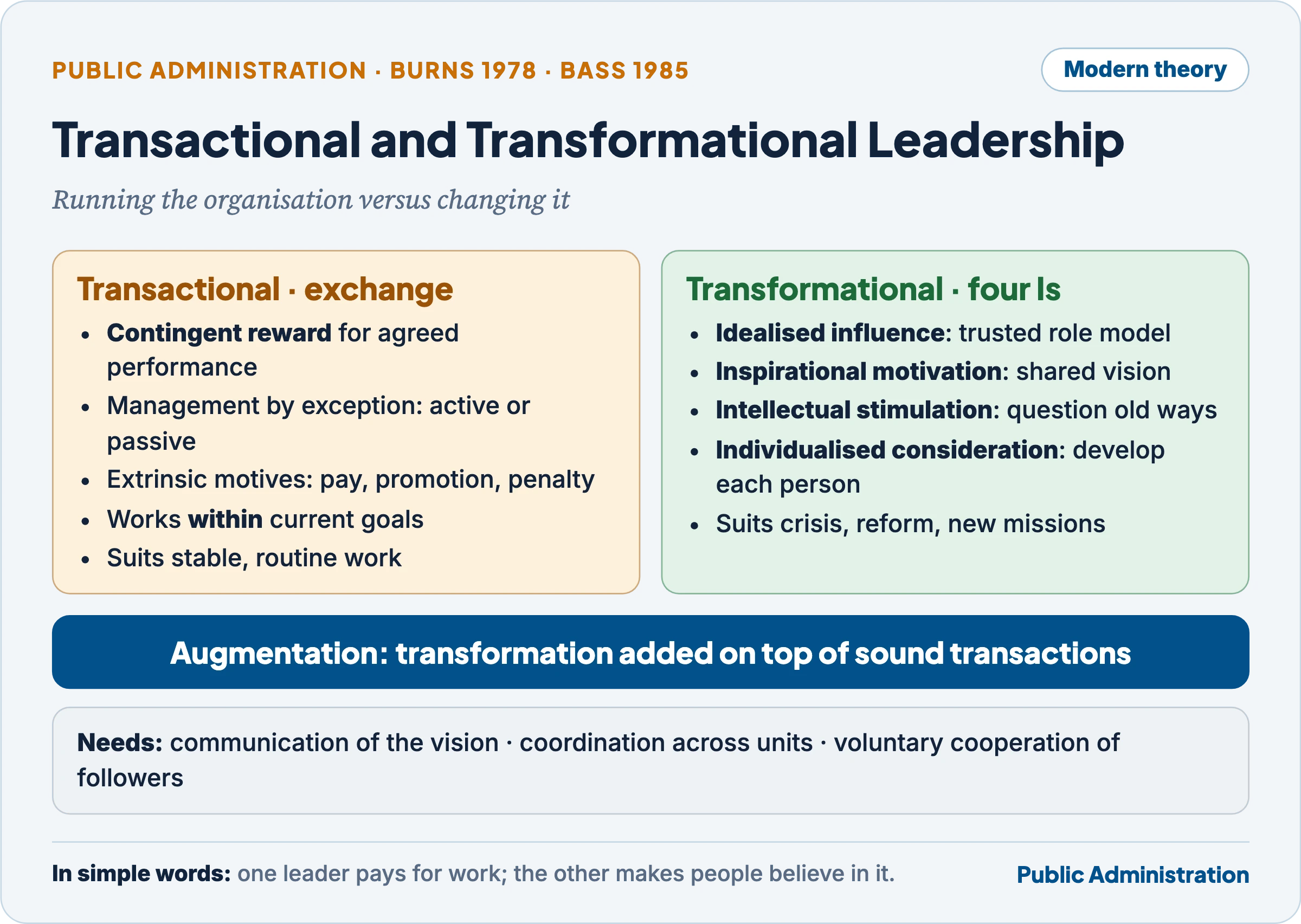
- Transactional leadership is an exchange: jobs for votes, rewards for effort, subsidies for support. It deals with followers’ existing interests and is the stuff of routine politics and administration.
- Transforming leadership occurs when leaders and followers raise one another to higher levels of motivation and morality. It appeals to higher values (liberty, justice, equality), changes followers’ needs and aspirations, and can turn followers into leaders and leaders into moral agents.
- For Burns, transforming leadership is inherently moral: a leader who mobilises people for hatred is not a transforming leader at all. His examples include Gandhi.
7.2 Bass: transformational leadership (1985)
Bernard Bass, the American organisational psychologist, in Leadership and Performance Beyond Expectations (1985), turned Burns’s political idea into an organisational theory and measured it with the Multifactor Leadership Questionnaire (MLQ).
Transformational leaders transform followers by making them more aware of the importance of tasks, getting them to put team or organisational goals above self-interest, and activating their higher-order needs. Bass and Bruce Avolio described four components (the “four Is”):
- Idealised influence (earlier “charisma”): the leader is a role model with high ethical standards, trusted and admired.
- Inspirational motivation: articulating an appealing vision, high expectations, using symbols to focus effort.
- Intellectual stimulation: encouraging followers to question assumptions, think independently and innovate.
- Individualised consideration: treating each follower as an individual, mentoring and advising.
The full-range leadership model places these alongside transactional behaviours: contingent reward (agreeing rewards for performance), management by exception, active (watching for deviations and correcting them) and passive (intervening only when things go wrong), and laissez-faire (abdication).
- Augmentation effect: transformational leadership does not replace transactional leadership but adds to it; the best leaders use both. Meta-analyses found the transformational components and contingent reward related to effectiveness, while passive management by exception and laissez-faire were not.
- Burns versus Bass on morality: Bass at first treated transformational leadership as amoral (Hitler could be “transformational”); later, with Steidlmeier, he distinguished authentic transformational leadership grounded in moral character, ethical values and ethical processes from pseudo-transformational leadership that uses “us versus them” manipulation.
- Noel Tichy and Mary Anne Devanna (1986) found effective transformational leaders see themselves as change agents, are courageous, believe in people, are value-driven, are lifelong learners and can deal with complexity and ambiguity.
| Feature | Transactional | Transformational |
|---|---|---|
| Basis | Exchange of rewards for performance | Shared vision and higher values |
| Motivation used | Extrinsic: pay, promotion, penalties | Intrinsic: purpose, pride, growth |
| Time frame | Short term, current goals | Long term, change of goals and culture |
| Attitude to status quo | Works within it | Challenges and changes it |
| Style | “Telling” once the deal is made; management by exception | “Selling” a vision; mentoring |
| Typical setting | Stable, routine organisations | Crisis, reform, new missions |
| Underlying psychology | Behaviourism, rational economic actor | Higher needs (Maslow), identification |
7.3 Transformational leadership needs coordination, communication and cooperation
Transformation is a collective achievement, not a solo performance. It therefore depends on three conditions.
- Communication: a vision changes nothing unless it is communicated clearly, repeatedly and in the followers’ language. Inspirational motivation is itself a communication process; intellectual stimulation needs upward and lateral communication so that followers can question and suggest. Bennis’s “management of meaning” makes the same point.
- Coordination: transformation usually cuts across departments (health, nutrition, water and education for a district’s child-health goal). Without coordination of units, schedules and resources, inspiration dissipates into uncoordinated enthusiasm.
- Cooperation: followers must voluntarily put collective goals above self-interest; transformational leaders earn this through trust (idealised influence) and individual attention (individualised consideration). Coerced compliance is transactional, not transformational.
- Indian illustration: the Aspirational Districts Programme (launched 5 January 2018, 112 districts) was designed around the “3 Cs“: convergence of central and state schemes, collaboration of central and state officers with District Collectors, and competition among districts through monthly delta ranking on 49 indicators. District Collectors were cast as “champions of change”, and the programme’s results depended on exactly the coordination, communication and cooperation that transformational leadership requires.
7.4 Critique of transformational leadership
- Heroic bias: it romanticises the individual leader and underplays teams, systems and followers (Gary Yukl, 1999).
- Elitism and manipulation: followers may become dependent; the line between inspiration and manipulation is thin (pseudo-transformational leaders).
- Measurement: the four components overlap heavily; the MLQ mixes traits and behaviours.
- Public-sector constraints: civil servants work under rules, political masters and audit; a transformational officer who changes goals without political sanction can undermine democratic accountability. Frequent transfers often end transformation before it takes root.
- Defence: evidence consistently links transformational behaviours to follower satisfaction and performance, especially in organisations facing renewal and change, and public-service motivation research finds that public employees respond strongly to mission and values. Bass argued that transactional leadership alone is a prescription for mediocrity.
Indian Connect — Transformational leadership in Indian public life
- T.N. Seshan (Chief Election Commissioner, 1990–96) changed the culture of the Election Commission, enforcing the Model Code of Conduct and expenditure limits and pressing for electors’ photo identity cards.
- E. Sreedharan led the Konkan Railway and then the Delhi Metro (managing director 1997–2011), building an organisation known for punctuality, integrity and on-time delivery.
- Verghese Kurien built the cooperative dairy model and led Operation Flood (from 1970), transforming farmers into owners of a national institution: a case of leadership through cooperation rather than command.
- In each case transformation rested on strong management systems as well; the cases support the augmentation view rather than a contrast between the two.
8. Modern Theories (2): Values, Relationships and Context
In simple words
After the heroic leader, theory turned in several directions: leaders who serve, leaders who are genuine, leaders who are ethical, leadership shared by many people, leaders who help people face hard problems rather than solve them for them, leaders who think in decades, leaders who lead through screens, and leaders who understand emotions, including their own.
8.1 Servant leadership
- Robert Greenleaf, an American management researcher at AT&T, wrote the essay “The Servant as Leader” (1970). The servant leader is servant first: the desire to serve comes before the desire to lead.
- Greenleaf’s “best test”: do those served grow as persons; do they become healthier, wiser, freer, more autonomous and more likely themselves to become servants? And what is the effect on the least privileged in society?
- Characteristics (as later listed by Larry Spears): listening, empathy, healing, awareness, persuasion, conceptualisation, foresight, stewardship, commitment to the growth of people, building community.
- Relevance: it fits the public-service ethos and the New Public Service idea of serving citizens rather than steering them; the Indian ideal of public servants as sevaks and the Nagrik Devo Bhava theme of recent capacity-building programmes echo it.
- Critique: vague and hard to measure; may seem naive in hierarchical or crisis settings; risk of servility to superiors rather than service to citizens.
8.2 Authentic leadership
- Popularised by Bill George‘s Authentic Leadership (2003) and developed by Bruce Avolio, William Gardner and Fred Walumbwa (2008). Authentic leaders are genuine, know themselves and act consistently with their values.
- Four components: self-awareness, relational transparency (openly sharing one’s thoughts), balanced processing (considering all relevant information, including criticism), and an internalised moral perspective (acting on inner values, not outside pressure).
- Critique: “being true to oneself” is ethical only if the self’s values are good; difficult to distinguish from ethical or transformational leadership.
8.3 Ethical leadership
- Michael Brown, Linda Treviño and David Harrison (2005) defined ethical leadership as demonstrating normatively appropriate conduct through personal actions and relationships, and promoting such conduct among followers through two-way communication, reinforcement and decision-making.
- Two pillars: the leader as a moral person (honest, fair, caring) and as a moral manager (who sets standards, rewards ethical conduct, disciplines violations).
- Indian anchor: the 2nd Administrative Reforms Commission‘s fourth report, Ethics in Governance (2007), treated ethics as the foundation of good governance and recommended a code of ethics for civil servants and ministers; the Nolan principles of public life (selflessness, integrity, objectivity, accountability, openness, honesty, leadership) list “leadership” itself as an ethical duty: holders of public office should promote and support the principles by example.
8.4 Distributed and shared leadership
- Distributed leadership (Peter Gronn, 2002; James Spillane, 2006, in schools) treats leadership as a property of the group, spread across many people and practices rather than located in one person.
- Shared leadership (Craig Pearce and Jay Conger, 2003): team members lead one another, the lead role shifting to whoever has the relevant expertise.
- Why it matters now: governance through networks of agencies, NGOs, private partners and citizens has no single commander; leadership must be collaborative. Complex programmes (Swachh Bharat Mission, the Jal Jeevan Mission) rely on leadership at village, block, district and state levels simultaneously.
- Critique: accountability can become diffuse (“when everyone leads, no one is responsible”); it presumes capable, motivated members.
8.5 Adaptive leadership
Ronald Heifetz, of Harvard’s Kennedy School, in Leadership Without Easy Answers (1994), distinguishes two kinds of problem.
- Technical problems can be solved with existing expertise and authority (repairing a canal, issuing a circular).
- Adaptive challenges require people to change their values, beliefs or behaviour (ending open defecation, reducing child marriage, changing a corrupt office culture). Authority cannot solve them; the people with the problem must do the work.
- Adaptive leadership means: “getting on the balcony” (seeing the whole pattern), identifying the adaptive challenge, regulating distress (keeping pressure productive, neither too high nor too low), maintaining disciplined attention, giving the work back to the people, and protecting voices of dissent.
- Relevance to crisis administration: bureaucratic agencies, built on fixed procedures, specialisation and hierarchical command, handle technical tasks well but can be too rigid for disasters, which mix technical tasks (rescue, supply) with adaptive ones (community behaviour, coordination among many agencies). This is why disaster management systems combine a clear incident command structure with flexibility, decentralised initiative and community participation.
8.6 Strategic leadership
Strategic leadership is the ability to anticipate, envision and maintain flexibility, and to empower others to create a viable future for the organisation (Duane Ireland and Michael Hitt, 1999). In the private sector it grew from the “upper echelons” theory of Donald Hambrick and Phyllis Mason (1984): organisations reflect the values and thinking of their top managers.
Core tasks: setting long-term direction; building core competencies and human capital; sustaining a healthy culture; emphasising ethical practices; establishing balanced controls; and managing the external environment and stakeholders.
In the public sector:
- Mark Moore‘s strategic triangle (Creating Public Value, 1995): a public strategy must be valuable (creates public value), authorised (has legitimacy and political support) and operationally feasible (the organisation has the capacity). The strategic public leader aligns all three.
- John Bryson‘s work on strategic planning for public and non-profit organisations treats strategy as a collaborative, stakeholder-based process.
Why leadership is called the most important, interesting and mysterious subject in public administration:
- Important: reforms, missions and crisis responses fail without leaders who convert mandates into outcomes; the same structures produce different results under different leaders.
- Interesting: it joins every other subject (motivation, communication, decision-making, ethics, politics) and is visible in dramatic cases.
- Mysterious: decades of research have produced no settled theory; effectiveness depends on traits, behaviours, followers, situations and values together; much of it rests on tacit judgement and character, which are hard to define, measure or teach. Strategic leadership is the most mysterious of all because it deals with the future, under uncertainty, and its results often appear only after the leader has gone.
- Public-sector specifics: strategic leaders in government must work within democratic authorisation, short tenures and contested goals, which makes strategic leadership harder than in business.
8.7 E-leadership
- Bruce Avolio, Surinder Kahai and George Dodge (2000) defined e-leadership as a social influence process mediated by information technology, producing change in attitudes, feelings, thinking, behaviour and performance.
- Features: leading virtual and dispersed teams, building trust without face-to-face contact, using data dashboards for monitoring, communicating through digital channels, and leading digital transformation itself.
- Indian examples: PRAGATI (launched in 2015), the Prime Minister’s video-conference platform for reviewing projects and grievances with Union Secretaries and Chief Secretaries; the real-time dashboards of the Aspirational Districts and Blocks Programmes; and the iGOT Karmayogi platform for online learning.
- Critique: risk of micro-management from the centre, loss of the personal relationships on which referent power depends, and digital exclusion.
8.8 Emotional intelligence
- Daniel Goleman, the American psychologist and science journalist, popularised emotional intelligence (EI) in Emotional Intelligence (1995) and applied it to leadership in “What Makes a Leader?” (Harvard Business Review, 1998), building on Peter Salovey and John Mayer (1990).
- Five components: self-awareness, self-regulation, motivation, empathy and social skill. Goleman argued that at senior levels EI distinguishes outstanding leaders more than IQ or technical skill.
- Six leadership styles (Primal Leadership, 2002, with Boyatzis and McKee): visionary, coach (developing people), affiliative, democratic, pacesetting and commanding. The first four build positive climate (“resonance”); pacesetting and commanding should be used sparingly.
- Critique: the concept is broad and partly overlaps with personality; some measures are self-reports; claims of its importance have been exaggerated in popular writing.
8.9 Leadership in conflict: does it migrate to the aggressive?
The claim that in organisational conflict leadership migrates to the aggressive and pushes the emotionally mature to the background describes a real but dysfunctional pattern.
Why it happens:
- Threat-rigidity: under threat, groups centralise control and narrow information processing (Staw, Sandelands and Dutton, 1981); they look for someone who appears decisive.
- Visibility bias: aggressive individuals speak first, loudest and most confidently; dominance is mistaken for competence and aggression for strength.
- Zero-sum framing: conflict turns problems into contests to be won, rewarding combative behaviour.
- Groupthink (Irving Janis, 1972): cohesive groups under pressure suppress dissent and rally behind assertive voices.
- Calm is misread as weakness: consultative, measured people appear indecisive in an acute crisis.
Why it is harmful:
- Aggressive leadership suppresses conflict rather than resolving it; resentment returns later.
- It produces win–lose outcomes, damages trust and drives away talent.
- It weakens upward communication, so problems are hidden.
What theory recommends:
- Mary Parker Follett‘s constructive conflict (1925): conflict can be handled by domination, compromise or integration; only integration, which finds a solution satisfying both sides, is durable, and it is the work of the emotionally mature.
- Goleman’s EI: self-regulation and empathy allow leaders to de-escalate, listen and find integrative solutions.
- Situational theory: a short phase of firm command may be needed in an acute crisis, but sustained leadership must return to participative and integrative styles.
- Organisational correctives: valuing EI in selection and appraisal, multi-source (360-degree) feedback, conflict-management training, fair grievance procedures and psychological safety so that calm voices are heard.
Conclusion: the statement is often true descriptively but false normatively: aggressive people may capture leadership in conflict, but organisations that let them keep it pay in lost trust and recurring conflict.
8.10 Accountability for failure: owning up
Leadership is tested less by how leaders share success than by how they own failure.
- “The buck stops here”, the sign on US President Harry Truman‘s desk, expresses the principle that responsibility cannot be passed down.
- Jim Collins, Good to Great (2001), described “Level 5” leaders who combine personal humility with professional will: they look out of the window to credit others for success and in the mirror to accept responsibility for failure.
- Amy Edmondson‘s research on psychological safety (1999) shows that teams learn when members can admit mistakes without fear; leaders create this climate by admitting their own errors first.
- McCall and Lombardo‘s successful executives were marked by admitting error; covering up was a mark of those who derailed.
Why owning failure matters in public administration:
- Democratic accountability: the doctrine of ministerial responsibility holds the minister answerable to the legislature for his department’s failures; Lal Bahadur Shastri resigned as Railway Minister after the Ariyalur train accident of November 1956, accepting moral responsibility.
- Learning: organisations that hunt for scapegoats hide errors; those whose leaders accept responsibility learn and correct them.
- Trust and morale: subordinates take initiative only if they know the leader will stand by reasonable decisions that go wrong.
- Against “blame games”: Christopher Hood (The Blame Game, 2011) shows how officials and politicians design procedures to avoid blame rather than to deliver results; leadership that owns failure counters this defensive culture.
Limits: accountability must be fair: leaders should own failures within their control, but systems must also distinguish honest errors from negligence or corruption. The Krech–Crutchfield “scapegoat” function warns that leaders are sometimes blamed for failures that are really systemic.
Comparing the modern theories.
| Theory | Key thinker (year) | Central idea | Main criticism |
|---|---|---|---|
| Transformational | Burns (1978), Bass (1985) | Raise followers to higher motivation and morality | Heroic, manipulable |
| Servant | Greenleaf (1970) | Serve first; followers grow | Vague, idealistic |
| Authentic | George (2003), Walumbwa et al. (2008) | Self-aware, transparent, value-consistent | Depends on the values held |
| Ethical | Brown, Treviño and Harrison (2005) | Moral person and moral manager | Overlaps with others |
| Distributed / shared | Gronn (2002), Pearce and Conger (2003) | Leadership spread across many | Diffuse accountability |
| Adaptive | Heifetz (1994) | Mobilise people to face adaptive challenges | Abstract, hard to operationalise |
| Strategic | Hambrick and Mason (1984), Moore (1995) | Long-term direction and public value | Hard to evaluate |
| E-leadership | Avolio, Kahai and Dodge (2000) | Influence through technology | Distance, micro-management |
| Emotional intelligence | Goleman (1995, 1998) | Self-awareness, self-regulation, empathy | Broad, overstated |
Common confusion
Is transformational leadership the same as charismatic leadership? No. Charisma (idealised influence) is one of four components of transformational leadership. The difference lies in how followers are treated: transformational leaders empower and develop followers until they can lead themselves, whereas a purely charismatic leader may keep followers dependent and loyal to his person. A leader can be charismatic without being transformational, and transformational through quiet mentoring without great charisma.
9. Leadership in Indian Administration
In simple words
Indian administration expects leadership from people who are also bound by rules, transferred often and answerable to ministers. The question is not whether theories of leadership apply here, but how much room the system leaves for them and how it is trying to create more.
9.1 Leadership at the apex
- Prime Minister’s Office: a strong PMO concentrates coordination and policy initiative; it reflects the personal leadership style of the Prime Minister, which explains why the PMO’s weight has varied across governments. Strong central leadership speeds decisions but can weaken ministerial initiative and collective responsibility.
- Chief Minister: the CM is the real executive of the State; effectiveness depends on personal traits, control of the party and the equation with the central leadership. This is the trait and situational debate in political form.
- Cabinet Secretary: as head of the civil service and coordinator of the Union government, the Cabinet Secretary leads without command authority over ministers, through persuasion, expertise and trust: a classic case of the “influential increment” and Selznick’s ordering of internal conflict.
- Coalition and political settings shape leadership styles: coalition leaders lean towards consultative and transactional leadership because their position depends on bargaining.
9.2 Leadership in the district
- The District Collector combines the roles of coordinator, crisis manager, development leader and regulator. Situational demands change hourly, making style flex essential.
- Disaster leadership: under the Disaster Management Act, 2005, the Collector chairs the District Disaster Management Authority. Successful disaster responses combine directive command in the emergency with participative preparedness and community leadership.
- Pandemic leadership: during the first COVID-19 wave (2020), district administrations such as Bhilwara in Rajasthan became known for aggressive containment, house-to-house surveys and contact tracing, showing directive leadership in an unstructured, high-stress situation.
- Leadership through people’s participation: in Manipur’s Tamenglong district, officer Armstrong Pame mobilised public contributions to build a road of about 100 km (2012) where government funds were not available, a case of referent power and cooperation substituting for formal resources.
- Aspirational Blocks Programme (launched 7 January 2023, 500 blocks in 329 districts) extends the “champions of change” idea down to block officials, treating them as leaders of change in convergence and outcome monitoring.
9.3 Constraints on leadership in Indian administration
- Short and uncertain tenures limit long-term transformation; T.S.R. Subramanian v. Union of India (2013) urged minimum tenure and Civil Services Boards.
- Rule-boundedness and risk aversion: fear of audit, vigilance and investigation discourages initiative; leaders choose “safe” 1,1 or 5,5 styles.
- Seniority-based promotion weakens the reward link and does little to identify leadership potential early.
- Political interference can override administrative leadership; the civil servant’s leadership must remain neutral and lawful.
- Hierarchical culture favours System 2 (benevolent-authoritative) management over participation.
9.4 Building leadership
- Training: the Lal Bahadur Shastri National Academy of Administration and state institutes run mid-career training programmes for IAS officers; leadership, ethics and behavioural competencies are part of these courses.
- Mission Karmayogi (2020) introduced a competency framework covering behavioural, functional and domain competencies; Karmayogi Sadhana Saptah (2–8 April 2026) marked five years of the Mission and the Capacity Building Commission’s foundation day.
- Recognition: the Prime Minister’s Awards for Excellence in Public Administration, given on Civil Services Day (21 April), recognise district and organisational leadership in priority programmes.
- Reform proposals: the 2nd ARC’s proposals for a leadership cadre, performance management and intermediate reviews of officers’ careers remain the main reform agenda for identifying and developing leaders.
Criticism — The case against leadership as the decisive variable
- Romance of leadership: James Meindl (1985) showed that people over-attribute organisational outcomes to leaders, ignoring structural and environmental causes.
- Substitutes for leadership: rules, training and professional norms do much of what leaders are credited with (Kerr and Jermier).
- Weberian design: good bureaucracies are built to work without extraordinary persons; dependence on individual leaders is a sign of weak institutions.
- Democratic accountability: civil servants who “lead” beyond their mandate threaten the authority of elected governments.
- No settled theory: after a century of research, trait, behavioural, situational and modern theories still disagree about what effective leadership is.
Defence — The case for leadership as a central variable
- Barnard and Selznick: cooperation and institutional values do not arise from structure alone; they are created and sustained by leaders.
- Katz and Kahn: every organisation is incomplete and changing; the influential increment fills the gaps no rulebook can.
- Evidence: districts and departments with the same rules, funds and staff perform differently, and leadership is a large part of the difference.
- Adaptive challenges: the hardest public problems (behaviour change, culture change, crisis) cannot be solved by authority or routine alone.
- Synthesis: modern theory treats leadership as a relationship among leader, followers and situation, working through institutions rather than against them; strong institutions and good leadership are complements.
Key Terms
| Term | Meaning in simple words |
|---|---|
| Leadership | Influencing people to work willingly towards common goals |
| Influential increment | Extra effort people give because of the leader, beyond what rules require (Katz and Kahn) |
| Headship | Position-based authority conferred by the organisation, not by followers |
| Bases of power | Legitimate, reward, coercive, expert, referent and informational sources of influence (French and Raven) |
| Zone of indifference | Range of orders a subordinate accepts without questioning (Barnard) |
| Great man theory | Belief that leaders are born with exceptional qualities |
| Trait theory | Search for personal qualities that distinguish leaders from non-leaders |
| Charisma | Extraordinary personal quality that makes followers obey out of devotion (Weber) |
| Routinisation of charisma | Conversion of a charismatic movement into a permanent traditional or legal structure |
| Initiating structure | Leader behaviour that organises tasks, roles and deadlines (Ohio State) |
| Consideration | Leader behaviour showing trust, respect and concern for people (Ohio State) |
| Employee-centred / job-centred | Michigan’s people-focused and production-focused supervision |
| System 4 | Likert’s participative group management based on trust and group decisions |
| Linking pin | Manager who belongs to a higher group and leads a lower one (Likert) |
| Managerial Grid | 9 × 9 grid of concern for production and concern for people (Blake and Mouton) |
| LPC scale | Fiedler’s measure of whether a leader is task- or relationship-oriented |
| Situational favourableness | How much control a situation gives the leader (Fiedler) |
| Follower readiness | Ability and willingness of a follower for a task (Hersey and Blanchard) |
| Effectiveness dimension | Reddin’s third dimension: whether a style fits the situation’s demands |
| Style flex | Ability to change style as the situation requires (Reddin) |
| Path–goal | Leader clarifies the path, removes obstacles and raises rewards (House) |
| Transactional leadership | Leadership as exchange of rewards for performance |
| Transformational leadership | Leadership that raises followers’ motivation and values and changes the organisation |
| Four Is | Idealised influence, inspirational motivation, intellectual stimulation, individualised consideration (Bass) |
| Servant leadership | Leading by serving followers so they grow (Greenleaf) |
| Adaptive challenge | A problem that requires people to change values or behaviour (Heifetz) |
| E-leadership | Leadership exercised through information technology |
| Emotional intelligence | Ability to understand and manage one’s own and others’ emotions (Goleman) |
| Psychological safety | A climate in which people can admit mistakes and speak up without fear |
Commissions, Committees and Judgments
| Body / case | Year | Key point on leadership |
|---|---|---|
| 2nd ARC, 4th Report: Ethics in Governance | 2007 | Ethics as the foundation of governance; codes of ethics for ministers and civil servants |
| 2nd ARC, 10th Report: Refurbishing of Personnel Administration | 2008 | Leadership cadre with elements of a Senior Executive Service; performance management; accountability for results |
| T.S.R. Subramanian v. Union of India (Supreme Court) | 2013 | Minimum tenure for civil servants and Civil Services Boards for postings |
| Mission Karmayogi (NPCSCB) | 2020 | Role-based, competency-based capacity building; Capacity Building Commission (2021) |
| Aspirational Districts Programme | 2018 | Convergence, collaboration, competition; Collectors as champions of change |
| Aspirational Blocks Programme | 2023 | Block officials as leaders of change in 500 blocks |
Contemporary Developments
- April 2025: the Capacity Building Commission and SCOPE launched DAKSH, a twelve-month common leadership development programme to build a pipeline of board-ready leaders in central public sector enterprises.
- January–April 2025: the Rashtriya Karmayogi Jan Seva Programme trained master trainers from 80 ministries (January) and then Secretaries and Additional Secretaries (April) to lead a behavioural programme on seva bhava across government.
- May 2025: the Government of NCT of Delhi signed an MoU with the Capacity Building Commission and Karmayogi Bharat to bring all its officials onto the iGOT platform, extending Mission Karmayogi to state-level leadership development.
- August 2025: the government informed Parliament that Mission Karmayogi is being implemented through existing training institutions and the iGOT platform, with the Capacity Building Commission (2021) and Karmayogi Bharat (2022) as its institutions.
- 2–8 April 2026: Karmayogi Sadhana Saptah marked five years of Mission Karmayogi and the Capacity Building Commission’s foundation day, with more than 100 central organisations, 30+ States and UTs and 250+ training institutions taking part around the themes of technology, tradition and tangible outcomes.
- Since 2023: the Aspirational Blocks Programme publishes delta rankings of 500 blocks on 40 indicators, carrying the district “champions of change” model to block-level leadership.
Revision Grid
| Thinker / body | Work or report (year) | Key idea |
|---|---|---|
| Thomas Carlyle | On Heroes, Hero-Worship (1841) | Great man theory |
| Ordway Tead | The Art of Leadership (1935) | Influencing people towards goals they come to find desirable |
| Chester Barnard | The Functions of the Executive (1938) | Endurance of organisation depends on quality of leadership |
| Lewin, Lippitt and White | Iowa studies (1939) | Autocratic, democratic, laissez-faire |
| Ralph Stogdill | Survey (1948); Handbook of Leadership (1974) | Traits matter only in relation to the situation |
| Ohio State studies | From 1945 | Initiating structure and consideration |
| Philip Selznick | Leadership in Administration (1957) | Institutional leadership, infusing value |
| Tannenbaum and Schmidt | HBR (1958; 1973) | Continuum of boss- to subordinate-centred behaviour |
| French and Raven | Bases of social power (1959) | Five bases of power |
| Rensis Likert | New Patterns of Management (1961) | Four systems; System 4 |
| Blake and Mouton | The Managerial Grid (1964) | 9,9 team management as best |
| Katz and Kahn | The Social Psychology of Organizations (1966) | Influential increment |
| Fred Fiedler | A Theory of Leadership Effectiveness (1967) | LPC, situational favourableness |
| William Reddin | 3-D theory (1967); Managerial Effectiveness (1970) | Effectiveness as third dimension |
| Hersey and Blanchard | Life cycle theory (1969) | Style matched to follower readiness |
| Robert Greenleaf | “The Servant as Leader” (1970) | Servant leadership |
| Robert House | Path–goal (1971); charismatic theory (1976) | Clarify paths; charismatic traits and behaviours |
| Vroom and Yetton | Leadership and Decision-Making (1973) | Participation as a contingency |
| James MacGregor Burns | Leadership (1978) | Transactional versus transforming |
| Bernard Bass | Leadership and Performance Beyond Expectations (1985) | Four Is; full-range model |
| Bennis and Nanus | Leaders (1985) | Managers do things right; leaders do the right thing |
| John Kotter | “What Leaders Really Do” (1990) | Management copes with complexity, leadership with change |
| Ronald Heifetz | Leadership Without Easy Answers (1994) | Adaptive versus technical challenges |
| Daniel Goleman | “What Makes a Leader?” (1998) | Emotional intelligence |
| Avolio, Kahai and Dodge | E-leadership (2000) | Leadership through technology |
| 2nd ARC | 4th Report (2007); 10th Report (2008) | Ethics; leadership cadre |
Previous Year Questions
- 2025In conflict situations in organizations, leadership migrates to the aggresive and relegates the emotionally matured to the background. Discuss.
- 2025Leadership is not only about taking credit for success but also owning up and being accountable for failures. Elucidate.
- 2023“Reddin model of leadership added third dimension to the existing two basic dimensions of leadership identified by Ohio Studies and Blake and Mouton.” Elucidate.
- 2022Every human organisation shall start from System-I and ultimately end up with System-IV. Comment on Likert’s statement.
- 2022Transformational leadership requires high degree of coordination, communication and cooperation. Explain.
- 2022‘Leadership is seen as dealing with change, whereas administration is viewed as coping with complexity.’ In this context, discuss the contextuality of leadership and administration for the success of organisations.
- 2021Nothing in public administration is more important, interesting or mysterious than leadership. Analyze the statement in the context of strategic leadership.
- 2018“A leader is a people’s developer” (Napoleon). Which aspects of subordinates’ development can be positively influenced by a leader? Discuss.
- 2017The Participative Management School of Argyris and Likert advocates democracy within the administrative system. Will this approach be equally useful to developing countries with evolving democracies?
- 2017“Leaders do the right things; managers do them rightly”– (Warren Bennis). Is this distinction by him valid? Explain.
- 2016“Blake and Mouton defined leadership styles based on two dimensions-concern for people and concern for production. In the light of the statement, discuss the Managerial Grid Model. Explain with reason which one of the styles is the best.”
- 2015Do you agree with the view that the charismatic approach of the mid-1970s is a “new version” of the Classical Trait Theory of Leadership? Give reasons.
- 2012Leadership id the ‘influential increment over and above mechanical compliance with the routine directives of the organization’ (Katz and Kahn). Analyze.
- 2010“The successful management leaders are found in Likert’s ‘System-4’ approach to organisational leadership.” Examine.
- 2008“Leaders do the right things; managers do them rightly.” (Bennis) Comment.
- 1994“Thus, the endurance of organisation depends upon the quality of leadership.” Comment.
- 1990‘A leader must always adapt his behaviour to take account of the persons whom he leads.’ Comment.
- 1989For charisma to be transformed into a permanent routine structure, it is necessary that its anti-economic character should be altered. (Weber). Comment.
- 1987Critically examine the functions of administrative leadership. What role does communication play in improving the quality of administrative decisions in goal setting and goal getting by public servants.
- 2016“Dominant centralized administration is correlated with decisive and authoritative leadership provided by the Prime Minister’s Office.” Explain with suitable examples since independence.
- 2013“Bureaucratic agencies, characterized by established procedures, specialization, leadership, clear objectives, are not ideal to handle disaster management.” Examine with reference to the need for administrative flexibility in managing disasters.
- 2008‘The Chief Minister is the real executive of the State, whose effectiveness is largely related to his personality traits and equation with central leadership.’ Explain and illustrate with relevant examples.
- 2000“The leadership qualities of a civil servant are test most during his tenure as the Cabinet Secretary – a dream-post for every bureaucrat.” Elucidate.