

Anthropology Optional › Paper II › Unit 09: Tribal Administration and Development
9.2 Role of anthropology in tribal and rural development.
Official Syllabus: Paper II, Unit 9.2
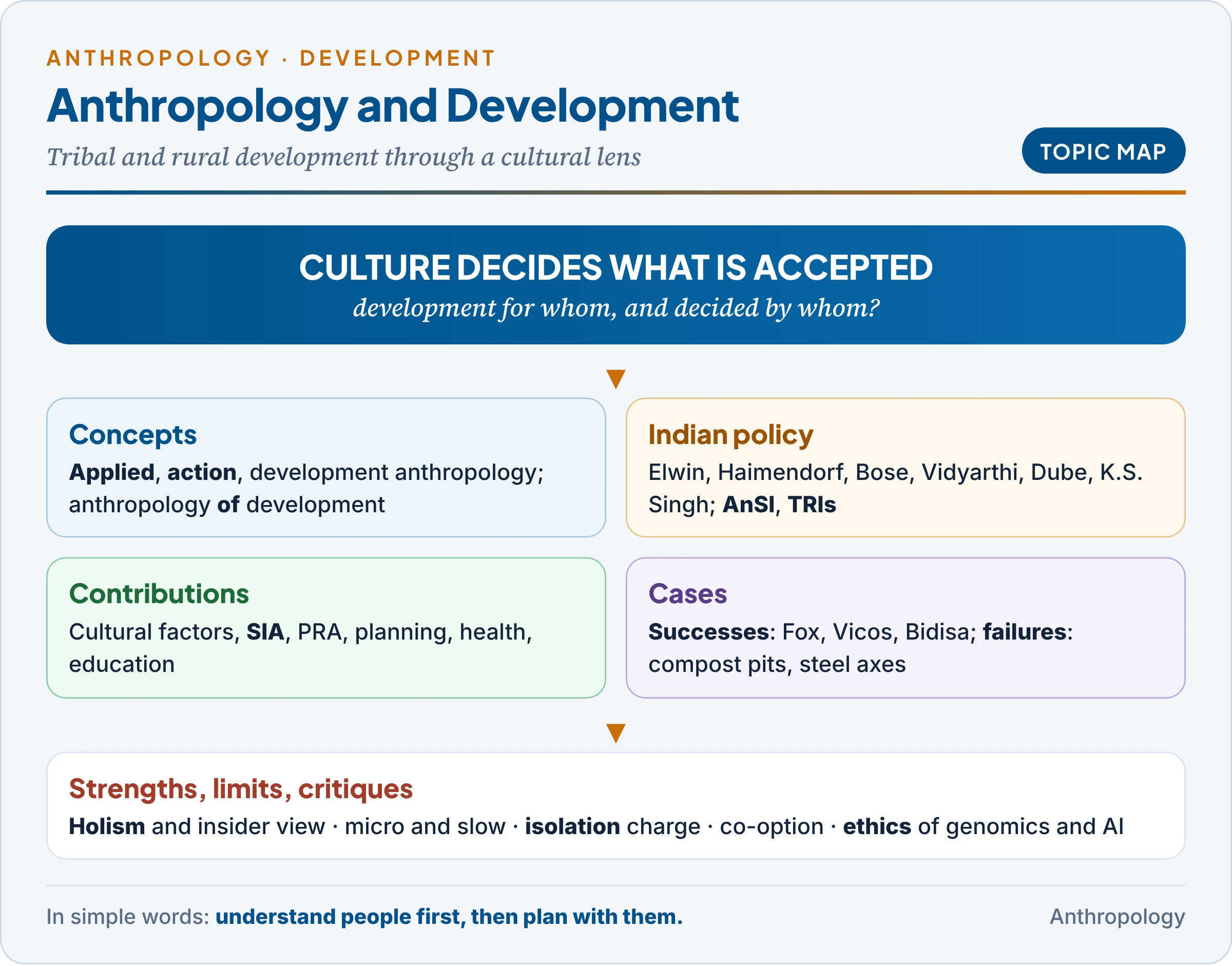
This article covers how anthropology has been used, and argued over, in tribal and rural development. The definitions of applied and action anthropology as branches are introduced in Paper I (1.3); RRA and PRA as research tools in Paper I (8b); applied physical anthropology (sports, nutrition, forensics) in Paper I (12a). In Paper II, the work of Indian anthropologists is in 4b; the five approaches to tribal welfare and the record of plans in 9.1a; NGOs in 9.1b; displacement and Cernea’s model in 6.3a; and anthropology’s reading of ethnic and political movements in 9.3.
1. Anthropology and Development: Concepts and Positions
In simple words
Development means planned change to improve people’s lives. Anthropology studies how people actually live and think, so it can tell planners why a good-looking scheme is accepted in one place and rejected in another. Anthropologists have played different parts: advisers to governments, partners of communities, and critics of development itself.
Example first: boiling water in Los Molinos. In the 1950s a Peruvian health worker spent two years persuading about 200 families in the town of Los Molinos to boil their drinking water; only 11 adopted the habit. The American anthropologist Edward Wellin (1955) found why. Local belief divided foods and drinks into “hot” and “cold”; boiled water was a medicine for the sick, not a drink for the healthy, and women who adopted it risked gossip. The few who changed were outsiders or already ill. The campaign failed not because villagers were ignorant, but because planners had ignored a cultural system. This is the core claim of anthropology in development: culture decides whether an innovation is accepted.
1.1 What is development?
The meaning of development has widened in four steps, and each step moved closer to anthropology’s concerns.
| Phase | Idea | Weakness that anthropologists pointed out |
|---|---|---|
| Growth (1950s) | Rising income and industry; benefits “trickle down” | Ignores who gains and who loses |
| Basic needs (1970s) | Food, water, health, schooling for all | Needs defined by outsiders |
| Human development (1990) | UNDP’s Human Development Index; the economist Amartya Sen‘s idea (Development as Freedom, 1999) of development as expanding capabilities and freedoms | Still measured with uniform indicators |
| Sustainable and participatory (1990s–) | Meet present needs without harming future ones; people plan for themselves | Participation can become a ritual |
The anthropological perspective on development follows from the discipline’s method. It is holistic (a change in farming touches kinship, ritual and power), emic (it asks what development means to the people themselves), comparative and culturally relative, and it looks at unequal power within the community. It therefore asks two questions planners often skip: development for whom, and decided by whom.
1.2 Theories of development seen by anthropologists
Anthropologists have engaged with each major theory of development, usually by testing it against local evidence.
| Theory | Key thinker | Anthropological response |
|---|---|---|
| Modernization | W.W. Rostow, The Stages of Economic Growth (1960): tradition → take-off → mass consumption | Treats culture as an obstacle; ethnocentric |
| Dependency | A.G. Frank (1960s–70s): the rich world underdevelops the periphery | Helps explain tribal resource drain, but ignores local agency |
| Post-development | Arturo Escobar, Encountering Development (1995): development is a Western discourse that invents the “Third World” | Powerful critique, but offers few alternatives |
| Actor-oriented | Norman Long (1970s–90s): people reshape interventions to their own ends | Puts local strategies at the centre |
1.3 Applied, action and development anthropology
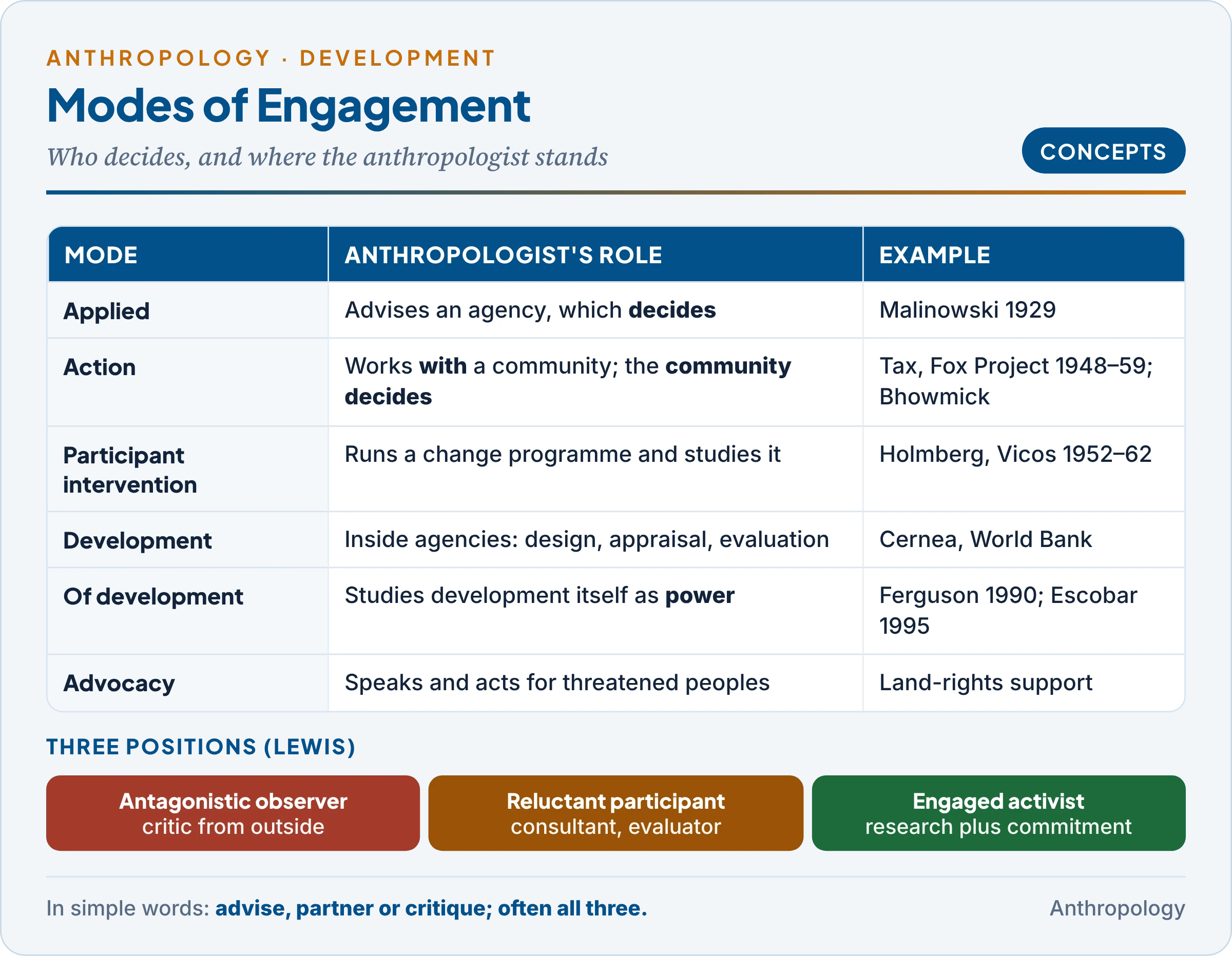
Anthropology’s practical branch has grown under several names. The table separates them.
| Term | Meaning | Classic example |
|---|---|---|
| Applied anthropology | Using anthropological knowledge to solve practical problems, usually for an agency that decides | Malinowski‘s “Practical Anthropology” (1929); the Society for Applied Anthropology (USA, 1941) |
| Action anthropology | Working with a community to reach its own goals while learning from the process | Sol Tax, the Fox Project among the Meskwaki of Iowa (1948–59); term coined in 1951, published 1952 |
| Participant intervention | Anthropologists run a change programme and study it | Allan Holmberg‘s Vicos project, Peru: Cornell leased a hacienda in 1952; its serfs bought the land in 1962 |
| Development anthropology | Anthropologists inside development agencies: design, appraisal, evaluation | Michael Cernea, the World Bank’s first sociologist (from 1974) |
| Anthropology of development | Studying development itself as a field of power and ideas | James Ferguson, The Anti-Politics Machine (1990); Escobar (1995) |
| Advocacy anthropology | Speaking and acting for threatened communities | Support to indigenous land claims; Cultural Survival (1972) |
The distinction between development anthropology (working in development) and the anthropology of development (working on it) was drawn by the British anthropologists Ralph Grillo and Alan Rew (1985). Many scholars now hold that the line is artificial: everyone who studies development is also, in some way, part of it.
Common confusion
How does action anthropology differ from applied anthropology? In applied anthropology the anthropologist advises an outside agency (a government, a company, a donor), and the agency decides. In action anthropology, as Sol Tax practised it among the Meskwaki, the anthropologist has two equal goals, to help the community solve a problem and to learn from doing so, and the community decides. Tax summed up its values as “help people help themselves“, freedom of choice and learning by doing. In India, P.K. Bhowmick‘s work with the Lodha at Bidisa (§4) is the best-known example.
1.4 Three positions anthropologists take
The British development scholar David Lewis (2005) described three positions anthropologists have taken towards development.
- Antagonistic observers: study development critically from outside. Ferguson showed how a World Bank project in Lesotho turned political problems of land and power into technical ones; Mahmood Mamdani (The Myth of Population Control, 1972) showed that a family-planning project in a Punjab village failed because the poor needed large families for labour and security.
- Reluctant participants: work as consultants and evaluators for agencies, often for practical reasons; they gain influence but risk being used to make projects look acceptable.
- Engaged activists: combine research with commitment to the poor, as in action and advocacy anthropology.
The positions overlap: the same anthropologist may advise a ministry, criticise its project, and support a community’s campaign.
2. Anthropology in Indian Tribal Policy and Administration
In simple words
In India anthropologists have not only studied tribes; many have advised governments, run institutions and written policy. At Independence they were distrusted as defenders of tribal “isolation”, but their knowledge became essential for tribal policy, the Constitution’s protective provisions and the planning of tribal development.
Example first: Verrier Elwin in NEFA. In 1954 Prime Minister Nehru appointed Verrier Elwin, the British-born anthropologist of the Baiga and Gond who became an Indian citizen, as adviser on tribal affairs for the North East Frontier Agency (now Arunachal Pradesh). For a decade he shaped its administration: officers were trained to learn local languages, respect tribal councils and customs, avoid sudden change, and keep out land-grabbing outsiders. His A Philosophy for NEFA (1957) carried Nehru’s foreword setting out the Tribal Panchsheel in its second edition. Critics called his approach “isolationist”; supporters credit it with sparing NEFA the land loss and conflict seen elsewhere. Either way, it is the clearest case of anthropology becoming policy in India (9.1a).
2.1 Colonial roots
- Scholar-administrators such as H.H. Risley, J.H. Hutton, J.P. Mills and W.V. Grigson (The Maria Gonds of Bastar, 1938) combined district rule with ethnography; the census and the gazetteers were tools of governance (4a).
- The legacy: because ethnography had served the policy of excluded and partially excluded areas (1935), nationalists suspected anthropologists of keeping tribes apart from the nation. The sociologist G.S. Ghurye called tribes “backward Hindus” and attacked Elwin’s protective approach. This suspicion shaped the discipline’s early years after 1947.
2.2 Anthropologists in policy since Independence
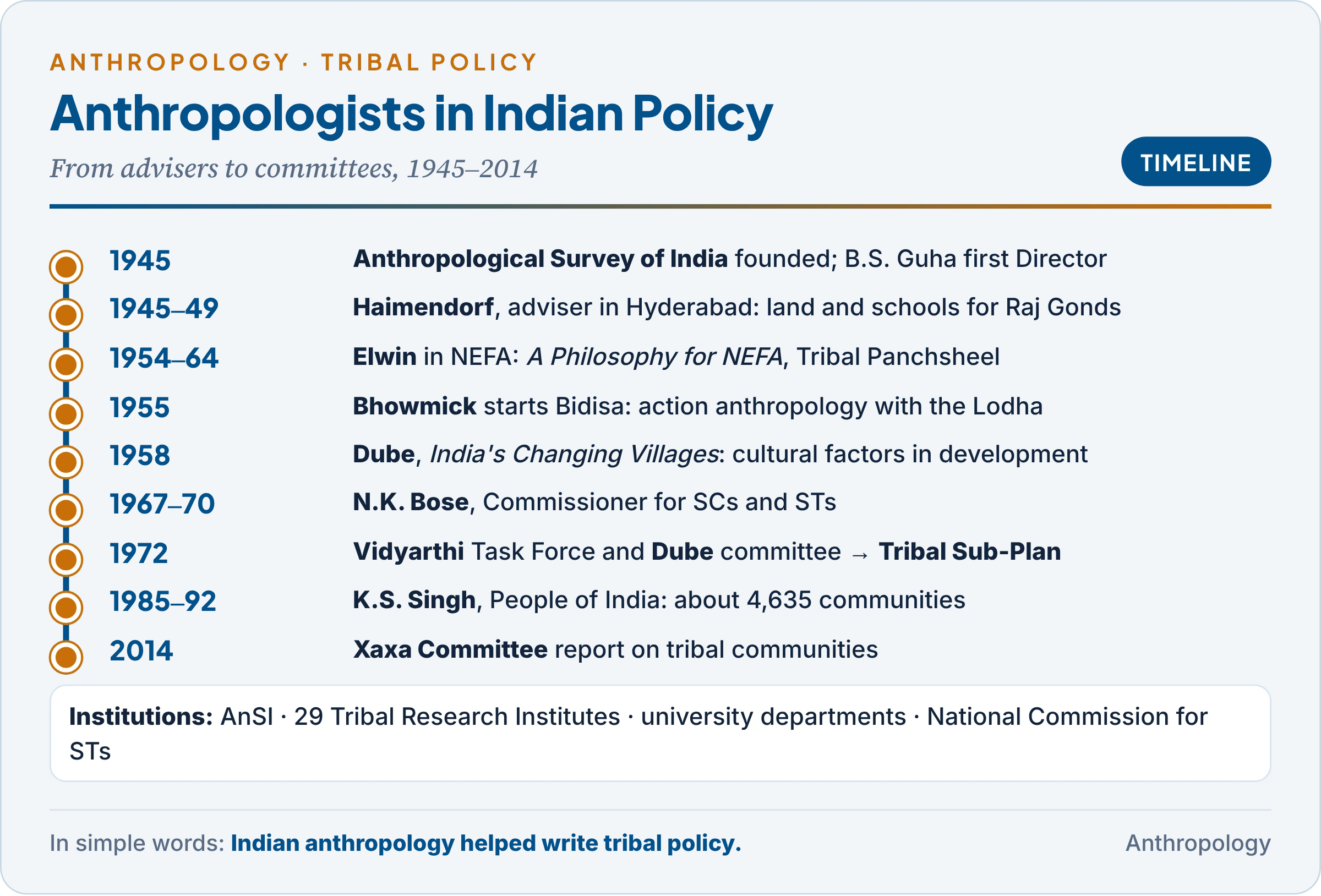
The table lists the main figures and what each contributed to policy or practice.
| Anthropologist | Role | Contribution |
|---|---|---|
| C. von Fürer-Haimendorf | Adviser for Tribes and Backward Classes, Hyderabad (1945–49) | Secured land for Raj Gonds, Gondi-medium schools, tribal councils; later Tribes of India: The Struggle for Survival (1982) |
| Verrier Elwin | Adviser for tribal affairs, NEFA (1954–64) | A Philosophy for NEFA; the Panchsheel |
| B.S. Guha | First Director, Anthropological Survey of India (1945) | National survey institution |
| N.K. Bose | Director, AnSI (1959–64); Commissioner for Scheduled Castes and Scheduled Tribes (1967–70) | Gandhian view of tribal absorption; official reports on SC/ST welfare |
| L.P. Vidyarthi | Chair, Planning Commission Task Force on Development of Tribal Areas (1972) | Applied Anthropology in India (1968); groundwork for the Tribal Sub-Plan |
| S.C. Dube | India’s Changing Villages (1958); chair of the 1972 expert committee on tribal development | Cultural factors in Community Development; Sub-Plan design |
| B.K. Roy Burman | Social studies of the 1961 Census | Tribes as a “buffer and bridge” in the North-East (7.1) |
| K.S. Singh | Director General, AnSI; People of India project (1985–92) | Profiled about 4,635 communities; Tribal Situation in India (1972) |
| P.K. Bhowmick | Bidisa (from 1955) | Action anthropology with the Lodha |
| Virginius Xaxa | Chair, High Level Committee on tribal communities (report 2014) | Land, displacement, health, education and governance reforms |
The list shows that Indian anthropology was policy-engaged from the start: the Sub-Plan, the NEFA model, the Commissioner’s reports and the latest review of tribal status all carry anthropologists’ imprint.
2.3 The anthropologist as administrator
When an anthropologist holds office, as Haimendorf in Hyderabad, Elwin in NEFA or N.K. Bose as Commissioner did, the knowledge of a discipline meets the power of the state.
- Advantages: knowledge of local language and custom lets the officer foresee resistance; empathy builds trust; the officer can protect customary rights that ordinary officials overlook, as Haimendorf did by securing land titles for Gonds dispossessed by outsiders.
- Practical rules: Elwin’s directions to NEFA officers (learn the language, work through village councils, never humiliate local custom, move slowly, keep exploiters out) remain a model for training officials in tribal areas.
- Dilemmas: a role conflict between scientist and official (loyalty to the state versus loyalty to informants), the risk of paternalism (deciding “for” the people), and suspicion from both politicians and the community.
- Lesson: the best use of anthropology in administration is not one gifted officer but trained cadres, long tenures and institutions that keep listening to the people.
2.4 Institutions
- Anthropological Survey of India (1945, moved to Calcutta in 1948): national surveys, People of India, physical and genetic studies of populations.
- Tribal Research Institutes: state bodies (29 supported by the Ministry of Tribal Affairs in 2025) for research, evaluation of schemes, training of officials, documentation and advice on ST status claims and customary law (7.2).
- University departments, the National Commission for Scheduled Tribes, and anthropologists in census, health, education and planning agencies.
- Weakness: institutes are often short of staff and independence, so their evaluations tend to be non-controversial, and their findings seldom reach decision-makers.
2.5 Anthropology and nation-building
- Integration without assimilation: anthropology supplied the intellectual basis for Nehru’s policy of developing tribes “along the lines of their own genius”, a middle path between isolation and absorption.
- Constitutional design: knowledge of tribal land, councils and customs informed the Fifth and Sixth Schedules, ST lists under Article 342 and the Lokur criteria (1965).
- Knowing the nation: the People of India project mapped India’s diversity and its many shared traits, supporting a view of the nation as unity built on difference.
- Managing conflict: studies of ethnicity, autonomy movements and the North-East explain why recognition and self-rule reduce conflict (7.3a, 9.3).
3. How Anthropology Contributes to Tribal and Rural Development
In simple words
A development project passes through stages: understanding the people, planning, designing the scheme, carrying it out and judging the results. Anthropology helps at each stage, by finding out what people need and believe, by spotting what will be resisted and why, and by checking whether the scheme helped or harmed.
Example first: compost pits that nobody used. In the 1950s the Community Development programme in a western Uttar Pradesh block persuaded villagers to dig compost pits outside the settlement, and village councils even fined those who did not use them. Most pits stayed empty. The anthropologist S.C. Dube (India’s Changing Villages, 1958) explained why: carrying refuse was women’s work, and women of higher castes could not be seen carrying loads through the village, while men would not do “women’s work”. The scheme clashed with the division of labour by sex and caste, not with any dislike of compost.
3.1 Cultural factors in development
Dube identified the cultural factors that decide whether a programme succeeds. The table groups them with his examples.
| Factor | How it works | Example |
|---|---|---|
| Habits and tastes | New items must fit daily life | High-yield wheat rejected for its taste and for making poor bread |
| Beliefs | Sacred or moral ideas block some changes | Sacred bulls could not be castrated or removed, so breeding schemes failed; smallpox treated as a goddess’s visit |
| Social structure | Caste, age, sex and kinship decide who does what | Upper castes “supervised” shramdan (voluntary labour) while lower castes did the unpaid work |
| Leadership and factions | Working only through the elite alienates others | Extension workers who chose rich “village leaders” spread benefits narrowly |
| Attitudes and values | Trust in the promoters; family prosperity as a goal | Schemes that raise household income accepted; community orchards neglected |
| Linked effects | A change spreads to other parts of life | Secondary and tertiary effects must be watched |
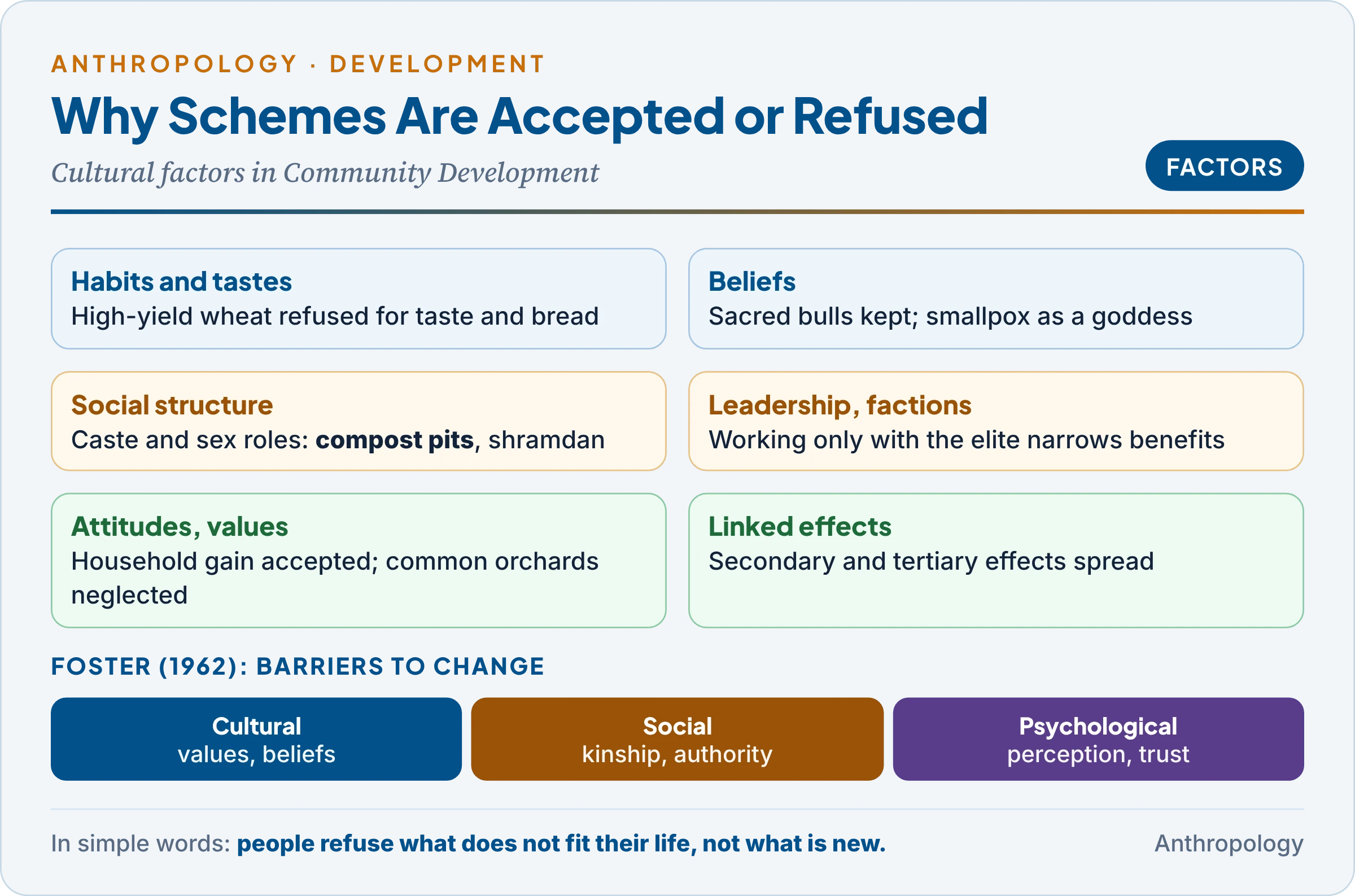
Two global classics make the same point. The American anthropologist George Foster (Traditional Cultures and the Impact of Technological Change, 1962) classified cultural, social and psychological barriers and stimulants to change. Lauriston Sharp‘s “Steel Axes for Stone-Age Australians” (1952) showed how missionaries’ gift of steel axes to the Yir Yoront of Australia, meant as help, destroyed the authority of elders and the trade networks built around stone axes. Innovations have unintended social consequences.
3.2 Displacement and resettlement
Anthropology’s sharpest contribution to development policy has come from studying people displaced by dams, mines and parks.
- Stages of resettlement: the American anthropologists Thayer Scudder and Elizabeth Colson, from the Kariba dam in Zambia, showed that resettled people pass through recruitment, transition, development and incorporation, and that most never get beyond the stressful transition.
- Risks: Cernea‘s Impoverishment Risks and Reconstruction model lists eight risks (landlessness, joblessness, homelessness, marginalisation, food insecurity, ill-health, loss of common property and social disarticulation) and turns each into a goal for rehabilitation.
- Indian evidence: studies by Walter Fernandes and others estimated that tribes, about one-twelfth of the population, formed about 40% of those displaced since Independence, and that only about a third were resettled (6.3a).
- Policy result: these findings fed the 2007 rehabilitation policy and the 2013 Act’s SIA and consent clauses.
Common confusion
Is a Social Impact Assessment the same as an Environmental Impact Assessment? No. An EIA under the Environment Impact Assessment Notification, 2006 studies a project’s effects on land, water, air and biodiversity, with a public hearing. An SIA under the LARR Act, 2013 studies its effects on people: who loses land, homes, livelihood, common resources and cultural sites, and whether acquisition is justified. Anthropologists contribute most to the SIA, but the two should be read together, because ecological loss is also social loss for forest communities.
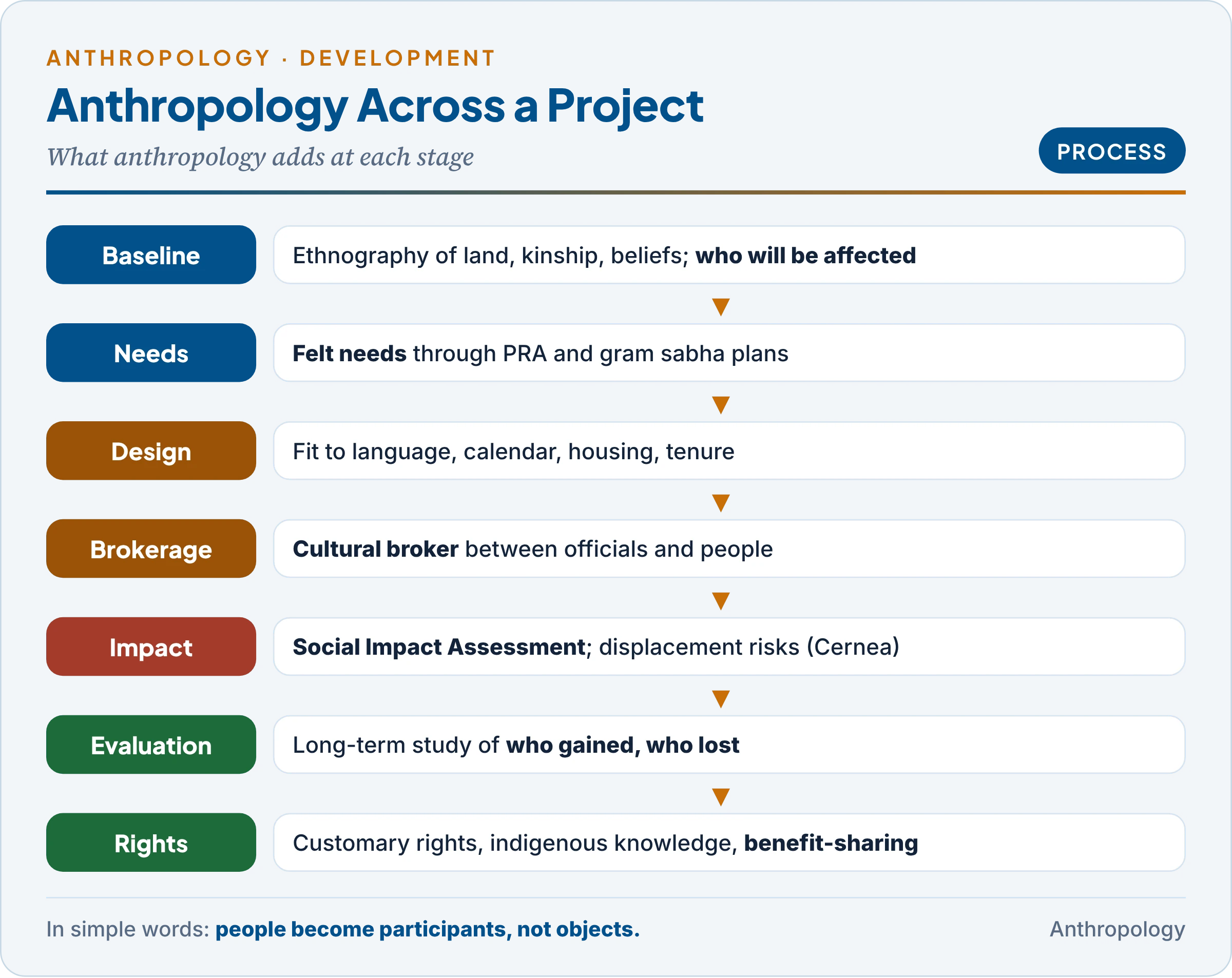
3.3 Roles across the project cycle
The table maps anthropology’s contributions onto the stages of a development project.
| Stage | Anthropological contribution | Tribal or rural example |
|---|---|---|
| Baseline | Ethnography of economy, kinship, land, beliefs; identifying the groups that will be affected | Tribal Research Institute baseline surveys of PVTGs |
| Needs and planning | Felt needs through participatory methods; plans made in the gram sabha | Village vision plans under the Adi Karmayogi campaign (2025) |
| Design | Fitting the scheme to culture: language, calendar, housing, tenure | Mother-tongue primers; houses near forest for forest-dependent groups |
| Communication | Cultural brokerage: explaining the scheme in local terms and local concerns to officials | Training officials posted to tribal areas |
| Impact assessment | Social Impact Assessment before land acquisition; risk analysis of displacement | LARR Act, 2013, sections 4–9: SIA with public hearings, reviewed by an expert group that includes two non-official social scientists |
| Evaluation | Long-term study of who gained and who lost | TRI and Programme Evaluation studies; ethnographies of projects |
| Rights and knowledge | Documenting customary rights and indigenous knowledge; benefit-sharing | FRA claim maps; the Kani–Jeevani arrangement (§4) |
Behind the table lies one idea: anthropology turns people from objects into participants of development. Cernea, who used anthropological research to write the World Bank’s resettlement rules, called this “putting people first” (1985); his Impoverishment Risks and Reconstruction model for displacement is in 6.3a.
3.4 Participatory methods
- RRA and PRA: the British development scholar Robert Chambers (Rural Development: Putting the Last First, 1983) criticised “rural development tourism”, in which experts visit roadside villages in the dry season and meet only the elite. Rapid Rural Appraisal and then Participatory Rural Appraisal use villagers’ own maps, transect walks, seasonal calendars, wealth rankings and Venn diagrams, so that local people analyse and plan. Full treatment is in Paper I (8b).
- Anthropology’s contribution: PRA borrows from ethnography (respect for local knowledge, the insider’s view), but is faster and more public.
- Critique: the British anthropologist David Mosse (1994), working on a project among the Bhil of western India, showed that PRA sessions are public performances in which powerful men speak and women stay silent; “local knowledge” can then simply reflect local power. His later book Cultivating Development (2005) followed the same project and showed how success is often produced by the project’s own reporting.
- Indian practice: gram panchayat and village development plans, PESA gram sabha plans and FRA community forest management plans all use participatory tools.
3.5 Anthropology in planning for tribal development
- Differentiated planning: the Dhebar Commission’s four layers of tribes and Vidyarthi‘s economic types (hunters, shifting cultivators, settled farmers, artisans, pastoralists, labourers) showed that one plan cannot fit all; the Tribal Sub-Plan therefore separated ITDP areas, MADA pockets and PVTGs (9.1a, 9.1b).
- Area plus group: anthropology insists that area development must be joined to the social group: roads and markets in a tribal block can benefit traders and moneylenders more than tribes unless protective measures go with them.
- Micro-planning: tribe-specific and hamlet-level plans, drawn up with the gram sabha and traditional councils, with the seasonal calendar of forest work, migration and festivals in view.
- Macro-planning problem: national plans need numbers; anthropology supplies depth. The solution lies in typologies, baseline surveys and sample ethnographies that let planners generalise without flattening difference.
- Monitoring: watching secondary effects (land transfers, alcohol, debt, loss of commons) that financial targets do not show.
3.6 Cultural and administrative factors together
Programmes fail as often from the side of the administration as from the side of culture.
| Cultural factors | Administrative factors |
|---|---|
| Land tenure and community ownership | Short tenures and punishment postings of officers |
| Kinship and reciprocity (sharing, labour exchange) | Departmental silos; no single-line authority over a tribal area |
| Religion and ritual calendar | Rigid schemes with uniform norms and deadlines |
| Customary councils and leadership | Language gap and contempt for tribal custom |
| Attitudes to money, debt and markets | Corruption and leakage; contractors’ interests |
The Shilu Ao Study Team (1969) and the Xaxa Committee (2014) both laid much of the blame for poor results on weak and insensitive administration rather than on tribal “backwardness”; anthropology’s task is to make the administration culturally competent.
3.7 Health and education
- Health: medical anthropology explains how tribes understand illness (spirits, breach of taboo, “hot” and “cold”) and why they use traditional healers first. The Expert Committee on Tribal Health chaired by Abhay Bang (2018) urged tribal-specific health plans, local health workers and respect for healers (6.2); sickle-cell screening needs counselling sensitive to marriage rules and stigma.
- Education: anthropology supports mother-tongue teaching in the early years, local teachers, calendars that fit agricultural and forest seasons, and curricula that include tribal knowledge; ignoring these produces drop-outs and alienation from community life.
3.8 Anthropology and rural development
- Village studies as baseline: monographs on Shamirpet (Dube, 1955), Rampura (Srinivas) and Kishan Garhi (Marriott) gave planners their first picture of caste, land and power in villages (5.1).
- Community Development: the Etawah pilot project (1948, led by the American planner Albert Mayer) and the national Community Development programme (1952) drew on village studies; Dube’s study of a CD block remains the classic analysis of why parts of it failed.
- Green Revolution: anthropological and sociological studies showed that gains went to larger farmers and widened inequality (7.2).
- Population and health: Mamdani’s study of the Khanna project (§1.4); later work on women’s health groups and community health workers (9.1b).
- Livelihoods and gender: studies of self-help groups, migration and women’s work shaped rural livelihood missions; Kerala’s Kudumbashree (1998) network of women’s neighbourhood groups shows how collective organisation, not credit alone, changes women’s position.
- Employment and accountability: social audits of rural works, first pressed by grassroots movements in Rajasthan, apply the anthropological habit of checking official records against village testimony.
4. Case Studies: Successes and Failures
In simple words
Where anthropological knowledge guided a programme and the community kept control, results were usually good. Where planners ignored culture or imposed decisions from outside, programmes failed or caused harm, even with large budgets.
Example first: Bidisa and the Lodha. The Lodha of Midnapore, West Bengal, were labelled a “criminal tribe” under colonial law and remained under police suspicion after denotification in 1952. P.K. Bhowmick, a student of N.K. Bose, studied them for his doctorate (The Lodhas of West Bengal, 1963) and from 1955 built a settlement-cum-research centre at Bidisa with a welfare society and an Institute of Social Research and Applied Anthropology. Families were settled on land, children went to school, and traditional festivals were revived to restore self-respect. The project shows the action anthropology formula: long fieldwork, a problem defined with the people, and a commitment that outlasts the research.
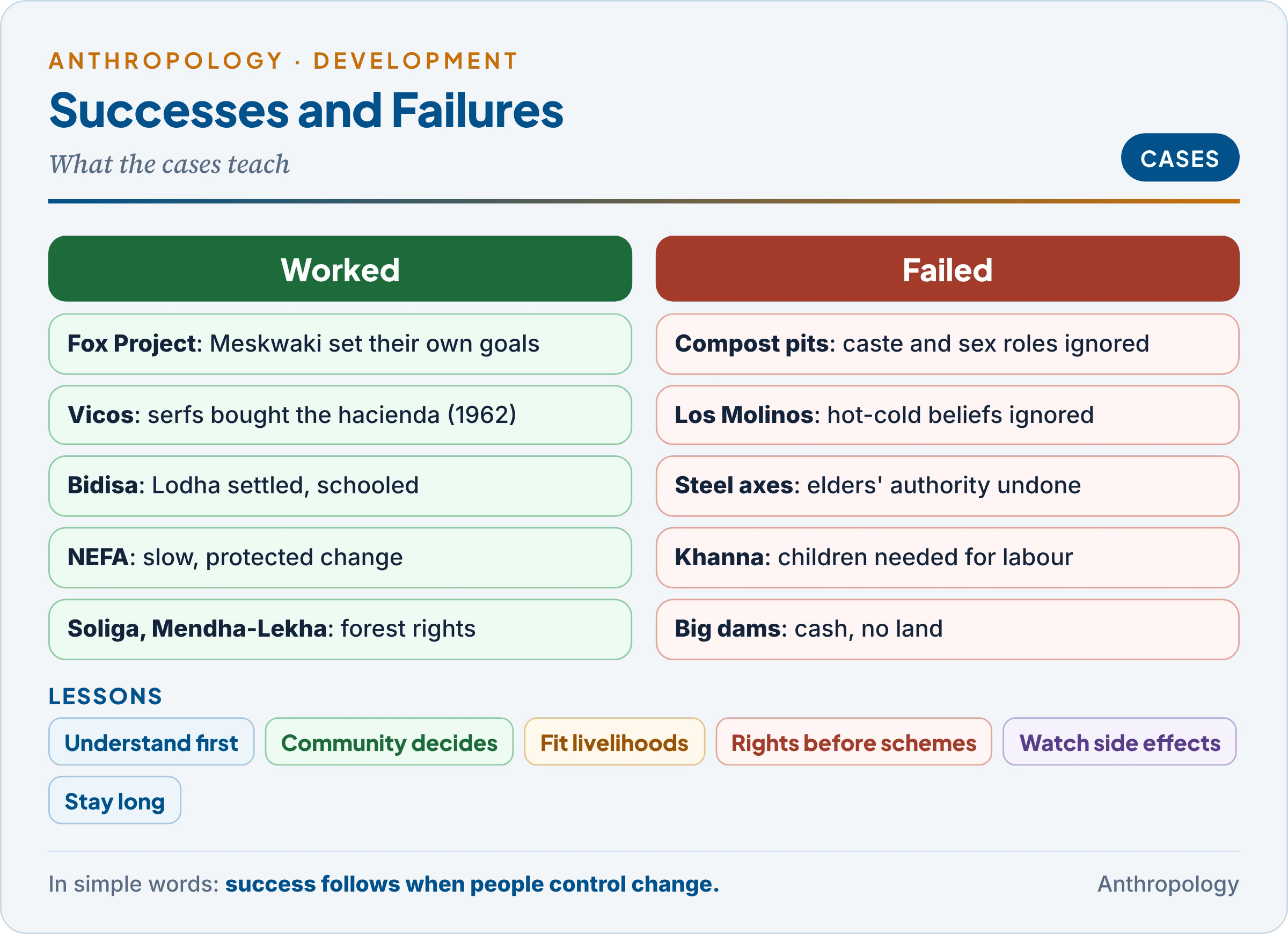
4.1 Successes
| Case | What anthropology did | Result |
|---|---|---|
| Fox Project (Meskwaki, Iowa, 1948–59) | Students helped the community pursue its own plans (scholarships, crafts enterprise) | Model of community-led change |
| Vicos (Peru, 1952–62) | Ended unpaid labour, introduced new crops, schools and elected leaders | Former serfs bought the hacienda (1962) |
| Bidisa (Lodha, from 1955) | Settlement, school, cultural revival | Stigmatised group gained land, schooling, leaders |
| NEFA (1954–64) | Elwin’s training and protective rules | Little land alienation; slow, chosen change |
| Soliga of BR Hills (2011) | Researchers and NGOs supported FRA claims | Community forest rights inside a tiger reserve (9.1b) |
| Mendha-Lekha (Gadchiroli) | Long study circles with outside supporters; decisions only by consensus of the gram sabha | Among the first community forest rights under FRA (2009); village-managed bamboo trade |
| Jarawa health policy | Minimum contact, preventive care | Population recovering (9.1b) |
4.2 Failures and partial failures
| Case | What went wrong | Lesson |
|---|---|---|
| Compost pits and shramdan (UP, 1950s) | Ignored caste and gender division of labour | Study social organisation first |
| Los Molinos (Peru) | Ignored hot-cold beliefs | Learn the local theory of health |
| Steel axes (Yir Yoront) | Gift undermined elders and trade | Watch unintended effects |
| Khanna family planning (Punjab) | Poor families needed children | Understand the economics of the household |
| Birhor settlement colonies (Jharkhand) | Houses far from forest; no livelihood | Fit design to the economy (9.1b) |
| Large dams (Hirakud, Sardar Sarovar) | Cash compensation, no land, cultural loss | Rehabilitation must rebuild livelihoods (6.3a) |
| Kani–Jeevani (Kerala, from 1995) | Half the licence fee and royalty shared with the Kani through a trust (1997), a pioneering model; but forest rules barred leaf collection and the trust faltered | Benefit-sharing needs secure rights and lasting institutions |
The two tables point to the same lessons: understand the culture before acting; let the community decide; fit schemes to livelihoods, not only to targets; protect rights first; watch unintended and long-term effects; and stay long enough for change to take root.
5. Strengths, Limitations and Critiques
In simple words
Anthropology’s strength is its close, long-term understanding of people’s lives. Its weaknesses are that it works slowly and on a small scale, rarely has the power to decide, and has sometimes been accused of wanting to keep tribes as they were. New questions of ethics arise as genetic data and artificial intelligence spread.
5.1 Strengths
- Holism: sees how a change in one field (land, crops, health) affects kinship, ritual and power.
- The insider’s view: long fieldwork and local languages reveal reasons that surveys miss.
- Focus on the marginal: women, small tribes and lower castes, whom averages hide.
- Cultural relativism: respect for other ways of life guards against “civilising” projects.
- Indigenous knowledge: forest, farming and healing knowledge as a resource, not a superstition.
- Indian institutional base: AnSI, TRIs and university departments with decades of data.
5.2 Limitations
- Micro and slow: detailed village studies are hard to scale into national plans; critics within Indian anthropology urged a move from micro studies to macro generalisations, and S.C. Dube warned against overselling applied social science as a science of human engineering.
- No executive power: anthropologists advise; administrators decide, often ignoring the advice.
- Language and timing: academic writing does not fit planning cycles; findings arrive after decisions.
- Romanticism: some work has idealised tribal life and treated change as loss.
- Co-option: anthropologists hired by agencies or companies may lend legitimacy to harmful projects; Ferguson’s “anti-politics machine” warns of this.
- Relativism versus intervention: if all cultures are valid in their own terms, by what right does an outsider change them? Most anthropologists answer that relativism forbids imposed change, not chosen change, and does not require silence about hunger, disease or exploitation.
- Disciplinary unease: the German anthropologist Michael Schönhuth (2002) found three objections inside the discipline: “purists” who separate science from use, “innocents” who fear destroying cultures before they are studied, and the “ethically correct” who see development itself as immoral.
5.3 The isolation–assimilation debate
- The charge: in the 1930s–40s Elwin proposed a protected “National Park” for the Baiga (The Baiga, 1939) where they could keep shifting cultivation away from exploiters; Ghurye (The Aborigines “So-Called” and Their Future, 1943) and the Gandhian A.V. Thakkar saw this as isolation that would keep tribes backward and apart from the nation. Anthropologists as a whole were branded “isolationists” and “zoo-keepers”.
- The reply: Elwin’s proposal was a temporary shield against land-grabbers, moneylenders and missions, not a permanent freeze, and he later shaped the integration policy of NEFA. Most anthropologists, including D.N. Majumdar (The Fortunes of Primitive Tribes, 1944), argued for integration.
- Verdict: history has partly vindicated the protective argument: where protection was weak (Chotanagpur, Bastar), land loss and conflict followed; where it was strong (much of the North-East), tribes kept land and identity. The real question was never isolation versus assimilation but who controls the pace and terms of change (4b, 9.1a).
5.4 Contemporary limits of tribal development and what anthropology offers
The table pairs today’s main limits with what anthropology can offer.
| Limitation today | Anthropological contribution |
|---|---|
| Top-down, uniform schemes | Tribe-specific and habitat-based plans |
| Land and forest loss for mines, dams and conservation | Free, prior and informed consent; gram sabha rights under PESA and FRA |
| Elite capture within tribes | Analysis of internal stratification; targeting the poorest groups |
| Data gaps (PVTGs never separately counted) | Ethnographic censuses and baseline surveys |
| Loss of language and knowledge | Mother-tongue education; documentation; benefit-sharing |
| Weak evaluation | Independent, long-term ethnographic evaluation by TRIs and universities |
| Climate stress on forest and rain-fed livelihoods | Use of local ecological knowledge in adaptation |
Most of these limits are about control: who plans, who owns the land and who judges success. Anthropology’s answer is consistent: move decisions closer to the community, and judge schemes by their effects on people’s own institutions and livelihoods, not only by targets met.
5.5 Ethics: genomics and artificial intelligence
- Consent and use of samples: the Havasupai of Arizona gave blood for diabetes research; when it was used for studies of migration and inbreeding without their consent, the university settled in 2010 and returned the samples. The case set the standard of community consent and limits on secondary use.
- India’s genomic turn: the GenomeIndia project released 10,000 whole genomes in January 2025, from 83 population groups, 30 of them tribal. Such data aid medicine (sickle-cell, drug response) but raise questions of consent, privacy, stigma and who benefits.
- Data sovereignty: the CARE principles for indigenous data (2019) ask that data about a people serve collective benefit, respect their authority to control it, and carry responsibility and ethics.
- Artificial intelligence: automated systems trained on majority data can misread or exclude tribal languages, faces and lives, and can strengthen surveillance; anthropology argues for local consent, cultural review of datasets, and human judgement in decisions.
- Field ethics: informed consent, protection of identities, return of findings to communities, and refusal to do research that harms the people studied (8a).
Key Terms
| Term | Meaning in simple words |
|---|---|
| Development | Planned change to improve people’s lives |
| Applied anthropology | Using anthropology to solve practical problems |
| Action anthropology | Working with a community toward its own goals |
| Participant intervention | Running a change programme and studying it |
| Development anthropology | Anthropology inside development agencies |
| Anthropology of development | Studying development itself, often critically |
| Cultural broker | Someone who explains each side to the other |
| Felt needs | Needs as the people themselves see them |
| Barriers to change | Cultural, social or psychological reasons for refusal |
| Unintended consequences | Effects of a change that no one planned |
| Social Impact Assessment | Study of a project’s effects on people before it starts |
| PRA | Methods by which villagers map, rank and plan themselves |
| Indigenous knowledge | Local people’s own knowledge of nature and health |
| Benefit-sharing | Giving communities a share of gains from their knowledge |
| Free, prior and informed consent | A community’s right to agree or refuse beforehand |
| Anti-politics machine | Ferguson’s term for depoliticising development |
Contemporary Developments
- Adi Karmayogi (2025–26): about 62,000 gram-sabha village plans prepared with trained local volunteers, a large-scale use of participatory planning.
- GenomeIndia (January 2025): 10,000 genomes from 83 groups, 30 tribal, opened to researchers, raising consent and benefit questions.
- Census 2027: the Ministry of Tribal Affairs has asked for separate enumeration of PVTGs.
- Great Nicobar (October 2026): the Supreme Court described the preservation of culture as a fundamental right while declining to stay High Court proceedings on forest rights.
- Rural employment: the VB-G RAM G Act, 2025 replaced MGNREGA from 1 July 2026, guaranteeing 125 days.
Diagrams to Master
- Topic map: concepts → Indian policy → project cycle → cases → strengths, limits, ethics.
- Modes of engagement: applied, action, participant intervention, development, anthropology of development, advocacy; three positions.
- Indian policy timeline: 1945 AnSI → Hyderabad → NEFA → Bose → 1972 Task Force → People of India → Xaxa 2014.
- Project cycle: baseline → needs → design → brokerage → SIA → evaluation → rights.
- Successes and failures: two columns with six lessons.
Revision Grid
| Scholar | Work (year) | Key idea |
|---|---|---|
| B. Malinowski | “Practical Anthropology” (1929) | Anthropology useful to administration |
| Sol Tax | “Action Anthropology” (1952); Fox Project (1948–59) | Help people help themselves |
| Allan Holmberg | Vicos project (1952–62) | Participant intervention |
| Lauriston Sharp | “Steel Axes for Stone-Age Australians” (1952) | Unintended consequences |
| Edward Wellin | Water boiling in Los Molinos (1955) | Health beliefs decide adoption |
| George Foster | Traditional Cultures and the Impact of Technological Change (1962) | Barriers and stimulants to change |
| S.C. Dube | India’s Changing Villages (1958) | Cultural factors in Community Development |
| L.P. Vidyarthi | Applied Anthropology in India (1968) | Anthropology for tribal planning |
| P.K. Bhowmick | The Lodhas of West Bengal (1963) | Action anthropology at Bidisa |
| Mahmood Mamdani | The Myth of Population Control (1972) | Large families as rational |
| Robert Chambers | Rural Development: Putting the Last First (1983) | RRA and PRA |
| Michael Cernea | Putting People First (1985) | Sociology in project design |
| James Ferguson | The Anti-Politics Machine (1990) | Development depoliticises |
| Arturo Escobar | Encountering Development (1995) | Post-development critique |
| David Mosse | 1994; Cultivating Development (2005) | PRA as performance; projects produce success |
Previous Year Questions
9.2 Role of anthropology in tribal and rural development
- 2025Identify the contemporary limitations in the process of tribal development. How can anthropological knowledge contribute in this process?
- 2024What are the ethical concerns in biological and socio-cultural anthropology because of recent advances in AI and genetic research?
- 2023Elucidate the role of anthropology in nation-building. Illustrate with suitable examples.
- 2022Briefly describe the anthropological perspective on development. How have anthropologists contributed in India’s rural development?
- 2018Examine the strengths and weaknesses of anthropology in the context of its role in tribal and rural development.
- 2016Describe how anthropological knowledge and methods are useful in rural development.
- 2015Examine in detail the role of anthropology in planning for tribal development.
- 2014Critically assess the role of anthropologists in rural development.
- 2013Discuss the significance of cultural and administrative factors in tribal development.
- 2013Discuss the criticism levelled against anthropology in the context of ‘Isolation, and assimilations debate’ on tribal populations.
- 2006Describe the role of anthropologists in Tribal Development.
- 2005Write a note on Role of anthropologists in rural development.
- 2004Anthropologists are better equipped to play an effective role in rural and tribal development. Discuss.
- 1997Write a note on Role of Anthropologists as an Administrator.
- 1994Write a note on Role of Anthropology in tribal development.
- 1992Write a note on Role of anthropology in tribal development.
- 1987Write a note on Anthropological approach to tribal development.
- 1985Discuss the role of Anthropology to planning and executing developmental programmes among the tribal communities.
- 1984Write a note in 200 words : Role of anthropology in tribal development.
- 1981How does applied anthropology help to solve some of the different problems confronting Administrators in tribalareas ?
Related questions from other units
- 2012Unit 9.3: Using examples, comment on how anthropology can be utilized in policy making.
- 2012Unit 9.1: Write a note in 150 words on Participatory Rural Appraisal.
- 2001Unit 6.3: Indicate the main thrust of anthropological studies on development induced displacement and rehabilitation. Suggest a worthwhile rehabilitation package for displaced tribals to retain their sense of community-belonging.
- 2000Unit 12: What is planning from below ? Critically assess the role of anthropology towards implementing sustainable development.
- 1999Unit 1.3: Write a note on Action anthropology.
- 1997Unit 12: Critically examine the anthropological approaches to planning and socioeconomic development among the weaker sections of the Indian society, highlighting the issues of macroplanning in anthropology.
- 1992Unit 1.3: Write an essay on the aims and scope of applied anthropology with special reference to India.
- 1989Unit 12: What is meant by Applied Anthropology? Explain its methods and scope in Indian context.
- 1984Unit 12: Distinguish between: Applied and action anthropology.
- 1982Unit 9.1: How are cultural factors important in planning and executing development programmes among simple communities ?
More from Tribal Administration and Development: all notes of this unit · every PYQ of this unit · Anthropology Optional hub