

Anthropology Optional › Paper II › Unit 08: Religions, Tribes and the Nation-State
8.2 Tribe and nation state – a comparative study of tribal communities in India and other countries.
Official Syllabus: Paper II, Unit 8.2
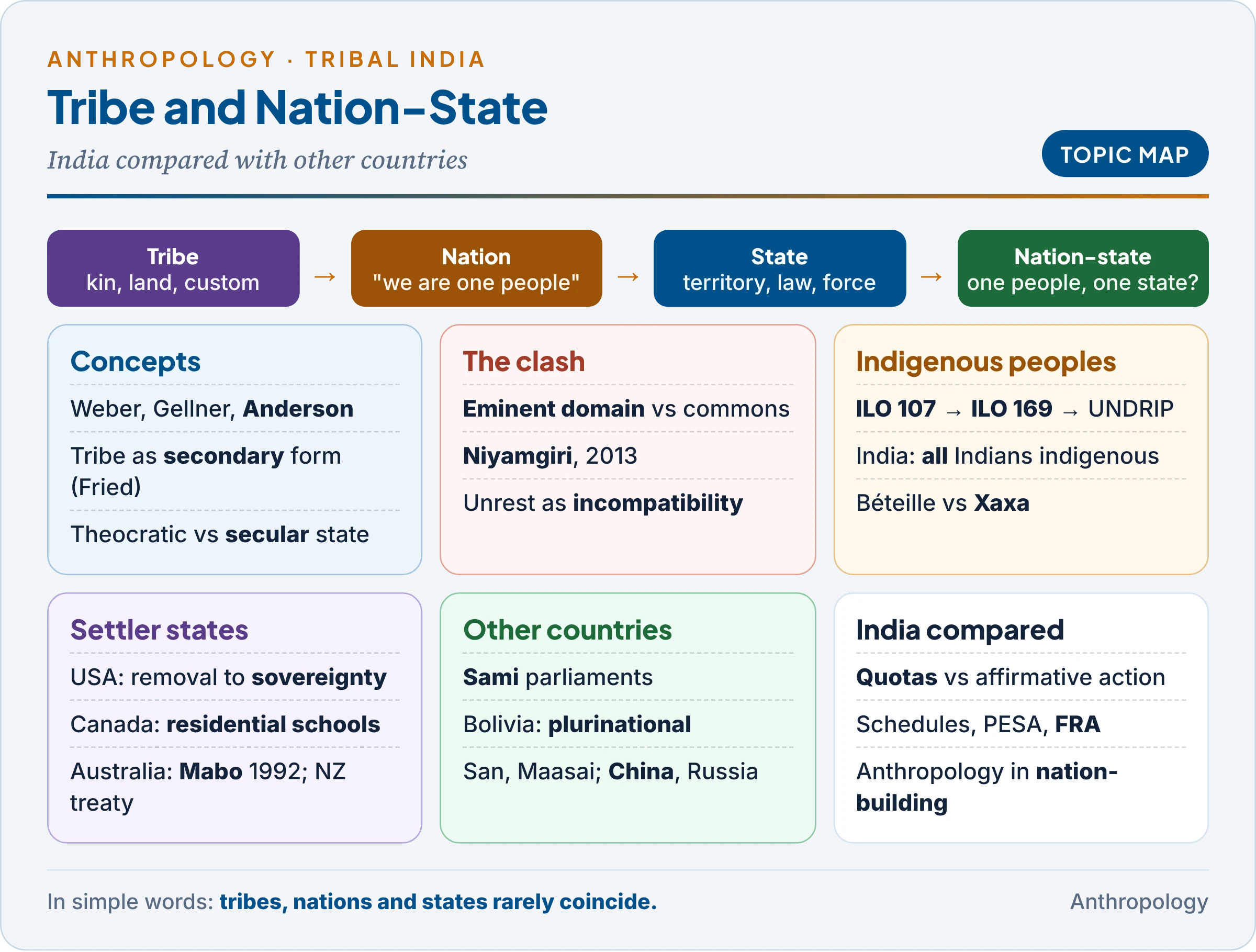
This article compares how states, India among them, treat the tribal and indigenous peoples inside their borders. The Fifth and Sixth Schedules are explained in 7.1, Nehru’s Tribal Panchsheel in 7.2, national integration in 7.3a, and the colonial administration of tribal areas in 7.3b and 9.1a; each is summarised here only where a comparison needs it.
1. Tribe, Nation and State: The Concepts
In simple words
A state is a government that rules a fixed territory with its own laws, army and courts. A nation is a people who feel they belong together because of shared history, language or culture. A nation-state claims to be the home of one nation, and tribes often sit uneasily inside it because they have their own sense of peoplehood and their own ties to land.
Example first: the Naga claim to be a nation. In 1951 the Naga National Council under A.Z. Phizo held a plebiscite in which, by its own count, almost all voters chose independence. The Indian state saw the Naga Hills as part of the territory it inherited from British India; many Nagas saw themselves as a nation that had never agreed to join any state. In Indian law the same people were Scheduled Tribes; in their own politics they were a nation. Nagaland became a state in 1963, and talks with Naga groups still continue. The case shows the core problem: tribe, nation and state are different kinds of unit, and they rarely coincide.
1.1 State, nation and nation-state
The three words are often used as if they meant the same thing. The table separates them.
| Term | Meaning | Key scholar | Example |
|---|---|---|---|
| State | A political organisation claiming supreme authority over a territory | Max Weber: the state claims the monopoly of the legitimate use of physical force in a territory (“Politics as a Vocation”, 1919) | The Indian Union |
| Nation | A people who see themselves as one community through shared history, language or myths | Benedict Anderson: an “imagined community” (1983) | The Naga or Mizo sense of peoplehood |
| Nation-state | A state whose boundaries are claimed to coincide with one nation | Ernest Gellner: the political and the national unit should be congruent (1983) | Iceland, Portugal, Japan |
| Multinational state | A state that openly contains several peoples | Anthony D. Smith: nations grow from an ethnic core, the ethnie (1986) | India, Switzerland, China |
- Weber, the German sociologist, stressed force and territory: the state claims the last word over land, forest and law everywhere, including where a tribe has its own customary authority.
- Gellner, the British-Czech philosopher and anthropologist (Nations and Nationalism), linked nationalism to industrial society, which needs one language, mass schooling and mobile labour. Modern states therefore push cultural uniformity, and small, distinct groups feel this push most.
- Anderson, the Irish-born political scientist (Imagined Communities), showed that nations are built through print, schools, maps and censuses. This explains how “Naga” or “Jharkhandi” identities were made through contact (the theory of ethnicity is in 7.3a).
Why this matters: the nation-state idea assumes one people per state, and almost no state fits it. The gap produces minorities, and tribes are the minorities whose claims rest most on land and prior presence.
1.2 Types of state in relation to their peoples
States differ in how close they come to “one nation, one state”.
| Type | Feature | Examples |
|---|---|---|
| Near-ideal nation-state | Ethnic and political boundaries largely coincide | Iceland, Portugal; Japan, though it has the indigenous Ainu of Hokkaido |
| Multinational state | Several language or ethnic groups share one political identity | Switzerland (four national languages), India |
| Stateless nation | A strong national identity but no state | Kurds across Turkey, Iraq, Iran and Syria |
| Settler state | Built by colonists on lands of indigenous peoples who became minorities | USA, Canada, Australia, New Zealand |
In settler states the line between “indigenous” and “settler” is sharp and recent. In India, centuries of migration and mixing blur it. This single difference explains much of India’s position on the word “indigenous” (§3).
1.3 Tribe and nation: are tribes “nations”?
- Tribe as a political form: Marshall Sahlins, the American anthropologist (Tribesmen, 1968), described tribes as segmentary societies of similar kin units with no central ruler, between band and chiefdom.
- Tribe as a product of states: Morton Fried, an American anthropologist (The Notion of Tribe, 1975), argued that most historically known tribes were “secondary” formations, shaped by states and colonial powers that needed bounded units to rule, tax and count. Colonial censuses in India did the same (see 7.3b).
- Tribes as nations: in North America many peoples call themselves nations (the Navajo Nation, Canada’s First Nations); the word claims political standing. George Manuel called them the “Fourth World” (1974).
- Tribes that built states: Surajit Sinha, the Indian anthropologist, showed in “State Formation and Rajput Myth in Tribal Central India” (1962) how Bhumij chiefs became kings by claiming Rajput descent; the Gond kingdom of Garha-Mandla and the Ahom kingdom of Assam are further examples. The tribe–state relation is old and two-way.
Common confusion
If First Nations are “nations”, are Indian tribes nations too? Not in law. In Canada and the USA, treaties signed with indigenous peoples gave them a recognised political status, so “nation” carries legal weight. Indian tribes hold no such treaties (accords such as the Mizo Accord of 1986 work within the Constitution); their special status comes from the Constitution (Scheduled Tribes, Fifth and Sixth Schedules). Some movements, such as the Naga, still claim nationhood.
1.4 Theocratic state and secular, liberal, democratic state
A theocratic state draws political authority from religion: rulers govern in the name of God or as sacred persons, and religious law is state law. A secular, liberal, democratic state keeps the state apart from any one religion, rests authority on the consent of citizens and protects individual rights, including freedom of belief.
| Point | Theocratic state | Secular, liberal, democratic state |
|---|---|---|
| Source of authority | God, sacred law or a sacred ruler | The people, through a constitution and elections |
| Law | Religious law is state law | Made by legislatures, equal for all faiths |
| Examples | Vatican City; Iran since 1979; historic Tibet under the Dalai Lamas; Shilluk divine kingship | India (secularism part of the basic structure, S.R. Bommai, 1994); France (1905 separation law); USA (First Amendment) |
- Tribal theocracy: E.E. Evans-Pritchard, the British anthropologist, described the Shilluk of southern Sudan, whose king (reth) embodied the founding hero Nyikang, so that the king’s health stood for the kingdom’s welfare (The Divine Kingship of the Shilluk, 1948). In the Himalaya, Sikkim‘s Buddhist Chogyal kings ruled from 1642 until Sikkim joined India in 1975.
- Separation within tribes: among the Munda, the headman (munda) handles secular affairs and the priest (pahan) the rites; among the Santal, the manjhi and the naeke are different men. Ritual and political life are linked but not fused.
- Today: India’s secular Constitution protects tribal faiths (Article 25) and lets Sixth Schedule councils apply customary law; the demand for a Sarna religion code in the Census uses a secular state’s language of rights (see 8.1).
2. Why Tribes and Nation-States Clash
In simple words
The modern state wants one law, clear borders and full control over land and minerals. Many tribes live by customary law, hold land and forest in common, and have kin across borders. When the state builds dams, mines or fences, these two ways of organising life collide, and the result can be protest or rebellion.
Example first: Niyamgiri. The Dongria Kondh of the Niyamgiri hills (Odisha) worship the hilltop as the seat of their god Niyam Raja. A company planned to mine its bauxite. For the state the minerals were national wealth; for the Dongria the hill was a sacred being and the source of their streams and forest food. In April 2013 the Supreme Court (Orissa Mining Corporation v. Ministry of Environment and Forests) ruled that the gram sabhas of the affected villages must decide whether the project harmed their religious and forest rights; all twelve gram sabhas consulted rejected it. The case shows two logics over the same land, and one way a democracy can settle the clash: by consulting the people.
2.1 Two logics
Real cases are mixtures, but the contrast explains why conflict recurs.
| Domain | Nation-state logic | Tribal logic |
|---|---|---|
| Authority | One supreme authority over the whole territory | Authority in clans and village councils |
| Land | Private or state property; eminent domain (the state’s power to take land for public use) | Community land tied to ancestors and deities |
| Resources | Minerals and forests belong to the state | Forest, water and hills are sacred commons |
| Law | One written law | Customary law, settled by elders |
| Boundaries | Fixed international borders | Kin and trade across borders |
| Development | Growth in output and income | Security, autonomy and continuity |
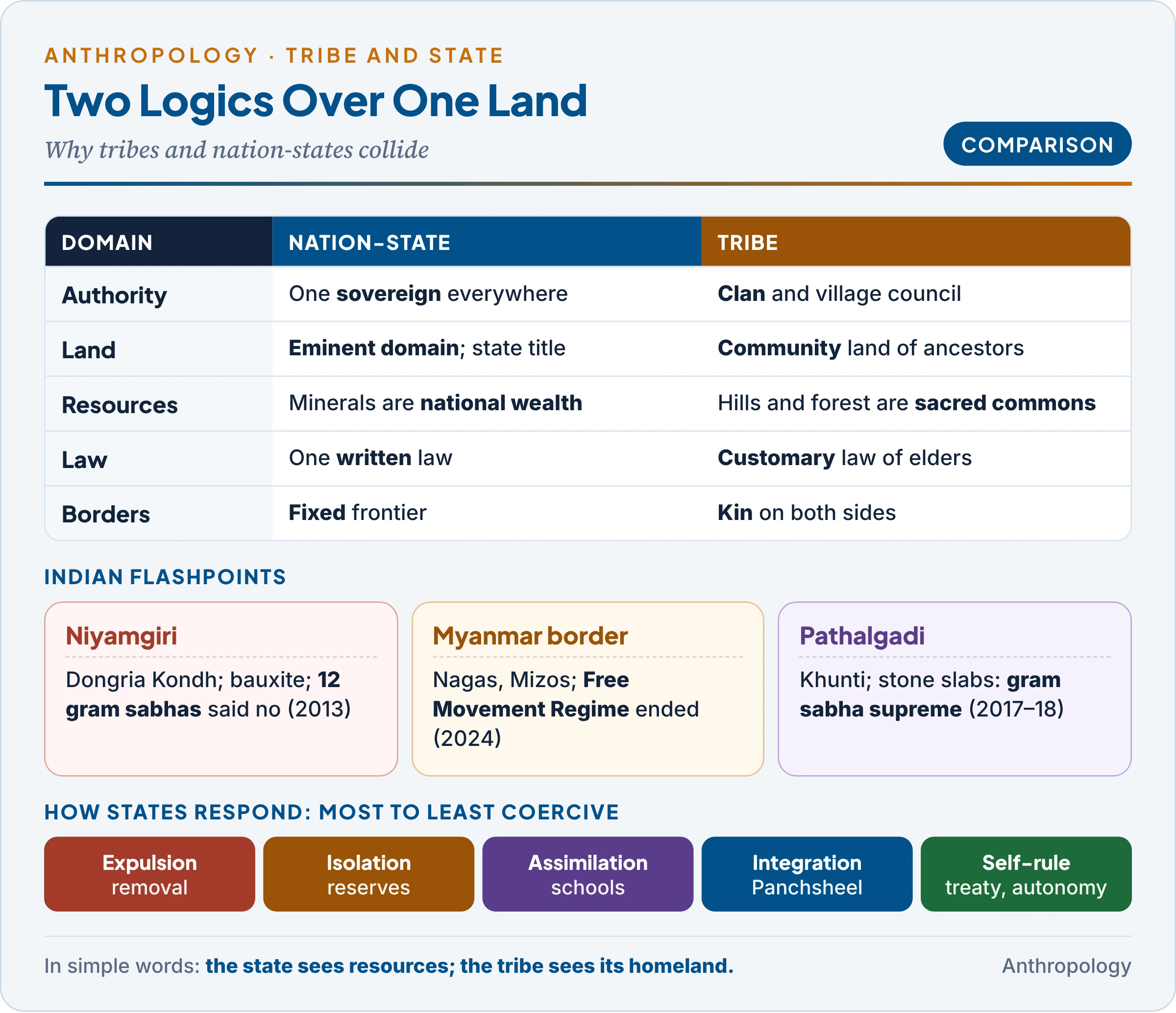
Unrest so often follows projects because the state sees national resources where the tribe sees its homeland. Consent mechanisms (gram sabha decisions under PESA and the Forest Rights Act) reduce conflict because they let the tribal logic speak inside the state’s own procedures.
2.2 Anthropological readings
- Pierre Clastres, a French anthropologist (Society Against the State, 1974), argued from Amazonian peoples that some societies actively prevent a ruling power from forming: chiefs had prestige but no command. Such tribes are not “pre-state” but anti-state by design.
- James C. Scott, an American political scientist and anthropologist (The Art of Not Being Governed, 2009), described the uplands of South-East Asia, which he called Zomia (reaching into north-east India), as a refuge where hill peoples escaped lowland states through shifting cultivation, mobility and oral tradition. Roads and fenced borders have since closed most such refuges.
- The Indian debate: G.S. Ghurye saw tribes as “backward Hindus” to be absorbed; Verrier Elwin first favoured protection, then helped shape integration in the North-East (the debate is in 4b). Virginius Xaxa, the tribal sociologist, argues that tribes are peoples with a claim to self-governance, not only “backward” citizens awaiting development.
2.3 How states have dealt with tribes: five responses
States have answered the tribal question in five broad ways, from the most to the least coercive.
| Response | What the state does | Examples |
|---|---|---|
| Extermination or expulsion | Kills or drives out the people to take land | Tasmania (nineteenth century); US Indian Removal (1830s) |
| Isolation | Keeps them apart in reserves | US reservations; British India’s excluded areas (1935) |
| Assimilation | Erases language and custom | Residential and boarding schools in Canada, the USA and Australia; Soviet policy in the North |
| Integration | Joins them to national life with safeguards for identity | India’s Panchsheel and Schedules |
| Self-determination | Recognises self-government, land and treaties | Nunavut (1999); Sami parliaments; US tribal self-determination (1975); Bolivia (2009) |
Settler states moved, slowly and unevenly, down this list. India began at integration in 1950, but practice often slid towards assimilation (schooling in dominant languages) and dispossession (projects).
2.4 Tribal unrest as incompatibility with the nation-state
Tribal unrest can be read as a mismatch between tribal life and the demands of the nation-state. Four points of friction recur; causes and cases of unrest are detailed in 7.3a.
- Territory: Nagas, Mizos and Chins live on both sides of the India–Myanmar border. In February 2024 the Union government announced the end of the Free Movement Regime, which had let hill people within 16 km of the border cross without visas; later rules allowed regulated passes within 10 km. Naga and Mizo bodies objected that the border divides clans and families.
- Resources: mines and dams in Jharkhand, Odisha and Chhattisgarh turn homelands into national resource zones (see 6.3a).
- Authority: the Pathalgadi movement in Khunti (Jharkhand, 2017–18) erected stone slabs declaring the gram sabha supreme, quoting the Fifth Schedule; the state treated parts of it as unlawful.
Why this reading matters: it moves the explanation from “lawless tribes” to structural friction, so the remedy lies in institutions that make room for difference (autonomy, consent, customary law within the Constitution), not only in policing.
2.5 Tribes and the nation-state on issues of governance
| Issue | Tension | India’s present answer | Weakness |
|---|---|---|---|
| Land | Loss to outsiders and projects | Fifth Schedule regulations; Samatha (1997); LARR Act 2013 | Benami transfers; acquisition for “public purpose” |
| Forest | State control versus customary use | Forest Rights Act 2006; community forest resource rights | Rejected claims; slow recognition |
| Self-rule | Officials versus village councils | PESA 1996; Sixth Schedule councils | Weak state rules; councils short of funds |
| Representation | Small numbers in national politics | 47 reserved Lok Sabha seats | Elite capture; party control |
3. Indigenous Peoples: The International Frame and India’s Position
In simple words
Since the 1950s international bodies have written rules to protect “indigenous and tribal peoples”, the descendants of those who lived in a land before conquest or colonisation and who keep their own ways. India supports these rights in general but says that all Indians are indigenous, so the label cannot belong to tribes alone. Its tribes are protected instead as Scheduled Tribes under the Constitution.
3.1 Who are “indigenous peoples”?
José R. Martínez Cobo, the UN Special Rapporteur whose study was completed in 1986–87, gave the most cited working definition: indigenous peoples have a historical continuity with pre-invasion and pre-colonial societies on their lands, see themselves as distinct from the now-dominant sectors, are non-dominant, and want to pass on their territories and identity. Four marks recur: priority in time, cultural distinctiveness, self-identification and experience of subjugation. The UN Declaration deliberately gives no definition, so that peoples can identify themselves.
3.2 From ILO 107 to UNDRIP
International law moved from integration to self-determination in fifty years. The table follows the three main instruments.
| Instrument | Spirit | Key points | India |
|---|---|---|---|
| ILO Convention 107 (1957), Indigenous and Tribal Populations | Integration; paternal protection | Covered “tribal and semi-tribal populations”; protected land but treated distinct cultures as a stage to pass through | Ratified 29 September 1958; still in force for India |
| ILO Convention 169 (1989), Indigenous and Tribal Peoples | Respect for distinct cultures as permanent | Self-identification (Art. 1); consultation in good faith (Art. 6); peoples set their own development priorities (Art. 7); rights to lands traditionally occupied (Art. 14); relocation only with free and informed consent, save exceptions (Art. 16) | Not ratified; in force for 24 states (2024), the latest being Germany (2021) |
| UNDRIP (13 September 2007) | Self-determination and collective rights | Autonomy in internal affairs (Arts. 3–4); no forcible removal without free, prior and informed consent (Art. 10); FPIC before projects (Art. 32); contacts across borders (Art. 36); states’ territorial integrity protected (Art. 46) | Voted in favour (143 for, 4 against, 11 abstentions), with an understanding (§3.3) |
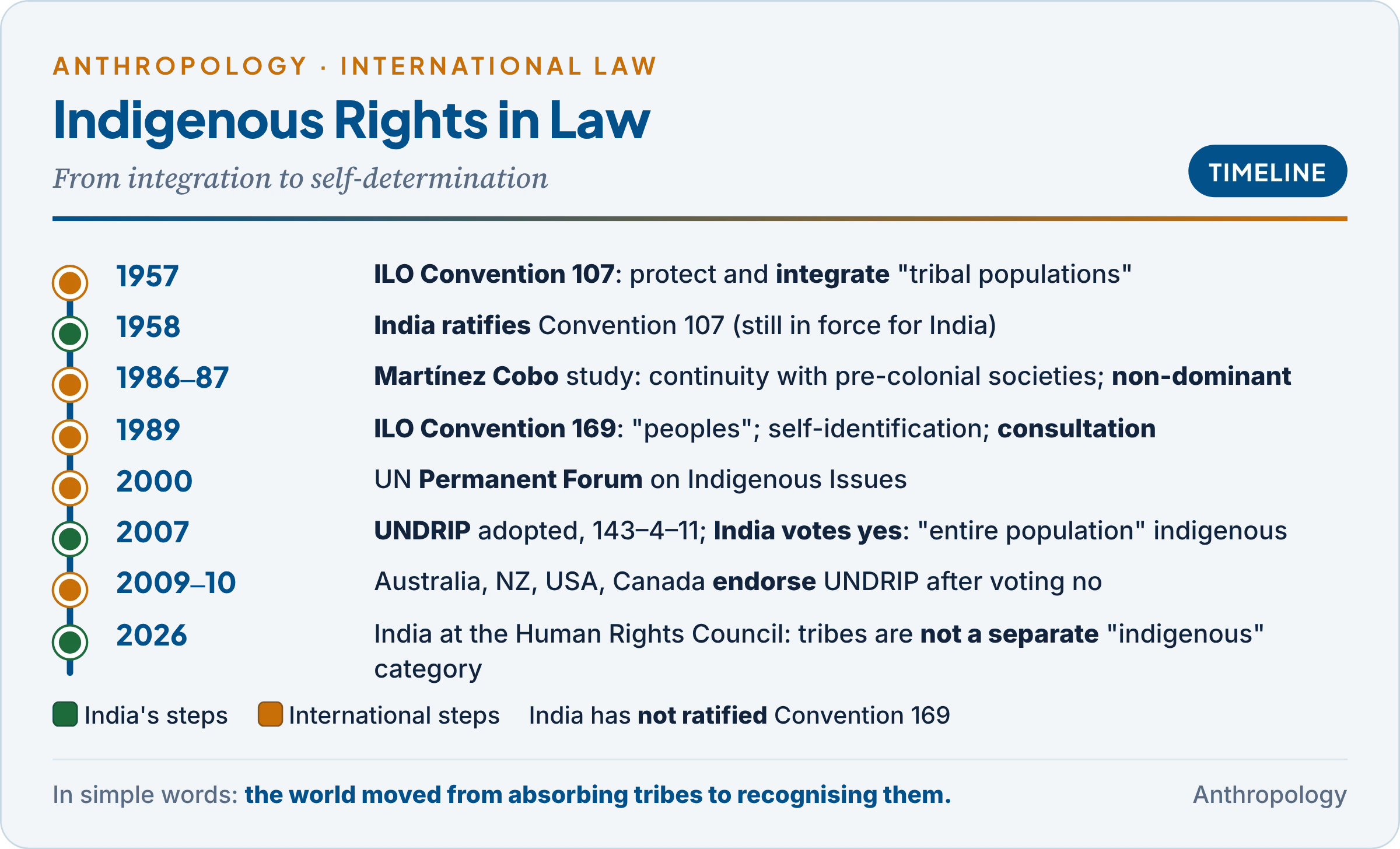
- The shift explained: Convention 107 assumed tribes would and should merge into the nation; by the 1980s indigenous organisations rejected this as assimilation by law. Convention 169 replaced “populations” with “peoples” (a word implying collective rights) and made consultation central. UNDRIP went on to self-determination, but within existing states.
- The four objectors: Australia, Canada, New Zealand and the USA voted against UNDRIP in 2007, fearing land claims and vetoes; all four endorsed it by 2010 (Australia 2009; New Zealand, the USA and Canada 2010). Bolivia made it national law first (Law 3760, November 2007); Russia abstained.
3.3 India’s position: “all Indians are indigenous”
At the General Assembly in 2007 India read indigenous rights as belonging to peoples descended from the inhabitants at the time of conquest or colonisation, the Convention 169 definition, and declared: “we regard the entire population of India at the time of our independence, and its successors, to be indigenous.” It added that self-determination applies only to peoples under foreign domination and cannot impair a state’s territorial integrity. The argument has three parts:
- No settler colonisation: India had no settler majority that displaced a native population.
- Long mixing: millennia of migration and intermarriage make “who came first” unanswerable.
- Protection already exists: Scheduled Tribes have reserved seats, the Schedules, PESA and the Forest Rights Act.
India restated this view in September 2026 at the Human Rights Council, calling references in an expert study to its tribal communities as “indigenous peoples” contrary to its constitutional framework.
Common confusion
Did India reject the UN Declaration on indigenous peoples? No. India voted for UNDRIP in 2007, and for its draft at the Human Rights Council in 2006. It rejects only the idea that its tribes alone are indigenous, and any reading of self-determination as a right to secede. It has ratified the older ILO Convention 107 but not Convention 169. Note that Convention 169 covers “tribal peoples” as well as indigenous peoples, so Indian tribes would fall within it as tribal peoples even on India’s own reading.
3.4 The anthropological debate: tribe or indigenous?
Anthropologists disagree on whether the word “indigenous” helps or harms in India.
| Against using “indigenous” in India | For using “indigenous” for Indian tribes |
|---|---|
| André Béteille, the Indian sociologist (“The Idea of Indigenous People”, 1998): the idea fits settler societies; in India first-comers cannot be separated from late-comers, and the term may create new hierarchies of belonging | Virginius Xaxa (“Tribes as Indigenous People of India”, 1999): tribes are non-dominant, territorially rooted and culturally distinct, and were colonised internally; the term captures their collective claim to land and self-rule |
| Adam Kuper, the South African-born anthropologist (“The Return of the Native”, 2003): the concept revives the idea of “primitive” peoples and rests on descent, which can justify excluding others | Benedict Kingsbury, the New Zealand legal scholar (1998), on the “Asian controversy“: use a flexible set of indicators (self-identification, attachment to land, non-dominance, distinct culture) rather than strict priority |
Neither side denies that India’s tribes suffered land loss and marginalisation. The dispute is over what follows: Béteille and Kuper fear a politics of origins that sorts citizens by ancestry; Xaxa and Kingsbury see a politics of rights for non-dominant peoples. The Adivasi (“original inhabitant”) movement uses the word as a claim to dignity. The Constitution’s answer is a third way: protection by status (Scheduled Tribe), not by origin.
3.5 “Tribe” in India versus “indigenous” elsewhere
| Point | “Scheduled Tribe” in India | “Indigenous” in other countries |
|---|---|---|
| Basis | Administrative listing (Article 342) | Self-identification plus historical priority |
| Historical frame | Colonial classification of “backward” groups | Settler colonisation and dispossession |
| Rights | Welfare, reservation, protective laws | Collective land title, treaties, self-government |
| Weakness | Uneven lists across states (705 groups at the 2011 Census; Hattee added in 2023 by political decision) | Hard proof of continuity (Australian native title); blood-quantum rules (USA) |
“Tribe” in India is a category of the state’s making that tribes have turned into a political identity; “indigenous” abroad is increasingly a category of self-assertion that states have been made to recognise.
4. Comparative Studies: Tribal and Indigenous Peoples in Other Countries
In simple words
The USA, Canada, Australia and New Zealand were built by European settlers on land taken from indigenous peoples, who went through war, removal, forced assimilation and, recently, apology and limited self-rule. Africa and Asia had different histories, because colonisers there ruled but did not settle in large numbers. These cases help us judge India’s record.
4.1 United States: from removal to tribal sovereignty
- Removal: the Indian Removal Act (1830) forced eastern peoples west of the Mississippi; on the Trail of Tears (1838–39) an estimated 4,000 Cherokee died.
- Allotment: the Dawes Act (1887) broke reservations into individual plots and sold the “surplus”; tribal land fell from about 138 million to 48 million acres by 1934. The aim was to dissolve the tribe into individual farmers.
- Boarding schools: a federal inquiry (2024) listed 417 schools and at least 973 child deaths; President Biden apologised on 25 October 2024.
- Reorganisation: citizenship (1924); the Indian Reorganization Act (1934) ended allotment; after a failed 1950s “termination” of tribes, the Self-Determination Act (1975) reversed course.
- Sovereignty today: 575 federally recognised tribes (the Lumbee added by law in December 2025) act as “domestic dependent nations” with their own governments, courts and police. Tribal casinos (Indian Gaming Regulatory Act, 1988) enriched some tribes and not most. In McGirt v. Oklahoma (2020) the Supreme Court held the Muscogee (Creek) reservation had never been dissolved. Poverty and diabetes remain far above the national average.
4.2 Canada: residential schools and reconciliation
- The Indian Act (1876) made the government guardian of “Indians” and for decades banned ceremonies such as the potlatch (the North-west Coast gift feast studied by Franz Boas).
- At least 150,000 First Nations, Inuit and Métis children passed through church-run, state-funded residential schools until the late 1990s. The Truth and Reconciliation Commission (2008–2015) called the policy “cultural genocide” and issued 94 Calls to Action.
- Section 35 of the Constitution Act, 1982 affirms “existing aboriginal and treaty rights”; the Inuit territory of Nunavut was created on 1 April 1999; the UNDRIP Act followed in 2021. Indigenous people number about 1.8 million, 5% of the population (2021).
4.3 Australia: from terra nullius to native title
- Terra nullius (“land belonging to no one”) let Britain treat Australia as empty in 1788, so no treaties were made.
- Stolen Generations: between about 1910 and 1970, between one in three and one in ten Aboriginal children were removed from their families (Bringing Them Home, 1997); Prime Minister Kevin Rudd apologised on 13 February 2008.
- Mabo v Queensland (No 2) (3 June 1992): the High Court rejected terra nullius and recognised the native title of the Meriam people of the Torres Strait; the Native Title Act 1993 followed. Claimants must show a continuing connection under traditional law, which many dispossessed groups cannot.
- Voice referendum (14 October 2023): a constitutional Aboriginal and Torres Strait Islander Voice to Parliament was defeated, 60.06% voting No and no state voting Yes. Indigenous Australians number 812,728, 3.2% (2021); Closing the Gap (2020) tracks gaps in health, schooling and imprisonment.
4.4 New Zealand: a treaty and biculturalism
- Treaty of Waitangi (6 February 1840): the English text ceded sovereignty; the Māori text ceded kawanatanga (governance) while guaranteeing tino rangatiratanga (full chieftainship). The two readings still shape politics.
- The Waitangi Tribunal (1975; claims back to 1840 from 1985) has led to settlements; Māori seats have existed since 1867 (seven today); te reo Māori is official since 1987.
- Nature as a person: the Te Urewera Act 2014 and Te Awa Tupua (Whanganui River) Act 2017 gave legal personhood to a forest and a river, following the Māori view of land as kin.
- A Treaty Principles Bill redefining the Treaty was defeated 112–11 on 10 April 2025. About one in six New Zealanders is Māori (2023).
4.5 Scandinavia: the Sami
- The Sami of Norway, Sweden, Finland and Russia’s Kola Peninsula faced policies of “Norwegianisation” that suppressed their language in schools.
- Protests against the Alta dam (1979–81) led to reform: Sami Parliaments in Norway (1989), Sweden (1993) and Finland (1996); Norway was the first state to ratify ILO 169 (1990).
- In the Fosen case (11 October 2021) Norway’s Supreme Court held that wind farms on reindeer pastures violated the herders’ right to enjoy their own culture (Article 27, International Covenant on Civil and Political Rights); settlements with the herders followed by 2024. Even rich welfare states face the clash between “green” development and indigenous land use.
4.6 Latin America: Bolivia’s plurinational state
- Evo Morales, an Aymara, became Bolivia’s first indigenous president in 2006. The 2009 Constitution made Bolivia a “Plurinational State”, guaranteed self-determination of indigenous nations within the unity of the state and made Spanish and 36 indigenous languages official.
- A highway through the TIPNIS indigenous territory (2011) set lowland peoples against that same government: recognition did not end the conflict between extraction and territory.
4.7 Africa: indigenous minorities in states of many tribes
Nationalism in India and Africa. In India the freedom movement built a mass national identity on shared civilisational symbols; Partha Chatterjee (The Nation and Its Fragments, 1993) argued that Indian nationalists conceded Western superiority in the material sphere but claimed sovereignty in the spiritual sphere of religion, family and culture. In Africa, borders drawn at the Berlin Conference (1884–85) enclosed many tribes in one colony, and mission Christianity spread widely, so leaders sought other unifying ideas: Ethiopianist churches that broke away over racism in mission hierarchies, Léopold Senghor‘s négritude (pride in Black African values), Pan-Africanism. Mahmood Mamdani, the Ugandan scholar (Citizen and Subject, 1996), showed how British indirect rule turned “native authorities” and customary law into tools of control, making tribe an administrative unit of the colonial state.
| Point | India’s states for tribes | Africa’s “tribal” nation-states |
|---|---|---|
| Status | Units of a federation (Nagaland 1963, Meghalaya 1972, Mizoram 1987; Jharkhand, Chhattisgarh 2000) | Sovereign states |
| Tribe and state | Tribes are minorities (8.6%) with protective rights | Tribes are building blocks of national politics; ethnic voting and patronage |
| Conflict | Autonomy movements met by statehood or councils | Civil war and secession bids (Biafra, 1967–70); genocide in Rwanda (1994) |
| Borders | Redrawn by Parliament | Colonial borders kept by the OAU’s 1964 decision |
Indigenous peoples in Africa. Since almost all Africans are literally “indigenous”, the term is used for hunter-gatherer and pastoral minorities marginalised by farmer-dominated states; the African Commission on Human and Peoples’ Rights adopted its Working Group’s report on them in 2003.
- San (Botswana): after removals from the Central Kalahari Game Reserve, the High Court held on 13 December 2006 (Sesana) that residents had been deprived of their land without consent.
- Ogiek (Kenya): the African Court held on 26 May 2017 that evictions from the Mau Forest violated their rights to land, culture and religion.
- Maasai (Tanzania): in June 2022 the government demarcated 1,500 sq km of Loliondo as a game reserve and promoted relocation from Ngorongoro; it calls the relocation voluntary, while UN experts and rights groups reported forced evictions. The case mirrors Indian disputes over tiger reserves.
4.8 Asia: China, Russia, Japan and India’s neighbours
Asian states, like India, mostly avoid the word “indigenous” but handle minorities very differently.
| Country | Category | Arrangement | Note |
|---|---|---|---|
| China | 55 minority nationalities (shaoshu minzu), 8.89% (2020) | 155 autonomous areas (5 regions, 30 prefectures, 120 counties) | Fei Xiaotong‘s “pluralistic unity” (1988); UN bodies criticise assimilation pressures |
| Russia | About 40 “small-numbered” peoples of the North, Siberia and Far East (under 50,000 each; about 250,000 people) | 1999 law; clan communities, traditional-use territories | Soviet collectivisation and oil and gas extraction disrupted herding; RAIPON (1990) represents them |
| Japan | Ainu | Diet resolution (2008); Ainu Promotion Act (2019) | Recognition after long assimilation |
| Bangladesh | “Tribes, minor races, ethnic sects and communities” (2011 amendment) | Chittagong Hill Tracts Accord (1997) with hill councils | Rejects “indigenous” in law, like India |
| Philippines | Indigenous cultural communities | Indigenous Peoples’ Rights Act (1997): ancestral domain titles, FPIC | Strong law, uneven enforcement |
The Asian cases show that institutions matter more than labels: Bangladesh and India reject “indigenous” yet have autonomy councils; China recognises nationalities yet keeps tight central control; the Philippines grants title, but enforcement depends on the state’s will.
5. India Compared: Protection, Autonomy and Affirmative Action
In simple words
India never fought wars of removal against its tribes and wrote their protections into its Constitution from the start. But tribes still lost land to dams, mines and parks, and self-rule laws are weakly applied. Other countries give stronger land titles and self-government, often after a far more brutal past. Each side can learn from the other.
5.1 India’s model in brief
- Constitutional safeguards: STs are notified under Article 342; the Fifth Schedule gives the Governor powers over land transfer and regulation with Tribes Advisory Councils, and the Sixth Schedule sets up 10 autonomous district councils in Assam, Meghalaya, Tripura and Mizoram (both explained in 7.1).
- Philosophy: Nehru’s Panchsheel (1959) asked that tribes develop “along the lines of their own genius“, keep their land and forest rights and be governed through their own institutions (record assessed in 7.2).
- Laws: PESA 1996, the Forest Rights Act 2006, the LARR Act 2013. The meaning of integration and “mainstream” is discussed in 7.3a.
5.2 Affirmative action in the USA and protective discrimination in India
Both countries use law to help groups that suffered historic injustice, by very different means. Marc Galanter, the American legal scholar (Competing Equalities, 1984), called India’s system “compensatory discrimination”; Indian usage also says “protective discrimination”.
| Point | USA: affirmative action | India: protective discrimination for STs |
|---|---|---|
| Origin | Executive orders of 1961 (EO 10925) and 1965 (EO 11246) | The Constitution (1950) |
| Beneficiaries | Racial minorities and women; Native Americans as members of political units (tribes) | Notified Scheduled Tribes as groups |
| Method | Outreach, goals, diversity in admissions; quotas barred (Regents v. Bakke, 1978) | Quotas: 7.5% of central posts and seats; reserved legislative seats (Articles 330, 332) |
| Legal base | Equal protection, read strictly | Articles 15(4), 16(4), 46, 335; National Commission for STs (Article 338A, 2003) |
| Limits now | SFFA v. Harvard (2023) ended race-conscious admissions; EO 14173 (January 2025) revoked EO 11246 | 50% ceiling (Indra Sawhney, 1992), with the EWS exception (2022) |
| Critique | Benefits to the better-off; now largely dismantled | Benefits captured by advanced tribes; unfilled posts; no creamy layer for STs |
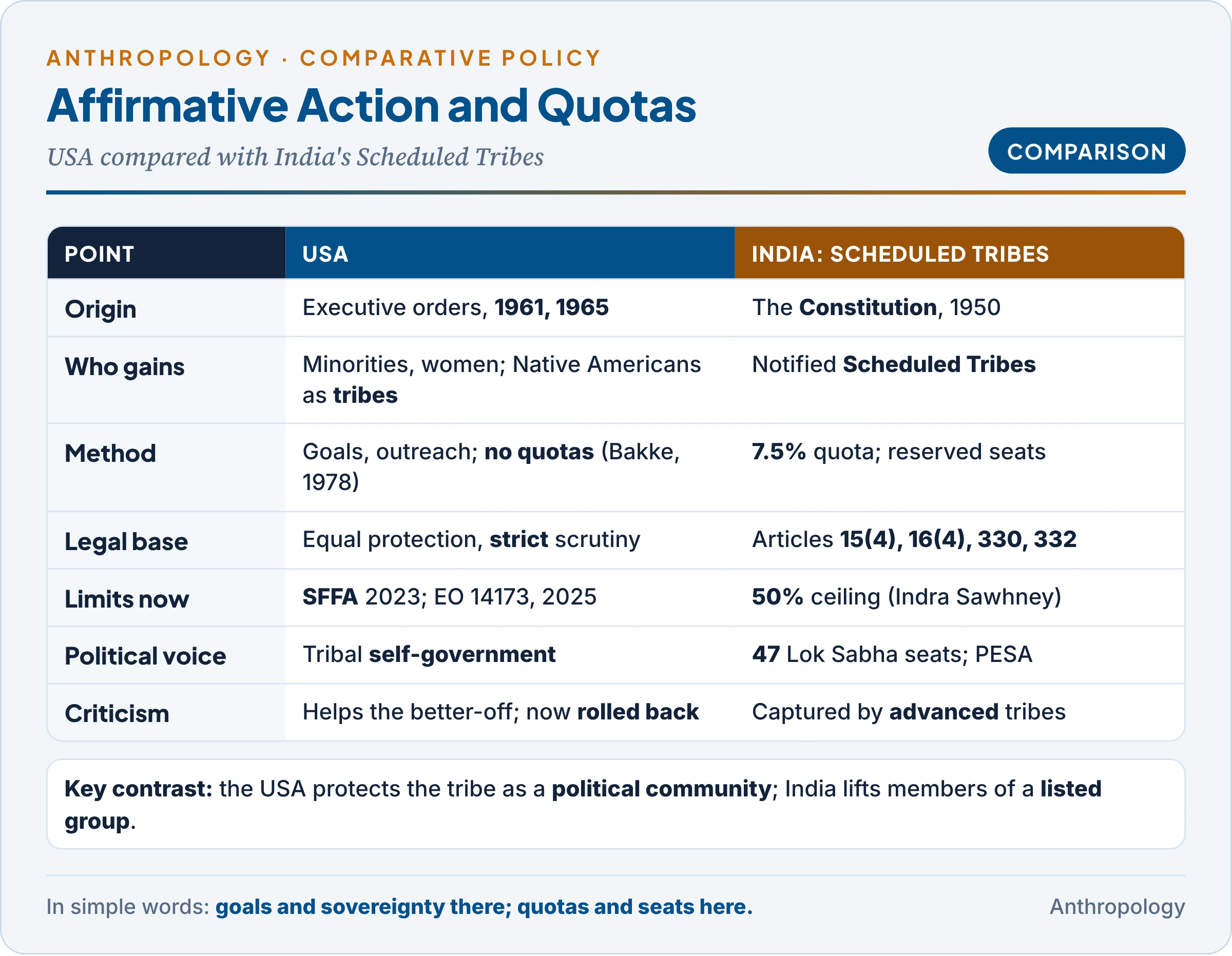
- The key contrast: US preferences for Native Americans rest on tribal political status (the Supreme Court upheld an Indian hiring preference as political, not racial, in Morton v. Mancari, 1974); Indian ST benefits rest on a constitutional list. India gives quotas and reserved seats; the USA gives self-government and land held in trust.
- Why it matters: quotas bring individuals into jobs and legislatures but do little for collective land and self-rule; sovereignty protects the collective but leaves many members poor. A complete policy needs both.
5.3 India and other countries: the overall comparison
| Dimension | India | Settler states | Others (Nordic, Bolivia, Africa, China) |
|---|---|---|---|
| History | Colonial land and forest laws; no settler majority | Conquest, removal, settler majority | Assimilation; conquest; colonial borders |
| Category | Scheduled Tribe (listed) | Indigenous, First Nations, native title | Sami; indigenous nations; nationalities |
| Land | Protective laws, forest rights | Trust land, treaties, native title | Grazing rights; territories; weak in Africa |
| Self-rule | Sixth Schedule councils, PESA | Tribal governments, Nunavut | Sami parliaments; autonomous regions |
| Facing the past | No formal apology; the Forest Rights Act admits “historical injustice“ | Apologies (Australia 2008, Canada 2008, USA 2024); truth commissions | Norway’s commission (2023) |
India’s formal framework compares well: few countries reserve legislative seats or write protections into the founding constitution. Its weakness lies in implementation and land loss, where the recent turn elsewhere to title, consent (FPIC) and truth-telling offers lessons; in turn, India’s guaranteed representation and territorial autonomy are models others have debated. Every case, from Norway to Bolivia, meets the same conflict when national development meets indigenous land.
6. Anthropology and Nation-Building
In simple words
Anthropologists study how people live and what they value. New states needed this knowledge to understand their many communities, write fair laws and plan development that people would accept. In India, anthropologists helped shape tribal policy, the lists of Scheduled Tribes and the idea of unity in diversity.
- Knowing the people: the Anthropological Survey of India (1945, first director B.S. Guha) documented communities; the People of India project under K.S. Singh (from 1985) profiled 4,635 communities and showed how much they share as well as how they differ.
- Shaping policy: Verrier Elwin, adviser for tribal affairs in NEFA, wrote A Philosophy for NEFA (1957), whose 1959 edition carried Nehru’s Panchsheel; ethnographic knowledge informed the Dhebar Commission (1960–61) and the Lokur criteria (1965), and Virginius Xaxa chaired the high-level committee of 2014. B.D. Sharma, as Commissioner for SCs and STs (1986–91), and B.K. Roy Burman argued for tribal self-rule, ideas that fed into PESA.
- Integration as a two-way process: N.K. Bose described the “Hindu method of tribal absorption”; Surajit Sinha explained the tribe–caste continuum. Both told the state that integration is slow and reciprocal, not an order.
- Beyond India: Ruth Benedict‘s The Chrysanthemum and the Sword (1946) informed American policy in post-war Japan; Talal Asad (Anthropology and the Colonial Encounter, 1973) warned that anthropology had also served colonial rule.
Why this matters: a state that does not know its peoples governs them by uniform rules that fit no one. Anthropology supplies the local knowledge, comparison and respect for difference that let integration work without assimilation.
Key Terms
| Term | Meaning in simple words |
|---|---|
| State | A government with supreme authority over a territory |
| Nation | A people who feel they form one community |
| Nation-state | A state claimed to be the home of one nation |
| Settler state | A state built by colonists on indigenous land |
| Eminent domain | The state’s power to take land for public use |
| Secondary tribe | A tribe shaped by contact with states (Fried) |
| Zomia | Scott’s name for the hill zone where peoples escaped states |
| Indigenous peoples | Descendants of pre-colonial inhabitants who stay distinct and non-dominant |
| Self-identification | Being recognised as indigenous because a people says so |
| FPIC | Free, prior and informed consent before projects on indigenous land |
| Terra nullius | “Land belonging to no one”, a fiction used to deny native rights |
| Native title | Traditional land rights recognised by courts (Australia) |
| Plurinational state | A state recognising several nations within it (Bolivia) |
| Protective discrimination | Reservation and special laws for disadvantaged groups in India |
| Affirmative action | US measures to widen opportunity for minorities and women |
| Theocracy | A state ruled in the name of religion |
Contemporary Developments
- India at the UN (September 2026): India told the Human Rights Council that its entire population is indigenous and rejected references to its tribal communities as “indigenous peoples”.
- India–Myanmar border: Naga bodies in Manipur sought restoration of the Free Movement Regime in 2025, citing kin across the border.
- USA: the Lumbee became the 575th federally recognised tribe (December 2025); federal contractor affirmative action ended with EO 14173 (2025).
- New Zealand: the Treaty Principles Bill was defeated 112–11 (April 2025).
Diagrams to Master
- Topic map: six themes with one case each.
- Two logics: state versus tribe on authority, land, resources, law and borders; three Indian flashpoints; five state responses.
- Indigenous rights timeline: 1957, 1958, 1986–87, 1989, 2000, 2007 (143–4–11), 2010, 2026.
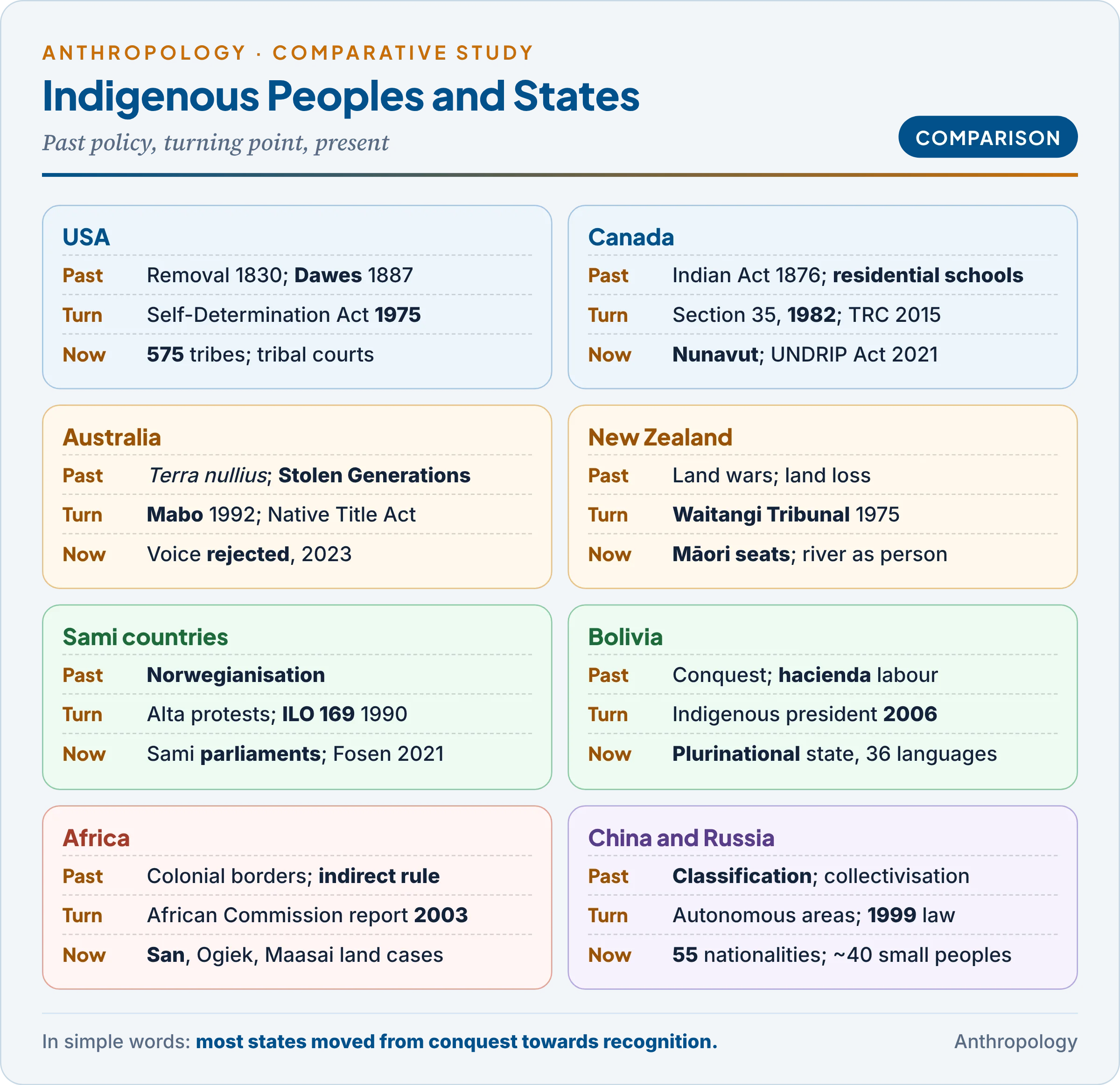
- Country grid: past policy, turning point and present arrangement for eight cases.
- Affirmative action versus protective discrimination: origin, method, legal base, limits, critique.
Revision Grid
| Scholar | Work (year) | Key idea |
|---|---|---|
| Max Weber | “Politics as a Vocation” (1919) | State as monopoly of legitimate force |
| Ernest Gellner | Nations and Nationalism (1983) | Political and national units should be congruent |
| Benedict Anderson | Imagined Communities (1983) | Nations imagined through print and schools |
| Morton Fried | The Notion of Tribe (1975) | Tribes as secondary formations |
| Pierre Clastres | Society Against the State (1974) | Societies that prevent a ruling power |
| James C. Scott | The Art of Not Being Governed (2009) | Zomia: hill peoples escaping states |
| Surajit Sinha | “State Formation and Rajput Myth” (1962) | Tribal chiefs became Rajput kings |
| André Béteille | “The Idea of Indigenous People” (1998) | “Indigenous” fits settler societies, not India |
| Virginius Xaxa | “Tribes as Indigenous People of India” (1999) | Tribes as non-dominant, territorial peoples |
| Adam Kuper | “The Return of the Native” (2003) | Indigenism revives “primitive” and descent |
| Mahmood Mamdani | Citizen and Subject (1996) | Indirect rule made tribe an administrative unit |
| Partha Chatterjee | The Nation and Its Fragments (1993) | Material and spiritual spheres of nationalism |
| Marc Galanter | Competing Equalities (1984) | Compensatory discrimination |
Previous Year Questions
8.2 Tribe and nation state – a comparative study of tribal communities in India and other countries
- 2025Critically evaluate the concept of Nation-State and describe its impact on indigenous societies.
- 2024Write notes on: Describe ILO’s Convention No. 169 on Indigenous and Tribal people. Is India a signatory to it?
- 2024Distinguish a ‘Theocratic State’ from a secular, liberal, democratic state. Illustrate your answer with examples from tribal and contemporary societies.
- 2023Elucidate the role of anthropology in nation-building. Illustrate with suitable examples.
- 2019Discuss with appropriate examples how tribal unrest may be understood as emerging out of an incompatibility between tribes and the nation-state.
- 2017Critically evaluate the term ‘tribe’ (as used in India) as compared to the term ‘indigenous’ in some other countries.
- 2015Critically compare ‘Affirmative Action’ of USA and ‘Protective Discrimination for Scheduled Tribes in India.
- 2012Critically examine the relationship between tribal communities and the Nation-State on issues of governance.
- 2001What do you know by tribe and nation? How do states carved for tribals in India differ from tribal-nation states in Africa? Discuss.
Related questions from other units
- 2024Unit 9.3: Elucidate the resurgence of ethno-nationalism from an anthropological lens.
- 2012Unit 6.1: Discuss the concept of ‘indigenous people’ as per the relevant UN convention. Are tribals of India indigenous people ? Comment.
- 2008Unit 6.1: Write a note on Tribes as Indigenous Cultures.
- 2007Unit 7.3: Discuss the anthropological understanding of rising ethnicity among Indian tribes in the context of nation-building.
- 1987Unit 7.3: What suggestions would you like to make as an anthropologist for bringing the tribal peoples in the national mainstream without obliterating their separate identity.
- 2023Unit 3: Discuss the impact of globalization on the economic systems of indigenous communities.
- 2020Unit 9.8: Describe the impact of infectious diseases on indigenous populations.
- 2019Unit 3: Discuss how indigenous people encounter globalization.
- 2005Unit 12: Discuss the relationship of ethnicity and nation-state.
- 2002Unit 12: Write a note on Nation State.
More from Religions, Tribes and the Nation-State: all notes of this unit · every PYQ of this unit · Anthropology Optional hub