

Anthropology Optional › Paper II › Unit 07: Scheduled Castes, Scheduled Tribes and OBCs
7.4 Social Movements among Tribal society
Official Syllabus: Paper II, Unit 7.4
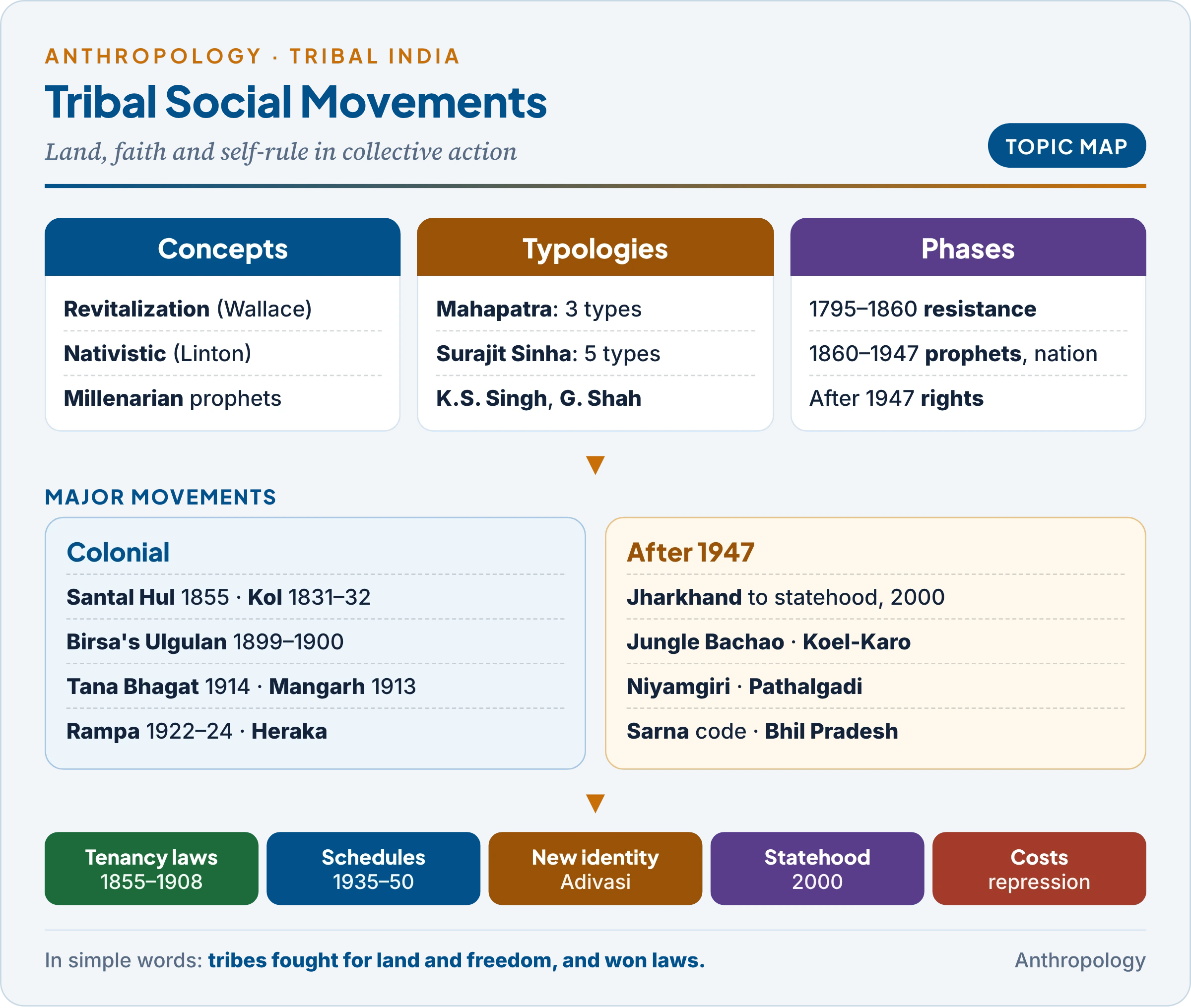
This article covers tribal social movements: concepts, typologies, phases, major cases, causes and consequences. Ethnicity, ethnic conflict, unrest and autonomy demands (including North-East insurgency and Left-wing extremism) are in 7.3; displacement in 6.3a; forest policy in 6.3b; religious change and the Sarna movement in 8.1; and K.S. Singh as a scholar in 4b.
1. Understanding Tribal Social Movements
In simple words
A social movement is a group of people acting together, over time, to change (or to protect) some part of their society. Tribes in India rose against loss of land, forests and freedom more often than almost any other group. Their movements mixed religion, land and politics, and they changed both tribal society and the laws of the state.
Example first: the Santal Hul of 1855. On 30 June 1855, thousands of Santals gathered at Bhognadih in the Damin-i-Koh (the Rajmahal hills tract settled by Santals) to hear the brothers Sido and Kanhu Murmu. The brothers said that Thakur (the supreme deity) had commanded them to end the rule of moneylenders, zamindars, police and the Company and to restore Santal rule. The rising was crushed by January 1856, but the government created a separate Santal Parganas district (Act XXXVII of 1855) with simpler administration. The Hul shows three features found in most tribal movements: a material grievance (land and debt), a religious charter (a divine command through a prophet), and an outcome in law that recognised the tribe as a special case.
1.1 What makes a social movement
The Indian anthropologist L.K. Mahapatra, who studied movements in eastern India, described a social movement as a large number of people deliberately banding together for collective action to alter, restore, protect or create parts of their culture or social order, or to redistribute power in their favour. Three elements follow from this idea:
- Collective action that lasts beyond a single clash, through meetings, symbols and organisation.
- Ideology: a shared idea of what is wrong and what a better order would be (for the Mundas, abua raj, “our rule”).
- Change-orientation: the goal is to change or defend a social order, not merely to settle a private dispute.
1.2 Concepts borrowed from Paper 1
Tribal movements are often analysed with concepts from the anthropology of religion and change. The table sets out the main ones and an Indian case for each.
| Concept | Scholar (year) | Meaning | Indian case |
|---|---|---|---|
| Revitalization movement | Anthony F.C. Wallace (1956) | “A deliberate, organized, conscious effort by members of a society to construct a more satisfying culture” | Birsa’s new faith; Tana Bhagats |
| Nativistic movement | Ralph Linton (1943) | An attempt to revive or perpetuate selected parts of one’s own culture under contact | Seng Khasi; Heraka |
| Millenarian movement | Stephen Fuchs, Rebellious Prophets (1965); K.S. Singh (1966, 1983) | Expectation of a sudden, total transformation of the world, led by a prophet | Birsa’s Ulgulan; early Tana Bhagats |
| Sanskritization movement | M.N. Srinivas; Surajit Sinha | Claiming higher status by adopting upper-caste practices | Bhumij claims to Kshatriya rank; Bhagat vegetarianism |
| Relative deprivation | David Aberle (1962) | Movements arise when people feel a gap between what they expect and what they get | Educated tribal elites leading statehood demands |
These concepts overlap. Birsa’s movement was revitalizing (a reformed faith), millenarian (a coming kingdom), and political (an end to colonial rule) at the same time. Wallace (an American anthropologist who studied the Seneca) described a sequence: a steady state, rising individual stress, cultural distortion, then a prophet’s vision that is communicated, organised and adapted until it produces a new steady state. Indian prophets of 1855–1914 fit it, because colonial rule disrupted land, law and religion at once.
Common confusion
Is every tribal “movement” a “revolt”? No. A revolt is an armed outbreak, usually short. A movement is the wider, longer effort of which a revolt may be one episode. The Tana Bhagat movement had no armed revolt at all: it worked through prayer, refusal of rent and non-cooperation. The Jharkhand movement worked mostly through parties and elections.
1.3 Why tribes rose so often
Under colonial rule, tribes rebelled more often and more violently than almost any other community. Verrier Elwin, the missionary-turned-anthropologist of central Indian tribes, traced most tribal rebellions to a single source: the loss of land and forests. The main reasons were:
- Land revenue and tenure: communal tenures such as the Munda khuntkatti (the land of the lineage that first cleared the forest) were turned into saleable private property under landlords and revenue farmers (thikadars).
- Dikus: moneylenders, traders and landlords from the plains (dikus, outsiders) entered under colonial protection; interest of 50–500% produced debt bondage (kamioti among the Santals).
- Courts and police: written law, distant courts and corrupt police favoured the literate outsider; begar (forced unpaid labour) served officials and landlords.
- Forest laws: reservation of forests and bans on shifting cultivation (podu in the Godavari hills) cut off food and livelihood.
- Missions: Christian missions brought schools and a new elite but also division between converts and non-converts (8.1).
2. Classifying Tribal Movements
In simple words
Scholars have sorted tribal movements in different ways: by their aim (to go back, to stay as they are, or to change), by their content (religion, land, autonomy), or by region. No single scheme is perfect, because real movements often combine several aims at once.
2.1 The main typologies
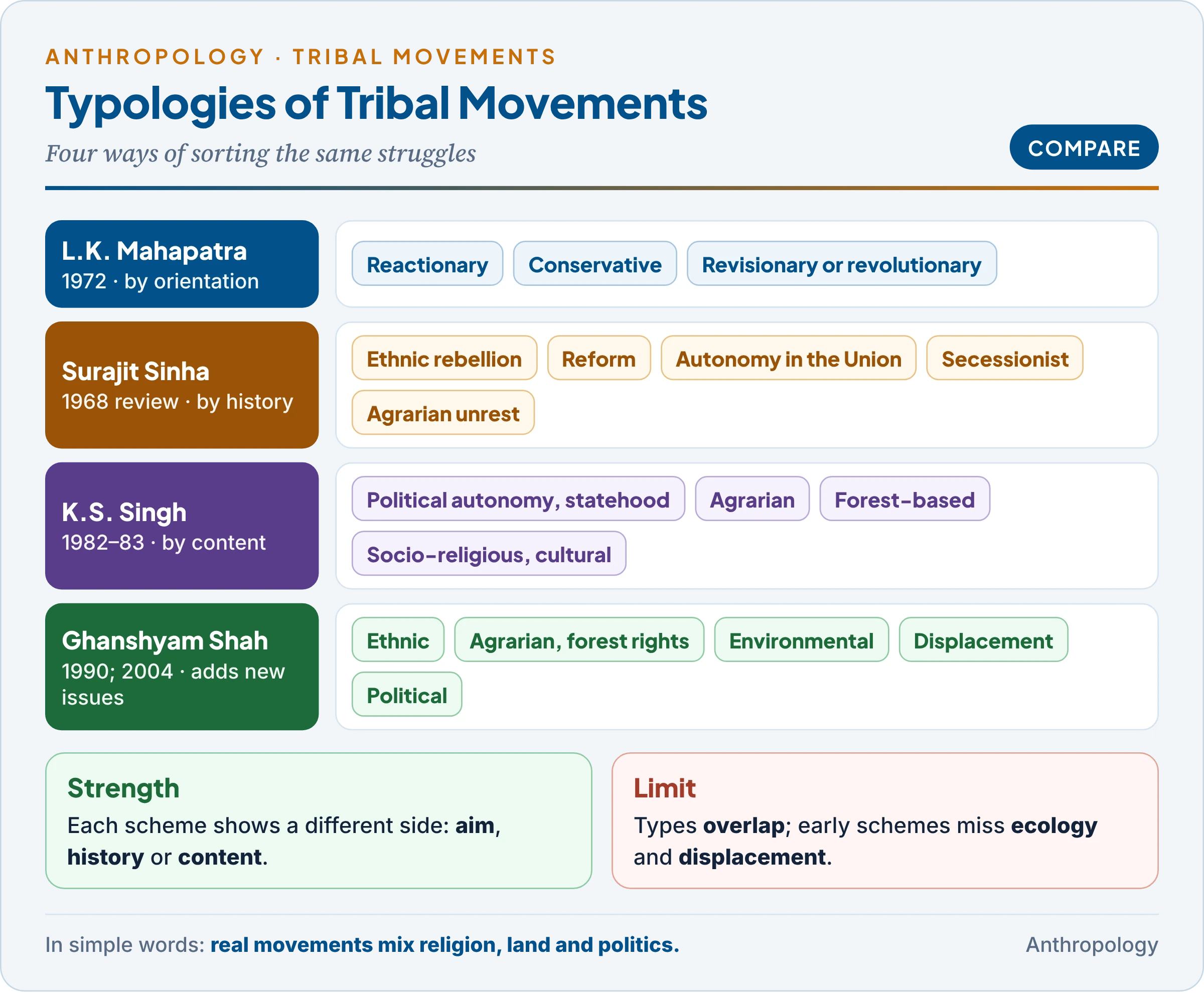
The table compares the best-known classifications. Read across a row for each scholar’s emphasis.
| Scholar (year) | Types | Emphasis |
|---|---|---|
| L.K. Mahapatra (1972) | Reactionary (back to the “good old days”), conservative (keep the status quo), revisionary or revolutionary (purify or remake the social order) | Orientation to change; leaves out political movements |
| Surajit Sinha (review of “tribal solidarity movements”, 1968; in The Tribal Situation in India, 1972) | (1) ethnic rebellion, (2) reform movements, (3) political autonomy within the Indian Union, (4) secessionist movements, (5) agrarian unrest | Historical sequence from rebellion to autonomy |
| K.S. Singh (Tribal Movements in India, 2 vols, 1982–83) | Sinha’s scheme with “Sanskritization” for reform and “cultural” for ethnic; by orientation: political autonomy and statehood, agrarian, forest-based, socio-religious or socio-cultural | Content and phase; colonial periodisation |
| S.M. Dubey (1982), North-East | Religious and social reform, separate statehood, insurgent, cultural rights | North-East only; thin lines between types |
| Ghanshyam Shah (Social Movements in India, 1990; rev. 2004) | Ethnic (identity, religion), agrarian and forest rights, environmental, displacement and rehabilitation, political (statehood, nationality) | Adds post-1970s ecological and displacement struggles |
Two lessons emerge. First, the older typologies were built on colonial-era movements and miss the environmental and anti-displacement struggles that now dominate; Ghanshyam Shah, a political scientist who reviewed the literature on Indian movements, added these. Second, the types overlap: the Jharkhand movement began as a socio-religious and educational effort, became a political party, and drew strength from forest struggles.
The data came from surveys: V. Raghaviah, a social worker in the Andhra tribal areas, listed about 70 revolts (1778–1970) in Tribal Revolts (1971), and a 1976 Calcutta workshop under K.S. Singh produced Tribal Movements in India.
2.2 A regional classification
Tribal movements can also be grouped by region, because history, ecology and colonial administration differed from region to region.
| Region | Main movements | Contributing factors |
|---|---|---|
| North-East | Tirot Singh (1829–33); Heraka; Seng Khasi; Naga, Mizo, Bodo autonomy | Late, light colonial rule; Christianity; borders |
| Central-eastern | Kol, Hul, Birsa, Tana Bhagat, Bhumkal, Jharkhand, Niyamgiri, Pathalgadi | Dikus, zamindari, mining, displacement |
| Western | Bhil risings; Mangarh (1913); Warli revolt (1945–47); Narmada; Bhil Pradesh | Princely states, forced labour, dams |
| Southern | Rampa (1879; 1922–24); Komaram Bheem; Srikakulam (1967–70); Indervelli (1981); Muthanga (2003) | Agency tracts, Nizam’s rule, settlers |
The table shows that land and forest run through every region, while the North-East is distinct in its emphasis on nationhood and autonomy, which arose from its separate colonial history (§5 and 7.3).
3. Phases of Tribal Movements
In simple words
Tribal movements changed over time. First tribes fought to keep the British out; then, as outsiders took their land, prophets mixed religion and protest; then tribes joined the national movement; and after 1947 they demanded states, land rights and protection from big projects.
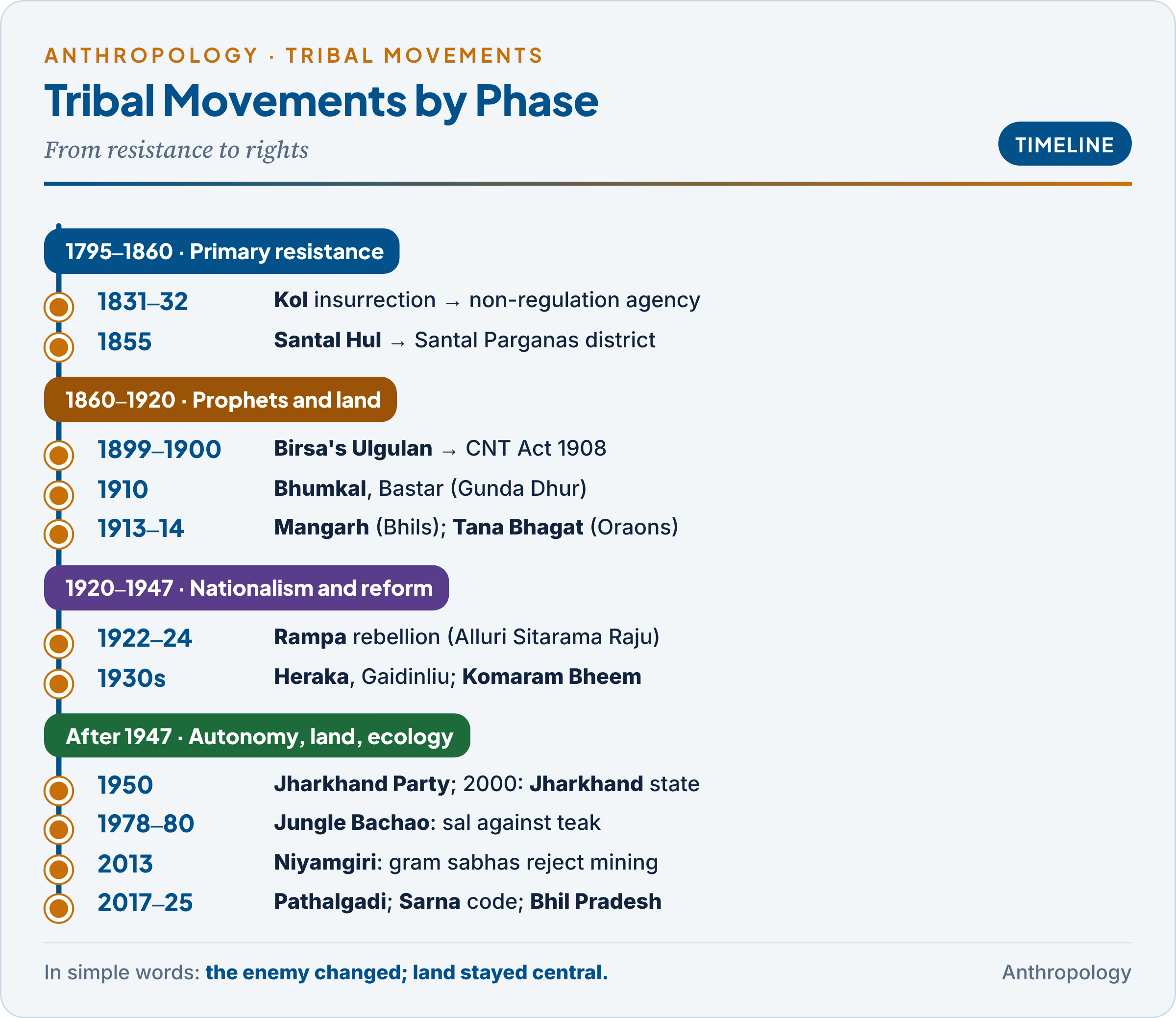
K.S. Singh, an administrator-anthropologist who later headed the Anthropological Survey of India and became the leading historian of tribal movements, divided colonial-era movements into three phases, each tied to a stage of colonialism. Post-colonial movements form a fourth.
3.1 First phase (1795–1860): primary resistance
- Character: resistance by tribes to the establishment of British rule, often led by chiefs and the upper crust of tribal society.
- Cases: the Paharia chiefs of the Rajmahal hills (from 1778), whom the Bhagalpur Collector Augustus Cleveland tried to win over with pensions and a hill council; the Tamar risings of Chotanagpur (1789–1832); the Kol insurrection of 1831–32 (Munda, Oraon, Ho), led by figures such as Buddhu Bhagat, against Sikh and Muslim thikadars who had been given Munda villages; the Bhumij rising of Ganga Narain (1832–33); the Khasi resistance under Tirot Singh (1829–33); and the Santal Hul (1855–56).
- Outcome: the Kol rising led to Regulation XIII of 1833 and the South-West Frontier Agency (1834), a non-regulation area where ordinary laws did not apply automatically; the Hul led to the Santal Parganas district (1855). These were the first steps toward the special administration of tribal areas that later became the Fifth and Sixth Schedules (7.1).
3.2 Second phase (1860–1920): agrarian and millenarian movements
- Character: merchant capital, rent and forest reservation penetrated deep into tribal economies. Movements, known by native terms such as mulkui larai (struggle for land), fituri, meli, ulgulan (great tumult) and bhumkal (earthquake), mixed agrarian, religious and political aims.
- Influences: Bhakti preachers introduced monotheism, vegetarianism and abstention from liquor; Christianity produced an educated tribal elite. Both fed millenarian hopes.
- Cases: the Kherwar movement among the Santals (1870s, under Bhagirath Manjhi); the Sardari larai of Munda and Oraon sardars (leaders) seeking restoration of khuntkatti and bhuinhari lands (to the 1890s); Birsa Munda’s Ulgulan (1895–1900); the Rampa rebellion (1879–80); the Bhumkal of Bastar (1910, Gunda Dhur); Govind Guru‘s Bhil movement (to 1913); and the Tana Bhagat movement (from 1914).
- Leadership: now from the lower rungs of tribal society; Birsa was the son of a poor raiyat (tenant).
3.3 Third phase (1920–1947): nationalism, reform and autonomy
- Three trends: tribes joined the Gandhian freedom struggle (Tana Bhagats in Non-Cooperation; Gaidinliu); reform and revival movements purified tribal society (the Haribaba movement of Duka Ho among the Hos, 1931; Seng Khasi; the Heraka); and movements for land, forest and autonomy emerged under an educated tribal middle class (the Adivasi Mahasabha, 1938).
- Cases: Rampa rebellion of Alluri Sitarama Raju (1922–24); Heraka of Jadonang and Rani Gaidinliu (1920s–1932); Komaram Bheem against the Nizam (1928–40); Praja Mandal agitations in princely states against begar and extra levies (abwabs); and the Warli revolt (1945–47) organised by the Kisan Sabha.
3.4 Post-colonial movements (since 1947)
After Independence the main adversary became the developmental state itself: projects, mines and forest departments, rather than only the moneylender. K.S. Singh grouped these movements into political (autonomy, statehood, self-rule) and agrarian and forest-based (land restoration, forest rights, resistance to displacement). Identity movements (religion, language, script) and environmental movements became prominent from the 1980s.
3.5 How leadership, goals and composition changed
| Feature | Colonial phases | Post-colonial |
|---|---|---|
| Leaders | Chiefs (phase 1) → poor peasants and prophets (phase 2) → educated middle class and Gandhian workers (phase 3) | Middle-class politicians, priests, teachers, activists; NGOs |
| Idiom | Religious, millenarian | Mostly secular: rights, Constitution, PESA, FRA |
| Goals | Restore pre-colonial polity, khuntkatti land, end of rent; tribal raj | Statehood, autonomy, land and forest rights, no displacement, recognition |
| Composition | One tribe, or a tribe with its service castes (the Hul included artisans) | Multi-tribal and multi-caste coalitions (Jharkhand: Adivasis with sadans, the non-tribal original settlers) |
The shift from prophets to parties reflects education and democracy; the core demands for land, forest and self-rule stayed the same.
4. Major Movements: Case Studies
In simple words
A few movements shaped tribal history and the law. The Santal and Munda risings won tenancy laws; the Tana Bhagats joined Gandhi; the Bhils, Gonds and Nagas each found their own leaders; and the long Jharkhand movement finally won a state.
4.1 Santal Hul (1855–56)
- Setting: Santals settled the Damin-i-Koh from the late eighteenth century, clearing forest at the foot of the Rajmahal hills. Bengali and up-country moneylenders and zamindars followed, charging ruinous interest and enslaving debtors through kamioti bonds; police and courts sided with them.
- Leadership and ideology: Sido, Kanhu, Chand and Bhairav Murmu, with their sisters Phulo and Jhano; a divine command from Thakur; the demand to expel dikus and pay only fixed, low rents.
- Composition and end: many artisan and service castes joined, making it a broad agrarian rising; martial law ran to 3 January 1856, and Sido and Kanhu were executed.
- Outcome: the Santal Parganas non-regulation district (Act XXXVII of 1855); recognition of village headmen (manjhi, parganait); later the Santhal Parganas Tenancy (Supplementary Provisions) Act, 1949, which restricts transfer of Santal land.
- Interpretation: W.J. Culshaw and W.G. Archer (1945) traced it to debt, corruption and denial of redress; the historian Ranajit Guha (Elementary Aspects of Peasant Insurgency in Colonial India, 1983) read it as a conscious peasant insurgency, not blind frenzy. 30 June is Hul Diwas in Jharkhand.
4.2 Birsa Munda and the Ulgulan (1895–1900)
Birsa Munda is the best-documented tribal leader of colonial India, and his movement is the classic Indian case of a millenarian revitalization movement.
- Life: born on 15 November 1875 (some records give 1874) at Ulihatu (now Khunti district) in a poor Munda family; studied at a German mission school at Chaibasa; came under the influence of a Vaishnava teacher (Anand Panre) and adopted sacred thread, vegetarianism and Hindu ideas of purity.
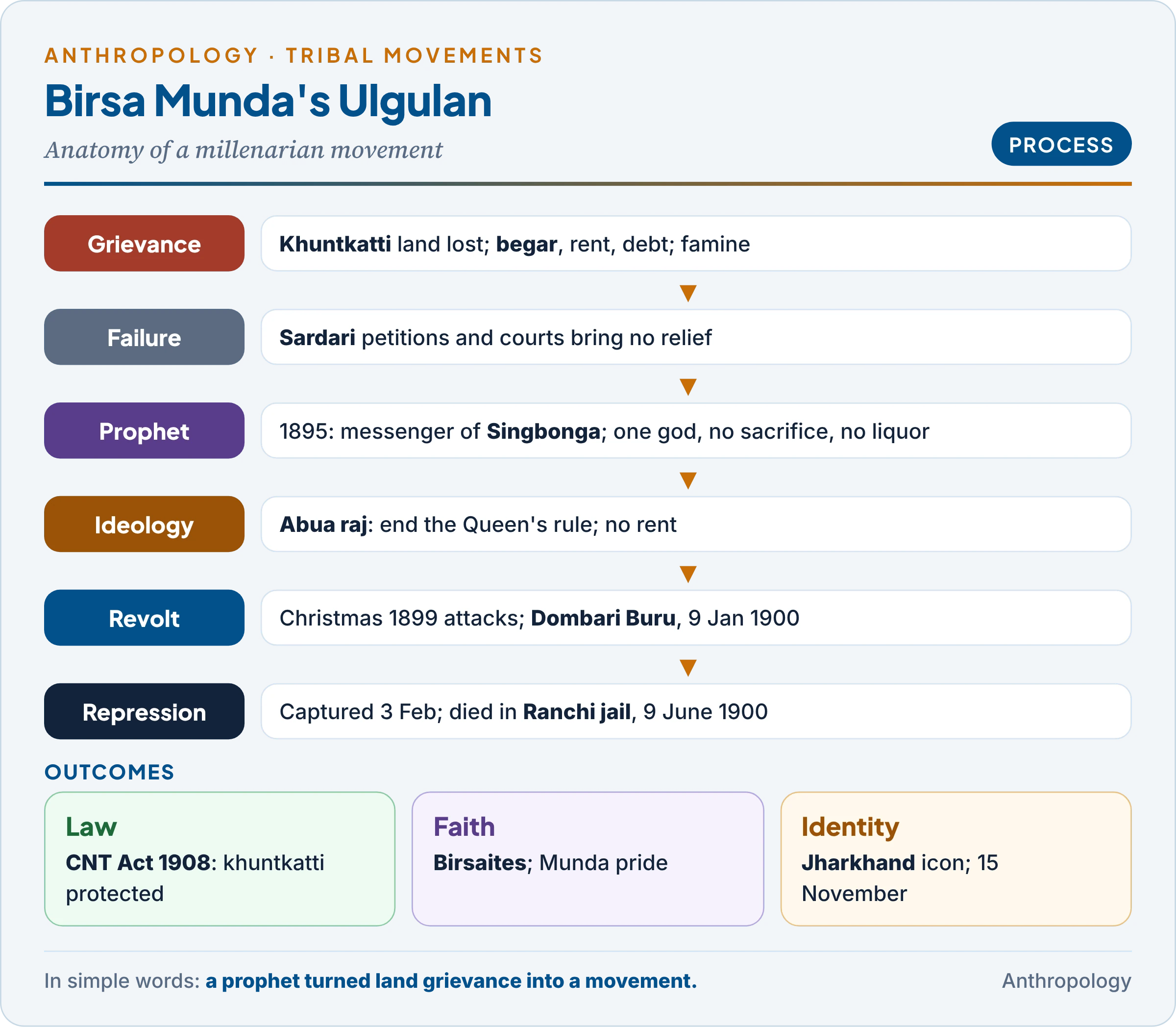
- Background: the Sardari larai had failed to win back khuntkatti land through petitions; famine (1896–97) deepened distress.
- The prophet (from 1895): Birsa declared himself a messenger of Singbonga (the supreme deity), healed the sick and preached a new faith: one god, no animal sacrifice, no liquor, cleanliness, and the end of witchcraft. Followers called him Dharti Aba (“father of the earth”) and Bhagwan.
- Political turn: he urged refusal of rent and forced labour and spoke of abua raj (our rule) replacing the Queen’s rule. Arrested in 1895, he was jailed for two years and released in 1897.
- The Ulgulan (1899–1900): around Christmas Eve 1899 his followers attacked missions, police stations and officials in the Khunti–Tamar–Ranchi area. Led by lieutenants such as Gaya Munda, they were fired on by troops at Dombari Buru on 9 January 1900. Birsa was captured on 3 February 1900 and died in Ranchi jail on 9 June 1900.
- Ideology: Birsa combined Munda belief, Hindu reform and Christian ideas (one god, a prophet, a coming kingdom), and attacked missions as well as landlords because they too had failed to restore Munda land.
Impact of his sacrifice on tribal society:
- Law: the Chotanagpur Tenancy Act, 1908 recognised khuntkatti tenure and restricted the transfer of tribal land to non-tribals; it remains the basic land law of the region.
- Religion and community: Birsaites continued his faith; Munda solidarity and pride grew.
- Identity and politics: Birsa became the icon of Jharkhand; the state was created on his birth anniversary, 15 November 2000. He is the only tribal leader whose portrait hangs in the Central Hall of Parliament.
- National memory: since 2021, 15 November is Janjatiya Gaurav Divas (Tribal Pride Day); 2024–25 was Janjatiya Gaurav Varsh, his 150th birth anniversary year.
- Scholarship: K.S. Singh‘s The Dust-Storm and the Hanging Mist (1966), revised as Birsa Munda and His Movement 1874–1901 (1983), analysed it as a millenarian movement rooted in agrarian grievance.
4.3 Tana Bhagat movement (from 1914)
- Founder: Jatra Oraon (Jatra Bhagat) of Chingri village, Bishunpur (now Gumla district), who in April 1914 announced a revelation from Dharmes (the Oraon supreme god).
- Teachings: give up belief in spirits and ghosts, animal sacrifice, meat and liquor, and the dances of the youth dormitory; live a pure, devotional (bhagat) life; do not pay rent to zamindars or work as labourers for outsiders. “Tana” comes from the Kurukh word for pulling, read as pulling out evil spirits or pulling the Oraons together.
- Causes: rent and begar under zamindars; failure of earlier land struggles; and a gap between Christian Oraons, who had gained from mission education, and the traditional sansari Oraons.
- Course: Jatra was jailed in 1914; later leaders (including a woman, Litho Oraon, and Sibu Oraon in 1919) kept it alive. From 1920–21 the Tana Bhagats joined the Non-Cooperation movement, wore khadi, followed Gandhi and refused rent and taxes; many lost their land in auctions for arrears.
- Outcome: the Ranchi District Tana Bhagat Raiyats Agricultural Lands Restoration Act, 1947 (Bihar Act II of 1948) provided for return of lands sold for arrears of rent during freedom movements of 1913–1942. Tana Bhagats still wear white, worship the tricolour at home and are honoured as freedom fighters.
- Assessment: a religious reform with millenarian hopes became a non-violent political movement; its Sanskritization (vegetarianism, purity) made the Bhagats a distinct status group among the Oraons. The historian Sangeeta Dasgupta shows that it drew on hierarchies within the Oraons as much as on protest against outsiders.
4.4 Bhil movements and Mangarh (1913)
- Govind Guru (Govindgiri), a Banjara reformer from Dungarpur, preached among the Bhils of the Rajasthan–Gujarat border through a fellowship called the Samp Sabha: no liquor or meat, cleanliness, education, and refusal of forced labour and unjust revenue. His followers kept a sacred fire (dhuni), the mark of the Bhagat movement among the Bhils.
- Mangarh, 17 November 1913: thousands of Bhils gathered on Mangarh hill (Banswara) refused to disperse; troops of the princely states and the Mewar Bhil Corps fired on them. There is no accurate count of the dead; local tradition remembers it as the “Adivasi Jallianwala”. Govind Guru was imprisoned.
- Afterlife: the demand for a Bhil state has revived: at a rally at Mangarh Dham in July 2024, Bhil organisations demanded Bhil Pradesh from 49 districts of four states and asserted that tribal religion is distinct from Hinduism.
4.5 Rampa rebellion (1922–24)
- Setting: the Godavari and Vizagapatam Agency (now Andhra Pradesh), home of Koya and Konda Dora hill people, where the Madras Forest Act, 1882 restricted podu (shifting cultivation) and forest use, and officials imposed forced labour on road building.
- Leadership: Alluri Sitarama Raju, a non-tribal ascetic who lived among the hill people, with the Koya leaders Gam Gantam Dora and Gam Mallu Dora.
- Course: raids on police stations at Chintapalli and nearby posts in August 1922 began a two-year guerrilla war; Raju was captured and shot on 7 May 1924.
- Context: an earlier Rampa rebellion of 1879–80 (against a non-tribal mansabdar, toddy rules and fraudulent decrees) led to protective rules consolidated in the Agency Tracts Interest and Land Transfer Act, 1917, which capped interest and controlled land transfer: a model for later tribal land laws.
4.6 Gond movements: Bastar, Komaram Bheem and Adilabad
- Bhumkal (1910), Bastar: against forest reservation, begar and traders, led publicly by Gunda Dhur, a Dhurwa; mango boughs and arrows circulated as a call to arms; suppressed within weeks.
- Komaram Bheem (1928–1940): a Gond leader of the Asifabad forests (now Telangana) who resisted the Nizam’s forest officials and revenue demands from Jodeghat and asked for Gond self-rule; he was killed in a police encounter in 1940. He is credited with the slogan “Jal, Jangal, Zameen” (water, forest, land), now the watchword of Adivasi movements across India. The Austrian anthropologist Christoph von Fürer-Haimendorf, then working with the Nizam’s government on tribal affairs, documented the grievances behind the rising.
- Indervelli (20 April 1981): police fired on Gonds gathering for a meeting on land restoration and encroachment by settlers and Lambadas (traders added to the state’s ST list in the 1970s); the official toll was 13, rights groups put it far higher. Land struggles were turning toward the radical left.
- Gondwana: a Gondwana state for the Gond belt has been demanded since the 1950s, later by the Gondwana Gantantra Party (1991).
4.7 North-East movements (summary)
North-Eastern movements stand apart because of late annexation, Excluded Areas status (1935), early Christianity and schooling, and international borders. Insurgency, autonomy and ethnic conflict are discussed in 7.3.
- Heraka (Zeliangrong Nagas): Haipou Jadonang (hanged 29 August 1931) launched a reformed indigenous faith among the Zeme, Liangmai and Rongmei against both missions and British rule; his cousin Gaidinliu, arrested on 17 October 1932 and jailed till 1947, was given the title “Rani” by Nehru. The movement was nativistic, revitalizing and nationalist at once.
- Seng Khasi (from 23 November 1899): an organisation founded in Shillong by sixteen young Khasis to protect Niam Khasi (the Khasi religion), matrilineal custom and culture against conversion; it still holds the Seng Kut Snem festival each November.
- Naga movement: from the Naga Club (1918) and its memorandum to the Simon Commission (1929), through the Naga National Council (1946), to statehood (1963) and the Framework Agreement (2015); it forged one Naga nationhood out of many tribes.
- Mizo and Bodo: the Mizo National Front rising (1966) ended in the Mizo Accord (1986); the Bodo movement of the All Bodo Students’ Union won the Bodoland Territorial Council (2003) and Region (2020).
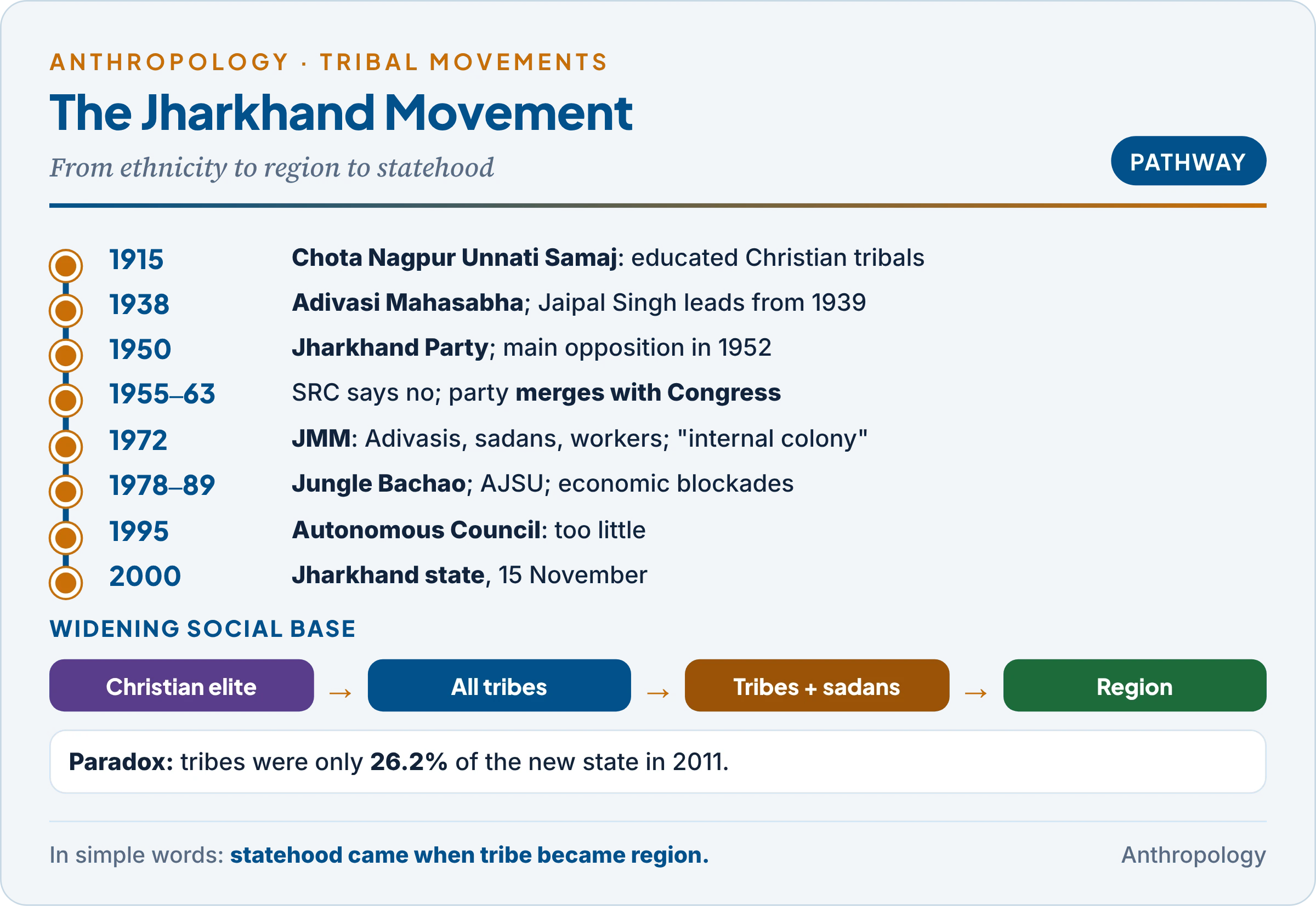
4.8 The Jharkhand movement: from ethnicity to region to statehood
Example first: the 1952 election. In the first general election, the Jharkhand Party of Jaipal Singh Munda (an Oxford-educated Munda who had captained India’s Olympic hockey team in 1928) won about 32 seats in the Bihar Assembly and became the main opposition. A tribal demand had become a regional political force within five years of Independence.
| Period | Organisation or event | Character |
|---|---|---|
| 1915 | Chota Nagpur Unnati Samaj (educated Christian tribals) | Education and social uplift; memorandum to the Simon Commission (1928) |
| 1938 | Adivasi Mahasabha; Jaipal Singh president from 1939 | Pan-tribal political front for a separate province |
| 1949–50 | Jharkhand Party (reorganised March 1949, launched 1 January 1950) | Opened to non-tribals; regional rather than only tribal |
| 1955 | States Reorganisation Commission rejects the demand | No common language; tribes a minority in the region |
| 1963 | Jharkhand Party merges with Congress | Movement fragments into splinter parties |
| 1972 | Jharkhand Mukti Morcha (Shibu Soren, Binod Bihari Mahato, A.K. Roy) | Adivasi–sadan (non-tribal original settlers, e.g. Kurmi Mahatos)–worker alliance; Jharkhand as an “internal colony” |
| 1978–80 | Jungle Bachao Andolan, Singhbhum; Gua firing (8 September 1980) | Forest struggle against replacing sal with teak |
| 1986–89 | All Jharkhand Students Union; economic blockades | Mass mobilisation |
| 1994–95 | After the Committee on Jharkhand Matters (1989), the Jharkhand Area Autonomous Council (Act of 1994, council 1995) | Partial autonomy, judged inadequate |
| 2000 | Bihar Reorganisation Act (25 August); Jharkhand state on 15 November 2000 | Statehood achieved |
The table shows a steady widening of the social base. The movement began among educated Christian Mundas and Oraons, became a pan-tribal front, then a regional movement that included non-tribal sadans and workers, and argued that the region supplied a large share of India’s minerals but received little of the benefit: a transition from ethnicity to regionalism.
- Decline in the 1960s: the merger; rivalry between Christian and non-Christian tribals; non-Christian support shifting to other parties.
- Revival: displacement by mines, dams and steel towns; in-migration that made tribes a minority (26.2% of Jharkhand in 2011); alliances with labour and peasants.
- After statehood: proposed amendments to the CNT and SPT Acts (2016–17) were withdrawn after protests; Pathalgadi (2017–18), the Sarna code and the Kurmi ST demand keep tribal anxieties alive (§4.9–4.10).
The 2000 states compared. Three new states were created in November 2000. Their movements differed in how far they were tribal.
| State (date) | Movement | Tribal share (2011) | Character |
|---|---|---|---|
| Jharkhand (15 Nov 2000) | Jharkhand Party, JMM, AJSU | 26.2% | Tribal-led, later regional; minerals and displacement |
| Chhattisgarh (1 Nov 2000) | Regional demand; Chhattisgarh Mukti Morcha of Shankar Guha Niyogi among miners and peasants | 30.6% | Regional backwardness more than tribal identity |
| Uttaranchal (9 Nov 2000) | Uttarakhand Kranti Dal (1979); mass agitation of 1994 | about 2.9% | Hill regional movement; tribes (Tharu, Bhotia, Jaunsari) marginal |
Tribal mobilisation alone did not create states; success came through a wider regional case, leaving tribes minorities in “their” new states.
4.9 Agrarian, forest and anti-displacement movements after 1947
- Naxalbari (1967) and Srikakulam (1967–70): Santal sharecroppers in north Bengal and Savara and Jatapu hill people in Andhra joined armed agrarian struggles led by the radical left; the link between land alienation and Left-wing extremism is discussed in 7.3.
- Jungle Bachao Andolan (1978–80): Ho and other tribals of Singhbhum resisted replacement of sal forest (sacred and food-giving) by commercial teak; police firing at Gua on 8 September 1980 killed several Adivasis.
- Koel-Karo: Munda villages blocked a hydroelectric project on the Koel and Karo rivers for decades with barricades and a round-the-clock vigil; police firing at Tapkara on 2 February 2001 killed eight people; the dams have not been built.
- Muthanga (19 February 2003): the Adivasi Gothra Maha Sabha of C.K. Janu occupied land in the Wayanad sanctuary after the Kerala government failed to honour a 2001 land agreement; the police eviction left at least two dead (a policeman and an Adivasi leader), and the official toll later rose to five.
- Niyamgiri: the Dongria Kondh opposed bauxite mining on their sacred hill; the Supreme Court (18 April 2013) left the decision to the gram sabhas, all twelve of which rejected the project (6.3a).
- Hasdeo Arand: Gond villages of Chhattisgarh opposed coal mining in a dense forest; the State Assembly passed a resolution on 26 July 2022 asking the Centre to cancel the coal blocks.
- Pathalgadi (2017–18): villages of Khunti erected stone slabs (pathalgadi, a Munda memorial custom) inscribed with PESA and Fifth Schedule provisions, declaring the gram sabha sovereign; sedition cases against villagers were withdrawn by the new state government on 29 December 2019.
These movements use law and the Constitution (PESA, FRA, Fifth Schedule) as weapons, join sacred geography to ecological argument, and draw support from NGOs and activists.
4.10 Identity and recognition movements
- Sarna religion code: tribal organisations of Jharkhand, Odisha, Chhattisgarh and Bengal demand a separate Sarna column in the Census; about 4.9 lakh people wrote “Sarna” under “Other religions” in 2011; the Jharkhand Assembly passed a resolution for a Sarna Adivasi Dharma Code on 11 November 2020 (detail in 8.1).
- Against “pseudo-tribal” claims: when the Kurmi (Kudmi) community staged rail blockades on 20 September 2025 in Jharkhand, Bengal and Odisha demanding ST status, tribal organisations held large counter-rallies in Ranchi, Dhanbad and Gumla in October 2025 to defend the ST category (pseudo-tribalism is discussed in 7.3).
5. North-East and Central India Compared
In simple words
Tribal movements in the North-East and in central India grew from different histories. In the North-East, tribes were never fully ruled from the plains and many became Christian and educated early, so they asked for nationhood and autonomy. In central India, tribes lost land to settlers and projects, so their movements centred on land, forests and a tribal state within India.
The table compares the two regions on the points that explain their difference.
| Point | North-East | Central India |
|---|---|---|
| Colonial rule | Late, indirect; Excluded Areas; Inner Line | Early, direct; zamindari; non-regulation tracts |
| Demography | Tribes a majority in most hill states | Tribes a minority amid dikus and migrants |
| Religion | Large Christian majorities among Nagas, Mizos, Khasis; revival movements (Heraka, Seng Khasi, Donyi-Polo) | Mixed: Sarna, Hindu, Christian; Sanskritizing Bhagat movements |
| Main goal | Nationhood, autonomy, sometimes sovereignty | Land, forest, protection, a tribal state within India |
| Methods | Insurgency and negotiated accords | Revolts, then parties, elections, gram sabhas, courts |
| Outcomes | Separate states, Sixth Schedule councils, accords | Tenancy laws, Fifth Schedule, Jharkhand and Chhattisgarh |
Current status. In the North-East, Naga talks remain unresolved a decade after the 2015 Framework Agreement, the Bodo accord of 2020 brought relative peace, and violence in Manipur since 2023 shows land and ST status dividing communities (7.3). In central India, struggles centre on mining and forest diversion (Hasdeo, Niyamgiri), PESA self-rule (Pathalgadi), religious identity (Sarna code) and defence of the ST category (the 2025 Kurmi agitation).
6. Causes, Consequences and Assessment
In simple words
Tribal movements arose from loss of land, debt, forest laws, outside rule and threats to culture. They won important laws and new states and gave tribes a shared identity, but they also brought repression, violence and new divisions inside tribal society.
6.1 Causes
| Type | Causes | Example |
|---|---|---|
| Economic | Land alienation, rent, debt bondage, forced labour, low prices for forest produce | Santal kamioti; Munda khuntkatti loss |
| Ecological | Forest reservation, bans on shifting cultivation, mining, dams | Rampa (podu), Bhumkal, Jungle Bachao, Niyamgiri |
| Political | Alien courts, police, revenue farmers; weak safeguards; no participation | Kol (thikadars); Pathalgadi |
| Cultural-religious | Threat to custom and religion, missionary pressure, contempt for tribal ways | Seng Khasi, Heraka, Sarna |
| Demographic | In-migration reducing tribes to minorities | Chotanagpur, Tripura |
| Leadership and ideology | Charismatic prophets; later an educated elite experiencing relative deprivation | Birsa; Jaipal Singh |
After 1947, unrest has been fed by weak implementation of safeguards: Fifth Schedule powers rarely used, outsiders taking jobs and land in industrial areas, meagre compensation for displacement, and cultivators treated as encroachers (6.2, 6.3).
6.2 Consequences
- Protective law: the Santal Parganas district (1855) and tenancy laws; the CNT Act (1908); the Agency Tracts Act (1917); the Tana Bhagat land restoration (1947); and, in a long line, the Excluded and Partially Excluded Areas of 1935 and the Fifth and Sixth Schedules.
- New identities: scattered tribes came to see themselves as Adivasis (original inhabitants), Jharkhandis or Nagas; the North-East saw old tribes take new names and small tribes merge into larger ones.
- Institutions and reform: tribal parties, autonomous councils and new states; abstinence, education and reform of custom (Bhagats, Heraka), sometimes Sanskritizing the tribe.
- Costs: heavy loss of life in repression; internal splits (Christian against non-Christian, advanced against backward tribes); elite capture of movement gains; and, in places, cycles of insurgency and counter-insurgency.
6.3 Role in the emergence of tribal identity
Movements made tribal identity as much as they expressed it: the Hul and Ulgulan gave Santals and Mundas heroes, songs and anniversaries; Jharkhand created a regional identity including sadans; the Naga movement fused many tribes into a nation. The Indian sociologist Virginius Xaxa shows that Adivasi itself became a political identity through such struggles: a claim to prior rights as original inhabitants.
6.4 Contribution to the freedom struggle
| Movement | Contribution |
|---|---|
| Santal Hul (1855) | Among the earliest mass armed challenges to Company rule |
| Birsa’s Ulgulan (1899–1900) | Demand for abua raj (self-rule) against the Queen’s rule |
| Tana Bhagats (1914 onward) | Non-violent non-cooperation, refusal of rent, Gandhian loyalty |
| Govind Guru (1913) | Mass Bhil assertion against princely and colonial exactions |
| Rampa (1922–24) | Guerrilla war against the Madras government |
| Gaidinliu (1930s) | Naga resistance linked to the national movement |
| Laxman Nayak (1942) | Quit India mobilisation in Koraput, Odisha |
Long left out of nationalist histories, tribal resistance now has official recognition through Janjatiya Gaurav Divas and tribal freedom fighters’ museums.
6.5 Strengths and weaknesses
| Strengths | Weaknesses |
|---|---|
| Won protective laws and administrative safeguards | Violence and harsh repression; lives lost |
| Built leadership and political consciousness | Fragmented: local, one tribe at a time, rarely pan-Indian |
| Created states and autonomous councils | Elite capture: gains to the educated and Christian sections |
| Put land, forest and consent on the national agenda (PESA, FRA) | Some movements were captured by insurgent or extremist groups |
The balance is positive: the main legal protections tribes enjoy today were won through movements, not granted freely. But movements have been better at winning laws than at securing their implementation. The usual remedies follow: real participation of tribes in decisions, closing loopholes in land laws, cheap credit against moneylenders, and wider use of Sixth Schedule-type self-government.
6.6 Anthropological interpretations
- Revitalization view (Wallace, Fuchs, K.S. Singh): cultural responses to the stress of contact, with prophets remaking religion.
- Agrarian view (K.S. Singh, Ranajit Guha): peasant insurgencies over land and rent; tribe and peasant overlap in central India.
- Identity view (Surajit Sinha, Xaxa): solidarity and identity formation, from tribe to Adivasi to region.
- Political economy view (the “internal colony” argument; Ghanshyam Shah): resistance to resource extraction by state and capital.
A full explanation of any one movement, such as Birsa’s, needs all four: land, religion, identity and power.
Key Terms
| Term | Meaning in simple words |
|---|---|
| Social movement | Sustained group action to change or protect society |
| Revitalization movement | Effort to build a more satisfying culture (Wallace) |
| Nativistic movement | Effort to revive or keep one’s own culture (Linton) |
| Millenarian movement | Hope of a sudden, perfect new world under a prophet |
| Diku | Outsider, exploiter from the plains |
| Khuntkatti | Munda land held by the lineage that first cleared it |
| Kamioti | Santal debt bondage to moneylenders |
| Hul / Ulgulan | Santal “revolution” / Munda “great tumult” |
| Abua raj | “Our rule”: Birsa’s goal of self-rule |
| Bhagat movement | Reform movement of purity, devotion and abstinence |
| Heraka | Reformed Zeliangrong Naga faith of Jadonang and Gaidinliu |
| Seng Khasi | Organisation protecting the Khasi religion (1899) |
| Sadan | Non-tribal original settlers of Chotanagpur |
| Internal colony | A region exploited for resources by the rest of the nation |
| Pathalgadi | Stone slabs declaring gram sabha self-rule |
| Jal, Jangal, Zameen | “Water, forest, land”: slogan credited to Komaram Bheem |
Contemporary Developments
- Birsa Munda at 150: Janjatiya Gaurav Varsh ended on 15 November 2025; museums of tribal freedom movements are being built.
- Kurmi ST agitation: rail blockades (20 September 2025) met large tribal counter-rallies in October 2025.
- Bhil Pradesh: the July 2024 Mangarh rally revived the Bhil state demand.
- Indervelli: the Telangana government officially observed the martyrs’ anniversary for the first time on 20 April 2025, 44 years after the firing.
Diagrams to Master
- Topic map: concept → typologies → phases → major cases → outcomes (law, identity, statehood).
- Typologies compared: Mahapatra (3), Surajit Sinha (5), K.S. Singh (4 orientations), Ghanshyam Shah (5).
- Timeline by phase: 1831 Kol → 1855 Hul → 1900 Ulgulan → 1913 Mangarh → 1914 Tana Bhagat → 1922 Rampa → 1950 → 2000 Jharkhand → 2013 Niyamgiri.
- Birsa’s Ulgulan: grievance → prophet → reformed faith → revolt → repression → CNT Act 1908.
- Jharkhand pathway: 1915 → 1938 → 1950 → 1963 → 1972 → 1995 → 2000, with the widening social base.
Revision Grid
| Scholar | Work (year) | Key idea |
|---|---|---|
| K.S. Singh | Birsa Munda and His Movement (1983); Tribal Movements in India (1982–83) | Millenarian Ulgulan; three colonial phases; four orientations |
| Surajit Sinha | “Tribal solidarity movements” (1972) | Five types: rebellion to agrarian unrest |
| L.K. Mahapatra | Typology (1972) | Reactionary, conservative, revisionary |
| Ghanshyam Shah | Social Movements in India (1990; 2004) | Adds environmental and displacement movements |
| V. Raghaviah | Tribal Revolts (1971) | About 70 revolts, 1778–1970 |
| A.F.C. Wallace | “Revitalization Movements” (1956) | Stages from stress to new steady state |
| Ralph Linton | “Nativistic Movements” (1943) | Reviving or perpetuating culture |
| Ranajit Guha | Elementary Aspects of Peasant Insurgency (1983) | Tribal risings as conscious insurgency |
| Virginius Xaxa | State, Society and Tribes (2008) | Adivasi as a political identity |
Previous Year Questions
7.4 Social Movements among Tribal society
- 2026Write notes on: Tana Bhagat movement.
- 2024Write an essay on the life history of tribal activist and freedom fighter Birsa Munda. What was the impact of his sacrifice on tribal society?
- 2022Compare the nature of tribal movements between North-East and Central India. Briefly mention the current status of existing tribal movements in these areas.
- 2013Write a note in 150 words on Ethnic movements in India.
- 2008Write a note on Revivalistic Movements.
- 2006Critically review Tana Bhagat Movement-its causes and effects.
- 2004Classify the tribal movements in contemporary India in a regional perspective and analyse the contributive factors.
- 2003Identify the causes and consequences of major tribal movements in India.
- 2001Write a note on Birsa Movement.
- 2000Assess the political and economic role of tribal and rural movements in the creation of the new states of Uttaranchal Jharkhand and Chhattisgarh.
- 1999Write a note on Jharkhand Movement.
- 1994Write a note on Tribal movement-pros and cons.
- 1991Discuss the socio-economic and political characteristics of revitalization movements in tribal India. How are they affected by culture-contact with outsiders ?
- 1990Discuss the role of sociopolitical movements in the emergence of tribal identity in the Indian context.
Related questions from other units
- 2026Unit 4: Write notes on: Kumar Suresh Singh’s contribution in studying tribal movements.
- 2026Unit 6.3: Make a critical appraisal of Niyamgiri movement against mining-induced displacement.
- 2019Unit 7.3: What has been the contribution of tribal people to the Indian Independence movement ?
- 2019Unit 5.3: Discuss how the elements of Little and Great Traditions combine in the emergence of social/political/religious movements, giving any one example to illustrate the issue.
- 2016Unit 9.3: Write a note in 150 words on Anthropological interpretation of ethnic and political movements.
- 2009Unit 9.3: In what ways has anthropology contributed to the understanding of ethnic & political movements in India?
- 2009Unit 7.3: Write a note on Tribal unrest in Central India.
- 2003Unit 7.3: What is regionalism ? Evaluate how regionalism has stimulated political movements in India.
- 1996Unit 2: Discuss the major linguistic divisions in the Indian population. Also point out the role of language in ethno-political movements.
- 1995Unit 9.3: To what extent, ethnicity is responsible for the tribal movements in India? Elaborate with suitable examples.
More from Scheduled Castes, Scheduled Tribes and OBCs: all notes of this unit · every PYQ of this unit · Anthropology Optional hub