

Anthropology Optional › Paper II › Unit 06: Tribal Situation in India
6.2 Problems of the tribal communities – land alienation, poverty, indebtedness, low literacy, poor educational facilities, unemployment, under-employment, health and nutrition.
Official Syllabus: Paper II, Unit 6.2
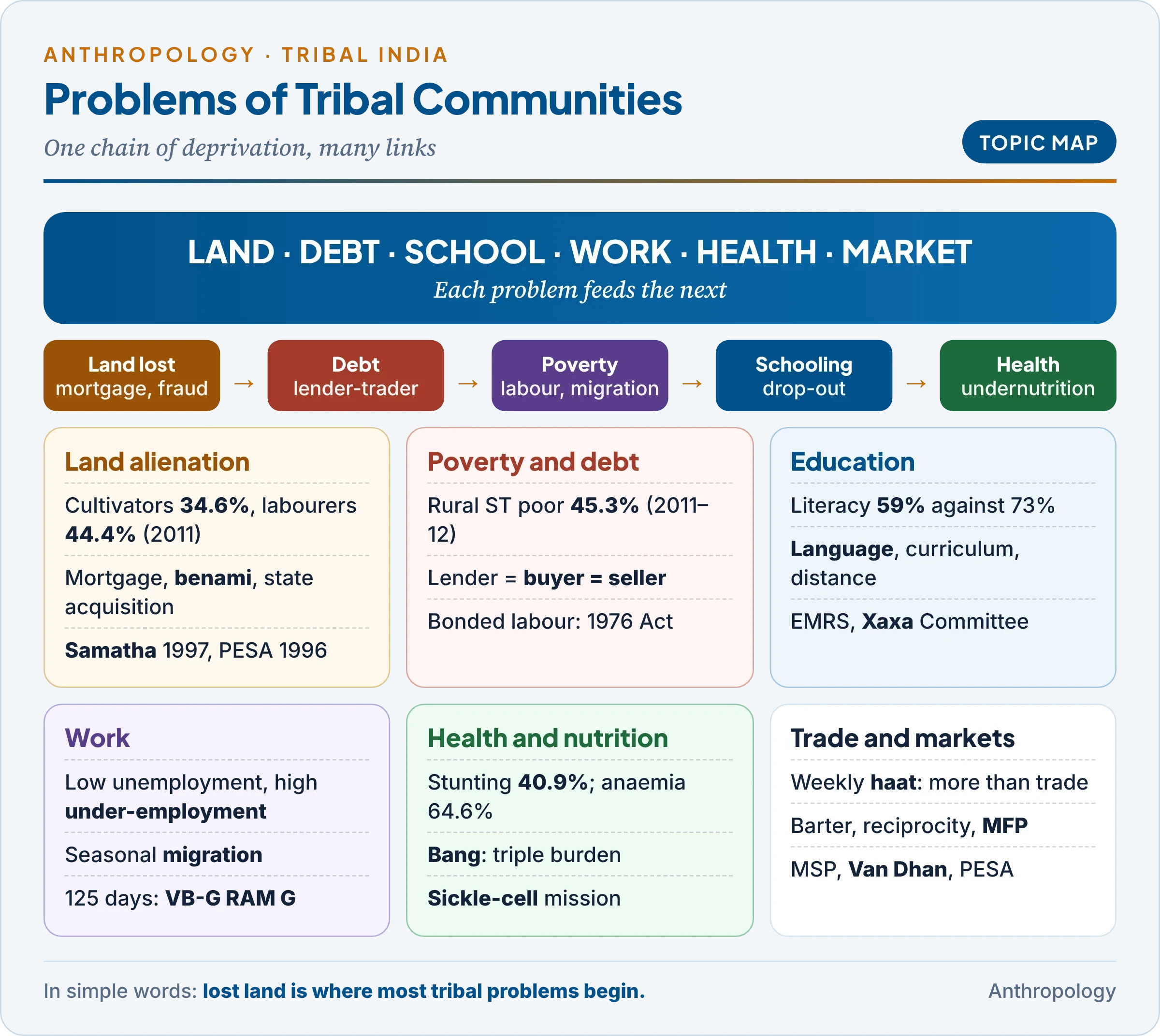
This article covers the problems of tribal communities and the trade and markets of tribal societies (§9). Who the tribes are and where they live is in 6.1; displacement by development projects in 6.3a; forest policy in 6.3b; the Fifth and Sixth Schedules and other safeguards in 7.1; and PVTGs and tribal plans in 9.1.
1. Understanding Tribal Problems
In simple words
Most tribal problems began when the outside world reached tribal areas: new land laws, money, moneylenders, forest rules and, later, mines and dams. These problems are linked: loss of land leads to debt, debt to bonded labour, poverty to poor schooling and poor health. Solving one problem alone rarely works.
Example first: the Santal Hul. In 1855 the Santals of the Rajmahal hills rose against the diku (outsiders): zamindars, moneylenders and traders who had taken their land through debt and false weights, backed by colonial courts and police. The revolt was crushed, but the British carved out the Santhal Parganas with special rules. Half a century later the Munda rising under Birsa Munda (1899–1900) led to the Chotanagpur Tenancy Act (1908). The pattern of contact → exploitation → revolt → protective law recurs throughout tribal history, and most of the problems in this article are its modern forms.
1.1 How colonial rule changed tribal resources
- Land: the Permanent Settlement (1793) and later revenue systems turned clan land into private property recorded in the name of zamindars or individuals; unrecorded customary rights could be ignored.
- Forests: the Indian Forest Acts (1865, 1878, 1927) made forests state property, turning shifting cultivation, grazing and collection into offences (detail in 6.3b).
- Money and courts: cash revenue, written documents and distant courts favoured literate outsiders; the moneylender became the gateway to cash.
- Outcome: a chain of revolts (Kol 1831–32, Santal 1855, Munda 1899–1900) and protective laws for “Excluded” and “Partially Excluded” areas that the Fifth and Sixth Schedules inherited.
1.2 Approaches to the problems
- Isolation (“national parks” for tribes), urged in his early writings by Verrier Elwin, would protect culture but freeze poverty.
- Assimilation, urged by G.S. Ghurye, would absorb tribes as “backward Hindus” and dissolve their identity.
- Integration, the policy of Nehru’s Tribal Panchsheel, aimed at development “along the lines of their own genius”, respecting land and forest rights (the debate is in 4b).
The problems below are therefore judged by a double test: do they cause material deprivation, and do they erode community control over land and life?
2. Land Alienation
In simple words
Land alienation means tribal land passing into the hands of non-tribals, by sale, mortgage, fraud, encroachment or government acquisition. For a tribal family land is not only income but identity, ancestry and security, so its loss starts a chain of debt, migration and poverty.
Example first: from cultivator to labourer. Between the 2001 and 2011 Censuses the share of cultivators among Scheduled Tribe workers fell by about 10 percentage points, to 34.6%, while the share of agricultural labourers rose to 44.4%. The Ministry of Tribal Affairs estimated that about 3.5 million tribal people left farming in that decade for informal labour. National Sample Survey data show the share of rural Adivasi households owning no land at all rising from 16% (1987–88) to 24% (2011–12) (Brinda Karat and Vikas Rawal, 2014). The numbers describe a people being turned from landholders into wage workers on land they once owned.
2.1 Why land matters more to tribes
- Identity and ancestry: clan territories, burial stones (the Munda sasandiri) and sacred groves tie the lineage to its land; selling land can mean selling the ancestors’ place.
- Communal tenure: clan or village ownership, shifting fields and forest commons were rarely written down, so they were easy to deny in a court that wanted documents.
- No alternatives: with low literacy and few skills valued outside, a landless tribal has only casual labour.
2.2 How land is lost
The methods fall into four types, from open sale to state action. The table groups them so that each can be matched with its remedy.
| Type | Methods | Example |
|---|---|---|
| Private transfer | Sale, mortgage for debt, lease, sharecropping that becomes ownership | Moneylenders taking land for unpaid loans |
| Fraud and evasion | Benami (in another’s name) purchases through tribal wives or “adopted” tribals; forged or back-dated deeds; collusive court decrees; 99-year leases | Collusive suits in Jharkhand’s industrial belt |
| Encroachment | Settlers occupying land without title; officials not recording tribal possession | Tribal land in the Nilgiris and the Tarai under non-tribal occupation |
| State action | Acquisition for dams, mines, industry and towns; declaring land “forest” without settling rights; parks and sanctuaries | Mining and dam projects (6.3a); “deemed forests” (6.3b) |
The first three types are illegal or loophole-driven and can be stopped by better laws and records; the fourth is legal and can be checked only by consent, compensation and rehabilitation rules.
2.3 Consequences
- Pauperisation and debt: loss of the main asset pushes families to the moneylender (§4).
- Migration to brick kilns, plantations and cities (§6).
- Women lose the most: they lose access to land-based work and forest produce, and have no title of their own.
- Cultural erosion: festivals, clan rituals and the authority of village councils rest on land.
- Unrest: land loss lies behind movements from the Hul to the Naxalite belt; the government’s own expert group linked land alienation to extremism in tribal areas.
2.4 Safeguards and why they fail
Constitutional and legal protections.
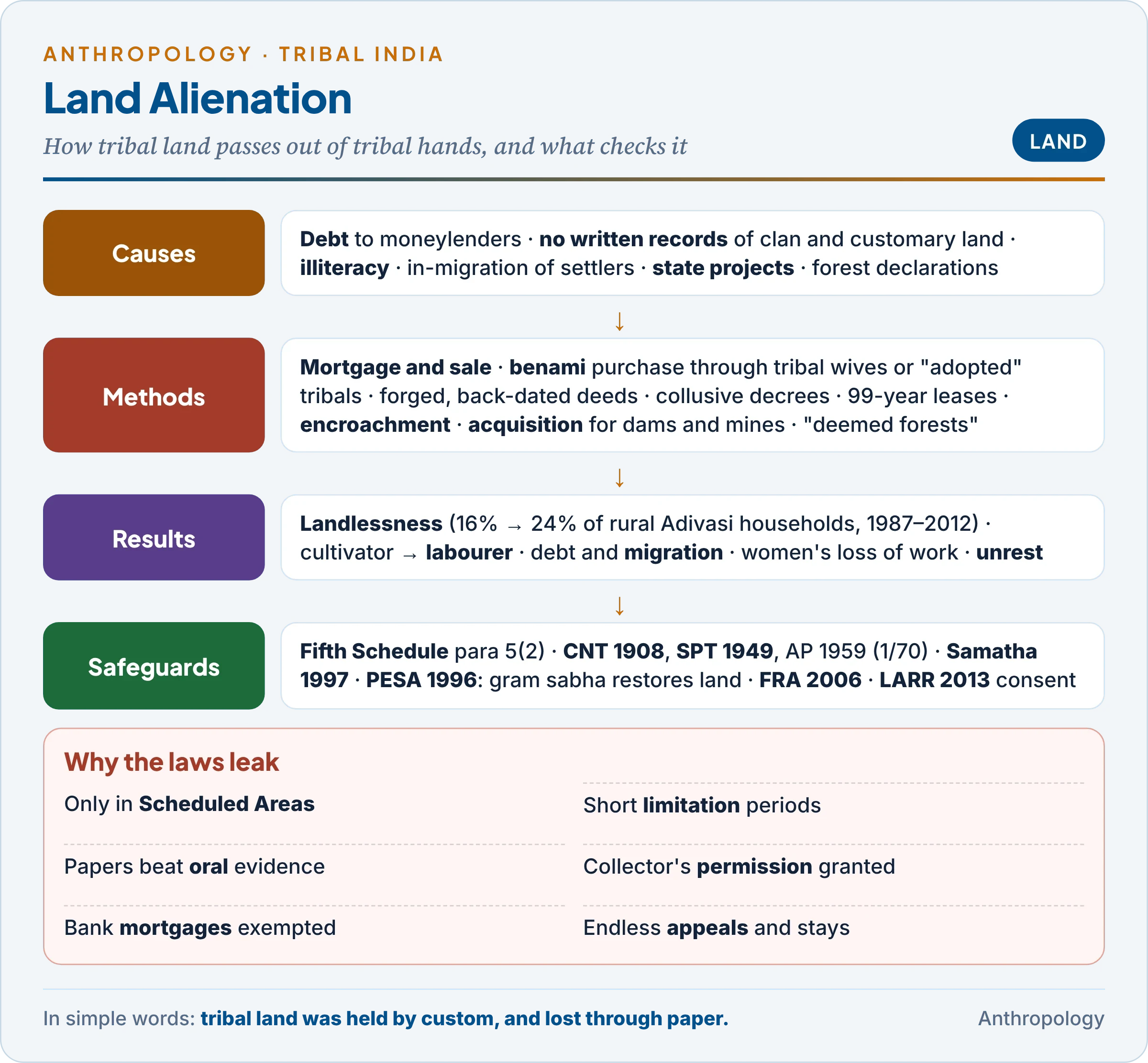
- Fifth Schedule, paragraph 5(2): following the Constituent Assembly’s sub-committees on excluded areas, which urged strict limits on land transfer and money-lending, the Governor may make regulations to prohibit or restrict transfer of land by or among STs, regulate allotment of land, and regulate money-lending in Scheduled Areas.
- State laws: the Chotanagpur Tenancy Act (1908) and Santhal Parganas Tenancy Act (1949) in Jharkhand; the Andhra Pradesh Scheduled Areas Land Transfer Regulation (1959), tightened by Regulation 1 of 1970; the Odisha regulation of 1956; Maharashtra‘s restoration Act of 1974; Karnataka‘s PTCL Act (1978) for granted lands.
- Samatha v. State of Andhra Pradesh (Supreme Court, 11 July 1997): the word “person” in the 1959 Regulation includes the State, so government land in Scheduled Areas cannot be leased to non-tribal private mining companies; such leases are void; transfers to state undertakings or tribal cooperatives are allowed, and lessees must spend on tribal welfare.
- PESA Act (1996): the gram sabha in Scheduled Areas has power to prevent land alienation and restore unlawfully alienated land, to control money-lending and to manage village markets.
- Forest Rights Act (2006) recognises individual and community rights over forest land (6.3b); the Land Acquisition, Rehabilitation and Resettlement Act (2013) requires gram sabha consent for acquisition in Scheduled Areas (6.3a).
Why the laws leak. Studies of state laws list the same gaps:
- laws apply only in Scheduled Areas, not to tribals outside them;
- short limitation periods (12 years in some states) bar old claims;
- no suo motu action, so the illiterate owner must sue;
- documentary evidence beats oral evidence, though tribal tenure was oral;
- Collector’s permission for transfers is routinely granted;
- bank mortgages were exempted, so defaulted loans transfer land;
- endless appeals and stay orders let occupants stay for decades;
- records are old or never made.
Remedies proposed include a presumption that disputed land is tribal, the burden of proof on the non-tribal, summary courts, the State as a compulsory party, updated land records with the gram sabha, and cheap institutional credit so that land is not mortgaged.
Common confusion
Is land acquired by the government for a dam “land alienation”? Yes, in the anthropological sense, because the land passes out of tribal control. But it is lawful acquisition, governed by the 2013 Act and the Fifth Schedule, not an illegal transfer. The remedies differ: illegal transfers are reversed and restored; lawful acquisition is checked through consent, compensation and rehabilitation.
3. Poverty
In simple words
Scheduled Tribes are the poorest social group in India by every measure: income, consumption, assets, health and schooling. Their poverty has fallen, but more slowly than that of other groups, so the gap remains.
The table compares official poverty estimates for STs with the whole population. Note that the ST rate in 2011–12 was about where the national rate had been in the mid-1990s.
| Measure | Scheduled Tribes | All population |
|---|---|---|
| Poverty ratio, rural (2004–05 → 2011–12, Tendulkar method) | 62.3% → 45.3% | 41.8% → 25.7% |
| Poverty ratio, urban (2004–05 → 2011–12) | 35.5% → 24.1% | 25.7% → 13.7% |
| Multidimensional poverty (2015–16, Global MPI 2021) | 50.6% (highest of all groups) | 27.9% |
- Global MPI 2021 (UNDP and the Oxford Poverty and Human Development Initiative) found STs, 9.4% of the population, to be the poorest group: 65 million of 129 million were multidimensionally poor, with the highest intensity of deprivation.
- A World Bank study of India’s Adivasis (Maitreyi Bordia Das and colleagues, 2010) found that tribal poverty fell more slowly than that of others, leaving STs about twenty years behind the general population.
Why tribal poverty persists.
- Spatial: STs live in remote, hilly, forested districts with poor roads, markets and services.
- Asset loss: land alienation and displacement remove the main productive assets (§2).
- Resource restrictions: forest laws cut access to food, fodder and saleable produce.
- Low returns: rain-fed farming, small plots and low prices for forest produce sold to middlemen.
- Human capital: low literacy and poor health reduce earnings (§§5, 7).
- Political voice: tribes are a minority in most states and their elites are few, so their concerns stay marginal.
4. Indebtedness and Bonded Labour
In simple words
A poor family borrows to eat, to pay for a wedding or a funeral, or to buy seed. When the lender charges very high interest and keeps the accounts, the debt grows faster than the family can repay. The family then pays with its land or with its labour, sometimes for generations.
Example first: the hali of south Gujarat. The Dutch anthropologist Jan Breman (Patronage and Exploitation, 1974) studied the Dubla, a tribal community of south Gujarat who worked as hali, farm servants bound to high-caste landlords by loans taken for marriage. The landlord gave food, a hut and loans; the hali and often his wife and children worked for him until the debt was repaid, which in practice was never. Breman showed that the old patronage that once gave the hali some security decayed into plain exploitation as farming commercialised. Similar systems are known as kamiauti in Bihar and sagri in Rajasthan.
4.1 Causes
| Cause | How it works |
|---|---|
| Poverty and food gaps | Loans for consumption in the lean season, repaid at harvest at high cost |
| Social and ritual expenses | Bride-price, marriage, funeral and festival feasts |
| Illness | Treatment costs and lost workdays |
| No institutional credit | Banks want collateral, forms and visits to town; they do not lend for consumption |
| Moneylender’s advantages | Lends at once, without security, on trust, at the doorstep; also buys the produce and sells goods |
| Illiteracy | Borrowers cannot check accounts; thumb impressions on blank papers |
| Low prices | Forest produce and crops sold cheaply to the same trader who lends |
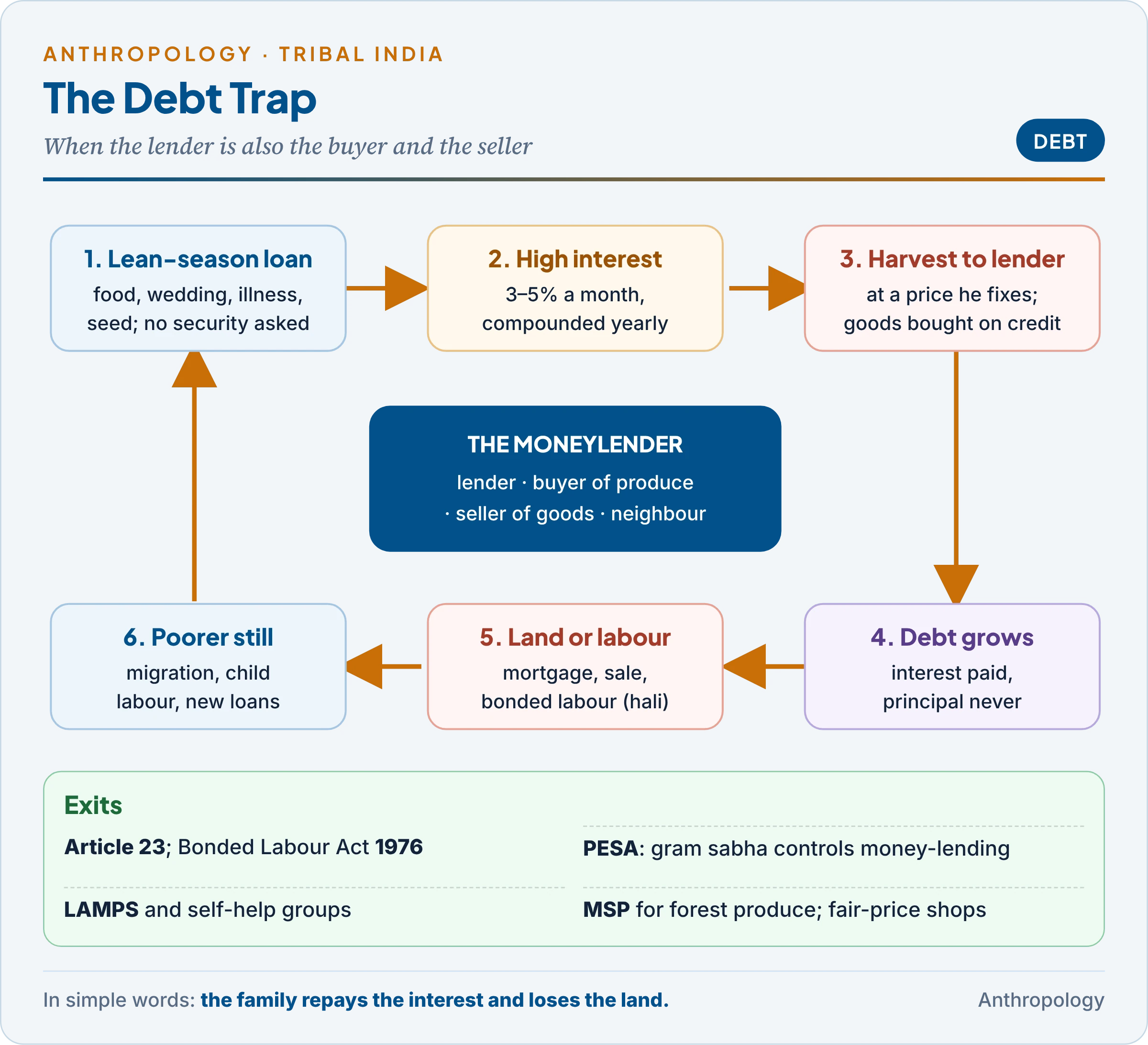
How the trap works. The moneylender often plays three roles at once: lender, buyer of produce and seller of goods. He lends in the lean season, buys the harvest at a low price fixed by himself to “recover” the loan, and sells rice and cloth on credit at a high price. Interest of 3–5% a month (36–60% a year) compounds; the family repays interest, never the principal. Debt then converts into land transfer (§2) or bonded labour. Because the lender is also a neighbour who helps in emergencies, the relationship is accepted as patronage, which is why it lasts.
4.2 Consequences
- Land alienation through mortgage and sale.
- Bonded labour and child labour: the Planning Commission’s evaluation found that most bonded labourers were SCs and STs.
- Migration to escape or to repay.
- Loss of bargaining power in selling produce.
4.3 Remedies and their limits
- Article 23 prohibits forced labour; the Bonded Labour System (Abolition) Act, 1976 freed bonded labourers, cancelled their debts and set up district vigilance committees. The Central Sector Scheme for Rehabilitation of Bonded Labourers (2016) pays rehabilitation assistance to those released.
- Money-lending regulations under the Fifth Schedule and state laws require licences and cap interest, and PESA gives the gram sabha power to control money-lending.
- Cooperatives: Large-sized Adivasi Multi-Purpose Societies (LAMPS) were set up from the 1970s to give credit, buy produce and sell essentials under one roof, the three functions of the moneylender.
- Why they fall short: moneylenders seldom take licences, enforcement is weak, cooperatives are often captured or under-funded, and banks still do not lend for consumption. Self-help groups, fair-price shops and minimum support prices for forest produce (§9) attack the trap from the market side.
5. Low Literacy and Poor Educational Facilities
In simple words
Tribal children start school later, understand less of what is taught, and leave earlier than other children. The reasons lie partly in poverty and distance, but mostly in a school that teaches in an unfamiliar language, with a curriculum and teachers that ignore the child’s own world.
Example first: the language gap. A Koya child in the Godavari hills or a Gond child in Bastar arrives at school speaking only her mother tongue, and meets a teacher and textbooks in Telugu or Hindi. For two or three years she copies words she does not understand, falls behind, is labelled “slow”, and drops out. Where schools begin in the mother tongue and bridge to the state language, children stay longer and learn more. Studies of tribal education repeatedly find that language, not lack of ability, explains much of the gap.
5.1 The gap in numbers
The table traces the literacy gap and shows where it persists today.
| Indicator | Scheduled Tribes | All |
|---|---|---|
| Literacy 1961 → 2011 (Census) | 8.5% → 59.0% | 28.3% → 73.0% |
| Female literacy 2011 | 49.4% | 64.6% |
| Gross enrolment, higher secondary (UDISE+ 2023–24) | 48.7% | 56.2% |
| Gross enrolment, higher education (AISHE 2023–24) | men 21.9%, women 23.7% | men 28.9%, women 31.2% |
- Progress: enrolment at the primary level is now near universal for STs; the gap opens at secondary and higher levels.
- Variation: ST literacy was 91.5% in Mizoram but about 49% in undivided Andhra Pradesh (2011), showing that history (missionary schooling) and policy matter more than “tribal” status.
5.2 Constraints
Educational constraints are best grouped as economic, socio-cultural, institutional and psychological.
- Economic: children work (cattle, younger siblings, forest collection, seasonal migration with parents); schooling has an opportunity cost; families cannot afford uniforms, books or travel.
- Socio-cultural: language of instruction; a curriculum built on urban, caste-Hindu life; festival and agricultural calendars that clash with the school year; early marriage of girls.
- Institutional: schools far from scattered hamlets; buildings, hostels and teachers in short supply; teacher absenteeism; non-tribal teachers posted unwillingly; separate departments running schools; in conflict areas, schools occupied by security forces.
- Psychological: teachers’ stereotypes (“tribal children are docile”, “their language is inferior”) and the child’s sense of inferiority lower expectations on both sides; lack of educated role models in the family.
The four groups interact: a child who migrates with parents for four months (economic) misses the lessons she could not follow anyway (socio-cultural), in a school with an absent teacher (institutional), and concludes that school is “not for us” (psychological).
5.3 Measures
- Constitution: Article 46 (promote with special care the educational interests of STs), Article 15(4) (special provisions), Article 350A (primary education in the mother tongue for linguistic minorities).
- Residential schooling: ashram schools, whose origin is linked to Thakkar Bapa‘s Bhil Seva Mandal (1922) in Gujarat; Eklavya Model Residential Schools for blocks with over 50% ST population and at least 20,000 tribal persons: 728 approved, 508 functional (July 2026).
- Scholarships, hostels, coaching and reservation in admissions.
- Mother-tongue and multilingual education: the NEP 2020 asks for the home language as the medium at least up to Grade 5 wherever possible; states such as Odisha run multilingual programmes in tribal languages.
- The Xaxa Committee (High Level Committee on the socio-economic, health and educational status of tribal communities, chaired by Virginius Xaxa, report 2014) recommended multilingual early education, a separate cadre of teachers for tribal schools, teacher training institutions in tribal areas, local culture and history in the curriculum, residential schools for nomadic tribes, demilitarisation of schools, social audits and community control through panchayats.
6. Unemployment and Under-employment
In simple words
Few tribal people are “unemployed” in the sense of having no work at all, because the poor cannot afford to sit idle. Their problem is under-employment: work for only part of the year, in low-paid, insecure jobs, often far from home.
- Low open unemployment: the PLFS for calendar 2025 put the ST unemployment rate at only 2.1% (rural 1.6%, urban 6.6%). The figure hides more than it shows.
- Under-employment: rain-fed farming gives work for four to six months; forest work has shrunk; landless families depend on casual and seasonal labour. Census 2011 showed a rise in marginal workers (those with work for less than six months).
- Shift from land to labour: cultivators fell and agricultural labourers rose (§2); one ST household in two now relies mainly on manual labour.
- Distress migration: seasonal streams of Bhils from western Madhya Pradesh and Rajasthan to Gujarat’s farms and construction sites, of Santal, Oraon and Munda to brick kilns and the farms of West Bengal and Punjab, of Gond and Kondh to cities. Migrants face advance-wage bondage, unpaid wages, unsafe sites and, for women, sexual exploitation. The Inter-State Migrant Workmen Act (1979) covered only contractor-recruited workers and was weakly enforced; it is now subsumed in the Occupational Safety, Health and Working Conditions Code (2020).
Issues of tribal agricultural labourers. They face low and unequal wages, seasonal idleness, debt to employers, absence from land reform benefits, and exclusion from welfare when they migrate. Women labourers are paid less than men.
Remedies. Rural employment guarantee: the MGNREGA (2005) was repealed and replaced from 1 July 2026 by the Viksit Bharat – Guarantee for Rozgar and Ajeevika Mission (Gramin) Act, 2025 (VB-G RAM G), which guarantees 125 days of wage work a year to rural households; skilling and Van Dhan enterprises (§9); reservation in jobs; restoring land and forest rights, which remain the surest source of year-round work.
7. Health and Nutrition
In simple words
Tribal people fall ill more often and die younger than other Indians. The causes are partly ecological (malaria in forests, inherited blood disorders), partly economic (poverty and lost forest foods) and partly social (remote clinics and a health system that does not speak their language). Malnutrition among tribal children is the most serious single problem.
Example first: Gadchiroli. In Gadchiroli, a forested tribal district of eastern Maharashtra, screening under the national sickle-cell mission had tested about 4.9 lakh people by July 2026 and found about 24,000 carriers and 2,654 people with sickle-cell disease. The same district carries a heavy burden of falciparum malaria, which the sickle-cell gene once helped carriers survive. Here the ecology of the forest, the genetics of the population and the poverty of the households combine in one disease landscape. The public-health physician Abhay Bang began his community work in this district.
7.1 The health gap in numbers
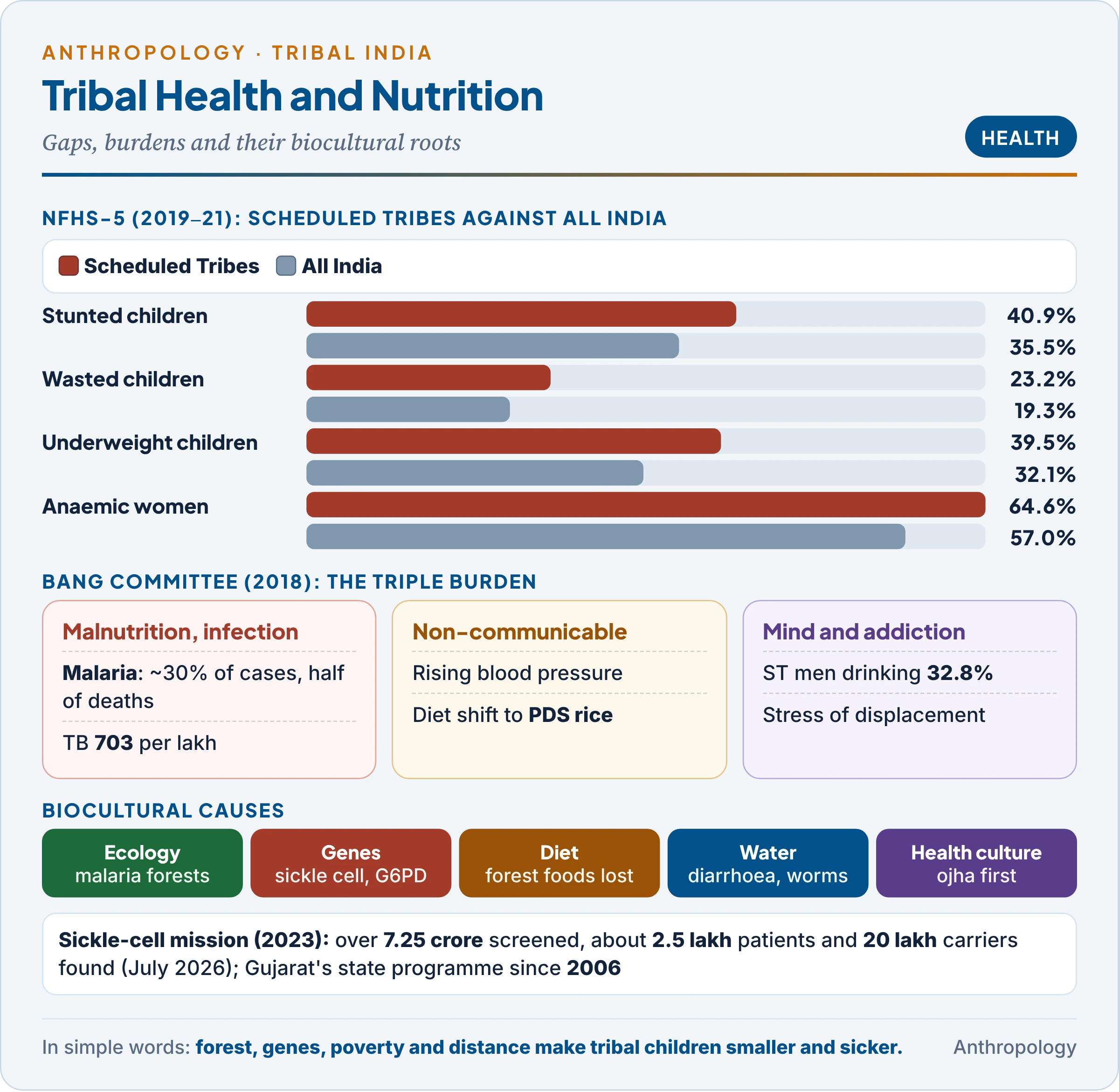
The table compares STs with the rest of the population on the key indicators from NFHS-5.
| Indicator (NFHS-5, 2019–21) | Scheduled Tribes | All India |
|---|---|---|
| Children under 5 stunted (too short for age) | 40.9% | 35.5% |
| Children under 5 wasted (too thin for height) | 23.2% | 19.3% |
| Children under 5 underweight | 39.5% | 32.1% |
| Women (15–49) anaemic | 64.6% | 57.0% |
- Progress: stunting, wasting and underweight among ST children fell from 43.8%, 27.4% and 45.3% in NFHS-4 (2015–16); NFHS-6 (2023–24) shows national stunting down to 29.3%, but ST-wise figures await the full report.
- Anaemia rose among ST women, from 59.9% (NFHS-4) to 64.6%; ST under-five mortality was still about 50 per 1,000 live births, and 32.8% of ST men drank alcohol against 17.4% of other men.
- Micro-studies show how low tribal health once stood: among the Muria, Maria, Bhattra and Halba of Bastar, life expectancy at birth was about 41 years (Basu and Kshatriya, 1989), far below the national level of the time.
- A paradox: STs have lower rates of diabetes and high blood pressure, and better sex ratio and breastfeeding, than non-STs; their burden is concentrated in infection, undernutrition and addiction.
7.2 The Bang Committee (2018)
The Expert Committee on Tribal Health, set up in 2013 by the health and tribal affairs ministries and chaired by Abhay Bang, reported in 2018 (Tribal Health in India: Bridging the Gap and a Roadmap for the Future).
- Triple burden: malnutrition and communicable disease (malaria, tuberculosis, diarrhoea), rising non-communicable disease, and mental illness and addiction.
- Malaria: tribal areas accounted for about 30% of cases, over 60% of falciparum cases and about half of malaria deaths, from 8.6% of the population; tuberculosis prevalence was about 703 per lakh against 256.
- Recommendations: a National Tribal Health Action Plan, Aarogya Mitras (trained tribal youth) beside ASHAs, a Tribal Health Council, a Tribal Health Index, and health spending per tribal person matching national norms.
- Cultural distance: services work better in local languages, with traditional healers and dais involved and the gram sabha in charge (Paper I, 9.8, §7).
7.3 Environmental and biocultural causes
- Ecology: malaria-endemic forests and hills; fluorosis from groundwater in parts of central India; iodine-poor hill soils (goitre).
- Genetics: sickle-cell disease, G6PD deficiency and thalassaemias (6.1, §3.3); consanguinity raises recessive disorders in some southern tribes.
- Food systems: deforestation and forest laws removed tubers, greens, fruit, honey and game that once balanced diets; the shift from millets to polished PDS rice lowered micronutrient intake.
- Water and sanitation: unsafe water and open defecation spread diarrhoea and worms, which waste the food a child eats.
- Health culture: illness is often explained by spirits, sorcery or broken taboos, and the first resort is the ojha, sirha or guni (diviner-healer); clinics are distant and staff may not speak the language.
- Habits and stress: alcohol (including home-brewed rice beer and mahua liquor, part of ritual) and tobacco; displacement and migration add mental stress and loss of social support.
- Women’s workload: long hours of fuel and water collection during pregnancy, with closely spaced births, produce low birth weight.
Causes of stunting and wasting among tribal children. Stunting (chronic) reflects maternal undernutrition and anaemia, low birth weight, poor complementary feeding after six months and repeated infections; wasting (acute) reflects seasonal hunger, diarrhoea and malaria. Interventions: take-home rations and hot meals through POSHAN 2.0 and anganwadis in every hamlet; millets and forest foods in the PDS and school meals; WASH (water, sanitation and hygiene); malaria control; and community-based management of acute malnutrition.
Traditional knowledge and health. Tribal ethnomedicine includes herbal remedies, bone-setting and birth attendance, and knowledge of hundreds of medicinal plants. It is valuable where it works and where it builds trust; the task is to validate remedies, protect knowledge against unfair patenting, and link healers with the formal system rather than replace them.
7.4 Sickle-cell disease: the national mission and the states
- Prevalence: carriers range from 1% to 40% across tribes of central, western and southern India, highest in groups of Madhya Pradesh, Chhattisgarh, Maharashtra, Gujarat and Odisha.
- The mission: the National Sickle Cell Anaemia Elimination Mission, launched at Shahdol on 1 July 2023, aims to eliminate the disease as a public-health problem by 2047 by screening 7 crore people aged 0–40 in 17 states. By July 2026 it had conducted more than 7.25 crore screenings, found about 2.5 lakh people with the disease and about 20 lakh carriers, and issued genetic status cards to guide marriage and pregnancy choices; 17 centres of excellence in 15 states have been approved with tribal affairs funding.
- State initiatives: Gujarat began the first state Sickle Cell Anaemia Control Programme in 2006 in its tribal districts and has screened over a crore people; Madhya Pradesh set up a State Haemoglobinopathy Mission, piloted screening in Jhabua and Alirajpur (2021) and built integrated centres in tribal districts; Gujarat, Maharashtra, Chhattisgarh and Odisha run newborn screening programmes.
- The anthropological point: pre-marital counselling must work through clan and marriage rules; a card that marks a person as a carrier can create stigma unless the community owns the programme.
8. Other Vulnerable Groups and New Pressures
In simple words
Some tribal groups face special problems: nomads who have no fixed village, communities once branded “criminal” by colonial law, and forest peoples whose livelihoods are threatened by mining and climate change.
- Nomadic, semi-nomadic and denotified tribes: the colonial Criminal Tribes Act (1871) branded whole communities as hereditary criminals; it was repealed in 1952 (“denotification”), but Habitual Offenders laws and police suspicion continued. Their problems are no land, no fixed address (hence no ration card or school enrolment), stigma and exclusion from ST/SC lists in many states. The Renke Commission (2008) and Idate Commission (2015–18) recommended a permanent commission and inclusion in reservation lists; the SEED scheme (2022) offers coaching, health insurance and livelihood support.
- Mining: most of India’s coal, iron ore and bauxite lies under tribal districts of Jharkhand, Odisha and Chhattisgarh; mining brings displacement, polluted water, lost forests and in-migration, while benefits flow outward. District Mineral Foundations (2015) were meant to return a share to affected people (detail in 6.3a).
- Climate change: forest-dependent and rain-fed tribal farmers are among the most exposed: erratic monsoons, heat stress, failing forest produce and new vector-borne disease. Yet their sacred groves, mixed cropping, millets and community forest management are adaptation strategies the state now seeks to learn from.
- Elites and alienation: the benefits of reservation and development have gone disproportionately to an educated tribal elite, opening a gap between them and the majority, and between the elite and its own culture.
9. Trade and Markets in Tribal Societies
In simple words
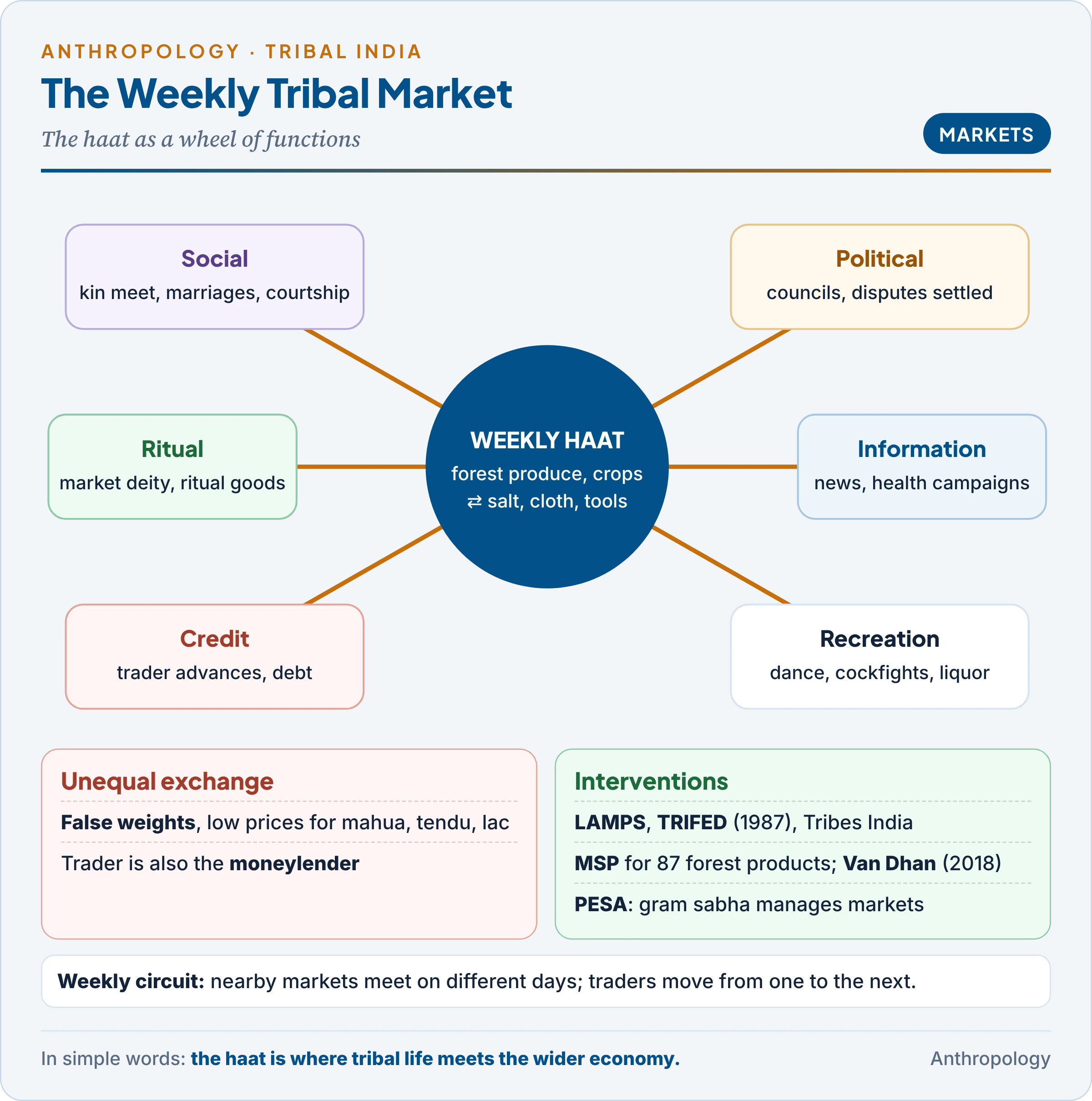
Most tribal villages have no shop. Once a week people walk to a market, the haat, to sell forest produce and crops and buy salt, cloth and tools. The haat is also where people meet relatives, settle disputes, court, hear news and perform rituals, so it is a social centre as much as a place of trade.
Example first: a Bastar market. The British anthropologist Alfred Gell studied a weekly market among the Muria Gond of north-central Bastar (“The Market Wheel: Symbolic Aspects of an Indian Tribal Market”, Man, 1982). He read the market’s layout and the movement of people through it as a map of society, a symbolic expression of the relations between tribe, caste and trader. The market linked tribal producers to a chain of traders that ran to the towns. Earlier, D.P. Sinha (Culture Change in an Intertribal Market, 1968) showed how the Banari market of the Chotanagpur hills brought several hill peoples together and became a channel of cultural change.
9.1 Forms of exchange
- Barter: goods for goods, measured by volume rather than weight, at customary rates: the Maler (Sauria Paharia) exchanged forest timber with Santal plains farmers for rice.
- Reciprocity: generalised among kin (help at transplanting), balanced in gift exchange at marriages, negative (bargaining for advantage) with outsiders (Paper I, 3b).
- Inter-tribal specialisation: in the Nilgiris the Toda, Kota, Badaga, Kurumba and Irula exchanged dairy produce, tools, music, grain and forest produce (6.1, §6.3).
- Coconut currency among the Nicobarese in trade with passing ships.
- Market exchange in cash at the weekly haat and through traders, now dominant almost everywhere.
9.2 Characteristics and functions of the tribal market
The weekly market differs from a town market in rhythm, layout and meaning. The table lists its functions, of which the economic is only the first.
| Function | What happens |
|---|---|
| Economic | Sale of forest produce, crops, livestock and crafts; purchase of salt, oil, cloth, tools and ornaments; credit from traders |
| Social | Meeting kin from other villages; arranging marriages; courtship among the young in their best clothes |
| Political and judicial | Village and inter-village councils meet; disputes are settled; leaders and officials address people |
| Religious and ritual | Offerings at the market deity; sale of ritual goods; festival markets |
| Information and change | News, rumours and new goods spread; health and government campaigns use the haat |
| Recreation | Cockfights, dance, liquor and entertainment |
- Periodicity: markets in neighbouring villages meet on different days, forming a weekly circuit that traders follow.
- Location: at ecological boundaries (hill and plain) where different products meet.
- Inter-ethnic: tribals, caste peasants, artisans and traders meet; the market is where tribal and non-tribal economies interlock.
9.3 Exploitation and change
- Unequal exchange: traders use false weights, fix low prices for minor forest produce (mahua, tamarind, sal seed, tendu leaves, lac, honey) and sell manufactured goods dear; the trader-moneylender binds sellers through advances (§4).
- Commercialisation: cash crops, plastic and factory goods replace crafts, undercutting artisan tribes; permanent shops and mobile phones change the weekly rhythm.
- Interventions: LAMPS and state forest-produce corporations buy produce; TRIFED (the Tribal Cooperative Marketing Development Federation of India, 1987) markets tribal crafts under Tribes India; minimum support prices for minor forest produce, introduced in 2013–14 for 10 items, now cover 87; Van Dhan Vikas Kendras (from 14 April 2018, first at Bijapur, Chhattisgarh) group gatherers into producer clusters, with 4,125 sanctioned for about 12.3 lakh members; PESA lets the gram sabha manage village markets; tribal multipurpose marketing centres are part of the 2024 village mission.
Key Terms
| Term | Meaning in simple words |
|---|---|
| Land alienation | Tribal land passing to non-tribals or the state |
| Benami transfer | Buying land in someone else’s name to evade the law |
| Diku | Chotanagpur term for exploiting outsiders |
| Scheduled Area | An area notified under the Fifth Schedule for special protection |
| Samatha judgment | 1997 ruling barring leases of Scheduled Area land to non-tribal private miners |
| PESA | 1996 law giving gram sabhas in Scheduled Areas power over land, markets and money-lending |
| Bonded labour | Working without free choice to repay a debt |
| Hali | A tied farm servant in south Gujarat, bound by marriage loans |
| LAMPS | Cooperative giving credit, buying produce and selling goods to tribals |
| Under-employment | Working fewer days or hours than one needs |
| Distress migration | Leaving home for work because of debt or hunger, not opportunity |
| Stunting / wasting | Low height for age (chronic) / low weight for height (acute) |
| Triple burden | Undernutrition and infection, non-communicable disease, and addiction together |
| Genetic status card | Card showing whether a person carries the sickle-cell gene |
| Ethnomedicine | A community’s own system of healing |
| Denotified tribes | Communities once branded “criminal” under the 1871 Act |
| Haat | Weekly market in a tribal area |
| Minor forest produce | Non-timber forest products such as mahua, tendu and lac |
| Van Dhan Vikas Kendra | A cluster of tribal self-help groups processing forest produce |
Contemporary Developments
- Saturation drives: PM-JANMAN (launched 15 November 2023) for the 75 PVTGs, and the Dharti Aaba Janjatiya Gram Utkarsh Abhiyan (approved 18 September 2024, launched 2 October 2024), with 25 interventions by 17 ministries in 63,843 tribal-majority villages of 549 districts, an outlay of ₹79,156 crore and up to 1,000 mobile medical units.
- Rural employment: the VB-G RAM G Act, 2025 replaced MGNREGA from 1 July 2026 with a guarantee of 125 days.
- Sickle-cell mission: more than 7.25 crore screenings by July 2026; 17 centres of excellence approved.
- NFHS-6 (2023–24), released 29 May 2026: national child stunting 29.3%; ST-wise figures are awaited.
- Education: 508 EMRS functional of 728 approved (July 2026).
- Forest produce: MSP list at 87 items; 4,125 Van Dhan Kendras sanctioned.
Diagrams to Master
- Topic map: land → debt → poverty → schooling → work → health, with markets and safeguards.
- Land alienation chain: causes → methods → consequences → safeguards (Fifth Schedule, tenancy laws, Samatha, PESA, FRA, LARR).
- Debt trap: the lender-buyer-seller triangle, compound interest, mortgage and bondage, and the exits.
- Health and nutrition panel: NFHS-5 gaps; Bang’s triple burden; biocultural causes; sickle-cell mission.
- Haat wheel: six functions, weekly circuit, unequal exchange and interventions.
Revision Grid
| Scholar or body | Work (year) | Key idea |
|---|---|---|
| D.P. Sinha | Culture Change in an Intertribal Market (1968) | The Banari market as a channel of change |
| Jan Breman | Patronage and Exploitation (1974) | Dubla hali bondage in south Gujarat |
| Alfred Gell | “The Market Wheel” (1982) | The Bastar market as a map of society |
| Supreme Court | Samatha v. State of Andhra Pradesh (1997) | No mining leases to non-tribal private firms in Scheduled Areas |
| Parliament | PESA Act (1996) | Gram sabha control over land, markets and money-lending |
| Maitreyi Bordia Das and colleagues | World Bank study of India’s Adivasis (2010) | Tribal poverty about twenty years behind |
| Virginius Xaxa (chair) | High Level Committee report (2014) | Multilingual education, teacher cadre, land and health |
| Abhay Bang (chair) | Tribal Health in India (2018) | Triple burden; tribal health action plan |
| Brinda Karat and Vikas Rawal | “Scheduled Tribe Households” (2014) | Rising landlessness among Adivasis |
| UNDP and OPHI | Global MPI (2021) | STs the poorest group: 50.6% |
Previous Year Questions
6.2 Problems of the tribal communities – land alienation, poverty, indebtedness, low literacy, poor educational facilities, unemployment, under-employment, health and nutrition.
- 2026Write an account on the prevalence of sickle cell disease among the tribal populations of India. What are the initiatives undertaken by the affected states to tackle with this disease?
- 2026What are the major challenges tribal communities are facing in contemporary India?
- 2025Examine the environmental and biocultural factors influencing the health of tribals of India.
- 2024Write notes on: Causes of stunting and wasting among tribal children.
- 2024Custodians of natural resources are the tribals, but they are the most deprived. Critically examine how climate change will impact their survival in future.
- 2024Discuss the economic, social, and developmental impacts on tribal communities with special reference to mining.
- 2022Write notes on: Issues of tribal agricultural labourers.
- 2022Write notes on: Major problems of nomadic and semi-nomadic groups.
- 2022Discuss the issues and solutions related to the Scheduled Caste and the Scheduled Tribe populations in India.
- 2022Explain how British policies impacted the major resources of the tribals.
- 2021Elucidate the problems and challenges in educational attainment of the Scheduled Tribes.
- 2021Examine the factors responsible for malnutrition in tribal India and suggest interventions required to overcome the problem.
- 2020Elucidate the problems of land alienation among the tribals of India.
- 2019Write a note in 150 words on Issues relating to tribal education.
- 2017Write a note in 150 words on Indebtedness among tribal communities.
- 2017Describe the impact of displacement on the health and nutritional status of tribal communities.
- 2015Discuss how constitutional provisions in India have built-in mechanisms for dealing with the problem of land alienation in tribal areas.
- 2015Discuss the sociocultural, economic and psychological constraints responsible for low literacy in tribal areas.
- 2014Discuss the impact of land alienation on the tribes of Central India.
- 2010Write a note in 150 words on Education and health among tribal women.
- 2010“Land and forest are the twin problems of the tribes.” Explain.
- 2010Discuss the relevance of traditional wisdom and knowledge of the tribes with reference to health in the present day context.
- 2010Critically examine the various structural constraints in the educational development of Scheduled Tribes.
- 2009Write a note on Indebtedness in Tribal Communities.
- 2008Discuss the health problems faced by tribal populations in India. Suggest some corrective measures.
- 2007Write a note on Land Alienation.
- 2005Discuss the factors related to low literacy rate among the tribals of India. Write in brief the measures taken by the government in different five-year plans to eradicate it.
- 2003Write a note on Constraints of educational development among the tribals.
- 2003Write a note on Land alienation among the tribals.
- 2000Write a note on The problems of denotified groups.
- 1999Write a note on Land Alienation in tribal India.
- 1999Bring out, with suitable examples, the constraints of educational development of tribal communities in India. Suggest remedial measures in this context.
- 1998Discuss the health and nutritional status of tribal and rural children in India. How far has the government policy been effective ?
- 1996Distinguish among nutrition, food and diet. Comment on the nutritional status of the tribes with subsistence economy in the form of hunting-gathering, shifting cultivation and settled agriculture in India.
- 1995Describe the socio-cultural factors related to the poor health conditions of the Indian tribal population. Suggest measures for improving these conditions.
- 1994Write a note on Factors responsible for tribal migration and its consequences.
- 1993Write a note on Tribal education.
- 1992Write a note on Indebtedness and land alienation among Indian tribes.
- 1992What are the major problems of the tribes in India ? Evaluate the measures adopted by the Central and State Governments in India to solve these problems.
- 1990Write a note on Transfer and alienation of tribal land.
- 1990Discuss the anthropological approach to the understanding of the tribal ethos and comment on the major socioeconomic problems of Indian tribes.
- 1989Discuss major problems of the tribes of India. Make a critical evaluation of the measures adopted by the Central and State Govt, in India to solve these problems and account for their limited success.
- 1988Write a note on Common Property Resources in tribal villages.
- 1988Write a note on Elites and alienation in tribal society.
- 1988Discuss the special problems of shifting cultivators or of hunting food gathering tribes.
- 1986Write a note on Indebtedness and land alienation among Indian tribes.
- 1986Define untouchability and point out whether the problems of its removal should be treated as a matter of social reform rather than as part of administrative and legal measures.
- 1983Write a note in 200 words : Indebtedness and land alienation among Indian tribes.
- 1983Discuss the isolationist and assimilationist approaches to the tribal problems, showing their respective merits and demerits.
- 1981Identify the main type of problems that arise out of contacts between tribal people and more advanced sections of Indian population. What measures do you suggest to mitigate the same ?
Trade and markets for tribal societies
- 2025Describe the nature of traditional socioeconomic interdependence among the Toda, Kota, Kurumba and Irula tribes of Nilgiri Hills. Highlight the changes occurring in these interrelationships.
- 1991What are the principal characteristic of tribal markets ? What extra-economic functions do such markets perform?
- 1990Write a note on Tribal markets as centres of social and cultural interaction.
- 1989Write a note on Barter and Exchange in the tribal societies.
Related questions from other units
- 2026Unit 9.1: ‘Dharti Aaba Janjatiya Gram Utkarsh Abhiyan aims to meet some of the Sustainable Development Goals’. Discuss.
- 2024Unit 6.3: Examine the impact of Forest Policies from 1878 to 2006 on land alienation and deprivation of rights of tribal communities in India.
- 2020Unit 9.1: Discuss the effect of job reservation in alleviating unemployment among the tribal people of India.
- 2014Unit 9.1: Critically examine the role of NGOs in promoting health and education in tribal areas.
- 2012Unit 9.1: Using suitable examples, bring out the historical processes of the social exclusion of denotified tribes.
- 2010Unit 7.1: Write a note in 150 words on The problem of bonded labour among Indian tribes.
- 2000Unit 7.2: Write a note on MADA, LAMPS TRIFED.
- 2000Unit 9.1: Write a note on Tribal education in the context of development.
- 1988Unit 6.1: Write a note on Migration as a means of socio-economic mobility in tribal society.
More from Tribal Situation in India: all notes of this unit · every PYQ of this unit · Anthropology Optional hub