

Anthropology Optional › Paper II › Unit 05: Indian Village and Social Change
5.3 Indigenous and exogenous processes of socio-cultural change in Indian society: Sanskritization, Westernization, Modernization; Inter-play of little and great traditions; Panchayati raj and social change; Media and social change.
Official Syllabus: Paper II, Unit 5.3
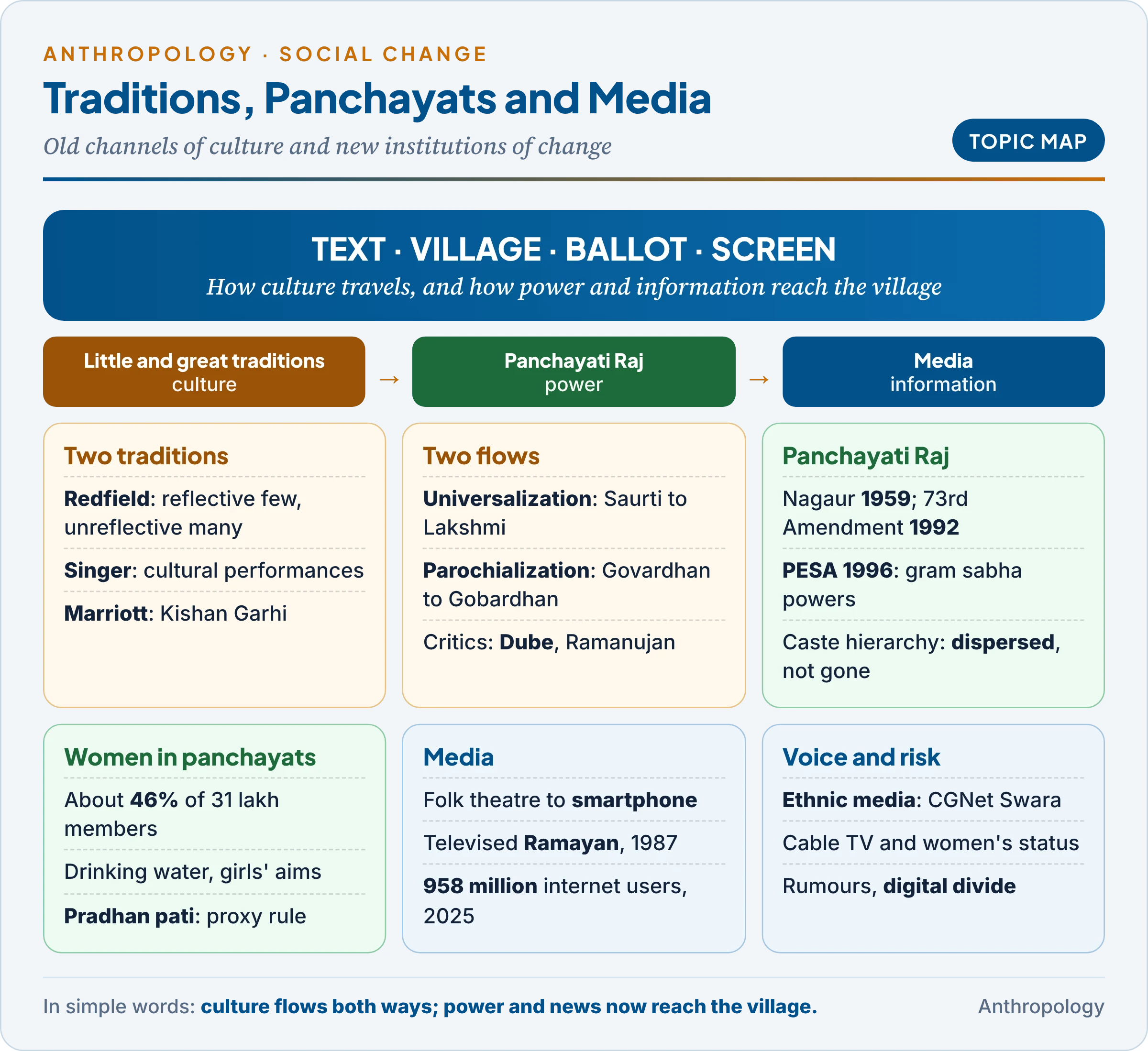
This article covers the second part of the syllabus line: how India’s little and great traditions interact, and how two modern institutions, Panchayati Raj and the media, change rural society. Sanskritization, Westernization and modernization are in 5.3a. L.P. Vidyarthi’s sacred complex, which applies the great-little framework to pilgrim centres, is in 3.3; the dominant caste and village factions are in 3.2b.
1. Inter-play of Little and Great Traditions
In simple words
Every civilization has two levels of culture. One is written down in sacred books and kept by priests and scholars; the other lives in village songs, local gods and family customs. In India the two levels have talked to each other for centuries, each borrowing from and reshaping the other, and this conversation holds the civilization together.
1.1 Diwali in Kishan Garhi: the example
In Kishan Garhi, a village in Aligarh district of western Uttar Pradesh, the American anthropologist McKim Marriott watched the Festival of Lights in 1951–52. Villagers worshipped Saurti, a local goddess of wealth drawn on the house wall, and they also knew Diwali as the festival of Lakshmi, the all-India goddess of prosperity in Sanskrit texts. Marriott suggested that the local Saurti and the textual Lakshmi were two versions of one idea: a village goddess could be lifted into the all-India pantheon, and an all-India goddess could be brought down into village practice. In December 2025 Deepavali was inscribed on UNESCO‘s list of the intangible cultural heritage of humanity: a festival with village roots now carries a global label. The example shows that Indian religion is neither purely textual nor purely local, but a continuous traffic between the two.
1.2 Redfield: the social organization of tradition
Robert Redfield, an American anthropologist at the University of Chicago, studied Mexican communities (The Folk Culture of Yucatan, 1941) and then turned to whole civilizations.
- Peasants are part-societies. A.L. Kroeber (Anthropology, 1948) called peasants “part-societies with part-cultures”: unlike an isolated tribe, a peasant village depends on towns, markets, priests and states, so its culture cannot be understood from inside the village alone.
- Two traditions. In Peasant Society and Culture (1956) Redfield wrote: “In a civilization there is a great tradition of the reflective few, and there is a little tradition of the largely unreflective many.” The great tradition is “cultivated in schools or temples”; the little tradition “works itself out and keeps itself going in the lives of the unlettered in their village communities.”
- Two currents. The two are “two currents of thought and action, distinguishable, yet ever flowing into and out of each other“. In isolated tribes there is no such division; it appears only in civilizations.
- Folk-urban continuum. In Yucatan Redfield arranged communities from the isolated folk village to the city, and argued that moving along this line brings secularization, individualization and disorganization of culture. The great-little framework softened this: the village is not the opposite of the city but linked to it by priests, markets and pilgrimage (3.2b §4.6).
- Orthogenetic civilization. With Milton Singer (“The Cultural Role of Cities”, 1954) Redfield called India an orthogenetic (self-generated) civilization, whose great tradition grew out of its own older folk cultures rather than being imposed from outside.
The table sets out the characteristics of the two traditions; read the rows as the ends of a continuum, not as two sealed boxes.
| Feature | Great tradition | Little tradition |
|---|---|---|
| Carriers | Reflective few: priests, scholars, monks | Unreflective many: peasants, folk |
| Medium | Written, Sanskrit or classical texts | Oral: songs, proverbs, stories, rites |
| Where cultivated | Schools, temples, monasteries, courts | Village homes, fields, shrines |
| Attitude | Consciously systematised and refined | Taken for granted, not scrutinised |
| Spread | Wide, civilization-wide | Local, regional |
| Example | Vedas, epics, Puranas, Lakshmi, Durga | Village goddesses, spirit cults, harvest rites |
| Specialists | Pandits, acharyas | Folk artists, healers, bards, storytellers |
The key point is that the two levels share one world-view: the village goddess and the Puranic goddess belong to one religion, so ideas can move between them without conversion or conflict.
1.3 Milton Singer: cultural performances in Madras
Milton Singer, Redfield’s colleague, studied Madras (Chennai) from 1954 and asked how a civilization can be observed directly.
- Cultural performances: a civilization is visible in concrete events (weddings, temple festivals, recitations, plays, dances, concerts) that have a fixed time, place, programme, performers and audience.
- Cultural media: song, dance, recitation, ritual, sculpture and painting, through which the content of the tradition is transmitted.
- Cultural specialists and centres: priests, reciters, musicians and dancers, working from temples, mathas and cities.
- In Traditional India: Structure and Change (edited, 1959) and When a Great Tradition Modernizes (1972) he showed that the great tradition modernizes rather than dying: Sanskrit epics moved into radio, film and urban devotional singing (bhajan) circles of the Madras middle class (5.3a §4.1).
1.4 Marriott: universalization and parochialization
Marriott’s essay “Little Communities in an Indigenous Civilization” in Village India (1955), which he edited, gave the two processes their names.
- Universalization: the upward carrying of elements already present in little traditions into the great tradition, where they gain a wider name and meaning. An indigenous civilization is one whose great tradition grew this way, so it has authority as a refined statement of what villagers already believe, but cannot uproot the local forms that are the source of its sacredness.
- Parochialization: the downward movement of great-tradition elements into little communities, where they are localised. Marriott described it as a process of “localization, of limitation upon the scope of intelligibility, of deprivation of literary form, of reduction to less systematic and less reflective dimensions.“
| Process | Direction | Kishan Garhi example |
|---|---|---|
| Universalization | Little to great | Wall goddess Saurti linked with Lakshmi at Diwali |
| Universalization | Little to great | Local festival Saluno (sisters place barley shoots on brothers) parallel to all-India Raksha Bandhan |
| Parochialization | Great to little | The nine Durgas of Navaratri worshipped as one mud goddess Naurtha (from nava ratra, nine nights) |
| Parochialization | Great to little | Krishna lifting Govardhan hill becomes Gobardhan (gobar, cow dung + dhan, wealth): a mound of dung in each yard |
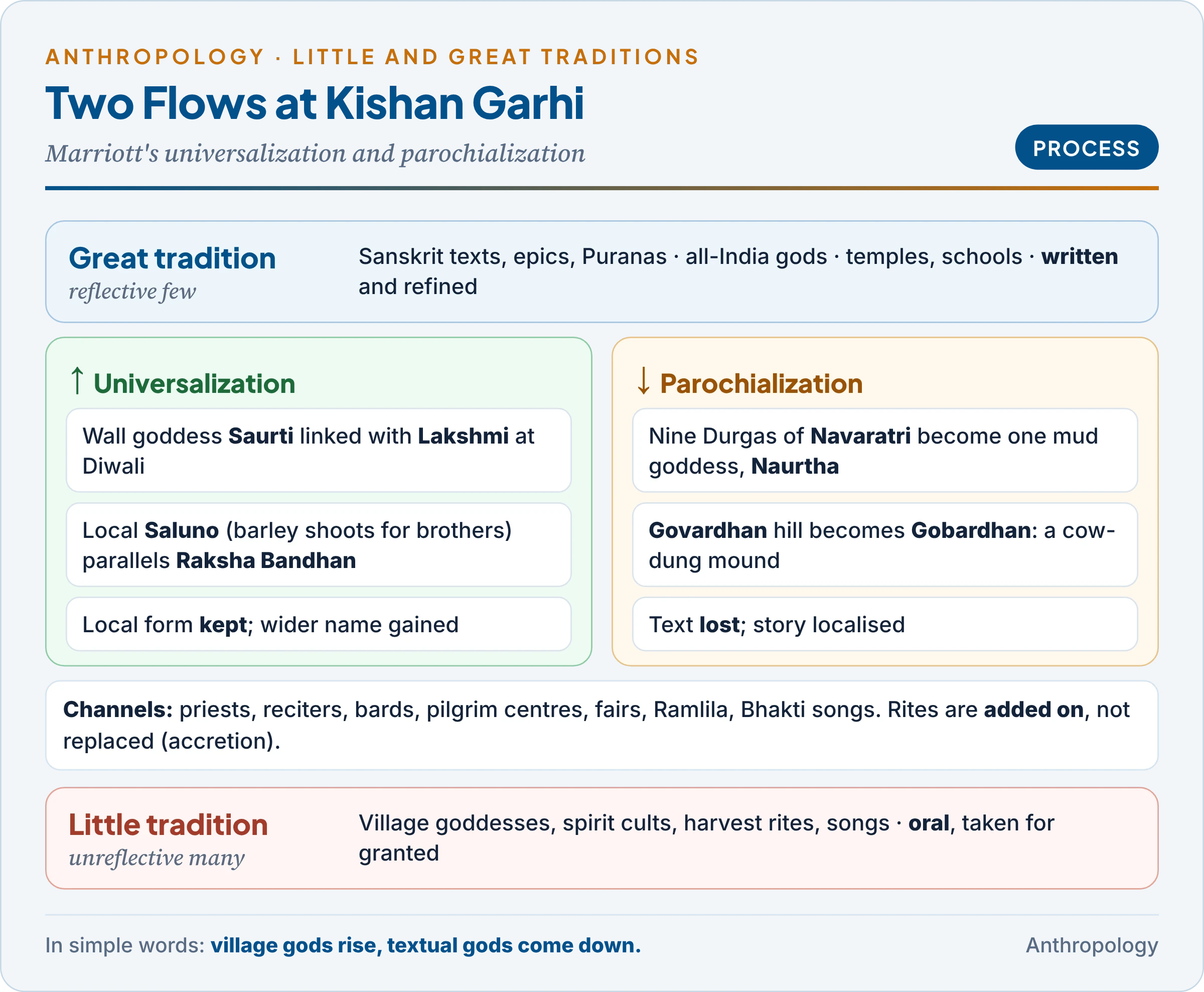
Two further findings matter. First, great-tradition rites in Kishan Garhi were added on to local ones, not substituted for them (accretion, not replacement), which qualifies Sanskritization (5.3a §2.8). Second, the local Sanadh Brahmins were only slightly Sanskritized and served a non-Sanskritic mother-goddess, so even the Brahmin channel carried mostly little-traditional content. A further secondary transformation was already visible: factory-made charms were replacing the priests’ threads at Raksha Bandhan.
Common confusion
Are universalization and Sanskritization the same? Not quite. Sanskritization (Srinivas) is a group’s strategy: a caste copies higher-caste customs to claim rank. Universalization (Marriott) is a movement of cultural content: a local deity or rite rises into the great tradition, whoever carries it and with no claim to status. Yogendra Singh noted that universalization resembles Sanskritization, while parochialization is closer to its reverse.
1.5 Channels of communication between the traditions
How does content travel between the two levels? The channels are people, places and performances.
- Cultural specialists: priests, kathavachaks (reciters of sacred stories), bards, genealogists and wandering ascetics translate texts into village idiom.
- Sacred centres and pilgrimage: at Gaya, L.P. Vidyarthi found pilgrim priests transmitting the great tradition to rural pilgrims (3.3). Bernard Cohn and McKim Marriott (“Networks and Centres in the Integration of Indian Civilization”, 1958) showed that pilgrim towns, fairs, markets and marriage networks link villages into a civilization.
- Performances: the Ramlila of north India, Yakshagana of Karnataka and the Pandavani of Chhattisgarh retell the epics in local languages and styles.
- Bhakti saints wrote in regional languages, carrying Sanskritic ideas downward and later feeding vernacular hymns back into Sanskrit.
- Modern media now carry both levels at once (§3).
1.6 Applying the framework: religion, kinship and agriculture
The framework is not only about gods. The table applies it to three fields of village life.
| Field | Great-tradition element | Little-tradition element | Interplay |
|---|---|---|---|
| Religion | Vishnu, Shiva, Devi; Sanskrit rites | Village goddesses, spirit cults, animal sacrifice | Local goddess identified as a form of Durga; both rites performed |
| Kinship | Dharmashastra rules: gotra exogamy, kanyadan (gift of a daughter) | Cross-cousin marriage in the south, bride-price, widow remarriage among many castes | Texts reinterpreted to accept regional custom |
| Agriculture | Seasonal festivals in the Hindu calendar | Harvest and rain rites, local field deities | Harvest feasts become all-India festivals (Pongal, Makar Sankranti) |
1.7 Critiques and Indian alternatives
Strengths. The framework treats the village as part of a civilization, not an isolate; it explains India’s unity in diversity; and, unlike Sanskritization, it can be compared across civilizations (Mexico, China, India).
Critiques.
- S.C. Dube, the Indian anthropologist of Shamirpet (Indian Village, 1955), held that two traditions are too few and proposed six: the classical, the emergent national, the regional, the local, the Western, and the local sub-cultural traditions of social groups.
- Yogendra Singh called both the dichotomy and Dube’s list ad hoc: they classify culture but say little about structure (power, land, caste).
- Louis Dumont and David Pocock (Contributions to Indian Sociology, 1957) argued that the village is not a self-contained “little community”: India must be studied as one civilization in which texts and village practice express the same structure of caste values.
- Elitism and Brahmanical bias: equating “great” with Sanskrit and “little” with the folk ranks Dalit, tribal and women’s traditions as lesser, though they have their own reflective traditions (Tamil Saiva hymns, Bhakti poets, tribal oral epics).
- Many great traditions: India also has Islamic, Buddhist, Jain and Dravidian great traditions. The sociologist A.R. Momin (“The Indo-Islamic Tradition”, 1977) showed Indian Muslims combining a Sufi-centred great tradition with local customs.
- Many tellings, not two levels: the poet and folklorist A.K. Ramanujan (“Three Hundred Ramayanas”, 1991) showed that the Ramayana exists in hundreds of tellings, folk and classical, oral and written, in conversation rather than in a ladder.
- Indian extensions: Surajit Sinha used the framework to show tribes as part of Indian civilization (3.2b), and Vidyarthi‘s sacred complex showed continuity and combination of the two traditions at Gaya (3.3).
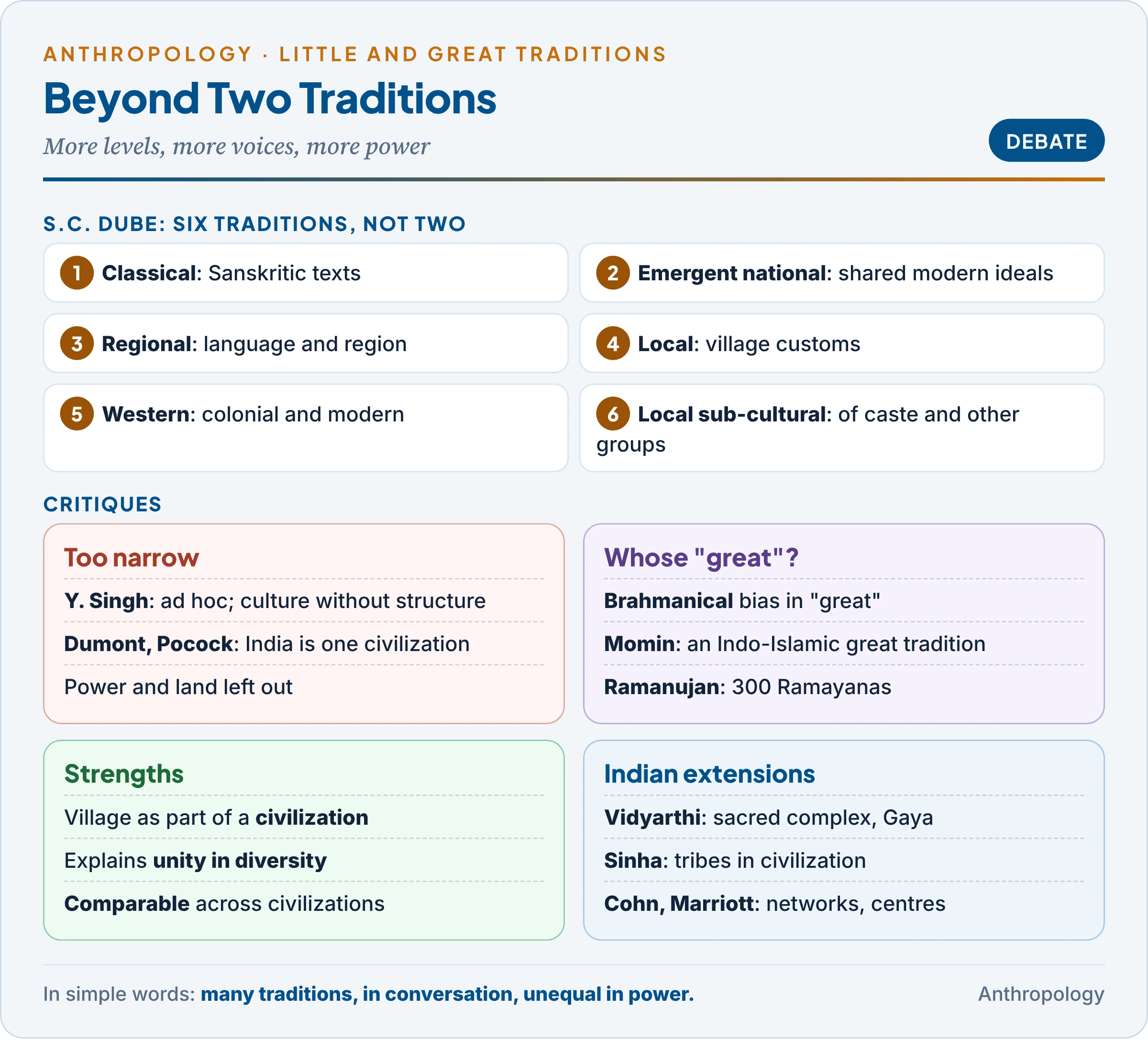
The debate refines rather than discards the framework: traditions are plural, unequal in power and in two-way communication.
1.8 Traditions in movements
Religious and political movements often fuse the two traditions.
- Birsa Munda movement (Chotanagpur, 1895–1900): Birsa, a Munda, preached one god (Singbonga, the Munda supreme deity) and borrowed Vaishnava practices (sacred thread, vegetarianism, abstinence from liquor) while mobilising Mundas against landlords and missions over khuntkatti (clan land) rights. The historian-administrator K.S. Singh (The Dust-Storm and the Hanging Mist, 1966) showed how great-tradition reform and little-tradition identity combined.
- Tana Bhagat movement (Oraon, from 1914): Jatra Oraon’s followers gave up spirit worship, meat and liquor, combining Bhakti-style reform with tribal demands; later they joined the Gandhian movement (7.4).
- Gandhi used the great-tradition idiom of Ram Rajya and the little-tradition idiom of the spinning wheel and the village.
1.9 Traditions in the age of globalization
- Great traditions go global: the UN General Assembly declared the International Day of Yoga in 2014; UNESCO has inscribed the Kumbh Mela (2017), Durga Puja in Kolkata (2021), Garba of Gujarat (2023) and Deepavali (2025), India’s sixteenth element.
- Little traditions become commodities: folk arts (Madhubani, Warli, Gond painting) gain GI tags and global markets, and local festivals become tourist spectacles.
- Glocalization: the British sociologist Roland Robertson (1992) used the term for the global being remade locally: a village festival streamed on YouTube, a diaspora temple adapting Diwali to a weekend.
- Two opposite effects: homogenization (a standard televised Ramayana, pan-Indian festivals displacing local ones) and revival (communities recording and asserting their own tellings, deities and languages).
2. Panchayati Raj and Social Change
In simple words
Panchayati Raj means elected councils at the village, block and district levels that plan and run local development. Since 1992 the Constitution reserves seats for Scheduled Castes, Scheduled Tribes and women, so people who were once excluded from village power now sit in the chair. Old hierarchies have not vanished, but they now have to work through elections.
2.1 Two villages: the example
In Melavalavu (Madurai district, Tamil Nadu), Murugesan, a Dalit, was elected president of a panchayat reserved for Scheduled Castes in 1996; in June 1997 he and five others were murdered by members of the locally dominant caste who would not accept a Dalit in the chair. In West Bengal and Rajasthan, the economists Raghabendra Chattopadhyay and Esther Duflo (“Women as Policy Makers”, Econometrica, 2004) compared gram panchayats where the head’s post was randomly reserved for women with others, and found that women heads invested more in drinking water, the good women had asked for. The two villages show both faces of Panchayati Raj: reservation opens power to the excluded, and the old hierarchy resists.
2.2 From traditional panchayats to constitutional PRIs
- Traditional councils: villages had caste panchayats (judging disputes within one caste) and village panchayats run by elders of the dominant caste (3.2b). They enforced custom, not equality, and excluded women and lower castes.
- Colonial and nationalist roots: Lord Ripon‘s resolution of 1882 on local self-government; Gandhi‘s ideal of gram swaraj (village self-rule), placed in the Constitution as Article 40 (a Directive Principle).
- Community Development and Mehta: the Community Development Programme (1952) failed to win people’s participation, so the Balwantrai Mehta Committee (1957) proposed a three-tier “democratic decentralisation”. Jawaharlal Nehru inaugurated Panchayati Raj at Nagaur (Rajasthan) on 2 October 1959.
- Decline and revival: after an early burst, PRIs were superseded or starved of funds. The Ashok Mehta Committee (1977–78) proposed two tiers; the G.V.K. Rao (1985) and L.M. Singhvi (1986) committees urged constitutional status.
- 73rd Amendment: passed in December 1992, in force from 24 April 1993 (now National Panchayati Raj Day), adding Part IX (Articles 243 to 243-O) and the Eleventh Schedule.
2.3 Main features of the 73rd Amendment
The table lists the provisions that matter for social change.
| Provision | Article | Content |
|---|---|---|
| Gram Sabha | 243A | Body of all registered voters of the village |
| Three tiers | 243B | Village, intermediate (block) and district; states under 20 lakh population may skip the middle tier |
| Direct elections | 243C | All seats filled by direct election |
| Reservation | 243D | SC and ST seats in proportion to population; not less than one-third of seats and chairpersons’ posts for women (including among SC/ST seats); states may reserve for backward classes |
| Five-year term | 243E | Fresh elections within six months of dissolution |
| Powers | 243G | Plans for economic development and social justice; 29 subjects in the Eleventh Schedule |
| Finance | 243H, 243I | Taxes, grants; State Finance Commission every five years |
| Elections | 243K | State Election Commission |
| Exemptions | 243M | Sixth Schedule areas, Nagaland, Meghalaya, Mizoram and some hill areas; Parliament may extend Part IX to Fifth Schedule areas (done by PESA) |
The Amendment aims at devolution (transfer of real power to elected bodies), not just administrative delegation. Its weak point is that the 29 subjects are only listed: each state decides how much to transfer, so actual devolution of funds, functions and functionaries varies widely.
2.4 PESA, 1996: Panchayati Raj in tribal areas
The Panchayats (Extension to the Scheduled Areas) Act, 1996, based on the Bhuria Committee (1995), extends Part IX to Fifth Schedule areas in ten states (Andhra Pradesh, Chhattisgarh, Gujarat, Himachal Pradesh, Jharkhand, Madhya Pradesh, Maharashtra, Odisha, Rajasthan and Telangana) with changes that respect tribal custom.
- State laws must be in consonance with customary law, social and religious practices and traditional management of community resources.
- A village is a habitation or group of hamlets managing its affairs by custom, not just a revenue unit.
- Every Gram Sabha is competent to safeguard traditions, cultural identity, community resources and the customary mode of dispute resolution; it approves plans and selects beneficiaries, and certifies the panchayat’s use of funds.
- Gram Sabhas or panchayats are given ownership of minor forest produce, power to prevent land alienation and restore alienated land, to manage village markets, to control moneylending, to regulate intoxicants, and must be consulted before land acquisition.
- Reservation: STs get at least half the seats, and all chairpersons must be STs.
Status. By August 2026, nine of the ten PESA states had notified PESA rules; Jharkhand did so on 2 January 2026, after pressure from its High Court, and Odisha had not. In the Niyamgiri case (Orissa Mining Corporation v. Ministry of Environment and Forest, 18 April 2013) the Supreme Court left it to the Dongria Kondh gram sabhas to decide whether bauxite mining would harm their religious and cultural rights; the gram sabhas consulted that year rejected it.
The table compares a traditional tribal council with the PESA Gram Sabha.
| Point | Traditional council | Gram Sabha under PESA |
|---|---|---|
| Basis | Custom, lineage, clan | Statute and Constitution |
| Membership | Elders, usually men of founding clans | All adult voters, women included |
| Leader | Hereditary headman (manki, munda, pargana) | Elected representatives |
| Functions | Disputes, ritual, land and marriage rules | Plans, beneficiaries, forests, markets, land |
| Strength | Legitimacy, speed | Rights, equality, state funds |
| Risk | Excludes women and the young | Can be bypassed by officials or captured by parties |
2.5 Panchayati Raj and the caste hierarchy
- Inclusion: reserved seats have brought hundreds of thousands of Dalits and Adivasis into office. Dominance now has to work through votes, coalitions and elections, and lower castes have learned to bargain.
- Resistance and capture: dominant castes field proxies, keep Dalit heads from sitting on chairs or signing cheques, call no-confidence motions, and in extreme cases kill (Melavalavu). Panchayat funds can be captured by contractors and local elites.
- Factions: elections give old factions (Oscar Lewis, 3.2b) a new arena and sometimes sharpen caste conflict.
- Parallel caste bodies: the khap panchayats of Haryana and western Uttar Pradesh are caste councils, not PRIs. In Shakti Vahini v. Union of India (27 March 2018) the Supreme Court held that their interference in adult couples’ marriages is illegal.
How reservation works on hierarchy. A reserved seat changes three things at once. It puts a Dalit, Adivasi or woman in an office that commands funds, files and officials, so dominant castes must now negotiate with someone they once commanded. It creates role models, so the next generation sees office as possible. And it forces the dominant caste to seek votes from the very groups it dominated, because even unreserved seats need cross-caste coalitions. What it does not change is land ownership and economic dependence: a landless Dalit sarpanch who works on a landlord’s field remains vulnerable, which is why capture and proxies persist.
Overall: Panchayati Raj has dispersed power without abolishing the hierarchy. It changed who sits in the chair faster than who owns the land.
2.6 Panchayati Raj and women
- Numbers: 21 states and 2 Union Territories reserve 50% of seats for women. Of about 31 lakh elected representatives, about 14.5 lakh (46%) are women (PIB, March 2025), a scale unmatched in the world.
- Different priorities: Chattopadhyay and Duflo found women heads investing in drinking water; Lori Beaman and co-authors found in West Bengal that villagers exposed to women leaders lost some of their bias against them (2009) and that girls’ aspirations and schooling rose where seats were reserved for women (Science, 2012).
- Proxy representation: the pradhan pati or sarpanch pati (husband or male relative who wields the power of an elected woman) is widespread. Following the Supreme Court’s advice, the Ministry of Panchayati Raj set up an advisory committee in October 2023; its report (February 2025) recommended exemplary penalties for proven proxies, training, women’s help desks, peer networks and recognition of successful women leaders.
- Why proxies persist: rotation of reserved seats every term, low education, domestic burdens and patriarchal norms that expect a woman to defer. Kerala, with women’s self-help groups (Kudumbashree) and long devolution, shows less proxy rule.
2.7 Panchayati Raj, development and participation
- Participatory planning: Kerala’s People’s Plan Campaign (1996) devolved a large share of plan funds to panchayats and drew citizens into ward and gram sabha planning.
- Social audit and the Gram Sabha: records of public works are placed before the gram sabha for scrutiny. Under the Viksit Bharat–Guarantee for Rozgar and Ajeevika Mission (Gramin) Act, 2025 (VB-G RAM G), which replaced the earlier rural employment guarantee law from 1 July 2026 with 125 days of guaranteed work, gram panchayats register households, prepare Viksit Gram Panchayat Plans for gram sabha approval and execute at least half the works.
- Limits: dependence on state grants, bureaucratic control over panchayat secretaries and engineers, overlapping parallel bodies, poor attendance at gram sabhas, and elite capture.
2.8 Panchayati Raj and the tribes
- Customary councils meet statutory bodies: in many tribal areas the traditional council (the Munda-Manki system of the Ho and Munda, the parha of the Oraon, the majhi of the Santal) continues beside the elected panchayat. Where the two cooperate, the gram sabha gains legitimacy; where they compete, officials deal with whichever suits them.
- Gram sabha as a shield: PESA lets gram sabhas refuse projects, regulate liquor and markets and reclaim alienated land; Niyamgiri showed that a gram sabha decision can stop a mining project.
- Women in PESA areas: the gram sabha includes all adult women, and seats for women apply in Scheduled Areas too, so women who had no place in clan councils now speak and hold office, though male elders often dominate meetings.
- Weak implementation: delays in rules (Odisha), forest and mining laws that bypass gram sabhas, and officials who treat the gram sabha as a formality have limited PESA’s promise (9.1).
3. Media and Social Change
In simple words
Media are the channels that carry the same message to very many people at once: newspapers, radio, television, films, mobile phones and the internet. In India they have spread new ideas, aspirations and information into villages, given excluded groups a voice, and also spread rumours, consumerism and division.
3.1 The Ramayan on television: the example
On Sunday mornings from January 1987, Doordarshan broadcast Ramanand Sagar’s serial Ramayan. Streets emptied; villagers garlanded television sets and bathed before watching; a single, standard version of the epic reached the whole country. The Indian-American scholar Arvind Rajagopal (Politics After Television, 2001) argued that the serial created a national Hindu audience and helped shape the politics that followed. The example joins this article’s themes: a great tradition carried by a modern medium into little communities, with social and political consequences.
3.2 Media, communication and theories of change
- Mass media are the technologies (print, radio, television, film, internet); mass communication is the process of sending messages from organised sources to large, scattered audiences.
- Functions: information, entertainment, socialization of the young (alongside family and school) and cultural continuity (radio broadcasting classical music, television retelling epics).
- Lerner (The Passing of Traditional Society, 1958) treated media participation as a step from literacy to modern attitudes (“empathy”).
- Wilbur Schramm (Mass Media and National Development, 1964, for UNESCO) argued that media could speed development by spreading information and aspirations.
- Everett Rogers (Diffusion of Innovations, 1962) showed that new practices spread through opinion leaders and personal networks; Elihu Katz and Paul Lazarsfeld (Personal Influence, 1955) called this the two-step flow of communication. In villages, media messages are filtered through the teacher, headman or priest.
- Critical views: the culture industry of mass media produces conformity (Adorno and Horkheimer); critics of cultural imperialism see Western media swamping local cultures; supporters of the public sphere (Habermas) see media as a space for citizens’ debate.
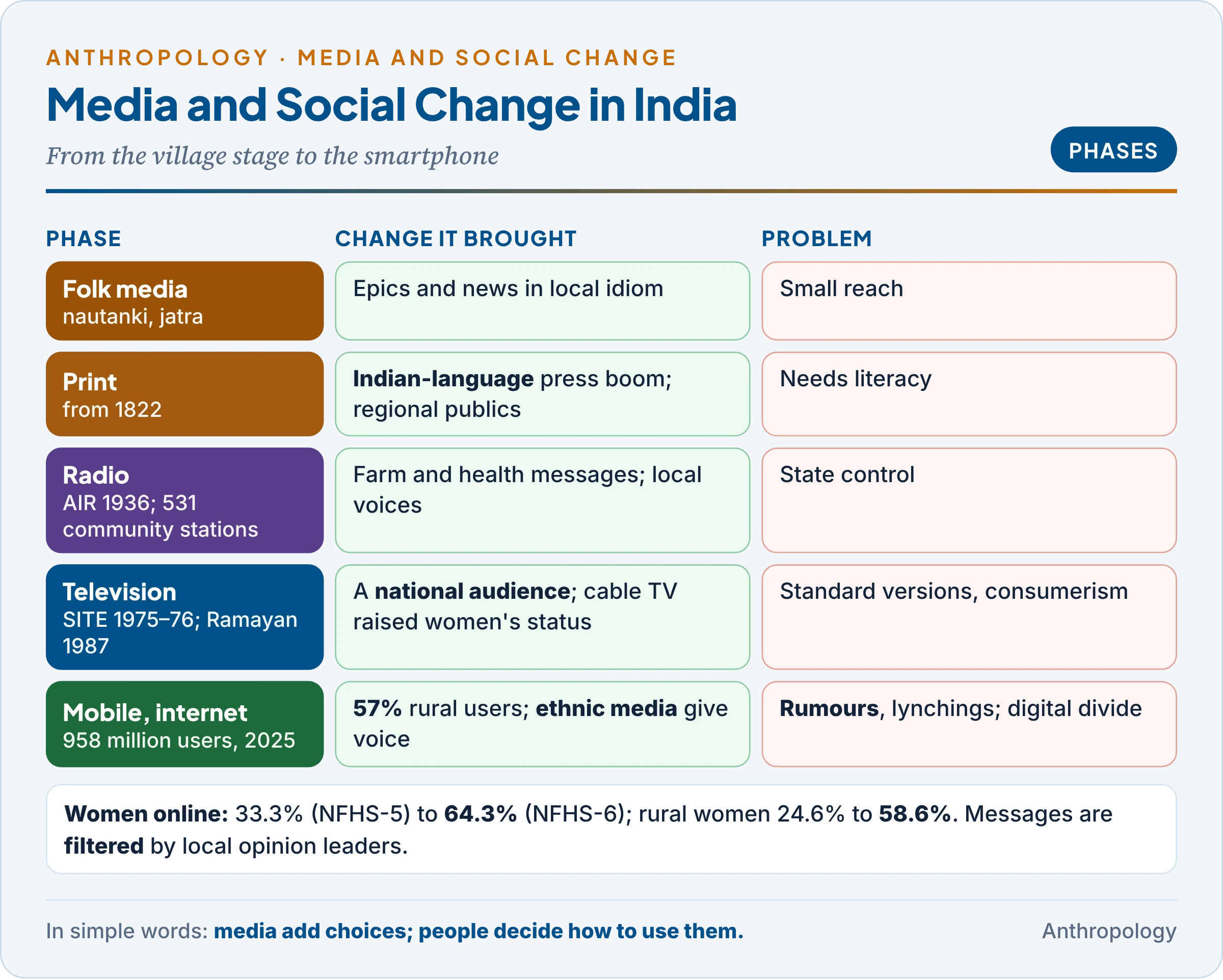
3.3 Phases of media in India
- Folk media: nautanki (north India), jatra (Bengal, Odisha), yakshagana (Karnataka), burrakatha (Andhra), puppetry and storytellers carried news, morals and epics; the state still uses them for health and rights campaigns.
- Print: Bombay Samachar (1822) is the oldest surviving newspaper. The historian Robin Jeffrey (India’s Newspaper Revolution, 2000) showed Indian-language newspapers booming from the late 1970s with literacy, cheap printing and rural editions, bringing small towns and villages into regional public life.
- Radio: All India Radio (named in 1936, Akashvani from 1957); farm and health programmes; 531 community radio stations operated in March 2025.
- Television: began in Delhi in 1959; the Satellite Instructional Television Experiment (SITE, 1975–76) beamed educational programmes to about 2,400 villages in six states; colour and national broadcasts came in 1982; cable and satellite channels after 1991.
- Mobile and internet: India had 1,002.85 million internet subscriptions in June 2025, but only 46.73 per 100 people in rural areas against 113.83 in urban areas (TRAI). The IAMAI–Kantar survey counted 958 million active internet users in 2025, about 548 million (57%) of them rural.
- Gender gap closing: women aged 15–49 who had ever used the internet rose from 33.3% (NFHS-5, 2019–21) to 64.3% (NFHS-6, 2023–24, provisional); among rural women, from 24.6% to 58.6%. Men’s figure is 80.5%.
3.4 What media have changed
Awareness, aspiration and status
- Cable television and women: Robert Jensen and Emily Oster (“The Power of TV”, Quarterly Journal of Economics, 2009) found that when cable TV reached villages in five Indian states, women reported less acceptance of wife-beating, less son preference, more autonomy and lower fertility. Urban serials showed smaller families and working women, and rural viewers compared their own lives with them.
- Markets and livelihoods: Jensen also showed that mobile phones let Kerala fishermen (1997–2001) compare prices between beaches, reducing waste and price swings.
- Governance: news, RTI-based reporting and social media expose corruption; digital payments and direct benefit transfers reach villages through phones.
- Health and education: campaigns on polio, sanitation and girls’ schooling used radio, TV and folk media together.
Problems
- Consumerism and new wants: advertising spreads urban consumption norms, raising wedding and dowry expenses and migration aspirations.
- Homogenization: national and global content can crowd out local languages and arts, though media also revive them (§1.9).
- Misinformation and violence: in 2018 rumours of child-lifters spread on WhatsApp led to lynchings, including five men killed at Rainpada (Dhule, Maharashtra) in July. In Tehseen S. Poonawalla v. Union of India (17 July 2018) the Supreme Court issued guidelines against lynching.
- Digital divide: rural, poor, older and women users have less access, and many go online through someone else’s phone; access is not the same as power.
- Polarization: caste and communal messaging travels as fast as information.
The Indian experience matches what sociologists have called cultural resilience: media change village life, but villagers also use them to reinforce their own festivals, kin ties and identities.
3.5 Ethnic and community media
Ethnic media are media made by and for a particular community, in its own language and on its own concerns. They turn excluded groups from subjects of news into producers of it.
- Dalit print: B.R. Ambedkar founded Mooknayak (Leader of the Voiceless, 1920) and Bahishkrit Bharat (1927), using the press to build Dalit consciousness.
- CGNet Swara (Chhattisgarh, from 2010): the journalist Shubhranshu Choudhary set up a voice portal where Adivasis record reports by phone in Gondi and Hindi; complaints about unpaid wages or absent teachers reach officials and the press.
- Khabar Lahariya (Bundelkhand, from 2002): a rural newspaper, now digital, run by Dalit and other rural women journalists in local dialects; the documentary Writing with Fire (2021) on its reporters was nominated for an Academy Award.
- Community radio in tribal and fishing areas broadcasts in local languages on forests, health and rights.
- Effects: awareness of rights and schemes, pride in language and identity, pressure on local officials. Limits: small reach, funding, harassment of reporters and capture by local elites.
Common confusion
Does media exposure simply modernize villagers? No. Early theories (Lerner, Schramm) expected media to replace tradition with modern attitudes. Fieldwork shows a two-way process: messages are filtered by opinion leaders, and villagers use media for their own ends, including reviving traditions and asserting caste or tribal identity. Media add choices; they do not decide which ones people make.
Key Terms
| Term | Meaning in simple words |
|---|---|
| Great tradition | The written, reflective culture of texts, temples and scholars |
| Little tradition | The oral culture of villagers: local gods, songs, customs |
| Part-society | A peasant community that depends on a wider civilization |
| Orthogenetic civilization | A civilization whose high culture grew out of its own folk culture |
| Cultural performance | A festival, recital or rite in which a tradition can be observed |
| Universalization | A local element rising into the great tradition |
| Parochialization | A great-tradition element localised and simplified in a village |
| Accretion | Adding new rites on top of old ones without replacing them |
| Glocalization | The global remade in local form |
| Devolution | Real transfer of powers, funds and staff to elected local bodies |
| Gram Sabha | All adult voters of a village meeting as a body |
| PESA | The 1996 law extending Panchayati Raj to Fifth Schedule tribal areas with customary powers |
| Pradhan pati | A male relative running a panchayat in place of an elected woman |
| Khap panchayat | A traditional clan or caste council, not a statutory body |
| Two-step flow | Media messages reaching people through local opinion leaders |
| Ethnic media | Media made by and for a particular community in its own language |
| Digital divide | Unequal access to and use of digital technology |
Contemporary Developments
- Deepavali on UNESCO’s list (10 December 2025): inscribed at the committee session held at the Red Fort, Delhi, as India’s sixteenth intangible heritage element, a village-rooted festival universalised to the global level.
- PESA rules: Jharkhand notified its PESA rules on 2 January 2026; by August 2026 nine of ten PESA states had rules, Odisha being the exception.
- Proxy leadership: the Ministry of Panchayati Raj’s committee report (February 2025) recommended exemplary penalties and support systems to end pradhan pati rule; about 46% of the 31 lakh panchayat representatives are women.
- Rural employment and panchayats: the VB-G RAM G Act, 2025 came into force on 1 July 2026, replacing the earlier rural employment guarantee with 125 days of work and giving gram panchayats and gram sabhas the planning and social-audit roles.
- Connectivity: 958 million active internet users in 2025, 57% rural (IAMAI–Kantar), and rural women’s internet use up from 24.6% to 58.6% between NFHS-5 and NFHS-6.
Diagrams to Master
- Topic map: three blocks (traditions, Panchayati Raj, media), each with its key scholars, laws or data.
- Marriott’s two processes: great tradition above, little tradition below; arrows up (Saurti to Lakshmi, Saluno to Raksha Bandhan) and down (Naurtha, Gobardhan); specialists and pilgrim centres as the channel.
- Beyond two traditions: Dube’s six traditions in a list, with critiques (Singh, Dumont-Pocock, Ramanujan, Momin) and Indian extensions (Vidyarthi, Sinha).
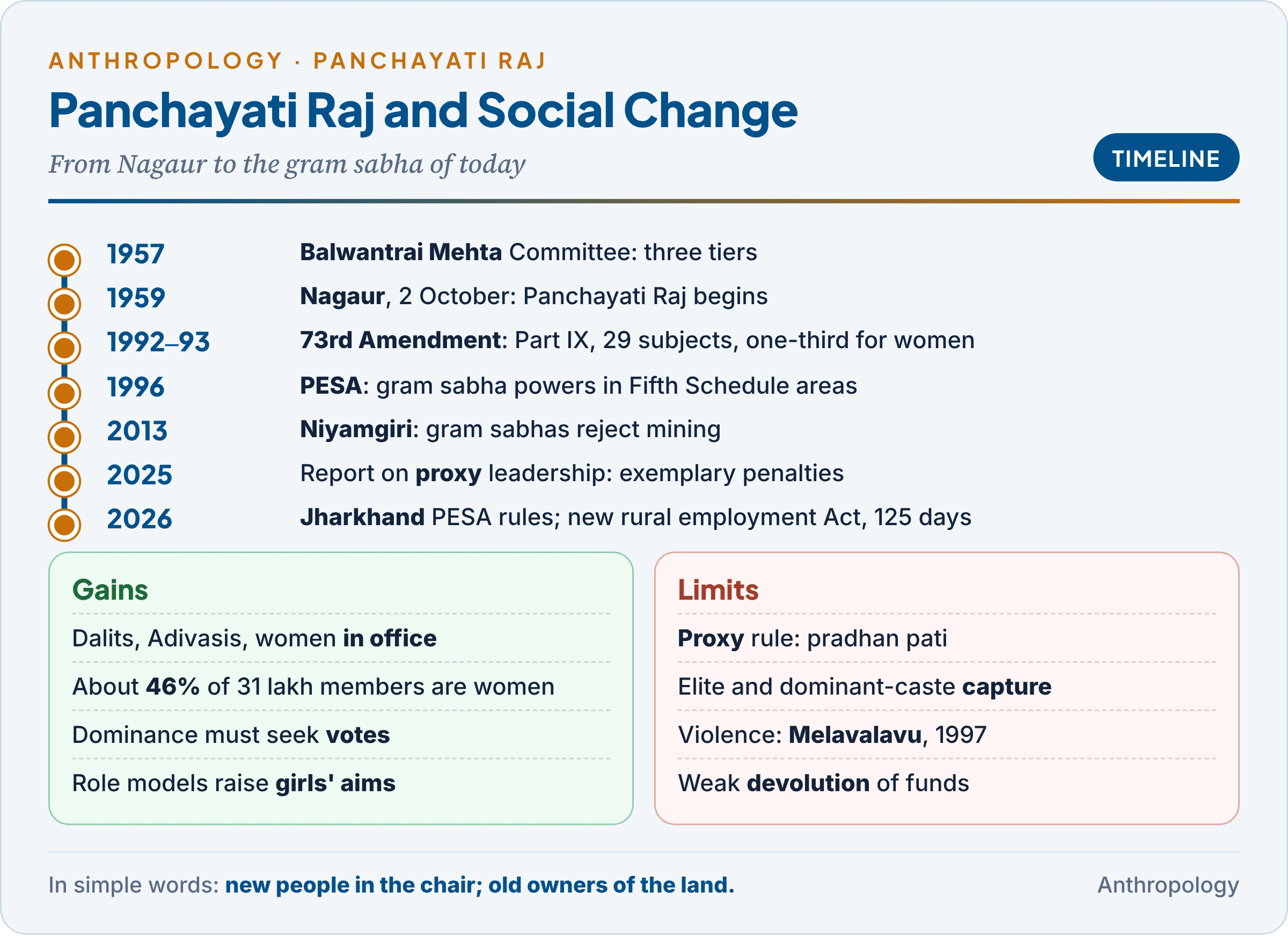
- Panchayati Raj: a timeline from 1957 to 2026 with a gains-and-limits panel for SCs, STs and women.
- Media phases: folk to print to radio and TV to mobile and internet, with one effect and one problem per phase.
Revision Grid
| Scholar | Work (year) | Key idea |
|---|---|---|
| Robert Redfield | Peasant Society and Culture (1956) | Great tradition of the reflective few, little tradition of the unreflective many |
| Redfield and Singer | “The Cultural Role of Cities” (1954) | Orthogenetic and heterogenetic civilizations |
| A.L. Kroeber | Anthropology (1948) | Peasants as part-societies with part-cultures |
| Milton Singer | When a Great Tradition Modernizes (1972) | Cultural performances; the great tradition modernizes |
| McKim Marriott | “Little Communities in an Indigenous Civilization” (1955) | Universalization and parochialization |
| Cohn and Marriott | “Networks and Centres” (1958) | Pilgrim centres and networks integrate India |
| S.C. Dube | Indian Village (1955) | Six traditions instead of two |
| A.K. Ramanujan | “Three Hundred Ramayanas” (1991) | Many tellings in conversation |
| K.S. Singh | The Dust-Storm and the Hanging Mist (1966) | Birsa movement blends traditions |
| Chattopadhyay and Duflo | “Women as Policy Makers” (2004) | Women heads invest in what women need |
| Beaman and others | Science (2012) | Women leaders raise girls’ aspirations |
| Daniel Lerner | The Passing of Traditional Society (1958) | Media participation and modernization |
| Everett Rogers | Diffusion of Innovations (1962) | Innovations spread through opinion leaders |
| Robin Jeffrey | India’s Newspaper Revolution (2000) | Indian-language press boom |
| Arvind Rajagopal | Politics After Television (2001) | Televised Ramayan and national politics |
| Jensen and Oster | “The Power of TV” (2009) | Cable TV improved women’s status |
Previous Year Questions
Inter-play of little and great traditions; Panchayati Raj and social change; media and social change
- 2025Write notes on: Characteristics and communication between Little and Great Traditions.
- 2021Discuss the role of Panchayati Raj Institutions in transforming traditional power hierarchy in rural India.
- 2021Write short notes on “Ethnic media and social awareness” in about 150 words.
- 2019Write a note in 150 words on Panchayati Raj as a facilitator of social inclusion in rural society.
- 2019Discuss how the elements of Little and Great Traditions combine in the emergence of social/political/religious movements, giving any one example to illustrate the issue.
- 2018Write a note in 150 words on The impact of Panchayati Raj Institutions in rural areas.
- 2017Discuss the impact of media as an instrument of social change.
- 2017Discuss the impact of Panchayati Raj institution on the empowerment of rural women in India.
- 2016Examine the nature of interplay of little and great traditions in the context of globalization.
- 2015Write a note in 150 words on Panchayati Raj Institutions and Social Change.
- 2015Examine the social implications of media and communication technology.
- 2014Write a note in 150 words on Great tradition and Little tradition.
- 2013Write a note in 150 words on Role of Gramsabha under PESA.
- 2011Write a note in 150 words on Critique of the concept of Great and Little Tradition.
- 2010Write a note in 150 words on Universalization and Parochialization.
- 2010Write a note in 150 words on Panchayati Raj and the tribes.
- 2008Critically examine the concepts of Little and Great Traditions for understanding the Indian Villages.
- 2005Write a note on Panchayati Raj.
- 1999Write a note on Great Traditions.
- 1996Write a note on Little and Great traditions.
- 1992Discuss in what way the study of Great tradition and Little tradition is essential for understanding the cultural processes of Indian civilization.
- 1989Write a note on : The study of Great tradition and Little tradition is essential for understanding Indian Civilization. Discuss.
- 1987“Tradition is a single unbroken chain.” Discuss this statement throwing light I on the relevance of the use of the term Great Tradition and Little Tradition in India in the fields of (a) religion, (b)kinship and (c) agriculture.
- 1986Write a note on Little tradition.
- 1985Write a note on Universalization.
- 1984Discuss in what way the study of Great tradition and Little tradition is essential for understanding the cultural processes of Indian civilization.
- 1983Write a note in 200 words : Little traditions and their significance.
- 1981Explain with the help of suitable examples how great and little traditions interact with each other in Indian society.
Related questions from other units
- 2026Unit 7.2: Discuss the impact of democratic institutions on the tribal populations of India.
- 2024Unit 7.2: How is PESA Act empowering local self-governance and impacting women’s political participation?
- 2023Unit 7.2: Critically examine the impact of modern democratic institutions on contemporary tribal societies. Illustrate with suitable ethnographic examples.
- 2022Unit 7.2: Compare the functioning of traditional ‘Tribal Council’ with that of ‘Gram Sabha’ under PESA.
- 2020Unit 5.1: Write short note on the ‘Khap’ Panchayat in about 150 words.
- 2019Unit 5.1: Discuss the impact of media on the social life of Indian villages.
- 2018Unit 7.1: Discuss the salient features of PESA Act of 1996 and attempt a comparison with the features of the VI Schedule.
- 2008Unit 7.2: How have modern democratic institutions influenced the Indian tribal societies ? Assess.
- 2003Unit 2.2: Write a note on Folk-Urban Continuum.
More from Indian Village and Social Change: all notes of this unit · every PYQ of this unit · Anthropology Optional hub