

Anthropology Optional › Paper II › Unit 05: Indian Village and Social Change
5.2 Linguistic and religious minorities and their social, political and economic status.
Official Syllabus: Paper II, Unit 5.2
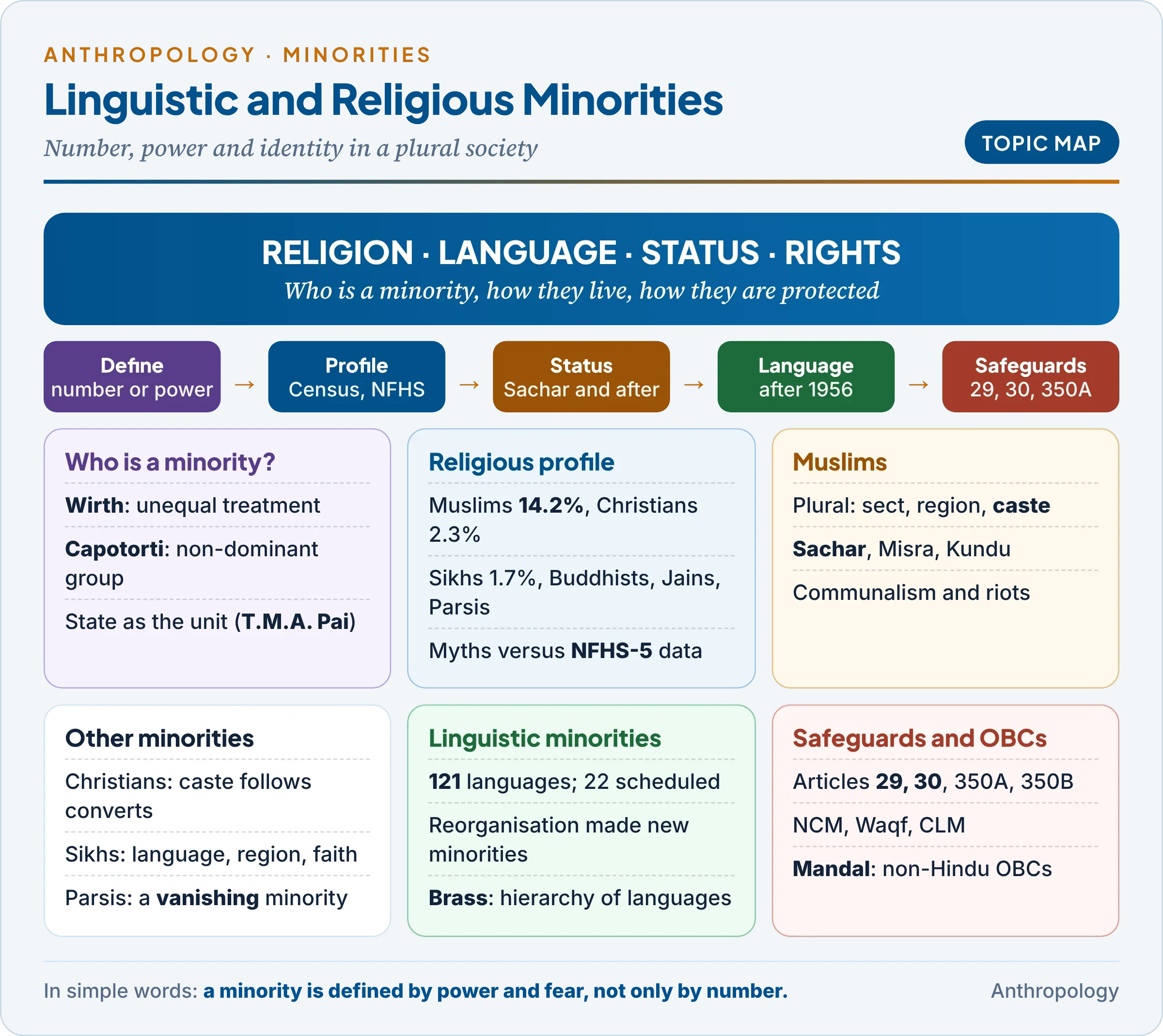
This article covers India’s religious and linguistic minorities as they live today. The historical impact of Buddhism, Jainism, Islam and Christianity is in 3.4; caste among Muslims and Christians in 3.2a (§7); the language families of India in 2a; safeguards for Scheduled Castes, Scheduled Tribes and OBCs in Unit 7; and the anthropology of communalism in 9.3.
1. Who Is a Minority?
In simple words
A minority is a group that differs from most of the population in religion or language and is smaller or weaker than the majority. Whether a group counts as a minority depends on where you stand: a group that is a minority in India may be the majority in one state. What makes a minority important is not only its size but its fear of losing its identity or its fair share.
Example first. Muslims are India’s largest minority, about one in seven Indians, yet they are the majority in Jammu and Kashmir and Lakshadweep. Hindus, the national majority, are a minority in Punjab, Mizoram, Nagaland and Meghalaya. A Bengali is in the majority in Kolkata but a linguistic minority in Bengaluru. Minority status is therefore relational: it depends on the unit (nation, state or district) and on who holds power.
1.1 Definitions
- Numerical: the dictionary sense, a group “smaller in number” than the rest.
- Sociological: the American sociologist Louis Wirth (1945) defined a minority as a group “singled out from the others in the society in which they live for differential and unequal treatment”, whose members therefore regard themselves as objects of collective discrimination. Here the test is unequal treatment and group consciousness, not size.
- International law: the UN Special Rapporteur Francesco Capotorti (1977) defined a minority as a group numerically smaller than the rest of a state’s population, in a non-dominant position, whose members have ethnic, religious or linguistic features of their own and a sense of solidarity directed at preserving them.
- Power, not number: the Indian writer Sumanta Banerjee argued that in human-rights usage a minority means a non-dominant, disadvantaged group; a small but dominant elite is not a minority in this sense.
The three ideas (number, non-dominance, shared identity) explain why a numerically small but powerful group does not seek protection, while a large but disadvantaged group does.
1.2 Minorities in Indian law
- The Constitution does not define “minority”. It speaks of minorities based on religion or language in Articles 29, 30, 350A and 350B.
- Notified religious minorities: under the National Commission for Minorities Act, 1992, the Union notified Muslims, Christians, Sikhs, Buddhists and Parsis (1993) and added Jains (January 2014).
- State as the unit: in T.M.A. Pai Foundation v. State of Karnataka (2002) the Supreme Court held that, for the right to run educational institutions (Article 30), religious and linguistic minorities are to be identified state by state, since states were reorganised on linguistic lines.
- Minority status for Hindus in some states: the Ranganath Misra Commission (§3.4) recommended recognising Hindus as minorities where they are fewer, and the question of state-level identification has been litigated in the Supreme Court.
Common confusion
Is a “minority institution” the same as an institution for minorities? No. A minority educational institution under Article 30 is one established and administered by a religious or linguistic minority; it may admit students of all communities. In 2024 a seven-judge bench (§6.2) held that such an institution does not lose minority character merely because a statute later incorporated it.
2. Religious Minorities: A Profile
In simple words
About one Indian in five belongs to a religion other than Hinduism. These communities differ greatly: some, like Jains and Parsis, are small, urban and prosperous; others, like many Muslims and Dalit Christians, are large and poor. Looking at numbers on education, sex ratio and fertility helps separate real differences from popular myths.
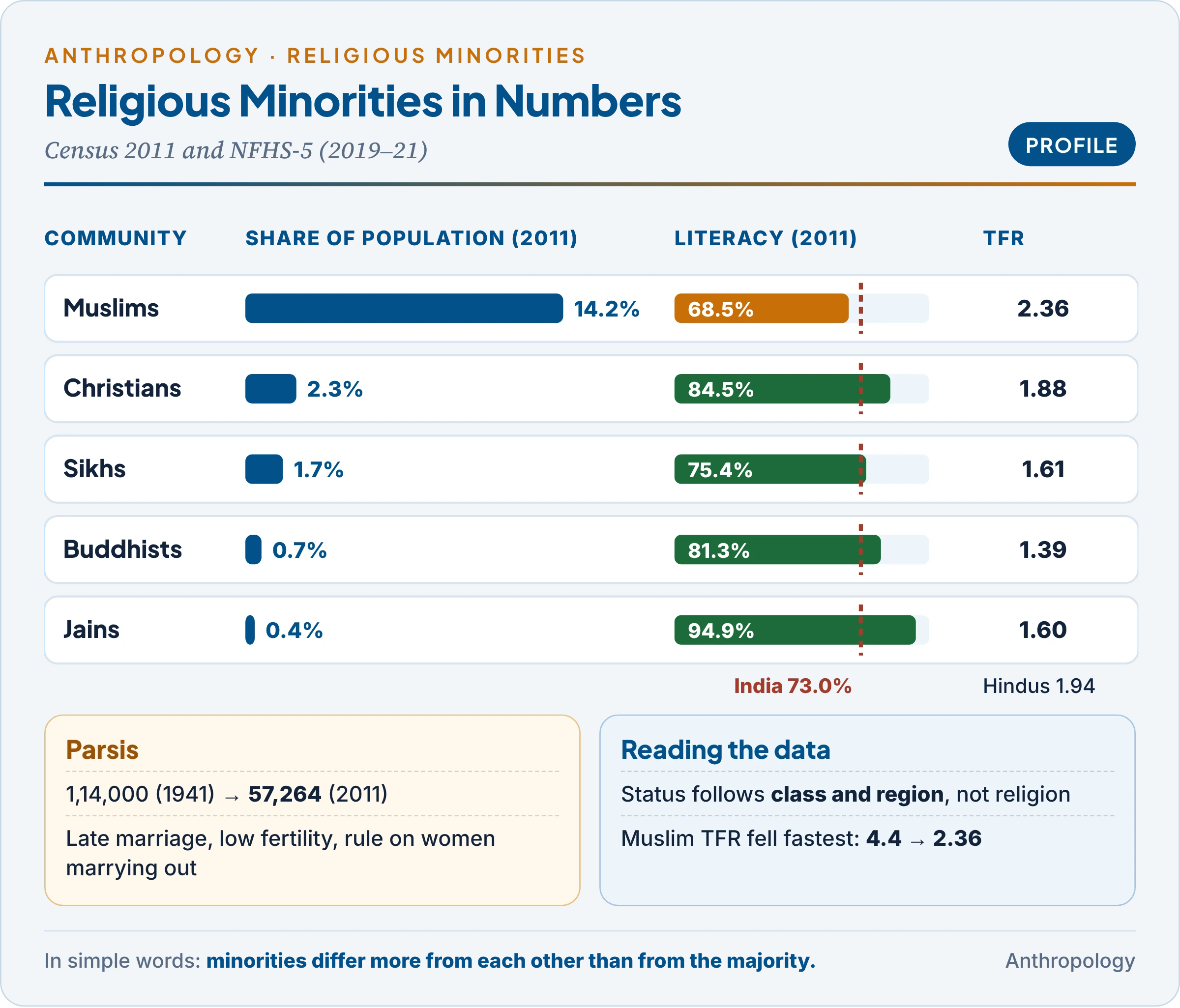
The table summarises Census 2011, with literacy for persons aged seven and above.
| Community | Population (2011) | Share | Main concentration | Literacy | Sex ratio |
|---|---|---|---|---|---|
| Muslims | 17.22 crore | 14.2% | Majority in J&K and Lakshadweep; Assam, West Bengal, Kerala, UP, Bihar | 68.5% | 951 |
| Christians | 2.78 crore | 2.3% | Kerala, Tamil Nadu; majority in Nagaland, Mizoram, Meghalaya | 84.5% | 1,023 |
| Sikhs | 2.08 crore | 1.7% | Punjab (majority of the state) | 75.4% | 903 |
| Buddhists | 84 lakh | 0.7% | Maharashtra (about 77%); Himalayan belt | 81.3% | 965 |
| Jains | 45 lakh | 0.4% | Maharashtra, Rajasthan, Gujarat | 94.9% | 954 |
| Parsis | 57,264 | negligible | Mumbai, Gujarat | High | — |
The national literacy rate was 73.0% and the sex ratio 943. The table shows that minorities do not share one status: Jains, Christians and Buddhists are above the national average in literacy, while Muslims are below it. Status follows class, region and history more than religion itself.
2.1 Myths and data
- Fertility: the National Family Health Survey (NFHS-5, 2019–21) recorded a total fertility rate (average children per woman) of 2.36 for Muslims, 1.94 for Hindus, 1.88 for Christians, 1.61 for Sikhs, 1.6 for Jains and 1.39 for Buddhists. Muslim fertility has fallen fastest, from 4.4 in 1992–93. Demographers link the remaining gap to poverty, female education and access to services, not to religion as such: fertility of all communities is lower in Kerala and the south than in the north.
- Polygyny: NFHS-5 found women reporting co-wives at 2.1% among Christians, 1.9% among Muslims and 1.3% among Hindus, and 2.4% among Scheduled Tribes (International Institute for Population Sciences, 2022). Polygyny is rare in all communities and declining, and follows poverty, rural residence and region more than religion.
- Sex ratio: Christians have the highest ratio (1,023) of all communities.
2.2 The Parsis: a vanishing minority
- Decline: from about 1,14,000 in 1941 to 57,264 in 2011.
- Causes: late marriage and many who never marry, very low fertility (below one child per woman), emigration, and the orthodox rule that children of Parsi women who marry outside are not admitted to the community, while those of Parsi men are.
- Response: the Jiyo Parsi scheme (2013) funds fertility treatment and counselling. The Parsi case shows that a minority can be economically secure yet demographically endangered because of its own kinship rules.
3. Muslims: Social, Economic and Political Status
In simple words
Indian Muslims are not one community: they speak many languages, follow different sects, and are divided by caste and class like other Indians. As a whole, they lag behind the national average in education, government jobs and access to credit. Government committees have measured these gaps and suggested remedies, and the debate over them is part of Indian politics.
3.1 A plural community
- Not a single cultural community: the Indian sociologist T. K. Oommen pointed out that Indian Muslims share a religion but not a language, region or way of life; a Malayali Mappila, a Bengali peasant and a Hyderabadi trader differ more from each other than from their non-Muslim neighbours.
- Sects: Sunnis (the majority) and Shias, and trading sects such as the Bohras and Khojas of western India.
- Caste: ranked, largely endogamous groups commonly described as Ashraf (claiming foreign descent), Ajlaf (occupational castes such as weavers and butchers) and Arzal (groups treated as polluting). The Indian sociologist Imtiaz Ahmad (Caste and Social Stratification among Muslims in India, 1973) documented caste among Muslims despite the egalitarian teaching of Islam.
- Book-view and field-view: this is a clear case of the gap between the book-view (what scripture says: all believers are equal) and the field-view (what fieldwork finds: caste ranking, endogamy, separate mosques or graveyards in places), the contrast drawn by M. N. Srinivas (see 5.1, §3.2).
- Pasmanda: “those left behind”, a movement of backward and Dalit Muslims (the All India Pasmanda Muslim Mahaz, founded by Ali Anwar in 1998) that argues the community’s leadership and benefits have gone mainly to the Ashraf (detail in 3.2a).
3.2 Economic and educational status
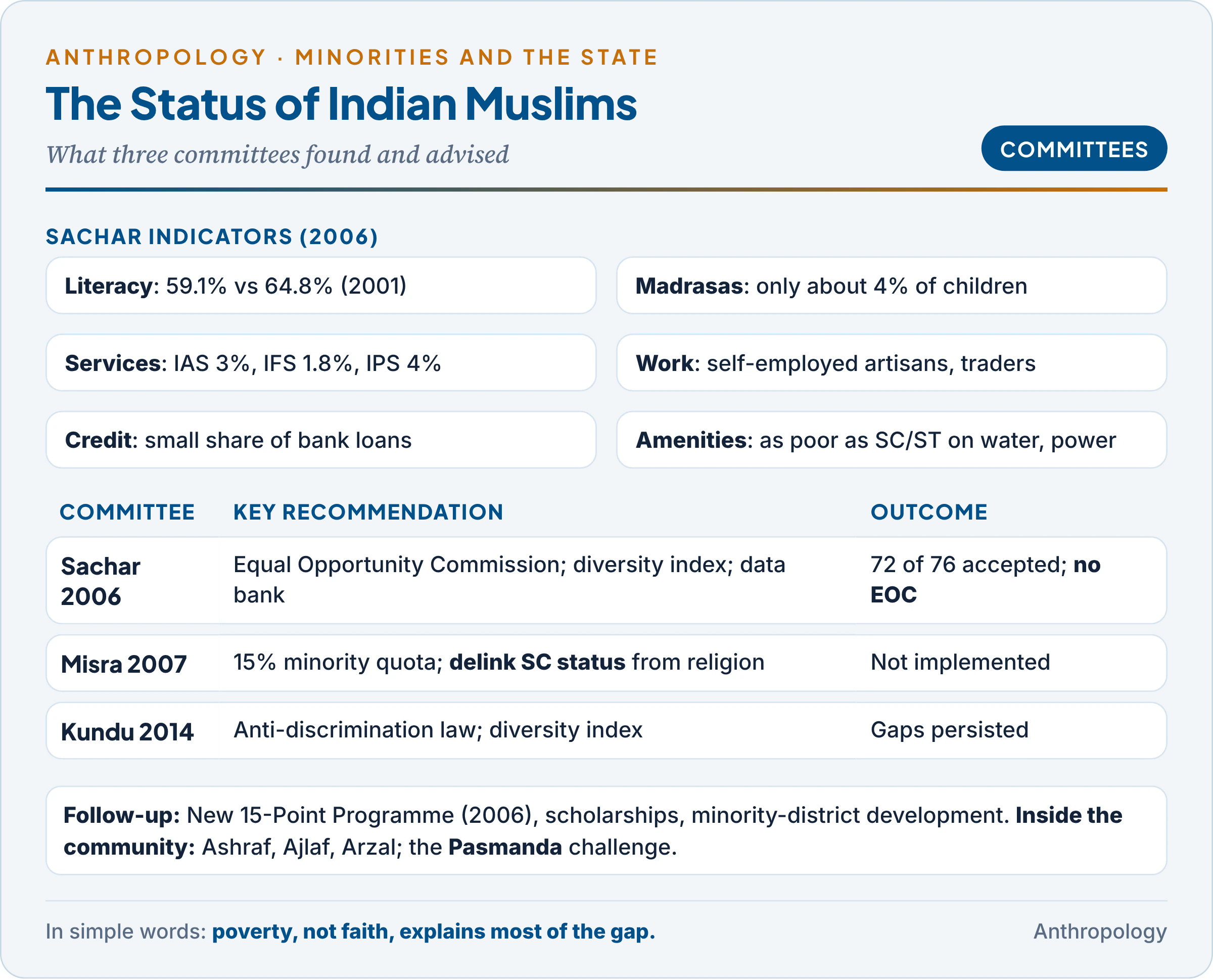
The Sachar Committee (Prime Minister’s High Level Committee, chaired by Justice Rajindar Sachar; constituted March 2005, report November 2006) gave the first systematic national picture.
- Education: Muslim literacy was 59.1% against a national 64.8% (2001); the gap was widest in towns. Only about 4% of Muslim children attended madrasas, which corrects the belief that Muslim children study mainly in religious schools. The committee found poverty, not religious conservatism, to be the main reason for dropping out.
- Employment: a high share of Muslims are self-employed (artisans, small traders, mechanics, tailors) and few are in regular salaried jobs. Muslims were 3% of the IAS, 1.8% of the IFS and 4% of the IPS.
- Credit and amenities: Muslims received a small share of bank credit, and villages with many Muslims had fewer schools, health centres and pucca roads; on water, electricity and cooking fuel they were as poorly served as SCs and STs.
- Ghettoisation: in many towns Muslims live in segregated neighbourhoods, a pattern the committee linked to insecurity after communal violence and to discrimination in housing.
- Artisan economies: Muslim artisans dominate crafts such as brassware (Moradabad), glass bangles (Firozabad), carpets (Bhadohi), chikan embroidery (Lucknow), locks (Aligarh) and handloom weaving (Mau, Bhiwandi). Many were reduced from owners to wage workers as machine goods and middlemen took over.
3.3 Social status and personal law
- Women: the status of Muslim women is often judged by divorce rules alone. In Mohd. Ahmed Khan v. Shah Bano Begum (1985) the Supreme Court granted maintenance under the general criminal code; Parliament then passed the Muslim Women (Protection of Rights on Divorce) Act, 1986. In Shayara Bano v. Union of India (2017) the Court set aside instant triple talaq, which the Muslim Women (Protection of Rights on Marriage) Act, 2019 made a punishable offence.
- Uniform civil code: Article 44 asks the state to endeavour to secure a uniform civil code; Uttarakhand enacted one in 2024 (in force January 2025), applying to all residents except Scheduled Tribes. Supporters see it as gender equality and national integration; critics see it as a threat to community autonomy, especially when it is framed against one community.
- Anthropological reading: much of what is called “Muslim personal law” combines Islamic rules with local custom: the matrilineal Muslims of Lakshadweep and north Kerala (Leela Dube, see 3.4) show that kinship often follows region more than religion.
3.4 Three committees
The table compares the three national committees on minorities.
| Committee | Years | Mandate | Main findings and recommendations |
|---|---|---|---|
| Sachar Committee | 2005–06 | Social, economic and educational status of Muslims | Development deficit close to that of SCs and STs in several indicators; Equal Opportunity Commission, diversity index, national data bank, better Urdu-medium and school provision |
| Ranganath Misra Commission (National Commission for Religious and Linguistic Minorities) | 2004–07 (tabled 2009) | Criteria for backwardness among religious and linguistic minorities | 15% reservation for minorities in education and jobs (10% for Muslims, 5% for others); delink SC status from religion; one member dissented on the SC point |
| Kundu Committee (Post-Sachar Evaluation) | 2013–14 | Review of follow-up to Sachar | Gaps persisted in schooling, jobs and credit; advised anti-discrimination law, a diversity index and an Equal Opportunity Commission |
The government accepted 72 of Sachar’s 76 recommendations. Follow-up included the Prime Minister’s New 15-Point Programme (2006), scholarships and a multi-sectoral programme for minority-concentration districts. The Equal Opportunity Commission was never set up, and the Misra recommendations on reservation were not implemented.
3.5 Political status and communalism
- Participation: Muslims vote and contest elections through mainstream parties in most states; community parties are strong only in a few regions (Kerala, Hyderabad, Assam). Muslim representation in legislatures and services has usually been below their population share.
- Communalism: the belief that people who share a religion share common secular interests opposed to those of other religions. The Indian historian Bipan Chandra (Communalism in Modern India, 1984) traced three stages: communal nationalism (a religious group has interests of its own), liberal communalism (these interests differ from others’) and extreme communalism (they are hostile).
- Factors (2011 question): historical memories of Partition; competition for jobs, land and trade; electoral mobilisation on religious lines; segregated neighbourhoods; rumour and media; weak or partisan policing.
- Riots: the American political scientist Paul Brass (The Production of Hindu–Muslim Violence in Contemporary India, 2003) described an “institutionalised riot system” of local specialists who convert ordinary disputes into communal violence; Ashutosh Varshney showed that civic ties across communities prevent riots (summary in 3.4, §8.1).
- Village evidence: S. C. Dube‘s Shamirpet (5.1, §3.4) found Hindus and Muslims sharing village rites, suggesting that communal hostility is produced more by urban politics than by everyday village life.
4. Christians, Sikhs, Buddhists, Jains
In simple words
Each of the smaller religious minorities has its own story. Christians are well educated but divided by caste and region; Sikhs are a prosperous farming and trading community with a strong regional identity; Buddhists are mostly Dalits who converted with Ambedkar; Jains are a small but wealthy merchant minority.
4.1 Christians
- Distribution: strongly concentrated in the south (Kerala, Tamil Nadu, coastal Karnataka, Goa) and the North-East; rural in the south and north-east but largely urban in north India.
- Denominations: Syrian (St Thomas) Christians, Roman Catholics (the largest group), Protestants, and large tribal and Dalit churches.
- Strengths: the highest literacy and sex ratio among major communities; a vast network of schools, colleges and hospitals.
- Caste among Christians: the Indian sociologist Rowena Robinson (Christians of India, 2003) showed that group converts carried caste with them: in Kerala, Dalit converts from Pulaya and Paraya castes remained landless labourers for Syrian Christian landowners, without intermarriage, sometimes with separate churches.
- Dalit Christians and SC status: clause 3 of the Constitution (Scheduled Castes) Order, 1950 limits SC status to Hindus, Sikhs and Buddhists, so Dalit Christians and Muslims are excluded; the Balakrishnan Commission (2022) is examining extension, and the Supreme Court has held that a Dalit who converts to Christianity loses SC status (details in 3.4, §7).
- Conversion laws: several states regulate conversion, beginning with Odisha (1967) and Madhya Pradesh (1968). Supporters see them as preventing fraud or inducement; critics see them as burdening the freedom to propagate religion (Article 25). Violence against Christians, such as the killing of the Australian missionary Graham Staines and his two sons in Odisha (January 1999), sharpened this debate.
4.2 Sikhs
- Distribution and economy: most live in Punjab, where they form the majority; Sikh Jat farmers led the Green Revolution (5.1, §6.6); Sikhs are prominent in transport, trade and the armed forces, and in the diaspora.
- Caste within: Jat landowners, Khatri and Arora traders, Ramgarhia artisans, and Dalit Mazhabi and Ravidasia Sikhs, who retain SC status.
- Politics of identity: the Punjabi Suba movement produced a Punjabi-speaking Punjab in 1966; the 1980s saw militancy, the army action at the Golden Temple (June 1984), the killing of thousands of Sikhs after Indira Gandhi’s assassination (31 October 1984), and the Rajiv Gandhi–Longowal accord (July 1985). Language, religion and region were fused in this movement, a pattern seen in many Indian minorities.
4.3 Buddhists and Jains
- Buddhists: about 77% live in Maharashtra, mostly Navayana Buddhists who followed Ambedkar in 1956; the Himalayan Buddhists of Ladakh, Sikkim and Arunachal form a second group. Buddhist identity is tied to Dalit assertion (see 3.4, §7).
- Jains: a small, urban, highly literate merchant community; notified as a national minority in 2014, which allows Jain institutions minority rights under Article 30.
4.4 Common problems of religious minorities
The table draws together the problems that recur across communities, the theme of several questions.
| Sphere | Problem | Examples |
|---|---|---|
| Social | Identity anxiety and stereotyping; segregation in housing; caste inside the community | Ghettoised Muslim neighbourhoods; Dalit Christians and Pasmanda Muslims |
| Economic | Low share of salaried jobs and credit; decline of craft occupations | Sachar indicators; Moradabad and Bhadohi artisans |
| Educational | Dropping out after primary school; weak mother-tongue and Urdu schooling | Muslim and tribal Christian children |
| Political | Under-representation; being treated as a vote bank; communal violence | Riots; conversion controversies |
| Legal | Disputes over personal law, conversion, SC status, institutions and property | Triple talaq; Dalit Christian SC status; waqf |
These problems explain why minorities are vulnerable to political manipulation (2005 question): a group that feels insecure tends to vote as a bloc, which invites both appeasement and hostility from parties, and reinforces the boundary between “majority” and “minority”. The anthropological answer is to look for cross-cutting ties (class, region, language, occupation) that make any single religious identity less decisive.
- Religious centres (2013 question): shared shrines show both integration and tension. The Ajmer dargah draws Hindus and Sikhs; Velankanni draws Hindus to a Catholic basilica; Bodh Gaya links Navayana and international Buddhists; the Golden Temple is the centre of Sikh identity. L. P. Vidyarthi‘s idea of the sacred complex (sacred geography, performances and specialists; see 3.3) explains how such centres connect local and civilizational traditions across religious boundaries.
5. Linguistic Minorities
In simple words
India has hundreds of mother tongues. When states were redrawn on the basis of language in the 1950s, every state got a main language, and people speaking any other language in that state became linguistic minorities. They need schooling in their own language, fair treatment in jobs and protection of their culture, and many small languages are disappearing.
Example first. Belagavi (Belgaum) went to Mysore (now Karnataka) in 1956, leaving a large Marathi-speaking population as a minority in a Kannada state; the border dispute with Maharashtra continues. In Assam, the place of Bengali speakers has been tied to questions of migration and citizenship since the Assam Movement (1979–85).
5.1 Linguistic diversity
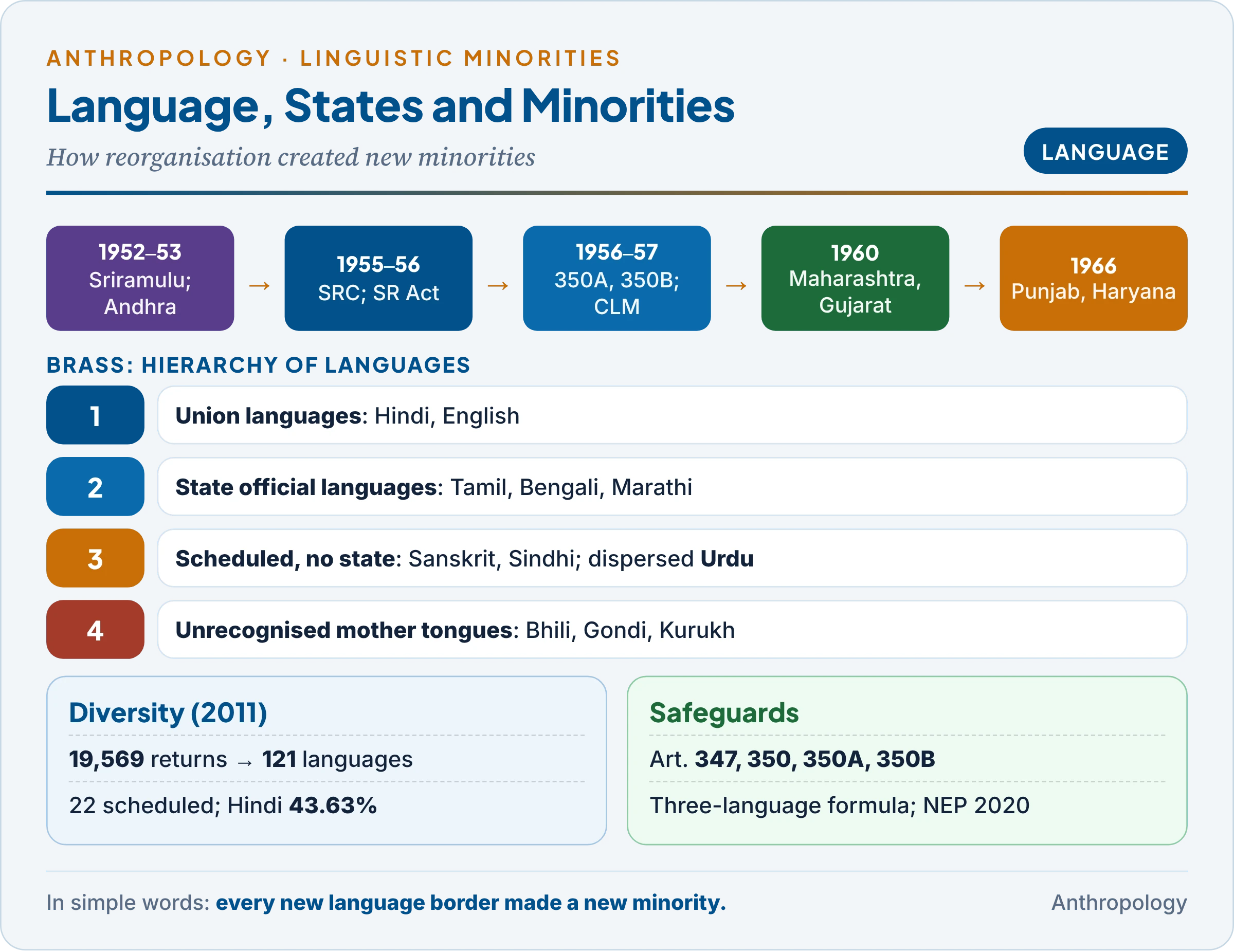
- Census 2011: 19,569 raw mother-tongue returns, rationalised into 121 languages with 10,000 or more speakers: 22 scheduled (Eighth Schedule) and 99 non-scheduled; 96.71% of people speak a scheduled language. The largest are Hindi 43.63%, Bengali 8.03%, Marathi 6.86%, Telugu 6.70%, Tamil 5.70% and Urdu 4.19%.
- Historical surveys: George Grierson‘s Linguistic Survey of India (1894–1928) and the People’s Linguistic Survey of India led by the literary scholar G. N. Devy, which counted about 780 languages and estimated that some 220 had disappeared in the previous fifty years (2013).
- Who counts: the Commissioner for Linguistic Minorities defines a linguistic minority as a group whose mother tongue differs from the principal language of the state, district or taluk; the language need not be in the Eighth Schedule.
5.2 Reorganisation of states
- Andhra: the death of Potti Sriramulu after a fast (December 1952) led to Andhra State (1 October 1953), the first linguistic state.
- States Reorganisation Commission (Fazl Ali, K. M. Panikkar, H. N. Kunzru; 1953–55) and the States Reorganisation Act, 1956; later Bombay was divided into Maharashtra and Gujarat (1960) and Punjab into Punjab and Haryana (1966).
- Effect: reorganisation satisfied large language groups and strengthened federal democracy, but it created minorities at every border and gave each state a dominant language to promote.
5.3 Kinds of linguistic minority
The table separates three situations with different needs.
| Kind | Example | Main demand |
|---|---|---|
| Speakers of another state’s official language | Bengalis in Assam; Marathi speakers in Belagavi; Telugu speakers in southern Odisha | Schooling and services in their language; protection from “sons of the soil” job preferences |
| Dispersed speakers of a scheduled language | Urdu speakers in UP, Bihar, Telangana, Karnataka | Recognition as a second official language; Urdu-medium schools and teachers |
| Speakers of tribal or non-scheduled languages | Bhili, Gondi, Ho, Kurukh, Mundari | Primary education in the mother tongue; scripts and textbooks; inclusion in the Eighth Schedule |
The American political scientist Paul Brass (The Politics of India since Independence, 1990) described a hierarchy of languages: Hindi and English at the top as Union languages, then the official languages of states, then scheduled languages without a state, and at the bottom unrecognised mother tongues. A group’s status follows its place on this ladder: the lower the language, the fewer the jobs, schools and public uses open to its speakers. The political scientist Myron Weiner (Sons of the Soil, 1978) showed how migrants speaking another language became targets of nativist movements, such as the Shiv Sena (1966) campaign against south Indians in Bombay.
5.4 Problems and safeguards
- Problems: too few teachers and textbooks in minority languages; language shift among tribal children taught only in the state language; neglect of Urdu in north India; endangerment of small languages (the last speaker of Bo, an Andamanese language, died in 2010); border disputes and job nativism.
- Safeguards: Article 347 (recognition of a language spoken by a substantial part of a state’s population), Article 350 (petitions in any language used in the Union or state), Article 350A (instruction in the mother tongue at the primary stage) and Article 350B (a Special Officer for Linguistic Minorities), the last two added by the Seventh Amendment (1956). The Commissioner for Linguistic Minorities (office created 1957) reports to the President.
- Language policy: the Official Languages Act, 1963 (amended 1967 after the anti-Hindi agitation of 1965 in Tamil Nadu) continued English with Hindi for Union purposes; the three-language formula (1968); the 92nd Amendment (2003) added Bodo, Dogri, Maithili and Santali to the Eighth Schedule; the National Education Policy 2020 prefers the mother tongue as the medium at least up to Grade 5; in October 2024 five more languages were declared classical, taking the total to eleven.
Common confusion
What is the difference between a language, a dialect and a mother tongue? The Census records the mother tongue each person reports, then groups mother tongues under languages. Whether a speech form is called a “language” or a “dialect” is often a political decision, not a linguistic one: Bhojpuri and Rajasthani are counted under Hindi, while Maithili, once grouped the same way, became a scheduled language in 2003.
6. Constitutional and Institutional Safeguards
In simple words
The Constitution protects minorities in two ways: by treating every citizen equally and by giving minority groups special rights to keep their religion, language and schools. Over the years governments have also created commissions, ministries and schemes to watch over minorities and help their development.
6.1 Articles
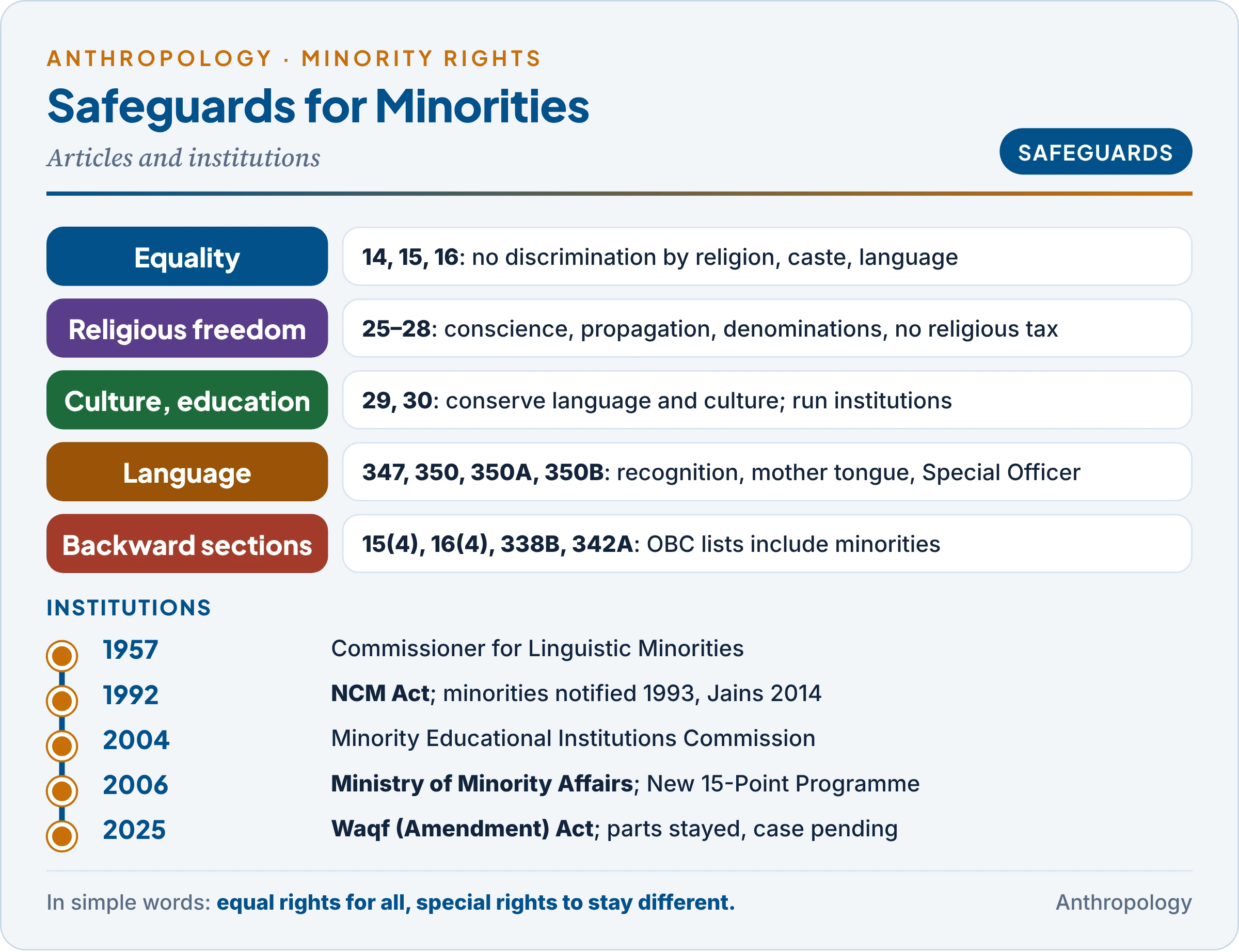
The table lists the articles that matter, grouped by purpose.
| Purpose | Article | Provision |
|---|---|---|
| Equality | 14, 15, 16 | Equality before law; no discrimination on grounds of religion, race, caste, sex or place of birth in state action, public places and public jobs |
| Religious freedom | 25 | Freedom of conscience and to profess, practise and propagate religion, subject to public order, morality and health |
| 26 | Religious denominations may manage their own affairs and property | |
| 27, 28 | No tax for promoting a religion; no religious instruction in fully state-funded schools | |
| Culture and education | 29 | Any section of citizens with a distinct language, script or culture may conserve it; no denial of admission to state-aided institutions on grounds of religion, race, caste or language |
| 30 | All minorities, religious or linguistic, may establish and administer educational institutions; no discrimination in grants-in-aid | |
| Language | 347, 350, 350A, 350B | Official recognition of a language in a state; petitions in any language; mother-tongue instruction; Special Officer |
| Backward sections | 15(4), 16(4) | Special provisions for socially and educationally backward classes, including those among minorities (§7) |
Articles 29 and 30 make up the cultural and educational rights. Courts have held that Article 30 is not absolute: the state may regulate standards, accounts and the conduct of staff, but may not take over administration.
6.2 Key judgments
- T.M.A. Pai Foundation (2002): minorities determined state-wise; regulation must not destroy the minority character.
- Aligarh Muslim University reference (8 November 2024): a seven-judge bench, by 4:3, overruled the 1967 Azeez Basha judgment and held that an institution established by a minority does not lose that character because a statute incorporated it; whether AMU is a minority institution was left to a regular bench to decide on the new test.
6.3 Institutions and schemes
| Year | Institution or scheme |
|---|---|
| 1957 | Commissioner for Linguistic Minorities |
| 1978 | Minorities Commission (by government resolution) |
| 1983 | Prime Minister’s 15-Point Programme for minorities |
| 1992–93 | National Commission for Minorities Act; statutory Commission; five communities notified |
| 1994 | National Minorities Development and Finance Corporation (loans to backward minorities) |
| 1995 | Wakf Act (state Wakf Boards and the Central Wakf Council) |
| 2004 | National Commission for Minority Educational Institutions Act |
| 2006 | Ministry of Minority Affairs; New 15-Point Programme |
| 2013–14 | Jiyo Parsi; Jains notified; Kundu Committee |
| 2024 | Closure of the Maulana Azad Education Foundation (approved February 2024) |
| 2025 | Waqf (Amendment) Act in force (8 April 2025); the parent law renamed the UMEED Act |
- Waqf (an endowment of property for religious or charitable purposes under Muslim law) is one of the largest bodies of land in India. The 2025 amendment changed the composition of Waqf Boards (allowing non-Muslim members), ended the recognition of new “waqf by user“, required online registration on the UMEED portal, and gave revenue officers a role in disputes over government land. Supporters present it as transparency and reform; petitioners argue it violates Articles 14, 25 and 26. On 15 September 2025 the Supreme Court refused to stay the Act as a whole but stayed certain provisions, including the condition that a person must have practised Islam for five years to create a waqf (pending rules) and the revenue officer’s power to decide title. The final challenge remains pending.
7. Backward Classes among Minorities
In simple words
Most Indian Muslims, many Christians and many Sikhs come from castes that were poor and low-ranked before conversion. Some of these groups are listed as Other Backward Classes (OBCs) and receive reservation. How OBCs are identified, at the national and state levels, matters as much for minorities as for Hindus.
7.1 Identifying OBCs
- Article 340 empowers the President to appoint a commission on backward classes. The First Backward Classes Commission (Kaka Kalelkar, 1953–55) was not acted upon nationally.
- Mandal Commission (Second Backward Classes Commission, B. P. Mandal; report 1980) estimated OBCs at about 52% of the population, including non-Hindu backward groups, using eleven indicators under three heads: social (regarded as backward by others, dependence on manual labour, early marriage, women’s work participation), educational (never enrolled, drop-outs, few matriculates) and economic (low family assets, kutcha houses, distance from drinking water, consumption loans). It recommended 27% reservation, implemented in 1990.
- Indra Sawhney v. Union of India (1992) upheld the 27% quota, set a 50% ceiling on reservation (save in exceptional cases) and required exclusion of the “creamy layer” (the better-off).
- National list: prepared on the advice of the National Commission for Backward Classes (statutory 1993; constitutional under Article 338B by the 102nd Amendment, 2018) and notified by the President under Article 342A.
- State lists: prepared by state backward classes commissions using surveys and similar indicators; the 105th Amendment (2021) confirmed that states make their own lists.
- Sub-categorisation: the Rohini Commission (2017) on dividing the central OBC list submitted its report in July 2023; the Bihar caste survey (2023) reported Extremely Backward Classes at 36.01% and Backward Classes at 27.12% of the state’s population. Census 2027 will enumerate caste.
7.2 Minorities in the OBC lists
- Muslim OBCs: many artisan and service castes are in central and state lists: Ansari/Momin (weavers), Qureshi (butchers), Mansuri (cotton carders), Salmani (barbers), Rayeen (vegetable growers). The Sachar Committee noted that because the 1950 Order restricted SC status to Hindus (later Sikhs and Buddhists), non-Hindu groups with “unclean” occupations were bracketed with middle castes as OBCs.
- State measures: some states (for example Kerala) give Muslim backward classes a separate share within the OBC quota.
- Changing life of OBCs (2023 question): political rise since 1990 (the “Mandal politics” of north India); growth of a middle class among dominant OBCs (Yadav, Kurmi, Vokkaliga); demands of the most backward for sub-quotas; and among Muslims, the Pasmanda challenge to Ashraf leadership.
7.3 Safeguards for backward classes
| Article | Provision |
|---|---|
| 15(4) | Special provisions for socially and educationally backward classes, SCs and STs |
| 15(5) | Reservation in admissions, including private unaided institutions (93rd Amendment, 2005); minority institutions under Article 30 are exempt |
| 16(4) | Reservation of posts for backward classes not adequately represented |
| 46 | State to promote the educational and economic interests of weaker sections |
| 338B, 340, 342A | National Commission for Backward Classes; commission of inquiry; central and state lists |
The exemption of minority institutions from Article 15(5) shows how minority rights (Article 30) and backward-class rights (Article 15) were balanced: a minority college may admit its own community without applying OBC quotas.
Key Terms
| Term | Meaning in simple words |
|---|---|
| Minority | A group smaller or weaker than the majority, with its own religion or language |
| Notified minority | A community declared a minority under the NCM Act, 1992 |
| Linguistic minority | People whose mother tongue differs from the main language of their state or district |
| Minority institution | A school or college set up and run by a minority (Article 30) |
| Ashraf / Ajlaf / Arzal | Higher, middle and lowest ranked caste groups among Indian Muslims |
| Pasmanda | Backward and Dalit Muslims; their movement for a fair share |
| Ghettoisation | Clustering of a community in segregated neighbourhoods |
| Communalism | Politics that treats religious groups as having opposed secular interests |
| Institutionalised riot system | Brass’s term for local networks that produce riots |
| Waqf | An endowment of property for religious or charitable use under Muslim law |
| Personal law | Family law (marriage, divorce, inheritance) that differs by religion |
| Mother tongue | The language a person reports learning first, as recorded in the Census |
| Eighth Schedule | The Constitution’s list of 22 recognised languages |
| Three-language formula | Teaching the regional language, Hindi and English in schools |
| Sons of the soil | Nativist demand that jobs go to speakers of the local language |
| Creamy layer | The better-off among backward classes, excluded from reservation |
| Sub-categorisation | Dividing a reserved category so the most backward get a fair share |
Contemporary Developments
- Waqf law: the Waqf (Amendment) Act, 2025 is in force (8 April 2025) with parts stayed by the Supreme Court’s interim order of 15 September 2025; the final challenge is pending.
- Citizenship: the Citizenship (Amendment) Rules were notified on 11 March 2024, opening fast-track citizenship for Hindu, Sikh, Buddhist, Jain, Parsi and Christian migrants from Afghanistan, Bangladesh and Pakistan who entered India by 31 December 2014. Supporters present it as relief for persecuted minorities of neighbouring countries; petitioners argue that excluding Muslims breaches equality and secularism. The challenge is pending; the Supreme Court scheduled final hearings from May 2026.
- Census 2027: population enumeration in February 2027 (reference date 1 March 2027) will record religion, mother tongue and, for the first time since 1931, caste for the whole population.
- AMU judgment (2024): the test for a minority educational institution was liberalised.
- Classical languages: Marathi, Pali, Prakrit, Assamese and Bengali were added in October 2024.
Diagrams to Master
- Topic map: definition → religious profile → Muslims and three committees → other minorities → linguistic minorities → safeguards → backward classes among minorities.
- Religious profile chart: shares, literacy, sex ratio and NFHS-5 fertility for six communities.
- Muslim status panel: Sachar indicators; Misra and Kundu recommendations; what was and was not implemented.
- Linguistic minorities panel: reorganisation timeline; three kinds of minority; Brass’s hierarchy; Articles 347, 350, 350A, 350B.
- Safeguards ladder: equality (14–16), religious freedom (25–28), culture and education (29–30), language (347–350B), backward classes (15(4), 16(4), 338B, 342A), with institutions by year.
Revision Grid
| Scholar or body | Work (year) | Key idea |
|---|---|---|
| Louis Wirth | “The Problem of Minority Groups” (1945) | Minority as a group singled out for unequal treatment |
| Francesco Capotorti | UN study (1977) | Number, non-dominance, distinct identity, solidarity |
| Imtiaz Ahmad | Caste and Social Stratification among Muslims in India (1973) | Caste among Muslims |
| Myron Weiner | Sons of the Soil (1978) | Nativism against linguistic migrants |
| B. P. Mandal | Backward Classes Commission (1980) | 52% OBC; eleven indicators |
| Bipan Chandra | Communalism in Modern India (1984) | Three stages of communalism |
| Paul Brass | The Politics of India since Independence (1990); The Production of Hindu–Muslim Violence (2003) | Hierarchy of languages; institutionalised riot system |
| Rowena Robinson | Christians of India (2003) | Caste among Christians |
| Rajindar Sachar | High Level Committee report (2006) | Muslim development deficit |
| Ranganath Misra | NCRLM report (2007) | Minority quotas; delink SC status from religion |
| Amitabh Kundu | Post-Sachar Evaluation (2014) | Persistent gaps; diversity index |
| G. N. Devy | People’s Linguistic Survey of India (2010–13) | 780 languages; language loss |
Previous Year Questions
5.2 Linguistic and religious minorities and their social, political and economic status.
- 2025Define minority. Elaborate the patterns of linguistic and religious minorities in India.
- 2025Trace the history and describe the methods of formulating the lists of OBCs, both at the State and National levels.
- 2024Write notes on: Constitutional Safeguards for Backward Classes.
- 2023How are Other Backward Classes identified? Enumerating the important features, elucidate the recent changes in their social and economic life.
- 2022Write notes on: Safeguards for linguistic minorities in India.
- 2021Delineate the constitutional safeguard for religious minorities in India.
- 2020Write short note on the Linguistic minorities in India in about 150 words.
- 2020What are the Social and Political problems of religious minorities in India ?
- 2018Write a note in 150 words on OBCs among non-Hindu communities.
- 2017Discuss the social, political and economic status of Muslims in India.
- 2015Discuss the problems faced by religious minorities in India.
- 2015Critically examine the concept of communalism and its relevance for multi-religious and multiethnic polity of India.
- 2013Discuss the significance of study of religious centers to the understanding of Indian civilization. (250 words).
- 2012Critically examine the prevalence of caste ideology among religious minorities in the Indian context.
- 2012Critically examine the ‘book view’ and the ‘field view’ of social reality.
- 2011Write a note in 150 words on Factors contributing to communalism.
- 2007What are the issues and socio-economic problems arising out of being a religious minority ? Discuss.
- 2005Linguistic and religious minorities are particularly vulnerable to political manipulations. Comment.
- 2003Discuss the socio-economic status of religious minorities in India. Identify their role in politics.
- 2000Distinguish between the characteristics and problems of linguistic and religious minorities in India. Give examples of conflicts generated by such considerations and steps to resolve them.
- 1993Write a note on Special provisions for minorities.
- 1991Write a note on ‘the state should protect the personal laws of religious minorities. Discuss with reference to the problems of national integration’
Related questions from other units
- 2026Unit 3.2: Does caste as a social category exist among the non-Hindu communities in India? Illustrate your answer with suitable examples.
- 2019Unit 9.3: Write a note in 150 words on Anthropological understanding of communalism.
- 2019Unit 3.4: What has been the impact of non-Hindu religions on the emancipation of Schedule Castes in India ?
- 2018Unit 2: Write a note in 150 words on Endangered languages.
- 2013Unit 6.1: Write a note in 150 words on Threat to tribal languages in India.
- 1997Unit 7.3: Discuss the significance of the regionalism and communalism in Indian context and its role in ethno-political movements in the present political system.
- 1996Unit 2: Discuss the major linguistic divisions in the Indian population. Also point out the role of language in ethno-political movements.
- 1987Unit 7.3: Examine the advantages and disadvantages of linguistic States in India in the context of national Integration.
More from Indian Village and Social Change: all notes of this unit · every PYQ of this unit · Anthropology Optional hub