

Anthropology Optional › Paper II › Unit 05: Indian Village and Social Change
5.1 Indian village: significance of village study in India; Indian village as a social system; traditional and changing patterns of settlement and inter-caste relations; agrarian relations in Indian villages; impact of globalisation on Indian villages.
Official Syllabus: Paper II, Unit 5.1
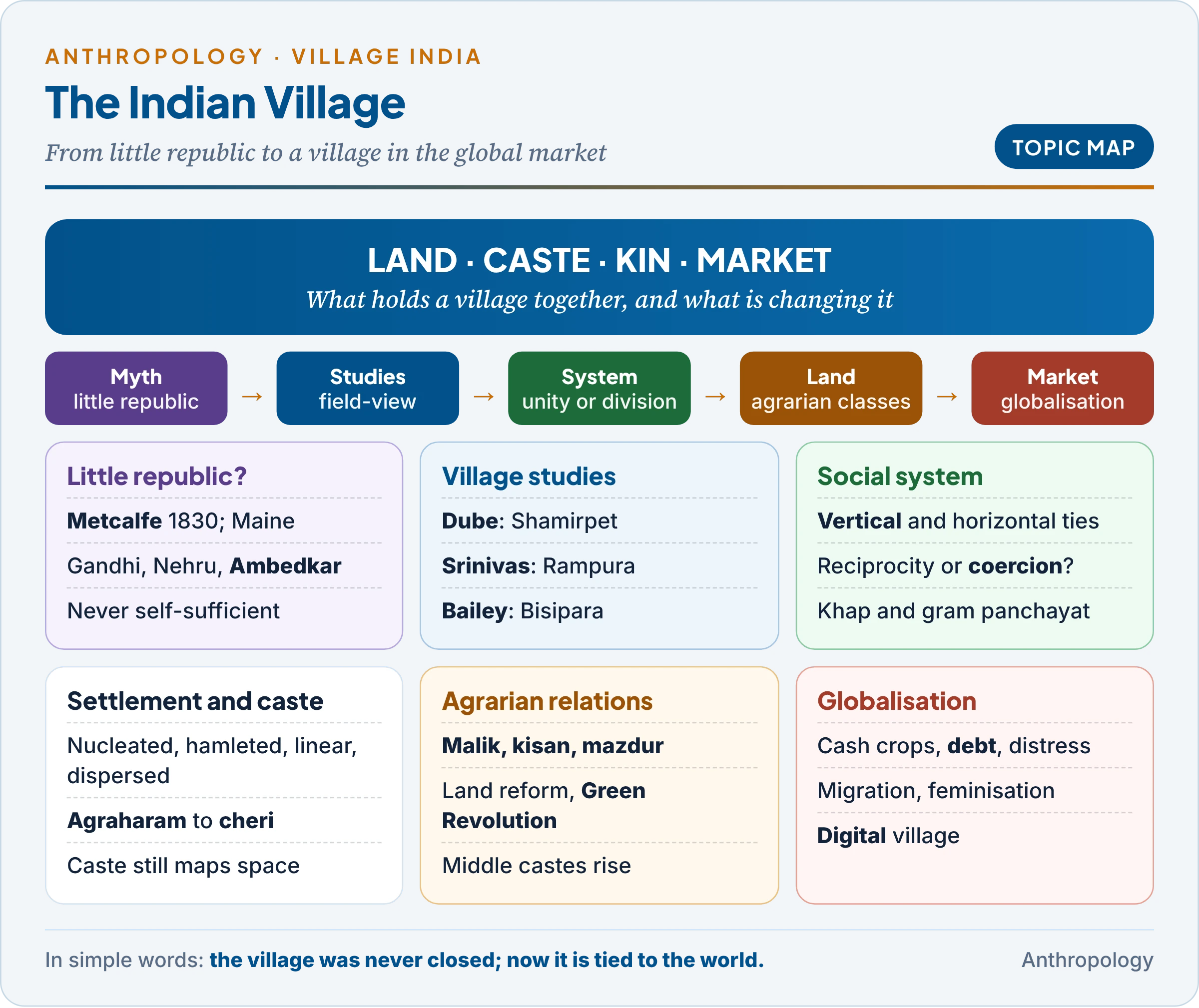
This article covers the Indian village as anthropologists have studied it. The caste system, dominant caste and jajmani are treated in 3.2a and 3.2b and only summarised here; Sanskritization, little and great traditions, Panchayati Raj and media are in 5.3a and 5.3b; tribal land alienation and shifting cultivation are in 6.2.
1. The Village and the Peasant: Basic Ideas
In simple words
Most Indians have lived in villages for thousands of years, and most still depend on farming in some way. A village is not only a cluster of houses; it is a web of families, castes, landowners, workers and gods. Anthropologists call the people of such villages peasants: farmers who grow mainly for their own needs but are tied to towns, markets and states.
- What counts as a village: the Census treats every settlement that is not urban as rural. A place is urban if it has a municipality or other civic body, or if it has at least 5,000 people, 75% of male main workers outside agriculture and a density of 400 per sq km (a census town).
- Scale: Census 2011 counted about 6.4 lakh villages and 83.3 crore rural people, about 69% of the population. In 2025 agriculture still employed 47.8% of rural male workers and 72.7% of rural women workers (Periodic Labour Force Survey, PLFS, 2025).
1.1 Peasant society
A peasant is a small cultivator who farms mainly with family labour for household needs, but who also pays rent, tax or tribute to more powerful outsiders. The concept matters because the Indian village was studied as the home of a peasantry, not of an isolated tribe.
- A. L. Kroeber, the American anthropologist, called peasants “part-societies with part-cultures” (Anthropology, 1948): they depend on towns and states for markets, law and religion.
- Robert Redfield, the American anthropologist of the Chicago school, saw peasant culture as a little tradition linked to a great tradition of cities and scholars (Peasant Society and Culture, 1956).
- Eric Wolf, an American Marxist anthropologist, defined peasants by surplus transfer: their surplus is taken by a dominant group that uses it to support itself and non-farming sections (Peasants, 1966).
The table separates three kinds of rural cultivator that are often confused.
| Feature | Tribe | Peasant | Farmer |
|---|---|---|---|
| Aim of production | Subsistence | Subsistence plus a small surplus | Profit for the market |
| Labour | Kin and community | Family | Hired wage labour |
| Link with outsiders | Relatively self-governing | Part-society, pays rent or tax | Fully in markets and the state |
| Indian example | Kond swidden cultivators | Okkaliga cultivators of Rampura in the 1950s | Capitalist farmers of Punjab |
The difference lies in who controls the surplus and how far production is for the market; the Indian village has moved from peasant toward farmer since the Green Revolution (§6).
2. The “Little Republic” and Its Critics
In simple words
British officials described the Indian village as a tiny, self-sufficient state that never changed while empires rose and fell. Indian nationalists borrowed this picture, some to praise the village and some to condemn it. Anthropologists who lived in villages showed that the picture was wrong: villages were always tied to markets, kin, castes and rulers beyond them.
- Charles Metcalfe, a British administrator, wrote in his minute of 1830: “The village communities are little republics, having nearly everything they can want within themselves, and almost independent of any foreign relations. They seem to last where nothing else lasts.”
- Henry Maine, the British jurist, treated the village as a community holding land in common, a survival of an early stage of society (Village-Communities in the East and West, 1871). B. H. Baden-Powell, a revenue official, replied that in many regions land was held severally by families, not in common (The Indian Village Community, 1896).
- Karl Marx (1853) used the same image of unchanging, self-sufficient villages to explain “Oriental despotism” and argued that British rule would break them.
2.1 Three nationalist images
The Indian sociologist Surinder S. Jodhka (“Nation and Village”, 2002) showed that three leaders read the village in three ways.
| Leader | Image of the village | What followed |
|---|---|---|
| Gandhi | Site of authentic Indian life | Gram swaraj (village self-rule), revival of crafts |
| Nehru | Site of backwardness | Planned development, Community Development (1952) |
| Ambedkar | Site of caste oppression: “a sink of localism, a den of ignorance, narrow-mindedness and communalism” (Constituent Assembly, 4 November 1948) | Individual citizen, not the village, as the unit of the Constitution |
2.2 The anthropological critique
- Not self-sufficient: M. N. Srinivas, the Indian social anthropologist trained at Oxford, wrote that the village “was always a part of a wider entity”; it depended on weekly markets, pilgrimage, marriage across villages, and revenue paid to rulers. André Béteille, the Indian sociologist, found no time within living memory when his village Sripuram (Thanjavur, Tamil Nadu) was economically self-sufficient.
- Not unchanging or equal: Bailey’s Bisipara (§3.4) saw land change hands within two generations, and every “republic” was a hierarchy (§4.3).
- A colonial construct: the American historian Ronald Inden (Imagining India, 1990) and the Dutch sociologist Jan Breman argued that the self-sufficient village was an administrative image, useful for revenue settlement and for portraying India as stagnant.
The “little republic” was therefore a myth with effects: it shaped colonial revenue policy, Gandhian programmes and early planning. What survives of it is the idea of the village as a unit of identity and local government, now carried by the gram panchayat (5.3b).
3. Village Studies: Significance, Classics and Critique
In simple words
After independence, anthropologists began to live for a year or more in a single village and to describe its whole life. These “village studies” gave the first detailed picture of how Indians actually lived, instead of how old books said they should live. They also produced many of the concepts still used to study Indian society.
3.1 Why village studies began (1950s)
- Decline of the tribe, discovery of the peasant: as anthropology turned from isolated tribes to complex societies, the village became its natural field, carrying over the method of participant observation (living with the people and taking part in their life).
- Development: the Community Development Programme (1952) and the Ford Foundation drew anthropologists into evaluation; the American anthropologist Oscar Lewis worked with the Planning Commission’s evaluation office.
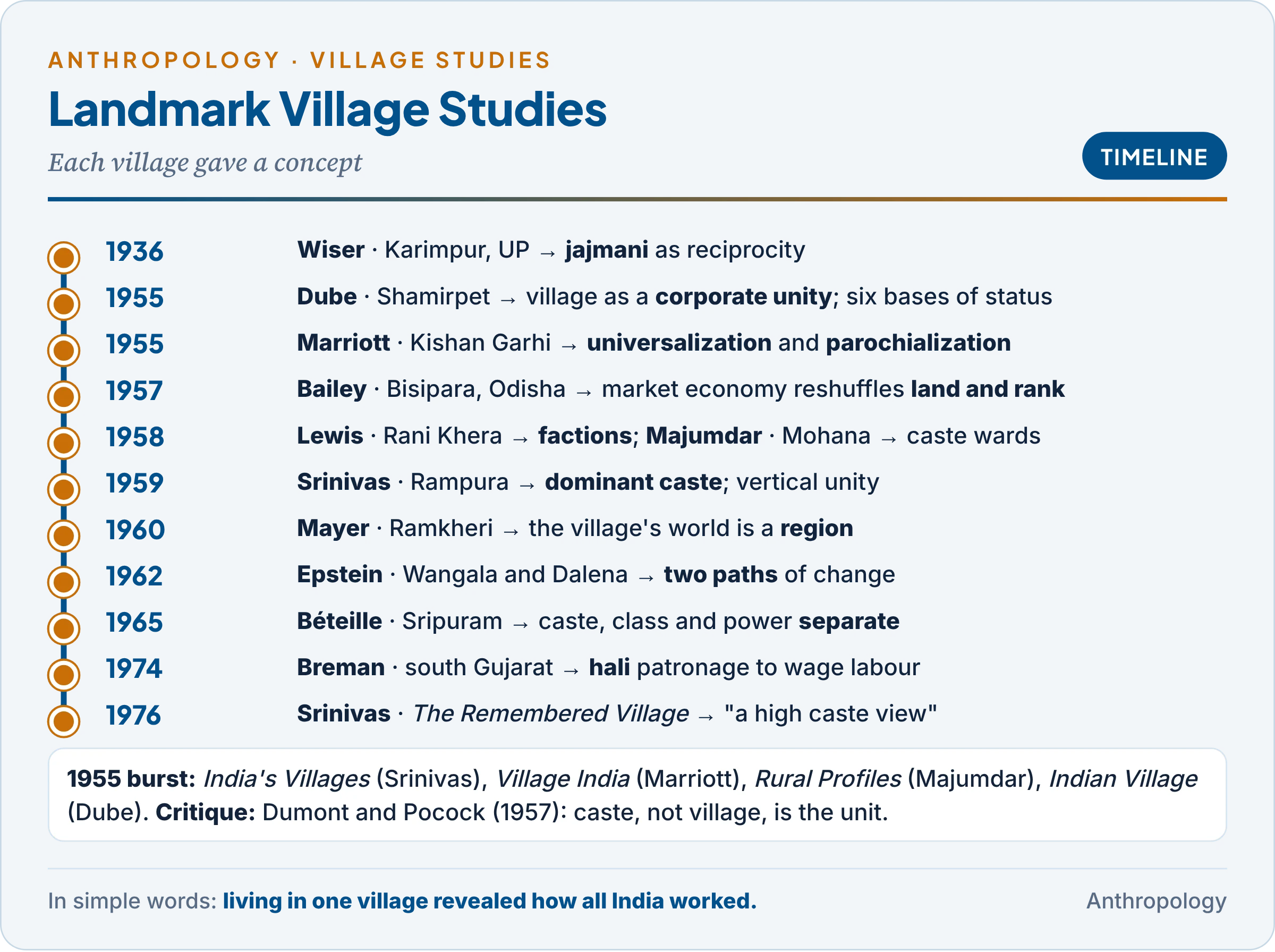
- Publication burst of 1955: essays printed in The Economic Weekly (1951–54) were edited by Srinivas as India’s Villages (1955); McKim Marriott edited Village India (1955); D. N. Majumdar edited Rural Profiles (1955); S. C. Dube published Indian Village (1955), the first full-length monograph by an Indian scholar.
- Urgency: Srinivas wrote, “We have, at the most, another ten years in which to record facts about a type of society which is changing fundamentally and with great rapidity.”
3.2 Significance of village studies
- Field-view against book-view: Srinivas contrasted the book-view (Indian society as described in Sanskrit texts, written mostly by Brahmins) with the field-view (society as observed). Village studies showed that caste ranks were disputed in the middle, that mobility occurred, and that land and power mattered as much as ritual.
- India in microcosm: the village was an observation centre where relations between castes and between landlords, tenants and labourers could be seen at close range (Béteille).
- Concepts: most of the vocabulary of Indian sociology came from villages (§3.5).
- Planning: they showed planners that peasants had reasons for caution. Srinivas argued that the peasant’s conservatism “is not without reason”: techniques that embody centuries of experience give security.
- Regional diversity: they replaced a single “Indian village” with many types (north Indian exogamy, south Indian cross-cousin marriage, linear Kerala settlements).
3.3 Landmark village studies
Each study below is remembered for what it proved, not for its story.
| Scholar | Village (region) | Work (year) | What it proves |
|---|---|---|---|
| W. H. Wiser | Karimpur (Mainpuri, UP) | The Hindu Jajmani System (1936) | Caste interdependence through hereditary service exchange |
| S. C. Dube | Shamirpet (near Hyderabad, Telangana) | Indian Village (1955) | Village as a corporate unity; six bases of status |
| M. N. Srinivas | Rampura (Mysore, Karnataka) | “The Dominant Caste in Rampura” (1959); The Remembered Village (1976) | Dominant caste; vertical unity of the village |
| McKim Marriott | Kishan Garhi (Aligarh, UP) | “Little Communities in an Indigenous Civilization” (1955) | Universalization and parochialization between little and great traditions |
| Oscar Lewis | Rani Khera (“Rampur” in the book), near Delhi | Village Life in Northern India (1958) | Factions and caste divide the village; land gives power |
| D. N. Majumdar | Mohana (near Lucknow) | Caste and Communication in an Indian Village (1958) | Caste wards split the village |
| F. G. Bailey | Bisipara (Kondmals, Odisha) | Caste and the Economic Frontier (1957) | Market economy reshuffles land and rank |
| Adrian Mayer | Ramkheri (Dewas, MP) | Caste and Kinship in Central India (1960) | The village’s social universe is a region; kindreds of cooperation and recognition |
| T. Scarlett Epstein | Wangala and Dalena (Mandya, Karnataka) | Economic Development and Social Change in South India (1962) | Same irrigation scheme, two different paths of change |
| André Béteille | Sripuram (Thanjavur, TN) | Caste, Class and Power (1965) | Caste, class and power separate with democracy |
| Jan Breman | South Gujarat villages | Patronage and Exploitation (1974) | Hali bondage dissolves into casual wage labour |
3.4 Two studies in detail
S. C. Dube and Shamirpet. Shyama Charan Dube, an Indian anthropologist who began among the Kamar tribe, studied Shamirpet, a village of Hindus, Muslims and tribals near Hyderabad, as part of an Osmania University project, and wrote the first full Indian account of a village’s economy, ritual, family and world-view together.
- Six bases of status: religion and caste, landownership, wealth, position in government service and village organisation, age, and personality. This showed that status was not fixed by caste alone.
- Corporate unity: each village had its own mores and could face outsiders as one body, despite factions.
- Hindu–Muslim relations: Muslims were placed in the jati framework, and both communities joined village rites against epidemics and evil spirits; communal tension was not a village product.
- Planned change: India’s Changing Villages (1958) studied the human factors behind the success and failure of Community Development, such as officials’ distance from peasants and the capture of benefits by the rich.
- Limitation: his account leaned on the village’s leading men, so the view of women and of the poorest households is thinner.
F. G. Bailey and Bisipara. F. G. Bailey, a British anthropologist of the Manchester school, studied Bisipara in the Kond hills of Odisha (1952–53).
- The frontier: British rule opened a mercantile economy in which land could be bought and sold. Partition of joint estates and debt made the old landholding Warrior caste sell land.
- Distillers rise: liquor trade enriched two low castes, the Boad Distillers and Ganjam Distillers; by about 1910 they owned as much land as the Warriors or more. They then Sanskritized (gave up liquor, adopted Brahminic customs) to claim higher rank.
- Untouchables blocked: the Boad Outcastes (Pans) gained money from trade and government posts, but their claims were resisted by everyone, so they turned to officials, courts and politics.
- Salience: Bisipara proved that economic change produces caste mobility, but that untouchability limits it; that the village was open to the wider economy; and that the system rests on the coercive power of the landholders rather than on reciprocity. His later work (Stratagems and Spoils, 1969) turned this into transactional analysis of politics as a game of strategies.
- Critique: a frontier village may not represent the plains, and actors appear as calculating individuals with few shared values.
3.5 Concepts that emerged from village studies
The table lists the concepts born in villages and the field where each was formed.
| Concept | Scholar | Field |
|---|---|---|
| Sanskritization, Westernization | Srinivas | Coorg (1952); Mysore villages |
| Dominant caste | Srinivas | Rampura |
| Vertical and horizontal unity | Srinivas | Rampura |
| Universalization, parochialization | Marriott | Kishan Garhi |
| Factions | Lewis; Dube | Rani Khera; Shamirpet |
| Kindred of cooperation / recognition | Mayer | Ramkheri |
| Caste, class and power separation | Béteille | Sripuram |
| Economic frontier | Bailey | Bisipara |
These concepts moved Indian sociology from describing caste to explaining mobility, power and change.
3.6 Srinivas and Vidyarthi on change
The Indian anthropologist L. P. Vidyarthi of Ranchi studied change from a different vantage point; the table compares the two (2024 question).
| Axis | M. N. Srinivas | L. P. Vidyarthi |
|---|---|---|
| Field | Multi-caste villages (Rampura) and Coorg | Tribal regions (the Maler) and pilgrimage centres (Gaya) |
| Method | Single-village participant observation; structural-functional | Regional and civilizational study; ecology; applied anthropology |
| Key ideas | Sanskritization, Westernization, dominant caste | Sacred complex (The Sacred Complex in Hindu Gaya, 1961); nature–man–spirit complex |
| Change seen as | Mobility of castes within a lasting hierarchy | Integration of local and tribal groups into Indian civilization; planned development |
Srinivas explains how groups climb within the village; Vidyarthi explains how villages and tribes connect to the wider civilization (sacred complex: 3.3).
3.7 Critique of village studies
- Upper-caste view: fieldworkers lived in the dominant caste’s quarter. Béteille lived in the Brahmin agraharam and was seen as a Brahmin; Srinivas admitted, “mine was a high caste view of village society”, and that he had kept away from the Harijan ward.
- Male view: most fieldworkers were men who could not enter women’s worlds. The Indian anthropologist Leela Dube wrote that the village never forgot she was “a Brahmin and a woman”.
- Functionalist bias: studies looked for what held the village together and played down conflict and exploitation; the dalit view of the village as a site of oppression (Ambedkar) was absent until the 1970s.
- Ahistorical and unrepresentative: a single village was treated as timeless and as standing for India.
- The village decentred: Louis Dumont and David Pocock (“Village Studies”, Contributions to Indian Sociology, 1957) argued that caste and kinship, which run across villages, are the real units. Later, Dipankar Gupta (“Whither the Indian Village”, 2005) called the village “vanishing” as an economic world, while Diane Mines and Nicolas Yazgi (Village Matters, 2010) defended it as a lived identity.
Common confusion
Did Dumont and Pocock deny that villages exist? No. They accepted villages as places, but denied that the village was a sociological reality in its own right, because a villager’s main loyalties (caste, kin, marriage) run across villages. Srinivas and Dube replied that unequal groups living face to face, sharing land, labour, gods and defence, can form a community.
4. The Village as a Social System
In simple words
A village works like a system because its parts depend on one another: landowners need labourers and artisans, the poor need land, grain and protection, and everyone shares the village gods and the village name. But the parts are unequal, and some scholars think the village is held together more by power than by mutual need.
4.1 Rampura: the unity thesis
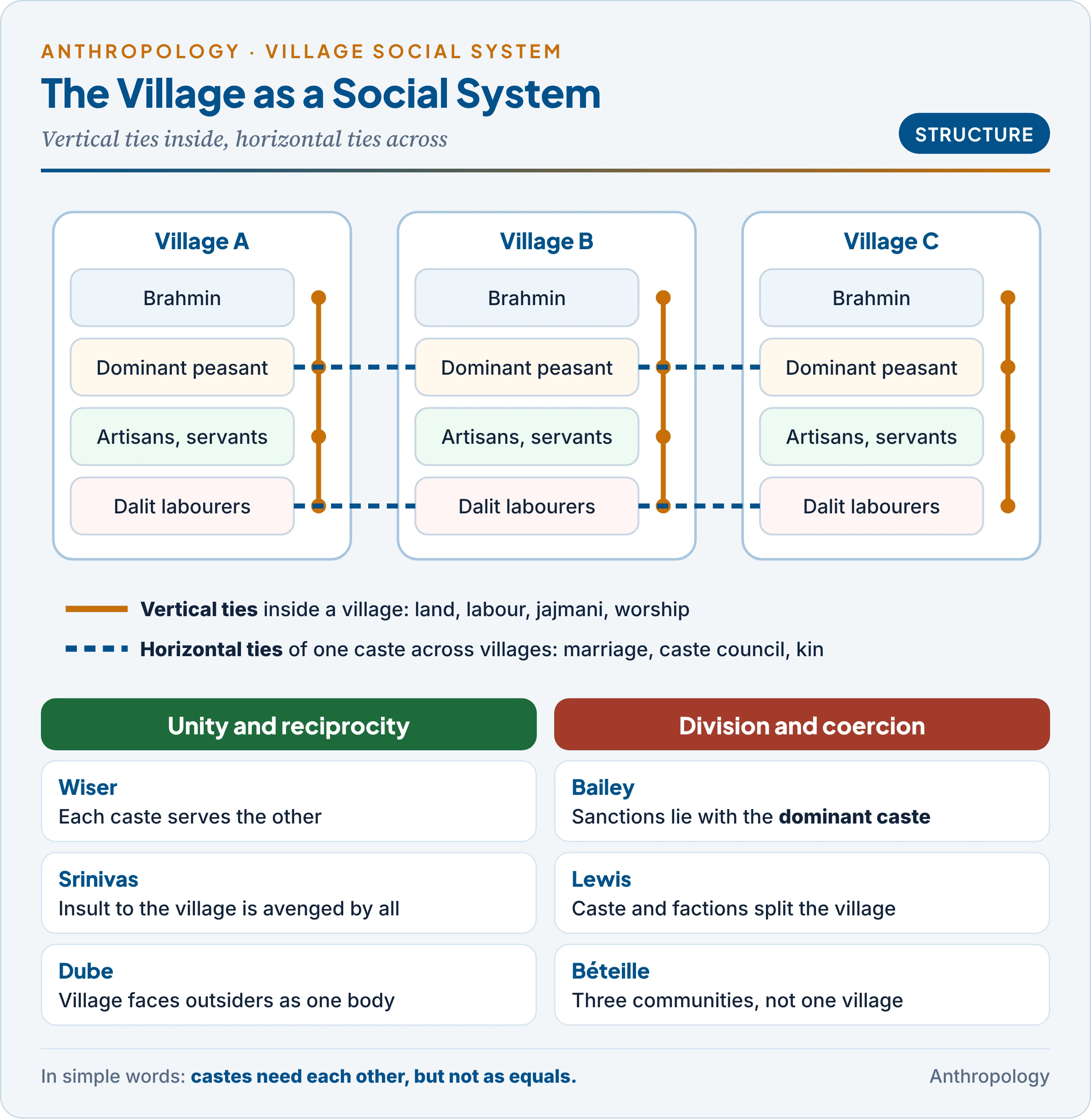
In Rampura, Srinivas found that an insult to one’s village had to be avenged like an insult to oneself or one’s family; villagers acted together in festivals, defence and disputes. He described two kinds of tie:
- Vertical unity: ties between different castes in the same village, through land, labour, jajmani services, patronage and common worship.
- Horizontal unity: ties within one caste across many villages, through marriage, caste councils and kinship.
Dube similarly wrote that the village settlement represents “a solidarity different from that of the kin, the caste, and the class”. Wiser had earlier described jajmani as reciprocity: “Each serves the other. Each in turn is master. Each in turn is servant.”
4.2 Parts of the system
- Caste and jajmani: the village is divided into endogamous castes ranked by purity and pollution; the jajmani system linked landowning patrons (jajmans) to service castes (kamins) paid in grain shares at harvest (details in 3.2b).
- Dominant caste: a caste that is numerically strong, owns much land and holds local power (the Okkaligas of Rampura); its leaders settle disputes and set the tone of village life (3.2b).
- Family: the joint family (shared residence, kitchen and property) was the ideal, commoner among landed castes; I. P. Desai, Dube and T. N. Madan saw nuclear households as a phase in a developmental cycle.
- Kinship: Irawati Karve, the Indian anthropologist, contrasted north India (village and gotra exogamy, so marriage links villages outward) with south India (cross-cousin marriage, which strengthens existing ties). Mayer distinguished the kindred of cooperation (close kin who help without formality) from the kindred of recognition (wider kin who come on ceremonial occasions).
- Authority: dominant caste elders, each caste’s caste panchayat, and the elected gram panchayat.
- Factions: Lewis found Rani Khera split into factions along kinship lines; Dube found factions within dominant castes.
- Gender: Dube found respectable women walking “with their eyes downcast”; men controlled grain payments and property.
4.3 The division thesis
The table sets the two views side by side.
| Unity–reciprocity view | Division–coercion view |
|---|---|
| Wiser: castes serve each other as equals in exchange | Bailey: interdependence is not equality; sanctions lie with the dominant caste, so the dependent castes cannot use their “right” to withhold service |
| Srinivas: vertical ties create village loyalty | Lewis: caste and kinship split Rani Khera into separate little communities; even the common land was used by Jat landowners in proportion to their holdings |
| Dube: the village faces outsiders as a compact whole | Béteille: Sripuram was a unit “in a physical sense and, to a much lesser extent, in the social sense”; Brahmins, non-Brahmins and Adi-Dravidas were the real units |
| Opler and Singh: every caste feels indispensable | Majumdar: the pure and polluted caste wards have little in common |
Evaluation: villages show integration in production and ritual and inequality in land and power at the same time. In Béteille’s words, production gives the village a vertical unity, but these relations “overflowed the boundary of the village”: half of Sripuram’s landowners lived elsewhere.
4.4 Khap panchayats
- What: a khap is a council of a clan (gotra) or group of villages of one caste, strong among Jats of Haryana, western Uttar Pradesh and Rajasthan; several khaps meet as a sarv khap.
- Role: enforcing village and gotra exogamy, settling disputes and asserting the clan’s honour. Some khaps have ordered boycotts of couples who married within the gotra or across caste, and such orders have been linked to honour killings.
- Law: in Shakti Vahini v. Union of India (27 March 2018) the Supreme Court held that an assembly cannot interfere with the marriage of two consenting adults and issued preventive, remedial and punitive directions to the police and administration.
- Anthropological reading: the khap expresses the horizontal unity of a caste and the patriarchal control of marriage.
Common confusion
Is a khap the same as a gram panchayat? No. A gram panchayat is an elected body under the 73rd Amendment (1992), open to all castes and with seats reserved for SCs, STs and women. A khap is a customary council of one caste or clan, with no legal authority. A caste panchayat governs one caste inside a village or region.
5. Settlement Patterns and Inter-caste Relations
In simple words
How houses are arranged in a village often shows how its people are ranked. In many villages the highest castes live near the temple and the lowest live at the edge, sometimes across a field. Roads, government housing, migration and Dalit assertion are slowly changing this map, but caste still shapes where people live.
5.1 Types of rural settlement
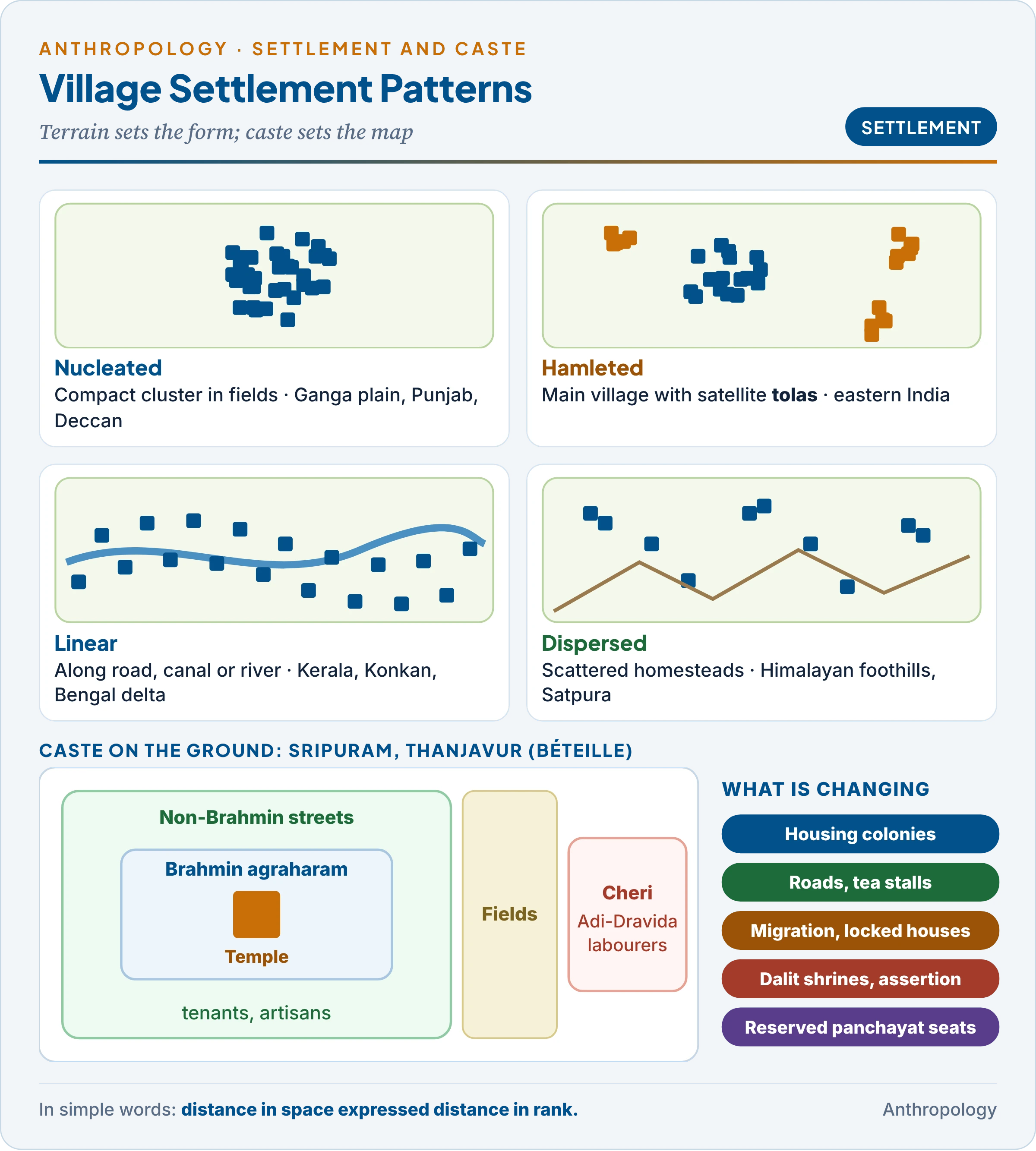
Geographers and anthropologists recognise four broad types; the table links each to its region.
| Type | Form | Typical regions |
|---|---|---|
| Nucleated (compact) | Tight cluster of houses surrounded by fields; streets by caste | Ganga plain, Punjab, Deccan plateau |
| Hamleted | A main village with satellite hamlets (tolas, padas), often of one caste | Middle Ganga plain, eastern India, tribal belts |
| Linear | Houses strung along a road, canal, river or ridge, each in its own compound | Kerala, Konkan coast, Bengal delta |
| Dispersed (scattered) | Isolated homesteads or clusters of two or three houses | Himalayan foothills, Gujarat highlands, Satpura range |
Settlement form follows water, terrain and security (compact villages where water is scarce or defence mattered, dispersed homesteads on hill slopes), but inside each form the social map follows caste.
5.2 The traditional social map
- Sripuram (Béteille): the Brahmin agraharam (a street of Brahmin houses around the temple) at the centre, non-Brahmin streets around it, and the Adi-Dravida cheri (Dalit hamlet) at a distance across the fields. Brahmins regarded the village as “their” agraharam.
- North India: caste mohallas or tolas (for example the Chamar toli), with separate wells and cremation grounds.
- Meaning: spatial distance expresses ritual distance. Separate water sources and temple-entry bars enforced untouchability; the Dalit hamlet also kept labourers close enough to work but far enough to be excluded.
5.3 Changing settlement and inter-caste relations
| Sphere | Traditional | Changing |
|---|---|---|
| Residence | Caste wards; Dalit hamlet outside | Colonies under housing schemes (Indira Awaas Yojana, PMAY-Gramin since 2016), often still caste-segregated; roads link hamlets |
| Commensality | Strict rules on food and water | Tea stalls, schools and mid-day meals mix castes; separate tumblers persist in places |
| Occupation | Hereditary, through jajmani | Wage work, migration, non-farm jobs; jajmani largely dissolved |
| Power | Upper-caste landlords rule | Middle castes (Jat, Yadav, Kurmi, Kamma, Reddy, Vokkaliga) dominant; reserved panchayat seats for SCs, STs, women |
| Status | Caste, class and power coincide | Béteille’s status incongruence: Brahmins keep land and rank but lose power |
| Marriage | Caste endogamy | Still largely endogamous; inter-caste marriage rare (3.2b) |
- Dalit exit and assertion: Dalits increasingly leave village labour ties for urban and non-farm work; Jodhka’s work in Punjab and Haryana describes this “exit” and the rise of separate Dalit shrines and gurdwaras. Assertion has also met violence, as at Kilvenmani in Thanjavur (25 December 1968), where 44 Dalits, mostly women and children of striking labourers, were burnt to death.
- New conflicts: disputes now centre on land, wages, panchayat power and dignity, fought through the SC/ST (Prevention of Atrocities) Act, 1989, courts and parties.
6. Agrarian Relations in Indian Villages
In simple words
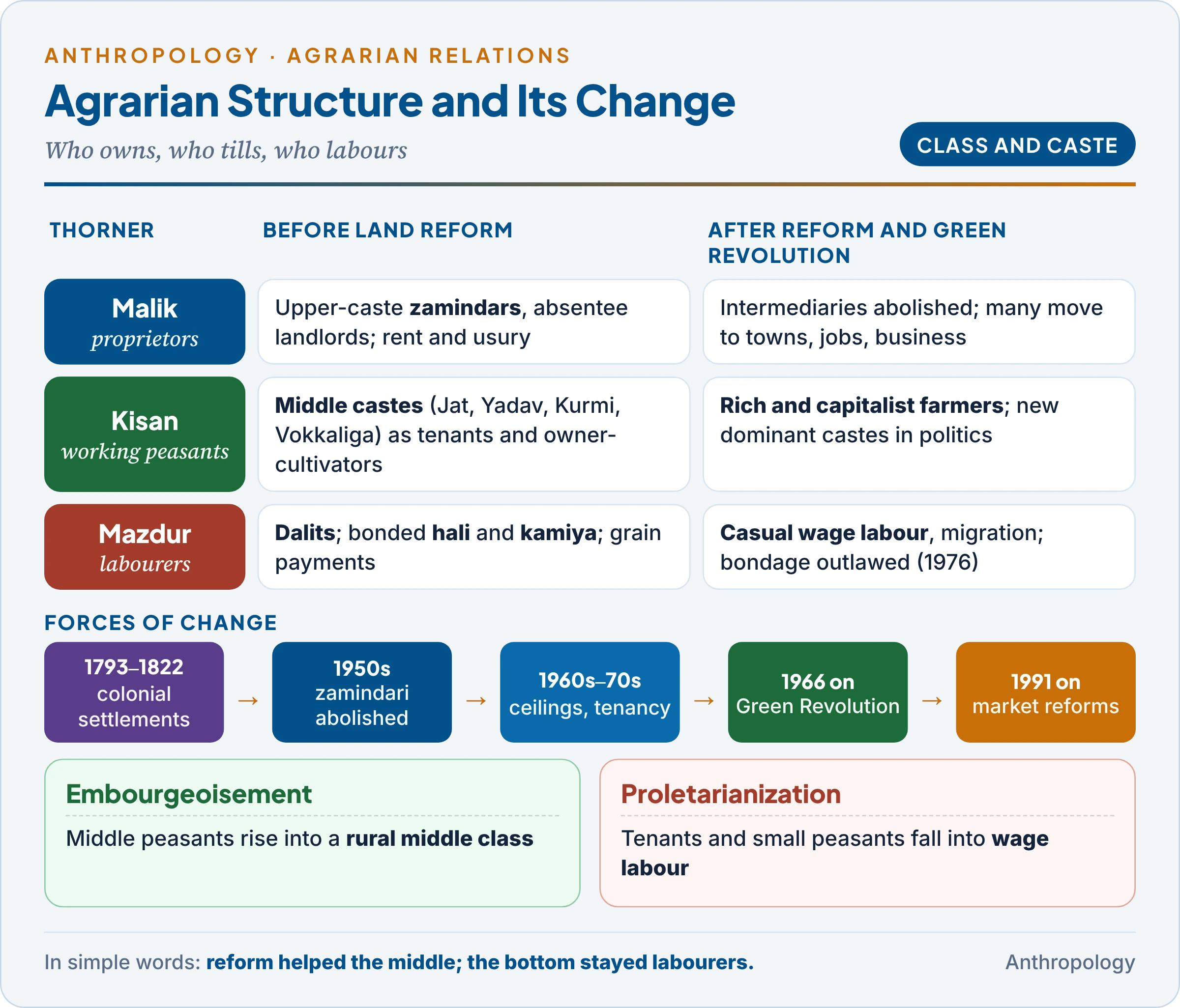
Agrarian relations are the ties between people who own land, people who rent it and people who work on it for wages. In India these ties followed caste: upper castes owned, middle castes cultivated and Dalits laboured. Land reforms and the Green Revolution reshuffled this order, making middle castes powerful and turning many tenants and labourers into wage workers.
6.1 Agrarian social structure
- Béteille (Studies in Agrarian Social Structure, 1974) defined it as the technological arrangements (ecology, tools, irrigation) and social arrangements (ownership, tenancy, labour, power) of agriculture. Economic life in Asian villages is embedded in kinship and caste, so it cannot be read from prices alone.
- Caste and class overlap: the Indian sociologist K. L. Sharma wrote that “caste incorporates the element of class and class has a cultural (caste) style”.
6.2 Colonial roots
- Land settlements: the Permanent Settlement (1793, Bengal) made zamindars owners responsible for fixed revenue; the Ryotwari system (Madras, Bombay; Thomas Munro) settled revenue directly with cultivators; the Mahalwari system (1822, north-western provinces) settled it with the village body.
- Effects: land became a commodity, intermediaries and moneylenders took the surplus, and cash revenue pushed cash crops.
- Built-in depressor: the American economist Daniel Thorner (The Agrarian Prospect in India, 1956) argued that landlords earned more from rent and usury than from investment, and tenants had no incentive to improve land: the agrarian structure itself depressed production.
6.3 Agrarian classes
Two classifications are used; the table matches them with typical castes.
| Thorner | Dhanagare (after Lenin and Mao) | Typical castes (before land reform) |
|---|---|---|
| Malik (proprietors living on rent) | Landlords; rich peasants | Brahmin, Rajput/Thakur, Bhumihar; Kamma and Reddy in Andhra |
| Kisan (working peasants on own or rented land) | Middle peasants; poor peasants | Jat, Kurmi, Yadav, Vokkaliga, Maratha–Kunbi |
| Mazdur (labourers) | Landless labourers | Dalit castes; many tribal groups |
The Indian sociologist D. N. Dhanagare (Peasant Movements in India, 1983) used the five-class model to test the claim of Eric Wolf and Hamza Alavi that middle peasants are the most rebellious stratum; he found that the leading class varied from movement to movement.
6.4 Forms of dependence
- Sharecropping: tenants paying a share of the crop (batai; bargadars in Bengal) with no security of tenure.
- Bonded labour: labour pledged against a debt, often across generations: the hali system of the Dubla (Halpati) labourers attached to Anavil Brahmin landowners in south Gujarat (Breman), and the kamiya of Bihar. The Bonded Labour System (Abolition) Act, 1976 outlawed it, but debt-bondage survives among migrant brick-kiln workers. Breman showed that the hali master’s patronage (security with exploitation) dissolved into casual wage labour without security.
6.5 Land reforms (1950s onward)
- Abolition of intermediaries: zamindari, jagirdari and similar tenures were abolished in almost all states by the mid-1950s, bringing cultivators into direct relation with the state. It was the most successful reform.
- Tenancy reform: regulation of rent, security of tenure and the right to buy; strongest in Kerala and in Operation Barga (West Bengal, 1978), which recorded sharecroppers’ rights.
- Ceilings on holdings: from the late 1950s, revised in 1972. By September 2013 only 68.48 lakh acres had been declared surplus and 50.93 lakh acres distributed to 57.38 lakh beneficiaries.
- Consolidation of scattered plots (Punjab, Haryana, western UP) and land records (now digitised).
- Who gained: the main beneficiaries were the middle castes who held occupancy rights and bought land from departing landlords. Many tenants were evicted before laws took effect, as “voluntary surrender”. Reform thus produced embourgeoisement (rise of rich peasants) for some and proletarianization (fall into wage labour) for many, as Yogendra Singh and P. C. Joshi noted.
6.6 The Green Revolution
- What: high-yielding wheat and rice varieties with irrigation, fertiliser and credit, from the Intensive Agricultural District Programme (1961, seven districts) and the High-Yielding Varieties Programme (1966–67), led by M. S. Swaminathan with dwarf wheat from Norman Borlaug. Foodgrain output reached a record 357.73 million tonnes in 2024–25.
- Economic dimensions: food self-sufficiency; growth of capitalist farmers who hire labour and invest; mechanisation; regional inequality (Punjab, Haryana, western UP versus eastern India); widening gap between large and small farmers, as the American political scientist Francine Frankel showed (India’s Green Revolution: Economic Gains and Political Costs, 1971).
- Ecological dimensions: falling water tables in Punjab and Haryana, soil degradation, pesticide residues, loss of crop diversity and coarse grains.
- Social dimensions: cash wages replace grain payments; seasonal migrant labour from Bihar to Punjab; farmers’ movements of rich and middle peasants (Mahendra Singh Tikait, Sharad Joshi); class conflict between landowners and Dalit labourers.
- Peasant rationality: the American economist T. W. Schultz (Transforming Traditional Agriculture, 1964) called traditional farmers “poor but efficient“. The speed with which Punjab and Mandya farmers (Epstein’s Wangala) took to new seeds and irrigation shows that Indian farmers are not slow to react to economic opportunities; their caution reflects risk, not ignorance.
The mode of production debate of the 1970s (Utsa Patnaik, Ashok Rudra, Amit Bhaduri) asked whether Indian agriculture had become capitalist or stayed semi-feudal, with landlords using usury and bondage; the answer varies by region.
7. Impact of Globalisation on Indian Villages
In simple words
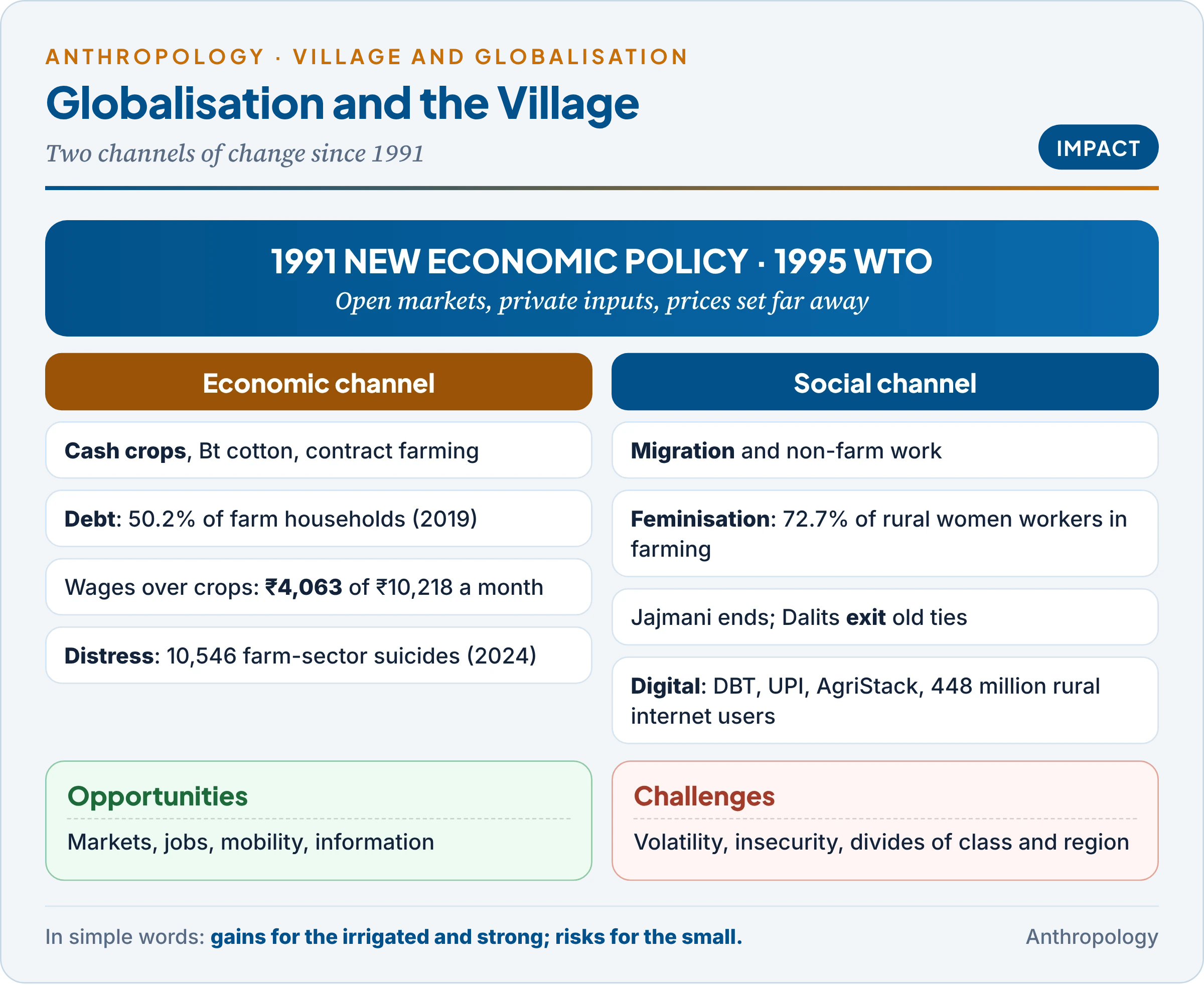
Since 1991, Indian villages have become much more tied to national and world markets. Farmers grow more cash crops, buy costly seeds and chemicals, borrow money and face prices set far away. Many villagers now earn from wages and migration rather than farming, and phones, roads and digital payments have reached most villages. These changes bring new chances and new risks.
7.1 The market economy before 1991
The Indian sociologist A. R. Desai traced four trends begun under colonial rule: the shift from subsistence to market production, modern technology, the abolition of intermediaries, and associations linking the village to the nation. The market brought rich peasants, traders and brokers as a new rural elite, credit and consumer goods, occupational mobility, the decline of jajmani, and a tendency toward nuclear households.
7.2 What changed after 1991
- Policy: the New Economic Policy (1991) and the WTO Agreement on Agriculture (1995) reduced protection, opened agricultural trade and encouraged private seed, input and processing companies.
- Crops and inputs: a shift toward cash crops (cotton, soybean, horticulture) and costly inputs, including Bt cotton (approved in 2002); contract farming (PepsiCo’s tomato and potato contracts in Punjab from the late 1980s).
- Incomes and debt: the Situation Assessment Survey (NSS 77th round, 2019) found an average monthly income of ₹10,218 per agricultural household, of which ₹4,063 came from wages and only ₹3,798 from crop production; 50.2% of agricultural households were indebted, with an average loan of ₹74,121.
- Smallholdings: 86.08% of holdings were small or marginal, averaging 1.08 hectares (Agriculture Census 2015–16).
- Distress: 10,546 farmers and farm labourers died by suicide in 2024 (4,633 cultivators and 5,913 labourers; NCRB). The Indian anthropologist A. R. Vasavi (Shadow Space: Suicides and the Predicament of Rural India, 2012) explained these deaths as a breakdown of the agrarian way of life: commercial crops unsuited to dry regions, dependence on input dealers and moneylenders, loss of local knowledge and community support, and a sense of shame at failure.
7.3 Social and cultural impact
- De-agrarianisation: villagers combine farming with construction, transport and trade; in 2025 construction employed 17.6% of rural male workers. Gupta’s “vanishing village” describes villagers who live in the village but earn outside it.
- Migration: circular migration to cities and to prosperous farm regions, which Breman called “footloose labour“; remittances fund houses and dowries.
- Feminisation of agriculture: as men migrate, women do more farm work without land titles; agriculture absorbs 72.7% of rural women workers.
- Caste and power: decline of hereditary service; Dalits gain from non-farm work and education; dominant castes shift to business and politics; land loses some of its power as the base of dominance.
- Values and culture: individualism, consumerism and weaker authority of elders; smartphones bring national and global images (media: 5.3b); local crafts face mass-produced goods.
- Industrialisation: Epstein’s Dalena, a dry village near a sugar factory town, diversified into urban jobs and trade and changed fast, while irrigated Wangala stayed agrarian and traditional. Industrial projects and land acquisition (under the Land Acquisition, Rehabilitation and Resettlement Act, 2013) displace villagers but also bring wage jobs.
7.4 Digitisation of the rural economy
- Payments and transfers: Jan Dhan accounts, Aadhaar and mobile phones (the JAM trinity) carry direct benefit transfers such as PM-KISAN (₹6,000 a year since 2019) and wages; UPI payments reach village shops.
- Markets and data: e-NAM (2016) links agricultural markets online; under the Digital Agriculture Mission (2024), AgriStack created 11 crore Farmer IDs by October 2026, linking farmers to land records and crop surveys.
- Connectivity: rural internet subscribers reached 448 million (TRAI, June 2026), about 48 per 100 rural people.
- Limits: a digital divide by gender, age and literacy; exclusion when authentication fails; dependence on agents (bank mitras); questions of data ownership under the Digital Personal Data Protection Act, 2023.
7.5 Opportunities and challenges
The table summarises the 2022 question: what globalisation offers and what it threatens.
| Opportunities | Challenges |
|---|---|
| Higher yields, new crops, export markets | Price volatility, input costs, debt |
| Non-farm jobs, remittances, mobility for Dalits | Distress migration, insecure informal work |
| Roads, phones, digital payments, information | Digital divide, data and exclusion risks |
| Weakening of caste-based occupations | New inequalities of class and region |
| Women’s wage work and self-help groups | Feminisation of low-return farming |
Globalisation accelerated a commercialisation begun under colonial rule. Its effects are uneven: irrigated large farmers gain, while dryland smallholders, tenants and labourers carry the risk.
Key Terms
| Term | Meaning in simple words |
|---|---|
| Peasant | A small cultivator farming with family labour for household needs, subordinate to outsiders |
| Part-society | Kroeber’s term for a peasantry that depends on towns and states |
| Little republic | The colonial image of a self-sufficient, unchanging village |
| Field-view / book-view | Society as observed in fieldwork / as described in classical texts |
| Vertical unity | Ties between castes inside one village |
| Horizontal unity | Ties within one caste across villages |
| Dominant caste | A locally powerful caste with numbers, land and political strength |
| Faction | A rival group within a village or caste, usually led by a leading family |
| Khap | A customary clan or caste council, mainly among Jats |
| Agraharam / cheri | Brahmin street / Dalit hamlet in a Tamil village |
| Nucleated settlement | A compact cluster of houses surrounded by fields |
| Malik, kisan, mazdur | Thorner’s proprietors, working peasants and labourers |
| Built-in depressor | A land system that discourages investment in farming |
| Hali | Hereditary bonded labour in south Gujarat |
| Embourgeoisement | The rise of some peasants into a prosperous rural middle class |
| Proletarianization | The fall of small peasants into wage labour |
| De-agrarianisation | Rural people earning mainly from non-farm work |
Contemporary Developments
- Rural employment law: the Viksit Bharat – Guarantee for Rozgar and Ajeevika Mission (Gramin) Act, 2025 (VB-G RAM G) came into force on 1 July 2026, repealing MGNREGA and guaranteeing 125 days of wage work per rural household, with a 60-day pause in peak farm seasons.
- Farm distress data: NCRB’s 2024 report recorded 10,546 suicides in the farm sector, with agricultural labourers (56%) outnumbering cultivators.
- SVAMITVA: drone survey of 3.30 lakh villages and 3.24 crore property cards prepared (August 2026); banks have begun lending against them.
- Labour shift: agriculture’s share of India’s workers fell from 44.8% (2024) to 43.0% (2025), while manufacturing rose to 12.1% (PLFS).
Diagrams to Master
- Topic map: little republic → village studies → social system → settlement and caste → agrarian relations → globalisation.
- Landmark studies timeline: Wiser (1936) to The Remembered Village (1976), each with its village and concept.
- Vertical and horizontal ties: castes inside one village linked by land, labour and worship; one caste linked across villages by marriage and councils; the division view beside it.
- Settlement types and caste plan: nucleated, hamleted, linear, dispersed; Sripuram’s agraharam, non-Brahmin streets and cheri.
- Agrarian ladder: malik–kisan–mazdur with castes; arrows for land reform and Green Revolution; embourgeoisement versus proletarianization.
- Globalisation panel: economic channel (cash crops, debt, distress) and social channel (migration, feminisation, digitisation), opportunities against challenges.
Revision Grid
| Scholar | Work (year) | Key idea |
|---|---|---|
| Charles Metcalfe | Minute (1830) | Villages as little republics |
| W. H. Wiser | The Hindu Jajmani System (1936) | Reciprocity among castes |
| S. C. Dube | Indian Village (1955); India’s Changing Villages (1958) | Corporate unity; six bases of status |
| M. N. Srinivas | India’s Villages (1955); The Remembered Village (1976) | Dominant caste; vertical unity; field-view |
| McKim Marriott | Village India (1955) | Universalization and parochialization |
| Daniel Thorner | The Agrarian Prospect in India (1956) | Malik–kisan–mazdur; built-in depressor |
| Dumont and Pocock | “Village Studies” (1957) | Village not a sociological reality |
| F. G. Bailey | Caste and the Economic Frontier (1957) | Market economy and caste mobility |
| Oscar Lewis | Village Life in Northern India (1958) | Factions; land over caste |
| T. S. Epstein | Economic Development and Social Change in South India (1962) | Wangala and Dalena |
| André Béteille | Caste, Class and Power (1965); “The Indian Village: Past and Present” (1980) | Status incongruence; village as design |
| Jan Breman | Patronage and Exploitation (1974) | Hali bondage to wage labour |
| Dipankar Gupta | “Whither the Indian Village” (2005) | The vanishing village |
| A. R. Vasavi | Shadow Space (2012) | Farmer suicides as agrarian crisis |
Previous Year Questions
5.1 Indian village: significance of village study in India; Indian village as a social system; traditional and changing patterns of settlement and inter-caste relations; agrarian relations in Indian villages; impact of globalisation on Indian villages.
- 2026Critically examine the salience of F. G. Bailey’s study on Bisipara village of Odisha.
- 2025“The village was not merely a place where people lived; it had a design in which were reflected the basic values of Indian civilization.” Who said this? Elaborate.
- 2024Write notes on: Digitisation of rural economy.
- 2024Compare and contrast the approaches of M. N. Srinivas and L. P. Vidyarthi to social change in village India.
- 2023Write notes on: Village as little republic.
- 2022Assess the contributions of S. C. Dube in Indian village studies.
- 2022“Globalisation, on one hand, has provided opportunities and on the other hand thrown challenges to Indian villages.” Elucidate.
- 2021Examine how structural transformation in economy is affecting traditional social relationships in agrarian society.
- 2020Write short note on the ‘Khap’ Panchayat in about 150 words.
- 2020Discuss the impact of Globalization on Indian villages.
- 2020Describe the different settlement patterns in rural India.
- 2019Discuss the impact of media on the social life of Indian villages.
- 2019Identify the theoretical concepts that have emerged out of village studies in India.
- 2019Describe the impact of industrialization on the economic and social aspects of India’s villages.
- 2018Discuss the impact of market economy on rural villages.
- 2018Write a note in 150 words on Agrarian social structure.
- 2017Give a critical evaluation of any one anthropological village study in India.
- 2016Describe the traditional patterns of settlement of Indian villages.
- 2016Explain Indian village as a social system with suitable examples.
- 2015Discuss the impact of globalization on village economy in India.
- 2015Examine the contribution of village studies towards the understanding of Indian social system.
- 2013Indian farmers are not slow to react to economic opportunities. – Discuss this statement. (250 words).
- 2012How has globalisation impact agrarian relations in the last two decades ?
- 2010Discuss the contributions of S.C. Dube towards the understanding of the Indian village.
- 2009Describe the significant contributions of village studies in Indian in the understanding of social transformations.
- 2004Write a note on Globalisation and Indian peasantry.
- 2004Analyse how the village studies contributed in understanding the Indian Social System.
- 2002What do you understand by Green Revolution ? What are its economic and ecological dimensions ?
- 2002Write a note on village studies in India.
- 2001Evaluate various changes in social organization of India’s villages due to impinging pressures of the market economy on them.
- 1998‘Village studies are crucial in the understanding of Indian life and culture.’ Who were the pioneer anthropologists undertake such studies ? Give a comprehensive picture of any one of them.
- 1991Write a note on Form of labour bondage in Indian agriculture.
- 1991Write a note on Problem of shifting cultivation in Indian tribes.
- 1982Write a note on (200 words) : Cultural parochialization in village India.
- 1982Write a note on (200 words) : Distinctive features of peasant society.
- 1982Write a note on (200 words) : Impact of industrialization on simple societies.
Related questions from other units
- 2021Unit 3.2: Write short notes on “Factionalism and politics in rural India” in about 150 words.
- 2018Unit 4: Examine the colonial administrators view that Indian villages can be considered as ‘little republics’
- 2014Unit 3.2: Define the concept ‘Dominant Caste and examine its relevance in the contemporary Indian village with suitable examples.
- 2013Unit 7.2: Examine the impacts of green revolution on rural poor.
- 2003Unit 6.1: Write a note on Tribe and peasant similarities and differences.
- 1996Unit 6.3: Bring out the impact of industrialization on rural population in India. Illustrate your answer with suitable examples. Suggest appropriate measures for the solution of the problems encountered with.
- 1991Unit 3.2: What is the notion of ‘folk-urban continuum’ in the study of peasant society? Is it applicable to Indian conditions ?
- 1990Unit 4: Discuss the major concept and approaches employed by the Anthropologists in the study of peasant society in India.
- 1988Unit 3.2: Discuss relationship between “dominant caste” and economic development” in rural India.
- 1985Unit 1.3: Write a note on Peasant society.
More from Indian Village and Social Change: all notes of this unit · every PYQ of this unit · Anthropology Optional hub