

Anthropology Optional › Paper II › Unit 04: Emergence and Growth of Anthropology in India
4 Emergence and growth of anthropology in India – Contributions of the 18th, 19th and early 20th Century scholar administrators. Contributions of Indian anthropologists to tribal and caste studies.
Official Syllabus: Paper II, Unit 4
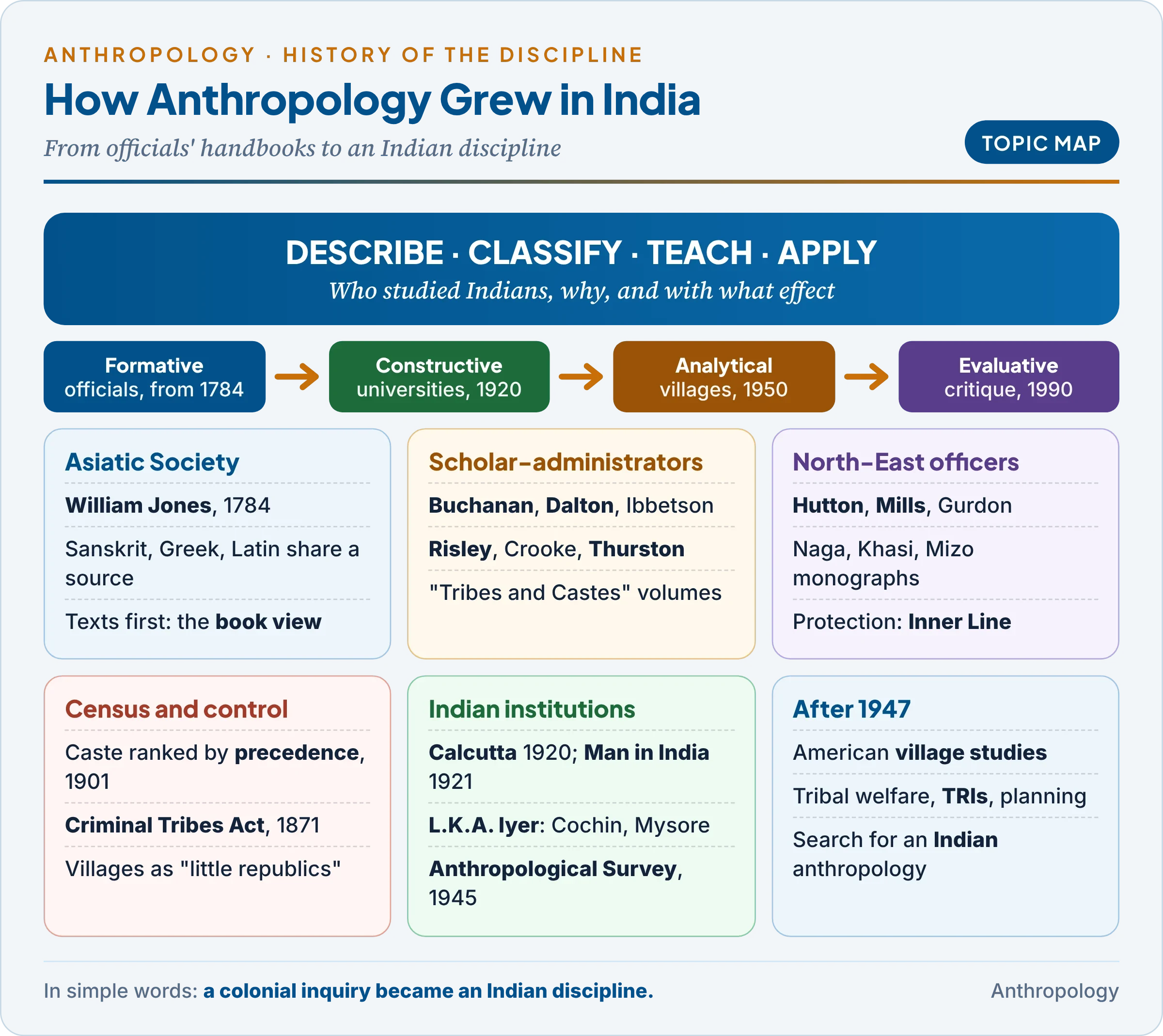
This article covers the first half of the syllabus line: how anthropology emerged in India, who the scholar-administrators were, what they produced, how the colonial state used their knowledge, and how the discipline grew after them. The contributions of Indian anthropologists to tribal and caste studies (S.C. Roy, Ghurye, Majumdar, Bose, Karve, Srinivas, Dube, Vidyarthi, Sinha, K.S. Singh and others) are in 4b.
1. Before Anthropology: Older Ways of Describing Indian Society
In simple words
Long before anyone called it anthropology, Indian and foreign writers described the people of India: their duties, customs, castes and beliefs. These accounts were written from books, courts and travel, not from long stays in villages. Modern anthropology began when people started to collect such facts systematically and to compare them.
- Normative texts: the Manusmriti (about the 2nd century CE) and the Arthashastra of Kautilya describe how society ought to be arranged: varna duties, marriage forms, punishments and the king’s revenue. They are prescriptions (rules laid down by an authority), not observations, which is why the anthropologist M.N. Srinivas later called this the “book view” of Indian society (3.1).
- Foreign observers: Megasthenes, the Greek envoy at the Mauryan court (about 300 BCE), described seven “classes” of Indians in his Indica; Al-Biruni wrote Kitab al-Hind (about 1030) on Hindu beliefs, castes and sciences; François Bernier described Mughal society (1670).
- Missionaries: the French priest Abbé J.A. Dubois, after three decades in south India, wrote Hindu Manners, Customs and Ceremonies (English 1816), stressing the role of Brahmins in maintaining caste.
- Why these are not yet anthropology: they lack systematic fieldwork, comparison across many communities and a theory of why customs vary. They are still useful as historical evidence of continuity and change.
2. Phases in the Growth of Indian Anthropology
In simple words
Historians of the subject divide its growth in India into periods. First, British officials, missionaries and travellers collected facts about castes and tribes. Next, universities and trained Indian scholars took over and wrote careful studies of single communities. After Independence, the field turned to villages, change, development and theory.
2.1 Three classic schemes
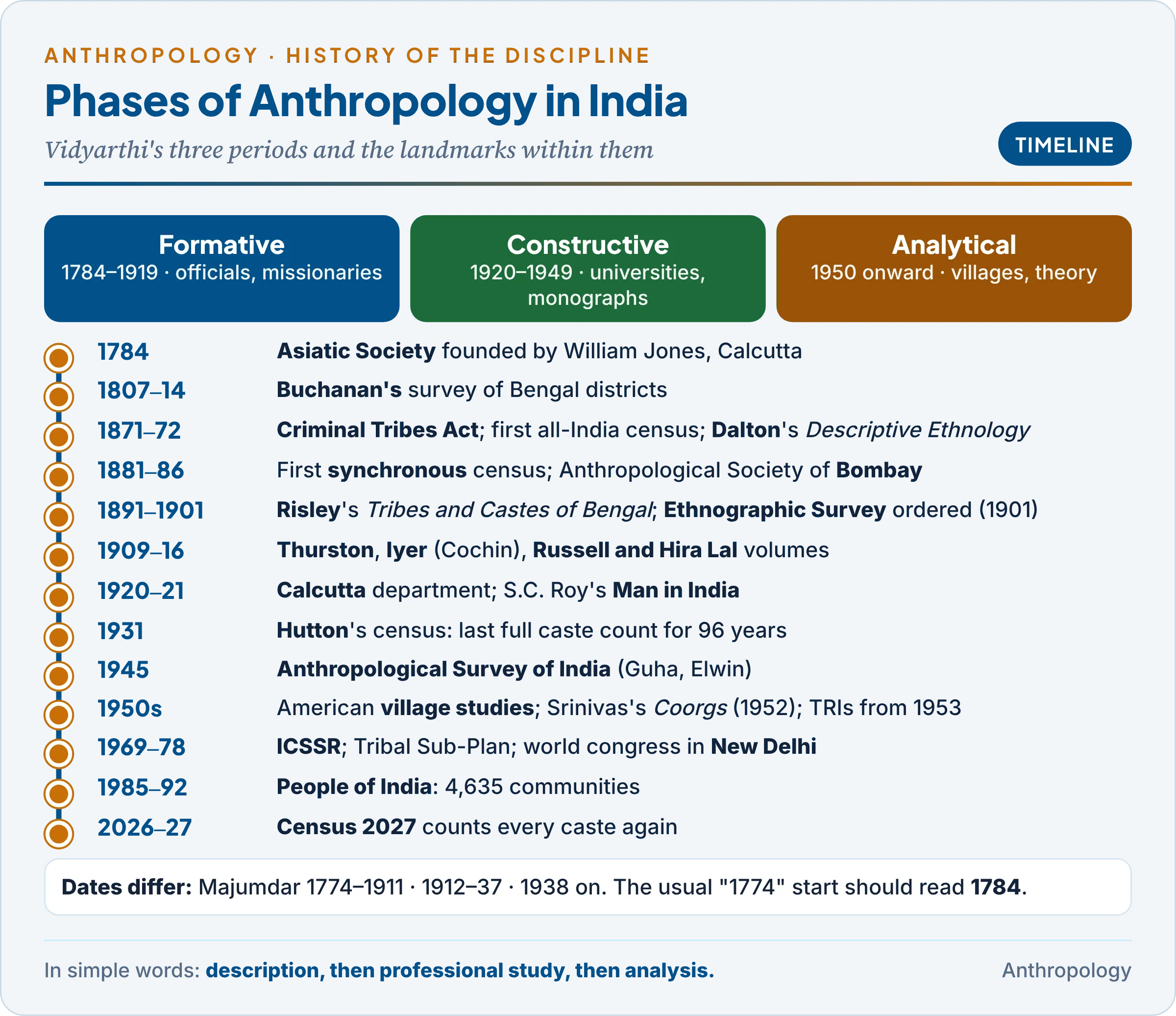
Indian anthropologists proposed periodisations (ways of dividing history into periods). The table sets them side by side.
| Scholar | First phase | Second phase | Third phase |
|---|---|---|---|
| D.N. Majumdar (1950) | Formulatory (1774–1911) | Constructive (1912–1937) | Critical (1938 onward) |
| Surajit Sinha (1971) | British colonial (1774–1919) | Pre-Independence (1920–1949) | Post-Independence (1950 onward) |
| L.P. Vidyarthi (The Rise of Anthropology in India, 1978) | Formative (1774–1919) | Constructive (1920–1949) | Analytical (1950 onward) |
The schemes differ more in dates than in substance. All agree that the subject began as colonial description, became professional when universities and Indian scholars took over, and turned analytical after Independence.
- Majumdar opened his critical phase in 1938, after his own problem-oriented monograph on the Ho (A Tribe in Transition, 1937); Vidyarthi began the constructive period in 1920, when anthropology became a post-graduate subject at Calcutta, and the analytical period in 1950.
- A correction on the starting date: all these schemes begin in 1774, but the Asiatic Society was founded on 15 January 1784 (Sir William Jones reached Calcutta only in 1783). The formative period is therefore better dated from 1784.
- A fourth, evaluative phase is often added for the years after about 1990: work turned to displacement, human rights, health, gender, indigenous knowledge and ethnicity, and to the colonial origins of the discipline itself.
2.2 What drove each phase
- Formative phase: the needs of rule. A trading company that became a government had to collect revenue, settle land disputes, recruit soldiers and keep order among people it did not understand. Knowledge of castes, tribes, customs and languages was administrative knowledge.
- Constructive phase: universities and nationalism. Anthropology entered Calcutta (1920) and sociology Bombay (1919); Indian scholars trained in Cambridge, Oxford, London and Harvard, and journals such as Man in India (1921) gave them a platform. The field kept its tribal focus but became intensive and monographic (one community studied in depth).
- Analytical phase: the new nation. Planning, community development and tribal welfare needed social knowledge; American scholars brought village studies, the study of civilization and culture and personality; Indian scholars built concepts of their own (Sanskritization, dominant caste, sacred complex: 4b).
3. The Scholar-Administrators of the Formative Period
In simple words
Most of the first ethnographers of India were British officials: district collectors, census commissioners, police officers, museum keepers and political agents. Their job required them to know the people they governed, so they wrote huge reference books on castes and tribes. These books are still read, but they also carried the prejudices and purposes of colonial rule.
3.1 An example: Buchanan’s survey of Bengal
In 1807 the East India Company’s government of Bengal sent Francis Buchanan (later Buchanan-Hamilton), a Scottish surgeon and naturalist, to survey the districts under its control. Over 1807–1814 he toured Dinajpur, Rangpur, Purnea, Bhagalpur, Patna and Gaya, Shahabad and Gorakhpur, recording for each district its topography, antiquities, people, castes, religion, agriculture, arts and trade. He had already surveyed Mysore (1800–01) after the fall of Tipu Sultan.
- What it shows: the earliest ethnography in India was a by-product of statistical survey for revenue and administration. Buchanan counted castes, noted their occupations and recorded claims such as those of the Nagbansi families of Gorakhpur to Rajput status, long before anyone used the word anthropology.
- Why it matters: his reports, largely unpublished for a century, were later mined by W.W. Hunter for the Statistical Account of Bengal (1875–77) and by later census officers: survey, gazetteer and census grew from the same root.
3.2 The Asiatic Society and the Orientalists
- Sir William Jones (1746–1794), a judge of the Supreme Court at Calcutta and a gifted linguist, founded the Asiatic Society on 15 January 1784. Its object was enquiry into “whatever is performed by man or produced by nature” within the geographical limits of Asia.
- Language as the first clue: in his Third Anniversary Discourse (1786) Jones argued that Sanskrit, Greek and Latin sprang from “some common source”. This launched comparative philology (the historical comparison of languages) and the idea of an Indo-European family, which later writers turned, wrongly, into the idea of an Aryan race.
- Publications: the Society’s journal Asiatick Researches began in 1788; the Journal of the Asiatic Society of Bengal followed in 1832.
- Other forums: the Indian Antiquary (1872), the Anthropological Society of Bombay (founded 1886, with its own journal), the Journal of the Bihar and Orissa Research Society (1915) and the Mythic Society of Bangalore.
The Orientalists studied India through texts: they looked to Sanskrit law books and epics to understand society. This textual bias later shaped the colonial image of caste as a fixed, Brahmin-defined system.
3.3 Survey, gazetteer and census
- District gazetteers and statistical accounts: W.W. Hunter’s Statistical Account of Bengal (20 volumes, 1875–77) and the Imperial Gazetteer of India (from 1881) described each district’s people, castes and customs. James Campbell‘s Bombay Gazetteer volumes were so detailed that later caste surveys of Bombay drew heavily on them.
- The census: the first all-India census was taken over 1867–1872; the first synchronous census (everyone counted on one date) followed in 1881. From the start it recorded caste and tribe, becoming a vast ethnographic source.
- The Ethnographic Survey of India: in May 1901 the Government of India, under Lord Curzon, ordered an ethnographic survey of the provinces, with Herbert Risley as Director of Ethnography and a Superintendent of Ethnography in each province. Funds were small and were withdrawn in 1909, but the survey produced most of the great “Tribes and Castes” volumes. Its questions followed a list agreed by Nesfield, Ibbetson and Risley at a conference in 1885.
- The Linguistic Survey of India: George A. Grierson, an Irish civil servant and philologist, began it in 1894; its volumes, published 1903–1928, described 179 languages and 544 dialects. It remains the basis for classifying Indian languages into families (2a).
3.4 The encyclopaedic “Tribes and Castes” volumes
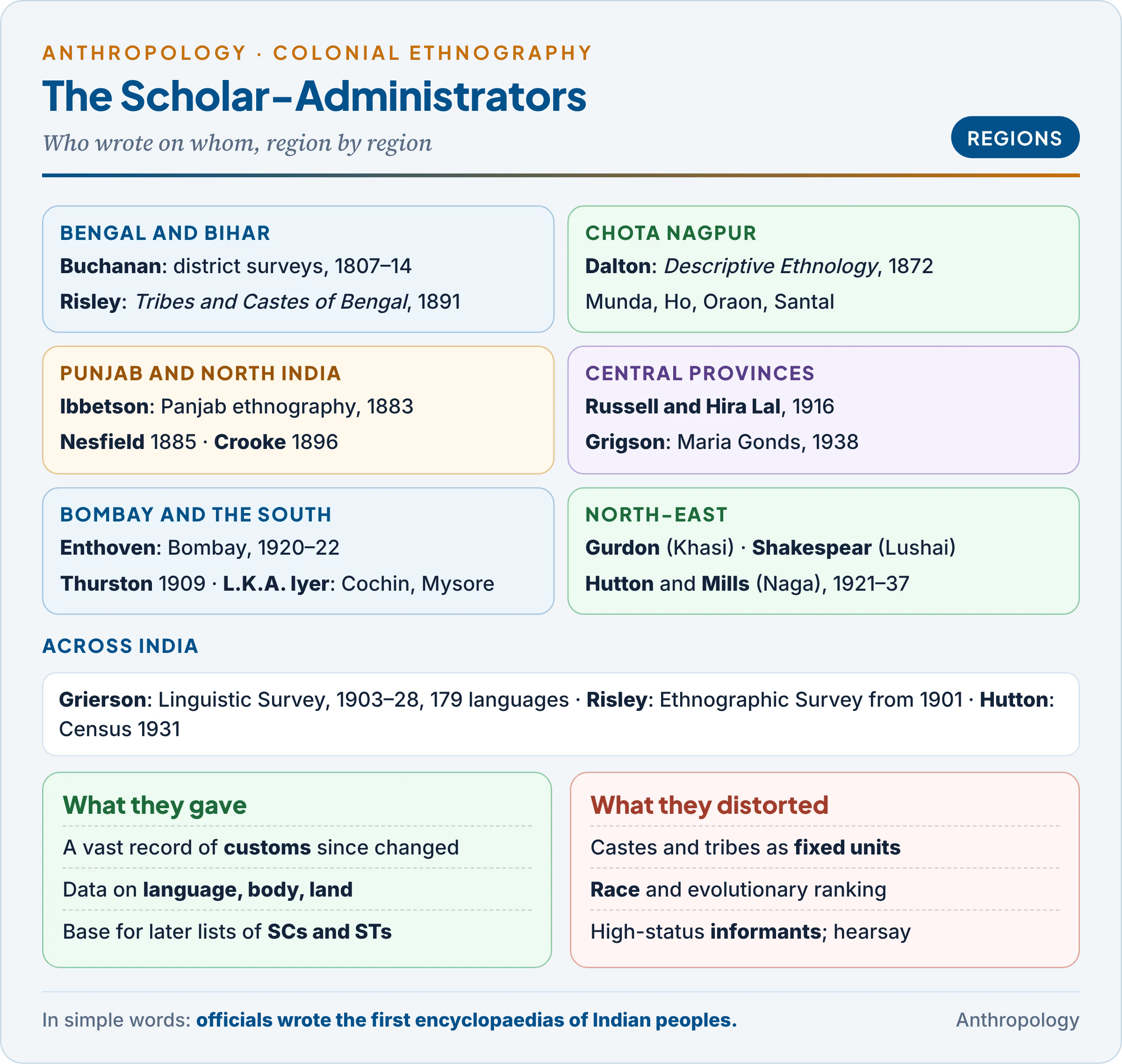
The great reference works were arranged as glossaries: an alphabetical entry for each caste or tribe, giving its origin legends, subdivisions, marriage rules, religion, occupation and status. The table lists the main ones.
| Author | Region | Work (year) | Distinctive contribution |
|---|---|---|---|
| M.A. Sherring (missionary) | North India, Banaras | Hindu Tribes and Castes (3 vols, 1872–81) | First all-India survey of castes from a missionary base |
| E.T. Dalton | Chota Nagpur, Assam | Descriptive Ethnology of Bengal (1872) | Pioneer account of the Munda, Oraon, Ho, Santal, illustrated with lithographs from photographs |
| Denzil Ibbetson | Punjab | Outlines of Panjab Ethnography (1883), from the 1881 census | Caste shaped by occupation, tribe and political power; status can change |
| J.C. Nesfield | North-Western Provinces and Oudh | Brief View of the Caste System (1885) | Occupational theory of caste; denied a racial basis |
| H.H. Risley | Bengal, then all India | Tribes and Castes of Bengal (1891); The People of India (1908) | Anthropometry and the racial theory of caste (§3.5) |
| William Crooke | North-Western Provinces and Oudh | Tribes and Castes of the NWP and Oudh (4 vols, 1896); Popular Religion and Folk-lore of Northern India (1894) | Folk religion and folklore of north India |
| Edgar Thurston (with K. Rangachari) | Madras Presidency | Castes and Tribes of Southern India (7 vols, 1909) | Superintendent of the Madras Museum; anthropometry plus customs of south Indian groups |
| L.K. Ananthakrishna Iyer | Cochin, Mysore | Cochin Tribes and Castes (2 vols, 1909–12); Mysore Tribes and Castes (4 vols, 1928–35) | First Indian author of a regional encyclopaedia (§5.2) |
| R.V. Russell and Rai Bahadur Hira Lal | Central Provinces | Tribes and Castes of the Central Provinces of India (4 vols, 1916) | Joint British and Indian authorship; Gond, Baiga, Bhil and many castes |
| R.E. Enthoven | Bombay Presidency | Tribes and Castes of Bombay (3 vols, 1920–22) | Built on Campbell’s Bombay Gazetteer |
The volumes record customs that have since changed and remain the first place to look for a community’s past. But they treat each caste or tribe as a separate, fixed unit, rely on high-status informants, mix observation with hearsay, and rank groups on an evolutionary scale from “primitive” to “civilised”.
3.5 Risley and the “Aryan” debate
Herbert Hope Risley (1851–1911) of the Indian Civil Service is the most influential and most criticised scholar-administrator. The 2014 question asks for his contribution to the “Aryan” debate.
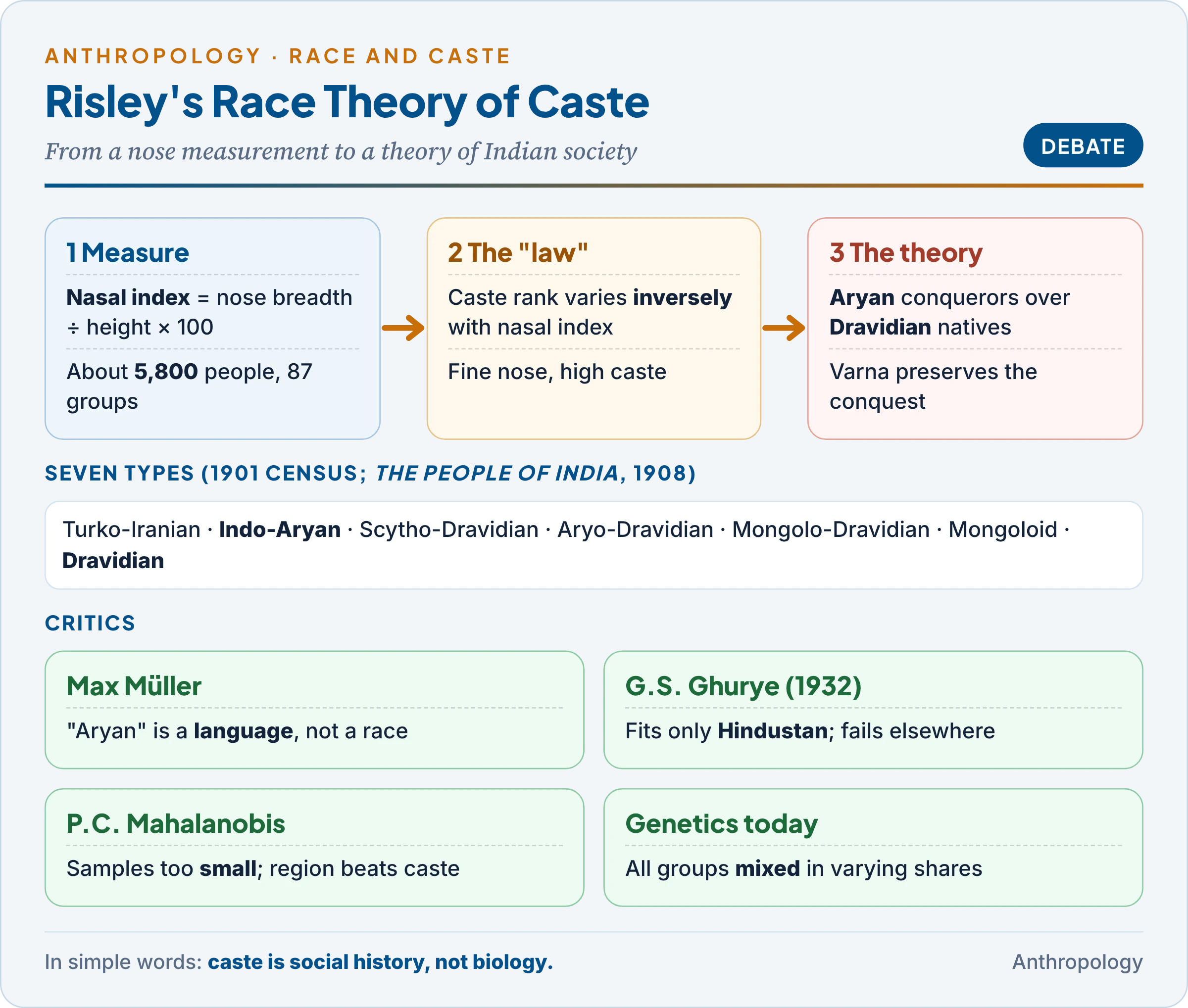
- Anthropometry: in Bengal (1886–88) he measured heads, noses and stature, and with later surveys built up measurements of about 5,800 individuals of some 87 castes and tribes. His key measure was the nasal index (nose breadth as a percentage of nose height), which the anatomists William Flower and Paul Topinard regarded as the best test of race.
- The “law”: he claimed that “the social position of a caste varies inversely as its nasal index”: the finer the nose, the higher the caste. He read this as proof that caste had a racial basis: lighter, fine-nosed Aryan invaders had placed themselves above the darker, broad-nosed Dravidian natives, and the varna order preserved that conquest.
- Seven types: in the 1901 Census report (republished as The People of India, 1908) he divided Indians into seven physical types: Turko-Iranian, Indo-Aryan, Scytho-Dravidian, Aryo-Dravidian, Mongolo-Dravidian, Mongoloid and Dravidian (details and critique in 2a).
- Origin of caste: he combined race with hypergamy (women marrying up), fiction of common descent and occupation, and listed several ways in which new castes form, such as change of occupation, migration and sectarian change (3.2a).
- Ranking by precedence: in 1901 he asked census officers to arrange castes “in order of social precedence as recognised by native public opinion”. Castes responded with petitions claiming higher varna names, and caste associations grew around the census (§4.1).
Criticism:
- Mixing language and race: the philologist Max Müller had insisted that “Aryan” names a language family, not a race; an ethnologist who spoke of Aryan blood or skulls was, he wrote, as great a sinner as a linguist who spoke of a “dolichocephalic dictionary or a brachycephalic grammar”.
- The data did not fit: G.S. Ghurye (Caste and Race in India, 1932) re-examined the figures and found the correlation between nasal index and caste rank only in Hindustan (the Gangetic plain); in Punjab, Bengal, Bombay and the south it broke down, and even Risley’s Punjab figures did not rank castes in the order of their social status.
- Statistics: the statistician P.C. Mahalanobis showed that many of Risley’s samples were far too small, and that caste groups within one region resembled each other more than they resembled their namesakes in another region.
- Genetics: modern genome studies show that most Indians descend from a mixture of ancient South Asian hunter-gatherers, Iranian-related farmers and later Steppe-related migrants in varying proportions; no caste is a “pure” race (2a).
- Political effect: by giving caste a biological basis Risley made it look unchangeable and racially divided, which suited a policy of governing through differences.
Common confusion
Did Risley prove that caste is racial? No. He claimed it, on the basis of nose and head measurements. His own figures fitted only parts of north India; small samples, regional differences and modern genetics all show that caste groups are mixed populations. “Aryan” is properly the name of a language family, not of a race.
3.6 Other scholar-administrators of north, central and south India
- E.T. Dalton, Commissioner of Chota Nagpur, gave the first broad picture of the Kol peoples (Munda, Ho, Oraon). He described the Aghariya, who claimed to be Kshatriyas who had laid aside the sacred thread: early evidence that status claims move in both directions.
- Denzil Ibbetson saw caste as a product of occupation, tribal origin and political power, open to change; in 1890, as President of the Anthropological Society of Bombay, he urged universities to found chairs of anthropology. Nesfield held that occupation alone, not race, created caste (3.2a).
- William Crooke, long a district officer in Mirzapur, showed that much of everyday Hinduism (village deities, spirit cults) lay outside Brahmanical texts.
- Edgar Thurston, Superintendent of the Madras Government Museum (1885–1908), measured and photographed south Indian groups within an evolutionary and racial frame.
- Rai Bahadur Hira Lal, co-author with R.V. Russell (1916), shows that Indians were contributors, not only informants, before 1920.
3.7 The North-East: Assam monographs and political officers
The 2026 question asks about colonial scholars of the North-East. From the early 1900s the Assam administration commissioned a series of tribal monographs, written mostly by political officers who knew the hill peoples at first hand.
| Author | People | Work (year) |
|---|---|---|
| P.R.T. Gurdon | Khasi | The Khasis (1907) |
| T.C. Hodson | Meitei; Nagas of Manipur | The Meitheis (1908); The Naga Tribes of Manipur (1911) |
| A. Playfair | Garo | The Garos (1909) |
| Sidney Endle (missionary) | Bodo-Kachari | The Kacharis (1911) |
| J. Shakespear | Lushai (Mizo), Kuki | The Lushei Kuki Clans (1912) |
| J.H. Hutton | Angami, Sema Naga | The Angami Nagas (1921); The Sema Nagas (1921) |
| J.P. Mills | Lotha, Ao, Rengma Naga | The Lhota Nagas (1922); The Ao Nagas (1926); The Rengma Nagas (1937) |
| N.E. Parry | Lakher (Mara) | The Lakhers (1932) |
- Contribution: detailed records of clan organisation, village councils, land tenure, feasts of merit, head-hunting, morung (men’s dormitory) and religion, often before missionary and state influence changed them.
- Policy influence: these officers tended to see the hill peoples as distinct societies to be protected from plains traders and moneylenders. That view fed the Inner Line (1873), the “excluded” and “partially excluded” areas of the Government of India Act, 1935, and later the Sixth Schedule (9.1).
- Limits: evolutionary and diffusionist assumptions, stress on the “primitive“, and an administrative interest in pacification.
- Later figures: Christoph von Fürer-Haimendorf toured with Mills (The Naked Nagas, 1939); Verrier Elwin shaped policy for NEFA as Adviser for Tribal Affairs from 1954 (4b).
3.8 J.H. Hutton: from Naga hills to the census of caste
John Henry Hutton (1885–1968) shows how the scholar-administrator shaded into the professional anthropologist.
- Political officer in the Naga Hills, author of the Angami and Sema monographs (1921).
- Census Commissioner for 1931: the last census to publish full caste tables until Census 2027. He introduced the term “exterior castes” for groups then called “depressed classes”, and his report listed the disabilities they suffered.
- Caste in India (1946): explained caste as a product of many factors, with stress on tribal ideas of mana and taboo (soul-stuff that can be transferred and must be guarded against) behind rules of food and touch (3.2a).
- Professor of social anthropology at Cambridge (1937–1950), linking Indian material with British academic anthropology.
3.9 Central and south India: from administrator to anthropologist
- W.V. Grigson, an ICS officer who had administered Bastar: The Maria Gonds of Bastar (1938) and The Aboriginal Problem in the Central Provinces and Berar (1944), a report on land alienation and indebtedness that urged protective law.
- Haimendorf in Hyderabad: as Adviser for Tribes and Backward Classes to the Nizam’s government from 1945, he studied the Chenchu, Reddi and Raj Gond and drafted land-protection measures for the Gonds of Adilabad.
- Verrier Elwin (1902–1964): came as a missionary, became an ethnographer of the Baiga (1939), Agaria (1942), Maria (1943), Muria (The Muria and their Ghotul, 1947) and Saora (1955), and finally an administrator-scholar of independent India: Deputy Director of the Anthropological Survey (1946), Adviser for NEFA (1954), author of A Philosophy for NEFA (1957). His ideas and the debate with Ghurye are in 4b.
3.10 Missionaries and academic visitors
- Missionaries learnt languages well: Stephen Hislop on the tribes of the Central Provinces (papers of 1866), P.O. Bodding on the Santal, John Hoffmann‘s Encyclopaedia Mundarica (1930–50). They often judged tribal religion against Christianity.
- British academics: W.H.R. Rivers, The Todas (1906), used the genealogical method; A.R. Radcliffe-Brown, The Andaman Islanders (1922), gave an early functionalist analysis of ritual. Rivers later supervised Ghurye at Cambridge. (C.G. Seligman‘s 1911 monograph, sometimes listed here, was on the Veddas of Ceylon.)
4. Anthropology and Colonial Rule: Classification and Control
In simple words
The colonial state did not only describe Indian society; it also sorted people into fixed categories such as castes, tribes, races and “criminal tribes”, and then made laws and policies on that basis. People began to organise around these categories. Later scholars ask how far colonial anthropology recorded Indian society and how far it reshaped it.
4.1 How classification worked
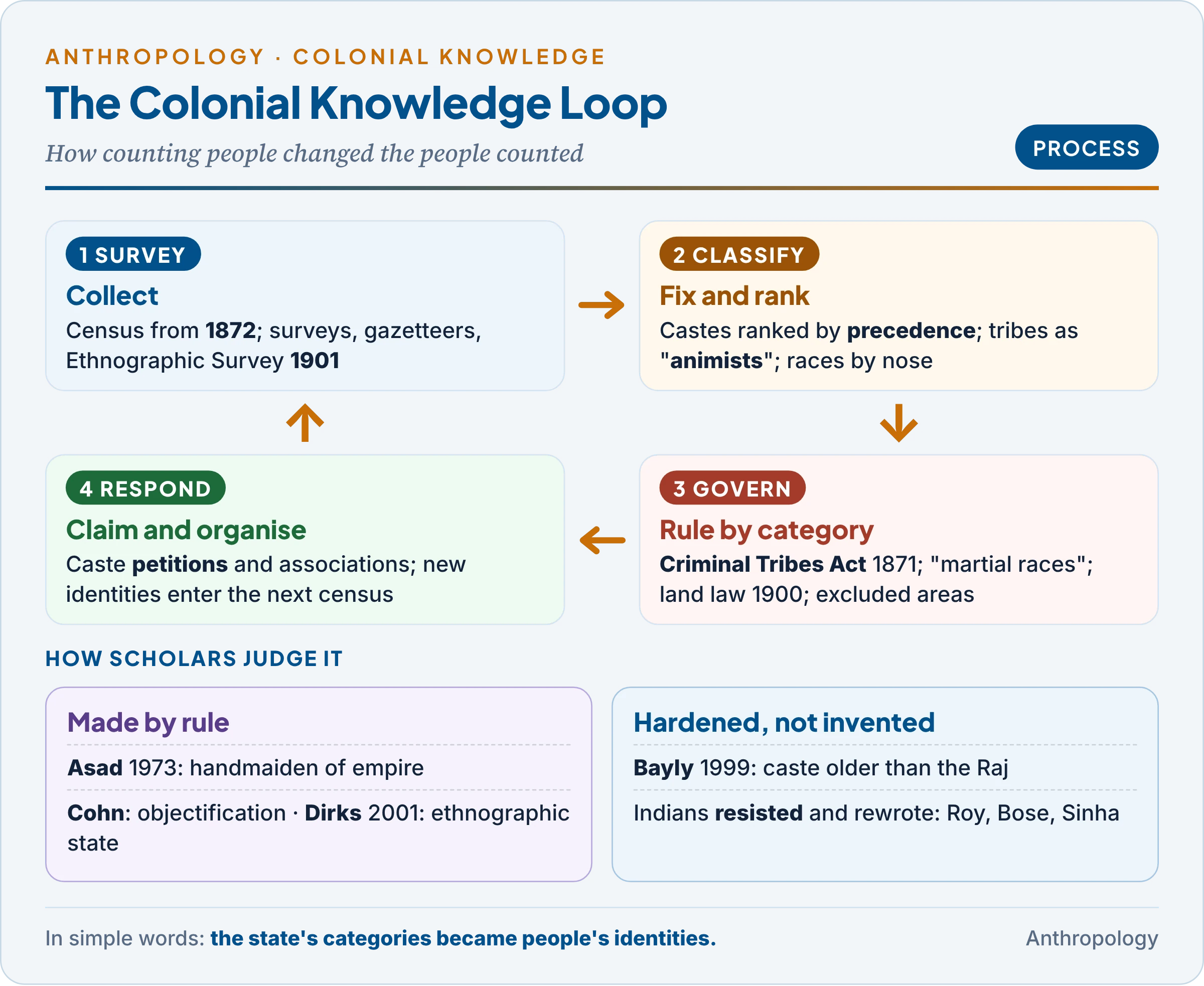
- The census as a mirror and a lever: by asking every Indian for a caste and by ranking castes by precedence (1901), the census turned fluid, local identities into fixed, all-India categories printed in tables. Castes organised sabhas (associations) to claim Kshatriya or Brahmin status; the Indian sociologist G.S. Ghurye described how “ambitious castes” used the census to press their claims (4b).
- “Criminal tribes”: the Criminal Tribes Act, 1871 declared whole communities hereditary criminals, subject to registration, roll-calls and settlements. After Independence the Act (as revised in 1924) was repealed in 1952 and these communities became Denotified Tribes, but Habitual Offenders laws and police suspicion continued. The anthropologist P.K. Bhowmick‘s work with the Lodha of Midnapore is the classic Indian response (4b).
- “Martial races” and “agricultural tribes”: army recruitment favoured “martial” groups; the Punjab Land Alienation Act, 1900 restricted land sales to notified agricultural tribes.
- Tribal areas: the Scheduled Districts Act, 1874, the Inner Line and the excluded areas of 1935 rested on the idea, supplied by ethnography, that tribes were separate, primitive peoples to be ruled differently (9.1).
- “Animism”: the censuses of 1901 and 1911 placed tribal religion under “animism“, a term from the Victorian anthropologist E.B. Tylor; the 1921 Census changed it to “tribal religion“.
4.2 The village as “little republic”
The 2018 question asks about the colonial view of the village.
- Charles Metcalfe, a Company official, wrote in 1830 that “the village communities are little republics, having nearly everything they can want within themselves”, surviving while “dynasty after dynasty tumbles down”.
- Henry Maine (Village-Communities in the East and West, 1871) saw the Indian village as a survival of the early Aryan community; B.H. Baden-Powell (The Indian Village Community, 1896) classified villages by land tenure.
- Purpose: the image supported revenue settlement with village bodies and the belief that Indian society was static, needing British rule to change it.
- Critique: villages were tied to markets, states, pilgrimage centres and castes spread across regions; they were hierarchical, not egalitarian. Srinivas called the self-sufficient village a myth; Dumont traced how the idea was built from Munro to Maine. Ambedkar, in the Constituent Assembly, called the village a “sink of localism” (5.1).
4.3 Was colonial anthropology a “handmaiden of colonialism”?
Scholars after 1970 asked whether anthropology simply served empire. The table sets out the main positions.
| Position | Main voices | Argument |
|---|---|---|
| Handmaiden | Talal Asad, Anthropology and the Colonial Encounter (1973) | Anthropology grew within colonial power and supplied knowledge useful for rule |
| Objectification | Bernard Cohn, An Anthropologist among the Historians (1987) | Census and survey turned identities into objects to be counted and ranked |
| Ethnographic state | Nicholas Dirks, Castes of Mind (2001) | After 1857 colonial rule governed through anthropology; caste in its modern, all-India form is largely a colonial product |
| Colonial hardening, not invention | Susan Bayly, Caste, Society and Politics in India (1999) | Caste was spreading and hardening from the eighteenth century under Indian kingdoms; colonial rule intensified it but did not invent it |
| Indian autonomy | Surajit Sinha, N.K. Bose, S.C. Roy | Indians used the same tools to defend tribes, criticise policy and build nationalist readings of Indian civilization |
The debate leaves a balanced picture. Colonial anthropology produced much of the data the discipline still uses, and it shaped the categories of caste and tribe that the Indian state inherited (the Scheduled Castes order of 1936 and Scheduled Tribes lists drew on census lists). But Indians were never passive: they petitioned, organised and, from Roy onward, wrote their own ethnography, which is the “autonomy” the 2024 question asks about.
Common confusion
Did the British invent caste? No. Caste (jati) and varna existed for many centuries before colonial rule. What colonial rule did was to record, rank and fix caste in law, census and administration, so that loose, local and negotiable ranks became written, all-India categories with real consequences for land, jobs and policing.
5. The Constructive Period: Institutions and the Indian Turn
In simple words
In the early twentieth century anthropology moved from government offices into universities, museums and journals. Indians trained abroad came back to teach, and an Indian lawyer in Ranchi began writing tribal studies that British scholars admired. By Independence, India had its own departments, journals and a national survey.
5.1 New institutions
| Year | Institution | Significance |
|---|---|---|
| 1886 | Anthropological Society of Bombay | First society devoted to anthropology in India |
| 1916 | Anthropological section of the Zoological Survey of India | Government physical anthropology; parent of the Anthropological Survey |
| 1919 | Department of Sociology and Civics, Bombay University (Patrick Geddes; Ghurye from 1924) | Sociology and social anthropology taught together |
| 1920 | Department of Anthropology, Calcutta University (Sir Asutosh Mukherjee) | First post-graduate anthropology department in India |
| 1921 | Man in India, Ranchi (S.C. Roy) | First Indian anthropological journal |
| 1921 | Department of Economics and Sociology, Lucknow (Radhakamal Mukerjee; D.N. Majumdar from 1928) | Base of the Lucknow tradition |
| 1938 | Silver Jubilee session of the Indian Science Congress, held jointly with the British Association | Indian and British anthropologists reviewed the field together |
| 1945 | Anthropological Survey of India (Banaras; Calcutta from 1948) | B.S. Guha first Director, Verrier Elwin Deputy Director |
| 1947 | Department of Anthropology, University of Delhi | Spread of departments after Independence |
- Calcutta 1920: anthropology had been taught as part of ancient Indian history from 1918; in 1920 it became a full post-graduate subject. Ramaprasad Chanda was its first head (1920–21); L.K. Ananthakrishna Iyer then led it until his retirement in the early 1930s. Early teachers and students included Panchanan Mitra, K.P. Chattopadhyay, B.S. Guha, T.C. Das, N.K. Bose, D.N. Majumdar and D. Sen.
- Holism: Indian departments taught physical anthropology, prehistoric archaeology and social anthropology together, a four-field (or three-field) holism closer to the American model than to British social anthropology.
- The Anthropological Survey: carved out of the Zoological Survey, it became the world’s largest government anthropological organisation, with regional stations across India.
5.2 L.K. Ananthakrishna Iyer: the Indian scholar-administrator
The 2012 and 2026 questions ask about L.K. Ananthakrishna Iyer (1861–1937), who stands between the colonial encyclopaedists and the university anthropologists.
- Career: a schoolteacher and college science assistant in Kerala, he conducted the ethnographic survey of Cochin State in the early 1900s and later completed the Ethnographic Survey of Mysore, begun in 1903 by H.V. Nanjundayya, after the latter’s death.
- Works: The Cochin Tribes and Castes (2 vols, 1909–12), The Mysore Tribes and Castes (4 vols, 1928–35, with Nanjundayya), Anthropology of the Syrian Christians (1926) and Lectures on Ethnography (1925), the published form of his first Calcutta lectures.
- Teacher: head of the Calcutta department until his retirement in the early 1930s; he took students into the Munda country for fieldwork. He presided over the anthropology section of the Indian Science Congress and was made Dewan Bahadur.
- Content: detailed accounts of Nayar matrilineal households and sambandham unions, Nambudiri Brahmins, forest tribes such as the Kadar and Malayan, rites of passage, magic and serpent worship in Malabar.
- Limitations: like the colonial glossaries, his volumes treat each caste or tribe as an isolated unit described through life-cycle rites, with little on links between groups or on economic change.
The trajectory of south Indian encyclopaedic work (2012 question) thus runs from Buchanan’s Mysore journey (1800–01) through the district manuals of Madras, Thurston and Rangachari (1909), the state surveys of Cochin (Iyer), Travancore (his son L.A. Krishna Iyer‘s The Travancore Tribes and Castes, 1937–41) and Mysore (Nanjundayya and Iyer), to the People of India volumes on the southern states in the 1990s.
5.3 The first Indian ethnographers
The constructive period belongs to Indian scholars, whose work is treated in 4b. In brief:
- S.C. Roy, a Ranchi lawyer, wrote The Mundas and their Country (1912) and The Oraons of Chota Nagpur (1915), founded Man in India (1921) and was hailed by Hutton in 1938 as the “Father of Indian Ethnology“.
- G.S. Ghurye (Caste and Race in India, 1932), D.N. Majumdar (A Tribe in Transition, 1937), N.K. Bose (“The Hindu Method of Tribal Absorption”, 1941) and Iravati Karve (Kinship Organisation in India, 1953) moved the field from compilation to analysis.
- Their importance for this unit is that they took over the scholar-administrators’ material and questioned it: Ghurye tested Risley’s race theory, Roy defended tribal customary law in courts, and Bose read tribes as part of Indian civilization rather than as isolated primitives.
6. After Independence: American Influence, Applied Work and the Search for an Indian Anthropology
In simple words
After 1947 the new Indian state wanted to plan development, and anthropologists were asked to help. American scholars came to study Indian villages and the links between villages and the wider civilization. Indian anthropologists learnt from them, but also began to ask whether India needed its own concepts rather than borrowed ones.
6.1 The American contribution
The 2011 question asks for the contribution of American anthropologists. The table lists the main figures.
| Scholar | Site or theme | Contribution |
|---|---|---|
| W.H. Wiser (missionary-sociologist) | Karimpur, UP; The Hindu Jajmani System (1936) | First model of the jajmani system (3.2b) |
| Morris Opler (Cornell) with R.D. Singh | Senapur, eastern UP (from the late 1940s) | Long-term village research project; training of Indian scholars |
| Oscar Lewis | Rampur, near Delhi; Village Life in Northern India (1958) | Factions and leadership; evaluation of community development |
| McKim Marriott | Kishan Garhi; ed. Village India (1955) | Universalization and parochialization between little and great traditions (5.3b) |
| Robert Redfield and Milton Singer (Chicago) | Study of civilizations; Singer on Madras (When a Great Tradition Modernizes, 1972) | Little and great traditions; the village as part of a civilization |
| Gerald Berreman | Sirkanda; Hindus of the Himalayas (1963) | Caste seen from below; comparison with US race |
| G.M. Carstairs (British psychiatrist), Gitel Steed | Rajasthan; Gujarat | Culture and personality studies |
- Effects: village and peasant studies replaced the tribal monograph; work moved from description to hypothesis; Dube, Majumdar, Vidyarthi and Sinha trained or collaborated in American universities.
- Peasant-society approaches (1990 question): Redfield’s little community and peasant society as a “part-society” with a “part-culture“; Marriott’s two-way flow between little and great traditions; Srinivas’s Sanskritization and dominant caste; Dube’s multiple traditions; and Bailey’s economic frontier. These are developed in 5.1 and 5.3.
- Critique: village studies sometimes treated the village as a bounded isolate again, and American interest followed Cold War priorities of development and stability; the Indian anthropologist Surajit Sinha described Indian anthropology of the period as “a Western apprentice“.
6.2 Applied and action anthropology
- Tribal Research Institutes: from 1953 (the first at Ranchi, in Bihar), states set up research and training institutes for tribal welfare; their reports fed the Dhebar Commission (1960–61) and later plans.
- Community development: S.C. Dube‘s India’s Changing Villages (1958) evaluated the programme and showed that benefits went mostly to landed, upper-caste households (4b).
- Action anthropology: the American Sol Tax‘s idea of working with a community on its own goals influenced P.K. Bhowmick‘s work among the Lodha and L.P. Vidyarthi‘s action-research unit at Ranchi.
- Tribal Sub-Plan: the strategy adopted in the Fifth Five-Year Plan (1974–75) followed two bodies of 1972: the Planning Commission’s Task Force on the Development of Tribal Areas, chaired by L.P. Vidyarthi, and the Expert Committee chaired by S.C. Dube (9.1).
6.3 Institutions and the search for an “Indian” anthropology
- Institutions: the Indian Council of Social Science Research (1969); Contributions to Indian Sociology (1957) of Louis Dumont and David Pocock, which urged the use of Indian categories such as purity and hierarchy; the Tenth International Congress of Anthropological and Ethnological Sciences in New Delhi (1978), hosted by L.P. Vidyarthi as President of the IUAES (1973–78); and the Anthropological Survey’s People of India project (1985–92) on 4,635 communities under K.S. Singh (4b).
- Indigenisation: N.K. Bose urged models built from Indian data; J.P.S. Uberoi called for a “swaraj of ideas” (“Science and Swaraj”, 1968); Vidyarthi’s sacred complex of Gaya (1961) was offered as a step toward “Indianness” (3.3).
- Dependence on the state: almost all funding came from government, so Indian anthropology became applied and policy-oriented: relevant, but with limited critical independence.
7. Distinctive Features of Indian Anthropology
In simple words
Indian anthropology grew from colonial roots, but it developed its own character. It stayed close to the study of tribes and castes, kept the physical and social branches together, worked closely with government, and tried to see every community as part of one long Indian civilization.
The 1992 and 1994 questions ask for the distinctive features and the factors behind them.
| Feature | Explanation | Factor behind it |
|---|---|---|
| Tribe-centred | Most early work was on tribes | Colonial rule of “excluded” areas; welfare after 1950 |
| Caste as the master theme | Caste studies from Risley to Dumont and Srinivas | Census, law and politics made caste central |
| Holistic training | Physical, archaeological and social anthropology taught together | Calcutta model; influence of American four-field teaching |
| Applied and state-linked | Anthropologists in the Survey, TRIs, planning and welfare | State funding; nation-building priorities |
| Study of one’s own society | Indians studying their own region or caste | Few funds for fieldwork abroad; nationalism |
| Civilizational perspective | Tribes, castes and villages seen as parts of one civilization | Bose, Sinha, Vidyarthi; Chicago influence |
| Text and field together | Use of Sanskrit texts with fieldwork | Indological tradition of Ghurye and Karve |
Results achieved (1994 question): a huge ethnographic record; concepts used worldwide (Sanskritization, dominant caste, sacred complex); a role in tribal policy (Panchsheel, Scheduled Areas, Tribal Sub-Plan); and the People of India survey. Weaknesses remain: thin theory, uneven regional coverage, and a long neglect of Muslims, Dalits, women and cities, which later scholars such as Leela Dube and Virginius Xaxa corrected (4b).
Key Terms
| Term | Meaning in simple words |
|---|---|
| Scholar-administrator | A government official who also wrote serious studies of the people he governed |
| Ethnographic glossary | An alphabetical reference book with an entry for each caste or tribe |
| Anthropometry | Measuring the human body (head, nose, stature) to compare groups |
| Nasal index | Nose breadth as a percentage of nose height |
| Racial theory of caste | Risley’s claim that caste rank follows race |
| Social precedence | The order of rank among castes, as Risley asked the 1901 census to record |
| Ethnographic Survey of India | The 1901 survey of castes and tribes, province by province |
| Criminal tribe | A community declared hereditary criminal under the 1871 Act |
| Denotified Tribe | A community freed from the criminal-tribe label after 1952 |
| Little republic | The colonial image of the Indian village as self-sufficient and unchanging |
| Objectification | Turning fluid identities into fixed, countable categories |
| Village study | An intensive study of one village as a social system |
| Action anthropology | Research done with a community to help it reach its own goals |
| Indigenisation | Building concepts from local data rather than borrowing them |
| Exterior castes | Hutton’s 1931 term for the “depressed classes” |
Contemporary Developments
- Census 2027 counts caste: the population-enumeration schedule notified on 14 August 2026 asks “SC/ST/Caste” (question 10), the first full caste count in a regular census since Hutton’s 1931 census; the 1941 caste data were never fully published, and the separate SECC 2011 caste data were never released.
- The colonial “criminal” label in law: in Sukanya Shantha v. Union of India (3 October 2024) the Supreme Court struck down prison-manual rules that treated members of Denotified Tribes as “habitual offenders” by birth and ordered caste columns removed from prison registers, tracing the practice to the Criminal Tribes Act, 1871.
- The Anthropological Survey at eighty: founded in 1945 at Banaras, it remains the only government anthropological survey of its kind; its roots lie in the Zoological and Anthropological Section of 1902 and the Zoological Survey (1916).
- Centenary of university anthropology: the Calcutta department, the oldest in India, passed its centenary (1920–2020); historians of the department have reopened questions about its early stress on race and anthropometry.
Diagrams to Master
- Topic map: older traditions, scholar-administrators, census and classification, institutions, post-Independence growth.
- Phases timeline: Majumdar, Sinha, Vidyarthi schemes; key dates from 1784 to Census 2027.
- Scholar-administrators by region: name, region, work and year; label one strength and one distortion.
- Risley and his critics: nasal index, the “law” of caste and race, seven types; critiques of Max Müller, Ghurye, Mahalanobis and genetics.
- Colonial knowledge loop: survey → classify → govern → respond, with examples (census ranking, Criminal Tribes Act, caste associations).
Revision Grid
| Scholar | Work (year) | Key idea |
|---|---|---|
| William Jones | Asiatic Society (1784); Third Discourse (1786) | Sanskrit, Greek and Latin share a source |
| Francis Buchanan | Bengal survey (1807–14) | Statistical survey of people and districts |
| Charles Metcalfe | Minute (1830) | Villages as “little republics” |
| E.T. Dalton | Descriptive Ethnology of Bengal (1872) | Kol peoples and Assam tribes |
| Denzil Ibbetson | Outlines of Panjab Ethnography (1883) | Caste from occupation, tribe and power |
| J.C. Nesfield | Brief View of the Caste System (1885) | Occupational theory of caste |
| H.H. Risley | Tribes and Castes of Bengal (1891); The People of India (1908) | Nasal index; racial theory; seven types |
| G.A. Grierson | Linguistic Survey of India (1903–28) | 179 languages, 544 dialects |
| Edgar Thurston | Castes and Tribes of Southern India (1909) | South Indian encyclopaedia |
| L.K.A. Iyer | Cochin Tribes and Castes (1909–12); Mysore Tribes and Castes (1928–35) | First Indian regional encyclopaedia |
| Russell and Hira Lal | Tribes and Castes of the Central Provinces (1916) | Joint British-Indian glossary |
| J.H. Hutton | The Angami Nagas (1921); Census (1931); Caste in India (1946) | Exterior castes; mana and taboo |
| Talal Asad | Anthropology and the Colonial Encounter (1973) | Anthropology and colonial power |
| Bernard Cohn | An Anthropologist among the Historians (1987) | Census as objectification |
| Nicholas Dirks | Castes of Mind (2001) | The ethnographic state |
Previous Year Questions
Emergence and growth of anthropology in India; contributions of the scholar-administrators
- 2026Write notes on: Contribution of L. K. Ananthakrishna Iyer in Anthropology.
- 2026Assess the contribution of colonial scholars in studying the tribal populations of North-East India.
- 2024Deconstruct the colonial history of Indian Anthropology highlighting the critical role played by the Indian Anthropologists in sustaining its autonomy.
- 2019Write about the role of colonial administration in the development of Anthropology in India.
- 2018Examine the colonial administrators view that Indian villages can be considered as ‘little republics’
- 2014Write a note in 150 words on Contribution of H. H. Risley to the Aryan’ debate.
- 2012Trace the trajectory of encyclopaedic work on tribes and castes of South India With special reference to Ananthakrishna Iyer’s contribution.
- 2011Evaluate the contribution of American anthropologists to Indian anthropology.
- 2002Critically examine the contributions of some of the British scholar administrators to Indian anthropology,.
- 1997Assess the growth and development of Anthropology in India. Illustrate the contributions of early twentieth century Anthropologists in Tribal and Caste studies.
- 1994Give a brief summary on the growth of Indian Anthropology indicating the factors responsible and the results achieved.
- 1992Write a note on Distinctive features in the growth of Indian Anthropology.
- 1990Discuss the major concept and approaches employed by the Anthropologists in the study of peasant society in India.
- 1987Briefly describe the highpoints in the growth of Indian anthropology and evaluate the contributions made either by D.N. Majumdar or Verrier Elwin.
- 1985Write an essay on the growth of Anthropology in India.
Related questions from other units
- 2026Unit 2: Why the classifications of Indian populations, based on somatometric and somatoscopic characteristics failed to develop a common understanding of the population diversity?
- 2023Unit 5.1: Write notes on: Village as little republic.
- 2022Unit 2: Describe the methods adopted by Sir Herbert Hope Risley in classifying Indian populations. What are the criticisms against Risley’s classification?
- 2021Unit 6.1: Write short notes on “Concept of tribe and Indian census” in about 150 words.
- 2020Unit 1.3: Write short note on the Debates on ‘Aryan’ invasion in about 150 words.
- 2016Unit 7.3: Write a note in 150 words on Tribe as a colonial construct.
- 2014Unit 7.3: Describe the history of tribal administration in the colonial period.
- 2014Unit 1.1: Critically examine the role of anthropology in Contemporary India.
- 2012Unit 7.3: Write a note in 150 words on Colonial Ethnography.
- 2012Unit 9.1: Using suitable examples, bring out the historical processes of the social exclusion of denotified tribes.
More from Emergence and Growth of Anthropology in India: all notes of this unit · every PYQ of this unit · Anthropology Optional hub