

Anthropology Optional › Paper II › Unit 03: Indian Social System and Caste
3.4 Impact of Buddhism, Jainism, Islam and Christianity on Indian society.
Official Syllabus: Paper II, Unit 3.4
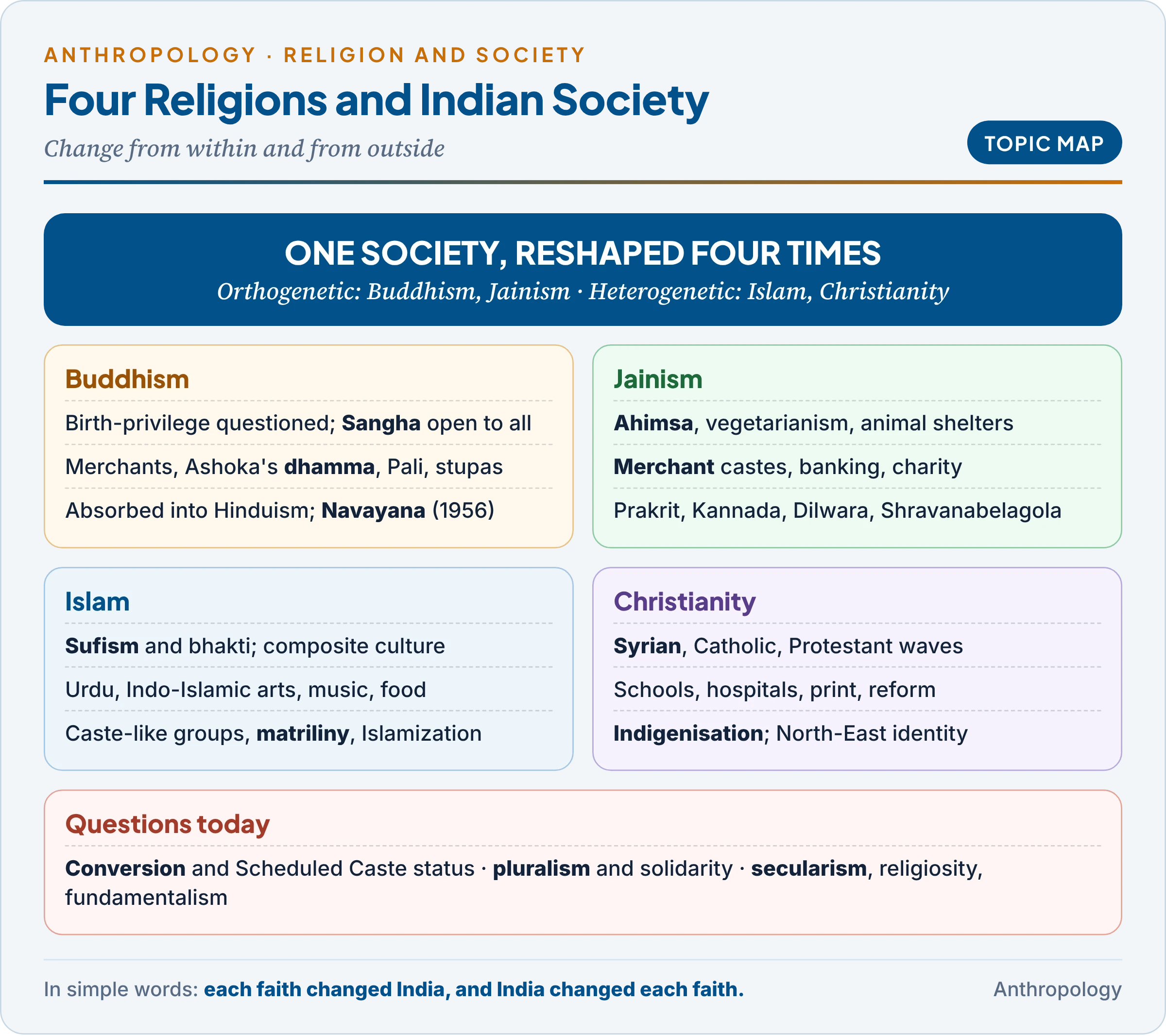
This article covers how four religions reshaped Indian society. The Hindu textual model they challenged (varna, karma) is in 3.1; caste among Muslims and Christians is treated in 3.2a (§7) and only summarised here; the present status of religious minorities is in 5.2; the impact of religions on tribes is in 8.1.
1. Studying Religious Impact Anthropologically
In simple words
When a new religion meets an old society, both change. People borrow beliefs and customs, mix them, react against them, or use the new faith to escape old inequalities. Anthropology studies these encounters through what actually happened in families, castes, villages and arts, not only through what the scriptures say.
- Two sources of change: the Indian sociologist Yogendra Singh (Modernization of Indian Tradition, 1973) distinguished orthogenetic change (arising from within a civilization) from heterogenetic change (arising from contact with another). Buddhism and Jainism were orthogenetic: protests from inside the Vedic world. Islam and Christianity were heterogenetic: they arrived with traders, rulers and missionaries.
- Processes to watch:
- Syncretism: blending of elements from two traditions (a Hindu offering a chadar at a Sufi shrine);
- Indianisation or indigenisation: a foreign faith taking local forms (caste-like groups among Christians, Indian music in church);
- Reaction and reform: the older tradition reforming itself under challenge (Hindu bhakti and later reform movements);
- Conversion as protest: low-ranked groups changing religion to escape stigma, an alternative to Sanskritization (5.3a).
The table gives each religion’s place in Indian society at a glance.
| Religion | Origin or arrival | Main carriers | Census 2011 share |
|---|---|---|---|
| Buddhism | Magadha, c. 5th century BCE | Monks, merchants, kings (Ashoka) | 0.7% (84 lakh; about 77% in Maharashtra) |
| Jainism | Magadha, same period | Ascetics, merchant castes | 0.4% (45 lakh) |
| Islam | Malabar traders (7th–8th century); Sindh (712); Delhi Sultanate (1206) | Traders, Sufis, rulers | 14.2% (17.2 crore) |
| Christianity | Kerala tradition (1st century); Portuguese (1498 onward); Protestant missions (1706 onward) | Syrian Christians, missionaries | 2.3% (2.8 crore) |
The two indigenous religions are small today but shaped core Indian values such as non-violence and vegetarianism; the two religions from outside are larger and shaped language, arts, education and law.
2. The Sramana Revolt: Why New Religions Arose
In simple words
Around 2,500 years ago, the Ganga valley saw new cities, money, trade and kingdoms. Many people grew dissatisfied with costly sacrifices and with the claims of Brahmin priests to be born superior. Wandering teachers, called sramanas, offered new paths to liberation through ethics and self-discipline. Buddhism and Jainism were the two that lasted.
- Dating: tradition places Mahavira (599–527 BCE) and the Buddha (563–483 BCE) in the 6th century BCE; many historians now place the Buddha’s death around 400 BCE. The movement belongs to the age of sixteen mahajanapadas (great kingdoms) and the second urbanisation of the Ganga plain.
- Sramana means “one who strives”: a wandering ascetic outside the Vedic household order. Buddhist texts speak of many rival teachers and views, including the Ajivikas (fatalists led by Makkhali Gosala) and materialists (Charvaka).
The table groups the causes historians and anthropologists give.
| Cause | What changed | Why it fed revolt |
|---|---|---|
| Economic | Iron tools, surplus rice farming, trade, coins, guilds | Cattle killed in sacrifice were needed for ploughing; rich merchants (setthis) had wealth but low ritual rank |
| Political | Kingdoms and republics (Magadha, Kosala, the Vajji league) | Kshatriyas resented Brahmin claims to supremacy; both founders were Kshatriyas |
| Social | Varna becoming rigid; Brahmin privilege in ritual and law | Shudras and women excluded from Vedic learning |
| Intellectual | Upanishadic questioning of ritual | Liberation sought through knowledge and conduct, not sacrifice |
The Indian historian Uma Chakravarti (The Social Dimensions of Early Buddhism, 1987) showed that early Buddhist texts address exactly these new groups: the householder (gahapati), the merchant and the king. The new religions answered the needs of an urban, commercial, state-building society that the sacrificial religion of cattle-keeping villages no longer served. This is why their ethics of thrift, non-violence and personal merit suited traders and kings alike.
3. Impact of Buddhism
In simple words
The Buddha taught that suffering comes from craving and can be ended by a moral, disciplined, meditative life, open to anyone regardless of birth. His followers built monasteries, universities and art that spread across Asia. Buddhism almost vanished from India by the 13th century, but much of it was absorbed into Hinduism, and it returned in the 20th century as a movement for Dalit dignity.
3.1 Teachings that mattered socially
- Four Noble Truths: life involves suffering (dukkha); its cause is craving; it can end (nirvana); the way is the Eightfold Path (right view, resolve, speech, action, livelihood, effort, mindfulness, concentration), grouped as morality (sila), concentration (samadhi) and wisdom (prajna).
- Middle Way between luxury and harsh austerity; anatta (no permanent self); karma as intention, not ritual; no creator god to be pleased by sacrifice.
- The Sangha, the order of monks and nuns, open to all, sustained by lay gifts (dana).
3.2 Social and economic impact
- Caste: in the Assalayana Sutta the Buddha mocks the Brahmin claim to pure birth (Brahmin women give birth like everyone else); in the Vasettha Sutta one is a Brahmin by deeds, not birth. Upali, a barber, became a leading monk and expert on monastic rules.
- Women: the order of nuns (bhikkhuni sangha), begun by Mahapajapati Gotami, gave women a recognised religious path outside marriage; the Therigatha preserves verses by early nuns. Yet the eight special rules (garudhammas) placed every nun below every monk.
- Economy: Buddhism valued thrift, honest trade and giving, and merchants were among its main patrons. Monasteries stood on trade routes; the rock-cut monasteries of the western Deccan carry donors’ inscriptions by merchants and artisans. This answers the 2017 question on economic transformation: the religion gave moral legitimacy to commerce and channelled surplus into public institutions.
- Ethics and the state: Ashoka (3rd century BCE), after the Kalinga war, preached dhamma: non-violence, care for animals, welfare works and respect for all sects. His Rock Edict XII asks people to honour other sects and restrain their speech, an early statement of religious tolerance as state policy.
Common confusion
Did Buddhism abolish caste? No. It denied that birth gave spiritual worth and admitted all castes to the Sangha, but it did not try to change caste among lay followers. Its texts often list the Kshatriya above the Brahmin, so they reordered the hierarchy rather than rejecting it, as Uma Chakravarti noted. The full anti-caste reading of Buddhism came much later, with Ambedkar (§7).
3.3 Cultural impact
- Language and literature: teaching in local speech rather than Sanskrit; the Pali canon (Tipitaka, Sanskrit Tripitaka: Vinaya, Sutta, Abhidhamma), the Jataka tales, Sanskrit works such as Ashvaghosha‘s Buddhacharita, and Nagarjuna‘s Madhyamaka philosophy. Pali was declared a classical language in October 2024.
- Education: monastic universities at Nalanda and Vikramashila drew students from across Asia.
- Art and architecture: the stupa (Sanchi, Bharhut, Amaravati), the chaitya hall and vihara cut in rock (Karle, Ajanta), Ajanta’s paintings, and the Buddha image, encouraged by Mahayana devotion under the Kushana king Kanishka, in the Gandhara (Greco-Roman style) and Mathura schools.
- Asia: monks and traders carried Buddhism to Sri Lanka, Tibet, China, Korea, Japan and South-East Asia, making India a giver of religion to half of Asia.
3.4 Influence on Hinduism and decline
- Absorption: Brahmanical religion took over non-violence, a turn to vegetarianism among upper castes, monastic orders (the mathas associated with Shankara are often compared to viharas) and even the Buddha as an avatar of Vishnu (as in Jayadeva’s 12th-century Gita Govinda).
- Correction of a common claim: older textbooks say that image worship and temples began with Buddhism. In fact images of yakshas and other deities were worshipped earlier, and Buddhist, Jain and Hindu images developed side by side in the Kushana period at Mathura. Buddhism gave the impulse, not the invention.
- Decline (by about 1200 CE): loss of royal patronage, the bhakti movements that met the same need for personal devotion, the Sangha’s distance from lay life, and the destruction of monasteries such as Nalanda during the Turkish conquest. Buddhism survived in the Himalaya (Ladakh, Sikkim, the Monpa of Arunachal) and returned in 1956 as Navayana (§7).
4. Impact of Jainism
In simple words
Jainism teaches that every living being has a soul and that harming any of them binds the soul with karma. Its followers therefore practise extreme non-violence, fasting and honesty. A small but prosperous merchant community, the Jains spread vegetarianism, charity and learning far beyond their numbers.
4.1 Basic tenets (2023 question)
- Tirthankaras: twenty-four “ford-makers” who show the way across the ocean of rebirth; Parshvanatha (23rd) is probably historical, and Mahavira (24th) gave the religion its present form.
- Soul and matter: the universe has living souls (jiva) and non-living substances (ajiva: matter, space, time, and the media of motion and rest). Karma is a subtle matter that sticks to the soul through passion and violence; liberation (kevala, moksha) is the soul freed of all karmic matter.
- Five great vows (mahavratas): non-violence (ahimsa), truth, non-stealing, non-possession, and celibacy, the fifth added by Mahavira to Parshva’s four. Lay people keep lighter versions (anuvratas).
- Three jewels (triratna): right faith, right knowledge, right conduct.
- Anekantavada (the many-sidedness of reality) and syadvada (“in some respect” statements): every claim is true only from a standpoint, a philosophy of intellectual tolerance.
- Sects: Digambara (“sky-clad”, monks naked, strong in Karnataka) and Svetambara (“white-clad”, strong in Gujarat and Rajasthan). Sallekhana, a vowed fast unto death at the end of life, is an accepted ideal.
4.2 Social and economic impact (2016 and 2018 questions)
- Non-violence and diet: Jain influence made vegetarianism a mark of status in Gujarat, Rajasthan and Karnataka. Animal shelters (panjrapoles) are a distinctively Jain institution. Mohandas Gandhi drew on Jain ethics through his Gujarati mentor Shrimad Rajchandra.
- Commerce: because farming and many crafts harm living beings, lay Jains concentrated in trade, money-lending and banking: merchant castes such as the Oswal and Porwal, and the Jagat Seths, the Oswal Jain bankers of 18th-century Bengal. Honesty in trade and the restraint of the vows supported credit and trust in merchant networks.
- Wealth and renunciation: the British anthropologist James Laidlaw (Riches and Renunciation, 1995) studied Jain merchants of Jaipur and showed how a community devoted to ascetic ideals also prized commercial success: lavish donations, temple building and public fasts turn wealth into religious merit and social standing.
- Caste: Jainism rejected the Vedas and the Brahmin’s claim to superiority, yet Jain communities are organised in endogamous castes and often marry within shared Hindu–Jain merchant castes: the faith softened but did not abolish caste.
- Charity and learning: rest houses, schools and hospitals, and great manuscript libraries (bhandars) at Patan and Jaisalmer that preserved Jain and non-Jain texts.
4.3 Cultural impact
- Language: Mahavira preached in Ardhamagadhi, and the Jain canon is in Prakrit; Jains wrote much of early Apabhramsa, early Kannada (the poets Pampa and Ranna) and Tamil classics (Jivaka Chintamani, Naladiyar); Hemachandra (12th century) wrote grammar, lexicons and history in Gujarat.
- Kings: Kharavela of Kalinga (Hathigumpha inscription) and the Chaulukya king Kumarapala, Hemachandra’s patron, who banned animal slaughter. In the 1580s the monk Hiravijaya Suri persuaded Akbar to forbid killing during the Jain holy days.
- Art: rock-cut caves at Udayagiri–Khandagiri (Odisha) and Ellora; the 57-foot monolith of Gommateshwara at Shravanabelagola (10th century); the marble temples of Dilwara (Mount Abu) and Ranakpur; temple cities at Palitana and Girnar.
- Survival: unlike Buddhism, Jainism survived in India because of its strong lay community, its close social ties with Hindu merchant castes and its accommodation of Hindu deities such as Lakshmi and Saraswati in worship. Jains were notified as a national minority in January 2014.
5. Impact of Islam
In simple words
Islam came to India through Arab traders, Sufi saints and Turkish and Mughal rulers. Over a thousand years it produced a shared Hindu–Muslim culture in language, music, food, dress and architecture, along with long-standing religious boundaries. Indian Muslims themselves became partly Indianised, with caste-like groups and, in some places, matrilineal families.
5.1 How Islam spread
- Routes: Arab traders settled on the Malabar coast (ancestors of the Mappilas); Muhammad bin Qasim took Sindh in 712; the Delhi Sultanate began in 1206 and the Mughal empire in 1526.
- Theories of conversion: the American historian Richard Eaton (The Rise of Islam and the Bengal Frontier, 1204–1760, 1993) tested four popular theories and found each weak:
- Immigration cannot explain mass Muslim populations of peasants;
- “Religion of the sword”: Muslims were fewest near the old centres of Muslim power (Delhi, the Ganga plain);
- Patronage: explains elite converts only;
- “Social liberation” from caste: Muslims were most numerous in East Bengal and West Punjab, where Brahmanical caste had been weakest.
- Eaton’s alternative: in East Bengal Islam spread with the agrarian frontier. Sufi-led settlers cleared forest for rice, and local peoples adopted Islam gradually: first by including Allah and saints among local deities, then identifying them with local gods, and finally displacing the older gods. Conversion was a slow cultural process, not a single event.
5.2 Sufism (2013 question)
- Sufism is the mystical path of Islam, seeking direct love of God under a spiritual master (pir or shaikh) whom a disciple (murid) follows.
- Orders (silsilas): the Chishti (Moinuddin Chishti of Ajmer, d. 1236; Nizamuddin Auliya of Delhi, d. 1325), who kept away from courts and used music; the Suhrawardi (Multan), close to rulers; the Qadiri; and the Naqshbandi, who stressed orthodoxy (Ahmad Sirhindi).
- Practices: the khanqah (hospice), the langar (common kitchen), sama (devotional music, the root of qawwali), and the dargah, the saint’s tomb, with its annual urs.
- Social impact: dargahs became shared sacred spaces: Hindus and Sikhs pray and offer at Ajmer and Nizamuddin. The Pew survey of 2019–20 found that in north India 37% of Muslims and 12% of Hindus identify with Sufism. Sufis also used Hindavi verse and Indian musical forms, making them a channel of syncretism.
5.3 Composite culture (2014 question)
The Indian historian Tara Chand (Influence of Islam on Indian Culture, 1936) argued that a composite culture grew from the meeting of the two traditions. The table shows its main fields.
| Field | Impact |
|---|---|
| Religion | Bhakti–Sufi convergence: Kabir, Nanak and Dadu rejected ritual and caste and stressed one formless God; Akbar’s sulh-i-kul (“peace with all”) and debates at the Ibadat Khana; Dara Shikoh compared Sufism and Vedanta (Majma-ul-Bahrain) and translated the Upanishads into Persian (Sirr-i-Akbar, 1657) |
| Language | Persian as the language of administration; Hindustani/Urdu from the mixing of Persian, Arabic, Turkish and Khari Boli; thousands of loanwords in Indian languages; Amir Khusrau‘s Hindavi verse |
| Architecture | The true arch, dome and minaret joined Indian craftsmanship in Indo-Islamic buildings (Qutb Minar, Taj Mahal); Rajput palaces borrowed Mughal forms |
| Music | Khayal and qawwali; the separation of Hindustani from Carnatic music; instruments such as the sitar developed (their attribution to Amir Khusrau is legend) |
| Painting | Mughal miniatures joined Persian technique and Indian subjects (the Razmnama, a Persian Mahabharata); Rajput and Pahari schools followed |
| Daily life | Dress (sherwani, salwar), cuisine (biryani, kebabs), the charbagh garden, new crafts and urban workshops (karkhanas) |
The phrase Ganga-Jamuni tehzeeb (“the culture of the Ganga and Yamuna”) names this blend in north India. Its limit is that synthesis was strongest in courts, cities and shrines; marriage, diet and worship largely kept communities distinct.
5.4 Impact on society
- Hindu reaction: orthodox scholars wrote new digests of the Smritis (nibandhas) that tightened rules on diet, marriage and purity, while bhakti saints pointed in the opposite, egalitarian direction.
- Correction of a common claim: older textbooks blame Muslim rule for purdah, child marriage, sati and female infanticide. All four are older than Islam in India (sati is recorded in a Gupta-period inscription of 510 CE at Eran, and early marriage of girls is prescribed in the Dharmashastras). At most, insecurity and courtly fashion intensified seclusion of women among some north Indian upper castes.
- Caste among Muslims: Indian Muslims developed ranked, largely endogamous groups, commonly described as Ashraf (claiming foreign descent: Sayyid, Shaikh, Mughal, Pathan), Ajlaf (occupational castes) and Arzal (groups treated as polluting); the Pasmanda movement mobilises the lower two (detail in 3.2a, §7).
- Islamization: the Indian sociologist Imtiaz Ahmad (Ritual and Religion among Muslims in India, 1981) showed that Indian Muslims combine formal Islam with local customs (life-cycle rites, saint veneration). Reform movements such as Deoband (1866) and the Tablighi Jamaat (1926) work to purge such customs, a process called Islamization, the Muslim parallel to Sanskritization.
- Economy: the Sultanate and Mughal periods saw growth of towns, crafts and long-distance trade; the Indian historian Irfan Habib linked the spread of paper and the spinning wheel to this period. Land revenue was collected through Hindu intermediaries, and Hindu bankers and merchants kept their place.
5.5 Islam and matriliny (2015 question)
- Lakshadweep: the Indian anthropologist Leela Dube (Matriliny and Islam: Religion and Society in the Laccadives, 1969) found devout Muslims living in matrilineal joint households (taravad), where property and membership pass through women and a husband often visits his wife’s house. Islamic law governed self-acquired property, matrilineal custom the ancestral property: the two systems coexisted by dividing the field.
- North Kerala: many Mappila families of Kannur followed matriliny; the Arakkal house, Kerala’s only Muslim royal family, passed rule to the senior member, male or female.
- Why it matters: these cases show that religion did not erase kinship systems rooted in the local society (shared with the Nair and other matrilineal groups of the coast). The Minangkabau of Sumatra, matrilineal and Muslim, are a parallel outside India.
6. Impact of Christianity
In simple words
Christianity reached Kerala very early, came again with the Portuguese, and spread widely through British-era missions. It brought schools, hospitals, printing, women’s education and new ideas of equality, and it attracted many Dalits and tribal peoples. In turn, Indian Christianity took on Indian forms, including caste divisions.
6.1 Three waves
| Wave | Period | Where and who | Key features |
|---|---|---|---|
| Syrian (St Thomas) Christians | Tradition: 1st century; documented from early medieval copper plates | Kerala | East Syriac liturgy; high status; Portuguese Synod of Diamper (1599) imposed Latin forms; the Coonan Cross Oath (1653) split the community |
| Catholic missions | 16th century onward | Goa, the coasts | Francis Xavier (1542); mass conversion of the Parava fishers (1530s); Goa Inquisition (1560–1812); Roberto de Nobili in Madurai (1606) |
| Protestant missions | 18th–20th centuries | South India, Bengal, Punjab, Chota Nagpur, North-East | Ziegenbalg at Tranquebar (1706); the Serampore mission (1800); Charter Act, 1813 opened British India to missionaries; mass movements of Dalits and tribes |
6.2 Syro-Malabar Christians (2024 question)
- Who: the largest group of Kerala’s St Thomas Christians, an Eastern Catholic church in communion with Rome but with its own law and East Syriac liturgy, the Holy Qurbana. It became a major archiepiscopal church in 1992 and claims more than 50 lakh faithful; Mar Raphael Thattil was elected its head in January 2024.
- Social profile: Syrian Christians traditionally held high status in Kerala’s caste order, owned land, traded in spices and kept endogamy, with origin stories of conversion from high castes. They kept apart from later Dalit converts (from Pulaya and Paraya castes).
- Indian idioms: their rites use local forms such as the minnu (wedding pendant, like the Hindu tali) and the brass oil lamp; the Indian anthropologist Susan Visvanathan (The Christians of Kerala, 1993) described this blend among the Yakoba (Jacobite) Syrian Christians.
- Today: a long dispute over how the Holy Qurbana is celebrated (the priest facing the altar or the people) has divided the Ernakulam–Angamaly archdiocese.
6.3 Social impact
- Education: mission schools and colleges, and the first systematic schooling of girls and Dalits; Christian institutions remain a large share of India’s schools and hospitals.
- Health: mission hospitals such as Christian Medical College, Vellore (begun by Ida Scudder in 1900).
- Print and languages: the Serampore press printed Bible translations in many Indian languages; Robert Caldwell‘s Comparative Grammar of the Dravidian Languages (1856) founded Dravidian linguistics; missionaries wrote the first grammars and Roman-script alphabets for Khasi, Mizo and other tribal languages.
- Social reform and protest: missionaries campaigned with Indian reformers against sati (abolished 1829) and supported the Nadar (Channar) women of Travancore in their struggle for the right to cover the breast (1813–1859).
- Dalit mass movements: from the late 19th century whole groups such as the Chuhra of Punjab and the Mala and Madiga of Andhra joined churches; the American missionary J. Waskom Pickett studied them in Christian Mass Movements in India (1933).
- Reaction: missions provoked Hindu reform (the Brahmo Samaj answered Christian criticism; the Arya Samaj began shuddhi, reconversion), the beginning of today’s conversion politics.
6.4 Indigenisation of Christianity (2022 question)
- Meaning: indigenisation or inculturation is the expression of Christian faith through local culture: language, music, dress, architecture and ritual forms.
- From above:
- Roberto de Nobili lived as a Brahmin sannyasi, kept vegetarian, wore the sacred thread and taught in Sanskrit and Tamil;
- Constanzo Beschi (Veeramamunivar) wrote Tamil Christian epic poetry;
- the Christian ashram movement (Shantivanam, founded 1950 by Jules Monchanin and Henri Le Saux, later led by Bede Griffiths) adopted saffron, meditation and Sanskrit chants;
- after the Second Vatican Council, Catholic liturgy in India allowed Indian gestures, arati and lamps.
- From below: popular pilgrimage at Velankanni (Tamil Nadu), where Christians and Hindus offer tonsure and vows to “Our Lady of Good Health”. The British anthropologist David Mosse (The Saint in the Banyan Tree, 2012) showed in a Tamil village how Catholic saints entered the caste order of honours: festival roles and precedence followed caste, so Christianity became part of local caste society.
- Critique: Dalit theology (A.P. Nirmal, 1980s) and tribal theology argue that Brahmanical inculturation imitates the high-caste culture that oppressed them; they seek indigenisation from Dalit and Adivasi experience. Hindu critics, on the other side, see inculturation as a conversion strategy. Indigenisation thus shows Christianity becoming Indian, and caste following it in.
6.5 Christianity in North-East India (2025 question)
- Why so fast? The hill peoples had no Brahmanical caste order to hold them; the British kept the hills as excluded areas where missions were often the only schools and clinics; and a new faith offered a written identity distinct from the Hindu and Muslim plains.
- Scale (2011): Christians form about 88% of Nagaland, 87% of Mizoram, 75% of Meghalaya, 41% of Manipur and 30% of Arunachal Pradesh.
- Missions: the Welsh Presbyterian Thomas Jones in the Khasi Hills (1841, with a Roman alphabet for Khasi); American Baptist E.W. Clark among the Ao Nagas (1872); J.H. Lorrain and F.W. Savidge among the Mizo (1894).
- Impacts: high literacy (Mizoram 91% in 2011), written languages, the end of head-hunting and inter-village feuds, decline of the youth dormitory (the Naga morung), the church as civil society (the Young Mizo Association, 1935) and as a marker of ethnic identity; some states adopted prohibition. Losses included festivals, songs and crafts tied to the old religion, and revival movements answered (Seng Khasi, 1899; the Heraka movement of Rani Gaidinliu). Detailed treatment of religion and tribes is in 8.1.
7. Conversion and the Emancipation of Scheduled Castes
In simple words
For people treated as untouchable, changing religion was a way to say “we refuse this rank”. Many Dalits joined Buddhism, Christianity, Islam or Sikhism, and gained dignity, schooling and confidence. But caste often followed them into the new faith, and Indian law withdrew Scheduled Caste benefits from Dalit Christians and Muslims.
- Ambedkar’s path:
- after leading the Mahad satyagraha (1927) for Dalit access to a public water tank, B.R. Ambedkar declared at Yeola (13 October 1935) that though born a Hindu he would not die a Hindu;
- in Annihilation of Caste (1936) he argued that caste rested on the religious authority of the shastras, so reform within Hinduism could not end it;
- on 14 October 1956 at Nagpur (Deekshabhoomi) he and several lakh followers, mostly Mahars, embraced Buddhism with 22 vows rejecting Hindu deities, Brahmin priests and caste;
- his The Buddha and His Dhamma (1957) recast Buddhism as social ethics: liberty, equality and fraternity. It is called Navayana (“new vehicle”).
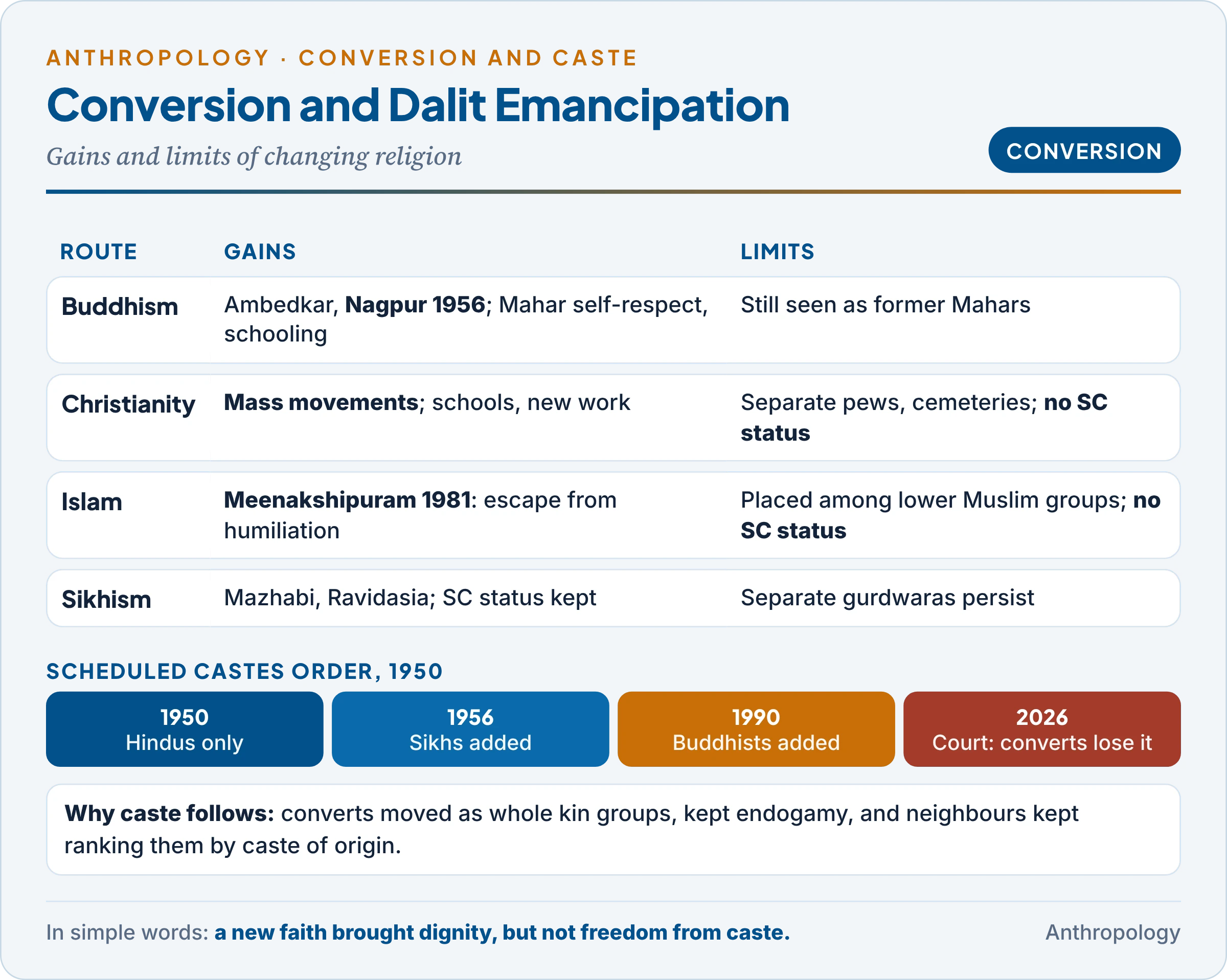
The table compares the main routes of conversion.
| Route | Main groups | Gains | Limits |
|---|---|---|---|
| Buddhism | Mahars of Maharashtra (about 77% of India’s Buddhists live there) | Self-respect, education, political assertion (Dalit Panthers, 1972) | Still identified as former Mahars; little spread beyond them |
| Christianity | Chuhras, Malas, Madigas, Nadars, Pulayas | Schools, hospitals, new occupations | Separate seating and cemeteries in some churches; loss of SC status |
| Islam | Pallars of Meenakshipuram (Tamil Nadu, 1981) and earlier groups | Escape from local humiliation | Placed among lower Muslim groups; no SC status |
| Sikhism | Mazhabi, Ramdasia, Ravidasia | SC status retained (since 1956) | Separate gurdwaras; the Ravidassia sect declared a separate religion in 2010 |
- The law: clause 3 of the Constitution (Scheduled Castes) Order, 1950 limits SC status to Hindus, with Sikhs added in 1956 and Buddhists in 1990. The Ranganath Misra Commission (2007) recommended delinking SC status from religion; in Chinthada Anand v. State of Andhra Pradesh (March 2026) the Supreme Court held that a Dalit who becomes a Christian loses SC status from the moment of conversion.
- Why caste follows converts: people converted as whole kin groups, kept endogamy and occupations, and neighbours went on ranking them by caste of origin; the new faith changed belief faster than it changed social relations.
- Assessment: conversion gave dignity and education and broke the religious justification of untouchability, but it did not dissolve caste as a social fact, because converts kept their kin networks and neighbours kept ranking them. The Indian sociologist Gail Omvedt (Buddhism in India: Challenging Brahmanism and Caste, 2003) read Navayana as the continuation of an old Indian anti-caste tradition.
8. Pluralism, Secularism and Religiosity
In simple words
India has many religions living side by side. Sometimes they share saints, festivals and markets; sometimes they keep apart or clash. Words such as pluralism, secularism, religiosity, fundamentalism and spirituality describe different ways in which people and states relate to religion.
8.1 Religious pluralism and social solidarity (2023 question)
- Diversity is a fact; pluralism is a relationship. The American scholar Diana Eck describes pluralism as active engagement with diversity, more than mere tolerance.
- Durkheim’s paradox: religion creates solidarity within a moral community, so it can also separate communities from each other.
- What holds plural India together:
- Shared sacred sites (the Ajmer dargah, Velankanni), though the American anthropologist Robert Hayden (“Antagonistic Tolerance”, 2002) warned that shared shrines can turn into contested ones when power shifts;
- Everyday economic and civic ties: the political scientist Ashutosh Varshney (Ethnic Conflict and Civic Life, 2002) found that cities with inter-communal business and civic associations avoided riots that struck cities where Hindus and Muslims lived apart;
- Living together separately: the Pew survey (2019–20, published 2021) found that 84% of Indians think respecting all religions is very important to being “truly Indian”, while large majorities want to stop inter-religious marriage.
8.2 Secularism, religiosity, fundamentalism and spiritualism (2024 question)
The table separates four terms that are often confused.
| Term | Meaning | Indian illustration |
|---|---|---|
| Secularism | The state’s relation to religion: in the West, separation; in India, equal respect and “principled distance” (Rajeev Bhargava) | “Secular” added to the Preamble (42nd Amendment, 1976); part of the basic structure (S.R. Bommai, 1994) |
| Religiosity | How intensely a person believes and practises; Glock and Stark (1965) measured belief, practice, experience, knowledge and consequences | Pew: religion “very important” to 84% of Hindus and 91% of Muslims |
| Fundamentalism | Return to the literal “fundamentals” of a faith, sharp boundaries and rejection of modern pluralism (the term comes from American Protestant pamphlets, The Fundamentals, 1910–15) | Revivalist and communal movements in several religions |
| Spiritualism | A personal search for the transcendent, often outside institutions (“spiritual but not religious”); in older usage, contact with spirits of the dead | Guru movements, yoga and Vipassana meditation centres |
The Indian anthropologist T.N. Madan (“Secularism in Its Place”, 1987) argued that in a society where most people are deeply religious, a privatised Western secularism cannot take root; secularism must come from the tolerance within religious traditions themselves.
Common confusion
Is Indian secularism the same as Western secularism? No. Western secularism (as in France) separates state and religion and keeps religion private. Indian secularism lets the state engage with all religions equally: it funds minority institutions, regulates temple administration and reforms personal law, while not having an official religion. Its test is equal respect and non-discrimination, not distance alone.
Key Terms
| Term | Meaning in simple words |
|---|---|
| Orthogenetic / heterogenetic change | Change arising from within a civilization / from contact with another |
| Sramana | A wandering ascetic outside the Vedic order |
| Sangha | The Buddhist order of monks and nuns |
| Anatta | The Buddhist teaching that there is no permanent self |
| Tirthankara | A Jain “ford-maker” who shows the way to liberation |
| Anekantavada | The Jain view that reality has many sides |
| Sallekhana | A Jain vow of fasting unto death at the end of life |
| Silsila | A Sufi order passed from master to disciple |
| Dargah / urs | A Sufi saint’s tomb / its death-anniversary festival |
| Composite culture | The shared culture formed by Hindu–Muslim interaction |
| Islamization | Reform that removes local customs to follow formal Islam |
| Ashraf / Ajlaf / Arzal | Higher, middle and lowest ranked groups among Indian Muslims |
| Pasmanda | “Those left behind”: backward and Dalit Muslims |
| Syro-Malabar | Kerala’s Eastern Catholic church of St Thomas Christians |
| Inculturation | Expressing Christian faith through local culture |
| Navayana | Ambedkar’s reinterpretation of Buddhism as social ethics |
| Principled distance | The Indian state’s flexible, equal treatment of religions |
| Religiosity | How intensely a person believes and practises |
Contemporary Developments
- Dalit converts and SC status: in Chinthada Anand v. State of Andhra Pradesh (24 March 2026) the Supreme Court held the religion clause of the 1950 Order “absolute”; the Balakrishnan Commission (set up 6 October 2022) had prepared its report by June 2026 after three extensions, and petitions on Dalit Christians and Muslims remain pending.
- Buddhist heritage: Pali and Prakrit were declared classical languages (3 October 2024); the new Nalanda University campus at Rajgir was inaugurated on 19 June 2024.
- Syro-Malabar Church: Mar Raphael Thattil became Major Archbishop (9 January 2024) amid the dispute over the uniform celebration of the Holy Qurbana.
- Living together separately: Pew’s 30,000-person survey (2021) recorded high personal religiosity, shared beliefs across faiths (77% of both Hindus and Muslims believe in karma) and strong preference for marrying within one’s religion.
Diagrams to Master
- Topic map: four religions × domains (caste, gender, economy, language, arts, reform); orthogenetic vs heterogenetic.
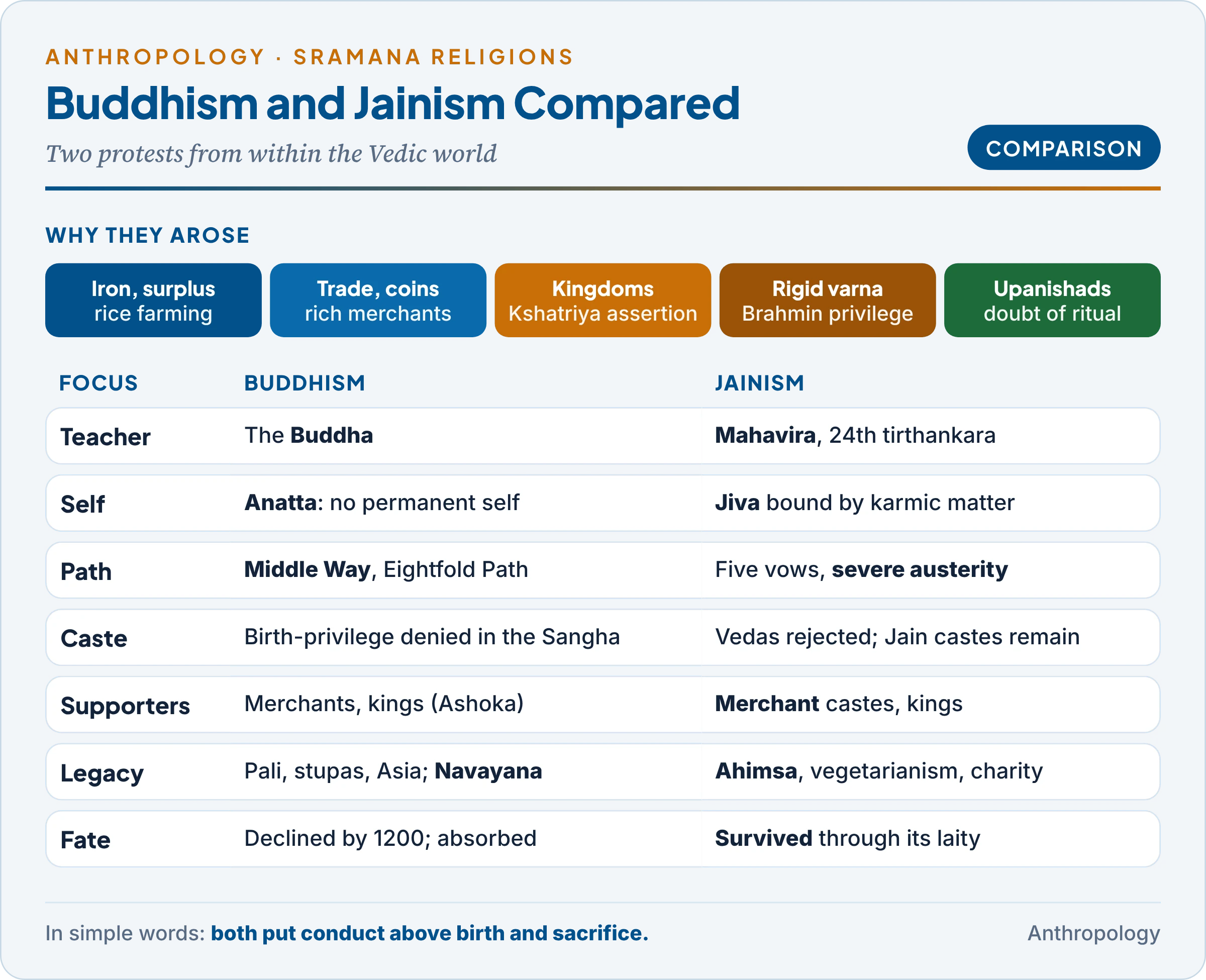
- Buddhism and Jainism compared: causes of revolt; tenets side by side; social impact on caste, women, diet, trade.
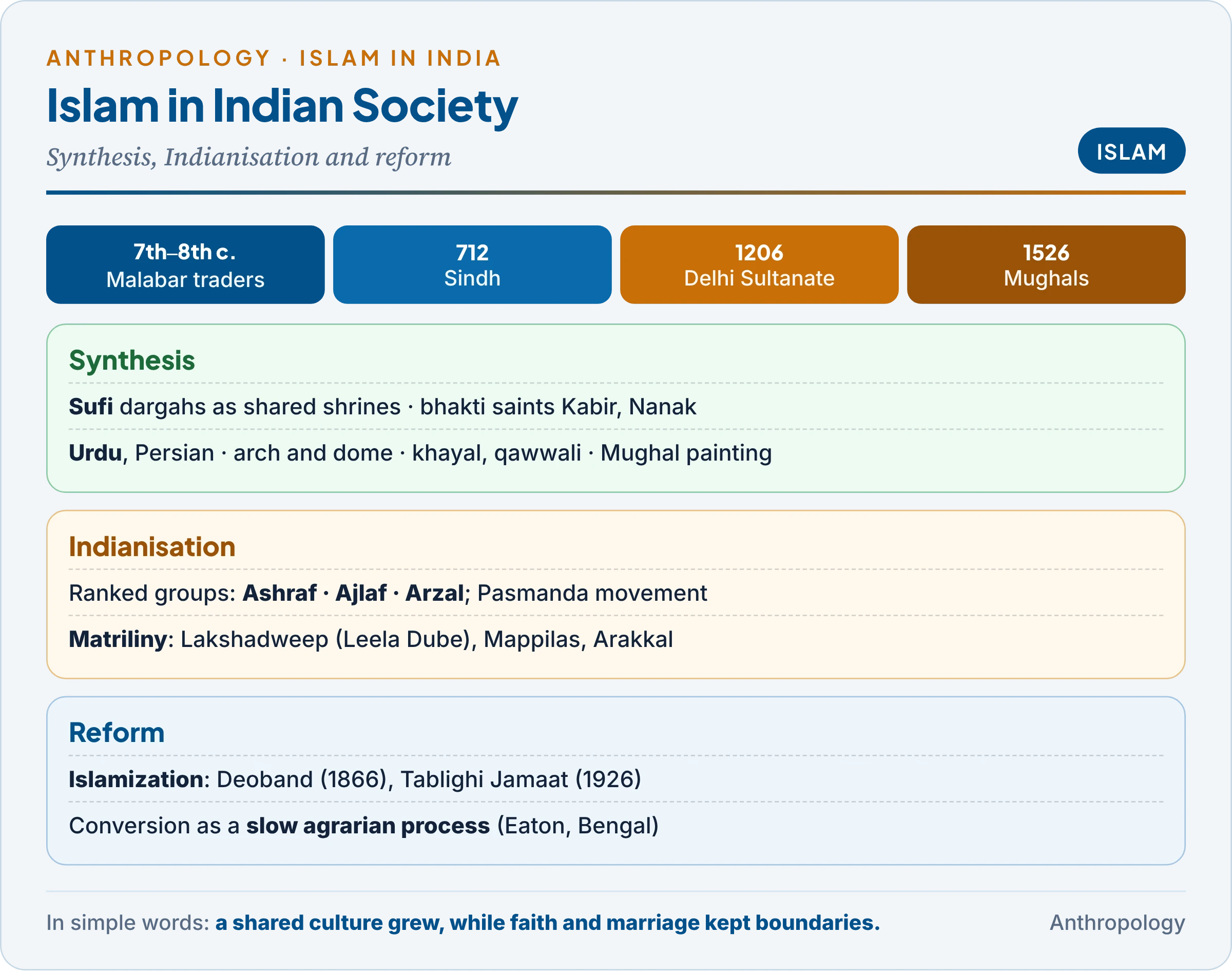
- Islam in India: three panels: synthesis (Sufi–Bhakti, Urdu, Indo-Islamic arts), Indianisation (caste-like groups, matriliny), reform (Islamization).
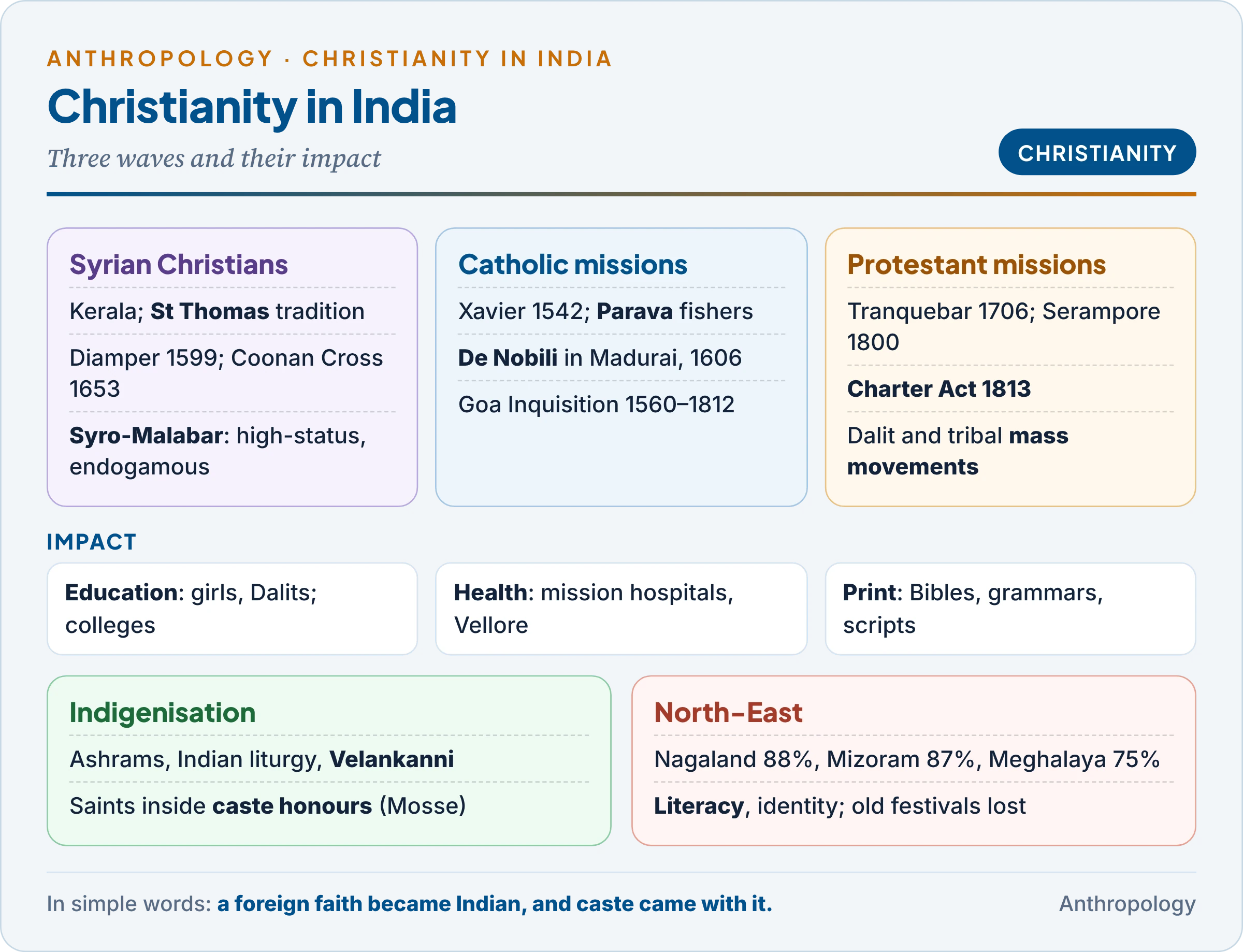
- Christianity: three waves with dates; impact arrows to education, health, print, reform; indigenisation from above and below; North-East.
- Conversion grid: four religions × gains and limits; the 1950 Order with 1956 and 1990 amendments.
Revision Grid
| Scholar | Work (year) | Key idea |
|---|---|---|
| Tara Chand | Influence of Islam on Indian Culture (1936) | Composite Hindu–Muslim culture |
| J. Waskom Pickett | Christian Mass Movements in India (1933) | Group conversion of Dalits |
| Leela Dube | Matriliny and Islam (1969) | Matriliny and Islamic law coexist in Lakshadweep |
| Yogendra Singh | Modernization of Indian Tradition (1973) | Orthogenetic and heterogenetic change |
| Imtiaz Ahmad | Ritual and Religion among Muslims in India (1981) | Syncretic practice; Islamization |
| Uma Chakravarti | The Social Dimensions of Early Buddhism (1987) | Buddhism and the new urban society |
| T.N. Madan | “Secularism in Its Place” (1987) | Limits of Western secularism in India |
| Richard Eaton | The Rise of Islam and the Bengal Frontier (1993) | Gradual, agrarian conversion |
| Susan Visvanathan | The Christians of Kerala (1993) | Syrian Christian ritual in local idiom |
| James Laidlaw | Riches and Renunciation (1995) | Jain merchants: wealth and asceticism |
| Ashutosh Varshney | Ethnic Conflict and Civic Life (2002) | Civic ties prevent riots |
| Gail Omvedt | Buddhism in India (2003) | Buddhism as anti-caste tradition |
| David Mosse | The Saint in the Banyan Tree (2012) | Catholicism inside caste society |
| B.R. Ambedkar | Annihilation of Caste (1936); The Buddha and His Dhamma (1957) | Conversion as escape from caste |
Previous Year Questions
3.4 Impact of Buddhism, Jainism, Islam and Christianity on Indian society.
- 2025Evaluate the impact of Christianity on Scheduled Tribe societies of North-East India.
- 2024Write notes on: Syro-Malabar Christians.
- 2024Elucidate the difference between secularism, religiosity, religious fundamentalism, and spiritualism from an anthropological perspective.
- 2023Discuss the basic tenets of Jainism and its impact on Indian society.
- 2023Write notes on: Religious pluralism and social solidarity.
- 2022Critically examine ‘Indigenisation of Christianity’ in India.
- 2020Discuss the impact of Islam on Indian Society.
- 2019What has been the impact of non-Hindu religions on the emancipation of Schedule Castes in India ?
- 2018Explain the impact of Buddhism and Jainism on Indian society.
- 2017Explain how Buddhism influenced the economic and cultural transformations of Indian society.
- 2016Write a note in 150 words on Impact of Jainism on Indian society.
- 2015Write a note in 150 words on Islam and Matriliny.
- 2014Discuss the contribution of Islam to the composite culture of India.
- 2013Write a note in 150 words on Sufi tradition of Islam.
- 2005Write a note on Impact of Islam on Indian society.
- 2004Write a note on Buddhism, Christianity and Scheduled Castes.
- 2003Evaluate the impact of Buddhism, Jainism, Islam and Christianity on Indian society and culture in anthropological terms.
- 1998Account for the emergence of new religions in India in the 6th century B.C.
Related questions from other units
- 2026Unit 8.1: Discuss the impact of Christianity on the tribal population of Jharkhand.
- 2026Unit 8.1: Write notes on: Buddhist tribes of India.
- 2022Unit 3.1: Write notes on: Varna and Buddhism.
- 2019Unit 8.1: Describe the impact of Buddhism on the tribal populations of India.
- 2019Unit 9.3: Write a note in 150 words on Anthropological understanding of communalism.
- 2017Unit 5.2: Discuss the social, political and economic status of Muslims in India.
- 2016Unit 8.1: Discuss the impact of Islam on scheduled tribes of India.
- 2015Unit 5.2: Critically examine the concept of communalism and its relevance for multi-religious and multiethnic polity of India.
- 2012Unit 5.2: Critically examine the prevalence of caste ideology among religious minorities in the Indian context.
- 2009Unit 8.1: Analyse the impact of Christianity on tribal communities with special reference to North East India.
More from Indian Social System and Caste: all notes of this unit · every PYQ of this unit · Anthropology Optional hub