

Anthropology Optional › Paper II › Unit 03: Indian Social System and Caste
3.2 Caste system in India- structure and characteristics, Varna and caste, Theories of origin of caste system, Dominant caste, Caste mobility, Future of caste system, Jajmani system, Tribe caste continuum.
Official Syllabus: Paper II, Unit 3.2
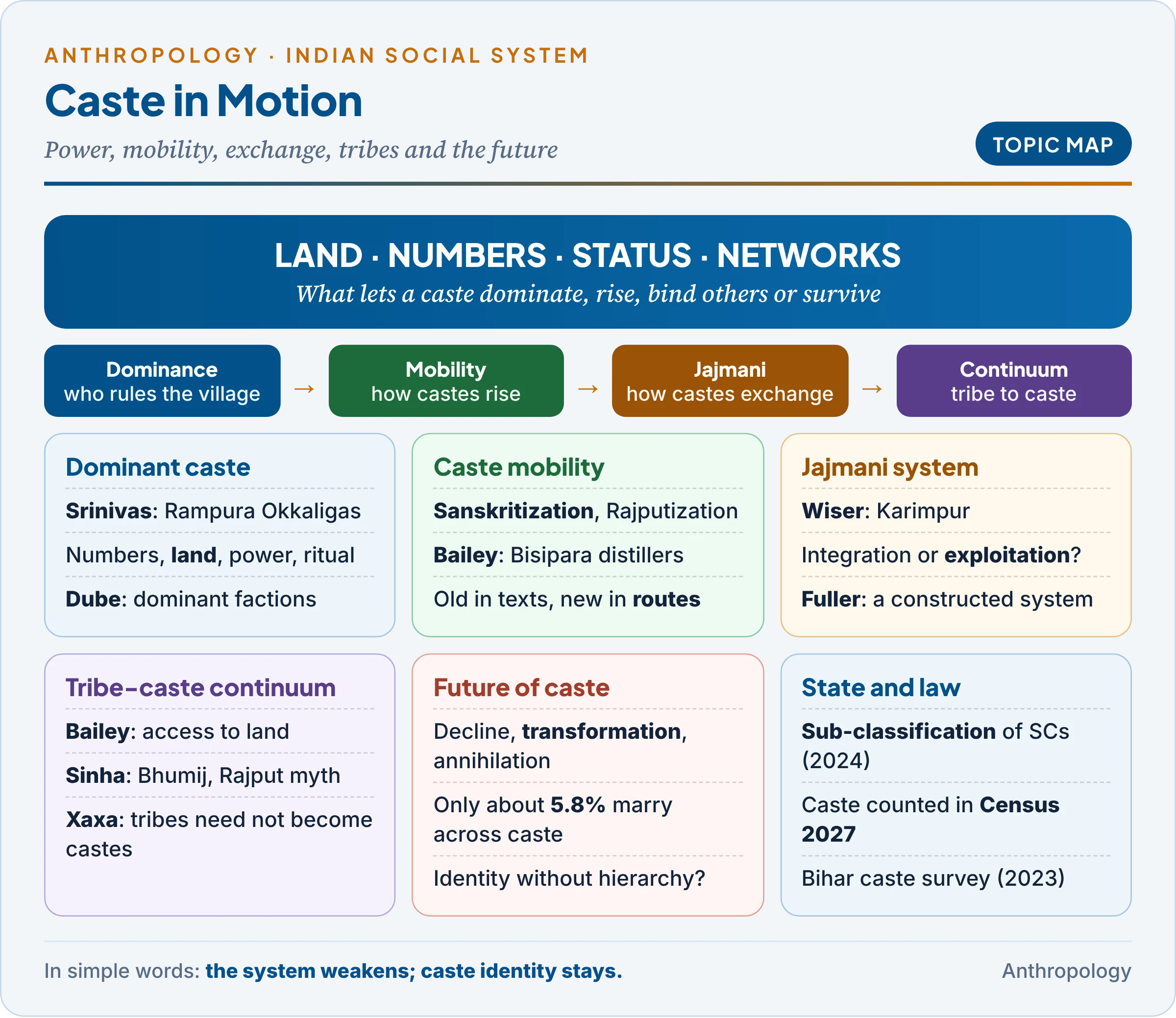
This article covers the second part of the syllabus line: how caste works as power in the village (dominant caste), how castes move (mobility), how they were tied together economically (jajmani), how tribes shade into castes (the continuum), and where caste is heading. The structure of caste, varna and jati, Dumont and the theories of origin are in 3.2a. Sanskritization, Westernization and Modernization as processes of change are treated fully in 5.3a; here they appear only as routes of caste mobility.
1. Dominant Caste
In simple words
In most villages one caste holds the land, the votes and the power to settle quarrels. Often it is not the Brahmin caste but a large peasant caste. Anthropologists call it the dominant caste, and it shapes how everyone else in the village lives and how they try to rise.
1.1 Rampura: the example
M.N. Srinivas, the Indian anthropologist who did fieldwork in Rampura near Mysore in 1948 and 1952, found that the village was run not by its few Brahmins but by the Okkaligas (Vokkaligas), a large peasant caste that owned most of the land. Okkaliga elders settled disputes, Okkaliga patrons had the largest followings, and lower castes copied Okkaliga ways. Srinivas first described this in “The Social System of a Mysore Village” (1955) and gave the concept its full form in “The Dominant Caste in Rampura” (American Anthropologist, 1959).
1.2 Srinivas’s definition and criteria
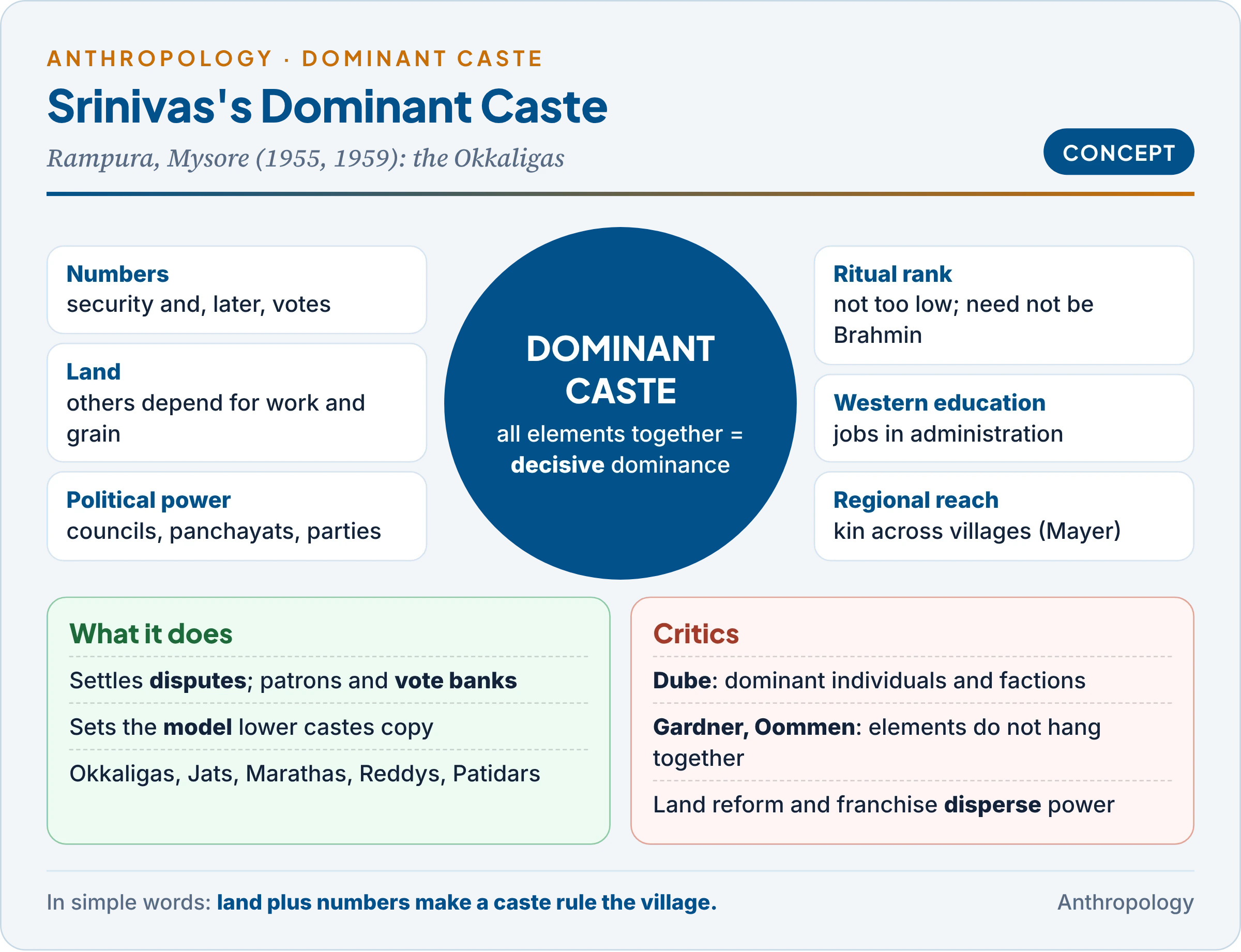
A caste is dominant, Srinivas wrote, when it preponderates numerically over other castes and also wields preponderant economic and political power, and it dominates most easily if its ritual rank is not too low. Later he added two modern elements.
- Numerical strength: numbers give security and, after universal franchise, votes.
- Economic power: above all ownership of cultivable land, which makes others dependent for work, credit and grain.
- Political power: control of the village and caste councils, and later of panchayats and party links.
- Ritual status: a caste need not be Brahmin, but a very low ritual rank blocks dominance.
- Western education and administrative jobs: educated members in government posts give access to officials and urban income.
Decisive dominance exists when one caste holds all these elements together. More often they are distributed: a ritually high caste may be poor and few, a populous caste may be poor and low. But each element tends to bring the others: a numerous, landed caste can buy education and, through Sanskritization, improve its ritual rank.
1.3 What the dominant caste does
- Settles disputes: village quarrels go upward from clients to patrons; elders of the dominant caste sit on the village council and judge cases even between other castes, applying each caste’s own customs.
- Provides patrons: members of the dominant caste have the largest patron-client followings; in elections these followings become what Srinivas called vote banks.
- Sets the model: lower castes imitate the dominant caste rather than distant Brahmins, so the model of Sanskritization may be Kshatriya, Vaishya or peasant, depending on who dominates locally.
- Regional dominance: Adrian Mayer, a British anthropologist, showed in Malwa (“The Dominant Caste in a Region of Central India”, 1958) that dominance often extends over a cluster of villages linked by kinship, so even a few families of the dominant caste in a village carry weight.
- Examples: Okkaligas and Lingayats (Karnataka), Reddys and Kammas (Andhra Pradesh and Telangana), Jats (Haryana and western Uttar Pradesh), Marathas (Maharashtra), Patidars (Gujarat), Vellalars (Tamil Nadu) and Rajputs or Thakurs in parts of the north.
Louis Dumont read the dominant caste as the local counterpart of the king: it holds the land and power that the royal function held at the level of the kingdom, while the Brahmin keeps ritual precedence.
1.4 Criticisms
- S.C. Dube, an Indian anthropologist who studied Shamirpet near Hyderabad (“Caste Dominance and Factionalism”, 1968), argued that castes are rarely united. Within a “dominant caste” a few rich individuals and factions hold power and exploit poorer caste-fellows too. One should speak of dominant individuals and factions, not a dominant caste, unless the caste acts together. Srinivas replied that the dominant individuals and factions draw their strength from belonging to the dominant caste.
- Peter Gardner (“Dominance in India: A Reappraisal”, 1968) and T.K. Oommen, an Indian sociologist (“The Concept of Dominant Caste: Some Queries”, 1970), questioned whether the elements of dominance hang together: numbers, land, ritual rank and political office often lie with different castes, and land reforms, adult franchise and new occupations have dispersed them further.
- Class within caste: land, not caste as such, is the root of power. Where a lower caste gains land (or the state redistributes it), dominance shifts.
The debate does not destroy the concept but qualifies it: dominance is held by landed sections of a caste, works through factions and patrons, and is regional rather than village-bound.
1.5 Dominant caste after reservations and democracy
- Panchayati Raj (73rd Amendment, 1992) reserved seats for SCs, STs and women, so a Dalit or woman can head a panchayat in a village dominated by Jats or Marathas. Dominance now works through proxy leaders and control of who contests.
- Clientelism: Siwan Anderson, Patrick Francois and Ashok Kotwal (American Economic Review, 2015) found that in Maharashtra villages where Marathas are the main landowners, landlords offer insurance in hard times to poor clients, who in return vote as the landlords wish; pro-poor schemes that would raise wages are blocked. Old patron-client dominance survives inside democratic institutions.
- The paradox of dominant castes seeking backwardness: dominant peasant castes have campaigned for OBC or SEBC status: the Jats (central OBC listing quashed by the Supreme Court in Ram Singh v. Union of India, 2015), the Patidars of Gujarat (2015 agitation) and the Marathas, whose 2018 quota the Supreme Court struck down in Jaishri Laxmanrao Patil (5 May 2021), calling them a “dominant forward class”; Maharashtra passed a new law giving them 10% in February 2024. The demands show that agrarian distress has made even landed castes feel insecure, and that numbers now convert into political pressure.
1.6 Factionalism and caste domination
Oscar Lewis, an American anthropologist (Group Dynamics in a North-Indian Village: A Study of Factions, 1954), found in Rampur near Delhi that the dominant Jats were split into rival factions, each built around kin groups and allied with dependent families of lower castes. Factions are vertical alliances across castes, led by members of the dominant caste.
- Why they matter: factions channel land disputes, panchayat elections and development benefits; a faction leader delivers votes and receives patronage.
- Caste and faction together: caste gives the boundary of the leaders’ group; faction gives the line of conflict inside it and the ties that cut across castes. The 2021 and 2025 questions on factionalism, caste domination and political power rest on this combination.
2. Caste Mobility
In simple words
Caste is supposed to be fixed by birth, yet whole castes have risen and fallen over centuries. A caste can change its customs, gain land or political power, form an association, convert, or use reservations. Usually the caste moves, not the individual.
2.1 An example: the Boad Distillers of Bisipara
F.G. Bailey, a British anthropologist (Caste and the Economic Frontier, 1957), studied Bisipara in the Kondmals of Odisha. A caste of distillers from Boad grew rich from the liquor trade under colonial excise rules, bought land from impoverished Warrior (landowning) families and then tried to raise its rank: it gave up practices considered low and adopted higher-caste customs. The village resisted at first, but wealth and land slowly brought acceptance. The untouchable Pans, by contrast, rose in income and education through government jobs and politics, yet were blocked when they tried to claim higher ritual status inside the village. Bailey’s lesson: economic change is the engine; ritual rank follows only if the village accepts it.
2.2 Is caste mobility recent? Indological and empirical evidence
The 2023 question asks whether caste mobility is new. The evidence says it is old.
- Indological evidence: the Chandogya Upanishad tells of Satyakama Jabala, of unknown father, accepted as a Brahmin student for his truthfulness; Vishvamitra, a Kshatriya, became a Brahmin sage. The historian K.M. Panikkar held that the Nandas were the last “true” Kshatriyas and that later Kshatriyas rose by seizing power. Many Rajput clans absorbed groups of Central Asian origin; Shivaji was crowned in 1674 after Brahmins certified a Kshatriya genealogy.
- Empirical evidence: Srinivas on the Coorgs (1952) and the Okkaligas; Bailey on the Distillers; Robert Hardgrave on the Nadars of Tamil Nadu (The Nadars of Tamilnad, 1969), toddy-tappers who rose through trade, education and the Nadar Mahajana Sangam (1910); O.M. Lynch on the Jatavs of Agra (The Politics of Untouchability, 1969), who moved from Sanskritization to Ambedkarite politics; Surajit Sinha on the Bhumij (§4).
- Census claims: when the 1901 Census under Risley ranked castes by precedence, petitions poured in from castes claiming higher varna status, evidence of an active market in rank.
The conclusion is that group mobility is an old feature of the caste system; what is new is its routes (education, democracy, reservation) and the fact that individuals can now rise without the whole caste.
2.3 Types of mobility
The 2025 question asks for the types. The table sets them out.
| Type | Meaning | Example |
|---|---|---|
| Group vs individual | A whole caste rises, or a person rises through education or a job | Nadars as a caste; a Dalit IAS officer |
| Upward vs downward | Rise in rank, or fall (loss of land, degrading work, outcasting) | Distillers rise; castes “fallen” in Manu’s vratya lists |
| Positional vs structural | A caste changes its place in the order, or the order itself changes | Sanskritization (positional) vs reservation and franchise (structural pressure) |
| Ritual vs secular | Rise in purity rank, or in wealth, power and education | Vegetarianism and sacred thread vs land and office |
| Intra- vs inter-generational | Change within one life, or between parents and children | First-generation graduates |
Srinivas stressed that Sanskritization produces only positional change: a caste moves up, but the hierarchy remains. Mobility through law, education and democracy puts pressure on the structure itself.
2.4 Routes of mobility
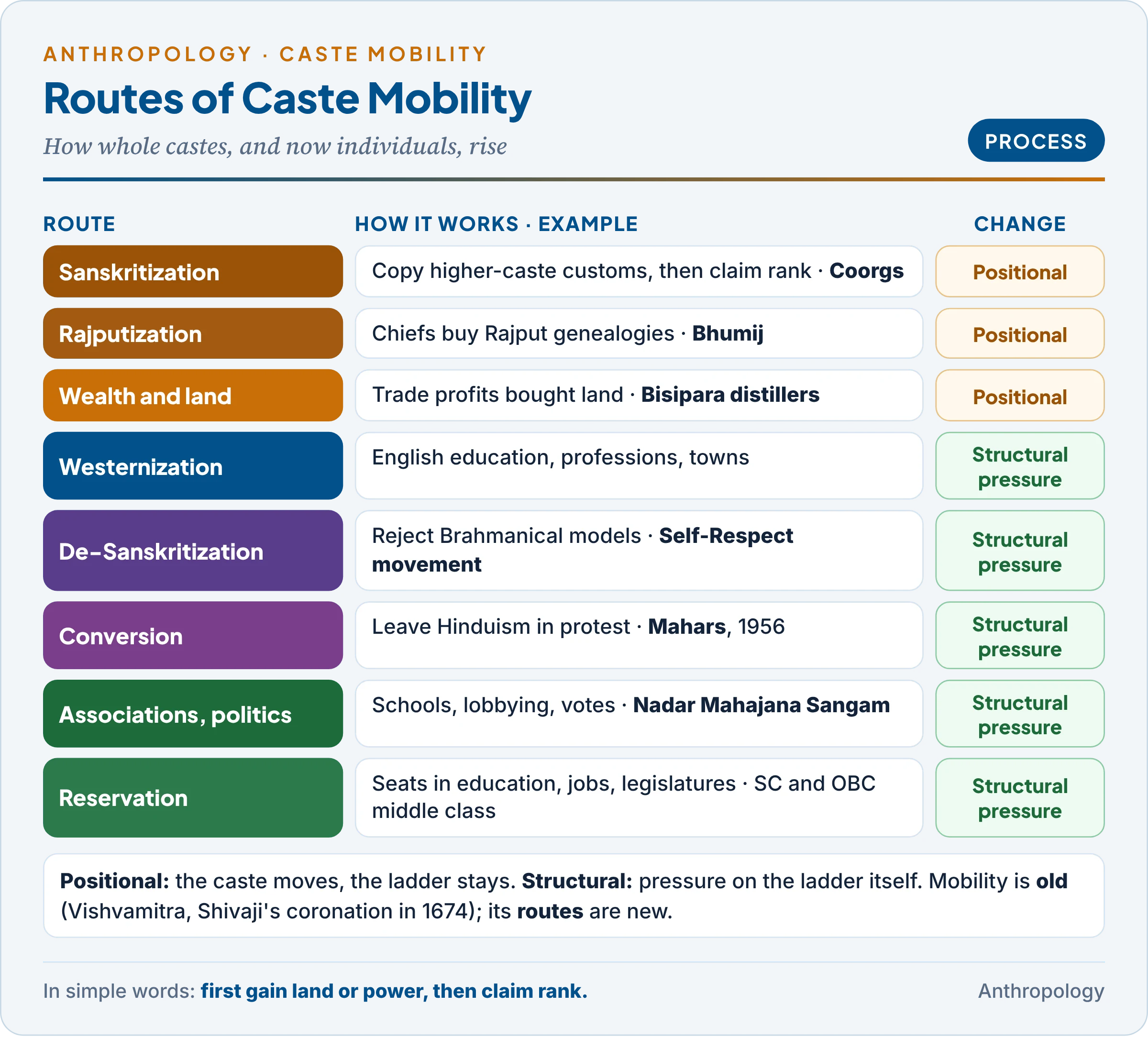
- Sanskritization: Srinivas’s term (1952) for a low caste adopting the customs, rituals and beliefs of a higher, often twice-born caste, such as vegetarianism, teetotalism and the sacred thread, and then claiming higher status, usually over a generation or two. It works best when it follows economic or political gains. (Full treatment in 5.3a.)
- Rajputization or Kshatriyization: tribal and peasant chiefs claim Rajput descent through genealogies written by Brahmins (Sinha on the Bhumij, §4).
- Westernization: English education, professions and urban jobs open caste-free channels of rise.
- De-Sanskritization: some movements rejected Brahmanical models altogether, as the non-Brahmin and Self-Respect movement in Tamil Nadu did.
- Conversion: protest mobility by leaving Hinduism, as with the Mahar conversion to Buddhism led by Ambedkar (Nagpur, 1956), though caste labels often follow converts (3.2a).
- Caste associations and politics: the Rudolphs (The Modernity of Tradition, 1967) showed how caste associations turned castes into interest groups: they ran schools, lobbied for reservations and fielded candidates.
- Reservation and protective discrimination: seats in education, jobs and legislatures (Articles 15(4), 16(4), 330, 332) created an SC and OBC middle class.
- Migration and markets: urban and Gulf migration, business networks and the land market let castes gain wealth outside the village hierarchy.
Common confusion
Is the tribe-caste continuum the same as Sanskritization? No. Sanskritization is a cultural process by which a caste (or tribe) copies higher-caste customs to claim a higher rank inside the caste order. The tribe-caste continuum is a structural picture of groups spread between two ideal poles, tribe and caste, and of the slow absorption of tribes into caste society through land, state formation and religion. A tribe can move along the continuum without Sanskritizing, and Sanskritization happens among castes that were never tribes.
3. The Jajmani System
In simple words
In the old village, families of farmers received services from families of barbers, washermen, potters, carpenters and priests. Instead of wages, they paid a share of the harvest and gifts at festivals. The ties were hereditary. Scholars still argue whether this was mutual help or a form of exploitation.
3.1 Karimpur: the example
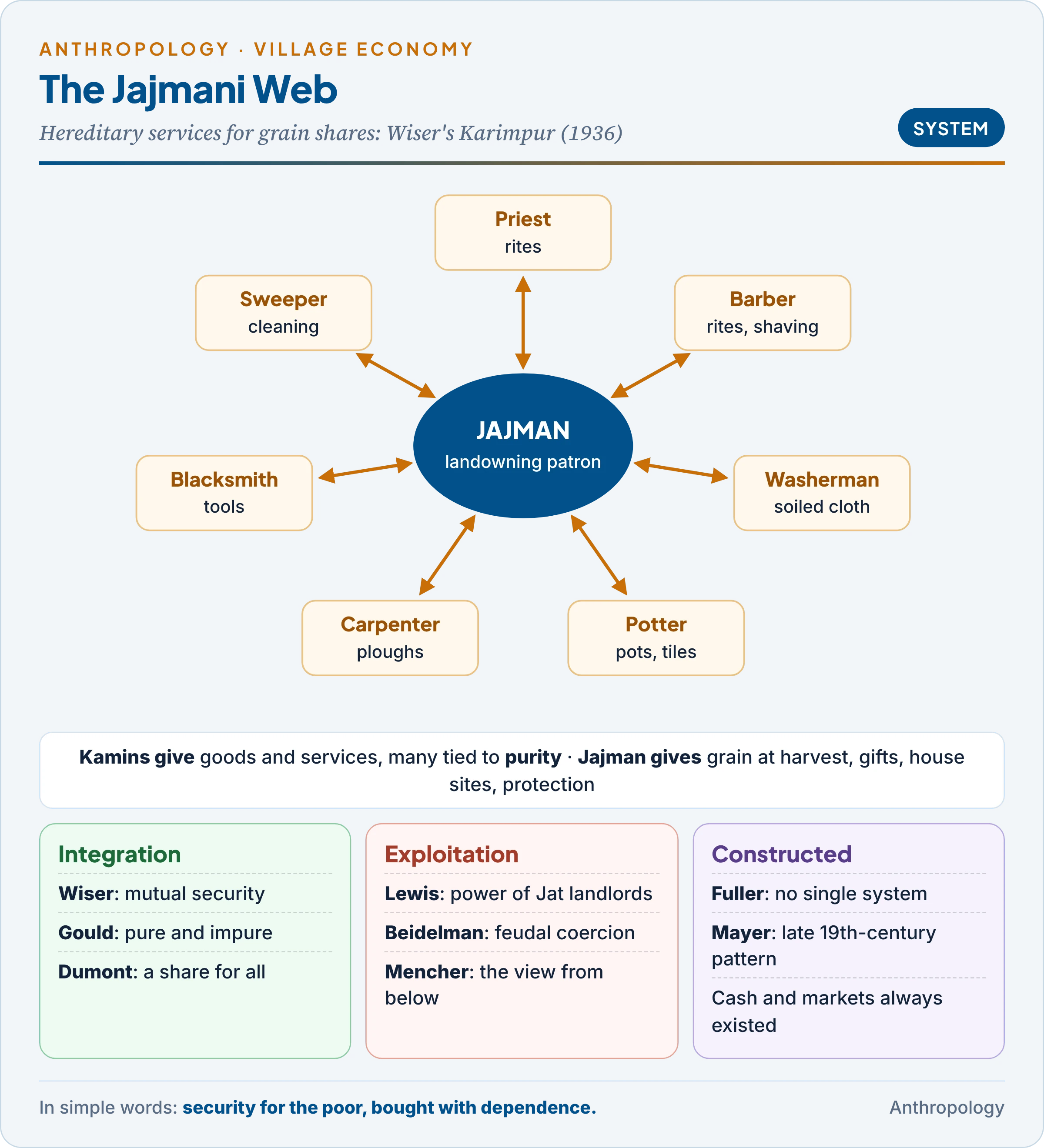
William H. Wiser, an American missionary and sociologist, lived in Karimpur in Mainpuri district of Uttar Pradesh and described its exchanges in The Hindu Jajmani System (1936). Each farming family had hereditary ties with particular families of carpenters, blacksmiths, potters, barbers, washermen, water-carriers and sweepers. They served it through the year; at harvest each received a fixed share of grain from the threshing floor, plus food at festivals, clothes at weddings and sometimes rent-free house sites. Wiser saw a system of mutual service in which every caste had a place.
3.2 Terms and features
- Jajman: originally the patron of a sacrifice (yajamana) for whom a Brahmin performed rites; in the village, the patron family receiving services. The service provider is the kamin, parjan or praja; in Maharashtra the hereditary village servants are balutedars, paid in baluta (grain shares).
- Hereditary and durable: the right to serve a family is inherited on both sides and may be divided among sons; it can be sold or mortgaged in some regions.
- Pauline Kolenda (“Toward a Model of the Hindu Jajmani System”, 1963), working in Khalapur, set out these features as a general model.
- Exclusive: a family is supposed to deal with one family of each specialist, and specialists may not poach others’ clients; caste councils enforce this.
- Payment in kind: grain at harvest, plus perquisites; cash and barter existed alongside it.
- Multiplex: ties are economic, ritual and social: the barber and washerman are needed at births, weddings and deaths to remove pollution; clients expect protection, loans and support in disputes; patrons expect support in factional fights.
- Two kinds of specialists: ritual specialists (priest, barber, washerman) whose work is tied to purity, and artisans and labourers whose work is material. Artisans often serve many patrons and are more independent; labourers tied to one landowner are most dependent.
3.3 The great debate: integration or exploitation?
The 2013 and 2026 questions ask for the debates. There are three positions.
1. Integration and reciprocity
- Wiser (1936): mutual services gave security to all and integrated the village.
- Harold Gould, an American anthropologist (1958; 1964), traced the pattern to the religious opposition of pure and impure: higher castes need lower castes to remove pollution, so the system defines the local ritual order as much as the economic one.
- Dumont (1966) saw jajmani as distribution oriented to the whole: everyone, down to the sweeper, received a share of the grain heap by right, a principle opposed to the market’s logic of individual gain.
- David Pocock (1962) separated ritual services, which express hierarchy, from ordinary economic exchange.
2. Exploitation and power
- Oscar Lewis and Victor Barnouw (1956), in Rampur, found the payments meagre, the obligations one-sided and the landowning Jats able to enforce them by force and boycott.
- Thomas Beidelman (A Comparative Analysis of the Jajmani System, 1959) called it a feudal system that maintained the power and prestige of landowning castes; its essence was coercion, not reciprocity.
- Kathleen Gough found in Tanjore that the labouring Pallars and Paraiyars were bound in hereditary servitude to Brahmin landlords.
- Joan Mencher (“The Caste System Upside Down”, 1974), working among Tamil labourers, argued that from below caste and jajmani look like economic exploitation justified by ideology.
3. A constructed “system”
- C.J. Fuller (“Misconceiving the Grain Heap”, 1989) argued that anthropologists fused varied local arrangements into one “jajmani system“, and that the image of a moneyless, non-market village economy was misleading: cash, markets and contract existed alongside customary shares for centuries.
- Simon Commander (1983) traced how the pattern changed over two centuries, and Peter Mayer (“Inventing Village Tradition”, 1993) argued that the north Indian “jajmani system” described by ethnographers took shape in the late nineteenth century, under colonial agrarian conditions, rather than being ancient.
Evaluation: the integration view explains why the ties lasted and why ritual services persist; the exploitation view explains the inequality of shares and the role of force; the historical critique warns against treating a colonial-era pattern as timeless. Most scholars now see jajmani as patron-client relations shaped by caste, combining security for the poor with dependence, varying by region and period.
3.4 Jajmani and the market economy
The 2017 and 2019 questions ask about the impact of the market. Most jajmani ties have declined, but not vanished.
Causes of decline
- Monetisation: farmers growing cash crops (sugarcane, cotton) prefer to sell their harvest and pay cash; workers prefer wages to grain they must resell.
- Factory goods: aluminium and plastic vessels replaced the potter’s wares; ready-made shoes and cloth undercut leather workers and weavers.
- Mechanisation: tractors, threshers and pumps reduced the demand for the carpenter and blacksmith, as studies of Punjab after the Green Revolution showed.
- Land reforms and migration: service castes gained small plots, moved to towns or found wage work; the power of landlords to coerce declined.
- Democracy and law: adult franchise, reservations and anti-untouchability laws let dependents refuse degrading tasks and seek outside help.
- Rural employment programmes such as MGNREGA (2005) gave the landless an alternative source of wages.
Continuity
- Ritual services survive: the Brahmin priest at weddings, the barber at rites of passage, the washerman after a death, often paid in cash now.
- Patron-client ties survive in new forms: credit, insurance in bad years, labour at peak seasons and votes (§1.5). Karve and Damle’s survey of Maharashtra villages in the 1960s found many villagers still valued such ties for security.
- Caste-based occupations persist at the bottom: manual scavenging and sanitation work remain concentrated among Dalit castes, which is why the 2013 Act prohibiting manual scavenging and the 2024 prison-manual reforms (3.2a) target them.
4. The Tribe-Caste Continuum
In simple words
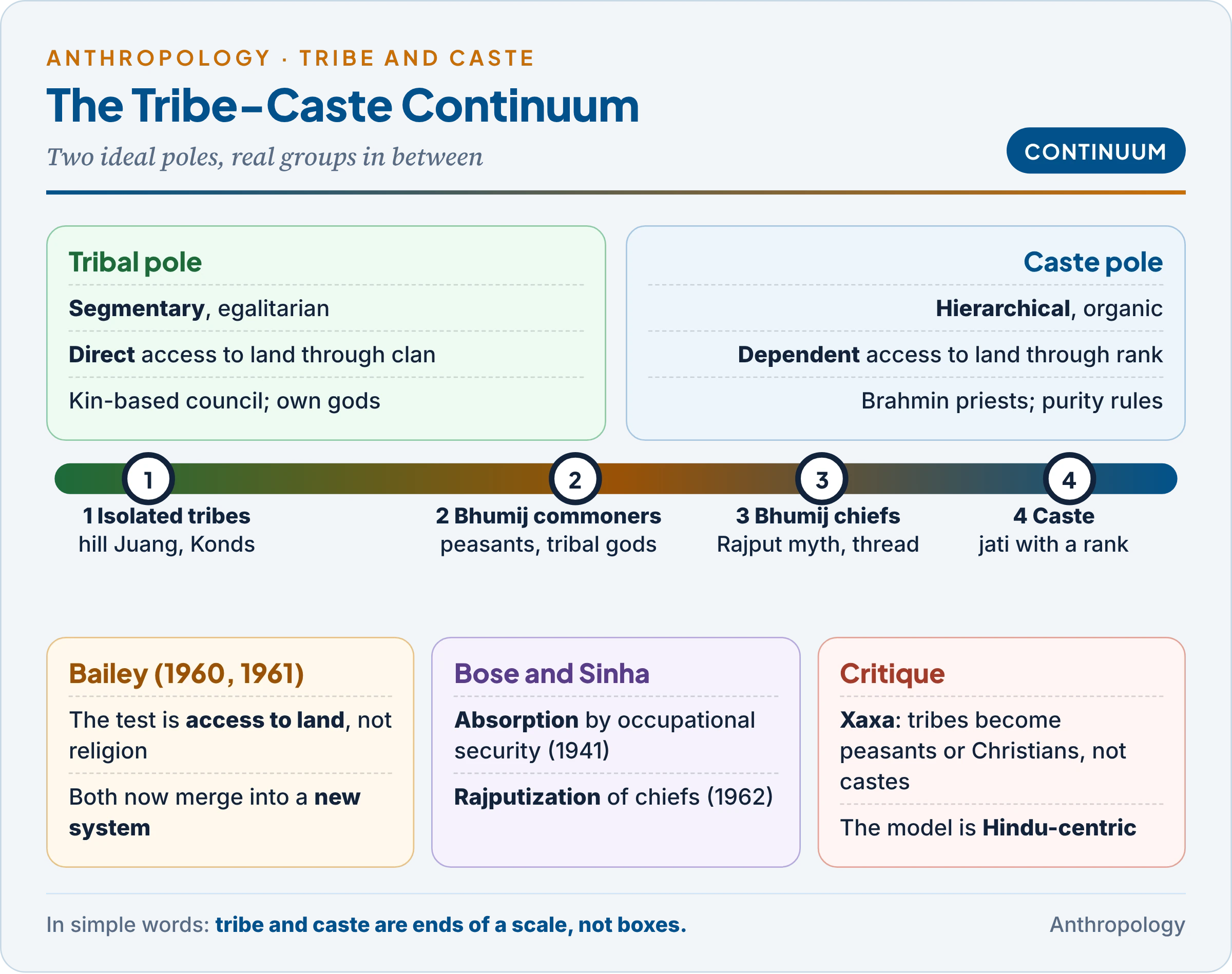
Tribes and castes in India are not two separate boxes. Many tribes live beside castes, trade with them, worship some of the same gods and slowly take on caste ways, while some castes keep tribe-like customs. Scholars therefore picture a line with “tribe” at one end and “caste” at the other, with real groups spread along it.
4.1 The Bhumij: the example
Surajit Sinha, an Indian anthropologist, studied the Bhumij of Barabhum in the former Manbhum district (now Purulia, West Bengal) (“State Formation and Rajput Myth in Tribal Central India”, 1962). Bhumij chiefs who had become landholders under a regional state patronised Brahmins with land grants; the Brahmins composed genealogies linking the chiefs to illustrious Rajput clans and a miraculous origin myth. The chiefs adopted the sacred thread, Brahmanical rites, Durga worship and restrictions on women, while still supporting the old tribal gods. Ordinary Bhumij remained closer to tribal ways. The same people thus stood at different points between tribe and caste.
4.2 Why a continuum? The classification problem
- Colonial categories: the census struggled to separate tribes from castes. Baines in the 1891 Census placed “forest tribes” under agricultural castes; the 1901 and 1911 Censuses classed tribal religion as “animism“; 1921 used “tribal religion“; 1931 under Hutton listed “primitive tribes“. Classification rested largely on religion, a weak test.
- Ghurye’s objection (The Aborigines “So-Called” and Their Future, 1943): tribes such as the Bhils and Baigas speak regional languages and follow Hindu practices, so the line between them and Hindu castes is arbitrary; tribes are “backward Hindus“, imperfectly integrated, to be assimilated.
- Elwin’s opposite view: Verrier Elwin, the British-born anthropologist of the Baiga and Gond (The Aboriginals, 1943), saw tribes as distinct societies damaged by contact; he graded them into four classes, from the isolated “purest” groups to the tribal aristocracy that had adopted Hindu ways, and first argued for protection, later for integration at the tribes’ own pace.
- Today a tribe is an administrative category: Scheduled Tribes are notified under Article 342, using the Lokur Committee (1965) criteria of primitive traits, distinctive culture, geographical isolation, shyness of contact and backwardness. The same community can be ST in one state and not in another: the Santals are STs in Jharkhand, Odisha and West Bengal but not in Assam.
4.3 Bailey: a structural continuum
Bailey (“Tribe, Caste and Nation”, 1960; “‘Tribe’ and ‘Caste’ in India”, 1961), working among the Konds and the caste villages of highland Odisha, argued that cultural tests (religion, diet) fail and that the distinction must be structural:
- Tribe: a segmentary, egalitarian society in which a man gets direct access to land by being a member of a clan or lineage.
- Caste: an organic, hierarchical society in which access to land depends on one’s position in a ranked system of dependence; most people are dependants of a land-controlling caste.
- Continuum: “the only solution” is to postulate a continuum, with a wholly segmentary society with no dependants at one end and, at the other, a society in which most people act as dependants. Real groups are placed by the proportion of people with direct access to land.
- Bailey’s caution: in modern India both tribes and castes are merging into a different system, the market and the state, “which is neither one nor the other”.
4.4 Sinha, Bose and absorption
- Sinha (“Tribe-Caste and Tribe-Peasant Continua in Central India”, 1965) treated tribes not as isolated categories but as parts of Indian civilization, linked to castes and peasants by state formation, trade and religion. Tribes move toward the caste pole through Rajputization of chiefs and peasantisation of commoners. This is the argument the 2026 question asks to appraise.
- Nirmal Kumar Bose, an Indian anthropologist (“The Hindu Method of Tribal Absorption“, 1941), explained why tribes entered caste society: Hindu society offered economic security through a hereditary occupational monopoly in a wider division of labour, while leaving tribal customs largely intact and adding Brahmin priests for rites of passage. Absorption was thus gradual and non-coercive in form, though it placed tribes low in the hierarchy.
- Caste-like tribes: in the Nilgiris, the Toda (pastoralists), Kota (artisans and musicians), Badaga (cultivators) and Kurumba (sorcerers) were linked by hereditary exchange, and the Badagas treated the Kotas as polluting, as David Mandelbaum described. The Apatani of Arunachal Pradesh have hereditary patrician and slave-descended strata (Haimendorf), and the Sherdukpen are divided into higher Thong and lower Chhao sections. In north Bengal and Assam the Rajbanshis pressed Kshatriya claims. Many tribes, such as the Oraons, have jajmani-like ties with serving castes.
Common confusion
Did Ghurye and Elwin disagree about whether tribes are different? Yes, at root. Ghurye held that tribes are backward sections of Hindu society and should be assimilated. Elwin held that tribes are distinct peoples whose culture contact had harmed, and first sought their protection. Nehru’s Tribal Panchsheel, framed with Elwin’s influence, chose a middle path of integration without imposition.
4.5 Relevance and critique
The table compares how the main scholars draw the line between tribe and caste.
| Scholar | Criterion | Position on the continuum |
|---|---|---|
| Ghurye (1943) | Religion and culture | Tribes are backward Hindus; no real line |
| Bose (1941) | Economy and occupational monopoly | Tribes absorbed into caste by economic security |
| Bailey (1960, 1961) | Direct vs dependent access to land | A structural continuum |
| Sinha (1962, 1965) | State formation and civilization | Tribe-caste and tribe-peasant continua |
| André Béteille (1986) | Isolation, size, language, religion | Tribes as relatively isolated societies; criteria loose |
| Virginius Xaxa (1999) | Tribes as societies, not stages | Tribes transform without becoming castes |
The table shows a shift from culture (Ghurye) to structure (Bailey) to history and state (Sinha), and finally to a critique.
- Relevance: the continuum explains porous boundaries, Kshatriya claims of tribal chiefs, mixed groups such as the Bhumij, and why the ST list is constantly contested. The Meitei demand for ST status, and the Manipur High Court order of 27 March 2023 directing the state to consider it (the key paragraph deleted on review in February 2024), preceded ethnic conflict with Kuki-Zo tribes from 3 May 2023: a reminder that tribe status is now a political resource.
- Critique: Virginius Xaxa, an Indian sociologist (“Transformation of Tribes in India: Terms of Discourse”, 1999), argued that the continuum is Hindu-centric: it assumes tribes can only become castes. In fact many tribes became peasants, Christians or workers while keeping a separate identity, as in Jharkhand and the North-East. Bailey himself conceded the model’s limited practical value once both tribe and caste enter the market and state.
- Law: in Chinthada Anand (2026) the Supreme Court held that conversion alone does not end Scheduled Tribe status, unlike Scheduled Caste status, because tribal identity rests on community recognition and customary life, not religion.
4.6 The folk-urban continuum
The idea of a continuum came from Robert Redfield, the American anthropologist who compared four communities in Yucatán, from the tribal village of Tusik to the city of Mérida (The Folk Culture of Yucatan, 1941). Moving towards the city, societies became more heterogeneous, secular and individualised, and less isolated and kin-based.
- Applicability to India: McKim Marriott (Kishan Garhi, 1955) and Srinivas showed that the Indian village was never an isolated folk society: it was tied to towns, pilgrimage centres and a literate great tradition. Redfield himself turned to the peasant society as a “part-society” of a civilization. The tribe-caste continuum adapted his idea to India’s distinctive axis of variation. (Little and great traditions: 5.3b.)
5. The Future of Caste
In simple words
Caste has lost much of its old religious and economic hold, especially in cities. But it has gained new life in politics, marriage and identity. Scholars disagree whether it will fade, change shape or need to be deliberately abolished.
5.1 Three hypotheses
The 2009 question asks for the prevalent hypotheses on the future of caste.
| Hypothesis | Main voices | Argument |
|---|---|---|
| Decline | Modernisation theorists; the early Nehruvian view | Industry, cities, education and secular law will dissolve caste |
| Transformation | Rudolphs (1967), Rajni Kothari (Caste in Indian Politics, 1970), Srinivas, Béteille, Gupta | Caste loses its ritual system but survives as identity and interest group |
| Annihilation | Ambedkar (Annihilation of Caste, 1936) | Caste rests on religious sanction and must be destroyed by inter-caste marriage and rejection of the shastras |
The evidence supports transformation. Srinivas wrote “An Obituary on Caste as a System” (2003): the system of ranked, interdependent, occupationally tied castes is dying, but caste identities are stronger than ever. Dumont called this substantialisation: castes stop being parts of one hierarchy and become separate blocs competing for resources.
5.2 What has changed and what persists
Changed
- Commensality: eating together in hotels, offices, hostels and trains is normal, though many people return to caste rules at home.
- Occupation: the link between caste and occupation is weak above the village level, though it persists at the bottom (sanitation work).
- Power: André Béteille found in Sripuram, Thanjavur (Caste, Class and Power, 1965), that Brahmin landlords had lost control as land came onto the market and non-Brahmins gained power through parties: caste, class and power were separating.
- Ritual authority: Brahmin precedence and caste councils have lost legal force; untouchability is a crime (Article 17; Protection of Civil Rights Act, 1955; SC/ST (Prevention of Atrocities) Act, 1989).
- Joint family and caste: the joint family once transmitted caste occupation and rules; its decline and urban nuclear households weaken the daily practice of caste, though families still arrange caste-endogamous marriages.
Persists
- Endogamy: only about 5.8% of marriages were inter-caste in the India Human Development Survey of 2011-12, with no clear rise since the 1970s. Honour killings punish those who cross the line.
- Politics: parties select candidates by caste, and caste associations bargain for reservation and recognition. The Rudolphs traced three phases: vertical mobilisation (notables deliver the votes of dependants), horizontal mobilisation (caste associations and federations, such as Gujarat’s Kshatriya Sabha, which drew Rajputs, Bariyas and Bhils together from 1946) and differential mobilisation (a caste splits by class, as when Rajasthan’s poorer Rajputs formed the Bhooswami Sangh in 1954 against the great jagirdars). Caste has become a language of democratic competition (the 2010 and 2016 questions).
- Social capital: caste networks supply jobs, credit and migration links. Kaivan Munshi and Mark Rosenzweig (2006) showed how caste networks in Mumbai channelled boys into particular schools and jobs; the same networks can exclude outsiders. Caste is thus bonding social capital: strong within, closed to others (the 2021 question).
- Violence and discrimination: atrocities against Dalits, segregated settlements and bias in housing and hiring continue; caste has also travelled abroad: Seattle banned caste discrimination in February 2023, while California’s bill (SB 403) was vetoed in October 2023.
5.3 The state’s measures: can caste be annihilated?
The 2023 question asks whether annihilation is possible in light of the state’s measures.
- Equality and protection: Articles 14-17, the PCR and PoA Acts, the Prohibition of Employment as Manual Scavengers and their Rehabilitation Act, 2013, and the Sukanya Shantha ruling (2024) against caste in prisons.
- Redistribution: reservations in education, jobs, legislatures and panchayats; the EWS quota (103rd Amendment, 2019), upheld 3:2 in Janhit Abhiyan (7 November 2022).
- Refining the categories: State of Punjab v. Davinder Singh (1 August 2024), a seven-judge bench, held 6:1 that states may sub-classify SCs on empirical data of inter-se backwardness, overruling E.V. Chinnaiah (2004); Justice B.R. Gavai urged a creamy layer for SCs and STs; Justice Bela Trivedi dissented.
- Encouraging inter-caste marriage: the Dr. Ambedkar Scheme for Social Integration through Inter-Caste Marriages (2013) gives an incentive to couples where one spouse is Dalit.
- Counting caste: Bihar’s caste survey (released 2 October 2023) found Extremely Backward Classes 36.01%, Backward Classes 27.12%, SCs 19.65%, STs 1.68% and the unreserved 15.52%; Census 2027 will enumerate all castes for the first time since 1931 (3.2a).
Assessment: these measures have weakened caste as a hierarchy of disabilities and created mobility for millions, but they also make caste a legal and political category people have reason to retain. Annihilation in Ambedkar’s sense, the end of endogamy and of the religious sanction, is far off; the more likely future is caste as identity without hierarchy, which still carries inequality wherever land, networks and marriage remain caste-bound.
Key Terms
| Term | Meaning in simple words |
|---|---|
| Dominant caste | The caste that holds most land, numbers and power in a village or region |
| Decisive dominance | When one caste holds all the elements of dominance together |
| Vote bank | A group whose votes are delivered as a block through patrons or caste leaders |
| Faction | A rival group inside a village, usually led by members of the dominant caste |
| Caste mobility | A change in the rank of a caste (or person) within the caste order |
| Positional change | A caste changes its place, but the hierarchy stays the same |
| Rajputization | Tribal or peasant chiefs claiming Rajput (Kshatriya) descent |
| De-Sanskritization | Rejecting Brahmanical customs as a model of status |
| Caste association | A modern organisation of a caste that works like an interest group |
| Jajman | The patron family that receives hereditary services |
| Kamin | The service or artisan family that serves a jajman |
| Balutedar | A hereditary village servant in Maharashtra, paid in grain shares |
| Clientelism | Exchange of protection or favours by patrons for loyalty and votes |
| Tribe-caste continuum | Tribes and castes seen as two ends of one scale, with groups in between |
| Folk-urban continuum | Redfield’s scale from isolated folk villages to cities |
| Substantialisation | Castes turning from parts of a hierarchy into separate competing blocs |
| Bonding social capital | Strong ties within a group that help members but exclude outsiders |
| Sub-classification | Dividing a reserved category such as SCs into groups by backwardness |
Contemporary Developments
- Census 2027: question 10 of the population-enumeration schedule, notified on 14 August 2026, records “Scheduled Caste / Scheduled Tribe / Caste” as an open entry; data on every caste will test the “transformation” thesis with national figures for the first time since 1931.
- Sub-classification of SCs: after Davinder Singh (1 August 2024), states may divide the SC quota by empirical backwardness, a legal recognition that SCs are internally ranked and unequal.
- Dominant castes and quotas: Maharashtra’s 10% SEBC law for Marathas (February 2024), passed after the Supreme Court had struck down their earlier quota in May 2021, shows dominant peasant castes using backwardness claims.
- Conversion and status: Chinthada Anand (24 March 2026) held that SC status ends on conversion out of Hinduism, Sikhism or Buddhism, but ST status does not end by conversion alone.
- Caste abroad: Seattle (February 2023) became the first US city to prohibit caste discrimination; California vetoed a similar bill (October 2023).
Diagrams to Master
- Topic map: dominant caste, mobility, jajmani, tribe-caste continuum, future of caste.
- Dominant caste: Srinivas’s five elements, decisive and regional dominance, examples and the critiques of Dube, Gardner, Oommen.
- Routes of mobility: Sanskritization, Rajputization, Westernization, de-Sanskritization, conversion, associations, reservation, migration; mark positional vs structural change.
- Jajmani web: jajman at the centre, specialists around, services in one direction, grain shares and protection in the other; the three positions: integration, exploitation, constructed system.
- Tribe-caste continuum: the two poles with Bailey’s land criterion, the Bhumij placed in between, the processes (Bose’s absorption, Sinha’s Rajputization) and Xaxa’s critique.
Revision Grid
| Scholar | Work (year) | Key idea |
|---|---|---|
| W.H. Wiser | The Hindu Jajmani System (1936) | Karimpur; jajmani as mutual service |
| N.K. Bose | “The Hindu Method of Tribal Absorption” (1941) | Tribes absorbed through occupational security |
| Robert Redfield | The Folk Culture of Yucatan (1941) | Folk-urban continuum |
| G.S. Ghurye | The Aborigines “So-Called” (1943) | Tribes as backward Hindus |
| Verrier Elwin | The Aboriginals (1943) | Four classes of tribes; protection |
| Oscar Lewis | Rampur factions (1954); with Barnouw (1956) | Factions; jajmani as power |
| M.N. Srinivas | “The Dominant Caste in Rampura” (1959) | Numbers, land, power, ritual, education |
| F.G. Bailey | Caste and the Economic Frontier (1957); 1960; 1961 | Distillers’ mobility; land-access continuum |
| T.O. Beidelman | A Comparative Analysis of the Jajmani System (1959) | Jajmani as feudal coercion |
| Surajit Sinha | 1962; 1965 | Rajput myth; tribe-caste and tribe-peasant continua |
| S.C. Dube | “Caste Dominance and Factionalism” (1968) | Dominant individuals and factions |
| Rudolph and Rudolph | The Modernity of Tradition (1967) | Caste associations; vertical, horizontal, differential mobilisation |
| Rajni Kothari | Caste in Indian Politics (1970) | Politicisation of caste |
| T.K. Oommen | “The Concept of Dominant Caste” (1970) | Dominance dispersed by reforms and franchise |
| C.J. Fuller | “Misconceiving the Grain Heap” (1989) | Jajmani as an anthropological construct |
| Virginius Xaxa | “Transformation of Tribes in India” (1999) | Tribes transform without becoming castes |
| M.N. Srinivas | “An Obituary on Caste as a System” (2003) | System dying, identity strengthening |
Previous Year Questions
Dominant caste, caste mobility, future of caste system, jajmani system, tribe-caste continuum
- 2026What are the major debates related to the concept of jajmani system?
- 2026Make a critical appraisal of Surajit Sinha’s line of argument that tribes and castes may not be isolated social categories, but are a part of the great Indian civilization.
- 2025Write notes on: Caste domination, factionalism and political power.
- 2025What are the different types of caste mobility in India? Highlight the various factors responsible for it.
- 2023Write notes on: Jajmani system: continuity and change.
- 2023“Tribes are backward Hindus.” Critically comment with reference to the contributions of G. S. Ghurye.
- 2023Is caste mobility a recent phenomenon? Discuss in the light of Indological and Empirical context.
- 2023Is annihilation of caste possible? Discuss the future of caste system in the light of various proactive measures taken by the Indian State.
- 2021Write short notes on “Relevance of tribe – caste continuum” in about 150 words.
- 2021Write short notes on “Caste and social capital” in about 150 words.
- 2021Write short notes on “Factionalism and politics in rural India” in about 150 words.
- 2020Write short note on the Concept of ‘Dominant’ caste in about 150 words.
- 2019Write a note in 150 words on The Jajmani system and contemporary market economy.
- 2018Based on historical and contemporary evidences, discuss the future of caste system in India.
- 2018Explain the significance of tribe-caste continuum in the present context.
- 2017Discuss the impact of market economy on the Jajmani system.
- 2016Write a note in 150 words on Relevance| of caste in contemporary Indian politics.
- 2016How is process of tribe-caste continuum different from Sanskritization? Comment.
- 2015Critically examine the concept of tribe caste continuum and its relevance in contemporary India.
- 2015What do you understand by dynamics of caste mobility ? How did the concept of Sanskritization contribute to its functionality ?
- 2014Write a note in 150 words on TribeCaste continuum.
- 2014Do you think caste persists in contemporary India ? Critically discuss.
- 2014Define the concept ‘Dominant Caste and examine its relevance in the contemporary Indian village with suitable examples.
- 2013What is Jajmani system ? Examine the views on Jajmani system as an egalitarian as well as exploitative system. Give reasons for its decline (375 words).
- 2013Examine the criticisms on the concept of dominant caste. (250 words).
- 2011Discuss the relevance of the concept Dominant Caste in the context of Contemporary Indian Society.
- 2010Examine the role of the caste system in the present political context.
- 2010Is the present political system strengthening the caste system ? Discuss.
- 2009Discuss the salient features of the prevalent hypotheses on the future of the caste system in India.
- 2009Bring out the various features and the importance of the ‘dominant caste’
- 2008Is Tribe-Caste Continuum a reality or myth ? Discuss.
- 2007Write a note on Jajmani System.
- 2004Write a note on Tribe-Caste Continuum.
- Explain criteria for dominant caste. How far is this concept still crucial to our understanding of India’s villages after implementation of reservations in democratic institutions ? Discuss. (year not recorded in the source)
- 2000Write a note on Tribe-caste continuum.
- 2000Define the Jajmani system. Analyse the changes in the relationship between caste and occupation in contemporary rural society.
- 1999Write a note on Dominant Caste.
- 1998Write a note on Folk-Urban Continuum.
- 1998Write a note on Jajmani System.
- 1997Examine the role of joint family in Hindu social system and its impacts caste system.
- 1994Describe the tribe-caste continuum in India. Is this continuum relevant in Modern Indian society ?
- 1992Write a note on Tribe caste continuum.
- 1991What is the notion of ‘folk-urban continuum’ in the study of peasant society? Is it applicable to Indian conditions ?
- 1990Write a note on Role of Dominant caste in the political institutions of a peasant village.
- 1988Discuss relationship between “dominant caste” and economic development” in rural India.
- 1987Write a note on Tribe-caste continuum.
- 1984Write a note in 200 words : Distinction between tribe and caste.
- 1984Examine the changes that have come about in caste system and joint family in modern India.
- 1982Write a note on (200 words) : Concept of dominant caste and its relevance in the study of political processes.
Related questions from other units
- 2023Unit 5.3: “Sanskritization is a culture-bound concept.” Critically comment to assess the strength and limitation of this concept in developing a theoretical framework to study social change.
- 2022Unit 9.1: Discuss the views of G. S. Ghurye and Verrier Elwin on the approach towards tribal populations. What are the policies of the Government of India towards Indian tribal populations?
- 2015Unit 4: Write a note in 150 words on Elwin Ghurye Debate on Tribes.
- 2010Unit 4: Assess the contributions of M.N. Srinivas towards Indian Anthropology in general. Add a note on his understanding in the context of studying social mobility in India.
- 1999Unit 5.3: Distinguish between sanskritization and desanskritization. Critically examine impact of sanskritization on social mobility in India.
- 1998Write a note on Caste mobility.
- 1997Elucidate the salient differences between tribal social system and caste system giving suitable examples in support of your answer.
- 1991Unit 7.1: Evaluate the extent to which existing reservations for scheduled castes and scheduled tribes have led to social mobility among them. What suggestions would you make for implementing to policy of adding an economic in extending reservation to the so-called ‘forward’ castes ?
- 1988Unit 1.3: Write a note on “Tribe” and “Caste” as closed ethnic groups.
- 1981Unit 5.3: Describe the different forms and proces of sanskritization and assess the overal impact of this phenomenon on caste structure in India.
More from Indian Social System and Caste: all notes of this unit · every PYQ of this unit · Anthropology Optional hub