

Anthropology Optional › Paper II › Unit 01: Evolution of Indian Culture and Civilization
1.3 Ethno-archaeology in India: The concept of ethno-archaeology; Survivals and Parallels among the hunting, foraging, fishing, pastoral and peasant communities including arts and crafts producing communities.
Official Syllabus: Paper II, Unit 1.3
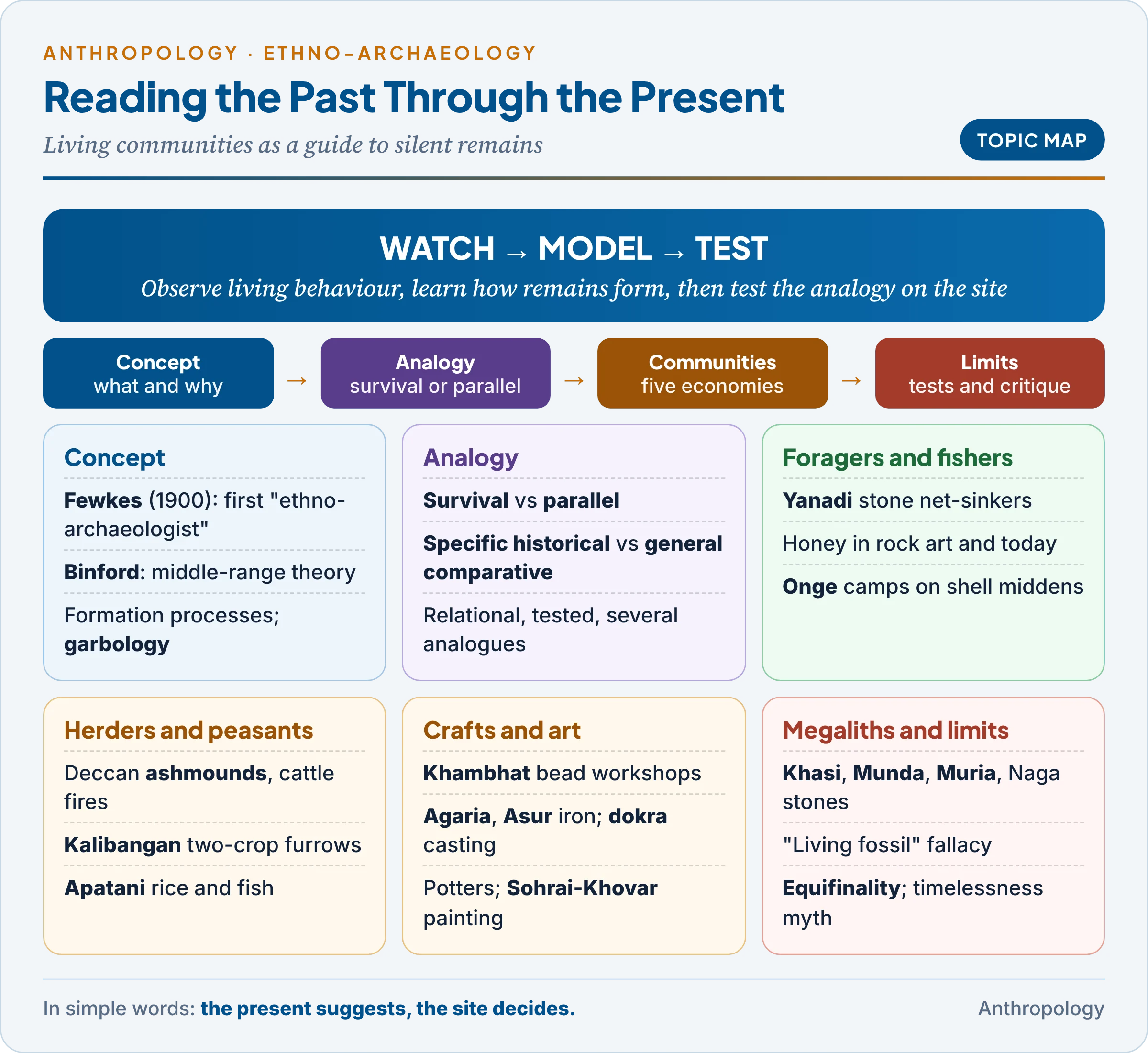
This article covers ethno-archaeology: what it is, how its reasoning works, and what living Indian communities of hunters, fishers, herders, farmers and craftspeople have taught archaeologists. The archaeological cultures themselves are in 1.1a (Stone Age to Chalcolithic) and 1.1b (Indus and after), and the world framework of archaeology in Paper 1, Units 1.8a–1.8c; here they are read through the present.
1. The Concept of Ethno-archaeology
In simple words
Archaeologists find tools, bones, pots and post-holes, but never the people who used them. Ethno-archaeology means going to living communities to watch how objects are made, used, thrown away and left behind, so that the silent remains of the past can be read with more confidence.
1.1 Definition and aim
Archaeology studies past societies through their material culture, the physical things a society makes and uses: tools, houses, pots, ornaments and graves. Its central difficulty is interpretation. How was this pot used? Why is this hut round and that one square? Why are bones heaped here and stone chips there?
- Definition: ethno-archaeology is the study of living societies by archaeologists, from an archaeological point of view, to understand the behaviour behind the making, use and discard of material culture, and so to read the archaeological record better.
- What is new: archaeologists always borrowed from ethnographies, but ethnographers rarely recorded what archaeologists need (where rubbish falls, how long a hut lasts, what a broken tool looks like). In ethno-archaeology the archaeologist does the fieldwork, with archaeological questions in hand.
- Other names: “action archaeology” (Maxine Kleindienst and Patty Jo Watson, 1956, who proposed an archaeological inventory of a living village) and “living archaeology” (Richard Gould’s 1980 book on Australian Aborigines).
- Why it matters: the record is static (objects lying in the ground) while the past was dynamic (people acting). Only by watching living behaviour turn into debris can archaeologists learn which patterns in a site come from which activities.
1.2 From armchair analogy to fieldwork
Reading the past through the present is old; the field method is recent.
| Date | Step | What it added |
|---|---|---|
| 1871 | E.B. Tylor, Primitive Culture | “Survivals“: customs carried by habit into a later stage of society |
| 1900 | Jesse Walter Fewkes, American archaeologist among the Hopi | First to call himself an “ethno-archaeologist“ |
| 1939 | Donald Thomson among the Wik Mungkan (Queensland) | The same people left very different seasonal camps |
| 1962 onward | Lewis Binford and the New Archaeology | Explanation by testing hypotheses; living peoples as laboratories |
| 1977–82 | Binford (Nunamiut Eskimo, Alaska), John Yellen (!Kung San, Kalahari), Gould (Western Desert Aborigines), Ian Hodder (Symbols in Action, 1982, Baringo, Kenya) | Ethno-archaeology becomes a major specialisation |
Two lessons run through this history. Thomson’s camps showed that one community can leave several “cultures” in the ground, so variation in a site need not mean a new people. Hodder showed that ear-rings and calabashes were used to mark ethnic boundaries, so material culture carries meaning, not only function; this moved the field from processual (systems and adaptation) towards post-processual (meaning and agency) archaeology (Paper 1, Unit 1.3).
1.3 Middle-range theory and formation processes
Lewis Binford, the American founder of the New Archaeology, argued that archaeologists need middle-range theory: tested links between behaviour (which we cannot see) and the traces it leaves (which we dig up). Such links can only be built where both can be observed together, that is, among living people.
- Nunamiut Eskimo (Alaska): Binford watched hunters butcher caribou, store meat and discard bones, and learned which bones are carried away and which left at the kill. Bone heaps at ancient sites could then be read as butchery, storage or consumption instead of being guessed at.
- Site structure: round a hearth at a hunting stand, men dropped small debris close by (drop zone) and threw larger pieces behind them (toss zone). Such rules let excavators recognise where people sat and worked.
- Formation processes: Michael Schiffer, an American archaeologist, separated cultural processes (discard, reuse, abandonment) from natural ones (decay, water, burrowing). A site is the product of both, never a frozen snapshot.
- Garbology: William Rathje‘s Garbage Project in Tucson, Arizona (from 1973) found households reporting far less beer than their bins showed: what people say and what they leave behind differ.
One general rule came out of this work: the commonest tool in a site is not necessarily the most important. Throw-away (expedient) tools are made from whatever is at hand and discarded at once, while valued (curated) tools are carried and repaired for years, so the valued tool may be rare in the ground.
1.4 Ethno-archaeology and its neighbours
Several approaches link present and past; the table separates them.
| Approach | What it studies | Example |
|---|---|---|
| Ethno-archaeology | Living people’s material behaviour, by archaeologists | Binford among the Nunamiut; Yanadi net-sinkers |
| Ethnography | A whole way of life, by social anthropologists | S.C. Roy, The Birhors (1925) |
| Ethnohistory | Written records of past peoples | Colonial gazetteers on craft castes |
| Experimental archaeology | Replicating tools and processes | Knapping microliths to compare edge wear |
| Classical archaeology | Literate Greece and Rome, guided by texts | Excavating a Roman town with inscriptions |
An ethnographer of the Birhor asks about kinship and belief; an ethno-archaeologist asks how long a leaf hut lasts and what it leaves behind.
Common confusion
Is ethno-archaeology the same as classical archaeology? No. Ethno-archaeology works from living people back to prehistoric remains. Classical archaeology studies the literate civilisations of ancient Greece and Rome, where texts and inscriptions guide interpretation. The first supplies analogies where there are no texts; the second has texts beside its objects.
2. Analogy: The Logic of Ethno-archaeology
In simple words
Ethno-archaeology rests on analogy: if two things are alike in some ways, they may be alike in others. A living practice can suggest what an ancient object was for, but the suggestion has to be tested, because similar objects can serve different purposes.
2.1 Survivals and parallels
The syllabus uses two words for two different links between present and past.
- Survival: a practice that has continued in the same region from antiquity, so the living practice is a descendant of the ancient one. Example: the ploughed field at Kalibangan (Rajasthan, early Harappan, about 2800 BC) has two sets of furrows crossing at right angles, one close and one wide; farmers of the area still plough this way to grow two crops (mustard and gram) in one field.
- Parallel: a practice that resembles an ancient one without proven continuity, because similar environments and technologies produce similar solutions. Example: living hunter-gatherers used as models for Palaeolithic camps tens of thousands of years older.
The difference sets how much weight an analogy can carry: a survival can suggest meaning (the same festival or belief), a parallel usually only function (how a tool might have been used).
2.2 Specific historical and general comparative analogy
Archaeologists formalise the same distinction as two kinds of analogy (R. Lee Lyman and Michael O’Brien, 2001, trace their history).
| Specific historical analogy | General comparative analogy | |
|---|---|---|
| Basis | Cultural continuity between living and ancient groups in the same area | Similar ecology, economy and technology, no assumed continuity |
| Other names | Direct historical approach; “folk-culture” approach (Ascher) | Discontinuous or general model |
| Strength | Can reach meaning, ritual and social organisation | Usable anywhere, even for the Palaeolithic |
| Weakness | Few areas show real continuity; tempts us to see the present everywhere | Equifinality; risk of treating living people as “fossils“ |
| Indian example | Munda stone slabs read with ancient Jharkhand megaliths; Kol and Baiga stone worship with Baghor I | Paddayya‘s seasonal-mobility models for the Hunsgi Acheulian; Roux‘s potters’ apprenticeship for Harappan specialisation |
General comparative analogy in India serves mainly the remote past. M.L.K. Murty, a prehistorian at Deccan College, Pune, noted (1981) that the forests and coasts of south-east India where Stone Age sites lie are still home to the Yanadi, Chenchu, Yerukula and Boya; since no animal bones or plant remains survive at those sites, the foods these groups use can, with care, build predictive models of Stone Age diet. K. Paddayya showed that models need not even come from Indian foragers: general patterns of tropical hunter-gatherers (mobility tied to seasonal water and food) can be tested against the Hunsgi sites. The weakness, as Carla Sinopoli noted (1991), is that such patterns hold for most tropical foragers, so they cannot show what was distinctive about a particular past.
2.3 Making analogy safe
Because analogy can mislead, scholars have proposed tests.
- Robert Ascher (1961): prefer analogies from societies with similar subsistence and environment, and above all from those historically linked to the archaeological culture.
- Formal vs relational analogy (Alison Wylie, 1985): a formal analogy rests on a likeness of shape; a relational analogy rests on a causal link between form and use that holds in both cases (the weight and groove that make a stone work as a net-sinker). Relational analogies are stronger.
- Several analogues, not one: John Yellen’s “spoiler” use of ethnography asks whether another equally good explanation exists; if it does, the first is not proved.
- Equifinality: Binford read small charred pits as hide-smoking pits; a critic showed the same pits fit pottery smoking. Different behaviours can leave the same trace.
- Independent checks: use-wear, residues, context and dates must agree with the analogy.
A classic case of analogy used well: polished stone “winged pendants” of the sixteenth-century Tairona of Colombia were assumed to be chest ornaments, until it was learned that their descendants, the Kogi, hang such objects in pairs from the elbows as dance rattles. The reading worked because there was demonstrable continuity between the two peoples.
3. Ethno-archaeology as a Research Strategy
In simple words
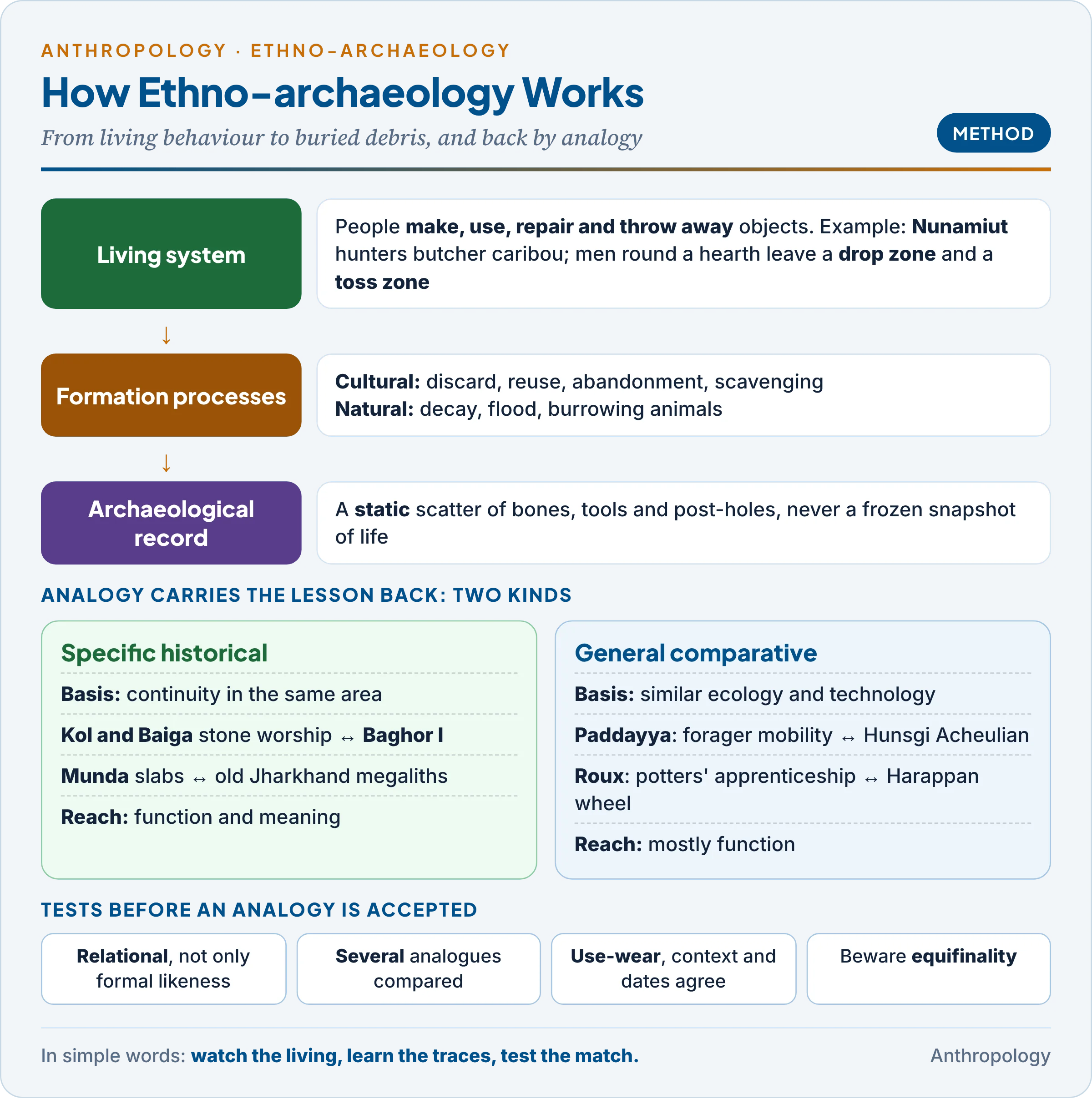
An ethno-archaeological study is planned like an experiment. The researcher starts with a puzzle from an excavation, finds living people in a similar situation, records what they do and what it leaves behind, and then checks whether the pattern matches the ancient site.
A typical study follows six steps, shown here with the Deccan ashmounds (§6.1) as the running example.
- Pose an archaeological question: what were the mounds of burnt cattle dung beside Neolithic villages?
- Choose a living analogue with similar ecology or a historical link: cattle-keeping villages of the same region.
- Observe and record making, use, repair, discard and abandonment: maps, debris counts, timing, informants’ explanations.
- Record abandoned sites of known history: what a deserted camp looks like after one, five or twenty years. LuAnn Wandsnider mapped abandoned and occupied camps of herders and labourers in Karnataka for this reason.
- Derive a model and test it on the excavated record.
- State the limits: how the living group differs from the ancient one.
The strategy answers three kinds of question: function (what was this object for?), organisation (how were production, exchange and settlement arranged?) and site formation (how did this deposit come to be?). Sinopoli grouped South Asian work (1991) into four fields: subsistence and settlement, technology and craft, social organisation and belief, and site formation.
4. Ethno-archaeology in India: Pioneers and Phases
In simple words
India is unusually rich ground for ethno-archaeology because foragers, herders, farmers and hereditary craftspeople still live beside ancient sites. Indian and foreign archaeologists have used this to read the Stone Age, the Harappan cities and the megaliths.
India offers what most regions lack: foragers, herders, shifting cultivators, farmers and hereditary craft communities living side by side, often near ancient sites. The main contributors are listed below.
| Scholar | Community or craft | Contribution |
|---|---|---|
| N.K. Bose | Material culture across India | Mapped house types, ploughs and other traits; demanded anthropological reasoning in archaeology |
| F.R. (Raymond) Allchin | Deccan cattle-keepers | Ashmounds as burnt cattle pens (1963) |
| M.L.K. Murty | Yanadi, Chenchu, Yerukula, Boya; Kuruba herders | Forager models (1981); Kurnool caves (1985); pastoral legends (with G.D. Sontheimer, 1980) |
| V.N. Misra and Malti Nagar | Van Vagri, Kanjar, Pardhi; Maria Gond graves | Hunters in an agrarian setting (1989); Nagar, Hunter-Gatherers in North and Central India (2008) |
| K. Paddayya | Hunsgi-Baichbal valleys (Karnataka) | Call for ecological and ethno-archaeological approaches (1979) |
| Zarine Cooper | Onge and Andaman middens; Kuruk fishers of Bastar | Coastal foraging; myths tested against dates |
| Kenoyer, Vidale and Bhan | Agate bead-makers of Khambhat | Organisation of craft specialisation (1991) |
| Daniel Miller | Village potters of Madhya Pradesh | Artefacts as Categories (1985): pots and caste status |
| Carol Kramer | Potters in two Rajasthani cities | Pottery in Rajasthan (1997): urban production and distribution |
V.N. Misra illustrates the field’s growth. He excavated the Mesolithic sites of Tilwara (1967) and Bagor (1968–70) in Rajasthan, the rock shelters of Bhimbetka (1973–77), the Acheulian sites around Didwana in the Thar and the Chalcolithic village of Balathal, and he paired excavation with ethnographic study of the Van Vagri, Kanjar, Pardhi, Kalbeliya and Banjara and of Maria Gond funerary structures. His work presented Indian prehistory as ecological adaptation, read with the help of living hunters and herders.
Two phases can be seen. Up to the 1970s, parallels were used informally, to name tools and argue continuity. From the late 1970s, under the New Archaeology, Murty, Misra, Nagar and Paddayya did planned fieldwork among living groups alongside excavation of primary sites (where tools lie as they were left), so that models from the present could be tested against mapped living floors. A 1993 Cambridge seminar gathered such work in Bridget Allchin‘s edited volume Living Traditions: Studies in the Ethnoarchaeology of South Asia (1994).
5. Hunting, Foraging and Fishing Communities
In simple words
India still has small communities that live partly by hunting, collecting forest produce and fishing. Watching how they move, hunt, fish and camp helps archaeologists picture Stone Age life, as long as we remember that today’s foragers live in a world of farmers, markets and the state.
5.1 The living foragers
India’s foraging communities are few and small, but they span every major forest and coast.
- Chenchu (Nallamala hills, Andhra Pradesh and Telangana): Christoph von Fürer-Haimendorf, The Chenchus (1943); tubers, honey and small game.
- Yanadi (south-east coast, Andhra Pradesh): fishing and collecting in coastal and riverine habitats.
- Birhor (Chota Nagpur): S.C. Roy, The Birhors (1925). Bands live in a temporary camp (tanda) of cone-shaped leaf huts (kumbha), net monkeys and make rope from forest creepers for sale; divided into the nomadic Uthlu and settled Jaghi.
- Kanjar, Pardhi and Van Vagri (Uttar Pradesh, Madhya Pradesh, Rajasthan): mobile trappers living at the edges of farming villages.
- Hill Kharia, Kadar and Paliyan (eastern India, Western Ghats): forest collectors and honey gatherers; Onge and Jarawa (Andamans): coastal and forest foragers.
5.2 What the ethno-archaeology of hunting shows
Watching present-day hunters changes how Stone Age remains are read in four ways.
- Most of the toolkit is perishable. Living hunters use bows, nets, snares, traps, digging sticks and baskets of wood, bamboo and fibre, which rarely survive. Stone tools are only a fraction of the equipment, and microliths are best read as parts of composite tools: barbs and tips in arrows, fishing spears and knives.
- Traps, snares and nets are old. Studies among tribes of central India and the Eastern Ghats suggest their prototypes were already used in the Upper Palaeolithic; scrapers fit wood and bamboo work, and backed blades fit as inserts in arrows and knives. Murty read the large crescent-shaped backed blades of the Eastern Ghats as woodworking tools.
- Small game and plants dominate. Foragers rely on a wide range of plants and small animals; big game is occasional, so bone-rich site samples may exaggerate hunting.
- Mobility follows water and season. A band may leave several small camps a year rather than one large site.
Honey collecting shows rock art and living practice illuminating each other. Paintings in the Bhimbetka region and the Pachmarhi hills (Madhya Pradesh) show people taking honey from the nests of the giant rock bee, sometimes with ladders and smoke (recorded by Yashodhar Mathpal, 1984), a task forest communities such as the Chenchu still perform. UNESCO’s listing of Bhimbetka (2003) rests partly on this continuity: the hunting-gathering themes of the paintings persist in modified form in nearby Gond, Pradhan and Korku villages, which still paint symbols on shrines and houses.
- Belief: at Baghor I (Son valley), an Upper Palaeolithic platform held a stone with concentric triangular bands; nearby Kol and Baiga people still worship such stones as the Mother Goddess (details in 1.1a). Because the worshippers live beside the site, this is a specific historical analogy.
5.3 Fishing communities
- Bored stones as net-sinkers: ring-shaped bored stones like Upper Palaeolithic ones are still used by Yanadi fishermen as sinkers for river nets, and heavier ones by the Voda Balije for sea fishing. Upper Palaeolithic sites of the Eastern Ghats lie beside permanent water, so aquatic food was probably important then too.
- Andaman shell middens: heaps of shells, bones, pottery and tools mark old camps. Cooper excavated the Chauldari midden (South Andaman, about 4.5 m high, about 2,300 years old) and noted that the Onge used middens as dry platforms for their camps, with huts in a rough circle, which explains why middens are also house sites.
- Myth tested by archaeology: an Andamanese legend names Wot-a-emi as the place of origin; Cooper’s dates showed other middens of the same age, so the myth could not be read as history. Ethno-archaeology runs both ways.
- River fishers: Cooper also studied the Kuruk fishermen of Bastar, whose traps and seasonal camps offer models for Mesolithic fishing.
5.4 Why today’s foragers are not the Stone Age
Contemporary hunter-gatherers have long histories of contact. Murty stressed their symbiosis with farmers: honey, resin, fibre, game and labour exchanged for grain and craft goods. Misra and Nagar showed (1989) that nineteenth-century hunters of the Ganga plains already lived inside an agrarian society, many with caste ideas and Hindu or Muslim practices. Their forests are depleted, so their foods are a reduced remnant of the Stone Age range. These facts limit analogy, yet the forager-farmer exchange they document is itself a model for periods when Mesolithic hunters lived beside Neolithic and Chalcolithic farmers.
The future of hunting and gathering communities is shaped by the same pressures: loss of forest access, sedentarisation, wage labour and conservation rules have made most of them part-time foragers. Several (Birhor, Chenchu, Hill Kharia, Onge, Jarawa) are Particularly Vulnerable Tribal Groups (Unit 9).
6. Pastoral Communities
In simple words
Herders move with their animals between pastures and leave few lasting traces. Living herding communities, with their camps, festivals and legends, help archaeologists read ancient cattle pens, ash heaps and the spread of animal keeping.
6.1 The Deccan ashmounds: an Indian classic
The ashmounds of the southern Deccan (Karnataka, Telangana, Andhra Pradesh) are mounds of vitrified ash beside Neolithic villages. Robert Bruce Foote, the geologist who began Indian prehistory, showed in the nineteenth century that the ash was burnt cow dung.
- Allchin’s excavation at Utnur (1957; published 1963) found stockade post-holes, layers of dung, cattle hoof-prints and repeated burning: the mounds were cattle pens whose dung was periodically burnt.
- Why burnt? Allchin argued the burning was deliberate and ritual, using three kinds of local evidence: place-names with budi (Dravidian for ash), the region’s pastoral communities, and cattle festivals such as Pongal, Diwali and Holi, at which cattle are decorated and, in parts of the Deccan, driven through fire.
- Later readings: Paddayya added that the fires may have drawn gatherings of herders, forerunners of the Deccan’s jatras and cattle fairs; Nicole Boivin linked the mounds to sunrise and inter-site visibility.
This is a specific historical analogy (same region, same animal, unbroken cattle-keeping), limited only by the chance that festival meanings changed over four thousand years.
6.2 Other pastoral parallels
- Kuruba (Kuruva) shepherds (Karnataka, Andhra Pradesh): Murty and Sontheimer (1980) used their Birappa legends and cults to think about the origins of herding in the third millennium BC, a rare use of oral tradition as evidence.
- Bagor (Rajasthan): Misra’s excavation showed Mesolithic people keeping sheep and goats alongside hunting; his studies of Banjara pastoralists supplied models for such mixed economies.
- Transhumance: the Gaddi of Himachal Pradesh and Gujjar of the western Himalaya move seasonally between high and low pastures. Their camps are light and rebuilt each year, which is why prehistoric herders are hard to find and why surveys look for pens, ash lenses and dung-rich soils rather than houses.
6.3 Issues faced by pastoral communities today
The mobility that hides herders from archaeologists also hides them from the state.
| Issue | How it works | Example or response |
|---|---|---|
| Loss of commons | Grazing land encroached, fenced or converted | Shrinking village pastures in Rajasthan and Gujarat |
| Forest restrictions | Protected areas close routes and camps | Van Gujjars and the Rajaji reserve (Uttarakhand) |
| Weak legal recognition | Rights were customary, not recorded | Forest Rights Act 2006, s.3(1)(d): grazing (settled or transhumant) and seasonal access for nomadic and pastoral communities |
| Invisibility in data | Mobile people missed by surveys | 21st Livestock Census (October 2024) counted pastoralists for the first time |
| Market and climate stress | Fodder costs, drought, falling wool prices | Shift to wage labour and settled dairying |
The table links ancient and modern: mobility is an adaptation, not backwardness. Herding uses land too dry or steep to farm, and policies that treat it as a stage to leave behind remove that adaptation.
7. Peasant Communities
In simple words
Peasants are village farmers who feed themselves and also supply towns and the state. Many of their tools, fields, houses and storage habits look like those found in ancient villages, so living villages help archaeologists read ancient farming settlements.
Peasants grow mainly for their own household but are tied to towns, markets and the state through rent, tax and trade; Robert Redfield, an American anthropologist, called them part-societies with part-cultures. India’s villages offer many parallels.
- Fields: the Kalibangan ploughed field and its modern two-crop counterpart (§2.1).
- Carts and ploughs: Harappan terracotta cart models resemble the bullock carts still used in the Indus and Ganga plains, and terracotta plough models from Banawali and Cholistan show the ox-drawn implement.
- Houses and storage: studies of village house forms (M.K. Dhavalikar, Malti Nagar and others) were used to read Chalcolithic Inamgaon (Maharashtra): wattle-and-daub walls, plastered floors, storage jars and pits.
- Shifting cultivation: a study of Garo shifting cultivators (1981) found that wear on their iron axes and hoes resembles wear on prehistoric stone celts of the same hills, supporting the reading of celts as clearing and digging tools.
Shifting cultivation (jhum in the North-East, podu in Andhra Pradesh and Odisha, bewar and penda in central India) clears and burns a forest plot, farms it for a year or two and leaves it fallow. It is sustainable when the fallow cycle is long (10–20 years); population pressure and land loss have shortened cycles, causing soil loss. Alternatives that keep the farmer’s knowledge include improved fallows with nitrogen-fixing trees (the alder-based jhum of Naga farmers), terracing, agroforestry and secure land rights, rather than bans that push families into poverty.
Apatani farming (Ziro valley, Arunachal Pradesh) shows how far a tribal peasantry can go without the plough. Haimendorf, The Apa Tanis and their Neighbours (1962), described irrigated wet-rice terraces fed by channels from hill streams, fish raised in the paddy, millet on the field bunds, clan-owned pine and bamboo groves, and all work done by hand, without draught animals: intensive farming need not follow one Eurasian path.
8. Arts and Crafts Producing Communities
In simple words
India still has hereditary potters, bead-makers, smiths, metal-casters and painters who use methods close to ancient ones. Watching them work shows archaeologists how ancient objects were made, how workshops were organised, and what waste a workshop leaves behind.
8.1 Pottery
Pottery is the most studied Indian craft, because sherds are the commonest archaeological find.
- Continuity: the wheel, paddle-and-anvil and open firing are used much as in the past; B.N. Saraswati argued (1978) that north Indian potting has continued from Harappan times, carried by endogamous potters’ communities.
- Learning: Valentine Roux, a French archaeologist, found that potters near Delhi learn wheel-throwing through a six-stage apprenticeship lasting 15–20 years, and argued that Harappan wheel-made pottery developed in comparable stages, implying craft specialisation.
- Status and change: Daniel Miller‘s study of a Madhya Pradesh village (1985) showed that pot forms marked caste status: when lower castes copied the vessels of higher castes, the higher castes moved to new forms, so styles changed through emulation and innovation, a process close to Sanskritization (5.3).
- Cities and figurines: Carol Kramer (1997) traced urban pottery production and distribution in Rajasthan, and Vidula Jayaswal found mould-made figurines produced mainly for urban buyers in the Ganga plain.
8.2 Beads, metal and painting
- Agate beads at Khambhat (Gujarat), made there since at least 2500 BC: Kenoyer, Vidale and Bhan (1991) found two systems side by side, merchant-controlled production passing stone through many households, each doing one stage, and small independent workshops doing every stage in one place. Each leaves a different spread of waste, a signature to look for in Harappan sites.
- Iron smelting: the Agaria of central India (Verrier Elwin, The Agaria, 1942) and the Asur of the Netarhat plateau, Jharkhand (K.K. Leuva, The Asur, 1963) smelted iron in small bloomery furnaces (producing a spongy lump of iron, not liquid metal) with charcoal and bellows. Their furnaces and slag heaps help interpret Iron Age smelting sites, and Asur smelting songs liken the furnace to an expectant mother: technology carries belief.
- Metal casting: dokra casters of Jharkhand, West Bengal, Odisha and Chhattisgarh still use lost-wax casting (a wax model coated in clay, melted out and replaced by molten metal), the method of the Harappan “dancing girl” bronze; many were mobile artisans serving settled villages.
- Painting: Sohrai-Khovar wall painting of Hazaribagh (Jharkhand), made by women at the harvest festival (Sohrai) and in the marriage chamber (khovar) with natural earths, shares motifs with nearby rock art such as Isco; Erwin Neumayer, an authority on Indian rock art, noted strong stylistic and thematic analogies between rock pictures and house-wall pictures.
Artisan tribes of Jharkhand. L.P. Vidyarthi classified Jharkhand’s tribes by economy and placed the Mahli, Lohra, Karmali and Chik Baraik among the simple artisans. The Lohra and Karmali are blacksmiths making ploughshares, sickles and axes for farming neighbours in jajmani-like exchange; the Mahli make bamboo baskets; the Chik Baraik are weavers; the Asur were iron-smelters. Their crafts show the interdependence of artisan and farming tribes, a pattern to look for when specialised workshops appear in ancient villages.
Craft studies reveal the organisation behind objects: how skill was learned, how work was divided and how goods moved. Their danger is reading caste back into the past: Sinopoli warned that kin-based craft groups occur in many early states, so specialised workshops alone do not prove caste in Harappan times.
9. Living Megalithic Traditions
In simple words
In parts of India, people still raise big stones for their dead and ancestors. Their reasons, feasts and rules help archaeologists understand ancient stone monuments, while also warning that a modern tradition may not share the meaning of an ancient one.
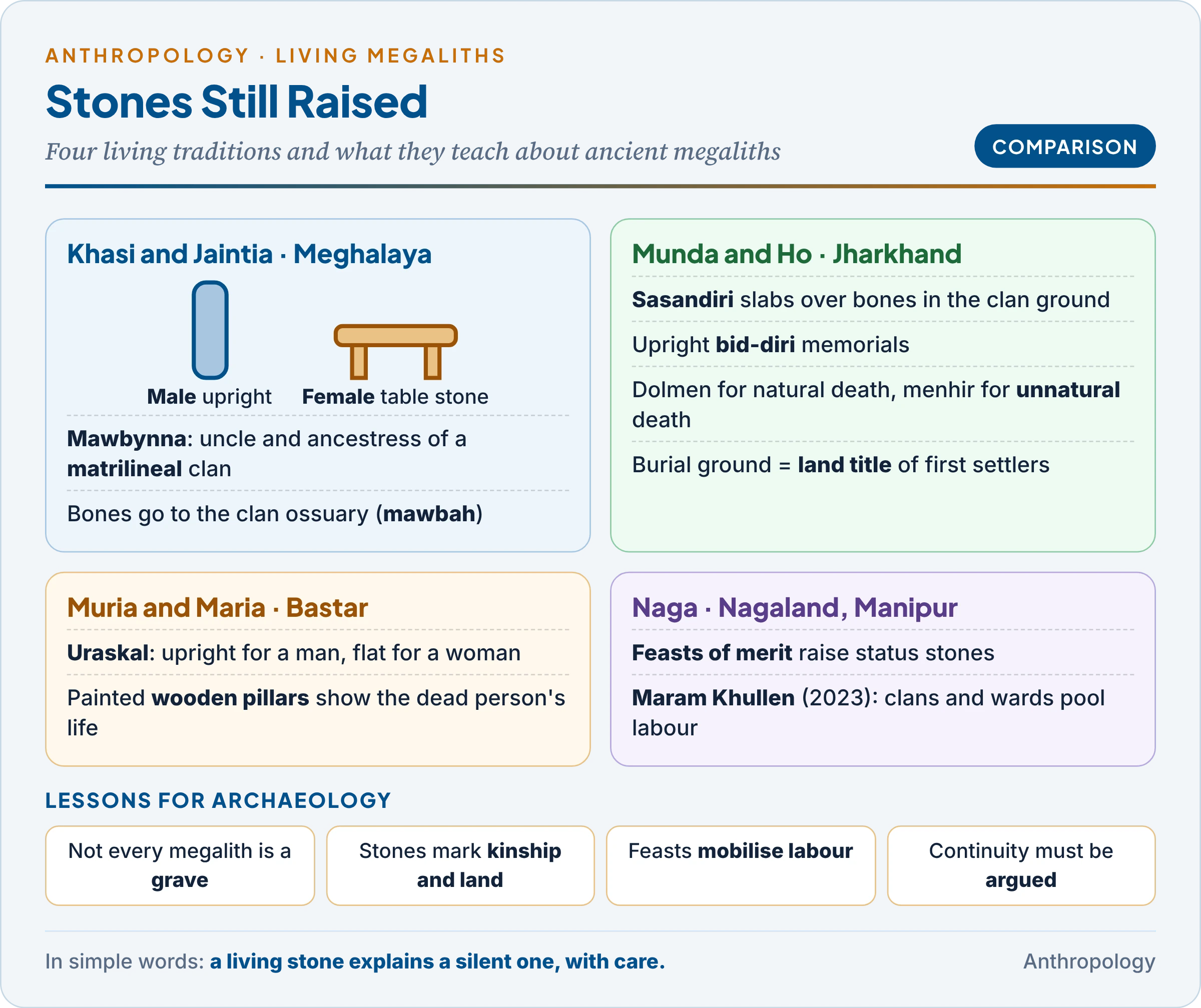
The ancient megaliths of south India are Iron Age tombs (types in Paper 1, Unit 1.8c; comparison in 1.1b). Several Indian communities still raise stone monuments, so India is one of the few places where megalith-building can be observed.
| Community | Monuments | What they mean |
|---|---|---|
| Khasi and Jaintia (Pnar) (Meghalaya) | Memorial stones (mawbynna): upright male stones (mawshynrang), flat female table stones (mawkynthei); clan ossuaries (mawbah) | In this matrilineal society the tallest upright stands for the maternal uncle, the flat stone for the ancestress; table stones also serve as resting seats; Nartiang holds the largest group |
| Munda and Ho (Jharkhand, Odisha) | Slabs or dolmen-like sasandiri over the bones in the clan burial ground (sasan); upright memorials (bid-diri, also written birdiri) | Burial in the clan’s ground marks the family’s right to village land; near Ranchi and Khunti, dolmens for a natural death, menhirs for an unnatural one |
| Muria and Maria (Bastar, Chhattisgarh) | Memorial stones (uraskal) and painted wooden pillars | Raised after death, upright for a man, flat for a woman; part of the soul is believed to stay in the stone; pillars now show the dead person’s life |
| Naga (Nagaland, Manipur) | Monoliths, stone circles, wooden posts | Feasts of merit: stones raised to display status, or by whole villages |
Each living tradition corrects an archaeological habit of mind.
- Not every megalith is a grave: many stones are memorials or ancestor seats with no body beneath.
- Monuments express kinship and land: Khasi stones honour the mother’s line; Munda sasandiri stand only for families descended from the village’s first settlers, so the burial ground doubles as a land title.
- Labour and feasting: a monolith raised by the Maram Naga village of Maram Khullen (Manipur) in 2023 drew cash, food and labour from clans and wards, and the village feasted guests from neighbouring villages, a model for how ancient communities mobilised labour.
- Gender symbolism: pairing upright “male” and flat “female” stones (Khasi, Jaintia, Muria) shows form encoding social categories invisible in excavation.
Continuity must still be argued, not assumed. Haimendorf held that the north-eastern tradition, linked to South-East Asia, and the south Indian Iron Age tradition were unconnected, so the Khasi give only a general comparative analogy for south Indian tombs. In Jharkhand, by contrast, ancient and new Munda stones stand in the same burial grounds, such as Chokahatu (first recorded by E.T. Dalton in 1872), with about 7,500 megaliths, so the link there is specific historical.
10. Limits and Critique of Ethno-archaeology
In simple words
Ethno-archaeology is powerful but risky. Living communities are not leftovers from the Stone Age, and a likeness between two objects does not prove that they meant the same thing. Good work states its limits and tests its analogies.
- The “living fossil” fallacy: treating tribes as Stone Age survivals denies them their own history. Sinopoli criticised writing about “living Harappans” or “living Megalithic” peoples as a colonial idea of India’s timelessness.
- The tyranny of the ethnographic record: Martin Wobst argued (1978) that if the past is read only through recently observed societies, archaeologists can never discover ways of life that no longer exist; ethnographers also observe briefly and may miss rare events such as famines.
- Equifinality: different behaviours can leave identical traces (§2.3).
- Projecting caste and Hinduism backwards: continuity of a symbol does not prove continuity of its meaning.
- A critique from social anthropology: one Indian anthropologist complained that much Indian “ethno-archaeology” merely describes a tribal technique (a prize-winning study of fishing methods is his example) without asking how a culture works. Cultural change, he argued, comes from the interplay of four sectors: subsistence, demography (customs such as celibacy or polyandry regulate numbers), social complexity (redistribution through feasts) and ideology (the values guiding a people’s choices). A single cause such as climate cannot explain why one region became Neolithic while its neighbour kept hunting. He credited N.K. Bose with having asked for such anthropological reasoning long before the New Archaeology.
The critiques define how to use the method rather than discard it. The best Indian studies (Murty on foragers, Kenoyer on Khambhat, Allchin on the ashmounds) worked in the same region as the archaeology, used several lines of evidence, and treated the living community as a source of hypotheses to test, not a picture of the past.
Common confusion
Is a “survival” the same as a “parallel”? No. A survival has continued in the same place from the past to the present (Kalibangan two-crop ploughing; Munda stones in old burial grounds), so it can support claims about meaning. A parallel only resembles an ancient practice, with no proven link (Khasi stones and south Indian tombs), so it can usually suggest only function.
Key Terms
| Term | Meaning in simple words |
|---|---|
| Ethno-archaeology | Archaeologists studying living people to learn how objects are made, used and discarded |
| Material culture | The physical things a society makes and uses |
| Specific historical analogy | Analogy based on continuity between living and ancient groups in the same area |
| General comparative analogy | Analogy based on similar ecology and technology, without assumed continuity |
| Survival | A practice continued in the same place from the past to the present |
| Parallel | A similar practice without a proven historical link |
| Middle-range theory | Tested links between behaviour and the traces it leaves |
| Formation processes | Cultural and natural processes that turn living debris into a site |
| Drop zone and toss zone | Where small debris falls near a seated worker, and where larger rubbish is thrown |
| Expedient and curated tools | Quick throw-away tools, and valued tools kept and repaired |
| Equifinality | Different causes producing the same end result |
| Relational analogy | Analogy resting on a causal link between form and use |
| Ashmound | Mound of burnt cattle dung beside Neolithic sites of the southern Deccan |
| Transhumance | Seasonal movement of herders between fixed pastures |
| Bloomery furnace | Small furnace producing a spongy lump of iron, not liquid metal |
| Lost-wax casting | Casting metal in a clay mould formed round a wax model that is melted out |
| Sasandiri | Munda stone slab over the bones of the dead in the clan burial ground |
| Mawbynna | Khasi memorial stones raised for ancestors |
Contemporary Developments
- Pastoralists counted (2024): the 21st Livestock Census, launched on 25 October 2024, enumerated pastoralists and their animals for the first time since livestock censuses began in 1919, defining a pastoralist as one whose animals move outside the village for at least a month a year and depend on common resources.
- Living megaliths documented (2023–2025): a study of the village-sponsored monolith at Maram Khullen (Manipur, 2023) showed clan- and ward-based mobilisation; a 2025 survey of the Upper Baitarani valley (Odisha) recorded ancient and recent Munda, Bhumij and Ho burial sites side by side.
- Decline of traditional ironworking (2026): fieldwork among the Asur, Lohra, Karmakar and Karmali of Jharkhand and Purulia found that ore-based smelting has ended under mining leases, forest laws and fuel scarcity; rituals survive while technical knowledge fades.
- Community-based archaeology (2025–2028): Nagaland University, with Australian and British partners, began a four-year study of Naga ancestral village sites through participatory research with descendant communities.
- Sohrai-Khovar painting received a Geographical Indication in May 2020; its registration cites motifs shared with the rock art of Hazaribagh.
Diagrams to Master
- Topic map: concept, analogy, method, the five kinds of community, megaliths and critique.
- How ethno-archaeology works: living behaviour → formation processes → record; specific historical vs general comparative analogy, with an Indian example each.
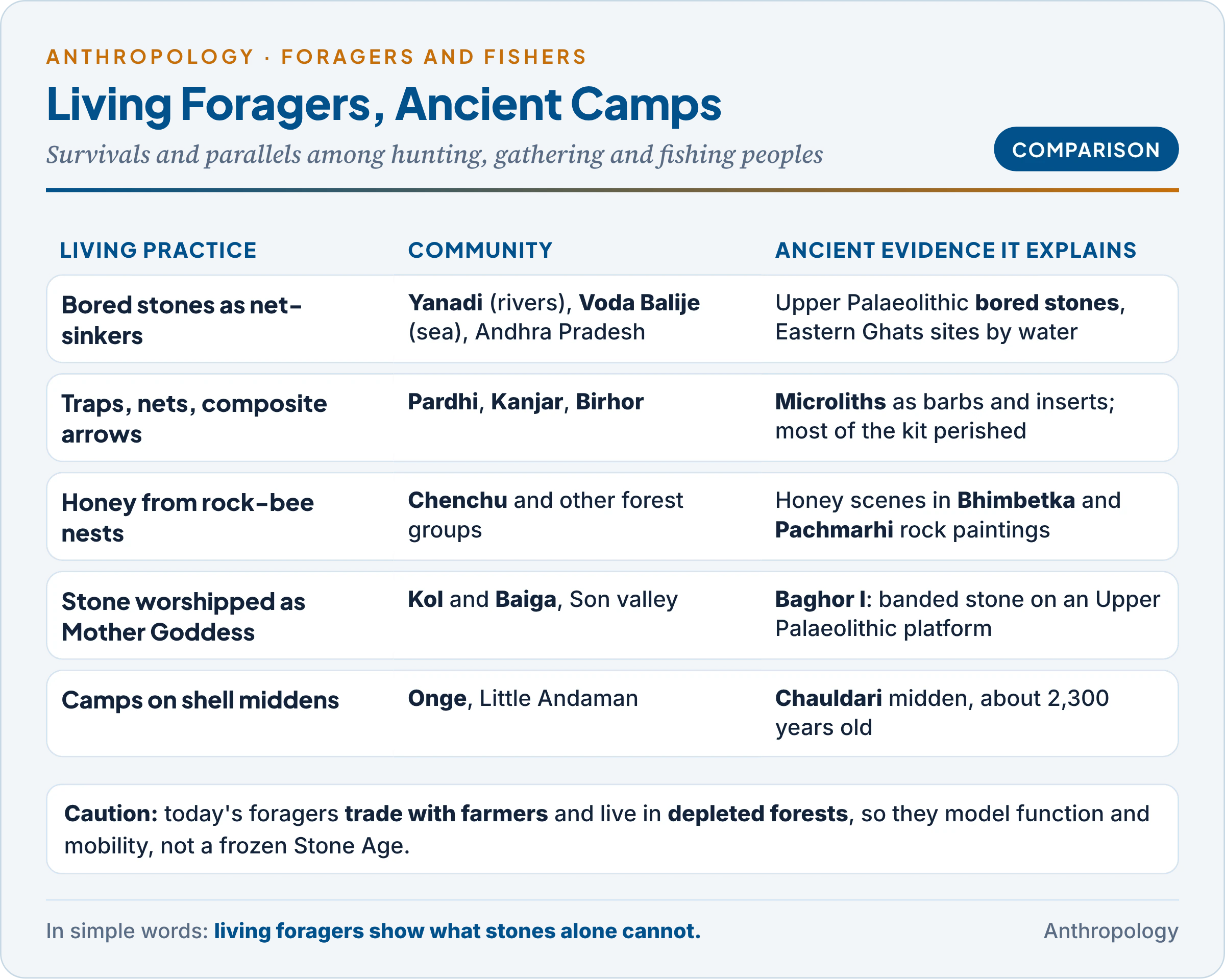
- Foragers and fishers: Yanadi net-sinkers, composite tools, honey in rock art, Baghor stone, Onge middens.
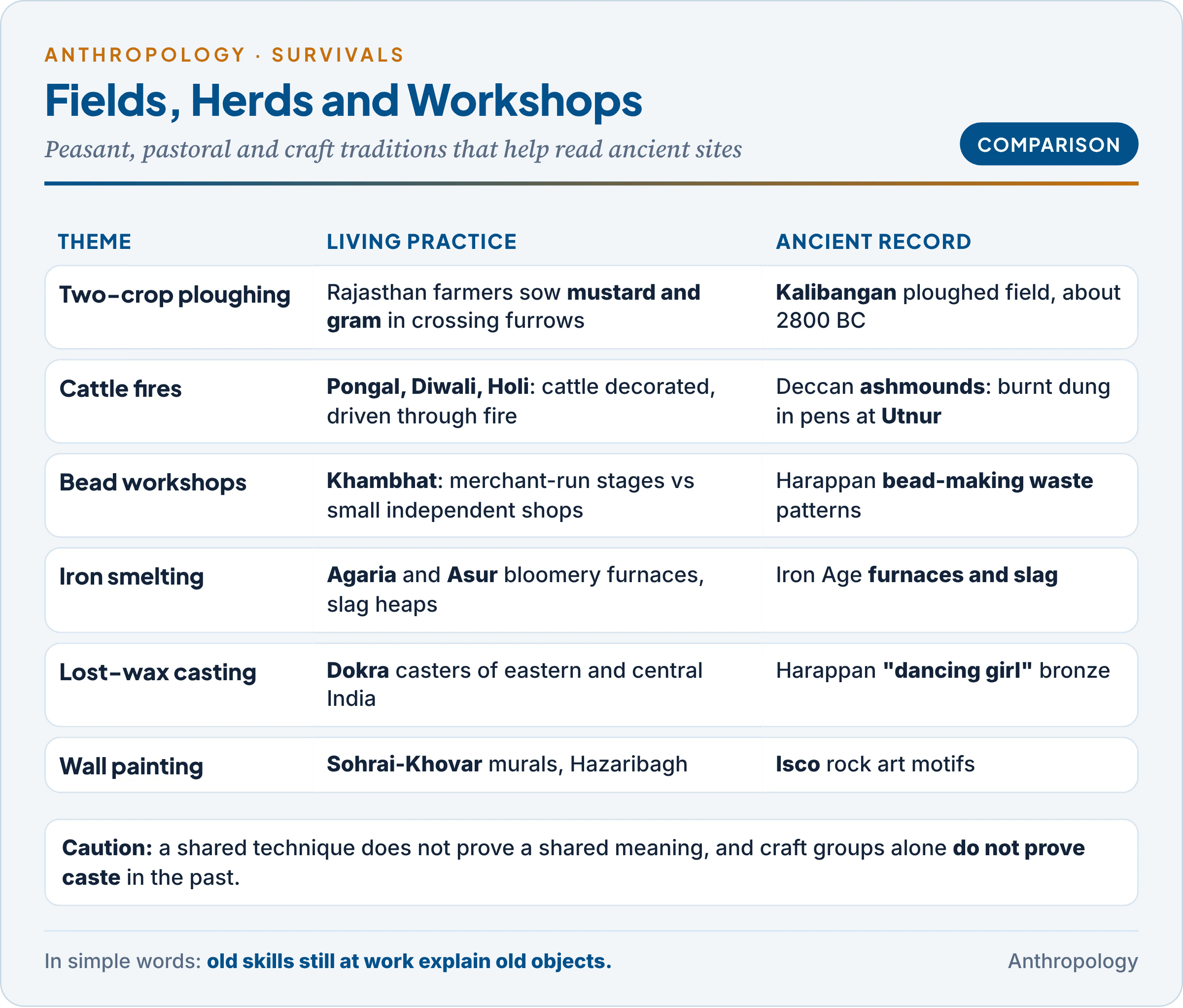
- Peasants, herders and crafts: Kalibangan furrows, ashmounds, Khambhat workshops, Agaria/Asur furnaces, lost-wax.
- Living megaliths: Khasi, Munda, Muria, Naga, each with the lesson it gives.
Revision Grid
| Scholar | Work (year) | Key idea |
|---|---|---|
| E.B. Tylor | Primitive Culture (1871) | Survivals carry the past into the present |
| J.W. Fewkes | Hopi studies (1900) | First “ethno-archaeologist” |
| Kleindienst and Watson | “Action archaeology” (1956) | Inventory a living community archaeologically |
| Robert Ascher | “Analogy in archaeological interpretation” (1961) | Rules for choosing analogies |
| Lewis Binford | Nunamiut Ethnoarchaeology (1978) | Middle-range theory; butchery and site structure |
| William Rathje | Garbage Project (1973) | What people say and what they discard differ |
| Ian Hodder | Symbols in Action (1982) | Material culture marks boundaries |
| Martin Wobst | “Tyranny of the ethnographic record” (1978) | The present limits what we imagine about the past |
| Alison Wylie | “The Reaction against Analogy” (1985) | Formal vs relational analogy |
| F.R. Allchin | Neolithic Cattle-Keepers of South India (1963) | Ashmounds as burnt cattle pens |
| M.L.K. Murty | World Archaeology (1981) | Forager models for Stone Age subsistence |
| Misra and Nagar | Man and Environment (1989) | Hunters in an agrarian setting |
| Kenoyer, Vidale and Bhan | Khambhat beadmaking (1991) | Organisation of craft specialisation |
| Daniel Miller | Artefacts as Categories (1985) | Pots, caste status and emulation |
| Carla Sinopoli | “Seeking the Past through the Present” (1991) | South Asian review; warning against “timelessness” |
Previous Year Questions
Ethno-archaeology in India: concept, survivals and parallels
- 2026Discuss with examples, how general comparative analogy has been used for ethnoarchaeological studies in India.
- 2024Write notes on: Agricultural practices of the Apatani.
- 2024Write notes on: Artisan tribes of Jharkhand.
- 2020Write short note on the Contribution of Robert Bruce Foote to Indian Archaeology in about 150 words.
- 2020Write short note on the Debates on ‘Aryan’ invasion in about 150 words.
- 2020Discuss the contribution of V. N. Misra to Archaeological Anthropology in India.
- 2020Discuss the importance of Ethnoarchaeology in reconstructing the Past citing Indian examples.
- 2019Write a note in 150 words on Ethno-archaeological analysis of hunting activities of contemporary tribal communities.
- 2019What are the salient issues faced by pastoral communities in India ? Discuss with suitable examples.
- 2018Write a note in 150 words on Ethnoarchaeology as a research strategy.
- 2017Write a note in 150 words on Ethno-archaeology.
- 2017Discuss the relevance of art and craft traditions in the understanding of Indian archaeology.
- 2016Write a note in 150 words on Ethnoarchaeological evidences for the survival of hunting-gathering traditions in India.
- 2014Discuss the importance of the ethno-archaeological approach to the study of indigenous craft in India.
- 2013Discuss alternatives for shifting cultivators in the context of ecological costs and humanistic concerns.
- 2011Write a note in 150 words on Future of Hunting and Gathering Tribes.
- 2009Write a note on New Archaeology.
- 2008Write a note on Concept of Ethnoarchaeology.
- 1998Write a note on Ethnographic profile of a matrilineal tribe in India.
- 1997Write a note on Shifting cultivation, its merits and demerits.
- 1996Write a note on Ethnographic profile of a polyandrous tribe.
- 1993Write a note on Shifting cultivation in the context of land use pattern.
- 1991Delineate the major social and cultural characteristics of Indian tribes at the hunting and food gathering stage. How is their ecological adaptation reflected in the world-view ?
- 1988Write a note on “Tribe” and “Caste” as closed ethnic groups.
- 1986Give in detail the ethnographic profits of either a matrilineal or a polyandrous tribe of India.
- 1986Write a note on Hunting and foodgathering tribes of India.
- 1985Write a note on Peasant society.
- 1985Write a note on Pastoralism.
- 1982Write a note on (200 words) : Shifting cultivation of different geophysical contexts.
- 1981Write a note on Food gatherers among Indian tribe. (200 words).
Related questions from other units
- 2026Write notes on: Ethnoarchaeology and classical archaeology.
- 2023Unit 1.1: Write notes on: Material culture and archaeology.
- 2023Unit 1.1: Write notes on: Prehistoric rock arts from Uttarakhand.
- 2022Unit 1.1: Make a critical appraisal of Megalithic tradition in India with special reference to North-East India.
- 2019Discuss with examples the Megalithic culture of India in the archaeological context.
- 2015Unit 1.1: Write a note in 150 words on Prehistoric Rock Art of Central India.
- 1997Unit 1.1: Describe the distinguishing characteristic features of South Indian Megaliths and compare these with either Central Indian or North-eastern Indian Megaliths.
- 1988Unit 6.2: Discuss the special problems of shifting cultivators or of hunting food gathering tribes.
More from Evolution of Indian Culture and Civilization: all notes of this unit · every PYQ of this unit · Anthropology Optional hub