

Anthropology Optional › Paper II › Unit 01: Evolution of Indian Culture and Civilization
1.2 Palaeo-anthropological evidences from India with special reference to Siwaliks and Narmada basin (Ramapithecus, Sivapithecus and Narmada Man).
Official Syllabus: Paper II, Unit 1.2
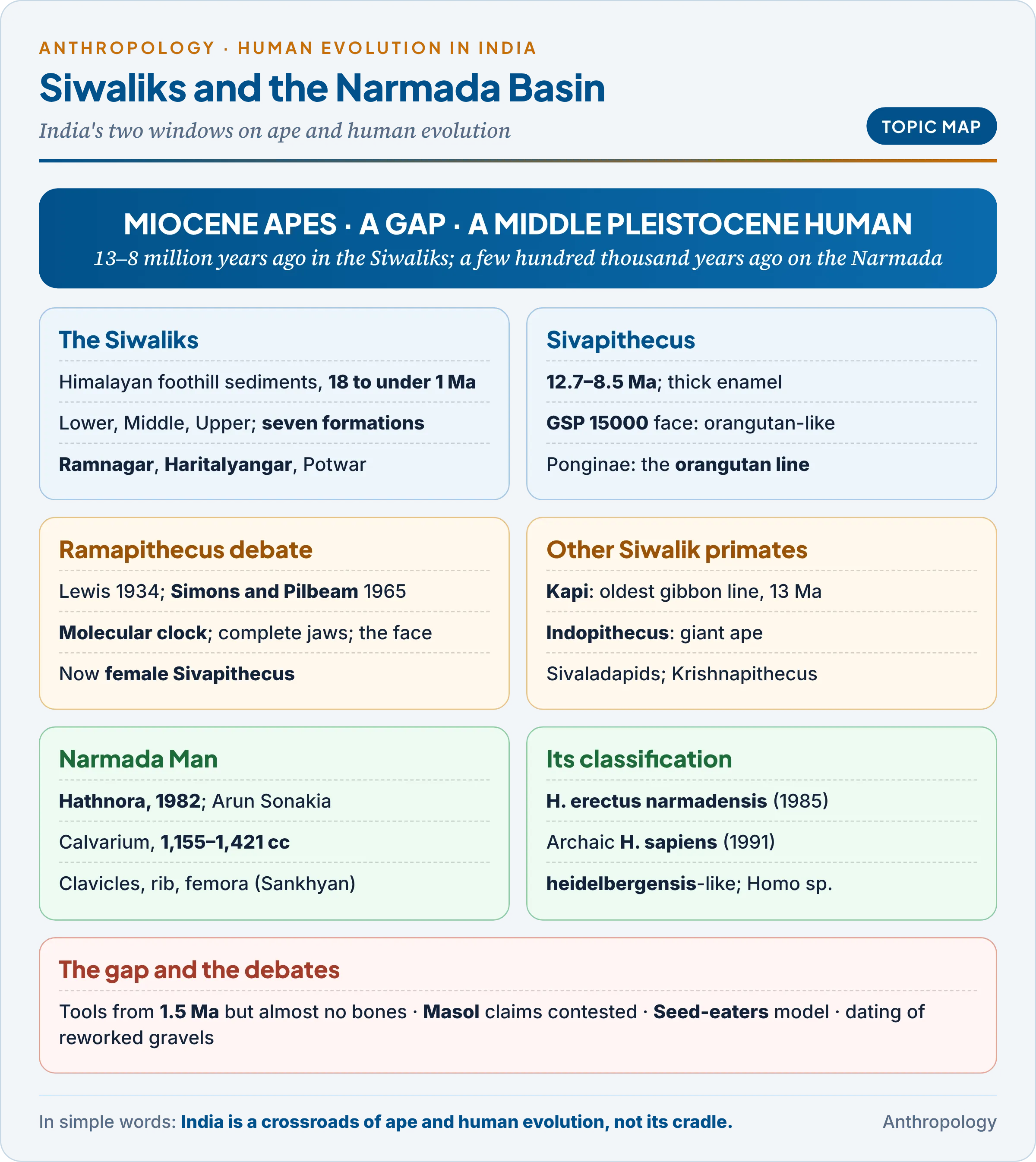
This article is the Indian evidence in depth. The world framework is in Paper 1: the Miocene apes and the first statement of the Ramapithecus debate in Unit 1.5b, and Homo erectus, Homo heidelbergensis and a short profile of Narmada Man in Unit 1.6b. The Soanian and Acheulian stone-tool cultures of the Siwaliks and the Narmada are taught in 1.1a; here they appear only as the context of the fossils.
1. Palaeoanthropology and India’s Two Windows
In simple words
Palaeoanthropology studies human evolution from fossils, tools and their ages. India has two rich windows on that past: the Siwalik Hills, which hold apes that lived 13 to 8 million years ago, and the Narmada valley, which holds a human skull a few hundred thousand years old. Between the two lies a long gap with tools but almost no bones.
- Palaeoanthropology: the study of human evolution through fossils (preserved remains), the tools and sites they left, and their dating and environment. It joins physical anthropology, archaeology, geology and palaeontology.
- Window 1, the Siwaliks: the foothills of the Himalaya hold one of the world’s longest dated records of Miocene apes (about 13–8 million years ago, Ma): Sivapithecus (with what was once called Ramapithecus), the giant Indopithecus, the gibbon-like Kapi and smaller primates.
- Window 2, the Narmada: the gravels of the central Narmada valley gave the only Middle Pleistocene hominin fossil of South Asia, the Hathnora calvarium (skullcap without face or jaw), called Narmada Man, with later post-cranial bones.
- The gap: stone tools show that humans were in India by at least about 1.5 million years ago (Acheulian hand-axes at Attirampakkam, Tamil Nadu), yet no hominin bone older than the Narmada fossil has been found (Section 6).
1.1 Names that changed: the old and the new scheme
The questions on this unit use the older classification, in which only humans and their direct ancestors were “hominids”. Current classification, based on DNA, groups humans with the great apes. Read the table to translate between them.
| Level | Older scheme (used in the questions) | Current scheme | Who is included (current) |
|---|---|---|---|
| Superfamily | Hominoidea | Hominoidea | All apes and humans |
| Family | Pongidae (great apes); Hominidae (humans) | Hominidae | Orangutans, gorillas, chimpanzees, humans |
| Subfamily | — | Ponginae | Orangutan line, with Sivapithecus |
| Tribe | — | Hominini | Humans and their extinct relatives after the split from chimpanzees |
| Common word | “Hominid” = human line | “Hominin” = human line; “hominid” = any great ape or human |
The change matters because the debate on Ramapithecus was a debate about whether it was a hominid in the old sense, that is, on the human line. In current terms the question becomes: was it a hominin, or a member of the Ponginae? The answer today is the second.
Common confusion
Hominoid, hominid, hominin: which is which? Hominoid is the widest: every ape and human. Hominid today means the great apes and humans (family Hominidae), though older books used it for the human line only. Hominin means the human line alone, after the split from chimpanzees about 7–6 million years ago. Sivapithecus is a hominoid and a hominid, but not a hominin.
1.2 A short history of research
- First finds: British engineers Proby Cautley and Hugh Falconer collected Siwalik fossils in the 1830s and described a fossil monkey (1837), among the first fossil primates ever reported anywhere. Their Fauna Antiqua Sivalensis (1846–49) made the Siwaliks famous.
- The first apes: Richard Lydekker described an ape jaw as Palaeopithecus sivalensis (1879); the geologist Guy Pilgrim of the Geological Survey of India named Sivapithecus (1910) and Dryopithecus punjabicus (1910), and thought India might be the home of human ancestry.
- Expeditions: the Yale North India Expedition (1932) led to G. Edward Lewis‘s Ramapithecus (1934); the Yale-Cambridge Expedition of Hellmut de Terra and T.T. Paterson (1935; published 1939) linked Siwalik and Narmada terraces to Himalayan glaciations and defined the Soan culture.
- Indian scientists: K.N. Prasad (Geological Survey of India) described Haritalyangar apes (1962–64); S.R.K. Chopra of Panjab University built India’s main palaeoanthropology programme in the Siwaliks and, with Elwyn Simons, named Gigantopithecus bilaspurensis (1969); Ashok Sahni, Rajeev Patnaik, G.L. Badam and A.R. Sankhyan continued the work; Arun Sonakia of the Geological Survey found Narmada Man (1982).
2. The Siwaliks: Geology, Subdivisions and Fauna
In simple words
The Siwaliks are low hills made of sand, clay and gravel washed down from the rising Himalaya over the last 18 million years. Layer upon layer, they buried the animals of each age, so they form a long, dated book of life. Apes appear in this book about 13 million years ago and vanish about 8 million years ago.
2.1 What and where
- Name: after the Shivalik (“belonging to Shiva”) hills; geologists write Siwalik Group.
- Extent: a belt of outer Himalayan foothills from the Potwar Plateau (Pakistan) through Jammu, Himachal Pradesh, Haryana–Punjab (Chandigarh), Uttarakhand and Nepal towards the Brahmaputra.
- Origin: molasse, the river-borne sediment shed from the Himalaya as it rose after India collided with Asia. Rivers laid sandstones, mudstones and conglomerates about 7 km thick, from about 18 to under 1 million years ago.
- Dating: volcanic ash for radiometric dating is rare, so the Siwaliks are dated by magnetic stratigraphy (matching reversals of the Earth’s magnetic field recorded in the sediments to the global time scale) and by biostratigraphy (the order of appearance of animal species, including small rodents). The Potwar sequence is dated to about 100,000 years at many levels, among the best-dated land sequences of the Miocene.
2.2 Subdivisions
The Siwalik Group is divided into three subgroups and seven formations. The ages are approximate and the boundaries are time-transgressive (the same rock unit can be of slightly different age in different places).
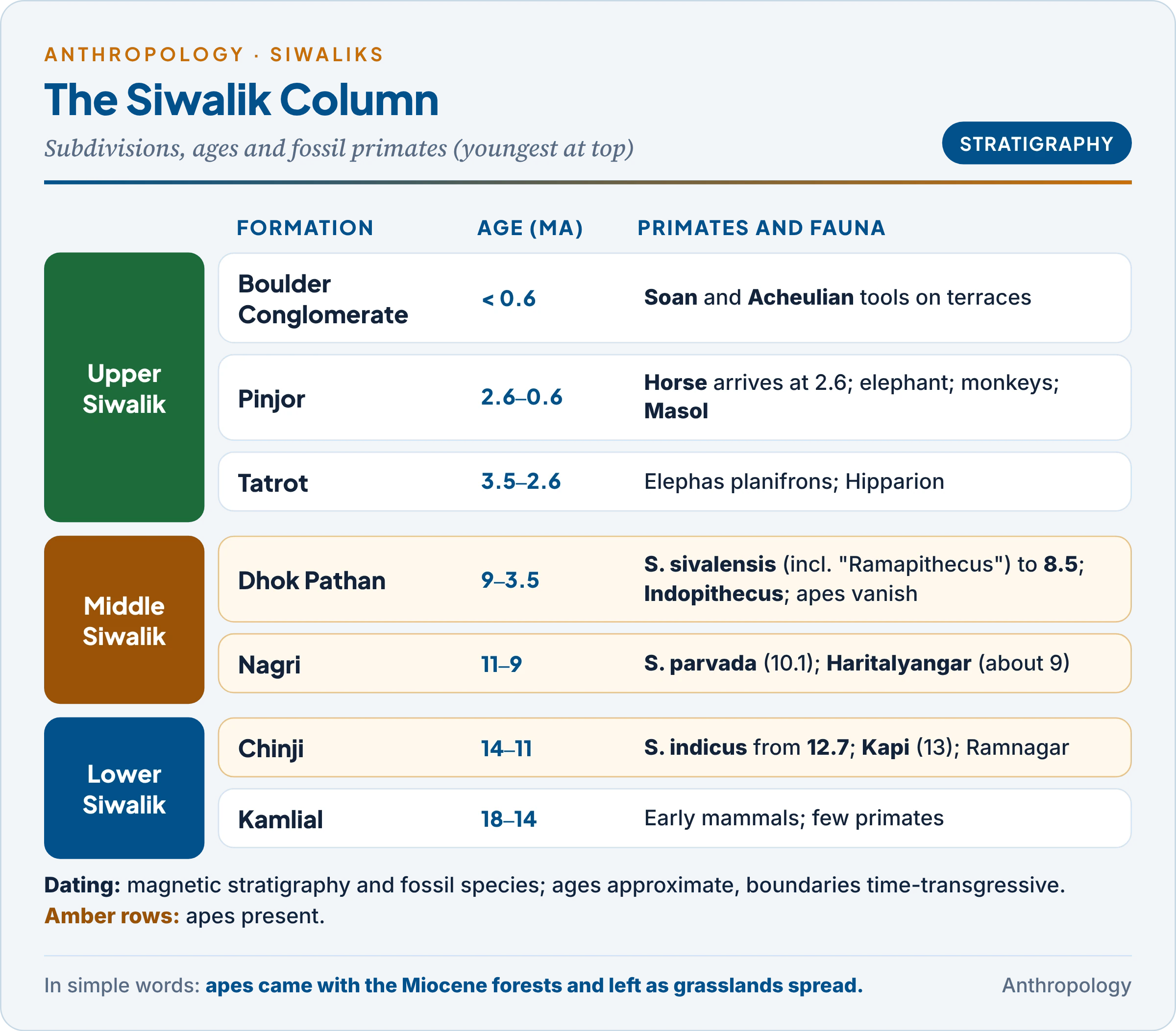
| Subgroup | Formation | Approximate age (Ma) | Primate and key fauna |
|---|---|---|---|
| Lower Siwalik | Kamlial | 18–14 | Early mammals; few primates |
| Chinji | 14–11 | Sivapithecus indicus (first at 12.7 Ma); Kapi; sivaladapids; Ramnagar (J&K) | |
| Middle Siwalik | Nagri | 11–9 | S. parvada (10.1 Ma); Hipparion horses arrive |
| Dhok Pathan | 9–about 3.5 | S. sivalensis (to 8.5 Ma, includes “Ramapithecus“); Indopithecus; apes vanish | |
| Upper Siwalik | Tatrot | about 3.5–2.6 | Elephas planifrons, Hipparion |
| Pinjor | 2.6–0.6 | Equus (horse) arrives at 2.6 Ma; Elephas and Stegodon; Old World monkeys; Masol (Chandigarh) | |
| Boulder Conglomerate | under 0.6 | Few fossils; Soan and Acheulian tools on its terraces |
The table shows the pattern that makes the Siwaliks important: apes appear with the warm, wet forests of the Middle Miocene and disappear in the Late Miocene, before the Pliocene–Pleistocene animals (horse, modern elephant, cattle) arrive. Human tools come only at the very top, in the gravels and terraces of the last million years.
2.3 Fossil primates of the Siwaliks
| Group | Taxon | Locality and age | Note |
|---|---|---|---|
| Strepsirrhines (lemur-like) | Sivaladapis, Indraloris; Ramadapis sahnii (2017) | Potwar; Ramnagar; Haritalyangar | Late survivors of the adapiform primates in Asia |
| Pliopithecoids (primitive catarrhines) | Krishnapithecus krishnaii | Haritalyangar, about 9 Ma | Confirmed by new molars (A.R. Sankhyan, Jay Kelley, Terry Harrison, 2017) |
| Lesser apes | Kapi ramnagarensis | Ramnagar, about 13 Ma | Oldest known gibbon-line fossil (2020) |
| Great apes | Sivapithecus (indicus, parvada, sivalensis) | Potwar, Ramnagar, Haritalyangar; 12.7–8.5 Ma | Orangutan line; includes “Ramapithecus“ |
| Giant ape | Indopithecus giganteus (= Gigantopithecus bilaspurensis) | Haritalyangar, about 9–8 Ma | Very large jaw and molars |
| Old World monkeys | Macaca, Procynocephalus and others | Upper Siwalik | Arrive in the Pliocene and Pleistocene |
- Ramnagar (Jammu and Kashmir): Lower Siwalik; renewed work since 2010 by Christopher Gilbert, R.K. Sehgal, Rajeev Patnaik and colleagues found a new Sivapithecus jaw (2019), Ramadapis (2017) and Kapi (2020).
- Haritalyangar (Bilaspur, Himachal Pradesh): Middle Siwalik, about 9.2–8.6 Ma; the classic Indian locality for Sivapithecus, “Ramapithecus” (Lewis’s type jaw), Indopithecus and Krishnapithecus.
- Potwar Plateau (Pakistan): the richest sequence, explored from the 1970s by David Pilbeam (Yale, later Harvard) with the Geological Survey of Pakistan; source of the face GSP 15000 and most limb bones of Sivapithecus.
2.4 Why the Siwaliks matter
Five reasons explain why the Siwaliks are central to palaeoanthropology.
- A long, dated record: few places in the world give a continuous, well-dated sequence of land mammals across 18 million years; faunal change can be timed to within about 100,000 years.
- Ape dispersal into Asia: Sivapithecus (12.7 Ma) and Kapi (about 13 Ma) show that great apes and lesser apes reached Asia at about the same time, after land routes opened from Africa through Arabia in the Middle Miocene.
- Origin of the orangutan: the Sivapithecus face is the best fossil evidence for the orangutan lineage, which places the split between the Asian and African great apes before about 12.7 Ma.
- Climate and extinction: the apes vanish by about 8 Ma, when the monsoon intensified, forests shrank and C4 grasslands (tropical grasses) spread, a change recorded in the carbon isotopes of soils and teeth. Patnaik and colleagues (2005) argue that increasing seasonality and aridity drove the Siwalik apes to extinction.
- Human prehistory at the top: the Upper Siwalik terraces carry Soan and Acheulian tools, and Masol has yielded contested claims of the oldest human activity in Asia (Section 6).
- Soan culture in brief: a pebble-tool industry of choppers and chopping tools (with later flakes) named after the Soan river of the Potwar. De Terra and Paterson (1939) divided it into Early and Late Soan stages on river terraces tied to Himalayan glaciations. Later work (V.N. Misra, 1989) showed the terraces are erosional and cannot be dated that way, and the Soan’s separate identity from the Acheulian is disputed. The culture is treated fully in 1.1a.
The Siwaliks therefore matter less as a “cradle of mankind” and more as a calibrated record of ape evolution, dispersal and extinction against which African and European finds are compared.
3. Sivapithecus: The Orangutan’s Ancestor
In simple words
Sivapithecus was a large ape, about the size of a chimpanzee or bigger, that lived in the forests of the Siwaliks between 13 and 8 million years ago. Its face looks very like an orangutan’s, so it is placed on the orangutan’s family line, not on ours. Its arm bones, however, are not like an orangutan’s, which still puzzles scientists.
Example first. In 1980, on the Potwar Plateau, David Pilbeam’s team found a partial skull with most of the face, GSP 15000, about 9–8 million years old. Published in Nature (1982), it showed a concave face, tall, narrow eye sockets set close together and large projecting upper incisors: the face of an orangutan. Many fragmentary jaws that had been argued over for decades suddenly made sense, and one fossil reset the timing of human origins.
3.1 Names, species and range
- Genus: Sivapithecus Pilgrim, 1910 (“Shiva’s ape”); the earliest species name is S. sivalensis (Lydekker, 1879).
- Species (one current scheme, by the primatologist Jay Kelley): time-successive species, each with large (male) and small (female) individuals:
- S. indicus: Chinji Formation, from 12.7 Ma;
- S. parvada: very large, one Potwar locality at 10.1 Ma;
- S. sivalensis: Nagri and Dhok Pathan, to 8.5 Ma; “Ramapithecus punjabicus” is now a junior synonym (a later name for the same species).
- Range: Siwaliks of Pakistan, India and Nepal; in 2018 a molar from Tapar in Kutch (Gujarat) became the first Sivapithecus outside the Siwaliks.
- Size: males about 30–70 kg, females much smaller: strong sexual dimorphism, like the orangutan and gorilla.
3.2 Salient features
| Region | Feature | What it suggests |
|---|---|---|
| Face (GSP 15000) | Concave (dished) profile; tall, oval orbits close together; narrow space between the eyes | Orangutan (pongine) synapomorphies |
| Snout and palate | Smooth floor between nose and mouth, with the palate overlapping the premaxilla | Pongine pattern, unlike African apes and humans |
| Front teeth | Very large, spatulate upper central incisors; small lateral incisors | Fruit-husking, as in orangutans |
| Canines and premolars | Large, sexually dimorphic canines; lower first premolar hones the upper canine | Ape, not hominin |
| Molars | Large, flat-wearing, thick enamel, low cusps | Tough or hard foods; thick enamel also occurs in hominins, so it is not diagnostic |
| Jaw | Deep, robust mandible | Heavy chewing |
| Arm bones | Humerus shaft bent, unlike living great apes | Above-branch quadruped, not a hanging climber |
| Hand and foot | Curved finger bones; grasping big toe | Arboreal life |
The table shows the “Sivapithecus paradox”: the face is orangutan but the limbs are not. Either the orangutan’s suspensory (hanging) limbs evolved later, after Sivapithecus, or the face resemblance arose convergently (independently). Most specialists still place Sivapithecus on the orangutan line because the facial and palatal features are many and specific, while locomotion can change quickly.
3.3 Phylogenetic position
- Older view (1960s–70s): Sivapithecus (often merged into Dryopithecus) was an ape near the common ancestor of apes and humans; smaller jaws were split off as Ramapithecus and placed on the human line.
- Current view: Sivapithecus belongs to the Ponginae, the orangutan lineage, with Lufengpithecus (China) and Indopithecus as relatives. Peter Andrews and John Cronin (Nature, 1982) and Pilbeam (1982) established this link.
- Consequence: if the orangutan line had separated by 12.7 Ma, the African ape–human line had to evolve separately in Africa or western Eurasia, and the human–chimpanzee split could be much later (about 7–6 Ma), as molecular dating requires.
4. Ramapithecus and the Ramapithecus–Sivapithecus Debate
In simple words
For about twenty years, a few jaw pieces from the Siwaliks were thought to belong to the first human ancestor, called Ramapithecus. Better fossils and genetic dating later showed that they were small members of Sivapithecus, an ape on the orangutan’s line. The story shows how science corrects itself.
Example first. In 1932, near Haritalyangar in the Siwalik Hills of Himachal Pradesh, G. Edward Lewis, a Yale graduate student, collected an ape upper jaw fragment (specimen YPM 13799) with small front teeth and a short face. He named it Ramapithecus brevirostris (“Rama’s short-snouted ape”, 1934) and suggested it was close to the human line. Lewis also named Sugrivapithecus and Bramapithecus; with Sivapithecus, these mythological names became the “god-apes” of the Siwaliks.
4.1 The case for a hominid (1960s–70s)
The American palaeontologists Elwyn Simons (1961, 1964) and David Pilbeam revived Lewis’s specimen and, in 1965, merged many small Siwalik and African jaws into Ramapithecus punjabicus (using Pilgrim’s older species name punjabicus). They included Kenyapithecus wickeri, found by Louis Leakey at Fort Ternan, Kenya (about 14 Ma). Other specimens were reported from Turkey, Hungary and Greece.
The features claimed as human-like were:
- Parabolic dental arcade (tooth rows diverging towards the back, as in humans), reconstructed from the maxilla;
- Small, vertically set incisors and canines, with little or no diastema (gap for the opposing canine);
- Thick-enamelled, flat-wearing molars with low cusps, and a robust jaw for heavy chewing;
- Short face (less prognathism, forward projection of the jaws);
- Wear gradient along the molars, suggesting slow growth.
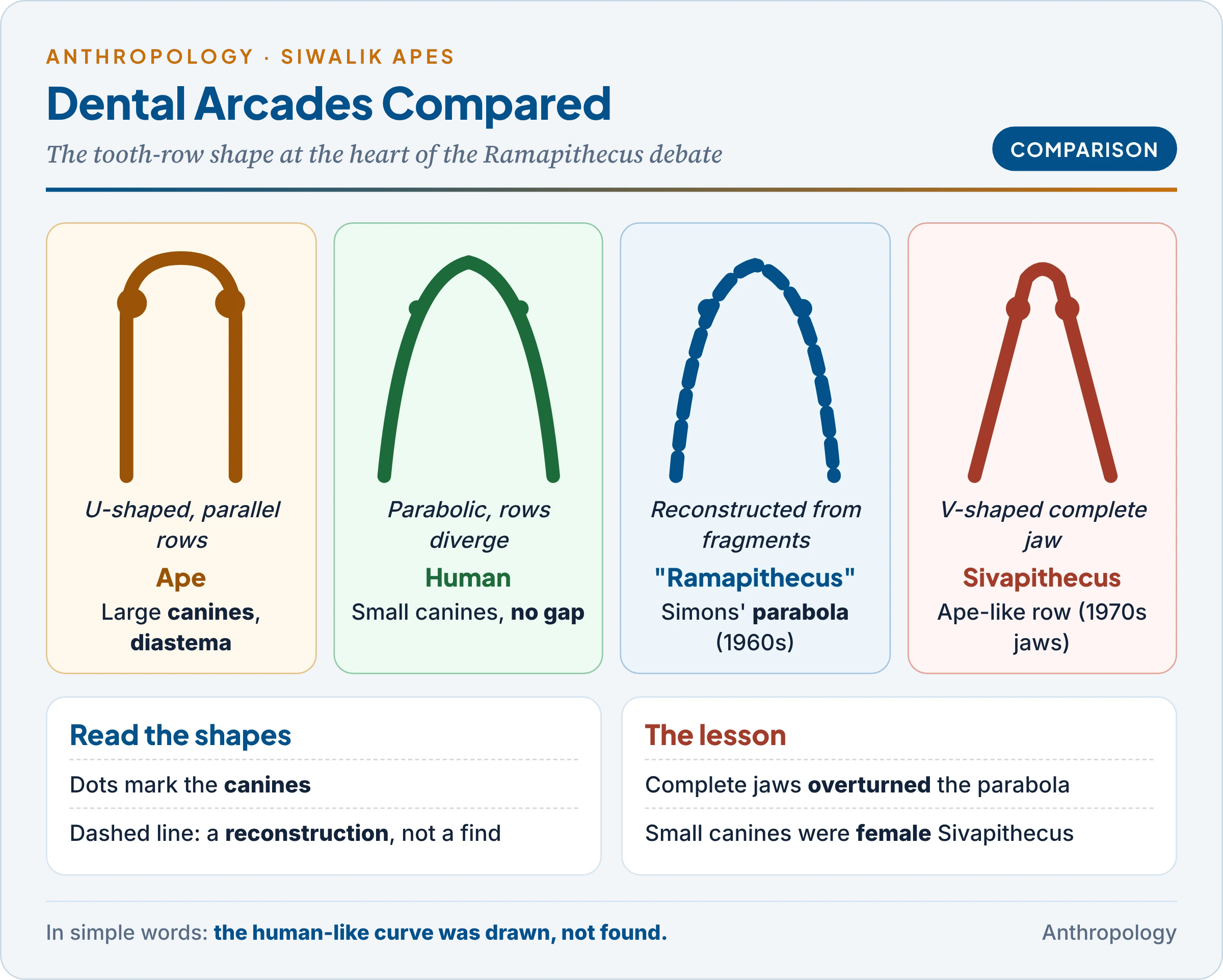
On this basis Simons and Pilbeam placed the human–ape split at about 14–15 Ma. Writers went further, suggesting tool use, bipedalism and life on the forest edge; none of these was ever shown by fossils.
4.2 The Seed-Eaters Model of hominid differentiation
In 1970 the British-born primatologist Clifford Jolly published “The Seed-Eaters: A New Model of Hominid Differentiation Based on a Baboon Analogy” (Man). He asked why the human line first diverged from the apes, and answered with an analogy from the gelada baboon (Theropithecus gelada) of the Ethiopian highlands, which feeds on grass seeds, blades and roots in open country.
- The model: the first hominids were small-object feeders in open grassland. Picking up small seeds needs precise finger movements and long hours of sitting upright; grinding them needs thick enamel, large flat molars, robust jaws and small incisors. These traits, Jolly argued, appeared before tools and hunting.
- Two phases: a first, seed-eating phase produced the dental and postural traits; a later, hunting phase (with tools and meat) produced the rest of the human pattern.
- Link to Ramapithecus: thick enamel and heavy chewing in Ramapithecus fitted the model, so it supported the hominid reading in the 1970s.
- Contribution: the model replaced the “hunting ape” idea (tools and weapons as the first human traits) with diet and ecology, and showed how analogy with living primates can generate testable hypotheses.
- Criticism: geladas still have large canines; Ramapithecus proved to be an ape; the earliest hominins (Ardipithecus, about 4.4 Ma) lived in wooded, not open, habitats; and dental wear shows varied diets. The model survives as one source of the hard-object feeding hypothesis for robust australopithecines.
4.3 How Ramapithecus lost its place
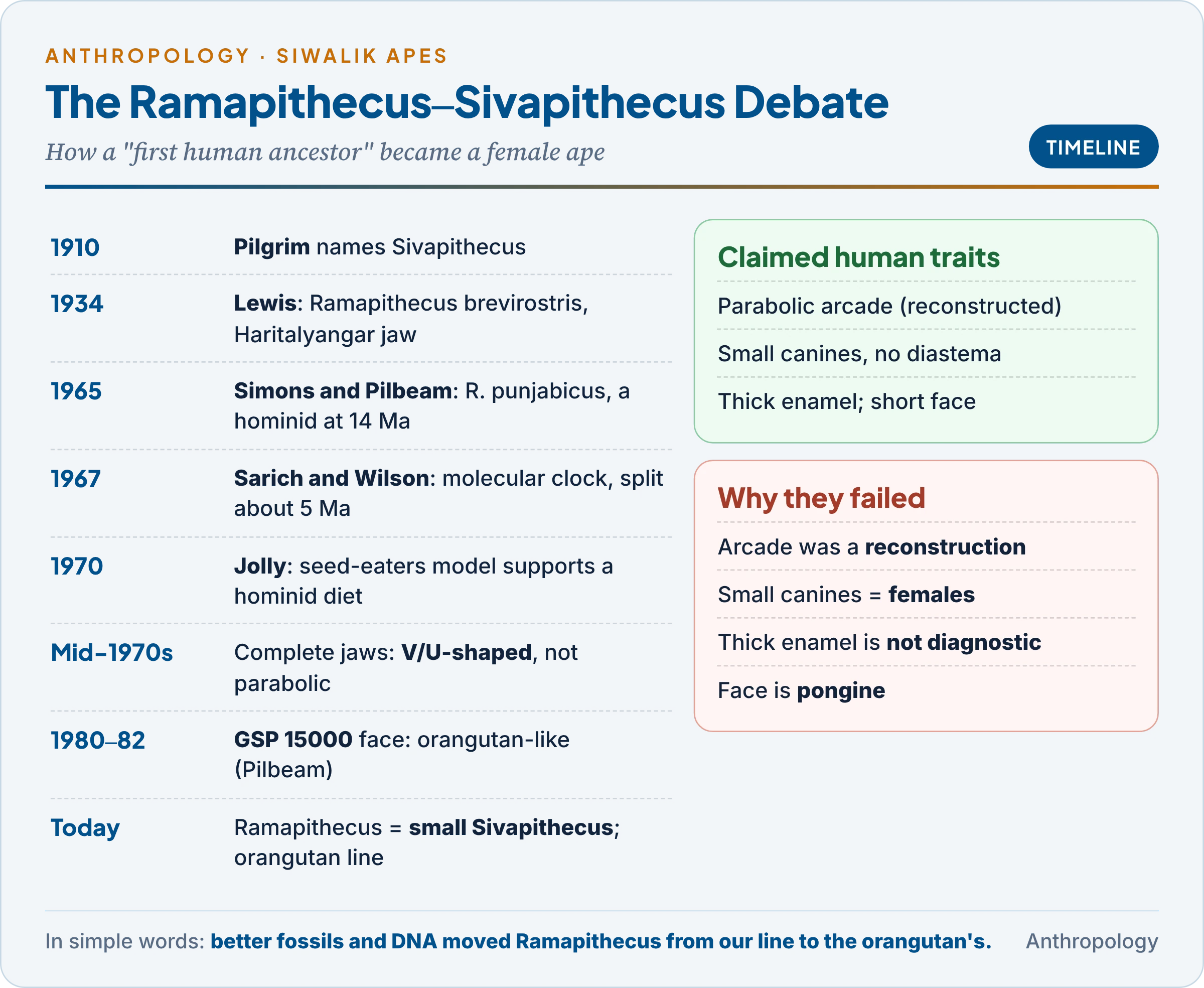
Four kinds of evidence, arriving over fifteen years, overturned the hominid reading.
| Evidence | Who and when | What it showed |
|---|---|---|
| Molecular clock | Vincent Sarich and Allan Wilson, Science (1967) | Blood-protein (albumin) differences put the human–ape split at about 5 Ma, far too late for a 14 Ma hominid |
| Complete jaws | Potwar and other finds, mid-1970s | The tooth row is V- or U-shaped, not parabolic; Simons’ parabola came from reconstructing broken pieces |
| Sexual dimorphism | Analysis of the larger samples | Small canines and jaws are the females (or smaller individuals) of Sivapithecus, not a separate genus |
| The face | GSP 15000, found 1980, published 1982 | Orangutan face: the whole group is pongine |
- Thick enamel re-examined: thick enamel occurs in many Miocene apes and in orangutans; it is a primitive or convergent trait, so it cannot mark the human line.
- Pilbeam’s change of mind: Pilbeam, once the chief advocate, led the Potwar project and himself abandoned the hominid claim, a celebrated example of a scientist following new evidence.
4.4 Current taxonomic status
- Ramapithecus is no longer a valid genus. The Siwalik specimens belong to Sivapithecus (mostly S. sivalensis); Lewis’s R. brevirostris and Simons and Pilbeam’s R. punjabicus are junior synonyms.
- Elsewhere: the Fort Ternan jaw is again Kenyapithecus wickeri (an African ape); European and Turkish “ramapithecines” are placed in genera such as Griphopithecus and Ankarapithecus.
- What remains: the human line arose in Africa about 7–6 Ma (Sahelanthropus, Orrorin, Ardipithecus); the Siwalik apes are relatives of the orangutan.
Common confusion
Was Ramapithecus “proved wrong” by the molecular clock alone? No. The clock (1967) created the conflict, but many palaeontologists rejected it for a decade. The case was settled by fossils: complete jaws showing the ape-shaped tooth row, larger samples revealing sexual dimorphism, and the 1980 face. The lesson is that molecular and fossil evidence must agree, and that a genus built on fragments can dissolve when complete specimens appear.
The debate leaves three methodological lessons: beware of reconstructing fragmentary fossils to fit a hypothesis; allow for sexual dimorphism before naming new genera; and treat shared primitive or convergent traits (thick enamel) separately from shared derived traits (the orangutan face) when building family trees.
5. Narmada Man: The Hathnora Hominin
In simple words
In 1982 a geologist found the top of a human skull in old river gravels at Hathnora, on the Narmada in Madhya Pradesh. It is the only human fossil of its age in South Asia. It has a thick skull and heavy brow like Homo erectus but a bigger, rounder brain-case, so scientists still argue about which species it belongs to and how old it is.
5.1 Discovery and context
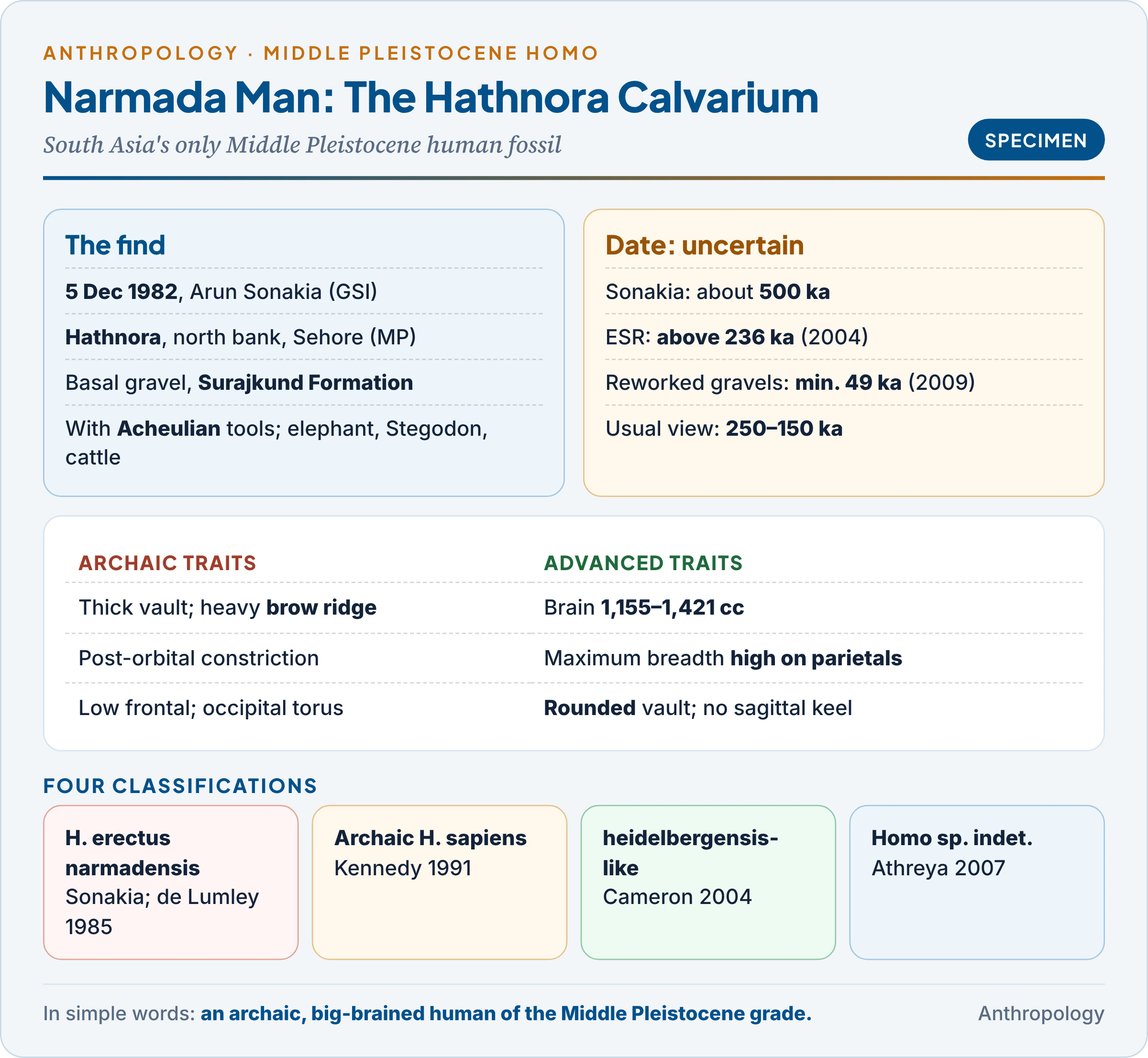
Example first. On 5 December 1982, Arun Sonakia of the Geological Survey of India noticed a fossilised skullcap in the basal gravels at Hathnora, on the north bank of the Narmada in Sehore district, Madhya Pradesh, across the river from Hoshangabad (now Narmadapuram). It is the calvarium of an adult human: most of the right side of the braincase (frontal, parietal, part of the occipital and temporal) with part of the left parietal.
- Deposit: the Boulder Conglomerate at the base of the Surajkund Formation, a gravel laid by the Pleistocene Narmada.
- Fauna in the same gravels: the straight-tusked elephant Palaeoloxodon (Elephas) namadicus, Stegodon, wild cattle Bos namadicus, buffalo Bubalus palaeindicus, hippopotamus Hexaprotodon, horse Equus namadicus and deer: a Middle to early Late Pleistocene fauna.
- Tools: Acheulian hand-axes and cleavers and later flake tools, many of them rolled and reworked.
5.2 Salient characteristics
The skull mixes archaic and advanced features. Read the table as the evidence used on both sides of the classification debate.
| Archaic (erectus-like) features | Advanced (later Homo-like) features |
|---|---|
| Thick vault bones | Larger braincase: about 1,155–1,421 cc (Kennedy and colleagues, 1991) |
| Massive, continuous brow ridge (supraorbital torus) with a groove behind it | Maximum breadth higher on the parietals |
| Post-orbital constriction (narrowing behind the eyes) | Higher, more rounded vault |
| Low, flattened frontal | No strong sagittal keel or angular torus |
| Strong occipital torus | Less angular occipital (back of the skull) |
- Age and sex: a young adult; Sonakia and the French palaeoanthropologist Marie-Antoinette de Lumley suggested a female of about 30, but sex cannot be fixed securely from a partial calvarium.
- Why it matters: the mosaic of thick, heavily browed vault with a large, rounded brain is the signature of Middle Pleistocene Homo, the grade that includes H. heidelbergensis in Africa and Europe.
5.3 The classification debate
| Classification | Proposed by | Main argument |
|---|---|---|
| Homo erectus narmadensis (an evolved H. erectus) | Sonakia (1984); de Lumley and Sonakia (1985) | Thick vault, heavy brow, post-orbital constriction, flat frontal |
| Archaic Homo sapiens | Kenneth Kennedy, Sonakia and colleagues (1991) | Brain size, high parietal breadth, rounded vault: like Petralona, Arago, Steinheim and Kabwe |
| Homo heidelbergensis-like | David Cameron, Rajeev Patnaik and Ashok Sahni (2004) | Cladistic analysis: shares key derived features with H. heidelbergensis |
| Homo sp. indet. (genus only) | Sheela Athreya (2007) | Traits fall within the variation of Middle Pleistocene Homo; one partial skull is not enough to name a species |
Arguments for excluding Narmada Man from Homo erectus (the 2022 question) are therefore: its brain size lies above the erectus range; its vault shape (higher, with maximum breadth on the parietals and a rounded rear) is derived; it lacks Asian erectus specialisations such as the sagittal keel and angular torus; and its probable date is younger than classic Asian erectus. The arguments for keeping it in erectus are the thick vault, brow and constriction, which are primitive features shared by all early Homo and so do not decide the case.
The present consensus is that Narmada Man belongs to the Middle Pleistocene, large-brained grade of Homo, best described as H. heidelbergensis-like or archaic Homo. Whether South Asia’s Middle Pleistocene people were related to the Denisovans (an Asian archaic group known mainly from DNA) is an open question that only ancient proteins or DNA from the fossil could test.
5.4 The dating problem
- Early estimates: Sonakia proposed about 500,000 years (Middle Pleistocene) from fauna, Acheulian tools and the Narmada sequence.
- ESR (electron spin resonance) on associated teeth: Cameron and colleagues (2004) reported an age above 236,000 years.
- Reworked gravels: Rajeev Patnaik, Parth Chauhan and colleagues (Journal of Human Evolution, 2009) showed that the hominin gravels contain reworked, temporally mixed fossils and tools. Their ESR ages on three teeth gave a minimum of about 49,000 years (early-uptake model) and about 83,000–162,000 years (linear uptake), so the calvarium’s age is uncertain: anywhere from the late Middle to the Late Pleistocene.
- Overlying layers: the Youngest Toba Ash (from the Sumatran eruption about 75,000 years ago) lies in the younger Baneta Formation above, which gives a broad upper limit to the sequence.
Most workers today place the calvarium in the late Middle Pleistocene, roughly 250,000–150,000 years, but this rests on fauna and context, not on a direct date.
5.5 Post-cranial finds and the “short-statured” hypothesis
- Clavicles and rib: Anek Ram Sankhyan of the Anthropological Survey of India reported a hominin clavicle (collar bone) from Hathnora (Journal of Human Evolution, 1997), and later a second clavicle and a ninth rib (2005). They are small, suggesting a short, stocky individual of about 4 feet 4 inches (about 1.3 m).
- Femora and humeri: surveys from 2005 to 2010 recovered a femur from Netankheri (Middle Pleistocene, heidelbergensis-like) and a humerus older than the Toba ash (about 75,000 years) that Sankhyan and colleagues (2012) linked to early modern humans.
- Sankhyan’s synthesis (2020): two morphotypes: a “robust, tall” hominin (the calvarium and two femora, cf. H. heidelbergensis, about 300,000–150,000 years) and a “short and stocky” hominin that he named Homo narmadensis (about 150,000–40,000 years), a possible precursor of short-bodied Indian populations.
- Evaluation: the bones come from different spots and levels, so linking them to one population is uncertain; the new species name has not been widely accepted. Sankhyan’s earlier claims that the Narmada valley was a centre of human origin conflict with the African evidence and are not supported.
5.6 Phylogenetic significance
- The only Middle Pleistocene hominin of South Asia: it fills a geographic gap between the African and European heidelbergensis-grade fossils and the Chinese ones (Dali, Jinniushan).
- Makers of the Acheulian: it gives a face (or rather a skull) to the makers of India’s hand-axes, though the association in reworked gravel is loose.
- Mosaic evolution: its blend of archaic and advanced traits supports the view that brain enlargement preceded the loss of the heavy vault, as in Kabwe and Petralona.
- Models of modern human origins: it is used by multiregional writers as evidence of local continuity and by Out-of-Africa writers as an archaic population later replaced; the fragmentary record cannot decide between them.
6. India in Human Evolution: Gaps, Claims and Prospects
In simple words
India has many stone tools from the last two million years but very few human bones. Scientists explain this by the kind of soils and rivers in India and by how little searching has been done. New dating methods and new searches may fill the gap.
- Tools without bones: Acheulian tools at Attirampakkam (about 1.5 Ma) and Isampur (about 1.2 Ma), and the claimed Riwat artefacts in Pakistan (about 1.9 Ma), show early human presence, but the Narmada fossils are the only hominin bones older than the Late Pleistocene.
- Masol claims: an Indo-French team led by Anne Dambricourt Malassé reported (2016) cut marks on bovid bones and simple choppers from the Quranwala zone near Masol (Chandigarh Siwaliks), below the 2.58 Ma magnetic reversal. If confirmed this would be the oldest human activity outside Africa, but the tools were collected from the surface and other specialists question the cut-mark identification, so the claim is not accepted.
- Why so few fossils (the archaeologist Parth Chauhan‘s review): acidic and reworked fluvial deposits destroy or mix bones; most fieldworkers are archaeologists or geologists, not trained physical anthropologists, so fragments go unrecognised; and dam construction on the Narmada threatens the key sections.
- “Cradle” or “crossroads”: Pilgrim’s idea of India as the cradle of mankind and later claims for the Narmada as a centre of origin are not supported; India is a crossroads, where ape and human dispersals between Africa, western Eurasia and East Asia can be timed.
- Prospects: ancient proteins from tooth enamel (palaeoproteomics), which have already placed Gigantopithecus (2019) on the orangutan line, and improved ESR and luminescence dating could test the age and affinities of the Narmada fossils.
Fossil Summary
The table brings together the main fossils of this unit for quick comparison.
| Specimen or taxon | Site | Date (method) | Traits | Significance |
|---|---|---|---|---|
| Kapi ramnagarensis (lower third molar) | Sunetar, Ramnagar, J&K | About 13 Ma (biostratigraphy; magnetic stratigraphy by correlation) | Gibbon-like molar | Oldest gibbon-line fossil; lesser and great apes reach Asia together |
| Sivapithecus indicus | Chinji Formation; Ramnagar | 12.7–about 11.4 Ma (magnetic stratigraphy) | Thick enamel; dimorphic canines | Earliest great ape of South Asia |
| “Ramapithecus“ (YPM 13799 maxilla) | Haritalyangar, HP | About 9 Ma (correlation) | Small incisors, short face | Former “first hominid”; now Sivapithecus |
| GSP 15000 (S. sivalensis face) | Potwar Plateau, Pakistan | About 9–8 Ma (magnetic stratigraphy) | Concave face, close-set oval orbits | Orangutan link; ended the hominid claim |
| Indopithecus giganteus | Haritalyangar, HP | About 9–8 Ma | Huge jaw and molars | Giant pongine; relative of Gigantopithecus |
| Hathnora calvarium (Narmada Man) | Hathnora, Narmada, MP | Late Middle Pleistocene? (fauna; ESR minimum 49 ka) | 1,155–1,421 cc; heavy brow; rounded vault | Only Middle Pleistocene hominin of South Asia |
| Hathnora clavicles and rib | Hathnora | Middle to Late Pleistocene | Small, robust | Short-statured hominins? |
Key Terms
| Term | Meaning in simple words |
|---|---|
| Palaeoanthropology | The study of human evolution from fossils, tools and their ages |
| Hominoid | Any ape or human |
| Hominid | Today, any great ape or human; in older books, the human line only |
| Hominin | The human line after the split from chimpanzees |
| Ponginae | The orangutan branch of the great apes |
| Siwalik Group | Himalayan foothill sediments of the last 18 million years |
| Molasse | Sediment shed from a rising mountain range |
| Magnetic stratigraphy | Dating rock layers by the reversals of the Earth’s magnetic field they record |
| Biostratigraphy | Dating layers by the fossil species they contain |
| Time-transgressive | A rock unit whose age changes from place to place |
| Calvarium | A skull without the face and lower jaw |
| Dental arcade | The curve of the tooth row: U-shaped in apes, parabolic in humans |
| Diastema | A gap in the tooth row for the opposing canine |
| Sexual dimorphism | Size and shape differences between males and females |
| Junior synonym | A later name for a species that already has a name |
| Synapomorphy | A shared derived trait that shows common ancestry |
| Homoplasy | A similarity that evolved independently, not from a common ancestor |
| Molecular clock | Dating a split from the number of genetic differences |
| ESR dating | Electron spin resonance: dating tooth enamel from trapped radiation damage |
| Reworked deposit | A layer whose fossils were washed in from older layers |
Contemporary Developments
- A firmer age for Ramnagar (October 2025): a jaw of the short-lived cane rat Paraulacodus indicus from the Sivapithecus site of Rashole places the Ramnagar primates, including Kapi and Ramadapis, at about 13 Ma, the same age as the first Sivapithecus of the Potwar (Rajeev Patnaik and colleagues, The Anatomical Record).
- Kapi defended (2025): quantitative analyses by Christopher Gilbert’s team answered critics who had called Kapi ramnagarensis a stem catarrhine or pliopithecoid, reaffirming it as the earliest known hylobatid.
- Oldest gibbon (2020): the naming of Kapi ramnagarensis extended the gibbon fossil record by about 5 million years and showed that lesser and great apes reached Asia together (Proceedings of the Royal Society B).
- Homo narmadensis proposed (2020): A.R. Sankhyan sorted the Narmada femora, humeri and clavicles into a robust heidelbergensis-like type and a short, stocky type he named Homo narmadensis; the proposal awaits wider acceptance.
- Sivapithecus in Kutch (2018): a molar from Tapar, Gujarat, was the first Sivapithecus found outside the Siwaliks, widening the ape’s known range.
- New Ramnagar Sivapithecus (2019): a new jaw and a taxonomic revision of the Ramnagar apes (Gilbert and colleagues, Journal of Human Evolution) confirmed S. indicus in India’s Lower Siwaliks.
Diagrams to Master
- Topic map: two windows (Siwaliks: Miocene apes; Narmada: Middle Pleistocene Homo), the gap between, and the debates.
- Siwalik column: three subgroups, seven formations, approximate ages, and the primates in each; mark 12.7 Ma (first Sivapithecus), 8.5 Ma (last apes) and 2.6 Ma (horse arrives).
- Ramapithecus debate timeline: 1910 → 1934 → 1965 → 1967 → 1970 → 1970s jaws → 1980–82 face → current status.
- Dental arcades: U-shaped ape, parabolic human, Simons’ reconstructed “Ramapithecus” versus the complete V-shaped jaw.
- Narmada Man card: find spot and date, fauna and tools, archaic versus advanced traits, four classifications and the dating range.
Revision Grid
| Scholar | Work (year) | Key idea |
|---|---|---|
| Cautley and Falconer | Fossil monkey (1837); Fauna Antiqua Sivalensis (1846–49) | First Siwalik primate; Siwalik fauna |
| Lydekker | 1879 | Palaeopithecus (= Sivapithecus) sivalensis |
| Guy Pilgrim | 1910; 1915 | Named Sivapithecus; India as human home |
| G. Edward Lewis | 1934 | Ramapithecus brevirostris, Haritalyangar |
| De Terra and Paterson | 1939 | Siwalik and Narmada terraces; Soan culture |
| Simons and Pilbeam | 1965 | Ramapithecus punjabicus as a hominid |
| Sarich and Wilson | Science (1967) | Molecular clock: human–ape split about 5 Ma |
| Simons and S.R.K. Chopra | 1969 | Gigantopithecus bilaspurensis (Indopithecus) |
| Clifford Jolly | Man (1970) | Seed-eaters model, gelada analogy |
| David Pilbeam | Nature (1982) | GSP 15000: Sivapithecus–orangutan link |
| Andrews and Cronin | Nature (1982) | Sivapithecus, Ramapithecus and the orangutan |
| Arun Sonakia | 1984; with de Lumley 1985 | Narmada Man as Homo erectus narmadensis |
| Kenneth Kennedy and colleagues | 1991 | Narmada Man as archaic Homo sapiens |
| A.R. Sankhyan | 1997; 2005; 2012; 2020 | Clavicles, rib, femur, humerus; Homo narmadensis |
| Cameron, Patnaik and Sahni | 2004 | Narmada calvarium heidelbergensis-like; ESR above 236 ka |
| Sheela Athreya | 2007 | Homo sp. indet. |
| Patnaik, Chauhan and colleagues | J. Human Evolution (2009) | Reworked gravels; uncertain age |
| Gilbert and colleagues | 2019; 2020 | Ramnagar Sivapithecus; Kapi ramnagarensis |
Previous Year Questions
Palaeo-anthropological evidences from India: Siwaliks and Narmada basin
- 2026Write notes on: Seed Eaters Model of hominid differentiation.
- 2026Write notes on: Debate regarding the phylogenetic position of Narmada Man.
- 2025Discuss the palaeoanthropological significance of Siwaliks of India giving its subdivisions, fossil primate fauna and major primate fossil localities.
- 2025Write notes on: Taxonomic status of Ramapithecus in the light of Ramapithecus-Sivapithecus controversy.
- 2023Write notes on: Ramapithecus-Sivapithecus debate.
- 2023“Siwalik deposits show a variety of Neogene fossil primates.” Critically examine.
- 2022What are the arguments for excluding Narmada Man from Homo erectus category?
- 2021Discuss the morphological features and phylogenetic position of Ramapithecus.
- 2020Write short note on the ‘Narmada’ Man In about 150 words.
- 2019Write a note in 150 words on Phylogenetic position and morphological features of Ramapithecus.
- 2018Describe the salient features of Sivapithecus.
- 2017Describe the salient features of Ramapithecus.
- 2016Delineate the salient characteristics of ‘Narmada Man’ and examine itsphylogenetic significance.
- 2015Describe the paleoanthropological fossil finds from Siwalik hills. Examine the contribution of Siwalik fossils to paleoanthropological knowledge.
- 2014Describe the evolutionary significance of the fossil finds of the Narmada Basin.
- 2013Write a note in 150 words : Examine the debates related to Ramapithecus.
- 2012Write a note in 150 words on Narmada Man.
- 2012Write a note in 150 words on Soan culture.
- 2010Write a note in 150 words on Sivapithecus.
- 2009Write a note on Importance of the Siwaliks in Anthropology.
- 2008Write a note on Paleoanthropological significance of Narmada Man.
- 1993Write a note on Homo erectus narmadenis.
Related questions from other units
- 2025Unit 1.5: Discuss the Miocene hominoid remains and their significance in evolution.
- 2025Unit 1.1: Write notes on: ‘Soanian cultural’ tradition.
- 2024Unit 1.6: Discuss the geographical distribution of Homo erectus. Taking into account its physical features, where does it fit in human evolutionary line?
- 2021Unit 1.6: What are the physical and cultural characteristics of Homo erectus ? Discuss its phylogenetic status.
- 2019Unit 1.1: Describe the Palaeolithic culture with special reference to Soanian tradition. Indicate the problems of describing the Indian Palaeolithic.
- 2015Unit 1.6: Describe the salient characteristics and geographical distribution of Homo erectus.
- 2014Unit 1.6: Write a note in 150 words on Asian Homo erectus.
- 1991Unit 1.6: Write a note on Ramapithecus.
- 1982Unit 1.6: Dryopithecus holds the clue for human origin. Discuss.
- 1981Unit 1.6: “Homo Erectus was too specialized to have been the direct ancestor of Homo Sapiens.” Discuss.
More from Evolution of Indian Culture and Civilization: all notes of this unit · every PYQ of this unit · Anthropology Optional hub