

Anthropology Optional › Paper I › Unit 12: Applications of Anthropology
12 Applications of Anthropology: Anthropology of sports, Nutritional anthropology, Anthropology in designing of defence and other equipments, Forensic Anthropology, Methods and principles of personal identification and reconstruction, Applied human genetics – Paternity diagnosis, genetic counseling and eugenics, DNA technology diseases and medicine, serogenetics and cytogenetics in reproductive biology, Application of statistical methods
Official Syllabus: Paper I, Unit 12
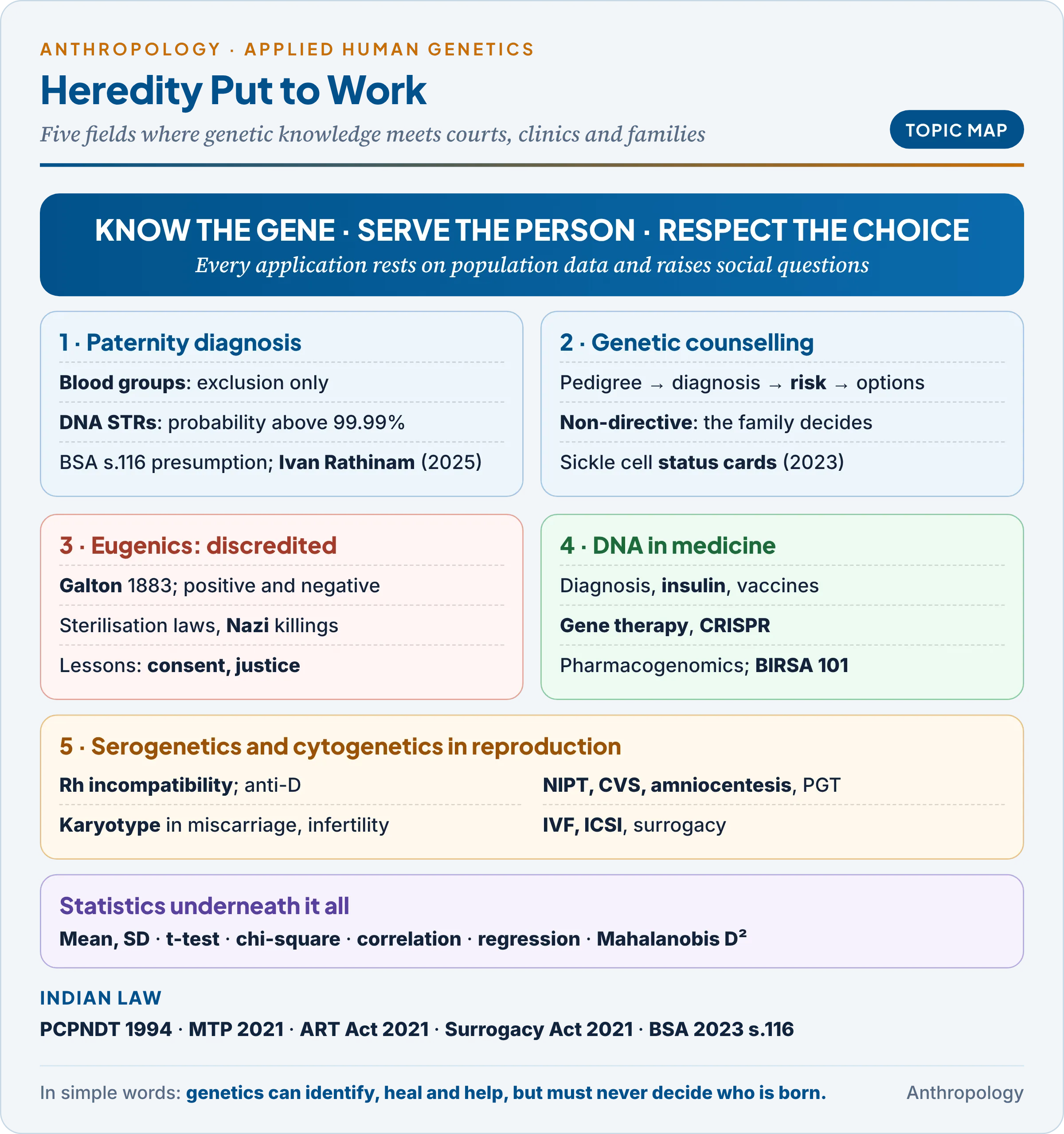
The first half of this syllabus line (sports, nutrition, equipment design, forensic anthropology and personal identification) is treated in Unit 12a. This note covers the second half: how heredity is applied to settle parentage, advise families, treat disease and assist reproduction; eugenics, its gravest misuse; and the statistical methods behind every measurement. The laboratory methods were explained in Units 9.1, 9.4 and 9.6; here they are followed into the court and the clinic.
Applied human genetics uses the principles of heredity to solve practical human problems. It rests on population data that anthropologists built, and every application raises social questions of kinship, stigma, caste, gender and consent.
1. Paternity Diagnosis
In simple words
A child gets half its genes from the mother and half from the father. If a man lacks the genes the child must have received from its father, he cannot be the father. Blood groups could only rule men out; DNA tests can also show, almost certainly, that a man is the father.
An example first. In 2008 Rohit Shekhar sued in the Delhi High Court, claiming that the veteran politician N.D. Tiwari was his biological father. After years of resistance Tiwari gave a sample on court direction; the Centre for DNA Fingerprinting and Diagnostics (CDFD), Hyderabad, compared it with the DNA of Shekhar and his mother, and on 27 July 2012 the court declared Tiwari the biological father. Every paternity question has three parts: a genetic logic, a laboratory method, and a legal and social setting that decides whether the test may be done at all.
1.1 The genetic logic: exclusion and inclusion
- The rule: at every locus (a fixed position on a chromosome) a child carries one allele from each parent. Once the mother’s allele is identified, the other is the obligate paternal allele, which the true father must carry.
- Exclusion: a man lacking the obligate allele is excluded. Because one mismatch may be a mutation, laboratories require mismatches at two or more loci.
- Inclusion: a man carrying the obligate allele at every locus is not excluded, but others may share those alleles. Inclusion is therefore a probability, strong only when the shared alleles are rare.
1.2 Blood groups: the classical method
Before DNA, courts relied on serology (testing inherited antigens on blood cells). The logic is the same, but these markers have few alleles, so many men share them.
| Mother | Child | Obligate paternal allele | Alleged father | Verdict |
|---|---|---|---|---|
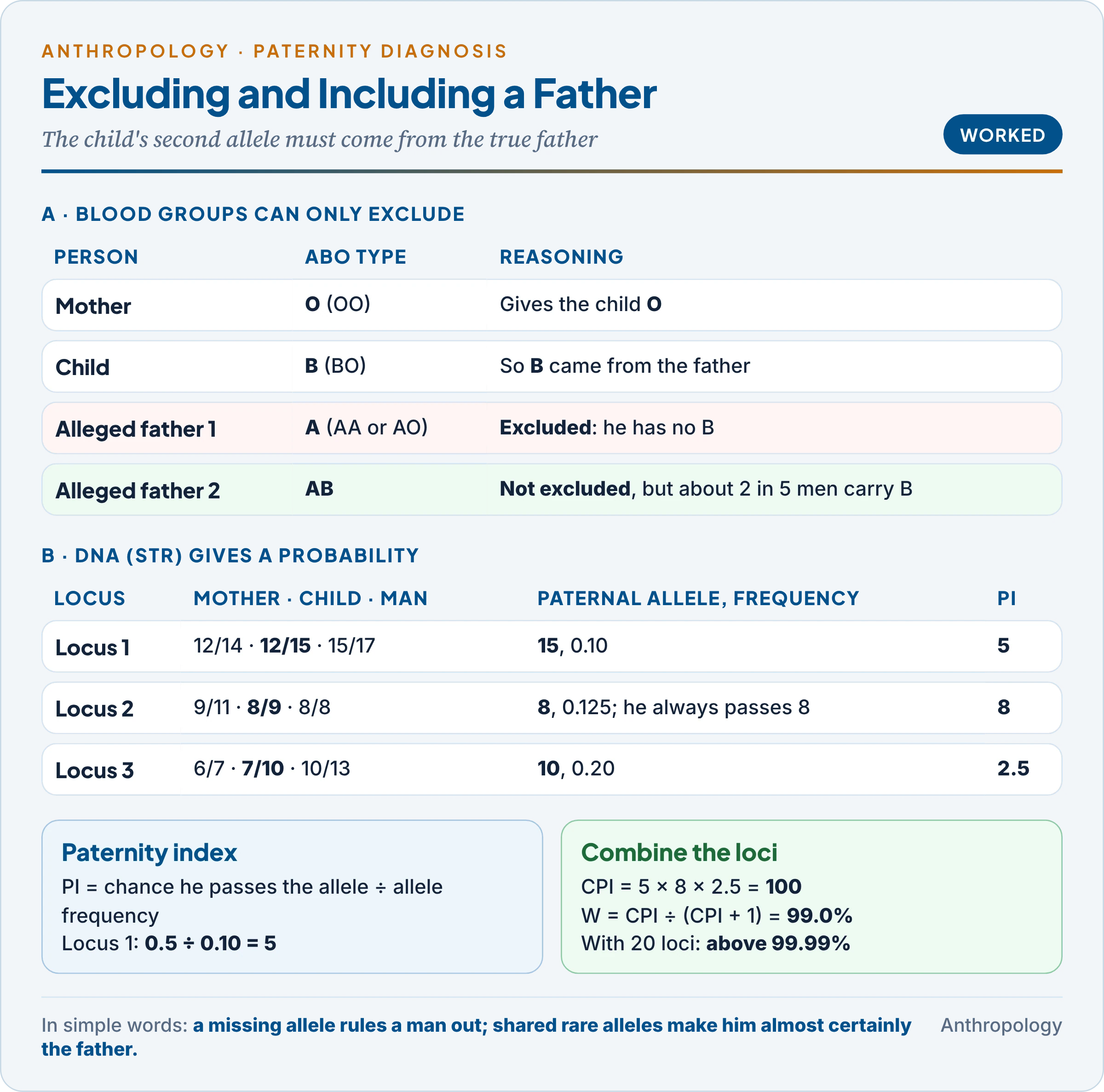
| O (OO) | B (BO) | B | A (AA or AO) | Excluded: no B |
| O (OO) | B (BO) | B | AB | Not excluded: carries B |
| MM | MN | N | MM | Excluded: no N |
| Rh-negative (dd) | Rh-positive | D | Rh-negative (dd) | Excluded: no D |
Serology therefore can exclude but never prove: the AB man fits the B child, but so do about two in five Indian men, who carry B. Adding Rh, MN, serum proteins, red-cell enzymes and the highly variable HLA antigens (Unit 9.6) raised the chance of clearing a falsely accused man, never to proof.
1.3 DNA: from exclusion to near-certainty
- DNA fingerprinting: the British geneticist Alec Jeffreys (1984) found that minisatellites (stretches repeated a variable number of times) give an individual-specific pattern; its first legal use (1985) proved a Ghanaian boy refused entry to Britain was his claimed mother’s son.
- PCR–STR testing (standard since the 1990s): short tandem repeats (2–6-base units) at 15–24 loci are copied by PCR and sized; a cheek swab is enough (Unit 9.1).
- Special cases: Y-STRs follow the male line when the alleged father is dead (his brother is tested) and mitochondrial DNA the female line; before birth, foetal DNA comes from CVS, amniocentesis or cell-free foetal DNA in the mother’s blood (Section 5).
How the probability is calculated. For each locus the laboratory computes a paternity index (PI): how much more likely the child’s genotype is if the alleged father is the father than if a random man is.
- Example: child 12/15, mother 12/14, so the obligate paternal allele is 15. The alleged father, 15/17, passes 15 half the time (0.5); a random man passes it with its population frequency, say 0.10. PI = 0.5 ÷ 0.10 = 5.
- Combined paternity index (CPI) is the product of the PIs, since loci are inherited independently: PIs of 5, 8 and 2.5 give CPI = 100.
- Probability of paternity (W), by the Swedish geneticist Erik Essen-Möller‘s formula (1938) with a neutral prior: W = CPI ÷ (CPI + 1) = 100 ÷ 101 = 99.0%. With 20 loci, W usually exceeds 99.99%.
- Why population data matter: the PI depends on allele frequencies, and India’s endogamous communities differ, so a wrong reference database can overstate a match.
Common confusion
Does a “match” in a paternity test prove that a man is the father? A test proves non-paternity outright when the man lacks the child’s paternal alleles at several loci. A match never proves paternity absolutely; it gives a probability, because another man could share the alleles. Blood groups give a weak probability; DNA at 15–24 loci gives one above 99.99 per cent, which courts treat as practical proof.
1.4 Law and society in India
- Presumption of legitimacy: Section 116 of the Bharatiya Sakshya Adhiniyam, 2023 (formerly s.112 of the Indian Evidence Act) makes birth during a valid marriage, or within 280 days of its dissolution, conclusive proof that the child is the husband’s, unless the spouses had no access to each other at conception.
- Courts on ordering tests: Goutam Kundu v. State of West Bengal (1993) held that blood tests cannot be ordered as a matter of course or for a “roving inquiry”; a strong prima facie case of non-access is needed. Nandlal Wasudeo Badwaik v. Lata (2014) let an accurate DNA result, taken with consent, prevail over the presumption.
- Latest position: Ivan Rathinam v. Milan Joseph (28 January 2025): legitimacy determines paternity until non-access is proved, and a DNA test needs an “eminent need” (insufficient other evidence, no disproportionate harm to privacy and dignity).
- Other uses: maintenance, inheritance, hospital baby-swaps, rape cases and immigration; Section 51 of the Bharatiya Nagarik Suraksha Sanhita, 2023 includes DNA profiling in an accused’s medical examination.
Why the law is cautious. The presumption shields the child from stigma and the mother from accusation. It reflects the anthropologist’s distinction between the pater (the socially recognised father) and the genitor (the biological father), seen in the Toda bow-and-arrow rite that assigns fatherhood and in Malinowski’s “sociological paternity” (Unit 2.5). Genetics identifies the genitor; society decides who the father is.
2. Genetic Counselling
In simple words
Genetic counselling is a conversation in which a trained person explains to a family how a disease is inherited, how likely it is to recur, and what choices they have. The family then decides for itself.
The definition and steps were set out in Unit 9.4 (§8): the American geneticist Sheldon Reed coined the term (1947), and the American Society of Human Genetics (1975) defined it as “a communication process which deals with the human problems associated with the occurrence, or the risk of occurrence, of a genetic disorder in a family“, moving from pedigree and diagnosis to risk (Mendelian, empirical or Bayesian), options and follow-up. Here the questions are where it is applied and why it must be non-directive.
Where counselling is applied.
- Carrier and premarital counselling: sickle-cell anaemia is concentrated in tribal central and western India; under the National Sickle Cell Anaemia Elimination Mission (launched at Shahdol, Madhya Pradesh, 1 July 2023), those screened receive genetic status cards, so that two carriers know their 1-in-4 risk before marriage. Thalassaemia screening serves other high-frequency groups.
- Consanguinity: in South India, where cross-cousin and uncle–niece marriage is a valued preference (Unit 9.3), the counsellor explains the extra risk (about 2–3 per cent more serious birth defects for first cousins, over a background of about 3 per cent) without condemning the custom.
- Prenatal, predictive and parentage: after an abnormal screen or for IVF couples (the ART Act, 2021 requires professional counselling); adults at risk of Huntington disease or BRCA1/2 cancers; families facing tests that may reveal non-paternity.
Why non-directiveness matters. A counsellor who tells carriers not to marry, or a pregnant woman to terminate, repeats the logic of eugenics: an authority deciding who should be born. Counselling therefore rests on autonomy, informed consent, confidentiality and cultural sensitivity. The American anthropologist Rayna Rapp (Testing Women, Testing the Fetus, 1999) called New York women deciding on amniocentesis “moral pioneers“, facing choices no earlier generation faced, shaped by class, religion and ethnicity.
3. Eugenics: History, Critique and Lessons
In simple words
Eugenics was the idea that humanity could be “improved” by encouraging some people to have children and stopping others. It led to forced sterilisation, racist immigration laws and Nazi killings, and is now rejected as bad science and a violation of human rights. Its history teaches what genetics must never be used for.
An example first. In Buck v. Bell (1927) the United States Supreme Court upheld, by 8 votes to 1, the forced sterilisation of Carrie Buck, a poor young Virginian labelled “feeble-minded” like her mother and infant daughter. Justice Oliver Wendell Holmes wrote: “Three generations of imbeciles are enough.” Carrie was later found to be of normal intelligence. About 60,000 Americans were sterilised under such laws. Eugenics in practice was a social judgement of “fitness”, dressed as biology and enforced by the state.
3.1 Meaning and types
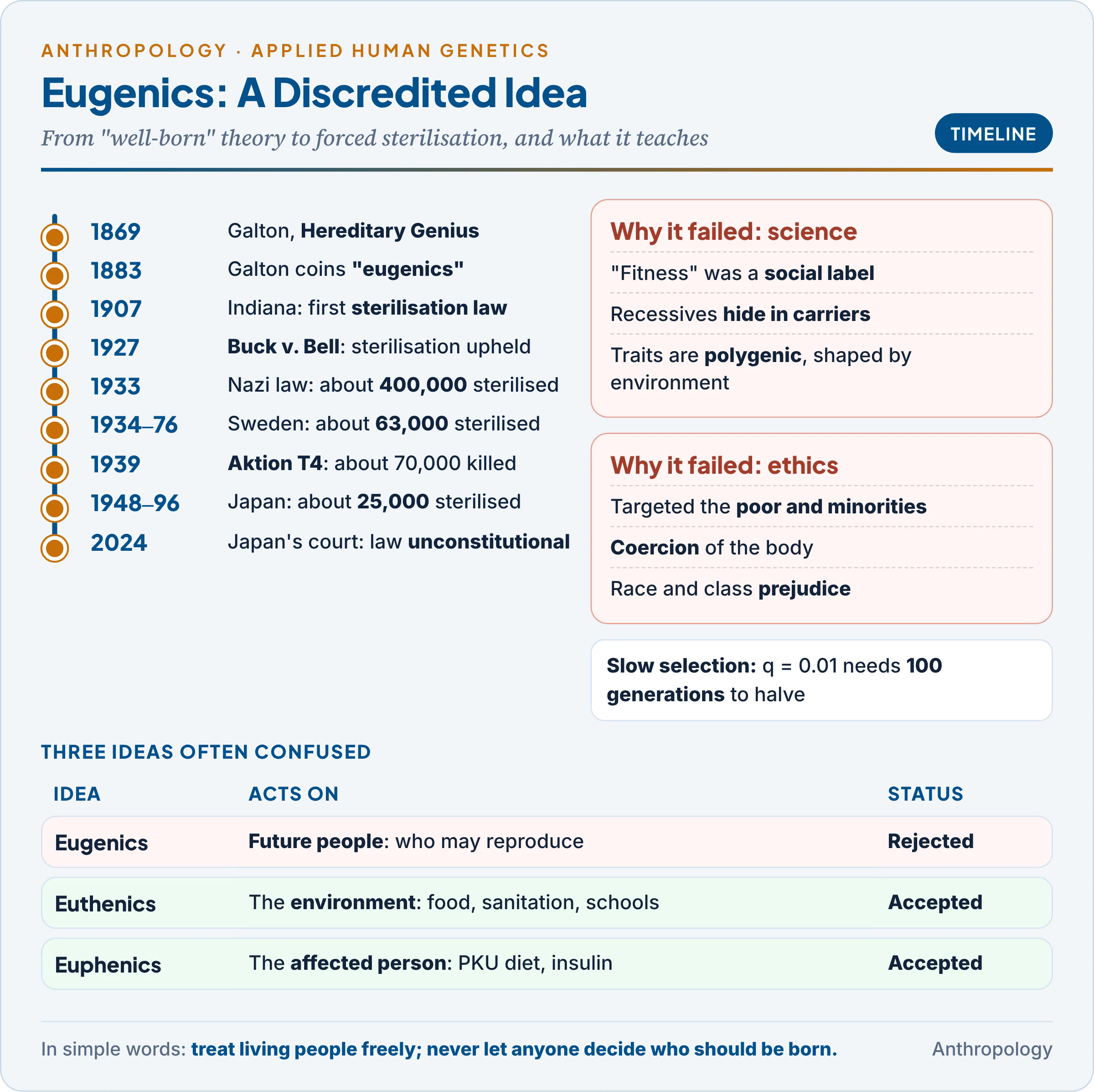
- Term: coined in 1883 by the English polymath Francis Galton (Darwin’s cousin, founder of biometrics) in Inquiries into Human Faculty, from the Greek for “well-born“. His 1904 definition: “the science which deals with all influences that improve the inborn qualities of a race“. Hereditary Genius (1869) had argued from eminent families that talent is inherited, ignoring their wealth.
- Positive eugenics: encouraging the “fit” to have more children: early marriage and subsidies for the “gifted”, and the American geneticist H.J. Muller‘s proposal of sperm banks and artificial insemination from “outstanding” men (“germinal choice”).
- Negative eugenics: preventing the “unfit” from reproducing: compulsory sterilisation, institutional segregation, marriage bans, immigration restriction and, at the extreme, killing.
Eugenics is often confused with two milder ideas that also aim at human welfare.
| Approach | Coined by | What it changes | Example | Status |
|---|---|---|---|---|
| Eugenics | Galton (1883) | Genes of future generations, by controlling who reproduces | Sterilisation laws | Discredited |
| Euthenics | Ellen Swallow Richards, American chemist (Euthenics, 1910) | The environment | Sanitation, nutrition, schooling | Accepted |
| Euphenics | Joshua Lederberg, American geneticist (1963) | The phenotype of an affected person, leaving heredity alone | Diet for phenylketonuria; insulin | Accepted |
The difference lies in whom the intervention serves: euthenics and euphenics help living people and leave reproduction free, while eugenics acts on future people by restricting the living.
3.2 History in brief
- United States: Indiana‘s sterilisation law (1907); the Eugenics Record Office (1910) of the biologist Charles Davenport; the Immigration Act of 1924, which cited eugenic “evidence” against southern and eastern Europeans and Asians.
- Nazi Germany: the Law for the Prevention of Hereditarily Diseased Offspring (1933), about 400,000 sterilisations; Aktion T4 (from 1939) killed about 70,000 disabled people, a rehearsal for the Holocaust.
- Sweden and Japan: Sweden sterilised about 63,000 people (1934–1976). Japan’s Eugenic Protection Law (1948–1996) led to about 25,000 sterilisations, 16,500 without consent; on 3 July 2024 Japan’s Supreme Court held it unconstitutional.
- India: eugenics was never law here, but coercive reproductive control was: during the Emergency, quotas and threats produced over six million vasectomies in 1976, mostly of poor men. Devika Biswas v. Union of India (2016), after 13 deaths at camps in Bilaspur, ordered mass sterilisation camps stopped. Sex-selective abortion applies the same logic of choosing which children are worth having.
3.3 Why eugenics failed
The scientific critique.
- “Fitness” is not a gene. “Feeble-mindedness”, “pauperism” and “criminality” were social labels, not Mendelian traits. The British geneticist Lionel Penrose‘s Colchester survey (1938) showed that intellectual disability had many separate causes.
- Harmful recessive alleles hide in carriers, so sterilising the affected barely changes their frequency. After n generations of complete selection, qₙ = q₀ ÷ (1 + n q₀): for a disorder affecting 1 in 10,000 (q₀ = 0.01), halving q takes 100 generations, about 2,500 years. R.C. Punnett, a British geneticist, made this point in 1917.
- Environment and variation matter: the American anthropologist Franz Boas showed (1911) that immigrants’ children differed in head form from their parents (Unit 9.5); valued traits are polygenic; and the sickle-cell allele eugenics would remove protects carriers against malaria (Unit 9.3).
The ethical and political critique.
- Whose “better”? The “unfit” were always the poor, disabled, colonised and minorities: eugenics gave class, race and colonial prejudice a scientific form. The British geneticist J.B.S. Haldane, later an Indian citizen, attacked it in Heredity and Politics (1938).
- Coercion violated bodily integrity and the right to found a family (Universal Declaration of Human Rights, 1948; UNESCO Declaration on the Human Genome and Human Rights, 1997).
- Anthropology’s role: physical anthropology shared in the early movement (Davenport and Steggerda’s “race crossing” study, 1929) and then led its rejection through the UNESCO Statement on Race (1950), drafted by Ashley Montagu and others.
3.4 “New eugenics” and the lessons
Modern genetics revives eugenic questions without state coercion: prenatal screening with termination, preimplantation testing, commercial polygenic embryo ranking, and the gene-edited twins of the Chinese scientist He Jiankui (2018), who was jailed. Critics call this “back-door” eugenics: individual choices shaped by markets and disability stigma. The lessons are voluntariness (no state, employer or insurer may impose a reproductive decision), non-directive counselling and informed consent, justice in access, respect for disability rights, and humility about predicting complex traits from genes.
Common confusion
Is genetic counselling a form of eugenics? No. Eugenics aimed at improving the population’s gene pool and let the state decide who should reproduce. Genetic counselling helps a family understand a risk and leaves every decision to them. A “back-door” eugenics arises only when counselling becomes directive or social pressure removes real choice.
4. DNA Technology in Disease and Medicine
In simple words
DNA technology lets doctors read, copy, cut and change genes. It diagnoses disease early, makes medicines such as insulin in bacteria, builds vaccines, matches drugs to a patient’s genes and, most recently, repairs faulty genes in a patient’s own cells.
An example first. Nearly three-quarters of India’s carriers of the sickle-cell gene belong to Scheduled Tribes. In late 2023 Britain and the United States approved Casgevy, the first CRISPR therapy, which edits a patient’s blood stem cells to make foetal haemoglobin again, at about US$2.2 million. On 19 November 2025 India launched BIRSA 101, an indigenous CRISPR therapy from the CSIR-Institute of Genomics and Integrative Biology (IGIB), named after the tribal leader Birsa Munda, which corrects the sickle mutation itself; human trials are expected in 2027. The case holds the whole field: a gene, a tool to change it, a population that carries it, and the question of who can afford the cure.
4.1 The toolkit and its uses
The laboratory steps (restriction enzymes, vectors, cloning, PCR, sequencing) were explained in Unit 9.1. The table shows what each tool does for patients.
| Application | How it works | Examples |
|---|---|---|
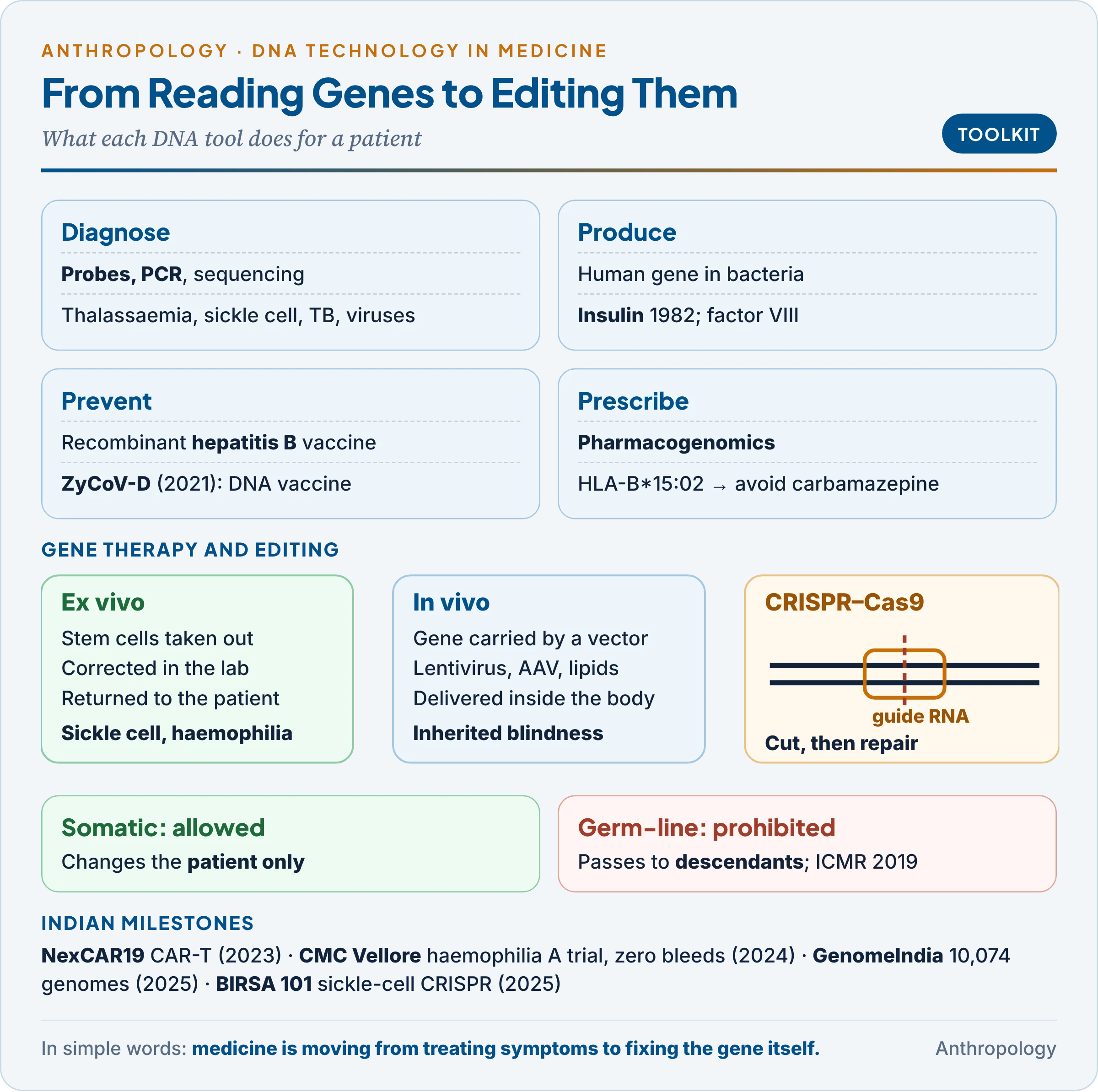
| Diagnosis | DNA probes (labelled DNA that binds a matching sequence), PCR, sequencing | Carrier and prenatal tests for thalassaemia and sickle cell; parasites and viruses hard to culture; RT-PCR for COVID-19 |
| Recombinant proteins | A human gene put into bacteria or yeast, which make the protein | Insulin (Humulin, 1982, the first recombinant drug), growth hormone, factor VIII, interferons |
| Vaccines | Only the gene for one antigen is used | Recombinant hepatitis B (1986); mRNA COVID vaccines (2020); India’s ZyCoV-D (2021), the first approved DNA vaccine for humans |
| Genome editing | CRISPR–Cas9 cuts DNA at a chosen site for repair | Casgevy (2023); BIRSA 101 (2025) |
| Pharmacogenomics | Drug and dose chosen by genotype | HLA-B*15:02 before carbamazepine |
Medicine thus moves from treating symptoms to acting on the gene, and from one drug for all to treatment matched to genotype; both need the variation of particular populations, where anthropological data on endogamous groups become useful.
4.2 Gene therapy and CRISPR
- Meaning: treating disease by adding, replacing, silencing or editing a gene, as proposed by the American scientists Theodore Friedmann and Richard Roblin (Science, 1972).
- Somatic vs germ-line: somatic therapy alters body cells and affects only the patient; germ-line therapy would alter eggs, sperm or embryos and pass to descendants, so its errors could never be recalled. It is prohibited in India by the ICMR National Guidelines for Gene Therapy Product Development and Clinical Trials (2019).
- Ex vivo vs in vivo: cells corrected outside the body and returned (blood stem cells), or the gene delivered inside it by a vector: usually a virus (lentivirus, adeno-associated virus), because viruses naturally enter cells, or lipid particles.
- Milestones: Ashanti DeSilva, a four-year-old with ADA deficiency, received the first approved gene therapy (1990); Jesse Gelsinger‘s death (1999) from a vector reaction set the field back; India approved its own CAR-T cancer therapy (engineered immune cells), NexCAR19, in 2023. At CMC Vellore, five men with severe haemophilia A received their own stem cells carrying a factor VIII gene in a lentiviral vector, and all had zero bleeds (New England Journal of Medicine, December 2024).
How CRISPR works. Bacteria store fragments of viral DNA in CRISPR arrays (clustered regularly interspaced short palindromic repeats); the Cas9 enzyme, guided by an RNA copy of a fragment, cuts matching DNA when the virus returns. Jennifer Doudna (American) and Emmanuelle Charpentier (French) showed in 2012 that the guide RNA can be programmed for any sequence (Nobel Prize in Chemistry, 2020). Why it matters: earlier gene therapy could only add a gene; CRISPR edits the faulty one in place, cheaply and precisely. Its main danger is off-target cutting, which IGIB’s engineered enFnCas9 enzyme is designed to reduce.
4.3 Pharmacogenomics and GenomeIndia
- Pharmacogenomics studies how genotype changes drug response: carriers of HLA-B*15:02 risk a severe skin reaction (Stevens–Johnson syndrome) to the anti-epileptic carbamazepine, which a test prevents; CYP2C19 variants, common in South Asians, weaken the heart drug clopidogrel.
- Why populations matter: most drug research used Europeans. GenomeIndia (Department of Biotechnology, coordinated by the Indian Institute of Science) sequenced 10,074 genomes from 83 populations (30 tribal, 53 non-tribal), opened in January 2025; its analysis of 9,772 genomes (Nature Genetics, April 2025) found about 180 million variants, many unique to India.
- Anthropological concerns: populations were coded by number so the data cannot rank communities; community consent and benefit-sharing with tribal groups remain open questions.
4.4 Ethics of genetic engineering
| Issue | Concern | Response |
|---|---|---|
| Safety | Off-target edits, immune reactions, cancer from vector insertion | Phased trials; long-term follow-up |
| Germ-line editing | Changes pass to descendants who cannot consent | Prohibited; He Jiankui jailed (2019) |
| Equity | Cures cost crores; patients are often poor and tribal | Indigenous platforms; National Policy for Rare Diseases (2021) |
| Privacy | Genetic data used by insurers, employers or police | Consent; data protection; the US Genetic Information Nondiscrimination Act (2008) |
The line drawn is between treating a consenting patient and redesigning future people, the line between euphenics and eugenics (Section 3).
5. Serogenetics and Cytogenetics in Reproductive Biology
In simple words
Serogenetics studies inherited blood factors; cytogenetics studies chromosomes. In reproduction they explain why some pregnancies fail or harm the baby, allow a foetus to be tested before birth, and guide treatments such as IVF. Because the same tests can be misused to choose a child’s sex, India regulates them by law.
An example first. An Rh-negative woman gives birth to a healthy Rh-positive first child. Unless she receives an anti-D injection within 72 hours, her next Rh-positive baby may be born jaundiced, anaemic or dead. Neither baby’s genes are faulty; the harm is an immune clash between mother and foetus, which a blood test predicts and an injection prevents. Serogenetics (the genetics of blood antigens and antibodies) and cytogenetics (the study of chromosomes, Unit 9.4) are applied in this way across reproductive biology: fertility, conception, pregnancy and birth.
5.1 Serogenetics: Rh, ABO and HLA in pregnancy
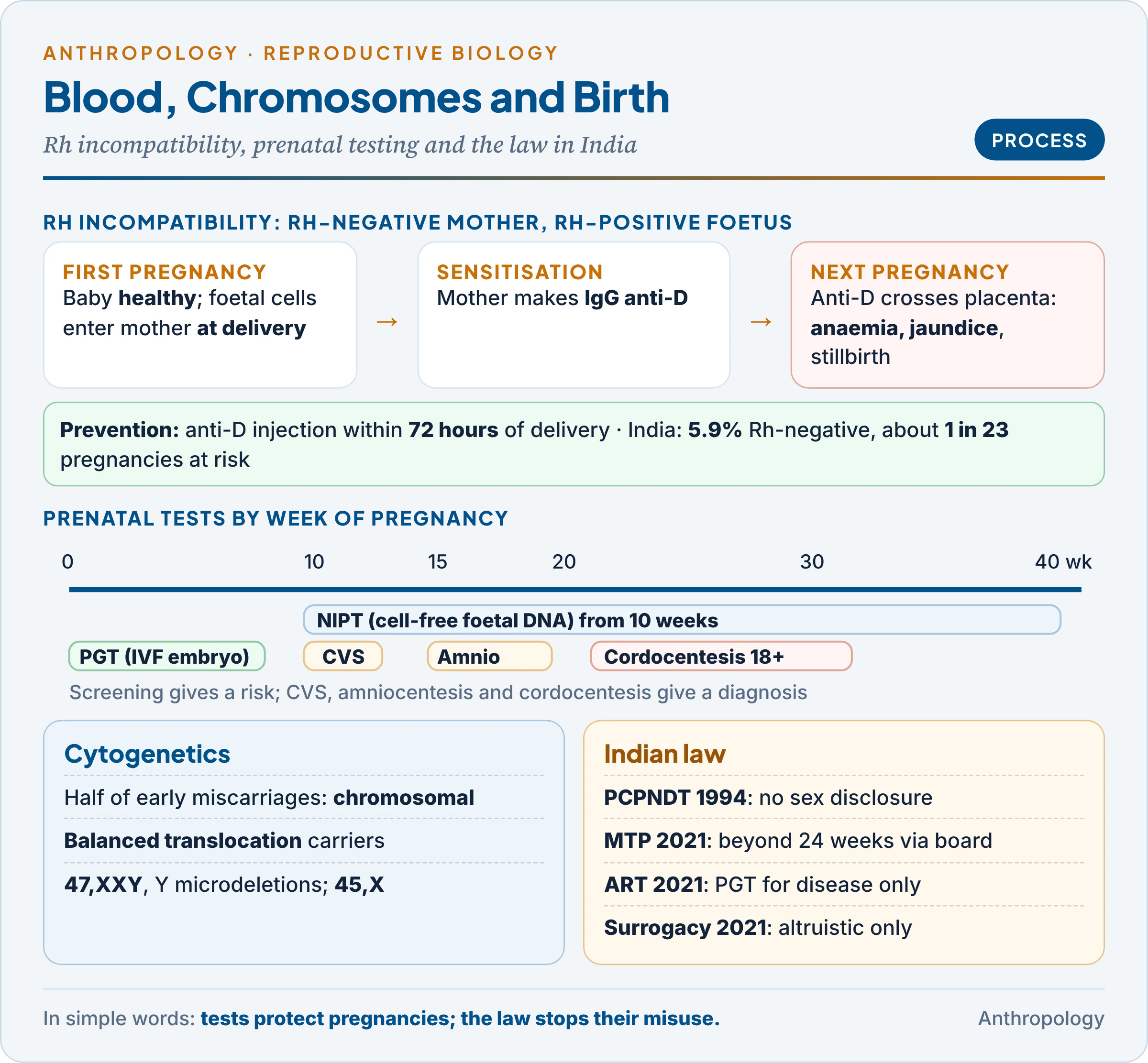
- Rh incompatibility (haemolytic disease of the foetus and newborn, erythroblastosis fetalis): an Rh-negative (dd) mother with an Rh-positive foetus is sensitised when foetal red cells enter her blood, mostly at delivery. In a later pregnancy her IgG anti-D crosses the placenta and destroys foetal red cells, causing anaemia, jaundice, kernicterus (bilirubin damage to the brain) and stillbirth. The first child is usually spared because sensitisation comes after it.
- Prevention: anti-D immunoglobulin within 72 hours of delivery, miscarriage or abortion, and at about 28 weeks, clears foetal cells before the mother makes antibodies. Without it about one in six Rh-negative mothers is sensitised after an Rh-positive pregnancy; with it, about one or two in a hundred.
- ABO incompatibility: an O mother may cause mild jaundice in an A or B baby, but it protects against Rh sensitisation, because her anti-A or anti-B destroys entering foetal cells before she responds to D.
- HLA: the foetus carries foreign paternal HLA antigens yet is not rejected, because the placenta expresses little classical HLA; links between HLA sharing and recurrent miscarriage remain inconclusive.
How common is the risk in India? (worked example). A 2020 review of about 14 lakh Indian blood donors found 5.87 per cent Rh-negative.
- Rh-negative = q² = 0.0587, so q ≈ 0.242 and p ≈ 0.758 (Hardy–Weinberg, Unit 9.3).
- Couples with an Rh-negative wife and Rh-positive husband: 0.0587 × 0.941 ≈ 0.055.
- An Rh-positive husband is DD with probability p² ÷ (1 − q²) ≈ 0.61 and Dd with 0.39, so their child is Rh-positive with probability 0.61 + 0.39 × 0.5 ≈ 0.80.
- Rh-incompatible pregnancies ≈ 0.055 × 0.80 ≈ 4.4 per cent, about one in 23: with about 2.5 crore births a year, roughly 11 lakh pregnancies need anti-D cover, which is why antenatal blood grouping is routine.
5.2 Cytogenetics: infertility and pregnancy loss
- Miscarriage: about half of first-trimester miscarriages are chromosomally abnormal (trisomies, 45,X, triploidy), mostly from non-disjunction in the egg, which rises with maternal age.
- Recurrent miscarriage: in a few per cent of couples one partner carries a balanced translocation (an exchange of chromosome segments): healthy, but producing some unbalanced gametes; hence karyotyping both partners.
- Male infertility: Klinefelter syndrome (47,XXY) and Y-chromosome microdeletions in the AZF (azoospermia factor) regions cause absent or very low sperm counts. Such men can father children by ICSI (below), but a son inherits the Y microdeletion, so testing precedes treatment.
- Female infertility and age: Turner syndrome (45,X) causes ovarian failure; the risk of Down syndrome rises from about 1 in 1,500 at 20 to 1 in 100 at 40, which is why the PCPNDT Act permits prenatal testing for women above 35.
5.3 Prenatal diagnosis and assisted reproduction
Prenatal tests run from screening, which gives a risk, to diagnosis, which gives an answer.
| Technique | When | What is tested |
|---|---|---|
| Ultrasound and maternal serum screening | 10–20 weeks | Structure; hormones and proteins (hCG, AFP); risk only |
| Non-invasive prenatal testing (NIPT) | From 10 weeks | Cell-free foetal DNA in maternal blood (found by Dennis Lo, 1997) |
| Chorionic villus sampling (CVS) | 10–13 weeks | Placental tissue, genetically identical to the foetus |
| Amniocentesis | 15–20 weeks | Foetal cells in amniotic fluid: karyotype, FISH, DNA |
| Cordocentesis | After 18 weeks | Foetal blood from the umbilical cord |
| Preimplantation genetic testing (PGT) | Before IVF embryo transfer | A few cells from the embryo |
The earlier and less invasive a test, the less certain it is: a positive NIPT must be confirmed by CVS or amniocentesis, while PGT, which avoids termination altogether, attracts carrier couples.
Assisted reproductive technology (ART) handles eggs, sperm or embryos outside the body.
- In vitro fertilisation (IVF): eggs fertilised in the laboratory and the embryo transferred. Louise Brown, the first IVF baby, was born in England on 25 July 1978; in Kolkata, Subhas Mukhopadhyay announced India’s first, Durga, on 3 October 1978, a claim recognised only after his death.
- ICSI (intracytoplasmic sperm injection, 1992) injects a single sperm into the egg; other techniques are gamete donation, embryo freezing and surrogacy (a woman carrying a pregnancy for another couple).
5.4 Indian law on reproductive technology
| Law | Main provisions |
|---|---|
| PCPNDT Act, 1994 (amended 2003) | Prenatal diagnosis only in registered centres, for listed abnormalities and recorded indications; no disclosure of foetal sex (s.5); sex selection prohibited (s.3A); detail in Unit 9.4 |
| MTP (Amendment) Act, 2021 | Termination up to 24 weeks for specified categories; beyond 24 weeks for substantial foetal abnormalities certified by a Medical Board |
| ART (Regulation) Act, 2021 (in force 25 January 2022) | National and State Boards and a National Registry; registered clinics and banks; women 21–50, men 21–55; counselling and written consent; at most three embryos per cycle; PGT only for known heritable disease (s.25); sex selection prohibited (s.26); no sale of gametes or embryos; the child is the commissioning couple’s; up to ten years’ imprisonment for the gravest offences |
| Surrogacy (Regulation) Act, 2021 | Commercial surrogacy banned; altruistic surrogacy only, for married Indian couples with medical need or widowed or divorced women; Rules amended in February 2024 to allow a donor gamete on medical certification, if one gamete is the couple’s own |
Why India regulated so tightly. By the 2010s India was a hub of commercial surrogacy: the sociologist Amrita Pande‘s Wombs in Labor (2014) described poor women in Anand, Gujarat, carrying babies for foreign couples in surrogate hostels. Clinics also offered sex selection where the child sex ratio had fallen to 918 girls per 1,000 boys (Census 2011). The 2021 Acts answer two harms: the exploitation of women and the selection of sons.
5.5 Ethical issues in reproductive technology
- Sex selection: where son preference is strong, prenatal tests and PGT become tools of gender discrimination.
- “Designer babies”: selecting embryos for traits rather than disease edges towards new eugenics (Section 3.4).
- Disability and the embryo: routine termination for Down syndrome implies such lives are worth less; surplus frozen embryos raise moral and religious objections.
- Commodification and consent: payment for eggs and wombs creates a market in poor women’s bodies; the child’s right to know its genetic origins.
- Equity: IVF costs lakhs and is urban, while infertility stigma is harshest among the poor.
The anthropological reading. ART separates genetic, gestational and social parenthood. The British anthropologist Marilyn Strathern (Reproducing the Future, 1992) argued that it reveals what kinship always held: “natural” relations are culturally chosen. In India, the anthropologist Aditya Bharadwaj (Conceptions, 2016) found that infertility stigma falls on women and that donor gametes are kept secret to protect lineage, caste and family honour. The technology is global; the cultural meaning of descent decides how it is used.
6. Application of Statistical Methods
In simple words
No two people have the same height or blood. Statistics turns many measurements into a few numbers (an average, a spread, a relationship) and tells us whether a difference between groups is real or only chance. Without it, anthropometry and genetics would be a heap of figures.
An example first. In 1920 the zoologist Nelson Annandale of the Indian Museum asked the Calcutta physicist P.C. Mahalanobis to analyse the body measurements of Anglo-Indians, to see how far they resembled Indian castes and Europeans. From this work Mahalanobis developed the D² statistic (1936), a single “generalised distance” between groups measured on many correlated traits. He founded the Indian Statistical Institute (1931), and D² later measured caste and tribal affinities in D.N. Majumdar‘s anthropometric survey of the United Provinces (1941). Indian statistics was partly born from physical anthropology.
6.1 Why anthropology needs statistics
- Variation is the subject: anthropology compares populations, whose traits overlap; only statistics can say how much they differ.
- Uses: anthropometry; growth standards (Unit 10a); gene frequencies (Unit 9.3); heritability (Unit 9.1); forensic equations (Unit 12a); demographic and epidemiological rates (Units 11a, 9.8); social surveys (Unit 8b).
- Founders: the Belgian astronomer Adolphe Quetelet (“l’homme moyen“, the average man, 1835; the body-mass index); Galton (regression 1886, correlation 1888, from parents’ and children’s heights); Karl Pearson (correlation coefficient 1896, chi-square 1900); W.S. Gosset as “Student” (t-test, 1908); R.A. Fisher (analysis of variance, discriminant function).
6.2 Data and descriptive statistics
- Data: qualitative (nominal like blood group, or ordinal like stage of puberty), summarised by counts and percentages; quantitative (discrete like number of children, or continuous like stature), summarised by averages and spreads.
- Central tendency: the mean (sum ÷ number), the median (middle value, unaffected by extremes) and the mode (most frequent value).
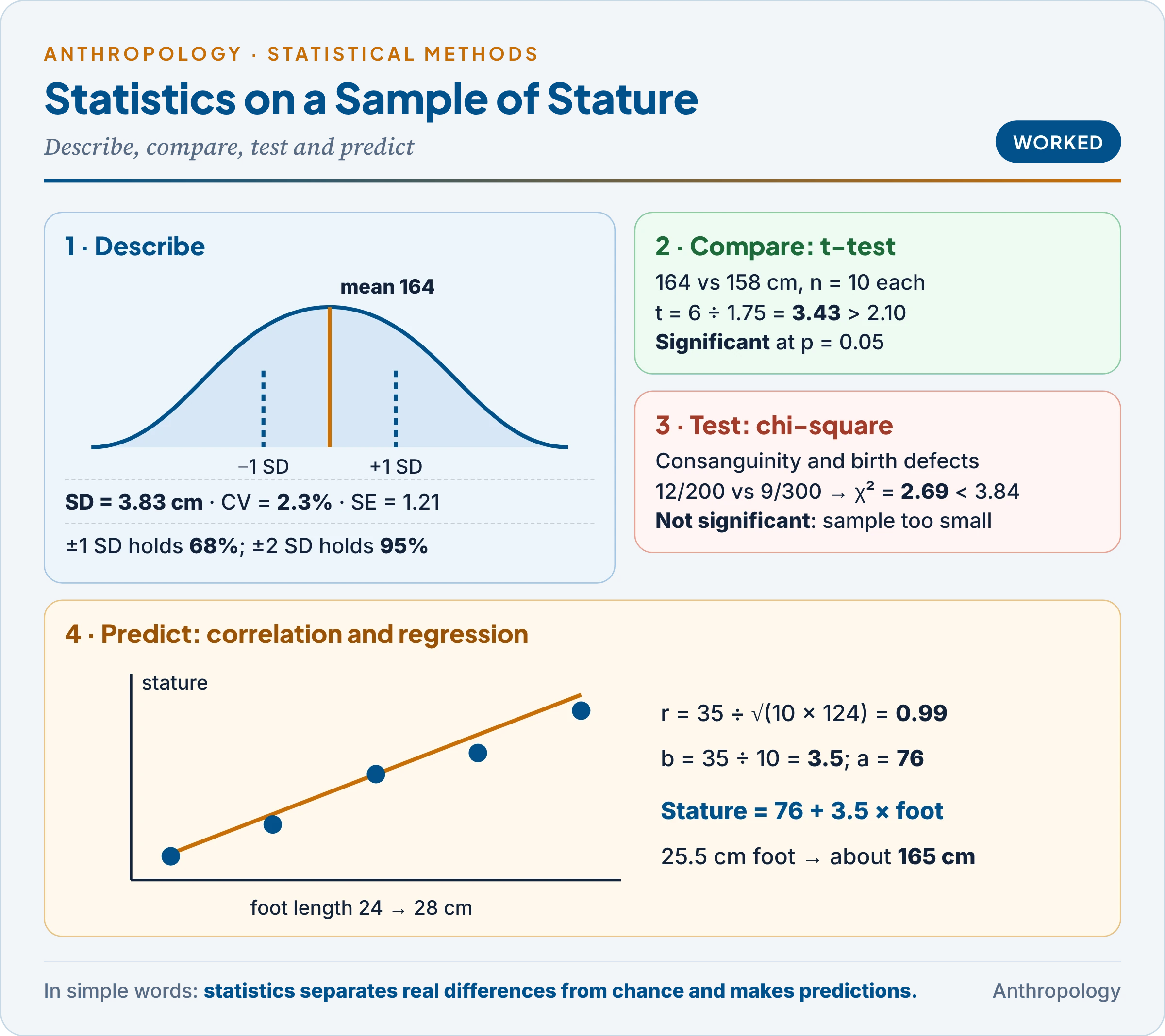
- Dispersion: the range; the standard deviation (SD, the typical distance of values from the mean); the coefficient of variation (CV = SD ÷ mean × 100), which compares traits measured in different units; and the standard error (SE = SD ÷ √n), which shows how precisely a sample mean estimates the population mean.
- The normal distribution: most continuous traits form a bell curve, with about 68 per cent of values within 1 SD of the mean and 95 per cent within 2 SD. This underlies percentile growth charts and the WHO definition of stunting (height-for-age below −2 SD).
6.3 Inferential statistics
- Hypothesis testing: the null hypothesis (H₀) says there is no real difference; the p-value is the probability of a difference this large arising by chance if H₀ were true. Below 0.05 the difference is significant; wrongly rejecting H₀ is a Type I error, missing a real difference a Type II error.
- t-test: compares the means of two groups; ANOVA compares three or more.
- Chi-square (χ²): compares observed and expected counts, for Hardy–Weinberg fit or the association of two attributes: χ² = Σ (O − E)² ÷ E, with degrees of freedom = (rows − 1) × (columns − 1).
- Correlation: Pearson’s r, from −1 to +1, measures the strength and direction of a straight-line relationship; Spearman’s coefficient serves ranked data. Correlation is not causation: height and vocabulary rise together in schoolchildren only because both rise with age.
- Regression: an equation y = a + bx that predicts one variable from another. Galton named it from “regression towards mediocrity” (very tall parents have children less tall on average). Trotter and Gleser (1952) estimate stature from long bones, for example 2.38 × femur + 61.41 cm (± 3.27) for American white males; India needs population-specific equations (Unit 12a).
- Multivariate methods: Mahalanobis D² and Pearson’s coefficient of racial likeness (1926) measure distance between populations; Fisher’s discriminant function sorts skulls by sex from several measurements at once; principal component analysis now plots genetic ancestry. Whatever the test, the sample design (Unit 8b) decides whether results apply to the population.
6.4 Worked examples
1. Mean, SD and CV. Stature (cm) of 10 men: 160, 162, 165, 158, 170, 168, 163, 167, 161, 166.
- Mean = 1,640 ÷ 10 = 164.0 cm; squared deviations sum to 132.
- SD = √(132 ÷ 9) = 3.83 cm (n − 1 for a sample); CV = 3.83 ÷ 164 × 100 = 2.3 per cent, so stature is one of the least variable measurements; SE = 3.83 ÷ √10 = 1.21 cm.
2. t-test. A second group of 10 men has mean 158.0 cm, SD 4.0.
- Pooled SD = √((14.67 + 16.0) ÷ 2) = 3.92; SE of the difference = 3.92 × √(2/10) = 1.75.
- t = 6.0 ÷ 1.75 = 3.43 (18 d.f.), above the critical 2.10 at p = 0.05: the 6 cm difference is significant.
3. Chi-square: consanguinity and birth defects in a sample. The table compares observed counts with those expected if there were no association.
| Parents | Affected (expected) | Unaffected (expected) | Total |
|---|---|---|---|
| Consanguineous | 12 (8.4) | 188 (191.6) | 200 |
| Non-consanguineous | 9 (12.6) | 291 (287.4) | 300 |
| Total | 21 | 479 | 500 |
- Expected = row total × column total ÷ grand total, e.g. 200 × 21 ÷ 500 = 8.4.
- χ² = 1.54 + 0.07 + 1.03 + 0.05 = 2.69 (1 d.f.), below the critical 3.84. The gap of 6 against 3 per cent is not significant in so small a sample: a difference that looks large may still be chance.
4. Correlation and regression: stature from foot length. Foot length x = 24, 25, 26, 27, 28 cm; stature y = 160, 163, 168, 170, 174 cm.
- Means 26 and 167; Σ(dx·dy) = 35, Σdx² = 10, Σdy² = 124.
- r = 35 ÷ √(10 × 124) = 0.99, a very strong positive correlation.
- b = 35 ÷ 10 = 3.5; a = 167 − 3.5 × 26 = 76; so stature = 76 + 3.5 × foot length: a 25.5 cm footprint predicts about 165 cm, the logic of forensic stature estimation (Unit 12a).
Key Terms
| Term | Meaning in simple words |
|---|---|
| Obligate paternal allele | The allele a child must have received from its father |
| Paternity index | How much more likely the child’s genes are if the man is the father than if a random man is |
| Pater and genitor | The socially recognised father and the biological father |
| Non-directive counselling | Counselling that informs but leaves every decision to the family |
| Eugenics | The discredited programme of “improving” humans by controlling who reproduces |
| Euthenics | Improving people by improving their environment |
| Euphenics | Treating the effects of a genetic condition in the individual |
| Gene therapy | Treating disease by adding, replacing or editing a gene |
| CRISPR–Cas9 | A programmable molecular scissor that cuts DNA at a chosen site |
| Germ-line editing | Changing genes in eggs, sperm or embryos, so the change is inherited |
| Pharmacogenomics | Choosing drugs and doses according to a person’s genes |
| Serogenetics | The genetics of blood antigens and antibodies |
| Erythroblastosis fetalis | Destruction of a foetus’s red cells by the mother’s anti-Rh antibodies |
| p-value | The probability that a difference this large would arise by chance alone |
Contemporary Developments
- BIRSA 101 (19 November 2025): India’s first indigenous CRISPR therapy for sickle-cell disease, built by CSIR-IGIB on its engineered enFnCas9 enzyme and licensed to the Serum Institute; Phase I trials are expected in 2027.
- Ivan Rathinam v. Milan Joseph (28 January 2025): the Supreme Court restated that a DNA paternity test needs an “eminent need” and must respect privacy and dignity.
- Japan’s eugenics ruling (3 July 2024): the 1948 Eugenic Protection Law was declared unconstitutional and victims of forced sterilisation were awarded compensation.
Diagrams to Master
- Topic map: five applied fields on a statistical base, with the governing Indian laws.
- Paternity testing: ABO exclusion (A excluded, AB not); STR obligate allele, PI, CPI and W.
- Eugenics: timeline 1869–2024; critique; eugenics vs euthenics vs euphenics.
- DNA medicine: diagnosis, recombinant products, gene therapy, CRISPR cut, pharmacogenomics.
- Reproductive genetics: Rh incompatibility and anti-D; prenatal tests by week; four Acts.
- Statistics: bell curve with SD; t and χ² against critical values; regression line.
Revision Grid
| Scholar | Work (year) | Key idea |
|---|---|---|
| Francis Galton | Hereditary Genius (1869); Inquiries into Human Faculty (1883) | Coined eugenics; regression and correlation |
| Karl Pearson | 1896, 1900, 1926 | Correlation; chi-square; coefficient of racial likeness |
| W.S. Gosset (“Student”) | 1908 | t-test for small samples |
| P.C. Mahalanobis | D² (1936) | Generalised distance between populations |
| Lionel Penrose | Colchester survey (1938) | Many causes of intellectual disability |
| J.B.S. Haldane | Heredity and Politics (1938) | Critique of eugenics |
| Alec Jeffreys | 1984 | DNA fingerprinting |
| Marilyn Strathern | Reproducing the Future (1992) | ART reveals the cultural basis of kinship |
| Rayna Rapp | Testing Women, Testing the Fetus (1999) | Women as “moral pioneers” of prenatal choice |
| Doudna and Charpentier | 2012 | Programmable CRISPR–Cas9 |
| Aditya Bharadwaj | Conceptions (2016) | Infertility, stigma and IVF in India |
Previous Year Questions
Unit 12: Applied human genetics, serogenetics and cytogenetics, and statistical methods
- 2026In what manner is our understanding of serogenetics and cytogenetics useful in reproductive biology? What are the major ethical issues involved in reproductive technology?
- 2021How are the cases of disputed paternity solved ? Discuss the recent techniques.
- 2020Write notes on the Ethics and Genetic engineering in about 150 words.
- 2019“Applied human genetics has come to touch every sphere of human life.” Discuss in light of recent advances in molecular anthropology.
- 2015Write a note in 150 words on DNA technology in Medicine.
- 2011Explain the application of anthropological knowledge in genetic counseling, forensic science, sports and nutrition.
- 2004Discuss the area in which the knowledge of human genetics can be applied.
- 2003Write a note on Eugenics.
- 2002What are the statistical methods used in Physical Anthropology.
- 2001Evaluate the role of Serogenetics and Cytogenetics in reproductive biology.
- 2001Write a note on Sampling Methods.
- 2000Write a note on Chi-square Test.
- 1999Discuss the application of the human genetics in the field of forensic science and diagnosis and treatment of genetic disorders.
- 1996Discuss the concepts of eugenics and euphenics and their potential applications to human welfare.
Related questions from other units
- 2025Unit 9.4: ‘Genome-wide Disease Association Studies (GWAS) advanced our understanding of health and disease.’ Discuss.
- 2024Unit 9.4: What is genetic counselling? Briefly discuss various steps involved in it.
- 2024Unit 8: Discuss the applicability of various sampling techniques in selecting the study group.
- 2022Unit 9.1: Write notes on: Pedigree analysis in genetic counselling.
- 2020Unit 9.5: Write notes on the Racism and Eugenics in about 150 words.
- 2016Unit 9.4: Explain the significance of screening and counselling for genetic disorders.
- 2012Unit 9.6: Discuss the role of ABO blood group system in resolving cases of disputed paternity.
- 2001Unit 9.4: Discuss the relevance of human DNA Profiling and Gene Mapping in the prevention and cure of diseases.
- 2000Unit 9.1: What do you understand by recombinant DNA technology ? Discuss its application and limitations in improving human health.
- 1995Unit 9.4: Write a note on Gene therapy.
More from Applications of Anthropology: all notes of this unit · every PYQ of this unit · Anthropology Optional hub