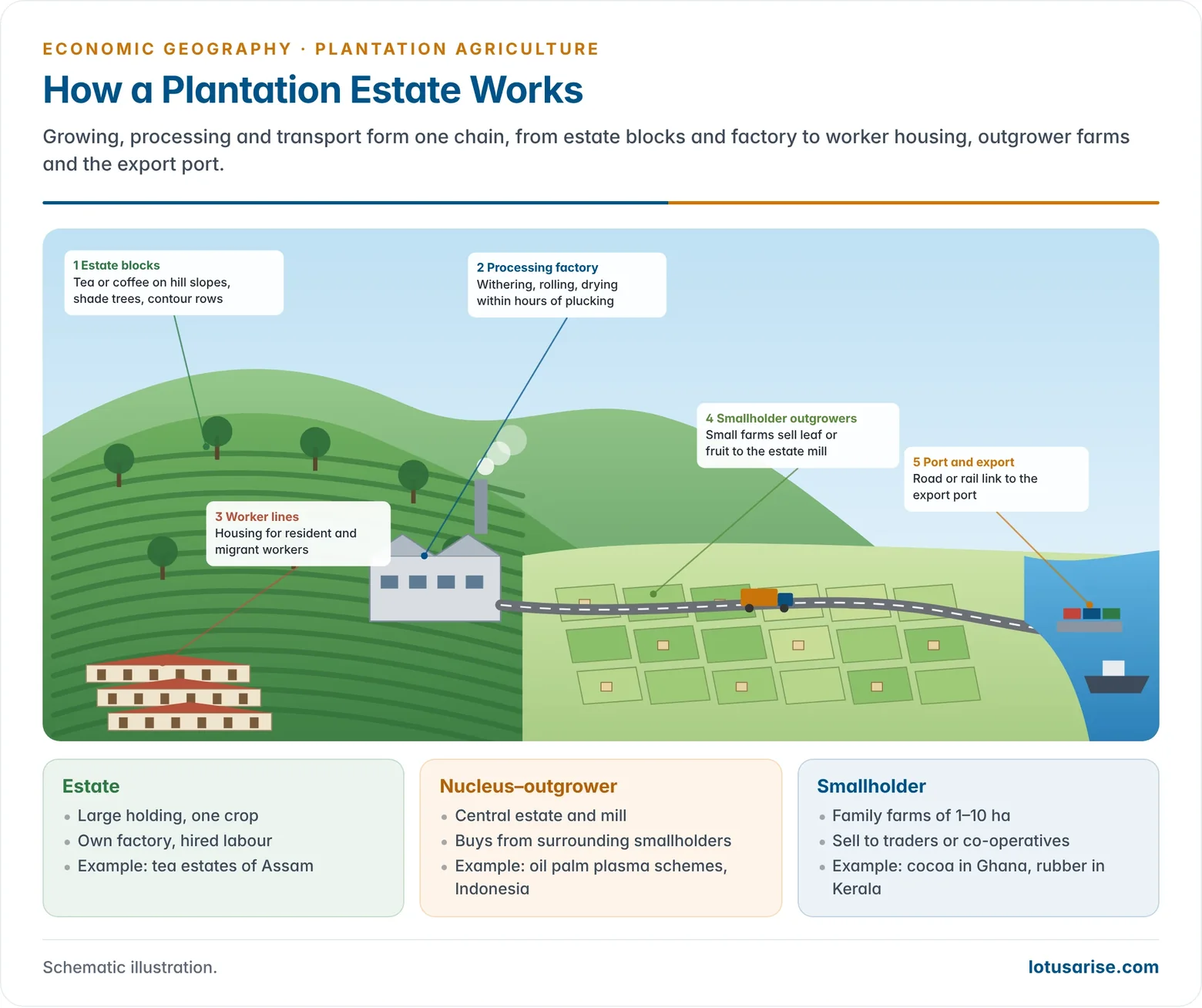
- Plantation agriculture is the large-scale, commercial cultivation of a single tree, bush or perennial crop for distant markets, usually combined with on-site processing.
- It belongs mainly to the tropical and subtropical belt between about 25°N and 25°S. Tea, coffee, cocoa, rubber, oil palm, sugarcane and bananas are its classic crops.
- It is Whittlesey’s commercial plantation type in the typology of agricultural regions, and the clearest example of how climate, colonial history, labour and world markets together create regional specialisation in agriculture.
Nature of Plantation Agriculture

Characteristics
- Monoculture: one crop dominates the estate and often the regional economy (rubber in Malaya, cocoa in Côte d’Ivoire, tea in Assam).
- Large estates: holdings run from tens to thousands of hectares, often with their own factory, worker housing (“lines”), roads, hospitals and links to a port.
- Capital-intensive and labour-intensive at once:
- Capital for clearing, planting, processing machinery and long gestation (rubber and oil palm yield only after 3–7 years).
- Large, often migrant labour forces for plucking, tapping and harvesting.
- Scientific management: clonal planting material, fertilisers, pest control, research stations (the Tea Research Association at Tocklai, Assam; the Rubber Research Institute of Malaysia).
- Export orientation: most output goes to distant markets in Europe, North America, and now China and India.
- Integration with industry: crop growing, processing, packaging and transport form one chain. Tea and oil palm must be processed within hours of harvest.
- Corporate or state ownership: historically foreign companies (British agency houses, Dutch firms, United Fruit); today national corporations, multinationals and many smallholders.
Origin and Evolution
- Sugar plantations (16th–18th centuries): the Portuguese in north-east Brazil and the British, French, Dutch and Spanish in the Caribbean grew sugarcane on enslaved African labour. This was the core of the Atlantic triangular trade.
- Dutch Java: the Cultivation System (from 1830) forced Javanese peasants to grow coffee, sugar and indigo for export.
- British Asia (19th century):
- Tea in Assam from the 1830s (the Assam Company, 1839) and later Darjeeling, the Nilgiris and Ceylon (after coffee rust destroyed Ceylon’s coffee in the 1870s–80s).
- Rubber after seeds of Hevea brasiliensis were taken from Brazil (1876) and raised at Kew; plantations spread across Malaya and Ceylon from the 1890s.
- Indentured Indian labour was sent to Malaya, Ceylon, Fiji, Mauritius, the Caribbean and Natal.
- Africa and Latin America: cocoa spread in Ghana (then the Gold Coast) and Côte d’Ivoire, largely on African smallholdings; bananas in Central America under US companies (the “banana republics”); coffee spread across São Paulo and Colombia.
- After independence: many estates were nationalised (Sri Lanka 1975; Indonesia’s state plantations), broken up or sold. Production shifted towards smallholders and new frontiers such as oil palm in Indonesia and rubber in Vietnam and Côte d’Ivoire.
Significance
- Foreign exchange: plantation crops are leading exports of many tropical countries: cocoa for Côte d’Ivoire and Ghana, coffee for Ethiopia and Uganda, palm oil for Indonesia and Malaysia, tea for Kenya and Sri Lanka.
- Employment: estates and smallholdings employ millions, many of them women (tea plucking) and migrants.
- Industrial raw materials: natural rubber for tyres and gloves, palm oil for food, cosmetics and biodiesel, cane for sugar and ethanol.
- Regional development: plantations opened up forested and hilly frontiers with roads, railways, ports, townships and research stations, as in Assam, Kerala and peninsular Malaysia.
- Cultural exchange: migrant labour created lasting diasporas, such as the Indian communities of Sri Lanka, Malaysia, Fiji, Mauritius and the Caribbean.
Geographical Conditions
| Factor | Requirement | Effect on location |
|---|---|---|
| Climate | High temperature (above about 20 °C), heavy and well-distributed rainfall (150–250 cm for rubber, cocoa, oil palm), frost-free | Confines most crops to the humid tropics; tea and coffee extend into tropical highlands |
| Relief and drainage | Well-drained slopes for tea and coffee; flat or rolling lowlands for oil palm, rubber, sugarcane, bananas | Tea on hill slopes of Assam, Darjeeling, Kenya; oil palm on Sumatran and Malaysian lowlands |
| Soil | Deep, fertile, often volcanic or laterite soils; acidic soils for tea | Volcanic soils of Java, Central America and East Africa |
| Labour | Large, cheap supply for plucking, tapping, harvesting | Explains migrant and indentured labour and today’s reliance on low-wage workers |
| Capital and organisation | Long gestation, factories, research | Favoured foreign companies and now agribusiness |
| Accessibility | Coastal location or railways to ports | Plantations cluster near coasts and export ports |
| Market and policy | Distant markets, price support, land laws | Colonial policy decided where and what was planted |
Types of Plantation Systems
| System | Organisation | Examples |
|---|---|---|
| Estate (corporate) plantation | Large company or state estate with its own factory and hired labour | Tea estates of Assam and Sri Lanka; FELDA and corporate oil palm estates in Malaysia |
| Smallholder plantation crops | Family farms of 1–10 ha growing the same crop for sale | Cocoa in Ghana and Côte d’Ivoire; rubber in Thailand and Kerala; coffee in Vietnam and Ethiopia |
| Nucleus–outgrower (contract) scheme | A central estate and mill buy from surrounding smallholders | Oil palm in Indonesia (plasma schemes); sugar mills in India and Kenya |
- Smallholders now produce most of the world’s cocoa and natural rubber and a large share of coffee and oil palm. The plantation is thus as much a commodity system as a type of farm.
Spatial Patterns and Regional Specialisation
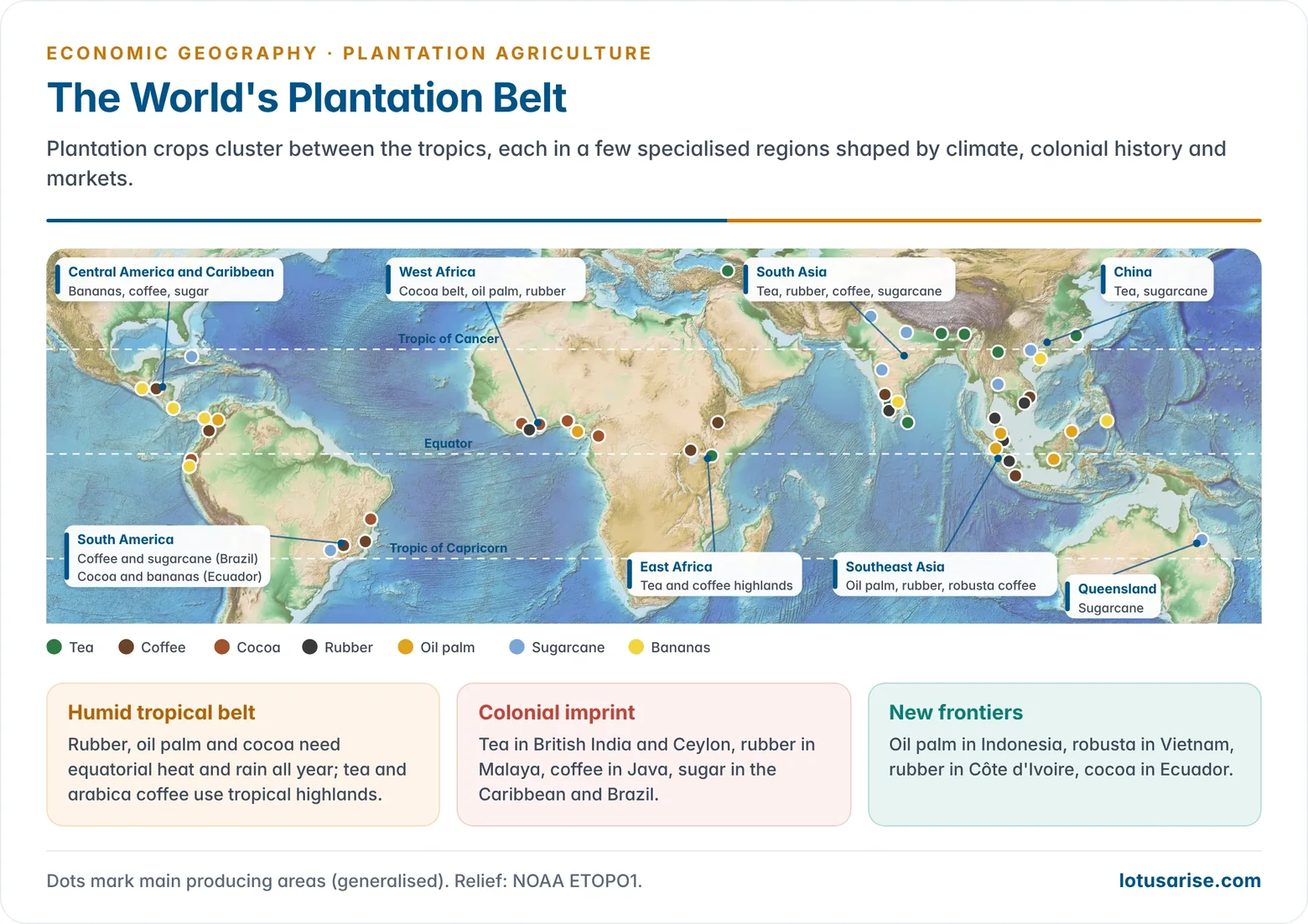
The Plantation Belt
- Plantation crops form a broken belt across the humid tropics, with outliers into the subtropics (tea in China, Japan and Türkiye; sugarcane in Uttar Pradesh, Queensland and Louisiana; coffee in southern Brazil).
- Each crop is concentrated in a few countries and, within them, in a few districts. This regional specialisation comes from ecological fit, colonial history and economies of scale in processing and marketing.
| Region | Specialisation | Leading areas |
|---|---|---|
| Southeast Asia | Oil palm, rubber, coffee (robusta), coconut, sugarcane | Sumatra, Kalimantan and peninsular Malaysia (oil palm); southern Thailand, Vietnam’s south-east (rubber); Vietnam’s Central Highlands (coffee) |
| South Asia | Tea, rubber, coffee, coconut, sugarcane | Assam, Darjeeling, the Nilgiris, Sri Lanka’s central highlands (tea); Kerala (rubber); Karnataka (coffee) |
| East Asia | Tea (green), sugarcane | Fujian, Yunnan, Zhejiang, Sichuan (China); Guangxi (sugarcane) |
| West Africa | Cocoa, oil palm, rubber | The cocoa belt of Côte d’Ivoire, Ghana, Nigeria, Cameroon; rubber in Côte d’Ivoire and Liberia |
| East Africa | Tea, coffee, cut flowers, sisal | Kenya Highlands (tea, coffee), Ethiopia (arabica coffee), Uganda (robusta), Tanzania |
| Latin America and Caribbean | Coffee, sugarcane, bananas, cocoa | Minas Gerais, São Paulo, Espírito Santo (coffee); São Paulo (sugarcane); Ecuador, Costa Rica, Guatemala, Colombia (bananas); Ecuador (cocoa) |
| Oceania | Sugarcane, coconut | Queensland coast; Fiji; Papua New Guinea (oil palm, coffee) |
Major Plantation Crops
Tea
- Conditions: warm, humid climate (13–30 °C), 150–300 cm of well-distributed rain, well-drained acidic soils on slopes; frost and waterlogging harm it. Plucking is labour-intensive.
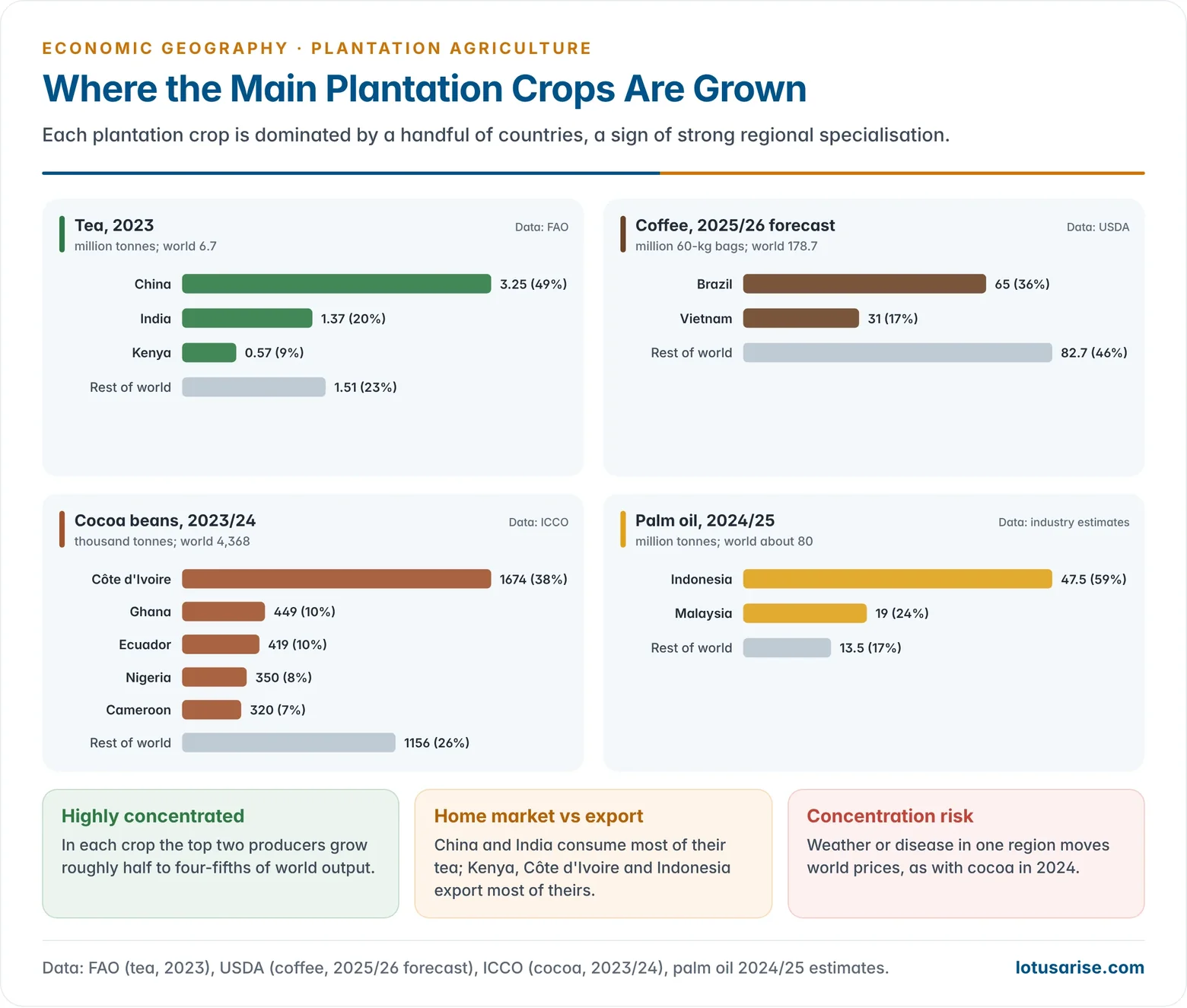
- Production: world output was about 6.7 million tonnes in 2023 (FAO). China produced about 3.3 million tonnes, nearly half, mostly green tea; India about 1.4 million tonnes; then Kenya (about 0.57 million tonnes), Sri Lanka, Türkiye and Vietnam.
- Specialisation: China’s tea is mainly for its home market. Kenya is the leading exporter of black tea, followed by Sri Lanka and India.
- India: Assam produces about half of India’s tea; West Bengal (Darjeeling, Dooars, Terai), Tamil Nadu (the Nilgiris) and Kerala make up most of the rest. Small tea growers now supply over half of India’s output.
Coffee
- Conditions: arabica needs tropical highlands (900–2,000 m), 15–24 °C, 150–250 cm of rain and a dry spell for flowering; robusta grows in hotter, wetter lowlands. Shade, well-drained volcanic or laterite soils; frost-free.
- Production (USDA forecast for 2025/26): a record 178.7 million 60-kg bags. Brazil about 65 million (over one-third), Vietnam about 31 million (mostly robusta), followed by Colombia, Indonesia and Ethiopia, the crop’s original home. India is among the top ten (Karnataka grows about 70% of Indian coffee).
- Changing pattern of production and export:
- Latin American dominance to a wider spread: Brazil and Colombia once supplied most of the world’s coffee. Since the 1990s Vietnam’s robusta boom made it the second-largest producer and exporter.
- Shift within Brazil: from frost-prone Paraná and São Paulo to the Cerrado and Minas Gerais and to robusta in Espírito Santo, with mechanised harvesting.
- Decline of some old producers: Côte d’Ivoire, once a major robusta exporter, and Central America (coffee leaf rust after 2012) lost share.
- Rise of East Africa and Asia: Ethiopia and Uganda have expanded; consumption is growing fastest in Asia (China, Vietnam, India) and in producing countries themselves.
- Value capture: roasting, branding and retail remain in importing countries (Europe, the US). Producers earn a small share of the final price.
- Climate risk: droughts and frosts in Brazil and Vietnam in 2021–24 pushed arabica and robusta prices to record highs in 2024–25.
Cocoa
- Conditions: hot, humid lowlands within about 10–15° of the equator, 21–32 °C, 150–250 cm of rain, deep fertile soils, shade trees. Grown mostly by smallholders on 2–5 ha farms.
- Production (ICCO, 2023/24): about 4.4 million tonnes. Côte d’Ivoire (about 1.7 million tonnes, nearly two-fifths) and Ghana (about 0.45 million tonnes) lead; Ecuador, Nigeria and Cameroon follow. Africa grows about 71% of the world’s cocoa.
- Specialisation: the West African cocoa belt grew on smallholdings in cleared forest. Grinding and chocolate making are concentrated in the Netherlands, Germany, the US, Malaysia and Côte d’Ivoire itself.
- Recent change: ageing trees, swollen-shoot virus, illegal gold mining and erratic rain cut West African output in 2023–24. World prices passed US$12,000 a tonne in late 2024. Ecuador and Brazil are expanding.
Natural Rubber
- Conditions: equatorial climate, 25–35 °C, over 200 cm of rain spread through the year, deep well-drained soils; tapping needs a large labour force.
- Production: about 14.3 million tonnes in 2024 (ANRPC). Thailand produces about a third; Indonesia, Vietnam, Côte d’Ivoire (now Africa’s largest), China, India and Malaysia follow.
- Specialisation: a colonial transfer from the Amazon to Southeast Asia; South American leaf blight still prevents large plantations in its homeland.
- Malaysia, once the leader, shifted to oil palm. Smallholders now produce over 85% of the world’s rubber.
- India: Kerala produces the bulk of India’s rubber; Tripura and Assam are new growing areas. Most tyre makers’ demand is met by both domestic rubber and imports.
Oil Palm
- Conditions: equatorial lowlands, 24–32 °C, 200–250 cm of rain without a long dry season. It gives the highest oil yield per hectare of any oil crop.
- Production: about 80 million tonnes of palm oil in 2024/25. Indonesia (about 47.5 million tonnes) and Malaysia (about 19 million tonnes) together produce over four-fifths; Thailand, Colombia and Nigeria follow.
- Specialisation: originally West African; its plantation core moved to Malaysia (from the 1960s, replacing rubber) and Indonesia (Sumatra, Kalimantan). India is the largest importer of palm oil and is expanding planting under the National Mission on Edible Oils – Oil Palm (2021), mainly in Andhra Pradesh, Telangana and the North-East.
- Issues: deforestation and peat fires in Sumatra and Borneo, loss of orangutan habitat, land conflicts. Certification (RSPO) and the EU Deforestation Regulation (due to apply from 30 December 2026 for large firms) press for deforestation-free supply.
Sugarcane
- Conditions: tropical and subtropical, 20–35 °C, 100–200 cm of rain or irrigation, a cool dry ripening season; heavy, fertile soils. Cane must be crushed soon after cutting, so sugar mills sit in the cane fields.
- Production: Brazil grows nearly two-fifths of the world’s sugarcane, chiefly in São Paulo, and is the largest sugar exporter. India is second (Uttar Pradesh, Maharashtra, Karnataka), then China, Thailand and Pakistan.
- Specialisation: the oldest plantation crop of the Americas (north-east Brazil, the Caribbean). Today it is as much an energy crop: Brazil’s cane ethanol and India’s ethanol-blending programme (20% blending reached in 2025) divert cane from sugar.
Bananas
- Conditions: hot, humid tropical lowlands, ample rain or irrigation, protection from strong winds.
- Production and trade: India is the largest producer (about a quarter of world output), followed by China, Indonesia, Brazil and Ecuador. India and China consume almost all they grow.
- Ecuador is the largest exporter; Costa Rica, Guatemala, Colombia and the Philippines follow. Export bananas come from large corporate plantations (“dollar bananas”).
- Issues: monoculture of a single variety (Cavendish) makes the crop vulnerable to Panama disease (TR4), now spreading in Latin America.
Why Plantation Crops Are Regionally Specialised
- Ecological fit: narrow climatic and soil needs (rubber and oil palm in the equatorial lowlands; arabica and tea in tropical highlands).
- Colonial inheritance: each empire specialised its colonies (tea in British India and Ceylon, rubber in Malaya, coffee and sugar in Java, cocoa in the Gold Coast). Ports, railways and research stations were built for one crop.
- Economies of scale and agglomeration: factories, mills, research, marketing boards and skilled labour concentrate in established districts.
- Market access: coastal location and port links to importing regions.
- Policy and institutions: marketing boards (Ghana COCOBOD), price support, land concessions (Indonesia), state settlement schemes (Malaysia’s FELDA, from 1956).
- Diffusion and new frontiers: crops move where land and labour are cheaper and diseases absent: rubber from Brazil to Asia, oil palm from West Africa to Southeast Asia, robusta coffee to Vietnam.
Problems and Recent Trends
Problems of Plantation Economies
- Economic:
- Commodity dependence and price volatility; worsening terms of trade for raw-crop exporters.
- Value addition and profits concentrated in importing countries and multinationals.
- Long gestation and ageing trees (cocoa in Ghana; tea bushes in Assam).
- Ecological:
- Deforestation and biodiversity loss (oil palm in Borneo, cocoa in West Africa, cattle and soya beyond the plantation belt).
- Soil erosion on tea and coffee slopes; heavy use of agrochemicals; peat fires.
- Monoculture vulnerability to pests and diseases: coffee rust (Ceylon 1870s, Central America 2012), Panama disease in bananas, swollen-shoot virus in cocoa.
- Climate change is shifting suitable zones upslope and poleward and raising drought and heat stress.
- Social:
- Low wages, poor housing and child labour (cocoa in West Africa); weak rights of migrant estate workers.
- Land conflicts with indigenous and forest communities.
- Closure of uneconomic tea gardens in Assam and North Bengal has caused hardship.
Recent Trends
- Shift to smallholders and contract farming.
- New frontiers in Africa (rubber in Côte d’Ivoire, oil palm in Liberia and Gabon) and Latin America (oil palm in Colombia; cocoa in Ecuador).
- Sustainability rules: certification (Rainforest Alliance, Fairtrade, RSPO) and the EU Deforestation Regulation, which covers cocoa, coffee, oil palm, rubber, soya, cattle and wood.
- Value addition at origin: Côte d’Ivoire and Ghana grind more cocoa; Indonesia and Malaysia refine palm oil and make oleochemicals; India exports branded tea and coffee.
- Rising Asian demand for palm oil, rubber and coffee, led by China and India.
Plantation Agriculture in India
- Tea: Assam, West Bengal, Tamil Nadu, Kerala; India is the second-largest producer.
- Coffee: Karnataka, Kerala, Tamil Nadu; shade-grown under a forest canopy in the Western Ghats.
- Rubber: Kerala, with new areas in Tripura and Assam.
- Spices and coconut: cardamom and pepper in the Western Ghats; coconut in Kerala, Tamil Nadu, Karnataka.
- Oil palm: Andhra Pradesh, Telangana, the North-East under the oil palm mission.
- Estate workers were long protected by the Plantations Labour Act, 1951. It is now subsumed in the Occupational Safety, Health and Working Conditions Code, 2020, in force since November 2025 with the other three labour codes.