

9.7 Concepts and methods of Ecological Anthropology: Bio-cultural Adaptations – Genetic and Non- genetic factors. Man’s physiological responses to environmental stresses: hot desert, cold high-altitude climate.
Official Syllabus: Paper I, Unit 9.7
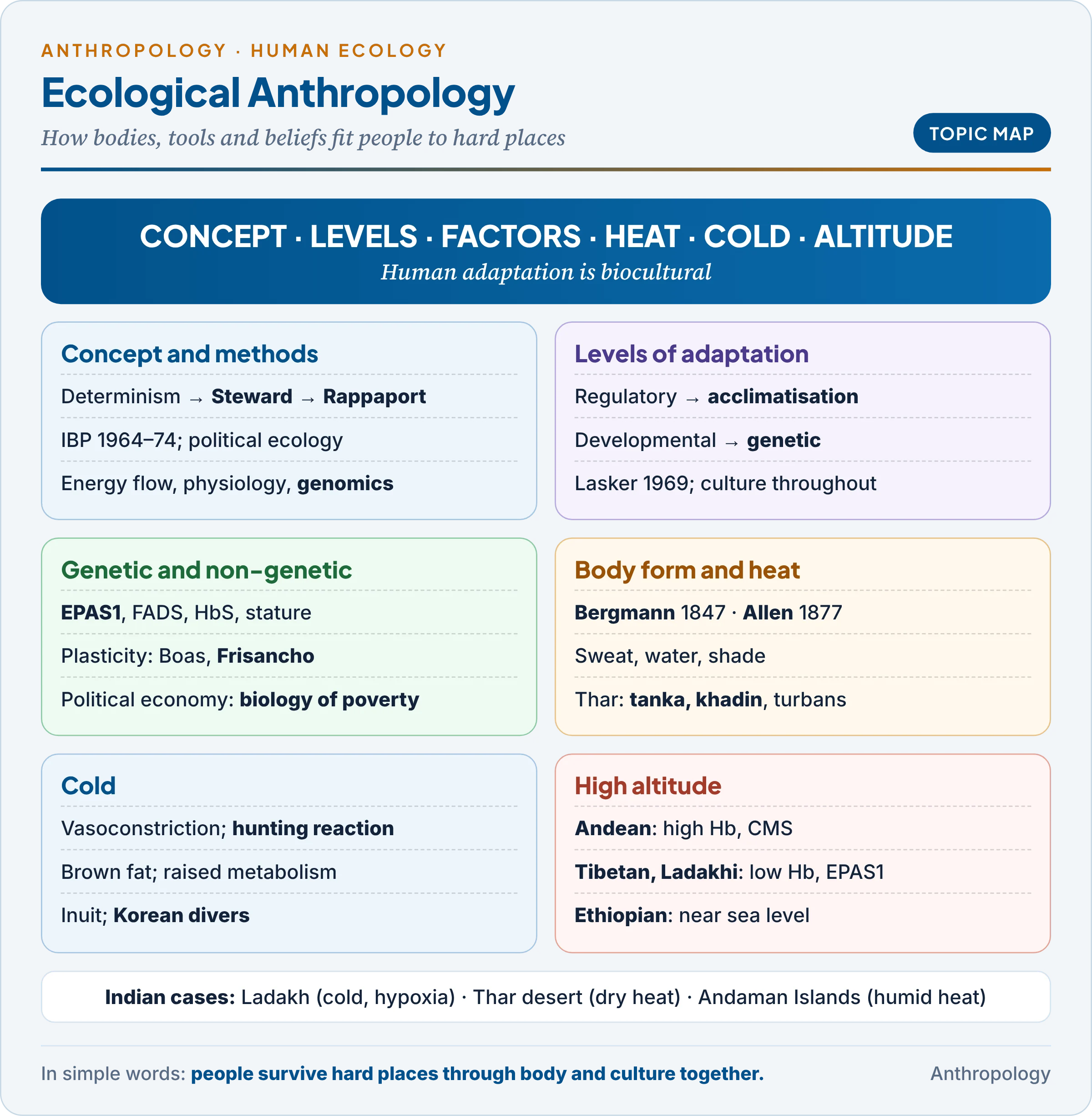
Unit 9.6 showed that traits such as haemoglobin and lung capacity change with altitude, diet and way of life. This unit asks how human populations fit their environments, through culture, body and genes together, and examines the three classic stresses named in the syllabus: dry heat, cold and the thin air of high mountains.
1. The Concept of Ecological Anthropology
In simple words
Ecological anthropology studies how groups of people live with their surroundings: how they get food and water, cope with heat or cold, and change the land around them. It looks at body and culture together, because people survive hard places mainly through tools, houses, clothing and social rules, helped by slower changes in the body.
An example first. On the Changthang plateau of eastern Ladakh, at about 4,500 metres, the Changpa herders raise pashmina goats, yaks and sheep. Every part of their life answers the environment. The air holds about two-fifths less oxygen than at sea level, and their bodies, of Tibetan ancestry, carry gene variants that keep blood from thickening (§7). Winter nights fall below −30 °C, so they live in yak-hair tents (rebo), wear thick wool and burn dung. Grass is thin, so they move their herds between seasonal pastures, and the fine under-wool their goats grow against the cold becomes the pashmina trade that links them to world markets. Biology, technology, economy and social organisation form one system. Studying that system is ecological anthropology.
Key terms.
- Ecology: the study of organisms in relation to their surroundings (the German biologist Ernst Haeckel coined the word in 1866).
- Ecosystem: all living things of an area together with their physical environment, linked by flows of energy and cycles of materials (the British ecologist Arthur Tansley, 1935).
- Human ecology: ecology applied to people, who differ from other species because they modify their environment through tools and cooperation and pass this knowledge on as culture.
- Ecological anthropology: the study of how human populations, through culture and biology, interact with the ecosystems they live in: the responses that affect their survival, reproduction, growth, health and spread.
What makes it distinctive. It is holistic, joining physiology, genetics, geography, economics and ethnography; it is problem-oriented, starting from a concrete stress (drought, hypoxia, cold); and it treats culture as humanity’s main adaptive mechanism, faster than genetic change, which takes many generations.
1.1 How the field developed
The table traces the main approaches; each grew from criticism of the one before.
| Approach | Key figures and works | Core idea | Main criticism |
|---|---|---|---|
| Environmental determinism | Friedrich Ratzel; Ellen Churchill Semple; Ellsworth Huntington | Climate and land shape character and culture | Ignores choice and history; often racist |
| Possibilism | Franz Boas; Alfred Kroeber (culture areas) | Environment limits but does not decide; history explains culture | Leaves environment passive |
| Cultural ecology | Julian Steward, Theory of Culture Change (1955) | Culture core (subsistence, work, technology) adapts to environment; multilinear evolution | Treats culture as the unit; weak biology |
| Ecosystem approach | Clifford Geertz, Agricultural Involution (1963); Roy Rappaport, Pigs for the Ancestors (1968); Andrew Vayda | Human population as one species in an ecosystem; energy flow; ritual as regulator | Functionalist; static equilibrium |
| Human adaptability | International Biological Programme (1964–74); Paul Baker; Gabriel Lasker (1969) | Measure biological and cultural responses to stress | Isolated “pristine” groups; little politics |
| Ethnoecology | Harold Conklin; Brent Berlin | How people classify and know their environment | Words may differ from practice |
| Cultural materialism and behavioural ecology | Marvin Harris; Bruce Winterhalder and Eric Alden Smith (1981) | Material needs and cost–benefit choices explain customs | Reductionist |
| Historical and political ecology | Eric Wolf (1972); William Balée; James Fairhead and Melissa Leach (1996) | Landscapes are made by history; power shapes access to resources | Can lose biology |
| Spiritual and environmental anthropology | Sacred groves; conservation, climate change | Belief, rights and policy in resource use | Applied, diverse |
The table shows a steady widening: from climate deciding culture, to culture adapting to environment, to whole ecosystems, and finally to history, power and belief. The constant thread is that human adaptation is biocultural. Steward’s method and his culture core are treated fully in Unit 6h; Marvin Harris in Unit 6i; ecological exchange cycles such as the kaiko in Unit 3b.
Steward and Rappaport, the two pillars.
- Julian Steward, an American anthropologist who studied the Shoshone and Paiute of the Great Basin, argued that a harsh, scattered food supply explains the Shoshone’s small, mobile family bands: an environment–technology–society chain he called cultural ecology.
- Roy Rappaport, an American ecological anthropologist, measured the calories that the Tsembaga Maring of highland New Guinea put into and took out of their gardens. When pigs became too many for the gardens and the women who fed them, a year-long ritual festival, the kaiko, slaughtered most of the pigs for the ancestors, redistributed meat and opened the way to renewed warfare and land use. Ritual worked like a thermostat keeping people, pigs and land in balance.
- Criticism: Rappaport’s model assumed a stable equilibrium and treated the group as a self-regulating unit, as functionalism did (Unit 6d). Critics asked how a ritual “knows” the carrying capacity, and noted that colonial pacification and markets were left out. The American anthropologist John Bennett (The Ecological Transition, 1976) added that an ecosystem model suits small, isolated groups but not complex societies, where markets and institutions stand between people and nature. Vayda himself later turned to “event ecology” (studying particular events and decisions), and political ecology added power.
Political ecology and India. Eric Wolf (1972) introduced the term political ecology: who controls land, water and forest shapes how people adapt. In India, Madhav Gadgil and Ramachandra Guha (This Fissured Land, 1992) wrote an ecological history of the subcontinent, and the sacred groves of the Western Ghats and Meghalaya, protected by belief, show spiritual ecology at work.
Common confusion
Is ecological anthropology the same as cultural ecology? Not quite. Cultural ecology is Steward’s narrower method: it asks how the culture core of subsistence and technology fits an environment, and treats culture as the unit. Ecological anthropology is the wider field that grew out of it: it treats a human population as one species in an ecosystem, measures biology as well as culture, and now includes historical and political ecology.
2. Methods of Ecological Anthropology
In simple words
Ecological anthropologists measure both the body and the way of life. They count calories, test lungs and blood, record what people eat and how they spend their time, ask how people name plants and soils, and compare groups living in different places.
The table groups the methods by what they measure; most studies combine several.
| Method | What it measures | Example |
|---|---|---|
| Ecosystem and energy-flow analysis | Calories in and out; nutrient cycles | Rappaport’s Tsembaga gardens |
| Physiological tests | Haemoglobin, oxygen saturation, lung volume, VO₂max, sweat rate, skin temperature | Andean and Tibetan comparisons |
| Anthropometry and growth | Stature, chest size, body proportions, fat | Bergmann–Allen studies; highland children |
| Diet, time-allocation and nutrition surveys | Food intake, work schedules | San foraging studies |
| Demography | Births, deaths, fertility, migration | Birth weight at altitude |
| Ethnoecology | Folk classifications of plants, soils, animals | Ka’apor of Brazil name 768 plant species |
| Genomics | Signals of natural selection | EPAS1 in Tibetans and Ladakhis |
| Historical and political analysis | Archives, land records, policy | Political ecology of forests |
| Remote sensing and GIS | Land use, population at altitude | 81.6 million people above 2,500 m (2021) |
Research designs matter as much as tools. The strongest comparisons are natural experiments:
- Natives versus migrants at the same altitude (separates lifelong from recent exposure).
- Migrants who arrived as children versus adults (separates development from genes).
- Highland and lowland groups of the same ancestry (separates environment from genes).
Measuring success. Adaptation is judged by demographic criteria (survival, fertility, growth of numbers), energetic criteria (energy captured for energy spent), nutritional criteria and, ultimately, fitness (reproductive success).
3. Adaptation, Adaptability and Acclimatisation
In simple words
When a lowlander flies to Leh, the body first breathes faster, then over weeks makes more red blood cells. A child who grows up there develops bigger lungs. Over thousands of years, populations living there may carry genes that help. These are different levels of adaptation, from minutes to millennia.
An example first. A soldier or tourist flying from Delhi to Leh (3,500 m) is breathless on the first day: a regulatory response (faster breathing). Over days to weeks the body makes more red cells: acclimatisation. A child born and raised in Leh grows a larger chest and lungs: developmental acclimatisation. A Ladakhi of Tibetan ancestry carries variants of EPAS1 inherited over thousands of years: genetic adaptation.
Definitions.
- Adaptation: in the American biological anthropologist Gabriel Lasker‘s words, “the change by which organisms surmount the challenges to life” (Science, 1969). Strictly, genetic adaptation is a heritable change in a population produced by natural selection over generations.
- Adaptability: the capacity of individuals and populations to adjust to stress through physiological, developmental, behavioural and cultural responses within a lifetime. Humans’ great adaptability is itself a product of evolution.
- Acclimatisation: reversible physiological changes within a lifetime in response to a natural environment, taking days to months (more red cells at altitude; earlier sweating in heat). Acclimation is the same change produced experimentally in a laboratory.
- Developmental acclimatisation: irreversible changes acquired during growth (larger lungs in highland-raised children).
- Habituation: a lessening of response to a repeated stress (hands that stop feeling pain in cold water).
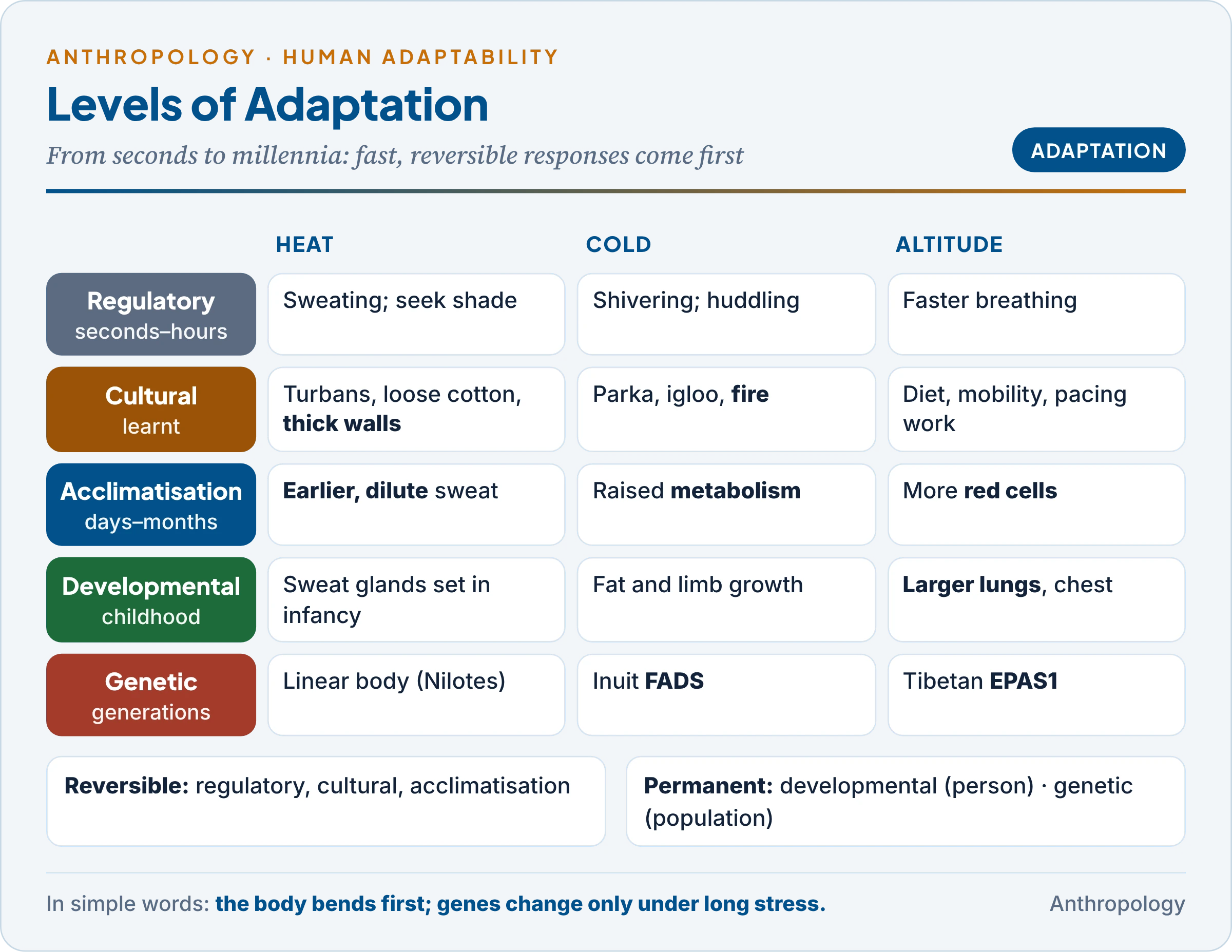
Lasker’s three levels set these out by timescale, which the table expands.
| Level | Timescale | Reversible? | Inherited? | Heat | Cold | Altitude |
|---|---|---|---|---|---|---|
| Regulatory and behavioural | Seconds to hours | Yes | No | Sweating; seek shade | Shivering; huddling | Faster breathing |
| Cultural | Learnt, across generations | Yes | Socially | Turbans, loose cotton, thick walls | Parkas, igloos, fire | Diet, pacing work, mobility |
| Acclimatisation | Days to months | Yes | No | Earlier, more dilute sweat | Raised metabolism; less shivering | More red cells; 2,3-BPG |
| Developmental | Childhood | No | No | Sweat glands activated in infancy | Fat and limb growth | Larger lungs and chest |
| Genetic adaptation | Many generations | No | Yes | Linear body (Nilotes) | Inuit FADS genes | Tibetan EPAS1 |
The table shows the human strategy: fast, cheap, reversible responses first, with genes changing only where a stress has been severe and lasting for thousands of years, as at high altitude. Culture sits between the two, as fast as behaviour but transmitted like genes.
Common confusion
Is acclimatisation the same as adaptation? No. Acclimatisation happens within one person’s life and disappears if the stress ends: a lowlander’s extra red cells fall after returning to Delhi. Genetic adaptation happens across generations in a population and is inherited: a Tibetan baby carries its EPAS1 variant before ever breathing mountain air. Adaptability is the umbrella term for every way of coping.
4. Bio-cultural Adaptation: Genetic and Non-genetic Factors
In simple words
People survive difficult places through a mix of inherited body features and things they learn and build. Each changes the other: culture can create new pressures on genes, and biology sets limits on culture. Poverty and power also decide who suffers most from heat, cold or thin air.
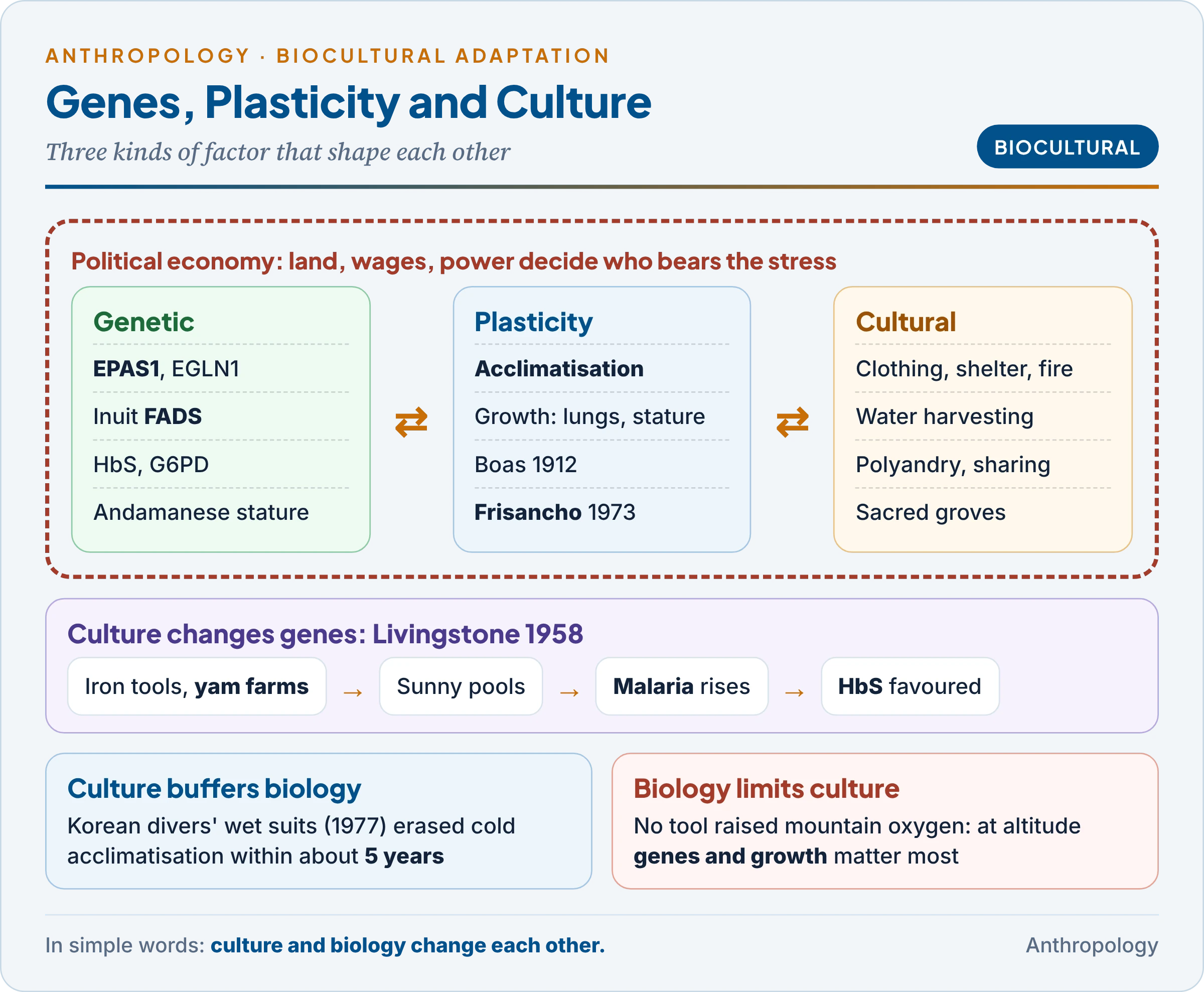
An example first: yams, mosquitoes and the sickle-cell gene. The American anthropologist Frank Livingstone (1958) asked why the sickle-cell gene is common in some West African groups and not others. His answer joined culture and biology: when farmers with iron tools cleared forests for yams, they created sunny, stagnant pools where the malaria mosquito Anopheles gambiae breeds. Malaria rose, and with it the selective advantage of carrying HbS (Unit 9.3). A cultural change altered the gene pool. This is the essence of biocultural adaptation.
4.1 Genetic factors
- Natural selection on specific variants: EPAS1 and EGLN1 in Tibetans and Ladakhis (altitude); FADS genes in Greenland Inuit (a diet of marine fats; Fumagalli and colleagues, Science, 2015); HbS, G6PD and thalassaemia (malaria); lactase persistence (dairying); skin pigmentation (ultraviolet light; Unit 9.5).
- Body size and shape: the very short stature of the Andamanese reflects strong selection on body-size genes, not an ancient African origin (Mayukh Mondal and colleagues, Nature Genetics, 2016).
- Gene flow from archaic humans: the Tibetan EPAS1 variant came from Denisovans (Emilia Huerta-Sánchez and colleagues, Nature, 2014).
- Why genes matter: they set the range (norm of reaction) within which the body can respond; selection acts where cultural buffering fails, as at extreme altitude.
4.2 Non-genetic factors
- Physiological acclimatisation (§5–7).
- Developmental plasticity: the body moulds itself during growth. Franz Boas (1912) found that children of European immigrants born in the United States differed in head form from their parents, showing that even “racial” traits respond to environment (Unit 9.5). A. Roberto Frisancho (1973) found that lowland Peruvians raised at altitude reached the same lung capacity as highland natives, while those arriving as adults did not.
- Nutrition and disease: diet, infection and workload shape growth, stature and haemoglobin (Unit 9.6); stature is therefore a sensitive record of environment.
- Culture: technology (clothing, shelter, fire, water storage), economy (mobility, herding, irrigation), social organisation (sharing, marriage rules such as Tibetan fraternal polyandry, which kept scarce land undivided; Unit 2.3) and belief (taboos, sacred groves, ritual regulation).
4.3 How they interact
- Culture buffers biology: the Inuit parka makes the Arctic survivable without large genetic change; Korean diving women lost their cold acclimatisation once they adopted wet suits (§6).
- Culture creates selection: yam farming and malaria; dairying and lactase persistence.
- Biology limits culture: no technology before oxygen cylinders could raise the oxygen in mountain air, so genes and development matter most at altitude.
4.4 Political economy and biology
The biological anthropologists Alan Goodman and Thomas Leatherman (Building a New Biocultural Synthesis, 1998) argued that political economy, the distribution of land, wages and power, is part of the environment to which bodies respond. R. Brooke Thomas called this a “biology of poverty“.
- Leatherman‘s work in the southern Peruvian Andes showed that illness among highland households was driven as much by poverty and labour demands as by hypoxia or cold.
- In India, the same lens explains why heat kills outdoor labourers and slum-dwellers more than others, why anaemia is worst among tribal women (Unit 9.6), and why sickle-cell disease, a genetic legacy of malaria, becomes a crisis where health care is weakest.
- Why it matters: adaptation is not only a matter of climate and genes; it is also about who can afford shade, warm clothing, a good diet or medical care.
5. Body Size and Shape: The Ecological Rules
In simple words
In cold places, bigger and stockier bodies keep heat better; in hot places, tall and slim bodies lose heat faster. Biologists noticed this in warm-blooded animals and named the patterns after Bergmann and Allen. Humans broadly follow them, though food and history blur the pattern.
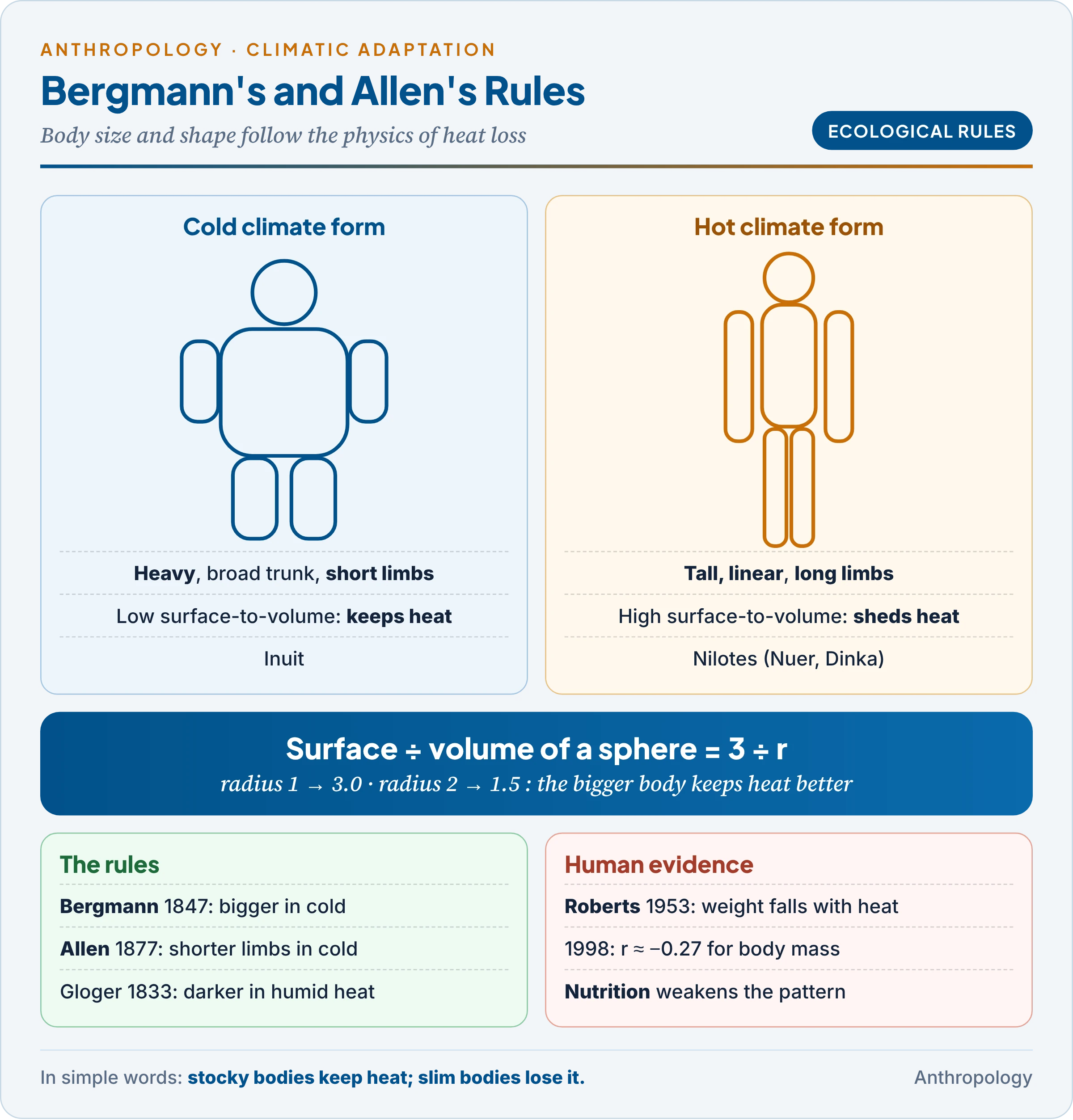
The physics. A body produces heat in proportion to its mass (volume) but loses it through its surface. As size increases, volume grows faster than surface, so the surface-to-volume ratio falls. A sphere of radius 1 has a ratio of 3; a sphere of radius 2 has 1.5. A large, compact body therefore conserves heat; a small or long, thin body sheds it.
The rules.
- Bergmann’s rule (the German biologist Carl Bergmann, 1847): within a warm-blooded species, body size increases in colder climates.
- Allen’s rule (the American zoologist Joel Allen, 1877): in colder climates limbs and extremities are shorter.
- Gloger’s rule (1833): pigmentation is darker in warm, humid regions (Unit 9.5).
Human evidence.
- The British anthropologist Derek Roberts (“Body weight, race, and climate”, 1953) found that average body weight falls as mean annual temperature rises.
- Peter Katzmarzyk and William Leonard (1998) re-tested this with 223 male and 195 female samples: body mass still correlated negatively with temperature (r ≈ −0.27), and relative sitting height (trunk length compared with stature) did so even more strongly (r ≈ −0.37 in men, −0.46 in women). But the slopes were weaker than Roberts’s, because better nutrition had made tropical populations heavier: food can override climate.
- Contrasts: the Inuit, with broad trunks and short limbs, against the tall, long-limbed Nilotic peoples of South Sudan such as the Nuer and Dinka; among fossils, the stocky Neanderthals of Ice Age Europe against the tall, linear Homo erectus boy from Nariokotome (Unit 1.6b). Christopher Ruff (1991) noted that body breadth (pelvis width) tracks climate best, because a tall, narrow body keeps a high surface-to-volume ratio whatever its height.
Limits. Nutrition and disease change size within a generation; clothing and housing reduce the stress; gene flow mixes populations; and some small-bodied peoples live in cold places. The rules describe tendencies, not laws.
The table summarises the two rules and their human tests.
| Rule | Prediction | Mechanism | Human example | Caveat |
|---|---|---|---|---|
| Bergmann (1847) | Bigger bodies in cold | Lower surface-to-volume ratio | Inuit heavier than equatorial peoples | Nutrition raises weight in the tropics |
| Allen (1877) | Shorter limbs in cold | Less surface for heat loss | Inuit short limbs; Nilotes long limbs | Clothing and shelter buffer cold |
Both rules rest on one principle: heat balance depends on shape. Their weaker fit today shows that culture and nutrition now shape human bodies as much as climate does.
6. Responses to Heat and Cold
In simple words
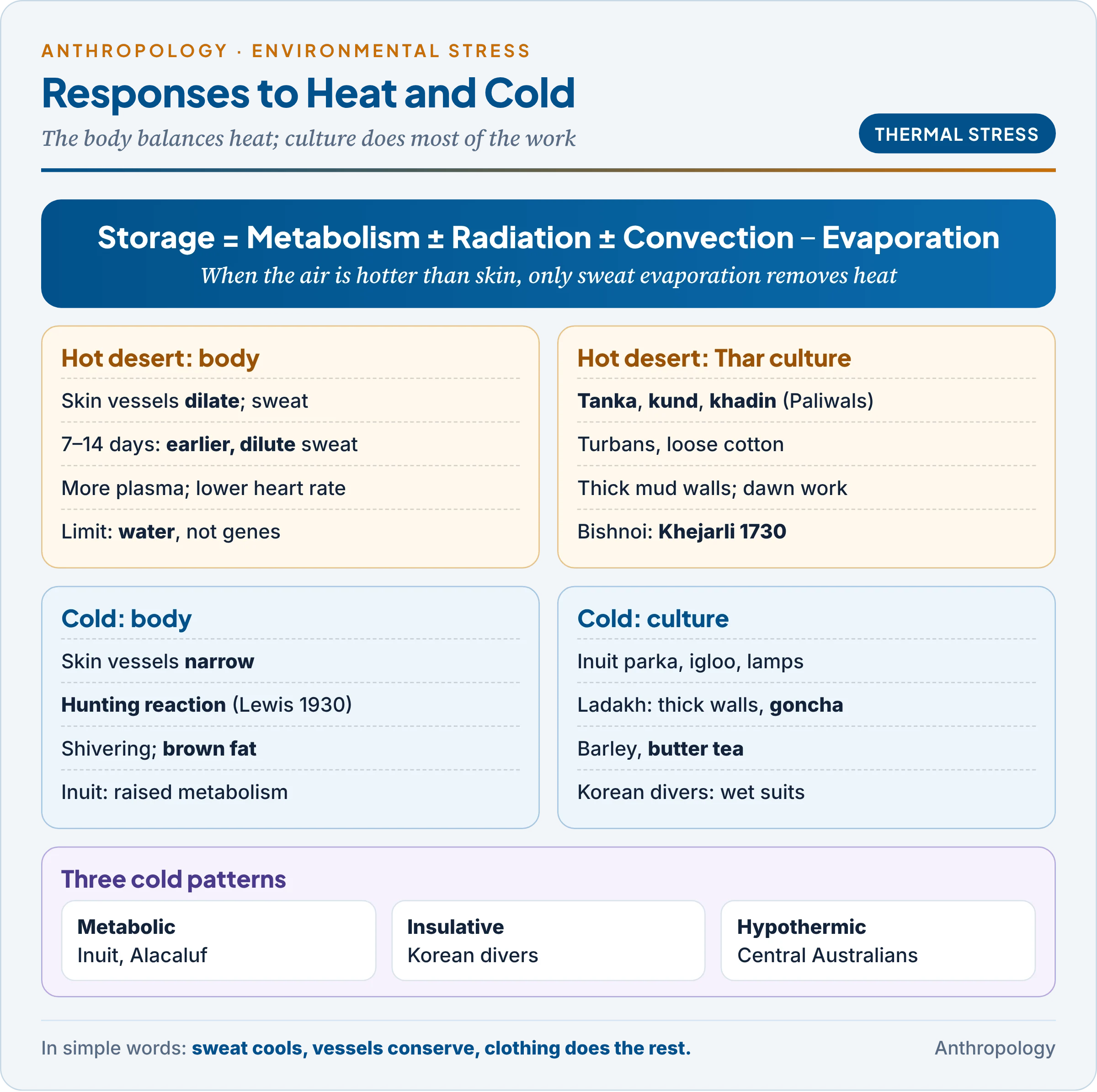
In heat the body cools itself mainly by sweating, which costs water, so desert peoples manage water and avoid the midday sun. In cold the body narrows its skin blood vessels and makes more heat, but people mainly survive through clothing, shelter and fire.
6.1 The heat balance
The body keeps a core temperature near 37 °C by balancing heat gained and lost:
Heat storage = Metabolism ± Radiation ± Convection ± Conduction − Evaporation
When the air is hotter than the skin, radiation and convection add heat, so evaporation of sweat becomes the only way to lose it. Sweating cools only if the sweat evaporates; in humid heat it drips off and is wasted.
6.2 Hot desert
An example first: the Thar desert. In western Rajasthan, rain falls on fewer than 30 days a year and summer temperatures exceed 45 °C. Desert villagers adapted mainly through culture:
- Water: household underground cisterns (tanka), saucer-shaped catchments draining to covered wells (kund) and the khadin, an earthen embankment that holds monsoon run-off so that crops grow on the moist soil, first built by the Paliwal Brahmins of Jaisalmer in the 15th century.
- Dress and shelter: loose cotton and large turbans (safa, pagri) that shade the head and trap cooler air; thick mud walls and small windows that slow the passage of heat; round thatched bhunga huts in neighbouring Kutch.
- Work and mobility: labour at dawn and dusk; dispersed hamlets (dhani); camel herding by the Raika; seasonal migration in drought.
- Belief and conservation: the Bishnoi protect the khejri tree and blackbuck; at Khejarli in 1730 many Bishnoi, led by Amrita Devi, were killed protecting trees from felling.
Physiological responses.
- Immediate: dilation of skin blood vessels (bringing heat to the surface), sweating, a faster pulse.
- Acclimatisation in about 7–14 days: sweating starts earlier and is more copious, sweat becomes more dilute (the hormone aldosterone conserves salt), plasma volume expands, heart rate and core temperature during work fall, and heat illness becomes rarer. A person can sweat over a litre an hour, so water, not heat tolerance, is the limit.
- Little genetic difference: the American anthropologist Paul Baker (1958) found that desert natives and newcomers acclimatise similarly; humans have no special genetic desert adaptation, unlike camels. Desert peoples rely on behaviour and technology.
- Body form: a tall, lean, long-limbed body (like the Nilotes) favours heat loss, but desert peoples come in all shapes.
- Clothing can be counter-intuitive: Bedouin wear black robes; experiments (Shkolnik and colleagues, Nature, 1980) found they gain no more heat than white ones, because loose robes let wind carry away the heat absorbed at the outer layer.
Hot-humid climates and fitness. In humid tropics, sweat cannot evaporate, so heat stress is greater at lower temperatures. Aerobic fitness raises heat tolerance because it brings on earlier sweating, a larger plasma volume and a stronger heart that can supply both muscles and skin; trained people thus gain part of heat acclimatisation without living in the heat.
Heat today. Heatwaves are a growing hazard in India. After the deadly 2010 heatwave, Ahmedabad adopted South Asia’s first Heat Action Plan (2013), with early warnings, cool shelters and changed working hours: a planned cultural adaptation.
6.3 Cold
An example first: Korean diving women. For centuries the haenyeo (or ama) of Korea dived for shellfish in water as cold as 10 °C wearing thin cotton suits. In winter their basal metabolic rate rose by about 35 per cent, their limbs held heat better, and they began to shiver at lower water temperatures than other women: clear cold acclimatisation. After they adopted wet suits in 1977, these responses disappeared within about five years (Y.S. Park, Suk Ki Hong and colleagues, 1983). Technology removed the stress, and the biology followed.
Physiological responses.
- Vasoconstriction: skin vessels narrow, turning the outer body into an insulating shell; the cost is cold hands and feet and the risk of frostbite.
- Cold-induced vasodilation (CIVD): the British physician Thomas Lewis (1930) found that cooled fingers periodically re-warm as vessels open, the “hunting reaction“. It is stronger in Inuit and in Gaspé fishermen who work with bare hands, protecting fingers and keeping them usable.
- Shivering and non-shivering thermogenesis: heat from muscle activity, and from brown fat, which is active in infants and, as shown in 2009, in many adults in the cold.
- Raised metabolism: Inuit and indigenous Siberians have basal metabolic rates above those predicted for their size (William Leonard and colleagues, 2002), supported by a high-fat, high-protein diet.
Three patterns of whole-body cold response were described in the mid-20th century; the table compares them.
| Pattern | What happens | Example |
|---|---|---|
| Metabolic | Heat production rises, keeping skin warm | Inuit; Alacaluf of Tierra del Fuego (H.T. Hammel) |
| Insulative | Skin cools strongly, reducing loss; metabolism steady | Korean diving women (in part) |
| Hypothermic | Core temperature allowed to fall slightly at night, saving energy | Aboriginal Australians of the central desert (P.F. Scholander and colleagues, 1958); Kalahari San |
The patterns show that cold tolerance is achieved in different physiological ways, matched to how severe and how long the cold is, and to diet: a meat-rich Arctic diet can fuel a high metabolism; a sparse desert diet favours saving energy.
Cultural responses dominate. The Inuit snow house (igloo), tailored caribou-skin parkas and seal-oil lamps; in Ladakh, thick mud-brick houses facing south, flat roofs stacked with fodder that insulate the rooms below, winter living around the stove, the woollen robe (goncha), and barley flour (tsampa) and butter tea that provide energy and fat. Body form (Bergmann and Allen) adds a small advantage.
7. High Altitude
In simple words
High in the mountains each breath carries less oxygen. Visitors cope by breathing faster and making more red blood cells. People whose ancestors have lived there for thousands of years have found different solutions in the Andes, Tibet and Ethiopia, and Ladakhis share the Tibetan one.
7.1 The stresses
- Hypobaric hypoxia: air pressure falls with height, so each breath carries fewer oxygen molecules. At 3,500–4,000 m, inspired oxygen is about 60–64 per cent of sea level. Culture cannot raise it, which is why altitude is the clearest case of biological adaptation.
- Cold and dryness, strong ultraviolet radiation, low plant productivity and rugged terrain add to the burden.
- How many people: about 81.6 million live above 2,500 m and 14.4 million above 3,500 m (Joshua Tremblay and Philip Ainslie, 2021); Ethiopia has the most above 2,500 m, China above 3,500 m.
7.2 How a lowlander acclimatises
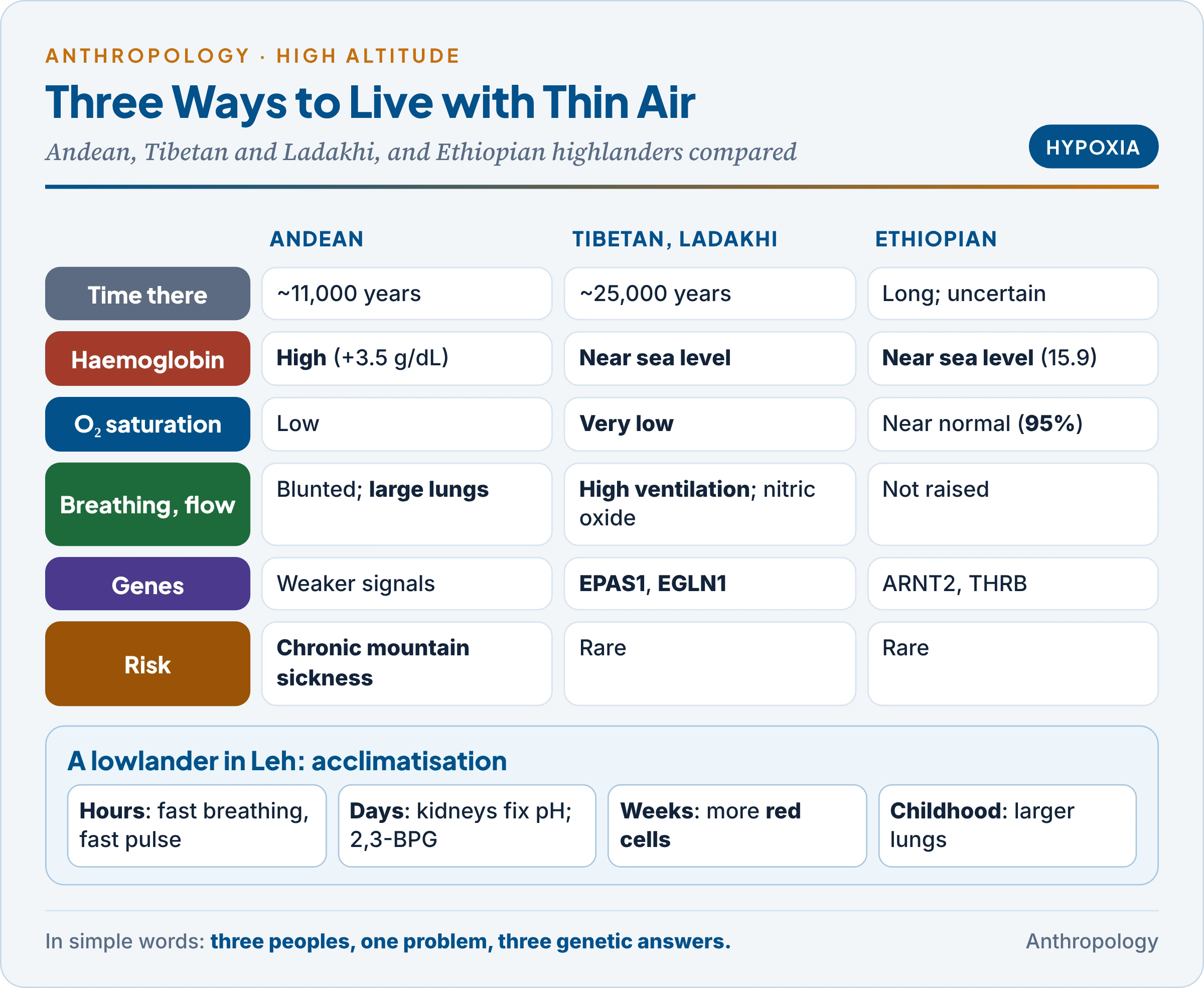
- Minutes to hours: hyperventilation (faster, deeper breathing) and a faster heart rate raise oxygen intake.
- Days: the kidneys excrete bicarbonate to correct the alkaline blood caused by over-breathing; plasma volume falls, concentrating haemoglobin; 2,3-BPG in red cells rises, helping haemoglobin release oxygen to tissues.
- Weeks: the hormone erythropoietin stimulates the marrow, and red cell mass rises (polycythaemia).
- Months: more capillaries and myoglobin in muscle.
- Dangers: acute mountain sickness, and potentially fatal high-altitude pulmonary oedema (fluid in the lungs) and cerebral oedema; these occur among soldiers and visitors in Ladakh.
- Developmental: children raised at altitude develop larger lungs and chests; lowland Peruvians who grew up at altitude matched natives’ lung capacity, those who came as adults did not (Frisancho and colleagues, 1973).
7.3 Three patterns among native highlanders
The Andean pattern (Quechua and Aymara of Peru and Bolivia, settled perhaps 11,000 years ago).
- High haemoglobin (about 3.5 g/dL above sea-level values at 4,000 m), a barrel chest with large lungs, and a blunted ventilatory response (they breathe less in response to low oxygen).
- Cost: some develop chronic mountain sickness (excessive red cells, thick blood, heart strain), described in 1925 by the Peruvian physician Carlos Monge; the cure is descent to lower altitude.
The Tibetan pattern (Tibetans and Sherpas, and Ladakhis of Tibetan ancestry, perhaps 25,000 years at altitude).
- Near sea-level haemoglobin despite low oxygen saturation; higher resting ventilation; about twice as much nitric oxide in exhaled breath, widening blood vessels and raising blood flow; and higher birth weights than lowland migrants at the same altitude.
- Genes: variants of EPAS1 (a hypoxia-response gene) and EGLN1 show the strongest signals of selection known in humans (Xin Yi and colleagues, Science, 2010; Tatum Simonson and colleagues, 2010). The EPAS1 variant was inherited from Denisovans (2014).
- Selection in action: Tibetan women likely to carry a gene for higher oxygen saturation had more surviving children (Cynthia Beall and colleagues).
- Why low haemoglobin helps: extra red cells raise oxygen content but thicken the blood; avoiding them prevents chronic mountain sickness.
The Ethiopian pattern (Amhara of the Semien mountains).
- At 3,530 m, haemoglobin averaged 15.9 g/dL in men and 15.0 in women and oxygen saturation 95.3 per cent: both close to sea-level values (Beall and colleagues, PNAS, 2002). Their arterial oxygen content equals that of lowlanders, against about 10 per cent less in Tibetans and about a fifth more in Andeans.
- Different genes (among them BHLHE41, VAV3, ARNT2 and THRB) show selection, pointing to a third solution.
The table puts the three patterns side by side.
| Feature | Andean | Tibetan and Ladakhi | Ethiopian (Amhara) |
|---|---|---|---|
| Time at altitude | About 11,000 years | About 25,000 years | Long; date uncertain |
| Haemoglobin | High (+3.5 g/dL) | Near sea level | Near sea level |
| Oxygen saturation | Low | Very low | Near normal (95%) |
| Breathing | Blunted response; large lungs | High ventilation | Not elevated |
| Blood flow | Ordinary | High nitric oxide, wide vessels | Under study |
| Key genes | Several, weaker signals | EPAS1, EGLN1 | BHLHE41, ARNT2, THRB |
| Main risk | Chronic mountain sickness | Rare | Rare |
The table shows convergent evolution by different routes: three populations faced the same thin air and reached successful oxygen delivery in three ways. It also corrects older textbooks that treated the Andean “barrel-chested, high-haemoglobin” highlander as the universal model and saw no genetic adaptation at all.
7.4 Ladakh: an Indian case
- Genetic signals: among healthy Ladakhi highlanders, protective variants of EGLN1 are common, while risk variants are frequent in lowlanders who develop high-altitude pulmonary oedema (Aastha Mishra, Qadar Pasha and colleagues, Clinical Science, 2012). A genome study of Leh and Kargil found two lineages, the Leh group close to Tibetans and Sherpas and carrying selection signals at EPAS1 (Lomous Kumar and colleagues, 2024, preprint).
- Low haemoglobin: a review of 17 studies of about 3,500 Himalayan highlanders (Tibetans, Sherpas and Ladakhis) found haemoglobin consistently lower than in Andeans or lowland migrants such as Han Chinese and Indian Tamils living in the Himalaya.
- Birth weight: a study of 316 newborns at 3,540 m in Leh found that foetal growth was protected, alongside Tibetan ancestry with later admixture (Sushil Bhandari and colleagues, 2022, preprint).
- The anaemia puzzle: NFHS-5 recorded 92.8 per cent of Ladakhi women as anaemic, partly because altitude cut-offs based on Andean data may misclassify Tibetan-ancestry highlanders (Unit 9.6).
- Culture: barley farming in short summers, pastoral Changpa nomadism, irrigation channels fed by glacier melt, and historically fraternal polyandry, which kept small fields undivided.
7.5 Work, growth and reproduction
- Work capacity: natives reach similar maximal oxygen uptake at altitude as lowlanders at sea level; the physiologist Robert Grover compared the Andean native to a trained athlete.
- Growth: slower growth and later puberty in Andean children, partly from hypoxia and partly from poverty and diet.
- Reproduction: lowland women at altitude bear lighter babies; long-resident populations are partly protected, through larger placentas and better uterine blood flow.
8. Indian Cases at a Glance
The three Indian environments in this unit are compared below; each shows a different balance of biology and culture.
| Region | Main stress | Biological response | Cultural response | Study or source |
|---|---|---|---|---|
| Ladakh (cold high altitude) | Hypoxia, cold, dryness | EGLN1, EPAS1; low Hb; larger lungs in natives | Barley, butter tea, goncha, thick walls, Changpa mobility, polyandry | Mishra and Pasha 2012; Kumar 2024 |
| Thar desert (hot, dry) | Heat, water scarcity | Acclimatisation; no special genes | Tanka, kund, khadin; turbans; dawn work; Bishnoi conservation | Paliwal khadin; Khejarli 1730 |
| Andaman Islands (hot, humid, island) | Humid heat, limited resources, natural hazards | Short stature selected (Jarawa, Onge) | Forest foraging; oral memory of earthquakes and waves | Radcliffe-Brown (1922); Mondal 2016 |
The comparison shows the rule of this unit: where culture can buffer the stress (heat, cold), people rely on culture; where it cannot (hypoxia), genes and development carry more of the load. In 2004 the Onge of Little Andaman and the Jarawa moved to higher ground after the earthquake and largely survived the tsunami, guided by oral tradition: knowledge as adaptation.
Key Terms
| Term | Meaning in simple words |
|---|---|
| Ecosystem | Living things and their surroundings linked by energy and materials |
| Cultural ecology | Steward’s study of how subsistence and technology adapt to environment |
| Culture core | The parts of culture most tied to getting a living |
| Ethnoecology | How a people names and understands its environment |
| Political ecology | How power and inequality shape use of land, water and forest |
| Adaptation | A change, usually genetic, that helps a population survive a stress |
| Adaptability | The capacity to cope with stress by any means within a lifetime |
| Acclimatisation | Reversible body changes over days to months in a new environment |
| Developmental acclimatisation | Permanent changes acquired while growing up |
| Bergmann’s rule | Larger bodies in colder climates |
| Allen’s rule | Shorter limbs in colder climates |
| Hypoxia | Too little oxygen reaching the tissues |
| Polycythaemia | An increase in red blood cells |
| Chronic mountain sickness | Illness from too many red cells in some long-term highlanders |
| Hunting reaction | Periodic re-warming of cooled fingers as blood vessels open |
| Non-shivering thermogenesis | Heat made by brown fat without shivering |
| EPAS1 | A hypoxia-response gene whose Tibetan variant keeps haemoglobin low |
| Biology of poverty | The effect of inequality on growth, health and adaptation |
Contemporary Developments
- Ladakh genomics (2024): genome-wide data from Leh and Kargil revealed two distinct lineages and selection at EPAS1 in the Tibetan-related Leh group; a 2024 study of Ladakhi villages from 3,048 to 4,522 m linked variants of EGLN1 and EPAS1 to adaptation at increasing altitude.
- Comparing the oxygen cascade (2025): a review of Andean, Tibetan and Ethiopian highlanders (Getu and colleagues, Experimental Physiology) contrasted ventilation, diffusion, blood flow and tissue use, confirming three distinct routes.
- High-altitude population (2021): GIS estimates put 81.6 million people above 2,500 m, far fewer than older guesses of 140 million.
- WHO altitude adjustment (2024): revised haemoglobin adjustments for altitude, with a call for ancestry-specific values above 2,500 m.
- Heat adaptation planning: city and state Heat Action Plans, beginning with Ahmedabad (2013), now treat early warning, cool roofs and work-hour changes as public-health adaptation.
Diagrams to Master
- Topic map: concept → approaches and methods → levels of adaptation → genetic and non-genetic factors → ecological rules → heat, cold, altitude → Indian cases.
- Adaptation levels: regulatory, cultural, acclimatisation, developmental, genetic, each with heat, cold and altitude examples.
- Biocultural loop: genes, plasticity and culture with feedback arrows; yam–malaria–HbS; political economy around it.
- Bergmann and Allen: two body forms; surface-to-volume worked for two spheres.
- Heat and cold: heat balance equation; sweating; vasoconstriction and hunting reaction; three cold patterns.
- Three altitude patterns: Andean, Tibetan and Ladakhi, Ethiopian; Hb, SaO₂, ventilation, genes, CMS.
Revision Grid
| Scholar | Work (year) | Key idea |
|---|---|---|
| Carl Bergmann | 1847 | Larger bodies in colder climates |
| Joel Allen | 1877 | Shorter extremities in colder climates |
| Franz Boas | Immigrant study (1912) | Body form changes with environment |
| Carlos Monge | 1925 | Chronic mountain sickness |
| Thomas Lewis | 1930 | Cold-induced vasodilation |
| Derek Roberts | “Body weight, race, and climate” (1953) | Weight falls as temperature rises |
| Julian Steward | Theory of Culture Change (1955) | Cultural ecology; culture core |
| Frank Livingstone | 1958 | Yam farming, malaria and the sickle-cell gene |
| Paul Baker | 1958; Andean studies | Desert natives adapt by behaviour; human adaptability |
| Roy Rappaport | Pigs for the Ancestors (1968) | Ritual regulates an ecosystem |
| Gabriel Lasker | Science (1969) | Levels of human adaptability |
| Eric Wolf | 1972 | Political ecology |
| A. Roberto Frisancho | 1973; Human Adaptation and Accommodation (1993) | Developmental adaptation to altitude |
| Goodman and Leatherman | Building a New Biocultural Synthesis (1998) | Political economy in human biology |
| Katzmarzyk and Leonard | 1998 | Climate rules weakened by nutrition |
| Cynthia Beall | 2002; 2006 | Andean, Tibetan and Ethiopian patterns |
| Yi; Simonson; Huerta-Sánchez | 2010; 2014 | EPAS1, EGLN1; Denisovan origin |
Previous Year Questions
Unit 9.7: Concepts and methods of ecological anthropology
- 2025How political economy is integrated with ecological and adaptability perspectives in bio-cultural anthropology?
- 2021What is acclimatization? Discuss adaptive responses to high altitude and cold climate.
- 2020Describe the biocultural responses to extreme climatic events.
- 2019“Human adaptations are always biocultural in nature.” Discuss with reference to human adaptation to high altitude climate.
- 2018Distinguish between adaptation, adaptability and acclimatization with examples.
- 2017Discuss the responses and acclimatization to high altitude stresses.
- 2016Discuss the genetic and non-genetic factors in the bio-cultural adaptations of human beings to different environments.
- 2015Critically examine the physiological responses and acclimatization to cold climate in Man.
- 2014Write a note in 150 words on Ecological Anthropology.
- 2014What are the stresses at high altitudes? How do better cardio-respiratory functions help the native highlanders in combating low environmental pressure.
- 2013Justify “Though human growth is under tight genetic control but it is influenced by various environmental factors.” (250 words).
- 2013Elaborate upon major human adaptations to heat and cold. (250 words).
- 2012How does improved aerobic fitness increase exercise tolerance in warm humid climates ? Give suitable examples in support of your answer.
- 2011Native highlanders are well adapted to the high altitude environment. Discuss.
- 2008Define adaptability. What biocultural adjustments do humans show in coping up with stress at high altitude ?
- 2007Examine adaptive significance of Human Variations in Tropical and Arctic climatic zones.
- 2002Write a note on Biological adaptation.
- 2001Write a note on Ecological Anthropology.
- 2000Define ecosystem. Explain with examples, how biocultural ad~ptive qualities have helped human survival in stressful eco-conditions.
- 1999Discuss the mechanism by which the human body adapts to altitudinal changes and other geographical stresses.
- 1997Write a note on Ecological Anthropology.
- 1997How are body size and shape related to climatic adaptation ? Discuss the ecological rules with examples from human situations.
- 1995Define adaptability. Compare the adaptive response in man to stresses at high altitudes and in a hot desert environment.
- 1995What is cultural ecology ? Discuss how man adapts himself to different environments, giving suitable examples.
- 1983Stature is susceptible to environmental influences. Substantiate.
Related questions from other units
- 2026Unit 5: How do religious beliefs help people to devise cultural mechanisms to adapt to their environment? Discuss in detail with appropriate examples.
- 2024Unit 1.4: Critically discuss the synergistic effect of biological and cultural factors in human evolution.
- 2021Unit 1.4: “The bio-cultural approach is the hallmark of Biological Anthropology.” Explain. (in about 150 words).
- 2021Unit 5: Write notes on Animism and Deep Ecology in about 150 words.
- 2018Unit 11.2: Do Allen’s rule and Bergmann’s rule hold for human populations ? Explain with examples.
- 2012Unit 9.6: Give a comparative account of variations in hemoglobin level and respiratory functions among the populations living under different environmental stresses.
- 2002Unit 6: Discuss the contribution of Julian Steward of Cultural Ecology.
- 2000Unit 9.3: Write a note on Genetic Adaptation.
- 1998Unit 6: What do you mean by cultural ecology ? Evaluate how Julian Steward’s particularistic approach is helpful in understanding multilineal evolution.
- 1989Unit 6: Write an essay on neo-evolutionism and cultural ecology.