

9.5 Race and racism, biological basis of morphological variation of non-metric and metric characters. Racial criteria, racial traits in relation to heredity and environment; biological basis of racial classification, racial differentiation and race crossing in man.
Official Syllabus: Paper I, Unit 9.5
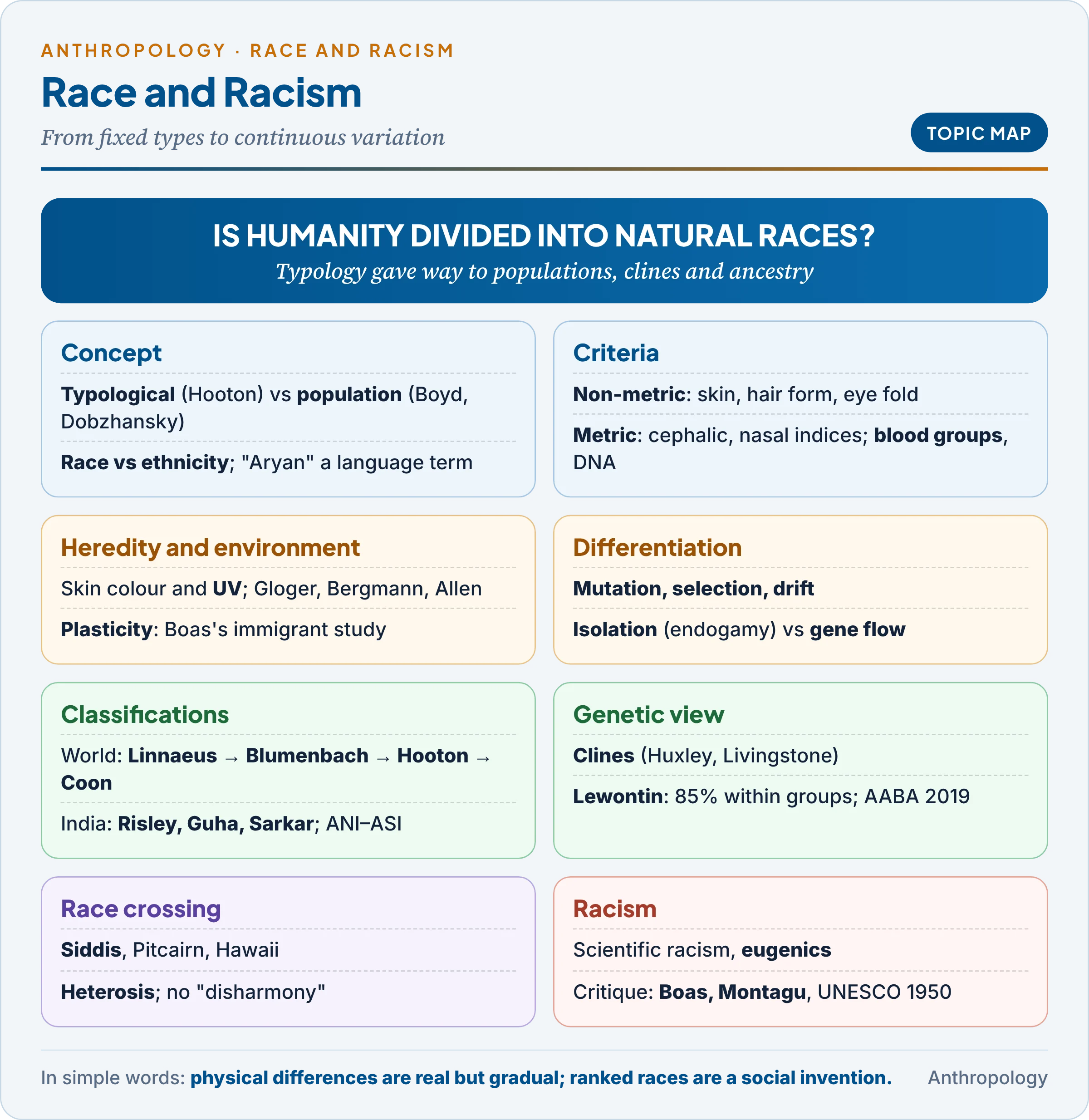
Unit 9.1 noted that most human genetic variation lies within populations, Unit 9.3 explained the forces that change gene frequencies (mutation, selection, drift, gene flow), and Unit 9.6 treats blood groups and other markers. This unit uses those tools on an old question: can humankind be divided into races, and what happens when people believe it can? The answer moves from nineteenth-century typology (fixed types judged by skull and skin) to the twenty-first-century view of continuous, clinal variation, and from the science of difference to the politics of racism.
1. The Concept of Race
In simple words
Race is the idea that humans fall into a few distinct biological groups. Physical anthropologists once tried hard to define such groups by skin, hair and skull shape. Most now conclude that human variation is continuous and overlapping, so races are better understood as social categories than as natural units.
In Brazil, the American anthropologist Marvin Harris (1970) showed 100 Brazilians a deck of 72 face drawings and recorded 492 different racial terms, applied inconsistently to the same face; a person’s “race” could change with wealth (“money whitens”). In the United States, by contrast, a person with any known African ancestor was long classed simply as “Black” (the “one-drop rule“). The same bodies are sorted differently by different societies, the first hint that race is partly a cultural classification.
1.1 Definitions
- Typological concept: a race is a fixed type defined by a set of physical traits. The American physical anthropologist Earnest Hooton defined race as “a great division of mankind, the members of which, though individually varying, are characterized as a group by a certain combination of morphological and metrical features, principally non-adaptive, which have been derived from their common descent.”
- Population (genetic) concept: the American immunochemist William Boyd (1950) defined a race as a population which differs significantly from other human populations in the frequency of one or more of its genes; the Russian-American geneticist Theodosius Dobzhansky similarly treated races as populations differing in gene frequencies.
- What the genetic definition implies:
- It is arbitrary: there is no agreed number of genes or size of difference that makes a race.
- No race has exclusive genes: blood group O is common in some populations and rare in others, but present in both.
- Races are genetically open: gene flow occurs between them; if it could not, they would be separate species, so “pure races” cannot exist.
- Individuals of two “races” often differ less than two individuals of the same one.
1.2 Race and ethnicity
The two words are often used together (PYQ 2023), but they classify different things. The table separates them.
| Basis | Race | Ethnicity |
|---|---|---|
| Claimed basis | Inherited physical traits (skin, hair, skull) | Shared culture: language, religion, descent, history |
| Who decides | Usually imposed by others | Usually self-identified |
| Boundaries | Treated as fixed and natural | Fluid; maintained by social boundaries (Fredrik Barth, Ethnic Groups and Boundaries, 1969) |
| Example | “Mongoloid” applied to Northeast Indians | Naga, Mizo, Tamil, Bengali identities |
The confusion of the two produced the “Aryan race“. Aryan is a language term (the Indo-Iranian branch of Indo-European), yet nineteenth-century writers turned it into a biological race. The German-born philologist Max Müller protested in 1888 that an ethnologist who speaks of an Aryan race is as great a sinner as a linguist who speaks of a dolichocephalic (long-headed) dictionary. Language, culture and biology vary independently, a point the German-American anthropologist Franz Boas made the basis of his critique of race (§9).
Common confusion
Is race the same as ethnicity? No. Race claims a biological basis in physical traits and is usually imposed from outside. Ethnicity rests on shared culture and history and is usually chosen or asserted by the group itself. Two people of one “race” can belong to different ethnic groups, and one ethnic group can include people of very different appearance.
2. Racial Criteria: Metric and Non-Metric Characters
In simple words
To classify people, early anthropologists either looked at features (skin colour, hair form, eye fold) or measured them (height, head shape, nose shape). Later they added blood groups and genes. Each criterion turned out to vary gradually and to be shaped partly by climate and diet, which weakened its use for drawing racial lines.
2.1 What makes a good criterion
William Boyd argued that a trait used for classification should be objective (measured the same way by any observer), non-adaptive (not shaped by the local environment, or it will reflect climate rather than ancestry), stable (not quickly changed by mutation) and of known inheritance (Mendelian). Most traditional racial traits fail at least one test: skin colour is adaptive, head form changes with environment, and stature depends on nutrition.
2.2 Non-metric (somatoscopic) characters
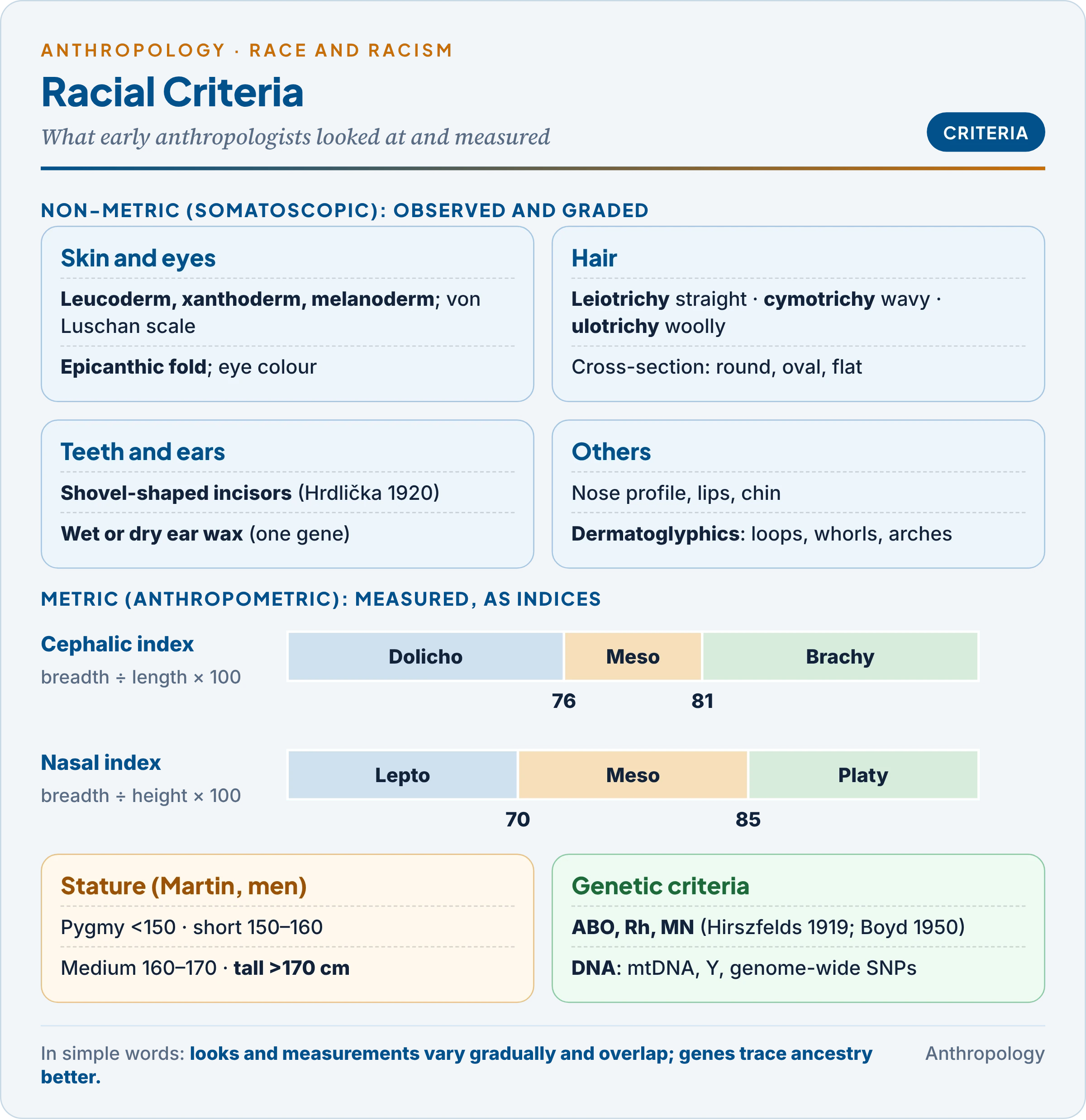
Non-metric or somatoscopic traits are observed and graded, not measured.
| Trait | Categories | Note |
|---|---|---|
| Skin colour | Leucoderm (light), xanthoderm (yellow-brown), melanoderm (dark); von Luschan’s 36-tile scale | Now measured by reflectance spectrophotometry; highly adaptive (§3) |
| Hair form | Leiotrichy (straight), cymotrichy (wavy), ulotrichy (woolly; “peppercorn” in the San) | A. C. Haddon (1924) made hair form the main basis of classification |
| Hair cross-section | Round (straight hair), oval (wavy), flat-elliptical (woolly) | Straight, thick East Asian hair linked to the EDAR gene variant |
| Eye | Colour; epicanthic fold (skin fold over the inner corner) | Fold common in East Asia and among the San |
| Nose profile, lips, chin | Straight, concave, convex; thin to thick | Graded by eye; observer bias |
| Teeth | Shovel-shaped incisors | Common in East Asians and Native Americans (Aleš Hrdlička, 1920) |
| Ear wax | Wet or dry | A single gene (ABCC11); dry type common in East Asia |
| Dermatoglyphics | Loops, whorls, arches; ridge counts | Polygenic; used in population and clinical studies |
2.3 Metric (anthropometric) characters
Metric traits are measured with instruments (anthropometer, spreading and sliding calipers) and often combined into indices (ratios × 100), which remove the effect of overall size.
| Index | Formula | Categories (living subjects) |
|---|---|---|
| Cephalic index (Anders Retzius, 1842; scales by Broca and Deniker) | Head breadth ÷ head length × 100 | Dolichocephalic below 76; mesocephalic (mesaticephalic) 76–81; brachycephalic 81 and above (skull values about 2 units lower: cranial index) |
| Nasal index | Nose breadth ÷ nose height × 100 | Leptorrhine below 70; mesorrhine 70–85; platyrrhine above 85 |
| Facial index | Face height ÷ bizygomatic breadth × 100 | Euryprosopic (broad), mesoprosopic, leptoprosopic (long) |
| Stature (Rudolf Martin’s scale, men) | Standing height | Pygmy below 150 cm; short 150–160; medium 160–170; tall above 170 cm |
- Facial angle and prognathism: the angle between the face profile and the horizontal; orthognathism (about 90°, straight face) and prognathism (projecting jaws).
- Why measurement did not solve the problem: precise numbers gave classification an air of science, but the traits are continuous: averages differ between populations while individual ranges overlap widely.
2.4 Serological and genetic criteria
After Karl Landsteiner discovered the ABO groups (1900), anthropologists turned to blood groups, whose inheritance is known and which do not change with climate. Ludwik and Hanna Hirszfeld (1919) found ABO frequencies differing between soldiers of many nations at Salonika; Reuben Ottenberg (1925) proposed six serological “types”; Boyd (1950) proposed six races from ABO, Rh and MN frequencies (Unit 9.6). Blood groups did not support the visible races: ABO frequencies cross racial lines, so a “European” and an “Australian” may share similar frequencies. Today DNA markers (mitochondrial DNA, Y chromosome, genome-wide SNPs) trace ancestry directly.
2.5 The biological basis of variation
- Polygenic inheritance: skin colour, stature and head form depend on many genes, each with small effect (SLC24A5, SLC45A2, MC1R, OCA2–HERC2 for pigmentation), which is why they vary continuously rather than in neat classes.
- Heritability with plasticity: stature has a high heritability (about 0.8) in well-fed populations, yet average height rose by more than 10 cm in some countries within a century as nutrition improved (the secular trend). Heredity sets a range; environment decides where in it a person ends up.
- Discrete traits (ear wax, blood groups) follow single genes and are useful for tracing ancestry precisely because they are not shaped by climate.
3. Racial Traits in Relation to Heredity and Environment
In simple words
Many traits once called racial are adaptations to climate. Dark skin protects against strong tropical sunlight, light skin helps make vitamin D where sunlight is weak, and body and nose shapes help keep heat in or let it out. Since unrelated peoples in similar climates evolve similar traits, these traits show environment rather than common descent.
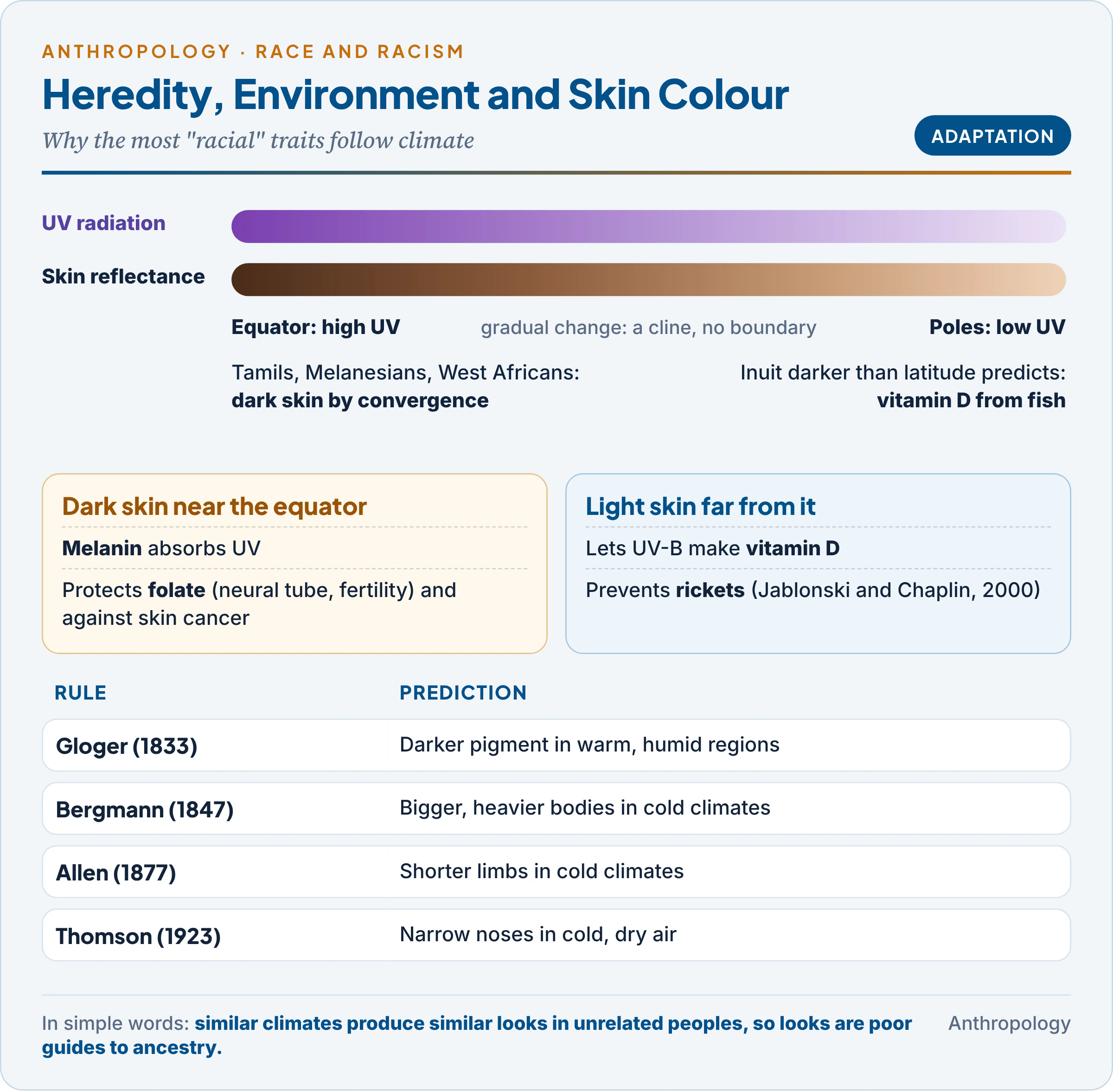
The Tamils of South India and the peoples of Melanesia have skin as dark as many West Africans, yet genetically they are no more closely related to Africans than Europeans are. They share dark skin because they share strong ultraviolet (UV) light, not ancestry: the clearest example of a trait shaped by environment through natural selection.
3.1 Skin colour
- Gloger’s rule (Constantin Gloger, 1833): warm-blooded animals in warm, humid regions are more darkly pigmented.
- Melanin (dark eumelanin and reddish pheomelanin) in the skin absorbs UV radiation. Dark skin protects against sunburn, skin cancer and the destruction of folate (vitamin B9) in the blood; folate shortage causes neural tube defects in the fetus and lowers fertility.
- Light skin lets enough UV-B through to make vitamin D, which prevents rickets (a deformed pelvis in rickety women obstructs childbirth).
- The balance model: the American anthropologists Nina Jablonski and George Chaplin (2000) showed that skin reflectance follows UV intensity: darker near the equator, lighter towards the poles, with women slightly lighter than men (higher calcium and vitamin D needs in pregnancy).
- Exceptions that prove the point: the Inuit are darker than their latitude predicts because a diet of fish and marine mammals supplies vitamin D.
3.2 Body form, nose and head
| Rule | Statement | Human evidence |
|---|---|---|
| Bergmann’s rule (1847) | Body size increases with colder climate (less surface area per unit mass) | D. F. Roberts (1953) found mean body weight falls as mean annual temperature rises |
| Allen’s rule (1877) | Limbs and extremities are shorter in cold climates | Long-limbed Nilotes (Dinka) vs short-limbed Inuit |
| Thomson’s nose rule (Thomson and Buxton, 1923) | Narrow noses in cold, dry air; broad noses in warm, moist air | J. S. Weiner (1954): nasal index tracks absolute humidity better than temperature |
- Head form is plastic: Franz Boas measured about 18,000 immigrants and their children in New York (1910–12) and found that the cephalic index of children born in America differed from that of children born abroad to the same parents. A reanalysis (Sparks and Jantz, 2002) found the change small; a counter-analysis (Gravlee and colleagues, 2003) upheld Boas. Either way, head form is not the fixed racial marker the typologists assumed.
- Disease and diet: the sickle-cell allele is common where malaria is common (Unit 9.3); lactase persistence (digesting milk in adulthood) is common among herding peoples of Europe, East Africa and north-west India: gene–culture coevolution, in which a cultural practice (dairying) changes gene frequencies.
- Acclimatisation: heat and cold tolerance can be acquired within a lifetime (Unit 9.7), so not every difference is genetic.
3.3 Three kinds of difference
Human differences arise from (i) accident (chance mutation, drift, prenatal infection such as German measles), (ii) adaptive response during life (acclimatisation, growth under different nutrition) and (iii) culture (diet, clothing, housing and technology buffering climate; the Inuit snow-house is a cultural adaptation that reduces the need for biological change). The practical lesson is that adaptive traits are the worst guides to ancestry: they converge in unrelated peoples who share a climate.
4. Racial Differentiation: How Populations Come to Differ
In simple words
Populations come to differ because new variants appear, some are favoured by local conditions, chance changes gene frequencies in small groups, and separation keeps groups apart. Movement and mixing work in the opposite direction, so differences never harden into separate species.
4.1 The processes
| Process | How it differentiates populations | Example |
|---|---|---|
| Mutation | Supplies new alleles | SLC24A5 light-skin variant |
| Natural selection | Favours locally useful traits | Skin colour and UV; sickle cell and malaria |
| Genetic drift | Random change, strongest in small groups; founder effect | Rare recessive disorders in endogamous Indian groups |
| Isolation | Geographic (islands, mountains) or social (endogamy, caste) | Andaman Islanders; Indian caste endogamy |
| Gene flow (migration) | Mixes gene pools and reduces differences | ANI–ASI mixture in India (§6.3) |
| Sexual and social selection | Mate preference for particular traits (Darwin, 1871) | Cultural preference for fair skin |
- Hooton’s distinction (S. S. Sarkar and others followed it in India): primary races were “differentiated by early geographical and genetic isolation, by loss of some genes and fixation of others, by mutations, by inbreeding, and by selection”; secondary (composite) races were formed by the “re-stabilization of blends of two or more primary races”.
- Why differentiation never became speciation: humans have always moved and intermarried, so gene flow has kept the species one interbreeding whole; Dobzhansky described races as stages that never reached reproductive isolation.
- Indian case: Reich and colleagues (2009) found that allele-frequency differences between Indian groups are larger than between European nations, because thousands of years of endogamy preserved strong founder effects. Here social isolation, not geography, produced differentiation, with a medical cost: an excess of recessive diseases, different in each group.
4.2 Origin models and the age of differences
- Multiregional model (Franz Weidenreich; Carleton Coon): regional populations evolved in parallel from Homo erectus over a million years, so “races” would be ancient.
- Recent African origin (mitochondrial “Eve”, Cann, Stoneking and Wilson, 1987): modern humans left Africa about 60,000–70,000 years ago; with some Neanderthal and Denisovan admixture, this is now the accepted model (Unit 1.6c).
- Consequence: visible differences are recent and superficial; Africa holds the most genetic diversity, and each migration out of Africa carried a subset of it (the serial founder effect), so diversity falls with distance from East Africa.
5. Racial Classifications of Mankind
In simple words
For two centuries scholars tried to divide humanity into races. They never agreed: the number of races ranged from three to more than thirty, depending on which traits were chosen. That disagreement itself showed that the divisions were not natural.
The schemes are compared in one table, from the first classifications to the last major ones.
| Scholar (year) | Basis | Scheme |
|---|---|---|
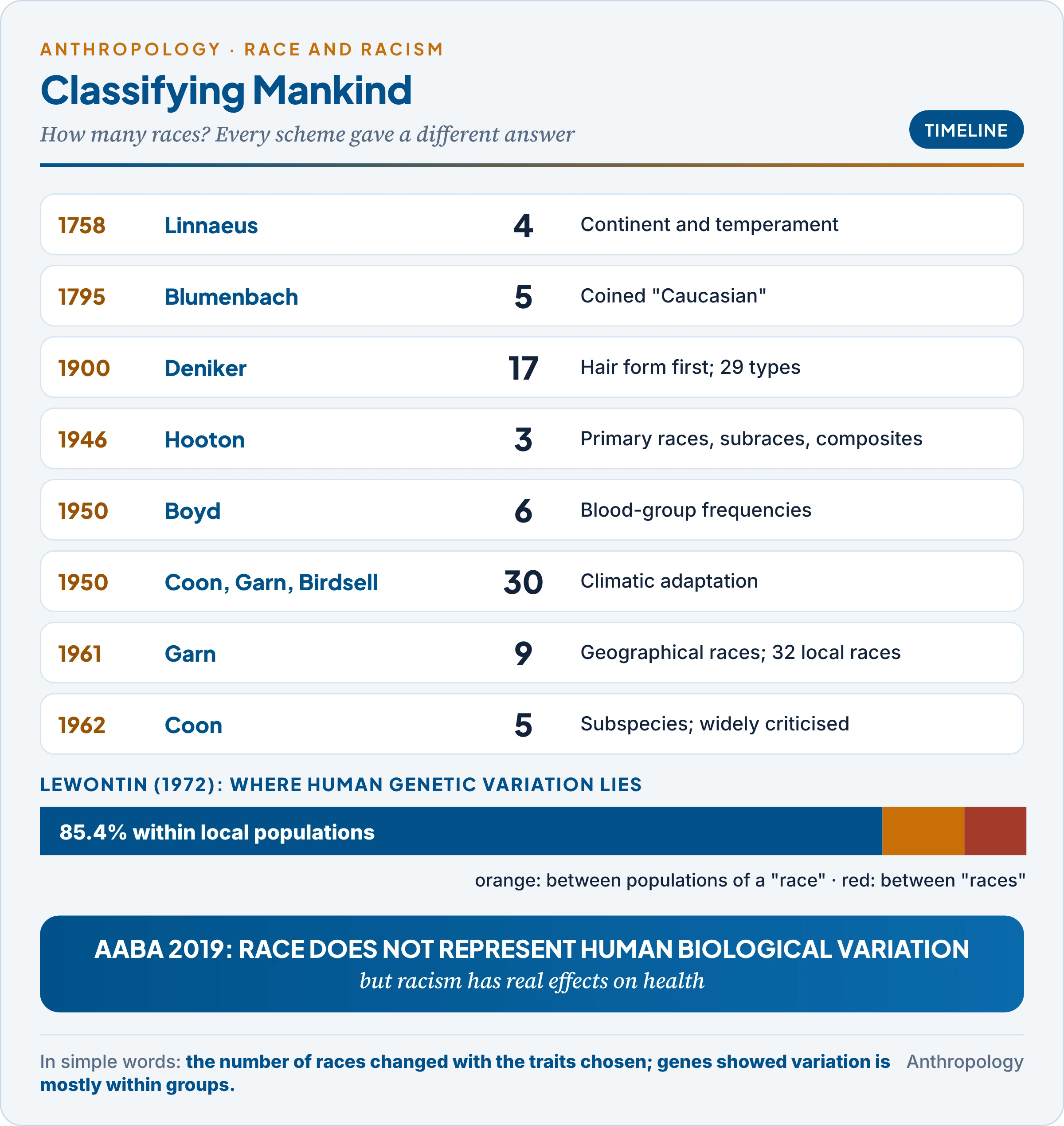
| Carl Linnaeus (Systema Naturae, 10th ed., 1758) | Continent, colour, temperament | Four varieties: Americanus, Europaeus, Asiaticus, Afer, each with assigned moral character |
| J. F. Blumenbach (German anatomist; 1775; 3rd ed. 1795) | Skull form, skin colour | Five varieties: Caucasian, Mongolian, Ethiopian, American, Malay; coined “Caucasian” |
| Georges Cuvier (1817) | Colour | Three: Caucasian, Mongolian, Ethiopian |
| Joseph Deniker (French; The Races of Man, 1900) | Hair form first, then skin, nose, stature, cephalic index | 17 races and 29 types |
| A. C. Haddon (1924) | Hair form | Ulotrichi, cymotrichi, leiotrichi |
| Earnest Hooton (Up from the Ape, 1931; 1946) | Combination of morphological traits | Three primary races (White, Negroid, Mongoloid) with subraces and composite races |
| William Boyd (1950) | ABO, Rh, MN frequencies | Six: Early European, European, African, Asian, American Indian, Australoid |
| Coon, Garn and Birdsell (Races, 1950) | Adaptation to climate | About 30 races |
| Stanley Garn (Human Races, 1961) | Geography and breeding isolation | 9 geographical races, about 32 local races, many micro-races |
| Carleton Coon (The Origin of Races, 1962) | Fossil lineages | Five subspecies (Caucasoid, Mongoloid, Australoid, Congoid, Capoid), each said to have become sapiens separately |
| Joseph Birdsell (1949–67) | Australian Aboriginal variation | Trihybrid origin of Aboriginal Australians (Murrayian, Carpentarian, Barrinean) |
- Migration-zone theory: the geographer Griffith Taylor (1927) held that the earliest races (Negritos) were pushed to the edges of the continents by later ones, so the most “primitive” lay at the periphery: a speculative scheme with no genetic support.
- Blumenbach’s paradox: he believed in one human species and opposed the polygenists (who claimed separate creations for each race), yet his ranking of the “Caucasian” as the most beautiful original form was used to justify hierarchy.
- Coon’s critics: Dobzhansky and Ashley Montagu objected that five lineages crossing the sapiens threshold at different times implied that some peoples had been “human” longer; the book was used by segregationists in the US and marked the end of race classification as a mainstream project.
- Garn’s advance: by treating races as breeding populations rather than types, he moved towards the population view, but his micro-races showed that the number of races depends simply on how finely one chooses to divide.
5.1 The three-race scheme
The scheme most often reproduced in textbooks (Hooton’s primary races) is summarised below; the ranges overlap, and the categories are now of historical interest.
| Trait | Caucasoid | Mongoloid | Negroid |
|---|---|---|---|
| Skin | Light to dark brown | Light yellow to yellow-brown | Brown to brown-black |
| Hair | Wavy to straight; medium texture | Straight, coarse | Woolly or frizzly |
| Eye | Light blue to dark brown | Dark; epicanthic fold | Dark brown |
| Nose | Leptorrhine; high bridge | Mesorrhine; low root | Platyrrhine |
| Face and jaws | Orthognathous | Flat; prominent cheekbones | Often prognathous |
| Body hair | Moderate to profuse | Sparse | Slight |
Australoids (Australian Aborigines, Veddas and the tribal “Proto-Australoids” of India) were sometimes added as a fourth major group. The table shows averages, not boundaries: populations such as the Ainu, Polynesians, Ethiopians and Indians never fitted, and were labelled “composite” or “mixed”. The textbook subdivisions are listed below only so that the older terms can be recognised.
| Major group | Subdivisions commonly listed |
|---|---|
| Caucasoid | Mediterranean, Nordic, Alpine, East Baltic, Dinaric, Armenoid, Keltic, Lapp, Indo-Dravidian, Polynesian, Ainu |
| Negroid | African: True Negro, Nilotic (Dinka, Shilluk), Bantu, Bushman–Hottentot (San and Khoikhoi: “peppercorn” hair, steatopygia), Negrillo (Mbuti of the Congo); Oceanic: Negritos (Andamanese, Semang, Aeta), Melanesian–Papuan |
| Mongoloid | Classic (Buriat, Siberia, Tibet), Arctic (Eskimo or Inuit, Chukchi), Indonesian–Malay, American Indian |
6. Racial Classification of the Indian Population
In simple words
Colonial and Indian anthropologists measured thousands of Indians to sort them into racial “types” such as Indo-Aryan, Dravidian and Mongoloid. Their schemes disagreed and mixed up race with language and caste. Genome studies have replaced them with a picture of a few ancient ancestral populations that mixed over thousands of years.
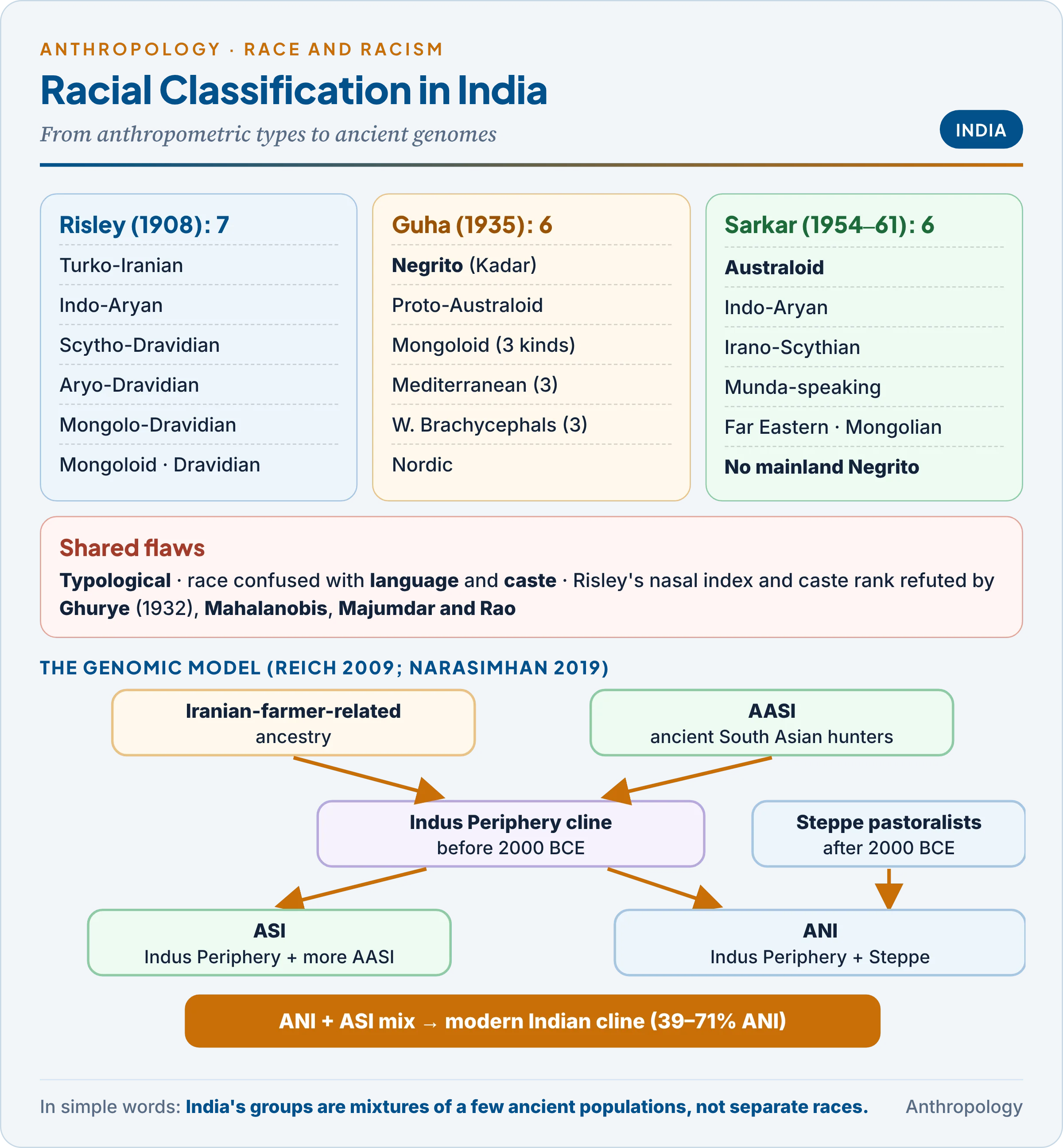
6.1 Risley, Guha and Sarkar
The three best-known schemes are compared below.
| Feature | H. H. Risley | B. S. Guha | S. S. Sarkar |
|---|---|---|---|
| Work | Census 1901; The People of India (1908) | Census 1931 (Part III, 1935); Racial Elements in the Population (1944) | The Aboriginal Races of India (1954); scheme of 1958–61 |
| Data | Anthropometry, especially nasal index, of castes | 29 characters on 2,511 persons of 34 groups; Pearson’s coefficient of racial likeness | Cephalic index, other measurements |
| Types | Seven: Turko-Iranian, Indo-Aryan, Scytho-Dravidian, Aryo-Dravidian, Mongolo-Dravidian, Mongoloid, Dravidian | Six races, nine subtypes: Negrito; Proto-Australoid; Mongoloid (Palaeo-Mongoloid long- and broad-headed, Tibeto-Mongoloid); Mediterranean (Palaeo-, Mediterranean, Oriental); Western Brachycephals (Alpinoid, Dinaric, Armenoid); Nordic | Six: Australoid, Indo-Aryan, Irano-Scythian, Munda-speaking, Far Eastern, Mongolian |
| Distinctive claim | Caste rank follows race: “the social position” of a caste varies inversely with its nasal index | A Negrito substratum among the Kadar, Irula and Pulayan of South India | No Negrito element on the mainland; the earliest stock is Australoid |
- Risley’s critics: the Indian sociologist G. S. Ghurye (Caste and Race in India, 1932) showed that the nasal index does not rank castes consistently across regions: physical type follows region more than caste. The statistician P. C. Mahalanobis (1927) re-analysed Risley’s Bengal data, work that led to his D² distance; and the joint study of D. N. Majumdar and C. R. Rao (Race Elements in Bengal, 1960) used multivariate methods to show regional clustering rather than caste–race correspondence.
- Guha’s critics: the “Negrito” frizzly hair of the Kadar may be local variation; Sarkar restricted Negritos to the Andaman Islands; the scheme imported European types (Nordic, Dinaric, Armenoid) on slender evidence.
- The shared problem: all three were typological, assumed waves of migration of pure types, and mixed race with language (Indo-Aryan, Dravidian and Munda are language families). Risley’s scheme also had colonial uses: ranking castes, recording “martial races” and “criminal tribes” (Criminal Tribes Act, 1871).
6.2 After typology
The People of India project of the Anthropological Survey of India (K. S. Singh, 1985–92) described 4,635 communities, treating them as social and historical units rather than racial types. Serological and then DNA studies replaced measurements.
6.3 The genomic picture: ANI and ASI
- Reich, Thangaraj, Singh and colleagues (Nature, 2009) analysed 132 individuals from 25 Indian groups and found two ancestral populations: Ancestral North Indians (ANI), related to Middle Easterners, Central Asians and Europeans, and Ancestral South Indians (ASI), distinct from all groups outside India. Most Indian groups carry 39–71 per cent ANI ancestry; ANI ancestry is higher in traditionally upper castes and Indo-European speakers. The Andamanese are ASI-related without ANI ancestry.
- Moorjani and colleagues (2013) dated the ANI–ASI mixing to about 4,200–1,900 years ago, after which endogamy largely froze the pattern: a genetic signature of the hardening of caste.
- Narasimhan and colleagues (Science, 2019; 523 ancient genomes) refined this: before 2000 BCE an “Indus Periphery” population mixed Iranian-farmer-related ancestry with Ancient Ancestral South Indian (AASI) hunter-gatherer ancestry; after the decline of the Indus civilisation it mixed with south-eastern groups to form the ASI, and with Steppe pastoralists arriving in the second millennium BCE to form the ANI. Steppe ancestry entered mainly through males and is somewhat higher in some priestly groups.
- Rakhigarhi (Shinde and colleagues, Cell, 2019): the genome of a Harappan woman showed Iranian-related and AASI ancestry with no Steppe ancestry.
What the genomic picture changes: India’s diversity is the result of mixture, not of pure races arriving one after another; Risley’s “races” are better described as mixtures in different proportions along a cline, and the sharp lines between them are social (endogamy), not biological.
7. The Modern Genetic View: Is Race a Valid Concept?
In simple words
Genetic studies show that people everywhere share almost all their DNA and that traits change gradually across the map instead of stopping at racial borders. Most differences are between individuals within the same group. That is why scientists today speak of clines and ancestry rather than races.
7.1 Clines
- A cline is a gradual change in the frequency of a gene or trait across geographical space; the term was coined by the English biologist Julian Huxley (1938).
- The American anthropologist Frank Livingstone (1962) argued “There are no races, there are only clines”: each trait has its own gradient (skin colour follows UV, sickle cell follows malaria, lactase follows dairying), and the gradients do not coincide, so any racial boundary depends on which trait is chosen.
- C. Loring Brace (1964) added that the traits respond to different selective pressures, so classifying people by a bundle of them mixes unrelated histories.
7.2 Lewontin and after
The American geneticist Richard Lewontin (1972) measured how human variation at 17 protein and blood-group loci is divided.
| Level | Share of total human genetic variation |
|---|---|
| Within local populations | 85.4% |
| Between populations within a “race” | 8.3% |
| Between the classical “races” | 6.3% |
So two people from the same village differ, on average, almost as much as two people from different continents. Whole-genome studies confirm the pattern: any two people are about 99.9 per cent identical, and Africans carry more variation among themselves than the rest of the world combined.
- The counter-argument: Rosenberg and colleagues (2002) used 377 DNA markers in 1,056 people and found that a computer program could group them into clusters matching continents. The British statistician A. W. F. Edwards (2003) called Lewontin’s inference “Lewontin’s fallacy“: although each locus differs little, many loci together can predict a person’s continental ancestry.
- The reply: clusters are real but clinal: their edges depend on where samples are taken (Serre and Pääbo, 2004). Predicting ancestry, a continuous individual history, is not the same as finding discrete races.
- Medicine: race used as a shortcut can harm. In 2021 US kidney societies removed the race coefficient from the formula estimating kidney function, which had overestimated function in Black patients and delayed their referral for transplant. Ancestry-specific gene variants (such as HLA-B*15:02, common in South-East Asia) matter, but they follow populations, not races.
Common confusion
If race is not biological, how can forensic anthropologists “estimate ancestry” from a skull? Ancestry estimation uses statistical differences in skull shape between reference populations to assign a probability of geographic origin. It works for groups well represented in the reference data and fails for mixed or unsampled populations. It shows that human variation has geographic structure, not that it falls into a few discrete races.
7.3 Statements by scientific bodies
- UNESCO 1950 (The Race Question, drafted with Ashley Montagu): all humans belong to one species; national, religious, linguistic and cultural groups are not races; for social purposes race is “not so much a biological phenomenon as a social myth”; it proposed the term “ethnic groups“.
- UNESCO 1951 (physical anthropologists and geneticists; published 1952): more cautious, keeping race as a classificatory device but affirming that no evidence links race to intelligence or temperament and that pure races do not exist.
- UNESCO 1964 (Moscow) and 1967 (Paris); Declaration on Race and Racial Prejudice (1978); AAPA 1996 and AAA 1998 statements.
- AABA 2019 (Statement on Race and Racism): “Race does not provide an accurate representation of human biological variation.” Race is a classification that emerged with European colonialism; it is a social reality, and racism affects health and biology.
So, is race valid? As a description of discrete biological units, no: variation is continuous, overlapping and mostly within groups. As a social category that shapes lives, health and opportunity, it is very real, and it is in this second sense that anthropology studies it today.
8. Race Crossing in Man
In simple words
Race crossing means children born to parents from populations that had long been apart. Earlier writers feared such mixing would produce weak or “disharmonious” offspring. Studies found the opposite: mixed populations are healthy and often taller, and all human populations are in fact the product of past mixing.
On the coasts of Gujarat and Karnataka live the Siddis, descendants of Africans brought to India, mainly by the Portuguese, over the last 300–500 years. A genome study (Shah and colleagues, 2011) found that they carry about two-thirds African ancestry traced to Bantu-speaking peoples, with Indian (and possibly Portuguese) ancestry from mixing about eight generations ago. Indian paternal lineages entered Siddi families, but African lineages did not enter neighbouring groups: gene flow ran one way, shaped by social rules. The case shows race crossing as a social as well as a biological process.
8.1 Classic studies
| Study | Population | Finding |
|---|---|---|
| Eugen Fischer (1913) | Rehoboth Basters of Namibia (Dutch × Khoikhoi) | Physical traits followed Mendelian inheritance; Fischer later supported Nazi racial policy |
| C. B. Davenport and M. Steggerda (1929) | Jamaica | Claimed “disharmonious” crosses; rejected for poor methods and eugenic bias |
| Harry Shapiro (1929, 1936) | Pitcairn Islanders (Bounty mutineers × Tahitians) | Vigorous, tall, fertile population: no degeneration |
| Newton Morton, Chung and Mi (1967) | Hawaii (Hawaiian, Chinese, Japanese, European crosses) | No adverse effect on birth weight, mortality or fertility |
- Heterosis (hybrid vigour): mixed offspring are often taller and more robust, because heterozygosity masks harmful recessive alleles carried by each parental group.
- No biological harm: the feared “disharmony” (for example, large teeth in small jaws) was never shown. Problems faced by mixed families, such as the Anglo-Indians, came from social exclusion, not biology.
- All populations are mixed: the ANI–ASI mixture in India (§6.3), Neanderthal genes in all non-Africans, and the Latin American mestizo populations show that crossing is the normal history of the species, which is why “pure races” never existed.
9. Racism and Its Anthropological Critique
In simple words
Racism is the belief that some races are naturally superior to others, together with the laws and practices built on that belief. Anthropologists first helped build racial ideas and then led the scientific case against them, showing that culture, language and ability are not fixed by biology.
9.1 What racism is
Racism joins three claims: humans fall into races; races differ in innate mental and moral capacity; and therefore unequal treatment is natural. It works at the level of individual prejudice and of institutions (laws, segregation, unequal access to health and education).
9.2 Scientific racism and its history
- Arthur de Gobineau (Essay on the Inequality of Human Races, 1853–55): the “Aryan” race as creator of civilisation, degraded by mixture.
- Samuel George Morton (Crania Americana, 1839) ranked races by cranial capacity. Stephen Jay Gould (The Mismeasure of Man, 1981) argued that Morton unconsciously biased his data; a 2011 remeasurement (Lewis and colleagues) found Morton’s numbers largely accurate, but both sides agree that skull size does not measure intelligence.
- Eugenics: the English polymath Francis Galton coined the term (1883) for improving the human stock by controlled breeding. It led to forced sterilisation laws in the US and elsewhere and to Nazi race laws (Nuremberg, 1935) and genocide. Apartheid in South Africa (1948–94) and Jim Crow segregation in the US were legal systems of racial classification.
- IQ debates: Arthur Jensen (1969), Herrnstein and Murray (The Bell Curve, 1994) and J. Philippe Rushton claimed genetic differences in average intelligence between races; critics showed that heritability within groups says nothing about the causes of differences between groups, which are confounded by poverty, schooling and discrimination.
9.3 The anthropological critique
| Scholar | Work | Argument |
|---|---|---|
| Franz Boas | The Mind of Primitive Man (1911); immigrant study (1910–12) | Race, language and culture vary independently; bodily form is plastic; differences in achievement are historical, not racial |
| Ruth Benedict | Race: Science and Politics (1940) | Racism as a modern ideology serving power |
| Ashley Montagu | Man’s Most Dangerous Myth: The Fallacy of Race (1942) | “Race” is a myth; drafted the UNESCO 1950 statement |
| Claude Lévi-Strauss | Race and History (UNESCO, 1952) | Cultural diversity reflects history and contact, not racial capacity |
| Livingstone; Lewontin; Gould | 1962; 1972; 1981 | Clines; within-group variation; critique of biological determinism |
Why the critique holds: the racist argument needs fixed, discrete races that differ genetically in mental capacity. Each link fails: races are not discrete (§7), visible traits are adaptations to climate (§3), and differences in achievement follow history, environment and opportunity. The anthropological case does not deny that biological variation exists; it denies that variation is organised into ranked races.
9.4 Race, caste and racism in India
- Caste is not race: Risley’s nasal-index theory has been abandoned; genetic data show caste groups as mixtures of the same ancestral populations, separated socially by endogamy. When Dalit groups sought to place caste discrimination on the agenda of the UN World Conference against Racism (Durban, 2001), the Government of India and the sociologist André Béteille argued that treating caste as race was scientifically wrong, even though caste discrimination is real and must be fought on its own terms.
- Racism against Northeast Indians: after the death of Nido Tania, a student from Arunachal Pradesh, in a racially charged assault in Delhi (January 2014), the M. P. Bezbaruah Committee (2014) recommended amending the criminal law to punish racial abuse, special police units and fast-track courts, and awareness campaigns.
- Medical labels: the term “mongolism” for Down syndrome, coined from a racial theory, was dropped by the WHO only in 1965 (Unit 9.4).
- Colourism: preference for fair skin in marriage advertisements and advertising for skin-lightening products is a form of social selection with racial overtones.
- Constitutional safeguards: Articles 15(1) and 16(2) prohibit discrimination on grounds of race, among others; India ratified the International Convention on the Elimination of All Forms of Racial Discrimination (1965) in 1968.
Key Terms
| Term | Meaning in simple words |
|---|---|
| Race (typological) | A supposed fixed type of human defined by physical traits |
| Race (genetic) | A population differing from others in gene frequencies |
| Ethnicity | A group identity based on shared culture and history |
| Somatoscopic trait | A feature observed and graded, such as skin colour or hair form |
| Anthropometric trait | A feature measured with instruments, such as head length |
| Cephalic index | Head breadth as a percentage of head length |
| Nasal index | Nose breadth as a percentage of nose height |
| Gloger’s rule | Darker pigmentation in warm, humid regions |
| Bergmann’s and Allen’s rules | Larger bodies and shorter limbs in colder climates |
| Cline | A gradual change in a trait or gene across geography |
| Founder effect | Gene frequencies set by the few founders of a group |
| Gene–culture coevolution | A cultural practice changing gene frequencies, as dairying did for lactase |
| Race crossing | Mating between long-separated populations |
| Heterosis | Extra vigour in offspring of genetically different parents |
| Ancestry | An individual’s continuous genetic history from past populations |
| ANI / ASI | Ancestral North Indians / Ancestral South Indians: the two populations behind most Indian groups |
| Racism | Belief in innate racial superiority and the practices built on it |
| Eugenics | The discredited programme of improving humans by controlled breeding |
Contemporary Developments
- AABA Statement on Race and Racism (2019): the biological anthropologists’ association declared that race does not represent human biological variation but that racism has real biological effects on health.
- Ancient DNA of South Asia (2019): the Narasimhan study and the Rakhigarhi genome placed the formation of ANI and ASI in the second millennium BCE, replacing racial-wave theories with a model of mixture.
- GenomeIndia (2025): 10,074 genomes from 83 populations were released with populations coded by number, not name, to prevent misuse of genetic data for community ranking.
- Race in medicine (2021): US kidney societies removed the race coefficient from kidney-function equations, an example of replacing racial categories with direct measurement.
Diagrams to Master
- Topic map: concept → criteria → heredity and environment → differentiation → classifications (world, India) → clines and genetics → race crossing → racism.
- Racial criteria: non-metric (skin, hair form, epicanthic fold, shovel incisors) vs metric (CI = B/L × 100, NI = B/H × 100, facial index, stature) with category limits.
- Skin colour and climate: UV gradient; folate protection (dark) vs vitamin D (light); Gloger, Bergmann, Allen, Thomson.
- Classification timeline: Linnaeus 4 → Blumenbach 5 → Deniker 17 → Hooton 3 → Boyd 6 → Garn 9 → Coon 5 → Lewontin 85/8/6 → AABA 2019.
- India: Risley 7 / Guha 6 (9 subtypes) / Sarkar 6; critique; AASI + Iranian-related → ASI, + Steppe → ANI; 39–71% ANI.
Revision Grid
| Scholar | Work (year) | Key idea |
|---|---|---|
| Carl Linnaeus | Systema Naturae (1758) | Four human varieties |
| J. F. Blumenbach | De generis humani varietate nativa (1775, 1795) | Five varieties; “Caucasian” |
| Arthur de Gobineau | Essay on the Inequality of Human Races (1853–55) | Aryan supremacy; founder of racial ideology |
| Joseph Deniker | The Races of Man (1900) | 17 races, 29 types |
| H. H. Risley | The People of India (1908) | Seven Indian types; nasal index and caste |
| Franz Boas | The Mind of Primitive Man (1911) | Plasticity; race, language and culture independent |
| B. S. Guha | Census of India 1931 (1935) | Six races, nine subtypes; Negrito strain |
| Earnest Hooton | Up from the Ape (1931, 1946) | Primary and secondary races |
| G. S. Ghurye | Caste and Race in India (1932) | Caste does not follow race |
| Ashley Montagu | Man’s Most Dangerous Myth (1942) | Race as myth; UNESCO 1950 |
| William Boyd | Genetics and the Races of Man (1950) | Serological races |
| S. S. Sarkar | The Aboriginal Races of India (1954) | Six types; no mainland Negrito |
| Stanley Garn | Human Races (1961) | Geographical, local and micro-races |
| Frank Livingstone | 1962 | “No races, only clines” |
| Carleton Coon | The Origin of Races (1962) | Five subspecies; criticised |
| Richard Lewontin | 1972 | 85% of variation within populations |
| Reich and colleagues | Nature (2009) | ANI and ASI |
| Narasimhan and colleagues | Science (2019) | Formation of ANI and ASI |
Previous Year Questions
Unit 9.5: Race and racism; morphological variation; racial criteria; racial classification; race crossing
- 2023Write notes on: Race and Ethnicity.
- 2021Write notes on : Is race a valid and biologically meaningful concept ?(in about 150 words).
- 2020Write notes on the Racism and Eugenics in about 150 words.
- 2019With reference to the somatoscopic and morphometric characteristics commonly used for racial classification, make critical comments as to whether ‘Race’ is a valid concept.
- 2018Write a note in 150 words on Race is a Myth. Justify its Present Day Relevance.
- 2017Write a note in 150 words on Concept of race.
- 2016Explain the role of heredity and environment in the formation of races.
- 2013Differentiate between Race and Racism. What are three races of the world ? Give important biological criteria used frequently for such a classification. (250 words)
- 2012Discuss race crossing in humans with suitable examples.
- 2010Is Race a valid concept ? Critically assess the relevance of racial classification in the Indian context.
- 2006Write a note on Racial Criteria.
- 2004Write a note on Race and Racism.
- 1999Write a note on Racial criteria.
- 1998What is ‘race’ ? Enumerate and discuss the factors responsible for the formation of races.
- 1996Write a note on Controversies of race.
- 1994Discuss the role of heredity and environment in formation of race.
- 1993Write a note on Racial types in India.
- 1992Discuss the main processes involved in the formation of races.
- 1991What is race ? Describe the criteria employed for the classification of human races:.
- 1990How are the races formed ? Describe the physical characteristics and distribution of different racial types in India ?
- 1989Examine critically the basis of racial classification in the light of modern development in Physical Anthropology.
- 1988Define race as a biological concept and discuss the various criteria of racial classification.
- 1987Write a note on Racism.
- 1985Write a note on Factors involved in race formation in man.
- 1984Discuss the role of environment and heredity in the formation of race.
- 1984Define race and describe its relevance to modern anthropological studies.
- 1983Do you find a serological basis: of racial classification? Discuss.
- 1982Discuss the role of environment and heredity in formation of races.
- 1982Racial superiority is not based on science. Substantiate.
Related questions from other units
- 2018Unit 11.2: Do Allen’s rule and Bergmann’s rule hold for human populations ? Explain with examples.
- 2013Unit 9.6: What are genetic markers and what is their usefulness? Why are blood groups considered as good genetic markers? Illustrate with examples. (250 words).
- 2004Unit 14: Explain Fredrik Barth’s concept of ethnic boundaries. Explain its distinction from cultural content.
- 2003Unit 12: Write a note on Eugenics.
- 2002Unit 14: What is ethnicity? Does ethnicity add to conflicts and tensions in the society? Illustrate.
- 2000Unit 9.6: Evaluate genetic heterogeneity of ABO, Rh and Gm antigens. Discuss how the principle human groups can be distinguished on the basis of their blood antigen characteristic.
- 1996Unit 12: Discuss the concepts of eugenics and euphenics and their potential applications to human welfare.
- 1994Unit 11.2: Discuss the racial classification of Indian population as per B.S. Guha. Mention the criticism propounded by other anthropologists.
- 1986Unit 11.2: Give a brief account of classification of Indian population as suggested by B.S. Guha, Critically examine his classification.
- 1981Unit 9.1: “Genetic similarities far outweigh the racial differences among men.” Discuss.