

8 Research methods in Anthropology: (i) Fieldwork tradition in anthropology; (ii) Distinction between technique, method and methodology.
Official Syllabus: Paper I, Unit 8
1. What Fieldwork Is
In simple words
Fieldwork means going to live with the people you study, for a long time, learning their language and joining their daily life, so that you understand their world from the inside. It is the main way anthropologists collect knowledge, and it sets anthropology apart from disciplines that rely on surveys or documents.
Example first. In 1948 the young Indian sociologist M.N. Srinivas went to live in Rampura, a village near Mysore. Classical texts said that Brahmins stood at the top of village society. Living in the village, Srinivas saw that real power lay with the Okkaliga peasants, who owned most of the land and were numerous; he called them the dominant caste. The books gave the “book view” of caste; only residence revealed the “field view”. That gap between what is written or said and what is lived is the reason anthropology insists on fieldwork.
1.1 Meaning
- Fieldwork is the first-hand study of a people through prolonged residence among them, participation in their life, observation and conversation in their language.
- The “field” is not a place but a set of relationships: the community, its activities and the networks the researcher follows.
- Claude Lévi-Strauss, the French structuralist, called each small society a ready-made experiment that the anthropologist cannot control, so close observation replaces laboratory control.
1.2 Characteristics of anthropological fieldwork
Anthropological fieldwork has a recognisable set of features. Each one exists for a reason.
- Long duration, usually a year or more: a full annual cycle of farming, festivals, migration and rituals must be seen, and people stop “performing” for a visitor only after months.
- Residence in the community: everyday life, not only staged events.
- Local language: meanings, jokes, kin terms and ritual speech cannot be grasped through interpreters (Unit 7).
- Participant observation as the core method (§3), supported by interviews, genealogies, case studies and other tools (Unit 8b).
- Holism: each custom is followed into economy, kinship, politics and religion, because in small societies these are tightly linked.
- Inductive, open-ended inquiry: questions are refined in the field, not fixed in advance.
- Insider’s point of view combined with outsider analysis (emic and etic, §4).
- Reflexivity and ethics: the researcher’s own position and duties to the people studied are part of the method (§2.6, §5).
1.3 How it differs from other social sciences
Many disciplines go to “the field”, but in different ways. The table contrasts the classic anthropological style with survey research in sociology or economics.
| Basis | Anthropological fieldwork | Survey research |
|---|---|---|
| Unit | One community, studied in depth | A large, statistically drawn sample |
| Duration | A year or more of residence | Short visits by enumerators |
| Main tool | Participant observation, informal talk | Questionnaire and schedule |
| Data | Mostly qualitative, contextual | Mostly quantitative, standardised |
| Researcher’s role | Immersed participant | Detached outsider |
| Logic | Discovery; hypotheses grow from the field | Testing hypotheses fixed beforehand |
| Strength | Depth, meaning, real behaviour | Breadth, representativeness |
The contrast is one of emphasis: anthropologists also use surveys, and sociologists ethnography. What remains distinctive is intensive, long-term presence, which lets the researcher see the gap between what people say and what they do, the gap that surveys miss.
1.4 Fieldwork and theory
Fieldwork does not only collect facts; it has repeatedly produced, tested and overturned theory. The table shows major cases.
| Field site | Ethnographer | Theory it produced or tested |
|---|---|---|
| Trobriand Islands (Papua New Guinea) | Malinowski (1915–18) | Functionalism; the kula and reciprocity; in a matrilineal society, a boy’s resentment falls on the mother’s brother, not the father, which challenged Freud’s universal Oedipus complex (1927) |
| Andaman Islands | Radcliffe-Brown (1906–08) | Rituals express and maintain social sentiments (structural-functionalism) |
| Nuer (Sudan) | Evans-Pritchard (1930–36) | Segmentary lineage system: order without a state |
| Kachin (Burma) | Edmund Leach (1940s) | Societies oscillate between models (gumsa and gumlao) |
| Ndembu (Zambia) | Victor Turner (1950s) | Social drama; rites of passage and liminality |
| Coorgs (Karnataka) | Srinivas (1940–42) | Sanskritisation |
| Rampura (Karnataka) | Srinivas (1948, 1952) | Dominant caste |
Theory tells the fieldworker what to look for; the field then corrects the theory. Malinowski arrived with the assumption that the father is a universal figure of authority and found that among matrilineal Trobrianders the mother’s brother holds that role. Evans-Pritchard wrote: “I had no interest in witchcraft when I went to Zandeland, but the Azande had; so I had to let myself be guided by them.” A good fieldworker carries theory but follows the grain of the field.
2. The Fieldwork Tradition: From the Armchair to the Field
In simple words
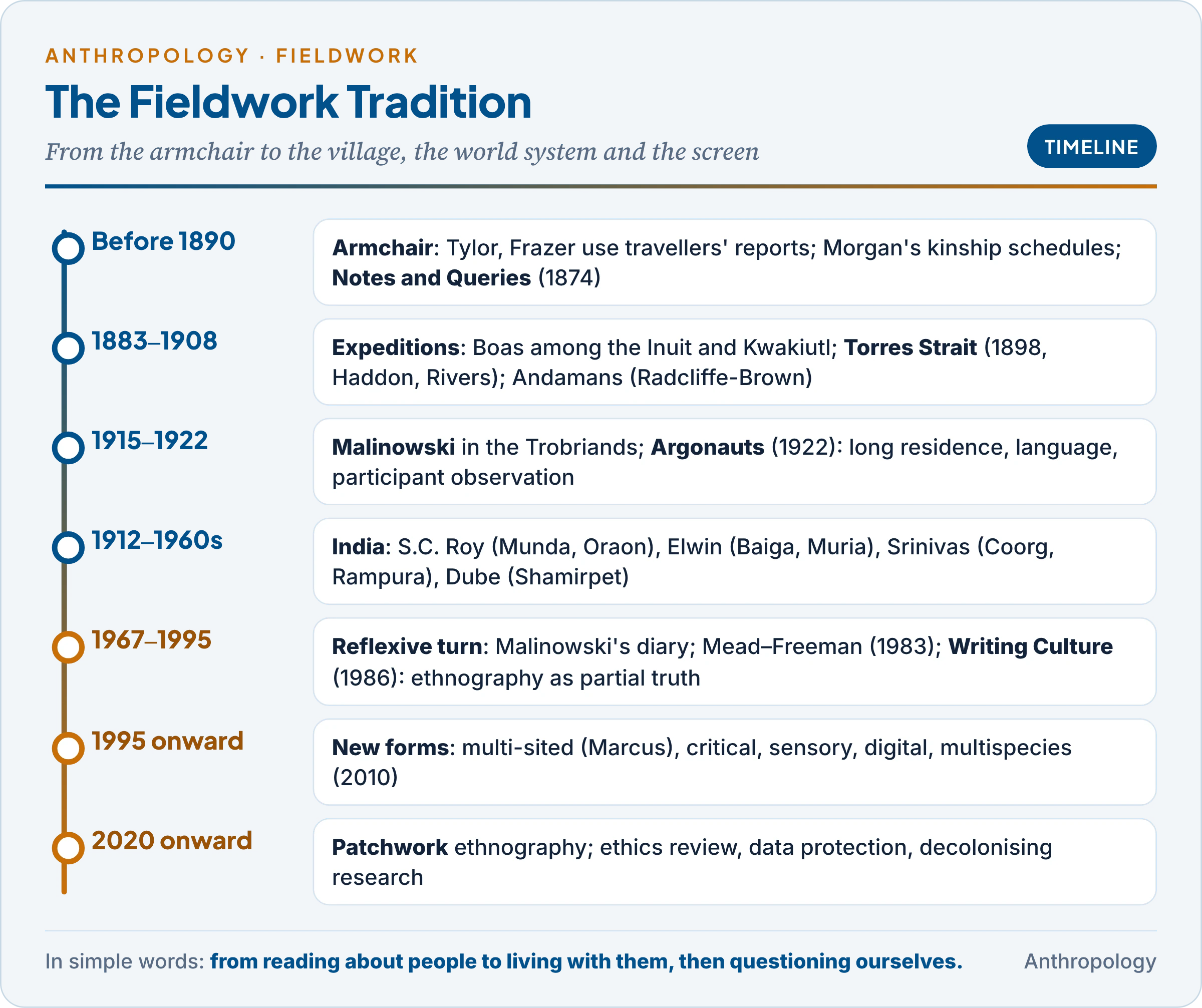
Early anthropologists wrote about distant peoples from their libraries, using reports from travellers and missionaries. Over a century the discipline moved to short expeditions, then to long stays in one village, and finally to fieldwork that questions the fieldworker’s own power and follows people across many places and online.
2.1 The armchair phase (to about 1890)
- E.B. Tylor and J.G. Frazer built grand evolutionary schemes from secondary sources: travellers, missionaries, traders and colonial officers. These “armchair anthropologists” rarely saw the peoples they classified, and their reports were often biased and selective.
- Questionnaires were sent to people in the colonies: Lewis Henry Morgan, the American lawyer-anthropologist, mailed kinship schedules worldwide for Systems of Consanguinity and Affinity (1871); the British Association published Notes and Queries on Anthropology (1874) to guide amateur observers.
- Early field contact: Morgan himself knew the Iroquois (Seneca) at first hand and wrote League of the Iroquois (1851) with the Seneca scholar Ely Parker; Frank Cushing lived among the Zuni (1879–84) and was initiated into a priesthood.
2.2 The expedition phase (1880s–1910s)
- Franz Boas, the German-American founder of American anthropology, wintered with the Inuit of Baffin Island (1883–84) and worked for decades among the Kwakiutl of British Columbia. His method stressed texts in the native language, often recorded with a trained native collaborator, George Hunt.
- The Torres Strait Expedition (1898), led by A.C. Haddon with W.H.R. Rivers, C.G. Seligman, C.S. Myers and others, studied the islands between Australia and New Guinea. Rivers developed the genealogical method there (published 1900), applied it among the Todas of the Nilgiris (The Todas, 1906) and in 1913 called for “intensive work”: a year or more with a single community.
- A.R. Radcliffe-Brown studied the Andaman Islanders (1906–08).
- Limits: expeditions were short, used interpreters and moved between many groups: surveys, not deep understanding.
2.3 Malinowski’s revolution
- Bronisław Malinowski, the Polish-British anthropologist, spent about two years in the Trobriand Islands (1915–16 and 1917–18), partly because the First World War kept him in Australian territory. He lived in a tent in Omarakana village and worked in the local language, Kilivila.
- The introduction to Argonauts of the Western Pacific (1922) set the standard: collect the skeleton (rules and structure, through genealogies, censuses and maps), the flesh and blood (the “imponderabilia of actual life“, recorded in an ethnographic diary) and the spirit (native views in their own words), so as “to grasp the native’s point of view, his relation to life, to realise his vision of his world”.
- Why it was a revolution: it made long residence, the local language and participant observation a professional standard, taught at the London School of Economics to Raymond Firth (Tikopia, 1928–29), E.E. Evans-Pritchard (Azande and Nuer), Meyer Fortes (Tallensi) and others. Unit 6d §2 describes the method and the controversy over his private diary (published 1967) in detail.
2.4 The American tradition
- Margaret Mead, a student of Boas, worked in Samoa (1925–26; Coming of Age in Samoa, 1928), on Manus, in the Sepik region of New Guinea (Arapesh, Mundugumor, Tchambuli) and in Bali, where with Gregory Bateson she pioneered photography and film as research tools (Balinese Character, 1942).
- Ruth Benedict studied Japan “at a distance” during the Second World War, using films, novels, interviews with Japanese Americans and prisoners’ documents (The Chrysanthemum and the Sword, 1946): content analysis where fieldwork was impossible.
- Cora Du Bois combined fieldwork in Alor (Indonesia, 1937–38) with projective tests such as the Rorschach.
- Robert Redfield studied the Mexican village Tepoztlán (1926) and found harmony; Oscar Lewis restudied it (1951) and found conflict and poverty. The Redfield–Lewis contrast showed that the observer’s questions and values shape what is seen, and made restudies a check on ethnography.
2.5 The Indian fieldwork tradition
India built its own fieldwork tradition, first among tribes and then in villages. The table lists the main figures.
| Ethnographer | Field and works | Contribution |
|---|---|---|
| S.C. Roy (1871–1942), lawyer in Ranchi | Munda (1912), Oraon (1915), Birhor (1925); founded Man in India (1921) | “Father of Indian ethnography”: decades of first-hand work in Chota Nagpur; used tribal customs to defend tribal land rights |
| Verrier Elwin (1902–64), British-born | Lived among the Gonds and Baiga of central India; The Baiga (1939), The Muria and their Ghotul (1947) | Total immersion; became an Indian citizen and adviser on tribal policy in the North-East |
| C. von Fürer-Haimendorf (Austrian) | Chenchu, Reddi, Raj Gond (1940s), Apatani | Long-term restudies of the same tribes over decades |
| D.N. Majumdar | Ho; Caste and Communication in an Indian Village (1958) | Tribal and village studies; candid on rapport with local elites |
| M.N. Srinivas | Coorgs (1952); Rampura (from 1948); The Remembered Village (1976) | Sanskritisation, dominant caste; the “field view” of India |
| S.C. Dube | Kamar (1951); Indian Village (1955), on Shamirpet near Hyderabad | Team-based village study linked to development |
| André Béteille | Sripuram, Thanjavur; Caste, Class and Power (1965) | Caste, class and power separated analytically |
The tradition also produced reflection on method. Encounter and Experience (ed. André Béteille and T.N. Madan, 1975) and The Fieldworker and the Field (ed. M.N. Srinivas, A.M. Shah and E.A. Ramaswamy, 1979) collected Indian anthropologists’ accounts of their own fieldwork. Srinivas wrote The Remembered Village largely from memory after his field notes were destroyed in a fire at Stanford in 1970.
Positionality in Indian village studies. In a caste society the village placed the fieldworker in its hierarchy. A.M. Shah in Gujarat was housed in the upper-caste ward and could observe the leaders closely but not the untouchables; Béteille was “permitted” to live in the Brahmin agraharam of Sripuram, on implicit conditions; Majumdar was hosted by an ex-zamindar family, which made rapport with the elite easy. Critics later argued that such access through dominant groups produced a conservative picture of village harmony. The lesson is that who hosts you shapes what you see.
- The Anthropological Survey of India (founded 1945) carried fieldwork to national scale: its People of India project under K.S. Singh (1985–92) profiled about 4,635 communities.
2.6 The reflexive turn
From the late 1960s, anthropologists began to examine themselves as part of the field.
- Triggers: Malinowski’s diary (1967) revealed loneliness and contempt behind the calm ethnographer; decolonisation made the colonial setting of fieldwork visible; the Redfield–Lewis and Mead–Freeman controversies (Derek Freeman’s attack on Mead’s Samoa, 1983) showed how far accounts could differ.
- Reflexive ethnography: Paul Rabinow‘s Reflections on Fieldwork in Morocco (1977) made the relationship with informants the subject of the book.
- Writing Culture (ed. James Clifford and George Marcus, 1986) argued that ethnographies are texts shaped by rhetoric and power, offering “partial truths” rather than objective pictures; Clifford Geertz‘s Works and Lives (1988) read classic ethnographies as literary works.
- Feminist and native voices: Women Writing Culture (ed. Ruth Behar and Deborah Gordon, 1995) and Lila Abu-Lughod‘s “Writing Against Culture” (1991) criticised male-centred and homogenising accounts. Kirin Narayan‘s “How Native Is a ‘Native’ Anthropologist?” (1993) argued that every researcher is partly insider and partly outsider.
- Why it matters: reflexivity (making the researcher’s own position, assumptions and relationships visible in the analysis) does not abandon objectivity; it makes bias visible and correctable.
2.7 Contemporary forms and challenges
Fieldwork has adapted to a mobile, connected and unequal world. The table lists the main newer forms.
| Form | Meaning | Example |
|---|---|---|
| Multi-sited ethnography | Follow people, things, ideas or conflicts across several places (George Marcus, 1995) | Following migrant workers from a Jharkhand village to Kerala construction sites |
| Multispecies ethnography | Study humans with animals, plants and microbes as social actors (Eben Kirksey and Stefan Helmreich, 2010) | Radhika Govindrajan, Animal Intimacies (2018), on people and animals in Kumaon, Uttarakhand |
| Critical ethnography | Ethnography with an explicit commitment to expose power and injustice (D. Soyini Madison, 2005) | Studies of displacement by dams and mines |
| Experiential (sensory) ethnography | Uses the researcher’s embodied experience, senses and emotions as data (Sarah Pink, 2009) | Learning a craft or dance to understand it from within |
| Digital ethnography (netnography) | Fieldwork in online worlds and social media (Tom Boellstorff, Coming of Age in Second Life, 2008) | Shriram Venkatraman, Social Media in South India (2017) |
| Studying up | Studying the powerful, not only the poor (Laura Nader, 1972) | Bureaucracies, corporations, laboratories |
| Patchwork ethnography | Fieldwork in short, repeated stretches fitted around work, care and travel limits (Gökçe Günel, Saiba Varma, Chika Watanabe, 2020) | Remote and intermittent work during the Covid-19 pandemic |
These forms respond to migration and global markets, ecological crisis and the charge that neutrality favours the powerful. Contemporary challenges include restricted access and permits, insecurity in conflict zones, tighter ethics review, shorter funded time, digital surveillance of both researcher and informants, the demand to decolonise research, and communities that now read and contest what is written about them.
3. Participant Observation
In simple words
Participant observation means joining in people’s everyday activities while watching and recording what happens. By living as a member of the community, the researcher sees what people actually do, not only what they say they do, and slowly earns enough trust to be told what outsiders never hear.
Example first. In 1958 Clifford Geertz and his wife arrived in a Balinese village, where people politely ignored them for days. Then police raided an illegal cockfight; the Geertzes ran with the villagers and hid in a courtyard, pretending to have been sipping tea. Next morning the village treated them as insiders: they had shared the risk. Geertz’s essay “Deep Play: Notes on the Balinese Cockfight” (1972) grew from that acceptance. Participant observation depends on such moments of shared life.
3.1 Meaning
- Participant observation is the method in which the researcher takes part in the daily life of a community over a long period while systematically observing and recording it.
- Understanding comes through experience: to know what a harvest festival means, help with the harvest.
- Deliberate, not total, participation: non-participation is almost impossible for someone who stays long, and hosts expect involvement. The real question is how far to participate, not whether.
- Where society offers no ready role for a stranger, the safest role is often what the researcher actually is: a friendly, curious outsider.
3.2 Degrees of participation
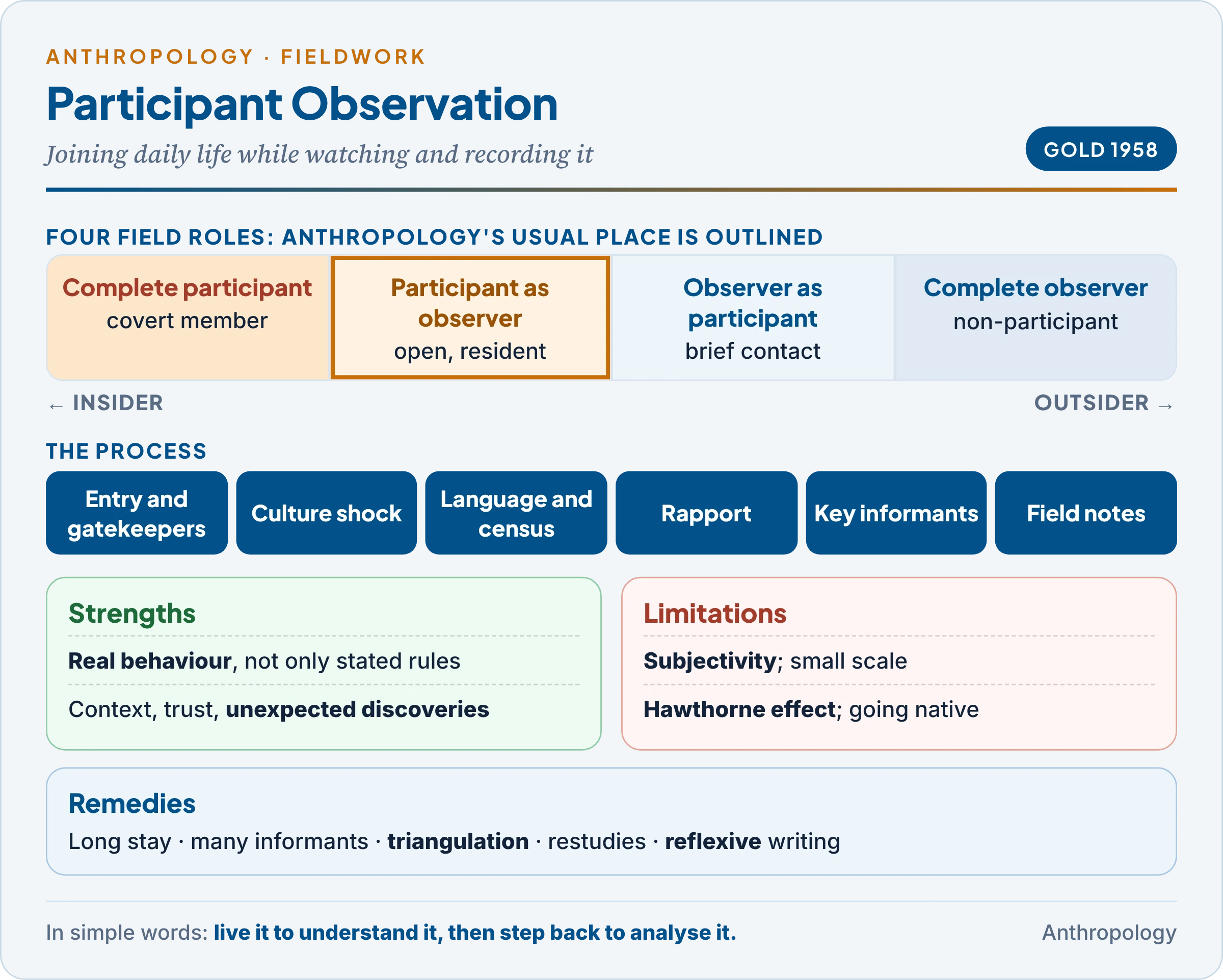
The sociologist Raymond Gold (1958) distinguished four field roles on a scale from full insider to full outsider.
| Role | What the researcher does | Strength | Risk |
|---|---|---|---|
| Complete participant | Joins as a member; identity as researcher hidden | Natural behaviour | Deception; ethically unacceptable in most cases |
| Participant-as-observer | Takes part openly; people know the purpose | Depth with honesty | Over-identification |
| Observer-as-participant | Mainly observes, with brief contact | Wider coverage | Shallow understanding |
| Complete observer | Watches without interacting (non-participant observation) | Least disturbance | Misses meanings; feasible only in public settings |
Classic anthropological fieldwork sits at participant-as-observer, sometimes called quasi-participation: open about its purpose, but living inside the community. Non-participant observation suits public events, markets or rituals where joining is impossible, but used alone it records behaviour without meaning.
3.3 The process
- Entry: permission from authorities and gatekeepers (headman, council, family elders); the first impression shapes later access.
- Culture shock: the disorientation of finding that one’s cultural rules no longer work (term popularised by the Canadian anthropologist Kalervo Oberg); it usually passes after weeks.
- Language learning and mapping the village, census and genealogies (Unit 8b).
- Key informants: people with deep knowledge and willingness to explain, such as Muchona, Victor Turner’s Ndembu interpreter of ritual, or Ogotemmêli, the blind Dogon elder who taught Marcel Griaule. The fieldworker must avoid seeing the whole community through one person’s eyes.
- Recording: brief jottings on the spot, full field notes the same evening, and a personal diary for feelings and reactions.
- Exit: leaving with goodwill and returning findings.
3.4 Rapport
Rapport is the relationship of trust and mutual understanding that makes people willing to share their lives with the researcher.
- How it is built: time, respect, the local language, small reciprocities (help, medicine, transport), keeping confidences and not taking sides in factions.
- Why it is hard: in divided communities, closeness to one group means distance from another; local elites often try to monopolise the researcher; people may watch for mistakes as time passes.
3.5 Strengths and limitations
Participant observation is anthropology’s strongest method, but it has known weaknesses. The table sets them side by side.
| Strengths | Limitations |
|---|---|
| Records real behaviour, not only stated norms; reveals the gap between ideal and real culture | Small scale: one community may not represent a region |
| Captures context, so statements can be interpreted and checked | Subjectivity: the researcher is the instrument |
| Gives access to sensitive matters (disputes, ritual secrets) through trust | Observer effect: people change behaviour when watched (the Hawthorne effect, named after factory studies of 1924–32) |
| Allows unexpected discoveries that change the research question | Going native: over-identification erodes analytical distance; Cushing was initiated into a Zuni priesthood |
| Works where literacy is low and questionnaires fail | Time-consuming, costly and hard to replicate |
| Builds the emic understanding that explanation needs | Ethical risks, especially in covert or intimate settings |
The limitations are reduced, not eliminated, by long residence (the observer effect fades), many informants and cross-checking, combining methods (triangulation), restudies by other researchers, and reflexive writing that states the researcher’s position.
3.6 Objectivity and subjectivity
Critics say anthropology cannot be objective: behaviour is complex, hard to predict, known through words and symbols, largely qualitative, and the observer has values. Defenders reply:
- Complexity is relative to our knowledge: social life is patterned, or people could not live together, and group behaviour is predictable even when individuals are not.
- Every scientist is part of nature: biologists are organisms too, yet achieve objectivity; the remedy is awareness of influences, not denial.
- Robert Merton advised building theories of the middle range, tested on limited data, rather than despairing of a science of society.
- Max Weber‘s value neutrality asks the researcher to keep personal values out of analysis, while accepting that values shape the choice of problem.
4. Emic and Etic
In simple words
“Emic” means describing a culture in the categories its own people use; “etic” means describing it in the categories of an outside observer, so that different cultures can be compared. Good fieldwork needs both: the people’s own view, and an outside framework that can explain it.
4.1 From phonemic and phonetic
The American linguist Kenneth Pike coined emic and etic in 1954 (Language in Relation to a Unified Theory of the Structure of Human Behavior), from phonemic and phonetic (dropping the “phon-“):
- Phonetics describes all the sounds a language produces, with measurements any trained outsider can make.
- Phonemics identifies only the sound differences that matter to speakers, because they change meaning. In Hindi, /k/ and /kʰ/ separate kal (tomorrow) from khal (skin); in English the same two sounds never change a word, so English speakers do not even notice them. The phonemic system can be discovered only by asking what speakers treat as different.
Pike extended this to culture: an etic account uses the observer’s universal categories; an emic account reconstructs the categories that participants treat as meaningful. This is how the distinction derives from the study of language.
4.2 The two perspectives compared
| Basis | Emic | Etic |
|---|---|---|
| Viewpoint | Insider, participant | Outsider, observer |
| Categories | Those the people use and recognise | Those the analyst defines for comparison |
| Test of validity | Native agreement: “yes, that is how we see it” | Scientific usefulness and comparability |
| Aim | Understand meaning | Explain causes and compare cultures |
| Example | A Hindu farmer: “the cow is sacred, our mother” | Marvin Harris: the cow ban preserves plough oxen, dung and milk |
The two are not rivals. Marvin Harris, the American cultural materialist, used them to separate what people say from what they do: Kerala farmers insisted that no calves were starved, but the sex ratio of young cattle showed that male calves were allowed to die (Unit 6i §3). The emic statement and the etic measurement together revealed a hidden adaptation.
4.3 The search for the insider’s view
- Malinowski‘s goal of the “native’s point of view” was an early emic programme.
- Ward Goodenough, an American anthropologist, defined culture emically as “whatever it is one has to know or believe in order to operate in a manner acceptable to its members” (1957). His new ethnography (ethnoscience) studied how people classify plants, colours, illness and kin (Unit 6j).
- Clifford Geertz distinguished experience-near concepts (a people’s own, used naturally) from experience-distant ones (the analyst’s), arguing that ethnography must move between them (1974).
Common confusion
Is emic the same as an insider researcher, and etic the same as objective truth? No. Emic and etic are kinds of description, not kinds of people: an outsider can produce an emic account by learning the people’s categories, and an insider can write an etic analysis. Nor is etic automatically “true”: scientific categories are themselves products of a culture, and a good etic account must still be tested against what people actually do.
5. Ethics in Fieldwork
In simple words
Anthropologists enter people’s homes, rituals and secrets, and often hold more power than those they study. Ethics means making sure that research does no harm, that people agree to it knowing what it involves, that their privacy is protected, and that they gain something from it.
Example first. In 1990 members of the Havasupai tribe of the Grand Canyon, Arizona, gave blood samples to university researchers for a study of diabetes. The samples were later used, without their knowledge, for studies of schizophrenia, inbreeding and migration, the last contradicting the tribe’s own account of its origins. The tribe sued, and in 2010 the university settled, paid compensation and returned the samples. The case shows that consent is to a specific use, and that research can harm a community’s dignity even when no one is physically hurt.
5.1 How anthropological ethics developed
- Project Camelot (1964–65): a US Army-funded social science project on counter-insurgency in Latin America, exposed in Chile, led the American Anthropological Association (AAA) to its 1967 statement on research and ethics.
- Thailand controversy (1970): revelations that anthropological data were used for counter-insurgency led to the AAA’s Principles of Professional Responsibility (1971).
- Codes of 1998 and 2009 followed; the current Principles of Professional Responsibility date from 2012.
- Human Terrain System (2007–14): a US military programme embedding social scientists with combat units; the AAA’s Executive Board declared it incompatible with professional ethics in 2007.
- Darkness in El Dorado (Patrick Tierney, 2000) accused researchers among the Yanomami of harm; several charges were later rejected, but the debate sharpened attention to consent, exchange of goods and representation.
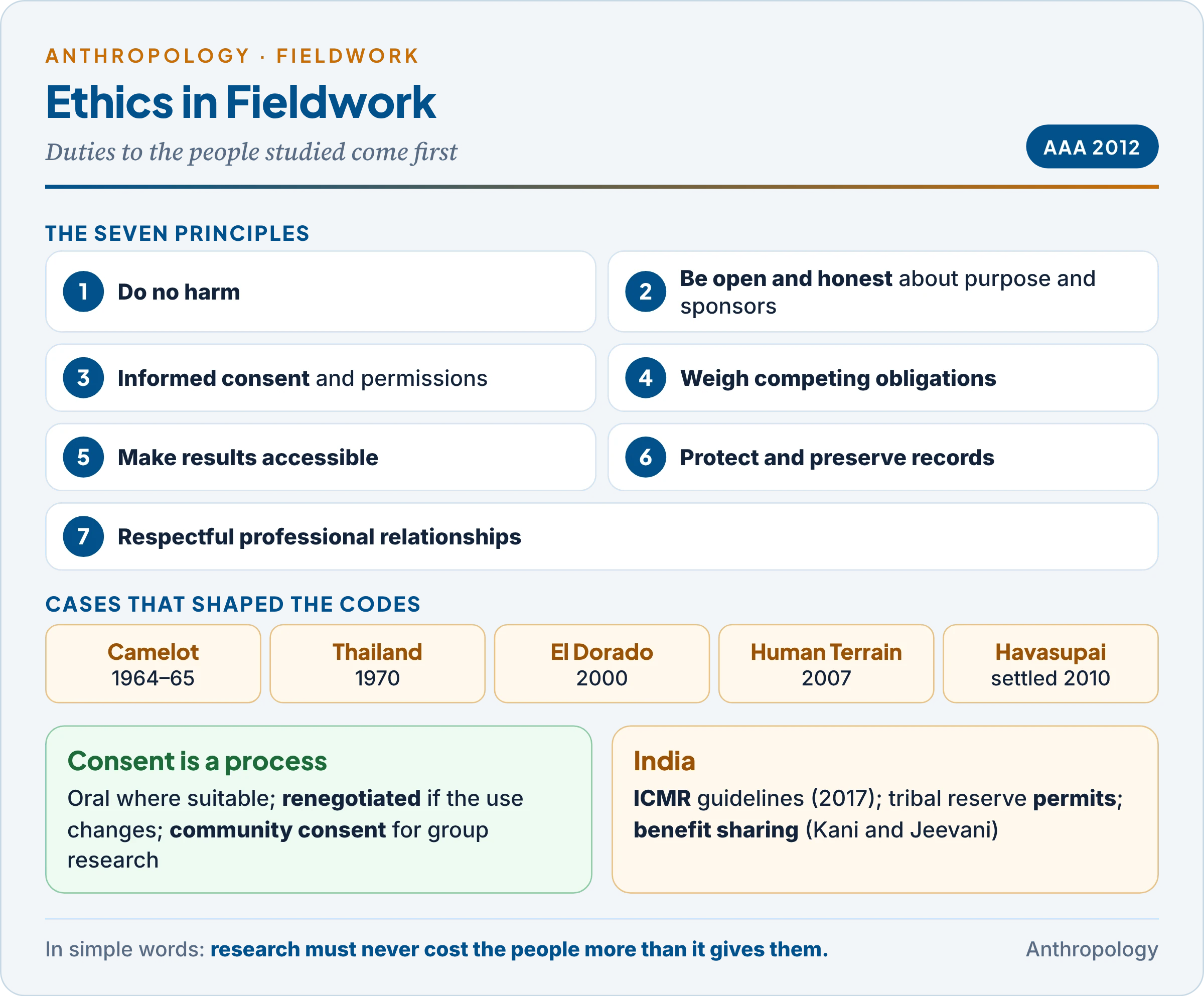
5.2 The AAA’s seven principles (2012)
| Principle | What it requires | Field illustration |
|---|---|---|
| 1. Do no harm | Weigh possible harm to dignity, bodies and livelihoods before and during research; this can override the search for knowledge | Not publishing the location of a sacred grove that could be looted |
| 2. Be open and honest | Disclose purpose, methods, sponsors and interests | Telling a village who funds the project |
| 3. Obtain informed consent and necessary permissions | Voluntary, informed agreement; permits for protected areas and sites | Explaining in the local language; obtaining a tribal reserve permit |
| 4. Weigh competing obligations | Balance duties to participants, collaborators, sponsors and the public | A government sponsor asks for names of illegal forest users |
| 5. Make results accessible | Share findings, including with the community | Returning a report in the local language |
| 6. Protect and preserve records | Secure field notes and recordings; plan for archiving | Encrypting interview files |
| 7. Maintain respectful professional relationships | Fairness to colleagues, students and assistants | Crediting local research assistants |
The principles place the people studied first, above sponsors and careers. When duties clash, the code is explicit that the obligation to avoid harm can lead a researcher not to undertake or to stop a project.
5.3 Informed consent
- Informed consent means that participants agree voluntarily, after understanding the research’s goals, methods, sponsors, likely outcomes and their right to refuse or withdraw.
- A process, not a form: the AAA stresses that consent is dynamic and continuous and that its quality, not its format, matters. In non-literate communities oral consent recorded by the researcher is often more appropriate than a signature that may frighten people.
- Renegotiation: if the research changes direction, consent must be sought again (the lesson of Havasupai).
- Community consent: where a whole group is affected, as in genetic or heritage research, collective consent through recognised bodies is needed in addition to individual consent.
- Covert research, where people do not know they are studied, is acceptable only in rare cases of public behaviour or serious public interest.
5.4 The Indian context
- The ICMR National Ethical Guidelines (2017) for health research, including social and behavioural studies, require ethics committee review, extra safeguards for vulnerable groups (including economically or socially disadvantaged communities), community engagement and post-research benefit sharing.
- Permissions: entry to protected tribal areas needs official permits; under the Andaman and Nicobar Islands (Protection of Aboriginal Tribes) Regulation, 1956, the reserves of the Jarawa and Sentinelese are closed to outsiders.
- Traditional knowledge: the Biological Diversity Act, 2002 requires benefit sharing when communities’ biological knowledge is used commercially; the Kani of Kerala, whose knowledge of the plant arogyapacha led to the herbal drug Jeevani, received a share through a trust fund in the late 1990s.
- Data: the Digital Personal Data Protection Act, 2023 makes consent central to processing personal data, relevant to recordings and digital fieldwork.
5.5 Everyday dilemmas
- Factions: helping one group can harm another; the fieldworker must explain that neutrality is a condition of work.
- Illegal or harmful acts witnessed in the field: confidentiality versus the duty to prevent harm.
- Anonymity in small communities: pseudonyms may not hide a village or a famous informant; some people want to be named and credited.
- Advocacy: action anthropology (Sol Tax’s Fox Project, 1948–59) and critical ethnography argue that researchers should help communities achieve their own goals; others fear advocacy distorts findings.
6. Technique, Method and Methodology
In simple words
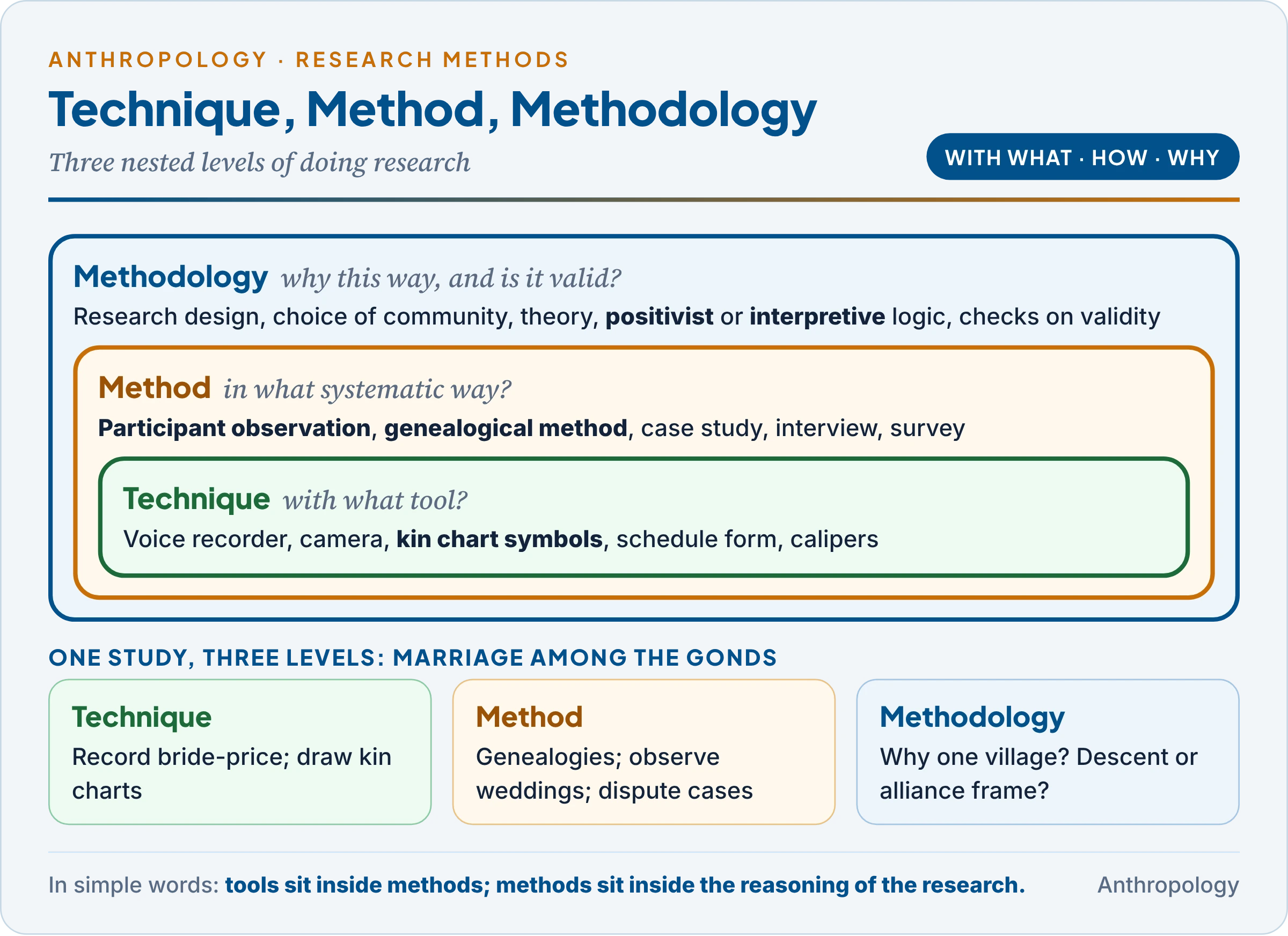
A technique is a specific tool, such as a tape recorder or a kinship chart. A method is a planned way of collecting information, such as participant observation or the genealogical method. Methodology is the reasoning behind the whole research: why these methods suit this problem, and what kind of knowledge they can produce.
Example first. Suppose a researcher studies marriage among the Gonds of a Madhya Pradesh village.
- Techniques: recording conversations, photographing a wedding, drawing kin charts with △, ○ and =, noting bride-price amounts in a notebook.
- Methods: the genealogical method to trace alliances, participant observation of weddings, case studies of marriage disputes, interviews with elders.
- Methodology: the decision to study one village intensively rather than survey a district; the theoretical frame (descent theory or alliance theory); how cases are chosen; how the findings will be checked; whether the aim is to explain causes or to interpret meanings.
The techniques answer “with what?“, the methods “how?“, and the methodology “why this way, and how do we know it is valid?“
6.1 Definitions
- Research is a careful, systematic search for new knowledge: defining a problem, forming hypotheses, collecting and analysing data, and testing conclusions.
- Technique: the specific procedures and instruments used to make observations, record data and process them: tape recorders, cameras, schedule forms, anthropometric calipers, pile sorts, coding software.
- Method: a systematic way of collecting and analysing data, which may use several techniques: participant observation, interview, case study, genealogical method, survey, comparative method. For participant observation, for instance, the techniques may include interaction recording, photography and audio recording.
- Methodology: the science or logic of method: research design, the choice and justification of methods, the assumptions behind them, and the criteria for judging results. It also includes epistemology, the question of how we know anything.
6.2 The three compared
The table compares the three terms across the same research situations. Note how each level contains the one before it.
| Basis | Technique | Method | Methodology |
|---|---|---|---|
| Question answered | With what tool? | In what systematic way? | Why this way, and is it valid? |
| Scope | Narrowest; a specific operation | Middle; a strategy using several techniques | Widest; the whole research logic |
| Nature | Practical, instrumental | Procedural | Theoretical, philosophical |
| Kinship study | Kin chart with standard symbols; recording kin terms | Genealogical method | Descent or alliance theory; choosing the community |
| Religion study | Photographing rites; field notes | Participant observation of festivals | Functional or interpretive approach |
| Physical anthropology | Anthropometer, sliding caliper | Anthropometry, somatotyping | Biocultural, positivist design; sampling |
The table shows that the terms form a hierarchy. The same method can use different techniques (a genealogy can be recorded on paper or software), and the same technique can serve different methods (a recorder serves interviews and observation). Methodology decides which methods suit the problem and explains the choice so that others can evaluate the results. In practice “method” and “technique” are often used loosely for each other, but “methodology” should not be used as a grand word for “method”.
6.3 Approaches within methodology
Anthropologists combine several paired approaches when designing research.
| Pair | Meaning | Indian example |
|---|---|---|
| Synchronic / diachronic | Society at one time, from fieldwork / change over time, from records and history | A village study / a history of land records |
| Inductive / deductive | From observed cases to generalisation / from theory to tested hypothesis | Dube’s Indian Village (1955): from Shamirpet to wider Indian patterns |
| Textual / contextual | Reading sacred and historical texts / observing practice in the field | L.P. Vidyarthi, The Sacred Complex in Hindu Gaya (1961), read the Puranas, then studied the pilgrimage; The Sacred Complex of Kashi (1979, with B.N. Saraswati and Makhan Jha) |
| Emic / etic | Insider categories / observer categories | §4 |
| Qualitative / quantitative | Meaning and context / measurement and counts | Life histories / household surveys |
A hypothesis is a provisional statement that further facts may confirm or reject; fieldwork is often hypothesis-generating, sharpening hypotheses in the field.
6.4 Positivist and interpretive methodologies
Behind the choice of methods lie two broad philosophies: positivism and interpretivism.
| Basis | Positivist (naturalist) | Interpretive (humanist) |
|---|---|---|
| View of society | A natural system with observable regularities | A web of meanings created by people |
| Aim | Explain through general laws | Understand and interpret meaning |
| Preferred methods | Measurement, comparison, statistics, controlled observation | Participant observation, texts, life histories |
| Scholars | Durkheim; Radcliffe-Brown (a “natural science of society”); Harris | Evans-Pritchard (1950: anthropology is closer to history and the humanities, interpreting rather than explaining); Geertz (“an interpretive science in search of meaning”, 1973) |
| Risk | Treats people as objects; misses meaning | Hard to verify; can become subjective |
- The interpretive critique: all social observation depends on the observer’s cultural knowledge and membership in society; even surveys and experiments presuppose this social competence. In that sense all social research involves participant observation.
- Empiricism, the doctrine that knowledge rests on experience, underlies British fieldwork from Malinowski onwards. Edmund Leach criticised mere fact-gathering as “butterfly collecting” (Rethinking Anthropology, 1961), and Lévi-Strauss argued that the anthropologist must build models that the observed facts do not reveal on the surface.
- Mixed methods today combine both: surveys to establish patterns, fieldwork to explain them (Unit 8b).
Common confusion
Are method and methodology the same thing? No. A method is a way of doing research (participant observation, the genealogical method). Methodology is the study and justification of methods: why this method was chosen, what it assumes, and how its results can be judged. A report that lists only interviews and observation has described its methods; it has a methodology only when it explains why those methods fit the problem and how their findings were checked.
Key Terms
| Term | Meaning in simple words |
|---|---|
| Fieldwork | Studying a people first-hand by living among them for a long time |
| Armchair anthropology | Writing about peoples from others’ reports without fieldwork |
| Participant observation | Joining in daily life while observing and recording it |
| Imponderabilia of actual life | Small everyday details visible only to a resident observer (Malinowski) |
| Rapport | A relationship of trust between researcher and community |
| Key informant | A knowledgeable person who explains the culture to the researcher |
| Going native | Over-identifying with the people and losing analytical distance |
| Hawthorne effect | People changing their behaviour because they are being observed |
| Reflexivity | Examining how the researcher’s own position shapes the research |
| Emic | Description in the people’s own categories |
| Etic | Description in the observer’s comparative categories |
| Informed consent | Voluntary agreement after understanding the research |
| Multi-sited ethnography | Fieldwork that follows people or things across several places |
| Technique | A specific tool or procedure for collecting or processing data |
| Method | A systematic way of collecting and analysing data |
| Methodology | The logic and justification of the methods used |
Contemporary Developments
- ICSSR call on PVTGs (2024–25): the Indian Council of Social Science Research invited multidisciplinary studies of Particularly Vulnerable Tribal Groups, asking for fieldwork-based ethnography, a participatory framework and the mixing of qualitative and quantitative methods.
- Ethics review in India: ICMR’s guidance has expanded since the 2017 guidelines, including ethical guidelines on artificial intelligence in biomedical research (2023) and operational guidelines for single ethics review of multicentre research (2026).
- Declaration of Helsinki (2024 revision): stresses meaningful community engagement and the harms of excluding vulnerable groups from research, principles that Indian commentators have mapped onto the ICMR guidelines.
- Data protection: the Digital Personal Data Protection Act, 2023 puts consent at the centre of handling personal data, affecting recordings, photographs and digital fieldwork.
- New field forms: multispecies, digital and patchwork ethnography (coined in 2020 during the Covid-19 pandemic) are now established ways of doing fieldwork when long, continuous residence is not possible.
Diagrams to Master
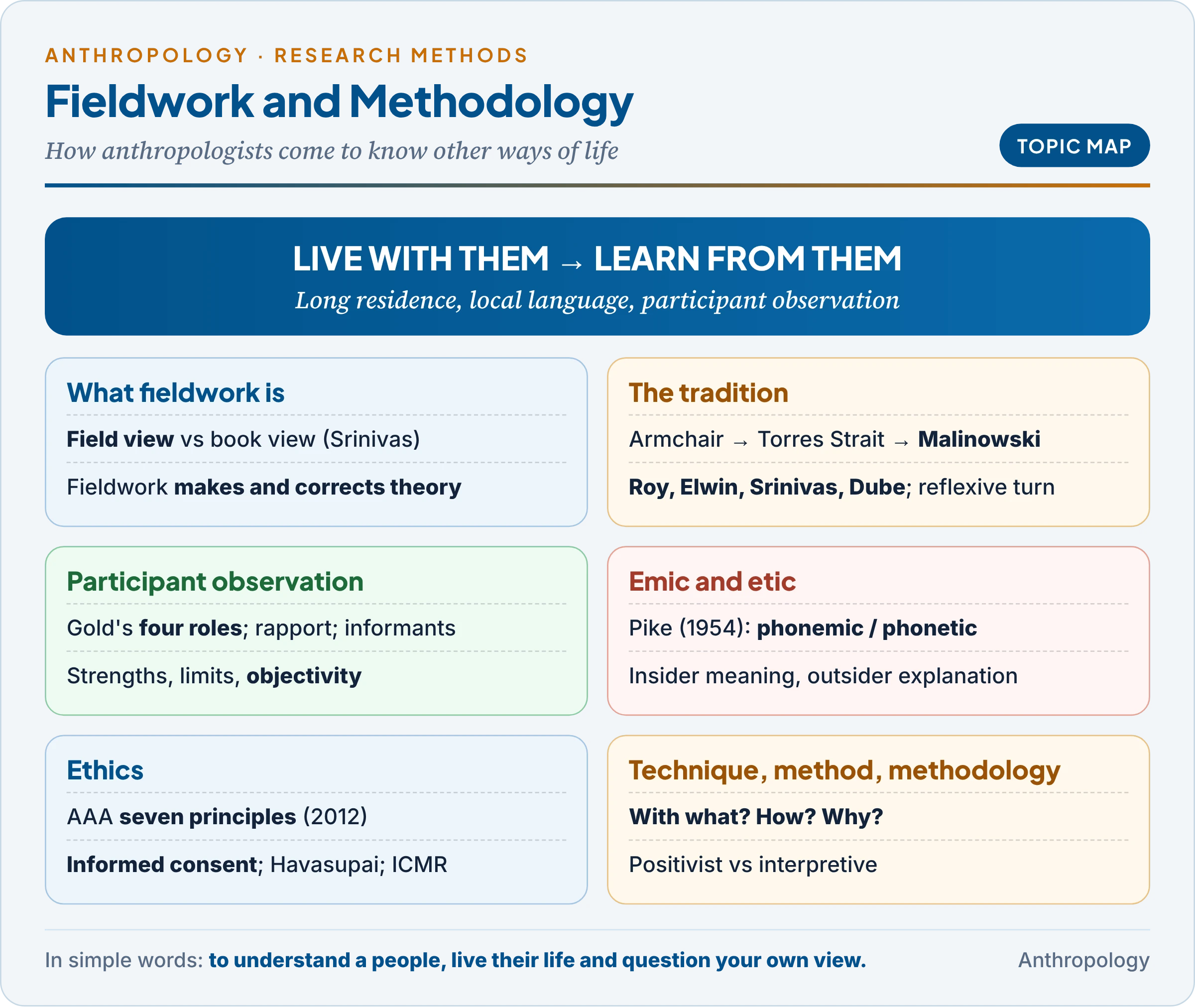
- Topic map of the article.
- Fieldwork timeline (§2): armchair → expeditions (Boas, Torres Strait 1898) → Malinowski (1915–18, 1922) → American and Indian traditions → reflexive turn (1967, 1986) → multi-sited, multispecies, digital, patchwork.
- Participant observation (§3): Gold’s four roles on a line; entry, rapport, key informants, field notes; strengths and limitations with remedies.
- Ethics (§5): seven AAA principles; Camelot to Human Terrain; Havasupai; Indian safeguards.
- Technique, method, methodology (§6): three nested boxes with “with what? how? why?” and one example each.
Revision Grid
| Scholar | Work (year) | Key idea |
|---|---|---|
| L.H. Morgan | League of the Iroquois (1851) | Early first-hand study, with Ely Parker |
| Franz Boas | Baffin Island (1883–84); Kwakiutl texts | Native-language texts; historical method |
| A.C. Haddon, W.H.R. Rivers | Torres Strait Expedition (1898); genealogical method (1900) | Expedition fieldwork; call for intensive work (1913) |
| S.C. Roy | The Mundas and their Country (1912) | Father of Indian ethnography |
| Bronisław Malinowski | Argonauts of the Western Pacific (1922) | Participant observation; native’s point of view |
| Margaret Mead | Coming of Age in Samoa (1928) | Fieldwork testing psychological theory; visual methods |
| Verrier Elwin | The Muria and their Ghotul (1947) | Total immersion among tribes |
| Kenneth Pike | Language in Relation to a Unified Theory (1954) | Emic and etic |
| M.N. Srinivas | Religion and Society among the Coorgs (1952); The Remembered Village (1976) | Field view; Sanskritisation; dominant caste |
| Raymond Gold | “Roles in Sociological Field Observations” (1958) | Four observer roles |
| Béteille and Madan | Encounter and Experience (1975) | Indian reflections on fieldwork |
| Clifford and Marcus | Writing Culture (1986) | Ethnography as text; partial truths |
| George Marcus | “Ethnography in/of the World System” (1995) | Multi-sited ethnography |
| AAA | Principles of Professional Responsibility (2012) | Seven ethical principles |
Previous Year Questions
Unit 8: Fieldwork tradition in Anthropology
- 2026Write notes on: Ethics in anthropological fieldwork.
- 2025Write notes on: Multispecies, Multi-sited and Critical Ethnography.
- 2024Discuss the contemporary challenges in fieldwork method in anthropological research.
- 2023Critically discuss the controversies related to fieldwork of Bronislaw Malinowski and Margaret Mead.
- 2022Write the historical development of fieldwork tradition in anthropology till recent times.
- 2020Write notes on the Experiential Ethnography in about 150 words.
- 2017Elucidate the basic characteristics of anthropological fieldwork methods.
- 2016Describe the evolution of fieldwork tradition in Anthropology.
- 2015Explain the difference between emic and etic, and how does the difference derive from the study of language?
- 2014Write a note in 150 words on Field work tradition in Anthropology.
- 2011Write a note in 150 words on Fieldwork tradition in Anthropology.
- 2008Discuss the importance of field work in anthropology and describe various tools of data collection.
- 2000Write a note on Etic and Emic approach.
- 1999Discuss the contribution of field work in the development of anthropological concept and theories.
- 1998Trace the genesis and development of field work in anthropological research. Assess its importance in the development of Anthropology.
- 1996Examine the importance of observation as a fieldwork technique in Anthropology. Differentiate between participant and non-participant observation and analyze the problem of objectivity in participant observation.
- 1994Discuss the nature and logic of anthropological field work methods. Do these differ from those of other social sciences ? Discuss.
- 1993Discuss the nature and method of Anthropological Field work and explain its uniqueness.
- 1991Discuss the nature and logic of anthropological field work methods.
- 1989How does fieldworker strike a balance between theoretical requirements and real field situations ? Describe with suitable examples.
- 1988Discuss the different fieldwork traditions in anthropological research.
- 1987Write a note on Anthropological fieldwork.
- 1986Explain the significant role of an informant in anthropological fieldwork.
- 1985Write a note in 200 words on Field work traditions in Anthropology.
- 1984Describe the nature of anthropological field work and evaluate its role in the formulation of anthropological theories.
- 1983Fieldwork has served to develop theory in Anthropology. Discuss.
- 1981Discuss the place and importance of fieldwork in anthropological method.
Unit 8: Distinction between technique, method and methodology
- 1993Write a note on Method and Methodology.
- 1990Discuss the difference between the technique, method and methodology as employed in anthropological studies.
- 1987Distinguish between technique, method and methodology. Examine their role in anthropological studies.
- 1986Trace the rise and development of empiricism in Anthropology.
Related questions from other units
- 2019Unit 8: Evaluate participant observation in producing anthropological knowledge.
- 2018Unit 2.2: Define ethnography and present a brief history of ethnographic studies.
- 2012Unit 8: What are the tools of data collection? Discuss the advantages and limitations of participants-observations as a technique of data collection.
- 2007Unit 8: Critically examine the contribution of Positivistic and Non-Positivistic approaches in Social Science Research.
- 2006Unit 8: Critically examine the role of subjectivity in Anthropological Research.
- 1997Unit 2.2: Critically assess the role of ethnography in the development of anthropological theories.
- 1995Unit 6: What was Boas approach of studying primitive cultures ? Delineate the role of field work and history in anthropological study.
- 1994Unit 2.2: Describe the nature, scope and methods of new ethnography.
- 1990Unit 2.2: Write a note on Ethnography.
- 1989Unit 8: Write a note on Participant Observation in Anthropological Field Work.