

6 Anthropological theories: (h) Symbolic and interpretive theories (Turner, Schneider and Geertz); (i) Cognitive theories (Tyler, Conklin).
Official Syllabus: Paper I, Unit 6 (symbolic, interpretive and cognitive theories)
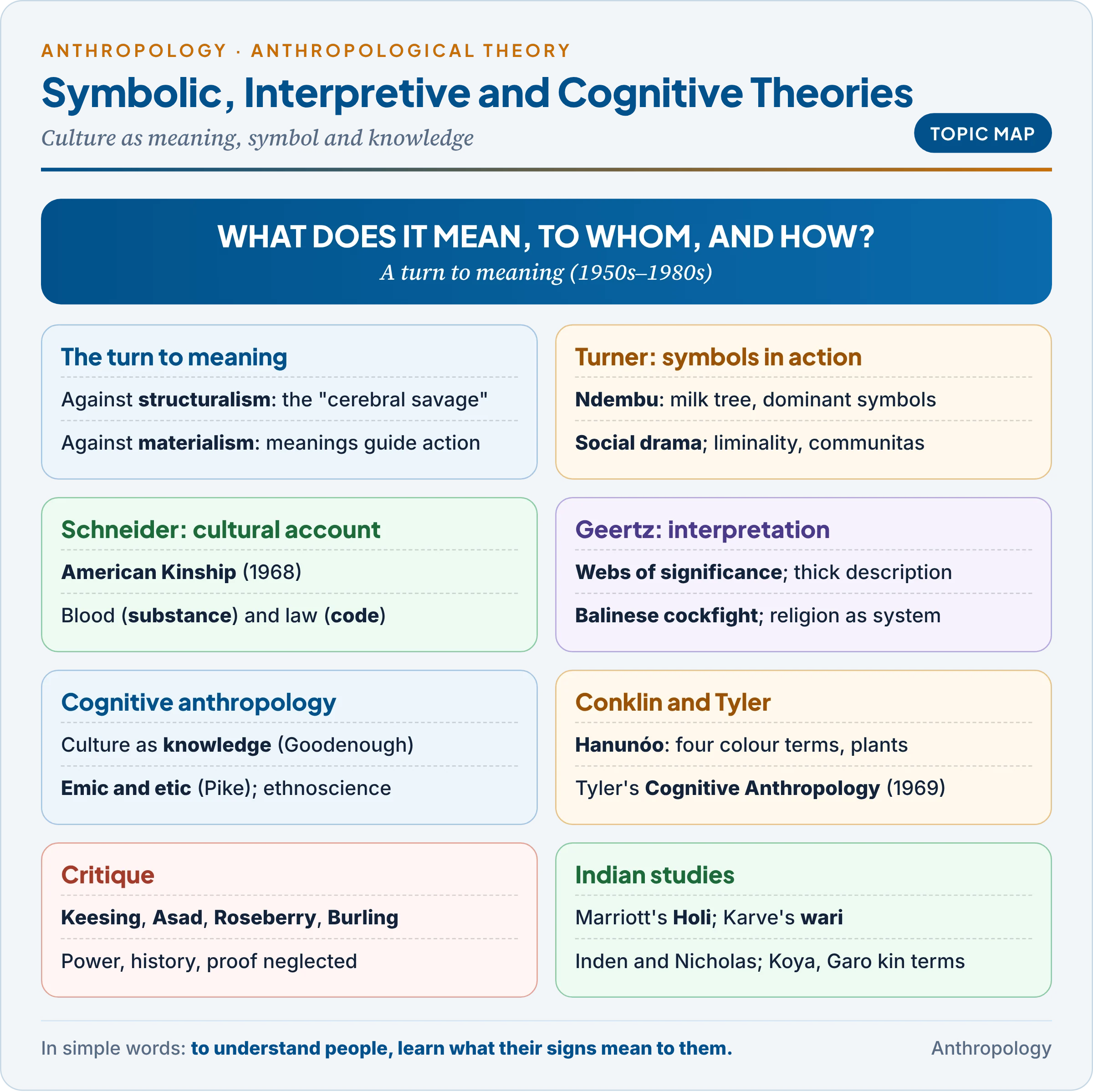
1. The Turn to Meaning
In simple words
These schools ask what things mean to the people who use them. A red mark, a tree in a ritual or a word for a colour is treated as a sign that carries ideas and feelings. To understand a culture, the anthropologist must learn to read those signs the way insiders read them.
Example first. A married Hindu woman in much of North India wears sindoor (vermilion powder) in the parting of her hair. Chemically it is only red powder; to everyone around her it says married, husband alive, auspicious, and its removal at widowhood says the opposite. A materialist asks what the custom does for survival; a structuralist asks which hidden opposition it expresses. The schools in this article ask first: what does it mean, to whom, and how does that meaning move people to act?
1.1 A reaction against two rivals
- Against structuralism. Lévi-Strauss sought universal laws of the mind behind myth and kinship (Unit 6f). The American anthropologist Clifford Geertz called this the study of a “cerebral savage” (1967): it found the logic of symbols but forgot the actors who use them. Symbolic anthropologists put actor and context back at the centre.
- Against materialism. White, Steward and Harris explained culture by technology, environment and economy (Units 6h, 6i). Symbolic anthropologists replied that people act on the meanings they give to things: a cow is food in one culture and sacred in another.
- Setting. The school grew in the 1960s–70s, chiefly at Chicago. Geertz and Schneider had trained at Harvard under the sociologist Talcott Parsons, who separated the social system (roles and relations) from the cultural system (symbols and meanings); they took the cultural system as anthropology’s object.
1.2 Basic premises
- A symbol is “something which stands for something else”, linked to it by learned convention, not by nature.
- Culture is a system of meanings carried by words, rituals, objects, colours, games and myths.
- Strange beliefs become intelligible once placed inside the people’s own system of meaning.
- Action is guided by interpretation, so symbols explain material as well as ideal activity.
- Method: long fieldwork, native terms and explanations, and a literary rather than laboratory style borrowing from philosophy, history and literary criticism.
1.3 Three ways of studying symbols
The founders agreed that culture is meaning but asked different questions about it.
| Victor Turner | Clifford Geertz | David Schneider | |
|---|---|---|---|
| Label | Symbolic anthropology | Interpretive anthropology | Cultural account |
| Influence | Durkheim, van Gennep, Manchester school | Max Weber, Ryle, hermeneutics | Parsons, Lévi-Strauss |
| Question | What do symbols do in social process? | What do symbols say about a worldview? | What is the system of symbols in itself? |
| Unit | Ritual and conflict | Public action read as text | A domain, such as kinship |
| Case | Ndembu, Zambia | Bali, Java, Morocco | American kinship |
Turner kept the British interest in society: symbols matter because they act on groups. Geertz was interested in culture as a way of seeing and feeling. Schneider went furthest in separating culture from behaviour.
- Mary Douglas, the British anthropologist, belongs to the same turn: in Purity and Danger (1966) “dirt is matter out of place“, so pollution is whatever breaks a classification (Unit 5b). Units 1.1 and 5a introduced the milk tree, webs of significance and liminality; here they are treated as theories, with their critics.
2. Victor Turner: Symbols in Action
In simple words
Turner showed that a ritual object can mean many things at once, and that it gains power by joining bodily feelings to moral rules. He also showed that village quarrels unfold in regular stages, and that ritual is one way a community repairs itself.
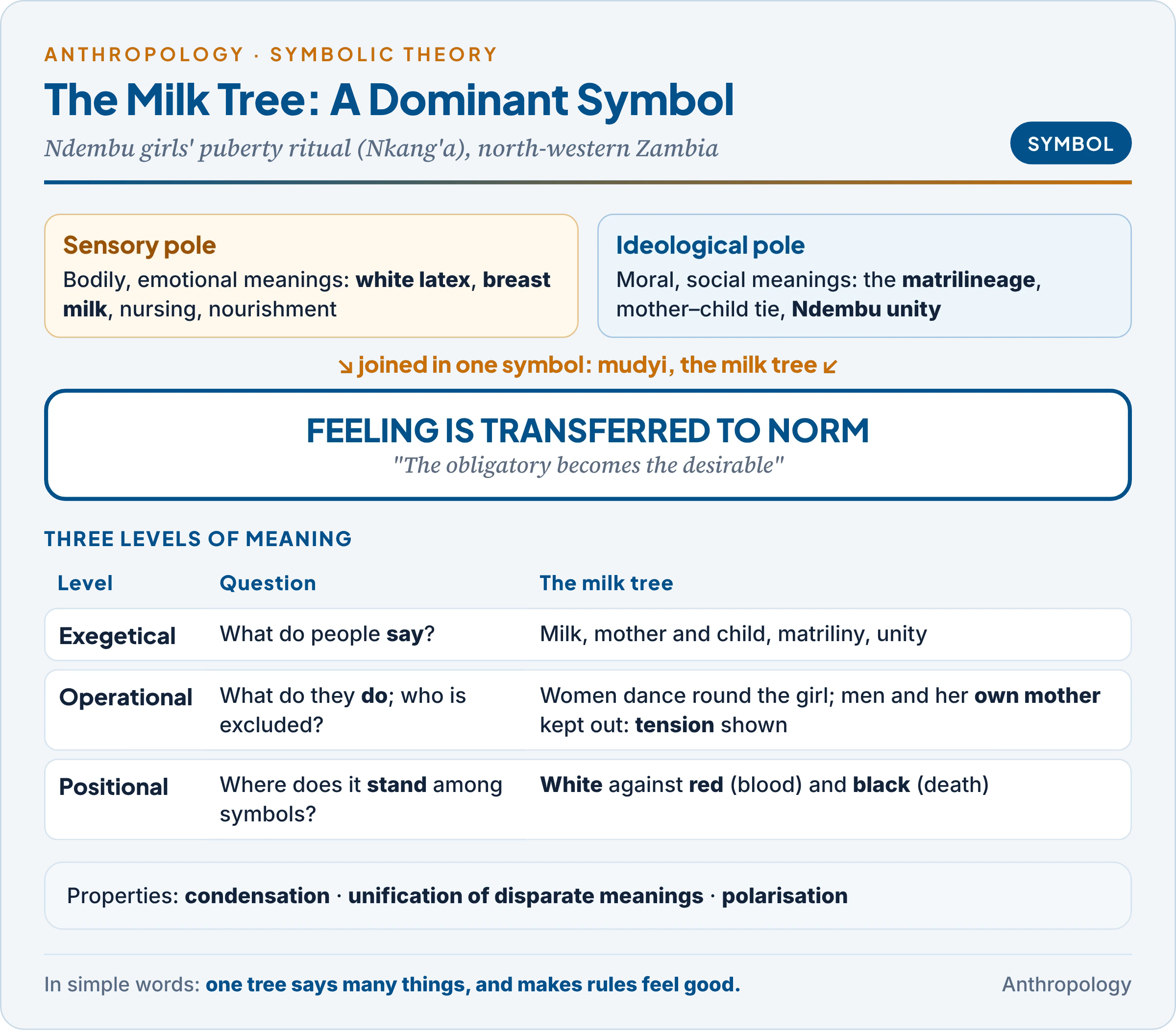
Example first. On the first day of Nkang’a, the girls’ puberty ritual of the Ndembu, a girl lies wrapped in a blanket for about eight hours at the foot of a mudyi sapling while women dance around her. The spot is the “dying-place“: she dies to childhood. The mudyi is the milk tree; it oozes white latex when cut. Women said it meant breast milk, the bond of mother and child, the matrilineage and the unity of all Ndembu. One tree carried all of these at once.
2.1 Victor Turner (1920–1983)
Victor Witter Turner, born in Glasgow, trained in the Manchester school of Max Gluckman, which studied conflict and process. Through the Rhodes-Livingstone Institute he worked from 1950 to 1954, with his wife Edith Turner, among the Ndembu (north-western Zambia), a matrilineal people of shifting cultivators living in small, mobile villages. He later taught at Cornell, Chicago and Virginia.
2.2 Social drama
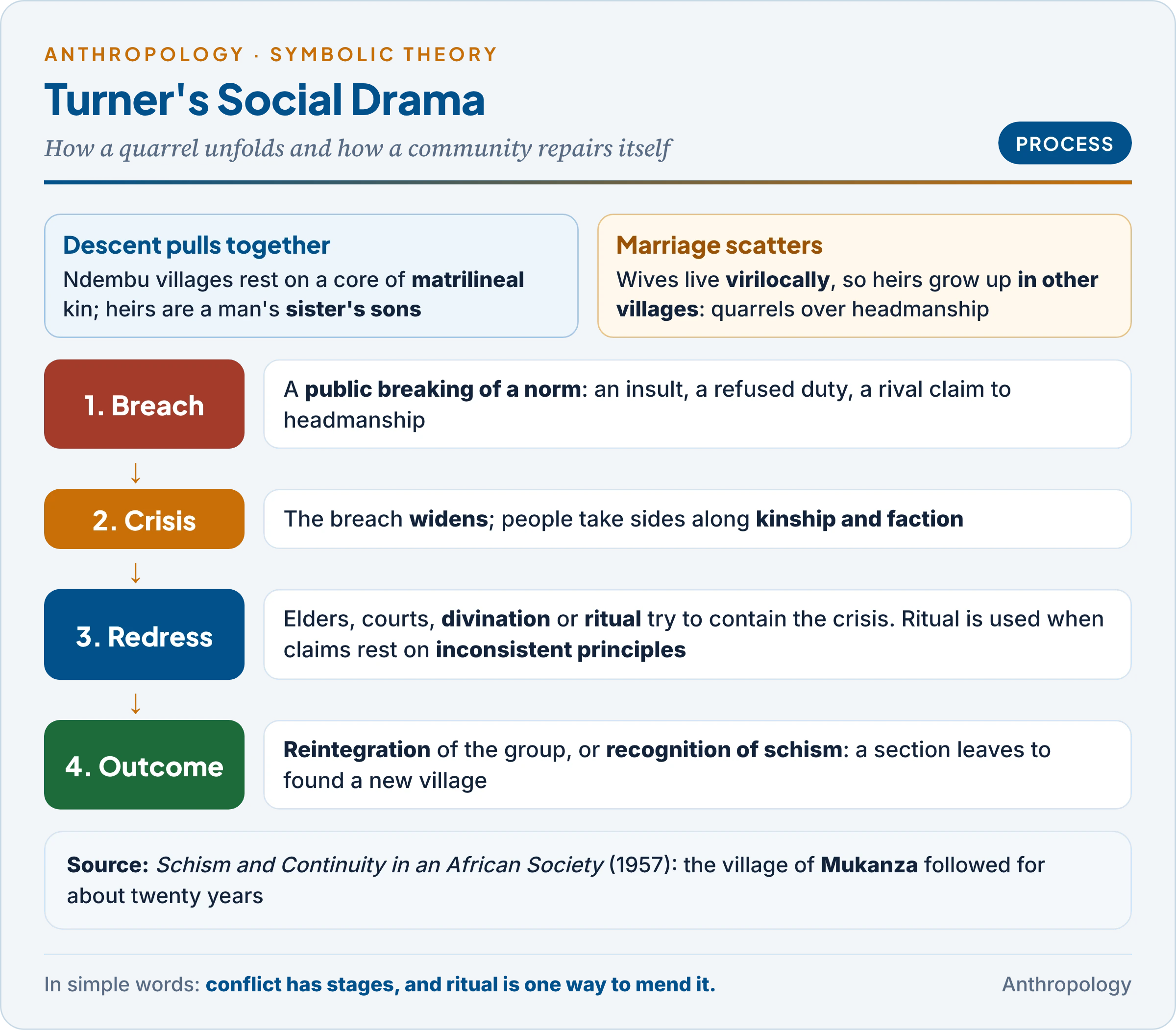
- The contradiction. Ndembu villages are built on a core of matrilineal kin, but wives live virilocally (in the husband’s village), so a man’s heirs, his sister’s sons, grow up elsewhere. Descent pulls kin together; marriage scatters them, and quarrels over headmanship follow.
- The study. Schism and Continuity in an African Society (1957) followed the village of Mukanza for about twenty years through a series of crises he called social dramas, his “principal unit of description and analysis in the study of social process”.
- Four phases:
- Breach: a public breaking of a norm.
- Crisis: the breach widens and people take sides along kinship and faction.
- Redressive action: elders, courts, divination or ritual try to contain it.
- Reintegration, or recognition of schism: the group reunites, or a section leaves to found a new village.
- Why it matters. It shows society as process and exposes its contradictions. When rival claims rest on inconsistent principles (descent against residence), no court can settle them, so Ndembu turn to ritual: conflict and ritual are linked.
2.3 The ritual symbol
- Definition. In The Forest of Symbols (1967) a symbol is “the smallest unit of ritual which still retains the specific properties of ritual behaviour”, the “molecule” of ritual.
- Dominant symbols recur across many rituals and carry its central values; they are ends in themselves, like the milk tree in girls’ puberty and boys’ circumcision. Instrumental symbols are means to one ritual’s specific goal, such as a medicine for one affliction.
- Three properties of a dominant symbol:
- Condensation: many meanings packed into one form; hence ritual symbols are multivocal (Turner’s multivocality), not univocal.
- Unification of disparate meanings: unlike ideas (milk, matriliny, tribal unity) joined by a shared quality, here whiteness and nourishment.
- Polarisation: a sensory (orectic) pole of bodily, emotional meanings (milk, breast) and an ideological (normative) pole of moral and social ones (the matrilineage and its rules).
- How it works. Ritual joins the poles, so the feelings of the sensory pole are transferred to the rules of the ideological pole: “the obligatory” becomes “the desirable”. Ritual makes people want to do what society requires.
2.4 Three levels of meaning
Turner insisted that a symbol’s meaning is more than what people say about it.
| Level | What it is | The milk tree |
|---|---|---|
| Exegetical | What informants say | Breast milk, mother and child, matrilineage, Ndembu unity |
| Operational | What people do with it, and who is present or excluded | Women dance round the girl; men and her own mother are kept out, showing tension between mother and daughter and between the sexes |
| Positional | Meaning from its place among other symbols | White set against red (blood) and black (death) in Ndembu colour classification |
The operational level is Turner’s sharpest tool: informants called the milk tree a symbol of harmony, but its use revealed conflict. A symbol can say unity while showing division. His colour triad shows the positional level: white for milk, semen and goodness, red for blood, black for death and impurity.
2.5 Liminality and communitas
In brief (from Unit 5a, §8.3). Arnold van Gennep, the Belgian-French folklorist, divided rites of passage into separation, transition and incorporation (1909). Turner studied the middle phase in “Betwixt and Between” (1964) and The Ritual Process (1969).
- Liminality (Latin limen, threshold): the novice is neither one thing nor the other, stripped of status, often treated as dead or sexless.
- Communitas: liminal people form a bond of equality and comradeship, the opposite of structure (the ordered system of statuses). Society alternates between structure and anti-structure, and communitas renews it. In modern life, optional leisure such as theatre and carnival is liminoid.
- Indian cases. Irawati Karve, the Indian anthropologist, walked the Pandharpur wari (Maharashtra’s foot pilgrimage) and described its moving community of many castes (“On the Road”, 1962), though caste distinctions did not vanish. At Sabarimala (Kerala) pilgrims under a 41-day vow all call one another “Swami“.
2.6 Assessment
- Contributions: ritual as process; a method for reading symbols at three levels; the link between emotion and norm.
- Still functionalist: symbols finally renew order, so conflict is always resolved inside the system.
- Whose exegesis? “Native” meanings came largely from senior experts, and the analyst chose which counted.
- Communitas over-generalised: John Eade and Michael Sallnow (Contesting the Sacred, 1991) showed pilgrimages to be arenas of competing groups and meanings.
- Gender: the historian Caroline Walker Bynum (1984) argued that liminality fits men’s experience; women’s symbols often stress continuity.
3. David Schneider: Kinship as a Cultural System
In simple words
Schneider asked what people mean when they call someone a relative. Americans, he found, define relatives by two ideas: shared blood and a duty of lasting love. Kinship is therefore not a biological fact that every society records, but a set of cultural symbols that differs from place to place.
Example first. An American says of his wife’s mother, “She’s not a real relative, she’s an in-law”: related by law, not by blood. In Cinderella the stepmother lacks the “natural” tie and so feels no love for a child related by law alone. Schneider asked what such talk reveals about a culture’s idea of kinship.
3.1 David Schneider (1918–1995)
David Murray Schneider, an American anthropologist trained at Harvard, did fieldwork on Yap (Micronesia) in 1947–48, co-edited Matrilineal Kinship (1961) with Kathleen Gough, and was a founder of Chicago’s symbolic anthropology.
- Culture is a system of symbols and meanings, distinct from norms and from behaviour; a regularity in behaviour is not necessarily culture.
- Unseen categories such as spirits or “blood” are cultural units even if no one observes them.
- He kept Lévi-Strauss’s idea of culture as a set of relations among units, which set him apart from Geertz and Turner.
3.2 American Kinship: A Cultural Account (1968)
- Order of nature: relatives “by blood” share biogenetic substance, half from each parent; the tie is permanent.
- Order of law: relatives by marriage, step- and foster relatives are bound by a code for conduct alone.
- Three classes: relatives in nature alone (a child’s unacknowledged genitor), in law alone (spouse, in-laws, step-kin) and in both (the “real” relatives).
- Diffuse, enduring solidarity: the code for conduct among kin is love, help given without calculation and for life. Sexual intercourse between spouses is the core symbol uniting the two orders: it unites the couple and creates shared substance in the child.
- Significance: even “blood”, the most “natural” fact of anthropology, is a cultural symbol.
3.3 A Critique of the Study of Kinship (1984)
- Self-criticism. Re-reading his Yap data, Schneider found he had imposed Western categories: the Yapese tabinau was a bond of people and land made through work and residence, not a “patrilineage” based on procreation.
- Thesis. Kinship theory rested on the European folk belief that “blood is thicker than water”; kinship may not be a universal domain and must be shown, not assumed, in each culture.
3.4 Influence and critique
- New kinship studies. Sylvia Yanagisako and Jane Collier (Gender and Kinship, 1987) extended the argument to gender; Kath Weston‘s Families We Choose (1991) studied gay and lesbian kinship built on choice; the British anthropologist Janet Carsten showed among Malays of Langkawi that relatedness is made by feeding and living together.
- India. Ronald Inden and Ralph Nicholas (Kinship in Bengali Culture, 1977) applied his method and found the body to be the central symbol, but with no split between substance and code: Bengali culture posits one order of bodily substance, each with its own code of conduct. Kin share a body (sapinda) or receive one in marriage. McKim Marriott generalised this into the Hindu person as “dividual“, remade by exchanges of food and substance (1976).
- Criticisms: symbols studied apart from behaviour and power; mainly white middle-class informants; and a nature/law dualism that the Bengali case shows to be Western.
4. Clifford Geertz: Interpretive Anthropology
In simple words
Geertz said that studying culture is like reading a text written in actions. The same movement can mean very different things, so the anthropologist must describe the layers of meaning that make an act what it is. He looked for meanings shared in public, not for laws of behaviour.
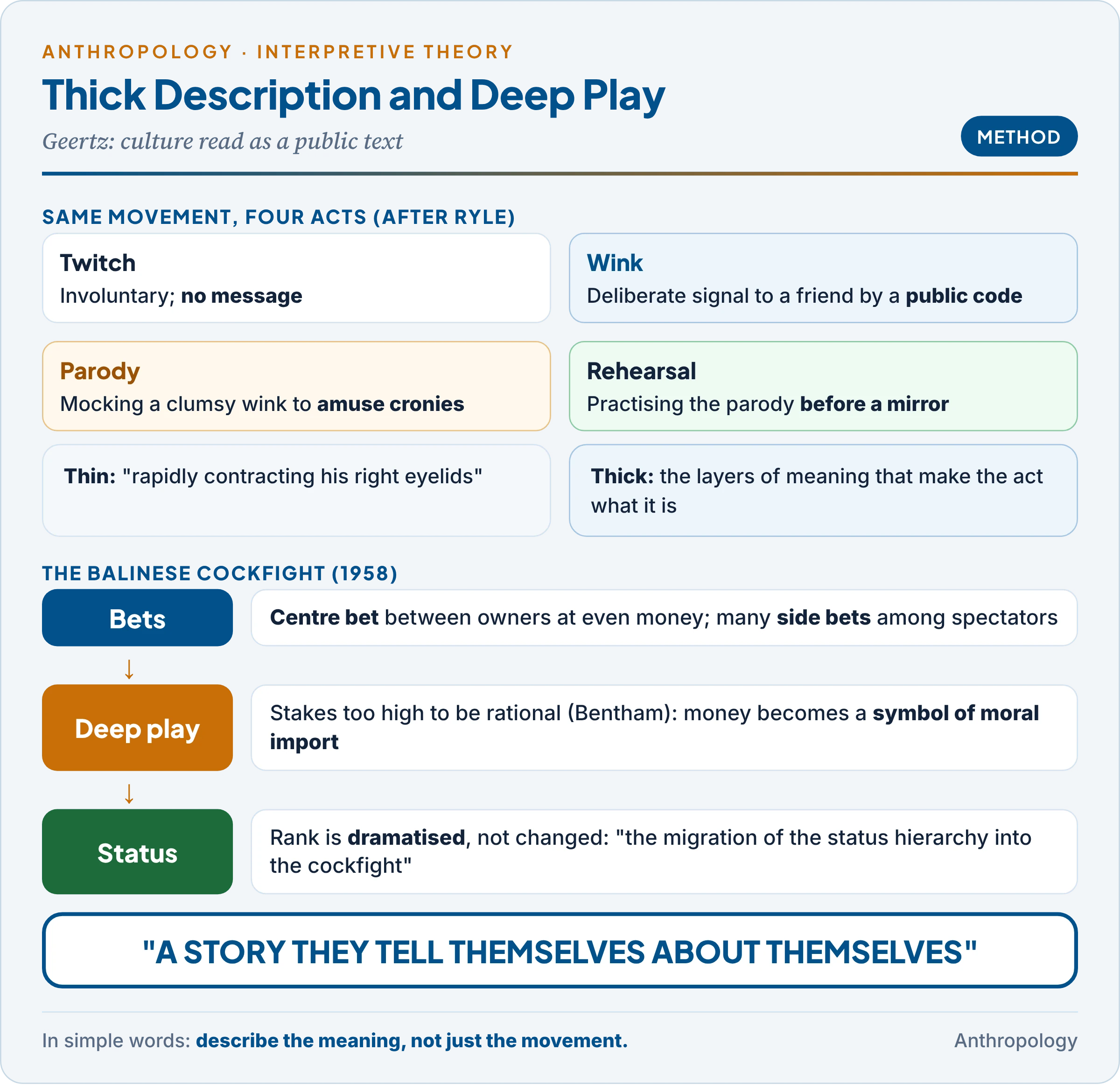
Example first. Two boys rapidly close the right eyelid. For one it is an involuntary twitch; for the other a wink, a secret signal to a friend. A third boy parodies the wink; a fourth rehearses the parody before a mirror. A camera records the same movement four times, yet four different things happened; telling them apart is the work of ethnography.
4.1 Clifford Geertz (1926–2006)
Clifford James Geertz, an American anthropologist (Harvard PhD, 1956), did fieldwork in Java, Bali (1957–58) and Morocco, and taught at Chicago (1960–70) and Princeton’s Institute for Advanced Study. Besides the works below he wrote The Religion of Java (1960), Agricultural Involution (1963) and Islam Observed (1968).
4.2 Culture as webs of significance
- Definition. “Believing, with Max Weber, that man is an animal suspended in webs of significance he himself has spun, I take culture to be those webs, and the analysis of it to be therefore not an experimental science in search of law but an interpretive one in search of meaning” (1973).
- Semiotic. Culture is “an historically transmitted pattern of meanings embodied in symbols” through which people communicate and develop their attitudes towards life.
- Public. Meaning lives in shared symbols and acts, “not in someone’s head“. This was aimed at the cognitivists (§5): a wink is cultural because a public code makes it one.
- Narrower than Tylor. He wanted to replace Tylor’s “most complex whole“, now too vague to use, with culture as meaning.
4.3 Thick description
- From Ryle. The British philosopher Gilbert Ryle contrasted a thin description (“rapidly contracting his right eyelids”) with a thick description (“practising a burlesque of a friend faking a wink to deceive an innocent”).
- The object of ethnography is “a stratified hierarchy of meaningful structures” in terms of which twitches, winks and parodies are produced and understood.
- Reading a manuscript. Ethnography is like reading “a manuscript, foreign, faded, full of ellipses”, written in “shaped behaviour“. His illustration was a 1912 sheep raid in Morocco where a Jewish trader, Berber tribesmen and a French officer each acted under a different code.
- Interpretations of interpretations. The ethnographer’s account is a second- or third-order interpretation of what people already interpret; it is “fiction” in the sense of something made, not something false.
- Why it matters. Without its layers of meaning an act cannot even be identified, so description and interpretation are one task.
4.4 Religion as a cultural system (1966)
Definition. Religion is “(1) a system of symbols which acts to (2) establish powerful, pervasive, and long-lasting moods and motivations in men by (3) formulating conceptions of a general order of existence and (4) clothing these conceptions with such an aura of factuality that (5) the moods and motivations seem uniquely realistic”.
- Model of and model for. Sacred symbols describe reality and also shape action: a cosmology tells believers both how the world is and how to live in it.
- Aura of factuality. In ritual the world as imagined and the world as lived fuse, so belief feels self-evident.
- Ritual can divide. In “Ritual and Social Change: A Javanese Example” (1957) a boy’s funeral in a Javanese town broke down because the Muslim official refused to bury a boy from a family in Permai, a party hostile to orthodox Islam. When meanings and social ties change at different speeds, ritual causes conflict, not the integration functionalists assumed.
- Against psychological approaches. Freud and Malinowski explained religion by individual needs (guilt, anxiety); Geertz read it as public meaning shared by a group (Unit 5a, §3).
4.5 Deep play: the Balinese cockfight
- Getting in. Geertz and his wife Hildred reached a Balinese village in 1958 and were treated as invisible. At an illegal cockfight the police raided; the couple fled with the villagers and backed their story. From then on they were “in“.
- Cock and man. The Balinese word carries the same double meaning as in English; men groom and identify with their birds, which also stand for the animality Balinese fear.
- Two kinds of bet. A large centre bet between owners and their allies, always at even money, and many small side bets among spectators. The bigger the centre bet, the more evenly matched the birds and the “deeper” the match.
- Deep play. Jeremy Bentham, the English philosopher, used the term for gambling so risky it is irrational. In a deep match, Geertz argued, money is “a symbol of moral import“: the stake is status. Men never bet against a cock of their own kin group, so the match brings about “the migration of the Balinese status hierarchy into the body of the cockfight“.
- A story they tell themselves. No one’s rank actually changes; status is dramatised. The cockfight is “a Balinese reading of Balinese experience, a story they tell themselves about themselves”, and culture is “an ensemble of texts” read “over the shoulders” of those to whom they belong.
- Theatre state. Negara (1980) carried the idea to the nineteenth-century Balinese state, where “power served pomp, not pomp power” (Unit 4a).
- Native’s point of view. Geertz did not claim to feel like a native. He moved between experience-near concepts (people’s own, such as “fear”) and experience-distant ones (the specialist’s, such as “phobia”) (“From the Native’s Point of View”, 1974). Works and Lives (1988) then showed how anthropologists write their authority into texts, preparing the postmodern debate (Unit 6k).
4.6 Criticisms of Geertz
- Whose meanings? The anthropologist Roger Keesing (“Anthropology as Interpretive Quest”, 1987) argued that meanings are not shared by all; they are often the ideology of senior men and elites, so interpretation must ask who creates and controls them.
- Religion without power. Talal Asad (1983) held that the definition is modelled on Christian belief and ignores the disciplines and authority that train people into religion.
- History and economy. William Roseberry (“Balinese Cockfights and the Seduction of Anthropology”, 1982) said culture read as text floats free of history, class and material life; the picture of Balinese order also said little of the violence that engulfed Bali in 1965–66.
- The interpreter’s authority. Vincent Crapanzano (in Writing Culture, 1986) noted that the essay speaks for “the Balinese” in general and never lets a particular Balinese speak.
- No test. Paul Shankman (“The Thick and the Thin”, 1984) and the materialists objected that interpretations cannot be checked or falsified.
4.7 Geertz, Turner and Leach compared
Geertz is often set against Turner and against Leach. The table brings the three together.
| Point | Turner | Geertz | Leach (Unit 6f) |
|---|---|---|---|
| A symbol is | An operator in social process; multivocal | A vehicle of meaning in a public text | A sign in a system of binary oppositions |
| Aim | How symbols act on people | What symbols say to users | The logic behind symbols |
| Method | Three levels of meaning; social drama | Thick description | Structural analysis, with political change |
| Roots | Durkheim, Manchester | Weber, hermeneutics | Lévi-Strauss, Malinowski |
| Case | Milk tree; social drama | Cockfight; Javanese religion | Kachin gumsa and gumlao |
Turner asks what symbols do; Geertz what they mean. Leach shared Geertz’s interest in actors and change, but located structure in the analyst’s model, while Geertz refused to look beneath public meanings at all.
Common confusion
Are symbolic and interpretive anthropology the same? The syllabus groups them, but strictly symbolic anthropology (Turner) studies how symbols work in ritual and social action, while interpretive anthropology (Geertz) reads culture as a text of meanings. Turner looks at what a symbol does to people; Geertz at what it says to them.
5. Cognitive Anthropology
In simple words
Cognitive anthropology studies how people sort and name their world: plants, colours, diseases, relatives. It treats culture as the knowledge a person needs to behave properly in a society, and tries to describe a people’s own categories rather than the observer’s.
Example first. In many Indian homes foods are “hot” or “cold“: mango, jaggery and meat are “hot”, curd and cucumber “cold”, whatever their temperature. A feverish child or a new mother is fed by these rules. An outsider sorting foods by calories would miss the system entirely. Cognitive anthropology asks what the people’s own categories are, how they are arranged, and what knowledge lets a person use them correctly.
5.1 Meaning and premises
- Culture as knowledge. The American anthropologist Ward Goodenough (1957): “a society’s culture consists of whatever it is one has to know or believe in order to operate in a manner acceptable to its members“. It is “not a material phenomenon” but “the forms of things that people have in mind, their models for perceiving, relating, and otherwise interpreting them”.
- Tyler’s two questions (Cognitive Anthropology, 1969): “what material phenomena are significant for the people of some culture; and, how do they organize these phenomena?”
- Premises:
- Each people organises the world in its own way, and this is coded in its language.
- Description should be in the people’s own (emic) terms.
- Culture consists of rules that can be analysed formally, like grammar or logic.
- An ethnography is adequate if, like a grammar, it would let an outsider act acceptably as a native; it states what is appropriate, not what will happen.
5.2 Roots: emic and etic
- Precursors. Boas studied cultures in their own terms, Malinowski sought “the native’s point of view“, and the Sapir-Whorf hypothesis held that language shapes thought.
- The validity problem. Revisits often produced ethnographies that did not match earlier ones. Linguistics offered a way to reduce the observer’s bias.
- Emic and etic. The American linguist Kenneth Pike (1954) coined the terms from phonemic and phonetic. Phonetics records every sound with universal categories; phonemics records only the differences that matter to speakers. Emic description uses the insider’s meaningful distinctions; etic description uses the observer’s comparative categories.
Common confusion
Is “emic” the method of cognitive anthropology and “etic” the method of old ethnography? No. Both are levels of description any study can use. Cognitive anthropology stressed the emic because it wanted native categories; Marvin Harris made the etic central to cultural materialism. Emic means meaningful to the actor, not “subjective”; etic means meaningful to the comparing observer, not automatically “objective”.
5.3 Ethnoscience: the new ethnography
- Name. Ethnoscience (new ethnography, ethnosemantics) arose in the mid-1950s, centred on Yale, to study a people’s own “science”: plants, animals, disease, colour and kin.
- Founders. Ward Goodenough (kinship on Truk, Micronesia), Floyd Lounsbury (Pawnee kin terms, 1956), Harold Conklin (§5.4) and Charles Frake. Frake’s study of disease among the Subanun of Mindanao (1961) mapped a native taxonomy of skin diseases; in 1962 he urged ethnographers to find “things for words” rather than “words for things”, starting from native terms and discovering what they pick out.
- Units: a domain (a field with a cover term, such as “colour”); a contrast set (terms at one level that exclude each other); a taxonomy (kinds within kinds); a paradigm (terms defined by combined features).
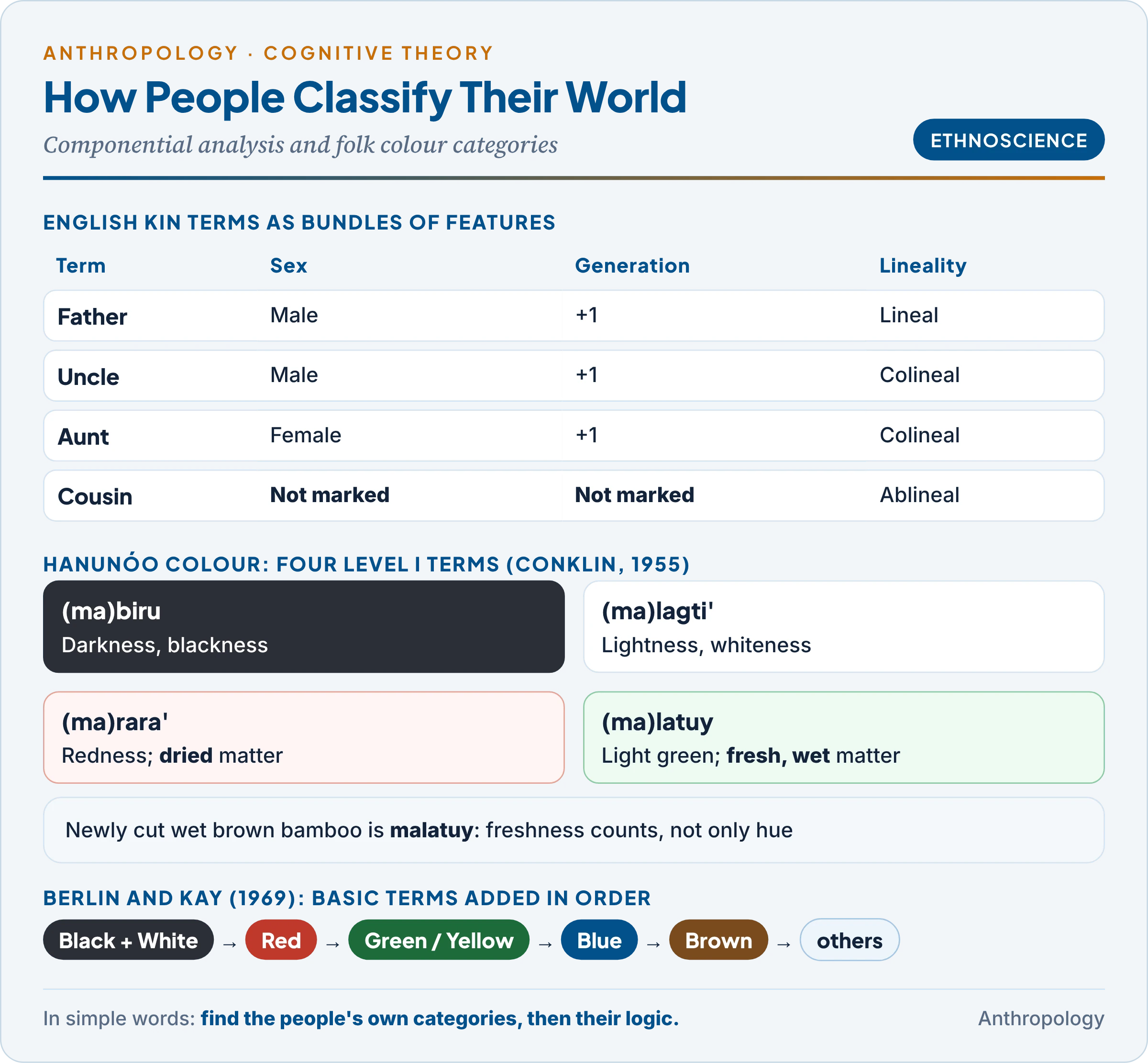
- Componential analysis (Goodenough and Lounsbury, 1956) borrowed the linguist’s search for distinctive features: record the terms, define each by the kin types it covers, find the dimensions that separate them, and state each term as a bundle of features.
- Worked example. Anthony Wallace and John Atkins (1960) found three dimensions in core English kin terms: sex, generation and lineality. “Uncle” = male, +1 generation, colineal; “aunt” = female, +1, colineal; “cousin” = ablineal, with sex and generation unmarked. English speakers mark the sex of uncles but not of cousins, a fact about their classification.
- Controlled eliciting: systematic native-language questions (“What kinds of X are there?”) so that the informant’s categories, not the interviewer’s, shape the answers.
5.4 Harold Conklin and the Hanunóo
Harold C. Conklin (1926–2016), an American anthropologist at Yale, worked among the Hanunóo (Mindoro, Philippines), swidden cultivators who write their language in an Indic-derived script on bamboo.
- Plants. The Relation of Hanunóo Culture to the Plant World (1954) recorded more than 1,600 named plant types, a folk botany finer for local plants than the botanists’ classification.
- Colour (1955). “Hanunóo Color Categories” found two levels of contrast:
- Level I: only four terms, on which all agreed: (ma)biru (darkness, blackness), (ma)lagti’ (lightness, whiteness), (ma)rara’ (redness) and (ma)latuy (light greenness).
- Level II: hundreds of specific, overlapping terms on which informants often disagreed.
- Not only hue. The terms also encode lightness and darkness and freshness against dryness: a shiny, wet, brown section of newly cut bamboo is malatuy (green), not marara’, because it is fresh. Categories follow what matters in Hanunóo life.
- Variation: men had finer terms for reds and greys of animals and feathers, women for indigo blues of cloth.
- Method lesson. Colour cards, a Western test, produced confused answers; colours of familiar things produced agreement. The method shapes the categories one finds.
- Other work: Hanunóo Agriculture (1957) showed swidden to be skilled ecology (Unit 3b); essays on folk taxonomies (1962) and the ethnogenealogical method (1964).
5.5 Stephen Tyler
- Stephen A. Tyler (1932–2020), an American anthropologist and linguist at Rice University, edited Cognitive Anthropology (1969), the reader that collected the field’s classic papers and defined its aims.
- Programme. Instead of a theory of culture, anthropology should build theories of cultures, one for each people’s organisation of its world, using data that are “mental phenomena which can be analyzed by formal methods similar to those of mathematics and logic”. Until then, he wrote, anthropologists had studied “only one small culture: the culture of anthropology“.
- India. Tyler worked among the Koya (Andhra Pradesh and Telangana), a tribe speaking a language close to Gondi, and wrote on Koya kinship terminology (1965, 1966) and India: An Anthropological Perspective (1973).
- The turn. Losing faith in formal models, he argued in The Said and the Unsaid (1978) and “Post-Modern Ethnography” (in Writing Culture, 1986) that ethnography should evoke rather than represent: a founder of cognitive anthropology became a postmodernist (Unit 6k).
5.6 Later cognitive anthropology
- Colour universals. Brent Berlin and Paul Kay (Basic Color Terms, 1969) found that basic colour terms are drawn from eleven universal categories and added in a partly fixed order (black and white; red; green or yellow; then the other; blue…). This weakened the strong Whorfian view, and the later World Color Survey of 110 languages broadly confirmed it.
- Prototypes and models. Eleanor Rosch showed that categories centre on best examples; the field moved to schemas and cultural models (Holland and Quinn, eds, 1987), such as Naomi Quinn‘s model of American marriage as lasting, shared and mutually beneficial.
- Consensus theory. Romney, Weller and Batchelder (“Culture as Consensus”, 1986) measured statistically how far informants agree and how competent each is. Roy D’Andrade surveyed the field in The Development of Cognitive Anthropology (1995).
5.7 Criticisms
- “God’s truth or hocus-pocus?” Robbins Burling (1964) showed that one set of kin terms allows several valid analyses, so componential analysis may describe the analyst’s logic, not the native’s mind.
- Trivial domains. Keesing: the new ethnography never moved beyond simplified, often trivial domains (colours, plants, kin) to religion, politics or whole cultures.
- Culture is public. Geertz located meaning in public symbols, not private minds.
- Idealism. Harris: it describes what people think, not why, and ignores material conditions.
- Whose knowledge? It assumed sharing, though knowledge varies by age, sex and expertise, as Conklin’s own data showed; it also neglected change and power. Consensus theory and cultural models were partly answers.
5.8 Indian applications
- Kin terms. Burling analysed Garo kinship terms (1963) of matrilineal Meghalaya, and Tyler the Koya; Dravidian cross and parallel terms became a classic test of formal analysis (Unit 2.5b).
- Heat and colour. Brenda Beck (“Colour and Heat in South Indian Ritual”, 1969) showed Tamil villagers ordering foods, deities and ritual substances by heat, coolness and colour.
- Ethnosociology. Marriott urged that Indian society be analysed through Indian categories (purity, substance-code, transaction): an emic project for a civilisation.
6. Comparison, Critique and Legacy
In simple words
These approaches agree that culture is meaning and knowledge, not only tools and environment. They differ on where meaning lives: in ritual action, in public texts, in a system of symbols, or in the mind. Their critics asked about power, history and proof.
6.1 The four approaches compared
The table compares the four on where culture is located, how it is studied and what each explained best.
| Point | Turner | Geertz | Schneider | Cognitive |
|---|---|---|---|---|
| Culture is | Symbols acting in social process | Public webs of meaning | Symbols apart from behaviour | Knowledge needed to act acceptably |
| Method | Three levels; social drama | Thick description | Cultural account of a domain | Eliciting; componential analysis |
| Style | Processual | Literary, hermeneutic | Analytical | Formal |
| Case | Ndembu ritual | Balinese cockfight | American kinship | Hanunóo colour |
| Critic | Eade and Sallnow; Bynum | Keesing; Asad; Roseberry | Practice and feminist theorists | Burling; Keesing; Harris |
The approaches run from the most social (Turner) to the most mental (cognitive). Geertz and the cognitivists both sought the native’s point of view but quarrelled over where it lives: in public symbols or in knowledge in the head. All four are idealist against materialism.
6.2 Common criticisms and the way forward
- Power and history neglected (Marxists, Roseberry, Asad). Sherry Ortner, the American anthropologist (“Theory in Anthropology since the Sixties”, 1984), proposed practice theory, drawing on Bourdieu, to join symbols to action and power; Marshall Sahlins (Islands of History, 1985) showed cultural categories changing through events.
- Subjectivity. Turner’s three levels, Conklin’s eliciting and consensus theory were attempts to make meaning checkable.
- The interpreter’s authority. Who speaks for the Balinese or the Ndembu? Raised against Geertz by his own students, this question opened postmodern anthropology (Unit 6k).
- Indian studies. McKim Marriott‘s “The Feast of Love” (1966), on Holi in Kishan Garhi near Mathura, showed the servile wife acting the domineering husband and the menial the master: a reversal that renews the order it mocks, as in Turner’s anti-structure. T.N. Madan‘s Non-Renunciation (1987) read Kashmiri Pandit values through their own concepts.
Key Concepts
| Concept | Scholar | Meaning |
|---|---|---|
| Social drama | Turner | Breach, crisis, redress, reintegration or schism |
| Dominant / instrumental symbol | Turner | Central value-bearing symbol / means to one ritual’s goal |
| Polarisation of meaning | Turner | Sensory and ideological poles in one symbol |
| Exegetical, operational, positional | Turner | What is said, what is done, where it stands |
| Substance and code | Schneider | Shared blood (nature) and proper conduct (law) |
| Webs of significance | Geertz | Culture as meanings people spin |
| Thick description | Geertz, after Ryle | An act described with its layers of meaning |
| Model of / model for | Geertz | Symbols describe reality and shape action |
| Deep play | Geertz, after Bentham | High-stakes play where status is at risk |
| Emic / etic | Pike | Insider’s distinctions / observer’s categories |
| Componential analysis | Goodenough, Lounsbury | Terms broken into distinctive features |
| Folk taxonomy | Conklin, Frake | A people’s own nested classification |
Major Works
| Scholar | Work | Year | Significance |
|---|---|---|---|
| Conklin | “Hanunóo Color Categories” | 1955 | Four terms; freshness and dryness |
| Goodenough | “Componential Analysis and the Study of Meaning” | 1956 | Method of ethnoscience |
| Turner | Schism and Continuity in an African Society | 1957 | Social drama |
| Turner | The Forest of Symbols | 1967 | Dominant symbols; milk tree |
| Schneider | American Kinship: A Cultural Account | 1968 | Kinship as symbols |
| Tyler (ed.) | Cognitive Anthropology | 1969 | Defining reader |
| Berlin and Kay | Basic Color Terms | 1969 | Universal colour sequence |
| Geertz | The Interpretation of Cultures | 1973 | Thick description; cockfight |
| Inden and Nicholas | Kinship in Bengali Culture | 1977 | Schneider’s method in India |
| Schneider | A Critique of the Study of Kinship | 1984 | Kinship as Western folk theory |
Key Terms
| Term | Meaning in simple words |
|---|---|
| Symbol | Something that stands for something else by custom |
| Multivocal | Having many meanings at once |
| Exegesis | Explanation of a symbol by insiders |
| Liminal | In between two states; on the threshold |
| Communitas | Fellowship of equals among people in transition |
| Matrilineal | Tracing descent through the mother’s line |
| Virilocal | Living in the husband’s place after marriage |
| Hermeneutics | The art of interpretation, first of texts, then of action |
| Thin description | Bare report of a physical act |
| Ethnoscience | Study of a people’s own classification of the world |
| Taxonomy | Classification by kinds within kinds |
| Emic / etic | The insider’s view / the outside observer’s view |
| Cultural model | A shared simple picture people use to reason |
| Idealist | Explaining culture by ideas rather than material conditions |
Contemporary Developments
- Social drama in Indian public life. The Sabarimala dispute fits Turner’s phases: a breach (the Supreme Court’s verdict of 28 September 2018 allowing women of all ages to enter), a crisis (mass protests in Kerala), redress (on 14 November 2019 a five-judge bench kept the reviews pending and referred wider questions to a larger bench), and no settled reintegration yet.
- Colour universals tested. The World Color Survey (Kay, Berlin, Maffi, Merrifield and Cook, 2009) published data from 110 unwritten languages, keeping Berlin and Kay’s broad finding of universal constraints with local variation.
- Folk taxonomy in Indian law. Under the Biological Diversity Act, 2002, Biodiversity Management Committees prepare People’s Biodiversity Registers of local names and uses of plants and animals: applied ethnobotany of Conklin’s kind.
- Thick description beyond anthropology. Since Geertz’s death in 2006 the term has become standard in history, political science and management studies.
Diagrams to Master
- Topic map of the article.
- Social drama (§2.2): four phases; matrilineal descent against virilocal marriage.
- The milk tree (§2.3–2.4): sensory and ideological poles; three levels of meaning.
- Thick description and the cockfight (§4.3, §4.5): twitch to rehearsal; centre and side bets; status.
- Componential analysis and Hanunóo colour (§5.3–5.4): kin-term feature grid; four Level I terms.
Revision Grid
| Scholar | Work (year) | Key idea |
|---|---|---|
| Pike | Language in Relation… (1954) | Emic and etic |
| Goodenough | Componential analysis (1956); definition (1957) | Culture as knowledge |
| Burling | “God’s Truth or Hocus-Pocus?” (1964) | Many valid analyses |
| Turner | Forest of Symbols (1967); Ritual Process (1969) | Milk tree; communitas |
| Schneider | American Kinship (1968) | Substance and code |
| Tyler | Cognitive Anthropology (1969) | Theories of cultures |
| Geertz | Interpretation of Cultures (1973) | Thick description; deep play |
| Keesing | “Interpretive Quest” (1987) | Whose meanings? |
Previous Year Questions
Unit 6: Symbolic and interpretive theories (Turner, Schneider and Geertz)
- 2026Compare Edmund Leach’s structuralism with interpretive anthropology of Clifford Geertz.
- 2025Compare and contrast the symbolic approaches of Clifford Geertz and Victor Turner to understand culture.
- 2023How did Clifford Geertz look at religion? Differentiate between anthropological and psychological approaches to the study of religion.
- 2021Elucidate the concept of “thick description” of Clifford Geertz with a suitable example.
- 2020Write notes on Victor Turner and Liminality in about 150 words.
- 2019Examine critically the contributions of Victor Turner and Clifford Geertz in anthropology.
- 2016According to Geertz, how does the cock-fight reveal aspects of Balinese culture?
- 2015What made Geertz’s Interpretive Anthropology distinct from Turner’s symbolic anthropology? What does each of them mean by the terms ‘Symbol’ and ‘Symbolic’ ?
- 2013Bring out the contribution of Turner and Geertz in symbolic and interpretive theories in Anthropology. (250 words).
- 2007Write a note on Symbolism.
- 2001Write a note on Symbolic Anthropology.
- 1999Write a note on Symbolism.
Unit 6: Cognitive theories (Tyler, Conklin)
- 2002Write a note on Cognitive Anthropology.
Related questions from other units
- 2015Unit 8: Explain the difference between emic and etic, and how does the difference derive from the study of language?
- 2011Unit 1.1: Critically examine the contribution of Anthropologists in the interpretation of symbols.
- 2000Unit 8: Write a note on Etic and Emic approach.
- 1996Unit 1.3: What is cognitive approach ? Critically examine its implications in Sociocultural Anthropology.
- 1995Unit 2.2: Write a note on New ethnography.
- 1994Unit 2.2: Describe the nature, scope and methods of new ethnography.
- 1991Unit 2.2: Write a note on New ethnography.
- 1987Unit 2.2: Write a note on New ethnography.