

6 Anthropological theories: (f) Neo-evolutionism (Childe, White, Steward, Sahlins and Service).
Official Syllabus: Paper I, Unit 6 (neo-evolutionism)
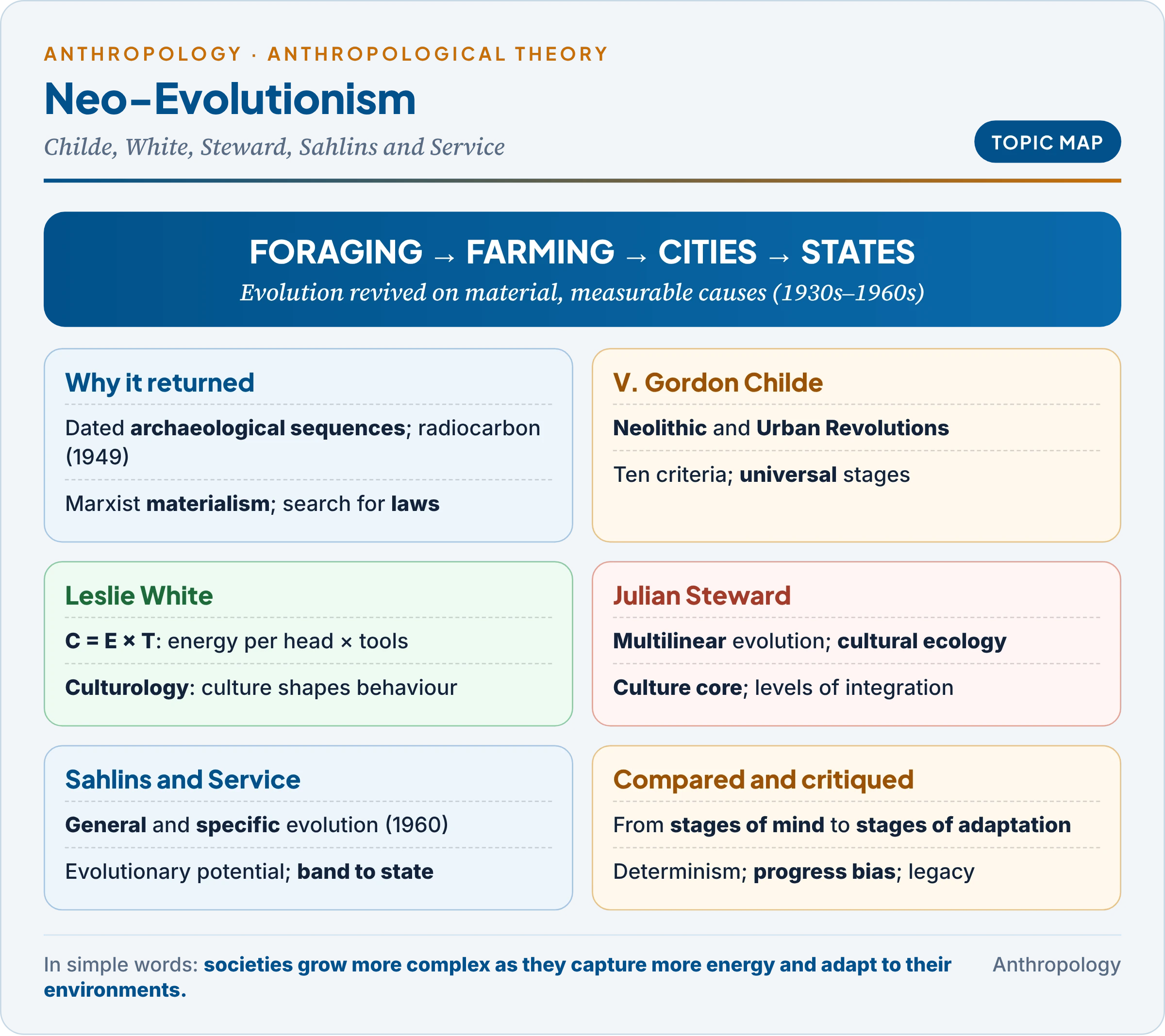
1. Why Evolution Came Back
In simple words
Neo-evolutionism is the return, in the mid-twentieth century, of the idea that human societies change in a direction: from small foraging groups to farming villages, cities and states. Unlike the older version, it explained that change by things that can be measured, such as food supply, energy, technology and environment, and it used archaeological and field evidence instead of armchair guesses.
Example first. At Mehrgarh (Kachi plain, Balochistan), people were growing barley and herding cattle, sheep and goats by about 7000 BCE. About four thousand years later the same region held the planned cities of the Harappan civilization, with granaries, drains, seals and writing. Much the same shift, from foraging to farming and from villages to cities, happened independently in Mesopotamia, Egypt, China, Mesoamerica and the Andes. Why should unconnected peoples arrive at such similar forms of life? Answering this question with archaeological evidence and measurable causes is the project of neo-evolutionism.
1.1 The fall of classical evolutionism
Classical evolutionism (Tylor, Morgan, Frazer; Unit 6a) placed every society on one ladder of savagery, barbarism and civilization, assumed psychic unity (all minds reason alike), and filled the gaps with survivals and armchair comparison. From about 1900 Boas and the historical particularists (Unit 6b) showed that each culture has its own history and that the stages rested on unreliable data; diffusionists (Unit 6c) stressed borrowing; and functionalists (Units 6d, 6e) turned to how customs work now. By the 1930s “evolution” was almost a forbidden word, because it suggested racist ranking of peoples.
1.2 The revival
Evolutionary thinking returned between the 1930s and 1960s because new archaeological sequences, dated after 1949 by radiocarbon (Willard Libby), replaced guesses; because the materialism of Marx and Engels, who had used Morgan’s stages, encouraged explanations based on production and technology; and because a generation trained by Boas wanted general laws, not only histories of single cultures. The American anthropologists Leslie White, Julian Steward, Marshall Sahlins and Elman Service, and the Australian-born archaeologist V. Gordon Childe, are together called neo-evolutionists (neo = new).
1.3 Three kinds of evolutionism (Steward’s typology)
Steward (1955) sorted evolutionary theories into three kinds, which shows how the neo-evolutionists differed from the classical school and from one another.
| Type | Claim | Scholars |
|---|---|---|
| Unilinear | Every society passes through the same stages in the same order | Morgan, Tylor |
| Universal | Culture as a whole (mankind’s culture) passes through broad stages; particular cultures may vary | Childe, White |
| Multilinear | Limited parallels: societies in similar environments with similar technology develop along similar lines | Steward |
Universal evolutionism applies the grand sequence to human culture in general, not to every tribe, which answers the Boasian objection; multilinear evolutionism drops it and looks only for regularities the evidence supports. Sahlins and Service later joined the two (§5).
1.4 What the neo-evolutionists shared
- Material causes and adaptation. Culture is humanity’s means of adapting to nature; change is explained by technology, energy, subsistence, environment and population, not by progress of the mind.
- Evidence and laws. Stages and parallels must be shown in archaeological and ethnographic data, and anthropology should find regularities of cause and effect.
- No racial ranking. Differences between societies are cultural and historical, not differences of intelligence.
2. V. Gordon Childe: The Neolithic and Urban Revolutions
In simple words
Childe was an archaeologist who argued that two great changes transformed human life. The first was the beginning of farming and herding, which let people store food, settle down and multiply. The second was the rise of cities, where surplus food supported craftsmen, priests, rulers, writing and trade.
2.1 Childe in brief
- Vere Gordon Childe (1892–1957) was born in Sydney, studied at the University of Sydney and Queen’s College, Oxford, and became a Marxist as a student. He was Abercromby Professor at Edinburgh (1927–46) and Director of the Institute of Archaeology, London (1947–57), and excavated Skara Brae in Orkney.
- Known as the “great synthesiser“, he joined the scattered prehistory of Europe and the Near East into one story.
- Main works: The Most Ancient East (1928), Man Makes Himself (1936), What Happened in History (1942), “The Urban Revolution” (1950) and Social Evolution (1951).
- Archaeology as economic history. Childe read tools, pots and houses as evidence of how people produced their living and what each change meant for food supply, population and social organisation. Man Makes Himself states the Marxist thesis: by changing their means of production, humans change their own society.
2.2 The Neolithic Revolution
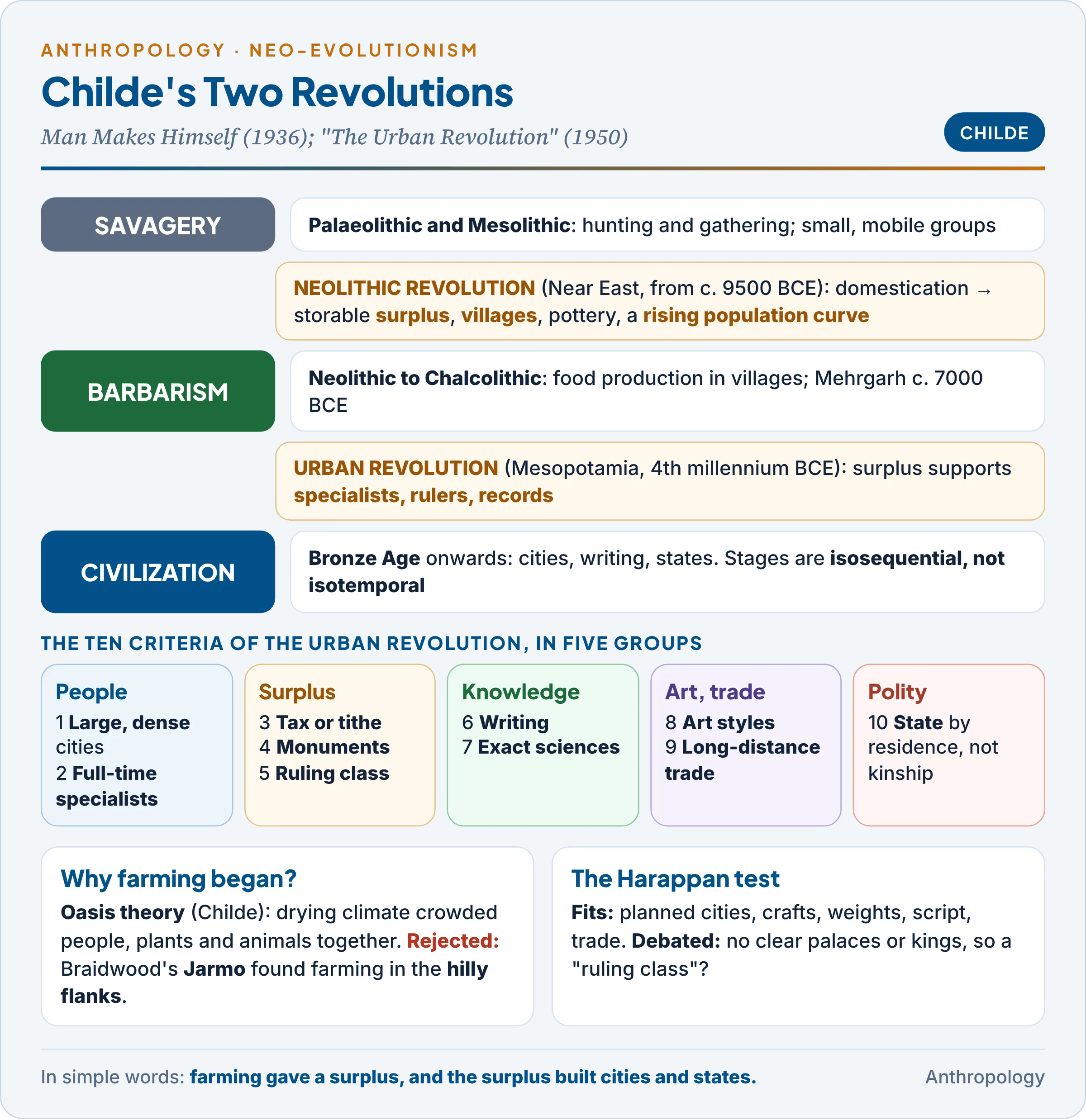
The Neolithic Revolution (a term Childe popularised) was the change from food gathering to food production: the domestication of plants such as wheat and barley and of animals such as sheep, goats and cattle, first in the Near East from about 9500 BCE (calibrated).
- Why call it a revolution? It took millennia, but like the Industrial Revolution it changed the whole basis of life: a storable surplus, settled villages, and many more people per square kilometre.
- The population test. Just as a successful species multiplies, a successful economy shows itself in a rising population curve; this was Childe’s measure of a revolution.
- Consequences: permanent houses, pottery, weaving, ownership of fields and herds, and inequality in stored wealth.
- Why it began: the oasis theory. Childe argued that as the climate dried after the Ice Age, people, plants and animals crowded into oases and river valleys, where close contact led to domestication. Robert Braidwood‘s work at Jarmo (Iraq, 1948–55) found early farming in the hilly flanks of the Zagros, where the climate had not dried, and Lewis Binford later stressed population pressure. The oasis theory is rejected, but Childe’s question remains central (Unit 1.8c).
2.3 The Urban Revolution
The Urban Revolution was the second leap: from farming villages to cities and states, first in Mesopotamia in the fourth millennium BCE. In “The Urban Revolution” (Town Planning Review, 1950), Childe listed ten criteria that mark it. The table groups them; read them as the signs of a society that has turned a farming surplus into specialists, rulers and records.
| Group | Childe’s criteria |
|---|---|
| Size and people | (1) Larger, denser settlements; (2) full-time specialists: craftsmen, merchants, officials, priests |
| Surplus and power | (3) Surplus paid as tax or tithe to a god or divine king; (4) monumental public buildings; (5) a ruling class of priests, officials and leaders |
| Knowledge | (6) Writing; (7) exact and predictive sciences: arithmetic, geometry, astronomy, calendar |
| Art and trade | (8) Sophisticated art styles; (9) regular long-distance trade |
| Polity | (10) A state based on residence rather than kinship |
The list moves from economics to politics: a surplus pays specialists, a ruling class concentrates it, records require writing, and loyalty shifts from kin to territory (Morgan’s societas and civitas, Unit 6a).
The Harappan test. The Harappan civilization (c. 2600–1900 BCE) fits most of the list: planned cities (Mohenjo-daro, Harappa, Dholavira), craft specialisation, standard weights, a script and trade with Mesopotamia. But it lacks clear palaces, royal tombs or dynasties, so whether it had a “ruling class” and “state” is debated. Childe’s criteria are a useful checklist, not a law.
2.4 Universal evolution
On the basis of archaeology, Childe built a universal sequence for human culture as a whole. He kept Morgan’s terms but defined them by economy.
| Stage | Archaeological period | Economic basis |
|---|---|---|
| Savagery | Palaeolithic and Mesolithic | Hunting and gathering |
| Barbarism | Neolithic to Chalcolithic | Food production in villages (Neolithic Revolution) |
| Civilization | Bronze Age onwards | Cities, writing, states (Urban Revolution) |
- Isosequential but not isotemporal. The stages appear in the same order wherever they appear, but not at the same time: Mesopotamia had cities by 3500 BCE while much of Europe was still barbarian.
- A Darwinian analogy. Inventions are the cultural equivalent of variations, tradition and diffusion of heredity, and population growth of reproductive success: the economy that feeds more people is the “fitter” one.
- Diffusion has a place. In Social Evolution (1951) Childe found that regional sequences diverge in detail, and that later societies borrowed farming and metallurgy from older centres. His stages describe mankind’s cumulative achievement, not a script every society must perform.
2.5 Critique of Childe
- Too narrow a base: a world scheme built on Europe and the Near East, ignoring independent beginnings in Africa, the Americas and Asia.
- Population as the measure is crude: numbers grow for many reasons, such as disease control or migration.
- Not sudden, not in his order. Radiocarbon dates showed both transitions took thousands of years, and monuments sometimes came before farming (Göbekli Tepe, below).
- Lasting value: the two revolutions remain the standard frame for the coming of farming and cities, and the ten criteria the starting point for defining civilization.
3. Leslie White: Energy, Culturology and Universal Evolution
In simple words
White argued that culture is a system for capturing energy from nature and putting it to human use. The more energy a society can harness for each person, and the better its tools, the larger, more complex and more organised it becomes. He also argued that culture follows its own laws, so that a person’s behaviour is shaped by the culture he is born into.
3.1 White in brief
- Leslie Alvin White (1900–1975), an American anthropologist at the University of Michigan from 1930, was trained in the Boasian tradition but turned against it after reading Morgan, and spent his career defending evolutionism. His students included Sahlins and Service.
- Works: “The Symbol” (1940), “Energy and the Evolution of Culture” (1943), The Science of Culture (1949) and The Evolution of Culture (1959).
3.2 The symbol and culturology
- The symbol. What makes humans unique is the ability to symbol: to give arbitrary meanings to things, as when holy water differs from ordinary water only because people say so. Culture is everything that depends on symbolling; it is extrasomatic (outside the body), learned rather than inherited, and cumulative.
- Culturology. White’s name for the science of culture. Culture is a reality of its own kind (sui generis) and must be explained by other cultural facts, not by individual psychology or biology: “culture grows out of culture”.
- How culture determines behaviour. A child born in Tamil Nadu speaks Tamil, eats with the right hand and may regard the father’s sister’s daughter as a proper bride; a child born in Punjab learns other rules. The difference lies in the culture each is born into, not in their bodies or minds. For White, individuals are the medium through which culture acts, not its cause.
- The inventor as a product of culture. Simultaneous inventions (natural selection by Darwin and Wallace, 1858; the telephone by Bell and Gray, 1876) show that when the cultural elements are ready, the invention appears, whoever makes it. The “great man” explains little.
3.3 Three subsystems
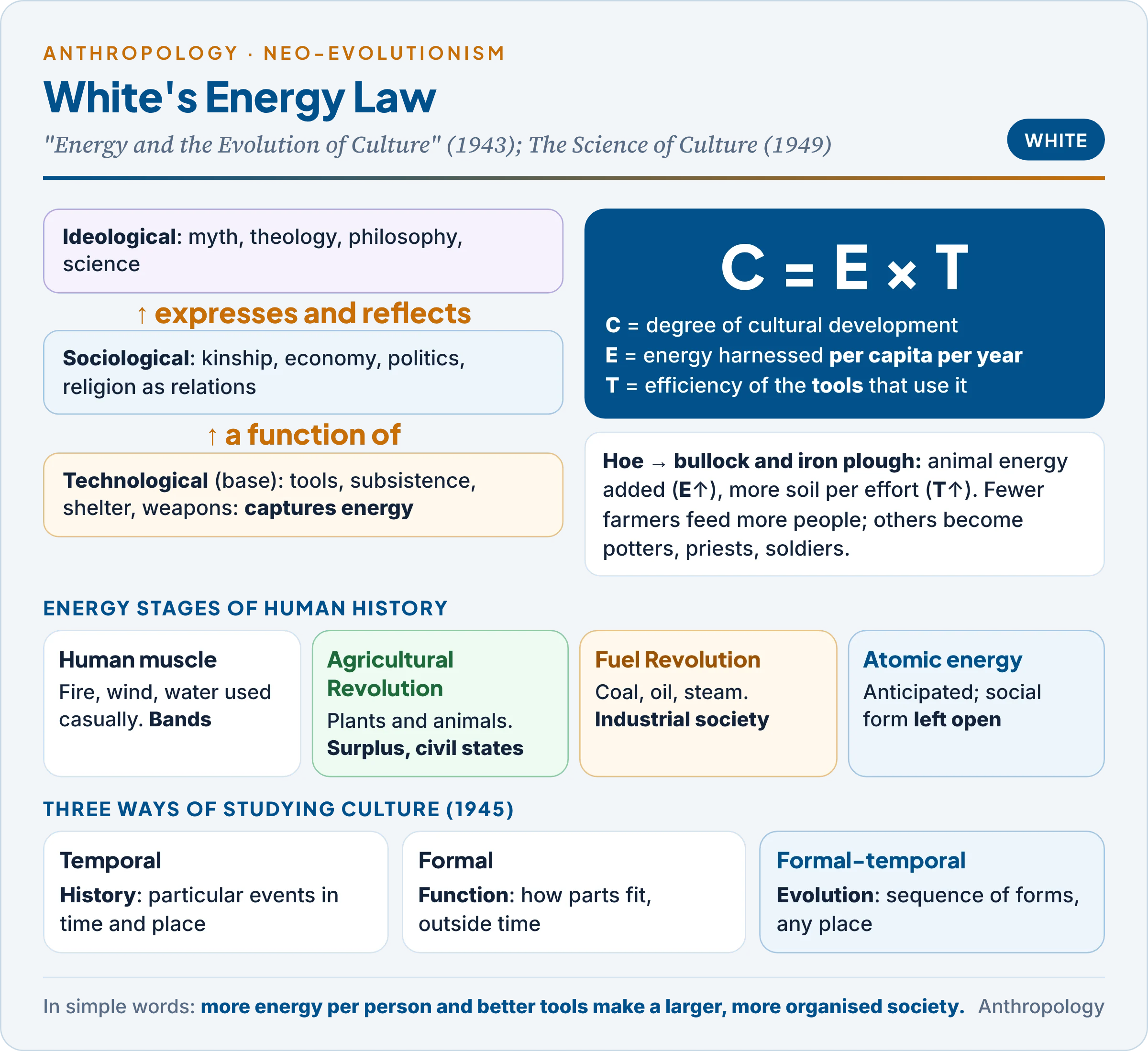
White divided every cultural system into three subsystems, arranged like layers. The table sets out what each contains and how it is related to the others.
| Subsystem | Contents | Role |
|---|---|---|
| Technological (base) | Tools, weapons, means of subsistence, shelter and the skills of using them | Basic and primary: captures energy |
| Sociological (middle) | Kinship, economic, political, military, religious and occupational relationships | A function of technology |
| Ideological (top) | Myth, theology, philosophy, science, lore, ideas and beliefs | Expresses the technology and reflects the social system |
The subsystems influence one another, but not equally: “social systems are functions of technologies; and philosophies express technological forces and reflect social systems”. Plough farming, for example, needs settled households and inherited land, and so favours lineages, property rules and fertility rituals; industry favours the nuclear family, wage contracts and secular science. Marvin Harris later adopted this ordering (Unit 6i).
3.4 The energy law: C = E × T
White’s basic law of cultural evolution (1943; restated 1949 and 1959) reads: “Other factors remaining constant, culture evolves as the amount of energy harnessed per capita per year is increased, or as the efficiency of the instrumental means of putting the energy to work is increased.“
He expressed it as a formula:
C = E × T
C = degree of cultural development (the quantity of human needs met by goods and services)
E = amount of energy harnessed per capita per year
T = efficiency of the tools used to put that energy to work
How the formula works. Culture advances by capturing more energy (E) or using it more efficiently (T). A farmer with a wooden hoe uses only his own muscle; with a bullock and an iron plough he adds animal energy (E rises) and turns more soil for the same effort (T rises). Fewer people can then feed more, freeing others to become potters, priests or soldiers, so the society grows larger, more differentiated and more organised. White saw history as a series of energy stages:
| Stage | Main energy source | Social result |
|---|---|---|
| Human energy | Muscle of the human body, plus casual use of fire, wind and water | Small, kin-based, egalitarian bands (Australian Aborigines, Palaeolithic) |
| Agricultural Revolution | Domesticated plants and animals | Surplus, villages, then cities, class-divided civil states (Egypt, Mesopotamia, India, China, Mexico) |
| Fuel Revolution | Coal, oil, steam and internal combustion | Industrial society, cities, nation-states |
| Atomic energy (anticipated) | Nuclear power | A new level, whose social form White left open |
Each jump in energy per person brought a new level of social integration, from kinship to the state. In 1959 White also wrote E × T × V → P (V the environment, P the product), admitting that habitat matters for particular cultures.
3.5 Evolution and history
In “History, Evolutionism and Functionalism” (1945) White separated temporal studies (history: particular events, such as the spread of tobacco from America), formal studies (function: how parts fit together at one moment) and formal-temporal studies (evolution: a sequence of forms regardless of place, such as the passage from kinship-based to territorial government). This is why he accused Steward of “confusing history with evolution“: comparing particular cases is history; evolution must generalise about culture as a whole.
3.6 Critique of White
- Technological determinism. Technology is primary by definition; ideas and politics appear only as effects, though religious and political choices can redirect technology.
- Energy is not progress. Atomic technology can light cities or destroy them, and fossil fuels have brought climate change. Energy per capita is also an average that hides who controls the energy.
- No explanation of variation. Why did some societies raise their energy capture and others not? Steward replied that White’s stages are so general that they explain no particular case.
- The individual vanishes. Treating culture as acting on its own (the “superorganic“) leaves human agency unexplained.
4. Julian Steward: Multilinear Evolution and Cultural Ecology
In simple words
Steward said there is no single road of evolution, but there are several roads. Societies that live in similar environments with similar tools tend to organise their work and social life in similar ways, even if they never met. To find out how, one must study exactly how people get their food from their environment and what that requires of them.
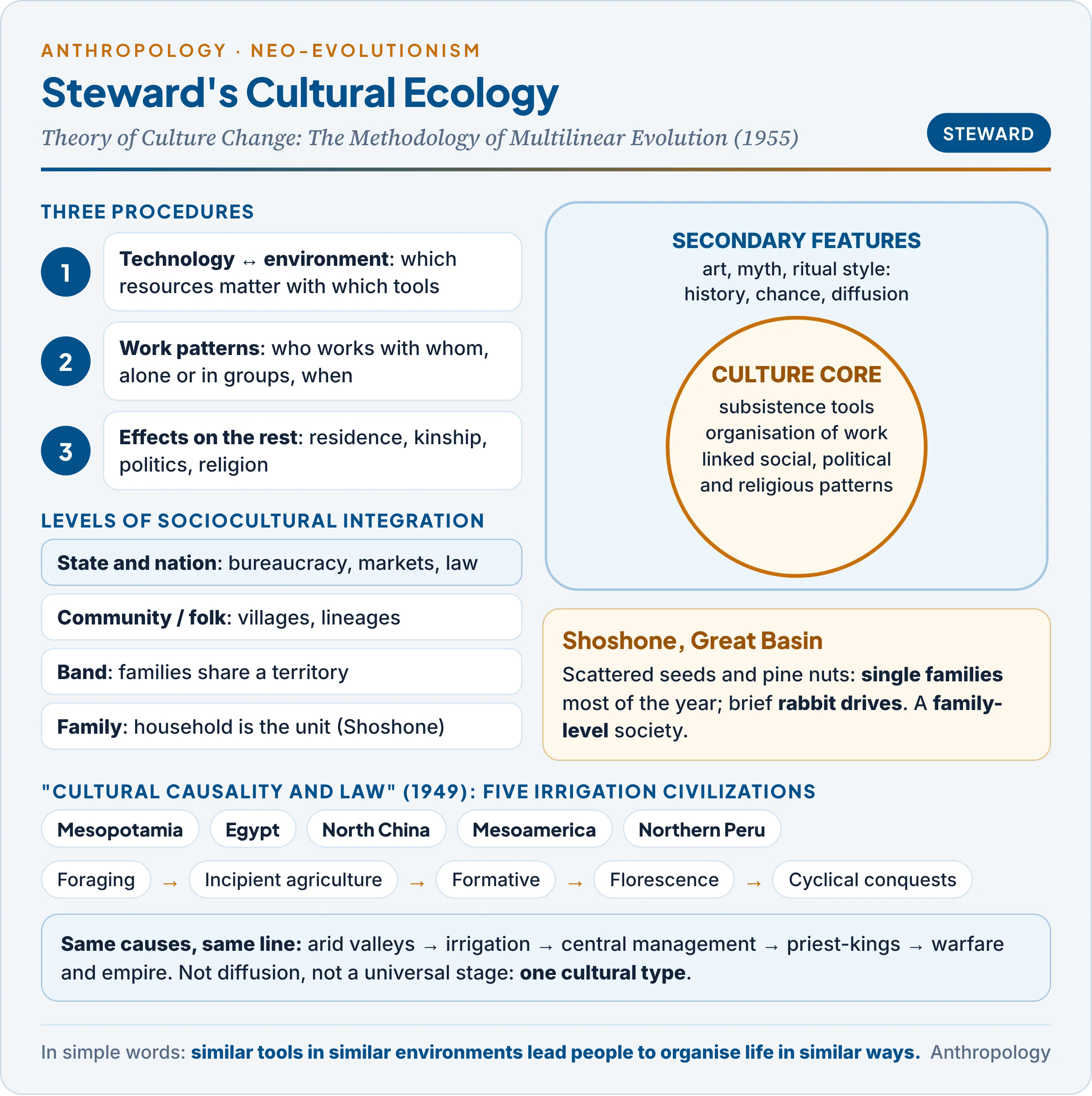
Example first. The Western Shoshone of the Great Basin (Nevada and Utah, USA), whom Steward studied in the 1930s, lived in a dry land where seeds, roots and pine nuts were scattered and unpredictable. Most of the year they lived as single families, moving to wherever food could be found; larger groups would have starved. Families came together only briefly for a communal rabbit or antelope drive, or where a good pine-nut harvest allowed a winter camp. No chiefs, clans or permanent villages developed, because the environment and the gathering technology did not allow large stable groups. Steward concluded that Shoshone society was a family-level adaptation to a harsh desert, and he built his theory from such cases.
4.1 Steward in brief
- Julian Haynes Steward (1902–1972), an American anthropologist trained under Kroeber and Lowie at Berkeley, worked among the Shoshone and Paiute, edited the Handbook of South American Indians (1946–59), and taught at Columbia and Illinois. His students Eric Wolf, Sidney Mintz, Morton Fried and Roy Rappaport carried his ideas into political economy and ecological anthropology.
- Works: “The Economic and Social Basis of Primitive Bands” (1936); Basin-Plateau Aboriginal Sociopolitical Groups (1938); “Cultural Causality and Law” (1949); Theory of Culture Change: The Methodology of Multilinear Evolution (1955).
4.2 Multilinear evolution
- Definition. Multilinear evolution is “a methodology based on the assumption that significant regularities in cultural change occur”, and it is concerned with limited parallels of form, function and sequence that have empirical validity.
- Not unilinear, not universal. Steward rejected one ladder for all societies (Morgan) and also stages so broad that they say nothing particular (White, Childe). He looked for several lines, each followed by societies sharing a type of environment and technology.
- Twin concepts: parallelism and causality. When unrelated cultures develop the same features in the same order, that parallel must have the same cause, and the cause must be found in the evidence. In Steward’s view, what is lost in universality is gained in concreteness and specificity.
- Empirical, not deductive. Multilinear evolution starts from cases and builds a cross-cultural type (a group of cultures with the same core and sequence) before generalising.
4.3 Cultural ecology
Cultural ecology is Steward’s method for multilinear evolution: the study of how a society adapts to its environment through its technology, and what that adaptation demands of social life. It rejects environmental determinism (land and climate directly shape culture), which ignores technology, and possibilism (environment only limits; culture chooses), which explains nothing. A particular technology in a particular environment requires particular kinds of work, and these shape other parts of culture. Steward set out three procedures:
- Analyse the interrelationship of productive technology and environment (which resources matter depends on the tools).
- Analyse the behaviour patterns involved in exploiting a particular area with a particular technology (who works with whom, alone or in groups, and when).
- Find out how far those behaviour patterns affect other aspects of culture, such as residence, kinship, politics and religion. Steward stressed that this is always an empirical question.
How the procedures work. Where the main game moves in large herds (caribou, bison), cooperative hunting pays, and large multifamily groups form, as among the Algonkian and Athabaskan hunters of Canada. Where game is scattered and non-migratory, small groups of men who know their territory hunt better, and patrilineal bands form, as among the San (Bushmen), the Congo forest peoples and the Australian Aborigines. The tools are similar; the pattern of the resource makes the difference.
4.4 Culture core and secondary features
Not every part of a culture is equally tied to the environment. Steward divided culture into two parts.
- Culture core: “the constellation of features which are most closely related to subsistence activities and economic arrangements. The core includes such social, political, and religious patterns as are empirically determined to be closely connected with these arrangements.”
- Secondary features: everything else (art styles, myths, many rituals), shaped more by “purely cultural-historical factors”, by chance innovation or by diffusion. They give cultures with similar cores their outward distinctiveness.
The distinction explains why cultures can be alike underneath and different on the surface. Two irrigation civilizations may share the core of canals, a managing bureaucracy and a divine king, yet one builds pyramids and the other ziggurats.
Common confusion
Is cultural ecology the same as environmental determinism? No. Environmental determinism says the environment directly causes culture (hot climates make people lazy, and so on). Cultural ecology says the environment matters only through a particular technology and the work it requires: a river valley offers little to foragers but everything to farmers with irrigation. Steward also limited the environment’s influence to the culture core; secondary features vary freely.
4.5 Levels of sociocultural integration
To compare like with like, Steward (1951, 1955) proposed levels of sociocultural integration, each a new kind of organisation rather than merely more people: the family level (the household as the unit of production, as among the Shoshone), the band or multifamily level (families cooperating on a territory), the community or folk level (villages and lineages bound by custom), and the state and national level (bureaucracy, markets and law integrating many communities). Higher levels contain the lower ones (the family survives inside the state) but add new institutions, so a family-level society should be compared with another family-level society, not with a state.
4.6 The irrigation civilizations
In “Cultural Causality and Law” (1949) Steward compared five historically unconnected early civilizations: Mesopotamia, Egypt, North China, Mesoamerica and northern Peru (the Andes).
- A common setting. Each arose in arid or semi-arid river valleys where farming depended on irrigation and flood water.
- A common sequence of eras: hunting and gathering; incipient agriculture; the Formative (villages, pottery, weaving, small irrigation); regional development and florescence (states, temples, priest-rulers, great art); and cyclical conquests (militaristic empires that rose and fell).
- The causal chain. Farming raised population; in a dry valley more land meant more irrigation; large canals needed centralised management; managers became a priestly or royal bureaucracy; competition for land and water led to warfare and empire.
- The conclusion. The parallels came neither from diffusion nor from a universal stage, but from similar causes: similar technology in similar environments. The five form one cultural type and one line of evolution.
The chain drew on Karl Wittfogel‘s “hydraulic hypothesis” (Oriental Despotism, 1957), that large-scale irrigation produces despotic states. Robert McC. Adams (1966) found that in Mesopotamia the state came before the great canals, which weakens the chain, but Steward’s comparative method became a model for the archaeology of early states.
4.7 Critique of Steward
- How many lines? Steward never said; critics asked “how multi is multilinear?”
- A vague core. What is “closely connected” to subsistence is decided case by case, so the core can include almost anything; critics also saw it as a weaker Marxist base.
- History confused with evolution (White): comparing particular sequences is history, not the evolution of culture.
- Religion can be core. Roy Rappaport (Pigs for the Ancestors, 1968) showed that among the Tsembaga Maring of New Guinea a ritual cycle regulated pig numbers, warfare and land use.
- Too eclectic. Marvin Harris praised Steward for showing that similar techno-environmental conditions regularly cause similar effects, but faulted him for treating causation case by case (Unit 6i).
4.8 Cultural ecology and India
- Nature-man-spirit complex. L.P. Vidyarthi, the Indian anthropologist of the Maler (Sauria Paharia) of the Rajmahal hills (Jharkhand), described forest, shifting cultivation, settlement and the spirit world as one ecological and moral system (1963).
- Caste as ecological niche. The ecologist Madhav Gadgil and the anthropologist K.C. Malhotra (1983) compared resource-dependent castes to species in separate niches: castes of one region divided fishing, grazing, hunting and basketry so as to avoid competition, favouring sustainable use. Their cases included the pastoral Gavli Dhangars and nomadic Nandiwallas of Maharashtra.
5. Sahlins and Service: General and Specific Evolution
In simple words
Sahlins and Service said that evolution moves in two ways at once. In one sense it produces higher levels of organisation, from bands to states; in another, it produces many different cultures, each fitted to its own environment. A society can be simple in the first sense and very well adapted in the second.
5.1 Evolution and Culture (1960)
White’s universal evolution seemed to ignore particular cultures; Steward’s multilinear evolution seemed to give up general laws. Two of White’s Michigan students, Marshall Sahlins (1930–2021) and Elman Rogers Service (1915–1996), edited Evolution and Culture (1960, with Thomas Harding and David Kaplan) to show that both were right about different things. In biology, evolution produces both species fitted to niches (adaptive radiation) and, over the history of life, higher forms; culture likewise evolves in two directions at once, creating diversity through adaptation and progress as higher forms surpass lower ones.
5.2 General and specific evolution
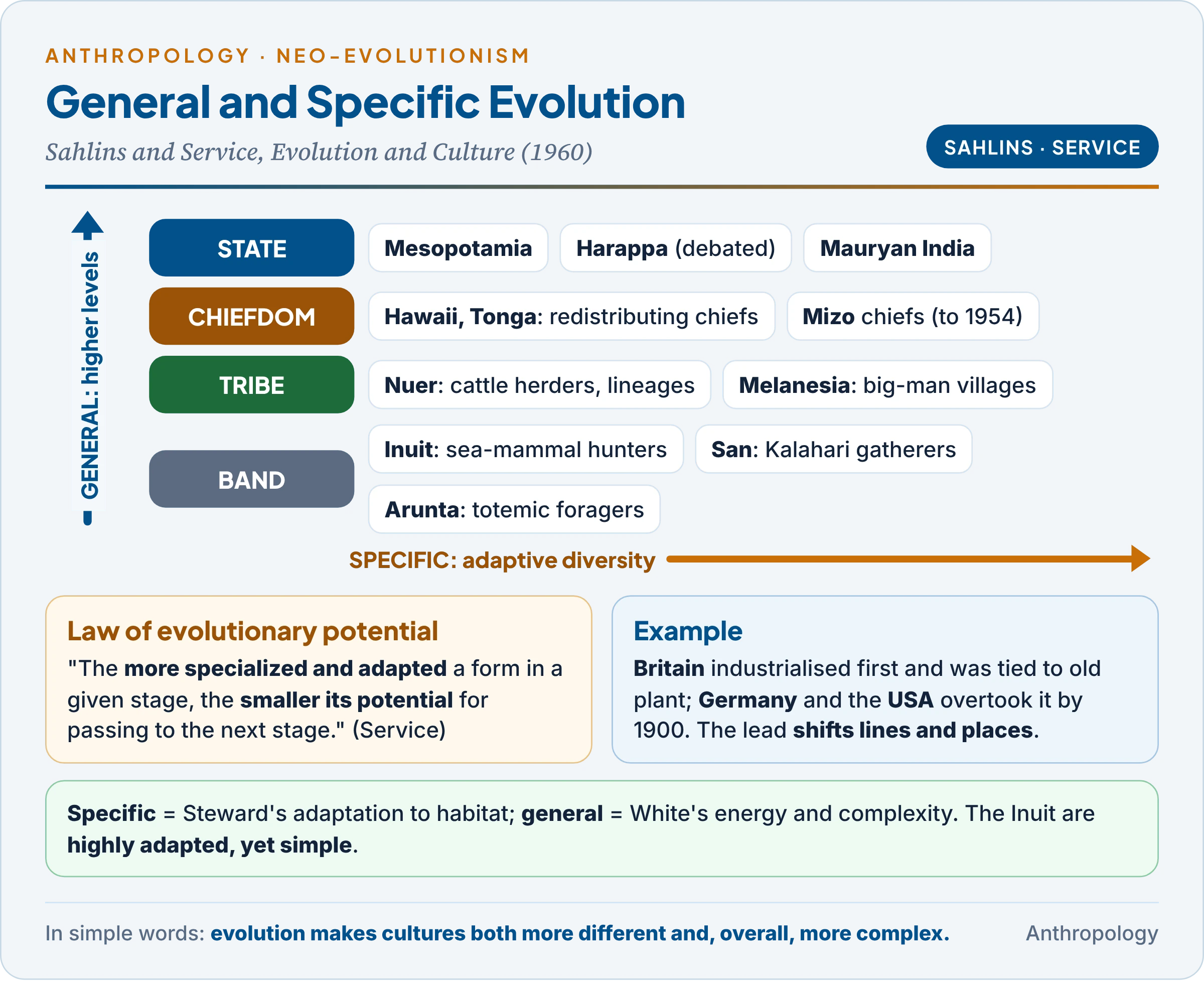
The table sets the two side by side; they answer different questions, so they do not contradict each other.
| Basis | Specific evolution | General evolution |
|---|---|---|
| Meaning | Adaptive diversification: particular cultures adjusting to particular environments | Progress: the emergence of higher levels of all-round development |
| Unit | A particular culture and its line of descent | Culture as a whole, taken out of its historical setting |
| Measured by | Adaptive efficiency in a given habitat | Energy captured, organisational complexity, all-round adaptability |
| Biological analogue | Adaptive radiation into niches | Succession of higher forms of life |
| Earlier champion | Steward (multilinear) | White and Childe (universal) |
The distinction removes the quarrel: Steward studied specific evolution and White general evolution, and the two need not run together. The Inuit (Eskimo), with snow houses, kayaks and seal-hunting skills, are a superb specific adaptation, yet at the general level they remain a low-energy hunting society: a culture can be highly adapted and still simple. Foragers also show specific diversity at one general level: the Inuit hunt sea mammals, the San of the Kalahari gather nuts and store water in ostrich eggshells, the Arunta of central Australia forage with an elaborate totemic religion.
5.3 The law of evolutionary potential
From this framework Service drew the law of evolutionary potential (in Evolution and Culture): “The more specialized and adapted a form in a given evolutionary stage, the smaller is its potential for passing to the next stage.“
How the law works. A society well adapted to one way of life has invested its tools, skills, institutions and interests in it. When a more productive way appears, it has the most to lose and the least room to change, while a less specialised neighbour can adopt the new way without that burden. So the leader of one stage is rarely the leader of the next.
- Discontinuity of progress. The next advance usually comes from a different line (phylogenetic discontinuity) and in a different place (local discontinuity): civilization moved from Mesopotamia and Egypt to Greece and Rome, and later to north-western Europe.
- The industrial example. Britain, the first industrial nation, was tied to early factories and railways; Germany and the USA industrialised later with newer technology and overtook it by 1900. Service argued that developing nations might likewise leap past older industrial ones, a “privilege of backwardness” noted earlier by Veblen and Trotsky.
- The law of cultural dominance. David Kaplan‘s companion principle: the system that exploits a region’s energy most effectively tends to spread there at the expense of others, as expanding farmers displaced foragers.
Common confusion
Is “general evolution” just the old unilinear evolution? No. Unilinear evolution claimed that each society must pass through every stage. General evolution makes no claim about any particular society: it describes the levels that human culture as a whole has reached. A society may skip stages by borrowing (most of the world received farming and industry from elsewhere), or may stay at one level while becoming highly specialised. Specific evolution, not general evolution, describes what happens to particular societies.
5.4 Band, tribe, chiefdom and state
Service‘s typology in Primitive Social Organization (1962; refined in Origins of the State and Civilization, 1975) classifies societies by level of political integration. The details belong to Unit 4a; the table summarises them.
| Type | Integration | Economy | Example |
|---|---|---|---|
| Band | A few dozen people; kinship; informal, temporary leaders | Foraging, sharing | San, Inuit; in India the Cholanaikan and Birhor |
| Tribe | Villages linked by clans, lineages or age-sets; no central authority | Horticulture, pastoralism | Nuer; many north-east Indian hill communities |
| Chiefdom | A permanent, hereditary chief who redistributes goods; ranked lineages | Productive farming; redistribution | Polynesian chiefdoms (Hawaii, Tonga); Mizo chiefs before 1954 |
| State | Centralised government with a monopoly of legitimate force, taxation, law and classes | Intensive agriculture; markets | Early Mesopotamia, Harappa (debated), Mauryan India |
The main contrast is between kinship-based societies and the state, based on territory and coercion. Service saw the chiefdom’s redistribution as the bridge, and held an integrative (managerial) theory of the state’s origin, against Morton Fried‘s conflict theory and typology of egalitarian, rank, stratified and state societies (1967).
5.5 Sahlins: adaptation and its limits
- Social Stratification in Polynesia (1958): the degree of stratification varied with productivity. Rich volcanic islands such as Hawaii and Tonga had paramount chiefs and classes; poor atolls had little rank. Inequality was a specific adaptation.
- “Poor Man, Rich Man, Big-Man, Chief” (1963) contrasted the Melanesian big man with the Polynesian chief (Unit 4a).
- The later turn. Stone Age Economics (1972) called foragers “the original affluent society“, meeting limited wants with little work; Culture and Practical Reason (1976) rejected materialism, arguing that culture is a symbolic order that defines what counts as useful (Unit 6i).
6. Classical Evolutionism and Neo-Evolutionism Compared
In simple words
Both schools believed that societies change in a direction, from simple to complex. The old school explained this by the progress of the human mind and used travellers’ reports; the new school explained it by food, energy, technology and environment, and used excavation and fieldwork.
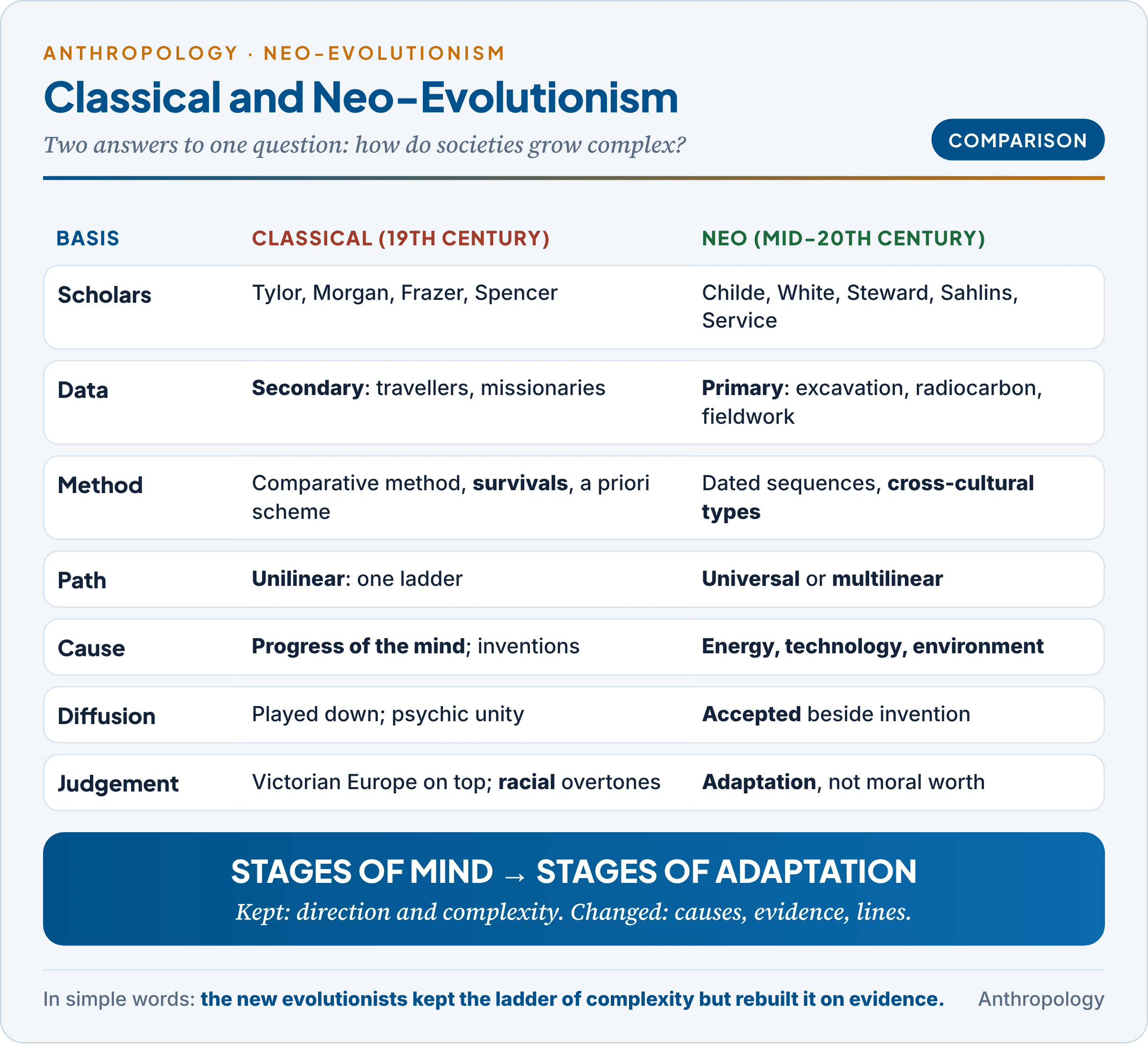
The table compares the two schools point by point; the most important rows are the cause of change and the kind of evidence.
| Basis | Classical evolutionism (19th century) | Neo-evolutionism (mid-20th century) |
|---|---|---|
| Scholars | Tylor, Morgan, Frazer, Spencer | Childe, White, Steward, Sahlins, Service |
| Data | Secondary: missionaries’, travellers’ and officials’ reports | Primary: excavation, radiocarbon dates, fieldwork |
| Method | Comparative method with survivals; an a priori scheme filled with examples | Archaeological sequences, cross-cultural types, measurement |
| Path | Unilinear: every society on one ladder | Universal (culture as a whole) or multilinear (limited parallels) |
| Cause of change | Progress of the mind (Tylor, Frazer); inventions and property (Morgan) | Material causes: energy, technology, subsistence, environment, population |
| Role of diffusion | Played down; independent invention through psychic unity | Accepted alongside invention (Childe, Sahlins and Service) |
| Value judgement | Victorian Europe at the top; racial overtones | Adaptation, not moral worth; no racial ranking |
| Typical stages | Savagery, barbarism, civilization by mental and moral traits | Savagery, barbarism, civilization by economy; band, tribe, chiefdom, state |
The deepest change is from stages of mind to stages of adaptation: complexity is explained by measurable causes and dated evidence, and different environments produce different lines. One weakness survived: ranking societies on a single scale of complexity.
7. Critique and Legacy
In simple words
Critics said that neo-evolutionism gave too much weight to technology and energy, too little to ideas, choices and history, and that it still ranked societies as higher and lower. Yet its questions about how farming, cities and states arose still drive archaeology and ecological anthropology.
7.1 Criticisms
- Material determinism. Technology, energy or environment is assumed to be the prime cause; religion, politics and ideas appear only as effects, though Rappaport’s Tsembaga ritual and Weber’s Protestant ethic show causes running the other way.
- Progress bias. Ranking by energy or complexity still puts industrial societies at the top, which foragers’ “affluence” and modern ecological crises call into question.
- History and agency left out. The schemes explain types, not events, and treat people as carriers of culture rather than actors.
- Societies treated as isolated. Steward’s student Eric Wolf (Europe and the People Without History, 1982) showed that many “tribes” and “chiefdoms” were shaped by colonial trade and conquest; Fried argued that the “tribe” is often a product of contact with states.
- Typologies become ladders. David Graeber and David Wengrow (The Dawn of Everything, 2021) argue that early peoples switched between egalitarian and hierarchical forms, sometimes by season, and that some early cities, including Teotihuacan and the Harappan cities, show little sign of rulers.
7.2 Legacy
- New (processual) archaeology. Lewis Binford, influenced by White, treated culture as “man’s extrasomatic means of adaptation” and archaeology as the testing of hypotheses about adaptation.
- Ecological anthropology and cultural materialism. Steward’s method led to the ecosystem studies of Rappaport and Andrew Vayda (Unit 9.7), and Marvin Harris fused White’s priority of technology, Steward’s ecology and Marx’s base and superstructure into cultural materialism (Unit 6i).
- Political economy. Steward’s students Wolf and Mintz (Sweetness and Power, 1985) turned the study of adaptation into the study of capitalism, colonialism and the peasant.
- Theories of the state. Robert Carneiro‘s circumscription theory (1970), that states arose where farmland was hemmed in by mountains, desert or sea so the defeated could not flee, continues Steward’s search for causes.
Key Concepts
| Concept | Meaning in neo-evolutionism |
|---|---|
| Neolithic Revolution | Childe: shift to food production, surplus and settled villages |
| Urban Revolution | Childe: shift to cities, specialists, writing and the state |
| Culturology | White: the science of culture as a reality of its own kind |
| Energy law (C = E × T) | Culture advances with energy per head and tool efficiency |
| Multilinear evolution | Steward: limited parallels in similar environments |
| Cultural ecology | Steward: adaptation to environment through technology and work |
| Culture core | Features most closely tied to subsistence and economy |
| Specific evolution | Adaptive diversification of particular cultures |
| General evolution | Emergence of higher levels of all-round development |
| Law of evolutionary potential | The more specialised a form, the less able to advance to the next stage |
Major Works
| Work | Author | Year | Significance |
|---|---|---|---|
| Man Makes Himself | Childe | 1936 | Neolithic and Urban Revolutions |
| “The Urban Revolution” | Childe | 1950 | Ten criteria of civilization |
| “Energy and the Evolution of Culture” | White | 1943 | Energy law |
| The Science of Culture | White | 1949 | Culturology, the symbol |
| The Evolution of Culture | White | 1959 | Energy stages to the fall of Rome |
| “Cultural Causality and Law” | Steward | 1949 | Five irrigation civilizations |
| Theory of Culture Change | Steward | 1955 | Multilinear evolution, cultural ecology |
| Evolution and Culture | Sahlins and Service (eds) | 1960 | General and specific evolution |
| Primitive Social Organization | Service | 1962 | Band, tribe, chiefdom, state |
Key Terms
| Term | Meaning in simple words |
|---|---|
| Neo-evolutionism | The twentieth-century revival of evolution, explained by material causes |
| Multilinear | Several lines of change, each tied to a type of environment |
| Surplus | Food or goods beyond what producers need to live |
| Isosequential | Appearing in the same order everywhere, though not at the same time |
| Extrasomatic | Outside the body; passed on by learning, not genes |
| Culturology | White’s name for the science of culture |
| Possibilism | The view that environment only limits what culture chooses |
| Culture core | The parts of culture tied most closely to getting a living |
| Cultural type | A group of cultures with the same core and sequence |
| Circumscription | Farmland hemmed in by barriers that prevent escape |
Contemporary Developments
- Göbekli Tepe (south-eastern Turkey; UNESCO World Heritage Site, 2018): monumental stone enclosures of about 9600–8200 BCE, raised by people who did not yet farm fully, reverse Childe’s order of farming first and monuments later.
- Seshat: Global History Databank. Peter Turchin and colleagues (PNAS, 2018) coded hundreds of past polities and found that their features of complexity vary together along a single main dimension, a quantitative test of the neo-evolutionist idea of levels.
- Energy and history. The historian Ian Morris‘s social development index (Why the West Rules, for Now, 2010; The Measure of Civilization, 2013) makes energy capture per person its main measure, a modern restatement of White’s law.
- Rakhigarhi (Haryana). Ancient DNA (Shinde and colleagues, Cell, 2019) showed a Harappan with no steppe ancestry and Iranian-related ancestry that split off before farming, supporting a largely local development of South Asian farming.
- Keeladi (Sivaganga, Tamil Nadu). The state archaeology department’s 2019 report dated a brick-built urban settlement to about the 6th century BCE, extending the Second Urbanisation beyond the Ganga valley.
Diagrams to Master
- Topic map of the article.
- Childe’s two revolutions (§2): Neolithic (surplus, villages, population) and Urban (ten criteria in five groups); the three archaeological stages.
- White’s energy law (§3): three layers with arrows upward; C = E × T with the hoe and plough example; energy stages.
- Steward’s cultural ecology (§4): three procedures; core and secondary features; the five irrigation civilizations.
- General and specific evolution (§5): a branching tree with levels; law of evolutionary potential; band, tribe, chiefdom, state.
- Classical versus neo-evolutionism (§6): data, method, path, cause, diffusion.
Revision Grid
| Scholar | Work (year) | Key idea |
|---|---|---|
| V. Gordon Childe | Man Makes Himself (1936) | Neolithic and Urban Revolutions |
| Leslie White | “Energy and the Evolution of Culture” (1943) | C = E × T |
| Julian Steward | “Cultural Causality and Law” (1949) | Five irrigation civilizations |
| Steward | Theory of Culture Change (1955) | Multilinear evolution; culture core |
| Sahlins and Service | Evolution and Culture (1960) | General and specific evolution |
| Elman Service | Evolution and Culture (1960) | Law of evolutionary potential |
| Service | Primitive Social Organization (1962) | Band, tribe, chiefdom, state |
| L.P. Vidyarthi | The Maler (1963) | Nature-man-spirit complex |
| Gadgil and Malhotra | “Adaptive significance of the Indian caste system” (1983) | Castes as ecological niches |
Previous Year Questions
Unit 6: Neo-evolutionism (Childe, White, Steward, Sahlins and Service)
- 2026Critically discuss how culture determines human behaviour in the light of Leslie White’s theory.
- 2022Discuss the approaches of Leslie White, Julian Steward and Marshall Sahlins in the light of cultural evolution.
- 2018Write a note in 150 words on Gordon Childe’s Theory of Cultural Evolution.
- 2017Critically examine the Stewardian view of neo-evolutionism.
- 2010Point out the differences in the concepts of classical evolutionism and neo- evolutionism in socio-cultural anthropology. Which stage of prehistoric culture is known as cultural revolution and why ?
- 2009Explain the theory of Neo-evolutionism’
- 2002Discuss the contribution of Julian Steward of Cultural Ecology.
- 2000What do you understand by neoevolutionism ? Evaluate how Leslie A. White’s approach is helpful in understanding cultural evolution.
- 1998What do you mean by cultural ecology ? Evaluate how Julian Steward’s particularistic approach is helpful in understanding multilineal evolution.
- 1997Write a note on Neo-evolutionism.
- 1993How do the approach of the 19th Century Evolutionists differ from those of the Neo-Evolutionists ? Discuss.
- 1989Write an essay on neo-evolutionism and cultural ecology.
Related questions from other units
- 2025Unit 1.8: What are the major theories proposed in support of the origin of food production? How the change in subsistence economy brought revolution during this period?
- 2018Unit 1.8: Give an account of the consequences of food production of Neolithic culture.
- 2017Unit 4: Mention the characteristic features of band with suitable examples.
- 2014Unit 9.7: Write a note in 150 words on Ecological Anthropology.
- 2012Unit 4: Write a note in 150 words on Band and Tribal societies.
- 2009Unit 4: Write a note on Chiefdom in tribal society.
- 2002Unit 1.8: Write a note on Universal Cultural Evolution.
- 1995Unit 1.8: What is the neolithic phase of culture in Europe called revolution ? Describe its distinctive features.
- 1995Unit 9.7: What is cultural ecology ? Discuss how man adapts himself to different environments, giving suitable examples.
- 1991Unit 1.4: Write a note on Social-cultural evolution.