

5 Religion: Anthropological approaches to the study of religion (evolutionary, psychological and functional); monotheism and polytheism; sacred and profane; myths and rituals; forms of religion in tribal and peasant societies (animism, animatism, fetishism, naturism and totemism); religion, magic and science distinguished; magico-religious functionaries (priest, shaman, medicine man, sorcerer and witch).
Official Syllabus: Paper I, Unit 5 (forms of religion, magic and functionaries)
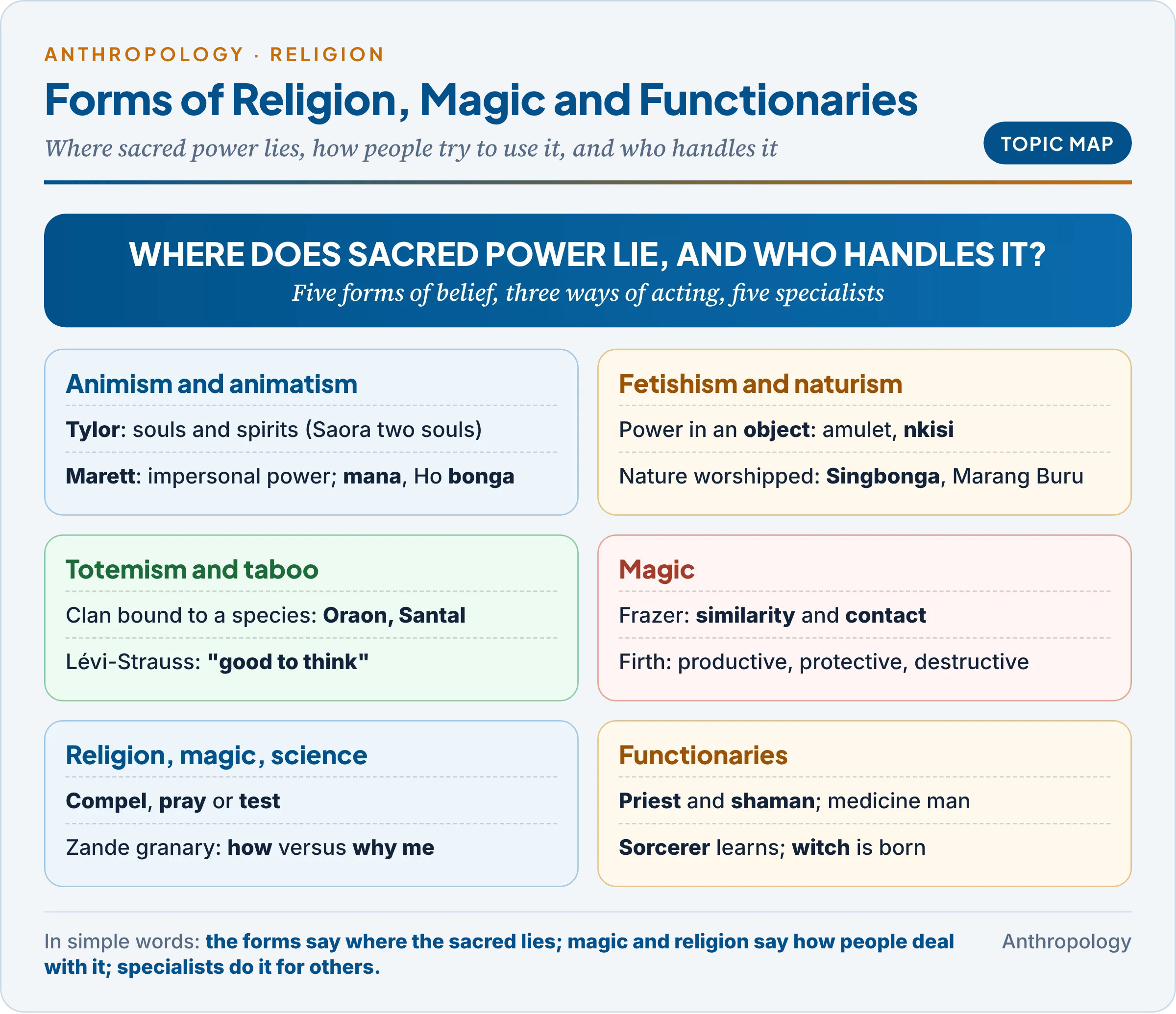
This article covers the last three items of the syllabus line: the forms of religion in tribal and peasant societies, religion, magic and science distinguished, and the magico-religious functionaries. The approaches, monotheism and polytheism, sacred and profane, and myths and rituals are in Unit 5a.
1. Forms of Religion: An Overview
In simple words
Tribal and village religions mix several ideas at once: that things have souls, that a hidden power flows through objects, that some objects hold special force, that nature is divine, and that a clan is bound to an animal or plant. Anthropologists named each idea so that it can be studied and compared.
Example first. In a Munda village of Jharkhand, the supreme god Singbonga is linked with the sun. The village gods (hatu bongako) live in the sarna, the sacred grove, where the village priest (pahan) sacrifices to them. Ancestral spirits (ora bongako) are fed inside each house. Spirits of people who died a violent death are feared and calmed by specialists. Every Munda belongs to an exogamous clan (killi) named after an animal, plant or object. One village thus holds every “form” of religion at once.
The table sets out the five forms named in the syllabus. Read each row as a different answer to the question “where does sacred power lie?”.
| Form | Core belief | Key scholar | World example | Indian example |
|---|---|---|---|---|
| Animism | Souls and spirits animate people, animals and things | Tylor (1871) | Nayaka devaru | Saora souls and shades |
| Animatism | An impersonal power pervades things | Marett (1900) | Melanesian mana | Ho bonga (Majumdar) |
| Fetishism | Power lodged in a particular object | de Brosses (1760), Comte | Kongo nkisi | Amulets, vermilion-smeared stones |
| Naturism | Forces of nature worshipped | Max Müller, Réville | Vedic Surya, Indra | Singbonga, Marang Buru |
| Totemism | A clan mystically linked to a species | McLennan, Durkheim, Lévi-Strauss | Australian clans | Oraon, Santal, Birhor clans |
The forms differ in where the sacred is placed: inside things as souls, spread through them as force, packed into one object, in nature as a whole, or in a group’s bond with nature. They are analytical lenses, not separate religions: real religions combine them, as the Munda case shows.
Common confusion
Are animism, animatism, fetishism, naturism and totemism stages of evolution? No. Nineteenth-century scholars ranked them as stages: Tylor put animism first, Marett put animatism before it, Comte began with fetishism. Fieldwork showed that they coexist in one society and even one ritual, and that “simple” societies also believe in high gods (Unit 5a §2). Today they are types of belief, not rungs on a ladder.
2. Animism
In simple words
Animism is the belief that people, animals, plants and even objects have souls or spirits. These spirits can leave the body in dreams, survive death and act in the world, so people try to keep good relations with them.
Example first. The Hill Saora of Odisha, studied by the British-born Indian ethnographer Verrier Elwin (The Religion of an Indian Tribe, 1955), say every person has two souls: a “little soul” that gives life and ends at death, and a “big soul” that wanders in dreams and after death becomes a shade (kulban), later an ancestor. Illness is often read as a dead relative acting on the patient, and the living talk with the dead through a shaman (§9).
- Tylor’s theory. E.B. Tylor, the British founder of academic anthropology, defined animism in Primitive Culture (1871) as “the belief in Spiritual Beings”, the “minimum definition of religion”. Early people, reasoning about dreams, trance and death, inferred a soul; souls of the dead became spirits, and spirits grew into gods (the full scheme is in Unit 5a §2).
- It has two branches: souls of individual creatures, and independent spirits that rule nature.
- Indian cases. Among the Munda and Ho, spirits of those who died by snakebite, drowning, childbirth or violence (such as the churin, a woman who died in childbirth) are restless and dangerous: the manner of death, not the person’s character, makes them harmful.
- Criticism. R.R. Marett, Tylor’s Oxford successor, held that religion was felt before it was reasoned (§3). The American R.H. Lowie argued that belief in spirits and worship of them overlap but are not identical. Tylor’s “savage philosopher” was an armchair construct: no one could observe how the first beliefs arose.
2.1 The “new animism” and deep ecology
Later anthropologists stopped asking “why did people wrongly see souls in things?” and asked “what relationship with the world does animism express?“.
- Nurit Bird-David, an Israeli anthropologist (“‘Animism’ Revisited”, 1999), studied the Nayaka, forest foragers of the Nilgiri region of South India. They treat certain hills, elephants and stones as devaru (super-persons) with whom they share and converse. She called this a relational epistemology: knowing the world by relating to it as a fellow person, as one knows a relative, not by standing apart from it. Animism is then a way of knowing, not a failed science.
- Deep ecology, the philosophy of the Norwegian Arne Naess (1973), holds that nature has value in itself, not only as a resource. Animism gives it an ethnographic base: if a hill is a person, mining it injures a relative.
- The Dongria Kondh of the Niyamgiri hills (Odisha) worship Niyam Raja, lord of the hills. In Orissa Mining Corporation v. Ministry of Environment and Forests (18 April 2013), the Supreme Court left it to the gram sabhas to decide whether bauxite mining would harm their religious and cultural rights; all twelve gram sabhas consulted rejected it.
- Sacred groves (sarna, devrai, kavu, oran) protect forest patches through religious taboo.
3. Animatism
In simple words
Animatism is the belief in a hidden power that is not a soul or a person. It flows through people, animals and things and explains why some succeed and others fail. People try to gain it, use it, or keep away from it when it is dangerous.
Example first. Among the Ho of Singhbhum (Jharkhand), the Indian anthropologist D.N. Majumdar found that bonga often meant not a particular spirit but a vague, impersonal power behind rain, storms, epidemics and wild animals. Anything new or startling could be bonga, and people differed in standing according to how much bonga they held. Majumdar called this Bongaism, an Indian parallel to mana.
- Mana. The English missionary R.H. Codrington (The Melanesians, 1891) described mana as a non-physical power shown in success: a chief’s victories, a canoe’s speed, a garden’s yield. It can be gained, transferred and lost.
- Marett. In “Pre-Animistic Religion” (1900), Marett argued that awe before such power, which he called animatism or pre-animism, came before belief in souls.
- Parallels. Orenda of the Iroquois (J.N.B. Hewitt, 1902), wakan of the Lakota and manitou of the Algonquian peoples.
- Mana and taboo. Marett treated taboo as the negative side of mana: what is full of power is dangerous to touch (§6.4).
- Criticism. Raymond Firth, the New Zealand anthropologist (“The Analysis of Mana”, 1940), found that in Tikopia mana meant efficacy granted by gods and ancestors, not a free-floating force. Roger Keesing (“Rethinking Mana“, 1984) showed that mana often works as a verb (“to be effective”); the cosmic “substance” was partly a scholars’ invention.
The table sets out the most-asked contrast. The difference lies in whether the supernatural is personal or impersonal.
| Basis | Animism | Animatism |
|---|---|---|
| Supernatural | Personal souls and spirits, with will | Impersonal power, without will or shape |
| Proponent | Tylor, Primitive Culture (1871) | Marett, “Pre-Animistic Religion” (1900) |
| Origin of belief | Reasoning about dreams and death | Emotion of awe before the uncanny |
| Typical practice | Prayer, offering, sacrifice | Acquiring, using or avoiding power; taboo |
| Example | Saora souls and shades | Melanesian mana; Ho bonga as power |
The two often sit together. Among the Ho, bonga names both personal deities (Singbonga, Marang Buru) and an impersonal power, so the two “forms” are poles of one belief system, not separate religions.
4. Fetishism
In simple words
A fetish is a made or chosen object believed to hold power: a charm, an amulet or a carved figure. People keep it because they believe the power inside protects them or harms enemies.
- The word. Portuguese traders on the West African coast called local ritual objects feitiço (“made thing”, charm). The French scholar Charles de Brosses (Du culte des dieux fétiches, 1760) coined “fetishism”, comparing West African cults with ancient Egyptian religion.
- As a stage. Auguste Comte, the French founder of sociology, made fetishism the first sub-stage of theological thought, before polytheism and monotheism. Tylor treated it as a branch of animism: a spirit embodied in an object.
- Cases. The nkisi figures of the Kongo peoples hold medicines and are activated by a specialist; nails driven into an nkisi nkondi bind an oath. In India: amulets (tabij) and threads tied by a medicine man against the evil eye, and uncarved stones smeared with vermilion that stand for a village deity.
- The test is efficacy. A fetish is kept while it “works” and discarded when it fails, which brings fetishism close to magic (§7).
- Criticism. The term began as a European label implying that Africans worshipped mere things; scholars now speak of power objects.
5. Naturism
In simple words
Naturism is the worship of nature itself: sun, sky, earth, rivers, hills and storms. People who depend on rain and harvest come to see these forces as living powers to be honoured.
Example first. At Sarhul, the Oraon and Munda honour the sal tree in flower; the Santal worship Marang Buru (“great mountain”); among the Munda, Singbonga is linked with the sun, Ikir Bonga rules deep waters and Buru Bonga the hills.
- Max Müller, the German-born Oxford Sanskritist, found the origin of religion in awe before nature, preserved in the Vedic hymns to Surya, Agni and Indra (his “disease of language” theory is in Unit 5a §2). Albert Réville, a French historian of religion, proposed the term naturism.
- L.P. Vidyarthi, the Indian anthropologist (The Maler, 1963), described a nature-man-spirit complex among the Maler of the Rajmahal hills: forest, people and spirits form one interdependent system (Unit 5a).
- Criticism. Émile Durkheim, the French sociologist, objected that nature’s regular round is familiar, not awe-inspiring, so it cannot be the first source of the sacred (Unit 5a §4).
- Ecological reading. Nature worship often encodes resource rules: sacred groves, springs and hilltops are also water and forest reserves (§2.1).
6. Totemism
In simple words
Totemism links a clan to an animal, plant or object, its totem. Members treat the totem as a relative or emblem, will not kill or eat it, and usually may not marry someone of the same totem. It is both a religious idea and a way of organising society.
Example first. Among the Oraon of Chotanagpur, studied by the Indian pioneer S.C. Roy (The Oraons of Chota Nagpur, 1915), clans carry totemic names: Ekka (tortoise), Lakra (tiger), Tigga (monkey), Minj (a fish), Kujur (a creeper), Toppo (a bird) and Tirkey (mice). A member must not kill, eat or harm the totem, and two people of the same clan may not marry. Legends explain the bond: an Ekka ancestor spared a tortoise that cried “I am of your own kind”. Roy noted that the Oraon do not claim descent from the totem, use no badges and hold no totem ceremonies, so the social side outweighs the religious.
6.1 Meaning, features and types
- The word. Totem comes from the Ojibwa (Great Lakes) ototeman, “he is a relative of mine”, introduced into English by the trader John Long (1791). The Scottish lawyer-ethnologist J.F. McLennan (“The Worship of Animals and Plants”, 1869–70) made it a theory: all humanity had once passed through a totemic stage.
- Common features (no society has all):
- Clan organisation: unilineal, usually exogamous groups (marrying out of the clan).
- Totemic names and emblems taken from nature.
- A mystical relationship: kinship, descent, protection or shared nature.
- Taboos on killing, eating or touching the totem.
- Occasionally increase rites, such as the Arunta intichiuma (Unit 5a §4.1).
- Types.
- Group totemism: the totem belongs to a clan, moiety or phratry and passes by descent; the commonest type.
- Individual totemism: a personal guardian spirit in animal form, often gained in a vision quest in North America. Among the Wiradjuri of New South Wales, only the medicine man has a personal totem, which guards him in sleep and is “sung into” a novice.
6.2 Theories of totemism
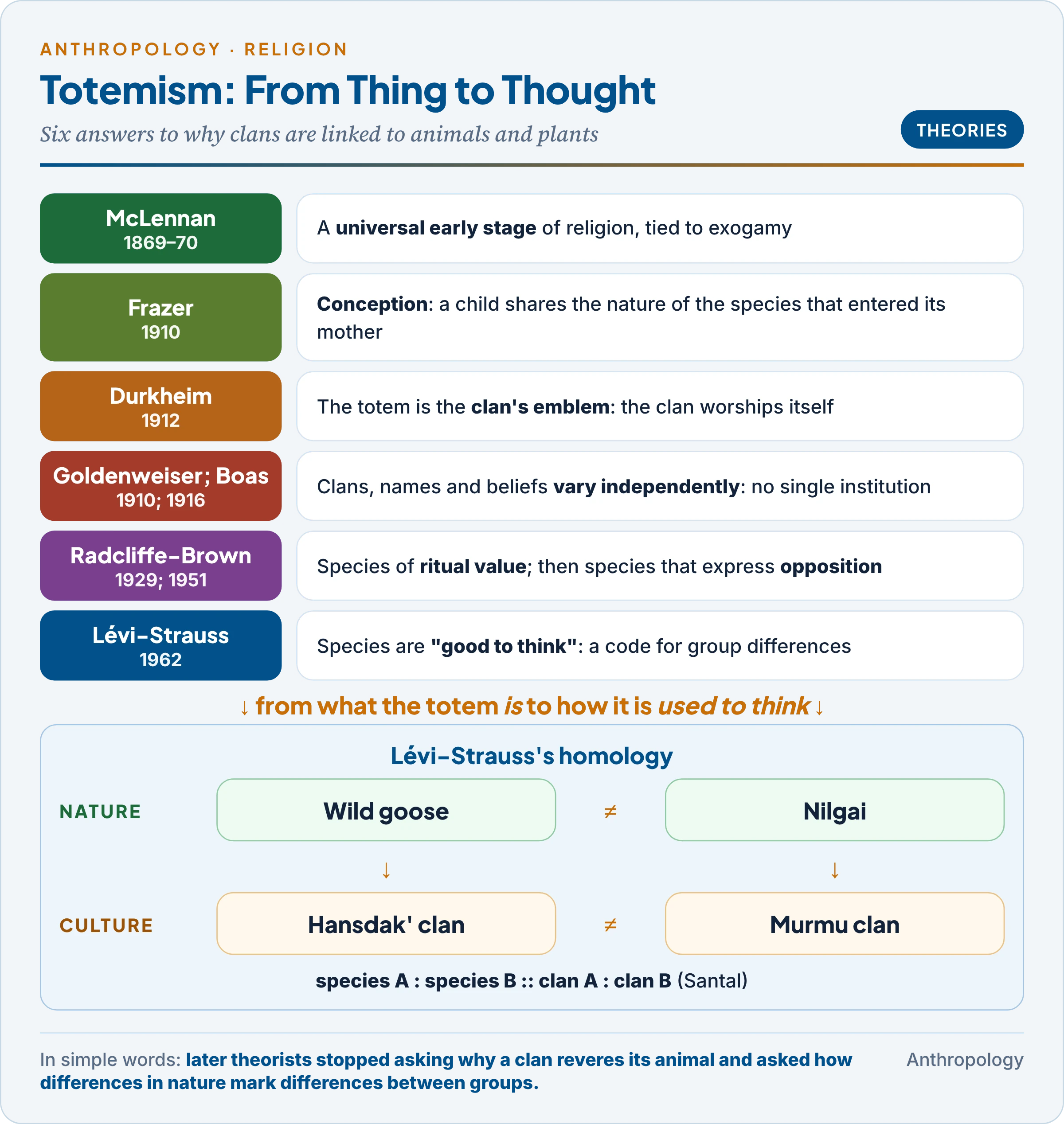
Each theory answered a weakness in the one before. The table gives the main positions; the paragraph after it draws out the turn that matters most.
| Scholar | Work (year) | Explanation |
|---|---|---|
| McLennan | 1869–70 | A universal early stage tied to exogamy |
| Tylor | Critique (1899) | Not animal worship; the mind’s urge to classify |
| Frazer | Totemism and Exogamy (1910) | Successive theories: external soul, co-operative magic for food, finally conceptionalism (conception when an animal or plant spirit enters a woman) |
| Durkheim; Freud | 1912; 1913 | Emblem of the clan: society worships itself; guilt after the primal parricide (Unit 5a §3–4) |
| Goldenweiser | “Totemism, an Analytical Study” (1910) | Clans, nature names and mystical bond vary independently: no single institution |
| Boas | 1916 | No single historical or psychological origin |
| Graebner; Schmidt | 1911–16 | A culture circle (Kulturkreis) spread from one centre by diffusion |
| Malinowski | 1925 | Species important for food and survival draw ritual interest |
| Radcliffe-Brown | 1929; Huxley Lecture (1951) | First, species of ritual value; later, species chosen to express opposition and alliance of groups (eaglehawk and crow moieties) |
| Lévi-Strauss | Totemism (1962) | Species chosen not as “good to eat” but as “good to think” |
The decisive shift is from content to form. Up to Malinowski, scholars asked why a group venerates a species. Claude Lévi-Strauss, the French structuralist, asked how differences between species are used to think about differences between groups. If eaglehawk differs from crow as one moiety differs from the other, nature supplies a ready-made code of contrasts. The real unit is a homology (a matching of two sets of differences): nature series : culture series. “Totemism” as a single institution was thus an illusion of earlier theorists, as Goldenweiser and Boas had foreseen.
6.3 Totemism in India
- Spread. Totemic clans are found among most Central Indian tribes: Oraon, Munda (killi), Ho, Santal, Kharia, Birhor, Bhil and Gond.
- Santal. Twelve exogamous clans (paris), such as Hansdak’ (wild goose) and Murmu (nilgai), traced in myth to the first ancestors Pilchu Haram and Pilchu Budhi. Marriage within the clan is treated as incest.
- Birhor (S.C. Roy, The Birhors, 1925): of 37 clans in one list, 12 were named after animals, 10 after plants, 8 after Hindu castes and places. A Birhor finding a dead totem animal smears his forehead with oil or red dye but neither mourns nor buries it. Once a year a clan’s men make an offering facing their ancestral hill, with the clan emblem set in a rice-flour diagram.
- Risley’s observation. The colonial ethnographer H.H. Risley noted that in India the religious aspect of totemism has faded while its social aspect (clan exogamy) stays strong, which matches Roy’s Oraon findings.
- Customary conservation. Studies among the Oraon of Chhattisgarh report that taboos on killing the clan’s monkey, tiger, crow or fish, or felling its tree, protect those species locally.
6.4 Taboo
- Meaning. From Polynesian tapu (“marked off”, forbidden), recorded by Captain James Cook in Tonga (1777). A ritual prohibition whose breach brings automatic misfortune without human punishment.
- Types. Taboos on food (the totem), persons (chiefs, mourners, menstruating women), places (sacred groves), times and words (names of the dead or of in-laws).
- Explanations.
- Frazer: taboo is negative magic (“do not do this, lest that happen”).
- Marett: the negative side of mana (§3).
- Radcliffe-Brown (“Taboo”, 1939): taboos mark things of social value (Unit 5a §4.2).
- Mary Douglas, the British anthropologist (Purity and Danger, 1966): taboo surrounds the anomalous, what fits no category (“dirt is matter out of place“).
- Social control. Because the sanction is supernatural and automatic, taboo works even when no one is watching (Unit 4b).
7. Magic
In simple words
Magic is a set of words and actions believed to force a hidden power to produce a definite result: rain, a harvest, a cure, or harm to an enemy. The magician does not beg; he follows a formula and expects it to work.
Example first. When rain fails, Oraon and Munda men climb a hill, make a sacrifice and roll stones down the slope so that the rumbling imitates thunder. The Ho light fires so that smoke rises like rain clouds. No one prays: the act is meant to produce its likeness.
- Frazer’s definition. J.G. Frazer, the Scottish classicist (The Golden Bough, 1890), saw magic as “a spurious system of natural law” and “a false science”: like science, it assumes that the same causes always produce the same effects, but it applies the wrong laws.
- Malinowski’s definition. Bronislaw Malinowski, the Polish-born British fieldworker (Magic, Science and Religion, 1925), defined magic as acts by which people try to control nature where their technical knowledge ends; it relieves anxiety and gives confidence.
7.1 Frazer’s laws of sympathetic magic
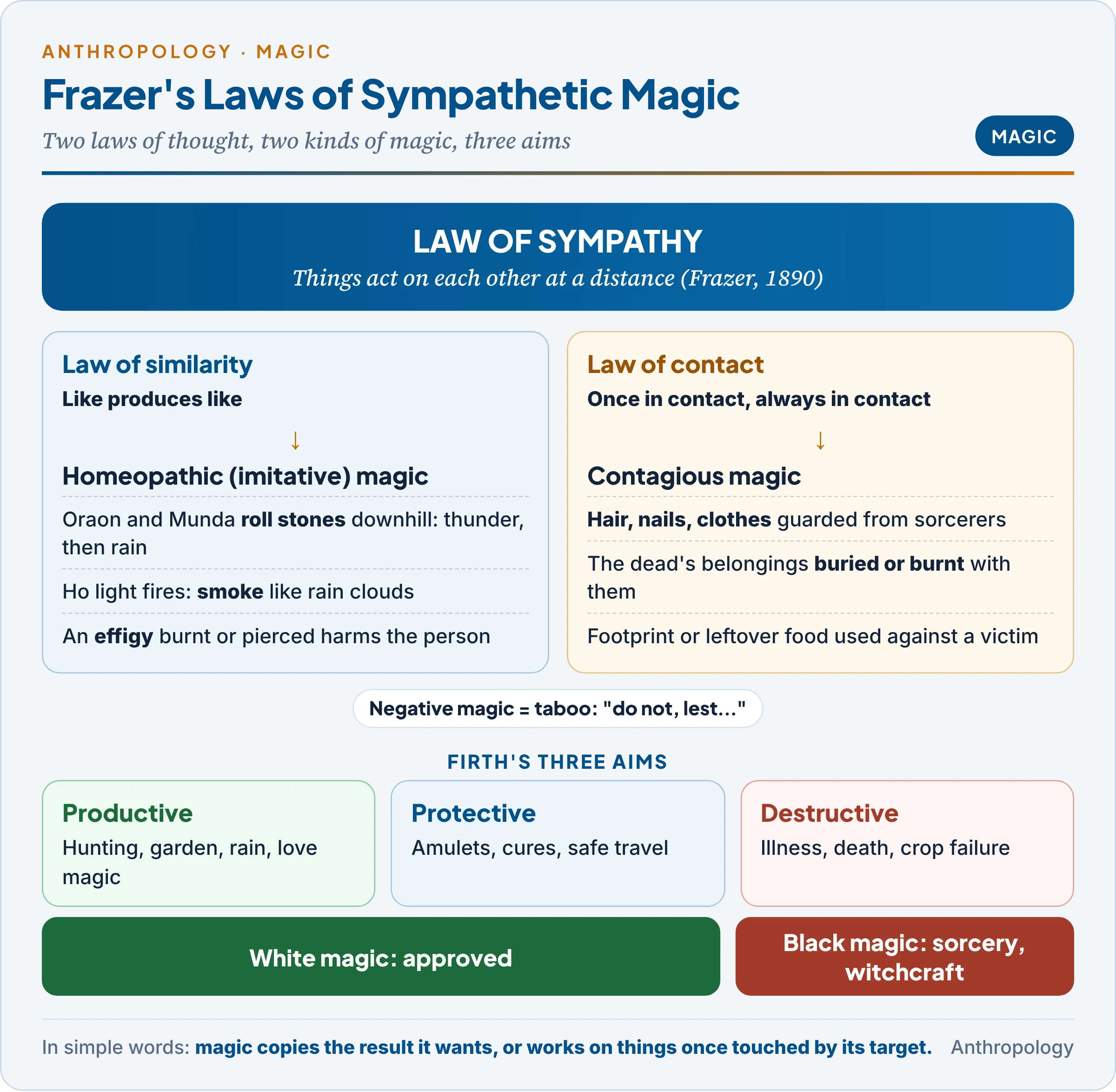
Frazer called all magic sympathetic, because it assumes that things act on each other at a distance through a secret sympathy. The table gives his two laws with Indian cases.
| Law | Principle | Form of magic | Indian example |
|---|---|---|---|
| Law of similarity | Like produces like | Homeopathic (imitative) | Oraon and Munda stone-rolling; Ho smoke; burning an effigy |
| Law of contact | Things once in contact go on acting on each other | Contagious | Hair, nails, clothes guarded from sorcerers; the dead’s belongings buried or burnt with them |
Both laws are mistaken uses of the association of ideas, by similarity and by contiguity. In Frazer’s words, “legitimately applied they yield science; illegitimately applied they yield magic, the bastard sister of science“. Positive magic says “do this to get that”; negative magic, or taboo, says “do not do this, lest that happen”. The Kondh meriah sacrifice of colonial Odisha, in which the victim’s tears were believed to bring rain, was read as homeopathic magic.
7.2 Elements, aims and functions
- Elements (Raymond Firth, Human Types). The practitioner (oneself or a specialist), the practical aim, and the formula: things used (medicines), things done (rites) and things spoken (spells). Malinowski held the spell to be the core: fixed, secret words whose exact repetition carries the power.
- Aims (Firth).
- Productive: hunting, fishing, garden, rain and love magic; approved, and it organises work.
- Protective: amulets, cures, safe travel, guarding property; approved, and a means of social control.
- Destructive: magic to cause illness, death or crop failure; this is sorcery (§9), and it is condemned.
- White magic covers the first two; black magic covers sorcery and witchcraft.
- Functions.
- Psychological: Trobriand fishermen used magic only for the dangerous open sea (Unit 5a §3).
- Organisational: in the Trobriand gardens (Coral Gardens and Their Magic, 1935), the garden magician (towosi) opened each stage of work with a rite, so magic set the farming calendar and co-ordinated labour.
- Explanatory and moral: it explains why misfortune strikes a particular person (§8).
8. Religion, Magic and Science Distinguished
In simple words
Magic, religion and science are three ways of dealing with the world. Magic tries to force results with formulas; religion asks higher powers for help and accepts their will; science tests ideas against evidence and drops those that fail. Most societies use all three side by side.
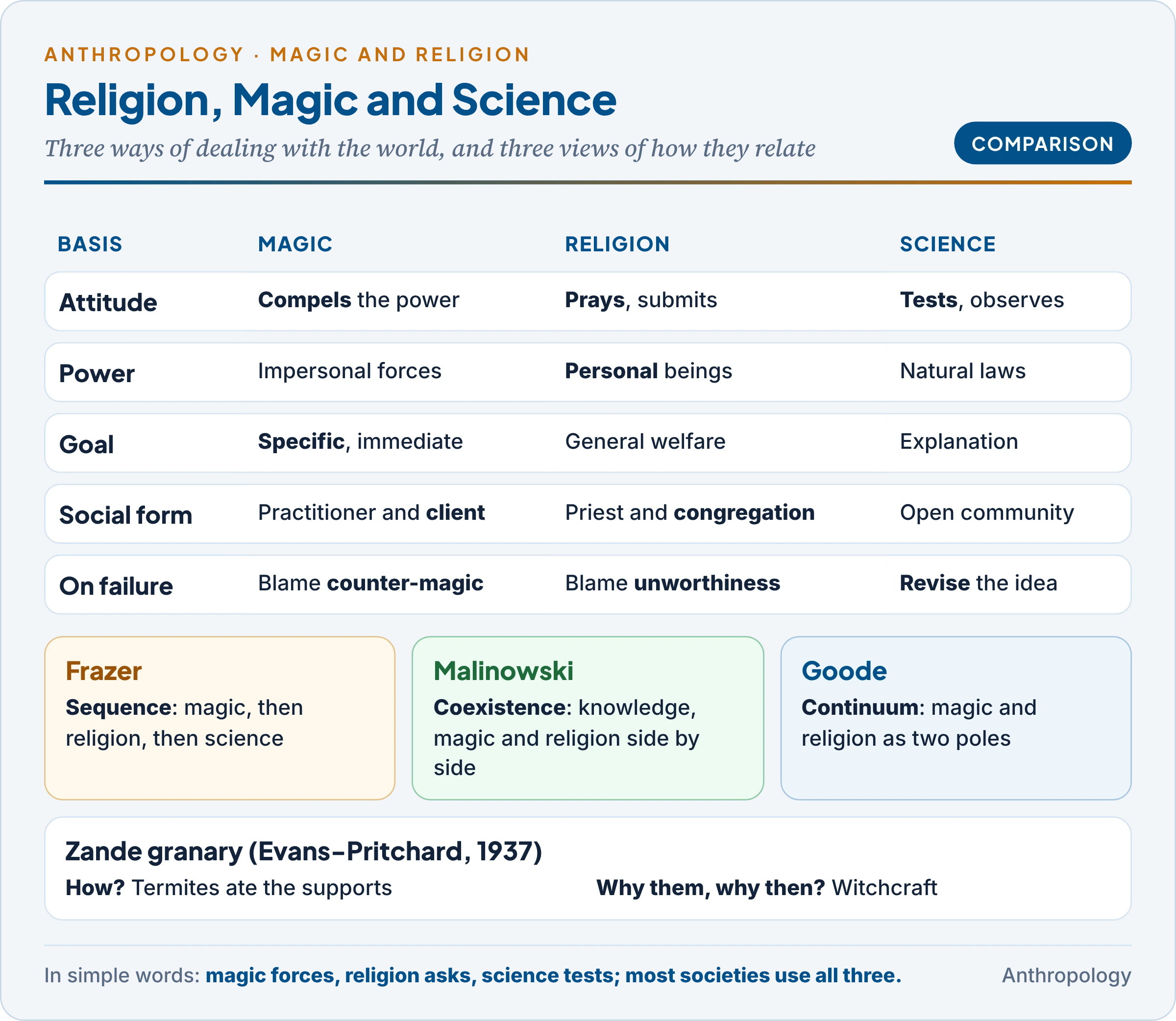
Example first. Among the Azande of South Sudan and the north-eastern Congo, described by the British anthropologist E.E. Evans-Pritchard (Witchcraft, Oracles and Magic among the Azande, 1937), an old granary collapsed on men sitting in its shade. The Azande knew that termites had eaten the supports. What they asked was why it fell at the very moment those particular men sat under it, and their answer was witchcraft (mangu). Natural cause explained how; witchcraft explained why me, why now. They asked a question science does not answer.
- Frazer: a sequence. Magic and science see nature as impersonal and lawful; religion assumes personal powers who can be persuaded. Frazer defined religion as “a propitiation or conciliation of powers superior to man which are believed to direct and control the course of nature and of human life”. When people saw that magic failed, they turned to religion; science later replaced both (Unit 6a).
- Malinowski: coexistence. Every people has a profane body of empirical knowledge alongside sacred magic and religion. Magic is a practical means to a definite end; religion consists of acts that are ends in themselves (a funeral rite “produces” nothing).
- Durkheim: no church. Religion unites believers into a moral community; “there is no Church of magic“: the magician has a clientele, not a congregation.
- Evans-Pritchard: rational within premises. Zande thought was coherent inside its own assumptions; a failed oracle was blamed on a broken taboo, so the system protected itself from disproof.
- Robin Horton, a British anthropologist in Nigeria (“African Traditional Thought and Western Science”, 1967): both explain events through theoretical entities (spirits, atoms). Traditional thought lives in a closed predicament (no awareness of alternatives), science in an open one.
- A continuum. The American sociologist William J. Goode (Religion among the Primitives, 1951) placed magic and religion at two ideal-type poles, with real practices in between. The Chinese-American Francis L.K. Hsu showed priests using magical techniques (holy water, prayer meetings for rain).
The table brings together the criteria most writers use. Read it as a set of tendencies: few real cases sit wholly in one column.
| Basis | Magic | Religion | Science |
|---|---|---|---|
| Attitude | Manipulative: compels | Supplicative: prays, submits | Investigative: tests |
| Power | Mostly impersonal forces | Personal beings who may refuse | Natural laws |
| Goal | Specific, immediate | General welfare; ends in themselves | Explanation and control |
| Social form | Individual, secret; practitioner and client | Collective, public; priest and congregation | Open community of enquirers |
| Morality | Good or evil | Mostly moral | Neutral |
| On failure | Stronger magic or a rival’s counter-magic blamed | Human unworthiness; rite continues | Hypothesis revised or rejected |
| Test | Efficacy, failure explained away | Faith; not open to test | Empirical, open to disproof |
Two contrasts carry most weight. Magic and religion share the non-empirical: both deal with forces beyond the senses, use symbol and ritual, arise in emotional stress and are hedged by taboos; Marett noted that a slight change of words can turn a spell into a prayer. Magic and science share the instrumental: both assume regular cause and effect and aim at definite results. What separates science is its method: it is an open system that expects to be proved wrong.
Common confusion
Is magic “primitive science”? Only in Frazer’s narrow sense that both assume regular cause and effect. Magic is closed: failure is blamed on a rival’s counter-magic or a broken rule, so it is never disproved. Science is open: failure counts against the idea. Malinowski added that the Trobriander who used garden magic also had sound empirical knowledge of farming, so magic is a supplement to technique, not a substitute for it.
9. Magico-Religious Functionaries
In simple words
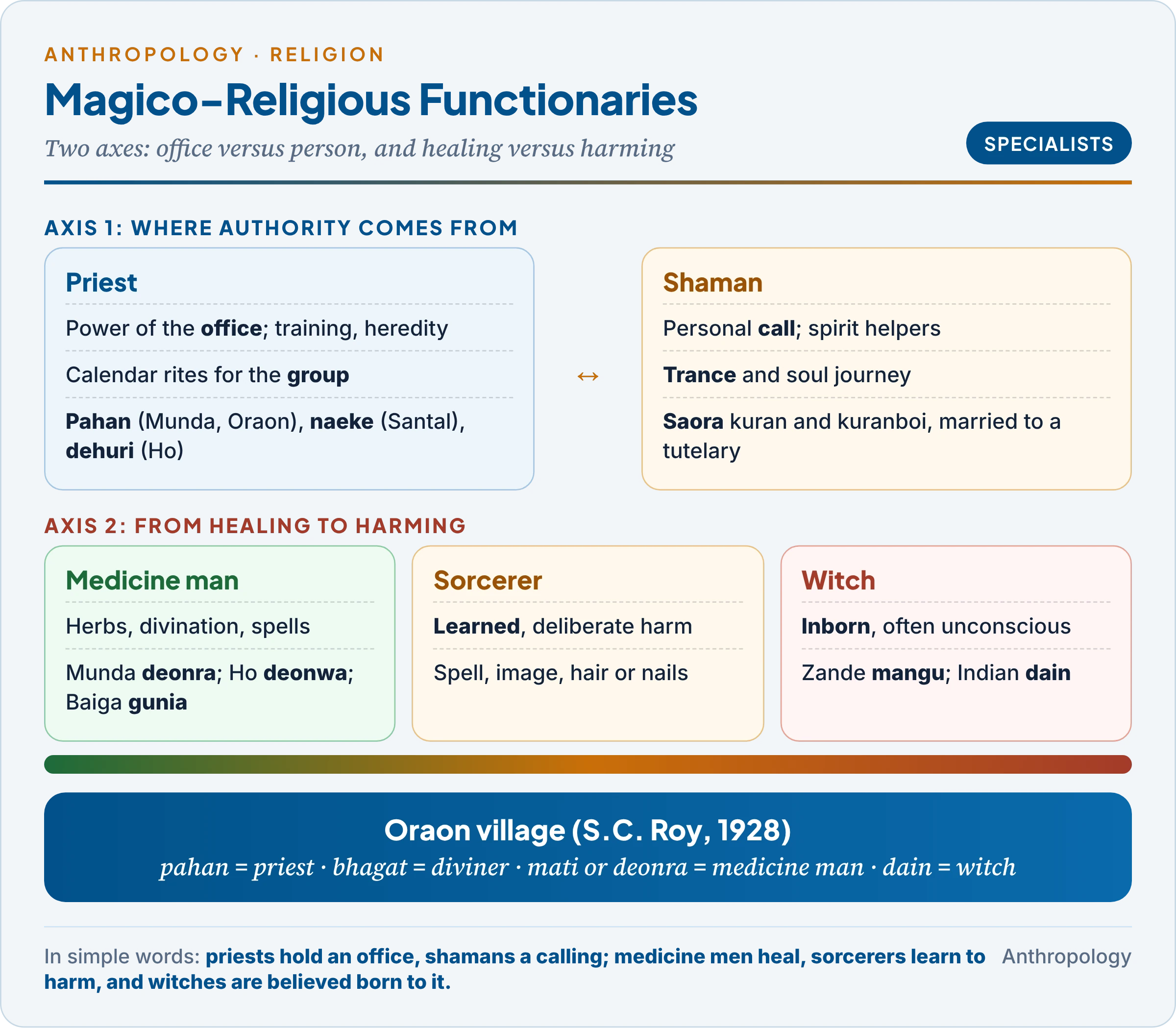
Most societies have special people who deal with the supernatural for others. A priest leads public worship from an office; a shaman travels to the spirit world in trance; a medicine man cures with herbs and spells; a sorcerer uses magic to harm; and a witch is believed to harm without even trying.
Example first. In an Oraon village (S.C. Roy, Oraon Religion and Customs, 1928), the pahan (Oraon naigas), from the founding family and often a Munda, is the priest of the village deities at the sacred grove. Anyone called by a vision may become a bhagat or sokha, a diviner who names the witch behind an illness. A trained mati, ojha or deonra is the medicine man: he divines, removes the evil eye and exorcises spirits. The feared dain is the witch. One village holds four of the five functionaries in the syllabus.
- Priest. A ceremonialist who acts as the representative of a group; his power comes from the office, not personal gifts. He usually has training, a fixed calendar of rites and a congregation. When the gods do not respond, he keeps his office and the failure is blamed on the people’s unworthiness.
- The Nuer “leopard-skin chief” (Evans-Pritchard, The Nuer, 1940) is a priest who sacrifices to settle blood feuds and cleanse incest.
- India: the Munda and Oraon pahan, the Santal naeke, and the Ho dehuri, who mediates between hor (man) and bonga and holds a hereditary office.
- Shaman. The word is from the Tungus (Evenki) of Siberia. Mircea Eliade, the Romanian historian of religion (Shamanism: Archaic Techniques of Ecstasy, 1951), defined shamanism by ecstasy: the shaman’s soul leaves the body in trance and journeys to sky or underworld, helped by spirit familiars.
- Shamans are usually part-time, recruited by a personal call (dream, vision or initiatory illness) and trained by an elder; their power is personal. They cure, divine, find game and warn of disaster.
- Saora (Elwin, 1955; Piers Vitebsky, Dialogues with the Dead, 1993): the shaman (kuran) and shamaness (kuranboi) are married to a tutelary spirit of the underworld, who gives the power of trance. In trance, the dead speak through the shaman and argue with the living over the cause of an illness.
- A medium is a related, usually part-time specialist (often a woman) who is possessed by a spirit, with tremors and seizures, so that the spirit speaks through her; the Baiga barua is one.
- Medicine man. A curer who joins herbal knowledge to magic: diagnosis by divination, then offerings, spells, sucking out an intruded object, and charms. Since illness is not split into natural and supernatural, the shaman is often also the medicine man.
- Munda: the deonra, spirit-doctor and exorcist, also called sokha or mati (S.C. Roy, “Exorcism in Chota Nagpur”, 1923); the najo also propitiates malevolent spirits.
- Ho: the deonwa reads the pulse or rice ground with vermilion to tell whether an illness comes from an evil bonga or a witch (dian), and counters witchcraft.
- Baiga (Elwin, The Baiga, 1939): the name Baiga itself means priest, sorcerer or medicine man to Gond and Hindu neighbours, who employ Baiga as village priests of the earth because they are held to be its first owners. Among the Baiga, the gunia is magician, medicine man and shaman in one; the dewar is a senior gunia for village-wide rites (crops, man-eating tigers, earthquakes); the barua is possessed so that a god speaks through him.
- Sorcerer. One who deliberately uses magic to harm, with a learned technique that can be demonstrated: a spell, a pierced image, or the victim’s hair, nails or excreta. Bone-pointing in Aboriginal Australia is a classic case; among the Azande, sorcery is “bad medicine” (ngua). Sorcery against an enemy may be approved, so it can also work as social control.
- Witch. One with an inborn, often unconscious power to harm by thought and emotion alone. Zande mangu is a substance in the belly, inherited by a child from the parent of the same sex; a person may be a witch without knowing it. Because witchcraft needs no technique, it can only be alleged, never proved: Evans-Pritchard concluded that sorcery may really be practised, but witchcraft is imaginary.
The table lines up the five. Notice two axes: how power is obtained (office, call, training, birth) and whether it is used to help or harm.
| Functionary | Source of power | Mode | Aim | Status | Indian example |
|---|---|---|---|---|---|
| Priest | Office, training, heredity | Prayer, sacrifice, calendar rites | Public welfare | High | Pahan, naeke, dehuri |
| Shaman | Personal call, spirit helpers | Trance, soul journey | Curing, divining | High, part-time | Saora kuran, kuranboi |
| Medicine man | Training; herbal and magical skill | Diagnosis, spells, medicine | Curing | Respected, paid | Munda deonra, Ho deonwa, Baiga gunia |
| Sorcerer | Learned technique | Spell, image, contagion | Harm | Feared | Bisaha (black-magic man) |
| Witch | Inborn, unconscious | Thought, evil eye | Harm | Stigmatised | Dain or dayan |
Priest and shaman are the two poles of religious leadership: one draws power from an institution, the other from personal experience in an altered state. The American anthropologist Anthony F.C. Wallace linked them to social scale: shamanic cults dominate in bands, communal cults in tribes, and ecclesiastical cults with full-time priests in states. Medicine man, sorcerer and witch form a second axis, from healing to harming, and one ojha may both cure and name a witch. These are ideal types: a Baiga dewar is both.
9.1 Witchcraft accusations: why they happen
Example first. On 6 July 2025, at Tetgama village in Purnia district (Bihar), a mob killed five members of an Oraon family and burnt their bodies after an exorcist named an elderly widow and her daughter-in-law as witches behind a child’s death and another child’s illness. Accusers and victims belonged to the same tribe and had lived side by side for generations.
- Strained relations. Accusations follow lines of tension: co-wives, neighbours, rivals for land, kin who share property.
- Clyde Kluckhohn, the American anthropologist (Navaho Witchcraft, 1944): witch beliefs let the Navaho displace hostility onto a hidden target instead of open quarrels within the kin group.
- Max Marwick (Sorcery in its Social Setting, 1965), on the Cewa of Northern Rhodesia: accusations are a “social strain-gauge”, clustering where relationships are under stress, and can justify splitting a lineage.
- Mary Douglas (ed., Witchcraft Confessions and Accusations, 1970): witch fears flourish in small groups with blurred roles and no clear way to settle conflict.
- Explanation of misfortune. Witchcraft is a native theory of failure, illness and death (the Zande granary, §8).
- Gender and land. Govind Kelkar and Dev Nathan (Gender and Tribe, 1991) and Samar Bosu Mullick (2000) linked witch-hunting among the Munda, Ho and Santal to patriarchy and land: women who are widowed, childless or hold land are the usual targets, and accusation removes them as claimants. A belief about the supernatural here serves a material interest.
- Weak health care. Where doctors are far away, the ojha is the first resort, and his diagnosis may name a witch.
Witch-hunting therefore persists despite laws because it is not only “superstition”: it explains misfortune and settles conflicts over property and power.
10. Religion in Tribal and Peasant India
In simple words
Indian tribal religions centre on spirits of nature and ancestors, a sacred grove, a village priest and a magician. Peasant religion joins local village gods to the texts and pilgrimage centres of Hinduism. Both have changed through contact with Hinduism, Christianity and the state.
- Features of tribal religion.
- A pantheon of spirits (bongas) under a remote supreme being (Singbonga, Dharmes, Thakur Jiu).
- A sacred grove (sarna, jaherthan) at the village edge.
- A division of labour between the priest (public rites) and the medicine man or diviner (illness and misfortune).
- An ancestor cult within the house, and seasonal festivals of the farming year (Sarhul, Karam, Sohrai).
- No scripture or church: belief is carried by myth and ritual.
- Peasant religion.
- Great and little traditions. The American anthropologist Robert Redfield (Peasant Society and Culture, 1956) contrasted the great tradition of the reflective few (texts, temples, Brahmin priests) with the little tradition of village folk. McKim Marriott (“Little Communities in an Indigenous Civilization”, 1955) showed for Kishan Garhi (Uttar Pradesh) a two-way flow: local deities rise into all-India forms (universalisation) and all-India gods take local forms (parochialisation).
- Sacred complex. L.P. Vidyarthi (The Sacred Complex in Hindu Gaya, 1961) analysed a pilgrimage centre as sacred geography (holy sites), sacred performances (rites) and sacred specialists (the Gayawal priests).
- Sanskritisation. M.N. Srinivas (Religion and Society among the Coorgs of South India, 1952) showed lower castes and tribes adopting Brahminical practices to claim higher status.
- Change.
- Hinduising reform: the Tana Bhagat movement among the Oraon (from 1914) gave up animal sacrifice, liquor and spirit cults.
- Revival and protest: Birsa Munda (1895–1900) preached one god, rejected sacrifice and witchcraft, and led a revolt over land.
- Sarna assertion: the demand for a separate Sarna religion code in the Census (Unit 5a).
Key Terms
| Term | Meaning in simple words |
|---|---|
| Animism | Belief that souls and spirits animate people, animals and things |
| Animatism | Belief in an impersonal supernatural power (Marett) |
| Mana | Melanesian term for power shown in success |
| Bongaism | Ho belief in bonga as impersonal power (Majumdar) |
| Relational epistemology | Knowing the world by relating to it as persons (Bird-David) |
| Fetish | An object believed to contain power |
| Naturism | Worship of forces of nature |
| Totem | Animal, plant or object linked to a clan |
| Taboo | A ritual ban whose breach brings automatic misfortune |
| Sympathetic magic | Magic assuming that things act on each other at a distance |
| Homeopathic magic | Magic based on likeness: like produces like |
| Contagious magic | Magic based on past contact |
| Spell | Fixed words believed to carry magical power |
| Priest | Office-holder who leads public worship for a group |
| Shaman | Specialist who enters trance and travels to the spirit world |
| Medicine man | Curer who combines herbs, divination and magic |
| Sorcerer | Person who deliberately uses magic to harm |
| Witch | Person believed to harm by an inborn, often unconscious power |
| Great tradition | The textual, all-India level of a civilisation’s religion |
| Sacred complex | Sacred places, rites and specialists of a pilgrimage centre |
Contemporary Developments
- Purnia witch killings (6 July 2025): five members of an Oraon family were killed at Tetgama (Purnia, Bihar) after an exorcist branded two women as witches; the exorcist was among those arrested.
- NCRB data: Crime in India 2023 recorded 74 murders with witchcraft as the motive (Jharkhand 22, Chhattisgarh 19, Madhya Pradesh 14), against 85 in 2022. State laws run from Bihar’s Prevention of Witch (Daain) Practices Act, 1999 and Jharkhand’s 2001 Act to Assam’s Witch Hunting (Prohibition, Prevention and Protection) Act, 2015; there is no central law.
- Sacred groves as forests (18 December 2024): in In re T.N. Godavarman Thirumulpad, the Supreme Court directed Rajasthan to map its orans and other sacred groves and classify them as forests regardless of size, and recommended protecting them as community reserves under s.36-C of the Wildlife (Protection) Act, 1972.
- Nature as a person in law: the Uttarakhand High Court declared the Ganga and Yamuna “living entities” (20 March 2017); the Supreme Court stayed the order in July 2017. Animist ideas of nature as person have entered legal debate.
Diagrams to Master
- Topic map of the article.
- Totemism theories (§6.2): the sequence from McLennan to Lévi-Strauss; label the homology “species A : species B :: clan A : clan B” with a Santal or Oraon example.
- Sympathetic magic (§7.1): the two laws, the two forms, one Indian example each; Firth’s three aims; white and black magic.
- Religion, magic and science (§8): three columns on attitude, power, goal, social form and failure; Frazer’s sequence against Malinowski’s coexistence.
- Functionaries (§9): priest and shaman on the institution-person axis; medicine man, sorcerer and witch on the healing-harming axis, with one Indian example each.
Revision Grid
| Scholar | Work (year) | Key idea |
|---|---|---|
| McLennan | “Worship of Animals and Plants” (1869–70) | Totemic stage |
| Tylor | Primitive Culture (1871) | Animism; minimum definition |
| Frazer | The Golden Bough (1890); Totemism and Exogamy (1910) | Similarity and contact; conceptional totemism |
| Marett | “Pre-Animistic Religion” (1900) | Animatism |
| Goldenweiser | “Totemism, an Analytical Study” (1910) | Totemic traits vary independently |
| S.C. Roy | The Oraons (1915); The Birhors (1925); Oraon Religion and Customs (1928) | Indian totemism; pahan, mati, bhagat |
| Malinowski | Magic, Science and Religion (1925); Coral Gardens (1935) | Magic where knowledge ends; spell |
| Radcliffe-Brown | 1929; “Taboo” (1939); 1951 | Ritual value; opposition of species |
| Evans-Pritchard | Witchcraft, Oracles and Magic among the Azande (1937) | Mangu; granary; witchcraft imaginary |
| Elwin | The Baiga (1939); Religion of an Indian Tribe (1955) | Gunia, dewar, barua; Saora shamans |
| Kluckhohn | Navaho Witchcraft (1944) | Displaced hostility |
| Eliade | Shamanism (1951) | Ecstasy, soul journey |
| Goode | Religion among the Primitives (1951) | Magic-religion continuum |
| Vidyarthi | Sacred Complex in Hindu Gaya (1961) | Sacred geography, performances, specialists |
| Lévi-Strauss | Totemism (1962) | “Good to think” |
| Marwick | Sorcery in its Social Setting (1965) | Social strain-gauge |
| Douglas | Purity and Danger (1966) | Taboo and anomaly |
| Bird-David | “‘Animism’ Revisited” (1999) | Relational epistemology |
Previous Year Questions
Unit 5: Forms of religion; religion, magic and science; magico-religious functionaries
- 2025Critically examine James Frazer’s theory of evolutionism. Elucidate the place of religion in modernity.
- 2022Write notes on: Shaman, sorcerer and medicine man.
- 2021Write notes on Animism and Deep Ecology in about 150 words.
- 2018Write a note in 150 words on Difference between Science and Magic.
- 2017Write a note in 150 words on Difference between religion and magic.
- 2017Discuss the different traditional forms of religion in tribal societies.
- 2016Write a note in 150 words on Totemism.
- 2013Write a note in 150 words on Totemism.
- 2013How does taboo serve as a means of social control ? (250 words).
- 2012Distinguish between Religion, Magic and Science.
- 2007Write a note on Shamanism.
- 2007How anthropologists define Religion? Describe various forms of religion with suitable examples?
- 2005“Witchcraft accusation is the result of strained interpersonal relations.” Explain.
- 2004Distinguish between magic and religion. Give suitable examples.
- 1999Discuss some of the characteristic features of tribal religions in India and state how far have they changed in recent times.
- 1998Write a note on Witchcraft and sorcery.
- 1996Why have religion and magic become stable features of a society ? What role do the religious functionaries play in simple and non-literate societies ?
- 1994Describe the role of totemism in primitive religion, according to Durkheim.
- 1993Highlight the significance of religious practices in Tribal Communities of India.
- 1992Write a note on Religion and Magic.
- 1992What is Taboo. Discuss the Significance of Taboo in primitive societies.
- 1990Describe the origin of religion. Distinguish between religion and magic.
- 1989What do you mean by totemism ? Discuss the role of totemism in the tribal life of India.
- 1987Distinguish between religion and magic. Critically examine the different theories of religion and comment on their relevance today.
- 1984Distinguish between : Animism and animatism.
- 1981“Nature Totemism continuities is a religion .” Substantiate based on.man (200- words).
Related questions from other units
- 2026Unit 2.3: Discuss ‘incest taboo’ as the basis of development of kinship systems in human societies.
- 2016Unit 2.5: Write a note in 150 words on Lineage and Clan.
- 2014Unit 6: What is functionalism? Discuss the functional approach to the understanding of Religion.