

2.2 The Nature of Society: Concept of Society; Society and Culture; Social institutions; Social groups and Social stratification
Official Syllabus: Paper I, Unit 2.2
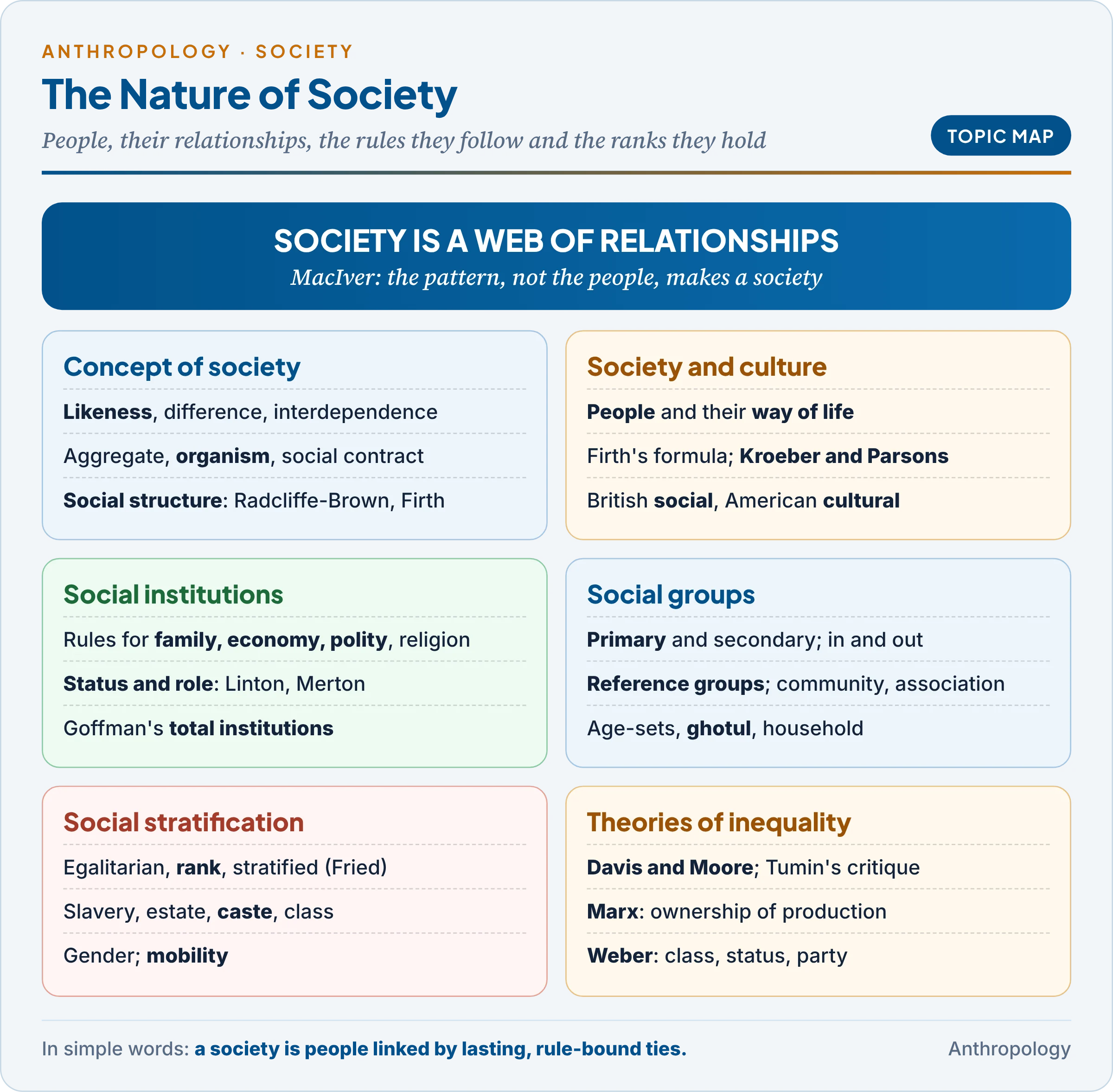
Unit 2.1 showed that culture is the learned, shared, symbolic way of life of a group, and that it is passed on by enculturation rather than by genes. This unit turns to the people who carry that culture: how they are organised into a society, the institutions that standardise their conduct, the groups they belong to, and the ranking of those groups into higher and lower strata.
1. The Concept of Society
In simple words
A society is not just a crowd of people. It is a lasting network of relationships in which people know they are connected, depend on one another and follow shared rules. The people come and go, but the pattern of relationships continues.
1.1 What society means
Example first. Hundreds of strangers waiting on a railway platform form only an aggregate (a collection of people brought together by an outside cause): they respond to the train, not to each other, and they scatter when it comes. If the same commuters travel together every morning, greet each other, sing bhajans and collect money when one of them falls ill, they have become a social group. A society is the largest such web: a self-perpetuating population whose relationships are organised by shared rules and culture.
- Everyday versus technical meaning: in everyday speech “society” means an organisation (the Arya Samaj, a housing society). In anthropology it means the system of social relationships itself, which is why the American sociologist R.M. MacIver called society “a web of social relationships“. The web is abstract: one can see people, but not the relationship of father to son.
- A society versus society: “society” in general is the human capacity for organised social life; “a society” is one bounded population with its own territory, name and culture (the Toda, Japan).
The definitions below fall into two families. Read the right-hand column to see whether each scholar stresses the structure of relations or what they do.
| Scholar | Definition (core words) | Emphasis |
|---|---|---|
| MacIver and Page (Society, 1949) | “a system of usages and procedures, of authority and mutual aid, of many groupings and divisions, of controls of human behaviour and of liberties” | Structural and functional |
| F.H. Giddings (American sociologist) | Society rests on “consciousness of kind“, the awareness of being alike | Mental awareness |
| Talcott Parsons (American sociologist) | The total complex of human relationships arising from action in terms of means and ends | Functional |
| Radcliffe-Brown (Structure and Function in Primitive Society, 1952) | Society is seen through its social structure, the network of actually existing relations between persons | Structural |
The two families are not rivals. A structural definition tells us what society is made of (groups, institutions, statuses); a functional definition tells us what it does (meets needs, coordinates action). A complete account needs both.
1.2 Characteristics of society
- Likeness: MacIver held that “society means likeness“. In simple societies likeness rested on kinship, real or supposed; in modern ones it widens to nationality and shared values. Without some likeness there is no understanding and so no relationship.
- Difference: a society of identical people would have little to exchange. The division of labour between men and women, young and old, potter and farmer rests on difference. Difference is subordinate to likeness: people cooperate in different tasks because they share wants.
- Interdependence and cooperation: each member depends on others for food, protection and meaning. Cooperation is basic, but conflict and competition are also part of social life; the British anthropologist Max Gluckman showed how quarrels can even bind a society together.
- Reciprocal awareness: two strangers sharing a compartment form a society only when they become aware of each other; fire and smoke have a relation but not a social relationship.
- Norms and authority: every society has usages (customs), procedures and some authority to keep order; members are born and die, but this pattern persists.
1.3 Society, aggregate and organism
- Aggregate: people collected by an external stimulus (a flood, a fair) who respond to the stimulus, not to each other. What is missing is mutual responsiveness.
- The organic analogy: the British philosopher Herbert Spencer (The Principles of Sociology, 1876–96) compared society to an organism: both grow, become more complex and differentiated, and their parts become interdependent.
- Spencer himself noted the limits: society has no single body, its units are mobile and physically separate, and it has no common brain (sensorium); each member feels and thinks for himself.
- The analogy survived in the functionalism of Durkheim and Radcliffe-Brown, who asked what each institution contributes to the whole, as an organ does to the body (Unit 6e).
- Social contract theories: Hobbes (Leviathan, 1651), Locke and Rousseau (The Social Contract, 1762) held that individuals came before society and created it by agreement. Anthropology rejects this: no human being has been found living outside society.
- Evidence that humans are social by nature: children deprived of human contact do not develop speech or normal behaviour.
- Kaspar Hauser, who appeared in Nuremberg in 1828 after being kept in a dark cell for most of his childhood, could barely walk or speak.
- Amala and Kamala, two girls found in a wolf den near Midnapore (Bengal) in 1920, walked on all fours and had no language.
- Anna, an American girl isolated in a room from infancy and studied by the sociologist Kingsley Davis (1940), could neither walk nor speak at six.
- These cases show that human nature itself is a product of social life; the debate “is the individual prior to society?” is like asking whether the hen or the egg came first. Individual and society make each other.
1.4 Anthropological views and types of society
- Durkheim: the French sociologist Émile Durkheim (The Rules of Sociological Method, 1895) treated society as a reality sui generis (of its own kind), made of social facts: ways of acting that are external to individuals and constrain them, such as language or law.
- Radcliffe-Brown and social structure: the British social anthropologist A.R. Radcliffe-Brown (“On Social Structure”, 1940) defined social structure as the network of actually existing relations between persons. He separated actual structure (the particular persons, who change through birth, death and marriage) from structural form (the general pattern, which persists), and called this persistence of form despite changing persons structural continuity. Institutions supply the form; people are the material.
- Firth and social organisation: the New Zealand-born Raymond Firth (Elements of Social Organization, 1951) added social organisation, the everyday choices by which people work the structure, so that change could be studied too.
- Types of society:
- Ferdinand Tönnies (Gemeinschaft und Gesellschaft, 1887): community based on kinship, place and sentiment versus association based on contract and self-interest.
- Durkheim (The Division of Labour in Society, 1893): mechanical solidarity (unity of people who are alike, in simple societies) versus organic solidarity (unity of specialists who depend on each other, in complex societies).
- Robert Redfield, the American anthropologist (The Folk Culture of Yucatan, 1941): a folk-urban continuum from small, isolated, homogeneous, sacred folk societies to large, heterogeneous, secular urban ones, traced across four Yucatán communities. Oscar Lewis‘s restudy of Tepoztlán (1951) found conflict and individualism where Redfield had seen harmony, and showed that the continuum was an ideal type, not a description.
1.5 Studying society: ethnography
- Ethnography is the first-hand, written description of a particular society, based on long fieldwork and participant observation (living with the people and taking part in their life). It grew from travellers’ and missionaries’ accounts, through the Torres Straits expedition (1898), to Malinowski‘s Trobriand fieldwork (1915–18), which set the modern standard.
- New ethnography (also called ethnoscience or cognitive anthropology, 1950s–60s; Ward Goodenough, Harold Conklin, Charles Frake) tried to record a society’s own categories (how the Hanunóo of the Philippines classify plants and colours) instead of the observer’s, so that description would be emic (from the insider’s view). Detail in Units 6j and 8a.
2. Society and Culture
In simple words
Society is the people and the relationships among them; culture is the way of life those people have learned and share. The two always go together in humans, but they are not the same thing: ants and bees live in societies without culture.
Example first. When indentured labourers from Bihar and eastern Uttar Pradesh reached Fiji, Trinidad and Mauritius in the nineteenth century, their village society was broken: castes were mixed on the ships and plantations, and the old village councils disappeared. Yet much of their culture survived: Bhojpuri speech, the Ramcharitmanas, festivals and food. A new society was built around an inherited culture. The case shows that society and culture can be separated analytically, even though neither exists without the other.
- Social insects: ants and bees have elaborate societies, but their behaviour is instinctive, so they have no culture; primates show only proto-culture (Unit 2.1). Only humans combine society with symbolic culture.
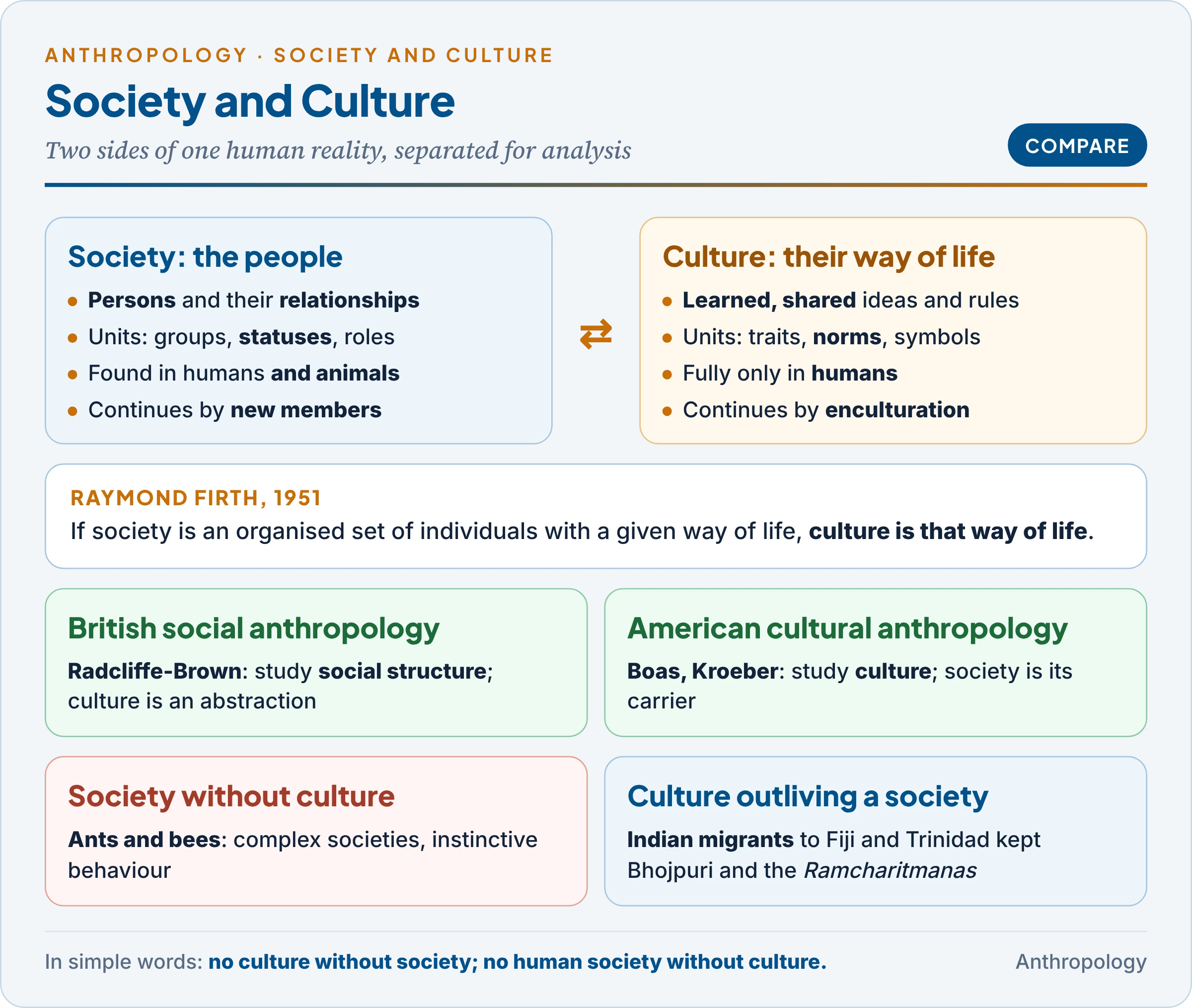
- Firth’s formula: “If society is taken to be an organized set of individuals with a given way of life, culture is that way of life.” Society refers to the people and their relations, culture to the content of those relations: the ideas, norms, skills and objects.
- Kroeber and Parsons (“The Concepts of Culture and of Social System”, 1958): the American anthropologist A.L. Kroeber and the sociologist Talcott Parsons agreed to separate culture (patterns of values, ideas and symbols) from the social system (the relational system of interaction among individuals and groups), so that each discipline could study one aspect without denying the other.
The table compares the two concepts point by point; notice that each depends on the other.
| Point | Society | Culture |
|---|---|---|
| Refers to | People and their relationships | Learned way of life of those people |
| Units | Groups, statuses, roles | Traits, complexes, norms, symbols |
| Found in | Humans and many animals | Fully only in humans |
| Continuity by | Recruitment of new members | Enculturation and learning |
| Studied mainly by | British social anthropology | American cultural anthropology |
The last row records a real debate. Radcliffe-Brown called culture a vague abstraction and studied social structure; Boas and Kroeber made culture the central concept and treated society as its carrier. Today most anthropologists use socio-cultural anthropology as one field, because a kin group (society) cannot be described without its rules (culture), and rules exist only in a living group.
- Mutual dependence: no culture without society, because culture needs a group to share and transmit it; no human society without culture, because human relationships are organised by learned rules, language and values.
- Cultural lag: the American sociologist William Ogburn (Social Change, 1922) argued that material culture (technology) changes faster than non-material culture (norms, laws), producing a lag and social problems; laws on online privacy trailing digital technology are an example (detail in Unit 2.1).
Common confusion
Are society and culture the same thing? No. Society is the organised group of people and the network of relations among them; culture is the learned way of life they share. A society of bees has no culture, and a culture can outlive the break-up of the society that carried it, as among Indian indentured migrants. In human life the two are inseparable in practice but distinct in analysis.
3. Social Institutions
In simple words
An institution is a settled, approved way of doing something important, such as marrying, worshipping, exchanging goods or settling disputes. It is not a building or a group of people but a set of rules and practices that outlasts the people who follow them. Institutions give each person a position and tell them how to behave in it.
3.1 Meaning and characteristics
Example first. Among the Santal of Jharkhand, marriage involves rules on whom one may marry (outside the clan, inside the tribe), a bride-price paid to the girl’s family, rites, a feast and the village headman’s recognition. Couples marry and die, but this pattern continues for generations. Marriage here is an institution; the particular family that results is a group.
- Definitions:
- MacIver and Page: “established forms or conditions of procedure characteristic of group activity”.
- W.G. Sumner, the American sociologist (Folkways, 1906): an institution consists of a concept (an idea or interest) and a structure (a framework of rules and officials).
- Malinowski, the Polish-British functionalist (A Scientific Theory of Culture, 1944): the institution is the real unit of culture, built around a charter (its purpose and values), personnel, norms, material apparatus, activities and a function that meets a human need.
- Radcliffe-Brown: institutions are socially recognised systems of norms governing some aspect of social life; they define how persons in given positions should behave towards one another.
- Characteristics: institutions have objectives, rules and procedures rooted in custom, symbols (the wedding fire, the courtroom), stability across generations, and they act as means of social control. They are abstract: one belongs to a family, not to “the family”.
- Primary and secondary institutions: five primary institutions are found everywhere: family, economy, polity, religion and education. Each gives rise to secondary ones: marriage and divorce from family; property and markets from economy; the temple and taboo from religion; the school from education.
- Why institutions matter: they transmit knowledge, morals and skills; they make behaviour predictable; and they integrate society, because each meets a need that the others depend on. In simple societies one institution, kinship, does the work that many separate institutions do in complex ones.
3.2 Status and role
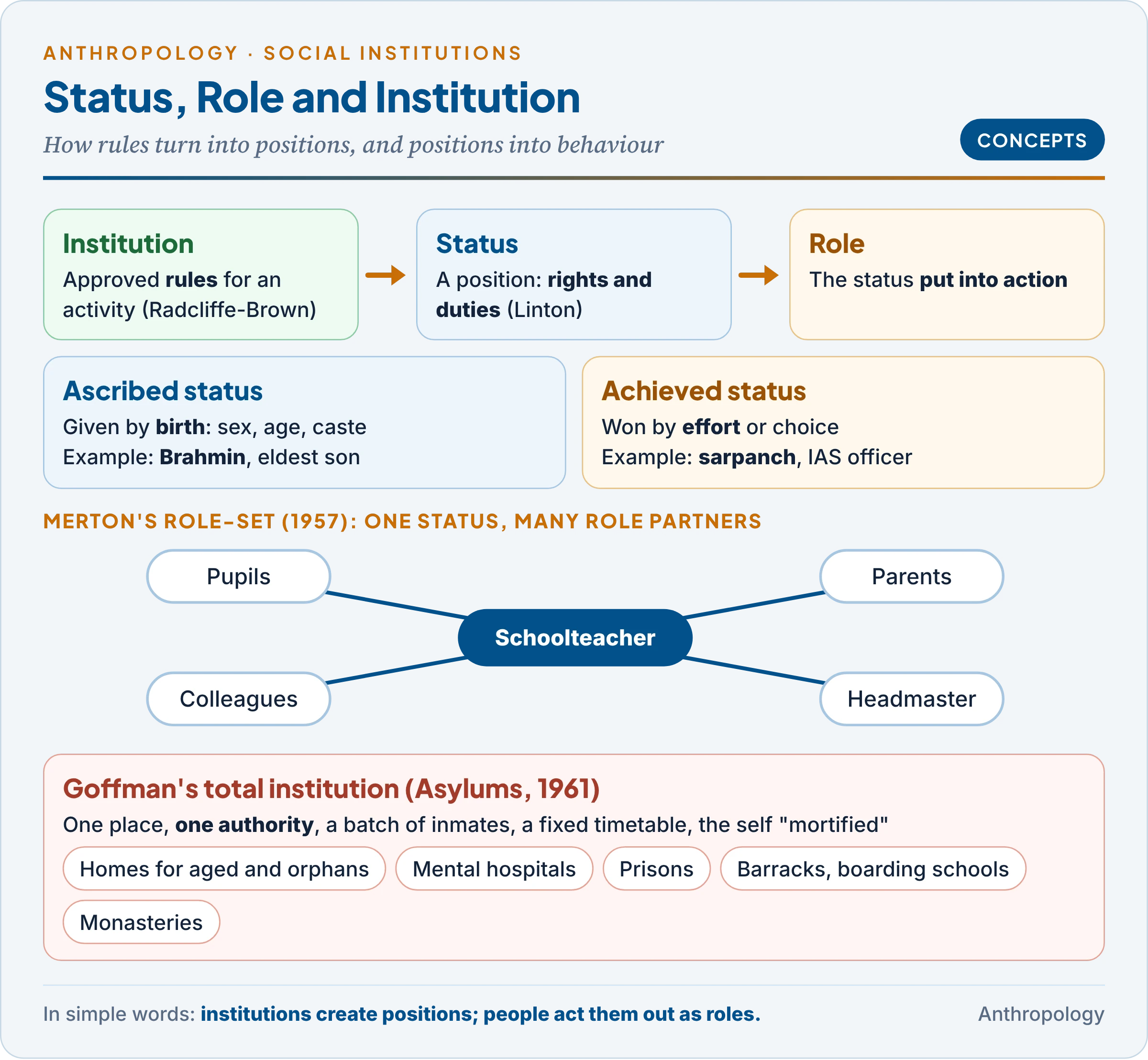
Status and role are the links between the individual and institutions. The American anthropologist Ralph Linton (The Study of Man, 1936) defined a status as “a collection of rights and duties” attached to a position, and a role as the dynamic aspect of a status: putting those rights and duties into action. A person occupies a status and performs a role.
- Ascribed and achieved status: Linton distinguished statuses assigned at birth from those won by effort. The table contrasts them; note that most societies mix both.
| Point | Ascribed status | Achieved status |
|---|---|---|
| Basis | Birth: sex, age, caste, kin position | Effort, skill, choice: education, office |
| Indian example | Brahmin by birth; eldest son | Sarpanch; IAS officer |
| Typical society | Simple and closed (caste) | Complex and open (class) |
- Universal and specialised roles: Linton also separated statuses shared by all (adult man) from those of a segment (shaman), and ideal roles (the norm) from actual roles (what people do).
- Multiple statuses: a man in an Indian village may be at once Brahmin, father, landowner and sarpanch. The status that dominates how others see him is his master status (Everett Hughes, 1945).
- Role-set: the American sociologist Robert Merton (1957) noted that one status brings many roles: a schoolteacher relates differently to pupils, parents, colleagues and the headmaster. Clashes between roles of different statuses produce role conflict; tension within one role produces role strain (William Goode, 1960).
- Radcliffe-Brown’s view: social structure is the arrangement of persons in institutionally defined statuses; institutions fix the norms of conduct between statuses (father and son, mother’s brother and sister’s son), and a person’s social personality is the sum of his statuses. S.F. Nadel (The Theory of Social Structure, 1957) went further and built structure out of roles.
3.3 Goffman’s total institutions
Example first. A new prisoner in an Indian jail surrenders his clothes and belongings, receives a number, sleeps, eats and works by a bell timetable alongside hundreds of others, and is watched by guards. Until 2024 many state prison manuals even assigned sweeping and scavenging by caste. Every part of his life now takes place in one place, under one authority.
- Definition: the Canadian-American sociologist Erving Goffman (Asylums, 1961, based on fieldwork in a Washington mental hospital) defined a total institution as a place of residence and work where many people in the same situation, cut off from wider society, lead an enclosed, formally administered round of life.
- Features: all activities (sleep, work, play) happen in one place, under one authority, in the company of a batch of others treated alike, on a tight schedule, according to a single rational plan of the institution.
- Five types: homes for the blind, aged and orphaned; mental hospitals and leprosaria; prisons and camps; army barracks, boarding schools and ships; monasteries and retreats.
- How it works on the inmate: the institution strips away the old identity by “mortification of the self” (uniforms, numbers, loss of privacy); inmates respond by withdrawal, rebellion, “colonisation” (settling in) or conversion to the staff’s view, and build an informal “underlife” of small freedoms.
- Relevance today: prisons, psychiatric hospitals, old-age homes, residential schools for tribal children, detention camps and military training show the same traits. In Sukanya Shantha v. Union of India (3 October 2024) the Supreme Court struck down caste-based work allocation in state prison manuals, showing how the wider stratification of society is reproduced inside a total institution.
- Criticism: institutions are seldom entirely “total”; inmates keep agency and outside ties; and the French philosopher Michel Foucault (Discipline and Punish, 1975) argued that the same disciplinary techniques spread into ordinary schools, factories and offices.
3.4 Institution, association and community
These three terms are often mixed up. The table separates them by asking what each one is made of.
| Point | Institution | Association | Community |
|---|---|---|---|
| Is a | Set of rules and procedures | Organised group for a purpose | Group sharing a locality and a whole life |
| Nature | Abstract | Concrete, named | Concrete, natural |
| Origin | Grows slowly | Created deliberately | Grows naturally |
| Membership | None: one follows it | Voluntary, can resign | Born into it |
| Example | Marriage, jajmani | Trade union, Gram Sabha, club | A village, a tribe |
The key difference is that people are members of associations and communities but only follow institutions. A family is an association (a group of people) whose life is governed by the institution of the family (its rules).
- Community rests on locality and community sentiment (we-feeling); Kingsley Davis called it the smallest territorial group that can embrace all aspects of social life.
- Association, for MacIver, is “an organisation deliberately formed for the collective pursuit of some interest“. In simple societies associations are few and many-purposed (age-sets, dormitories); in complex ones they specialise.
Common confusion
Is a social institution the same as a social group? No. A group is a set of people who interact; an institution is the established set of rules for some activity. Marriage, property and religion are institutions; a particular family, a co-operative or a temple committee is a group. The same word can name both (“the school” as rules of education, “a school” as staff and pupils), which is the source of the confusion.
4. Social Groups
In simple words
A social group is two or more people who interact, feel they belong together and follow common rules. Groups range from a pair of friends to a whole tribe. The kind of group decides how close, lasting and binding the ties are.
4.1 Meaning and characteristics
Example first. In a Muria village of Bastar (Chhattisgarh), unmarried boys and girls belong to the ghotul, the village dormitory described by the British-born anthropologist Verrier Elwin (The Muria and Their Ghotul, 1947). Members hold named offices, follow ghotul rules, work and dance together and are disciplined by their seniors. A crowd at a weekly market has none of this; the ghotul is a social group.
- Definition: for the American social psychologists Muzafer and Carolyn Sherif, a group is a unit of individuals who stand in definite status and role relationships and share norms of their own.
- Group, aggregate and category: an aggregate shares only a place; a category shares a trait without interacting (all left-handed people); a group has interaction, awareness and shared norms.
- Characteristics: reciprocal relations, a sense of unity and we-feeling, common interests, group norms, some structure of statuses and roles, and change over time.
4.2 Classification of groups
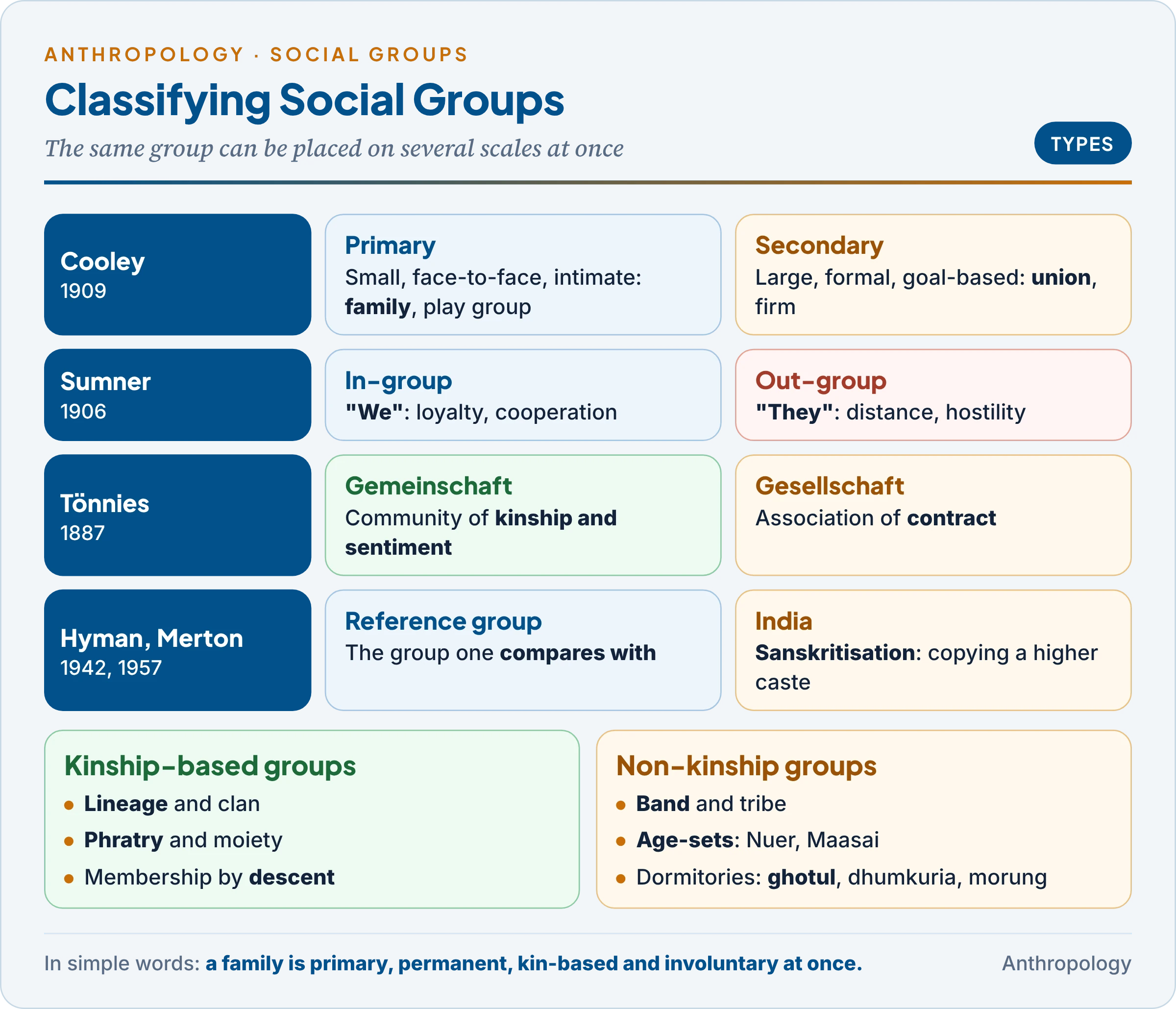
Scholars have sorted groups by intimacy, loyalty, purpose and membership. The table lists the classifications that recur in answers.
| Classification | Scholar | Types and meaning |
|---|---|---|
| Primary and secondary | C.H. Cooley, Social Organization (1909) | Face-to-face, intimate, lasting (family, play group) vs formal, impersonal, goal-based (union, firm) |
| In-group and out-group | W.G. Sumner, Folkways (1906) | “We” (loyalty) vs “they” (distance, hostility) |
| Community and association | Tönnies (1887) | Gemeinschaft (sentiment, kinship) vs Gesellschaft (contract) |
| Reference group | Herbert Hyman (1942); Merton | A group one compares oneself with or wants to join |
| By membership | Dwight Sanderson | Voluntary, involuntary (kin) and delegate |
| By size | Georg Simmel | Dyad (two), triad (three) and larger; a third member changes the relationship |
| By duration | Common usage | Temporary (a crowd, a relief committee) vs permanent (clan, caste) |
The classifications overlap: a family is primary, involuntary, permanent and kin-based at once. They are best read as dimensions along which any group can be placed.
- Primary groups: Cooley called them “the nursery of human nature“, because personality, morals and the self are first formed there. Their conditions are physical nearness, small size and long duration. Their relations are ends in themselves.
- Secondary groups: relations are partial, contractual and instrumental; status depends on the role performed. They grow with urbanisation and industry. (The term “secondary group” was added by later writers; Cooley spoke only of primary groups.)
- Temporary and permanent groups: temporary groups (a crowd, an audience, a flood-relief camp) dissolve when their purpose ends and have weak norms; permanent groups (lineage, caste, village) recruit new members, keep names, property and rules, and so outlive their members.
- Reference groups: the American social psychologist Herbert Hyman (“The Psychology of Status”, 1942) coined the term; Merton developed it, using the finding of The American Soldier (Stouffer, 1949) that men felt relative deprivation by comparing themselves with others, not by objective conditions. In India, M.N. Srinivas‘s Sanskritisation, in which a lower caste adopts the customs of a higher one to claim higher rank, is reference-group behaviour.
4.3 Kinship-based and non-kinship-based groups
- Kinship-based groups: lineage, clan, phratry and moiety are descent groups, whose members trace descent from a common ancestor through one line only (unilineal: patrilineal through the father, matrilineal through the mother), through either (ambilineal) or through both (double descent). Allocation of a person to such a group is called filiation. They regulate marriage, property and ritual (detail in Unit 2.5).
- Band: a small (about 25–300), nomadic, egalitarian group of foragers with situational leadership and sharing of food; the Andamanese and the Hadza of Tanzania are examples (Unit 4a).
- Tribe: a larger group with a common territory, name, dialect and culture, usually endogamous and organised by kinship (Unit 4a).
- Age-grades and age-sets: an age-grade is a category of persons in a stage of life (boy, warrior, elder); an age-set is a named group of people initiated together who move through the grades as a body. Among the Nuer of South Sudan (E.E. Evans-Pritchard, The Nuer, 1940) and the Maasai of Kenya and Tanzania, age-sets cut across kinship, organise warfare and give lifelong comradeship; members of one set are equals.
- Youth dormitories: found widely in middle and north-eastern India: the ghotul of the Muria, the dhumkuria of the Oraon, the morung of the Nagas, and the bukumatula of the Trobriand Islanders (Malinowski). They give secondary socialisation: training in work, dance, myth, sexual conduct and discipline, and service to the village. Membership usually ends with marriage.
4.4 Household and domestic group
- Household: a residential and economic unit whose members share a dwelling and a hearth (common cooking and eating, commensality). It is defined by co-residence, not by kinship, and may include servants or lodgers.
- Family: a kinship unit of people related by marriage and descent, who may live apart (a son working in Dubai remains in the family but leaves the household).
- Domestic group: Meyer Fortes, the British social anthropologist, in The Developmental Cycle in Domestic Groups (ed. Jack Goody, 1958), showed that domestic groups pass through a cycle of expansion (marriage and children), dispersion (children marry and leave or divide) and replacement (a new head takes over). A census that finds “nuclear” and “joint” households may only be catching the same family at different stages of its cycle.
- India: A.M. Shah (The Household Dimension of the Family in India, 1973) showed that Indian households regularly move between nuclear and joint forms over the cycle; among the Nayar of Kerala the household (taravad) was a matrilineal group that excluded husbands (Unit 2.4).
5. Social Stratification
In simple words
Social stratification means that a society ranks groups of people as higher and lower, and gives them unequal shares of wealth, respect and power. The ranking lasts across generations because children inherit their parents’ position. Some systems, like caste, close the doors between ranks; others, like class, leave them partly open.
5.1 Inequality, differentiation and stratification
Example first. In Sripuram, a village of Thanjavur in Tamil Nadu, the Indian sociologist André Béteille (Caste, Class and Power, 1965) found that Brahmins once held land, ritual rank and village power together. After independence, land passed partly to non-Brahmins, and power moved to non-Brahmin leaders through elections, while Brahmins kept ritual status. The three kinds of rank had separated. Stratification is therefore many-sided, which is the core of Max Weber’s theory (§5.5).
- Social differentiation: people are distinguished by age, sex or skill without being ranked.
- Social inequality: differences are socially evaluated as superior and inferior.
- Social stratification: inequality between groups arranged in a hierarchy of layers (strata), lasting across generations. The Russian-American sociologist Pitirim Sorokin (Social Mobility, 1927) defined it as the differentiation of a population into hierarchically superimposed classes, based on unequal rights, privileges, duties and power, and held that an unstratified society “is a myth”.
- Its nature: the American anthropologist Gerald Berreman called stratification at once structural, moral (people judge each other by it), behavioural, material (it decides access to goods) and existential (people experience their rank).
5.2 Egalitarian, rank and stratified societies
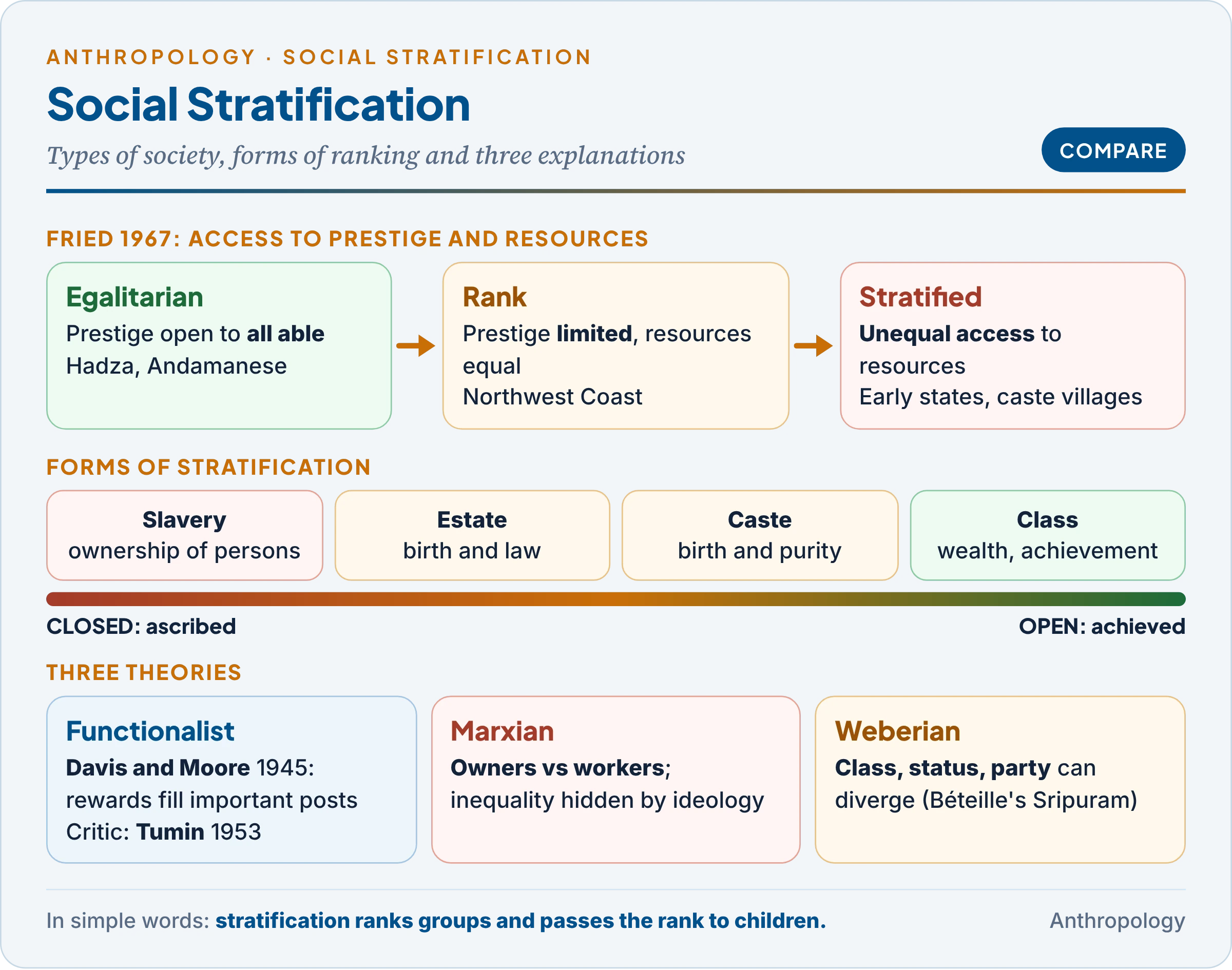
The American anthropologist Morton Fried (The Evolution of Political Society, 1967) showed that not every society is stratified. He classified societies by access to prestige and to basic resources.
| Type | Definition (Fried) | Example |
|---|---|---|
| Egalitarian | As many positions of prestige as there are persons capable of filling them | Hadza, !Kung San, Andamanese bands |
| Rank | Positions of prestige are limited, but everyone has equal access to resources | Northwest Coast chiefdoms (potlatch); Trobriand chiefs |
| Stratified | Members of the same age and sex lack equal access to basic resources | Early states; caste-organised agrarian villages |
The table explains why stratification is not universal in the strict sense. Egalitarian foragers still recognise differences of age, sex and skill (a good hunter has prestige), but they share food and no one can deny another land or water. Stratification appears with surplus, permanent settlement and control of land, which is why Fried treated it as the step just before the state.
5.3 Bases of stratification
- Birth decides rank in slavery, estates and caste; wealth and property are the basis of class (land under feudalism, capital in industry).
- Occupation indexes prestige: a poorly paid teacher may rank above a better-paid technician, because prestige follows an occupation’s importance and the scarcity of people able to do it (Kingsley Davis).
- Power, education, gender, age and ethnicity add further dimensions; gender and age stratify every society to some degree.
5.4 Forms of stratification
The four historical forms differ in how far rank is fixed at birth and what justifies it.
| Form | Basis | Justification | Mobility | Example |
|---|---|---|---|---|
| Slavery | Ownership of persons | Law, conquest | Almost none | Ancient Greece, the American South |
| Estate | Birth and land, legally defined | Law and church | Very limited | Medieval Europe: clergy, nobility, commoners |
| Caste | Birth, endogamy, purity | Religion (karma, dharma) | Closed in principle | Hindu jati system |
| Class | Wealth, occupation, achievement | Secular, market | Open | Industrial societies |
Read the “mobility” column as the key contrast: from slavery to class, rank becomes less fixed and less sacred. Even the closed systems were never fully closed, and even open class systems pass on advantage through families.
- Caste: the Indian sociologist G.S. Ghurye (Caste and Race in India, 1932) listed six features: segmental division, hierarchy, restrictions on food and social intercourse, civil and religious disabilities, restricted choice of occupation and endogamy. The French sociologist Célestin Bouglé reduced the spirit of caste to repulsion, hierarchy and hereditary specialisation.
- Caste and class contrasted: caste is closed, ritually sanctioned, endogamous and needs no class-consciousness; class is open, secular, economically defined and allows intermarriage. C.H. Cooley put it simply: “when a class is somewhat strictly hereditary, we may call it a caste”.
- Is caste unique to India? The French anthropologist Louis Dumont (Homo Hierarchicus, 1966) said yes: caste rests on a unique ideology of hierarchy, the opposition of pure and impure, which subordinates power to ritual status. Berreman (“Caste in India and the United States”, 1960) said no: caste is any birth-ascribed, endogamous hierarchy, found also in the racial order of the American South and among the Burakumin of Japan, and is sustained by power rather than consensus.
- Caste mobility: castes have always moved, through Sanskritisation (Srinivas), political mobilisation and education, as the Ezhavas of Kerala and the Mahars of Maharashtra show; but mobility usually changes a group’s position without changing the system (Paper II, Unit 5).
- Tribe and caste: tribal societies are mostly segmentary and relatively egalitarian, with clans of equal rank, while caste is hierarchical and interdependent. Surajit Sinha placed them on a continuum, since many tribes became castes over time (Paper II, Unit 3).
5.5 Theories of stratification
Three approaches dominate the study of stratification. The table compares their answers to two questions: why does inequality exist, and whom does it serve?
| Approach | Scholar | Why inequality exists | Whom it serves |
|---|---|---|---|
| Functionalist | Kingsley Davis and Wilbert Moore (“Some Principles of Stratification”, 1945) | Society must place talented people in important positions, so it offers them higher rewards | Society as a whole |
| Conflict (Marxian) | Karl Marx | Ownership of the means of production divides owners (bourgeoisie) from workers (proletariat) | The owning class, which hides it by ideology |
| Multidimensional | Max Weber (“Class, Status, Party”) | Separate orders of class (market chances), status (honour, lifestyle) and party (power) | Varies; the three may not coincide |
The functionalist view explains why every complex society rewards some roles more, but the conflict view explains why rewards are inherited rather than earned. Weber’s model is the most useful for India, because caste (status), land and income (class) and electoral power (party) can diverge, as in Béteille’s Sripuram.
- Tumin’s critique: Melvin Tumin (1953) replied to Davis and Moore that “importance” is hard to measure, that elites restrict access to training, that inequality wastes talent among the poor, and that stratification breeds hostility and suspicion. Stratification is therefore partly dysfunctional.
- How stratification sustains inequality (critical view): inequality persists because advantage is inherited (property, networks), legitimised (karma for caste, “merit” for class), and reproduced through education; the French sociologist Pierre Bourdieu showed how the cultural capital of the privileged (speech, taste, schooling) passes for natural talent. In India the World Inequality Lab (2024) estimated that in 2022–23 the top 1% received 22.6% of national income and held 40.1% of wealth, the highest shares on its record since 1922.
5.6 Gender stratification
- Sex and gender: sex is biological; gender is the cultural set of roles and values attached to each sex. Gender stratification is the unequal distribution of wealth, power and prestige between them.
- Mead’s evidence: the American anthropologist Margaret Mead (Sex and Temperament in Three Primitive Societies, 1935) found in New Guinea that both sexes among the Arapesh were gentle and cooperative, both among the Mundugumor were aggressive, and among the Tchambuli women were dominant and practical while men were decorative and emotional. Temperament is therefore shaped by culture, not sex.
- Explaining male dominance: Michelle Rosaldo (Woman, Culture and Society, 1974) linked it to the separation of a domestic sphere (women) from a public sphere (men): the sharper the separation, the lower women’s status. Helen Hacker (“Women as a Minority Group”, 1951) compared women’s position with that of racial minorities: high visibility, ascribed traits and discrimination.
- India: matrilineal Khasi and Garo women inherit property, yet authority often rests with the mother’s brother; women’s farm work (weeding, transplanting) is undercounted and lower paid.
5.7 Social mobility
- Meaning: the movement of individuals or groups between positions in a stratification system (Sorokin, 1927).
- Types: horizontal (a change of occupation at the same level) and vertical (upward or downward); intra-generational (within one life) and inter-generational (between parent and child); individual and group mobility, the second being typical of caste.
- Avenues: education, wealth, political power, migration and social movements; industrialisation creates new occupations and so raises mobility.
- Open and closed systems: in closed systems ascription fixes position (caste in principle); in open ones achievement decides it. No real system is fully either.
- Consequences: mobility uses talent and weakens class barriers, but rapid mobility can bring strain, the loss of community and anomie (Durkheim’s term for normlessness).
Key Terms
| Term | Meaning in simple words |
|---|---|
| Society | A lasting network of social relationships among a population |
| Social structure | The lasting pattern of relations between persons and groups |
| Institution | An established, approved set of rules for an important activity |
| Total institution | A closed place where a batch of people live under one authority |
| Status | A position with its rights and duties |
| Role | The behaviour expected of a person in a status |
| Ascribed status | A position given by birth |
| Achieved status | A position won by effort or choice |
| Role-set | The many role relations attached to one status |
| Primary group | A small, intimate, face-to-face group, such as the family |
| Reference group | A group one compares oneself with or wants to join |
| Age-set | A named group initiated together that moves through life stages as a body |
| Social stratification | The ranking of groups into lasting higher and lower layers |
| Rank society | A society with limited prestige positions but equal access to resources |
| Social mobility | Movement between positions in a stratification system |
Contemporary Developments
- Caste enumeration in Census 2027: the Cabinet Committee on Political Affairs decided on 30 April 2025 to include caste enumeration in the next Census, the first full caste count since 1931; the reference date is 1 March 2027.
- Bihar caste survey (2 October 2023): the first state survey to publish caste data found Extremely Backward Classes 36.01%, Backward Classes 27.12%, Scheduled Castes 19.65% and Scheduled Tribes 1.68% of the population.
- Sub-classification of Scheduled Castes: in State of Punjab v. Davinder Singh (1 August 2024) a seven-judge bench held 6:1 that states may sub-classify SCs and STs for reservation, recognising stratification within stratified categories.
- Caste in prisons: Sukanya Shantha v. Union of India (3 October 2024) struck down caste-based allocation of work in prison manuals.
- Top-end inequality: the World Inequality Lab’s Income and Wealth Inequality in India, 1922–2023 (2024) put the top 1% at 22.6% of income and 40.1% of wealth in 2022–23.
Diagrams to Master
- Topic map: society, culture, institutions, groups, stratification.
- Society and culture: two columns (people and relations; learned way of life), with Firth’s formula and the British–American contrast.
- Status, role and institution: ascribed and achieved status → role → role-set; institution → social structure; Goffman’s five types of total institution.
- Classification of groups: Cooley, Sumner, Tönnies, Hyman and Merton, kin and non-kin groups with Indian dormitories.
- Stratification: Fried’s three types; slavery → estate → caste → class from closed to open; functionalist, Marxian and Weberian theories.
Revision Grid
| Scholar | Work (year) | Key idea |
|---|---|---|
| Tönnies | Gemeinschaft und Gesellschaft (1887) | Community vs association |
| Durkheim | The Division of Labour in Society (1893) | Mechanical and organic solidarity |
| Sumner | Folkways (1906) | In-group and out-group; institution as concept and structure |
| Cooley | Social Organization (1909) | Primary groups |
| Linton | The Study of Man (1936) | Status and role; ascribed and achieved |
| Radcliffe-Brown | “On Social Structure” (1940) | Social structure; structural continuity |
| Redfield | The Folk Culture of Yucatan (1941) | Folk-urban continuum |
| Davis and Moore | “Some Principles of Stratification” (1945) | Functional theory of stratification |
| Firth | Elements of Social Organization (1951) | Social organisation; society and culture |
| Merton | 1957 | Role-set; reference groups |
| Goffman | Asylums (1961) | Total institutions |
| Béteille | Caste, Class and Power (1965) | Caste, class and power diverge |
| Dumont | Homo Hierarchicus (1966) | Hierarchy of pure and impure |
| Fried | The Evolution of Political Society (1967) | Egalitarian, rank, stratified |
Previous Year Questions
Unit 2.2: The nature of society
- 2024Examine critically the concept of social stratification as a basis for sustaining social inequality.
- 2023Write notes on: William Ogburn and Cultural lag.
- 2022Write notes on: Household and domestic group.
- 2022Write notes on: Radcliffe-Brown’s ideas on status, role and institution.
- 2021Critically evaluate different types of social stratification with suitable examples.
- 2020Discuss Erving Goffman’s concept of total institutions and its relevance in contemporary society.
- 2019Discuss social stratification according to any three major approaches.
- 2018Define ethnography and present a brief history of ethnographic studies.
- 2015Write a note in 150 words on Society and Culture.
- 2014Define Status and Role. Distinguish between Ascribed and Achieved Status.
- 2012Explain the concept of ‘Status’ and ‘Role’ in Anthropology.
- 2012What are the bases of social stratification? Discuss with examples.
- 2011Discuss different modes of exchange in simple societies with suitable examples.
- 2009Write a detailed note on polyandrous societies, citing Indian examples.
- 2007Discuss mechanisms of social control in simple societies citing suitable examples.
- 2003Write a note on Folk-Urban Continuum.
- 2000Write a note on Social stratification.
- 1999Write a note on Social structure.
- 1998Write a note on Caste mobility.
- 1998‘Primitive society is governed by the traditional customary law.’ Do you agree with this statement ? Explain.
- 1997Critically assess the role of ethnography in the development of anthropological theories.
- 1997Elucidate the salient differences between tribal social system and caste system giving suitable examples in support of your answer.
- 1995Write a note on New ethnography.
- 1994Describe the nature, scope and methods of new ethnography.
- 1993Write a note on Social institution.
- 1993Describe the means of social control in simpler societies and compare the legal system of simple and complex societies.
- 1992Write a note on Group and Association”.
- 1991Write a note on New ethnography.
- 1990Write a note on Ethnography.
- 1987Write a note on New ethnography.
- 1986Write a note on Differences between temporary groups and permanent groups.
Related questions from other units
- 2026Unit 2.5: How is the theory of structuralism helpful in understanding the concepts of caste and gender?
- 2019Unit 2.5: How did Radcliffe-Brown and Levi-Strauss study kinship in terms of social structure?
- 2012Unit 2.4: Write a note in 150 words on : Is family a social institution ?
- 2003Unit 2.5: Describe structural features of social life as suggested by Radcliffe-Brown in his theory of social structure.
- 1998Unit 2.5: Now we live more in a class than a caste. Discuss foe role of kinship in this changed situation.
- 1996Unit 2.4: Examine family both as a social group and as an institution. Describe the functions of family and household, indicating therein the recent changes.
- 1996Unit 2.5: Analyze how Raymond Firth’s concepts of structure, function, organization and process accommodate the study of both static and dynamic aspects of the social structure.
- 1996Unit 9.1: Why are gender studies gaining importance these days ? Assess the contribution of anthropology to gender studies.
- 1993Unit 2.4: Is family a Universal Social Group ? Critically examine this with examples.
- 1991Unit 2.5: What is kinship system? Discuss its relevance in understanding the social structure of society.