

2.1 The Nature of Culture: The concept a characteristic of culture and Civilization; Ethnocentrism vis-a-vis Cultural Relativism
Official Syllabus: Paper I, Unit 2.1
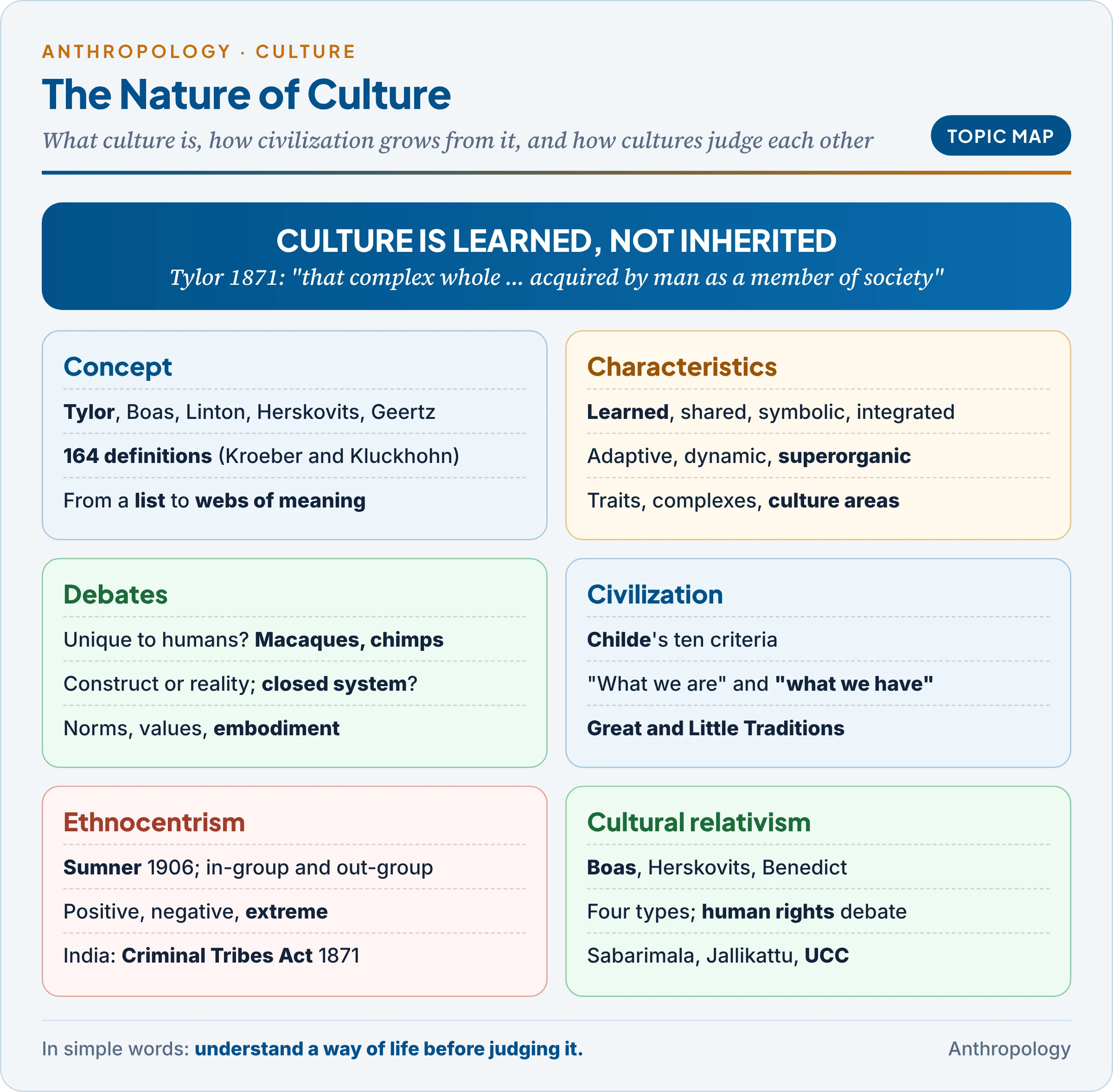
Culture is the central idea of socio-cultural anthropology. Unit 1.1 showed that anthropology studies humans holistically and comparatively; this unit explains what is being compared: culture, its characteristics, its relation to civilization, and the two attitudes with which one culture can look at another, ethnocentrism and cultural relativism. Society, the organised group that carries a culture, follows in Unit 2.2.
1. The Concept of Culture
In simple words
Culture is the whole way of life that people learn as members of a group: their language, food habits, beliefs, rules, tools and values. It is not carried in the genes; every child picks it up from the people around it. Because of culture, humans can live in almost any environment.
1.1 What culture means
Example first. A newborn child of Toda parents of the Nilgiris, if adopted at birth by a Bengali family in Kolkata, will grow up speaking Bengali, eating fish and rice and celebrating Durga Puja, with no trace of Toda buffalo rituals. The child inherits the Toda genes, but not Toda culture. The American anthropologist A.L. Kroeber made the same point with ants: ant eggs hatched on an island produce a colony that behaves exactly like its parents, because ant behaviour is instinctive; human infants left alone would grow up without their parents’ language or customs, because human behaviour is learned.
- Everyday versus anthropological meaning: in everyday speech “culture” means refinement (“a cultured man”); in anthropology every person and every society has culture, so no one is “uncultured”. Cultures differ in complexity, not in being present or absent.
- Origin of the word: from the Latin colere, “to tend or cultivate”, as in agriculture.
- First anthropological definition: the British anthropologist Edward Burnett Tylor, in Primitive Culture (1871), wrote that “Culture or Civilization, taken in its wide ethnographic sense, is that complex whole which includes knowledge, belief, art, morals, law, custom, and any other capabilities and habits acquired by man as a member of society”.
- Strength: it stresses that culture is acquired (“as a member of society”) and comprehensive.
- Weakness: it treats culture as a list of items, and it equates culture with civilization, which Tylor ranked in evolutionary stages (Unit 6a).
- How many definitions? A.L. Kroeber and Clyde Kluckhohn reviewed 164 definitions in Culture: A Critical Review of Concepts and Definitions (1952) and grouped them as descriptive, historical, normative, psychological, structural and genetic.
The definitions below show how the idea shifted from a list of items to a system of meanings. Read them as answers to the question “where does culture exist?”
| Scholar | Definition (core words) | Where culture lies |
|---|---|---|
| Tylor (1871) | “that complex whole which includes knowledge, belief, art, morals, law, custom…” | In a list of acquired habits |
| Franz Boas (1930) | “the totality of the mental and physical reactions and activities that characterize the behavior of the individuals composing a social group” | In learned behaviour of a particular group |
| Bronislaw Malinowski (1944) | Culture is an instrumental apparatus by which people satisfy their needs | In institutions that meet needs |
| Ralph Linton (1945) | “the configuration of learned behavior and results of behavior whose component elements are shared and transmitted by the members of a particular society” | In shared, transmitted behaviour |
| Melville Herskovits (1948) | “the man-made part of the environment” | In everything humans add to nature |
| Leslie White (1949) | Culture depends on symbolling; the symbol is its basic unit | In symbols |
| Ward Goodenough (1957) | “whatever it is one has to know or believe in order to operate in a manner acceptable to its members” | In knowledge in people’s minds |
| Clifford Geertz (1973) | “webs of significance” that man himself has spun | In public meanings |
The table shows two broad families of definition. Behavioural and material definitions (Tylor, Linton, Herskovits) locate culture in what people do and make; ideational definitions (Goodenough, Geertz) locate it in what people know and mean, and treat behaviour as its product. The difference matters for method: the first family observes and counts, the second interprets.
- Kluckhohn and Kelly (1945): culture is “all those historically created designs for living, explicit and implicit, rational, irrational, and nonrational, which exist at any given time as potential guides for the behavior of men”. The phrase design for living is the most widely used shorthand.
- David Bidney (Theoretical Anthropology, 1953) divided culture into artifacts (objects), sociofacts (social organisation) and mentifacts (language, religion, art), with agrofacts (products of cultivation).
1.2 The development of the concept of culture
The concept was not fixed once; each school of anthropology redefined it to suit its question. The figure follows the main turns.
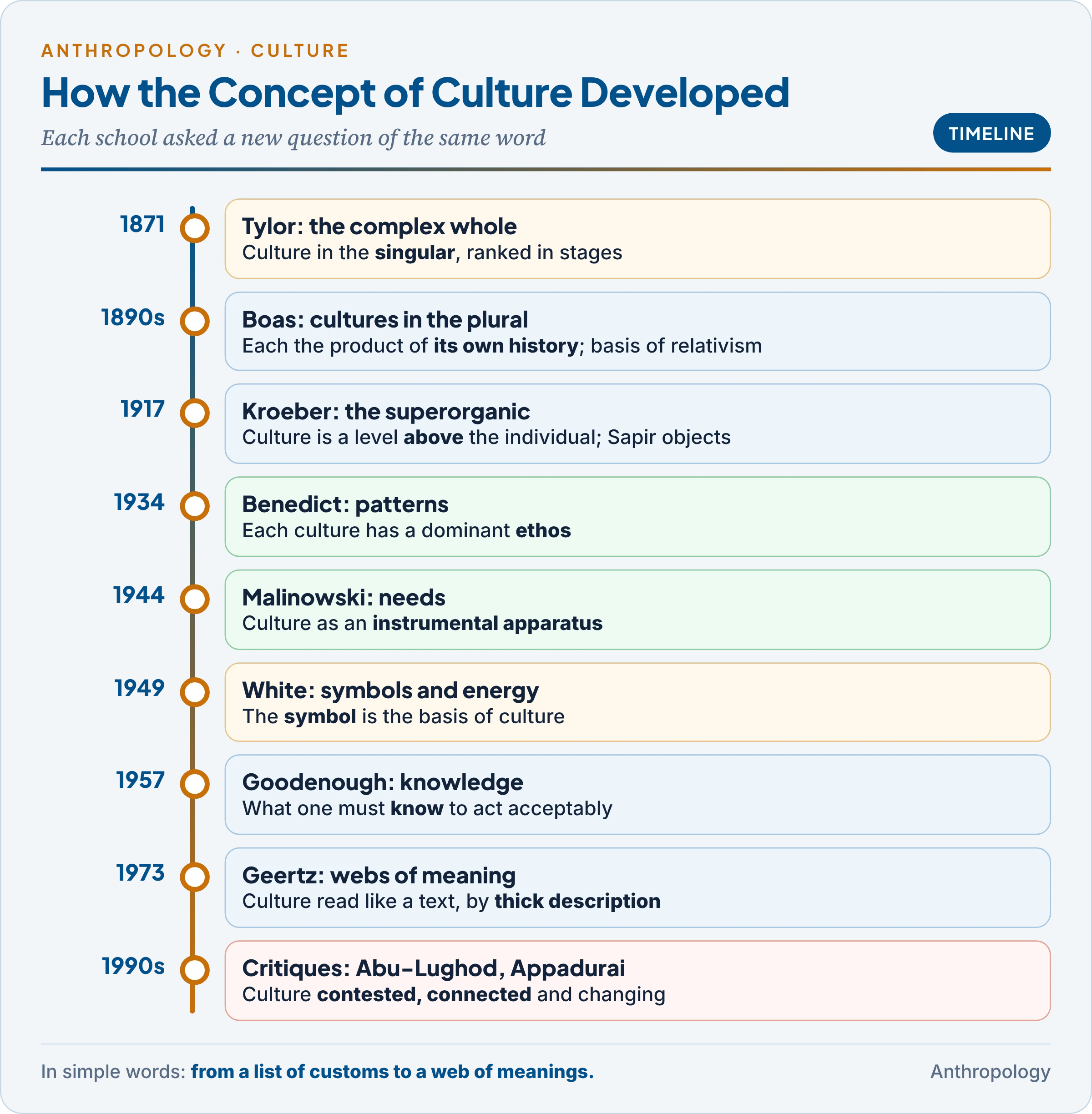
- Evolutionist (Tylor, Morgan, 1870s): culture in the singular, one human culture climbing through stages; societies were ranked by how much of it they had. This view rested on Victorian ethnocentrism.
- Boas and historical particularism (1890s–1920s): the German-American anthropologist Franz Boas spoke of cultures in the plural, each the product of its own history and to be understood in its own terms. This single change made cultural relativism possible (§5).
- Superorganic (Kroeber, 1917): culture is a level of reality above the individual and the organism, with its own patterns (§2.2).
- Functional (Malinowski, 1944; Radcliffe-Brown): culture as an integrated apparatus for satisfying needs; the British social anthropologist A.R. Radcliffe-Brown went further and called culture an abstraction, real only as social structure.
- Configurational (Ruth Benedict, Patterns of Culture, 1934): each culture is a pattern with a dominant ethos (emotional tone), like a personality writ large (Unit 6g).
- Symbolic and energetic (Leslie White, 1949): culture rests on the human capacity to create symbols; it evolves as the energy harnessed per person increases (Unit 6h).
- Cognitive (Goodenough, 1957) and structural (Claude Lévi-Strauss): culture as knowledge and as the product of universal mental structures (Unit 6f).
- Cultural materialism (Marvin Harris, 1968–79): culture shaped by material conditions: technology, environment and population (the infrastructure) shape social structure and ideas (Unit 6i).
- Interpretive (Geertz, 1973): culture as public meanings to be read like a text, by thick description.
- Critiques (1980s–1990s): Eric Wolf (Europe and the People Without History, 1982) attacked the picture of cultures as separate “billiard balls“; Lila Abu-Lughod (“Writing against Culture”, 1991) warned that the culture concept freezes differences; Arjun Appadurai (Modernity at Large, 1996) described culture as flows across global “scapes”. Culture today is seen as contested, changing and connected.
2. Characteristics of Culture
In simple words
Culture has a set of basic qualities. It is learned, shared, built on symbols, passed down, fitted together into a whole, useful for survival and always changing. It also outlives any one person, which is why some scholars say it stands above individuals.
2.1 The main characteristics
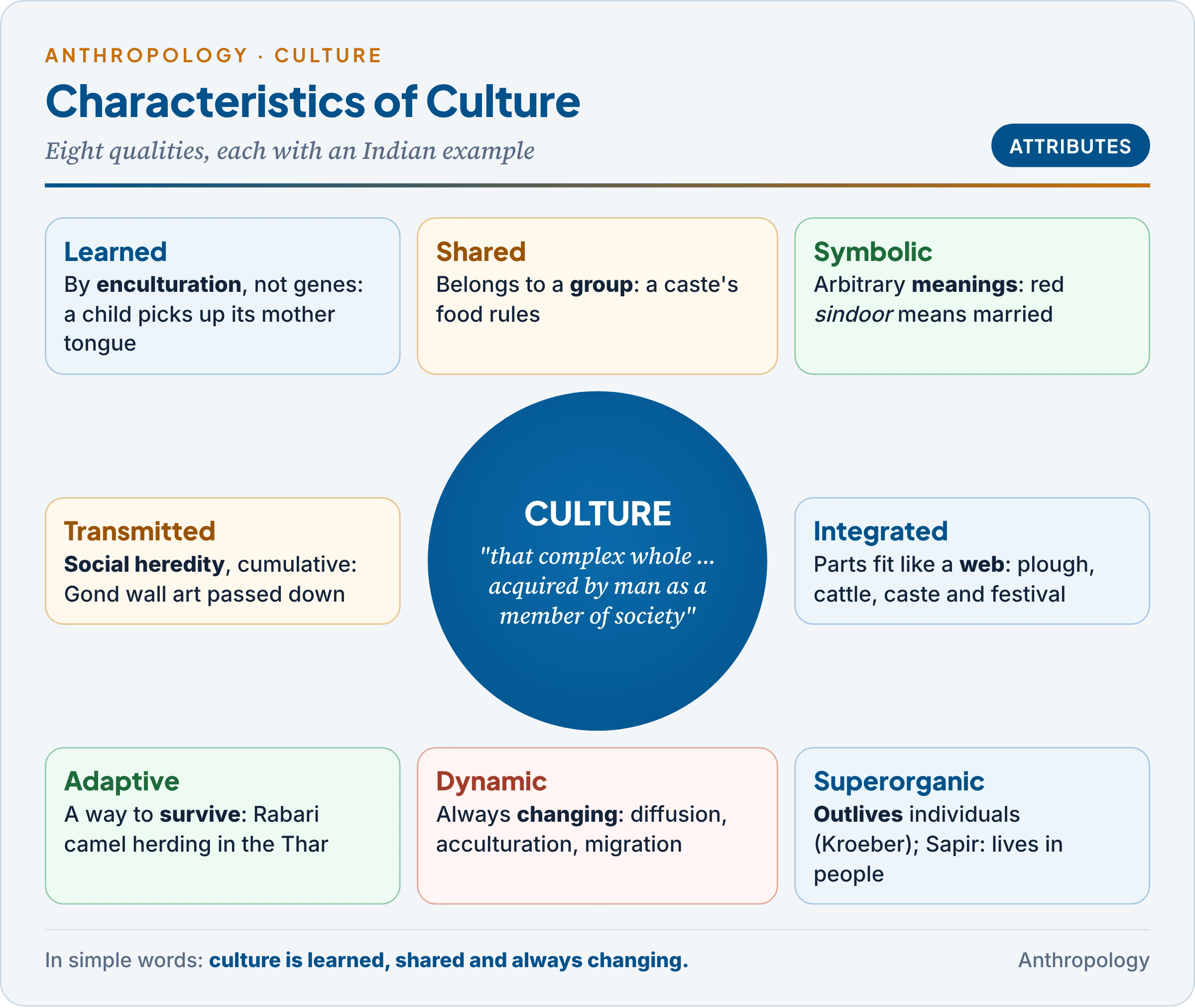
Example first. In a Gond village of central India, a girl learns to paint digna designs on house walls from her mother (learned); every household paints them at festivals (shared); the patterns stand for fertility and protection (symbolic); they pass to her daughters (transmitted); they are tied to the festival calendar, the crops and the house (integrated); the clay plaster cools the walls in summer (adaptive); and now the same designs appear in Gond art sold in cities (dynamic). One small practice carries all the characteristics of culture.
- Learned: culture is acquired by enculturation (Herskovits’s term for the lifelong process by which a person learns his or her own culture), not by genes. Kroeber’s ant example (§1.1) shows the difference between instinct and culture.
- Shared: culture belongs to a group, not to one person; a private habit is not culture. Sharing is never complete: men and women, castes and generations hold different parts of it, which gives subcultures.
- Symbolic: culture rests on symbols, meanings attached arbitrarily to things, sounds or acts (a red sindoor line means “married”). Leslie White held that “the symbol is the origin and basis of human behavior”; language is the master symbol system that lets culture be stored and taught (Unit 7).
- Transmitted and cumulative: culture passes from generation to generation as social heredity, and each generation adds to it, so it accumulates; this is why technology builds on earlier technology.
- Integrated (patterned): parts of a culture fit together, so a change in one part spreads to others, as a change in a spider’s web shakes the whole. Malinowski’s functionalism and Benedict’s patterns both rest on this. Integration is a tendency, never complete.
- Adaptive and sometimes maladaptive: culture is the chief human means of adapting to environments (Inuit snow houses, the Rabari’s camel herding in the Thar), but some practices harm their bearers (over-grazing, female infanticide).
- Dynamic: every culture changes, through invention, diffusion (borrowing traits from another culture) and acculturation (major change after continuous contact between two cultures); enculturation is the opposite process, the transmission of a culture within its own society.
- Gratifying: the American anthropologist George Peter Murdock (“The Cross-Cultural Survey”, 1940) listed seven characteristics: culture is learned, inculcated, social, ideational, gratifying, adaptive and integrative. Gratifying means it satisfies biological and acquired needs; traits that stop satisfying needs fade away.
- Ideational: culture exists as shared ideas, norms and ideals in people’s minds, expressed through objects and acts.
- Universal and unique: all humans have culture (cultural unity), but each society has a particular culture (diversity); the distinction between culture (the human capacity) and a culture (a particular way of life) expresses this.
2.2 Culture as superorganic
- Kroeber’s claim: in “The Superorganic” (American Anthropologist, 1917), Kroeber argued that culture forms a level of phenomena above the organic (biology) and the inorganic (physics). It existed before each individual is born and continues after death, so it is superindividual, and it follows its own patterns. His evidence included simultaneous inventions (the telephone patented on the same day by Bell and Gray), which suggested that inventions arise when a culture is ready, whatever the individual.
- Criticism: the American linguist-anthropologist Edward Sapir replied (“Do We Need a ‘Superorganic’?”, 1917) that culture exists only in individuals and their interactions; treating it as a thing above people reifies it (turns an abstraction into an object). The superorganic idea also leaves no room for human agency.
- Balanced view: culture is organic in origin (it rests on the human brain, hand and voice) but superorganic in persistence; it is created by people yet faces each person as an existing reality.
2.3 Units, components and attributes of culture
The units of culture run from the smallest element to whole regions; the table lists them in order of size.
| Unit | Meaning | Example |
|---|---|---|
| Culture trait | The smallest identifiable unit, with form, use, function and meaning | Namaste; the sacred thread |
| Culture complex | A cluster of traits around one activity | The plough complex (plough, bullocks, yoke, ploughman); the jajmani system |
| Culture pattern | The arrangement that gives a culture its distinctive shape | Benedict’s Apollonian Zuni and Dionysian Kwakiutl |
| Culture area | A region whose societies share many traits | Clark Wissler‘s Plains culture area of North America |
| Age-area | Traits spread outward from a centre, so the widest-spread trait is the oldest | Wissler and Kroeber’s method of estimating age from distribution |
These units let anthropologists compare and map cultures; the American diffusionists used culture areas and age-areas to reconstruct history without written records (Unit 6c).
- Patterns: Kroeber (Configurations of Culture Growth, 1944) separated stable systemic patterns (the alphabet, the plough complex) from changeable secondary patterns; Kluckhohn classed behaviour patterns as compulsory, preferred, typical, alternative and restricted.
- Material and non-material culture: objects (tools, houses) and ideas (beliefs, values); the American sociologist William Ogburn (Social Change, 1922) argued that material culture changes faster, so non-material culture shows a cultural lag (for example, laws on data privacy lagging behind digital technology).
- Universals, specialties and alternatives: Ralph Linton (The Study of Man, 1936) separated universals shared by all adult members (language, incest taboo), specialties shared by some categories (a potter’s skills, a priest’s rites) and alternatives open to choice (several ways to the same end).
- Universal pattern: Wissler listed nine headings found in every culture (speech, material traits, art, mythology and knowledge, religion, family and social systems, property, government, war); Murdock (1945) listed some seventy cultural universals.
- Overt and covert, explicit and implicit: overt items are directly observable to an outsider (dress, tools, speech), covert ones are not (fears, values). Kluckhohn distinguished explicit culture that members can describe from implicit culture of which they are only dimly aware, such as the grammar they speak by.
- Ideal and real culture: what people say they should do and what they actually do; the gap is normal and itself worth studying.
- Ethos and eidos: the ethos is the emotional tone of a culture; the eidos its cognitive or intellectual style (Gregory Bateson, Naven, 1936).
- Subculture and counterculture: a subculture is the distinctive way of life of a group within the larger culture (an occupation, a caste, a youth group); a counterculture (or contraculture) rejects the dominant values.
2.4 Norms and values
- Norms are shared rules of behaviour. The American sociologist William Graham Sumner (Folkways, 1906) distinguished folkways (customary ways of doing things, mildly enforced, such as greeting elders), mores (norms seen as vital for welfare, strongly enforced, such as incest rules) and laws (norms enacted and enforced by an authority).
- Values are shared ideas of what is good and desirable. Kluckhohn (1951) defined a value as “a conception, explicit or implicit… of the desirable which influences the selection from available modes, means and ends of action”. Values justify norms: the value of purity underlies many caste norms of food and touch, as Louis Dumont showed (Homo Hierarchicus, 1966).
- Why they matter: norms make behaviour predictable; values give it meaning; together they are the core of social control (Unit 4b). Their relevance today is seen where values clash, as when courts weigh constitutional morality against social morality in cases on religious custom (§5.4).
2.5 Is culture unique to human beings?
- Animal traditions: primatologists record learned, group-specific behaviours. Young Japanese macaques on Koshima island began washing sweet potatoes in 1953, after a female named Imo started it, and the habit spread through the troop; Andrew Whiten and colleagues (“Cultures in Chimpanzees”, Nature, 1999) found 39 behaviours, such as termite fishing and nut cracking, that differ between chimpanzee communities without ecological reasons.
- Human distinctiveness: human culture is symbolic (based on arbitrary meanings), cumulative (each generation improves on the last, a “ratchet effect”), carried by language, and normative (it contains ideas of right and wrong). Animal traditions lack these.
- Conclusion: many animals have proto-culture or traditions; only humans have culture in the full sense. The difference is of degree and kind together: a matter of the scale of learning and of symbols.
2.6 Culture as construct or reality, and as a closed system
- Construct or reality? For Kroeber and White, culture is a real order of phenomena that can be studied in its own right. For Radcliffe-Brown, culture is an abstraction made by the observer; what is real is people in social relations. Most anthropologists now take a middle position: culture is an analytical construct, but one that refers to real, observable regularities in thought and behaviour.
- The integrated, closed system and its drawbacks: functionalists and configurationists pictured each culture as an integrated, bounded whole. This picture is useful for showing how parts fit, but it misleads in today’s world:
- It hides internal variation and power: women, lower castes and the young may not share the dominant view (Abu-Lughod).
- It ignores connections: societies have long been linked by trade, empire and migration (Wolf’s “billiard balls”).
- It cannot explain change and hybridity, as in diaspora cultures or tribal youth using social media (Appadurai).
- It can be used politically to essentialise groups (“their culture is backward”), the reverse of relativism.
The Boasian insight that “all cultures are hybrid” (a 1982 question) answers the closed model: every culture is a product of borrowing as well as invention.
2.7 Culture and embodiment
- Meaning: embodiment is the idea that culture is not only in minds and symbols but in the body: in posture, gait, gesture, skill and the felt sense of the body.
- Mauss: the French anthropologist Marcel Mauss (“Techniques of the Body”, 1934 lecture, published 1935) noticed that walking, swimming, digging and sleeping are done differently in different societies; they are learned bodily techniques.
- Bourdieu: the French sociologist Pierre Bourdieu (Outline of a Theory of Practice, 1972) called such learned dispositions habitus: durable ways of standing, speaking and judging that people absorb from their social position and reproduce without thinking.
- Csordas and the “three bodies”: Thomas Csordas (“Embodiment as a Paradigm for Anthropology”, 1990) proposed that the body is the subject, not just the object, of culture; Nancy Scheper-Hughes and Margaret Lock (The Mindful Body, 1987) distinguished the individual body, the social body (the body as a symbol of society) and the body politic (the body as controlled by power).
- Indian examples: squatting and sitting cross-legged, eating with the right hand, the posture of pranam before elders, and the bodily discipline of yoga and of purity and pollution (who may touch whom) show caste and gender inscribed in bodies.
3. Civilization
In simple words
Civilization usually means a large, complex way of life with cities, writing, rulers, specialists and trade. It grows out of culture but is not separate from it: every civilization is a culture, but not every culture is a civilization. Scholars also contrast the material, measurable side of life (civilization) with its inner values (culture).
3.1 Meaning and criteria
Example first. The Harappan cities of the third millennium BC (Unit 1.8c) had planned streets, standard bricks and weights, writing on seals, full-time craftsmen and long-distance trade, while the farming villages around them had none of these, though they shared the same pottery and gods. The cities and villages had one culture; only the cities had civilization. Civilization is a special development of culture: a complex, urban, literate form of it.
- Evolutionist usage: Tylor used culture and civilization as synonyms. The American lawyer-anthropologist Lewis Henry Morgan (Ancient Society, 1877) made civilization the last of three stages, after savagery (marked by fire and the bow) and barbarism (marked by pottery, domestication and iron), beginning with the phonetic alphabet and writing.
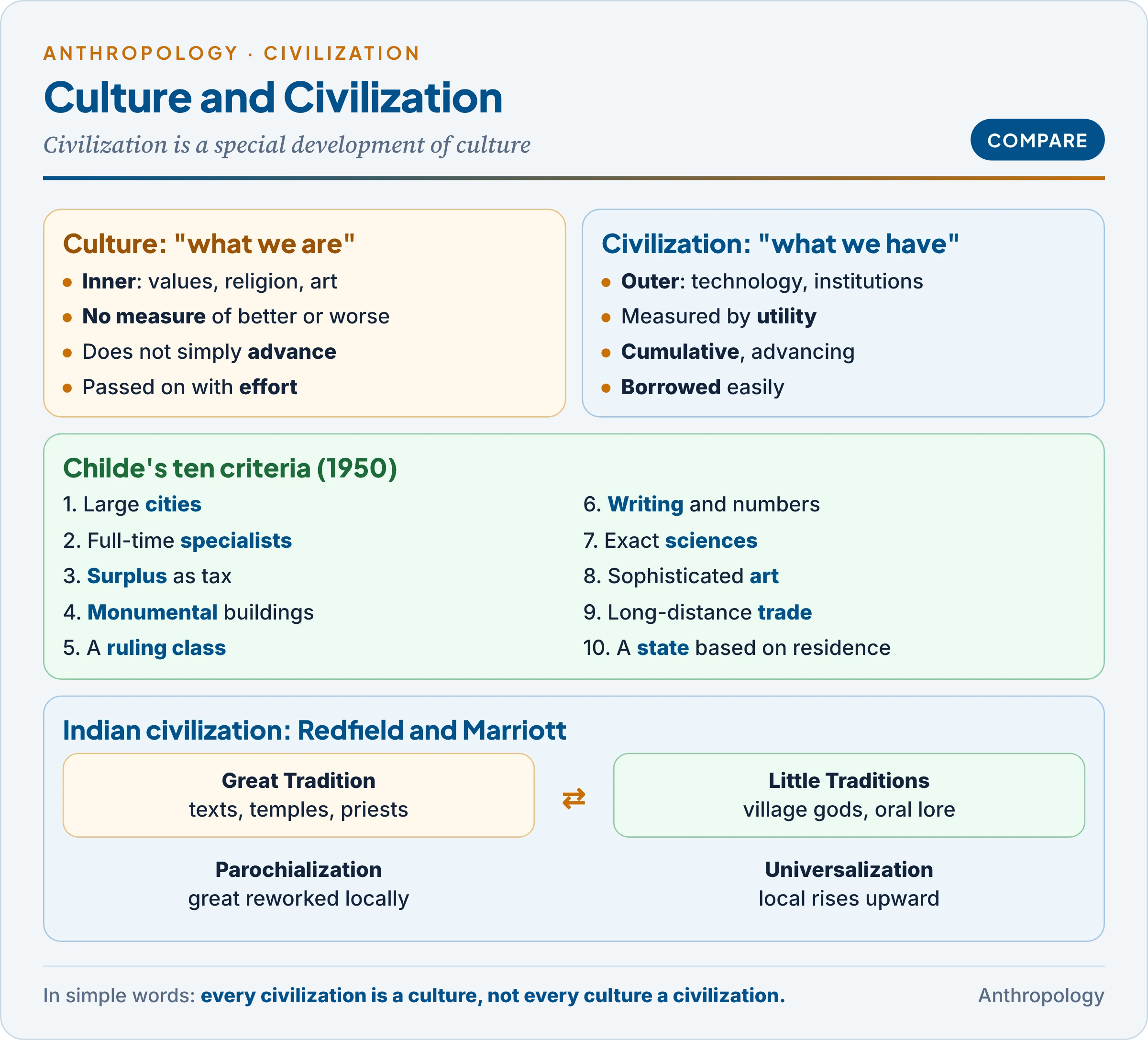
- Childe’s criteria: in “The Urban Revolution” (1950) V. Gordon Childe gave ten criteria, summarised by the American anthropologist Elman Service:
- large cities; full-time specialists; a surplus collected as tax or tribute; monumental public buildings; a ruling class
- writing and numbers; exact sciences (arithmetic, geometry, astronomy); sophisticated art; long-distance trade; a state based on residence rather than kinship
- Sociological criteria: the American sociologists J.L. and J.P. Gillin called civilization a more complex, evolved form of culture, and A.W. Green held that a culture becomes a civilization only when it has written language, science, philosophy, a specialised division of labour and a complex economic and political system.
- Criticism of Childe’s list: the traits seldom appear together. The Inca ran a great state and road network without writing (they kept records on knotted quipu cords). Childe’s list is therefore treated as a cluster of common features, not a checklist.
3.2 Culture and civilization distinguished
Some sociologists and philosophers drew a sharp line between culture and civilization. The table sets out their contrast; read the right-hand column as the material side and the left as the inner side.
| Point | Culture | Civilization |
|---|---|---|
| Nature | Inner: values, religion, art, literature, philosophy | Outer: technology, tools, machines, institutions |
| Formula | “What we are” (MacIver and Page) | “What we have or use” |
| Measurement | No objective standard: one cannot prove one painting better | Measurable by utility: a car is faster than a bullock cart |
| Progress | Does not necessarily advance | Cumulative and advancing |
| Transmission | Passed with effort, needs inner sympathy | Borrowed easily and without loss |
| Scholars | Alfred Weber, MacIver and Page, Ogburn | Same scholars, for the contrast |
The table follows the German sociologist Alfred Weber and the American sociologists R.M. MacIver and C.H. Page (Society, 1949), for whom civilization is the means and culture the end. Ogburn and Nimkoff called civilization “the latter phase of superorganic culture”. The German philosopher Oswald Spengler (The Decline of the West, 1918) reversed the value: civilization is the late, rigid stage of a culture that has lost its creative spirit, while the British historian Arnold Toynbee (A Study of History) saw civilizations grow through creative responses to challenges.
- Anthropological criticism: for anthropologists the sharp line is artificial. Technology is part of culture (Herskovits’s “man-made part of the environment”), and technology carries meaning: the Toda dairy is both a workplace and a temple. The two are interdependent: objects of civilization acquire cultural meaning, and cultural values decide how technology is used.
- The relationship today: civilization is best seen as culture at a particular scale and complexity, marked by cities, writing and the state; as it is often put, civilization is the body and culture the soul.
3.3 Civilization and the anthropology of India
- Great and Little Traditions: the American anthropologist Robert Redfield (Peasant Society and Culture, 1956) described a civilization as made of a great tradition, the reflective, written tradition of the learned few (Sanskrit texts, temples, priests), and little traditions, the oral, local traditions of village people. The two constantly feed each other.
- Orthogenetic and heterogenetic: Redfield and Milton Singer (“The Cultural Role of Cities”, 1954) distinguished primary civilizations that grow from their own folk culture through orthogenetic (carrying forward) transformation, as in India and China, from secondary civilizations formed by heterogenetic contact with other peoples, typical of modern commercial cities.
- Universalization and parochialization: McKim Marriott (Kishan Garhi, U.P., 1955) showed that local deities and festivals rise into the great tradition (universalization) and pan-Indian elements are reworked locally (parochialization). The village goddess worshipped as a form of Lakshmi is an example.
- Tribes in Indian civilization: N.K. Bose described the “Hindu method of tribal absorption“, and Surajit Sinha placed tribe and caste on a continuum within one civilization (Paper II, Units 3–4). L.P. Vidyarthi‘s sacred complex of Gaya treated pilgrimage centres as nodes of the civilization.
Common confusion
Are culture and civilization opposites? No. Culture is the whole learned way of life of any society, from a Jarawa band to a modern nation. Civilization is one kind of culture, large, urban, literate and state-organised. The sharper contrast of “inner culture” against “outer civilization” belongs to some sociologists and philosophers (Alfred Weber, MacIver); anthropologists treat material and non-material elements as parts of one culture.
4. Ethnocentrism
In simple words
Ethnocentrism is the habit of judging other people’s ways by the standards of one’s own group and finding them strange or inferior. Every group has some of it, because it gives members pride and unity. It becomes harmful when it turns into contempt, discrimination or domination.
4.1 Meaning and features
Example first. In 1871 the British government passed the Criminal Tribes Act, which declared whole communities, such as many Pardhi, Sansi and Kanjar groups, “criminal by birth“, required them to register and restricted their movement. Colonial officials judged mobile, non-farming ways of life by the values of settled Victorian society and labelled them criminal. The law (re-enacted in 1924) was repealed in 1949 and the communities were “denotified” in 1952; they are now known as Denotified Tribes, but the stigma remains. This is ethnocentrism turned into law.
- Definition: William Graham Sumner (Folkways, 1906) defined ethnocentrism as “the technical name for this view of things in which one’s own group is the center of everything, and all others are scaled and rated with reference to it”.
- In-group and out-group: ethnocentrism grows from the division between the in-group (“we”, marked by loyalty and cooperation) and the out-group (“they”, marked by distance or hostility). The Austrian sociologist Ludwig Gumplowicz called the primordial identification with one’s group syngenism.
- Double morality: Sumner observed “two codes of morals“, one for comrades inside and another for strangers outside; what is forbidden inside the group may be praised when done to outsiders.
- Universal: every group is ethnocentric to some degree. Many peoples’ names for themselves mean simply “people” or “true people“; the Greeks called non-Greeks barbaroi; China called itself the Middle Kingdom.
4.2 Forms, functions and dysfunctions
The table separates three degrees of ethnocentrism, from the harmless to the destructive.
| Degree | Meaning | Example |
|---|---|---|
| Positive | Preferring one’s own way of life; pride and identity | Celebrating one’s language and festivals |
| Negative | Ranking all others by one’s own standards | Calling forest peoples jungli |
| Extreme negative | A powerful group imposes its rule and actively destroys what others value | Colonial bans and forced assimilation; Nazi racial policy |
The table shows that ethnocentrism is a continuum. Mild ethnocentrism is almost necessary for group life, while extreme ethnocentrism underlies racism, colonialism and genocide.
- Functions: solidarity and morale, identity and continuity, resistance to outside domination (it can sustain minority cultures).
- Dysfunctions: prejudice and stereotypes, discrimination, conflict, resistance to useful change, and bad science: the classical evolutionists ranked societies as savage, barbarian and civilized with Victorian England at the top, which was ethnocentrism dressed as theory (Unit 6a).
- Social psychology: Henri Tajfel‘s social identity theory (1981) explains how simply sorting people into groups produces in-group favouritism, the psychological root of ethnocentrism.
- In anthropology itself: early colonial ethnographies described tribal religion as “superstition” and tribal marriage as “promiscuity”; the discipline’s turn to fieldwork and relativism was largely a correction of this.
5. Cultural Relativism
In simple words
Cultural relativism is the rule that a custom should be understood within the culture where it belongs, not judged by the standards of an outsider. It asks anthropologists to suspend their own preferences while studying others. It does not have to mean that every practice is right, which is the main point of debate.
5.1 Meaning and origins
Example first. The Jarawa of the Andaman Islands go almost unclothed and hunt pig and turtle in the forest. Visitors on the Andaman Trunk Road who threw food and filmed them as a spectacle judged them by their own idea of “civilised” dress and food. An anthropologist instead asks what clothing, food and the forest mean within Jarawa life, and how outside contact affects their health and autonomy. This shift, from judging to understanding in context, is cultural relativism.
- Meaning: a custom is neither good nor bad in itself; its meaning and function depend on the cultural setting in which it occurs. The American anthropologist Melville Herskovits stated the principle: “Judgments are based on experience, and experience is interpreted by each individual in terms of his own enculturation”.
- Boas’s foundations: Boas, trained in physics and geography and influenced by Kant‘s argument that the mind shapes all experience and by the German thinkers Herder and von Humboldt, argued that each culture must be understood through its own history and categories, and fought the racial theories of his day. His approach rests on four postulates:
- cultural behaviour is learned, not biologically determined
- cultural conditioning works mostly unconsciously, through habit
- every culture is equally developed by its own priorities; none is more “primitive“
- traits have meaning only in context, within the culture’s own pattern
- Herskovits systematised and named the doctrine (Man and His Works, 1948; Cultural Relativism, 1972), and Ruth Benedict popularised it (Patterns of Culture, 1934: cultures as different, equally valid selections from the “great arc” of human possibilities).
5.2 How relativism replaced ethnocentrism in anthropology
The shift from ranking cultures to understanding them happened through several historical and intellectual changes.
- Failure of evolutionism: ethnographic data did not fit single ladders of progress; Boas’s historical particularism showed that similar traits could arise from different histories (Unit 6b).
- Fieldwork: long participant observation (Malinowski in the Trobriand Islands, 1915–18) made anthropologists see customs from “the native’s point of view“, where they made sense.
- Fight against racism: Boas’s studies showing that head shape changes among immigrants’ children (1911) undermined racial determinism; Nazi racial policy and the Holocaust discredited ranking peoples.
- Decolonisation: after 1945, colonised peoples rejected the label “primitive”, and anthropologists were criticised for their colonial ties (Talal Asad, Anthropology and the Colonial Encounter, 1973).
- India: Verrier Elwin‘s defence of tribal ways against forced assimilation, and Jawaharlal Nehru‘s Tribal Panchsheel (foreword to Elwin’s A Philosophy for NEFA, 1959), whose first principle was that “people should develop along the lines of their own genius” with nothing imposed on them, put relativism into tribal policy, against G.S. Ghurye‘s view of tribes as “backward Hindus” to be integrated.
5.3 Types and value of cultural relativism
The American anthropologist Melford Spiro (“Cultural Relativism and the Future of Anthropology”, 1986) separated three kinds of relativism; the table adds the methodological use most anthropologists accept.
| Type | Claim | Status |
|---|---|---|
| Descriptive | Cultures differ, and behaviour is shaped by enculturation | Accepted as fact |
| Methodological | Suspend judgment while studying; understand in context | Accepted as research rule |
| Epistemological (cognitive) | Knowledge and perception are culture-bound; no neutral standpoint | Debated |
| Normative (ethical) | Right and wrong are only relative to each culture | Strongly contested |
The key point of the table is that methodological relativism (a tool for research) does not commit anyone to ethical relativism (the claim that no practice can be criticised). Much confusion in the debate comes from mixing the two.
Why has relativism been so dear to anthropologists?
- It makes objective ethnography possible, by guarding against the observer’s bias.
- It makes comparison honest: cultures are compared as different solutions to common problems, not ranked against one standard (the “comparative method” without ethnocentrism).
- It supports tolerance and the defence of minority and indigenous cultures against domination.
- It improves applied anthropology: development schemes that ignore local meanings fail, as when new houses were left empty because they ignored local rules of space; relativism asks planners to understand before they change.
5.4 Criticism, and cultural relativism and human rights
- Moral paralysis: if every practice is right in its own setting, nothing can be condemned, not even genocide, slavery, sati or female genital cutting.
- Whose culture? Cultures are not uniform; what is called “the culture” is often the view of powerful men and elders, while women, dalits or the young within the same society contest it. Relativism can silence these internal critics.
- Contradiction: the claim that “all values are relative” is itself put forward as a universal value (tolerance).
- Cultures change: many practices defended as timeless are recent, and societies reform themselves (the abolition of sati in 1829 was supported by Indian reformers such as Raja Rammohun Roy).
The human rights debate.
- AAA Statement (1947): when the United Nations drafted the Universal Declaration of Human Rights (adopted 1948), the American Anthropological Association’s Executive Board, in a statement drafted by Herskovits, warned that a declaration based on Western values could not apply to all cultures: “Standards and values are relative to the culture from which they derive“.
- AAA Declaration on Anthropology and Human Rights (1999): the Association reversed its stance, committing itself to the defence of human rights and holding that the capacity for culture itself depends on basic rights.
- Indigenous rights: the UN Declaration on the Rights of Indigenous Peoples (2007) protects the right to maintain distinct cultures, within the framework of universal human rights, combining both ideas.
- Critical (or ethical) relativism: most anthropologists now understand practices in context while judging them against universal minimal standards of bodily integrity and dignity, giving weight to the voices of those inside the culture who suffer from a practice. Clifford Geertz (“Anti Anti-Relativism”, 1984) defended relativism mainly as a guard against provincialism, not as a moral theory.
Indian cases. Indian courts regularly face the tension between respect for custom and individual rights.
- Sabarimala (2018): a five-judge bench ruled 4:1 that excluding women aged 10–50 from the temple was unconstitutional; in a 2019 review a larger bench was asked to examine the essential religious practices doctrine, and a nine-judge bench heard the reference in 2026.
- Shayara Bano v. Union of India (2017): the Supreme Court set aside instant triple talaq.
- Jallikattu: banned by the Supreme Court in 2014 on animal-welfare grounds; Tamil Nadu amended the law in 2017 to protect it as cultural heritage, and in 2023 a five-judge bench upheld the amendment.
- Tribal customary law: the Uttarakhand Uniform Civil Code (in force January 2025) exempts Scheduled Tribes, and Articles 371A and 371G protect the customary law of Nagaland and Mizoram, recognising that a single code may override valued tribal custom.
Common confusion
Does cultural relativism mean “anything goes”? No. In anthropology relativism is first a method: understand a practice in its own context before judging it. That is different from ethical relativism, the claim that no practice can ever be criticised. One can explain why sati or witch-hunting arose and what they meant, and still condemn them as violations of human dignity.
5.5 Ethnocentrism vis-à-vis cultural relativism
The table brings the two attitudes together; read it as the two ends of one continuum.
| Point | Ethnocentrism | Cultural relativism |
|---|---|---|
| Standard | One’s own culture | The culture being studied |
| Attitude | Exclusive, closed, judgmental | Inclusive, open, understanding |
| Use | Group solidarity, identity | Objective research, tolerance |
| Danger | Prejudice, racism, domination | Moral paralysis, silencing internal critics |
| Key scholars | Sumner (1906) | Boas, Herskovits, Benedict |
The two are not simply good and bad. Mild ethnocentrism gives identity, and uncritical relativism can excuse injustice; the anthropological position lies between them, as methodological relativism combined with universal minimal rights.
5.6 Culture change, race and ethnicity
- Culture change: cultures change through innovation, diffusion, acculturation (studied in the Redfield, Linton and Herskovits “Memorandum for the Study of Acculturation”, 1936), assimilation and transculturation (two-way exchange). Contra-acculturation is the conscious revival of the old culture against an intruding one, as in nativistic movements (Linton, 1943) such as the Tana Bhagat movement among the Oraon (1914). The German-Austrian Kulturkreis school explained change mainly by the diffusion of culture circles (Unit 6c).
- Race and ethnicity: race was a biological classification of humans by physical traits, now rejected as a scientific category because human variation is continuous and most genetic variation lies within populations (Unit 9.5). Ethnicity is a cultural identity based on shared descent, language, religion or history. The Norwegian anthropologist Fredrik Barth (Ethnic Groups and Boundaries, 1969) showed that ethnic groups are defined by the boundaries they maintain, not by the cultural content inside them; Indian movements for statehood or autonomy (Bodo, Naga) show ethnicity as a basis for political mobilisation.
Key Terms
| Term | Meaning in simple words |
|---|---|
| Culture | The learned, shared way of life of a group |
| Enculturation | Learning one’s own culture from birth onwards |
| Acculturation | Major cultural change after continuous contact between two cultures |
| Diffusion | Spread of a trait from one culture to another |
| Superorganic | Kroeber’s idea that culture is a level above biology and individuals |
| Culture trait | The smallest unit of a culture |
| Culture complex | A cluster of related traits around one activity |
| Culture area | A region whose societies share many traits |
| Cultural lag | Non-material culture falling behind changes in material culture |
| Folkways and mores | Mild customary norms and strongly enforced vital norms |
| Habitus | Learned bodily and mental dispositions absorbed from social position |
| Civilization | A complex, urban, literate, state-organised culture |
| Great and Little Traditions | The learned written tradition and the local oral traditions of a civilization |
| Ethnocentrism | Judging other cultures by the standards of one’s own |
| In-group and out-group | “We” and “they” groups |
| Cultural relativism | Understanding a custom within its own cultural context |
| Ethical relativism | The claim that right and wrong are only relative to each culture |
| Ethnicity | A cultural identity based on shared descent, language or history |
Contemporary Developments
- Deepavali on the UNESCO list (December 2025): Deepavali was inscribed on UNESCO’s Representative List of the Intangible Cultural Heritage of Humanity on 10 December 2025, at the twentieth session of the committee held at the Red Fort, New Delhi, India’s sixteenth element on the lists. Intangible heritage treats culture as living practice carried by communities.
- Sabarimala reference (2026): a nine-judge Constitution Bench heard the reference on the scope of religious freedom and the essential religious practices doctrine for 16 days from 7 April 2026 and reserved judgment on 14 May 2026; judges questioned whether the doctrine lets courts rank religious practices, a version of the relativism-versus-rights debate.
- Uttarakhand Uniform Civil Code (January 2025): the first state civil code of its kind came into force with Scheduled Tribes exempted under section 2, reflecting respect for tribal customary law.
- Hatti polyandry wedding (July 2025): two brothers of the Hatti community of the Trans-Giri area of Sirmaur, Himachal Pradesh (Scheduled Tribe since 2023), married the same woman in a traditional jodidara ceremony at Shillai, reviving public debate on judging fraternal polyandry by mainstream norms.
Diagrams to Master
- Topic map: concept → characteristics → civilization → ethnocentrism → relativism.
- Timeline of the concept: Tylor 1871, Boas, Kroeber 1917, Malinowski 1944, White 1949, Goodenough 1957, Geertz 1973, Abu-Lughod and Appadurai in the 1990s.
- Characteristics web: learned, shared, symbolic, transmitted, integrated, adaptive, dynamic, superorganic around Tylor’s definition, with one Indian example each.
- Culture and civilization: “what we are” against “what we have”; Childe’s ten criteria; great and little traditions.
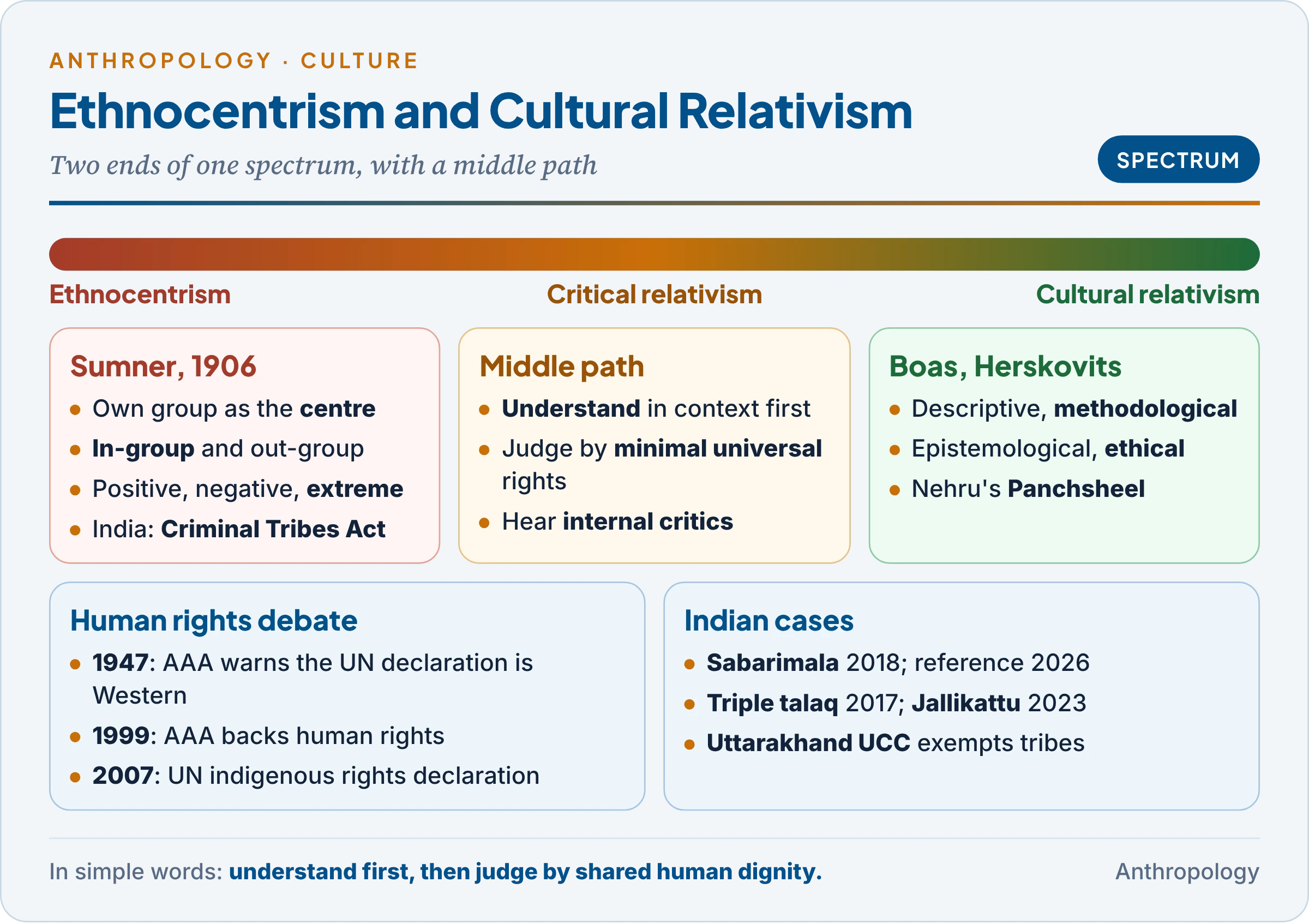
- Spectrum: ethnocentrism (Sumner; three degrees) → critical relativism → relativism (four types), with the human rights statements of 1947 and 1999.
Revision Grid
| Scholar | Work (year) | Key idea |
|---|---|---|
| Tylor | Primitive Culture (1871) | “Complex whole” definition |
| Morgan | Ancient Society (1877) | Savagery, barbarism, civilization |
| Sumner | Folkways (1906) | Ethnocentrism; folkways and mores |
| Kroeber | “The Superorganic” (1917) | Culture above the individual |
| Sapir | 1917 | Critique of the superorganic |
| Ogburn | Social Change (1922) | Cultural lag |
| Benedict | Patterns of Culture (1934) | Configuration; relativism |
| Mauss | “Techniques of the Body” (1935) | Culture in the body |
| Linton | The Study of Man (1936) | Universals, specialties, alternatives |
| Murdock | 1940 | Seven characteristics of culture |
| Malinowski | A Scientific Theory of Culture (1944) | Culture as instrumental apparatus |
| Herskovits | Man and His Works (1948) | Enculturation; cultural relativism |
| White | The Science of Culture (1949) | Symbol as basis of culture |
| Childe | “The Urban Revolution” (1950) | Ten criteria of civilization |
| Kroeber and Kluckhohn | 1952 | 164 definitions of culture |
| Redfield | Peasant Society and Culture (1956) | Great and Little Traditions |
| Goodenough | 1957 | Cognitive definition |
| Barth | Ethnic Groups and Boundaries (1969) | Ethnic boundaries |
| Geertz | The Interpretation of Cultures (1973) | Webs of significance |
| Spiro | 1986 | Types of relativism |
| Csordas | 1990 | Embodiment paradigm |
Previous Year Questions
Unit 2.1: The nature of culture
- 2025Write notes on: Culture and embodiment.
- 2025Critically examine the drawbacks in assuming culture as an ‘integrated-closed system’ in understanding of contemporary society.
- 2024Write notes on: Attributes of culture.
- 2023Write notes on: Race and Ethnicity.
- 2022Discuss the historical and cultural contexts that led to superseding ethnocentrism with cultural relativism in anthropology.
- 2020Write notes on Human rights and Cultural relativism in about 150 words.
- 2019Write a note in 150 words on Cultural Relativism.
- 2017Discuss the development of the concept of culture in Anthropology.
- 2016Write a note in 150 words on Cultural Relativism.
- 2014Is culture unique to human beings ? Critically examine.
- 2013Bring out the distinguishing features of culture and civilization. (250 words).
- 2013Why has the concept of Cultural Relativism been so dear to anthropologists ? (250 words).
- 2010Write a note in 150 words on Cultural; relativism and subseqent violation on human rights.
- 2010What stage is known as the incipient stage of food production ? Point out major features of this cultural stage. Illustrate your answer with suitable examples from a specific area in the old world.
- 2003Write a note on Cultural Materialism.
- 2002“Components of culture are vast and varied.” Explain this statement.
- 2000Write a note on Culture Area & Age Area.
- 1999Write a note on Culture trait and Culture complex.
- 1998Write a note on Pattern of culture.
- 1998Write a note on Superorganic view of culture.
- 1997Write a note on Acculturation and contra-acculturation.
- 1997Elucidate the various concepts of social and cultural changes indicating the specific problems involved in the change process.
- 1997What do you understand by cultural relativistic approach and ethnocentric approach in the study of culture ? Discuss the logical premises of cultural relativist approach.
- 1995Write a note on Cultural relativism.
- 1995What is cultural change ? How did the Austro-German school put up the scheme of cultural change ?
- 1993Write a note on Norms and Values.
- 1992What do you understand by ‘norms and values. Write briefly on cultural relativism.
- 1991Write a note on Culture and civilization.
- 1990What do you understand by ‘norms and values’ ? Discuss their anthropological perspective and relevance in contemporary times.
- 1989Write a note on Culture as Construct or Reality.
- 1988What do you understand by ‘norms and values’ ? Discuss their anthropological perspective and relevance in the context of contemporary times.
- 1987Write a note on Cultural relativism.
- 1987How does culture differ from civilization? Describe the attributes of culture.
- 1984What is cultural relativism ? Evaluate its importance for the development of comparative method in social anthropology.
- 1983Civilization is a special development of culture. Elaborate.
- 1982All cultures are hybrid. Substantiate.
- 1981Indicate the implications of culture relativism for applied Anthropology. (200 words).
Related questions from other units and Paper II
- 2026Unit 3.2: Make a critical appraisal of Surajit Sinha’s line of argument that tribes and castes may not be isolated social categories, but are a part of the great Indian civilization.
- 2025Unit 5.3: Write notes on: Characteristics and communication between Little and Great Traditions.
- 2023Unit 2.2: Write notes on: William Ogburn and Cultural lag.
- 2016Unit 5.3: Examine the nature of interplay of little and great traditions in the context of globalization.
- 2014Unit 5.3: Write a note in 150 words on Great tradition and Little tradition.
- 2011Unit 5.3: Write a note in 150 words on Critique of the concept of Great and Little Tradition.
- 2010Unit 5.3: Write a note in 150 words on Universalization and Parochialization.
- 2000Unit 1.1: Write a note on Criteria of civilization.
- 1999Unit 1.1: Critically examine various sources of India’s culture and civilization. Also distinguish between primary and secondary civilization.
- 1998Unit 6: Define ‘culture area’. How did it help the American diffusionists to understand diffusion of culture ?
- 1997Unit 1.1: Write a note on Components of cultures and its link with civilization.
- 1983Unit 1.1: Discuss how Anthropology is concerned with common humanity and universal values.