

1.4 Human Evolution and emergence of Man: Biological and Cultural factors in human evolution. Theories of Organic Evolution (Pre-Darwinian, Darwinian and Post-Darwinian). Synthetic theory of evolution; Brief outline of terms and concepts of evolutionary biology (Doll’s rule, Cope’s rule, Gause’s rule, parallelism, convergence, adaptive radiation, and mosaic evolution).
Official Syllabus: Paper I, Unit 1.4
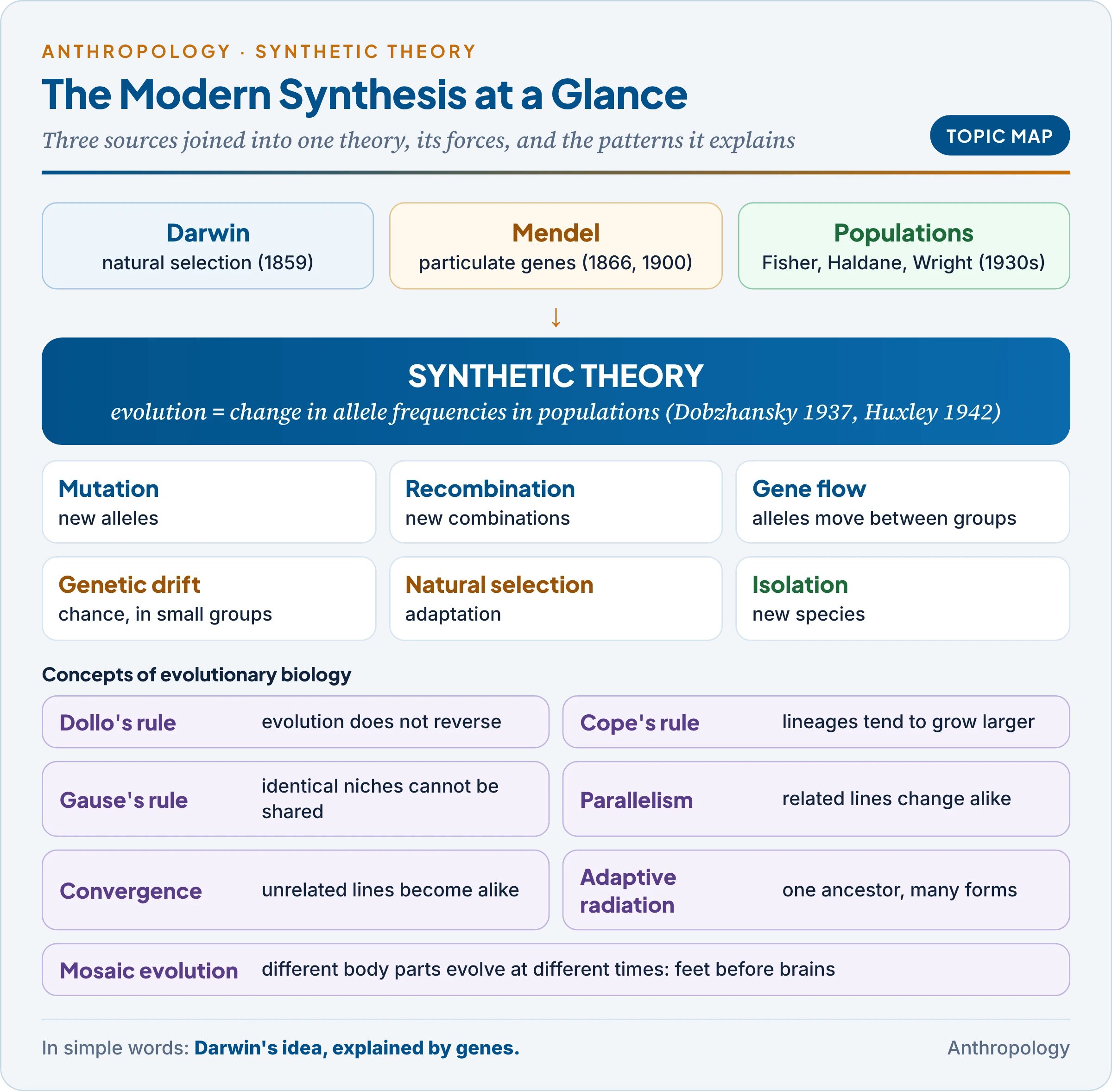
This article covers the synthetic theory of evolution and the terms and concepts of evolutionary biology. The biological and cultural factors in human evolution and the pre-Darwinian, Darwinian and post-Darwinian theories are in Unit 1.4a.
1. The Synthetic Theory: Darwin Joined to Genetics
In simple words
Darwin explained how nature selects among living things, but he did not know how traits are inherited. Genetics later showed that traits pass on through genes. In the 1930s and 1940s scientists joined the two ideas: evolution became the change in the frequency of genes in a population over generations. This joined theory is called the synthetic theory, or the modern synthesis.
In 1848 a black form of the peppered moth was first recorded near Manchester; until then the moth was almost always pale and speckled, well hidden on lichen-covered bark. As factory soot blackened the trees, birds found the pale moths more easily, and by the 1890s about 98 per cent of the moths around Manchester were black. After clean-air laws of the 1950s, the pale form returned. The case contains the whole synthetic theory: a single mutation (now traced to an insertion of mobile DNA in a gene called cortex) supplied the variation, natural selection by birds changed the frequency of the allele in the population, and the change reversed when the environment did. The British geneticist J.B.S. Haldane calculated in 1924 that so rapid a rise needed a strong selective advantage, far stronger than Darwin had imagined.
1.1 Why a synthesis was needed
- From about 1880 to 1920, Darwinism was in “eclipse”. Mutationists (Bateson, de Vries) held that evolution proceeds by large jumps, while biometricians (Pearson, Weldon) defended gradual selection of continuous variation (Unit 1.4a §7.5).
- The quarrel ended when it was shown that many genes of small effect produce continuous variation (R.A. Fisher, 1918), and that small mutations are exactly the fuel that selection needs. Genetics and selection were partners, not rivals.
- The British biologist Julian Huxley named the result “The Modern Synthesis” (Evolution: The Modern Synthesis, 1942). It is also called the synthetic theory or, loosely, neo-Darwinism.
1.2 The architects
The synthesis was built in stages, as each field showed that its evidence fitted the same mechanism.
| Scholar | Field | Work (year) | Contribution |
|---|---|---|---|
| R.A. Fisher (British) | Mathematical genetics | The Genetical Theory of Natural Selection (1930) | Selection acting on many small genes; fitness measured mathematically |
| J.B.S. Haldane (British, later Indian) | Mathematical genetics | The Causes of Evolution (1932) | Rates of change under selection, mutation and migration |
| Sewall Wright (American) | Population genetics | “Evolution in Mendelian Populations” (1931) | Genetic drift in small populations; the “adaptive landscape” |
| Theodosius Dobzhansky (Russian-American) | Experimental genetics | Genetics and the Origin of Species (1937) | Joined laboratory genetics to wild populations; isolating mechanisms |
| Ernst Mayr (German-American) | Systematics | Systematics and the Origin of Species (1942) | Biological species concept; geographical speciation |
| Julian Huxley (British) | Zoology | Evolution: The Modern Synthesis (1942) | Named and summarised the synthesis |
| George Gaylord Simpson (American) | Palaeontology | Tempo and Mode in Evolution (1944) | Fossil record fits population genetics |
Read across the “Field” column and the meaning of “synthesis” becomes clear: mathematics, laboratory genetics, classification and fossils all converged on one explanation. The theory reached anthropology through Sherwood Washburn‘s “The New Physical Anthropology” (1951), which replaced the measuring of racial types with the study of evolutionary processes in populations (Unit 1.3). Haldane has an Indian link: he moved to India in 1957, worked at the Indian Statistical Institute, Calcutta, became an Indian citizen, and died in Bhubaneswar in 1964.
1.3 The core propositions
- The population is the unit of evolution. An individual’s genes are fixed at conception, so an individual cannot evolve; only a population (an interbreeding group sharing a gene pool, the total of all alleles in it) changes over generations.
- Evolution is a change in allele frequencies. An allele is one version of a gene. If the proportion of an allele rises or falls from one generation to the next, the population has evolved. Dobzhansky defined evolution as “a change in the genetic composition of populations”.
- Variation comes from mutation and recombination, and is spread by gene flow.
- Natural selection, genetic drift and gene flow change allele frequencies; natural selection is the only force that makes populations better adapted.
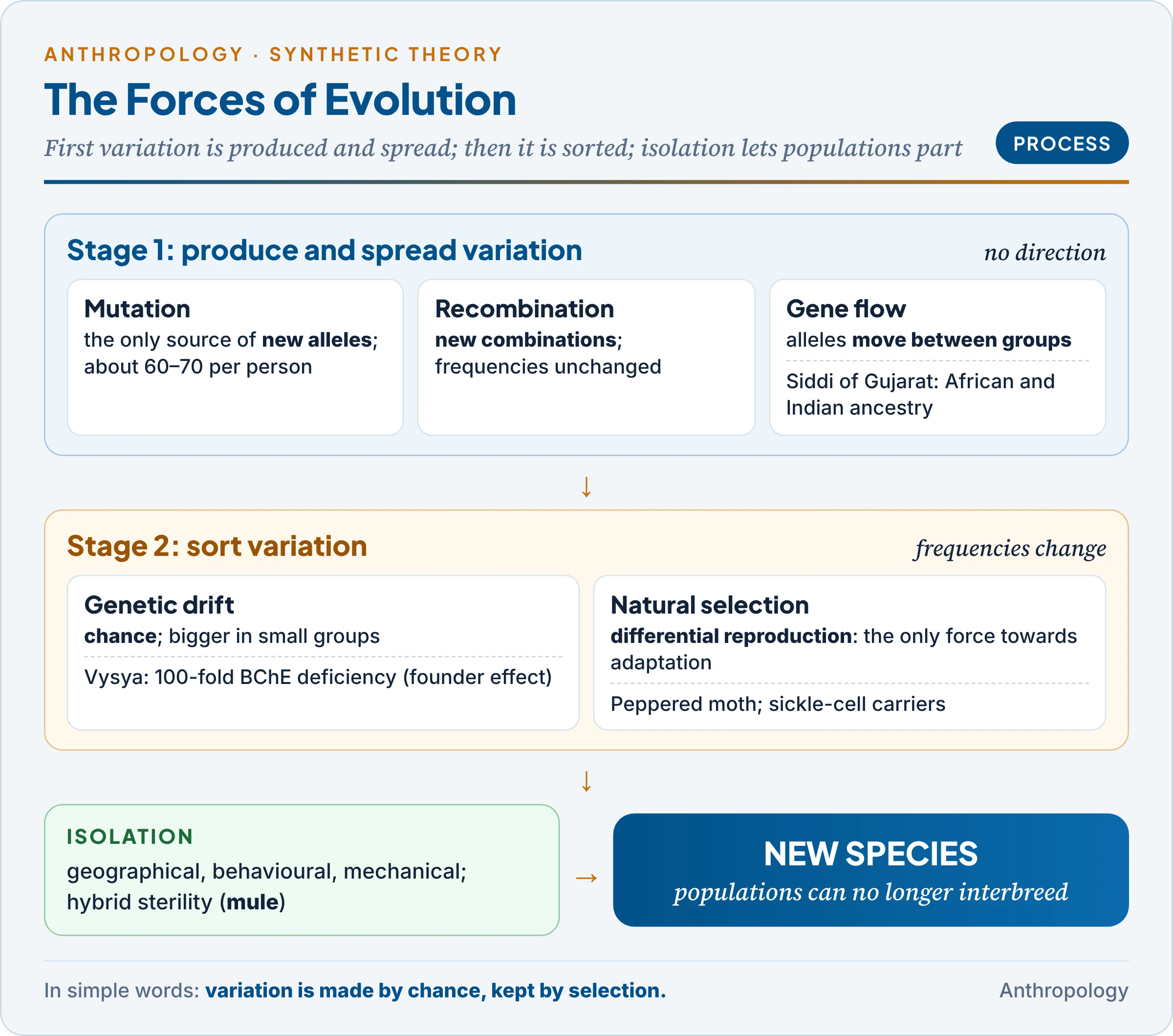
- Evolution is a two-stage process: first variation is produced and redistributed, then selection sorts it.
- New species arise through reproductive isolation, usually after geographical separation.
- Macroevolution is accumulated microevolution: the large changes seen in fossils come from the same processes acting over long periods.
1.4 Darwinism and the synthetic theory compared
The synthetic theory keeps Darwin’s core and replaces what he got wrong or could not explain.
| Basis | Darwinism (1859) | Synthetic theory (1930s–40s) |
|---|---|---|
| Source of variation | Unknown; “innate” | Mutation, recombination, gene flow |
| Inheritance | Blending; pangenesis | Particulate (Mendelian genes) |
| Acquired characters | Possibly inherited | Not inherited (Weismann) |
| Unit of evolution | Individuals and species | Population and its gene pool |
| Definition of evolution | Descent with modification | Change in allele frequencies |
| Forces | Natural selection (and sexual selection) | Selection plus mutation, drift, gene flow, isolation |
| Role of chance | Small | Genetic drift important in small populations |
| Speciation | By divergence, mechanism vague | Reproductive isolation; biological species concept |
| Method | Observation and analogy | Mathematical models, experiments, field genetics |
The comparison shows that the synthesis is Darwinism plus genetics plus populations. Its two great additions are the idea that evolution is measurable as allele frequency change, and the recognition that chance (drift) as well as selection changes populations.
Common confusion
Are neo-Darwinism and the synthetic theory the same thing? Not strictly. Neo-Darwinism first meant Darwin’s theory purged of Lamarckian inheritance by Weismann (1890s), before Mendel was rediscovered. The synthetic theory of the 1930s–40s added Mendelian and population genetics, drift, isolation and the species concept. Today many writers use “neo-Darwinism” loosely for the synthetic theory, so read the date and context.
2. The Forces of Evolution
In simple words
Several forces change the genes of a population. Mutation creates new versions of genes; recombination shuffles them in every generation; migration carries them between populations; chance can change them in small groups; and natural selection keeps the useful ones. Isolation then lets populations drift apart until they become separate species.
The Vysya, a trading community of Andhra Pradesh, have about a 100-fold higher rate of butyrylcholinesterase deficiency than other Indian groups. People with the condition cannot quickly break down certain muscle relaxants used in surgery, so Vysya ancestry is a known warning sign for anaesthetists. The cause is not selection: a few founders carried the allele, and marriage within the community kept it there. Nathan Nakatsuka and colleagues (Nature Genetics, 2017) found that 81 of 263 South Asian groups studied have founder events stronger than those of Finns or Ashkenazi Jews. A social rule, endogamy, turned chance into a lasting genetic difference.
2.1 Two stages: producing variation and sorting it
The forces fall into two groups, and the distinction explains how evolution can be both creative and directional.
| Stage | Force | What it does | Changes allele frequency? |
|---|---|---|---|
| 1. Produce and spread variation | Mutation | Creates new alleles | Yes, but very slowly |
| Recombination | Creates new combinations of existing alleles | No (only new genotypes) | |
| Gene flow (migration) | Moves alleles between populations | Yes | |
| 2. Sort variation | Genetic drift | Random change, strongest in small groups | Yes, without direction |
| Natural selection | Favours alleles that raise reproductive success | Yes, towards adaptation | |
| Then | Isolation | Stops gene flow, so populations diverge | Allows divergence |
The table carries the key idea of the synthesis: mutation and recombination supply the raw material, but have no direction; only selection gives evolution a direction towards adaptation, while drift gives it random wanderings.
2.2 Mutation
- A mutation is a heritable change in DNA. Point (gene) mutations change one or a few DNA letters; chromosomal aberrations change the number or structure of chromosomes (Unit 9.4).
- Only mutations in sex cells (germ line) pass to offspring and matter for evolution; mutations in body cells die with the individual.
- Rates are low: each human is born with about 60–70 new mutations among about three billion DNA letters. Most are neutral, some harmful, a few beneficial.
- Why it matters: mutation is the only source of genuinely new alleles. On its own it shifts frequencies too slowly to cause much change; coupled with selection, it drives adaptation.
2.3 Recombination
- In forming sex cells (meiosis), chromosomes from the two parents are shuffled (independent assortment) and exchange segments (crossing over). Each parent can produce over 8 million chromosome combinations from independent assortment alone, before crossing over adds more.
- Recombination does not change allele frequencies, but it creates new combinations on which selection can act. Adaptation usually depends on a team of genes, and only recombination can assemble such teams. This is why, apart from identical twins, no two humans are genetically alike, and why sexual reproduction speeds evolution.
2.4 Gene flow (migration)
- Gene flow is the movement of alleles between populations through migration and interbreeding. It adds variation to the receiving population and makes populations more alike, working against divergence.
- Indian cases: the Siddi of Gujarat and Karnataka descend from Africans who came to India over many centuries, and carry substantial Indian admixture (Anish Shah and colleagues, 2011). On a larger scale, most Indians descend from a mix of South Asian hunter-gatherers, Iranian-related Neolithic farmers and Steppe pastoralists (Elise Kerdoncuff and colleagues, Cell, 2025).
- Archaic gene flow: modern humans received about 1–2 per cent of their DNA from Neanderthals and Denisovans. Some of it was useful: the EPAS1 variant that helps Tibetans live at high altitude came from Denisovans.
- Culture controls it: in humans, social rules (caste endogamy, clan exogamy, preferred marriage partners) decide who mates with whom. This is why biological anthropologists need social anthropology to measure gene flow.
2.5 Genetic drift
Genetic drift is random change in allele frequency from one generation to the next, caused by chance in which individuals happen to reproduce. Its effect is inversely related to population size: the smaller the population, the larger the drift.
Worked example (from an accident to drift):
- A village of 100 people has 200 copies of the ABO gene; 60 are the O allele (frequency 0.30). Two people of blood group OO die in a road accident before having children, removing 4 O alleles. The next generation draws from 56 of 196 alleles: frequency 0.286. The population has evolved, by chance.
- In a town of 10,000 (6,000 of 20,000 alleles are O), the same accident leaves 5,996 of 19,996: frequency 0.2999, practically unchanged.
- If the victims had died because of an inherited trait (say, poor eyesight), the change would be selection, not drift. Drift means the genes had nothing to do with the event.
Two special forms of drift are common in human history:
- Founder effect: a small group founds a new population and carries only a sample of the parent population’s alleles. The Dunkers, a religious group in Pennsylvania studied by Bentley Glass (1950s), differed in blood-group frequencies both from the German population they came from and from their American neighbours. The Vysya case above is an Indian example.
- Bottleneck: a population is sharply reduced (by famine, epidemic or war) and the survivors’ alleles are a random sample. The Andamanese groups, reduced to a few hundred people after colonial contact, show the low diversity typical of bottlenecks.
2.6 Natural selection
Natural selection is differential reproductive success: individuals with some genotypes leave more surviving offspring than others. Fitness is measured by offspring left, not by strength or health alone.
Worked example (selection against a recessive lethal): let q be the frequency of a recessive allele that kills homozygotes (aa) before they reproduce. Each generation the new frequency is q′ = q / (1 + q), and after n generations qₙ = q₀ / (1 + n q₀).
- Starting at q = 0.5: 0.333, then 0.25, then 0.20 after three generations: fast at first.
- Starting at q = 0.01: it takes about 100 generations (roughly 2,500 years in humans) just to halve it to 0.005.
- Why it slows: when an allele is rare, almost all copies sit hidden in healthy carriers (Aa), where selection cannot see them. This is why harmful recessive alleles persist, and why consanguineous marriage, which brings two hidden copies together, raises the rate of recessive disease (Unit 9.3).
Units of selection and evolution: selection acts on individuals (who reproduce or do not), but evolution is measured in populations (whose allele frequencies change).
2.7 Isolation and hybridisation
Isolating mechanisms (Dobzhansky’s term, 1937) are barriers that stop two populations from interbreeding successfully. Without them, gene flow would erase any differences that drift and selection create.
| Type | Mechanism | Example |
|---|---|---|
| Pre-zygotic (before fertilisation) | Geographical or ecological: different places or habitats | Populations on either side of a mountain range or river |
| Seasonal (temporal): breed at different times | Plants flowering in different months | |
| Behavioural (ethological): different courtship signals | Bird songs; firefly flash patterns | |
| Mechanical: reproductive organs do not fit | Insects with lock-and-key genitalia | |
| Post-zygotic (after fertilisation) | Hybrid inviability: hybrids die early | Many frog crosses |
| Hybrid sterility: hybrids survive but cannot breed | Mule (horse × donkey) |
Pre-zygotic barriers are favoured by selection because they prevent wasted matings; post-zygotic barriers act only after the waste has occurred (Ernst Mayr, 1970). Hybridisation, the crossing of genetically different populations or species, is not only artificial: it happens in nature and can add useful genes, as with Neanderthal and Denisovan genes in modern humans.
The Hardy–Weinberg baseline: in a large, randomly mating population with no mutation, migration or selection, allele and genotype frequencies stay constant (p² + 2pq + q² = 1). The law is a null model: when a real population departs from it, one of the forces above is at work (Unit 9.3).
3. Modes of Natural Selection
In simple words
Natural selection can push a population in three main ways. It can move the average in one direction, it can favour the average and remove extremes, or it can favour both extremes over the average. In some cases it keeps two forms of a gene in balance because carrying both is best.
Among 13,730 babies born in a London hospital between 1935 and 1946, Mary Karn and Lionel Penrose found that babies of about 3.6 kg had the lowest death rates; very small and very large babies died more often (1951). Selection was removing both extremes and favouring the middle. This is stabilising selection, and it shows that selection often keeps a population as it is rather than changing it.
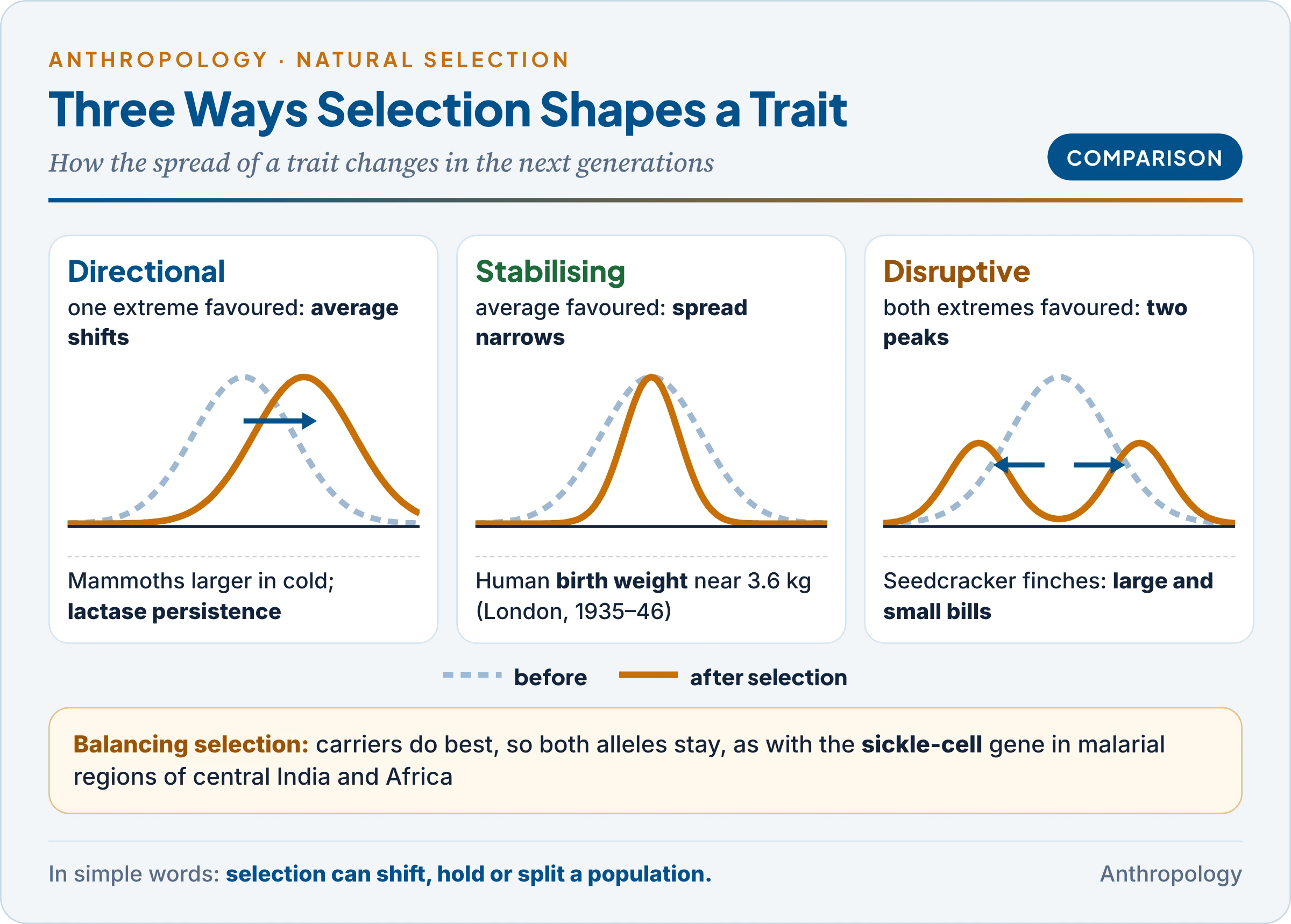
The table sets out the main modes. Notice what each does to the average and to the spread of a trait.
| Mode | What is favoured | Effect on the trait | Example |
|---|---|---|---|
| Directional | One extreme | Average shifts; spread similar | Mammoths grew larger as the climate cooled; lactase persistence; dark peppered moths |
| Stabilising | The average | Average same; spread narrows | Human birth weight (Karn and Penrose, 1951) |
| Disruptive (diversifying) | Both extremes | Population splits into two peaks | African seedcracker finches: large-billed and small-billed birds suit two seed types (Thomas Smith, 1993) |
| Balancing | Heterozygotes, or rare forms | Two or more alleles kept in the population | Sickle-cell carriers (HbAS) resist malaria; both alleles persist |
| Sexual | Traits that win mates | Can produce costly ornaments | Peacock’s tail |
Directional selection changes populations; stabilising selection preserves them; disruptive selection can begin a split into two forms, though interbreeding pulls them together again unless some reproductive isolation develops. Balancing selection explains why some harmful alleles stay common: the sickle-cell allele harms people with two copies but protects carriers in malarial regions, which is why it reaches high frequencies in parts of central India’s tribal belt.
4. Species and Speciation
In simple words
A species is a group whose members can breed with one another and have fertile young, but not with other groups. New species form when one population is cut off from another, usually by geography, and the two change separately until they can no longer interbreed.
In the Western Ghats, small bush frogs of the genus Raorchestes live on separate hill massifs divided by low valleys such as the Palghat Gap. S.P. Vijayakumar and colleagues (2016) showed that this group has radiated within the Western Ghats into many species, driven by geographical barriers and by differences in altitude and climate. Frogs on different massifs stopped exchanging genes, diverged, and became distinct species: speciation in an Indian landscape.
- Biological species concept (Ernst Mayr, 1942): species are “groups of actually or potentially interbreeding natural populations, which are reproductively isolated from other such groups”. Reproductive isolation, not appearance, is the test.
- Limits: the concept cannot be applied to asexual organisms or to fossils, whose breeding cannot be observed. Palaeoanthropologists therefore use morphological and phylogenetic species, and debate whether fossil hominins should be “lumped” into few species or “split” into many.
- Anagenesis and cladogenesis: a lineage can change gradually into a new form without splitting (anagenesis, giving chronospecies), or split into two or more lineages (cladogenesis). Only cladogenesis multiplies species.
Modes of speciation:
| Mode | How it happens | Example |
|---|---|---|
| Allopatric (geographical) | A physical barrier divides a population | Western Ghats bush frogs; Galápagos finches |
| Peripatric | A small group at the edge is isolated; drift and selection act fast | Island colonists; Mayr’s founder model |
| Sympatric | A new species arises within the same area | Polyploid plants; cichlid fishes in African crater lakes |
Allopatric speciation, which Moritz Wagner foresaw in 1868 and Mayr made central, is the most common route. The human story shows that the boundary is not always sharp: Neanderthals and modern humans had diverged for several hundred thousand years, yet still interbred and produced fertile offspring.
5. Microevolution, Macroevolution and the Tempo of Evolution
In simple words
Small changes in gene frequencies inside one population are called microevolution. Large changes, which produce new species and new groups over millions of years, are called macroevolution. Scientists still debate whether big changes come slowly and steadily, or in short bursts separated by long quiet periods.
About 50 million years ago, the ancestors of whales were wolf-sized land mammals such as Pakicetus from Pakistan; its close relative Indohyus comes from Kashmir. Over about 10 million years, fossils show a series of forms with shorter legs, nostrils moving up the skull and bodies built for swimming, ending in fully aquatic whales. This is macroevolution: a whole new way of life and, eventually, a new group of mammals. Yet each step was made of small changes in allele frequencies, the same microevolution we can measure today in lactase persistence.
5.1 Micro- and macroevolution
The terms were coined by the Russian entomologist Yuri Filipchenko (1927). The table compares them.
| Basis | Microevolution | Macroevolution |
|---|---|---|
| Level | Within a population or species | At and above the species level |
| Time | Few to thousands of generations | Millions of years |
| What changes | Allele frequencies | New species, genera, body plans, adaptive types |
| Studied by | Population genetics, field studies | Palaeontology, comparative genomics |
| Human example | Lactase persistence; EPAS1 in Tibetans | Origin of hominins and of the genus Homo |
Genetic mechanisms of microevolution: mutation, recombination, gene flow, drift and selection change allele frequencies (§2).
Genetic mechanisms of macroevolution:
- Accumulation of microevolutionary change, plus speciation and adaptive radiation (§6.5).
- Changes in regulatory genes that control development, such as the Hox genes that lay out the body plan. A small change in when or where a gene is switched on can change a whole structure, which is the subject of evo-devo (evolutionary developmental biology).
- Gene duplication, which provides spare copies free to take new functions. Duplications of the gene SRGAP2 in the human line are linked to brain development.
- Chromosomal rearrangements: human chromosome 2 formed from the fusion of two ape chromosomes, which is why humans have 46 chromosomes and great apes 48.
- Mass extinctions, which clear the stage for new groups: the extinction of the dinosaurs about 66 million years ago opened the world to mammals.
5.2 Microevolution has not ceased
Culture has changed the pressures on humans, but it has not stopped selection.
- Lactase persistence spread in the last 10,000 years with dairying (Unit 1.4a §3).
- Tibetans carry the Denisovan-derived EPAS1 variant that limits excess red-cell production at high altitude; the Bajau sea nomads have larger spleens for diving.
- A study of nearly 16,000 ancient genomes found 479 gene variants strongly selected in West Eurasia over 10,000 years, with selection accelerating after farming (Ali Akbari, David Reich and colleagues, Nature, 2026).
- Medicine relaxes some pressures (for example on poor eyesight), while new ones appear (diet, infectious diseases, the age of reproduction). Change continues, but in new directions.
5.3 Gradualism and punctuated equilibrium
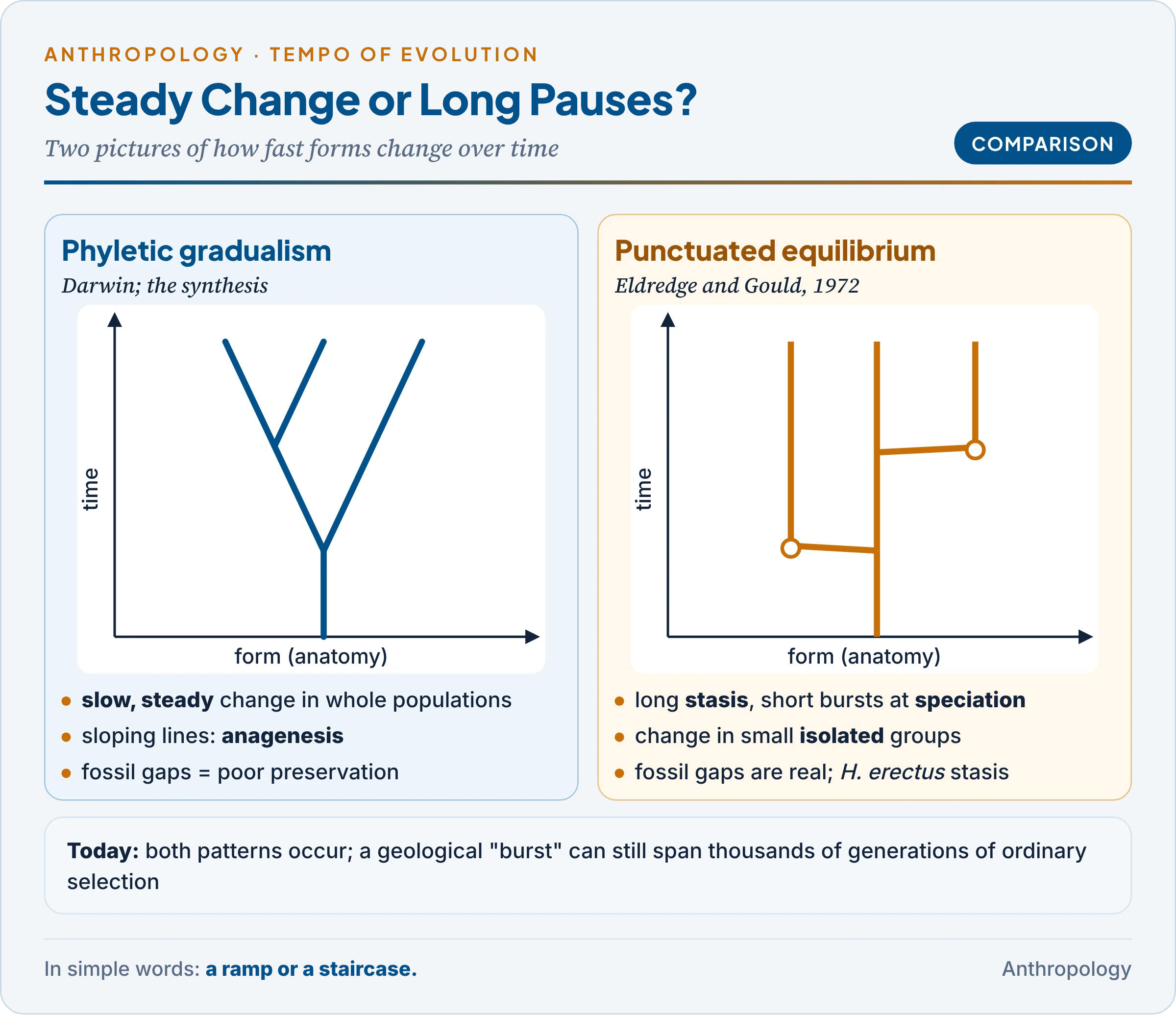
Darwin pictured evolution as slow and steady. In 1972 the American palaeontologists Niles Eldredge and Stephen Jay Gould argued that the fossil record shows something else.
| Basis | Phyletic gradualism | Punctuated equilibrium |
|---|---|---|
| Proponents | Darwin; the synthesis (Simpson) | Eldredge and Gould (1972) |
| Tempo | Slow, steady change | Long stasis broken by short bursts |
| Where change happens | In the whole population | In small, isolated peripheral populations |
| Mode | Mostly anagenesis | Mostly cladogenesis (branching) |
| Gaps in the fossil record | An artefact of poor preservation | Real: speciation is too quick and too local to be preserved |
| Human example | Gradual brain increase within later Homo | Long stasis of Homo erectus (over a million years) |
The two views are less opposed than they first seemed. A “rapid” burst in geological terms may last 50,000 years, enough for thousands of generations of ordinary selection, so punctuated equilibrium does not require new genetic mechanisms; it is mainly a claim about tempo and the location of change. Its lasting contribution was to make stasis a fact needing explanation (often stabilising selection), and to stress speciation as the place where change concentrates. Most biologists now accept that both patterns occur.
5.4 Molecular evolution and the neutral theory
- Molecular evolution studies change in DNA and proteins themselves.
- Neutral theory: the Japanese geneticist Motoo Kimura (1968) argued that most changes at the molecular level are selectively neutral and spread by drift, not selection (Jack King and Thomas Jukes called this “non-Darwinian evolution”, 1969). Selection still shapes adaptive traits, but most DNA differences between species are neutral.
- Molecular clock: if neutral changes build up at a roughly constant rate, the number of differences between two species measures time since they split (Émile Zuckerkandl and Linus Pauling, 1960s). Using protein differences, Vincent Sarich and Allan Wilson (1967) dated the human–ape split to about 5 million years ago, when most palaeontologists placed it at 15 million or more; later fossils proved the molecules right.
- Why it matters: the neutral theory explains why molecular change is steady enough to date events, and it corrects the synthesis’s tendency to see every change as adaptive.
5.5 Advanced molecular anthropology techniques
Molecular methods now answer questions that bones alone cannot.
| Technique | What it reveals | Example |
|---|---|---|
| Mitochondrial DNA (maternal line) | Female ancestry; dates of dispersal | African “mitochondrial Eve” (1987); Andamanese early coastal migration |
| Y-chromosome (paternal line) | Male ancestry; sex-biased migration | Male-biased Steppe ancestry in north India |
| Genome-wide SNP arrays and whole genomes | Population structure, admixture, selection | ANI and ASI ancestral groups of India (David Reich and colleagues, 2009); GenomeIndia (10,000 genomes, 2025) |
| Ancient DNA | Genomes of extinct humans | Neanderthal genome (2010); Denisovans (2010); Rakhigarhi genome (Vasant Shinde and colleagues, 2019) |
| Palaeoproteomics (ancient proteins) | Relationships beyond the reach of DNA | Enamel proteins of Homo antecessor (2020); Harbin cranium identified as Denisovan (2025) |
The Swedish geneticist Svante Pääbo, who led the Neanderthal genome project, received the Nobel Prize in 2022 for founding palaeogenomics. Interbreeding, migration and selection can now be read directly from genomes.
5.6 Critique of the synthesis and contemporary trends
The synthesis remains the framework of evolutionary biology, but several critiques have widened it.
| Critique | What it adds | Status |
|---|---|---|
| Adaptationism (Stephen Jay Gould and Richard Lewontin, “spandrels”, 1979) | Not every trait is an adaptation; some are by-products of structure | Widely accepted as a caution |
| Punctuated equilibrium (1972) | Stasis and rapid speciation | Accepted as one common pattern |
| Neutral theory (1968) | Most molecular change is neutral | Accepted for DNA, not for adaptive traits |
| Evo-devo | Development and regulatory genes shape what can evolve | Integrated |
| Epigenetics and niche construction | Non-genetic inheritance; organisms change their own environment | Debated |
| Extended Evolutionary Synthesis (Kevin Laland and colleagues, 2015) | Brings these into one framework | Debated: an extension, not a replacement, for most biologists |
The 2010 critique that the synthesis is “gene-centred” holds partly: it said little about development and treated the environment as fixed. But each new finding has been absorbed without overturning its core, that heritable variation sorted by selection and drift explains evolution. For humans, the most important extension is culture as a second inheritance system (gene-culture co-evolution, Unit 1.4a §3).
6. Concepts of Evolutionary Biology
In simple words
Biologists have noticed some regular patterns in evolution. Evolution does not run backwards; lineages often grow larger over time; two species cannot share exactly the same way of life for long; unrelated animals living alike come to look alike; one ancestor can branch into many forms; and different parts of the body evolve at different speeds.
Whales returned to the sea, where vertebrates first evolved, yet they did not become fish again. They breathe air with lungs, their flippers contain the finger bones of land mammals, and their tails beat up and down like a running mammal’s back, not side to side like a fish’s. A whale’s fish-like shape is a new solution built from mammalian parts. This one animal illustrates two concepts at once: Dollo’s rule (evolution does not reverse) and convergence (unrelated animals in the same environment evolve similar forms).
6.1 Dollo’s rule: evolution is irreversible
- Louis Dollo, a Belgian palaeontologist, stated in 1893 that an organism never returns exactly to a former state, even if it returns to the environment of its ancestors.
- Why: a complex structure is built by many genetic changes in a particular order. Reversing it would need the same mutations to be undone in exact reverse order, under a reversed sequence of environments, which is vanishingly improbable. Once an allele is lost, the exact version rarely returns.
- Examples: whales and dolphins, which kept lungs and mammalian limb bones; wings that were lost with the pterosaurs and evolved again in birds and bats, but from different structures; hominoids, which lost the tail in their common ancestor and never regained it.
- Critique: the rule is a statistical tendency, not a law. Single back-mutations occur, and some lost structures have been regained in modified form: lower teeth in the frog Gastrotheca guentheri after more than 200 million years (John Wiens, 2011), and wings in some stick insects (2003). Dollo’s rule holds for complex structures in detail, which is why true atavisms (throwbacks) never recreate an ancestor.
6.2 Cope’s rule: lineages tend to grow larger
- Named after the American palaeontologist Edward Drinker Cope (19th century), and also called the Cope–Depéret rule after the French palaeontologist Charles Depéret (1907). Cope never stated it as a rule himself.
- The claim: animal lineages tend to increase in body size over evolutionary time.
- Why size can pay: larger animals escape more predators, catch larger prey, win more mates, store more energy and lose heat more slowly.
- Examples: horses, from the fox-sized Hyracotherium (Eohippus, about 55 mya) to Equus; elephants and their relatives; many dinosaurs; and hominins, from australopithecines of about 30–45 kg to Homo erectus of about 60 kg.
- Exceptions and critique: island dwarfing (Homo floresiensis and dwarf Stegodon on Flores); flight limits size; Dirk Hooijer noted size decrease in many Quaternary vertebrates, and A.J. Arnold found newer planktonic foraminifera smaller. Steven Stanley, an American palaeontologist (1973), explained the trend statistically: most lineages begin small, so there is more room to grow than to shrink. It is a tendency, not a law.
6.3 Gause’s rule: competitive exclusion
- The Russian biologist Georgy Gause (The Struggle for Existence, 1934) grew two species of the single-celled Paramecium together on the same food. P. aurelia always survived and P. caudatum died out. But P. caudatum and P. bursaria coexisted, because P. bursaria lived in a different part of the culture tube and fed differently.
- The principle: two species with identical ecological needs (the same niche, meaning their whole way of using resources) cannot coexist indefinitely; the better competitor excludes the other, unless they divide the resources. The American ecologist Garrett Hardin named it the competitive exclusion principle (1960): “complete competitors cannot coexist”.
- How coexistence happens: resource partitioning (five species of North American warblers feed in different parts of the same spruce trees; Robert MacArthur, 1958) and character displacement (where two Galápagos finch species meet, their beaks differ more than where each lives alone).
- Hominin application: some anthropologists once argued for a single-species hypothesis: because culture gives every hominin the same broad niche, Gause’s rule should allow only one hominin species at a time. Richard Leakey and Alan Walker refuted it (1976) when a Homo erectus skull (KNM-ER 3733) and a robust Paranthropus (KNM-ER 406) were found in the same levels at Koobi Fora, Kenya, about 1.7 mya. The two coexisted for about a million years by dividing the niche: Paranthropus specialised in chewing tough plant food; Homo relied on tools, meat and a broad diet.
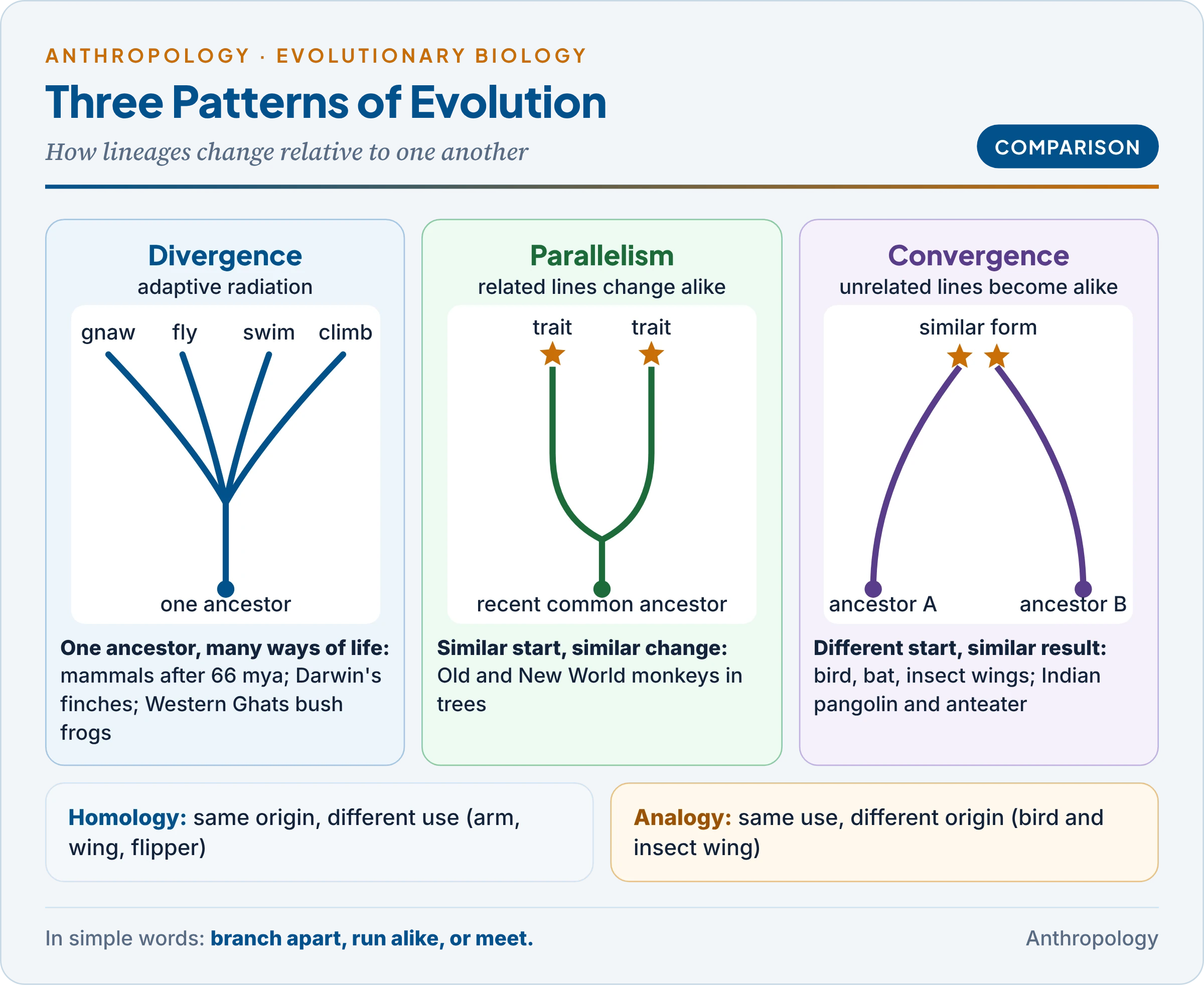
6.4 Parallelism, convergence, homology and analogy
The three ways in which lineages change relative to one another are easiest to see together.
| Pattern | Ancestry | Direction | Example |
|---|---|---|---|
| Divergence | One common ancestor | Descendants become more different | Adaptive radiation of mammals; Darwin’s finches |
| Parallelism | Closely related ancestors | Similar changes, independently, in related lines | Old World and New World monkeys evolving similar arboreal adaptations from a common ancestor of over 30 mya; megadont chewing in East and South African Paranthropus (debated) |
| Convergence | Distantly related ancestors | Become more alike in a similar environment | Wings of birds, bats and insects; streamlined shark, ichthyosaur and dolphin; ant-eating Indian pangolin and South American anteater |
Why they happen: in each case, similar selection pressures in similar environments favour similar solutions. The difference lies in the starting material: parallel lines start from a similar genetic and developmental base, so they tend to arrive at similar changes in similar ways; convergent lines start from very different bases and reach a similar function with different structures.
- Convergence in humans: lactase persistence evolved separately in Europeans and in East African herders, through different mutations in the same regulatory region (Sarah Tishkoff and colleagues, 2007). Light skin evolved partly through different genes in Europeans and East Asians.
- Parallelism within monkeys: among the Old World monkeys (Cercopithecidae), tail length varies independently of relationship; long balancing tails recur in tree-living forms such as colobus monkeys, a parallel response to arboreal quadrupedal movement.
- A warning from the tarsier: the large eye sockets and short snout of the tarsier and of humans once suggested a close relationship; both are convergent results of relying more on vision than on smell.
- A corrected example: the lack of a tail in gibbons, great apes and humans was once treated as parallel loss. A genetic study traced it to one DNA insertion (an Alu element in the TBXT gene) in the common ancestor of all apes (Bo Xia and colleagues, Nature, 2024): a shared inheritance, not parallelism.
Homology and analogy describe the structures that result:
- Homologous organs have the same origin and basic structure but may differ in use: the human arm, bat wing, whale flipper and seal flipper all have one upper bone, two forearm bones, wrist bones and five digits.
- Analogous organs have the same function but different origins: wings of birds and insects.
- Homoplasy is any similarity not due to common ancestry (through convergence, parallelism or reversal).
- Serial homology is similarity within one body: the human arm and leg correspond bone for bone (humerus and femur, radius-ulna and tibia-fibula, carpals and tarsals, and so on).
- Rule of thumb: parallel evolution after divergence tends to leave homologies; convergence produces analogies.
Common confusion
If both parallelism and convergence make animals look alike, how do we tell them apart? By how closely related the starting forms are. In parallelism the lineages share a fairly recent common ancestor and similar body plans, so the similar features are built the same way (Old World and New World monkeys). In convergence the ancestors are distantly related, so similar functions are built from different parts (a bird’s wing is a feathered arm; an insect’s wing is a fold of body wall). Molecular trees now settle most cases.
6.5 Adaptive radiation
- Adaptive radiation is the rapid evolution of one ancestral species into many descendant species, each adapted to a different way of life. The American palaeontologist Henry Fairfield Osborn described it as a “law of adaptive radiation” (1902).
- Triggers: (1) new, empty environments, such as islands; (2) the extinction of competitors, as when the dinosaurs died out 66 mya; (3) a key innovation that opens new ways of life, such as flight or the placenta.
- Classic examples:
- Mammals after 66 mya radiated into gnawing rodents, hunting carnivores, grazing hoofed mammals, tree-living primates, flying bats and swimming whales.
- Darwin’s finches of the Galápagos, about 15–18 species from one ancestor that arrived about 2–3 mya, with beaks for seeds, insects, cactus and even tool use.
- Cichlid fishes of Lake Victoria (hundreds of species in about 15,000 years) and Australian marsupials.
- Western Ghats bush frogs (§4), an Indian case.
- In primates: the order radiated in the Paleocene and Eocene into prosimians, New World and Old World monkeys and apes; in the Miocene, apes radiated widely across Africa and Eurasia (including Sivapithecus in the Siwaliks); and in the Plio-Pleistocene, hominins radiated into Australopithecus, Paranthropus and Homo (Unit 1.5).
- Note on terms: adaptive radiation is one form of macroevolution, not another name for it; it combines divergence between branches with frequent parallelism and convergence across them.
6.6 Mosaic evolution
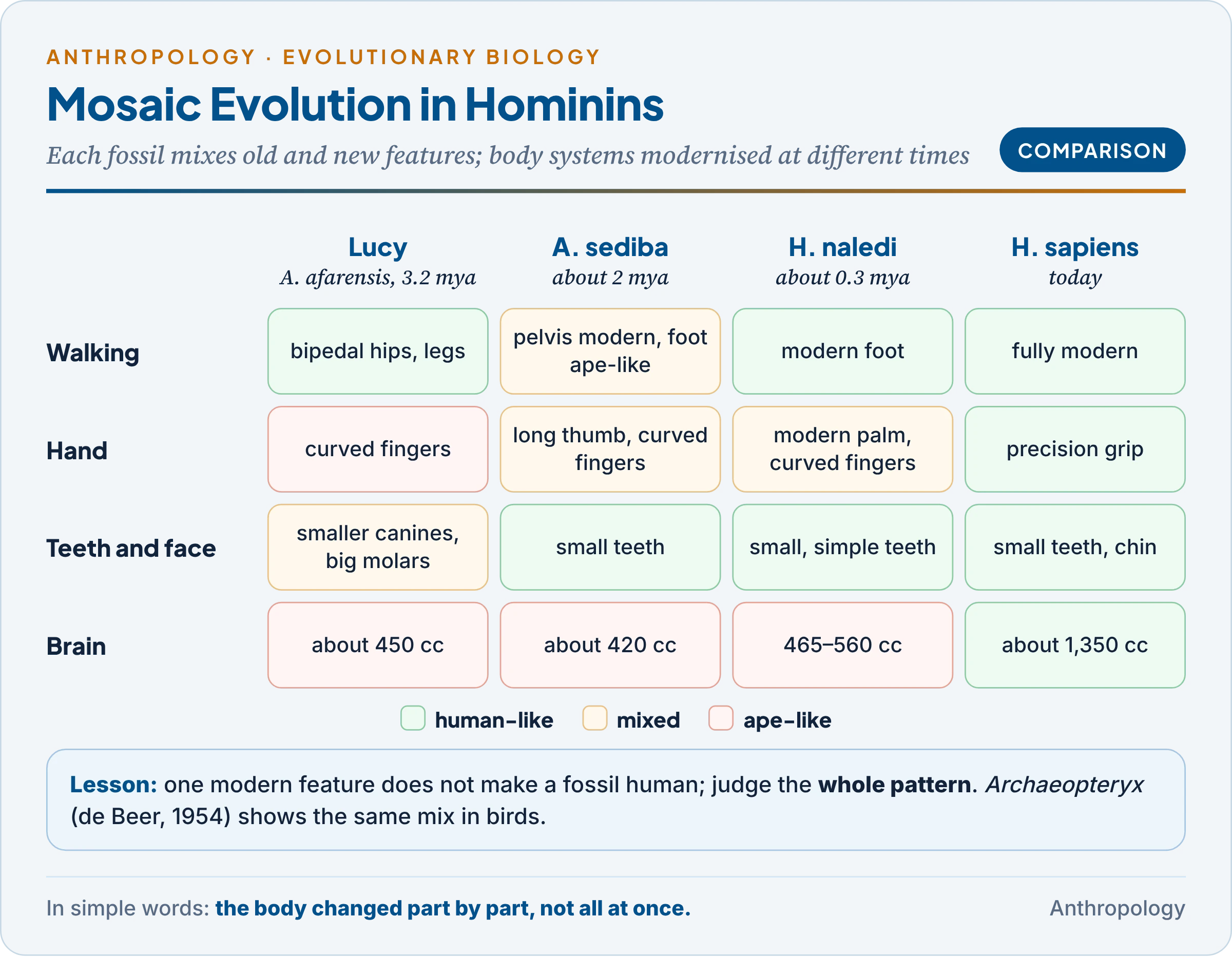
- Mosaic evolution means that different parts of an organism evolve at different rates and times, so a transitional form combines old (primitive) and new (derived) features. The British embryologist Gavin de Beer coined the term (1954) for Archaeopteryx, which has reptilian teeth, claws and a bony tail together with bird feathers and wings.
- Why it happens: body systems such as locomotion, chewing and the brain are partly independent modules, each responding to its own selection pressures. A change in diet acts on the jaws; a change in habitat acts on the legs.
- Hominin evidence:
- Lucy (Australopithecus afarensis, 3.2 mya): hips and legs for bipedal walking, but an ape-sized brain and curved fingers for climbing.
- Australopithecus sediba (Malapa, South Africa, about 2 mya): a human-like hand and pelvis with a small brain and an ape-like foot.
- Homo naledi (Rising Star cave, South Africa, about 335,000–236,000 years ago): a small brain (about 465–560 cc) with modern-looking hands and feet, but curved fingers and a primitive shoulder.
- The general sequence: bipedalism first, then tools and smaller teeth, brain expansion last (Unit 1.4a §1.1).
- Implications:
- A single feature cannot classify a fossil: a modern-looking foot does not make a fossil Homo. Judgement must rest on the whole pattern, and on more material when a fossil is fragmentary.
- The idea of one “missing link” half-way between ape and human is misleading: each fossil is a different mosaic.
- It explains why the faked Piltdown skull (human cranium, ape jaw) was believed until 1953: scholars expected the brain to come first.
6.7 The rules at a glance
The seven concepts of the syllabus can be held together by what each describes.
| Concept | Proposed by (year) | What it describes | Key example |
|---|---|---|---|
| Dollo’s rule | Louis Dollo (1893) | Irreversibility of evolution | Whales did not regain gills |
| Cope’s rule | E.D. Cope; Depéret (1907) | Size increase in lineages | Horse: Hyracotherium to Equus |
| Gause’s rule | G.F. Gause (1934) | Competitive exclusion | Paramecium; Homo and Paranthropus dividing the niche |
| Parallelism | (descriptive) | Related lines changing alike | Old and New World monkeys |
| Convergence | (descriptive) | Unrelated lines becoming alike | Bird, bat and insect wings; lactase persistence |
| Adaptive radiation | H.F. Osborn (1902) | One ancestor, many forms | Mammals after 66 mya; Darwin’s finches |
| Mosaic evolution | Gavin de Beer (1954) | Unequal rates in different parts | Archaeopteryx; Lucy |
All of these are generalisations about patterns, not independent forces: each is explained by selection, drift, isolation and the history of a lineage, which is why they are “rules” rather than laws.
Key Terms
| Term | Meaning in simple words |
|---|---|
| Modern (synthetic) synthesis | Darwin’s natural selection joined with Mendelian and population genetics |
| Gene pool | All the alleles in an interbreeding population |
| Allele frequency | The proportion of one version of a gene in a population |
| Gene flow | Movement of alleles between populations through migration and mating |
| Genetic drift | Random change in allele frequency, strongest in small populations |
| Founder effect / bottleneck | A new group, or a shrunken one, carries only a chance sample of alleles |
| Balancing selection | Selection that keeps two alleles, as sickle-cell carriers resist malaria |
| Isolating mechanism | A barrier that stops two populations interbreeding successfully |
| Allopatric speciation | New species formed after geographical separation |
| Micro- / macroevolution | Change within a population / origin of new species and groups |
| Punctuated equilibrium | Long periods of no change broken by short bursts of speciation |
| Neutral theory | Most DNA changes neither help nor harm and spread by chance |
| Homology / analogy | Same origin, possibly different use / same use, different origin |
| Convergence | Unrelated lineages becoming alike in similar environments |
| Adaptive radiation | One ancestor branching rapidly into many species with different ways of life |
| Mosaic evolution | Different parts of the body evolving at different times and rates |
Contemporary Developments
- India’s evolutionary history in genomes (June 2025): whole genomes of 2,762 Indians showed ancestry mainly from South Asian hunter-gatherers, Iranian-related farmers and Steppe pastoralists, strong founder events from a recent shift to endogamy, and 1–2 per cent Neanderthal and Denisovan ancestry, with the largest variety of Neanderthal segments of any population studied (Elise Kerdoncuff and colleagues, Cell).
- Selection in ancient DNA (April 2026): nearly 16,000 ancient genomes showed hundreds of strongly selected variants and faster selection after farming (Nature), direct evidence that microevolution has not ceased.
- The genetics of tail loss (February 2024): a single Alu insertion in the TBXT gene, shared by all apes, is linked to the loss of the tail (Nature), turning a classic example of “parallel” loss into a shared inheritance.
- Palaeoproteomics comes of age (June 2025): ancient proteins identified the Harbin cranium as Denisovan, showing how molecules now classify fossils that DNA cannot reach.
Diagrams to Master
- Topic map: the synthesis (Darwin + Mendel + populations), its forces, and the concepts below.
- Two-stage forces: mutation, recombination, gene flow (produce variation) → drift, selection (sort it) → isolation → speciation; mark the Vysya founder effect.
- Modes of selection: three pairs of curves for directional, stabilising (birth weight) and disruptive; add a note on balancing (sickle cell).
- Gradualism vs punctuated equilibrium: sloping branches beside vertical lines with sideways jumps.
- Patterns: divergence (one stem, many branches), parallelism (two related stems running alike), convergence (two distant stems meeting).
- Mosaic evolution: four rows (locomotion, hand, teeth, brain) against time, each turning modern at a different point; place Lucy, sediba, naledi.
Revision Grid
| Scholar | Work (year) | Key idea |
|---|---|---|
| Fisher | Genetical Theory of Natural Selection (1930) | Selection on many small genes |
| Haldane | The Causes of Evolution (1932) | Rates of evolutionary change; later worked in India |
| Wright | 1931 | Genetic drift; adaptive landscape |
| Dobzhansky | Genetics and the Origin of Species (1937) | Founding text; isolating mechanisms |
| Mayr | Systematics and the Origin of Species (1942) | Biological species concept; allopatric speciation |
| Huxley | Evolution: The Modern Synthesis (1942) | Named the synthesis |
| Washburn | “The New Physical Anthropology” (1951) | Synthesis enters anthropology |
| Karn and Penrose | 1951 | Stabilising selection on birth weight |
| Kimura | 1968 | Neutral theory |
| Sarich and Wilson | 1967 | Molecular clock: human–ape split about 5 mya |
| Eldredge and Gould | 1972 | Punctuated equilibrium |
| Dollo | 1893 | Irreversibility |
| Cope; Depéret | 19th century; 1907 | Size increase in lineages |
| Gause | The Struggle for Existence (1934) | Competitive exclusion |
| Leakey and Walker | 1976 | Refuted the single-species hypothesis |
| Osborn | 1902 | Adaptive radiation |
| De Beer | 1954 | Mosaic evolution (Archaeopteryx) |
Previous Year Questions
Unit 1.4: Synthetic theory of evolution and concepts of evolutionary biology
- 2021Explain the genetic mechanisms of micro and macro evolution.
- 2020Elucidate how Darwin and Post-Darwin theories of evolution resulted in the development of Synthetic theory of evolution.
- 2018Write a note in 150 words on Advanced Molecular Anthropology Techniques.
- 2013Discuss how Neo-Darwinism integrated the fields of Genetics and Evolution. (250 words).
- 2012Write a note in 150 words on Adaptive tradition in context of evolution.
- 2011Write a note in 150 words on Synthetic theory.
- 2010Critically examine the synthetic theory of human evolution.
- 2008Discuss the modern theory of evolution with special reference to the concepts of gradualism and punctuationalism.
- 1999Write a note on Molecular evolution.
- 1994How Darwinism differs from the synthetic theory of organic evolution ?
- 1993What is Synthetic Theory of Evolution?Discuss how this theory helps us in understanding the evolutionary mechanism.
- 1992Discuss the contemporary trends in evolutionary studies.
- 1992Write a note on Synthetic theory of evolution.
- 1990Write a note on Micro evolution.
- 1990Write a note on Synthetic theory of evolution.
- 1988Give a critical account of the processes of organic evolution, and explain how they contribute to speciation.
- 1984Distinguish between : Macro-evolution and Micro-evolution.
- 1983Microevolution has not ceased.Comment.
- 1981Discuss the synthetic theory of human evolution. How does it differ from Darwinism?
Related questions from other units and from Unit 1.4a
- 2026Unit 9.3: Write notes on: Genetic polymorphism and natural selection.
- 2025Unit 1.7: Write notes on: Mitochondrial DNA and human evolution.
- 2022Unit 9.3: Discuss the role of evolutionary forces in creating human diversity.
- 2020Unit 9.3: Write notes on the Genetic drift in about 150 words.
- 2019Unit 1.5: Write a note in 150 words on Adaptive primate radiation.
- 2019Unit 1.7: Write a note in 150 words on Implications of mutation in evolution.
- 2012Unit 9.3: Write a note in 150 words on How ‘natural selection’ acts on variation?
- 1997Unit 1.5: Discuss the gradualist view of evolutionary change vis-a-vis the punctuationalist view giving an example from primate evolution that supports one view or the other.
- 1987Unit 1.4: How is Darwinism different from Lamarckism ? Critically evaluate their contribution to synthetic theory of evolution.
- 1985Unit 9.3: Discuss the role of genetic drift, mutation and migration as the causes of variation.