

Nature of Religious Language: Analogical and Symbolic; Cognitivist and Non-cognitive.
Official Syllabus: Paper II, Section B, Unit 10
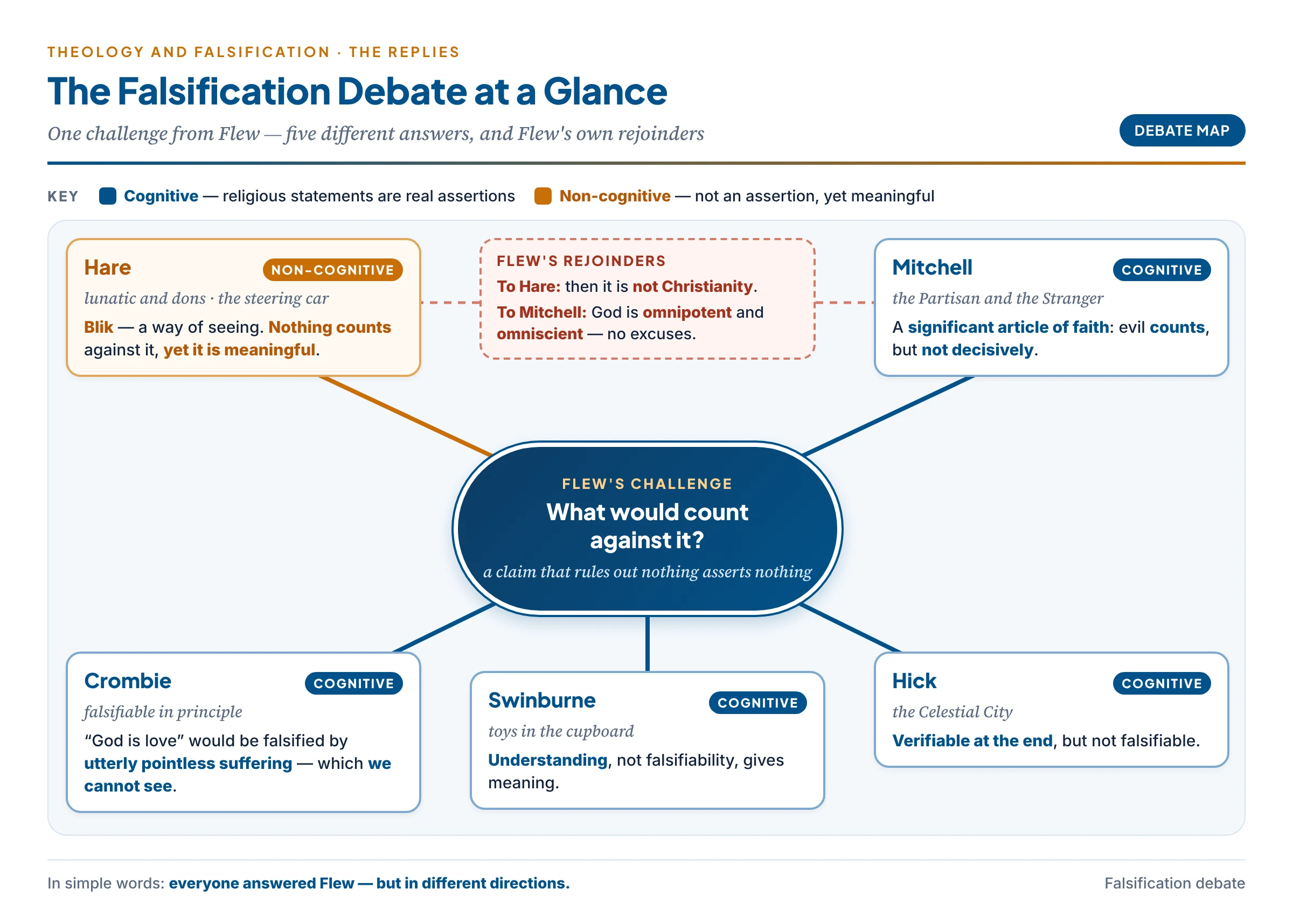
After the verification principle came the falsification challenge. In a short symposium called “Theology and Falsification” (1950), Antony Flew asked believers a simple question: what would have to happen for you to admit that God does not love us, or does not exist? If the answer is “nothing“, then “God loves us” is compatible with every possible state of affairs — and a statement that rules nothing out asserts nothing. Two replies became classics: R. M. Hare’s theory of bliks (religious beliefs are unfalsifiable but meaningful ways of seeing the world) and Basil Mitchell’s parable of the Partisan and the Stranger (believers do let evil count against their faith, but not decisively). This article explains the whole debate — Flew’s invisible gardener and the “death by a thousand qualifications“, Hare, Mitchell, Ian Crombie, Flew’s rejoinders, Swinburne’s reply — and assesses whether religious language survives.
In simple words
A friend says, “My new phone is waterproof.” You drop it in a bucket and it dies. He says, “Well, it’s waterproof — but not against bucket water.” Next it dies in the rain: “Not against rain, I meant.” Then in the swimming pool: “Not chlorinated water.” After enough of these excuses, “waterproof” means nothing at all. Flew thought believers treat “God loves us” in the same way — every disaster brings a new qualification, until the claim dies “the death by a thousand qualifications“.
Context & Problem
From Verification to Falsification
- Verification asked: what would show this statement true? Religious statements failed (Article 4).
- Falsification asks the reverse: what would show it false? A statement is a genuine assertion only if the speaker can say what would count against it.
- The source — Karl Popper: the philosopher of science Karl Popper proposed falsifiability as the mark of a scientific theory: a genuine scientific claim sticks its neck out — it forbids certain observations, and so could be refuted. Einstein’s theory predicted that light would bend near the sun; if it had not, the theory would have been refuted. Theories that explain everything whatever happens (Popper’s targets were certain versions of Marxism and psychoanalysis) are not scientific.
- The occasion: the symposium began as a paper read to the Socratic Club at Oxford (founded by C. S. Lewis) and was printed in 1950 in an undergraduate journal, University; it became famous when reprinted in New Essays in Philosophical Theology (1955).
- Flew’s application: Flew, influenced by Popper, applied falsifiability to religious statements — not to ask whether they are scientific, but whether they are assertions at all.
- The principle in John Hick’s words: “In order to say something which may possibly be true, we must say something which may possibly be false.“
- Why it bites: for most believers, little or nothing counts against their faith. That is precisely why they believe — they have already resolved, to their own satisfaction, the problems that keep others from believing, such as the problem of evil.
Core Doctrine
Flew’s Parable of the Invisible Gardener
Flew adapted John Wisdom’s parable of the gardener (Article 4) into a sharper story:
- Two explorers come upon a clearing in the jungle. In it grow many flowers and many weeds.
- The believer says, “Some gardener must tend this plot.” The sceptic disagrees.
- The tests: they pitch their tents and set a watch — no gardener is ever seen. “Perhaps he is an invisible gardener.” So they set up a barbed-wire fence, electrify it, and patrol with bloodhounds. No shriek ever suggests that an intruder has received a shock; no movement of the wire betrays an invisible climber; the bloodhounds never give cry.
- The qualifications: yet the believer is not convinced. “But there is a gardener, invisible, intangible, insensible to electric shocks, a gardener who has no scent and makes no sound, a gardener who comes secretly to look after the garden which he loves.“
- The sceptic’s despair: “But what remains of your original assertion? Just how does what you call an invisible, intangible, eternally elusive gardener differ from an imaginary gardener or even from no gardener at all?“
Flew’s argument:
- To assert is to deny: to assert that something is the case is necessarily to deny that its opposite is the case. “If there is nothing which a putative assertion denies, then there is nothing which it asserts either.”
- Believers allow nothing to count against their beliefs — for example, the problem of evil does not make them abandon belief in a loving God.
- So no possible situation could, in principle, falsify their beliefs.
- A belief that cannot be falsified is not a genuine assertion — it is meaningless as a factual claim.
- Therefore believers’ statements about God are empty — “bogus” explanations and “vacuous” assertions.
The death by a thousand qualifications:
- A bold hypothesis — “there is a gardener” — is first stated plainly. Each failed test brings a qualification (“invisible”, “intangible”, “scentless”…) until nothing is left. “A fine brash hypothesis may thus be killed by inches, the death by a thousand qualifications.“
The child with cancer:
- “Someone tells us that God loves us as a father loves his children. We are reassured. But then we see a child dying of inoperable cancer of the throat. His earthly father is driven frantic in his efforts to help, but his Heavenly Father reveals no obvious sign of concern.“
- A qualification is made — God’s love is “not a merely human love” or “an inscrutable love” — and we find that such suffering is compatible with “God loves us as a father (but, of course…)”. We are reassured again.
- But then: “What is this assurance of God’s (appropriately qualified) love worth, what is this apparent guarantee really a guarantee against?“
- Flew’s challenge: “What would have to occur or to have occurred to constitute for you a disproof of the love of, or of the existence of, God?“
- Note on Flew’s tone: Flew did not dogmatically declare religious statements meaningless; he raised a doubt: “sophisticated religious people tend to refuse to allow, not merely that anything actually does occur, but that anything conceivably could occur, which would count against their theological assertions… But in so far as they do this their supposed explanations are actually bogus, and their seeming assertions are really vacuous.”

Hare’s Reply — Bliks
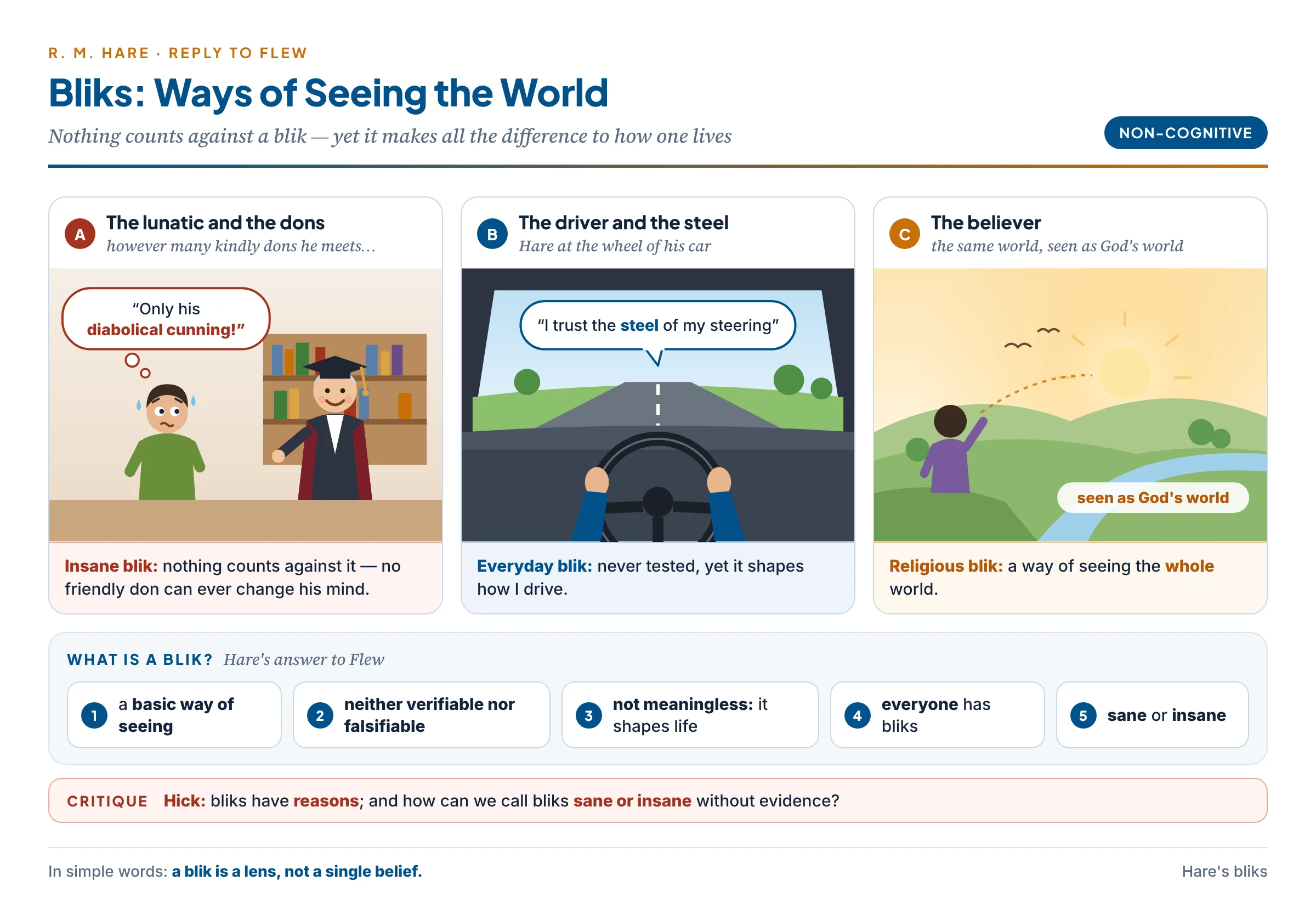
R. M. Hare (1919–2002), the Oxford moral philosopher, admitted that “on the ground marked out by Flew, he seems to me to be completely victorious“. He accepted Flew’s point that religious beliefs are not falsifiable assertions — but denied that they are therefore empty.
The parable of the lunatic and the dons:
- “A certain lunatic is convinced that all dons want to murder him. His friends introduce him to all the mildest and most respectable dons that they can find, and after each of them has retired, they say, ‘You see, he doesn’t really want to murder you; he spoke to you in a most cordial manner; surely you are convinced now?‘ But the lunatic replies, ‘Yes, but that was only his diabolical cunning; he’s really plotting against me the whole time, like the rest of them; I know it, I tell you.‘ However many kindly dons are produced, the reaction is still the same.”
- The point: no behaviour of dons will be accepted by the lunatic as counting against his belief. On Flew’s test, his belief asserts nothing. Yet it does not follow that there is no difference between what he thinks of dons and what we think — otherwise we would not call him a lunatic and ourselves sane.
- The name: Hare calls that in which we differ from the lunatic our respective bliks. The lunatic has an insane blik about dons; his friends have a sane one. Crucially, we have a sane blik — not no blik at all.
What a blik is:
- A basic way of seeing and interpreting the world — a framework through which all experience is viewed.
- Not based on reason or fact in the ordinary way; neither verifiable nor falsifiable; it “just is”, and we need not explain why we hold it.
- Not meaningless: bliks make a huge difference to how a person lives and responds to everything.
- Everyone has bliks, religious or not.
- There are right and wrong — sane and insane — bliks.
The car and the steel:
- Hare’s own example: when he drives his car, it may occur to him to wonder whether his movements of the steering wheel will always be followed by the right movements of the car. He has never had a steering failure; he has a blik about steel and its properties that makes him trust the car — so he happily drives at speed.
- Hume’s lesson: Hare noted that it was Hume who taught that our whole commerce with the world depends on our blik about the world — for example, the belief that events have causes and nature is regular — and that differences between bliks cannot be settled by observation of what happens in the world.
- Bliks decide what counts as an explanation: “it is by our bliks that we decide what is and what is not an explanation“. A person who believed that everything happens by pure chance would assert nothing testable — yet this blik would make all the difference to how he explains, predicts and plans. Hare says this is the sort of difference there is between those who really believe in God and those who really disbelieve.
- The believer is not a detached explorer: Hare noted that, unlike Flew’s explorers, the believer minds very much what goes on in the garden — he quoted the Psalm in which God says of a tottering earth, “I bear up the pillars of it“.
- Religious belief as a blik: belief in God is a positive, life-affirming blik — a way of seeing the world as a place in which God can be experienced, rather than a godless place. It governs how the believer lives.
In simple words
Two students fail the same exam. The first says, “Everyone is against me — the examiner, the teachers, the system.” The second says, “I can learn from this; next time will be better.” Show the first student fair marking schemes, kind teachers, past toppers — he explains each away. Neither student’s outlook is a single fact that can be tested; each is a lens through which every fact is seen. Hare calls such a lens a blik — and some lenses are sane, some insane.
Mitchell’s Reply — the Partisan and the Stranger
Basil Mitchell (1917–2011) disagreed with both Flew and Hare. He held that religious statements are assertions based on fact, though not straightforwardly verifiable or falsifiable.
The parable:
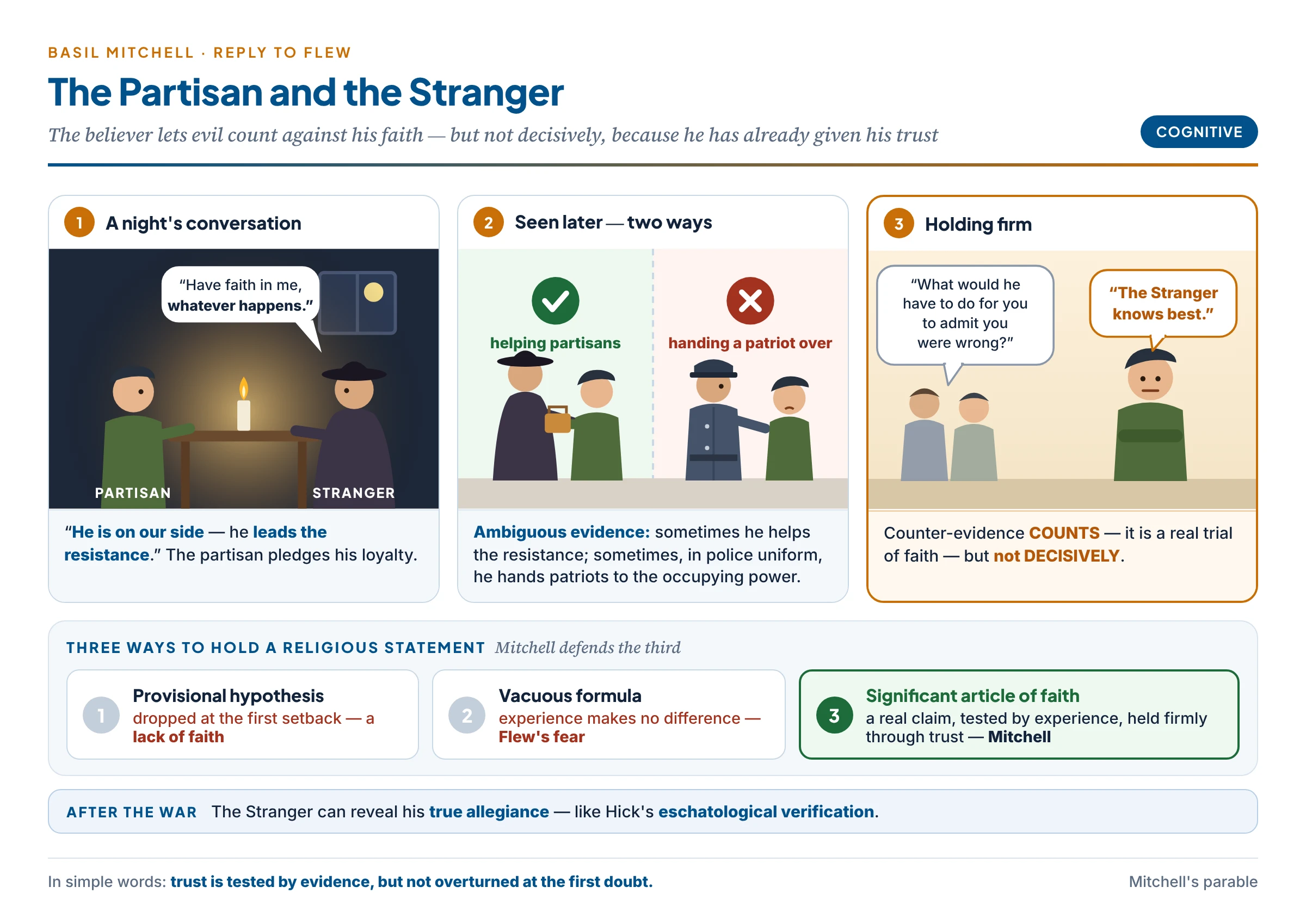
- In time of war in an occupied country, a member of the resistance meets one night a Stranger who deeply impresses him. They spend the night together in conversation. The Stranger tells him that he himself is on the side of the resistance — indeed, that he is its leader — and urges the partisan to have faith in him, whatever happens.
- The partisan is utterly convinced and pledges his loyalty. They never meet again in conditions of intimacy.
- Afterwards: sometimes the Stranger is seen helping members of the resistance; at other times he is seen in the uniform of the police, handing patriots over to the occupying power.
- The partisan’s friends murmur against him, but he still says, “He is on our side.” Sometimes he asks the Stranger for help and receives it; sometimes he asks and does not. Then he says, “The Stranger knows best.“
- His friends exasperate him: “Well, what would he have to do for you to admit you were wrong?“
Mitchell’s point:
- The partisan does admit counter-evidence: he sees the Stranger’s ambiguous behaviour as really counting against his belief. That is precisely what makes it a trial of faith. Flew was wrong to say believers allow nothing to count against their beliefs.
- But not decisively: he will not allow it to count decisively, because he has committed himself to trust the Stranger, on the basis of a personal encounter.
- Applied to God: the theologian does recognise that pain and evil count against “God loves us” — that is exactly why there is a “problem of evil” and why theologians write theodicies. The believer “must face the full force of the conflict“: his faith is put on trial, and light-hearted belief is put under great strain.
- Three ways to hold religious statements:
- As provisional hypotheses, to be discarded if experience tells against them — the believer is barred from this, for it would show a lack of faith.
- As significant articles of faith — real assertions, tested by experience, held firmly because of a trust already given. Mitchell defends this way.
- As vacuous formulae, to which experience makes no difference — the believer is in constant danger of slipping into this, and if he does, “it is a failure in faith as well as in logic“.
- Reasons, not a blik: the partisan has a reason for his trust — the character of the Stranger — whereas the lunatic has no reason for his blik about dons, “because, of course, you can’t have reasons for bliks“. So Mitchell sides with Flew on one point: “theological utterances must be assertions“.
- Revelation at the end: the Stranger will be able to reveal his true allegiance after the war and explain his mysterious behaviour — just as, in traditional belief, the puzzling parts of faith will be revealed at the end of time. This links Mitchell with Hick’s eschatological verification (Article 4).
Mitchell vs Hare:
| Hare’s lunatic | Mitchell’s partisan | |
|---|---|---|
| Grounds for belief | None — no reason to mistrust the dons | A personal encounter and examples of the Stranger helping |
| Counter-evidence | Allows nothing to count against | Admits counter-evidence counts, but not decisively |
| Status of belief | Non-cognitive blik | Cognitive assertion — “the Stranger is on our side” |
| Attitude | Fixed, unreasoning | Trust under trial |
Crombie’s Reply — Falsifiable in Principle
- Ian Crombie argued that religious statements are falsifiable in principle, even if not by us in this life.
- “God is love” would be decisively falsified by “suffering which was utterly, eternally and irredeemably pointless“. We can say what would count against it — so it is a genuine assertion.
- But we are never in a position to observe such suffering, because we cannot see the whole — including what follows death. So the statement is meaningful but cannot in practice be falsified. Like Hick, Crombie places the decisive evidence beyond death.
In simple words
A student says, “My teacher is fair.” A friend asks, “What would prove she isn’t?” — “If she marked every answer of mine wrong for years, with no reason ever given, I’d admit it.” The student can name what would count decisively against his belief, even though he has not seen it and may never see it. Crombie says “God is love” is like that: it would be overturned by utterly pointless suffering — but only the whole story, which we do not yet see, could show any suffering to be utterly pointless.
Flew’s Rejoinders
- To Hare: if religious utterances are bliks — with no cosmological assertions about a personal creator — then they are not what Christians mean. If Hare’s religion really is a blik, “surely he is not a Christian at all?” Religious activity would become “fraudulent, or merely silly”, and “you ought because it is God’s will” a “dialectical dud cheque“. Religious utterances are intended to be — or at least to presuppose — assertions. Hare saves meaning by giving up the believer’s claim to truth.
- To Mitchell: the partisan’s Stranger is a man, with limited powers and knowledge; his ambiguous behaviour can be explained by the demands of war. But God is omnipotent and omniscient. “We cannot say that he would like to help but cannot: God is omnipotent. We cannot say that he would help if he only knew: God is omniscient.” Indeed an omnipotent, omniscient God must be “an accessory before (and during) the fact” to every human misdeed. So the excuses that work for the Stranger do not work for God; the believer is pushed either to abandon the claim or to qualify it into vacuity — or to live with a kind of “doublethink“.
In simple words
Your neighbour does not come to your wedding. If he was abroad, or never got the invitation, you forgive him — he couldn’t, or didn’t know. But suppose he lives next door, saw the card on his table, and was free all day. The usual excuses vanish. Flew says the believer’s excuses for God are like the first kind — but God, being all-powerful and all-knowing, is in the second position.
Swinburne’s Reply — the Toys in the Cupboard
- Richard Swinburne denied that a statement must be falsifiable to be meaningful.
- “Some of the toys which to all appearances stay in the toy cupboard while people are asleep and no one is watching, actually get up and dance in the middle of the night and then go back to the cupboard, leaving no traces of their activity.“
- No observation could verify or falsify this. Yet we understand it perfectly well — we know what it would be like for it to be true. So understanding, not falsifiability, is the test of meaning.
- Swinburne as a realist: a statement is true if it corresponds to the state of affairs it describes. Most theists are realists about God: they may not know whether a given statement is true, but they hold that there is a truth to be known.
Criticisms of the Falsification Principle Itself
- Unscientific is not meaningless: if a statement cannot be falsified, it may not be scientific (Popper) — but why should that make it meaningless? Popper himself used falsifiability to separate science from non-science, not sense from nonsense; he held that metaphysical statements can be meaningful.
- Self-defeating: “Only falsifiable statements are meaningful” cannot itself be falsified — no state of affairs could disprove it. By its own standard it is meaningless.
- Too strong for science: universal statements like “all cats are mortal” cannot be conclusively falsified (Article 4); and scientists rightly keep a well-supported theory in the face of some anomalies — they do not abandon it at the first counter-instance.
- Ayer conceded that criteria of meaning stated in terms of falsification face the same difficulties as verification.
- Believers do allow counter-evidence: the very existence of the problem of evil and of theodicies shows that evil counts against faith (Mitchell).
Common confusion
Is religious language “verified because it cannot be falsified”? No — and this muddle is common. That a statement cannot be falsified does not show it is verified; an irrefutable claim (like the lunatic’s) may be empty. Popper called irrefutability a vice, not a virtue. What Hick showed is different: some meaningful statements are verifiable if true but not falsifiable if false (life after death, “three sevens in a row somewhere in pi”). Unfalsifiability, then, does not prove meaninglessness — but it proves no truth either.
How Can Religious Language Be Verified? — Pulling the Threads Together
- Eschatologically — at the end of life, if true (Hick).
- In principle by decisive evidence we cannot now observe — utterly pointless suffering would falsify “God is love” (Crombie).
- Partially, through the trial of experience — evil counts against faith; the believer’s trust is tested and may be vindicated (Mitchell).
- By its fruits in life — a declared policy of living can be checked in conduct (Braithwaite, Article 6).
- By cumulative reasons — religious experience, arguments and testimony make belief more or less probable (Swinburne).
- In realisation — Indian traditions place verification in direct experience (anubhava) attainable in this life.
Critical Evaluation
Do Cognitivists Give a Cogent Answer to the Falsification Objection?
Partly yes:
- Mitchell shows that believers do let evil count, so religious statements are real assertions; the problem of evil is the proof.
- Crombie and Hick show that a statement can be meaningful even if its decisive test lies beyond our present experience.
- Swinburne shows that understanding, not falsifiability, is the criterion of meaning — and that the falsification principle defeats itself.
- Theodicies (the free-will defence, Hick’s soul-making) explain why evil counts against God’s love without decisively refuting it — they give the believer reasons, not mere excuses.
Partly no:
- Flew’s omnipotence point remains strong: the Stranger’s excuses do not transfer to an all-powerful, all-knowing God.
- Eschatological answers postpone the test; for now, faith’s claims remain practically unfalsifiable.
- Many ordinary believers do treat their faith as immune to all evidence — exactly Flew’s target.
- Verdict: the cognitivists answer the logical challenge (religious statements can be meaningful assertions); they do not remove the practical difficulty of saying what would actually change a believer’s mind.
Does Hare’s Blik Successfully Defend the Meaningfulness of Religious Language?
Its successes:
- It shows that meaning is wider than assertion: an unfalsifiable outlook can be full of significance for life.
- It captures the comprehensive character of faith — a way of seeing everything, not one belief among others.
- It is true to experience: faith often survives counter-evidence, as Hare’s lunatic shows.
- It reveals that everyone — including the atheist and the scientist — lives by bliks (the regularity of nature, the reliability of steel), so religion is not uniquely “irrational”.
Its failures:
- It concedes too much: it gives up the believer’s truth-claim — believers mean “God loves us” as true, not as a lens. Flew: then Hare “is not a Christian at all“.
- Hick’s first objection — bliks have reasons: religious beliefs are not groundless; people believe because of religious experience, scripture they find true, tradition, arguments.
- Hick’s second objection — inconsistency: Hare says bliks are neither verifiable nor falsifiable, yet distinguishes sane from insane bliks. If no evidence bears on bliks, by what criterion can we call one sane and another insane?
- An unflattering analogy: comparing faith with a paranoid lunatic suggests religious belief is a psychological bias, which classical believers reject.
- Bliks do change: conversions and loss of faith show that experience and argument can affect a person’s basic outlook — so bliks are not as sealed as Hare suggests.
Verdict: Hare succeeds in showing that religious language is not senseless and that it shapes life; he fails to defend it as ordinary believers understand it — as a claim about how things really are. His defence of meaningfulness is bought at the price of cognitive content, which is why Mitchell’s cognitive alternative is generally preferred.
Comparative Summary
| Thinker | Parable | Is religious language an assertion? | Does anything count against it? |
|---|---|---|---|
| Wisdom | Long-neglected garden | No real factual difference — a difference of feeling | Nothing experimental |
| Flew | Invisible gardener | Believers think so — but it dies by a thousand qualifications | Believers allow nothing — so it asserts nothing |
| Hare | Lunatic and dons; steering car | No — a blik (non-cognitive), yet meaningful | Nothing — but bliks are sane or insane |
| Mitchell | Partisan and the Stranger | Yes — a significant article of faith | Evil counts, but not decisively |
| Crombie | — | Yes | Utterly pointless suffering would — but we cannot see it |
| Hick | Celestial City | Yes — verifiable at the end | Verifiable if true, not falsifiable if false |
| Swinburne | Toys in the cupboard | Yes — meaning needs understanding, not falsifiability | The principle itself is self-defeating |
Critics and Defenders
Criticism — The falsification challenge
- To assert is to deny something; a claim that rules out nothing asserts nothing (Flew).
- Believers meet every evil with a new qualification — the death by a thousand qualifications.
- The child dying of throat cancer: what would ever count against God’s love?
- Mitchell’s Stranger is a man; God’s omnipotence and omniscience remove the excuses.
- Hare’s bliks are not Christianity — they abandon cosmological claims.
Defence — The believers’ replies
- Believers do let evil count — hence the problem of evil and theodicies (Mitchell).
- “God is love” is falsifiable in principle by utterly pointless suffering (Crombie).
- Religious claims are verifiable at the end (Hick).
- Unfalsifiable bliks are meaningful and everyone has them (Hare).
- The falsification principle is self-defeating; understanding, not falsifiability, makes meaning (Swinburne’s toys).
- Popper’s criterion separates science from non-science, not sense from nonsense.
Cross-Tradition Comparison
| Theme | Western | Indian |
|---|---|---|
| Beliefs stand until decisively defeated | Mitchell: counter-evidence counts but not decisively | Mīmāṃsā: a cognition is valid by itself (svataḥ-prāmāṇya) until overturned by a defeating cognition (bādhaka-jñāna) |
| Falsification in reverse | — | Advaita: the world is valid for practice until sublated (bādha) by the knowledge of Brahman — the rope corrects the snake |
| Unfalsifiable explanations | Flew: “God’s love is inscrutable” | Critics of karma: every fortune and misfortune is explained by unseen past deeds (adṛṣṭa), so nothing could count against the theory |
| Outlook-shaping beliefs | Hare’s bliks | Darśana — literally a “way of seeing“; śraddhā as the basic orientation of a person (“as is his faith, so is he” — Gītā) |
| Testing by debate | Philosophical symposium | Indian vāda: rules of debate, tarka, and points of defeat (nigraha-sthāna) |
Indian Connect — Indian Connect — svataḥ-prāmāṇya and Mitchell’s partisan
- The Mīmāṃsā principle that a cognition is innocent until proven guilty — valid by itself, overturned only by a stronger defeating cognition — is close to Mitchell’s article of faith: the partisan’s trust is valid unless decisively defeated, and mere ambiguity does not defeat it.
- The Indian discussion of karma shows the same danger Flew pointed to: a theory that can explain any outcome by unseen causes risks saying nothing. Defenders reply, as Mitchell does, that suffering does count — that is why the problem of evil and theodicies arise in India too (Unit 03).
Synthesis (Siddhānta)
- Flew turned Popper’s criterion on religion: a claim compatible with everything asserts nothing; religious claims die “the death by a thousand qualifications“.
- Hare conceded that religious beliefs are unfalsifiable but called them bliks — meaningful, life-shaping ways of seeing; his defence saves meaning but loses truth-claims, and faces Hick’s two objections (bliks have reasons; sane vs insane needs a criterion).
- Mitchell gave the most cogent cognitive reply: believers do let evil count, but not decisively, because faith is trust in a person; religious statements are significant articles of faith. Flew’s rejoinder from omnipotence remains the strongest counter.
- Crombie and Hick locate decisive evidence beyond death; Swinburne shows the principle is self-defeating and that understanding, not falsifiability, gives meaning.
- Religious language is not “verified because it cannot be falsified”; but neither is it meaningless because it cannot be falsified now. The debate establishes that religious statements can be meaningful assertions — while leaving each believer the honest question Flew asked: what would count against my faith?
“A fine brash hypothesis may thus be killed by inches, the death by a thousand qualifications.” — Antony Flew
Previous Year Questions
- 2026Analyse R. M. Hare’s concept of ‘blik’ and assess whether it successfully defends the meaningfulness of religious language.
- 2015How can religious language be verified? Is it correct to say that religious language is verified because it cannot be falsified? Discuss.
- 2013Do cognitivists provide cogent answer to the objection based on falsifiability?
- 2006“Religious faith consists of a set of profoundly unfalsifiable assumptions that govern all of a person’s other beliefs.” (R. M. Hare). Critical notes.