

Religion and Morality: Religion and Morality.
Official Syllabus: Paper II, Section B, Unit 8
If morality does not depend on religion (Articles 3 and 4), then a secular ethics — a morality grounded without reference to God or revelation — must be possible. But religious thinkers have always pressed a hard question: if there is no God, why should anyone be moral — and especially, why be moral all the time, even when wrongdoing would pay and no one would ever know? The novelist Dostoevsky gave this worry its most famous form: without God and immortality, “everything is permitted”. This article sets out the foundations of secular morality, compares religious and secular ethics, examines the question “Why should I be moral all the time?“, asks how absolute values can have authority in a non-theological system, considers whether an atheist may be a better person than a religious person without moral values, and explains the is–ought problem that lies under the whole debate.
In simple words
A shepherd finds a ring that makes him invisible whenever he turns it. Now he can take anything, enter anywhere, and never be caught. Would he stay honest? Plato told this story — the Ring of Gyges — two and a half thousand years ago. The question “why be moral all the time?” is really this question: what reason is there to stay good when you are wearing the ring? Religion answers, “God sees you even when no one else does.” Secular ethics must find another answer.
Context & Problem
Dostoevsky’s Challenge
- In The Brothers Karamazov (1880), the brilliant, troubled Ivan Karamazov is reported by other characters to hold that if there is no God and no immortality, everything is permitted (“everything is lawful”).
- The theistic argument behind it: without a transcendent Lawgiver and Judge:
- objective moral values collapse into subjective preferences, evolutionary accidents or arbitrary social conventions;
- there is no ultimate accountability — the clever wrongdoer escapes forever;
- moral obligation becomes an illusion.
- In the novel, the half-brother Smerdyakov takes Ivan’s idea seriously and commits murder — showing what may follow when the idea is lived out.
Common confusion
Did Dostoevsky write the line “If God does not exist, everything is permitted”? Not in these words. No character in The Brothers Karamazov speaks this exact sentence. The idea that “everything is permitted” is attributed to Ivan by other characters (and Dmitri reports a similar argument); Ivan himself says that “if there is no immortality, there is no virtue”. The famous one-line version became popular through later writers, notably Sartre, who said that all of existentialism begins from it. It is fair to call it “Ivan Karamazov’s thesis” or “the Dostoevsky challenge“, but it is not a direct quotation — and it is not necessarily Dostoevsky’s own view as author.
Morality “Pointless” without Religion
- A related popular view holds that the demands of morality are only worth obeying if there is a God who will reward obedience and punish disobedience. It is like the monk who said he would leave his monastery if he stopped believing in heaven.
- This is not Kant’s view. Kant held morality to be binding in itself and postulated God only to make sense of the highest good. The “pointless” view works in the opposite direction: it values morality only because of what it expects from God — which turns morality into a form of prudence.
Core Doctrine
1. What Is Secular Ethics?
- Secular ethics grounds right and wrong in human reason, human nature, sympathy and social life, without appeal to God, scripture or the supernatural.
- Secular is not the same as anti-religious. A secular ethics can be accepted by believers too; it simply does not depend on any religion. Many religious people hold secular moral theories (Kant was a believer; so were many utilitarians).
- Atheists, agnostics and theists alike recognise that torturing an innocent child is evil. Moral truths of this kind are discovered by reason and empathy, needing no “theological scaffolding”.
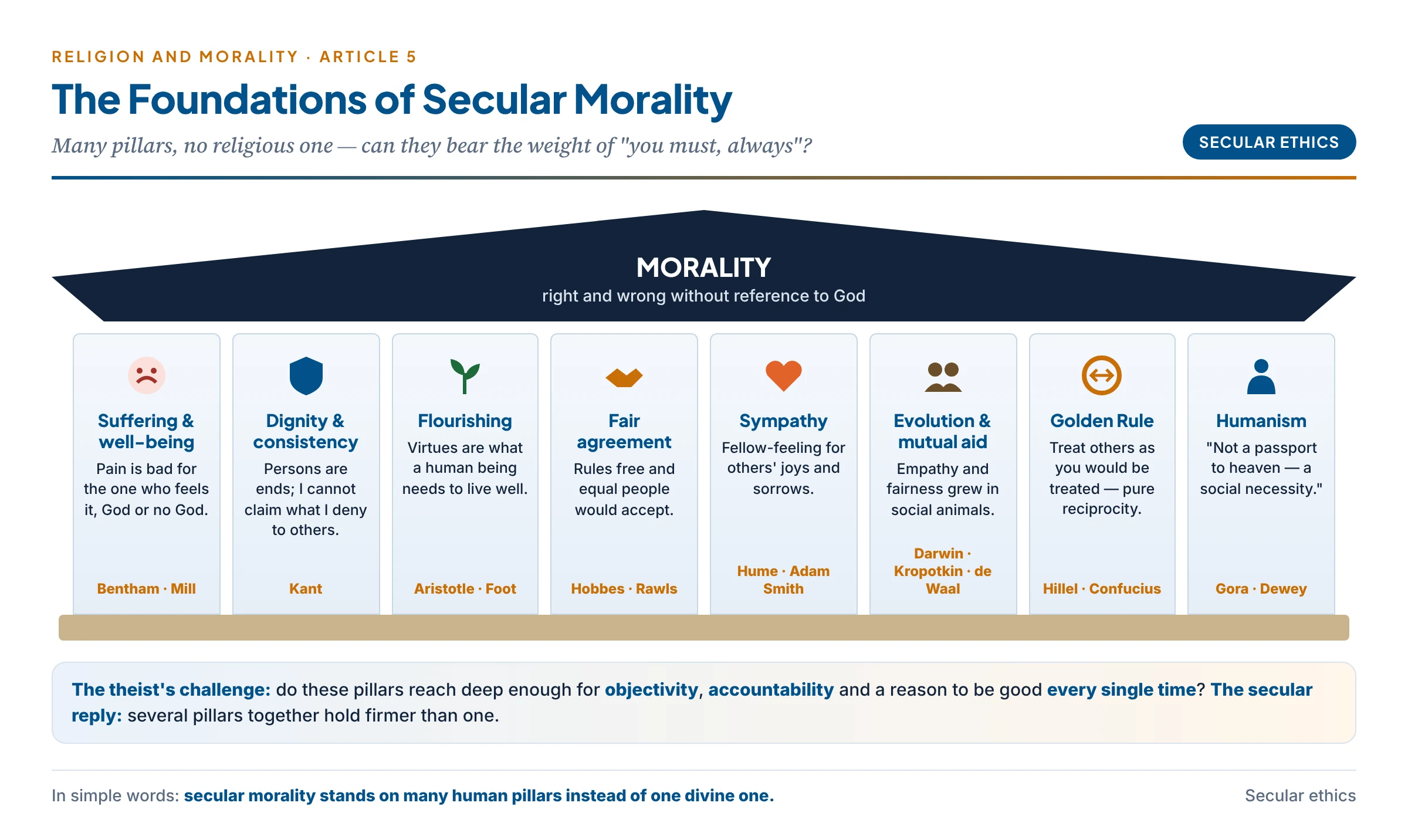
2. The Foundations of Secular Morality
(a) Suffering and well-being — utilitarianism
- Pain is intrinsically bad and happiness intrinsically good for the beings who feel them, whether or not a deity exists. Bentham and J.S. Mill: the right act produces the greatest happiness of the greatest number.
- Example: a secular person who stops to help an accident victim does so because of the objective badness of the victim’s pain — not because a deity commands it or will reward it.
(b) Dignity and consistency — Kantian ethics
- Rational, conscious agents have intrinsic dignity (Würde). Basic obligations — honesty, justice, respect for rights — follow from the logic of mutual respect and non-contradiction (I cannot consistently claim for myself what I deny to others). These hold whether God exists or not.
(c) Flourishing — virtue ethics
- Aristotle (Nicomachean Ethics) and modern thinkers such as Philippa Foot: morality is rooted in human nature — the virtues (courage, temperance, justice, practical wisdom) are the traits a human being needs to flourish (eudaimonia).
(d) Fair agreement — the social contract
- Hobbes: without rules, life would be “solitary, poor, nasty, brutish and short”; rational people agree to moral rules for mutual protection. Rawls: just principles are those that free and equal persons would choose behind a “veil of ignorance“.
(e) Sympathy — moral sentiment
- Hume and Adam Smith: we are moved by fellow-feeling for others’ joys and sorrows; morality grows out of this natural sympathy, refined by reflection.
(f) Evolution — the social animal
- Human beings are social primates. Empathy, cooperation, fairness and mutual aid developed over millions of years as survival mechanisms — long before organised religion. Darwin traced the moral sense to social instincts; Kropotkin (Mutual Aid, 1902) stressed cooperation in nature; Frans de Waal has documented fairness and consolation in apes; Peter Singer describes morality as an “expanding circle” of concern.
(g) The Golden Rule
- “Do unto others as you would have them do unto you” is found in almost every culture and religion (Hillel, Jesus, Confucius, the Mahābhārata), but needs no religious premise — it expresses reciprocity and impartiality.
(h) Humanism
- Humanists hold that morality is a human creation for human good. The Indian atheist Gora put it plainly: “Moral conduct is not a passport to heaven; it is a social necessity.“
In simple words
A building can stand on one great pillar or on many smaller ones. Religious ethics often rests on a single pillar — God’s will. Secular ethics rests on several — suffering, dignity, flourishing, fairness, sympathy. If one pillar is questioned, the others still hold. The theist’s challenge is whether any of these pillars goes deep enough to bear the full weight of “you must, always”.
3. Religious Ethics and Secular Ethics Compared
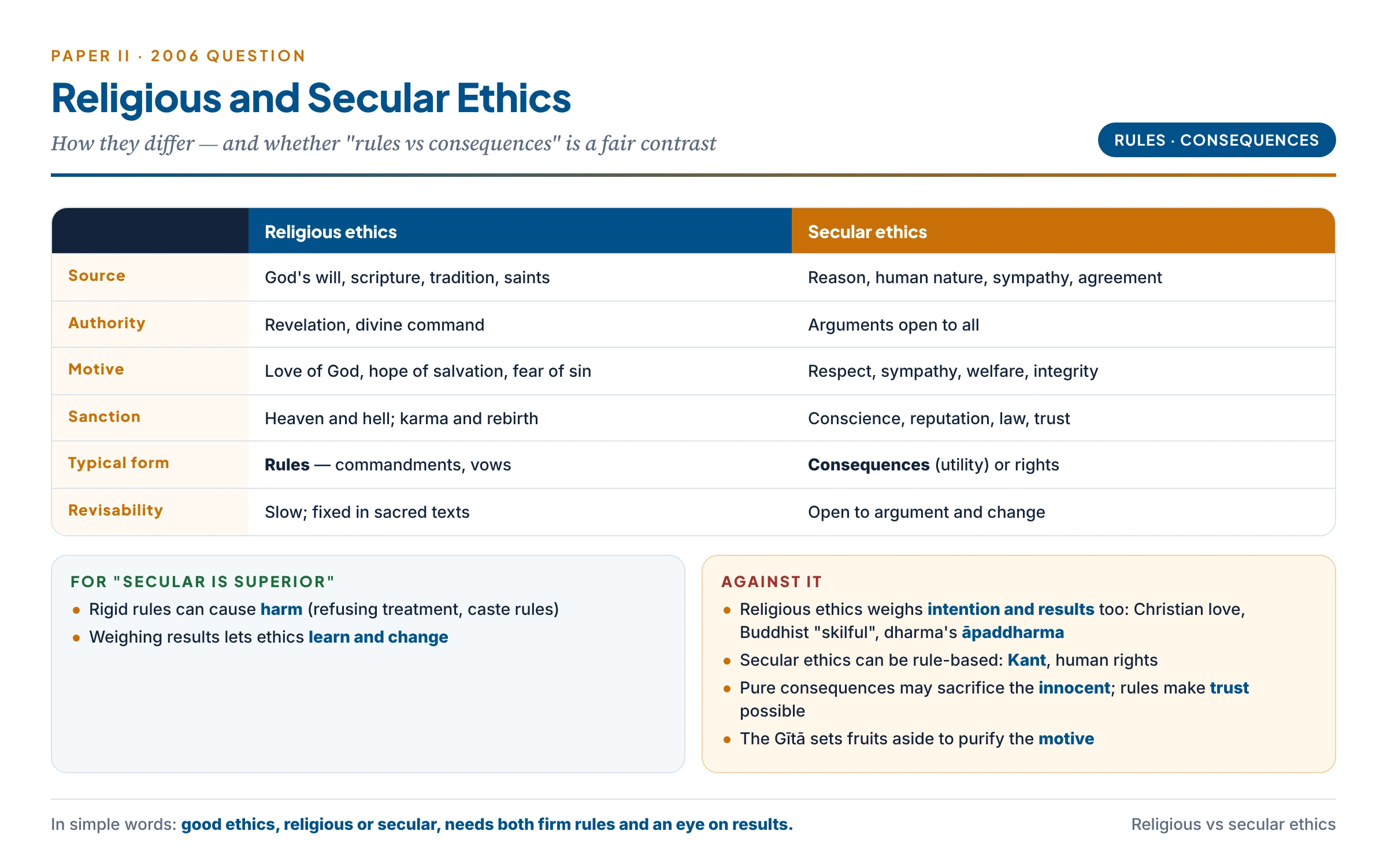
| Point | Religious ethics | Secular ethics |
|---|---|---|
| Source | God’s will, scripture, tradition, saints | Reason, human nature, sympathy, agreement |
| Authority | Revelation; divine command | Arguments all can examine |
| Motive | Love of God, hope of salvation, fear of sin | Respect, sympathy, welfare, integrity |
| Sanction | Heaven and hell; karma and rebirth | Conscience, reputation, law, social trust |
| Form | Often rules (commandments, vows) | Often consequences (utility) or rights |
| Revisability | Slow; fixed in sacred texts | Open to revision by argument |
| Scope | Includes duties to God (worship) | Duties to humans and sentient beings |
The 2006 claim: secular ethics is superior because religious ethics is essentially based on rules without decisive regard for consequences, whereas secular ethics at its best aims at the best overall consequences.
For the claim:
- Rigid rules can produce harm: refusing a life-saving blood transfusion on religious grounds; forbidding contraception in an epidemic; defending caste rules whatever the suffering.
- A consequence-based ethics can learn from results and change.
Against the claim:
- Not all religious ethics is rule-based. Christian ethics centres on love of neighbour; Buddhism judges actions as skilful or unskilful by their intention and their results; the dharma tradition has āpaddharma — special duties in emergencies — showing attention to circumstances.
- Not all secular ethics is consequentialist. Kant and rights theories are as rule-centred as any religion; they too refuse to torture an innocent person even for good results.
- Consequentialism has its own problems. It can justify sacrificing the innocent for the majority; consequences are hard to predict; it ignores justice and rights.
- Rules have value. Stable rules make trust possible; people can rely on promises being kept.
- The Gītā deliberately sets aside consequences — “your right is to action alone, never to its fruits” (niṣkāma karma) — not from blindness but to purify the motive of action.
Verdict: neither religious nor secular ethics is purely rule-based or purely consequentialist. The best ethics, religious or secular, combines principled rules with attention to consequences — as in rule-utilitarianism, or in dharma with its provision for emergencies.
4. “Why Should I Be Moral — All the Time?”
The question. It is easy to see why society needs morality, and why I benefit if others are moral. But why should I be moral every time — even when a particular wrong act would benefit me and I could never be caught?
(a) The classical forms of the question
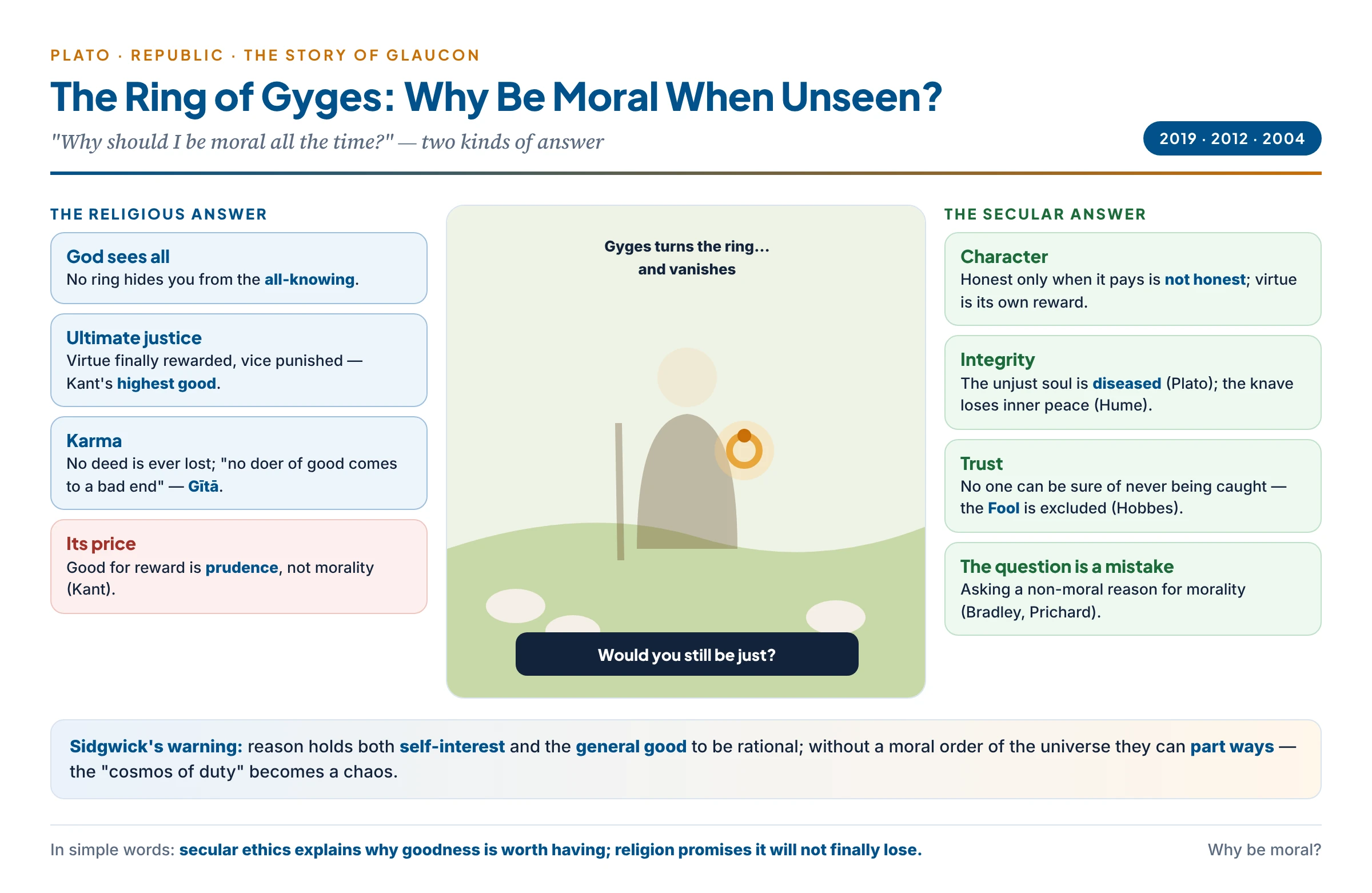
- Plato’s Ring of Gyges. In the Republic, Glaucon tells of the shepherd Gyges, who found a ring that made him invisible, seduced the queen, killed the king and seized the throne. Glaucon argues that anyone with such a ring would act unjustly; people are just only because they fear being caught. Socrates must show that justice is good in itself — that the just soul is harmonious and the unjust soul diseased, even if no one ever finds out.
- Hobbes’s “Fool”. The fool “says in his heart there is no such thing as justice” and asks why he should keep a covenant when breaking it pays. Hobbes replies that no one can rely on never being discovered; the one who breaks faith will be excluded from the society on which his safety depends.
- Hume’s “sensible knave” takes advantage of exceptions to general rules of honesty. Hume answers that the knave loses the inward peace of mind, the consciousness of integrity and the satisfactory review of one’s own conduct — goods worth far more than his petty gains.
(b) Answers that dissolve the question
- F.H. Bradley (Ethical Studies, 1876, essay “Why should I be moral?”) and H.A. Prichard (“Does Moral Philosophy Rest on a Mistake?”, 1912): the question is improper. To ask for a non-moral reason (usually self-interest) for being moral is to ask morality to justify itself by something lower than itself. If I could be moral only because it pays, I would be prudent, not moral. We see our obligations directly; that is the only reason there can be.
- Kant: the moral law is categorical — it does not depend on what I want. So “why should I?” has no answer outside morality.
(c) Why the question still bites — Sidgwick’s dualism
- Henry Sidgwick (The Methods of Ethics, 1874) found two principles each self-evident to reason: rational egoism (pursue your own greatest good) and universal benevolence (pursue the general good). Usually they agree; sometimes they conflict — as when self-sacrifice is morally required.
- Sidgwick admitted that unless we assume a moral government of the universe that makes duty and self-interest finally coincide, practical reason is divided against itself — the “cosmos of duty” is reduced to a chaos. Even a great secular moralist thus conceded something to the religious answer.
(d) The religious answer
- God sees everything — there is no ring of invisibility before Him.
- Ultimate justice — virtue will finally be rewarded and vice punished (Kant’s highest good, heaven and hell).
- Karma — no deed, good or bad, is ever lost; the Gītā assures that “no one who does good ever comes to a bad end“.
- Religion thus gives a reason for being moral in every single case, not just in general.
(e) The secular answer
- Character. Being moral “all the time” is not a series of separate calculations; it is having a good character. A person who is honest only when it pays is not honest. Virtue is its own reward — the Stoic answer.
- Integrity and self-respect. The wrongdoer must live with himself; the inner cost of wrongdoing is real even when undetected (Plato, Hume).
- Trust and social life. No one can be sure of never being found out; and a habit of exceptions corrupts the whole person (Hobbes).
- Human needs. We have reason to be just, courageous and temperate because these are what we need to live well. Courage is needed constantly in ordinary life — people would often not be born but for the courage of their mothers; and anyone who tries to eat ten plates of spaghetti with a crate of beer will soon see the need for temperance. Such reasons do not presuppose God.
- The reasonableness of a demand. One may be told to keep promises without being told “because God will punish you”. But one cannot be told “you just ought” about anything at all — if someone demanded that all readers fund his supply of fine port, “you just ought” would be no answer. Reasons for morality must connect with what people need as human beings.
(f) Evaluation
- The 2019 and 2004 claim — “secular ethics cannot fully (satisfactorily) resolve why one should be moral all the time” — is partly true. Secular ethics can show why morality is good overall and why a good character is worth having; it cannot guarantee that being moral pays in every case. Sidgwick’s dualism remains.
- But the religious answer has a price. If I am moral in each case only because God will reward me, my morality becomes prudential (Kant). The best religious traditions themselves say one should be good for its own sake — the Gītā’s niṣkāma karma, the saint’s love of God without hope of reward.
- So: secular ethics answers “why be moral?” through character and reasons; religion adds hope that goodness is not finally defeated. The deepest answer may be that the question “why be moral all the time?” is only fully answered by becoming a person for whom it no longer arises.
5. Thin Secular Concepts and Thick Religious Ones
- Sin and wrong. In Judaism, Christianity and Islam, wrongdoing is sin — an offence against God within a living relationship. Secular ethics speaks of moral wrong — a “thin” concept shared by atheists, Jews, Muslims, Christians, Hindus and Buddhists. Other religions have their own thick concepts — for example avidyā (ignorance that involves wrong desiring, feeling and choosing as well as wrong thinking) in Advaita.
- Salvation and happiness. Religions speak of salvation, union with God, identity with Brahman or realising one’s Buddha-nature; secular ethics speaks of happiness or well-being.
- The trade-off. Thin concepts are shareable across a plural society; but they are so abstract that they motivate less. “Why should I be moral?” is a serious question; “Why should I care about offending God?” is foolish to anyone who understands the context in which it would be asked. Part of the force of the “why be moral all the time” problem comes from this thinning.
6. Absolute Ethical Values in a Non-Theological System
The 2017 question asks what authority and acceptance absolute ethical values can have in a non-theological system of social practices.
The worry. Without God, absolute values (never torture the innocent; never enslave) may seem to rest only on opinion, which can change. Who or what authorises them?
Sources of authority without theology:
- Reason. The categorical imperative and the demand for consistency give values that hold for every rational being, regardless of belief.
- Human dignity. Modern human rights rest on the “inherent dignity … of all members of the human family” (Universal Declaration of Human Rights, 1948) — a secular foundation that nevertheless treats some rights (such as freedom from torture and slavery) as absolute, allowing no exception even in emergency.
- Overlapping consensus. Rawls: citizens with different religious and secular world-views can agree on the same core principles, each for their own reasons. The authority of the values then rests on public reason, not on any one theology.
- Constitutional morality. In India, the Constitution’s values — justice, liberty, equality, fraternity, dignity — function as a secular yet binding moral order for public life.
- Non-theistic religions. Buddhism and Jainism show long-standing systems with near-absolute values (ahiṃsā, the precepts) and no creator God; their authority rests on insight, experience and the example of the enlightened.
- Exemplars. Across cultures people recognise moral exemplars — saints, sages, arahants, heroes of conscience — and can see why they are admirable even across religious divides; a common morality may grow from the virtues they share.
How acceptance is secured: through education, law, habit, public deliberation, and the lived experience that these values make social life possible. Their authority is that of good reasons rather than of command.
Limits. Such values can be eroded if their reasons are forgotten; they need constant renewal in culture and institutions. Religious traditions can support them — but they do not need to found them.
Indian Connect — Absolute values without a creator — the Indian case
- Jainism holds ahiṃsā as the supreme and almost absolute value, binding monks fully (mahāvrata) and householders partially (aṇuvrata) — yet Jainism denies a creator God. Its authority rests on the teaching and example of the tīrthaṅkaras, who are perfected humans.
- Buddhism grounds the precepts in insight into suffering and its causes and in the natural working of karma, not in divine command.
- Mīmāṃsā treats Vedic dharma as eternally binding, again without God. India therefore offers living proof that absolute values can have authority and acceptance in non-theological systems.
7. “An Atheist May Be a Better Man than a Religious Person Bereft of Moral Values”
- The meaning. The statement contrasts an atheist who is morally good with a believer who is religious in name or ritual but lacks moral values. It claims that moral worth depends on conduct and character, not on creed.
- Support:
- Pierre Bayle (1682) argued that a society of virtuous atheists is possible, and that atheists can be morally upright while professing believers may be vicious.
- Kant: moral worth lies in the good will, not in belief; a believer who is moral only from fear has less moral worth than an atheist who is moral from duty.
- Secular altruism. The secular person who helps without hope of heaven or fear of hell acts from purer altruism than one motivated by fear of damnation.
- Indian examples. The atheist Gora worked against untouchability and was admired by Gandhi; Bhagat Singh, who wrote Why I Am an Atheist (1930), combined unbelief with intense self-sacrifice. Gandhi said of the famous atheist Charles Bradlaugh that he was a “truth-fearing” and therefore a “God-fearing” man.
- Religion without morality is empty (Article 2); the prophets themselves condemned the hypocrite.
- Cautions:
- The statement does not say atheists are better than religious people in general — only better than religious people without moral values, which is almost a truism.
- Many religious people are deeply moral, and religion often strengthens morality (Article 1).
- Good intentions are not enough. The philosopher Daniel Dennett, reflecting on the medical care that saved his life, contrasted the religious tendency to value intention with the secular demand of medicine and science that everything possible actually be done: “Loyalty to tradition is not enough. You’ve got to keep asking yourself: What if I’m wrong?” Religious and secular people alike can be held to the same moral standards; good intentions alone do not make a person good.
In simple words
Two people are asked to look after a neighbour’s sick child for a night. One prays beautifully for the child’s recovery but falls asleep and forgets the medicine. The other does not pray at all but stays awake, gives every dose on time and calls the doctor at the first sign of fever. Whom would the child’s mother call a good neighbour? Goodness is shown in care and conduct, whatever one’s creed.
8. The Is–Ought Problem
The 2014 question asks on what grounds the dichotomy between “is” and “ought” can be justified or rejected. The question matters for religion, because it asks whether any fact — including “God commands it” — can by itself yield an obligation.
The dichotomy stated
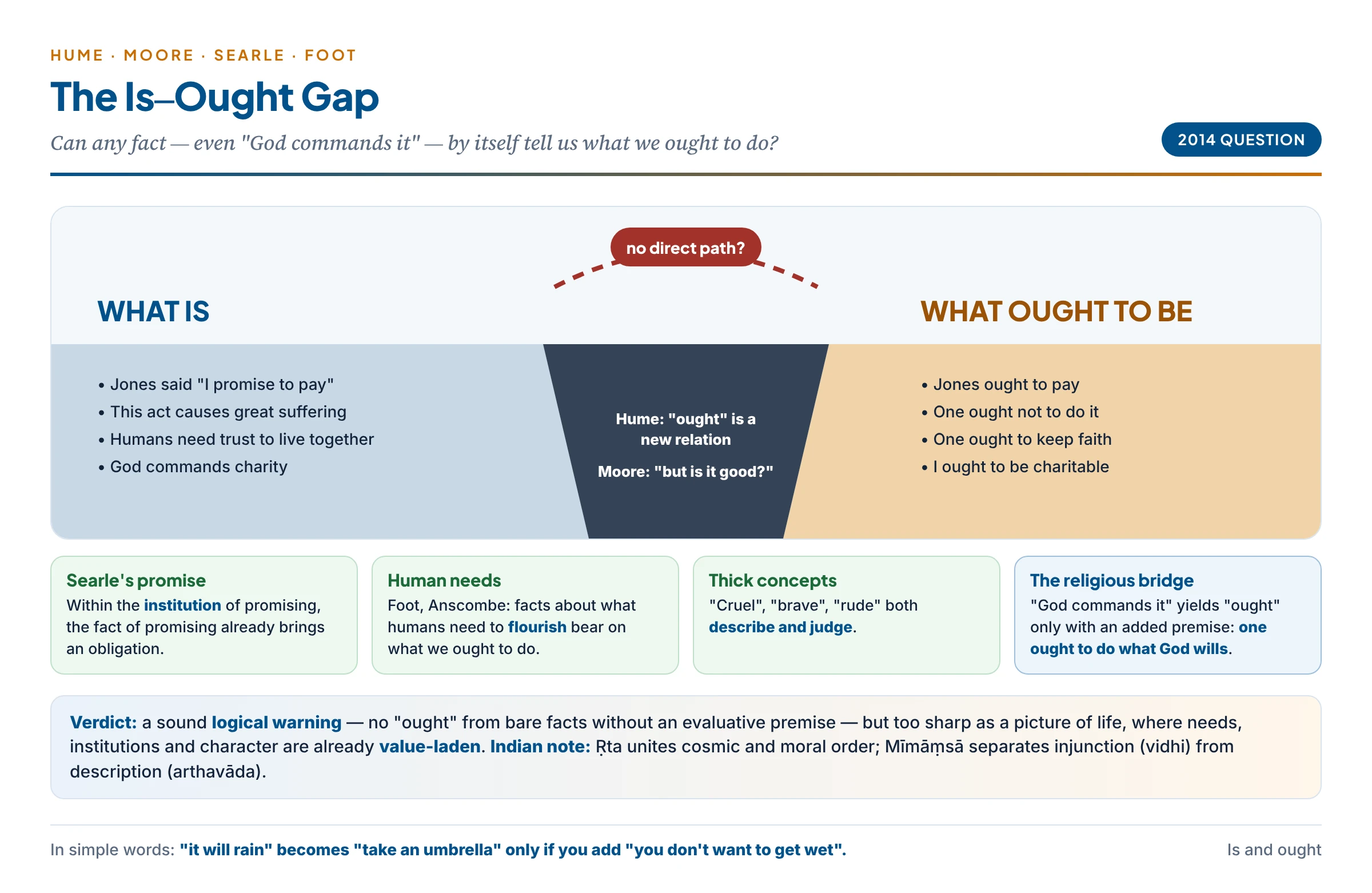
- Hume noticed that moral writers pass, without explanation, from statements about what is to statements about what ought to be. A new relation (“ought”) appears in the conclusion that was not in the premises; this, he said, needs to be explained — and seems impossible to derive.
- G.E. Moore (Principia Ethica, 1903) argued that defining “good” in terms of any natural property (pleasure, evolution, God’s will) commits the naturalistic fallacy: for any such property one can still sensibly ask, “But is it good?” — the open question argument.
In simple words
A weather report says, “It will rain at five.” That is an is. “Take an umbrella” is an ought. The second does not follow from the first alone — it follows only if you add “you do not want to get wet“. Hume’s point is that every “ought” conclusion hides some such evaluative premise. The religious version: “God commands charity” (is) leads to “be charitable” (ought) only if we add “one ought to do what God commands“.
Grounds for accepting the dichotomy
- Logic. In a valid argument the conclusion cannot contain what is absent from the premises; from factual premises alone, no “ought” follows.
- Science and value. Science describes how the world is; whether that state is good is a further question. Keeping the two apart protects science from wishful thinking and ethics from mere description.
- Critique of authority. The gap blocks the move from “this is the custom” or “this is what nature does” — or “God wills this” — straight to “this is what you ought to do”. As Article 3 showed, the believer needs an extra ought premise (“one ought to do what God wills”).
- Moral freedom. If values could be read off facts, there would be no room for moral choice and criticism of the status quo.
Grounds for rejecting it
- Searle’s promise. John Searle (1964): “Jones uttered the words ‘I hereby promise to pay Smith five dollars'” (a fact) → “Jones promised” → “Jones placed himself under an obligation” → “Jones ought to pay Smith”. Within institutions such as promising, facts already include obligations.
- Human nature and good. Philippa Foot and Anscombe: facts about what human beings need to flourish (as facts about a plant tell us what is good for it) bear directly on what we ought to do.
- Thick concepts. Words like cruel, brave, generous, rude both describe and evaluate; the fact–value line cannot be drawn cleanly through them.
- Pragmatism. Dewey and later pragmatists argue that facts and values are entangled in inquiry; ends and means shape each other.
- Religious and metaphysical traditions. Natural law, Aristotle and the Indian idea of Ṛta see the order of what is and the order of what ought to be as one order.
Verdict. The dichotomy is a useful logical warning — one cannot deduce values from bare facts without an evaluative premise — but it is too sharp as a metaphysical claim: in human life, facts about needs, institutions and character are already value-laden.
Indian Connect — Is and ought in Indian thought
- Ṛta in the Veda is at once the order of nature (the regular course of sun and seasons) and the moral order (truth, right conduct) — no gap between “is” and “ought” at the level of the cosmos.
- Mīmāṃsā, however, draws a sharp line inside the Veda itself between vidhi (injunctions — “one should sacrifice”) and arthavāda (descriptive or praising statements — “Vāyu is the swiftest god”). Descriptive sentences have no independent authority about dharma; they are meaningful only as supports to injunctions. This is a striking Indian parallel to the is–ought distinction: only an “ought” sentence can establish dharma.
Critical Evaluation
Critics and Defenders
Criticism — Critics of secular ethics
- Dostoevsky’s challenge: without God, values lose objectivity and accountability.
- Sidgwick: reason is divided between self-interest and benevolence without a moral governor.
- Anscombe: “moral obligation” without a lawgiver is a survival without sense.
- Thin concepts: secular ideas of wrong and happiness motivate weakly.
- Fragility: secular values may erode when their reasons are forgotten.
Defence — Defenders of secular ethics
- Plato, Hume: justice and integrity are goods of the soul worth more than any gain.
- Bradley, Prichard, Kant: asking for a non-moral reason for morality is a mistake.
- Bayle, Gora, Bhagat Singh: atheists can be among the most moral of people.
- Rawls, human rights: absolute values can rest on public reason and dignity.
- Buddhism, Jainism, Mīmāṃsā: whole religious civilisations have held absolute values without a creator God.
Cross-Tradition Comparison
| Question | Western secular answers | Indian answers |
|---|---|---|
| Why be moral when unseen? | Integrity, character (Plato, Hume, Stoics) | Karma never misses a deed; the inner witness (sākṣī) |
| Why be moral at all? | Reason (Kant), welfare (Mill), flourishing (Aristotle), contract (Hobbes, Rawls) | Liberation needs purity (cittaśuddhi); śīla before prajñā; social order (lokasaṃgraha) |
| Can values be absolute without God? | Human rights, dignity, overlapping consensus | Jaina ahiṃsā, Buddhist precepts, Mīmāṃsā dharma — all without a creator |
| Rules or consequences? | Kant vs Mill | Dharma rules with āpaddharma; Buddhist intention and result; Gītā’s disregard of fruits |
| Is and ought | Hume, Moore vs Searle, Foot | Ṛta unites them; Mīmāṃsā separates vidhi from arthavāda |
Indian Connect — Takeaways
- Indian thought answers “why be moral all the time?” mainly through karma — an impersonal moral law that works whether or not any God or human sees — showing that the “religious” answer need not be theistic.
- At the same time, the Gītā’s niṣkāma karma insists that the truly moral person acts without eye on the fruit — agreeing with Kant and Bradley that morality pursued only for reward is not yet true morality.
Synthesis (Siddhānta)
- Secular morality is possible and real. Its foundations — suffering, dignity, flourishing, fairness, sympathy, social nature — are solid enough to ground the great bulk of moral life, and many atheists live by them admirably.
- The question “why be moral all the time?” exposes a real limit. Secular ethics can justify good character and show that morality is good on the whole, but cannot guarantee that virtue never loses. Religion (theistic or karmic) supplies hope that goodness is not finally defeated — at the risk, if misused, of turning morality into prudence.
- Absolute values can have authority without theology, through reason, dignity, public consensus and exemplars — as both human-rights law and the Jaina and Buddhist traditions show — though they need constant cultural renewal.
- Contemporary relevance. Surveys show wide differences: most people in Europe now say belief in God is not necessary to be moral, while 85% of Indians in 2025 said it is. In such a world, the task is to build a shared moral language — dignity, fairness, compassion — that believers and non-believers can both speak, while respecting the deeper reasons each brings.
“Moral conduct is not a passport to heaven; it is a social necessity.” — Gora
Previous Year Questions
- 2019Secular ethics cannot fully resolve as to why one should be moral all the time. Examine.
- 2017What will be the authority and acceptance of the absolute ethical values in the non-theological system of social practices? Discuss.
- 2015“An atheist may be a better man than a religious person bereft of moral values.” Discuss.
- 2014On what grounds, the dichotomy between ‘is’ and ‘ought’ can either be justified or rejected?
- 2012“If God does not exist then why should one be moral all the time?” Discuss.
- 2006Distinguish between religious and secular ethics. Discuss in this context the view that holds that secular ethics are superior to religious ethics because religious ethics are essentially based on rules without decisive regard for consequences whereas secular ethics at their best aim at producing the best overall consequences.
- 2004“Secular ethics cannot satisfactorily answer the question — ‘Why should I be moral all the time?’“
- 2003Are God and religion necessary presuppositions of morality? Elucidate your answer following Kant and consider critically in this context the possible grounds of morality for an atheist.