

Religious Experience: Nature and Object (Indian and Western).
Official Syllabus: Paper II, Section B, Unit 6
Countless people claim to have experienced God, Brahman or nirvāṇa. For some, these experiences are the best evidence there could be for the reality of what they believe; for others, they are illusions produced by the brain, by childhood wishes, by drugs or by culture. This article examines whether religious experience can be validated — whether it gives a person (and others) good reason to believe in its object. It covers the argument from religious experience (the analogy with perception, Swinburne‘s principles of credulity and testimony, James, Alston, Plantinga and Hick), the philosophical and scientific challenges (no checking procedures, conflicting claims, circularity, the finite and the infinite, Freud, Ramachandran, Persinger), the replies, and the Indian debate on whether direct experience (anubhava) is a valid means of knowledge (pramāṇa).
In simple words
In a court, a witness says, “I saw the accused at the station at 9 p.m.” The judge does not demand a mathematical proof; she believes the witness unless there is a reason to doubt — the witness was drunk, short-sighted, a known liar, or the accused was provably elsewhere. Defenders of religious experience say we should treat a person who says “I was aware of God” in the same way. Critics reply that this witness is describing something no one else can check — and that makes all the difference.
Context & Problem
Religious Experience and Justification
- A private matter. Religious experience is typically private: someone senses that she is one with the divine, or that God or an angel speaks to him.
- The key questions.
- Is a person justified in inferring from a religious experience — her own or another’s — that its object is objectively real?
- Can one be mistaken about such experiences? How would one know?
- Is religious experience evidence only for the experiencer, or also for others?
- “Verify” and “validate”. To verify is to check a claim by public tests, as one checks that there is milk in the fridge. To validate is broader: to show that it is rational to accept the claim. Religious experience may be hard to verify and yet arguably valid.
- Its place among the proofs. The argument from religious experience relates to people more directly than abstract proofs; it is accessible and understandable. Its weakness is that it deals with something akin to emotion, not with something publicly measurable.
Core Doctrine
1. The Argument from Analogy with Sense Perception
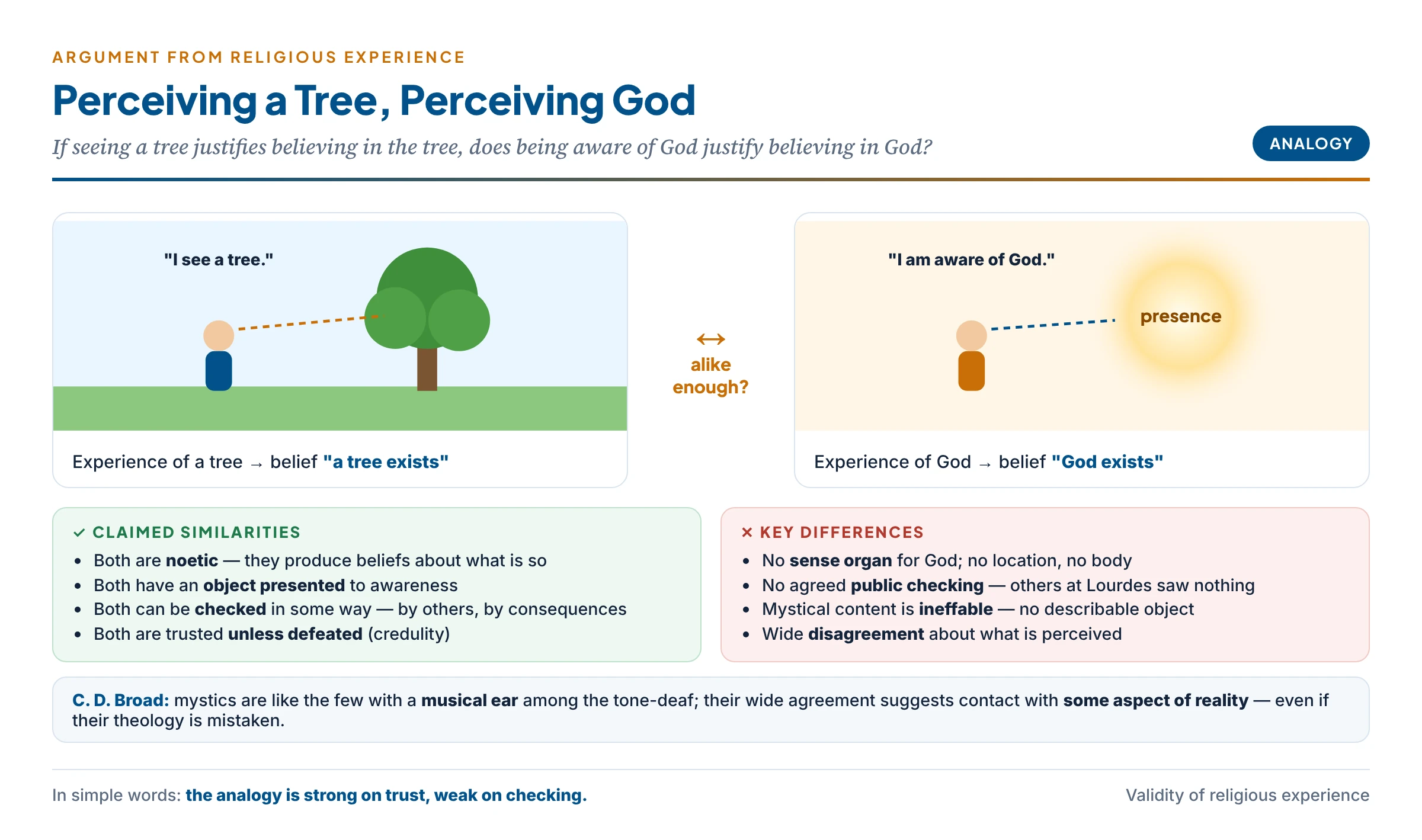
- The argument. “I experience a tree, and I believe that a tree exists. I experience God, and I believe that God exists.” Despite differences, there are enough relevant similarities to warrant belief in God if we are warranted in believing in trees.
- Three similarities claimed. Both experiences:
- are noetic — they concern the content of the mind, producing beliefs;
- have a perceptual object — something presented to awareness;
- include states of affairs that can be checked in some sense — by others, by consequences.
- The weak point. Whether religious experiences really have a perceptual object is debatable. Mystics call their experience ineffable — and an ineffable experience, by definition, has no expressible cognitive content. How can something with no describable content count as perception of something?
- C. D. Broad’s version. Broad compared mystics to people with an unusual capacity — like those with a fine musical ear among the tone-deaf. A tone-deaf person should not deny that music exists. The agreement of mystics across ages and cultures makes it reasonable to suppose they are in touch with some aspect of reality that others miss — though their theological interpretations may be mistaken.
2. Swinburne: the Principles of Credulity and Testimony
- Source and conclusion. Richard Swinburne, The Existence of God (1979; revised 1991), builds a cumulative case: on our total evidence, “theism is more probable than not.” Religious experience is the decisive part.
- Definition. A religious experience is “an experience of God or of some other supernatural thing.” This matters: many people dismissed testimonies because they were of an angel or the Virgin Mary, not of God; Swinburne includes them.
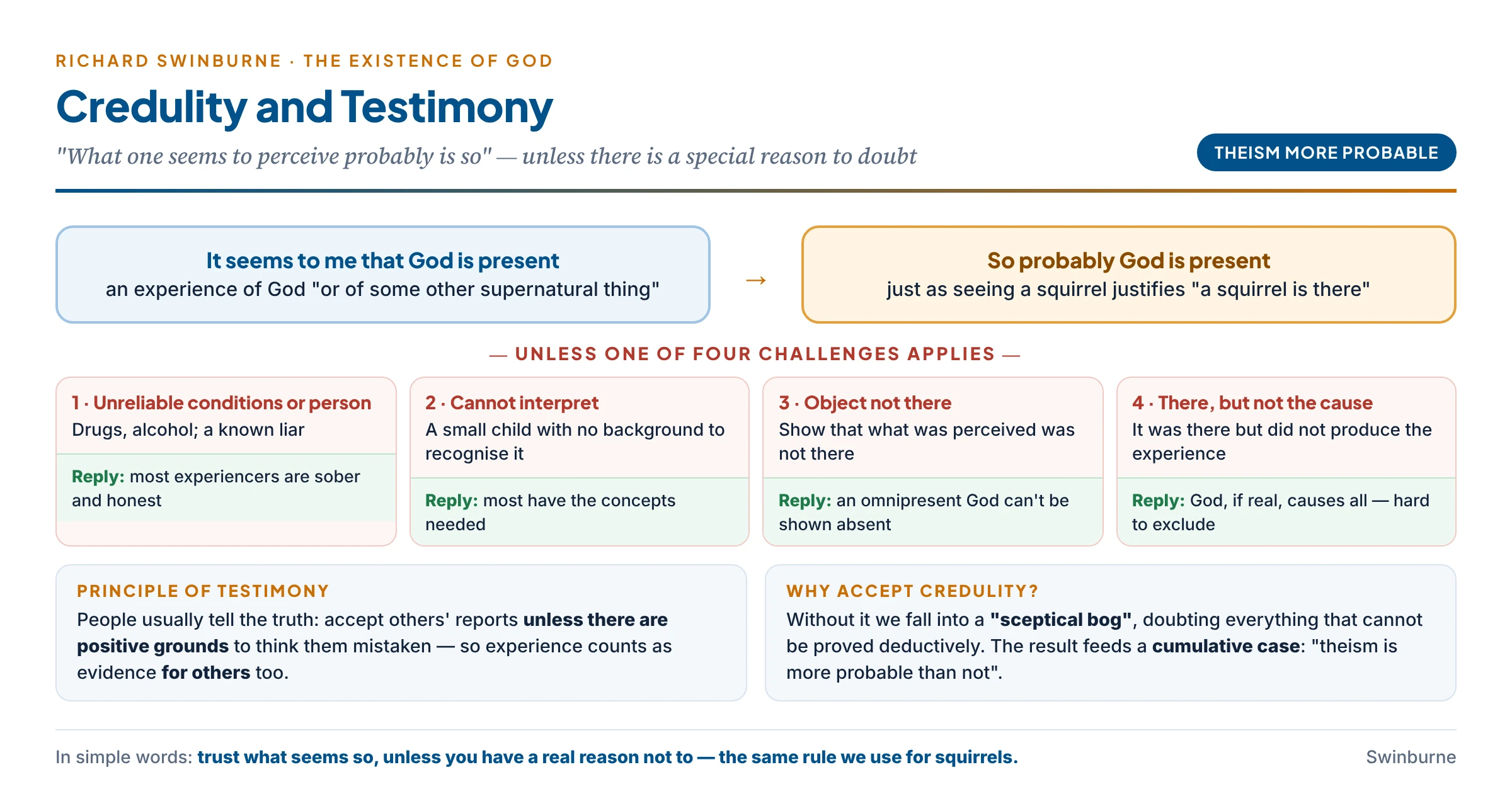
- The principle of credulity. In plain words: if it seems to a person that something is present, then probably it is present — “what one seems to perceive probably is so.” In the absence of special considerations, we should accept appearances.
- Example. Walking in a forest, I see a squirrel in a tree ahead. I am justified in believing a squirrel is there — unless I have special reason to doubt.
- Why accept it? Rejecting the principle lands us in a “sceptical bog“: we would have to doubt everything that cannot be proved deductively — even our ordinary perceptions.
- The four challenges (special considerations). Swinburne accepts that credulity can be defeated if:
- Unreliable conditions or subject — the experience occurred in conditions that generally produce unreliable results (drugs, alcohol), or the person is unreliable (a pathological liar);
- Lack of ability to interpret — the person lacked the background to recognise what he experienced (a very young child);
- The object was not there — it can be shown that what was perceived was absent;
- The object was there but not the cause — what was perceived was present but not responsible for the experience.
- Swinburne’s reply to the challenges. None applies to religious experience in general: most experiencers are not drugged or liars; God, being omnipresent, can hardly be shown absent; and since God, if He exists, is the cause of everything, it cannot easily be shown that He was not involved. To defeat the experience one would need strong prior evidence that God does not exist.
- The principle of testimony. “In the absence of special considerations, the experiences of others are probably as they report them.” People usually tell the truth; I should accept your report unless I have positive grounds to think it mistaken. So religious experience is evidence not only for the experiencer but for others too.
- The cumulative case. Each argument for God may be weak alone, but together they add up — and religious experience tips the balance.
3. Flew’s Leaky Buckets and Franks Davis’s Reply
- Flew’s objection to the cumulative case. “If one leaky bucket will not hold water, that is no reason to think that ten can.” Many weak arguments do not make one strong argument.
- Caroline Franks Davis’s reply. Ten leaky buckets can hold water if they are placed one inside another so that the holes do not overlap. The weaknesses of one argument may be covered by the strengths of another. Religious experience is strongest as part of a cumulative case, not alone.
In simple words
A single sieve cannot carry water. But stack ten sieves so that each one’s holes sit over the solid parts of the next — and very little water escapes. That is Franks Davis’s point: the arguments for God may each have holes, but if their holes are in different places, together they may hold.

4. William James’s Argument
- Experience as the final arbiter. All normal persons have some religious experience, and since experience is the final arbiter of truth, God — as the object of religious experience — should be accepted as real.
- The fruits. Religious experiences have profound effects on individuals and even whole societies; such effects cannot reasonably be attributed to hallucinations. It is more reasonable to believe a real God is responsible than an imaginary being.
- Religion and neurosis. Many in James’s time dismissed religious experience as the product of a “faulty” mind. James did not deny the link — he said religion and neurosis are compatible, even partners; what matters is the fruits, not the roots.
- “The Reality of the Unseen”. In this lecture James gathered testimonies whose most compelling feature is their sheer certainty.
- His conclusions.
- The cause of the experiences is real; if that cause is believed to be God, then God exists — not necessarily the God of classical theism, but God as the source of the experiences.
- True things tend to lead to “consistency, stability and flowing human intercourse“; what is real improves life, what is false restricts it.
- Those who claimed religious experiences seemed more fulfilled and purposeful than those who held atheist theories.
- Mystical states are authoritative for those who have them, but impose no duty on others to accept them; yet they show that ordinary consciousness is not the only kind (Article 2).
- Emotion as evidence. Since feeling is an integral part of religion, it is reasonable to accept it as evidence; we should not be troubled by the charge of subjectivity.
5. Alston: Perceiving God
- M-beliefs. William Alston calls beliefs formed in religious experience “M-beliefs” (M for manifestation): that God is “speaking to him, comforting him, strengthening him, enlightening him, giving him courage, guiding him, pouring out His love or joy into him, sustaining him in being”.
- A spectrum. Such experiences run from faint, occasional moments in an ordinary believer’s life, through “peak experiences“, to the overwhelming experiences of the classic mystics and the paradigm experiences of the prophets and apostles.
- Mystical perception. These experiences have the structure of perception: something is presented to awareness as being a certain way (loving, powerful), not merely thought about.
- Doxastic practices. We form beliefs through socially established practices — sense perception, memory, introspection, reasoning. None can be shown reliable without circularity: we can check our senses only by using our senses. So it is rational to engage in any well-established practice unless it is shown unreliable. Christian mystical practice is such a practice, with its own checks (scripture, tradition, moral fruits).
- Alston’s own difficulty. There are rival mystical practices — Hindu, Buddhist, Muslim — whose outputs conflict. Alston admitted this was the most serious problem for his view.
6. Plantinga and Hick: Rational Belief Without Proofs
- Basic beliefs. Beliefs formed directly in religious experience are basic — not derived from other evidence-stating beliefs. Alvin Plantinga argues they can be properly basic: as rational as our basic perceptual beliefs. He traces this to the Reformers, especially Calvin. On the basis of their experience it was as rational for Moses or Jesus to believe in God as in Mount Sinai or the Mount of Olives.
- Grounded, not groundless. “I see a tree”, “I had breakfast this morning”, “that person is in pain” are not inferred from other beliefs, yet they are grounded in experience. So too “God is forgiving me”.
- Against Clifford. W. K. Clifford: “It is wrong always, everywhere, and for anyone, to believe anything upon insufficient evidence.” Hick replies that this is too narrow. Footprints are evidence that someone passed by; but seeing the person pass is not “evidence” — it is direct experience. When I see my hand before my eyes, I do not infer it; the model “evidence → inference → belief” does not apply.
- Basic and foundational beliefs. Particular beliefs (“I see a tree”) rest on a foundational belief that our senses generally put us in touch with a real world — a belief we cannot prove without circularity but which it would be irrational to reject. Hume: nature “has doubtless esteemed it an affair of too great importance to be trusted to our uncertain reasoning”. Likewise, religious basic beliefs rest on a foundational belief in the reality of the Divine.
- The disanalogy. The foundational belief in the physical world can be doubted only artificially; the foundational belief in a transcendent reality can be, and is, seriously doubted. The universe is “religiously ambiguous” — capable of being experienced both religiously and naturalistically.
- Hick’s verdict. The question is not whether God’s existence can be established as public knowledge, but whether it is rational for those who experience life theistically to believe in God and live accordingly. Hick answers yes — while conceding that experience cannot demonstrate God’s existence.
7. The Philosophical Challenges
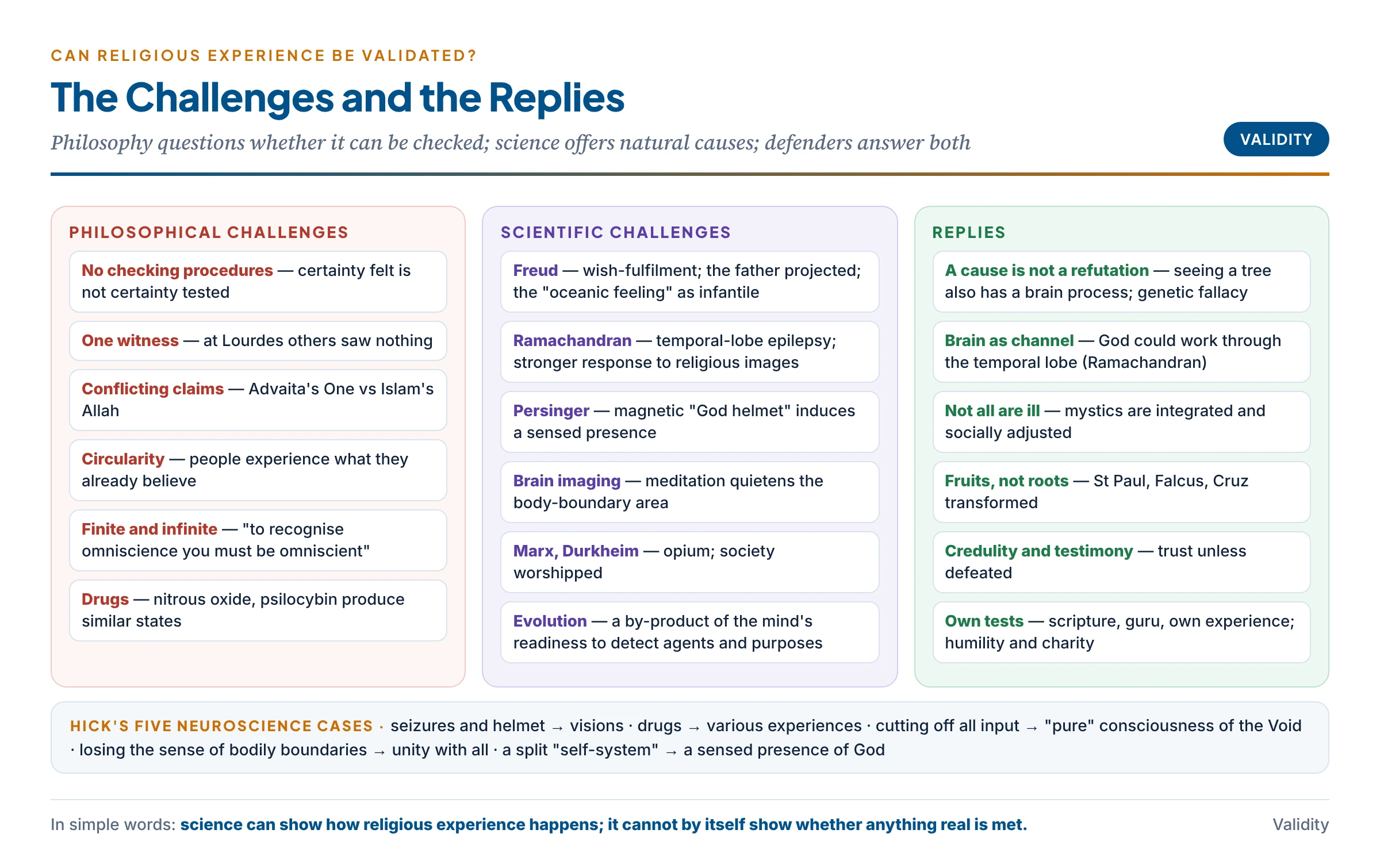
- No checking procedures (lack of verifiability). Perceptual claims can be checked by others and by agreed procedures; religious claims cannot. The experience may feel incorrigible, indubitable and self-validating, but this psychological certainty is not empirical certainty, which comes from inter-subjective tests with objective checks. A report like “I had a vivid sense of God” behaves more like “I have a headache” — a report about oneself — than like “I see a tree”.
- Individual, not group. Religious experiences happen to individuals, so we often have only one person’s testimony. At Lourdes, Bernadette said the Virgin spoke to her; the people around her saw and heard nothing — only Bernadette talking to someone unseen.
- Subjectivity. Religious experience is very like emotion — a personal response; no objective criteria can judge its authenticity; it cannot be offered as scientific proof.
- Conflicting claims. Experiences are divergent and even contradictory: the Advaitin’s experience that all reality is one contradicts the Muslim’s experience of Allah as a separate being. Some experience the God of their own faith, some a deity outside organised religion, some simply the force of nature.
- Circularity. Justification depends on assumptions not self-evident to all, which are then used as controls on the experience. Experiencers tend to have experiences in line with what they already believe.
- Can the finite experience the infinite? How can one recognise God as Creator, omnipotent, eternal? “To recognise omniscience, you would have to be omniscient yourself.” God is not material and has no location; “God is love” — how does one encounter love itself? Kant: it is impossible for a finite being to experience an infinite being.
- Interpretation. We interpret every experience in ways we understand: the religious person within a religious framework, the atheist as natural events (Article 7).
- Neither verifiable nor falsifiable. Religious experience cannot be brought under the verification principle of the logical positivists or Karl Popper‘s falsification principle: no observation could confirm or refute “I was in God’s presence”.
- Drugs. Drugs and alcohol can produce very similar experiences. James himself reported that nitrous oxide and other anaesthetics, mixed with air, “stimulate the mystical consciousness in an extraordinary degree”. In 1962, divinity students given psilocybin in a chapel on Good Friday reported mystical experiences; modern research has repeated such findings.
In simple words
If you tell me there is milk in the fridge, I can open the fridge and look; so can anyone else. If you tell me God comforted you last night, which fridge do I open? There is no agreed place to look, no instrument to read, no second observer who can stand where you stood. That missing “fridge” is what philosophers mean by the lack of checking procedures.
8. The Scientific Challenges
- Freud — psychology.
- Freud held that humans are wholly material; religious urges are a kind of obsession, and religious experiences are illusions — projections of the oldest, deepest wishes.
- Helplessness and fear in childhood create a wish for a loving, protective father; carried into adulthood, it demands a greater being — a heavenly father replaces the earthly one. Two further wishes are satisfied: for universal justice and for life after death. All are met by “the illusion of divine providence”.
- Someone who “experiences the suffering of Jesus” is projecting his own beliefs about suffering, helplessness and separation, and his longing for salvation and reunion with a parent.
- Religion is a mass delusion or wish-fulfilment; it uses magical thinking. Freud noticed that the obsessive rituals of his patients resembled formal prayer and worship. He even remarked that paranoid delusions are like philosophical systems — attempts to make sense of the world.
- The mystic’s “oceanic feeling” of oneness with the universe he traced to an infantile state before the ego separated itself from the world.
- V. S. Ramachandran — neurology.
- Studying temporal lobe epilepsy, he measured patients’ skin resistance (how much they sweated) while viewing images; epileptic patients reacted far more strongly to religious images than others.
- He suggested that figures such as St Paul might have had the condition: “there are certain circuits within the temporal lobes which have been selectively activated… more conducive to religious belief and mystical belief.”
- Yet he did not rule out God: it may be that God placed the temporal lobe there as a means of communication. “Whether God exists or not, the way our brains have developed, we will go on believing.”
- Michael Persinger — the “God helmet”.
- Weak magnetic fields applied across the temporal lobes induced in many subjects a sense of a presence or of oneness — over 900 participants reported some such experience.
- Proposed mechanism: deprived of normal input, the brain loses its sense of where the self ends; the self “expands” to fill the world — “one with the universe“.
- When the field is switched off, the experience stops.
- Hick’s five neuroscientific cases.
- Epileptic seizures and stimulation by the “Persinger helmet” cause religious visions;
- psychotropic drugs cause various forms of religious experience;
- “pure” consciousness — of the Void, emptiness, śūnyatā — is consciousness continuing after all perceptual input is cut off;
- the sense of unity with all reality results from closing down awareness of the body’s boundaries;
- the sense of the presence of God or other beings results from a splitting of the “self-system” into two, one half seeing the other as a separate being.
- Sociological and evolutionary explanations. Marx (religion as “opium” of the oppressed), Durkheim (God as society worshipped symbolically), and evolutionary theories (a by-product of mind-reading and agency-detection).
- Conclusion of the critics. Philosophers who accept that people have authentic religious experiences may still deny that one can infer their cause was God, nirvāṇa or the Ultimate. A religious experience can establish the reality of a psychological state, not the objective reality of its object.
Common confusion
Did Persinger’s helmet produce the experiences of Tibetan monks and Franciscan nuns? Many notes say so, but the famous studies of Tibetan Buddhist meditators and Franciscan nuns were brain-imaging studies by Andrew Newberg and Eugene d’Aquili: during deep meditation and prayer, activity fell in a part of the parietal lobe that helps us sense where the body ends — matching the reported sense of boundlessness. Persinger’s own “God helmet” results have also been questioned: a careful double-blind study in Sweden in 2005 found the effects depended on suggestibility, not on the magnetic field.
9. Replies to the Challenges
- Experience is the strongest form of evidence. A person who has seen a vision or heard God’s voice will firmly believe it; no argument from philosophy or science will change her mind — and from her own point of view she may be rational in this.
- A cause is not a refutation. Showing the brain process behind an experience does not show it is false: seeing a tree also has a brain process. If God exists, He could work through the temporal lobes — as Ramachandran himself allows. To reject a belief because of its origin is the genetic fallacy.
- Not everyone is ill. Temporal lobe epilepsy cannot explain every experience — there are far too many experiences and people. Mystics typically show social adjustment and mental integration — the opposite of neurosis (Article 4).
- Fruits, not roots. James: what matters is not the cause but the fruits — courage, love, moral transformation (St Paul, Davey Falcus, Nicky Cruz).
- Checking procedures of a different kind. Traditions have their own tests:
- Christian discernment of spirits — humility, charity, conformity with scripture (Teresa insisted that genuine visions leave peace and humility);
- the Indian triple test — agreement of scripture (śāstra), the teacher (guru) and one’s own experience (svānubhava);
- the Buddhist test of reduced craving and increased compassion.
- Public experiences exist. Swinburne’s first two types are public — God’s action seen in a sunset or a miracle. Corporate experiences — the apparition at Knock (1879) reported by many villagers; Pentecost — are claimed by groups. Some effects are claimed to be publicly demonstrable — lasting regenerative changes of character, speaking in tongues, alleged clairvoyance — and the selfless lives of saints are offered as a check on those who reduce religious experience to mere subjectivity. (Critics reply that such cases are rare and often naturally explicable: the 1995 reports of Gaṇeśa images “drinking milk” were explained by scientists as capillary action.)
- Conflict can be explained. Different experiences may be partial apprehensions of one Real (Hick, Radhakrishnan), or one may be true and another mistaken — conflict among witnesses does not prove there was no event.
- Drug-induced experience does not discredit all. That a counterfeit coin exists does not make all coins counterfeit; and some argue that chemicals might open a capacity rather than create an illusion.
Common confusion
If science finds the brain process behind a religious experience, has it proved the experience false? No. Every experience — seeing a tree, hearing music, falling in love — has a brain process behind it; finding it does not show that there is no tree. A causal explanation shows how the experience happens, not whether its object is real. Judging a belief false merely because of its origin is the genetic fallacy. What neuroscience does show is that religious feelings can be produced without any religious object — so the experience alone cannot be public proof.
10. The Charge of Misplaced Emphasis
- Some argue that seeking justification for religious beliefs from religious experience overemphasises its cognitive side.
- Buddhism: the primary goal is release from craving and suffering — nirvāṇa, no-self, emptiness. The Buddhist does not ultimately seek knowledge about, or proof of, God or Ultimate Reality; she seeks the extinction of self and its attending cognitive processes. Experiences can still validate beliefs within the tradition, but they are aimed at liberation, not cognition.
- Similarly, for many theists religious experience is relationship with God, not evidence-gathering: one does not treat a friend’s love as a hypothesis to be tested.
11. Indian Views: Is Anubhava a Valid Means of Knowledge?
- Intrinsic validity (svataḥ-prāmāṇya) — Mīmāṃsā and Vedānta. Every cognition is valid in itself; its falsity is known only from outside, when a contradicting cognition or a defect in its causes is found. This is strikingly like Swinburne’s credulity: accept what appears unless there is a special reason to doubt.
- Extrinsic validity (parataḥ-prāmāṇya) — Nyāya. Validity is known from outside — by the success of the action it leads to (pravṛtti-sāmarthya): water that quenches thirst was real water. This is close to James’s pragmatic test of fruits.
- Advaita’s criterion: non-contradiction. The test of reality is abādhitatva — never being contradicted. Every dual experience is eventually sublated; the realisation of Brahman is never sublated. Hence it is the final valid experience — “self-certifying” (svataḥ-siddha).
- Yogic perception. Nyāya, Yoga, Buddhist logicians (Dharmakīrti) and Jainas (kevala-jñāna) accept a direct perception by perfected yogins of what ordinary perception cannot reach. Buddhist logicians accept it as valid only when it is non-erroneous and concerns what is truly real, such as the four noble truths.
- The deniers. Kumārila (Mīmāṃsā) denies any human omniscience or perception of the suprasensible — dharma is known only from the Veda. Cārvāka accepts perception alone and dismisses talk of the beyond as the invention of priests.
- Śaṅkara. Knowledge of Brahman culminates in experience, but the authoritative means is śruti; mere personal experience unsupported by scripture is not enough, and scripture is understood with the help of sound reasoning.
- Modern Vedāntins. Vivekananda: religion must be verified by practice, like a science — “if there is a God we must see Him”. Radhakrishnan: religious experience is self-certifying, yet “liable to error” and to be tested by logic and life.
- Buddhist “come and see”. The Buddha told the Kālāmas not to accept anything on mere tradition or authority but to test it in their own experience — an empirical attitude to religious claims.
| Point | Western defenders | Indian parallels |
|---|---|---|
| Accept appearances unless defeated | Swinburne’s credulity | Mīmāṃsā–Vedānta: intrinsic validity |
| Judge by results | James’s fruits | Nyāya: success of action; Buddhist test of reduced craving |
| Practice-based reliability | Alston’s doxastic practices | Śāstra–guru–svānubhava; yogic discipline |
| Final criterion | Coherence and cumulative case | Advaita: never contradicted (abādhita) |
| Sceptics | Hume, Freud, neuroscience | Cārvāka, Kumārila on the suprasensible |
Indian Connect — Indian Connect
- India gave a systematic theory of validity centuries before the modern Western debate: the clash between intrinsic (Mīmāṃsā) and extrinsic (Nyāya) validity maps neatly onto Swinburne’s credulity and James’s fruits.
- Advaita’s test of non-contradiction offers a distinctive answer: an experience is valid if nothing can ever overturn it — and only the realisation of Brahman meets that test.
12. Is Mystical Experience a Valid Source of Knowledge?
For:
- Its noetic quality — mystics speak of knowledge, not mere feeling;
- the convergence of testimony across cultures (Broad, James, Stace);
- its transforming fruits;
- the principle of credulity and the doxastic-practice argument;
- in Indian terms, the experience is self-luminous and never contradicted.
Against:
- Ineffability removes it from public checking — there is no criterion to tell genuine insight from pathology or suggestion;
- its content varies with tradition, suggesting that interpretation is built in (Katz);
- certainty accompanies error as readily as truth;
- similar states can be produced by drugs, epilepsy or brain stimulation.
Balanced verdict:
- Mystical experience is best understood as knowledge by acquaintance — like knowing the taste of sugar — rather than knowledge by description, which can be passed on in sentences.
- It is strong warrant for the subject and weak as public proof. For others it is at most testimony, to be weighed with the person’s character and the coherence of the claim.
- In the Indian tradition it functions as the confirmation of what scripture teaches (anubhava confirming śruti) rather than an independent public proof; its philosophical value lies less in what it proves than in what it makes intelligible — that there may be more to reality than ordinary consciousness shows.
In simple words
Someone who has tasted a mango knows something that no description can give to a person who never has. Her knowledge is real and certain for her; to others it is only testimony — trustworthy if she is honest and sensible, but not something they can check by their own tongue unless they taste it themselves. Mystical knowledge is like that: certain from the inside, uncheckable from the outside — except by walking the same path.
Critical Evaluation
Weighing the Debate
- Strengths of the argument from religious experience. It is direct and personal; it parallels the way we justify perceptual beliefs; credulity and testimony are principles we use everywhere else; it fits a cumulative case; and it explains the moral fruits of saints.
- Weaknesses. The analogy with perception breaks down at checking procedures, sense organs and agreement; conflicting claims and circularity are serious; and naturalistic explanations, while not refuting the experience, make it dispensable as public evidence.
- “All religious experiences have natural explanations”? The scientific challenges show that many experiences have natural causes or correlates — epilepsy, drugs, suggestion. But “all” goes beyond the evidence: a natural mechanism may be the channel of a real encounter, and ineffable, life-changing experiences of healthy people remain unexplained in their content and fruits.
- Who wins? There is no clear answer to whether religious experience demonstrates God’s existence. For the non-believer it is valuable mainly in pointing to another area of human life that might involve a divine reality; for the believer it can make belief rational, even if not provable.
Critics and Defenders
Criticism — Critics
- Flew: ten leaky buckets hold no more than one.
- Freud: wish-fulfilment, projection of the father.
- Ramachandran and Persinger: temporal-lobe activity produces religious feelings.
- Kant: the finite cannot experience the infinite.
- Verificationists: no checking procedures, so no cognitive claim.
- Hume and the conflict argument: rival experiences cancel each other.
- Cārvāka and Kumārila: no perception of the suprasensible.
Defence — Defenders and strengths
- Swinburne: credulity and testimony; avoid the sceptical bog.
- Franks Davis: nested buckets — a cumulative case.
- James: fruits, not roots; religion and neurosis compatible.
- Alston: mystical practice is as rational as perceptual practice.
- Plantinga and Hick: properly basic, rational belief without proofs.
- Broad: agreement of mystics suggests contact with reality.
- Advaita: the realisation of Brahman is never contradicted.
Cross-Tradition Comparison
Validation of Religious Experience: Western and Indian
| Question | Western answers | Indian answers |
|---|---|---|
| Is experience a source of knowledge? | Yes (Swinburne, Alston, Plantinga); no (Flew, Freud, verificationists) | Yes (Advaita, Yoga, Nyāya, Buddhism, Jainism); no (Cārvāka, Kumārila for the suprasensible) |
| Test of validity | Credulity; fruits; coherence; cumulative case | Intrinsic validity; success of action; non-contradiction; śāstra–guru–svānubhava |
| Naturalistic challenge | Freud, neuroscience, sociology | Cārvāka: only the physical; consciousness from matter |
| Role of scripture | Tradition and Bible as checks (Alston) | Śruti as the primary pramāṇa; anubhava as its culmination |
| Goal of the experience | Knowledge of and relation with God | Liberation (mokṣa, nirvāṇa) more than knowledge — the “misplaced emphasis” point |
Indian Connect — Takeaways
- Indian epistemology treats religious experience within a general theory of valid cognition, not as a special exception — a strength when answering “can it be validated?”.
- The Buddhist reminder that experience aims at liberation, not information corrects a one-sidedly cognitive Western debate.
Synthesis (Siddhānta)
- Can religious experience be validated? Not in the way an empirical hypothesis is verified by public tests. But it can be validated in a weaker and still important sense: it is rational for the experiencer to trust it (credulity, proper basicality, intrinsic validity) unless defeated; and for others it counts as testimony, strengthened by the person’s integrity, the agreement of independent mystics and the moral fruits of the experience.
- Limits. Conflicting claims, the lack of public checks and naturalistic explanations mean that religious experience cannot by itself prove God’s existence to a neutral observer.
- The balance. The best case treats religious experience as one part of a cumulative argument — Franks Davis’s nested buckets — and as knowledge by acquaintance, certain for those who have it and open to those willing to follow the path.
- Contemporary relevance. Modern neuroscience of meditation and prayer, research on psychedelics in therapy, and the global spread of mindfulness make the question live: do these discoveries explain religious experience away, or show how human beings are built to open towards the transcendent?
Previous Year Questions
- 2016State and evaluate the nature and validity of mystic experience.
- 2013Can mystical experience be regarded as valid source of knowledge?
- 2009Explain the nature of religious experience. Can this experience be validated?