

Religious Experience: Nature and Object (Indian and Western).
Official Syllabus: Paper II, Section B, Unit 6
William James (1842–1910), the American philosopher and psychologist who founded pragmatism, gave the philosophy of religion its most famous book on religious experience: The Varieties of Religious Experience: A Study in Human Nature (1902), first delivered as the Gifford Lectures at the University of Edinburgh in 1901–02. James was trained as a medical doctor at Harvard and approached religion not as a theologian but as an empirical psychologist: he collected hundreds of first-hand reports — of conversion, saintliness and mystical states — and asked what they are, what they do to people, and what they might tell us about reality. His answer is that personal religious experience is the root of religion, that it must be judged by its fruits, not by its roots, and that mystical states, though they bind no one else, break the monopoly of ordinary consciousness over what we may believe.
In simple words
A doctor does not judge a medicine by asking who invented it or whether its inventor was a strange person; he asks does it heal? James treats religious experience the same way. It does not matter, he says, whether a saint had a nervous temperament or an unusual brain. What matters is what the experience does — whether it makes life wiser, stronger, kinder and more whole. “By their fruits ye shall know them, not by their roots.”
Context & Problem
Why James Wrote the Varieties
- The rise of scientific psychology. By 1900 psychology had become a laboratory science. Many scientists treated religion as a symptom — of hysteria, epilepsy or degeneracy. James wanted to study religion scientifically without explaining it away.
- A radical empiricist. James held that experience — all of it, including feelings and mystical states — is the final court of appeal. Philosophy and theology are secondary products, “like translations of a text into another tongue”; the original text is feeling.
- Pragmatism. For James the meaning and truth of an idea lie in its practical consequences — the difference it makes to life. Applied to religion, this gives the test of fruits.
- Method. He studied extreme and vivid cases — saints, mystics, converts, religious geniuses — because, as with any science, a phenomenon shows its nature most clearly in its strongest forms. Ordinary church-going he called second-hand religion, which is often “dull habit”.
The Structure of the Lectures
| Lectures | Theme |
|---|---|
| I–III | Religion and neurology; defining religion; the reality of the unseen |
| IV–VII | The religion of healthy-mindedness and the sick soul |
| VIII–X | The divided self and its unification; conversion |
| XI–XV | Saintliness and its value |
| XVI–XVII | Mysticism |
| XVIII–XX | Philosophy; other characteristics (prayer); conclusions, the “more” and over-beliefs |
Core Doctrine
1. What Religion Is — Personal Religion
- Two sides of religion. Institutional religion — worship, sacrifice, theology, ceremony, church organisation — and personal religion — the inner dispositions of the individual: his conscience, helplessness, incompleteness. James studies only the personal side, because it is more fundamental: every church was founded by individuals whose direct personal communion with the divine was its source. “The founders of every church owed their power originally to the fact of their direct personal communion with the divine.”
- James’s definition. Religion means “the feelings, acts, and experiences of individual men in their solitude, so far as they apprehend themselves to stand in relation to whatever they may consider the divine“.
- “In their solitude” — first-hand, inner experience, not group ritual.
- “Whatever they may consider the divine” — the divine is taken widely: not only a personal God but any primal reality that a person feels impelled to respond to “solemnly and gravely“. This lets him include Buddhism and Emerson‘s godless transcendentalism.
- The reality of the unseen. At bottom, religious belief is belief that “there is an unseen order, and that our supreme good lies in harmoniously adjusting ourselves thereto”.
- Many people report a sense of presence — “a feeling of objective presence, a perception of what we may call ‘something there‘” — more vivid than ordinary sense perception.
- Such intuitions come “from a deeper level of your nature than the loquacious level which rationalism inhabits”. When reason argues against them, the person often answers: “I know, I have felt it.”
- What James found most compelling in the testimonies was their sheer certainty.
2. Religion and Neurology — “Fruits, Not Roots”
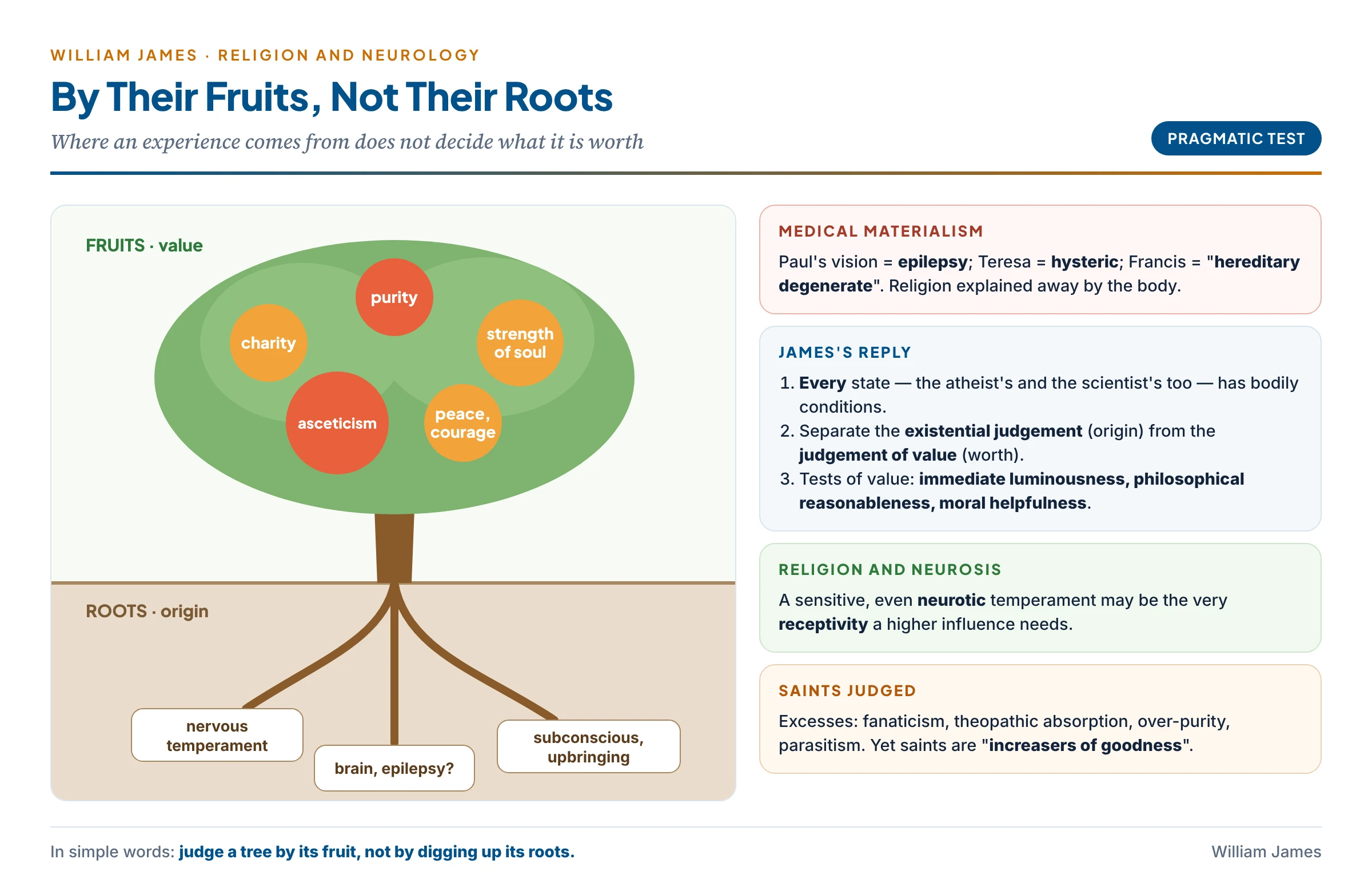
- Medical materialism. Critics of his time “explained” religion by bodily causes: St Paul’s vision on the road to Damascus as an epileptic discharge in the brain, St Teresa as a hysteric, St Francis of Assisi as a “hereditary degenerate”. James calls this medical materialism.
- James’s reply — origin does not settle value.
- Every mental state has a bodily condition — the scientist’s belief in science and the atheist’s disbelief included. If a bodily cause discredited a belief, all beliefs would be discredited.
- We must separate two questions: the existential judgement — what is its nature, origin and history? — and the judgement of value — what is its importance, meaning and significance? Answering the first does not answer the second.
- The tests of value are immediate luminousness, philosophical reasonableness and moral helpfulness.
- “By their fruits ye shall know them, not by their roots.” We judge Newton’s physics by its truth, not by his digestion.
- Religion and neurosis can go together. James freely admits that religious geniuses often had a nervous, “psychopathic” temperament — and sees no harm in it. “If there were such a thing as inspiration from a higher realm, it might well be that the neurotic temperament would furnish the chief condition of the requisite receptivity.” A sensitive instrument picks up signals that a coarse one misses. He treats religion and neurosis as compatible, even to a degree necessary partners.
Common confusion
Did James claim that religious experience proves God exists? No. James argued that experience justifies the person who has it in believing, and that the fruits of religious experience are real and valuable. He explicitly denied that it proves the God of classical theism (omnipotent, omniscient creator). What it supports, he said, is only that we are continuous with “something more” — a wider spiritual reality — through which saving experiences come. Everything beyond that he called over-belief.
3. The Two Temperaments: Healthy-Mindedness and the Sick Soul
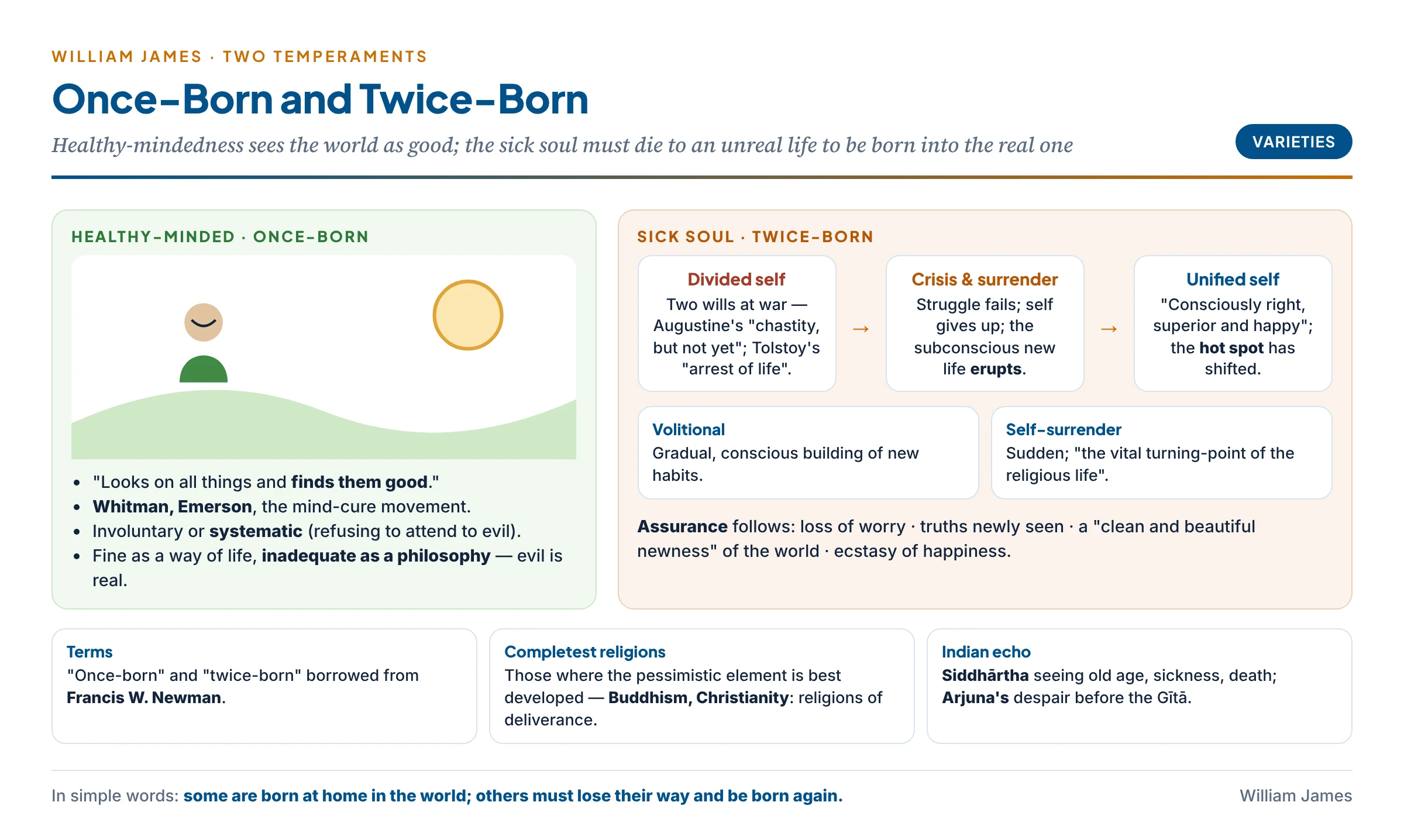
- Healthy-mindedness (the once-born). “The tendency which looks on all things and finds them good.” The healthy-minded are optimists by temperament; they hardly feel the reality of evil and “are born happy”. James’s examples: Walt Whitman, Emerson, and the American mind-cure movement, which taught that thinking positively heals body and soul.
- Involuntary healthy-mindedness simply feels the goodness of things.
- Systematic healthy-mindedness deliberately refuses to attend to evil.
- The sick soul (the twice-born). For some, evil is the very essence of the world. Melancholy, the sense of sin and the vanity of all things press on them. Tolstoy, at the height of fame, suffered an “arrest of life“: he could see no meaning in anything; John Bunyan was tormented by guilt.
- “Once-born” and “twice-born”. James borrows these terms from Francis W. Newman. The once-born need only one birth — they are naturally at home in the world. The twice-born must be born again: they find no peace until their divided life is reborn through a crisis.
- James’s judgement. Healthy-mindedness works for many as a way of life, but it is inadequate as a philosophy, because evil is a genuine part of reality and may be “the best key to life’s significance”. So “the completest religions would seem to be those in which the pessimistic elements are best developed” — the religions of deliverance, like Buddhism and Christianity: “a man must die to an unreal life before he can be born into the real life.”
Indian Connect — Healthy-mindedness and the sick soul in India
- Prince Siddhārtha is a classic “sick soul”: the sight of old age, sickness and death made the palace pleasures worthless and drove him to seek deliverance — and Buddhism, as James notes, is a religion of deliverance.
- Arjuna’s despair (viṣāda) at the start of the Gītā is a “divided self”: duty pulls one way, love of kin another, until Kṛṣṇa’s teaching unifies his will.
- Indian thought, like James, treats suffering (duḥkha) as the starting-point of the religious quest — the first of the Buddha’s Four Noble Truths and the opening concern of Sāṃkhya.
4. The Divided Self and Conversion
- The divided self. Some people are born with a heterogeneous personality — “two souls” at war, like St Augustine, who prayed for chastity “but not yet”. Their life is a struggle between a higher and a lower self.
- Unification. The divided self seeks unity. It may be unified by religion — or by non-religious means (a new passion, a cause, even a move from belief to unbelief). Religious conversion is one important case of a general human process.
- James’s definition of conversion. “To be converted, to be regenerated, to receive grace, to experience religion, to gain an assurance, are so many phrases which denote the process, gradual or sudden, by which a self hitherto divided, and consciously wrong inferior and unhappy, becomes unified and consciously right superior and happy, in consequence of its firmer hold upon religious realities.”
- The shifting “hot spot”. Every person has a habitual centre of personal energy — the ideas that are “hot” and move him. In conversion, religious ideas, once peripheral, become central; the whole field of consciousness is re-arranged.
- Two types (following the psychologist Edwin Starbuck):
- Volitional type — gradual, conscious, by building new moral habits piece by piece.
- Self-surrender type — the person struggles in vain, then gives up; and in that surrender the new life, which has been incubating in the subconscious, bursts into consciousness. “Self-surrender has been and always must be regarded as the vital turning-point of the religious life.”
- The subconscious. James explains sudden conversion partly by subliminal or subconscious processes: ideas mature below the threshold of consciousness and then erupt. This does not exclude a higher source: if there is a higher power, it may work through the subconscious door.
- The state of assurance that follows conversion:
- loss of all worry — the sense that “all is ultimately well”;
- a sense of perceiving truths not known before;
- a “clean and beautiful newness” in the outer world;
- an ecstasy of happiness.
- Judged by fruits. Sudden converts are not spiritually superior to gradual ones; and some converts backslide. The worth of conversion lies in the lasting change of life it brings.
In simple words
Think of a student’s study table. For years the cricket bat sits at the centre and the books are pushed to a corner. One day — perhaps after slowly growing interest, perhaps after a sudden shock — the books move to the centre and the bat goes to the corner. Nothing new has been added to the room; the centre has shifted. James says conversion is like this: religious ideas that were on the edge of a person’s mind become the “hot spot” from which he now lives.
5. Saintliness — the Fruits of Religion
- The saintly character. The collective name for the ripe fruits of religion is saintliness. Its inner condition has four features:
- a feeling of being in a wider life than this world’s selfish interests, and a conviction of the existence of an Ideal Power;
- a sense of the friendly continuity of this power with our own life, and a willing self-surrender to it;
- an immense elation and freedom, as the outlines of the confining self melt down;
- a shifting of the emotional centre towards loving and harmonious affections — from “no” to “yes“.
- Practical consequences: asceticism (self-denial, even taken to excess), strength of soul (fearlessness, patience), purity (shrinking from the worldly and impure), charity (tenderness and love even for enemies).
- The value of saintliness.
- Judged by empirical standards — by its effect on life — saintliness can be excessive: fanaticism, theopathic absorption (love of God crowding out all human love), excessive purity and withdrawal, charity that feeds parasites, and asceticism that is self-torture. Nietzsche attacked the saint as weak and life-denying.
- Yet, balanced, the saints are “authors, auctores, increasers of goodness” — the great torch-bearers of belief; their charity creates the goodness it assumes in others. Even their excesses point to the highest human possibilities.
- So, by the pragmatic test, religion is vindicated in its fruits, though not every religious belief is thereby shown to be true.
6. Mysticism — the Four Marks
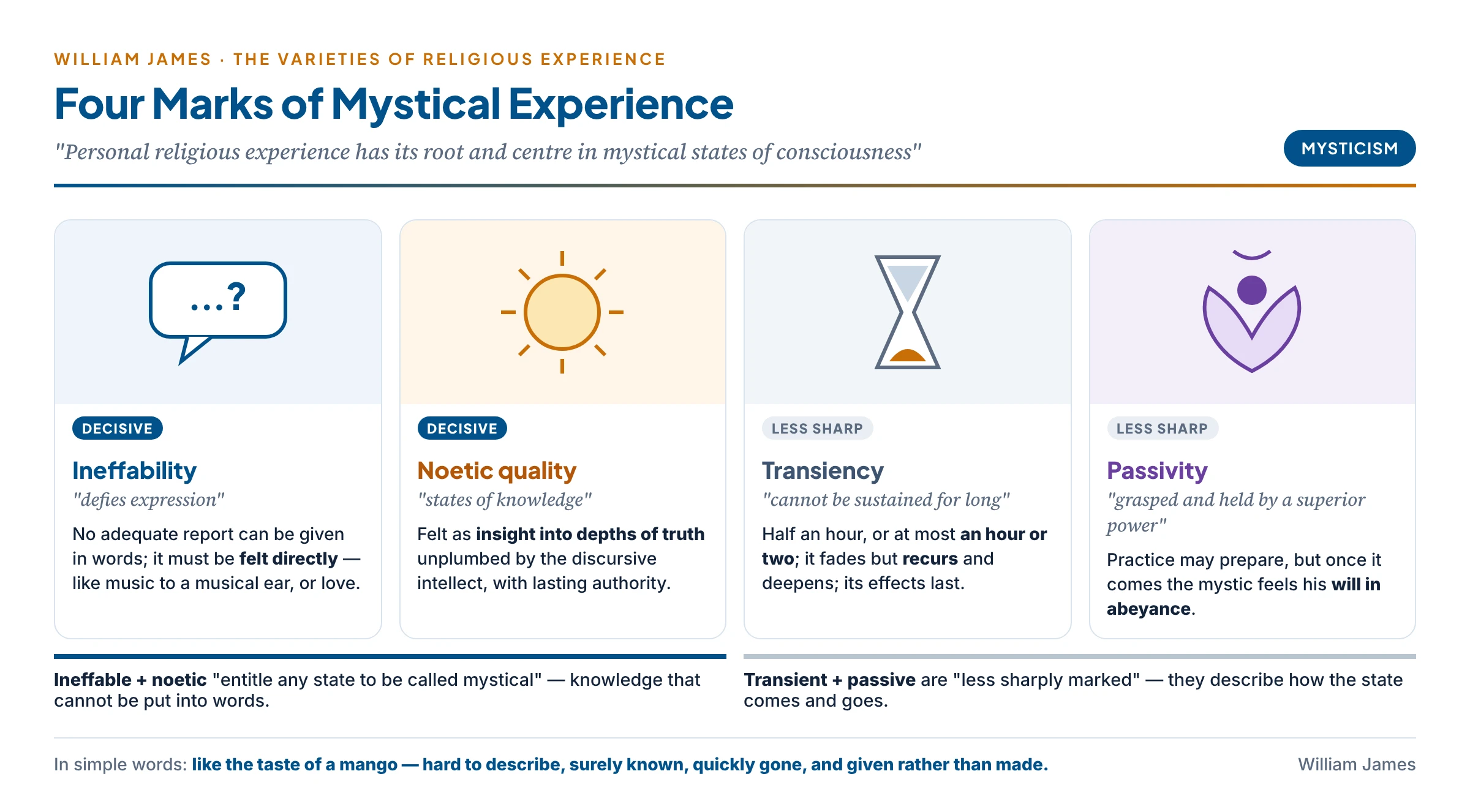
“Personal religious experience has its root and centre in mystical states of consciousness.” James offers four marks that justify calling an experience mystical:
- Ineffability. “The subject of it immediately says that it defies expression, that no adequate report of its contents can be given in words.” It must be directly experienced; it cannot be imparted or transferred. It is more like a state of feeling than a state of intellect — as one must have a musical ear to know the value of a symphony, or have been in love to understand a lover’s state.
- Noetic quality. Though like feelings, mystical states seem to those who have them to be “states of knowledge” — “states of insight into depths of truth unplumbed by the discursive intellect“: illuminations, revelations, full of significance, carrying “a curious sense of authority for after-time”.
- Transiency. “Mystical states cannot be sustained for long.” Except in rare cases, half an hour, or at most an hour or two, seems the limit. When they fade, their quality can only imperfectly be recalled — but they recur, and each recurrence brings continuous development in inner richness.
- Passivity. The onset may be helped by voluntary preliminaries — fixing attention, bodily exercises, practices prescribed in manuals — yet once the state has set in, “the mystic feels as if his own will were in abeyance, and indeed sometimes as if he were grasped and held by a superior power“.
- Which marks are decisive? James says the first two — ineffability and noetic quality — “will entitle any state to be called mystical”; the other two are “less sharply marked“.
- The paradox of the first two. It is ineffable yet noetic — it gives knowledge that cannot be stated. This tension runs through all later debate (Articles 8–9).
In simple words
Think of the taste of a mango. You cannot explain it to someone who has never eaten one — words like “sweet” and “juicy” do not carry it (ineffable). Yet you are sure you know what a mango tastes like (noetic). The taste lasts only a moment (transient), and you cannot produce it by willing — the mango has to be given to your tongue (passive). James says mystical states have all four of these features, only about reality as a whole.
7. The Ladder of Mystical States
James arranges experiences from the faintest to the fullest:
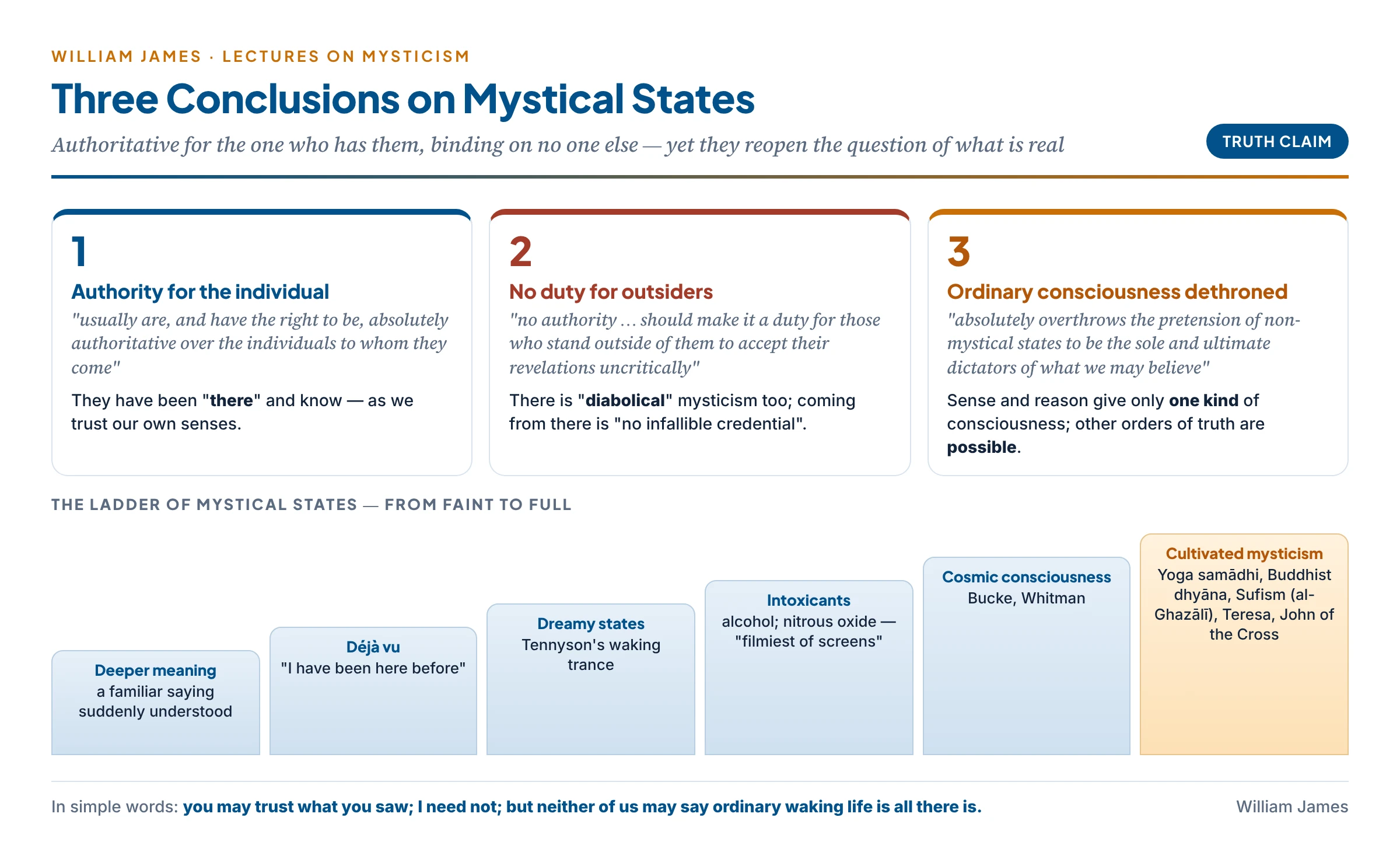
- A sudden deeper meaning in a familiar saying — “I’ve heard that said all my life, but I never realized its full meaning until now.”
- The feeling of having been here before (déjà vu).
- Dreamy states — the poet Tennyson could pass into a “waking trance” by repeating his own name, in which “individuality itself seemed to dissolve and fade away into boundless being”.
- Intoxicants and anaesthetics. Alcohol stimulates “the mystical faculties of human nature” — it is “the great exciter of the Yes function”. Nitrous oxide and ether, “especially nitrous oxide, when sufficiently diluted with air, stimulate the mystical consciousness in an extraordinary degree”. From his own experiments with nitrous oxide James drew a famous lesson: “our normal waking consciousness, rational consciousness as we call it, is but one special type of consciousness, whilst all about it, parted from it by the filmiest of screens, there lie potential forms of consciousness entirely different.“
- Cosmic consciousness — R. M. Bucke‘s term for a sudden sense of the life and order of the universe, as in Walt Whitman.
- Methodically cultivated mysticism in the great traditions:
- Yoga — James quotes Swami Vivekananda‘s account of samādhi, the “superconscious” state in which the mind “knows facts which no instinct or reason can ever know”.
- Buddhist dhyāna — the stages of meditation leading beyond perception and non-perception.
- Sufism — al-Ghazālī‘s autobiography: Sufism is learnt not by study but by “transport, ecstasy and the transformation of the soul“; as knowing the definition of drunkenness is different from being drunk.
- Christian mysticism — St John of the Cross and St Teresa of Avila, with their stages of prayer (orison) culminating in union; Teresa’s report that in union the soul is “utterly dead to the things of the world” and certain afterwards that “she has been in God, and God in her”.
- The common note. “This overcoming of all the usual barriers between the individual and the Absolute is the great mystic achievement. In mystic states we both become one with the Absolute and we become aware of our oneness. This is the everlasting and triumphant mystical tradition, hardly altered by differences of clime or creed.” In Hinduism, Neoplatonism, Sufism, Christian mysticism and Whitmanism “we find the same recurring note”, so that the mystical classics have “neither birthday nor native land“.
- Mystical language. Mystics speak by negation — “No! no!” (the Upaniṣadic neti neti, Dionysius’ negative theology) — not because the reality is empty but because it is more than any positive description. Their tendency is optimistic and monistic.
Indian Connect — James and Indian mysticism
- James quoted Vivekananda‘s Rāja Yoga at length; the “superconscious” samādhi was, for him, a methodically cultivated mystical state.
- His phrase “we both become one with the Absolute and we become aware of our oneness” echoes the Upaniṣadic brahmavid brahmaiva bhavati — “one who knows Brahman becomes Brahman”.
- His observation that mystics describe by negation matches Yājñavalkya’s neti neti — “not this, not this”.
8. Three Conclusions about Mystical States
Do mystical states give truth? James’s answer has three parts:
- Authority for the individual. “Mystical states, when well developed, usually are, and have the right to be, absolutely authoritative over the individuals to whom they come.” They have been “there” and know. We have no right to demand that a person disbelieve what he has directly perceived, any more than we can rationally overturn our own sense perceptions.
- No authority for outsiders. “No authority emanates from them which should make it a duty for those who stand outside of them to accept their revelations uncritically.” Mystical states are of many kinds — there is also a “diabolical” mysticism found in insanity — so “to come from thence is no infallible credential”.
- They break the monopoly of ordinary consciousness. “They break down the authority of the non-mystical or rationalistic consciousness, based upon the understanding and the senses alone. They show it to be only one kind of consciousness.” “The existence of mystical states absolutely overthrows the pretension of non-mystical states to be the sole and ultimate dictators of what we may believe.” They “open out the possibility of other orders of truth”.
- Why this matters. These conclusions are James’s answer to the question “on what grounds is mysticism a genuine expression of religious experience?” — it is genuine because it is the root and centre of personal religion, because it meets the four marks, because it carries authority for those who have it, and because its fruits in saintly lives are real, while its claims remain open to testing by others.
9. Conclusions: the “More”, the Subconscious and Over-beliefs
- The common nucleus of all religions. Beneath every creed James finds two things:
- An uneasiness — “a sense that there is something wrong about us as we naturally stand”;
- Its solution — “a sense that we are saved from the wrongness by making proper connection with the higher powers”.
- The “more”. The person “becomes conscious that this higher part of himself is coterminous and continuous with a MORE of the same quality, which is operative in the universe outside of him, and which he can keep in working touch with”.
- The subconscious as the door. On its “hither side” the more is the subconscious self — a fact accepted by psychology. “Whatever it may be on its farther side, the ‘more’ with which in religious experience we feel ourselves connected is on its hither side the subconscious continuation of our conscious life.” This gives religion a meeting-point with science.
- Over-beliefs. Everything beyond this — what the “more” is on its farther side: Kṛṣṇa, Christ, Brahman, Allah — is an over-belief: a belief that goes beyond the evidence of experience. Over-beliefs are not worthless; they are often “the most interesting and valuable things about a man”. But they are personal, and science cannot settle them.
- James’s own over-belief — “piecemeal supernaturalism”. The unseen region is not merely ideal: it produces real effects in this world (new energy, conversion, healing of the will). “God is real since he produces real effects.” Unlike “refined” supernaturalism that keeps God aloof, James thinks the higher order actually enters the course of events.
In simple words
Imagine you are on a beach at night and feel the tide lifting your legs. You can say with confidence: “Something larger than me is moving me.” That is the “more” — and it is all experience can strictly tell you. Whether that larger thing is the moon’s pull, the ocean, or God’s hand is a further question. James calls the confident first statement experience and the further answers over-beliefs.
Critical Evaluation
Objections to James
- A biased sample. By studying extreme, often pathological cases, James may have described religious eccentricity rather than religion; ordinary believers rarely have such experiences.
- Too individualistic. Defining religion as what individuals feel “in their solitude” ignores its social and institutional life. Durkheim, writing a decade later, saw religion as essentially collective — the sacred is what society sets apart. Critics also detect a Protestant bias that makes inner feeling the essence and treats ritual and church as secondary.
- Feeling before doctrine? James held that feeling is primary and theology a secondary “translation”. Later critics argue that concepts and beliefs shape experience from the start: a Catholic mystic does not first feel and then interpret; she experiences as a Catholic. (This is the constructivist objection — Article 7.)
- The pragmatic test proves too little. Good fruits do not prove a belief true: comforting falsehoods can also bear good fruits. Russell objected that on pragmatic grounds “Santa Claus exists” would be true for children. Bad fruits, too, have come from religious experience (fanaticism, crusades).
- Tension among the marks. If an experience is ineffable, how can it be noetic — how can there be knowledge that cannot be stated? And the notion of transiency does not fit traditions like Advaita, where realisation is said to be permanent knowledge, not a passing state; passivity fits theistic grace better than yogic technique.
- Drugs undermine authority. If nitrous oxide can produce mystical states, perhaps all such states are chemical events. James himself admits the parallel.
- The “more” is vague. Locating the divine on the “hither side” of the subconscious may explain religion naturalistically rather than defend it — the “more” may be just the unconscious mind.
James’s Strengths
- Empirical respect for testimony. He takes reports seriously as data instead of dismissing them; he founded the psychology of religion.
- The genetic fallacy exposed. His distinction between origin and value remains a decisive answer to reductive “nothing-but” explanations (Freud, neuroscience — Article 8).
- Balanced epistemology. His three conclusions avoid both credulity (outsiders must believe) and dogmatic scepticism (no one may believe); mysticism keeps reality open.
- Pluralism. By finding a common nucleus across religions, he anticipates later pluralist thinkers such as Hick.
- Fidelity to life. The once-born/twice-born distinction and the analysis of conversion still describe real human types.
Common confusion
Did James say that mystical states last only half an hour and so cannot be permanent? James said that mystical states “cannot be sustained for long” — usually not beyond an hour or two — and gave this as a less sharply marked feature. He also noted that they recur and that their effects last a lifetime. So transiency describes the episode, not the change it leaves behind. (Many notes also wrongly reverse his point about passivity: James says the state cannot simply be produced by the person’s will — the will feels “in abeyance”.)
Critics and Defenders
Criticism — Critics
- Durkheim: religion is social before it is individual; James ignores the community and its rites.
- Constructivists: experience is shaped by prior concepts; there is no pure feeling to “translate”.
- Russell: usefulness is not truth — fruits cannot certify beliefs.
- Medical materialists: extreme cases are pathology; nitrous oxide shows the states are chemical.
- Advaitins: realisation is not transient or passive; it is permanent knowledge prepared by discipline.
Defence — Defenders and strengths
- Origin is not value: every belief has bodily conditions; only fruits and reasonableness can judge.
- Authority for the subject: like perception, experience justifies the one who has it.
- Open reality: mystical states overthrow the claim of ordinary consciousness to be the only judge.
- Pragmatic test: saintly lives are public, lasting evidence of what experience can do.
- Modesty: James claims only the “more”, leaving creeds as over-beliefs — hard to refute.
Cross-Tradition Comparison
James and Indian Thought
| Point | William James | Indian parallel |
|---|---|---|
| Root of religion | Personal experience; theology is secondary | Anubhava is the goal; śruti is the record of the seers’ experience (Radhakrishnan) |
| Test of truth | Fruits — luminousness, reasonableness, moral help | The sthitaprajña of the Gītā; the jīvanmukta’s life; Radhakrishnan: test “by logic and by life” |
| Mystical union | “One with the Absolute and aware of our oneness” | Brahmavid brahmaiva bhavati; aham brahmāsmi |
| Duration | Transient states that recur | Yoga: samādhi may be long (Ramakrishna); Advaita: realisation is permanent knowledge |
| Method | Passive, though helped by practice | Active sādhanā — yoga, śravaṇa–manana–nididhyāsana — with grace in bhakti |
| Sick soul | Religions of deliverance are “completest” | Buddhism and Sāṃkhya begin from duḥkha |
| Over-belief | Creeds go beyond the evidence | Radhakrishnan: names of God are partial; “Him who is One sages name variously” |
Indian Connect — Takeaways
- James’s common nucleus (a wrongness and a deliverance) fits the Indian scheme of bondage (bandha) and liberation (mokṣa) closely.
- Indian schools would reject passivity and transiency as defining marks: the yogin cultivates samādhi, and the Advaitin’s knowledge, once gained, is never lost.
Synthesis (Siddhānta)
- James’s lasting achievement. He moved the question from “can God be proved?” to “what does religious experience do, and may we trust it?” He showed that experience must be judged by its fruits, not dismissed by its roots.
- Mystical states as genuine religious experience. For James they are the root and centre of personal religion; they are marked by ineffability, noetic quality, transiency and passivity; they are authoritative for those who have them; and they overthrow the monopoly of ordinary consciousness — while binding no outsider to accept their claims.
- A balanced verdict. James’s empiricism and pluralism make him the natural bridge between the psychology of religion and its philosophy, and between Western theism and Indian mysticism. His weak points — individualism, the vagueness of the “more”, the pragmatic theory of truth — are the starting points of the later debates on interpretation and validity (Articles 7–8).
- Contemporary relevance. Research on meditation, psychedelic therapy and well-being increasingly asks James’s question — what do these states do for people? — and many studies report lasting changes in meaning, compassion and fear of death: James’s “fruits” measured by modern instruments.
Previous Year Questions
- 2026On what grounds does William James characterize mystical states as a genuine expression of religious experience? Elaborate.
- 2022Discuss the nature and variety of religious experiences as presented by William James.