

Reason, Revelation and Faith.
Official Syllabus: Paper II, Section B, Unit 5
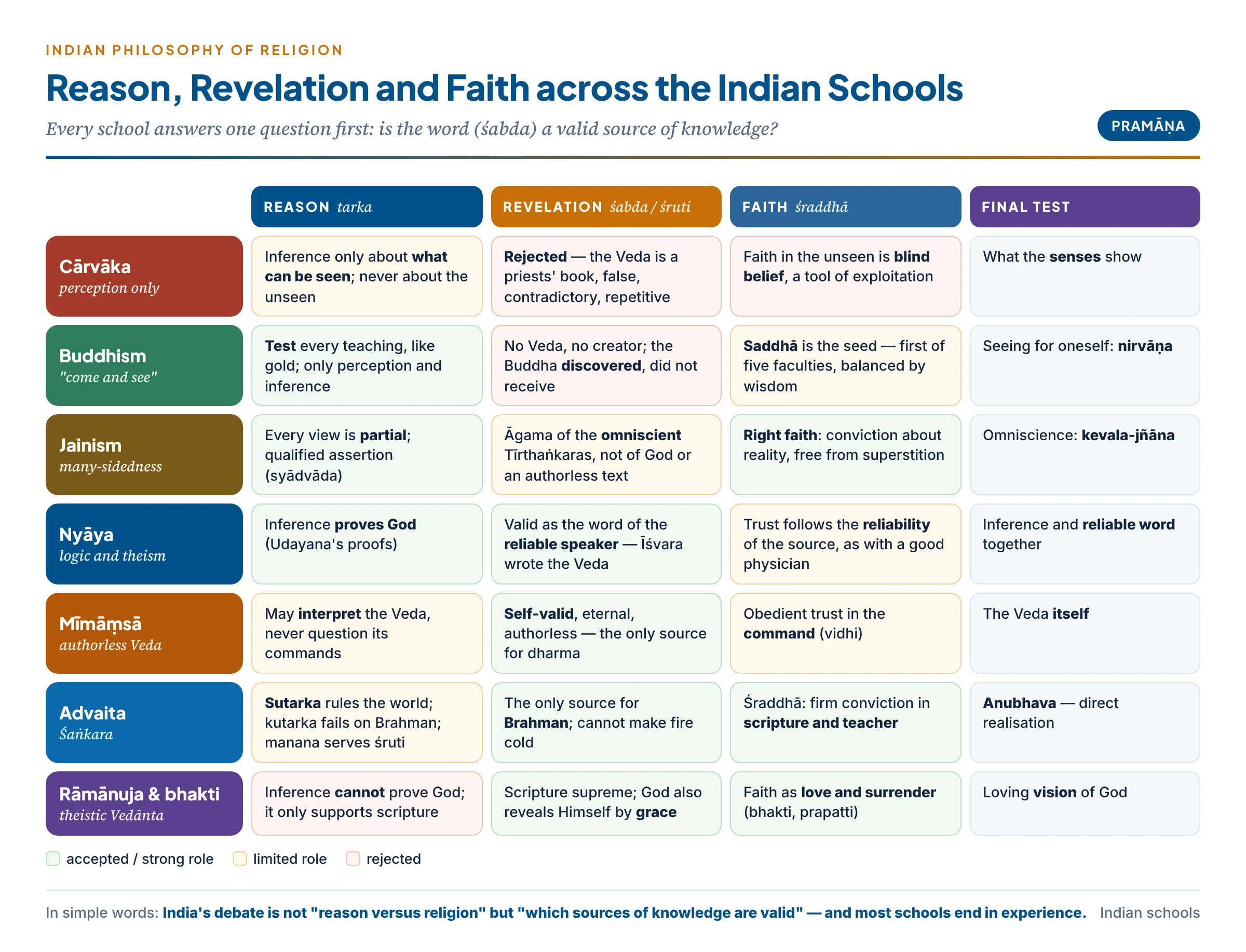
Western philosophy of religion usually tells the story of reason, revelation and faith as a quarrel: philosophers against priests, Athens against Jerusalem. Indian philosophy tells it differently. Here the question was never only “may I believe what scripture says?” but “how many valid means of knowledge (pramāṇa) are there, and is verbal testimony (śabda) one of them?” Every school had to answer it, from the Cārvāka, who accepted perception alone, to Mīmāṃsā, which made the Veda self-valid, to Advaita, which joined scripture, reasoning and direct experience into one path. This article sets out these Indian answers — including the Cārvāka critique of belief in suprasensible entities — and then brings the whole unit together to answer the old examination question: are reason, revelation and faith compatible, and if they seem not to be, how can the conflict be resolved?
In simple words
Think of learning to swim. First you hear the coach’s instructions — you could not have invented them yourself (that is like revelation). Then you think them over: “Why should I breathe out under water? Ah, so that I can breathe in when my face comes up” (that is reason). Then, without proof that it will work for you, you step into the water trusting the coach (that is faith). And only in the water do you finally know how to swim (that is experience, anubhava). Most Indian schools say religious knowledge works the same way — each step needs the others, and none is complete alone.
Context & Problem
Why the Indian Debate Takes a Different Shape
- Philosophy as a path, not only a theory. An Indian system (darśana, literally “seeing”) aims at liberation (mokṣa, nirvāṇa, kaivalya). Knowledge matters because it frees. So the question “what can reason know?” is also the question “what can save us?”
- The theory of knowledge comes first. Each school begins by listing its pramāṇas — the valid sources of knowledge:
- Cārvāka — perception (pratyakṣa) only;
- Buddhism and Vaiśeṣika — perception and inference (anumāna);
- Sāṃkhya and Yoga — perception, inference and reliable testimony (āptavacana);
- Nyāya — these three plus comparison (upamāna);
- Prābhākara Mīmāṃsā — five (adding postulation, arthāpatti);
- Bhāṭṭa Mīmāṃsā and Advaita — six (adding non-cognition, anupalabdhi).
- Revelation enters as a pramāṇa. In India the question about revelation becomes a precise one: is śabda — the word of a reliable person, or the Veda — an independent source of knowledge, or only a kind of inference, or no source at all?
- Āstika and nāstika. The orthodox (āstika) schools accept the authority of the Veda; the heterodox (nāstika) schools — Cārvāka, Buddhism, Jainism — reject it. (The words do not mean theist and atheist: Mīmāṃsā and classical Sāṃkhya are orthodox but do not need a creator God.)
The Three Indian Words
- Tarka / yukti — reasoning. Tarka in its technical sense is hypothetical reasoning that shows the absurd result of denying a conclusion; more broadly it means argument and reflection. Its good form is sutarka (sound reasoning); its bad form is kutarka or śuṣka tarka — “dry”, ungrounded argument for its own sake.
- Śruti / śabda / āgama — revelation or authoritative word. Śruti means “that which is heard” — the Vedas, including the Upaniṣads — as distinct from smṛti, “that which is remembered” (epics, law-books, Purāṇas). The Buddhists and Jainas have their own āgamas (canonical teachings).
- Śraddhā — faith in the Indian sense: a firm, serene confidence in the truth of the teaching and the teacher, strong enough to set one on the path, and expected to be confirmed in experience.
- Anubhava — direct experience or realisation, the fourth term that most Indian schools add to the Western triad. It is the court in which reason, revelation and faith are finally judged.
Core Doctrine
1. Cārvāka: The Critique of Belief in Suprasensible Entities
The Cārvāka (also called Lokāyata, “the view of ordinary people”) is India’s materialist school. Its rejection of revelation and faith follows directly from its theory of knowledge.
The starting principle
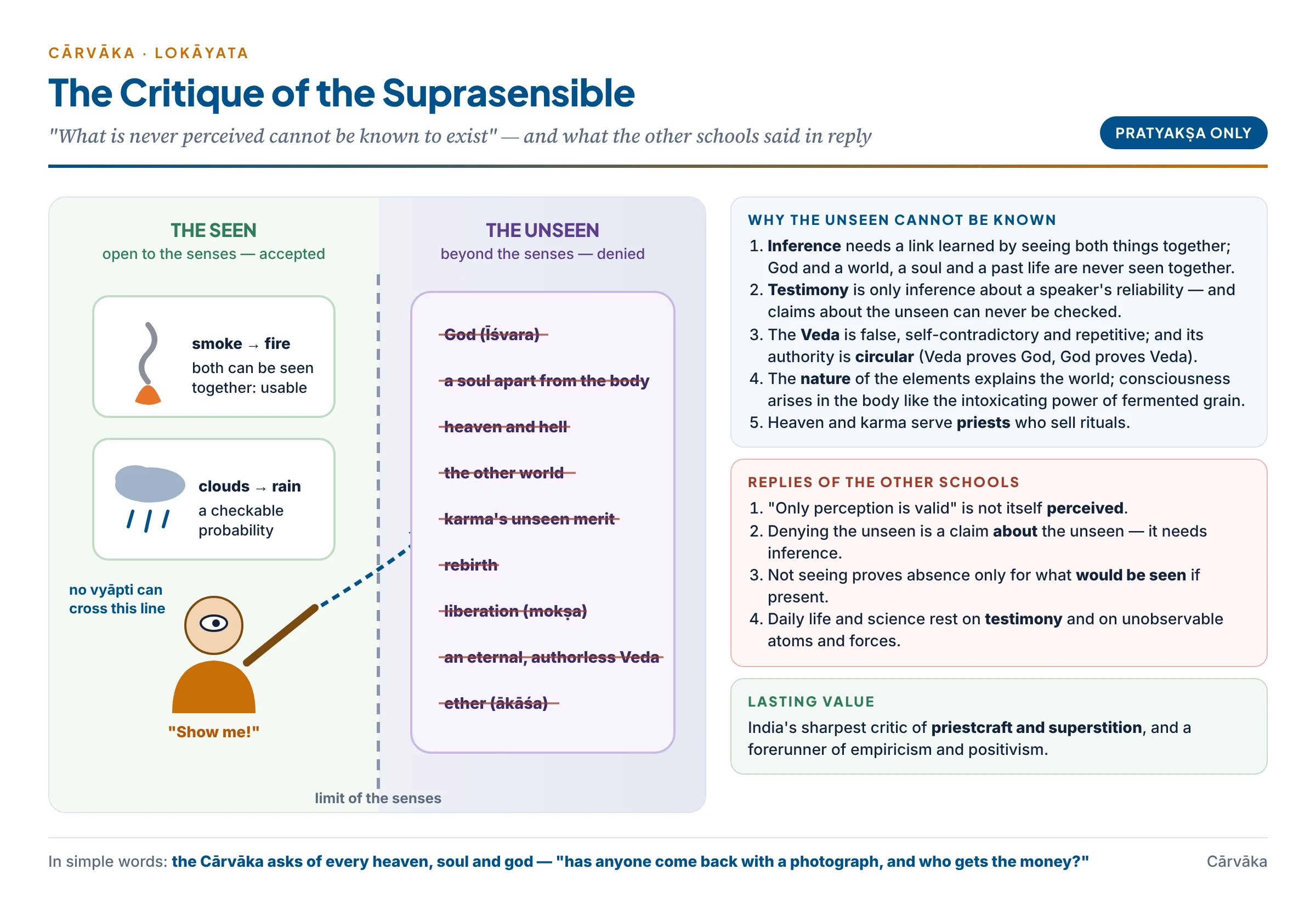
- Perception is the only pramāṇa (pratyakṣam evaikaṃ pramāṇam). What is perceived exists; what is never perceived cannot be known to exist.
- Suprasensible entities (atīndriya padārtha) are things said to lie beyond the senses: God (Īśvara), a soul distinct from the body, heaven and hell, the other world (paraloka), the unseen merit and demerit that carries karma across lives (adṛṣṭa), rebirth, liberation (mokṣa), an eternal Veda, and ether (ākāśa). The Cārvāka denies them all.
The arguments
- Inference cannot reach the unseen. Every inference rests on a universal connection (vyāpti) — “wherever there is smoke there is fire”. Such a connection is learned only by observing both terms together. We have never perceived God together with a world, or a soul together with a past life, so no vyāpti can ever link them. An inference about the suprasensible is a leap in the dark.
- Testimony is only borrowed inference. We accept someone’s word because we infer that he is reliable (“this man is trustworthy; what trustworthy men say is true”). So testimony inherits every weakness of inference. And testimony about the unseen can never be checked by perception — accepting it is blind belief.
- The Veda is a human document. The claim that the Veda is authorless (apauruṣeya) cannot be tested. In fact, the Cārvāka says, it was composed by cunning priests for their livelihood: “the three authors of the Vedas were buffoons, knaves and demons” (bhaṇḍa-dhūrta-niśācarāḥ).
- The Veda has three defects.
- Falsehood (anṛta) — a sacrifice performed for a son produces no son;
- Self-contradiction (vyāghāta) — it praises now Indra, now Agni as supreme, and says “do not injure any living being” while prescribing animal sacrifice;
- Useless repetition (punarukti).
- The authority is circular. The Veda is said to be valid because God composed it, and God is known to exist because the Veda says so.
- The suprasensible is unnecessary. The world is explained by the nature (svabhāva) of the four elements — earth, water, fire, air. Fire is hot and water cool by nature; no creator is needed. Consciousness too arises from the elements in a living body, as the power to intoxicate arises when certain ingredients ferment, though none of them is intoxicating alone (kiṇvādibhyo madaśaktivat). So there is no separate soul to survive death.
- Belief in the unseen serves exploitation. Heaven, hell and karma are used to make people pay for rituals whose only visible benefit goes to the priests. The Cārvāka mocks the rites: “If an animal slain in sacrifice goes to heaven, why does the sacrificer not offer his own father?” “If food offered in the funeral rite (śrāddha) feeds the dead, why should a traveller carry provisions?” “If he who leaves the body goes to another world, why does he never come back, restless for love of his family?”
- This-worldly conclusions. The only heaven is pleasure here; the only hell is pain here; “death alone is liberation“. The only lord is the king recognised by the world.
In simple words
Imagine a travel agent selling expensive tickets to a holiday island no traveller has ever returned from. He shows you beautiful brochures (scripture), tells you his ancestors sold the same tickets (tradition), and says the island’s existence is guaranteed by the brochure itself (circular authority). The Cārvāka is the friend who asks: “Has anyone come back with a photograph? And who gets the money?” That is the whole critique of the suprasensible in one question.
Two kinds of Cārvāka
- Dhūrta (crude) Cārvākas rejected all inference and all values beyond bodily pleasure.
- Suśikṣita (refined) Cārvākas, such as Purandara, accepted inference about perceivable things — smoke and fire, clouds and rain — as useful probability, and rejected only inference about the unperceivable (the other world, the soul, God). This makes the Cārvāka position strikingly close to modern empiricism and logical positivism: a claim with no possible check in experience gives no knowledge.
Common confusion
Did the Cārvāka reject all reasoning? No. Many notes say the Cārvāka “rejects reason” or “rejects logic”. The careful position is narrower: inference is rejected as a source of certain knowledge, and above all as a route to the suprasensible. Refined Cārvākas used inference freely in daily life, and their critique of the Veda is itself a piece of reasoning. What they rejected was not thinking but thinking beyond all possible perception.
Evaluation of the critique
- It refutes itself. “Only perception is valid” is not itself perceived. And “there is no God, no soul, no other world” is a claim about what lies beyond perception — so it needs the very inference the Cārvāka rejects. Not perceiving something proves its absence only when it is the kind of thing that would be perceived if present (a pot on a lit table), not when it is suprasensible by nature.
- Life runs on testimony and inference. We know of distant countries, past history and our own date of birth by testimony; science depends on unobservable entities — atoms, fields, forces — inferred from effects.
- Ethics without the unseen is thin. Critics (Jaina, Buddhist, Nyāya) argued that denying karma and the moral order leaves no answer to undeserved suffering and no reason to be good when unobserved.
- Yet its lasting value is real. The Cārvāka is India’s sharpest critic of priestcraft and superstition, an early voice for the burden of proof, and a reminder that faith which cannot face questions invites exploitation. Every other school had to answer it, which sharpened Indian logic.
2. Nyāya: Reason and Revelation as Partners
Nyāya, the school of logic, is India’s clearest case of a harmony between reason and revelation.
- Śabda is a pramāṇa. Testimony is the statement of a trustworthy person (āpta-vākya). The commentator Vātsyāyana describes the āpta as one who has directly known the truth and wishes to communicate it exactly as known. Testimony is of two kinds:
- Laukika (worldly) — the word of reliable human beings;
- Vaidika (scriptural) — the Veda, about things beyond ordinary perception.
- Why the Veda is valid. For Nyāya the Veda is not authorless: it was composed by Īśvara, the supremely trustworthy person. Its validity therefore comes from outside — from the reliability of its author (parataḥ prāmāṇya). The Nyāya Sūtra argues that the Veda is valid “like spells and medical science (āyurveda), because its validity follows from the validity of the reliable speaker”. When we see that the physician’s prescriptions work, we trust what he says about things we cannot check; so with the Veda.
- Reason proves God independently. Unlike Advaita, Nyāya holds that inference can establish God. Udayana offered a series of proofs — the world is an effect and needs a maker (kāryāt); atoms need a first mover to combine (āyojanāt); the world needs a power that sustains it (dhṛti); words need an original giver of meaning (padāt); the Veda needs an infallible author (pratyayataḥ) (see the Proofs unit).
- Reply to the Cārvāka’s three defects.
- Falsehood? If the rite for a son fails, the fault lies in the performance, the performer or the materials, not in the Veda.
- Contradiction? Different instructions are alternatives (vikalpa), each valid for its own case — as a doctor may allow a medicine “morning or evening”.
- Repetition? Repetition is purposeful restatement (anuvāda) for emphasis or explanation, not a defect.
- Reply to the circle. God is known by independent inference, not only by the Veda, so the argument is not circular.
So Nyāya gives the Indian form of the Western pair natural theology (God proved by reason) and revealed theology (truths received through śabda), held together by the conviction that a reliable source cannot contradict sound reasoning.
3. Mīmāṃsā: Revelation That Needs No Author
Pūrva Mīmāṃsā (Jaimini, Śabara, Kumārila, Prabhākara) gives revelation the highest independence in Indian thought.
- The Veda is authorless and eternal (apauruṣeya, nitya). Its arguments:
- No author is remembered, though the Vedic tradition has been handed down without a break; a human author of so important a text would not have been forgotten.
- The relation between a word and its meaning is natural and eternal (autpattika), not invented by anyone.
- Defects in knowledge come from defects in its source (ignorance, carelessness, the wish to deceive). A text with no author has no such defects, so nothing can make it invalid.
- All knowledge is self-valid (svataḥ prāmāṇya). A cognition is accepted as true as soon as it arises; it is rejected only when a defect in its source or a contradicting cognition is found. The Veda, having no author, can never be shown defective — so it stands.
- The Veda’s domain is dharma. “Dharma is that good which is known by the Vedic command” (codanā-lakṣaṇo ‘rtho dharmaḥ). The Veda does not teach what perception or inference can find; it teaches duty, which no other pramāṇa can reveal. Statements that look like factual claims are arthavāda — praise that encourages the command.
- No God is needed. Early Mīmāṃsā does not require a creator to give the Veda its authority or to give actions their fruits; the unseen potency (apūrva) generated by the rite does that.
- Reason as interpreter. Reason has no right to question the content of a Vedic command, but it has a vast role in interpreting it. Mīmāṃsā built India’s science of interpretation — rules (nyāya) for deciding which word governs which, when a statement is a command and when praise, how conflicts between texts are resolved. Later Vedānta adopted its six marks for finding the real purport of a text — the beginning and the end, repetition, novelty, the result promised, praise, and reasoned intelligibility (upapatti). Even here, then, reason helps decide what revelation says.
- Faith as obedience. Śraddhā here is the ritualist’s trust in the command (vidhi): the performer acts because the Veda says so, not because he has seen the result.
In simple words
The rules of cricket are not proved by physics or by any experiment; they simply tell players what to do, and a game exists only because people accept them. But umpires and committees still need sharp reasoning to interpret the rules in a strange case — a ball that hits a helmet left on the field. Mīmāṃsā treats the Veda like that rule-book: its authority over dharma is not open to proof or disproof, but reason is needed at every step to interpret it.
For the full debate on śabda, apauruṣeyatva and the Nyāya–Mīmāṃsā dispute, see the Paper I Mīmāṃsā and Nyāya articles.
4. Advaita Vedānta: Śruti, Tarka and Anubhava
Śaṅkara produced the most balanced Indian account of the three — and the one most often misunderstood.
Why revelation is needed
- Brahman is beyond perception and inference. Brahman has no form, so it cannot be perceived; it has no distinguishing mark linked to anything else, so it cannot be inferred. The Brahma Sūtra says Brahman is known “because scripture is its source” (śāstra-yonitvāt).
- Śruti’s proper domain is the unseen. Scripture is a valid source only for what no other pramāṇa can reach (atīndriya). It does not compete with perception about the world of experience.
Why reason cannot stand alone
- Reasoning is ungrounded (tarkāpratiṣṭhānāt). An argument that one clever thinker builds is overthrown by a cleverer one tomorrow; the Sāṃkhya, Vaiśeṣika and Buddhist systems, each brilliantly argued, refute one another. Reason depending only on individual ingenuity reaches no final rest on supersensible matters.
- But Śaṅkara admits the irony: “this very ungroundedness of reasoning is itself established by reasoning“. Reason is used even to show its own limits — so it cannot be thrown away.
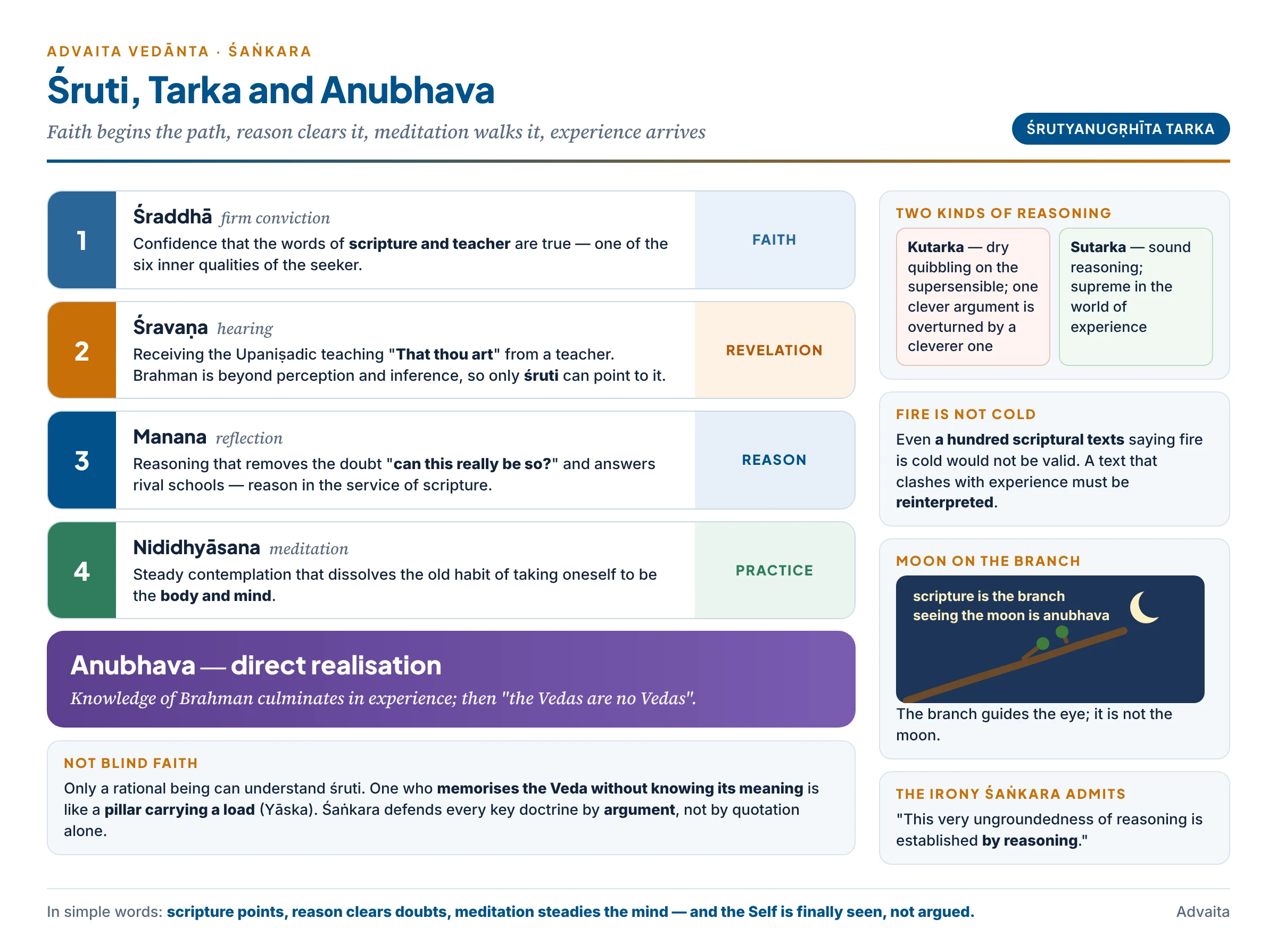
- Kutarka vs sutarka. What Śaṅkara condemns is kutarka — quibbling, dry argument detached from scripture and experience, “debaters who fight like animals over bait”. Sutarka — sound reasoning — keeps full authority in the world of experience.
Why reason is still indispensable
- Reason in the service of śruti (śrutyanugṛhīta tarka) is the method of Vedānta. Scripture must be understood, and only a rational being can understand it; the ancient grammarian Yāska said that one who memorises the Veda without knowing its meaning is like a pillar carrying a load.
- Scripture cannot overrule perception in its own field. In his commentary on the Gītā, Śaṅkara says that even a hundred scriptural texts declaring that fire is cold or without light would not become valid. Where a text seems to contradict experience, it must be reinterpreted, not believed literally.
- Reason defends the teaching. Śaṅkara never rests a vital doctrine on mere quotation; he defends it against Sāṃkhya, Nyāya and the Buddhists by argument.
The path: śravaṇa, manana, nididhyāsana The Bṛhadāraṇyaka Upaniṣad says, “The Self is to be seen, to be heard, to be reflected upon, to be meditated upon.” Śaṅkara builds the method on this:
- Śravaṇa — hearing the Upaniṣadic teaching from a teacher (revelation received in faith).
- Manana — reflecting on it rationally, removing the doubt “can this really be so?” (asaṃbhāvanā) and answering objections (reason).
- Nididhyāsana — meditating steadily, until the old contrary habit of taking oneself to be the body and mind (viparīta-bhāvanā) dissolves.
- Anubhava — direct realisation (aparokṣānubhūti) of the Self as Brahman.
Experience as the culmination
- In the enquiry into Brahman, Śaṅkara says, not only scripture but also experience is a means of knowledge, “because knowledge of Brahman culminates in experience” (anubhavāvasānatvāt) and concerns an existing reality, not a duty to be done.
- Scripture is finally transcended. The Upaniṣad says that in the state of realisation “the Vedas are no Vedas“. Śruti is a means, like a ladder one no longer needs on the roof.
Where faith fits
- Śraddhā is one of the six inner qualities a seeker must have (with calm, self-control, withdrawal, endurance and concentration). A text traditionally attributed to Śaṅkara, the Vivekacūḍāmaṇi, defines it as “the firm conviction that the words of scripture and of the teacher are true“.
- Faith begins the path, reason clears it, meditation walks it, and experience arrives.
In simple words
On the second night after the new moon the crescent is so thin that a child cannot find it. The mother says: “See that tree? Look just above the tip of that branch.” The branch is not the moon, but it guides the eye to the moon. Indian philosophers call this the “moon-on-the-branch” rule (śākhā-candra-nyāya). For Śaṅkara, scripture is the branch, reason keeps the eye steady on it, and seeing the moon yourself is anubhava. Nobody, having seen the moon, argues about the branch.
Common confusion
Was Śaṅkara a fideist who distrusted reason? No. He is sometimes called “anti-rational” because he says reasoning is ungrounded. But his criticism is aimed at kutarka — reasoning cut off from scripture and experience — on supersensible questions. In the empirical world he gives reason unquestioned authority: no scripture can make fire cold. His method (manana) is rational reflection, and his works are among the most argued in Indian philosophy. The correct description is reason subordinated to śruti on Brahman, and śruti subordinated to experience at the end.
5. Rāmānuja and the Theistic Vedānta
- God is known only through scripture. Rāmānuja goes further than Śaṅkara against the Nyāya proofs. Reading śāstra-yonitvāt strictly, he argues that inference cannot prove God:
- From the world as an effect we might infer many makers, as a palace is built by many workers, not one;
- All the makers we know are embodied, limited beings, so the inference would give a limited, embodied God;
- The argument from design proves at most a powerful maker, not the all-knowing, all-good Lord of devotion.
- Reason supports scripture. Scripture is authoritative; reason is applied only in support of it — to interpret, harmonise and defend.
- Knowledge becomes devotion. For Rāmānuja the knowledge that liberates is a constant loving remembrance of God, which he equates with the highest bhakti. Faith here is not mere belief but love and surrender (prapatti).
- Revelation through grace. God reveals Himself to the devotee by His own will — the doctrine of grace, strong in Rāmānuja, central for Madhva and the later bhakti schools. In the Gītā, Kṛṣṇa grants Arjuna the vision of His cosmic form (viśvarūpa), which Arjuna could not have seen by his own eyes.
- Madhva keeps the Veda supreme and adds the witness-self (sākṣī) as the final guarantor that our knowledge is valid — another form of the appeal to inner experience.
The bhakti saints often put love above learning. Kabīr sang that the world died reading books and no one became learned; whoever reads the “two and a half letters” of love (prem) becomes truly wise. This is the Indian form of moderate fideism — not hostile to reason, but sure that reason is not what saves.
6. Buddhism: “Come and See”
The Buddha did not claim revelation from a God. He claimed awakening (bodhi) — a truth discovered by discipline and meditation, which anyone can verify.
Reason and experience over authority
- The Kālāma Sutta. The Kālāma people asked the Buddha how to choose among teachers who each praised their own doctrine. He told them not to accept a teaching merely because of reports, legends, tradition, scripture, logical conjecture, inference, analogies, agreement after pondering views, the speaker’s seeming competence, or because “this teacher is ours”. Instead: “When you know for yourselves” that certain qualities are unskilful, blameworthy, criticised by the wise and lead to harm and suffering, abandon them; when you know that they are skilful and lead to welfare and happiness, take them up.
- Notice that the Kālāma Sutta sets aside mere logic as well as mere scripture. Its test is lived experience of what leads to suffering or welfare, checked against the judgement of the wise. It is not pure rationalism; it is experiential verification.
- Ehipassiko — “come and see“. One of the classical qualities of the Dhamma is that it invites inspection: it is to be seen for oneself (sandiṭṭhiko) and known personally by the wise.
- The goldsmith’s test. A verse attributed to the Buddha and quoted in later Buddhist texts says: as the wise test gold by burning, cutting and rubbing it, so, monks, accept my words after examining them, not out of respect for me.
- Silence on speculation. The Buddha refused to answer unanswerable metaphysical questions (avyākata) — whether the world is eternal, whether the Tathāgata exists after death. Like a man struck by a poisoned arrow who must first have it pulled out, not ask who shot it, the seeker must first end suffering.
Yet Buddhism has a place for faith
- Saddhā (śraddhā) is the first of the five spiritual faculties — faith, energy, mindfulness, concentration, wisdom. “Faith is the seed,” says one discourse; practice is the rain, wisdom the plough.
- Balanced faith. Later Buddhist teaching insists that faith and wisdom must be balanced: one strong in faith but weak in wisdom believes uncritically and groundlessly; one strong in wisdom but weak in faith becomes cunning and hard to cure.
- Provisional trust. A beginner trusts the Buddha as a patient trusts a good physician — enough to take the medicine — and the trust is then confirmed by the cure. Entering the Eightfold Path needs a first step of acceptance of the teaching before one has full understanding; this is why some describe it as a mild fideism. But it is faith on the way to seeing, not faith instead of seeing.
Buddhist logic and revelation
- Dignāga and Dharmakīrti accepted only two pramāṇas — perception and inference. Reliable testimony is a form of inference, valid only when its content is not contradicted by perception and inference.
- Dharmakīrti listed five marks of “damaged intelligence“: belief in the authority of the Vedas, belief in a world-creator, seeking merit from ritual bathing, pride of caste, and self-torment to remove sin. The Buddhist critique of the Veda is as sharp as the Cārvāka’s, though it keeps karma, rebirth and nirvāṇa.
In simple words
A goldsmith never trusts a shop’s sign that says “pure gold“. He heats the metal, cuts it, rubs it on a touchstone. If it passes, he trusts it fully — and the trust is now worth something. The Buddha asked to be treated the same way. Faith, in Buddhism, is the decision to pick up the metal and test it; wisdom is the result of the test.
Common confusion
Is Buddhism “pure rationalism” with no place for faith? No. The Kālāma Sutta is often quoted as if the Buddha said “believe only what your reason approves”. But the same sutta sets aside mere logic and inference too, and the tradition makes saddhā the first spiritual faculty. The accurate picture is: provisional faith → practice → direct seeing, with reason as a guard against both blind belief and clever self-deception.
7. Jainism: Rational Faith and Intellectual Humility
- Right faith is the first jewel. “Right faith, right knowledge and right conduct together are the path to liberation” (samyag-darśana-jñāna-cāritrāṇi mokṣa-mārgaḥ), says the Tattvārtha Sūtra. Right faith (samyag-darśana) is defined as faith in the true nature of things (tattvārtha-śraddhānam) — a conviction about reality, not mere loyalty to a sect.
- Two ways it arises — by nature (nisarga), from one’s own inner purification, or by instruction (adhigama), through learning.
- Not blind. Right faith must be free of the three follies (mūḍhatā): popular superstition (bathing in rivers for merit, worshipping heaps of stones), false gods, and false teachers. Faith that is credulous is, for the Jaina, mithyā-darśana — wrong faith.
- Revelation by perfected humans. Jainism rejects the Veda and a creator God. Its scripture (āgama) is the teaching of the omniscient (kevalin) Tīrthaṅkaras, who saw the truth directly. Knowledge from scripture is a recognised kind of knowledge (śruta-jñāna), but it rests on human omniscience, not on an authorless text.
- Humility of reason. The doctrine of many-sidedness (anekāntavāda) and the method of qualified assertion (syādvāda — “in some respect, it is…”) teach that every judgement from a limited standpoint is partial. The story of the blind men and the elephant — one touching the trunk and calling it a snake, another the leg and calling it a pillar — shows why no school should treat its partial view as the whole truth.
8. Sāṃkhya and Yoga: Testimony with Reason, and Faith as Serenity
- Sāṃkhya accepts three pramāṇas — perception, inference and reliable testimony (āptavacana), which it identifies with the reliable revealed word. Yet it proves its two ultimate realities — matter (prakṛti) and spirit (puruṣa) — mainly by inference, making it the most argumentative of the orthodox schools.
- Yoga accepts Īśvara, the special self untouched by karma, as the first teacher of even the most ancient teachers.
- Śraddhā in the Yoga Sūtra. For ordinary seekers, concentration is reached through “faith, energy, mindfulness, concentration and wisdom“. The commentator Vyāsa explains faith as “clarity (serenity) of mind” (cetasaḥ samprasādaḥ) and adds that, “like a kind mother, it protects the yogī“. Faith here is not an opinion but a calm, clear state of mind that keeps the practitioner going until insight dawns.
9. The Upaniṣads and the Bhagavad Gītā on Śraddhā
- Faith comes before reflection. The Chāndogya Upaniṣad teaches: “When one has faith, then one reflects; one who has no faith does not reflect.” Faith is the condition of serious thinking about ultimate things — the Indian counterpart of Augustine’s “believe that you may understand”.
- Faith awakens enquiry. In the Kaṭha Upaniṣad, faith enters the boy Naciketas as he watches his father give away worthless cows; that faith drives him to Yama, the lord of death, with the question of what lies beyond death.
- The Gītā: a person is what his faith is. “This person is made of faith; as his faith is, so is he” (śraddhāmayo ‘yaṃ puruṣo yo yac-chraddhaḥ sa eva saḥ). Faith shapes character.
- Three kinds of faith. According to one’s nature, faith is sāttvika (directed to the divine, pure and calm), rājasika (directed to power and gain), or tāmasika (directed to spirits and ghosts, dark and harmful). Not all faith is good; it must be examined.
- Faith leads to knowledge. “The one who has faith gains knowledge” (śraddhāvān labhate jñānam); “the ignorant, the faithless and the doubter perish“.
- Yet reason is respected. After teaching Arjuna everything, Kṛṣṇa says: “Reflect on this fully, and then do as you wish” (vimṛśyaitad aśeṣeṇa yathecchasi tathā kuru). Revelation is offered, not forced; the hearer must think it through and choose.
Indian Connect — The Gītā’s balance in one line
- Śraddhā begins the path; viveka (discrimination) and buddhi (understanding) guide it; jñāna (realised knowledge) completes it.
- Faith that is not examined can be rājasika or tāmasika; reason that never trusts becomes the doubter who perishes.
- The last word of the teacher is an invitation to reflect and choose — revelation that respects freedom.
10. Modern Indian Thinkers
- Swami Vivekananda — religion is realisation, not doctrine or theory; in his lecture on reason and religion he urged that religion be examined by the same methods of reason used for other knowledge, and that whatever cannot stand the test should go. The proof of God is the experience of the sages, open to anyone who follows the method.
- S. Radhakrishnan — religion rests on intuition (integral experience), which is not opposed to intellect but completes it; reason tests and interprets what intuition gives.
- Mahatma Gandhi — refused to accept any interpretation of scripture that was repugnant to reason or to the moral sense, which is why he rejected untouchability although some texts were cited for it; yet his own life rested on deep faith in Truth as God.
- B.R. Ambedkar — rejected the infallibility of the Vedas and of any scripture, and chose Buddhism because, in his reading, the Buddha’s Dhamma rests on reason, experience and morality, not on revelation.
- Sri Aurobindo — reason is a stage between instinct and higher intuition: indispensable, but not the last step of human knowing (see the Paper I Aurobindo articles).
Self-Revelation: Faith or Reason? The Indian Answer
The question “what is instrumental to self-revelation — faith or reason?” has a distinctive Indian answer, because in Advaita and in Sāṃkhya–Yoga the Self is self-luminous (svaprakāśa) — it reveals itself and everything else.
- Neither faith nor reason produces the Self. One cannot manufacture what is always present. What both do is remove obstacles.
- Faith’s role — it brings the seeker to the teacher and the teaching (śravaṇa); without it, as the Chāndogya says, one does not even begin to reflect.
- Reason’s role — it removes the doubts and false views that hide the Self (manana); Śaṅkara’s whole method of distinguishing the witness from what is witnessed (the body, the senses, the mind) is a work of disciplined reason.
- Meditation’s role — it dissolves the habit of wrong identification (nididhyāsana).
- The result — the Self reveals itself, as the sun appears when the clouds clear. So the best answer is: faith to begin, reason to clear, experience to see.
Are Reason, Revelation and Faith Compatible?
This section draws together the whole unit.
The Role of Each
Reason (Article 1)
- Tests the credentials of a claimed revelation (Locke, Aquinas, Nyāya’s reliable speaker).
- Selects among rival religions, conceptualises fleeting experiences, interprets scripture and gives conviction to faith.
- Purifies religion of contradiction, superstition and cruelty; remains, at most, a regulative force in all sources of religious belief.
Revelation (Articles 2–3)
- Discloses what reason alone cannot reach — the hidden God of the Bible, the “unknown and unknowable” Brahman of the Upaniṣads.
- Gives content to religion — its stories, commands and vision — and binds a community.
- For the believer it is certain and indubitable; for the critic it is unverifiable and varies from one religion to another.
Faith (Articles 4–6)
- Is the receptivity of man to revelation: “if revelation is the work of God, faith is the receptivity of man” — the two are correlative.
- Is the necessary and sufficient condition of religious life; it involves commitment, action, self-surrender, inspiration and trust in the unseen.
- Has, in Kant’s words, subjective certainty sufficient for action, but insufficient for objective knowledge.
Where They Seem to Conflict
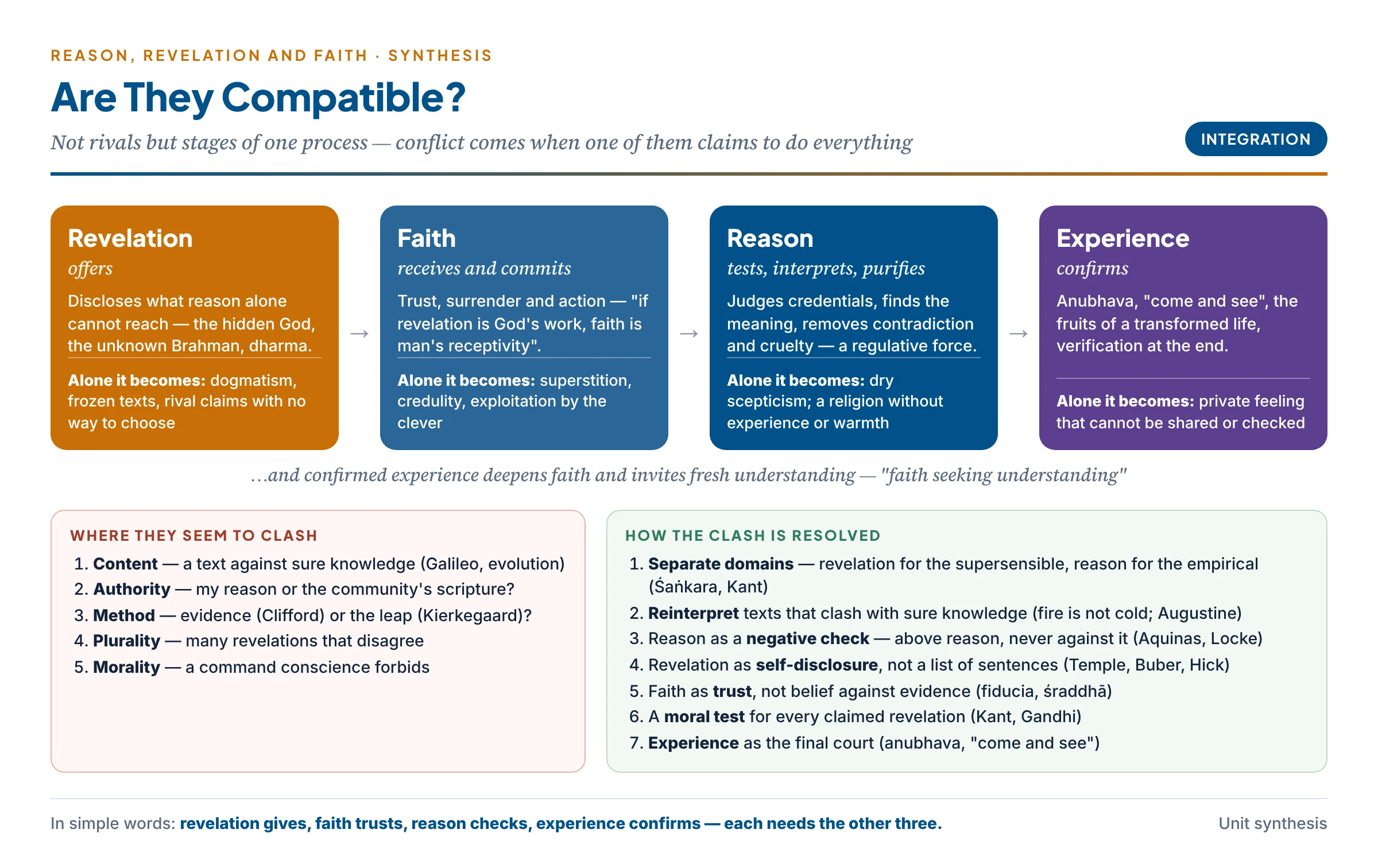
- Content conflict — a scriptural statement seems to contradict established knowledge (the earth fixed at the centre of the universe in the Galileo affair; a literal six-day creation against geology and evolution).
- Authority conflict — who decides, the believer’s reason or the community’s scripture and tradition?
- Method conflict — reason proportions belief to evidence (Clifford); faith trusts beyond evidence (Kierkegaard’s leap).
- Plurality conflict — there are many revelations, and they disagree; reason asks how one can be preferred.
- Moral conflict — a revealed command seems to demand what conscience forbids (Abraham asked to sacrifice Isaac; caste exclusion defended from texts).
Five Ways the Three Have Been Related
| Model | Claim | Western examples | Indian examples |
|---|---|---|---|
| Conflict | Faith and reason are enemies; one must win | Tertullian (faith wins); Clifford, Russell (reason wins) | Cārvāka (perception wins) |
| Revelation over reason | Reason may only interpret and obey | Barth; Luther’s distrust of reason | Mīmāṃsā (self-valid Veda) |
| Reason over revelation | Accept only what reason approves | Deists; Toland; Kant’s religion within the limits of reason alone | Buddhist logicians; Ambedkar |
| Separate domains | Each rules its own field; no real clash | Kant (knowledge vs faith); Gould’s “non-overlapping magisteria” | Śaṅkara (śruti only for the supersensible) |
| Harmony / integration | One truth; each needs the others | Augustine, Anselm, Aquinas, Hick | Nyāya; Advaita’s śravaṇa–manana–nididhyāsana; the Gītā |
How the Apparent Inconsistency Can Be Resolved
- Distinguish the domains. Revelation speaks about what lies beyond perception and inference (the supersensible, the meaning of life, duty); reason rules the empirical. Śaṅkara and Kant agree on this boundary. Many “conflicts” are revelation trespassing on science, or science trespassing on ultimate questions.
- Reinterpret rather than reject. When a text contradicts sure knowledge, read it non-literally. Śaṅkara’s rule (a hundred texts cannot make fire cold) matches Augustine’s advice that a scriptural passage which seems to contradict what is certainly known must be understood figuratively.
- Use reason as a negative check. Reason need not prove a revelation; it is enough that the revelation is not contrary to reason — “above reason, not against reason” (Aquinas, Locke). Reason works like a filter, not a factory.
- Understand revelation non-propositionally. If revelation is God’s self-disclosure in events and encounters (Temple, Brunner, Buber, Hick) rather than a list of infallible sentences, then the human formulations are fallible interpretations and can be revised without losing the revelation itself. This also softens the plurality conflict.
- Understand faith as trust, not as belief against evidence. Faith as fiducia or śraddhā — committed, serene trust — does not require believing contradictions. It requires acting where proof is not available, as we do with friends, doctors and life-choices.
- Apply a moral test. A claimed revelation that commands cruelty or injustice is suspect (Kant; Gandhi’s refusal to accept untouchability). The ethical content of revelation is one of its strongest credentials.
- Let experience be the final court. Hick’s eschatological verification, the Buddha’s “come and see”, and Śaṅkara’s anubhava all hold that the truth of religious claims is finally settled in experience, not in debate.
Conclusion of the debate: reason, revelation and faith are not inconsistent when each keeps to its role. They are stages of one process: revelation offers, faith receives and commits, reason tests, interprets and purifies, and experience confirms. Conflict arises when one of them claims to do everything — revelation without reason becomes dogmatism, reason without revelation and faith becomes dry scepticism, faith without reason becomes superstition.
In simple words
A good marriage is not built on proof — you cannot prove in advance that your partner will be faithful for forty years. It is built on trust (faith), in response to the other person’s self-disclosure (revelation), checked by good sense — you would not marry someone who lies constantly or is cruel (reason). And over the years the trust is either confirmed or shaken by experience. No one thinks love and good sense are enemies; they are partners. The religious life, on the integration view, works the same way.
The Relative Importance of Reason and Revelation
- For empirical questions, reason (perception, inference, science) is supreme; scripture has no authority here.
- For supersensible questions — God, the soul, liberation, the meaning of life — the believer gives revelation primacy, because reason alone reaches no stable conclusion (Śaṅkara’s tarkāpratiṣṭhānāt, Kant’s antinomies).
- But reason keeps three rights even there: to judge whether something is a revelation, to decide what it means, and to reject what is contrary to reason or morality (“reason must be our last judge and guide in everything” — Locke).
- Neither alone is enough. Revelation without reason cannot be understood or communicated; reason without revelation and experience lacks the content and living warmth of religion — which is why a religion of reason alone would lack an experiential account.
Reason, Revelation and Faith in Indian Public Life
Paper II asks how these ideas work in society. India’s Constitution itself strikes a balance between faith and reason.
- Freedom of faith with limits. Article 25 guarantees freedom of conscience and the right to profess, practise and propagate religion, subject to public order, morality and health, and allows the State to regulate secular activities associated with religion and to carry out social reform.
- A duty of reason. Article 51A(h) makes it a fundamental duty “to develop the scientific temper, humanism and the spirit of inquiry and reform“.
- Courts test faith-claims by reason. Under the essential religious practices test (from the Shirur Mutt case, 1954), courts ask whether a practice is essential to a religion before giving it constitutional protection. In the Sabarimala case (2018) the Supreme Court held, by majority, that excluding women of menstruating age could not be sustained against constitutional morality; review petitions were referred to a larger bench in 2019. In the Ayodhya judgment (2019) the Court said that title cannot be established on the basis of faith and belief, though faith and belief may indicate patterns of worship.
- Law against exploitation, not against worship. The Maharashtra Anti-Superstition and Black Magic Act (2013), passed after the murder of the rationalist Narendra Dabholkar, punishes harmful practices — “exorcism” by beating, fake miracles to make money, denying medical treatment in favour of charms — while expressly protecting ordinary worship, pilgrimage, prayer, kīrtan and festivals. Karnataka passed a similar Act in 2017. This is the Cārvāka’s concern (exploitation of the credulous) and the Jaina’s distinction (between faith and superstition) written into law.
- Living tension. Debates over faith-based medicine during epidemics, viral “miracles”, and godmen’s empires show that the old question is still alive: faith must be free, but it must not be a licence to deceive or harm.
Critical Evaluation
Objections to the Indian Accounts
- To śabda as a pramāṇa (Cārvāka, Buddhist): testimony is only inference from the speaker’s reliability; and the reliability of a speaker about the unseen can never be checked.
- To Nyāya: the proofs of God are inconclusive (Rāmānuja, the Mīmāṃsakas, the Buddhists); if God’s existence rests on inference, and inference about the supersensible is weak, the Veda’s authority is weak too.
- To Mīmāṃsā: “no author is remembered” does not show there was no author; the eternity of sound is never perceived; and self-validity would make every confident belief valid until refuted.
- To Advaita: if Brahman is known only through śruti, and śruti’s validity is accepted on faith, the system seems to rest on an unargued starting point; and if anubhava is the final test, whose anubhava — since mystics of different schools report different experiences?
- To Buddhism: the Buddha’s authority still plays a large role in practice; “come and see” requires years of discipline before one can see, so for most followers it is faith in the end.
- To Jainism: omniscient Tīrthaṅkaras are themselves a suprasensible claim accepted on faith.
Replies
- Testimony is irreducible. Almost everything we know about history, geography and science we know by testimony; reducing it to inference does not make it less necessary. Modern epistemology increasingly treats testimony as a basic source of knowledge.
- Every system has starting points. Perception, inference and testimony all rest on trust in our faculties; Plantinga calls such beliefs properly basic. Śruti as a starting point is not more irrational than trusting memory.
- Experience can be shared and tested. The Indian schools prescribe methods (meditation, ethical discipline) whose results can be compared — closer to an experiment than to blind belief.
- Plurality may reflect one reality. Different mystical reports can be read as culturally shaped responses to one Real (Hick), or as partial views (Jaina anekānta), rather than as proof that none is true.
Critics and Defenders
Criticism — Against the harmony of reason, revelation and faith
- Cārvāka: only perception gives knowledge; the suprasensible is a priestly fiction.
- Dharmakīrti: Vedic authority and a creator God are marks of damaged intelligence.
- Clifford, Russell: belief beyond evidence is always wrong.
- Kierkegaard, Tertullian: a faith made reasonable is no longer faith.
- Mīmāṃsā, Barth: revelation needs no approval from reason.
- Freud, Marx: faith is wish-fulfilment or ideology, not knowledge.
Defence — For their partnership
- Nyāya: the reliable word and sound inference support each other.
- Śaṅkara: śruti for the supersensible, sutarka for the world, anubhava at the end.
- Buddha: provisional faith, tested in practice, becomes seeing.
- Gītā: reflect fully, then choose — faith that respects freedom.
- Aquinas, Locke: above reason, never against reason.
- Hick: faith as interpretation, verified in experience.
Cross-Tradition Comparison
| Theme | Western thinker | Indian counterpart | Point of contact |
|---|---|---|---|
| Reason and revelation in harmony | Aquinas — truths of reason and truths of revelation; supra, not contra, rationem | Śaṅkara — sutarka for the world, śruti for Brahman | Revelation is above reason, never against it |
| Reason judges revelation’s credentials | Locke — reason decides whether something is a revelation | Nyāya — the Veda is valid because its speaker is reliable | Trust in the source is itself rationally assessed |
| Self-authenticating revelation | Barth, Calvin’s inner witness of the Spirit | Mīmāṃsā — svataḥ prāmāṇya of the authorless Veda | Revelation needs no outside proof |
| Testimony about the unseen | Hume — testimony to miracles never outweighs uniform experience | Cārvāka — testimony about the unseen is unverifiable inference | Experience as the measure of belief |
| Think for yourself | Kant — “Dare to use your own understanding” (Sapere aude) | Buddha — the Kālāma Sutta; the goldsmith’s test | Authority is no substitute for one’s own judgement |
| Faith before understanding | Augustine, Anselm — believe that you may understand | Chāndogya — when one has faith, one reflects | Faith as the condition of enquiry |
| Faith beyond reason | Kierkegaard — the leap; Pascal — the heart’s reasons | Bhakti — prapatti; Kabīr’s “letters of love” | Love and surrender above argument |
| Experience as final test | Hick — eschatological verification; James — fruits of religion | Advaita — anubhava; Buddhism — ehipassiko | Religious truth is finally seen, not argued |
| Limits of reason on the supersensible | Kant — antinomies of pure reason | Śaṅkara — tarkāpratiṣṭhānāt | Reason alone reaches no stable conclusion on ultimate questions |
Indian Connect — Indian takeaways
- India adds a fourth term — anubhava — to the Western triad, and makes it the final court.
- Indian thought rarely glorifies contradiction: there is no strong Indian counterpart to Tertullian’s “I believe because it is absurd”. Even Mīmāṃsā, which shields the Veda from criticism, builds a rigorous science of interpretation.
- The heterodox schools (Cārvāka, Buddhism, Jainism) provide India’s own critique of revelation, so the debate between faith and reason is internal to Indian philosophy, not imported from the West.
- Śraddhā is best translated not as “belief without evidence” but as serene, committed confidence that seeks confirmation.
Synthesis (Siddhānta)
- Indian philosophy treats the problem of reason, revelation and faith as a question about pramāṇas — whether śabda is a valid source of knowledge — and adds anubhava (direct experience) as the final test.
- The Cārvāka rejects all suprasensible entities — God, soul, heaven, karma, liberation — because only perception gives knowledge and testimony about the unseen cannot be checked; the critique is self-limiting (it relies on inference and testimony itself) but is a lasting weapon against priestcraft and superstition.
- Nyāya joins inference and the reliable word in harmony; Mīmāṃsā gives the authorless Veda self-validity but makes reason its indispensable interpreter; Śaṅkara subordinates reason to śruti on Brahman, keeps sutarka supreme in the world, and makes experience the culmination; Rāmānuja and the bhakti schools turn faith into love, surrender and grace.
- Buddhism and Jainism replace revelation by a personal God with the teaching of awakened or omniscient human beings, to be tested in practice; both keep a place for faith — saddhā as a seed, samyag-darśana as rational conviction — and both reject superstition.
- The Upaniṣads and the Gītā make śraddhā the condition of reflection and the root of character, while warning that faith comes in good and bad forms and inviting the hearer to reflect fully and choose.
- Taken together with the Western thinkers of this unit, the Indian schools show that reason, revelation and faith are compatible as stages of one process: revelation offers, faith receives and commits, reason tests, interprets and purifies, and experience confirms. Their apparent inconsistency is resolved by distinguishing domains, reinterpreting texts that clash with sure knowledge, treating reason as a negative check, understanding revelation as self-disclosure and faith as trust, applying a moral test, and letting experience have the last word.
- In public life, the Indian Constitution reflects the same balance: freedom of conscience (Article 25) alongside a duty to develop scientific temper (Article 51A(h)), with laws that target exploitation in the name of faith rather than faith itself.
“When one has faith, then one reflects. One who has no faith does not reflect.” — Chāndogya Upaniṣad
Previous Year Questions
- 2026“If religion were a subject of reason alone, it would have lacked an experiential account.” Do you agree with this statement? Give reasons in support of your answer.
- 2025Discuss Cārvāka’s critique of the belief in the existence of suprasensible entities.
- 2019What is instrumental to self-revelation: Faith or Reason? Justify your position.
- 2008Discuss the role of reason, revelation and faith in the sphere of religion. Are they compatible? If not, how to resolve their apparent inconsistency?
- 2006Explain the notion of revelation. Does revelation stand in need of confirmation? Discuss and also explain the difference or similarity between revelation and Śruti.
- 2002Point out the relative importance of reason and revelation in religion. Are the two compatible? Discuss.
- 2000Reason and Revelation (short note).